
I
An Integrated Security Protocol Communication
Scheme for Internet of Things using the Locator/ID
Separation Protocol Network
A thesis submitted in partial fulfilment of the requirements for the degree of Doctor of Philosophy (PhD)
Faculty of Science and Technology
Middlesex University
United Kingdom
By
Ali Hussein Raheem
Supervised by
Prof. Aboubaker Lasebae Dr. Mahdi Aiash Prof. Jonathan Loo
I
Abstract
Internet of Things communication is mainly based on a machine-to-machine pattern, where devices are globally addressed and identified. However, as the number of connected devices increase, the burdens on the network infrastructure increase as well. The major challenges are the size of the routing tables and the efficiency of the current routing protocols in the Internet backbone. To address these problems, an Internet Engineering Task Force (IETF) working group, along with the research group at Cisco, are still working on the Locator/ID Separation Protocol as a routing architecture that can provide new semantics for the IP addressing, to simplify routing operations and improve scalability in the future of the Internet such as the Internet of Things. Nonetheless, The Locator/ID Separation Protocol is still at an early stage of implementation and the security Protocol e.g. Internet Protocol Security (IPSec), in particular, is still in its infancy.
Based on this, three scenarios were considered: Firstly, in the initial stage, each Locator/ID Separation Protocol-capable router needs to register with a Map-Server. This is known as the Registration Stage. Nevertheless, this stage is vulnerable to masquerading and content poisoning attacks. Secondly, the addresses resolving stage, in the Locator/ID Separation Protocol the Map Server (MS) accepts Map-Request from Ingress Tunnel Routers and Egress Tunnel Routers. These routers in trun look up the database and return the requested mapping to the endpoint user. However, this stage lacks data confidentiality and mutual authentication. Furthermore, the Locator/ID Separation Protocol limits the efficiency of the security protocol which works against redirecting the data or acting as fake routers. Thirdly, As a result of the vast increase in the different Internet of Things devices, the interconnected links between these devices increase vastly as well. Thus, the communication between the devices can be easily exposed to disclosures by attackers such as Man in the Middle Attacks (MitM) and Denial of Service Attack (DoS).
This research provided a comprehensive study for Communication and Mobility in the Internet of Things as well as the taxonomy of different security protocols. It went on to investigate the security threats and vulnerabilities of Locator/ID Separation Protocol using X.805 framework standard. Then three Security protocols were provided to secure the exchanged transitions of communication in Locator/ID Separation Protocol. The first security protocol had been implemented to secure the Registration stage of Locator/ID separation using ID/Based cryptography method. The second security protocol was implemented to
II
address the Resolving stage in the Locator/ID Separation Protocol between the Ingress Tunnel Router and Egress Tunnel Router using Challenge-Response authentication and Key Agreement technique. Where, the third security protocol had been proposed, analysed and evaluated for the Internet of Things communication devices. This protocol was based on the authentication and the group key agreement via using the El-Gamal concept. The developed protocols set an interface between each level of the phase to achieve security refinement architecture to Internet of Things based on Locator/ID Separation Protocol. These protocols were verified using Automated Validation Internet Security Protocol and Applications (AVISPA) which is a push button tool for the automated validation of security protocols and achieved results demonstrating that they do not have any security flaws. Finally, a performance analysis of security refinement protocol analysis and an evaluation were conducted using Contiki and Cooja simulation tool. The results of the performance analysis showed that the security refinement was highly scalable and the memory was quite efficient as it needed only 72 bytes of memory to store the keys in the Wireless Sensor Network (WSN) device.
III
IV
Acknowledgments
The quest for a PhD has indeed been a long one! I thank Allah first for His abundant blessings, and for blessing me in particular with the opportunity to pursue a doctorate. I thank Him for supporting me in the face of challenges with His Mercy and Guidance, and for facilitating the completion of this thesis.
First of all, I would like to thank my Director of Studies Prof. Aboubaker Lasebae and Supervisors Dr. Mahdi Aiash and Prof. Jonathan Loo for their invaluable guidance, encouragement, cooperation and support over the years. I thank Middlesex University for giving me the opportunity to do PhD and be one of its students.
Among family and friends, I would like to thank my parents (Prof. Hussein Raheem Mustafa and Prof. Ibtisam Jassm Al-Dourie) for their love and for being very supportive in every way possible. I would like to thank them in particular for ensuring that I keep smiling even during the tough times I had. Their faith in my ability and their constant encouragement to explore new horizons helped bring out the best in me and I remain indebted to them for this.
As always, it is impossible to mention all those who had an impact on this work, however there are those whose spiritual support is even more important. I feel a deep sense of gratitude to my sister Dr. Rand Hussein Raheem, who formed part of my vision and taught me good things that really matter in life. Her infallible love and support have always been my strength. Her patience and sacrifice will remain my inspiration throughout my life. I am also very much grateful to all my family members for their constant inspiration and encouragement.
V
Author’s Declaration
I hereby declare that except where specific reference is made to the work of others, the contents of this dissertation are original and have not been submitted in whole or in part for consideration for any other or qualification in this, or any other university. This dissertation is my own work and contains nothing which is the outcome of work done in collaboration with others, except as specified in text and acknowledgments.
Ali Hussein Raheem January 2017
VI
Table of Contents
Abstract……… I Acknowledgments……… IV Author’s Declaration………... V Table of Contents……… VI List of Figures………. XIList of Tables………... XIII
List of Abbreviations……….……….. XV
List of Publications………. XVII
Chapter 1……… 1
Introduction……… 1
1.1 Security Cryptography for the Internt of Things ………... 2
1.2 Research Motivations………. 3
1.3 Research Challenges……….. 4
1.4 Research Questions……… 6
1.5 Research Aims and Objectives……….. 7
1.6 Research Methodology……….. 8
1.7 Research Contributions………. 9
1.8 Thesis Outline……… 10
Chapter 2………. 12
Internet of Things Security Research in Heterogeneous Network……… 12
2.1 Introduction……… 12
2.2 Brief Background………...….…... 12
2.2.1 Machine-to-Machine……….………..….. 14
2.2.2 Internet of Things……….……. 14
2.3 The IPv6 on Sensor Nodes: 6LoWPAN……….…… 16
2.4 Security Issues in Internet of Things ………....……. 16
2.5 Communications and Mobility in Internet of Things………. 19
2.6 Types of Mobility in Internet of Things……….….…... 20
2.7 Mobile IPv6……….……… 21
2.8 Proxy MIPv6……….…….. 23
2.9 Network Mobility (NEMO)……….……... 24
2.10 Locator/ID Separation Protocol………..………... 26
2.10.1 Address Registration Procedure………...…… 27
2.10.2 Address Query and Communication………. 30
2.10.3 Mobility Transaction………...…. 31
2.11 Security in Internet of Things……… 32
2.12 Security Protocols Classification in Internet of Things……… 32
2.12.1 Asymmetric Key Schemes………..…... 34
VII
2.12.1.2 Key Agreement Based on Asymmetric Techniques………..….……... 38
2.12.2 Symmetric Key Pre-Distribution………..……. 40
2.12.2.1 Probabilistic Key Distribution………....…… 40
2.12.2.1 Deterministic Key Distribution……….. 41
3.13Verifying Security Protocols……….……….…… 44
3.14 Summary………..………….… 46
Chapter 3………. 49
Security Issues and Analysis in Internet of Things based on LISP Network Architecture………...……… 49
3.1 Introduction……… 49
3.2 Security Threats in Internet of Things………... 49
3.2.1 Attacks against Network Layer……… 51
3.2.2 Analysis……… 52
3.3 Overview of X.805 Security Framework………... 53
3.4 Security Analysis to Internet of Things using LISP Network Architecture...………... 54
3.4.1 Access Control………... 54 3.4.2 Authentication………... 55 3.4.3 Non-Repudiation ……….. 56 3.4.4 Data Confidentiality……….. 57 3.4.5 Communication Security………... 58 3.4.6 Data Integrity……….…… 59 3.4.7 Availability……… 60 3.4.8 Privacy……….. 61 3.5 Summary………..……….. 62 Chapter 4……….. 65
An Enhanced Security Protocol for Registration Stage in LISP Network Architecture……...………...……… 65
4.1 Introduction……… 65
4.2 First Version Enhanced Security Protocol for Registration Stage in LISP Architecture………... 65
4.2.1 Protocol Exchange Messages……… 66
4.2.2 Formal Analysis and Attacks Discovered using AVISPA……… 67
4.2.3 Security Analysis for the Registration Protocol………….……….. 69
4.3 Final Version Enhanced Security Protocol for Registration Stage in LISP Architecture……….. 71
4.3.1 Protocol Exchange Messages ……… 72
4.3.2 Formal Analysis Using AVISPA………... 73
4.3.3 Analysis of Results………. 75
4.3.4 Security Protocol Analysis for Registration in LISP Network Architecture …… 77
VIII
Chapter 5………. 80
An Enhanced Security Protocol for Resolving Stage in LISP Network Architecture………...…………...……… 80
5.1 Introduction……… 80
5.2 First Version Enhanced Security Protocol for Resolving in LISP Architecture... 80
5.2.1 The Security Protocol Description………. 81
5.2.2 The Security Protocol Exchange Messages………... 81
5.2.3 Formal Analysis of the basic Mapping Procedure using AVISPA……… 82
5.2.4 Security Analysis for Resolving Procedure in LISP Network Architecture…….. 84
5.3 Final Version Enhanced Security Protocol for Resolving Stage Procedure in LISP Architecture………... 85
5.3.1Protocol Exchange Messages……….. 85
5.3.2 Analysis of Results………. 85
5.3.3 Security Analysis for Resolving Address in LISP Architecture……… 88
5.4 Summary………. 89
Chapter 6……… 90
A secure Authentication Protocol for Internet of Things Communication using LISP Network Architecture………….……….. 90
6.1 Introduction……… 90
6.2 First Version of the Security Protocol for Internet of Things Communication using LISP Network Architecture……….. 90
6.2.1 The Security Protocol Description ………..………..…………...…. 91
6.2.2 Security Protocol Exchange Messages ……….……… 92
6.2.3 Specification and Verification of Protocol ………...… 94
6.2.4Security Communication Protocol Analysis………... 96
6.3 Final Version of Mutual Authentication Proposed for IP-WSN Communication using LISP Network Architecture……….. 97
6.3.1 Protocol Description……….. 98
6.3.2 Security Protocol Transaction Messages IP-WSN Communication………….…. 98
6.3.3 Security Protocol Analysis for IP-WSN Communication……….. 100
6.3.3.1 Trivial Attacks………... 100
6.3.3.2 Security Key Guessing Attacks………. 100
6.3.3.3 Man in the Middle Attack………. 101
6.3.3.4 Replay Attack……… 101
6.3.3.5 Perfect Forward Security……….. 101
6.3.4 Specification and Verification of Protocol……… 101
6.3.5 Analysis of Results……… 104
6.4 Summary………. 106
Chapter 7………..……… 107
A Security refinement protocol for Internet of Things Communication using LISP Network Architecture ……….……….………. 107
IX
7.2 Security refinement Protocol for Internet of Things using LISP Network……….…. 107
7.2.1The Security refinement Protocol Transition Messages for Internet of Things……….... 109
7.2.2Formal Analysis and Results for refinement Protocol using AVISPA……...… 113
7.2.3 Analysis of Results……… 118
7.3 Simulation and Performance Analysis……… 120
7.4 Performance Analysis of Communication Overhead………... 122
7.5 Performance Analysis of Power Computation for Security refinement Protocol….… 123 7.6 Performance Analysis Memory Consumption in the IP-WSN……….. 123
7.7 Performance Analysis of Energy Consumption in the IP-WSN………. 124
7.8 Resilience against Node Compromise……… 124
7.9 Summary ……… 126
Chapter 8………... 127
A comparison of Security Protocols for Internt of Things………. 127
8.1 Introduction………. 127
8.2 Secure Internt of Things……….. 127
8.2.1 Security Requirments in Internt of Things………. 127
8.3 Secuirty Protocol for the Internt of Things……….. 128
8.4 Summary………. 134
Chapter 9……….. 137
Conclusion and Further Work…………..……….. 137
9.1 Introduction ……… 137
9.2 How Were The Key Research Questions Addressed?... 137
9.3 Main Contributions………...………. 139
9.4 Elaboration On The Main Contributions………... 140
9.4.1 Identification of Main Gaps in Knowledge in field of Providing Internet of Things Security in Network Environments……….. 140
9.4.2 Defining a Generic Structure of Internet of Things Network Architecture…….. 140
9.4.3 Defining Security Threats in Internet of Things……… 141
9.4.4 Providing an Enhanced Security Protocol for Registration Stage in Locator/ID Separation Protocol Arahitecture………... 142
9.4.5 Providing an Enhanced Security Protocol for Resolving Stage in Locator/ID Separation Protocol Architecture………... 142
9.4.6 Providing End-toEnd Security Communication to Internt of Things using Locator/ID Separation Protocol Architecture……… 143
9.4.7 Providing a Security Refinement Protocol and Performance to Internt of Things using Locator/ID separation Protocol Architecture………... 143
9.4.8 Providing a Comparison of Secuirty Protocol to Internt of Things……… 143
9.5 Future Improvements to Solution to maximize the study……….……… 144
9.6 Concluding Remarks………. 145
X
Appendices……… 162
Appendix-A Registration Protocol Version I……… 162
Appendix-B Resolving Procedure protocol Version I……….. 166
Appendix-C Communication Protocol for Internet of Things version I………... 170
Appendix-D Security Registration Protocol Final Version……….. 174
Appendix-E Resolving Procedure Protocol Final Version……… 178
Appendix-F Communication Protocol for Internet of Things Final Version……… 182
XI
List of Figures
Fig 2.1 Internet of Things……….………... 15
Fig 2.2 Mobility types inside 6LoWPAN……….. 20
Fig 2.3 MIPv6 in 6LoWPAN………. 22
Fig 2.4 PMIP in 6LoWPAN……….. 24
Fig 2.5 NEMO in 6LoWPAN………... 25
Fig 2.6 The LISP Network Architecture Design………... 27
Fig 2.7 ETR Address Registration Procedure………... 28
Fig 2.8 The No Proxy Map Server Processing……….….. 29
Fig 2.9 The Communication between Mobile Sensor devices (LISP Sites)….………... 30
Fig 2.10 Mobility Signalling... 31
Fig 2.11 Security Classification of IoT Network... 33
Fig 2.12 Public Key Transport Mechanism……….….... 35
Fig 2.13 Identity-Based Cryptography infrastructure……….…... 38
Fig 2.14 Key Agreement on Asymmetric Mechanisms……….…. 39
Fig 2.15 Server-Assisted Mechanism………. 43
Fig 2.16 Architecture of the AVISPA tool……….. 45
Fig 3.1 The X.805 Standard Architecture……….. 53
Fig 3.2 X.805 Standard for Internet of Things using LISP Network Architecture ……… 54
Fig 3.3 Threats in Access Control……….…. 55
Fig 3.4 Threats in Authentication………..……… 56
Fig 3.5 Threats in Non-Repudiation……….………..…... 57
Fig 3.6 Threats in Data Confidentiality………..………..………. 58
Fig 3.7 Threats in Communication……….………. 59
Fig 3.8 Threats in Data Integrity………. 60
Fig 3.9 Threats in Availability……… 61
Fig 4.1 Security Protocol for Address Registration………... 66
Fig 4.2 Attack 1: on I_ETR and I_TAS Playback Attacks………….……….….. 69
Fig 4.3 Attack 2: on I_MS and I_TAS Eavesdropping Attacks……… 70
XII
Fig 4.5 Security Protocol for Address Registration ……….. 72
Fig 4.6 AVISPA Results ……….…..… 76
Fig 4.7 Attacks Discovery on Registrattion………….……….………. 78
Fig 5.1 Security protocol for Resplving Procedure first version……….. 82
Fig 5.2 Security Attacks Discovery via AVISPA…….……… 84
Fig 5.3 Security Protocol Address Resolving Procedure……….. 86
Fig 5.4 AVISPA Results……… 87
Fig 6.1 The Simple Message Exchange………. 91
Fig 7.2 The Security Communication Protocol for IoT Frist Version ………..…… 93
Fig 6.3 Security Attacks Discovery via AVISPA……….. 96
Fig 6.4 The Proposed Security for IP-WSN Node Communication using LISP Network……… 100
Fig 6.5 AVISPA Results………...………. 105
Fig 7.1 Keys Tree for Security Refinement Protocol ……….….. 108
Fig 7.2 Security Refinement for Internet of Things using LISP Network Architecture... 112
Fig 7.3 AVISPA Results……… 118
Fig 7.4 Integrate the security Protocols in Sensor Node Architecture………..…...….… 121
Fig 7.5 Nodes Simulation in Cooja tool………. 121
Fig 7.6 Communication Overhead (%) of Security refinement to Internet of Things…... 122
Fig 7.7 Energy Consumption for IP-WSN………. 124
XIII
List of Tables
Table 2.1 Network Architecture Comparsion……….. 46
Table 2.2 Security Protocols Comparison……… 47
Table 3.1 The Headers of AVISPA Input File………. 62
Table 3.2 Comparison Security Issues in IoT……….. 63
Table 4.1 Notation of Register Stage in LISP Network Architecture …….……….. 67
Table 4.2 HLPSL Code: Specifying Security Goal………...……….. 68
Table 4.3 HLPSL Code: Intruder Information Heading……….………… 68
Table 4.4 Notation Regtration Stage in LISP Network Architecture……….. 73
Table 4.5 HLPSL Code: Transitions………... 74
Table 4.6 HLPSL Code: Specification Security Goals………... 74
Table 4.7 HLPSL Code: Intruder Information Heading………. 75
Table 4.8 AVISPA Tools (OFMC, ATSE, SATMC, and TA4SP) Reults……….… 77
Table 5.1 Notation Resolving Procedure in LISP Network Architecture ………..… 81
Table 5.2 HLPSL Code: Specifying Seucrity Goals………... 83
Table 5.3 Intruder Information Heading………. 83
Table 5.4 Notation of AVISPA………... 85
Table 5.5 AVISPA Tools (OFMC, ATSE, SATMC, and TA4SP) Results………… 88
Table 6.1 Notations of Communication Protocol…………..……….. 92
Table 6.2 HLPSL Code: Intruder Information Heading……….. 95
Table 6.3 HLPSL Code: Specifying Security Goals………... 95
Table 6.4 Protocol Notations………... 97
Table 6.5 HLPSL Code: Basic Roles……….. 102
Table 6.6 HLPSL Code: Role Session……… 103
Table 6.7 HLPSL Code: Specifying Security Goals………... 104
Table 6.8 AVISPA Tools (OFMC, ATSE, SATMC, and TA4SP) Results………… 106
XIV
Table 7.2 HLPSL Code: Basic Roles……….. 113
Table 7.3 HLPSL Code: Intruder Information Heading………. 116
Table 7.4 HLPSL Code: Specifying Security Goals………... 117
Table 7.5 Protocol Notation of security refinement ……….…………..… 97
Table 7.6 AVISPA Tools (OFMC, ATSE, SATMC, and TA4SP) Results………… 119
Table 7.7 Simulation Parameters in Cooja ……….……… 120
Table 7.8 Storage Requirement of Keys in Sensor Node device………….………... 123
Table 8.1 Protocol Comparison Based on Secuirty Requirements………. 134
Table 8.2 The Comparsion Summary of 6LoWPAN Security Attacks for (outside and Inside) Adversaries………... 135
XV
List of Abbreviations
AVISPA Automated Validation Internet Security Protocol and Applications
AES Advanced Encryption Standard
ACLs Access Control
AODV Ad hoc On Demand Distance Vector Protocol
CoAP The Constrained Application Protocol
CL-AtSe Constraint Logic based Attack Searcher
CRA Challenge-Response Authentication
CA Certificate Authority
CBC Cipher Block Chaining
DNS Domain Name System
DoS Denial of Service Attack
DTLS Datagram Transport Layer Security
DHP Diffie Hellman assumption
DSA Digital Signature Algorithm
EID Endpoint IDs
ETR Egress Tunnel Router
ECC Eliptic Cure Cryptosystem
E2E End to End Security
FFD Full Function Device
HTTP Hypertext Transfer Protocol
HLPSL High level Protocols Specification Language
HI Host Identifier
HIP Host Identity Protocol
IoT Internet of Things
IPv6 Internet Protocol Version 6
IETF Internet Engineering Task Force
ITR Ingress Tunnel Router
IPsec Internet Protocol Security
IBC ID/Based Cryptography
IF Intermediate Format
XVI
LISP Locator/ID separation Protocol
LoWPAN Low-Power Wireless Personal Area Network
MS Map Server
MSN Mobile Sensor Node
MitMA Man in the Middle Attack
MD5 Message Digest Algorithm
M2M Machine-to-Machine
MAC Message Authentication Code
OFMC On-the Fly Model Checker
PETR Proxy ETR
PIETR Proxy ITR
PKI Public key infrastructure
RLoC Routing Locators
RR Return Reputability
RFD Reduced Functionality Device
RSA Rivest Shamir Adleman algorithm
SATMC SAT-based Model-Checker
SA Security Association
TLS Transport Layer Security
TA4SP Tree Automata-based Protocol Analyser
TCP Transmission Control Protocol
UDP User Datagram Protocol
WSN Wireless Sensor Node
XVII
List of Publications
[1] Ali Raheem, Aboubaker Lasebae, Mahdi Aiash, and Jonathan Loo ‘Supporting Communication in the the IoT using the Location/ID Split Protocol: A Security Analysis’
Future Generation Communication Technology (FGCT), 2013 Second International Conference, IEEE, London , 12-14 November, 2013. (Presented in November-2013)
[2] Ali Raheem, Aboubaker Lasebae, and Jonathan Loo ‘ A secure Authentication Protocol for
IP-Based Wireless Sensor Communications using the Location/ID split Protocol (LISP)’The 13th IEEE International Conference on Trust, Security and Privacy in Computing and Communications, Beijing, China 24-26 September, 2014. (Presented in September-2014).
1
Chapter 1
Introduction
Internet of Things (IoT) is a network of globally identifiable physical objects (or Things)
in their integration with Internet and their representation in the virtual or digital world. In order to build the IoTs, a wide range of technologies are involved such as, the Radio-Frequency Identification (RFID) for location and device identification, improved personal and web area networking protocols, web technologies [Atzori et al., 2010]. These technologies help to build a virtual world of things on top of physical world where things through Machine-to-Machine (M2M) communication talk to each other, through humans-to-machine interactions providing information to humans or taking actions on human inputs, or acting as passive entities to provide data to intelligent entities.
IPv6 over Low power Wireless Personal Area Networks (6LoWPAN) standard is IEEE 802.15.4; it allows the efficient use of the Internet Protocol version 6 (IPv6) over a low power and low rate wireless network on simple embedded devices through an adaptation layer and the optimization of released protocols [kim, 2008]. Adding to this, Wireless Sensor Network (WSN) is a technology that connects the virtual world and physical world where nodes can autonomously communicate among each other and with intelligent systems [Fei et al., 2016]. The Locator/ID Separation Protocol (LISP) is a routing architecture that provides new semantics for IP addressing, in order to simplify routing operations and improve scalability in the future of the Internet such as the IoT [Cisco-A, 2014]. Based on this, the thesis focuses on the IoT formed through the interconnection of IP-connected WSN based on the LISP network architecture.
A conventional WSN is a network of sensor devices that senses and collects environmental data and cooperatively forward it to the router for further processing. However, these first generations WSN lack any standardization support and are mostly used for environmental monitoring and battlefields [Li et al., 2016]. Current WSNs are deployed in environments more close to humans and are aimed for applications such as building automation, bridge and tunnel monitoring, industrial automation and control and human sensing. The sink in current WSN such as LISP routers, i.e., ITR and ETR, can query data from sensor nodes and/or send control message to them [Kafle et al., 2010]. In other words, the sensor nodes are
resource-2
constrained devices with limited storage and processing capabilities because its battery power is connected through weak links.
1.1
Security Cryptography for the Internet of Things
More and more Internet of Things (IoT) devices will be connected to the network [Atzori et al. 2010]. The sensors distributed in the smart city will be able to communicate to another one with smartphones. Therefore, this channel needs security protocol which connect all these devices to the Internet [Cheng et al. 2017]. In order to establish this secure communication in the IoT, cryptography is used as a security measure.
The encryption methods for 6LoWPAN/IoT need to be developed more in order to be adapted to the prevailing constraints in 6LoWPAN/IoT such power and low computing ability. This means that the un-optimised cryptography mechanisms will consume more resources and, therefore, shorten network life time [Ferguson et al. 2010]. Added to this ,the key used in encryption methods should not be too short, otherwise, it will be easy to be broken by any attacks. As 6LoWPAN/IoT is the combination of WSN and the Internet, it is natural to apply these two network cryptography mechanisms for securing this network. To secure the link layer with several operations, WSN uses Advanced Encryption Standard (AES) [Biryukoy et al 2010] modes. Most of these modes do not ensure integrity function. In order to protect network layer end-to end security, IPsec (Internet protocol Security) is utilised with transport and tunnel models. Formerly, the public key cryptography mechanism was thought to be too heavy for applying in WSN. Fortunately, recent developments [Ayuso et al. 2010] show a way to combine Rivest- Shamair–Adelman asymmetric encryption (RSA) and Elliptic Curve Cryptography (ECC) techniques with several modes that can be adjusted to network scenarios. Another problem that should be considered is the exchanging key. The Internet Key Exchange from Internet Protocol Security (IPsec) is suggested for exchanging the key in the network [kundu et al. 2010]. However, the Internet Key Exchange (IKE) is not considered as a feasible solution because of its heavy signalling messages, which are unsuitable for the small packet size of 802.15.4 nature and the energy efficiency requirement. Besides, they lack scalable ability. Therefore, it is very necessary to analyse the threat towards the key at the bootstrap time when an adversary sits among other nodes without being required to be authenticated.
Therefore, this research study used El-Gamal encryption which is lierally an asymmetric key algorithm for public key cryptography which is based on Diffie-Hellman key (DH) exchange.
3
Here, the public key of 𝐵 is 𝑔𝑏 and the computed DH key 𝑔𝑎𝑏 are used as one-time pad to encrypt a message 𝑚 ∈ ℤ𝑝∗ which are a group element of the respective group used, typically the encryption operation is defined as multiplying the message with the DH key or xoring the message with a hash of the DH key [Mikhail et al.2014]. The cipher text is then a tuple
(𝑐1, 𝑐2) consisting of the message encrypted with DH key 𝑚. 𝑔𝑎𝑏 and the part 𝑔𝑎 of the DH key computed by the encrypting party. But it should be noted that the entire process is conducted by one party, i.e. the party encrypting the message. This party then sends the tuple
(𝑐1, 𝑐2) = (𝑔𝑎 , 𝑚. 𝑔𝑎𝑏) to the receiver 𝐵. Consequently, the advantages of useing El-Gamal
in this research are the following [Mikhail et al 2014]:
It is homomorphic encryption scheme that allows multiplying plaintext hidden inside the cipher texts. When using the homomorphic property with an encryption of the identity element 1 of the group, it allows publicly re-randomising El-Gamal cipher text, i.e. obtaining new cipher texts for the same message which are unlikable to the original cipher text. Furthermore, using exponential El-Gamal obtained from EL-Gamal by encoding the message 𝑚 as 𝑔𝑚, i.e. as exponent of the generator 𝑔, El-Gamal can also be made additively homomorphic for polynomial sized message spaces (since decrypting involves computing discrete logarithms)
There are efficient honest-verifier zero-knowledge proofs of knowledge to prove properties of El-Gamal cipher texts without revealing the plaintext, e.g., equality of plaintexts.
EL-Gamal schemes provide a good security system that can exchange and compute the shared secret keys between the devices
El-Gamal schemes provide End-to-End Security encryption where only the communicating users can read the messages.
1.2 Research Motivations
The IoT has become a ubiquitous term to describe the tens of billions of devices that have sensing or actuation capabilities and are connected to each other via the Internet. This massive increase has a direct effect on the network infrastructure and on the size of the routing table’s efficiency of the current routing protocols in the IoT. To address this problem, an IETF working group, along with the research group at Cisco, are working on LISP as a
4
routing architecture that provides new semantics for IP addressing in order to simplify routing operations and improve scalability in the future of the Internet such as the IoT [Chen et al 2016]. However, LISP is still at an early stage of implementation and the security protocol, in particular, is still in its beginning. Therefore, the main motivation of this research is divided into four main parts:
Part I: Investigating and analysing the level of security performance for the IoT based on LISP architecture and exposing its security vulnerabilities using X.805 security framework architecture.
Part II: Modelling the security threats for the IoT based on LISP using Automated Validation Internet Security Protocol and Applications (AVISPA) tool in order to design efficient protocols against these threats.
Part III: Designing and simulating three security protocols namely the registration stage, the resolving stage and the communication procedure for the IoT based on LISP network architecture.
Part IV: Implementing the analysis and the verification of the designed protocols via AVISPA.
1.3 Research Challenges
There has been a tremendous increase in the use of the IoTs, from the 365 million of
users in 2000 to 50 billion devices in 2020 [Gartner, 2013]. Nevertheless, this rising growth faces serious challenges related to scalability, manageability, addressing/identity and robustness [Sundmaeker et al., 2010]. Furthermore, the distinct features of the openness and ubiquity of the current Internet are considered in fact a real problem as they do not offer suitable support for privacy and secure communication/mobility. Henceforth, different challenges arise that actually need to be faced in this research especially because this technology has unique characteristics such as low energy combustion, short size memory and small packet size. These challenges were tackled in the IoT as the following:
Communication/Mobility support in IP-WSN increases the fault tolerance capacity and connectivity, allowing extending and adapting network to change its location and infrastructure. These features are necessary to satisfy the dependability and scalability of the networks of the future world. Several solutions have been developed to support mobility, but actually they still present limitations mainly caused by the role of IP
5
address, as both node ID for session determination in the application/transport layer, and Locator in the network layer [Cisco-A, 2014]. For that reason, this research study is based on one of the first LISP that supports IP-WSN, which has defined compressed and size optimised mobility signalling. The mentioned approach presents the first challenge, since LISP messages are potentially dangerous. For example, a malicious host might be able to establish false updates of the location, thereby preventing some packets from reaching their intended destination, diverting some traffic to the intruder, or flooding third parties with unwanted traffic. Therefore, robust authentication protocols are very much needed to support the security in IP-WSN in both scenario communication between the devices and mobility, i.e., when the devices are roaming to different domain.
Another challenge is the security privacy and trust in the IoT which can be the platform of choice for launching a variety of attacks targeting the IoT. At the most basic level, the IP-WSN devices will likely to have evolving naming and addressing schemes which can ensure that the names and addresses used are verifiable and authenticated. The research study is based on the LISP network architecture, as each LISP-capable router needs to register with a Map Server (MS), and this is known as the initial or the Registration stage. However, this stage is vulnerable to masquerading and content poisoning attacks which disclose the privacy and the trust in the WSN/IoT devices on the network. Consequently, an enhanced security protocol is needed to authenticate the MS with the source of the data (device) in a secure way. The MS and a globally distributed database that contains all known Endpoint Identifiers (EIDs) prefixes to Routing Locators (RLOC) mappings. Similar to the current Domain Name System (DNS), the Mapping systems are queried by LISP-capable devices for EID-to-RLOC mapping [Cisco-B, 2013].
One more challenge is the data confidentiality and encryption. The WSN/IoT devices transfer the data over the network, which in turn disclose the secret information from unauthorised device. As the research study is based on LISP network architecture, the address resolving stage is therefore one of the important stages that allow the Map Server (MS) to accept Map-Requests from routers MS that has to look up the databased before returning the requested mapping to routers. However, this stage lacks data confidentiality and mutual authentication. Therefore, the implementation of
6
security protocol is needed to maintain the data confidentiality over the network. Besides, security protocol must be devised and applied to ensure the secure transfer of the transmitted data and guard it against unauthorized interference or misuse of the data being transmitted across the network.
1.4 Research Questions
Targeting the unaddressed challenges in the IoT Security communications using LISP, this research intended to find out answers to a set of important questions as shown below:
How to introduce an efficient architecture in term of routing size for the
future of Internet and what are the main operational entities that are required
in this architecture?
This research question requires the presence of a new architecture for the future of Internet in order to contain huge numbers of the IoT devices.
‘What are the Security vulnerabilities/threats in terms of Internet of Things
that the devices can expose in Locator/ID Separation Protocol?’
This research question requires using a specific mechanism in order to expose the security vulnerabilities for the IoT using Locator/ID Separation Protocol networks.
‘How to provide End-to-End Secure communication
between the Internet of
Things devices?’
The answer to this question is designing a new security protocol which can provides, a high security communication to the IoT.
‘Considering the proposed security protocols; how could the security
protocols interface to a single refinement protocol which is integrated in order
to approach a robust security for the Internet of Things using Locator/ID
Separation Protocol?’
Therefore, the proposed approach aims at protecting the data and network from malicious attacks; this protection can be achieved by building a security interface between the proposed security protocols.
7
1.5 Research Aims and Objectives:
The aim of this research is to improve the security of the Internet of Things (IoT) networks using the Locator/ID Separation Protocol (LISP) and to provide comprehensive solution to mitigate outlined challenges. The above mentioned objectives encompass the following challenges, which must be specifically addressed:
The LISP architecture and security protocol are still at an early stage of development and implementation as mentioned earlier. Based on this fact, this research investigated the security issues arising from deploying the LISP architecture in the IoT. The investigation comes to discover a number of vulnerabilities that must be considered before moving to the implementation stage.
To secure the IoT and provide robust security against any security vulnerabilities, the research designed three security protocols for IoT using LISP network architecture. Firstly, security enhancement protocol is the registration protocol. It allowed the authentication of new IoT device that can join the network. This protocol was achieved by ID/Based Cryptography (IBC) [Tan et al., 2016]. Secondly, enhancement protocol attempted to secure the resolving addresses, when the devices send a data through the network, and this data must be encrypted and routers must trust and authenticate each other. This protocol was accomplished by Authentication and Key Agreement (AKA) [Li et al., 2017]. Thirdly, security protocol was developed to secure the communication between IoT devices by providing secure link and authentication. The protocol was achieved by El-Gamal cryptography [Mikhail et al 2014].
The research proposed a set of interfaces between each level of the protocols in order to achieve a new security refinement protocol that can provide End-to-End secure communication for IoT using the LISP network architecture.
The study then evaluated the performance of those security protocols for the IoTs. In order to resolve the problem outlined in this study, the developed protocols and their accompanying security refinement protocol were validated in terms of both (formal
8
security analysis and AVISPA simulation tool). No security flaws were found, the performance analysis has been accompanied by Contiki and Cooja simulation tool.
1.6 Research Methodology
The methodology of this study was proposed after a detailed analysis of the identified challenges with enough consideration given to multiple parameters in each studied area. The literature review has discussed many previous related works to the present study in order to evaluate the existing limitations and eventually present suitable solutions to minimise these limitations with the intention of improving the system security.
Thus, the methodology of this research is divided into four phases. The understanding and conclusion of each phase have given motivation to address the next phase in a better manner.
The first phase illustrates the related literature provides a solid background of the IoT in order to understand the features of this technology. Furthermore, it discussed the existing IoT network architecture and the performance limitations of this technology. Added to this, it discusses different communication security protocols for the IoT devices. A comparative analysis of these protocols and techniques has been presented in order to avoid any security vulnerabilities in the design phase.
The second phase provides the IoT threats model which is based on LISP architecture using X.805 framework.
The third phase of this research introduces the designed security protocols that are based on LISP architecture. These designed protocols include three security protocols; two of them are enhanced security protocols. The first protocol is to secure the Registration stage and the second is to secure the Resolving stage in LISP architecture. While the third protocol is a new security protocol that is designed to secure the communication process between the IoT devices.
In the fourth phase, these protocols have been implemented through a simulation tool in order to achieve powerful IoT security refinement based on LISP architecture.
The comparative simulation in this thesis is performed by using the Automated Validation of Internet Security Protocols (AVISPA) tool [AVISPA, 2013], which is a formal method based tool. The AVISPA has been chosen from a range of options such as Casper/FDR, SN2 [Hossain, 2009], BAN logic [Burrows et al. 1990], and OPNET [Aboelela,2007] tools,
9
because AVISPA provides a modular and expresses a formal language for specifying protocols and their security properties, and also integrates different back-ends that implement a variety of state-of-the-art automatic analysis techniques. Experimental results, carried out on a large library of Internet security protocols, indicate that the AVISPA tool is the state of the art for automatic security protocols. No other tool combines the same scope and robustness with such performance and scalability.
1.7 Research Contributions
In order to reach the planned objective, the following contributions are realised:
Provided an overview of existing network architectures for the IoT and identifying the security issues and network operation in these architectures in chapter 2.
Provided a comprehensive security analysis via using X.805 security framework to analyse the security performance of the IoT based on the LISP network architecture. Furthermore, modelled the security threats for the IoT based on LISP network architecture using AVISPA tool in order to design efficient protocols against these threats in chapter 3
Designed security protocols for the IoT based on the LISP architecture. These protocols are divided as the following:
1. The Initial stage; each LISP-capable router needs to be registered with a Map Server, known as the Registration stage. This stage is vulnerable to masquerading and content poisoning attacks. Consequently, the research has introduced an enhanced security protocol which addresses the security issue in the Registration stage in chapter 4.
2. The Resolving addresses between the Routing Locators (RLoC) routers need to be addressed, e.g. when the RloC router (A) wants to send data to the RLoC router (B), both of these routers need to be authenticated so that the information can be reached from its original destination. Adding to this, LISP limits the efficiency of the security protocol which works against the redirection of the
10
data or acting as fake routers. Therefore, the research provides an enhanced security protocol to address this issue in chapter 5.
3. Designeing an end to end secure communication protocol for the IoT nodes. In this research study, a new security protocol provides a message authentication scheme that relies on locally shared keys and symmetric cryptographic operations only it provides also also a level of security approximating and that of end-to-end security mechanisms in chapter 6.
The proposed protocols set an interface between each level of the protocol in order to achieve security refinement protocol to the IoT based on LISP architecture; these proposed protocols methods meet practicability, simplicity and the strong notions of security. Besides, a performance security refinement protocol analysis is provided, in order evaluated the developed protocol impact on the IP-Based Sensor Network (IP-WSN) in chapter 7.
Provided a comparison of the recent security protocol for IoT against the present research study protocols in chapter 8.
The proposed protocols were verified using methods based on AVISPA tool [AVISPA, 2013]. The performance and evaluation have used Contiki and Cooja simulation tool [Contiki, 2014]. Contiki and Cooja have been chosen because they are an open source operating system for the IoT. They connect tiny cost and low-power microcontrollers to the Internet. Indeed, they are a low-powerful toolbox used for building complex wireless systems.
1.8 Thesis Outline
This thesis has eight chapters, beginning with an introductory chapter one that outlines the work in the IoT technologies. It spotlights the thesis contributions, aims, objectives and motivations. Each chapter opens with an introduction and issues discussion related to the studied research area; it goes on to review the achieved security protocols in IoT after proposing suitable solutions to the raised issues. A summary is provided at the end of the chapter.
11
Chapter Two provides a background of the IoT that is considered the base of this research. It foucs on the previous work in this area that dealt with the existing IoT networks architecture and the performance limitations of this technology. Besides, it discusses different communication security protocols for the IoT devices. A comparative analysis of these protocols and techniques has been presented in order to avoid any security vulnerabilities in the design phase.
Chapter Three deals with the security Threats/Attacks analysis using X.805 framework for the IoT based on the LISP network architecture.
Chapter Four introduces the enhanced security protocol for Registration stage in LISP Architecture. In this chapter, more than one protocol version is provided to reveal any possible attacks on the protocol. This protocol has been designed and verified via AVISPA tool.
Chapter Five presents the enhanced security protocol for Resolving Addresses in LISP Architecture. Also, the chapter discloses different types of attacks by designing more than one protocol versions in order to test the protocol flexibility and robustness. The protocol has been verified by AVISPA tool.
Chapter Six proposes a mutual authentication protocol for IoT communication based on the LISP network architecture. In addition, the chapter presents two versions of protocol and attack revealed by AVISPA tool. The second version therefore is designed to stop any security vulnerabilities that can affect the performance of the protocol.
Chapter Seven proposes a new security refinement for the IoT based on LISP network architecture. This chapter provides a set interface of each protocol to create refinement, in order to provide a robust security to IoT devices which can resist any possible attacks by providing End-to-End Security. Also, it provides a performance analysis for the developed security refinement protocol to IP-WSN devices.
Chapter Eight provides a comparison of the recent security protocol for IoT against the present research study protocols.
Chapter Nine concludes the thesis with a summary of the main contributions of this research study along with a discussion of future works and recommendations.
12
Chapter 2
Internet
of
Things:
Security
Research
in
Heterogeneous Network
2.1 Introduction
The Internet of Things (IoT) defines a highly interconnected network of heterogeneous devices where all communications seem to be possible, even unauthorized ones. As a result, the security requirement for such network is critical whilst common standard Internet security protocols are recognised as unusable in this type of networks, particularly due to some classes of the IoT devices with constrained resources. On the other hand, for the large numbers of applications of smart object, i.e., IoT, the networking technology must be scalable, interoperable, stable, manageable and flexible. Consequently, new mechanisms are needed to protect users/devices, servers and networks infrastructure. This means that the future of the IoT networks has to integrate communication, mobility and security. Therefore, the structure of this chapter is divided as the following: 2.2 is a brief background for the IoT. In section 2.3, the IPv6 on Sensor Nodes has been tackled together with 6LoWPAN. Section 2.4, however, discusses the main security issues in the IoT. Section 2.5 provides a comprehensive study of the most common communication and mobility networks which have been used for the IoT devices and the key issues in communication and mobility. Section 2.6 discusses the type of mobility network in the IoT. Section 2.7 discusses the mobile IPv6 in the IoT and other related issues. Section 2.8 discusses the proxy MIPv6. Section 2.9 discusses the network mobility (NEMO). In section 2.10, LISP architecture is explained. Section 2.11 discusses the security in the IoT. Section 2.12 discusses the main security classification in the IoT. As for section 2.13, it verifies Security Protocol Tools. Finally, a summary concludes the chapter in section 2.14.
2.2 Brief Background
Both Machine-to-Machine (M2M) communication and IoT are results of the technological progress over the last decades, including not just the decreasing costs of
13
semiconductor components, but also the spectacular uptake of the Internet protocol (IP) and the broad adoption of the Internet.
The application opportunities for such solutions are limited only by human imaginations. This is because; the role that M2M and IoT will have in industry and border society is just starting to emerge for a series of interacting and interlined reasons [Yang et al., 2016].
The Internet has undoubtedly had a profound impact on society and industries over the past two decades. Starting off as ARPANET [DARPA, 2017] connecting remote computers together, the introduction of the TCP/IP protocol suite, and later the introduction of services link email and the World wide Web (WWW), created a tremendous growth of usage and traffic. In conjunction with innovations that dramatically reduced the cost of semiconductor technologies and the subsequent extension of the Internet at a reasonable cost via mobile networks, billions of people and businesses are now connected to the Internet. Quite simply, no industry and no part of society have remained untouched by this technical revolution.
At the same time the Internet has been evolving, another technology revolution has been unfolding the use sensors, electronic tags and actuators to identify digitally observe and control objects in the physical world.
Decreasing rapidly costs of sensors and actuators means that where such components cost previously several Euros each, they are now a few cents only. In addition, these devices, though increasing in the computational capacity of the associated chipsets, are quite able now to communicate via fixed and mobile networks. As a result, they are able to communicate information about the physical world in near-time across networks with high bandwidth low relative cost.
So undoubtedly, M2M solution will be seen for quite some time; we are now entering a period of time where the uptake of both M2M and IoT solutions will increase dramatically. The reasons for this are diagnosed as the following [Singh, 2012]:
An increased need for understanding the physical environment in its various forms, from industrial installations through to public spaces and consumer demands. These requirements are often driven by efficiency improvements and sustainability objectives, or improved health and safety.14
Reduced costs of components and the ability to collect and analyse the data they produce more cheaply.2.2.1 Machine-to-Machine
M2M refers to those solutions that allow communication between devices of the same type and specific application, all via wired or wireless commutation network. M2M solutions allow end to capture data about events from assets such as temperature or inventory levels. Typically, M2M is deployed to achieve productivity gains, reduce costs and increase safety or security. In fact, M2M has been applied in many different scenarios, including the remote monitoring and control of enterprise assets, or to provide connectivity of remote machine-type devices [Atanasoy et al., 2017]. Remote monitoring and control have generally provided the incentive for industrial applications, whereas connectivity has been the focus in other enterprise scenarios such as connected vending machines or point-of-sale terminals for online credit card transactions. M2M solutions, however, do not generally allow for the broad sharing of data or connection of the devices in question directly to the Internet [Yang et al., 2016].
2.2.2 Internet of Things
The IoT is a widely used term for a set of technologies, systems and design principles associated with the emerging wave of Internet-connected things that are based on the physical environment. In many respects, it can initially look the same as M2M communication connecting sensors and other devices to Information and Communication Technology (ICT) systems via wired or wireless networks [Zigler et al., 2015].
In contrast to M2M, however, IoT also refers to the connection of such systems and sensors to the broader Internet, as well as the use of general Internet technologies. In the longer term, it is envisaged that IoT ecosystem will emerge not different to today’s Internet, allowing things and real world objects to connect, communicate and interact with one another in the same way humans do via the web today [Clark et al., 2003]. Increased understanding of the complexity of the system in question, economies of scale and methods for ensuring interoperability in conjunction with key business drivers and governance structures across value chains will create wide-scale adoption and deployment of IoT solutions [Mahalle et al,
15
2014]. The Internet will no longer be only about people, media and content, but it will also include all real-world assets as intelligent creatures exchanging information, interacting with people, supporting business processes of enterprises and creating knowledge as shown in figure 2.1. The IoT is an extension to the existing Internet [Makinen, 2014].
IoT is actually about the technology; the remote monitoring and control is also about where these technologies are applied. IoT can have a focus on the open innovative promises of the technologies at play and also on advanced and complex processing inside very confined and close environments such as industrial automation. Visions put forward have included notions like a global open fabric of sensor and actuator services. These notions integrate many Wireless Sensor Network (WSN) deployments and provide different levels of aggregated sensor and actuator series in an open manner. The purpose is to achieve application innovation and use it not only in pure monitor and control type of applications, but also to enrich other types of services with contextual information [Kortuem et al., 2010]. However, IoT applications will not only rely on data and services from sensor and actuators alone. Equally important is the blend in of other information sources that have relevance from the viewpoint of the physical world. These can be data from Geographic Information Systems (GIS) like road databases and weather forecasting systems and can be of both a static nature and a real-time nature. Even information extracted from social media like Twitter feeds or Facebook status updates that relate to real world observations can be fed into the same IoT system [Butun, 2017].
16
2.3 The IPv6 on Sensor Nodes: 6LoWPAN
Internet Protocol version 6 (IPv6) is the most recent version of the Internet Protocol (IP). In other words, it is the communications protocol that provides an identification and location system for computers on networks and routes traffic across the Internet [Nicills et al., 2017]. With the introduction of 6LoWPAN compressed IPv6 in WSNs, resource constrained devices can be connected to the Internet [Khan et al., 2017]. This hybrid network of the Internet and the IPv6 connected constrained devices from the IoT [Sanchez, 2015]. Unlike the Internet where devices are mostly powerful and unlike typical WSN where devices are mostly resource constrained, the things in the IoT are extremely heterogeneous [Dawood et al., 2014]. The IoT device can be a typical sensor node, a light bulb, a microwave oven, an electricity meter, an automobile part, a smartphone, a PC or a laptop, a powerful server machine or even a cloud [Rantos et al., 2014]. Hence the numbers of potential devices that can be connected to the IoT are in hundreds of billions. Definitely, this requires the use of IPv6 [Xiaorong et al., 2013], a new version of the Internet Protocol that increases the address size from 32 bits to 128 bits (2 128 unique addresses). Also, a number of protocols are being standardized to fulfil the specific needs of the IoT [Dooley et al., 2013].
6LoWPAN allows the transmission of IPv6 packets over an IEEE 802.15.4 network. The main idea of 6LoWPAN is to introduce an adaptation layer to enable IPv6 communication in WSNs.
2.4
Security Issues in Internet of Things
The security in the IoT is essentially linked to the ability of users to trust their environment. If users do not believe their connected devices and their information are reasonably secure from misuse or harm, the resulting erosion of trust causes a reluctance to use the Internet [Pishya 2017]. This has global consequences to electronic commerce, technical innovation, free speech and practically every other aspect of online activities. Indeed, ensuring security in the IoT products and services should be considered a top priority for the sector [Cheah, 2017].
However, as we increasingly connect devices to the Internet, new opportunities to exploit potential security vulnerabilities grow. Poorly secured IoT devices could serve as entry points for cyberattack by allowing malicious individuals to re-program a device or cause it to malfunction. It is noteworthy that the poorly designed devices can expose user data to theft
17
by leaving data streams inadequately protected. Added to this, Failing or malfunctioning devices can also create security vulnerabilities. These problems are just as large or even larger for the small, cheap and ubiquitous smart devices in the IoT as they are meant for the computers that have been traditionally the endpoints of Internet connectivity. Along with potential security design deficiencies, the sheer increase in the number and nature of the IoT devices could increase the opportunities of attack. When coupled with the highly interconnected nature of the IoT devices, every poory secured device that is connected online will affect potentially the security and resilience of the Internet globally, and not just locally. Therefore, two main security issues can be summarised as the following:
Security Issue 1: Many IoT devices such as sensors and consumer items are designed to be deployed at a massive scale which is beyond that of traditional Internet-connected devices. As a result, the potential quantity of interInternet-connected links between these devices is unprecedented. Furthermore, many of these devices will be able to establish links and communicate with other devices on their own in an unpredictable and dynamic fashion. Consequently, security communication protocol is mostly required in the IoT. It is important that a receiver which is able to verify the IoT data is generated by trusted nodes. It is also necessary to encrypt the IoT data in transit. As this research study focuses on the network layer of the Open Systems Interconnection Model (OSI Model), the IPsec works well on non-Low-power devices which are not subject to severe constraints on host software size, processing and transmission capacities. IPsec supports Authentication Header (AH) for authenticating the IP header and Encapsulating Security Payload (ESP) for authenticating and encrypting the payload [Djeddai et al., 2016]. The main issues of IPsec are twofold processing power and key management. Since these tiny IoT devices do not process huge number of data or communicate with many different nodes, it is not well understood if complete implementation of Security Association Database (SADB), policy-debase and dynamic key-management protocol are suitable for these small battery powered devices. In addition, given existing constraints in IoT environments, IPsec might not be suitable to be use in such environments, especially that IoT node devices might be able to operate all IPsec algorithms on its own capability either Full-Function Device (FFD) or Reduced-Function Devices (RFD). Bandwidth is a very rare resource in IoT environments. The fact that IPsec requires another header (AH or ESP) in every packet makes its use problematic in IoT environments [Aouini et al., 2016]. Besides,
18
IPsec requires two communicating peers to share the secret key that is established dynamically with the Internet key Exchange (IKEv2) protocol. Thus, it has an additional packet overhead incurred by IKEv2 packets exchange [Rao et al 2016].
Security Issue 2: In the IoT, there are privacy, integrity and disclosed data (confidentiality) issues. This is because of the features of the IoT as they are randomly deployed by users in the network. Thus, the decentralisation of these nodes in most cases can create many privacy and security issues. Therefore, the majority of the IoT applications need to take into considerations the support of mechanisms to carry out the authentication, authorization and key management. In addition, due to the reduced capabilities from the constrained devices enabled with Internet connectivity, a higher protection of the edge networks needs to be considered with respect to the global network. In other words, during the development of IPv4, information Technology security is not one of the focus points [Siddika et al., 2017]. This had caused a lot of vulnerabilities that can be exploited in IPv6 implementation. Even though a lot of methods such as Secure Sockets Layer (SSL) and Secure Shell (SSH) are introduce to overcome this weakness, still it they are not sufficent. In a network, five phases are involved in exiting IPv4 environment [Shaharuddin et al., 2017], which are reconnaissance, scanning, Gaining access Maintaining access, and Clearing track. The first two phases involve a process of scanning for vulnerabilities in the host networks. One of these vulnerabilities are exposing the process of gaining access is executed. Freely available on the internet, port scanning tools like Nmap [Jicha et al., 2016] and Wireshark [Beeharry et al., 2016] can bused to execute the reconnaissance and scanning phase. As the number of IPv4’s addresses is small, scanning a class C network takes only a few minutes. This show how vulnerable is IPv4 network, with a few minute all open access can be expose. Furthermore, Address Resolution Protocol (ARP) and internet Control Message Protocol (ICMP) are two protocols in layer 4 used for finding a host’s hardware address and protocol for responding to errors in datagram respectively [Nikolenko et al., 2016]. In an attack these two protocols can be exploited by associating the packet with a fake address resulting in other packet to be mistakenly sent to a rogue address. Besides, IP fragmentation referred to IP datagram that is broken up to smaller size. This is to enable the IP datagram to pass through the data link medium which has a limit on the size of transiting frame called
19
Maximum Transmission unit (MTU). An attacker can use this features to evade from being detected by firewall and Network Intrusion Detection System (NIDS). Also, broadcast features in IPv4 can also be exploited. A huge number of frames are broadcasted through a network and are now flooding the network system. However this large number of frames looks like a legitimate packet will hinder the hosts from receiving a valid packet. Likewise, the packet in IPv4 can be intercepted during its transmission by eavesdropping on the network. This attack is called Man in the Middle Attack (MitM) and it occurs as a result of the lack of authentication mechanism provided in IPv4 protocol [Shuai et al., 2016]. And it can be done applying ARP attack as explained above.
In order to prevent all vulnerabilities, extra tools are used to harden the network security in IPv4 environment. Application like Network Address Translation (NAT) is used to overcome the shortage of IPv4’s addresses. Firewall and IDS are deploying to protect and detect any anomalies in the networks. Access Control List (ACL) can be applied in network to drop any packets that can cause security problems in the networks.
2.5 Communications and Mobility in the Internet of Things
A Wireless Sensor Network (WSN) is a multi-hope network and is made up of a number of wireless sensor devices. With the constant increase in demands for various global services, it has become urgent to connect these wireless sensor devices to Internet [Khan et al., 2014]. Since IP is the facto standard for the Internet, it is quite reasonable to believe that IP could be the future for WSN [Bag et al., 2009]. However, and due to limited resources, implementing the heavy IP protocol in WSNs has become a big challenge [Pradeska et al., 2017]. The IPv6 over Low-Power Wireless Personal Area Network (6LoWPAN) enables the wireless connection to be one of the key technologies for WSNs [Twayej et al., 2017]. Therefore, this section, reviews the recent mobility and commun
![Fig 2.1 Internet of Things [Kogatam, 2014]](https://thumb-us.123doks.com/thumbv2/123dok_us/611889.2573315/33.892.163.758.761.1085/fig-internet-things-kogatam.webp)
![Fig 2.2 Mobility Types Inside 6LoWPAN [Shelby et al., 2009]](https://thumb-us.123doks.com/thumbv2/123dok_us/611889.2573315/38.892.149.744.497.836/fig-mobility-types-inside-lowpan-shelby-et-al.webp)
![Fig 2.4 PMIP in 6LoWPAN [Shelby et al., 2009]](https://thumb-us.123doks.com/thumbv2/123dok_us/611889.2573315/42.892.156.727.335.687/fig-pmip-lowpan-shelby-et-al.webp)
![Fig 2.5 NEMO in 6LoWPAN [Shelby et al., 2009]](https://thumb-us.123doks.com/thumbv2/123dok_us/611889.2573315/43.892.171.726.690.1059/fig-nemo-in-lowpan-shelby-et-al.webp)
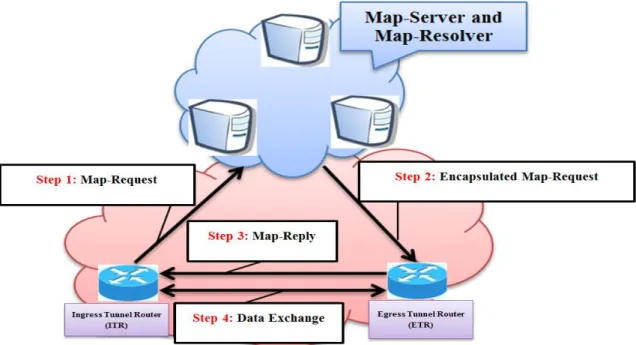
![Fig 2.6 the LISP Network Architecture Design [Cisco-A, 2014]](https://thumb-us.123doks.com/thumbv2/123dok_us/611889.2573315/45.892.152.739.332.646/fig-lisp-network-architecture-design-cisco.webp)
![Fig 2.13 Identity-based cryptography infrastructure [Stallings, 2011]](https://thumb-us.123doks.com/thumbv2/123dok_us/611889.2573315/56.892.190.770.107.446/fig-identity-based-cryptography-infrastructure-stallings.webp)