University of Kentucky University of Kentucky
UKnowledge
UKnowledge
Theses and Dissertations--Curriculum and
Instruction Curriculum and Instruction
2016
Dialogic Learning and Self-Explanation in Classrooms
Dialogic Learning and Self-Explanation in Classrooms
Implementing Worked Example Instruction with Interactive
Implementing Worked Example Instruction with Interactive
Whiteboard Technology
Whiteboard Technology
Ellen C. BloomfieldUniversity of Kentucky, [email protected] Author ORCID Identifier:
http://orcid.org/0000-0002-9551-3006
Digital Object Identifier: https://doi.org/10.13023/ETD.2016.449
Right click to open a feedback form in a new tab to let us know how this document benefits you. Right click to open a feedback form in a new tab to let us know how this document benefits you.
Recommended Citation Recommended Citation
Bloomfield, Ellen C., "Dialogic Learning and Self-Explanation in Classrooms Implementing Worked Example Instruction with Interactive Whiteboard Technology" (2016). Theses and Dissertations--Curriculum and Instruction. 16.
https://uknowledge.uky.edu/edc_etds/16
This Doctoral Dissertation is brought to you for free and open access by the Curriculum and Instruction at UKnowledge. It has been accepted for inclusion in Theses and Dissertations--Curriculum and Instruction by an authorized administrator of UKnowledge. For more information, please contact [email protected].
STUDENT AGREEMENT: STUDENT AGREEMENT:
I represent that my thesis or dissertation and abstract are my original work. Proper attribution has been given to all outside sources. I understand that I am solely responsible for obtaining any needed copyright permissions. I have obtained needed written permission statement(s) from the owner(s) of each third-party copyrighted matter to be included in my work, allowing electronic distribution (if such use is not permitted by the fair use doctrine) which will be submitted to UKnowledge as Additional File.
I hereby grant to The University of Kentucky and its agents the irrevocable, non-exclusive, and royalty-free license to archive and make accessible my work in whole or in part in all forms of media, now or hereafter known. I agree that the document mentioned above may be made available immediately for worldwide access unless an embargo applies.
I retain all other ownership rights to the copyright of my work. I also retain the right to use in future works (such as articles or books) all or part of my work. I understand that I am free to register the copyright to my work.
REVIEW, APPROVAL AND ACCEPTANCE REVIEW, APPROVAL AND ACCEPTANCE
The document mentioned above has been reviewed and accepted by the student’s advisor, on behalf of the advisory committee, and by the Director of Graduate Studies (DGS), on behalf of the program; we verify that this is the final, approved version of the student’s thesis including all changes required by the advisory committee. The undersigned agree to abide by the statements above.
Ellen C. Bloomfield, Student Dr. Joan Mazur, Major Professor Dr. Kristin Perry, Director of Graduate Studies
DIALOGIC LEARNING AND SELF-EXPLANATION IN CLASSROOMS IMPLEMENTING WORKED EXAMPLE INSTRUCTION WITH
INTERACTIVE WHITEBOARD TECHNOLOGY
Dissertation
A dissertation submitted in partial fulfillment of the requirements for the degree of Doctor of Education in the
College of Education at the University of Kentucky
By
Ellen Celeste Bloomfield Georgetown, Kentucky
Chair: Dr. Joan Mazur, Professor, Department of Curriculum & Instruction Lexington, Kentucky
2016
ABSTRACT OF DISSERTATION
DIALOGIC LEARNING AND SELF-EXPLANATION IN CLASSROOMS IMPLEMENTING WORKED EXAMPLE INSTRUCTION WITH
INTERACTIVE WHITEBOARD TECHNOLOGY
This purpose of this study was to explore the relationship between classroom discourse and interactive pedagogies when using the interactive whiteboard (IWB) for worked example instruction. Using an embedded single case study design (Yin, 2003), the researcher examined the effect of interactive pedagogies and the differences in whole class dialogue and student self-explanation about the worked example. The sources of data included two classroom observations of teacher directed instruction and one
classroom observation of student directed instruction. Each worked example presentation used a different level of interactive pedagogy as defined by Glover, et al., 2006. These included the supported didactic, interactive, and enhanced interactive.
Results of the content analysis indicated the students used more features and affordances of the IWB to facilitate conceptual development than the teacher. However, under both the teacher directed and student directed instructional methods, the IWB was used mainly for the display of the procedural steps. As a result, the IWB supported explanations that gave meaning to a set of quantitative expressions or imposed the purpose of an action rather than expand on conceptual conditions or inferences about the worked example.
Teachers’ understanding of content, learning, and pedagogical practices for using the IWB is an essential element in their ability to present worked example instruction so that it facilitates student learning about the worked examples. Findings suggest
implications for rethinking Activity Theory informed professional development and the need to explicitly task the teacher as a role model for students to engage with interactive display technologies for dialogic understanding.
KEYWORDS: Interactive whiteboard; Worked example instruction;
Ellen Celeste Bloomfield Name
November 18, 2016 Date
DIALOGIC LEARNING AND SELF-EXPLANATION IN CLASSROOMS IMPLEMENTING WORKED EXAMPLE INSTRUCTION WITH
INTERACTIVE WHITEBOARD TECHNOLOGY By
Ellen Celeste Bloomfield
Dr. Joan Mazur
Director of Dissertation
Dr. Kristen Perry
Director of Graduate Studies
November 18, 2016 Date
DEDICATION
In loving memory of my dad, ‘Coach’ Rick Cohn. You are with me in spirit, every day.
Cohn Driven
Here comes the sun, and I say, it’s alright
iii
ACKNOWLEDGEMENTS
I would like to express my appreciation to Dr. Joan Mazur, the Chair of my committee and inspiring mentor. I will always value your dedication and genuine love for teaching and learning. You are a pedagogical artist providing feedback and guiding your students through the learning process. Thank you for sharing your art.
I am thankful for my committee – Dr. Doug Smith, Dr. Gerry Swan, Dr. Margaret Bausch. I am fortunate to have worked with such an intelligent, intuitive, and supportive group of professionals. Each qualifying exam you assigned me was a catalyst for what was to become. And for that, I am very grateful. It has been a long journey, and I appreciate you traveling with me to the end.
I would be remiss without thanking two other people who facilitated the finish of this doctoral pursuit: To Dr. Rebekah Epps - who graciously agreed to serve on as a member my dissertation defense committee. Thank you for your time and expertise. To Mary Konopka, M.A. - Thank you for your keen advice and personal guidance during the editing process. It was a pleasure to work with you and a memory I will cherish.
Of course none of this would have been possible without the love and encouragement of my family. Thank you to my husband, Josh, for continued encouragement and support throughout my educational journey. When I questioned whether or not I should even pursue this degree, you whole-heartedly believed in me and gave me the courage to do so. My daughters, Isabell and Riette – thank you for hanging in there with me. Your love and humor balanced my hills and valleys throughout this process. To Julie (Nenaw) and Tim, thank you for your encouragement and the support you provided my family as I completed this journey. To my mom and sister, Lynne and Emily – Thank you for your reassurance and encouragement - you were my coaches on deck. I am beyond blessed to call you family.
iv
Table of Contents
ACKNOWLEDGEMENTS ... iii
LIST OF TABLES ... vii
LIST OF FIGURES ... viii
Chapter One ...1
Introduction ...1
Worked Examples and IWB Instruction ...4
Need for research ...5
Purpose ...6
Research Questions ...7
Chapter 2 ...8
Conceptual Framework and Review of Relevant Literature...8
Conceptual Framework for the Study ...8
Epistemological Relationships Among Conceptual Elements ...8
Theoretical Perspectives that Framed the Study ... 11
Socio-constructivism ... 12
Activity Theory ... 13
Dialogic learning ... 14
Cognitive Load Theory ... 16
Mayer’s theory of multimedia learning ... 20
Review of Relevant Literature ... 22
Three types of cognitive load ... 25
Interactive Whiteboard ... 39
IWB function and use in the classroom ... 40
Pedagogical approaches and the IWB ... 43
The IWB and Dialogic Learning ... 46
The Interactive Whiteboards, Pedagogy and Pupil Performance Evaluation: An Evaluation of the Schools Whiteboard Expansion Project (London Challenge)... 47
Prior Literature Reviews of Interactive Whiteboard Research ... 50
Chapter 3 ... 56
Methodology ... 56
Study Design... 56
Setting and the Case Study Teacher. ... 58
v
Procedures and Instruments ... 59
Analysis ... 64
Chapter 4 ... 72
Findings ... 72
Introduction ... 72
The Case Teacher: Ms. Monica Stepps ... 72
The Case-study classroom: AP Calculus II ... 73
Findings Part II: Research Questions ... 74
Three Observation Classroom Conditions: Supported Didactic, Interactive and Enhanced Interactive... 77
Discussion of Frequencies ... 77
Discussion of observations ... 80
Supported didactic teaching condition. ... 80
Interactive teaching condition ... 84
Enhanced interactive teaching condition ... 91
Summary ... 99
Chapter 5 ... 102
Discussion, Implications, and Future Research ... 102
Introduction ... 102
Discussion: Rethinking Levels and Purposes of Technology Professional Development for Teachers ... 102
Professional development requires pedagogical focus ... 102
Using IWB Displays and Dialogic Interaction to Inform the Design of Professional Development ... 103
Recommendation #1: Focus on student outcomes by using the interactive display and capture of student talk to demonstrate conceptual and procedure understanding. ... 104
Recommendation #2: Use dwindling professional development time primarily for focusing on pedagogy. ... 104
Recommendation #3: Focus specifically on student data generated by the interactive display technology that demonstrates conceptual dialogue and understanding. ... 105
Recommendation #4: Use interactive display technologies to explicitly demonstrate students’ 21st century skills. ... 106
Recommendation #5: Outcomes for professional development need to explicitly task the teacher as a role model for students to fully engage with interactive display technology for dialogic understanding. ... 107
Theoretical Implications for Teacher Professional Development Practice ... 109
vi
Using IWB or interactive display technologies in other content areas ... 112
Professional Development for Teachers: Interactive Pedagogy ... 112
Conclusion ... 113
Appendices ... 114
References ... 140
vii
LIST OF TABLES
Table 2-1: Literature Review Terminology ... 24
Table 2-2: Intra-examples Atkinson Integration Model of Intra-Examples ... 33
Table 2-3: Inter-examples Atkinson Model of Inter-Example Features within lesson design ... 36
Table 3-1: Interactive Pedagogical Levels and IWB features... 65
Table 3-2: Structural analysis: Whole class discussion and student self-explanation ... 69
Table 3-3: Interactivity analysis: Whole class discussion ... 70
Table 4-1: Content Analysis – Themes and Categories... 76
Table 4-2: IWB Feature Correlation with Worked Example Instruction ... 77
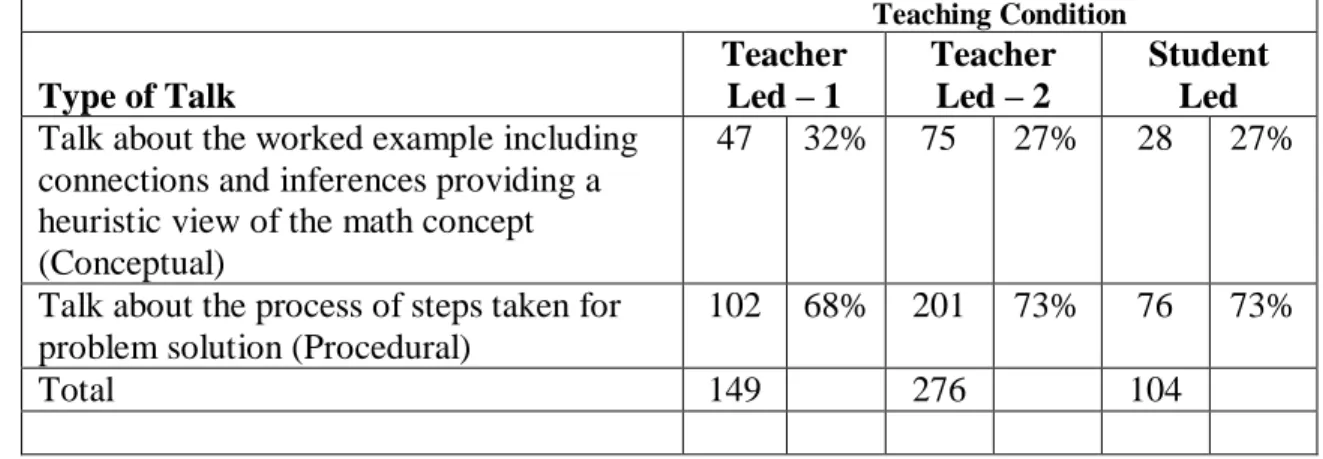
Table 4-3: Teaching Conditions: Conceptual and Procedural Dialogue ... 78
Table 4-4: Purpose of IWB Use in Teaching Conditions ... 80
viii
LIST OF FIGURES
Figure 2-1: Gowin’s Vee Heuristic ... 8
Figure 2-2: Gowin’s Vee – Connecting Theory and Practice ... 10
Figure 2-3: Conceptual Framework: Central Theories Related to Worked Example and IWB Areas of Research ... 11
Figure 2-4: Activity theory system for worked example presentations on the IWB ... 14
Figure 3-1: Embedded Single Case Study Design: Design Phases, Procedures, and Products of the Research Methodology ... 58
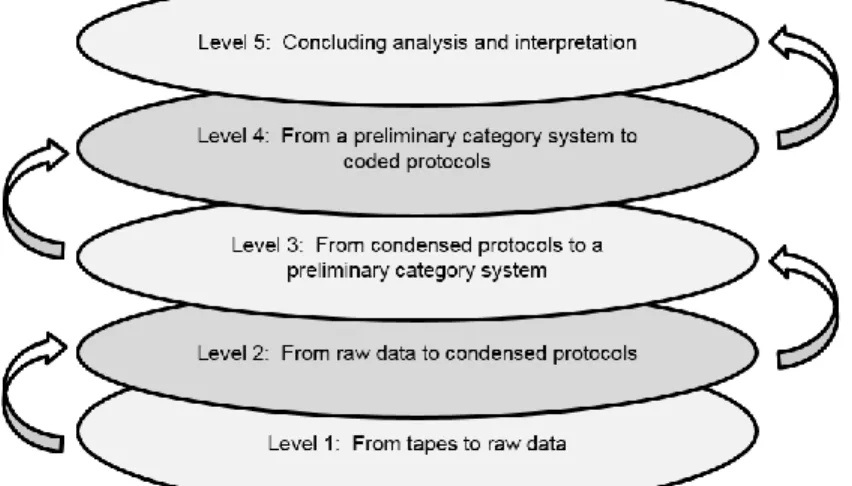
Figure 3-2: Iterative Steps to Qualitative Content Analysis ... 66
Figure 4-1: Teacher-Led Supported-didactic Condition (IWB screen shot) ... 82
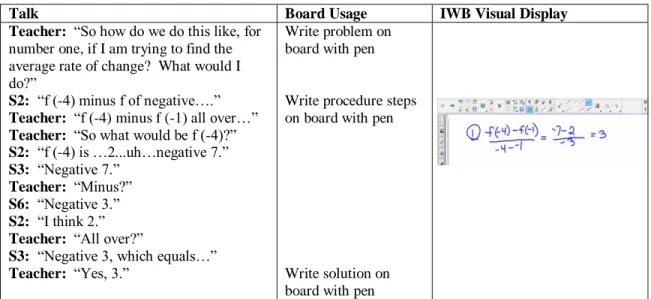
Figure 4-2: Teacher-Led Supported Didactic Teaching Condition (Excerpt 1) ... 82
Figure 4-3: Teacher-Led Supported Didactic Teaching Condition (Excerpt 2) ... 83
Figure 4-4: Teacher-Led Supported Didactic Teaching Condition (Excerpt 3) ... 84
Figure 4-5: Teacher-Led Supported Didactic Teaching Condition (Excerpt 4) ... 84
Figure 4-6: Teacher-Led Supported Didactic Teaching Condition (Excerpt 5) ... 85
Figure 4-7: Teacher-Led Interactive Condition Screen Shot of IWB ... 86
Figure 4-8: Teacher-Led Interactive teaching condition (Excerpt 1) ... 87
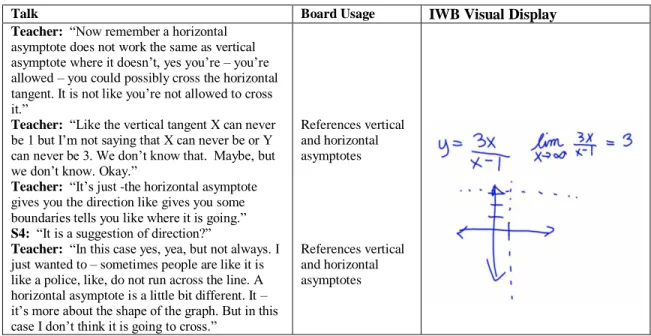
Figure 4-9: Teacher-Led Interactive teaching condition (Excerpt 2) ... 88
Figure 4-10: IWB screen shot of highlight feature used to denote problem steps ... 88
Figure 4-11: Teacher-Led Interactive teaching condition (Excerpt 3) ... 89
Figure 4-12: Teacher-Led Interactive teaching condition (Excerpt 4) ... 90
Figure 4-13 Teacher-Led Interactive teaching condition (Excerpt 5) ... 91
Figure 4-14: Student-Led Enhanced Interactive Condition Screen Shot of IWB without Manipulative ... 92
Figure 4-15: Student-Led Enhanced Interactive Condition of Screen Shot of IWB with Manipulative ... 92
Figure 4-16: Student-Led Enhanced Interactive Teaching Condition (Excerpt 1) ... 93
Figure 4-17: Student labeled diagram ... 94
Figure 4-18: Student-Led Enhanced Interactive Teaching Condition (Excerpt 2) ... 94
Figure 4-19: Student-Led Enhanced Interactive Teaching Condition (Excerpt 3) ... 95
Figure 4-20: Student-Led Enhanced Interactive Teaching Condition (Excerpt 4) ... 96
Figure 4-21: Student-Led Enhanced Interactive Teaching Condition (Excerpt 5) ... 97
Figure 4-22: Student-Led Enhanced Interactive Teaching Condition (Excerpt 6) ... 98
Figure 4-23: Student-Led Enhanced Interactive Teaching Condition (Excerpt 7) ... 99
Figure 4-24: Student-Led Enhanced Interactive Teaching Condition (Excerpt 8) ... 99
Figure 5-1: Activity theory system for interactive display technology professional development... 112
1 Chapter One
Introduction
This study derives from two distinct areas of educational research. First, research collected on worked example instruction was examined to determine the theoretical foundation and effective implementation of worked examples as an instructional device in a lesson. Second, a literature review was conducted on the interactive whiteboard (IWB) to examine 1) how the features and manipulations of the IWB content displays are used during instruction and 2) to identify the pedagogical approaches that contribute to student learning.
Although the research on worked example instruction and the IWB differ significantly from each other, the literature searches revealed several interesting areas where the intended learning purposes intersect: 1) active learning approaches to visual presentations of procedural, 2) conceptual aspects of worked example instruction, 3) collaborative whole class instruction and 4) to support students’ self-explanations of content in worked examples. The aim of this study was to explore these areas to
determine if and how the IWB can support student learning when used to present worked example instruction in an AP Calculus II course.
Calculus teachers often use worked examples as an instructional device to demonstrate the solution procedures of a certain problem type. Typically, the teacher follows the general format of a worked example and conveys the conceptual and
procedural knowledge through visual presentation and verbal explanation to the students in a whole class learning environment.
2
Early research on worked example instruction was conducted before the onset of classroom technology integration as we know it today (Sweller & Cooper, 1985). Consequently, researchers utilized print-based materials, chalkboards, and dry-erase whiteboards as presentation tools. The proliferation of technology in the classroom offered new delivery mediums and presentation tools to consider when designing effective worked example instruction.
These advances in classroom technology have affected the way mathematical information is disseminated thereby potentially influencing the ways teachers educate math students. Teachers are expected to promote the implementation of technology in the context of teaching and learning mathematics in order to prepare students with the development of 21st century skills. This expectation reiterates standards established by the National Council of Teachers of Mathematics (NCTM) in 2000.1 In their Technology Principle associated with those standards, NCTM recognizes the importance of
technology as an essential component in teaching and learning mathematics stating, “it influences the mathematics that is taught and enhances students’ learning” (NCTM, 2000, p. 3). Further, the Technology Principle advocates the importance of teacher training so that educators are prepared to create a “positive environment that promotes collaborate problem solving” (NCTM, 2000, p.3) whereby students themselves experience the learning event in an interactive way. Researchers have used multimedia technologies
1 NCTM published Principles and Standards for School Mathematics (PSSM) in 2000. At the time of this study, the teacher-centered principles and standards remained the same. In 2006, NCTM expanded the standards to include ways in which the student should learn the mathematical concept. The student-centered Common Core Standards were implemented in 2010. NCTM provides resources aligned with PSSM and emphasizes effective instruction that supports Common Core standards.
3
(Gerjets, Scheiter, & Catrambone, 2004) and computer simulated examples (Schwonke, et al., 2007) to further explore the worked example effect and provide insight into multimedia worked example presentations. Multimedia presentations combine the worked example and modality effect in a single instructional strategy to facilitate student understanding of the mathematical concepts.
Thus, teachers of mathematics are turning to instructional technologies to engage students in the lesson content in order to promote active learning of worked examples. One type of technological tool used in math classrooms for worked example
presentations is the interactive whiteboard (IWB). In 2016, the National Science Board published a report on the use of the IWB as an instructional tool in elementary and secondary mathematics and science classrooms in the United States. The findings included in their Science and engineering indicators noted 51% of the K -12 teachers have IWBs available for them to use (National Science Board, 2016). 57% of the teachers who had access to an IWB reported using the technology tool for instructional purposes.
The IWB allows the presentation and manipulation of images, text, and video on a large touch-sensitive screen. The IWB connects to a projector that displays the content from the computer onto the screen. Special software is installed on the whiteboard and offers a variety of features or affordances using the white screen board as the interface device. As a result the IWB can be used for several types of instruction. Teachers can use the IWB as a direct didactic display of instructional material or incorporate
interactive individual and interactive group work allowing students to go to the board and manipulate the display. It is also possible to add new images and animations from the
4
Internet or other programs to augment the existing ones in the software. Teachers have options to use ready-made materials or create their own materials and resources to support content delivery in lessons. In addition, the teachers can save the work from the display and return to the archived saved files at any time.
Current research suggests how the affordances of the IWB can facilitate an interactive learning environment for either whole group instruction or peer-to-peer
interaction. Gillean, Staarman, Littleton, Mercer, and Twiner (2007) describe the IWB as an artifact that can mediate teacher and student as well as student to student interactions. Other studies emphasized the link between dialogic learning and the IWB (Hennesey, Deaney, Ruthven, & Winterbottom, 2007; Haldane, 2007; Gillean et al., 2007). The IWB, as a mediating artifact, can be used as dialogic space where verbal discourse becomes central to the learning process.
Worked Examples and IWB Instruction
Learning from worked example instruction and using the IWB as an instructional tool both involve active participation from the learner. Students using worked examples must be actively involved in the cognitive processes to determine the solution structure and rationale for choosing the appropriate procedure. The affordances of the IWB can support learning through various levels of interactivity and can be used to enhance the learning environment through use of multiple representations. Further, the research on worked examples and IWBs describes discourse as an effective approach by which students are able to make meaning and develop understanding of the instructional content. Worked example research overwhelmingly supports the importance of self-explanation when learning from worked example instruction (Atkinson, Derry, Renkl, &
5
Wortham, 2000; Catrambone, 1995; Chi, Bassok, Lewis, Reimann, & Glaser, 1989; Renkl, 1997). It would seem plausible that there exists a relationship between worked example self-explanations and the affordances of the IWB used to support dialogic
learning. As previously mentioned, this study explored the potential relationship between worked example presentations and the affordances of the IWB to support whole-class dialogue and student self-explanation about the worked example.
Need for research
Much of the literature reviewed suggested research conducted on the IWB in whole-class settings was specific to elementary and middle school environments (Solvie, 2004; Moss, et al., 2007). While some research using the IWB is available, specifically as related to elementary classrooms, it needs be expanded to a whole class naturalistic environment in secondary classrooms. This suggestion is similar to one found in worked example research. Even though the research on worked example is extensive and offers a theoretically sound framework for the effective presentation of worked examples, Renkl & Atkinson (2003) recommended more research be conducted in real classrooms as a opposed to laboratory settings where most early worked example research was
conducted.
IWB research has noted that in order to maximize the effectiveness of the IWB as a presentation tool, a pedagogical shift from teacher centered to student interactive approaches must transpire (Armstrong, et al., 2005). The IWB offers an interactive approach to pedagogy which may conflict with more traditional didactic teaching styles. Therefore, teacher training is essential to the effective use of IWBs in the classroom (Glover, et al., 2007). Teachers’ understanding of content, learning, and pedagogical
6
practices for using the IWB may also be an essential element in their ability to present worked example instruction so that it facilitates student learning about the worked examples.
The context of research for this study was a whole class settings found in an AP Calculus II class. Investigating IWB use in a naturalistic setting was to provide teachers with applicable results that can be used to understand dialogic dimensions of IWB instruction, improve methods and pedagogy and suggest direction for training in the use of the IWB as a tool for mediating learning.
Purpose
This study used an embedded single case study design (Yin, 2003) to explore differences in whole class dialogue and student self-explanation between worked example presentations and variations of interactive pedagogy used with the IWB. The central purpose was to examine the effect of the different interactive features within the interface of the IWB during worked example instruction on the quality of whole class discussion and student self-explanation.
The levels of interactive pedagogy were defined using the three classifications of interactivity with the IWB established by Glover, et al., 2007. These include the
supported didactic classification, an interactive classification, and an enhanced interactive classification that are discussed in more detail in Chapter Two of this dissertation. The qualitative data were used to describe how the use of the different levels of interactivity, coupled with the use of the IWB either support or hinder whole class discussion and student self-explanation. To accomplish this goal, the research evaluated current IWB
7
usage and examined the effect of the interactive pedagogies and IWB features on whole class dialogue and student self-explanation.
Research Questions
The research questions that framed this study are below:
1. How do teacher-led and student-led IWB visual presentation of procedural and conceptual aspects of worked example instruction affect classroom interaction
a. In collaborative whole class instruction?
b. In student’s self-explanation of content in worked examples? 2. In what ways do different IWB features and pedagogical approach affect
worked example instruction?
Following this introductory chapter, Chapter Two presents the theoretical constructs used to guide the study design and research. In addition, Chapter Two also contains an examination of the relevant literatures concerning worked example
presentations and instruction using the IWB in order to provide a general framework in which to situate the study. Chapter Three presents the methodology used to conduct this study. Information on the embedded, single case-study design is included along with a description of the subjects and how they were recruited for the study. In addition, descriptions of data collection instruments, procedures, and research analyses are included in the Methodology chapter. Chapter Four presents the findings of the study. Chapter Five concludes the dissertation with a discussion of findings, implications of the study and suggestions for further research.
8 Chapter 2
Conceptual Framework and Review of Relevant Literature Conceptual Framework for the Study
Epistemological Relationships Among Conceptual Elements
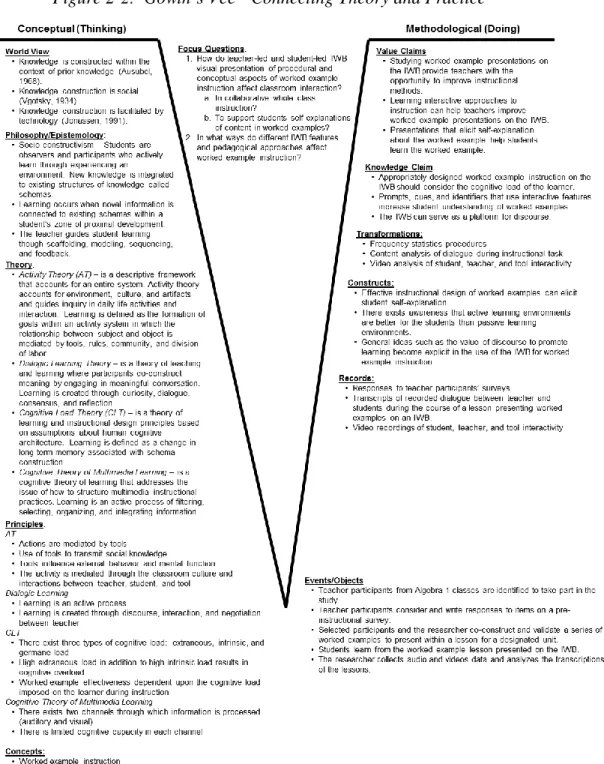
This study examined teaching and learning with worked examples presented on the IWB. Gowin’s Vee heuristic (Gowin, 1981) was used to guide understanding between the relationships of theory and practice concerning the two topics addressed. The Vee heuristic is a visual representation designed to show the relationships between the basic epistemological elements contained in both areas of research. Gowin’s Vee (Figure 2.1) identifies 12 elements that contribute to the development of meaning and knowledge in the research (Novak, 1993).
Figure 2-1. Gowin’s Vee Heuristic
Note: This figure illustrates the relationship between theory and practice of research. World view Philosophy Theory Principles Concepts Theoretical/Conceptual Focus Questions Methodological Events/Objects Value claims Knowledge claims Transformations Constructs Records
9
The center of the Vee describes the research questions and includes any sub-questions that may be answered by the research. The lower part of the Vee depicts the events and objects to be studied to answer the research questions. The left side of the Vee articulates the conceptual component specifying the relevant concepts, principles, theories, and worldview influencing the study. The right side of the Vee is the
methodological part of the research. It identifies the records and transformations that will be constructed and inferred to produce the value and knowledge claims of the study.
Gowin’s Vee helps guide research by connecting theory and practice. The knowledge for the Vee for the proposed research was acquired through library research, Internet research, and coursework. The graphic representation of this knowledge (Figure 2-2) will provide a means by which to reflect and redirect the course of research when necessary.
10
Figure 2-2. Gowin’s Vee - Connecting Theory and Practice
Figure 2-2. This figure illustrates the relationship between theory and practice of research for this study.
11 Theoretical Perspectives that Framed the Study
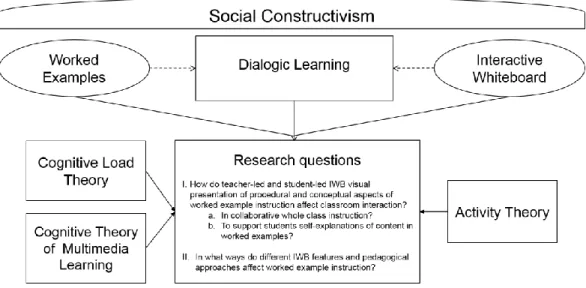
Socio-constructivism, Activity Theory, Dialogic Learning, Cognitive Load Theory and Multimedia Learning are the theoretical perspectives that framed this study (Figure 2-3). The following sections discuss each theoretical component as it relates to this study. The first section addresses socio-constructivism, the overarching theory of learning as applied to the research. The second section considers Activity Theory and the role of the IWB as a mediating tool for obtaining mathematical knowledge through interaction and dialogue. The discussion concludes with an analysis of the relevant theories of worked example instruction, cognitive load and effective multimedia presentations.
The conceptual framework diagram below in Figure 2-3 shows the relationship among the central theories elaborated as the conceptual framework for this investigation. Figure 2-3. Conceptual Framework: Central Theories Related to Worked Example and IWB Areas of Research.
12 Socio-constructivism
The rationale for this study derives from socio-constructivist theory. This theory is based on explicit assumptions about reality, knowledge, and learning. Social
constructivism views the context in which learning occurs as central to learning itself. From this perspective, students are active participants in the construction of new knowledge through experiencing an environment (Vygotsky, 1978). Under the socio-constructive construct, knowledge is integrated into existing structures of knowledge. For the purpose of this study, pre-existing knowledge will be defined as ‘schemas.’ Sweller, Van Merrienboer, and Paas (1998) define schemas as “anything that has been learned and is treated as a single entity” (p. 256). They describe schemas as the elements of knowledge which in turn are used by the learner to create more complex schemas and thereby acquire new knowledge. As an extension of these principles learning occurs within a zone of proximal development (ZPD). ZPD is the difference between what a learner can do without help and what the learner can do with assistance from an expert guide (Vygotsky, 1978). Assistance is provided by the instructor whose roles are subject matter expert and mentor. The teacher contributes to the expansion of the ZPD and helps guide the student’s thinking through the instructional event. Thus, learning occurs when new knowledge is connected to existing schema within the student’s ZPD through the aide and guidance of the instructor.
This study examined how the IWB was used as a presentation tool to create conditions for learning about worked examples within the theoretical framework provided by socio-constructivism. The teacher guided students through a series of
13
scaffolds mediated by a tool (the IWB) to facilitate schema construction about the conceptual ideas of the problem type.
Activity Theory
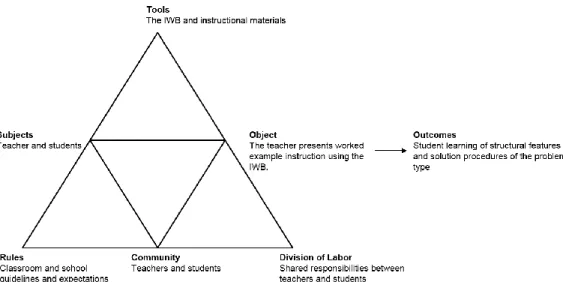
Activity theory (Engestrom, 2001) is used to explore the processes that occur when people engage in interactions that are mediated by cultural tools. Described by Nardi (1997), “Activity theory offers a set of perspectives on human activity and a set of concepts for describing that activity” (p. 8). Activity theory (AT) provides a framework to contextualize the use of the IWB as an instructional tool used for worked example presentations (See Figure 2-4).
Figure 2-4. Activity theory system for worked example presentations on the IWB
The basic unit of analysis in activity theory (AT) is the activity. An activity is defined as an action performed within a situated context. The action is directed towards an object that is considered the goal of the desired outcome. The desired outcome in this study was student learning from the worked example instruction. In the activity system, the teacher used the IWB as a technological tool in order to achieve the expected
14
outcome. In essence, the IWB served as a mediating artifact facilitating interaction between the members of the community. The pedagogical methods used to present the worked example instruction guided the interactions between the students and teacher. Dialogic learning
Both worked example research and IWB literature emphasize the importance of dialogue as a part of the learning process. This study focused on the relationship
between classroom discourse and conceptual development of mathematics along with the reflective discourse generated by the student about the worked example. Specific issues addressed include both the teacher’s role and the role of the IWB in supporting reflective shifts in discourse.
Worked example research recognizes self-explanation as an effective way to facilitate learning from worked examples. The literature implies that the design of the worked examples should encourage learners to reflect during the critical parts and goal operators of the solution procedure in order to understand the rationale behind the processes. Renkl (1997) investigated individual differences in learning from worked out examples with respect to the quality of self-explanations. Noting that characteristics of individual self-explanations were multidimensional, Renkl (1997) concluded that the learner’s performance could be predicted by the qualitative difference of
self-explanations. Based on the analysis, Renkl (1997) identified categories of learners who effectively self-explain as anticipative reasoners and principle-based explainers.
Anticipative reasoners are those students who think of likely calculations to be performed in advance and compare their predictions with the next step in the worked out example.
15
Principle based explainers are those students who justify their calculations based on the mathematical principles that are applied in the worked out example.
Chi and VenLehn (1991) define self-explanation as a “comment about an example statement that contains domain-relevant information over and above what was stated in the example line itself” (p. 69). In their study, Chi, et al., (1989) analyzed explanations through the examination of the structure and the content of the student responses. The structure of the explanation depicts the purpose of the student explanation. Chi, et al., (1989) supposed that if a student understood an example solution then the conditions and consequences of each solution step would be clearly defined within the explanation. The data analysis of their study classified the structural discourse into four categories. Structural explanations were used to
refine or expand existing conditions,
explicate or infer consequences of an action, impose a goal or purpose of an action, give meaning to quantitative expressions.
To further examine the quality of self-explanation, Chi, et al., (1989) also included an analysis of the nature and content of the student responses. The analysis focused on the dialogue regarding principles pertaining to the topic along with other principle based knowledge about the subject matter. This study used similar categories to characterize the structure and content of student self-explanations about the worked examples presented on the IWB.
16 Cognitive Load Theory
The ‘worked example effect’ derives from research based on cognitive load theory. Cognitive load theory provides a model of human cognitive architecture and assumes that working memory is very limited in terms of being able to store and process information. The human cognitive architecture consists of a working memory that has a limited capacity of seven elements, or chunks, of information when holding information (Miller, 1956). Remembering the digits of a phone number until you write them down is an example of holding information in the working memory. Processing information is the changing of information and has significantly less capacity within the working memory.
Another assumption of cognitive load theory is that long-term memory can store large amounts of information through an organizational strategy termed schemas. Unlike working memory, long-term memory has potentially unlimited capacity and holds
information in schemas. Schemas are domain-specific knowledge structures within long-term memory. They help learners delong-termine problem states and the associated moves needed to obtain the solution (Kalyuga, Chandler, Tuovinen, & Sweller, 2001). Cognitive load theory views the formation of schemas as the process of learning and knowledge acquisition. Understanding occurs when learners employ cognitive processes and relate new information to an existing schema. “According to schema theory, it is through the building of increasing numbers of ever more complex schemas by combining elements consisting of lower level schemas into higher level schemas that skilled
performance develops” (Sweller, et al., 1998, p. 256). Additional learning takes place when the schemas modify processing efforts from controlled to automatic. Once a
17
schema is acquired and becomes automated, the processing load of that schema within the working memory is reduced. As a result, processes and procedures can be handled in working memory with very little conscious effort regardless the complexity of the acquired schema (Sweller, et al., 1998).
Learning is an active, constructive process where the learner uses available cognitive resources to create new knowledge from the instruction and previously stored schemas. Cooper and Sweller (1987) defined schema as a construct that allows problem solvers to group problems into categories in which the problems in each category require similar solutions. They indicated that worked examples support schema acquisition of domain content. Sweller and Cooper (1985) asserted that worked examples will increase the strength and number of schemas acquired. They concurred that the use of worked examples can direct attention to the problem states and the components of an expert solution.
The knowledge required to solve mathematics problems may contain a number of different problem states or schemas. A conceptual understanding of multiplication and the patterns that lie within can be said to form a schema used to solve a variety of problems. Some students use this schema to solve problems with very little working memory load. Subsequently, the students are able to apply the learned schema to new types of problems that use multiplication. Students who lack a conceptual understanding of multiplication often struggle with solving novel problems due to the heavy load imposed on the working memory by the solution procedures. Consistent with cognitive load theory, the student uses more working memory to hold and process information
18
about multiplying and is unable to solve the given problem in an efficient and effective manner.
Cognitive load theory addresses human cognitive architecture related to the concepts of short-term and long-term memory, as well as schema acquisition and automation (Sweller, et al., 1998). The theory also addresses information structure by classifying three categories of load imposed on a learner during an instructional event: extraneous, intrinsic, and germane load. The three categories of load will be discussed briefly here and then examined further during the discussion of the worked example literature.
Extraneous load is the cognitive processes generated by irrelevant mental
activities experienced by the learner during instruction. Extraneous load is caused by the instructional design and presentation of information. Chandler and Sweller (1991) note that poorly designed instructional formats can “result in students engaging in cognitive activities far removed from the ostensible goals of the task” (p. 294). To avoid
extraneous load, they suggest “that information should be presented in ways that do not impose a heavy extraneous cognitive load (Chandler and Sweller, 1991, p. 295). Instructional efficiency depends on the extraneous load imposed on the learner by the instructional design and presentation format. In order to facilitate schema formation, instructional strategies, such as worked examples, should be designed to decrease ineffective load bearing requirements.
In addition to extraneous load, working memory may be affected by intrinsic load. Intrinsic load is the inherent level of difficulty or complexity associated with the
19
the elements in the content material. Sweller and Chandler (1994) defined element interactivity as instructional content involving of a range of components or elements. It is proposed that the cognitive load associated with material to be learned is strongly related to the extent to which the elements of that material interact with each other. These elements are said to interact if there exists a relationship between them. Therefore, the working memory load is dependent upon the number of elements in the material that must be processed simultaneously.
Instruction that contains low element interactivity results in a low intrinsic load. Whereas, instruction that contains high element interactivity brings about an increased level of intrinsic load within the working memory. Originally, the level of intrinsic load was thought to be unalterable by the instructional design of the presentation given the inherent nature of the material (Sweller and Chandler, 1994). However, it was later found that intrinsic load could be influenced by dividing instruction into smaller pieces, thus decreasing the level of interactivity between elements.
First described by Sweller, et al., (1998), germane load is the load that frees working memory capacity thereby facilitating schema formation. Germane load can be influenced by instructional design. The design of worked example presentation should optimize germane load in order to help domain specific schema constructions. This is unlike extrinsic and intrinsic loads where the goal of the presentation design is to
diminish the effects of both types of load on the learner. Under the cognitive model, the amount of germane load is a determinant of instructional efficiency. Effective
instructional design reduces the extraneous load and transfers the surplus of working memory available to germane load.
20
Cognitive Load Theory was used to guide the design of the worked example instruction. Specifically, CLT was used to identify possible load bearing effects of the IWB worked example presentation. The design of the worked example presentation considered cognitive load experienced by learners during the lesson as a whole and within the single worked example presented on the IWB.
Mayer’s theory of multimedia learning
Mayer (2001) defines multimedia as the presentation of material in the form of pictures and words. Pictures can include photographs, screen shots, and other visual forms. Words can be expressed using text on a page or computer screen, in spoken form, and other verbal manners. Mayer and Moreno (2003) developed the cognitive theory of multimedia learning by integrating cognitive load theory (Chandler and Sweller, 1991), dual-coding theory (Pavio, 1986), and Baddeley’s (1986) working memory model. Mayer’s theory of multimedia learning offers principles to help guide the design of multimedia instruction.
Mayer’s theory of multimedia learning is based on three assumptions. First, there exist two separate channels (auditory and visual) for processing information. The theory of multimedia learning suggests people learn better from words and pictures than from words alone, and learning is deeper when appropriate pictures are added to text. The second assumption states the human mind is limited in its capacity to effectively process new information within the working memory. “In accordance with the limited-capacity assumption, working memory is limited in the amount of knowledge it can process at one time – so that only a few images can be held in the visual channel of working memory, and only a few sounds can be held in the auditory channel of working memory” (Mayer,
21
2001, p. 66). Finally, multimedia learning theory assumes that learning is an active process by which the learner integrates new information into existing schemas (Chandler & Sweller, 1991). Learners actively filter, select, organize, and integrate information during the learning process.
Mayer’s theory of multimedia learning provides a theoretical rationale upon which nine principles of multimedia were developed. The nine principles provide a framework for designing instruction that benefit learning outcomes by considering ways that are consistent with how the human mind works.
Mayer’s nine principles for the design of multimedia instruction and their definitions are:
Multimedia principle: People learn better from words and pictures than from words alone;
Segmenting principle: People learn better when a multimedia lesson is presented in learner-paced segments rather than as a continuous unit; Pre-training principle: People learn better from a multimedia lesson when
they know the names and characteristics of the main concepts;
Modality principle: People learn better from animation and narration than from animation and on-screen text;
Coherence principle: People learn better when extraneous words, pictures, and sounds are excluded rather than included;
Redundancy principle: People learn better from animation and narration than from animation, narration, and on-screen text;
22
Signaling principle: People learn better when the words include cues about the organization of the presentation;
Spatial contiguity principle: People learn better when corresponding words and pictures are presented near rather than far from each other on the page or screen;
Temporal contiguity principle: People learn better when corresponding words and pictures are presented simultaneously rather than successively;
To support effective instructional design, the principles contextualized through Mayer’s theory of multimedia learning influenced the design of the worked example instruction on the IWB for this research. Specifically, the worked example presentations designed for this research included text, diagrams, and manipulatives. Mayer’s principles were used to identify effective design strategies to support student learning of worked examples when using the IWB.
Review of Relevant Literature
The literature review consists of selected research concerning worked examples and interactive pedagogy with the IWB as these two conceptual elements provided a construct in which to situate the research. The first section of this review contains resources related to worked example instruction and its effect on student learning. Worked example instruction will be defined and described through the theoretical construct of cognitive load. Then, an analysis of a worked example literature review written by Atkinson, et al., (2000) is presented and specific factors moderating the effectiveness of worked example presentations are identified. The review pinpoints instructional design principles that describe effective example design and solution
23
procedure presentation. Further, Atkinson et al., (2000) propose organizational guidelines for the presentation of worked examples at the lesson level. The results are discussed in terms of the theoretical and practical implications for learning from worked example instruction.
The second section analyzes sources related to the use of the IWB as a catalyst for student learning. This part describes how the features and manipulations of the IWB are used during an instructional event to foster learning and explicate pedagogical strategies which can cultivate student learning. The analysis of the research identified the ways in which the IWB can direct learner attention and support interactive pedagogy.
Additionally, the research exploited the potential of the IWB as a mediating artifact that provides a space for shared understanding between the teacher and student establishing a link between dialogic learning and the IWB.
The ‘worked-example effect’ (Sweller & Cooper, 1985) stems from research conducted on cognitive load. The cognitive load theory provides a model of human cognitive architecture and assumes that working memory is very limited in terms of being able to store and process information. Another assumption of cognitive load theory is that long-term memory can store massive amounts of information known as schemas. A schema is essentially a mental framework for understanding and remembering
information. Schemas categorize elements of information according to how they will be used (Chi, Glaser, & Rees, 1981). When new schemas are formed or existing schemas altered, learning occurs.
24
Given the extensive research on worked examples, there is a broad array of terms used throughout the review (Table 2-1). If necessary, please consult Table 2-1 for the descriptions of common terms used in worked example research.
Table 2.1
Literature Review Terminology
Term Description
Completion (faded) problems Completion problems present worked examples in a sequence that isolates concepts and
procedures of the problem. The examples gradually progress a learner through the series of procedures required to obtain the solution. Interactivity Interactivity defines the interaction between
student, teacher, and tool and includes technical, physical, and conceptual components.
Structure features Structural features are the fundamental mathematical procedures needed to solve the problem. They form the conceptual knowledge that is the basis for schema construction.
Sub-goals Sub-goals organize solution procedures into
chunks of meaningful information. As an
instructional device, sub-goals link the subsets of conceptual aspects to a solution procedure. To distinguish what constitutes a sub-goal depends on the domain in which it resides and the
instructor’s view of the important concepts of the domain knowledge.
Surface features Surface features are the specific story lines in a problem. They are used to establish a context for the learner. Typical worked examples in the algebra domain offer real world situations such as the degrees on a thermometer or the yards gained or lost on a football field to illustrate the concept of integers.
Variability There are two types of variability discussed in worked example research. First, structural variability refers to different problem types and conceptual ideas within worked examples. Second,surface feature variability refers to the variance of story lines in a series of worked examples
25 Three types of cognitive load
The three types of cognitive load, extraneous, intrinsic, and germane, were introduced previously in this chapter. The following discussion examines the types of cognitive load and how they relate to the effective design of worked examples.
Extraneous cognitive load can be caused by the design of the instruction. In a series of six experiments, Chandler and Sweller (1991) found that high levels of
extraneous load influences the degree to which learning can be facilitated. The cognitive load generated by irrelevant activities can impede acquisition of concept. Therefore, instruction should be designed so as to reduce the extraneous load. The research defines three effects known to cause extraneous load in the presentation of worked examples: Split-attention, redundancy, and expertise-reversal.
The split attention effect occurs when students are required to integrate two or more sources of information while learning from instructional materials. As a result of the split format, the student experiences an increase in extraneous cognitive load. Tarmizi and Sweller (1988) found that when learners were required to split attention among multiple sources of information learning efficiency decreased. They called the result “the split attention effect” and concluded that schema acquisition was hindered due to the extraneous load imposed by the separate material. Tarmizi and Sweller (1988) recommended designing worked examples so the presentation reduces the need for students to integrate multiple sources such as text and diagrams. In turn, this will lessen extraneous cognitive load imposed on the learner.
The split-attention effect is not limited to mathematics. In any discipline, when the instructional design imposes a high visual cognitive load, the result is an increase in
26
extraneous load on the learner. Chandler and Sweller (1991) used biology materials in the form of diagrams and instructions explaining the flow of blood around the heart, lungs, and body. The first group received a single self-explanatory diagram of the heart, lungs, and body. A second group was given instructions with textual information
presented separately from a diagram of the heart, lungs, and body. This group had to assimilate the textual information with the related diagram. The third group used a modified integrated diagram where the instructions were placed directly on the diagram. The learners in the diagram-only group found it easier to integrate and process both forms of visual information and, as a result, performed better on the post-test than the other two groups. Accordingly, learners were able to devote more cognitive attention and mental resources to processing the self-explanatory diagram and perform better on the post-test. The cognitive load generated by the disparate pieces of information impeded knowledge acquisition. Therefore, instruction should be designed to integrate text into diagram wherever possible in order to avoid the split-attention effect.
Another source of extraneous cognitive load caused by poor instructional design is the redundancy effect. Chandler and Sweller (1991) found that the redundancy effect occurs when multiple of sources of information are autonomous and can be understood in isolation. In an experiment using biology instructional materials, the modified integrated diagram included redundant information placed on top of the diagram of the blood flow through the heart, lungs, and body. The results of the study showed that the presence of ostensibly useful but unnecessary instructional explanations were detrimental to the learning outcomes. Once the students understood the material, redundant information pertaining to the lesson increased extraneous cognitive load and thus hindered learning.
27
Similar to redundancy, the expertise reversal effect imposes extraneous cognitive load. When a learner becomes more experienced in a domain, the advantage of
instructional guidance decreases (Kalyuga, Ayres, Chandler, & Sweller, 2003). Kalyuga et al., (2003) suggested that under some conditions, when fully guided instructional material is presented to more experienced learners, a part or all of the instructional guidance might be redundant and impose unnecessary load on limited working memory resources. In contrast, that same material may be essential for less experienced learners (Kalyuga et al., 2003). Therefore, for worked examples to be effective, it is important to consider the level of experience of intended learners.
In addition to extraneous load, working memory may be affected by intrinsic load. Intrinsic load is the inherent level of difficulty or complexity associated with the
instructional activity. Intrinsic load is measured by the amount of interactivity between the elements in the content material. Sweller and Chandler (1994) defined element interactivity as instructional content involving a range of components or elements. These elements are said to interact if there exists a relationship between them. Therefore, the working memory load is dependent upon the number of elements in the material that must be processed simultaneously.
Instruction that contains low element interactivity results in a low intrinsic load. Whereas, instruction that contains high element interactivity brings about an increased level of intrinsic load within the working memory. Originally, the level of intrinsic load was thought to be unalterable by the instructional design of the presentation given the inherent nature of the material (Sweller and Chandler, 1994). However, it was later found that intrinsic load could be influenced by dividing instruction into smaller pieces,
28
thus decreasing the level of interactivity between elements. Clark, Nguyen, & Sweller (2006) defined the smaller pieces as “subschemas” (p. 12).
Gerjets, Scheiter, and Catrambone (2004) utilized the concept of subschemas in their research the on molar and modular worked examples. Molar worked examples focus on problem categories and their associated solution procedures. Modular worked examples break down complex solutions into small meaningful solution elements. They found that by using a modular worked example format, task-related intrinsic load was reduced due to the decrease of interactivity between the elements of the problem solving process.
First described by Sweller, et al., (1998), germane load is the load that frees working memory capacity thereby facilitating schema formation. Germane load can be influenced by instructional design. The design of worked example presentation should optimize germane load in order to help domain specific schema constructions. This is unlike extrinsic and intrinsic loads where the goal of the presentation design is to diminish the effects of both types of load on the learner. Variability and eliciting self-explanation are both strategies that can be used to increase germane load through instructional design.
The research indicates that variability over problem situations is a strategy that can be used to increase germane load. Paas and Van Merrienboer (1994) compared low and high variability conditions in conventional problems and worked examples. The purpose of the study was to relate the effects of variability to training performance, transfer performance, and cognitive load. The results showed that students who studied worked examples gained most from the high variability examples than the students who
29
used the conventional method. However, Paas and Van Merrienboer (1994) noted that in order to benefit from high variability conditions, the instructional design must minimize extraneous cognitive load. Quilici and Mayer (1996) demonstrated that high variability of structural features within the worked examples facilitated schema construction and, hence, increased germane load. By redirecting attention from extraneous load to germane processes, variability within the instructional design can facilitate schema formation.
Research also endorses self-explanation as an effective way to increase germane load and facilitate learning from worked examples. Renkl (1997) describes the
characteristics of effective self-explanation as being able to describe the principles and goal operators of a solution procedure. Therefore, the design of the worked examples should encourage learners to reflect during these critical parts in order to understand the rationale behind the procedures used to obtain the solution. From this conclusion, the question that arises is how can the design of the worked example presentation induce self-explanation? The answer depends upon whether the self-explanation is used to understand the principles behind the content (the why of the solution procedure) or the goal operator combinations needed to obtain the solution (the how of the solution procedure).
Renkl, Atkinson, and Grobe (2004) ascertained that faded examples triggered student self-explanation. Faded examples provide a link between a worked example and conventional problem solving. From a cognitive load perspective, the faded approach frees working memory capacity by isolating individual steps, thereby reducing the load imposed on the learner. Renkl, et al., (2004) concluded the faded step condition fostered
30
self-explanation as the learners decided what goal operator was needed to obtain the next step. They further purported faded examples are most effective when using backwards fading design. This entails presenting the last solution step of the first practice problem, the last two solution steps of the second practice problem, and so on, until the student is left to solve a problem independently. Schwonke et al., (2007) found evidence that the faded procedure leads to deeper conceptual understanding through explanation thus fostering schema construction. Their study concluded that when learning from faded worked examples it is valuable to direct attention to the goal operating combinations needed to solve a problem. By directing attention to the goal operating combinations the sub-goals become more salient.
Another method to induce self-explanations is to design prompts to engage the learner in a self-explanation activity. Schworm and Renkl (2002) investigated to what extent learning from worked examples could be fostered by self-explanation prompts and by providing instructional explanations. The results showed that prompting
self-explanations had favorable effects on learning outcomes. Their study also found that instructional explanations only partially enhanced learning and at times they were
detrimental to knowledge construction as a result of the redundancy effect. Gerjets, et al., (2006) also examined whether learning was enhanced by self-explanation prompts and worked examples in modular format. It was determined that either the instructional explanations or the self-explanation prompts were not effective for learning since the design of the modular examples provided the learner sufficient instructional support to incite self-explanations. Hence, the self-explanation prompts forced learners to process redundant information and impeded knowledge construction.
31
Cognitive load theory is concerned with instructional techniques for managing working memory load in order to facilitate the changes in long term memory associated with schema construction and automation. Instructional strategies, such as worked examples, should decrease ineffective load bearing requirements, minimize the number of unrelated interacting elements, and optimize germane load to facilitate domain specific schema constructions. Further, when designing worked example instruction, it is
important to analyze the internal structure of problem design to determine whether or not to elicit self-explanations. When sufficient support is provided to the learner by
instructional techniques, such as modular examples, prompting for self-explanation may impose a heavier working memory load due to the redundant information that learners must process. To assess whether or not to include self-explanation strategies in a modular presentation format, the learner’s prior knowledge should be considered.
The research provides a number of suggestions to guide the design of effective worked example presentations. Worked example research establishes that instructional efficiency depends on the cognitive load imposed on the learner by the content and the instructional design. Under the cognitive model, an effective example reduces
extraneous load and transfers the surplus of working memory to germane load to facilitate schema constructions. This implies the presentation of the worked examples should avoid extraneous load bearing effects such as split-attention and redundancy.
Additionally, the design of the worked example presentation must address the intrinsic load imposed on the learner by the material. The level of interactivity between the elements of the material in conjunction with learner prior knowledge determines the amount of intrinsic load experienced by the learner. Interactivity is only effective when it
32
is carefully designed to trigger the processing of central aspects to the worked example. Dividing complex solutions into smaller meaningful chunks can decrease interactivity between elements and is an effective way to manage the intrinsic load of the material. In the case of a high interactivity lesson, using a modular design will help decrease the interactivity between the content elements. Then again, if there is low interactivity between the elements of the material, teachers should consider how much instructional support is needed in order to avoid redundancy and creating extraneous load.
The amount of germane load is a determinant of worked example instruction effectiveness. Increasing germane involves redirecting learner attention to the problem state and structural features of the worked example that are relevant to learning. Presenting multiple examples of the same problem type is an effective way to focus learner attention on the structural features of the problem thereby increasing germane load. Variability over problem situation can also direct learner attention to the structural features. When a new problem is presented students search their memory for a similar problem. By emphasizing structural features rather than surface stories students are more apt to choose the appropriate solution procedure.
Presentations that generate questions resulting in student self-explanation about the worked example are another effective strategy to increase germane load. The quality of self-explanation is a major factor in determining whether learners benefit from
studying examples. Inclusion of gaps or prompts should be positioned strategically to encourage productive learner self-explanation of the worked examples. When utilizing completion problems, the instruction should direct learner attention to the procedures and rationale used to find and understand the problem solution. This entails constructing the
33
worked example based on the structural features of the problem type and the processes used to obtain the solution.
Principles of effective worked example instruction
Atkinson, et al., (2000) conducted a literature review on worked examples research that focused on the effective presentation and use of worked examples during instruction. In the review Atkinson et al., (2000) identified factors that influence learning from worked examples. Then, based on the design principles revealed from the literature, they presented an instructional model applicable to the use of worked examples in a real classroom setting.
According to Atkinson, et al., (2000), worked example instruction should include intra-example elements of the presentation and inter-example features of the problem types in order to regulate worked example effectiveness. The intra-example principles provide insight on how to integrate the different elements, such as text, diagram, and aural information, when presenting worked examples. Principles of inter-example consider the sequence and arrangement of worked examples during the instructional presentation. Table 2-2 summarizes the intra-example principles as suggested by Atkinson, et al., (2000).
Table 2-2
Intra-examples Atkinson Integration Model of Intra-Examples
Integration Problem Recommendation
Integrating Text and Diagram
Tarmizi and Sweller (1988) and Ward and Sweller (1990) found that splitting attention among multiple sources of information imposed a heavy cognitive load on the learners.
Worked example
presentations should integrate text into the diagram
wherever possible in order to avoid the split attention effect.
34 Table 2-2 (continued)
Integration Problem Recommendation
Integrating Aural and Visual Information
Mousavi, Low, and Sweller (1995) found that mixed mode formats (visual-auditory and simultaneous) facilitate learning more than the conventional single mode format (visual-visual)
Under “high visual” conditions Jeun, Chandler, and Sweller (1997) found that a mixed mode format imposed a heavy
cognitive load on the learners. Students will use a large amount of cognitive effort trying to locate the elements of the example to which the aural presentation is referring, thus increasing cognitive load.
Examples should be constructed to maximally integrate all sources of information (text, diagrams, and aural) into one unified presentation except when an example display is complex. When presenting a complex diagram, explicit direction or cues to the relevant parts of the example must accompany the aural explanation.
Integrating Steps and Subgoals
Catrambone and Holyoak (1990) examined structuring examples to emphasize sub-goals. They found that students who used cues, such as
highlighting, outperformed the students in the non-highlighting group.
Renkl, et al., (2004) examined whether the position of the fades steps influenced learning
outcomes. They concluded that students learned most about those principles that were faded. Further they asserted the
backward fading approach was the most effective use of the faded example strategy.
Distinguish the sub-goals of the problem by labeling each step or visually isolating steps in the example presentation.
When designing instruction one must determine what steps are best supported by the fading procedure and sequence the faded steps using the backward approach.
Atkinson et al., (2000) identified three factors that moderate effective worked example instruction. First, they determined that it is important to consider how the