VYSOKÉ UČENÍ TECHNICKÉ V BRNĚ
BRNO UNIVERSITY OF TECHNOLOGY
FAKULTA PODNIKATELSKÁ
ÚSTAV INFORMATIKY
FACULTY OF BUSINESS AND MANAGEMENT INSTITUTE OF INFORMATICS
THE APPLICATION OF FUZZY LOGIC FOR TEST
CASE PRIORITIZATION
APLIKACE FUZZY LOGIKY PRO URČENÍ PRIORITY TESTŮ
DIPLOMOVÁ PRÁCE
MASTER’S THESISAUTOR PRÁCE
Ing. ANDREA STAROSTOVÁ
AUTHOR
VEDOUCÍ PRÁCE
prof. Ing. PETR DOSTÁL, CSc.
SUPERVISOR
Abstract
The master’s thesis focuses on determination of Test case priority using Fuzzy logic. As principle of Fuzzy logic is a convenient way to turn given inputs to final output according to defined rules, a Fuzzy based model for assigning Test case priority has been chosen. In order to fulfil the aim of the thesis, firstly particular criteria along with parameters set to each Test case and its weights needs to be defined accordingly. So as to come to the conclusion and evaluate input data, the solution for computing in the program MS Excel and MATLAB is used herein.
Abstrakt
Diplomová práce je zaměřena na stanovení priority testovacích případů s využitím fuzzy logiky. Vhodným přístupem k získání výstupu na základě definovaného vstupu a stanovených pravidel byl zvolen fuzzy model přiřazující prioritu testovacím případům. K dosažení cíle práce byla nejprve stanovena kritéria, parametry a poté určena jejich váha pro jednotlivé testovací případy. Na závěr jsou vyhodnocena vstupní data s využitím řešení v programu MS Excel a MATLAB.
Key words
Fuzzy Logic, Fuzzy Logic Toolbox, Software development, Software testing, Test cases
Klíčová slova
Fuzzy logika, Fuzzy Logic Toolbox, Vývoj softwaru, Testování softwaru, Testovací případ
Bibliographic citation
STAROSTOVÁ, A. The Application of Fuzzy Logic for Test case Prioritization. Brno: Vysoké učení technické v Brně, Fakulta podnikatelská, 2014. 77 s. Vedoucí diplomové práce prof. Ing. Petr Dostál, CSc.
Declaration of originality
I hereby declare that this master´s thesis originated entirely from me. Information derived from the published work has been acknowledged in the text and references are given in the list of reference. I also declare that I did not breach of copyright in the sense of Act. No. 121/200 coll. on Copyright Law and Rights Related to Copyright and on the Amendment of Certain Legislative Acts.
Brno, 30th May 2014
...
Acknowledgements
I would like to thank my tutor doc. Ing. Petr Dostál, CSc. for supervising my master’s thesis, for his guidance and for providing feedback with this work.
In particular, I would like to express my thanks to Ing. Věslav Zahradník CSc. for his availability at all times to discuss particular aspects of the thesis. I greatly appreciate his time and insight. After all, much of this thesis would not have been possible without the assistance and support of my family and close friends.
CONTENT
INTRODUCTION ... 10
AIM OF THE THESIS ... 11
1 THEORETICAL BACKGROUND ... 12
1.1 Fuzzy logic ... 12
1.1.1 Operations on Fuzzy Sets ... 13
1.1.2 Process of fuzzy logic system ... 14
1.1.3 Contribution of fuzzy logic ... 16
1.2 MATLAB ... 17
1.2.1 Fuzzy Logic Toolbox ... 17
1.2.2 Fuzzy Inference System ... 18
1.3 Software development ... 22
1.3.1 Software development life cycle ... 24
1.3.2 Specifying software requirements ... 25
1.4 Software Project Environment ... 26
1.5 Software testing ... 29
1.5.1 Testing Types ... 31
1.5.2 Levels of testing ... 31
1.5.3 Test case Development ... 35
1.5.4 Prioritization of software testing ... 36
2 PROBLEM ANALYSIS AND CURRENT SITUATION ... 37
2.1 Company profile ... 37
2.2 BIAC Services ... 38
2.3 Modules in SAP Insurance system ... 42
2.4 Process of software testing in BIAC ... 44
2.4.1 Test Management tasks ... 44
2.4.2 Test coordination ... 44
2.4.3 Test automation ... 45
2.4.4 The execution of Test cases ... 45
3 PROPOSALS AND CONTRIBUTION OF SUGGESTED SOLUTIONS ... 47
3.1 Input variables ... 48
3.2 Solution in MS Excel ... 50
3.3.1 Input variables scheme ... 53 3.3.2 FIS Editor ... 55 3.3.3 MF Editor ... 56 3.3.4 Rule Editor ... 56 3.3.5 Rule Viewer ... 57 3.3.6 Surface Viewer ... 58
3.3.7 Evaluation of Test case priority in both programs ... 59
CONCLUSIONS ... 66 REFERENCES ... 67 LIST OF FIGURES ... 71 LIST OF TABLES ... 72 LIST OF GRAPHS ... 72 LIST OF APPENDICES ... 73
10
INTRODUCTION
As a matter of fact, self-learning approaches are applied in software computations comprising statistics, machine learning, neural networks and Fuzzy logics. Artificial intelligence has featured as promising, instrumental and practical technique of soft computing technologies in science and engineering domains. Nevertheless, progression from bivalent logic to Fuzzy logic is a significant positive step in the evolution of science. In large measure, the real-world is a fuzzy world. To deal with fuzzy reality what is needed is fuzzy logic. In coming years, Fuzzy logic is likely to grow in visibility, importance and acceptance.
From the tests in software engineering point of view, fuzzy expert system provides a better way of prioritizing the Test cases. Moreover, prioritization of Test cases becomes all the more important due to fact that it is not feasible to run all the Test cases after each and every change. Once a change is made it is not possible to retest all the Test cases of the test suite as it will consume lot of time. Therefore, prioritization of the Test cases has been widely proposed and used in recent years as it can improve the rate of fault detection during the testing phase.
More specifically, prioritization is used when the time for the testing is limited. So, in order to attain maximum coverage, the more important cases are tested. However for this purpose, Fuzzy expert system should be selected because of better decisions made by it in comparison to the normal expert system.
In this regard, the master’s thesis aimed at determination of Test case priority using Fuzzy logic. The work is organized into three main parts as follows. The first part describes the basis of theoretical background concerning testing phase in software engineering that is essential for understanding of subsequent parts. The second part represents analyses focusing on profile of BIAC’s company, BIAC services and process of software testing in BIAC.
Finally, the last part is dedicated to evaluation of Test case priority in the program MS Excel and Fuzzy Logic Toolbox in MATLAB. Nevertheless, in order to meet the objective of the master’s thesis, the last chapter reflects approach of determination of particular criteria along with parameters set to each Test case and its assigned weights.
11
AIM OF THE THESIS
The aim of master’s thesis is to determine prioritization of Test case using Fuzzy logic based model. The output of the proposed model will be determination of Test case priority order in the program MS Excel and Fuzzy Logic Toolbox in MATLAB which would in fact increase among other things the test effectiveness and fault detection rate. Nevertheless, the objective of the proposed solution is concentrated on definition of input variables along with parameters set to each Test case and assigning its particular weights based on testing environment.
12
1
THEORETICAL BACKGROUND
1.1
Fuzzy logic
According to Zadeh (2008, p.2753), fuzzy logic is a precise logic of imprecision and approximate reasoning. More specifically, fuzzy logic may be viewed as an attempt at formalization/mechanization of two remarkable human capabilities. First, the capability to converse, reason and make rational decisions in an environment of imprecision, uncertainty, incompleteness of information, conflicting information, partiality of truth and partiality of possibility – in short, in an environment of imperfect information. And second, the capability to perform a wide variety of physical and mental tasks without any measurements and any computations. In fact, one of the principal contributions of fuzzy logic – a contribution which is widely unrecognized – is its high power of precisiation.
To be more precise, fuzzy logic deals with the concept of partial truth theory and provides a methodology to model uncertainty and the human way of thinking, reasoning and perception. Fuzzy logic systems are rule-based or knowledge-based systems first formulized by Zadeh in 1965. Since the fuzzy set, a class of objects with a continuum of grades of membership, is descriptive of vague impressions than numerical, variables are therefore better described by linguistic terms.
Fuzzy logic sets are characterized by membership functions, also known as characteristic functions that assign to each object a degree of membership varying between zero and one. Variety of membership functions are in practice such as S-shaped, Z-shaped, Triangular, and Trapezoidal shaped functions. The triangular membership functions are formed using straight lines. These straight line membership functions have the advantage of simplicity. Because of their smoothness and concise notation, Gaussian membership functions are popular methods for specifying fuzzy sets. These curves have the advantage of being smooth and nonzero at all points (Taghavifar and Mardani, 2013). In fact, fuzzy logic measures the certainty and uncertainty of how much the element appertains to the set. Due to the principle of fuzzy logic, it is practicable to figure out the solution of a given task better than by conventional methods (Dostál, 2011).
13
1.1.1 Operations on Fuzzy Sets
Basically, a fuzzy set is a class of objects with a continuum of grades of membership. Such a set is characterized by a membership (characteristic) function which assigns to each object a grade of membership ranging between zero and one. The notions of inclusion, union, intersection, complement, relation, convexity, etc., are extended to such sets, and various properties of these notions in the context of fuzzy sets is proved without requiring that the fuzzy sets be disjoint (Zadeh, 1965, p.338).
The notion of fuzzy sets aimed at mathematically modelling vague concepts was first introduced by Zadeh in connection with the representation and manipulation of human knowledge automatically. As Zadeh (1965, p.339) described, the theory of fuzzy sets is a generalization of classical set theory, making use of the notion of partial degrees of membership. Practically, the theory of fuzzy sets provides a systematic framework for dealing with complex phenomena in describing the behaviour of systems which do not lend themselves to analysis by classical methods based on probability theory and bivalent logic.
Since its inception, the mathematical foundation as well as extensive application of the theory too many different areas have already been well established (Zadeh, 1965). The examples of fuzzy sets are illustrated in the Figure 1 (ESRU, 2014).
Figure 1 Fuzzy sets 𝝁𝑨, 𝝁𝑩. Adopted fromESRU (2014)
The following Figure 2 gives an instance of intersection of the fuzzy set between 5 and 8
14
Figure 2 Intersection of two fuzzy sets. Adopted from ESRU (2014)
In Figure 3, the union of two fuzzy sets is shown. Besides that, the negation of the fuzzy set A is represented by blue line (ESRU, 2014), (see Figure 4).
Figure 3 Union of two fuzzy sets. Adopted from ESRU (2014)
Figure 4 Negation of the fuzzy set A. Adopted from ESRU (2014)
1.1.2 Process of fuzzy logic system
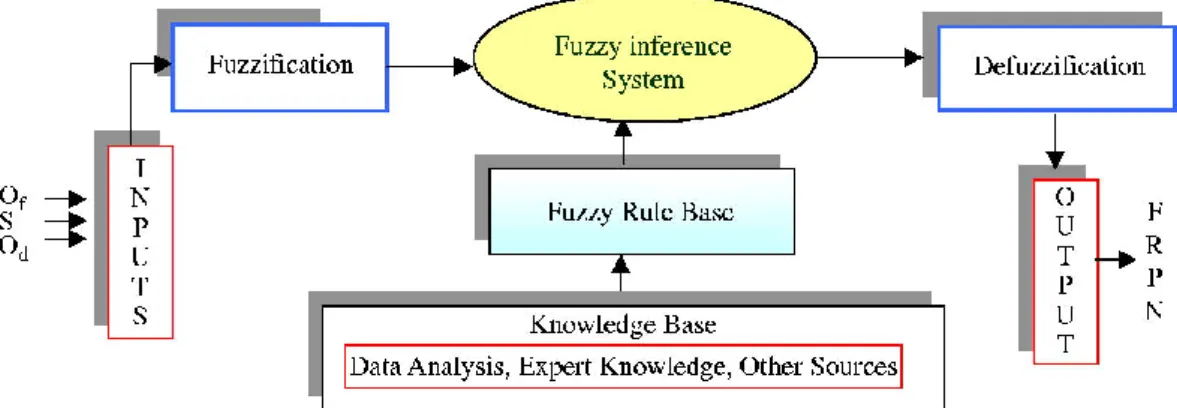
The fuzzy logic system compose of three basic steps: fuzzification, fuzzy inference, and defuzzification (Dostál, 2011), (see Figure 5).
15
Figure 5 Architecture of fuzzy decision making system. Adopted fromEmerald Insight (2014)
The first step (fuzzification of data) represents the transformation of language variables into numerical values. For instance, the variable could be characterized as very low, low, medium, high and very high. It is usually defined by three to seven attributes (terms). The degree of membership of attributes is determined by mathematical functions. Nevertheless, there are many shapes and types of membership functions that are used. Both input and output variables are defined by attribute and membership functions (Dostál, 2011).
Figure 6 The types of membership functions , . Adopted from Dostál (2011).
The second step (fuzzy inference) defines the system behaviour in terms of the rules such as <IF>, <THEN>, <WITH>. The fuzzy sets are essential to perform the fuzzy model based on that rule using an implication function. This implication functions, however, known as If-then true rule or called linguistic rule. The rules determine the input
16
and output membership functions that will be used in inference procedure. The fuzzy rules determine the fuzzy expert system. Furthermore, it is required to determine the weight of the rule in the system. It is allowed to change the weight rules during the process of optimization. The fuzzy rule base is usually constructed from the experience of the decision maker (Dostál, 2011).
For example, IF there is excellent software quality with a strong analyst capability THEN there must be less number of errors in the software. In this case excellent, strong, and less are fuzzy sets qualifying the variables software quality, analyst capability and number of errors respectively (Srivastava, Kumar, Singh and Raghurama 2010).
The third step (defuzzification) represents the reverse process of fuzzification. Defuzification is necessary to convert the output fuzzy values to linguistic values in order to present verbally the results of a fuzzy computing cycle. In the process of entering the data, the fuzzy logic system works as an automat (Dostál, 2011).
1.1.3 Contribution of fuzzy logic
As Zadeh (2008, p.2753) described, the most visible, the best understood and the most widely used contribution of fuzzy logic is the concept of a linguistic variable and the associated machinery of fuzzy if–then rules. But there are other equally important contributions which are much less visible and much less well understood. What is needed to understand the significance of these contributions is fuzzy logic in its non-traditional setting.
The machinery of linguistic variables and fuzzy if–then rules is unique to fuzzy logic. This machinery has played and is continuing to play a pivotal role in the conception and design of control systems and consumer products. However, its applicability is much broader. A key idea which underlies the machinery of linguistic variables and fuzzy if– then rules is centred on the use of information compression. In fuzzy logic, information compression is achieved through the use of fuzzy granulation (Zadeh 2008, p.2753).
In conclusion, fuzzy logic is described as an approximation process, in which crisp inputs are turned to fuzzy values based on linguistic variables, set of rules and the inference engine provided (Omran, 2010).
17
1.2
MATLAB
MATLAB is a high – level programming language and technical computing environment developed by MathWorks. MATLAB allows analysing data, developing of algorithms, plotting of functions and data and creating models and applications. The language and tools in MATLAB enable to use several approaches and reach a solution faster than with classical programming languages including C/C++ or Java (MathWorks, 2014a).
Moreover, the MATLAB deals with a range of applications, such as signal processing and communications, design and video processing, control systems, test and measurement. The language of technical computing is used by many engineers and scientists in industry and academia (Matlab, 2014a).
1.2.1 Fuzzy Logic Toolbox
The Fuzzy Logic Toolbox deals with functions, apps and a Simulink block focused on providing analysis, design and simulating systems built on fuzzy logic. The product is able to develop and analyse fuzzy inference systems and several methods like adaptive neurofuzzy inference systems and fuzzy clustering (MathWorks, 2014b; MathWorks, 2014c).
Basically, the toolbox is aimed at modelling comprehensive system behaviours using simple logic rules and shift these rules to a fuzzy inference system accordingly. Furthermore, the toolbox uses fuzzy inference blocks in Simulink and simulate the fuzzy systems within a complex model of the whole dynamic system. It is also possible to generate C code from Simulink for use in embedded applications that involve fuzzy logic. As all toolboxes in MATLAB, Fuzzy Logic Toolbox can be adjusted as well. Such revisions incorporate modifying of source code and algorithms, adding own membership or using defuzzification techniques (MathWorks, 2014b; MathWorks, 2014c).
Key features
Fuzzy Logic Design app for setting up fuzzy inference systems and viewing and analysing results
18
Support for AND, OR, and NOT logic in user-defined rules
Standard Mamdani and Sugeno-type fuzzy inference systems
Automated membership function shaping through neuroadaptive and fuzzy clustering learning techniques
Capability of including a fuzzy inference system in a Simulink model
Capability of generating embeddable C code or stand-alone executable fuzzy inference engines (MathWorks, 2014d).
,
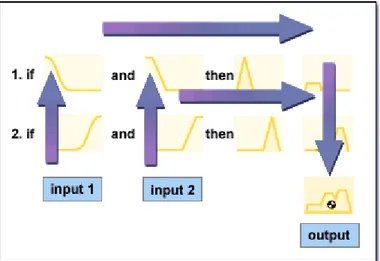
Figure 7 Fuzzy Inference Diagram. Adopted fromMathWorks (2014e)
1.2.2 Fuzzy Inference System
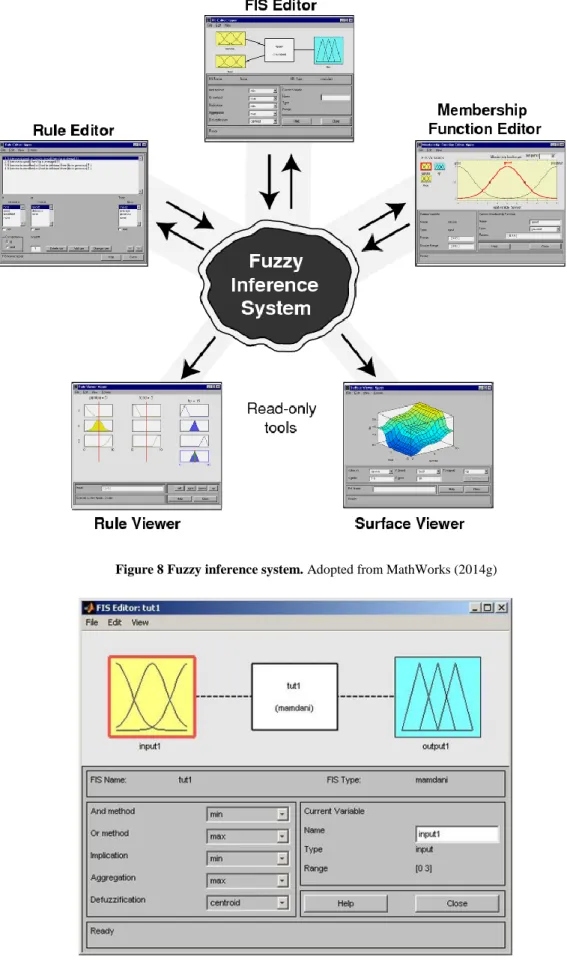
Fuzzy inference is a method that interprets the values in the input vector and, based on user-defined rules, assigns values to the output vector. Using the editors and viewers in the Fuzzy Logic Toolbox, the rules set, definition of the membership functions and analysis of the behaviour of a fuzzy inference system (FIS) can be built (MathWorks, 2014f), (see Figure 8). The following editors and viewers are provided:
FIS Editor displays general information about a fuzzy inference system. Furthermore, the input and output membership functions, the rule base and the fuzzy operators can be defined, with the FIS editor (Klingenberg 2014; MathWorks, 2014f).
19
Figure 8 Fuzzy inference system. Adopted fromMathWorks (2014g)
20
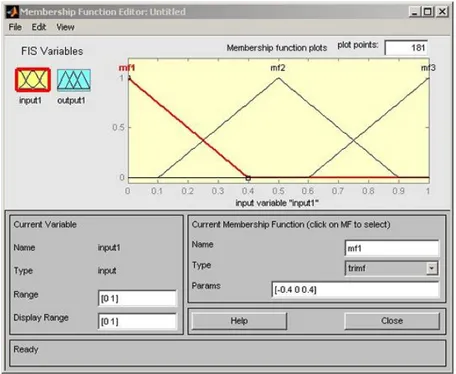
Membership Function Editor demonstrates and edits the membership functions associated with the input and output variables of the FIS (MathWorks, 2014f).
Figure 10 Membership Function Editor. Adopted from Klingenberg (2014)
Rule Editor enables to view and set up the fuzzy rules (Dostál, 2011).
21
Rule Viewer illustrates detailed behaviour of a FIS to help diagnose the behaviour of specific rules and enables evaluation of the dependence of the output on the values of inputs (Dostál, 2011; MathWorks, 2014f), (see Figure 11).
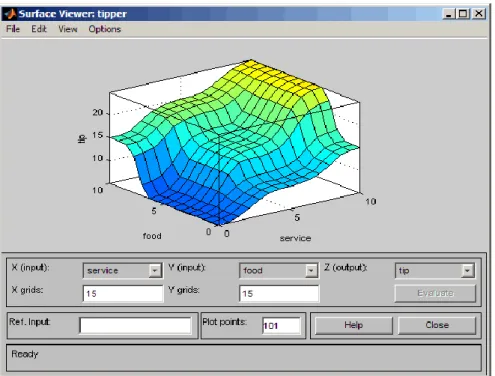
Surface Viewer generates a 3-D surface from input variables and the output of an FIS and displays dependence of single variables created by the rules (Dostál, 2011; MathWorks, 2014f), (see Figure 12).
Figure 12 Rule Viewer. Adopted fromKlingenberg (2014)
22
1.3
Software development
Basically, main objective of software development is customer satisfaction. According to Srivastava, Kumar, Singh and Raghurama (2010, p.183), software engineering is the application of a systematic, disciplined, quantifiable approach to the development, operation, and maintenance of software. The main aim of software engineering is to produce software at low cost with higher efficiency. Apart from the fact that the field is still relatively young compared to its sister fields of soft computing, there is still much discussions around what software engineering indeed is, and if it the title engineering is used properly. Software development area composes of several phases. However, software testing is defined one of the most important in all the phases of Software Development Life Cycle (SDLC).
Nevertheless, drawing on Rodrigez, Vizcino, Piattini and Beecham (2012, p. 664), Global Software Engineering (GSE) has become an increasing area of research, besides being an expanding trend in the Information Technology environment. GSE requires software tools (management tools, development tools, etc.) to encourage the specific features that this area has, and which have mainly come about as a consequence of the distance factor (temporal, geographic and socio-cultural distance).
Furthermore, modern software development, such as globally distributed teams, makes up particular challenges and risks (despite the benefits that can be gained) for the software field, which is essential to take into account. Actually, developing software systems through collaboration with other partners and in distinct geographical locations is a good opportunity for firms (Rodrigez, Vizcino, Piattini and Beecham, 2012).
Software tools for GSE should hence help to mitigate problems e.g.:
Geographic Dispersion, which sometimes causes a loss of synchronous communication or team interactions, since the sites are in different time zones.
Control and Coordination Breakdown, due to the difficulties created by a distributed environment.
Loss of Communication - this is the case in this type of environment, if we consider that the richest communication medium is face-to-face communication.
23
Cultural Differences which occur when people from different cultures work together in a global environment (Rodrigez, Vizcino, Piattini and Beecham, 2012).
Tools designed to alleviate the challenges stated above should hence comprise unique characteristic, for instance supporting the interaction of distributed teams by applying communication and collaboration technology, supporting the development of real-world projects, minimizing the cost of the tools and infrastructure needed, together with their maintenance effort or helping to make up a feeling of trust between the members, and facilitating the knowledge of team ethics within the others.
However, there is lack of information considering which tools are able to help in the aforementioned challenges, or about which specific tools offer characteristics that are appropriate to allow them to be used in a GSE area. The most that we can state is that certain surveys exist in which some of the existing tools, usually those with regard to collaboration, are shortly demonstrated. A good instance of this is in which the authors present a set of collaboration tools for GSE, classified by the fields in which they can be used (Rodrigez, Vizcino, Piattini and Beecham, 2012).
As Kelkar (2009) described, software represents both computer programmes and related documentation together. It has impact on all areas of knowledge. In general, the system plays a dual role. It is a product by itself (information ’’transformer’’). It represents the ’’vehicle’’ for delivering other products (supporting system functionality, controlling other programmes).
Characteristics of a good software:
Maintainability
o The information system must allow for changing requirements.
Dependability
o Software must be reliable.
Efficiency
o The system resources should be saved.
Usability
24
1.3.1 Software development life cycle
The development of an information system demands the commitment of valuable company resources and time. Large projects often require much more effort and take years to complete (Everett and McLeod, 2009).
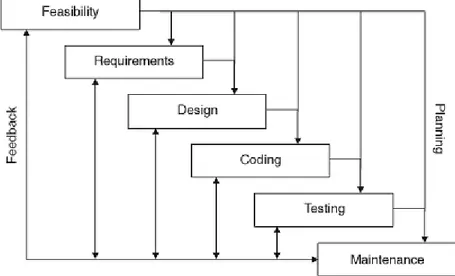
In fact, software development life cycle (SDLC) includes several phases which generally involves the planning, definition, requirements, design, building, implementation, testing and maintenance. Under each of these phases, IT professionals or project leader needs to come up with deliverables, which depend on specifications of the software system or the project itself. For instance, within the planning phase of SDLC, there are various deliverables which are needed. As the planning phase includes a high-level view of the software project, a set of aims is required to be written down. This also involves information about the financial resources. Therefore, the deliverables may include documentation like the SDLC templates (Lewis, 2008).
Figure 14 Iterative waterfall model. Adopted from (Kelker, 2009)
Within the definition stage, the deliverable represents a documentation which indicates the project plan. Within the requirements phase, the following deliverables might be demanded: a business process model (business proposal), requirements for information system, standards for the data architecture and analysis on how data will be transformed. The last two stages which involves building and implementation may need deliverables
25
as application forms, tested applications, site configuration, user training plan and software delivery (Lewis, 2008).
1.3.2 Specifying software requirements
Lewis (2008) described that the software system requirements may differ from company to company, but the main aim is clear. System’s requirements aim to standardize the set of practices used in developing an information system, as that development will be both cost – effective and feasible.
Therefore, establishing the requirements for a software product is a significant undertaking and directs the course of action for the remaining software development effort. Traditionally, requirements specifications address the overall product under development and its external interfaces. However, an important practice employed by most engineering disciplines is the specification of requirements for every element of the product architecture or design. Therefore, there are significant implications with this practice that demand that the complete software architecture be formulated, including a specification for each element of the software product and associated post-development sustainment processes (Schmidt, 2009, p.10).
Drawing on Schmidt (2009, p.10), the software requirements specifications for the product guide the definition of the product architecture, software implementation, and software test and evaluation efforts. Requirements that are nonessential, over-specified, or introduce unacceptable risks place the project in jeopardy of being unsuccessful. This represents a situation where the software development team may attempt to do too much with too. Projects are constrained by the amount of resources available to produce a product. Project budget and schedule objectives must be the primary focus when establishing product requirements.
However, every software product is intended to serve a purpose and the software requirements should represent those product features and performance factors that enable the product to serve its purpose. Software products may support a business process, control the operation of a system or process, support data gathering and analysis activities, guide work productivity by automating mundane tasks, or provide some entertainment relevance. Thus, there exists a significant cost-benefit motivation for every software development undertaking that must be appreciated. Caution must be taken when
26
establishing software requirements that broaden the scope of the development effort beyond the means of the project to achieve its objectives. Improperly extending the software product scope sets the development effort on a path destined for failure. Every requirement implies a level of effort necessary to devise a suitable solution. Managing the scope of the software engineering undertaking is essential to the success of each and every development project (Schmidt, 2009, p.10).
1.4
Software Project Environment
The effective and profitable execution of a software engineering project involves an understanding of the complex interactions and dependencies inherent in the project environment. This knowledge must be fortified with a set of supervisory tools that provide information concerning the current status of tasks and work products. This information contains obscure symptoms of potential situations that threaten the project’s success or software product’s quality and competitiveness in the marketplace. Software engineering exploits this information to permit its attentive practitioners to recognize disruptive trends and react in a positive manner to neutralize the root causes of problematic conditions (Schmidt, 2009, p.55).
There are three fundamental management tools that are used to guide a project toward successful completion. The first is the integrated master plan (IMP), which identifies the organizational roles and responsibilities, tasks to be performed, and expected outcomes. The second is the integrated master schedule (IMS), which provides a timeline of key events, milestones, reviews, and decision points. And finally, there is the project budget, which identifies the resources that are allocated to each organization to enable the execution of planned tasks. However, these project management instruments must be properly developed, monitored, and adjusted to reflect the ambiguity inherent in task estimation. Initial planning forecasts of anticipated productivity, performance, and results must account for project uncertainty (Schmidt, 2009, p.55).
Software development projects are established with the aim of delivering a “new” software product to one or more customers. Therefore, until the software product definition is relatively complete, the project plans will always be imprecise. This implies that the project plans, schedules, and budgets are simply tools that direct the project team toward the definition, design, implementation, testing, documenting, and delivery of a
27
software product. The dilemma faced by the project team is determining how to define the software product in such a manner that the project goals and objectives can be satisfied. Inherent in this situation is the fact that project plans, schedules, and budgets are simply a means to an end to the successful delivery of a software product on time (according to schedule) and without exceeding authorized funding thresholds (according to budget). As long as the project team can define and deliver an acceptable software product by the delivery date and does not expend more resources than authorized, the project should be deemed successful (Schmidt, 2009, p.56).
Within the project environment there exists a variety of decision points that represent opportunities to maintain the project scope so that goals and objectives can be attained. Software engineering practices and tools are structured to recognize when the definition of the software product presents an opportunity to revisit the project plan. At each opportunity, a decision must be made on which way to proceed among alternative approaches. Making proper architectural design decisions involves the following factors:
Understanding the product functions and characteristics that are important to stakeholders (requirements analysis).
Determining how each product characteristic will be provided (functional analysis and design synthesis).
Identifying which design approach best serves the current product stakeholders and the envisioned stakeholder community or customer base (trade-off analysis).
Eliminating unknown conditions that improve the likelihood of achieving project and product objectives (risk assessment).
Ensuring that every function or characteristic is necessary to the operation of the product and not in excess of what is needed (verification and validation).
Controlling product complexity to simplify software operational and support costs (integrated product and process development, IPPD).
Refining technical and project plans, schedules, and budgets to reflect the selected course of action (control) (Schmidt, 2009, p.57).
Fundamentally, the software product architecture determines the project effort necessary to successfully implement, test, deliver, and support the product throughout its life cycle. If the project definition is allowed to drive the software product definition, then the product may be less beneficial and noteworthy in a competitive environment.
28
The project scope must be aligned to provide the resources (personnel, facilities, equipment, tools, budget, schedule, etc.) necessary to define, design, implement, test, and deliver the software product to its customers. The software product must be developed to accommodate the needs and expectations of all stakeholders, including users, support staff, training staff, investors, and enterprise management. When the product definition and project scope are unbalanced, then the software engineering, technical, and project management teams must collaborate to stabilize the situation (Schmidt, 2009, p.57).
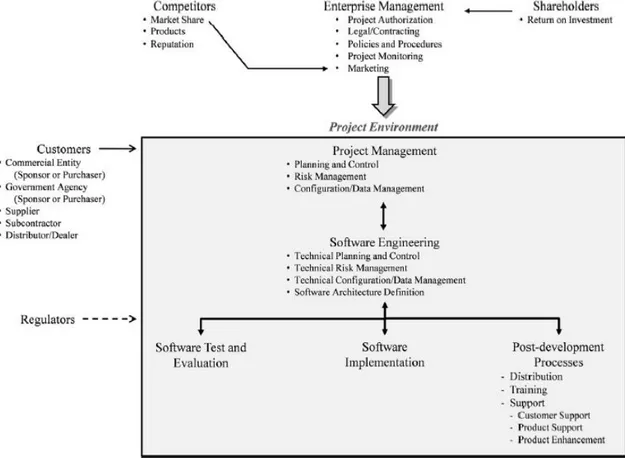
The software engineering effort represents the total technical effort within the project scope. As such, the software engineering leadership is responsible for defining the software product architecture in a manner that is consistent with the project scope. When it is perceived that the product value to its customers (consumers, operators, investors, etc.) can be enhanced with the application of additional project resources, then change proposals are generated to establish the merit of the enhancement. This occurs whenever the enhancement cannot be accommodated within the established project cost and schedule objectives. Figure 10 depicts the role of software engineering within a project environment (Schmidt, 2009, p.57).
Figure 15 Role of software engineering within a project environment. Adopted from (Schmidt, 2009, p.58).
29
1.5
Software testing
Software testing can be defined as the execution of a program against Test cases with the intent of revealing faults. The different testing techniques are defined based on the artefact used to derive Test cases. Functional – or black-box – testing derives Test cases from the specification or description of a program; structural – or white-box – testing derives Test cases from implementations; fault-based testing derives Test cases from fault models based on common mistakes committed by programmers; and model-based testing derives Test cases from system specification models. To deem a software system correct, one could test every possible element of the system's input domain and check whether the output is consistent with the expected output (Lemos, Ferrari, Eler, Maldonado and Masiero, 2012).
However, even for simple programs this is usually infeasible, because the input domains tend to be very large (imagine, for instance, the input space of a compiler system). Therefore, a large portion of testing research focus on proposing ways to select meaningful subsets of Test cases to enhance the chance of revealing faults. Based on the categories of testing techniques described above, several testing selection criteria were proposed (Lemos, Ferrari, Eler, Maldonado and Masiero, 2012).
Besides testing techniques and criteria, there are many other aspects involved in the testing activity. For instance, in general, it is too expensive to test programs manually; therefore, software testing usually relies on tools to automate the Test case generation, execution, and results gathering. After faults are revealed while testing the programs, they must be localized and fixed. This activity is usually not included under the software
testing activity, being called debugging (Lemos, Ferrari, Eler, Maldonado and Masiero,
2012).
Since it is closely related to testing, we decided to include papers concerned with it in our survey. Other topics that are important to software testing and were included are the following: fault-injection, which consists in intentionally introducing known failures into the system during its execution to evaluate if the system is robust enough to recover without crashing regression testing, which consists in selectively retesting a system to verify whether modifications have not caused unwanted effects and testing strategy, which consists in the way by which Test case design methodologies are combined to
30
provide an effective testing activity (Lemos, Ferrari, Eler, Maldonado and Masiero, 2012).
Software Testing is an important process of software development which is performed to support and enhance reliability and quality of the software. It consists of estimating testing effort, selecting suitable test team, designing Test cases, executing the software with those Test cases and examining the results produced by those executions. Studies indicate that 40-50 percent of the cost of software development is devoted to testing, with the percentage for testing critical software being even higher (Lemos, Ferrari, Eler, Maldonado and Masiero, 2012).
As such software testing is the process of validation and verification of the software product. Effective software testing will contribute to the delivery of reliable and quality oriented software product, more satisfied users, lower maintenance cost, and more accurate and reliable result in day to day working environment of software professionals. However, ineffective testing will lead to the opposite results, low quality products, unhappy users, increased maintenance costs, unreliable and inaccurate results.
Hence, software testing is a necessary and important activity of software development process. Myers states that “Software Testing is the process of executing a program with the intent of finding errors”. The importance of testing can be understood by the fact that “around 35% of the elapsed time and over 50% of the total cost are involved in testing programs” (Srivastava, Kumar, Singh and Raghurama, 2010, p.183).
Practitioners are generally short of time or resources and tend to perceive systematic testing as not so very lucrative job. However, it affects overall software life cycle, because quality of software life cycle depend upon testing technique demanding adequate Test case preparation, modeling, and documentation which make the process complicated and challenging. These impending challenges have to be addressed by researchers and practitioners working closely together by estimating the amount of effort that is required to develop user-friendly software (Srivastava, Kumar, Singh and Raghurama, 2010, p.183).
31
1.5.1 Testing Types
Manual testing
Manual testing involves the testing of the software manually for instance without using any automated tool or any script. Therefore, the tester takes over the role of an end user and test the software to detect any unexpected behaviour or bug. Manual testing includes various levels like Unit testing, Integration testing, System testing and User Acceptance testing (Khan, 2011; Tutorialspoint, 2014).
In order to test the software and ensure the completeness of testing, testers use test plan, Test cases or test scenarios. Manual testing also includes initial testing as testers investigate the software to determine defects in it (Khan, 2011; Tutorialspoint, 2014).
Automation testing
Automation testing also known as “Test Automation” includes software testing when the tester writes scripts and utilizes another software for testing. This process incorporates automation of a manual process. Automation testing aimed at rerunning the test scenarios that were performed manually, quickly and repeatedly. Besides regression testing, automation testing is also utilized to test the application from load, performance and stress point of view. It growths the test coverage, improve accuracy, saves time and money by comparison to manual testing (Khan, 2011; Tutorialspoint, 2014).
However, it is impossible to automate everything in the software. Hence, the areas at which user can make transactions such as login form or registration forms etc., any area where large amount of users’ can access the Software simultaneously should be automated. Moreover, all GUI items, connections with databases or field validations could be efficiently tested by automating the manual process (Khan, 2011; Tutorialspoint, 2014).
1.5.2 Levels of testing
Software testing is the process of accessing the functionality and correctness of a software through analysis. It also identifies most important defects, flaws, or errors in the application code that must be fixed. The system must be tested in steps with the planned build and release strategies. The key to successful testing strategies selecting the right
32
level of test at each stage in a project. The level of testing have a hierarchical structure which build up from the bottom-up where higher level assume successful and satisfactory completion of lower level test. Each level of test is characterized by an environment i.e. type of people, hardware, data etc. and these environmental variables vary from project to project. Each completed level represent a milestone on the project plan and each stage represents a known level of physical integration and quality. These integrated stages are known as level of testing (Khan, 2011).
Unit Testing
Unit testing represents the first and the lowest level of testing. In this level, respective components of software are tested. Unit testing is performed by individual developer on individual units of source code assigned areas. The aim of unit testing is to separate each part of the programme and show that individual parts are correct in terms of requirements and functionality. Therefore it helps to expose defects that might be hidden (Khan, 2011). However, there are certain bounds of scenarios and test data that the developer can use to verify the source code. So when the developer exhausts all options there is no choice but to stop unit testing and unify the code segment together with other units (Tutorialspoint, 2014).
Integration Testing
Integration testing represents the level after unit testing where either the developer or an independent tester performs testing. The goal of integration testing is to test combined parts of a software and determine if they function correctly together. Furthermore, integration testing aimed at verifying functional, performance and reliability requirements placed on major design items. The importance of integration testing must not be overlooked due to the fact that approximately 40% of software bugs are exposed during testing. There are two types of integration testing:
Bottom-Up Integration testing
Top-Down Integration testing
In a comprehensive software development environment, Bottom-Up testing is usually done first, followed by Top-Down testing (Khan, 2011; Tutorialspoint, 2014).
33
System Testing
System testing begins after completion of integration testing. Once all the components are integrated, the application as a whole is tested rigorously to see that it meets Quality Standards. System testing represents the first step in Software Development Life Cycle, where the application is tested as a whole. The application is tested in an environment which is very close to the production environment where the application will be deployed. System Testing enables us to test, verify and validate both the business requirements as well as the Applications Architecture. This type of testing is performed by a specialized testing team if there is one (Oladimeji, 2007; Tutorialspoint, 2014).
Acceptance Testing
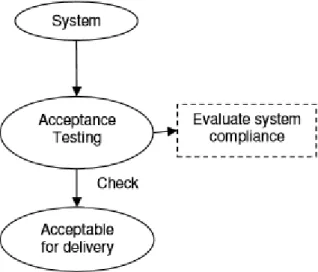
In software engineering acceptance testing is a level of software testing where the system is tested for user acceptability. This is arguably the most important type of testing as it is performed by the Quality Assurance Team who will appraise whether the application meets the intended specifications and satisfies the client’s requirements. Acceptance testing is performed after system testing and before making the system available for actual use.
Acceptance tests are not only intended to point out simple spelling mistakes, cosmetic errors or Interface gaps, but also to point out any bugs in the application that will result in system crashers or major errors in the application. By performing acceptance tests on an application the testing team will deduce how the application will perform in production. There are also legal and contractual requirements for acceptance of the system (Khan, 2011; Tutorialspoint, 2014).
34
Figure 16 Acceptance testing. Adopted from Khan (2011).
Regression Testing
Unlike the previous levels of testing discussed, regression testing spans through the testing phase. Important reason for regression testing is that it is often extremely difficult for a programmer to find out how the changes in one part of the software effects the other part. Hence,regression testing is carried out whenever the system is modified either by adding new components during testing or by fixing errors. Its goal is to determine if modification to the system has introduced new errors in the system.
Therefore, the quality of a system is directly connected to good regression testing. Furthermore, regression testing is a very important aspect of the system maintenance. There are three types of regression testing techniques namely selection, prioritization and minimization (Oladimeji, 2007; Khan, 2011; Bhasin, Gupta and Kathuria, 2013).
35
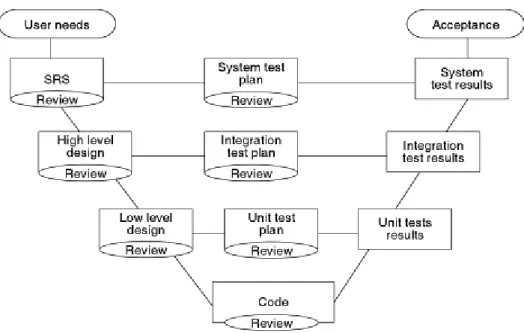
Figure 17 Verification, validation and testing: schematic. Adopted from Kelkar (2009, p. 31)
1.5.3 Test case Development
As a tester, the best way to determine the compliance of the software to requirements is by designing effective Test cases that provide a thorough test of a unit. So basically, a Test case represents a detailed procedure that fully tests a feature or an aspect of a feature. While the test plan describes what to test, a Test case describes how to perform a particular test. Therefore, it is needed to develop Test cases for each test listed in the test plan. Set of Test cases is called Test case suite (Bhasin, Gupta and Kathuria, 2013; Symbiosys Technologies, 2013).
General Guidelines
Moreover, various Test case design techniques enable the testers to develop effective Test cases. Besides, implementing the design techniques, every tester needs to keep in mind general guidelines that will aid in Test case design:
The purpose of each Test case is to run the test in the simplest way possible.
Concentrate initially on positive testing i.e. the Test case should show that the software does what it is intended to do.
36
Existing Test cases should be enhanced and further Test cases should be designed to show that the software does not do anything that it is not specified to do i.e. Negative Testing
Where appropriate, Test cases should be designed to address issues such as performance, safety requirements and security requirements
Further Test cases can then be added to the unit test specification to achieve specific test coverage objectives. Once coverage tests have been designed, the test procedure can be developed and the tests executed (Symbiosys Technologies, 2013)
1.5.4 Prioritization of software testing
The prioritization of Test case becomes all the more important owing to the fact that it is not feasible to run all the Test cases after each and every change. Once a change is made it is not possible to retest all the Test cases of the test suite as it will consume lot of time. Therefore, prioritization of the Test cases has been widely proposed and used in recent years as it can improve the rate of fault detection during the testing phase (Chaudhary, Sangwan and Singh, 2012).
Generally, prioritization is used when the time for the testing is limited. In order to attain maximum coverage, the more important cases are tested. However for this purpose, fuzzy expert system should be selected because of better decisions made by it in comparison to the normal expert system. Basically, fuzzy expert system provides a better way of prioritizing the Test cases (Bhasin, Gupta and Kathuria, 2013).
In the work conducted by Zhewei Xu, Kehan Gao and Taghi M Khoshgoftaar, a fuzzy expert system has been proposed so as to select the Test cases when information of the source code is not available to testers. The system takes different Test cases as inputs and determines test importance accordingly (Bhasin, Gupta and Kathuria, 2013).
37
2
PROBLEM ANALYSIS AND CURRENT SITUATION
2.1
Company profile
BIAC GmbH (Business Insurance Application Consulting) is the IT and SAP Competence Centre primarily of the VIG (Vienna Insurance Group). The company supports the business processes of its clients of VIG and also for clients outside the VIG group with solutions based mainly on SAP. The service extends from consulting to the correct application up to development of specific solutions for the insurance industry, including planning, implementation, support and training and constant updating (BIAC, 2014a; BIAC 2014b).
BIAC basically offer holistic solutions with several complex services – from Customer consulting to Project Management to Hosting services and Service levels. The company enables to offer the services separately as well. The approach is based on the developing all systems in such a way as to offer the highest possible quality within a business framework. The main focus lies clearly on SAP Insurance and its surrounding systems (BIAC, 2014a; BIAC 2014b).
History
1985 - Separating of the IT division from WIENER STÄDTISCHE Versicherung and
founding of Metropolitan Datenservice GmbH.
2005 - Foundation of BIAC Business Insurance Application Consulting as legal successor to Metropolitan Datenservice GmbH and to Central Point Insurance IT-Solutions (CP)
2008 - Foundation of the wholly-owned subsidiary B&A in Ostrava, CZ
2010 - Acquisition of 30 % of AIS s.r.o. in Brno, CZ
2010 - Integration of TBI-Info in Sofia, Bulgaria for the implementation of the SAP in Bulgaria (BIAC, 2014a)
38
2.2
BIAC Services
Project Management
In general, taking into consideration systematic project management, it is the vital requirement for the successful management and implementation of projects along the way of all their stages. With regard to BIAC’s company, a project contract is developed for each project and mutually agreed to the company and the customer. The attainment of the project aims depends on all the phases of the project, from planning, through implementation and testing up to its successful conclusion.
Therefore, starting with the project requirements as defined by the client, a description of the project (a business case) with project plan, description of approach, extent, dependencies as well as a schedule with clear phases and milestones, including coordination of third parties and a technical design concept of the subject of the project is designed. The project management team thereby takes over control of the project with the establishment of the processes, the management of the extent of the project taking into account possible changes in requirements, quality control, schedules, costs and dependencies (BIAC, 2014c).
Test Management
Test management supports the activities of planning and test development. Hence, proper test management is critical to the success of a project. It covers the areas of test organisation, planning, automation and stand-alone active test implementation, test data management and reporting of the test results. The task of the cross function “Test Coordination and Test Automation” is the support of the development team in all test activities.
Within the framework of test organisation all activities are planned, documented and agreed with the development teams and specialist departments; the infrastructure is prepared, the testers are instructed about test scenarios and so on. It develops the information interfaces between the specialist department/s, BIAC and external providers. Besides that, other tasks include monitoring and reporting of test activities and test evaluation for the project leadership and overall product leadership (BIAC, 2014d).
39
Support services
All current requirements are covered with quick response times by the support services. Whole process starts with the ticket registration and processing at the support desk up to the Key User support and User Management. In addition, other important support services consist of change-request registration, its processing and evaluation and problem processing for production releases. However, the major concerns also dealt with IT security and ensuring of knowhow through training (BIAC, 2014e).
There are also further support services incorporated such as:
First and Second Level Support
MSA Application Support
Third Level Support
SAP Userline (BIAC, 2014e).
Business consulting
Business consulting offers support with the analysis and development of the specialist tasks and blueprints and, together with the client, defines the requirements in a prospective integrated solution. Superlative industry knowledge along with deep knowhow of process solutions in SAP applications together make up the basis for the realisation of sophisticated client solutions (BIAC, 2014f).
Solution consulting
In Solution consulting the step-by-step realisation of the IT technical client solution on the basis of the formulated specialist requirements takes place. SWD Software Development provides professional support and conduct in all software development phases. The services provided include support and advice in the creation of technical blueprints, SAP and non-SAP software development, test, quality and performance management, as well as migration support and the handover of the developed software into production systems (BIAC, 2014g).
40
Architecture
The function of the architecture is to view the application and project portfolio in its entirety and to highlight potential for improvement. Whilst doing so it also has in mind the TCO (Total Cost of Ownership) of IT to the VIG. This happens mainly in the framework of duties associated with projects under the title of the Architecture Board, when needed also through timely reviews in the framework of an Architecture Check. Concrete duties in close collaboration with the projects within the framework of a project include:
Establishment of the current and desired architecture of the application affected by the project
Impact analysis on associated applications
Checking the list of applications affected by a project for its completeness
Definition of cross over scenarios and the necessary interfaces for them
Identification of intersections with already existing functionalities or functionalities developed in parallel in other projects
Standardisation of the entire functionality and ensuring its use
Separation of specialist requirements into components in special cases
Checking the compliance of architecture standards
Clarification of technical and organisational effects of requirements on operations and costs
Functions of architecture not directly involved in the project include: architecture standards, suggestions for process optimisation regarding project development (e.g. early definition of hardware requirements) and suggestions for the reduction of the Total Cost of Ownership (TCO) for projects (BIAC, 2014h).
41
Quality Management
Quality Management tasks include:
Description of the enterprise from a systemic, integrated point of view (QM manual; guidelines, templates, BIAC Q-targets/standards)
Creating of templates for QM documents (reports, procedure instructions, enquiry catalogue, checklists etc.)
Carrying out audits (projects, QM systems etc)
Quality assurance related to development (checks for project documents such as PHB, PMHB etc) coordinated with the relevant BIAC and SAP QA activities (QA KPIs)
Providing an integrated description of the as-is situation of the enterprise (management review)
Support with the development/derivation of Q targets/SLAs/KPIs, reporting, Q gates
Platforms for improvements (e.g. KVP etc.)
To provide a description of how our clients/contact persons see us (client feedback)
Involvement in all activities and tasks in order to maintain the QM relevant points/tasks/topics
Competent contact partner for enquiries about the relevant standards (ISO 9000ff; 19011; 10005ff)
Supporting standardization. Input for the topic of Corporate Identity and formal minimal requirements for documents (e.g. version control)
Interface to Q certification organisations
Offers of the relevant training
Monitoring easy traceability of relevant documents (guidelines, templates, lists of documents) and delivery of input for improvement
Making tools for quality control (CAST, Code Inspector) in important core processes available and overall monitoring
42
2.3
Modules in SAP Insurance system
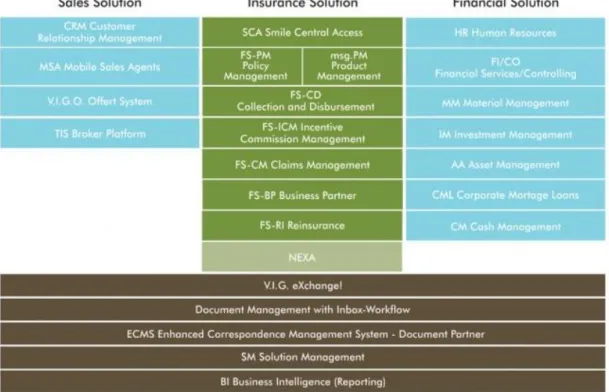
FS-PM – Policy Management
SAP Policy Management is a division-overlapping policy management system which is suitable for both regional and global market oriented insurance enterprises. This is ensured by its inclusion within the SAP landscape (BIAC, 2014i).
msg.PM – Product Management
msg.PM (Product Management) is used for insurance product calculations (rates, tariff checks, balance sheets) across all lines of business for SAP Insurance modules. It is always used in combination with FS-PM (BIAC, 2014i).
FS-CD – Collection and Disbursement for payments in/out
FS-CD manages collection and disbursement tasks across all lines of business, including current accounting, payment processing, incoming payment processing, correspondence and dunning. It also displays key account, corporate, broker and coinsurance business information (BIAC, 2014i).
43
FS-ICM – Incentive Commission Management for commissions
The SAP Module FS-ICM is a cross sector solution that allows companies to manage all types of commissions and incentives paid both to employees and to partners. It provides up-to-date and transparent information about all previously earned and expected commissions and incentives. FS-ICM is a management instrument used to realise strategic corporate goals using monetary and/or non-monetary incentives, e.g. by increasing sales, by improving quality, reducing costs or other forms of adding value (BIAC, 2014i).
FS-CM – Claims Management for damages/indemnification
The SAP module FS-CM is used to set up and manage settlement claims for non-life insurance policies and benefit entitlement claims for life insurance policies (BIAC, 2014i).
FS-BP – Financial Services Business Partner for the management of partner data
FS-BP is used to store and manage information on business partners in a central application. This can be of particular interest when a company has more than one business relationship with a specific partner, e.g. as an existing supplier and a prospective customer. FS-BP utilises information technology benefits (e.g. data integrity and the elimination of redundant data) and, at the same time, facilitates customer service and new customer acquisition (BIAC, 2014i).
FS-RI – Reinsurance
The FS-RI module allows comprehensive management of active and passive reinsurance policies and contracts. Reinsurance is insurance for insurers. Reinsurance means that the direct insurer has transferred part of the policy risk, payments and premiums to another insurer (the reinsurer). The reinsurer in turn balances its risk by taking over the “risks” of several direct insurers. FS-RI has been designed for use in both active and passive reinsurance and offers direct insurers, reinsurers and agents flexible means of managing and administrating their reinsurance policies (BIAC, 2014i).
44
2.4
Process of software testing in BIAC
2.4.1 Test Management tasks
As already mentioned above, Test management in BIAC supports the activities of planning and test development as software testing is a necessary and important activity of software development process. In general, effective software testing will contribute to the delivery of reliable and quality oriented software product, more satisfied users, lower maintenance cost, and more accurate and reliable result in day to day working environment of software professionals.
Therefore, proper test management is critical to the success of a project. As a tester, the best way to determine the compliance of the software to requirements is by designing effective Test cases that provide a thorough test of a unit. So basically, a Test case represents a detailed procedure that fully tests a feature or an aspect of a feature. In other words, Test cases are flows or sequences of so-called Test Steps which are processed in the test object.
The test process, roles and responsibilities that are in place are defined with the support of renowned consulting firms and correspond to the customary international standards (ISO 9126). The members of the test management team are also trained and certified to the customary international standards (ISTQB). The test processes and tools used correspond to the standard recommendations for SAP implementation projects (BIAC, 2014j).
2.4.2 Test coordination
Moreover, there are a number of activities that must be carried to ensure tests are organised effectively. The careful preparation of test concepts and joint planning and agreement on test activities between the development team and the department is the first step in this process and should be based on defined and established test processes (guidelines smile test concept) (BIAC, 2014j).
Test organisation also extends to the preparation of the test infrastructure, which includes the organisation of rooms, equipment, systems, user rights and software installations. The nominated testers are offered wide support in the test preparation phase. This ranges from the provision of test documentation templates, advice on how to
45
describe test scenarios and test cases, risk analysis and test case prioritisation, roles and rights assignment, training in how to use the test tools (SAP Solution Manager, Support Desk), as well as guidance in preparing reports and preselecting test data.
With regard to test plans and test packages (work lists for testers), they are provided at the end of the test preparation phase. During the actual test process, the test coordination team serves as the information interface between the department(s), BIAC and the external providers.
Further tasks carried out during the test process include test status tracking, the monitoring of test and error resolution progress, the provision of test reports to the departments and project management teams, as well as the preparation of go-live recommendations and final test reports. Consolidated reporting of the results of the departmental tests and BIAC regression tests to release management forms the basis for a go-live decision (BIAC, 2014j).
2.4.3 Test automation
Test automation is an important aspect in comprehensive test management. In addition to the manual tests, automated regression tests are also an absolute necessity and are regularly required. Test automation activities include the establishment of an automated regression test portfolio to safeguard production applications and support projects, regular mechanical regression tests (“smoke tests”) to control quality in test systems after project changes or changes to production applications, as well as regular application of the automated regression test portfolio during the project and release test phases (BIAC, 2014j).
2.4.4 The execution of Test cases
From the BIAC point of view, all required input and verification parameters are specified in the Test cases, especially in the software tool for testing TOSCA Commander™. The execution of Test cases can be initiated by any user, no specific technical know-how is thus required. Therefore, this provides the advantage that everyone, even without special of knowledge TOSCA Commander™ (business unit) can create, administrate and execute Test cases, but the Test cases and results can nevertheless be administrated in a central tool (and together with automated Test cases) (BIAC, 2014j).
46
The execution of a Test case can be started directly in TOSCA Commander™ or by directly starting TOSCA Executor. This flexibility is based on the use of test set data files, which contain the actual information for the execution of a Test case. During the execution via TOSCA Commander™ these test sets are created automatically. If required, they can be created manually by experienced users.
Furthermore, each Test case is defined in MS-Excel according to the defining rules of the Test Management Team. This requires an Excel spreadsheet, which organizes the test data in rows and columns. Test cases are represented by columns; particular data sets are represented by rows. The Excel-sheets contain an identification so that a selected policy with the additional check criteria will be used for a certain test execution. The policy numbers are referenced analogue to the regression Test cases with previously generated policies (BIAC, 2014j).
47
3
PROPOSALS AND CONTRIBUTION OF SUGGESTED
SOLUTIONS
In order to determine the Test case prioritization several software tools are proposed. The conceptual design can be implemented using any proper computer programming language and data base management technology. As fuzzy logic is a convenient way to map an input space to output space, a fuzzy based technique for assigning priority of Test case has been chosen. With this regard, the solution in the programme MS Excel and MATLAB is presented in master’s thesis.
Taking into consideration proposed programmes, Microsoft Excel is a software programme included in the Microsoft Office suite of applications, which allow users to organize, format and calculate data with formulas using a spreadsheet system (Janssen, 2014). Moreover, using Microsoft Excel it is possible to integrate fuzzy logic decision-making with the existing source of data.
As was already mentioned in previous chapter, MATLAB is a high – level programming language and technical computing environment developed by MathWorks. MATLAB allows analysing data, developing of algorithms, plotting of functions and data and creating models and applications. In comparison to Microsoft Excel, MATLAB using Fuzzy Logic Toolbox is able to design and simulate fuzzy logic systems based on fuzzy logic principle.
So as to process and compute analysed data, firstly input data needs to be defined. Therefore, in the following chapter different criteria (variables) considered for assigning weight will be elaborated based on priorities of test coordinators in BIAC. Basically, each input variable represents one decision criterion. In order to assign its weights (attributes), input variables are classified based on their importance in the test environment.
48
3.1
Input variables
Test cases often differ in execution in terms of specifying specific values or environment information. In addition to business-based processes, information, which is derived from the execution environment and should be used in Test Steps and Test Step Values (or in Modules) plays a major role. Nevertheless, following 8 different criteria (variables) and its weight are determined and depicted below based on priorities of test coordinators in BIAC.
Number of Test steps
Test steps are executable actions which are executed in the test object. The input variable Number of Test Steps has been divided into five intervals according to executed steps count as shown in Table 1.
Number of verification steps
A Test case describes an elementary and functional sequence, which is used for the verification of one or several properties underlying a specification. However, the value that is expected according to the Test case specification does not always correspond to the value provided by the test object. Therefore, it is verified whether a particular state is reached or not with comparison to specified value. So basically, number of verification steps involves eventual number of stages (steps) necessary to verify results with desired values. This criterion is described by 5 categories depicted in Table 1.
Module integration complexity
Integration metric defines aspect of complexity of component-based software. This criterion takes into account number of interfaces (interactions) with other components. Module integration complexity variable is sorted into 4 intervals ill