USF Scholarship: a digital repository @ Gleeson Library |
Geschke Center
Doctor of Nursing Practice (DNP) Projects Theses, Dissertations, Capstones and Projects
2010
Exploring the Value of Group and Traditional
Obstetrical Appointments to Reduce Health
Disparity
Helene M. Holbrook
University of San Francisco, [email protected]
Follow this and additional works at:https://repository.usfca.edu/dnp Part of theMaternal, Child Health and Neonatal Nursing Commons
This Project is brought to you for free and open access by the Theses, Dissertations, Capstones and Projects at USF Scholarship: a digital repository @ Gleeson Library | Geschke Center. It has been accepted for inclusion in Doctor of Nursing Practice (DNP) Projects by an authorized administrator of USF Scholarship: a digital repository @ Gleeson Library | Geschke Center. For more information, please [email protected].
Recommended Citation
Holbrook, Helene M., "Exploring the Value of Group and Traditional Obstetrical Appointments to Reduce Health Disparity" (2010).
Doctor of Nursing Practice (DNP) Projects. 4.
Exploring the value of group and traditional obstetrical appointments to reduce health disparity
Helene M. Holbrook, FNP-C
Abstract
Disparity in health outcomes is influenced by socioeconomic factors that may include
access to important healthcare information in a culturally sensitive way. Can a group
appointment model like the CenteringPregnancy model provide a more effective means for
engaging Spanish-speaking pregnant women? Research studies using the group prenatal
appointment model show increased pregnancy knowledge, readiness for labor and higher
satisfaction compared with individual prenatal appointments. This paper discusses the
importance of reducing disparities in birth outcomes using a group appointment model conducted
Introduction
In addition to direct care, Doctor of Nursing Practice /Nurse Practitioners (DNP/NP)
emphasize care of individuals’ understanding of the practice context in order to document
practice trends, identify potential systemic changes, and make improvements in the care of their
particular patient populations in the systems within which they practice.
Raphael (2008) reinforces the social concept of need:
Social determinants of health are the economic and social conditions that shape the
health of individuals, communities, and jurisdictions as a whole. Social determinants of
health are the primary determinants of whether individuals stay healthy or become ill (a
narrow definition of health). Social determinants of health also determine the extent to
which a person possesses the physical, social, and personal resources to identify and
achieve personal aspirations, satisfy needs, and cope with the environment (a broader
definition of health). Social determinants of health are about the quantity and quality of a
variety of resources that a society makes available to its members. (p. 16)
Debate exists over what causes health disparities among ethnic and racial groups (WHO
2008). However, it is generally accepted that disparities can result from three main areas: (a)
personal, (b) socioeconomic and (c) environmental characteristics among ethnic and racial
groups. Evidence continues to evolve of the confluence of the social determinants of health on
community health (Goldberg, 2004). These determinants include barriers certain racial and
ethnic groups encounter when trying to enter into the healthcare delivery system and from the
Disparities in early and adequate prenatal care and infant/maternal outcomes still exist between
white and nonwhite populations. Medicaid expansions are intended to improve outcomes,
although eligible women often delay enrollment and barriers to healthcare remain (USDHHS,
2000).
Despite the presence and use of safety net providers that do increase prenatal care use
among minorities, troubling disparities still exist between white and nonwhite populations in the
United States in terms of early and adequate prenatal care and pregnancy outcomes, such as
infant/maternal mortality and low birth weight (LBW) (Martin, 2003). For example, whereas
68% of black non-Hispanic and Hispanic women received early (by the fourth month) and
adequate (80% or more of recommended visits) prenatal care in 2002, 79% of white
non-Hispanic women did not (National Center for Health Statistics, 2005). The Healthy People 2010
goal is 90% for all groups (USDHHS, 2000). Both LBW and preterm birth have been associated
with increased risks of infant mortality and developmental disabilities, such as mental retardation
and cerebral palsy (Avchen, Scott, & Mason, 2001). These disparities remain despite large
investments in the public health infrastructure, expansions of Medicaid coverage for low-income
women and infants, income policies and a decade of economic growth, now overshadowed by a
stressed economy.
Eliminating disparities in infant mortality and the use of pregnancy- and delivery-related
medical care remain critical goals for 2010. Lu (2003) uses The National Institutes of Health
(NIH) assertion that one of the greatest research challenges is "unraveling the underlying reasons
for ethnic variations in low birth weight and preterm delivery” (p. 16). This evidence lends
support to policies to maintain safety net providers, which are perhaps better equipped than
racial/ethnic groups by office-based healthcare providers (USDHHS, 2000). The role of
community healthcare facilities, which are more likely to participate in Medicaid and group
appointments, should be considered. The community health center setting, by law, is located in
medically underserved communities where they play a critical role in providing care to minority
populations. Although non-Caucasians represent one-third of the U.S population, half the
patients who receive care at community health centers are persons of color (Rosenbaum, 2009).
A broad set of factors related to racial and ethnic health disparities affect trust, perceived
eligibility, and need (Smedley, 2002). These factors include cost barriers, poor services in poor
communities, cultural and communication barriers, fear of the healthcare system and problems in
relationships between patients and providers. (Mullins,2005) The clear, efficient group
appointment model can meet many patient needs and healthcare goals to reduce healthcare
disparities. Improved self-management practices are positively influenced by prenatal education
and group dynamics (Walker, 2008). Lu’s life-course perspective sees socioeconomic status,
race, racism, healthcare, disease status, stress, nutrition and weight status, birth weight and a
range of behaviors as some of the key protective and risk factors that may affect health outcomes
(Lu, Kotelchuck, Hogan, Jones, Jones, & Halfon, 2009).
Group prenatal appointments may be a just way to address racial and ethnic disparities
and are in alignment with Healthy People 2010, an important federal guideline to promote
improvement of health and access to care, in increasing pregnancy knowledge and rates of
breastfeeding in the United States (USDHHS, 2000). Sharon Rising (1998) conceived the
CenteringPregnancy (CP) group prenatal care approach, which offers consistently prepared
group facilitators and a curriculum containing the same basic components as individual care.
gained from the interactions with group facilitators, guest speakers, and the pregnant women in
the group (Walker, 2008).
Normal infant weight for gestation, weeks of gestation at birth, and degree of
breastfeeding retention are markers associated with both pregnancy knowledge and pregnancy
outcomes associated with the group appointment learning opportunities. (Rasmussen, 2009)
While women cannot often alter some of the risk factors that are associated with adverse
perinatal outcomes (e.g. race/ethnicity and past obstetric history), they can adjust their activities
to decrease the possibility of poor birth outcomes (USDHHS, 2000).
Why are group visits beneficial for Hispanic prenatal patients?
Hispanics constitute the largest and fastest-growing minority group in the United States,
and this group has experienced a 57.9 percent increase in population between 1990 and 2000
(U.S. Census Bureau, 2004; Pew Hispanic Center/Kaiser Family Foundation, 2002). In 2004,
there were 40.4 million Latinos in the United States, an estimated 14.2 percent of the population
(U.S. Census Bureau, 2004; Pew Hispanic Center/Kaiser Family Foundation, 2005). The
Hispanic population is projected to rise to 47.7 million by 2010 and 60.4 million by 2020 (Pew
Hispanic Center/Kaiser Family Foundation, 2005).
In the Hispanic culture, social support is a key element of community and its importance
to one's sense of wellbeing. (Marks, 2005) Groups provide women with social support, which is
built through actions from others that contribute to a feeling of inclusion and importance and to
the development of a network of belonging. In a culture of idiom, language, child rearing and
that women with high life stress and low psychosocial assets or support experience more
pregnancy complications, postpartum depression, and adverse neonatal outcomes (Norbeck,
1989). Although lack of social support is related to poorer pregnancy and postpartum outcomes,
positive social support appears to be related to better pregnancy outcomes, including improved
fetal growth and increased infant birth weight. Baldwin (2006) found that women who
participated in CenteringPregnancy groups perceived more support from their significant others
than those receiving individual prenatal care. It is possible that the provision of resources and
information offered in-group care could help mitigate physical and psychological stressors in
pregnancy.
Groups honor a pregnant woman's need for affiliation and provide opportunity for skill
building, attitude change, self-responsibility and the development of social support and
community as members share their common life experiences. In CenteringPregnancy groups,
women share the common focus of pregnancy, but all come with different experiences and
challenges. The group may collectively create solutions or suggest coping mechanisms. In
addition, the group format allows for a variety of learning experiences – auditory, visual, and
experiential – which uphold the principles of adult learning (Brookfield, 1995). Studies in
several areas of healthcare attest to the improved health outcomes of those receiving care in
groups.(Hamman,1989) Caring for Our Future (1989) outlines basic objectives for prenatal
care, which include the pregnant woman, the fetus and infant, and the family. Potentially the
most difficult objectives to fulfill in traditional care are those listed under family objectives: (a)
Promoting healthy family development and reducing family violence, (b) reducing unintended
pregnancies, and (c) promoting the use of community resources (United States Public Health
Hispanics tend to view the family group as a primary source of support. Families are broadly
defined, close-knit, and emotionally and financially supportive. The eldest male is typically the
authority figure, and gender roles are traditional. The whole family, not an individual, makes
important decisions. Elders often provide childcare so that children and spouses can work. In
traditional Hispanic families, children are highly protected and very dependent upon their
parents. They are expected to live with their parents until they marry. Punishment is often
emphasized over positive rewards. Children are taught to avoid confrontations with their parents
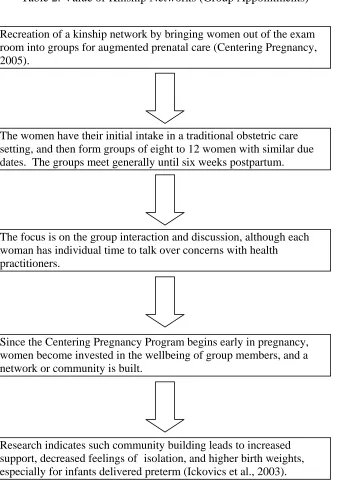
and elders and to be obedient, respectful and shy (Norbeck, 1989). Kinship is another way of
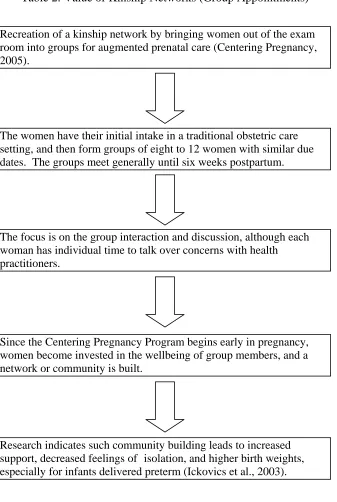
Table 2: Value of Kinship Networks (Group Appointments)
Recreation of a kinship network by bringing women out of the exam room into groups for augmented prenatal care (Centering Pregnancy, 2005).
The women have their initial intake in a traditional obstetric care setting, and then form groups of eight to 12 women with similar due dates. The groups meet generally until six weeks postpartum.
The focus is on the group interaction and discussion, although each woman has individual time to talk over concerns with health practitioners.
Since the Centering Pregnancy Program begins early in pregnancy, women become invested in the wellbeing of group members, and a network or community is built.
A Model for Equity
In a formal group prenatal model based on the CenteringPregnancy prenatal group
appointment, eight to 10 women with similar gestational ages begin their group care after their
initial obstetric exam, usually around 12 to 16 weeks. There are 10 two-hour sessions following
the usual prenatal visit schedule of four-week visits until the 28th week of pregnancy, followed
by bi-weekly visits until the last session (Rising, 1998). During the last month of pregnancy,
healthy women can be seen every other week according to the Guidelines for Prenatal Care or
may be seen individually, if needed (ACOG, 2009).
During each session, women complete self-care activities, including checking their blood
pressure using digital wrist or arm cuffs, measuring their weight, and determining their
gestational age using a standard gestational age wheel. The educational component is guided by
an extensive curriculum developed by the Centering Healthcare Institute (CHI) based upon the
educational needs of pregnancy, current recommendations of leading healthcare groups and
organizations, and current research. A facilitative leadership style is used to guide the discussion
of the group, and self-assessment sheets help to guide discussions about common pregnancy
topics like nutrition, contraception, labor, birth, and parenting issues. Patient-centered group
facilitation training is offered nationwide for prenatal group appointments (Rising, 2004).
Women in the CP groups share their concerns and develop supportive relationships with
one another throughout the six to 10 sessions. Women often exchange contact information,
thereby creating opportunities for mutual support during and after pregnancy. Knowing the
community culture that is being served allows for gathering and sharing information, as a means
CenteringPregnancy model for group care overcomes some of the limitations that variability in
the group presentation can be avoided. The group facilitator skills (motivational interviewing,
presence of behavior-specific objectives, and patients confidence level) are uniformly addressed
in the curriculum and training provided by CenteringPregnancy. (Lorig, 2003)
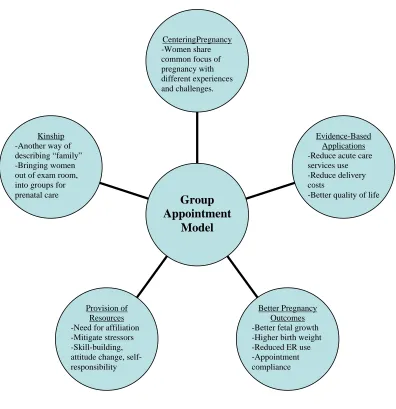
Figure 1: Group Pregnancy Model Diagram
Kinship -Another way of describing “family” -Bringing women out of exam room, into groups for prenatal care
Provision of Resources -Need for affiliation -Mitigate stressors -Skill-building, attitude change, self-responsibility
Better Pregnancy Outcomes -Better fetal growth -Higher birth weight -Reduced ER use -Appointment compliance
Evidence-Based Applications -Reduce acute care services use -Reduce delivery costs
-Better quality of life CenteringPregnancy
-Women share common focus of pregnancy with different experiences and challenges. Group Appointment Model
Group problem solving and socialsupport may also reduce perceived barriers to behavior
change. Group visits may reinforce patients’ self-efficacy (i.e.,judgment of their capabilities to
associated with successful chronic disease self-management. (Marks 2005) Modeling, or seeing
that others have accomplished the desiredbehavior and overcome obstacles, is another powerful
contributorto patient self-efficacy. (Lorig, 2003)
Baldwin (2006) comments on the effect of traditional prenatal care versus a group model
of care, CenteringPregnancy, on maternal knowledge of pregnancy, social support, health locus
of control and satisfaction. The group appointment model of care is utilized in pregnancy,
pediatrics, geriatric and chronic conditions management. These models of care have
demonstrated evidence-based applications in reducing utilization of acute care services,
reduction in delivery costs, improved quality of life, knowledge, health behaviors, improved
self-esteem and patient and provider satisfaction (Beck, 1997; Rising, 1998; Trento,2001; Trento
2005).
The group appointment model based on the CenteringPregnancy model could meet the
needs of the Hispanic prenatal patient population. In Hispanic culture, social support is a key
element of community and its importance to one's sense of wellbeing. Groups provide women
with social support (Lipson 1996), which is built through actions from others that contribute to a
feeling of inclusion and importance and to the development of a network of belonging. In a
culture of idiom, language, child rearing and birthing custom familiarities, the relationship of
social support to pregnancy outcomes suggests that women with high life stress and low
psychosocial assets or support experience more pregnancy complications, postpartum
depression, and adverse neonatal outcomes (Norbeck, 1989). Although lack of social support is
related to poorer pregnancy and postpartum outcomes, positive social support seems related to
better pregnancy outcomes, including improved fetal growth and increased infant birth weight
(Martin, 2003). Baldwin found that women who participated in CP groups perceived more
support from their significant others than those receiving individual prenatal care (2006). The
provision of resources and information offered in-group care might help mitigate physical and
psychological stressors in pregnancy.
Additional Group Appointment Models
Book Reviews about Group Medical Appointments
Book Reviews
Six months ago, I was given an introduction to the group appointment model based on
CenteringPregnancy. I was amazed at the format and curriculum in serving like-dated prenatal
patients and did the group facilitator training workshop soon after. The model was used in a
variety of settings and I wondered what else had been done to promote other models. Edward
Noffsinger, PhD., in the Bay Area, had written extensively about a group model he developed in
an HMO setting called the shared medical appointment(SMA) model used for about 20 years in
a variety of practices throughoutthe United States (mostly with Kaiser Permanente in
California,Palo Alto Medical Foundation in California, and Harvard VanguardMedical
Associates in Massachusetts).
Noffsinger's Running Group Visits in Your Practicebook isan excellent compilation of
information on the subject of SMAs. In it, he describes in depth all aspects of the process of
runningSMAs, including consideration of the idea and getting the SMA"ball" rolling;
management issues of scheduling, billing, andrecord keeping; and systematic conduct of visits.
He includesit all, steadfastly walking readers through the evidence supporting the promises and
Noffsinger describes in detail each of the three mostcommon types of SMAs: cooperative
healthcare clinics (CHCCs),physical shared medical appointments (PSMAs), and drop-in
groupmedical appointments (DIGMAs). In CHCCs, thesame group of 10 to 20 high-utilizing
patients with similarchronic illnesses are seen in monthly group visits of 2 hours,during which
time they participate in educational sessions andare seen individually (separately and briefly) by
the provider. In PSMAs, used in primary and specialty care when a private examination is
needed, physical examinations are conducted sequentiallyon 6 to 9 patients in separate
examination rooms over 45 minutes, followed by a group session of equal duration in which
eachpatient's specific medical needs are reviewed communally. However, DIGMAs are clearly
the author's preferred model. Inthis SMA type, groups of 12 to 15 preselected patients,
witheither similar or varied diagnoses, meet with a physician, behaviorist,medical assistant,
nurse, and dedicated documenter for 90 minutes. The clinician briefly interviews and examines
patients in agroup setting; the behaviorist facilitates the meeting and groupprocess; the medical
assistant and nurse attend to routine tasks(such as vital signs and preventive care issues); and the
documenterenters notes into the chart. Using such team-based care (andincluding patient
participation as an integral part of the medicalinteraction) is why Noffsinger suggests that
DIGMAs can increasepatient and clinician satisfaction, improve clinic access, andboost a
provider's productivity.
An accompanying DVD includes a didactic review ofSMAs, and a DIGMA training
session. It offers anumber of forms readily adaptable for any practice, includingfliers,
confidentiality releases, and patient informationalpackets. The book is a comprehensive guide to
What Works, Effective Tools & Case Studies to Improve Clinical Office Practice is
another title associated with the utility of group appointments. Suzanne Houck is President and
CEO of Houck & Associates, a health care management-consulting firm with a background as a
nurse practitioner. Her book is a practical guide to sustainable improvement in outpatient care
and medical practices. Things as simple as handbooks on how to use the system, keep well have
been shown to improve access, utilization and patient satisfaction. Such information is shared in
welcoming group sessions done in a relaxed environment. Many more case studies, strategies,
useful tools for “seeing” and managing the patient experience are explored and examples are
provided for use.
An interview with DeeAnn Schmucker MSW, LCSW was done because of her expertise
and experience in promoting the use of group medical appointments (GMA). The group support
aids the patient in-group appointments to make changes. The ‘quality chasm’ refers to the state
of medical knowledge and the care actually delivered to patients. (Institute of Medicine, 2001)
An alternate delivery system is discussed in her book “Group Medical Appointments.”
(Schmucker, 2006) The GMAs had a goal of improving patient and provider satisfaction, and to
increase access to care. An opportunity to address a wide range of issues, make choices about
are a few of the expected outcomes. The GMAs promote a supportive healing environment, and
a partnership between patient and provider.
Other approaches to GMA were developed in the 1990s at Kaiser Permanente. Facing
deteriorating access, substantially increased workloads, growing patient demands and
expectations, morale issues, and unruly large patient panel sixe
Group Medical Appointments by DeeAnn Schmucker gives experienced information for
increasing patients' and providers' satisfaction and level of care. This is a resource detailing
possibilities afforded by group medical appointments, including a range of support afforded by
the group model, a patient centered focus, an efficient, cost-effective treatment model. Ms
Schmucker has years of experience using group medical appointments. The appointment models
reflect shifts in how medicine is practiced, in relationships between provider and patient, in the
number of patients who must be treated, and the nature of their conditions. She includes
information on financial cost analysis, as well as systematic instructions, tools, scripts, and
marketing materials to help the provider create a GMA that best addresses the needs of the
practice and the patient.
Confirming the value
In order to determine the value of the group versus traditional methods of prenatal
appointments, a pilot chart review was done. A thorough retrospective chart review compares
prenatal and infant outcomes of birth weights, number of prenatal visits and breastfeeding
retention in Spanish-speaking women by reviewing those who received prenatal care via group
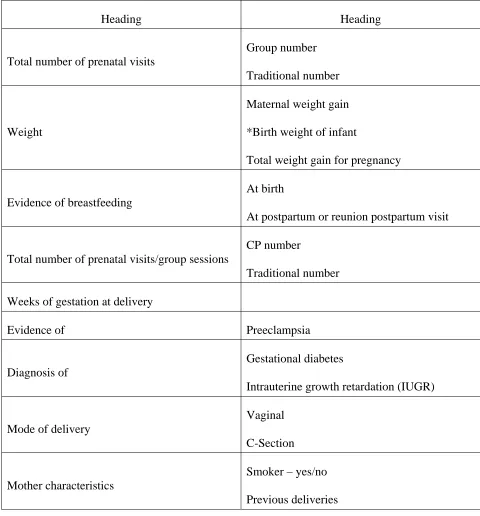
one-on-one prenatal appointments from a Northern California community health center (Table
1).
A convenience sample of the most recent 100 prenatal patients, with expected date of
delivery by December 31, 2009, were divided evenly between traditional and group prenatal
care. The sample was gathered from prenatal rosters listing Spanish-speaking patients, date
entered for care and participation in-group versus individual prenatal care. A chart review tool
used by the Academy of Pediatrics (Gearing, 2006) was modified to fit the variables of interest
in this population; the tool has been used in other populations to conduct pilot studies allowing
researchers to assess feasibility of the planned investigation, reliability of the data abstraction
instrument, effectiveness of the protocol, availability of the data, and address any sampling
concerns (Gearing, 2006). The reliability and validity of this chart audit tool has not been
established in this population. IRB has been approved by the county IRB review board and
Chief Nursing Officer, and University of San Francisco IRB review chair and approved.
The prenatal charts were limited to Spanish-speaking patients who formed the population
of interest. Subjects were retrospectively identified using language preference, which is listed in
the chart demographics that can be obtained from the billing codes, listing the prenatal patients
as in-group and traditional prenatal settings. Patient names were verified by prenatal clinic
rosters kept in clinic.
Prenatal and infant outcomes were defined as: (a) maternal weight gain, (b) infant birth
weight, (c) gestational age at delivery and (d) breastfeeding retention. The birth weights,
gestational weeks at delivery and breastfeeding retention results will provide an understanding of
pregnancy knowledge gained from the group appointment information compared with traditional
traditional care reflect improved infant birth weights, even those born prematurely, lower
preterm delivery rates, increased rates of breast feeding initiation and adequate prenatal care
(Ickovics, 2003; Grady, 2004; Kilma, 2003).
Data analysis
Group Prenatal Versus Traditional Appointments
Fifty charts were reviewed, each from selected group and traditional prenatal rosters of
Spanish-speaking patients. Birth weight, maternal weight gain for pregnancy from first recorded
weight to last, were retrieved from clinic chart notes. Breast-feeding at delivery as recorded on
delivery discharge notes, breast-feeding at postpartum check as recorded on clinic chart note, and
weeks of gestation as recorded on delivery discharge note were captured in a spreadsheet with
medical record numbers and names eliminated and individual data associated with a spreadsheet
number (Table 4).
After a review of the data by a committee content expert and seasoned researcher,
the results of the review are as follows.
Traditional versus Group Prenatal
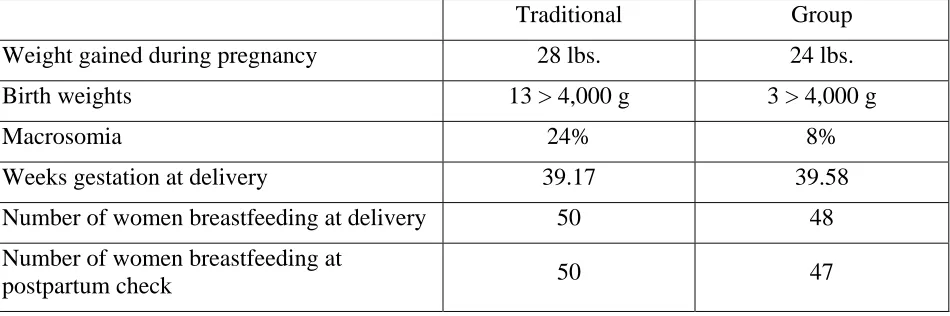
Table 3
Traditional Group
Weight gained during pregnancy 28 lbs. 24 lbs. Birth weights 13 > 4,000 g 3 > 4,000 g
Macrosomia 24% 8%
Weeks gestation at delivery 39.17 39.58 Number of women breastfeeding at delivery 50 48 Number of women breastfeeding at
Traditional Group t = P .05 Weight gained during
pregnancy 24.73 25.15
.85 NS
Birth weights 3504.40 3570.55 .53 NS Weeks gestation at delivery 39.17 39.49 .27 NS
*Macrosomia
Birth Weight >4000 gm
13>4,000 g 24%
3 >4000 g 8%
# of women breastfeeding at
delivery 50 48
# of women breastfeeding at
postpartum check 50 47
Group Prenatal Appointments
Fifty charts were reviewed, selected from Group Prenatal rosters of Spanish speaking
patients. Birth weight, maternal weight gain for pregnancy from first recorded weight to last,
retrieved from clinic chart notes, breast feeding at delivery as recorded on delivery discharge
notes, breast feeding at postpartum check as recorded on clinic chart note, and weeks of gestation
as recorded on delivery discharge note were captured in an excel spread sheet with medical
record numbers and names blinded and individual data associated with an excel spreadsheet
number.
After a review of data by a committee content expert and seasoned researcher, the 50
charts reviewed, selected from Group prenatal Spanish speaking patient appointments showed:
macrosomia, 4.) An average of 39.58 weeks gestation at delivery, 5.) 48 listed breastfeeding at
delivery. 6.) 47 listed breastfeeding at postpartum check.
Fifty charts were reviewed, selected from Traditional Prenatal rosters of Spanish
speaking patients. Birth weight, maternal weight gain for pregnancy from first recorded weight
to last retrieved from clinic chart notes, breast feeding at delivery as recorded on delivery
discharge notes, breast feeding at postpartum check as recorded on clinic chart note, and weeks
of gestation as recorded on delivery discharge note were captured in an excel spread sheet with
medical record numbers and names blinded and data associated with an excel spreadsheet
number.
After a review of data by a committee content expert and seasoned researcher, the 50
charts reviewed, selected from Traditional prenatal Spanish speaking patient appointments
showed: 1.) average of 28 pounds of weight gained for pregnancy, 2.) 13 birth weights
>4000gm=24% macrosomia, 4.) An average of 39.17 weeks gestation at delivery, 5.) 50 listed
breastfeeding at delivery. 6.) 50 listed breastfeeding at postpartum check.
With the national average of macrosomia at 10%, a slightly lower rate of 8% in the group
appointment is encouraging and the value of 24% in the traditional group warrants additional
review of similar populations. This is important because macrosomia is a link to obesity in later
Indications for future research
Obesity is a significant health issue in the United States with 30% of the US
population considered obese defined as a body mass index above 30 kg/m2.(Center for Disease
Control 2009) Obesity is associated with long-term health complications including diabetes and
cardiovascular disorders. During pregnancy, obesity is associated with an increased risk of fetal
macrosomia and birth injury, as well as increased risk of gestational diabetes, preeclampsia,
cesarean birth, and preterm birth. The intrauterine environment has been purported to influence
the early childhood and lifelong risk of obesity and the metabolic syndrome (obesity,
hyperlipidemia, and insulin resistance [IR]). (Yogev, 2009).
Factors associated with increased risk for overweight or obesityin infancy and early
childhood include excessive maternal weightgain, smoking during gestation,
shorter-than-recommended durationof breast-feeding, suboptimal amounts of sleep during infancy. Such
exposures during early development program a person’s long-termregulation of energy balance
and may have epigenetic effects: 1. exposures probably influence the development of
hypothalamiccircuits that regulate body weight, 2. endocrine pancreaticfunction, 3.changes in
the proportion of lean versus fat bodymass, 4. and other cycles of metabolic programming. The
Institute of Medicine guidelines for maternal weight gain in pregnancy provide an estimate for
population goals, but may be inadequate for individual patient needs. (Rasmussen, 2009)
A better determination of caloric and exercise needs may allow the development of more specific
dietary recommendations during pregnancy. Thoughtful nutrition recommendations will result
in improved maternal and neonatal outcomes. As the intrauterine environment may have
important impacts on neonatal and childhood metabolic and cardiovascular outcomes, creation of
guidelines may reduce well-documented problems such as fetal macrosomia, birth injury,
cesarean delivery, and later predisposition toward childhood obesity. (Rasmussen, 2009)
Diabetes is on the rise in the US, and it is an epidemic that is hitting Hispanic and African
American patients even harder than it is hitting Caucasian patients. Hispanic/Latino Americans
and non-Hispanic African Americans are 1.7 and 1.8 times more likely to have diabetes than
non-Hispanic Caucasian. (Centers for Disease Control and Prevention [CDC}, 2005) Minority
patients are less likely to have control of their diabetes than are Caucasian patients. They also
have a higher prevalence of diabetic complications. For example, Latinos have higher rates of
renal disease and retinopathy than do Caucasians. (Carter, 1996 Lanting, 2006) Some of these
disparities in diabetes are because of non-modifiable factors, such as aging or genetics. Some
are because of other factors such as socioeconomic characteristic disparities such as educational
level, household income, residential area (with access to healthy food and safe places to
exercise). (Huang, 2009)
Access to quality medical care disparities include health insurance coverage, continuity
of care, quality of care, interactions with health care providers, intensity of appropriate
medications. Clinically, disease characteristics are affected by disparities, such as, disease
severity, diabetes duration, comorbidities, and depression. Cultural attitudes and behaviors
around chronic diseases like diabetes mellitus self-management, self-efficacy, diabetes-specific
emotional distress can affect adherence to therapeutic regimen. Of these, patient adherence is
one of the most important. (Heisler, 2007) Adherence to national screening and treatment
guidelines, clinicaltrial recruitment and participation, addressing language andgeographic
barriers, and increasing access to insurance arepart of the coordinated efforts required to reduce
related to prevalence of obesity and predisposing factors like parental obesity, macrosomia, the
odds of living well with any chronic disease will decrease the risks of complications and
co-morbidities. (CDC, 2005) Those who were born from 1946 to 1955 did not reach the level of
obesity until they were in their 30s. Those who were born between 1936 and 1945 did not get to
that weight category until their 40s, according to the report published in the April 12 2010 issue
of the International Journal of Obesity. (Wang, 2010)
Implications for practice
The clinical implications for practice are that the group appointments allow more time for
self-management education, skill-building, and provider-patient interaction. Group education
reinforces messages received in individual appointments, increases perceived benefits, and
provides social persuasion and social action cues.
Additionally, topics are addressed, such as
medical and pharmaceutical management, nutrition, exercise, and psychosocial contributorsto
health and illness. (Noffsinger, 2003)
Obesity, viewed as an epidemic, can be seen in phases. The first phase was recognized in
the early 1970s and is ongoing: average weight is progressively increasing among children from
all socioeconomic levels, racial and ethnic groups, and regions of the US. The current phase is
characterized by the emergence of serious weight-related problems. It is projected that such
medical complications of obesity will lead to life-threatening disease. (Heisler, 2007) Without
rate through transgenerational mechanisms. Changing the face of knowledge sources and
acquisition has the power to choose the shape of things to come. (Ludwig, 2007)
Addressing health disparities and inequities through group appointments is one way to
provide the opportunity to learn what the evidence has taught us health care providers. If the
chance to understand that some of the risks for obesity may lay in-utero and the group
appointment model shows less macrosomia, it is pointing us toward a healthier outcome. The
direct practice of APNs is characterized by the use of a holistic perspective; the formation of
therapeutic partnerships to facilitate informed decision making, positive lifestyle change, and
appropriate self-care; advanced practice thinking, judgment, and skillful performance; and use of
diverse, evidence-based interventions in health and illness management (Brown, 2005). The
lived experience of the group appointment reflects an opportunity to offer patients such a
holistic, evidenced based source to discover what we practitioners know, gain confidence in the
source and outcomes, and affect themselves, their families, and communities as living well. The
goal of wholeness or health of human beings must recognize that they are in continuous
interaction with their environments (Fawcett, 2005).
Implications for the Doctor of Nursing Practice Role
The preparation for Doctors of Nursing Practice is an important step in linking evidence
to practice change. In this project, the limitations of time allowed only 100 charts to be
reviewed. Nevertheless, the in-group experience for women sees that the group model is a
holistic opportunity to assess the prenatal patient in a safe and educational environment. How
political recognition as a remarkable, fully funded opportunity to access care, The CP model of
prenatal care validates group appointments as a model of change with success in
self-management, improved pregnancy knowledge and reduced risk associated with race and
previous pregnancy outcomes.
Discussion and Conclusion
To identify a method by which comparison of pregnancy trajectory and birth outcomes,
in-group versus traditional appointments need to be explored. Group prenatal care based on the
CenteringPregnancy model is an innovative model of care, and data is available for review. The
data of the randomized control trial (RCT) by Ickovics in 2007 and the cohort study by Ickovics
in 2003 support the protective effect of group prenatal care against preterm delivery for women
at increased risk of adverse outcomes. More and extensive study will be needed to define the
optimal population for group care. The more data and understanding of what improves prenatal
knowledge, satisfaction and access to care will improve the pregnant woman and infant
outcomes. Patient-centered group care as modeled with the CenteringPregnancy (CP) model
remains dedicated to assuring culturally sensitive and appropriate care to the specific group
needs. The CP-trained group facilitators have a consistent curriculum and patient-focused
theme, well adapted to many settings. Additional applications of this group model can extend
the pregnancy model to parenting, Well Child checks, pediatric obesity, and chronic disease.
Local community outreach programs familiar with the cultural expectations of the minority
groups can apply the CP model of group facilitation for provider education programs to raise the
cultural awareness and sensitivities of providers may be needed to eliminate racial and ethnic
county health center Group Appointments Chair with recommendations to consider a look at
food diaries and exercise during pregnancy as another contributing factor to macrosomia. The
incidence of diabetes, maternal weight gain was not macrosomia contributing factors in the 100
charts I reviewed. Future discussion with other CP group appointment researchers will guide
further recommendations for research.
Ultimately, the group prenatal appointment model based on the CenteringPregnancy
model is an effective way to address racial and ethnic disparities and is in alignment with
Healthy People 2010 by increasing pregnancy knowledge and rates of breastfeeding in the
country (USDHHS, 2000). Rising wrote, of the CenteringPregnancy prenatal care model, “it
holds the potential for a revolutionary redesign of prenatal health care delivery” (2004).
Susan Hagedorn developed a Theory of Primary Caring that includes five domains:
connection, consistency, commitment, community, and change (Table 1) (Hagedom, 1995)
Connection describes how the Doctoral in Nursing Practice/Nurse Practitioner (DNP/NP)’s
effectiveness is based on relationship-centered caring with the patient, the family, and the
community. The overarching methods associated with group appointments based on
CenteringPregnancy, match this model as an ideal method of DNP/NP practice and as a mode of
care. The DNP/NP's practice is based on engagement with all three of these groups, the patient,
the family, and the community. Through authentic listening, the DNP/NP serves patients with
respect and compassion. Consistency describes the importance of evidence- and theory-based
care in DNP/NP practice. Consistency is providing clinically competent healthcare that assures
patients' positive health outcomes. This is an essential of Doctoral Nurse Practice (DNP)
preparation. Consistency, too, refers to the importance of consistent care and care providers, and
and family to her or his best ability. The buy in by group appointments, additionally gives the
patient the commitment of the other patients’ interaction, a notion modeled by the DNP/NP. The
DNP/NP is committed to providing ethical care within a context of confidentiality, compassion,
and respect. Community illustrates the role of the DNP/NP in facilitating full access to
healthcare for all persons and strives to meet unmet community health needs. As a nurse, the
DNP/NP manages patients' care as a knowledgeable advocate and network participant that
connects the patient to the services she or he needs to achieve optimal health. The DNP/NP, by
nature of their role, relies on a network of content experts, community resources and other links
from the professional community. The DNP/NP must be culturally competent -- able to listen
openly and sensitively to the patients' cultural stories and empathize with the cultural influences
of the patient's experience of health and disease. This promotes education, literacy appropriate
materials, and self-determination of the patient, reducing risks and improving outcomes. Lastly,
change explains how DNP/NP s introduces innovative models of healthcare and share
decision-making with patients. This is the essence of DNP/NP preparation. To assess the system,
integrate innovation as a change agent, and strive for continuous quality improvement are the
credo to best practices promoted by the DNP/NP. The DNP/NP assesses patients analytically
and facilitates patients' self-care. She or he must (author’s emphasis) be involved in social
change in order to support patient and community health initiatives. The DNP/NP also functions
as a member of a healthcare team that includes not only health professionals but also auxiliary
specialists.
Table 1. Attributes of NP Caring based on Hagedorn theory.
Relationship-centered practice Evidence-based practice Compassion Cultural Competency Health promotion and disease prevention Engagement with patient(s) and communities Consistent provider and healthcare home Respect Community resources Critical thinking
Authentic listening Highly competent
practice Maintaining confidentiality Case Management Community advocacy for health
Watson, in her 2005 work on the concepts of caritas, defined the work of nursing as, "the
practice of loving-kindness...being authentically present...developing and sustaining a
helping-trusting...relationship [with patients]...being...supportive of the expression of positive and
negative feelings...creative use of self...attempting to stay within other's frame of
reference...creating healing environments...assisting with basic needs...soul care for self and the
The 10 caritas are:
(word "caritas" comes from the Greek word meaning to cherish, appreciate, and give special attention)
The clinical caritas are integrative expanded perspectives that guide the nurse practitioner to consider the human condition of each patient encountered
1. Practice loving-kindness and equanimity.
2. Be authentically present; enable and sustain the deep, internal, and spiritual belief system of oneself and the person being-cared for.
3. Cultivate one's own spiritual practice and transpersonal self, going beyond "ego self."
4. Develop and sustain a helping-trusting, caring relationship.
5. Be present to and supportive of the expression of both positive and negative feelings as a connection with the deeper spirit of self and the person being cared for.
6. Creatively use oneself and all ways of knowing as part of the caring process; engage in artistry of caring-healing practices.
7. Participate in genuine teaching-learning experiences that attend to unity of being and meaning attempting... to stay within other's frame of reference.
8. Create a healing environment at all levels (physical as well as nonphysical), subtle environment of energy and consciousness, whereby wholeness, beauty, comfort, dignity, and peace are potentates.
9. Assist with basic needs, with an intentional caring consciousness; administer 'human care essentials,' which potentiate alignment of mind/body/spirit, wholeness, and unity of being in all aspects of care; attend to both embodied spirit and evolving spiritual presence.
10.Open and attend to spiritual mysteries and existential dimensions of one's own life-death; soul care for self and one being cared for. (Watson, 2005)
DNP/NPs creatively use themselves therapeutically with individual patients, families,
helping-trusting relationships. (Brown, 2005) The natural, holistic utilization of patient centered
group appointments promotes such an empowered model for care.(Hagedorn, 1995) Reiterating
the first DNP/NP essential: Recognizes the philosophical and scientific underpinnings essential
for the complexity of nursing practice at the doctoral level, and the example of:
A basic tenet of transformative power: People must obtain this for themselves. It cannot
be given to them. No one can empower another person, because the achievement of power that
effects transformation can only come from self-action. Self-action is the first step in modifying
health disparities and group appointments offer a means to that end.
References
_____, (2001) Crossing the Quality Chasm: A New Health System for the 21st Century. National
Academy Press. Retrieved February 2, 2010 from;
http://www.nap.edu/books/0309072808/html/
American College of Obstetricians and Gynecologists (ACOG). (2009). ACOG/AAP Guidelines
for Perinatal Care. Retrieved January 31, 2010 from http://www.acog.org/.
Avchen, R. N., Scott, K. G., Mason, C. A. (2001). Birth Weight and School-Age Disabilities: A
Population-Based Study. American Journal of Epidemiology, 154(10), 895-901.
Baldwin, K. (2006). Comparison of selected outcomes of CenteringPregnancy versus traditional
prenatal care. Journal of Midwifery & Women’s Health, 51(4), 266-272.
Beck, A., Scott, J., Williams, P., et al. (1997). A randomized trial of group outpatient visits for
chronically ill older HMO members: The cooperative health care clinic. Journal of
American Geriatric Society, 45, 543-549.
Brookfield, S. (1995). Adult learning: An overview. In A. Tuinjman (Ed.), International
Encyclopedia of Education. Oxford: Pergamon Press. Retrieved March 10, 2010, from
http://www.eap.gr/programmes/eke/eke50/docs/Adult%20Learning-an%20overview%20-%20brookfield.doc.
Brown, S. J. (2005). Direct clinical practice. In A.B. Hamric, J. A. Spross, & C. M.
Hanson (Eds.) Advanced Practice Nursing: An Integrative Approach (3rd ed.) (pp.
Carter, J., Pugh, J., & Monterrosa, A. (1996). Non-insulin dependent diabetes mellitus in
minorities in the United States. Annals Internal Medicine, 125, 221-32.
Centering Pregnancy. (2005). An empowering program for clients and professionals. Retrieved
January 25, 2010, from http://www.centeringpregnancy.com/.
Centers for Disease Control and Prevention. (2005). CDC National Diabetes Fact Sheet.
Retrieved February 12, 2010, from http://www.cdc.gov/diabetes/pubs/factsheet05.htm
Fawcett, J., Newman, D., McAllister, M. (2004) Advanced practice nursing and conceptual
models of nursing. Nursing Science Quarterly. 17:135-138.
Fawcett, J. (2005). Contemporary Nursing Knowledge: Analysis and Evaluation of Nursing
Models and Theories (2nd ed.). (pp. 198-222). Philadelphia: Davis.
Gearing, R., Mian, I., Barber, J., & Ickowicz, A. (2006). A methodology for conducting
retrospective chart review research in child and adolescent psychiatry. Journal of
Canadian Academic Child Adolescent Psychiatry, 15(3), 126-134.
Goldberg, J., Hayes, W., & Huntley, J. (2004). Understanding Health Disparities. Health Policy
Institute of Ohio (pp. 6-7).
Grady.R., Bloom, K. (2004). Pregnancy outcomes of adolescents enrolled in a
CenteringPregnancy program. Journal of Midwifery and Women’s Health, 49(5),
412-420.
Hagedorn, S. (1995) The politics of caring: the role of activism in primary care. Advances in
Nursing Science. 17:1-11.
Hamman, R., Mayer, E., Moo-Young, G., et al. (1989) Prevalence, and risk factors of diabetic
retinopathy in non-Hispanic whites and Hispanics with NIDDM. San Luis Valley
Heisler, M., Faul, J., Hayward, R., et al. (2007) Mechanisms for racial and ethnic disparities in
glycemic control in middle-aged and older Americans in the health and retirement study.
Archieves of Internal Medicine. 167:1853-60.
Henry J. Kaiser Family Foundation (KFF). (1999). A Synthesis of the Literature: Racial and
Ethnic Differences in Access to Medical Care. Retrieved November 30, 2009, from
http://www.kff.org/minorityhealth/1526-index.cfm.
Houck, S. (2003) What Works, Effective Tools & Case Studies To Improve Clinical Office
Practice. Health Press Publishing, Denver, CO.
Huang, E., Brown, S., Thakur, N., et al. (2009) Racial/ethnic differences in concerns about current and future medications among patients with type 2 diabetes. Diabetes Care. 32:311-6.
Ickovics, J. R., Kershaw, T. S., Westdahl, C., Rising, S. S., Klima, C., Reynolds, H., & Magriple,
U. (2003). Group prenatal care and preterm birth weight: Results from a matched cohort
study at public clinics. Obstetrics and Gynaecology, 102(5), 1051-1057.
Ickovics, J. R., Kershaw, T. S., Westdahl, C., Rising, S. S., Klima, C., Reynolds, H. and
Magriple, U. (2007). Group prenatal care and perinatal outcomes: A randomized
controlled trial. Obstetrics and Gynaecology, 110. 330-339.
Lorig, K., Holman, H.(2003) Self-management education: history, definition, outcomes, and
mechanisms. Annals of Behavior Medicine. 26: 1–7
Influenza and pneumococcal vaccination rates among persons with diabetes mellitus—United
Kilma, C. S. (2003). CenteringPregnancy: A model for pregnant adolescents. Journal of
Midwifery and Women’s Health, 48(3). 220-225.
Lanting, L., Joung, I., Mackenbach, J., Lamberts, S., & Bootsma, A. (2005). Ethnic differences
in mortality, end-stage complications, and quality of care among diabetic patients: A
review. Diabetes Care, 28, 2280-2288.
Lipson, J., Dibble, S., & Minarik, P. (Eds.). (1996). Culture & Nursing Care: A Pocket Guide.
University of California at San Francisco: School of Nursing Press.
Lu, M. C., & Halfon, N. (2003). Racial and ethnic disparities in birth outcomes: A life-course
perspective. Maternal Child Health Journal, 7(1), 13-30.
Lu, M. C., Kotelchuck, M., Hogan, V., Jones, L., Jones, C.A., & Halfon, N. (2009). Closing the
black-white gap in birth outcomes: A life-course approach. Accepted for publication in
Ethnicity and Disease 02-12-2008.
Ludwig, D. (2007). Childhood obesity -- The shape of things to come. The New England
Journal of Medicine, 357(23), 2325-2328.
Marks, R., Allegrante, J., and Lorig, K. (2005) A review and synthesis of research evidence for
self-efficacy-enhancing interventions for reducing chronic disability: implications for
health education practice . Health Promotion Practice. 6: 37–43.
Martin, J. A., Hamilton, B. E., Sutton, P. D., Ventura, S. J., Menacker, F., & Munson, M. L.
(2003). Births: Final data for 2002. National Vital Statistics Reports, 52(10).
Hyattsville, Maryland: National Center for Health Statistics. Retrieved February 25,
Mullins, C., Blatt, L., Gbarayor, C., Yang, H., & Baquet, C. (2005). Health disparities: A barrier
to high-quality care. American Journal of Health-System Pharmacy, 62(18), 1873-1882.
Retrieved from CINAHL Plus with Full Text database. March 11, 2010
National Center for Health Statistics. (2005). Cited in Factsheet, Office of Minority Health,
Centers for Disease Control and Prevention. Retrieved October 29, 2009, from
www.cdc.gov/omh/AMH/factsheets/sti.htm.
Noffsinger, E., Atkins, T.(2001) Assessing a group medical appointment program: a case study
at Sutter Medical Foundation. Group Practice Journal. 48: 42–9.
Noffsinger, E. (2009) Running Group Visits in Your Practice. New York, NY, Springer.
Norbeck, J., Anderson, N. (1989). Psychosocial predictors of pregnancy outcomes in
low-income black, Hispanic and white women. Nursing Resource, 38, 204-209.
Pew Hispanic Center/Kaiser Family Foundation. (2002). 2002 National Survey of Latinos.
Retrieved February 25, 2010, from http://pe-whispanic.org/files/reports/15.pdf.
Pew Hispanic Center/Kaiser Family Foundation. (2005). Hispanic Trends: A People in Motion.
Retrieved February 24, 2010, from http://pewhispanic.org/reports/report.
php?ReportID=40.
Raphael, D. (2008). Introduction to the social determinants of health. In Raphael, D. (Ed.),
Social Determinants of Health: Canadian Perspectives (2nd ed.) (pp. 2-19). Toronto:
Canadian Scholars' Press.
Rasmussen, K., Yaktine, Y. (Eds.) (2009). Weight Gain During Pregnancy: Reexamining the
Guidelines Committee to Reexamine IOM Pregnancy Weight Guidelines. Institute of
Medicine, National Research Council. Retrieved April 15, 2010, from
Rising, S. (1998). Centering pregnancy. An interdisciplinary model of empowerment. Journal
of Nurse-Midwifery, 43(1), 405-411.
Rising, S. S., Kennedy, H. P., Kilma, C. S. (2004). Redesigning prenatal care through
CenteringPregnancy. Journal of Midwifery Women’s Health, 49(5), 433-442.
Rosenbaum, S., Finnegan, B., & Shin, P. (2009). Community Health Centers in an Era of health
system reform and economic downturn: Prospects and Challenges. Menlo Park: The
Henry J. Kaiser Family Foundation. (KFF Pub. No. 7876).
Schmucker, D. (2006) Group Medical Appointments: An Introduction for Health Professionals.
Jones and Bartlett Publishers, Boston
Smedley, B. D., Stith, A. Y., Nelson, A. R. (Eds.). (2002). Unequal Treatment: Confronting
Racial and Ethnic Disparities in Health Care. Washington, D.C.: National Academy of
Sciences, Institute of Medicine, Committee on Understanding and Eliminating Racial and
Ethnic Disparities in Health Care.
Trento, M. B., Passera, P., Borgo, E, et al. (2005). A 3-year prospective randomized controlled
clinical trial of group care of type 1 diabetes. Nutrition Metabolism Cardiovascular
Diseases, 15, 293-301. Doi: 10.1016/j.numecd.2004.12.005.
Trento, M. B., Passera, P., Tomalino, M., et al. (2001). Group visits improve metabolic control
in type 2 diabetes: A 2 year follow-up. Diabetes Care, (24), 995-1000. Doi:
10.2337/diacare.24.6.995.
U.S. Census Bureau Fact Sheets. (2000) Retrieved November 10, 2009, from
http://factfinder.census.gov/servlet/SAFFIteratedFacts?_event=&geo_id=04000US02&_
geoContext=01000US%7C04000US02&_street=&_county=&_cityTown=&_state=0400
gsl=040&_submenuId=factsheet_2&ds_name=DEC_2000_SAFF&_ci_nbr=008&qr_na
me=DEC_2000_SAFF_R1040®=DEC_2000_SAFF_R1040%3A008&_keyword=&_i
ndustry=
U.S. Department of Health and Human Services (USDHHS). (2000). Healthy People 2010
(Conference Edition), With Understanding and Improving Health and Objectives for
Improving Health. Washington, D.C.: U.S. Government Printing Office. Retrieved
October 29, 2009, from http://www.healthypeople.gov.
United States Public Health Service. (1989). Caring for Our Future: The Content of Prenatal
Care. Washington, D.C.:D department of Health and Human Services.
Walker, D., Worrell, R. (2008). Promoting healthy pregnancies through perinatal groups: A
comparison of CenteringPregnancy group prenatal care and childbirth education classes.
Journal of Perinatal Education, 17(1), 27-34.
Wang, Y. (2009). Fetal macrosomia and adolescence obesity: Results from a longitudinal cohort
study. International Journal of Obesity, 33(8), 923-33. Watson, M. (2005) Watson's
caring theory. Available at: http://www2.uchsc.edu/son/caring/content/. Accessed
January 6, 2010.
World Health Organization. (2004). Adherence to long-term therapies: Evidence for action.
Retrieved January 26, 2010, from
http://www.who.int/chronic_conditions/adherencereport/en.
World Health Organization. (2008). Commission on the Social Determinants of Health.
Yogev, Y., Visser, G. (2009). Obesity, gestational diabetes, and pregnancy outcome. Seminars
Table 1: Descriptive Variables in Spanish-Speaking Prenatal Women in Traditional or
CenteringPregnancy Group Care
Heading Heading
Total number of prenatal visits
Group number
Traditional number
Weight
Maternal weight gain
*Birth weight of infant
Total weight gain for pregnancy
Evidence of breastfeeding
At birth
At postpartum or reunion postpartum visit
Total number of prenatal visits/group sessions
CP number
Traditional number
Weeks of gestation at delivery
Evidence of Preeclampsia
Diagnosis of
Gestational diabetes
Intrauterine growth retardation (IUGR)
Mode of delivery
Vaginal
C-Section
Mother characteristics
Smoker – yes/no
*Birth weight is greater for infants of women in-group versus individual prenatal care. Infants of
group patients less likely than those of individual care patients to be low birth weight (less than
Table 2: Value of Kinship Networks (Group Appointments)
Recreation of a kinship network by bringing women out of the exam room into groups for augmented prenatal care (Centering Pregnancy, 2005).
The focus is on the group interaction and discussion, although each woman has individual time to talk over concerns with health practitioners.
Since the Centering Pregnancy Program begins early in pregnancy, women become invested in the wellbeing of group members, and a network or community is built.
The women have their initial intake in a traditional obstetric care setting, and then form groups of eight to 12 women with similar due dates. The groups meet generally until six weeks postpartum.
Table 3: Chart Review
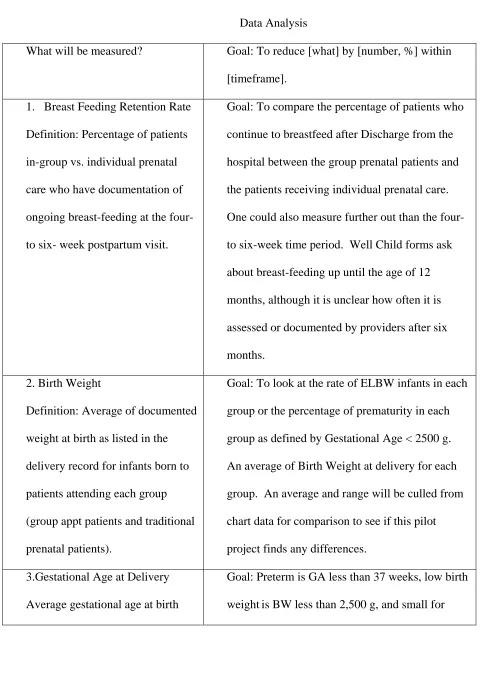
Data Analysis
What will be measured? Goal: To reduce [what] by [number, %] within
[timeframe].
1. Breast Feeding Retention Rate
Definition: Percentage of patients
in-group vs. individual prenatal
care who have documentation of
ongoing breast-feeding at the four-
to six- week postpartum visit.
Goal: To compare the percentage of patients who
continue to breastfeed after Discharge from the
hospital between the group prenatal patients and
the patients receiving individual prenatal care.
One could also measure further out than the four-
to six-week time period. Well Child forms ask
about breast-feeding up until the age of 12
months, although it is unclear how often it is
assessed or documented by providers after six
months.
2. Birth Weight
Definition: Average of documented
weight at birth as listed in the
delivery record for infants born to
patients attending each group
(group appt patients and traditional
prenatal patients).
Goal: To look at the rate of ELBW infants in each
group or the percentage of prematurity in each
group as defined by Gestational Age < 2500 g.
An average of Birth Weight at delivery for each
group. An average and range will be culled from
chart data for comparison to see if this pilot
project finds any differences.
3.Gestational Age at Delivery
Average gestational age at birth
Goal: Preterm is GA less than 37 weeks, low birth
documented on the newborn H & P
between each group, class vs.
traditional.
gestational age (SGA) is BW less than the 10th
percentile weight for the infant'sGA. An average
and range will be culled from chart data for
comparison to see if this pilot project finds any
differences
4. Weight Gain for Pregnancy
Average weight gain by the date of
delivery documented in the OB H
& P for each group.
Current guidelines recommend that average-sized
women gain between 25 and 35 pounds during
pregnancy. If a woman is already overweight
when she becomes pregnant, most practitioners
suggest that she gain between 15 and 20 pounds.
An average and range will be culled from chart
data for comparison to see if this pilot project