D
RAFT
S
OLID
W
ASTE
AND
R
ESOURCE
M
ANAGEMENT
P
LAN
–
S
TAGE
2
R
EPORT
FOR
C
ONSULTATION
Submitted to:
Squamish‐Lillooet Regional District Box 219, 1350 Aster Street Pemberton, BC V0N 2L0
Submitted by:
Todd Baker, P.Eng Senior Environmental Engineer Morrison Hershfield Ltd.
Suite 310, 4321 Still Creek Drive
Burnaby, BC, V5C 6S7
Email: [email protected]
Tel: 604 – 454‐0402
Fax: 604 – 454‐0403
Project No. 5130801.00 15 April, 2015
February 24, 2015
Meredith Gee
Squamish‐Lillooet Regional District Box 219, 1350 Aster Street
Pemberton, BC V0N 2L0
Re: Solid Waste and Resource Management Plan Update 2015 – Stage 2 Report
Dear Ms. Gee,
Morrison Hershfield, in association with Maura Walker and Associates, is pleased to submit the Stage 2 Report of
the Solid Waste and Resource Management Plan. This report is the culmination of a series of meetings with the
Solid Waste Management Plan Advisory Committee and describes the options recommended by the Committee
for inclusion in the new Solid Waste and Resource Management Plan.
This is a draft document prepared for review by the Solid Waste and Resource Management Plan Advisory
Committee. Upon their review and feedback, the content of this report will be ready for community and
stakeholder consultation, subject to Board approval to undertake consultation.
Regards,
Morrison Hershfield Limited
Todd Baker, P.Eng
Senior Environmental Engineer
Page
LETTER OF TRANSMITTAL GLOSSARY ... 1 EXECUTIVE SUMMARY ... 2 1. INTRODUCTION ... 4
1.1 LONG TERM VISION ... 4
1.2 OBJECTIVES ... 5
2. PLAN AREA AND DEMOGRAPHICS ... 6
2.1 POPULATION ... 8
3. CHARACTERIZATION OF THE CURRENT WASTE STREAM... 9
3.1 WASTE GENERATION, DIVERSION AND DISPOSAL ESTIMATES ... 9
3.2 COMPOSITION OF WASTE DISPOSED ... 11
4. EXISTING WASTE MANAGEMENT SYSTEM ... 14
5. A PROPOSED NEW PLAN FOR THE SLRD ... 17
6. COMMUNICATIONS ... 19
7. REDUCTION AND REUSE ... 22
8. WASTE DIVERSION THROUGH POLICY ... 24
9. EXTENDED PRODUCER RESPONSIBILITY ... 26
10. RESIDENTIAL WASTE MANAGEMENT ... 28
11. COMMERCIAL AND MULTI‐FAMILY WASTE MANAGEMENT ... 30
12. ORGANIC WASTE MANAGEMENT ... 32
13. CONSTRUCTION AND DEMOLITION WASTE MANAGEMENT ... 33
14. LANDCLEARING WASTE MANAGEMENT ... 34
15. RESOURCE RECOVERY ... 35
16. RESIDUAL WASTE MANAGEMENT ... 36
17. ILLEGAL DUMPING ... 38
18. WILDLIFE AND WASTE MANAGEMENT ... 39
19. LAND USE PLANNING ... 40
Page
21. PLAN IMPLEMENTATION ... 42
21.1 ESTIMATED DIVERSION ... 42
21.2 PROPOSED IMPLEMENTATION SCHEDULE AND COSTS ... 42
21.3 STAFFING IMPLICATIONS ... 44
21.4 COST RECOVERY ... 46
22. PLAN TARGETS ... 47
23. MONITORING AND MEASUREMENT ... 48
23.1 MEASURING PROGRESS ... 48
23.2 ON‐GOING MONITORING AND EVALUATION ... 49
24. PLAN FLEXIBILITY ... 50
25. NEXT STEPS IN THE PLANNING PROCESS ... 51
LIST OF APPENDICES
APPENDIX A: SOLID WASTE AND RESOURCE MANAGEMENT STRATEGIC COMMUNICATIONS PLAN
APPENDIX B: FACILITY AUTHORIZATION PROCESS
APPENDIX C: PLAN MONITORING ADVISORY COMMITTEE TERMS OF REFERENCE
Page
LIST OF TABLES
TABLE 2‐1: POPULATION DATA FOR THE SERVICE AREAS WITHIN THE SLRD ... 8
TABLE 3‐1: DISPOSAL AND DIVERSION ESTIMATES (2012) ... 10
TABLE 3‐2: SLRD’S ESTIMATED WASTE COMPOSITION AT FOUR DISPOSAL LOCATIONS SHOWN AS % BY WEIGHT (2012) ... 11
TABLE 6‐1: SUMMARY OF PROPOSED COMMUNICATIONS INITIATIVES ... 21
TABLE 7‐1: SUMMARY OF PROPOSED NEW REDUCTION AND REUSE INITIATIVES ... 23
TABLE 8‐1: SUMMARY OF PROPOSED NEW WASTE DIVERSION POLICY INITIATIVES ... 25
TABLE 9‐1: CURRENT EPR PROGRAMS IN BC ... 26
TABLE 9‐2: SUMMARY OF THE PROPOSED NEW EPR RELATED INITIATIVES ... 27
TABLE 10‐1: PROPOSED RESIDENTIAL WASTE MANAGEMENT INITIATIVES ... 29
TABLE 11‐1: PROPOSED NEW COMMERCIAL AND MULTI‐FAMILY WASTE MANAGEMENT INITIATIVES ... 31
TABLE 12‐1: PROPOSED NEW ORGANIC WASTE MANAGEMENT INITIATIVES ... 32
TABLE 13‐1: PROPOSED NEW C&D MANAGEMENT INITIATIVES ... 33
TABLE 16‐1 ‐ SUMMARY OF GARBAGE RECEIVING FACILITIES IN THE SLRD ... 36
TABLE 16‐2: PROPOSED RESIDUAL WASTE INITIATIVES ... 37
TABLE 17‐1: PROPOSED NEW INITIATIVES TO PREVENT ILLEGAL DUMPING ... 38
TABLE 18‐1: PROPOSED NEW WILDLIFE MANAGEMENT INITIATIVE ... 39
TABLE 21‐1: ESTIMATED DIVERSION ... 42
TABLE 21‐2: PROPOSED IMPLEMENTATION SCHEDULE AND ESTIMATED COSTS ... 42
TABLE 21‐3: SLRD STAFFING IMPLICATIONS BY INITIATIVE AND ANNUALLY ... 44
LIST OF FIGURES FIGURE 2‐1: PLAN AREA ... 7
FIGURE 3‐1: SLRD PER CAPITA WASTE DISPOSED (2001 – 2012) ... 9
FIGURE 3‐2: 2012 ESTIMATED WASTE COMPOSITION SHOWN AS THE PROPORTION OF ORGANICS, RECYCLABLES AND RESIDUAL WASTE (% BY WEIGHT) ... 12
FIGURE 3‐3: WASTE COMPOSITION OF REGIONAL DISTRICT SIMILAR TO THE SLRD ... 13
GLOSSARY
C&D waste Waste materials generated at construction, renovation and demolition projects
Disposal Landfilling
Diversion Activities that divert waste materials away from disposal as garbage to
alternatives such as recycling or composting. Does not include combustion of
garbage to product energy.
DOL District of Lillooet
DOS District of Squamish
Generation The sum of all materials discarded that require management as solid waste,
including garbage, recycling, and organic waste. Does not include organic waste
composted at home.
ICI Industrial, commercial and institutional (does not include heavy industry)
MOE BC Ministry of Environment
organic waste/organics kitchen scraps, food waste, yard and garden waste
RMOW Resort Municipality of Whistler
SLRD Squamish‐Lillooet Regional District
SWRMP Solid Waste and Resource Management Plan
EXECUTIVE SUMMARY
Over the past two years, Squamish‐Lillooet Regional District (SLRD) has engaged in a process to update the 2007
Solid Waste and Resource Management Plan to reflect current and future waste management needs. The process
to update the Plan is being conducted in three stages. The first stage involved reviewing of the current solid waste
management system. The second stage involved reviewing options to address the region’s future solid waste
management needs and the selection of preferred management options. This document is the result of the Stage 2
process and presents the proposed options for the updated Solid Waste and Resource Management Plan
(SWRMP). This Stage 2 report is considered a draft version of the updated Plan.
As part of the planning process, a long term vision for solid waste management in the SLRD was established that
encompasses the following:
1. The ultimate goal is zero waste – all of our discards are regarded as resources.
2. To the greatest extent possible, these resources are used locally, thereby moving the SLRD towards a
closed‐loop economy.
3. The system to manage discards is financially self‐sustaining. Embedded in this goal is to have the cost
to purchase a product include the cost of re‐resourcing it at the end of its useful life.
4. Citizens are actively engaged in behaviours that reflect the waste management hierarchy (i.e. reduce
before reuse before recycle…).
5. Until we have achieved zero waste, the infrastructure to manage residual waste meets or exceeds
provincial guidelines and regulatory requirements.
Waste composition studies indicate that there is still a significant quantity of disposed waste that can be recycled
or managed through composting or similar methods. It is estimated that up to 43% of the disposed waste stream is
compostable organics, while plastic and paper make up an additional 25% of the landfilled waste stream. The
proposed initiatives described in this report target the recyclable and compostable components of the waste
stream. Upon full implementation, these initiatives have the potential to reduce the amount of waste sent to
landfill from the current estimate of 525 kg per person to 347 kg per person, a reduction of 34%.
The key diversion initiatives being proposed include:
a residential food scraps reduction campaign;
ICI / multi‐family communications strategy;
tourist accommodation communication strategy;
Re‐Build It facilities in Pemberton and Lillooet; and
curbside collection services in Pemberton and surrounding area.
The other key component of this planning process has been establishing long term residual waste disposal
capacity. There is a lack of long term disposal capacity in the region. Whistler currently sends its waste to a
privately‐owned landfill in Washington State. The District of Squamish landfill is nearing capacity and expansion
options are currently under consideration. In the short‐term, the District intends to expand the landfill vertically to
gain an additional 13‐14 years of capacity. A long‐term option is to expand the site horizontally; although this
option has a number of technical hurdles to overcome. If the horizontal expansion becomes possible, the
Squamish Landfill could be designated as a regional landfill and would be able to receive waste from all of the
southern corridor communities. A working group of municipal, SLRD and First Nation representatives will be
established to collectively consider long term residual waste management options.
The implementation schedule for the new Plan is 2015 to 2020. Estimated additional operating costs to the SLRD
establishment of two Re‐Build It centres and the provision of new curbside collection services. The capital cost to
expand the Squamish Landfill will be the responsibility of the District of Squamish.
Implementation of New Initiatives 2015 2016 2017 2018 2019 2020
Estimated new operating costs $ 55,000 $ 35,500 $ 50,000 $ 41,000 $ 37,000 $ 20,000
The implementation of the new Plan will be overseen by the Plan Monitoring Advisory Committee. They will
1. INTRODUCTION
In British Columbia, each regional district is mandated by the Provincial Environmental Management Act to
develop a Solid Waste and Resource Management Plan that provides a long term vision for solid waste
management, including waste diversion and disposal activities. Plans are updated on a regular basis to ensure that
the plan reflects the current needs of the regional district, as well as current market conditions, technologies and
regulations.
Over the past two years, Squamish‐Lillooet Regional District (SLRD) has engaged in a process to update the 2007
Plan to reflect current and future waste management needs. The process to update the Plan is being conducted in
three stages. The first stage involved reviewing of the current solid waste management system. The Stage 1
Report can be found on SLRD’s website.1
The second stage involved reviewing options to address the region’s future solid waste management needs and
the selection of preferred management options. This document is the result of the Stage 2 process and presents
the proposed options for the updated Solid Waste and Resource Management Plan (SWRMP). This Stage 2 report
is considered a draft version of the SWRMP.
Two advisory committees, established for both the South (Furry Creek to Pemberton) and the North (Gold Bridge
to Lillooet) areas of the region, provided input on the technical reports prepared during Stages 1 and 2. Both
advisory committees have public, local government and technical representation and are collectively referred to as
the Solid Waste and Resource Management Plan Advisory Committee (SWRMP AC).
The third and final stage involves community consultation to obtain input on the selected options presented in this
draft SWRMP.
The planning process and the development of this report have been undertaken in accordance with the BC
Ministry of Environment (MoE) document entitled “Guide to the Preparation of Regional Solid Waste Management
Plans by Regional District” (BC MoE, 1994).
1.1 LONG TERM VISION
A long‐term vision for the SWRMP was developed by the SWRMP AC during Stage 1 of the planning process. The
initiatives described in this document are intended to move the SLRD towards this vision:
1. The ultimate goal is zero waste – all of our discards are regarded a resources.
2. To the greatest extent possible, these resources are used locally, thereby moving the SLRD towards a
closed‐loop economy.
3. The system to manage discards is financially self‐sustaining. Embedded in this goal is to have the cost
to purchase a product include the cost of managing it at the end of its useful life.
4. Citizens are actively engaged in behaviours that reflect the waste management hierarchy (i.e. reduce
before reuse before recycle…).
5. Until we have achieved zero waste, the infrastructure to manage residual waste meets or exceeds
provincial guidelines and regulatory requirements.
1
1.2 OBJECTIVES
At the initial meeting of the SWRMP AC, an exercise was conducted to help define the priorities (key issues) for the
planning process. During this exercise, the committee also identified criteria that they felt are important to include
in the consideration of options for managing solid waste. The priorities and criteria are:
Priorities
Moving from awareness to action
(behaviour change)
Diverting organic waste
Improving existing reuse, recycling and composting
activities
Managing construction,
demolition and renovation waste
Educating and improving awareness
Criteria
Collaboration (government,
business, non‐profits, first nations)
Affordable and realistic
Create local jobs/supports the
2. PLAN AREA AND DEMOGRAPHICS
The plan area shown in Figure 2‐1 includes four incorporated municipalities and four unincorporated electoral
areas, including:
District of Squamish (DOS);
Resort Municipality of Whistler (RMOW); Village of Pemberton (VOP);
District of Lillooet (DOL);
Electoral Area A (Gold Bridge, Bralorne and area);
Electoral Area B (Yalakom, Bridge River, Seton/ Tsal’álh, Texas Creek, Fountain Valley, Pavilion);
Electoral Area C (Pemberton Meadows, Mt. Currie ‐ D'Arcy corridor, Whistler‐Pemberton Corridor (excluding
municipalities);
Electoral Area D (Furry Creek, Britannia, Upper Squamish, Upper Cheakamus, Ring Creek, Pinecrest/Black
Tusk).
First Nations within in the SLRD include the Xwisten (Bridge River),Tsal’álh (Seton Lake), Sekw'elw'as (Cayoose
Creek), T’itq’et (Lillooet), Ts'kw'aylaxw (Pavilion), Xaxli'p (Fountain), N’Quatqua, Lytton, Lil'wat (Mt. Currie), and
Squamish peoples. Thirty‐six reserves are located in the region, with a total on‐reserve population of
3,275 persons in 20112. Lil’wat Reserve 6 has the largest population, with over 1,300 people. Seven other reserves
have populations of 100‐300 persons. All other reserves have populations of under 100 persons, with the smallest
having five or fewer residents.
2
2.1 POPULATION
Table 2‐1 provides a breakdown of the permanent population of the SLRD for 2011 (based on the 2011 Census)
and estimated for 2012 to 2014.
Table 2‐1: Population Data for the Service Areas within the SLRD JURISDICTION 2011 POPULATION DATA 2012 POPULATION DATA 2013 POPULATION DATA 2014 POPULATION DATA Lillooet 2,324 2,337 2,335 2,344 Pemberton 2,485 2,513 2,579 2,601 Squamish 17,727 18,377 18,789 19,294 Whistler 10,333 10,409 10,194 10,447 Unincorporated Areas 6,644 6,982 6,970 6,810
Squamish‐Lillooet TOTAL 39,513 40,618 40,867 41,496
Source: British Columbia Regional District and Municipal Population Estimates Prepared by: BC Stats, Ministry of Labour, Citizens' Services and Open Government http://www.bcstats.gov.bc.ca/StatisticsBySubject/Demography/PopulationEstimates.aspx
Whistler receives over two million visitors every year with large seasonal variation in the resident population.
Therefore the RMOW calculates an equivalent adjusted population figure to account for the impact of the visiting
population on amenities and services. In 2011, the adjusted population number for Whistler was 26,1323, which
would increase the overall SLRD population to 55,312 for 2011 (an increase of 40%).
3
3. CHARACTERIZATION OF THE CURRENT WASTE STREAM
This section provides estimates of the current composition of the SLRD’s waste and the quantity of waste disposed
and recycled. Additional information is presented in the Stage 1 report. The data presented in this section is from
2012 and represents the most recent data available when the Stage 1 report was prepared.
3.1 WASTE GENERATION, DIVERSION AND DISPOSAL ESTIMATES
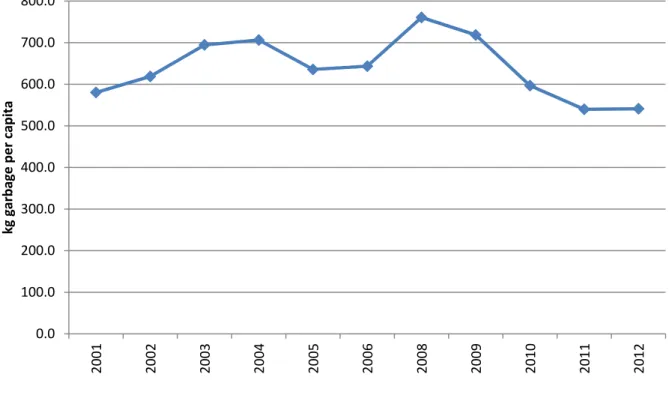
The SLRD has tracked its waste disposal rate for many years. Figure 3‐1 shows the per capita quantity of waste
disposed in the SLRD from 2001 to 2012. The amount of waste disposed is typically driven by two factors: the
range of diversion opportunities, such as recycling and composting, available to the population and the level of
regional economic activity. In 2012, the disposal rate was 541 kg per capita.
Figure 3‐1: SLRD per Capita Waste Disposed (2001 – 2012)
Table 3‐1 provides a summary of the estimated waste disposal and waste diversion quantities recorded at the
0.0 100.0 200.0 300.0 400.0 500.0 600.0 700.0 800.0 20 01 20 02 20 03 20 04 20 05 20 06 20 08 20 09 20 10 20 11 20 12 kg garbage per capita
Table 3‐1: Disposal and Diversion Estimates (2012)
Disposal and Diversion Estimated Tonnes (2012)
Disposal
Squamish Landfill 11,692
Rabanco Regional Landfill via Whistler Transfer Station 12,795
Lillooet Landfill 2,479
Total disposal 26,966
Diversion
Squamish curbside recycling program 936
Squamish other recycling + composting 5,525
Recycling at Whistler Transfer Station 1,698
Whistler other recycling 5,109
Whistler Composting Facility 2,510
Whistler Re‐Use‐It Center 309
Whistler Re‐Build‐It Centre 221
Pemberton Transfer Station Recycling 294
Lillooet Landfill Recycling (includes tonnes from Gold Bridge Transfer
Station) 196
Devine Transfer Station Recycling 7
Extended Producer Responsibility Programs (estimated) 3,339
Total diversion 20,144
Total waste generation (disposal + diversion) 47,110
2012 Diversion rate (diversion/waste generation) 43%
The disposal data is based on scale data from SLRD and member municipality disposal facilities. Not all recycling
and diversion activities have available data, so the estimated total diversion is considered to be conservative.
3.2 COMPOSITION OF WASTE DISPOSED
The composition of the SLRD landfilled waste is estimated based upon several information sources including a
regional waste composition study conducted by Dillon Consulting in 2012 as part of the Regional Composting
Feasibility Study4 and municipal data available for RMOW.
The purpose of the 2012 regional waste composition study was to estimate the proportion of potentially
compostable organic materials in the garbage currently being landfilled. The study separated the garbage into 3
main categories: organics, recyclables, and residual waste. The organics waste stream was further broken down
into: backyard compostable food, non‐backyard compostable food, yard waste, and non‐food organic. Table 3‐2
shows the composition of the waste received at four different disposal locations separated by source. Figure 3‐2
illustrates how the garbage is broken into the three primary categories (organics, recyclables, and residual waste). Table 3‐2: SLRD’s Estimated Waste Composition at Four Disposal Locations shown as % by Weight (2012) Location Source Foo d ‐ Backyard Compostable Foo d ‐ No n Backyard Compostable Yard Waste Non Fo od Org anic Total Organics Recyclable s Residuals
Squamish Residential garbage 22 16 12 5 56 13 32
Mixed Commercial garbage 11 26 0 8 44 24 32
Whistler Residential garbage 16 14 5 4 39 23 38
Commercial ‐ Ski Resort
Housing garbage
13 13 1 4 31 39 30
Commercial ‐ Grocery Store
garbage
7 47 0 2 56 21 23
Lillooet Residential garbage 10 11 9 3 34 21 46
First Nations garbage 16 25 2 6 49 25 25
Mixed Commercial garbage 11 10 1 5 27 58 15
Gold
Bridge
Mixed Residential &
Commercialgarbage
Figure 3‐2: 2012 Estimated Waste Composition shown as the Proportion of Organics, Recyclables and Residual Waste (% by Weight)
The largest components disposed, by weight, are organic waste (average of 43% across sources), residual waste
(30%) and recyclables (27%). The waste composition results were based on a one‐week sort and do not represent
seasonal variations in a waste stream.
To obtain additional insight into the potential composition of the waste currently sent to landfill, the results of a
2012 waste composition study conducted for the Regional District of North Okanagan (RDNO) were also
considered. The RDNO is a combination of rural areas and smaller towns, similar to SLRD (with the exception of
Whistler). As a result, the waste composition data from the RDNO is considered to have reasonable application
for the SLRD’s purpose. The RDNO’s study provides a breakdown of the main waste composition categories, as
shown in Figure 3‐3. The RDNO study indicates that compostable organics constitute the highest percentage of
waste landfilled (43%); and plastic and paper constituted the second highest percentage (13% and 12%
respectively). Collectively, these three waste categories constituted at least 71 % of the residential waste stream5.
5
TRI Environmental Consulting Inc., 2012 Solid Waste Composition Study for Regional District of North Okanagan. 0% 10% 20% 30% 40% 50% 60% 70% 80% 90% 100% Residuals Recyclables Total Organics
Figure 3‐3: Waste Composition of Regional District Similar to the SLRD
3.2.1 RMOW Waste Composition
The RMOW has a unique demographic; it is a tourism community with a fluctuating population. The type and
amount of waste produced in the municipality varies with number of visitors throughout the different seasons of
the year. RMOW has conducted a variety of waste composition studies in 2004, 2010, 2011, and most recently in
2012. These studies indicated that the largest components of garbage disposed in Whistler are: compostables
(25%), paper products (17%), wood waste (16%), plastics (8%) and metal (8%). The RMOW’s 2013 Solid Waste
Strategy states that 41% of Whistler’s garbage could be diverted to the compost facility, and another 40% could be
recycled6. Paper, 12% Plastic, 13% Compostable Organics, 43% Non Compostable Organics, 6% Metals, 5% Glass, 2% Building Material, 4% Electronic Waste, 2% Household Hazardous, 3% Household Hygiene, 6%
4. EXISTING WASTE MANAGEMENT SYSTEM
The following sections provide a brief outline of the SLRD’s existing solid waste management system. A detailed
description of the system is included in the Solid Waste and Resource Management Plan Stage 1 Report available
on the SLRD website.
Education and Promotion: The SLRD and member municipalities
participate in educating residents and businesses about proper
waste management. A range of waste management‐related
promotion and education programs are used to support all solid
waste services. The SLRD provides financial support to the
Recycling Council of BC (RCBC). RCBC provides a toll‐free Recycling
Hotline and an on‐line searchable database called “Recyclepedia”
that provides residents with information on waste management
programs in the region.
In addition to the SLRD’s initiatives, private and non‐profit
organizations in the region also engage in education and promotion
activities to increase waste diversion.
Reduction and Reuse Programs: Across the SLRD communities
there are several reduction efforts targeting edible unwanted food,
the use of plastic bags, bottled water, and encouraging green
purchasing and green building. Free stores are operated at the
Pemberton, Gold Bridge and Devine transfer stations, as well as at
the Lillooet landfill. There are also a number of commercial and
non‐profit stores in the region focused on reuse, repair or rental of
equipment.
Extended Producer Responsibility Programs: The SLRD is a member of the BC Product Stewardship Council, a body
that advocates on behalf of local government for effective product stewardship programs. SLRD staff has also
engaged in consultation and discussions with stewardship programs in their plan development process. A wide
range of EPR products are collected and recovered under the regulated programs. In addition, there are also
voluntary programs operating in the SLRD, targeting things like bike tubes, obsolete agricultural pesticide, fridges,
and old vehicles.
Back Yard Composting: The SLRD operated a residential composter distribution program, however this program
ended due to lack of participation and the availability of composters at local retailers. Backyard composting is not
widely encouraged in the SLRD due to concerns with attracting bears into residential areas. Some municipalities
have addressed the issue in their bylaws.
Recyclables Collection: Curbside recycling collection is
provided to single‐family homes in Squamish, Furry
Creek, Britannia Beach and on Squamish Nation’s
reserve lands. For residents in the rest of the SLRD,
there are recycling, drop off facilities available in
Squamish, Whistler, Pemberton, Lillooet, Devine and
Gold Bridge.
In Squamish, Pemberton and Whistler, owners of multi‐
institutional (ICI) buildings can arrange for recycling collection via private collection service providers.
Compost Collection: Squamish residents receive seasonal curbside yard waste collection. Drop off facilities
(available all year around) are available for yard waste in Squamish, Whistler, Pemberton and Lillooet. Britannia
Beach and Furry Creek have seasonal drop off sites for yard waste. The ICI sector and multi‐family buildings can
arrange for their private collection service providers to collect organics in Squamish, Pemberton and Whistler.
Garbage collection: Curbside garbage collection is currently provided to residents in Squamish (municipal service),
Lillooet (municipal service), Furry Creek and Britannia Beach (SLRD service), and on Squamish Nation reserve lands
(Squamish Nation service). Private collection companies are available to provide residential garbage collection
service on a subscription basis in Pemberton, Pinecrest and Whistler. Residents in other communities in the region
and in rural areas self‐haul their garbage to a transfer station, landfill or Whistler depot.
In Squamish, Pemberton, Whistler and Lillooet, multi‐family and ICI buildings must hire a private garbage collection
service.
Processing facilities for recyclables and compost: There are two Materials Recovery Facilities (MRFs) in the SLRD
for sorting, processing and marketing of recyclables. The SLRD owns one at the Lillooet Landfill, which is operated
by a private contractor. The other MRF is privately owned in Squamish.
There are two composting facilities located within the Region; a municipal facility in Whistler and a privately
owned facility in Pemberton (Sea‐to‐Sky Soils). The SLRD recently established a yard waste composting capacity at
the Lillooet Landfill.
Construction, demolition and land clearing waste management: Efforts have been made to encourage separation
of the reusable and recyclable portions of construction and demolition (C&D) waste generated in the region. There
are two C&D waste sorting and processing areas: one next to the Squamish Landfill, and the other at the Whistler
Transfer Station. Source separation is encouraged through differential tipping fees charged at Squamish Landfill,
Whistler Transfer Station, Lillooet Landfill and Gold Bridge Transfer Station.
Clean wood waste (i.e. untreated wood) is accepted at the
Whistler Transfer Station, the Squamish Landfill and the
Lillooet Landfill, where it is chipped for use in composting.
Source‐separated scrap metal, cardboard and gypsum are
collected and stored for recycling at all local government
solid waste facilities in the SLRD (Lillooet, Pemberton,
Squamish, and Whistler).
Land‐clearing waste refers to tree waste, including trunks and
stumps that are generated as a result of clearing land for
development. In the SLRD, land‐clearing waste is generally
managed by grinding wood waste to incorporate into the soil,
current composting operation as a product for sale in addition, or as an alternative to, compost, which is the
current saleable product.
Residual waste is the portion of the solid waste stream that is not managed through recycling, composting and/or
recovery activities. It is commonly referred to as “garbage”.
There are four publicly owned transfer stations operating in the region; the Whistler, Pemberton, Devine and Gold
Bridge transfer stations. In addition, there are two depots located in Whistler, where residential garbage can be
dropped off at no cost. Garbage can also be dropped off at Carney’s Waste Systems in Squamish.
There are two operating landfills in the SLRD, the Squamish Landfill and the Lillooet Landfill. The planned closure
date for the Squamish Landfill is 20187, however there is potential to expand the site to accommodate for waste
disposal until 20598. Since the closure of the Whistler Landfill, garbage from the Whistler transfer station and
depots has been compacted and transported to Roosevelt Regional Landfill (also known as Rabanco) in
Washington State, US.
First Nations are responsible for providing their own waste management systems, as regulated under the federal
Indian Reserve Waste Disposal Regulations. In the SLRD, some communities have their own landfills, while others
contract with commercially available collection and disposal services or they self‐haul to SLRD or municipal
facilities.
7
Conestoga Rovers Associates, Lifespan Analysis Update ‐ District of Squamish Landfill, 2013. 8
5. A PROPOSED NEW PLAN FOR THE SLRD The proposed components of the new plan focus on:
Collaboration. Many organizations in the SLRD are stakeholders in solid waste management. In particular,
municipalities, the SLRD and First Nations are providing services and engaging their communities to ensure
effective waste management. This Plan aims to bring together the collective resources of all of these
organizations to ensure that services and communications are more consistent and delivered in a manner
that can be more resource efficient
Improving communication. The new plan incorporates the recommendations of the SLRD Solid Waste and
Resource Management Strategic Communications Plan that was approved by the SLRD Board in October
2014. The focus of the Communications Plan is engaging with audiences through community based social
marketing to achieve long‐term, sustainable behaviour changes that will improve how waste is managed in
the SLRD
Improving the use of existing recycling and composting services. This plan does not propose major new
programs or infrastructure, but rather focuses on doing better with the services and infrastructure that we
already have.
Putting more emphasis on reduction (i.e. not creating waste that needs to be “managed”); and
Identifying the process to establish long‐term disposal capacity for District of Squamish and the other
communities that currently use the District’s landfill for disposal.
The sections of the Plan are presented as follows: Communications
Reduction and reuse
Extended producer responsibility Waste diversion through policy Residential waste management
Commercial and multi‐family waste management Organic waste management
Construction and demolition waste management Landclearing waste management
Resource recovery
Residual waste management Illegal dumping
Wildlife and waste management Land use planning
Responsibility – indicating which organization(s) are proposed to be responsible to implement the initiative; Implementation – indicating the year(s) in which the initiative is proposed to be implemented;
Estimated staffing requirements – indicating the estimated hours of SLRD staff time on an annual basis that
the initiative will require;
Estimated capital cost – referring to estimated SLRD capital expenditure requirements; and Estimated operating cost – referring to estimated SLRD operating expenditure requirements.
6. COMMUNICATIONS
During the first stage of this planning process, the top priorities for updating the Solid Waste and Resource
Management Plan were identified. Some of these priorities relate to communications, specifically: Moving from awareness to action (behaviour change)
Improving on existing reuse, recycling and composting activities Educating and improving awareness.
Consequently, much of this plan are focused on communications. In October 2014, the Regional Board approved
the Solid Waste and Resource Management Strategic Communications Plan prepared by Ecoinspire. The Strategic
Communications Plan is intended to meet the waste reduction and diversion communications needs of the SLRD
over the next five years by:
Building on existing organizational objectives and strengths of the SLRD and partner organizations; Providing a unifying brand that harmonizes waste reduction efforts across the region;
Focusing on proven audience‐focused social marketing technique and behavioral change science;
Identifying specific belief, behavior, and knowledge objectives, and a practical action plan to achieve them;
and
Creating an approach that can be replicated to solve other social, environmental or economic challenges.
The Strategic Communications Plan provides detailed information on the process and mechanisms for developing
and implementing a successful communications plan and is included in Appendix A for reference. Implementing
the Strategic Communications Plan will ensure that the waste reduction and diversion goals identified in the SLRD
SWRMP (current and updated versions), as well as the waste reduction and diversion goals of member
municipalities, are achieved sooner and with longer lasting effects.
The first communications strategy, as outlined in the Communications Plan, will target the reduction of food waste
from single‐family homes. This strategy will test a broad range of tools and the lessons learned from this strategy
will be applied to future strategies, which will target:
Improving waste diversion in commercial and multi‐family buildings
Improving waste diversion in tourist accommodations
Construction and demolition waste management
As discussed in the previous section, all of these strategies are envisions to be collaborative efforts in order to
maximize the effectiveness of the campaign and reduce the collective costs and effort of each organization
(compared to if they were to undertake the same type of initiative on their own).
Communication and education are critical support mechanisms to successful waste diversion. The SLRD already
provides 20 workshops per year to schools throughout the SLRD and conducts an Earth Day event. Additionally,
program promotion and education that encourages high rates of effective participation and long‐term
behavior change. As outlined in the Strategic Communications Plan, a CBSM plan should include 6
strategic phases (refer to Appendix A for details on each of these phases): Analysis
Strategy development
Program and communication design Pretesting
Implementation Evaluation
2. The first Communications Strategy will be focused on reducing food scraps in waste from single‐family
homes. This will be the first communications strategy developed under the new SWRMP. The successful
approaches and tools used in this strategy are intended to be used for future communication strategies.
It is anticipated that these campaigns could be a collaborative effort by SLRD, Squamish, Whistler,
Pemberton, Lillooet, First Nations, and possibly other stakeholders.
3. Establish a mechanism for sharing, standardizing and coordinating communication and education efforts
amongst organizations involved in providing waste management services, such as an annual strategic
communications planning session. The SLRD would facilitate this collaboration of Squamish, Whistler,
Pemberton, Lillooet, First Nations, and other
stakeholders as appropriate. Through doing so,
the desired outcomes can be harmonized and
efficiencies improved.
4. Implement the logo and tagline “Love this place. Reduce your
waste” developed for SLRD solid waste communications (part of
the Communication Strategy).
5. The second communications strategy will be focused on ICI and
multi‐family properties, with an aim to improve the performance
of recycling and organic waste diversion.
6. The third communications strategy will target tourist accommodations, to improve the performance of
recycling and organic waste diversion.
7. Coordinate municipal and SLRD efforts to establish internal zero waste programs, so that the SLRD and
member municipalities can lead by example for other businesses in the regional district. This collaboration
will allow local government to share successes and create a consistent visual campaign associated with
their in‐house programs and policies.
8. Expand the SLRD’s zero waste workshops beyond schools to other public venues.
9. Encourage and support “bear smart” backyard composting.
10. Increase public awareness of EPR take back programs available in the SLRD.
11. Promote construction and demolition waste reuse and recycling opportunities.
Table 6‐1, on the next page, summarizes the proposed new communication initiatives and resource requirements
such as staffing and financial implications. An initiative not listed below indicates that there are no anticipated
Table 6‐1: Summary of proposed Communications initiatives
NEW INITIATIVE RESPONSIBILITY IMPLEMENTATION ESTIMATED
STAFFING REQUIREMENTS (HRS/YR) ESTIMATED CAPITAL COST ESTIMATED OPERATING COST Incorporate community‐
based social marketing into
major campaigns SLRD, municipalities 2015 onwards included under individual initiatives included under individual initiatives included under individual initiatives
Residential food scraps
reduction campaign
SLRD,
municipalities
2015‐2017 1000 $ ‐ $ 66,000 over 3 yrs ICI and multi‐family
communication strategy SLRD, municipalities 2017‐2018 1000 $ ‐ $ 30,000 over 2 yrs Tourist accommodation communication strategy Whistler, Squamish 2019‐2020 500 $ ‐ $ 20,000 over 2 yrs
Construction & demolition
communication strategy SLRD, municipalities 2019‐2020 500 $ ‐ $ 15,000 over 2 yrs Coordination of local
governments’ internal zero
waste initiatives
SLRD,
municipalities
2015 ‐2016 40 $ 0 $ 1000 over 2 yrs
Expansion of zero waste
workshops
SLRD,
municipalities
2015 onwards 0 $ ‐ $ 5,000 annually
Bear Smart backyard
composting SLRD, municipalities 2015 onwards 20 $ ‐ $ 1,000 every 3rd year EPR awareness SLRD, municipalities 2015 onwards 20 $ ‐ $ 1,000 every 3rd year
Promote local construction
and demolition waste
reuse/recycling opportunities SLRD, municipalities 2015 onwards 40 $ ‐ $ 1,000 every 3rd year
7. REDUCTION AND REUSE
Reduction and reuse initiatives prevent waste from entering the waste management system resulting in
conservation of resources. Although reduction and reuse initiatives are at the top of the waste management
hierarchy, historically solid waste management strategies have not focused on these initiatives. As noted in the
previous sections, one of the priorities for this planning process is improving on existing reuse, recycling and
composting activities.
Real change will ultimately have to be driven from the consumer level. This can be driven by consumer demand for
more durable goods, and also through increased consciousness regarding what and how much we consume. The
SLRD and member municipalities can support a change in mindset through encouraging the reuse of goods before
they become waste. This is currently being done through: Whistler’s Reuse It and Rebuild It Centres
Squamish’s Reuse It Fair
Free stores at the all SLRD transfer stations (Pemberton, Gold Bridge, Devine) and the Lillooet Landfill
In addition, there are other reuse opportunities in the SLRD available through non‐profit initiatives such as
Squamish ReBuild and Pemberton Re‐Use‐It, consignment and thrift stores, on‐line services such as Facebook,
Craigslist and Kijiji, and many rental, repair and maintenance shops.
The SLRD and member municipalities could enhance their support of the "reduce and reuse" mindset shift through
undertaking the following proposed activities:
1. Develop campaigns to encourage reduction and reuse behavior. These campaigns are discussed in the
Communications section. The initial focus would be on reducing the amount of food scraps in residential
waste.
2. Establish a Re‐Build‐It Centre type of facility in Pemberton where usable construction, demolition and
renovation discards can be stored for reuse.
3. Establish a Re‐Build‐It Centre type of facility at Lillooet Landfill.
4. Encourage bear smart backyard composting.
5. Establish a fund to foster local zero waste initiatives that would be administered by the SLRD. It is
anticipated that applications for funding would be received and reviewed on an annual basis by the Plan
Monitoring Advisory Committee (see Section 23 for additional information on this committee). The
committee would collaborate on establishing criteria for eligibility for funding.
Table 7‐1 below summarizes the proposed new reduction and reuse initiatives and their associated resource
requirements such as staffing and finances. Resource requirements for bear smart composting have been included
under Communications.
Table 7‐1: Summary of proposed new reduction and reuse initiatives
NEW INITIATIVE RESPONSIBILITY IMPLEMENTATION ESTIMATED
STAFFING REQUIREMENTS (HRS/YR) ESTIMATED CAPITAL COST ESTIMATED OPERATING COST Campaigns to encourage
reduction and reuse
behavior
Incorporated into Communication Initiatives
Re‐Build‐It Centre type of
facility in Pemberton
SLRD 2017 40 $ ‐ to be
determined Re‐Build‐It Centre type of
facility at Lillooet Landfill
SLRD 2018 60 $ 15,000 to be
determined
Bear smart backyard
composting
Incorporated into Communication Initiatives Fund for local zero waste
initiatives
SLRD 2017 15 $ ‐ $ 5,000 annually
8. WASTE DIVERSION THROUGH POLICY
Two policy approaches to encouraging diversion were explored during this planning process: variable tipping fees
and disposal bans.
Variable tipping fees refers to the application of different disposal rates for different types of waste at landfills and
transfer stations. For example, in the SLRD, tipping fees on recyclable and compostable materials are generally
lower than the tipping fee for garbage. Additionally, loads of garbage that contain an excessive amount of
recyclables can be charged a tipping fee higher than the one for regular garbage. Variable tipping fees act as a
financial incentive to source‐separate these types of materials from the regular garbage. This is particularly
effective for businesses and construction/demolition projects.
Although variable tipping fees are in effect throughout the SLRD, how they are applied varies from facility to
facility. It is proposed that the SLRD and member municipalities begin to use variable tipping fees to target the
same waste types for source‐separation (based on the availability of local alternatives) so that the policy is more
consistent throughout the region. Waste types that could be considered include: Cardboard
Metal Yard waste Food waste Clean wood waste Drywall
Products covered under an Extended Producer Responsibility (EPR) program
A similar policy approach involves banning specific materials from disposal. Disposal bans are typically
implemented using a bylaw that specifies which waste materials must be collected separately from garbage for the
purpose of recycling or composting. Bans are also used to prohibit hazardous materials from entering landfills.
They are enforced at the point where garbage is deposited at a landfill or transfer station and non‐compliance with
the bylaw results in the deliverer of the garbage being ticketed or having a surcharge placed on the tipping fee.
It is proposed that disposal bans, which are not currently a policy tool used by in the SLRD, will only be
implemented if variable tipping fees are not as effective at achieving the desired diversion behaviours. Some
exceptions are anticipated when a specific waste stream is determined to warrant the establishment of a disposal
ban prior to determining if variable tipping fees would be effective. To this end, it is also proposed that landfill
bans on most EPR products be established when and where local collection services are available for those
products. The specific list of EPR products to be banned from garbage will be determined through collaborative
dialogue between SLRD and the municipalities of Squamish and Whistler. This initiative is discussed further in the
next section on EPR (Section 9).
Creating greater consistency in terms of disposal policies throughout the southern part of the SLRD will require
that local government representatives meet on a regular basis (at least annually) to review existing policies and
consider opportunities to enhance the effectiveness of their policies. Table 8‐1 lists the proposed new policy
initiatives and their implications.
Table 8‐1: Summary of proposed new waste diversion policy initiatives
NEW INITIATIVE RESPONSIBILITY IMPLEMENTATION ESTIMATED
STAFFING REQUIREMENTS (HRS/YR) ESTIMATED CAPITAL COST ESTIMATED OPERATING COST Establish regionally
consistent tipping fee
categories SLRD, Whistler, Squamish. Coordinated by SLRD. 2016 10 hrs annually for collaboration and revisions to tipping fee schedule $ ‐ $ ‐
9. EXTENDED PRODUCER RESPONSIBILITY
Use of Extended Producer Responsibility (EPR) as a policy tool aims to shift the responsibility for end‐of‐life
management of products (physically and economically) to the producer and away from municipalities to create an
incentive for producers to include environmental considerations in design of products. EPR programs in BC are
mandated by Recycling Regulation 449/2004, under the Environmental Management Act. The regulation requires
producers of the designated products to develop a program for their collection and recovery of materials and to
consult stakeholders (including local governments) when developing their plans. The Ministry of Environment,
who is responsible for the regulation, requires the product stewards to file annual reports on the materials
collected and recovered, and to breakdown collection volumes by regional district where possible.
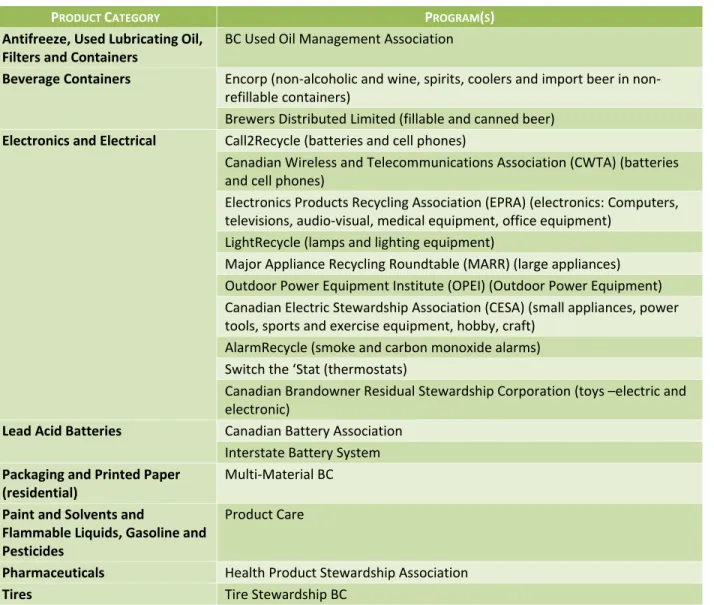
Table 9‐1 lists the current EPR programs in BC. Most of these programs operated “take back” programs where
consumers can return the used product to a depot or to the retailers. In the SLRD, several EPR programs have
arranged for municipal and SLRD landfills and transfer stations to operate as take‐back depots. It is proposed that
local governments continue to provide EPR take‐back services, as needed, to ensure local access to these programs
by residents. Local government participation may be dependent on the level of cost recovery that is offered by the
EPR program to the SLRD or member municipality to provide the service. Table 9‐1: Current EPR programs in BC
PRODUCT CATEGORY PROGRAM(S)
Antifreeze, Used Lubricating Oil,
Filters and Containers
BC Used Oil Management Association
Beverage Containers Encorp (non‐alcoholic and wine, spirits, coolers and import beer in non‐
refillable containers)
Brewers Distributed Limited (fillable and canned beer)
Electronics and Electrical Call2Recycle (batteries and cell phones)
Canadian Wireless and Telecommunications Association (CWTA) (batteries
and cell phones)
Electronics Products Recycling Association (EPRA) (electronics: Computers,
televisions, audio‐visual, medical equipment, office equipment)
LightRecycle (lamps and lighting equipment)
Major Appliance Recycling Roundtable (MARR) (large appliances)
Outdoor Power Equipment Institute (OPEI) (Outdoor Power Equipment)
Canadian Electric Stewardship Association (CESA) (small appliances, power
tools, sports and exercise equipment, hobby, craft)
AlarmRecycle (smoke and carbon monoxide alarms)
Switch the ‘Stat (thermostats)
Canadian Brandowner Residual Stewardship Corporation (toys –electric and
electronic)
Lead Acid Batteries Canadian Battery Association
Interstate Battery System
Packaging and Printed Paper
(residential)
Multi‐Material BC
Paint and Solvents and
Flammable Liquids, Gasoline and
Pesticides
Product Care
Pharmaceuticals Health Product Stewardship Association
The SLRD is a member of the BC Product Stewardship Council (BPPSC), a body that advocates on behalf of local
government for effective product stewardship programs. As a member of BCPSC, it is proposed that SLRD:
Liaise with member municipalities to share information on the outcomes of the BCPSC meetings and provide
information on other EPR‐related initiatives.
Encourage BCPSC to invite First Nations to participate on the Council.
SLRD staff also engage in consultation with stewardship programs in their plan development process, and
advocates that these programs provide reasonable service levels for the SLRD.
To reinforce that EPR products are a private sector responsibility and they should not be landfilled in the SLRD, it is
proposed that specific EPR products should be added to the list of materials that are banned from disposal as
garbage. This ban would be implemented at landfills and transfer stations only when a take‐back program for the
targeted EPR products is locally available. A list of EPR products that could be banned from landfilling includes:
Lead‐acid batteries Electronics
Appliances Motor oil and filters
Paints and solvents Pharmaceuticals
Pesticides Tires
Household batteries – single use and
rechargeable
During the planning process, it was noted that more awareness of the breadth of EPR programs and drop off
locations is needed. It is proposed that SLRD and municipal staff work with the product stewardships organizations
to support increased awareness throughout the SLRD as part of the overall Communications strategy discussed in
Section 6.
Table 9‐2 below summarizes the proposed new EPR related initiatives and their associated resource requirements
such as staffing and finances.
Table 9‐2: Summary of the proposed new EPR related initiatives
NEW INITIATIVE RESPONSIBILITY IMPLEMENTATION ESTIMATED STAFFING
REQUIREMENTS (HRS/YR) ESTIMATED CAPITAL COST ESTIMATED OPERATING COST Landfill bans on specified EPR materials/products SLRD, Squamish, Whistler 2016 40 hrs for bylaw revision and communications $ ‐ $ ‐ Increase awareness of
EPR programs and
services
Incorporated into Communication Initiatives
10. RESIDENTIAL WASTE MANAGEMENT
This section describes collection services provided by local government to residents, including the collection of
garbage, recyclables and compostable waste. Residential services currently provided in the SLRD include:
District of Squamish Door‐to‐door collection of garbage, recycling and seasonal yard waste
(curbside food waste to be collected with yard waste starting in 2015)
Resort Municipality of
Whistler
Depot‐based collection of garbage, recycling and food waste
District of Lillooet Door‐to‐door collection of garbage
SLRD Door‐to‐door collection of garbage and recycling in Britannia and Furry Creek Drop off facilities for seasonal collection of yard waste in Britannia and Furry
Creek
Depot‐based collection of garbage, recycling and food waste in Pemberton Depot‐based collection of garbage, recycling and yard waste in Lillooet Depot‐based collection of garbage and recycling for Electoral Areas A, B and C Note that the services above do not include collection services for multi‐family buildings. For the purposes of
waste collection, multi‐family buildings are treated as commercial buildings. Refer to Section 11 for a list of actions
related to commercial and multi‐family buildings.
In addition to maintaining the current residential waste collection system, the following initiatives are proposed: Implement curbside collection services in Pemberton and surrounding area. This process will begin with
community consultation to determine the community’s support for a collection service, the possible breadth
of the service (garbage and/or recycling and/or organic waste collection) and the collection protocols (e.g.
types of collection containers, frequency of collection). If there is support for a curbside service, it is
expected that the service requirements for the Pemberton transfer station may be reduced and that there
will be costs savings associated with operating the transfer station.
Assess the provision of curbside recycling and yard waste collection services in Lillooet. It is proposed that the
District of Lillooet undertake an assessment of the cost‐benefit of adding curbside recycling and yard waste
collection to their existing curbside collection service (currently for garbage only). One of the considerations
for implementing this service may be the availability of funding for the recycling service through Multi‐
Material BC or other producer responsibility organization.
These initiatives are intended to achieve following objectives: To reduce the amount of residential garbage sent to landfill
To provide services and incentives that encourage diversion of recyclable and compostable discards
In addition to the above, a communication strategy is proposed to reduce the amount of food waste generated by
single‐family homes. This strategy, discussed in Section 6, will incorporate community‐based social marketing, and
Featuring food scraps‐focused information that builds on implementation of guiding SLRD branded
communication (providing food scraps collection tips online to introduce behaviour change). Tips should
include bin recommendations, meal planning tools, how‐to videos, etc.
Coordinate with transfer station staff to focus feedback and support on food scraps diversion: special training
provided in advance of campaign. Critical to include before and after feedback about food scraps diversion,
and the results of the increased public participation in waste reduction, both at the transfer stations and
through online channels.
Providing branded food scraps bins (removing barriers to enable behaviour change) in exchange for public
commitment to experiment with food scraps collection (post public commitments at transfer stations “wall of
fame”. Potential to partner with local ice cream businesses to give away bins, and provide gift certificates to
receive ice cream to all “waste reduction heroes”. Emphasize a “wrap your scraps” with newspaper to
overcome collection and transfer challenges.
Hosting a weekly “waste reduction hero” contest (providing rewarding communications to reinforce
behaviour change). To participate, people nominate a “waste reduction hero” with a photo and story and
post it on SLRD Facebook site. Winning waste reduction story featured in the News section of SLRD website,
and winner awarded donated prize (potentially ice cream). Ideally nominations would include both regular
citizens as well as higher profile community members including but not limited to politicians and other
community leaders, professional athletes who live in or use training facilities in the area.
Campaign promotion: through municipal partner online channels; with transfer station staff; through earned
media; through targeted bought ads in local newspapers; and most effectively, through word of mouth
generated by free ice cream.
Table 10‐1 below summarizes the proposed new residential waste initiatives and their associated resource
requirements such as staffing and finances.
Table 10‐1: Proposed Residential Waste Management Initiatives
NEW RESIDENTIAL INITIATIVES RESPONSIBILITY IMPLEMENTATION ESTIMATED
STAFFING REQUIREMENTS (HRS/YR) ESTIMATED CAPITAL COST ESTIMATED OPERATING COST
Curbside collection services in
Pemberton and surrounding
area a. Community consultation SLRD and Pemberton 2015 80 $ ‐ $ 2,500 b. Implementation SLRD or Pemberton 2016 150 $ ‐ $ 10,000 c. On‐going collection service SLRD or Pemberton 2017 40 to be determined to be determined
11. COMMERCIAL AND MULTI‐FAMILY WASTE MANAGEMENT
Throughout the SLRD, private collection companies are contracted to collect their garbage, recycling and organic
waste from commercial, institutional and multi‐family residential buildings. During Stage 1 of the planning
process, it was noted that in communities where recycling and organic waste collection services are offered, not all
businesses and multi‐family buildings subscribe to these services. Waste composition data presented in the Stage
1 report indicates the 24% of Squamish’s commercial garbage is recyclable, 39% of Whistler’s ski resort
accommodation garbage is recyclable, and 21% of commercial grocery store garbage is recyclable. This data
indicates that there is a significant opportunity to increase diversion b