AN EVALUATION OF PARTIAL
DIFFERENTIAL EQUATIONS
BASED DIGITIAL INPAINTING
ALGORITHMS
B
YAHMED AL-JABERI
School of Computing
The University of Buckingham / United Kingdom
A Thesis
Submitted for the Degree of Doctor of Philosophy in Mathematics
and Computation
Science to the School of Computing in the University of
Buckingham
i
ABSTRACT
Partial Differential equations (PDEs) have been used to model various phenomena/tasks in different scientific and engineering endeavours. This thesis is devoted to modelling image inpainting by numerical implementations of certain PDEs. The main objectives of image inpainting include reconstructing damaged parts and filling-in regions in which data/colour information are missing. Different automatic and semi-automatic approaches to image inpainting have been developed including PDE-based, texture synthesis-based, exemplar-based, and hybrid approaches. Various challenges remain unresolved in reconstructing large size missing regions and/or missing areas with highly textured surroundings. Our main aim is to address such challenges by developing new advanced schemes with particular focus on using PDEs of different orders to preserve continuity of textural and geometric information in the surrounding of missing regions. We first investigated the problem of partial colour restoration in an image region whose greyscale channel is intact. A PDE-based solution is known that is modelled as minimising total variation of gradients in the different colour channels. We extend the applicability of this model to partial inpainting in other 3-channels colour spaces (such as RGB where information is missing in any of the two colours), simply by exploiting the known linear/affine relationships between different colouring models in the derivation of a modified PDE solution obtained by using the Euler-Lagrange minimisation of the corresponding gradient Total Variation (TV). We also developed two TV models on the relations between greyscale and colour channels using the Laplacian operator and the directional derivatives of gradients. The corresponding Euler-Lagrange minimisation yields two new PDEs of different orders for partial colourisation. We implemented these solutions in both spatial and frequency domains. We measure the success of these models by evaluating known image quality measures in inpainted regions for sufficiently large datasets and scenarios. The results reveal that our schemes compare well with existing algorithms, but inpainting large regions remains a challenge.
Secondly, we investigate the Total Inpainting (TI) problem where all colour channels are missing in an image region. Reviewing and implementing existing PDE-based total inpainting methods reveal that high order PDEs, applied to each colour channel
ii
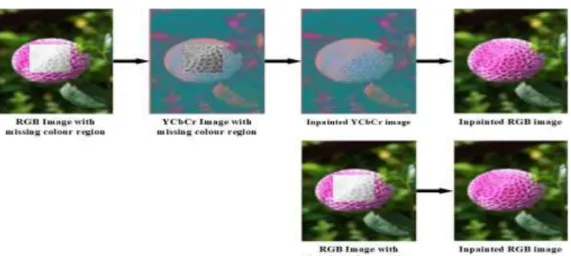
separately, perform well but are influenced by the size of the region and the quantity of texture surrounding it. Here we developed a TI scheme that benefits from our partial inpainting approach and apply two PDE methods to recover the missing regions in the image. First, we extract the (Y, Cb, Cr) of the image outside the missing region, apply the above PDE methods for reconstructing the missing regions in the luminance channel (Y), and then use the colourisation method to recover the missing (Cb, Cr) colours in the region. We shall demonstrate that compared to existing TI algorithms, our proposed method (using 2 PDE methods) performs well when tested on large datasets of natural and face images. Furthermore, this helps understanding of the impact of the texture in the surrounding areas on inpainting and opens new research directions.
Thirdly, we investigate existing Exemplar-Based Inpainting (EBI) methods that do not use PDEs but simultaneously propagate the texture and structure into the missing region by finding similar patches within the rest of image and copying them into the boundary of the missing region. The order of patch propagation is determined by a priority function, and the similarity is determined by matching criteria. We shall exploit recently emerging Topological Data Analysis (TDA) tools to create innovative EBI schemes, referred to as TEBI. TDA studies shapes of data/objects to quantify image texture in terms of connectivity and closeness properties of certain data landmarks. Such quantifications help determine the appropriate size of patch propagation and will be used to modify the patch propagation priority function using the geometrical properties of curvature of isophotes, and to improve the matching criteria of patches by calculating the correlation coefficients from the spatial, gradient and Laplacian domains. The performance of this TEBI method will be tested by applying it to natural dataset images, resulting in improved inpainting when compared with other EBI methods.
Fourthly, the recent hybrid-based inpainting techniques are reviewed and a number of highly performing innovative hybrid techniques that combine the use of high order PDE methods with the TEBI method for the simultaneous rebuilding of the missing texture and structure regions in an image are proposed. Such a hybrid scheme first decomposes the image into texture and structure components, and then the missing regions in these components are recovered by TEBI and PDE based methods respectively. The performance of our hybrid schemes will be compared with two existing hybrid algorithms.
Fifthly, we turn our attention to inpainting large missing regions, and develop an innovative inpainting scheme that uses the concept of seam carving to reduce this
iii
problem to that of inpainting a smaller size missing region that can be dealt with efficiently using the inpainting schemes developed above. Seam carving resizes images based on content-awareness of the image for both reduction and expansion without affecting those image regions that have rich information. The missing region of the seam-carved version will be recovered by the TEBI method, original image size is restored by adding the removed seams and the missing parts of the added seams are then repaired using a high order PDE inpainting scheme. The benefits of this approach in dealing with large missing regions are demonstrated.
The extensive performance testing of the developed inpainting methods shows that these methods significantly outperform existing inpainting methods for such a challenging task. However, the performance is still not acceptable in recovering large missing regions in high texture and structure images, and hence we shall identify remaining challenges to be investigated in the future. We shall also extend our work by investigating recently developed deep learning based image/video colourisation, with the aim of overcoming its limitations and shortcoming. Finally, we should also describe our on-going research into using TDA to detect recently growing serious “malicious” use of inpainting to create Fake images/videos.
Dedicated to
ACKNOWLEDGEMENTS
ALLAH THE MOST GRACIOUS AND MERCIFUL: Who gave me this
opportunity for doing research at this level. In addition, there are many people that I have to thank because, without them, I would not be the PhD student that I am today.
My family:
My heartiest and warm thanks go to my family, for their support, patience and understanding throughout the duration of my PhD time. I begin with my Mother who has not stopped praying for this work to be completed and I would like to dedicate this work and all my success to my Father, who passed away before I start this work. My wife who has been there for me every step of the way. I end with my sisters, who have been my continuous source of hope and determination to continue, despite the difficult times I have encountered.My supervisors:
I would like to express my sincerest gratitude towards my Supervisor Professor Sabah Jassim for his support, patience, valuable advice, suggestions, convincing arguments, and more during the life of this thesis; I wish him all the best for the future. I would also like to thank my Supervisor Dr. Nasser AL-Jawad for his valuable comments, useful discussions, and encouragement from the beginning until the end.Staff and Colleague:
I am highly indebted and thoroughly grateful to staff at Applied Computing Department and my colleagues. Special thanks go to Aras Asaad, PhD student in the School for his discussion and collaboration to propose and work together, I wish all the best for him in the future. In addition, I would also like to thank my personal tutor (Mr. Hongbo Du) for being a very good listener and for his continuous support and encouragement.My Sponsor:
I would like to express my sincere appreciation and gratitude to the Ministry of Higher Education and Scientific Research in Iraq, to my University in Basra and to the Iraqi Culture Attaché in London for sponsoring my PhD program of study.v
ABBREVIATIONS
Anupam Modified EBI method that introduced in (Anupam et al. 2010).
BP Belief Propagation approach
BV Bounded Variation space
CCs Connected Components
CDD Curvature-Driven Diffusion model
CMY (Cyan, Magenta, and Yellow) colour model
CMYK (Cyan, Magenta, Yellow, and Black) colour model
Criminisi EBI method that introduced in (Criminisi et al. 2004).
CSQM Coherence and Structure Quality Measurement
CSRBF Compactly Supported Radial Basis Function
Deng Modified EBI method that introduced in (Deng et al. 2015).
DWT Discrete Wavelet Transform
DFT Discrete Fourier Transform
EBI Exemplar-based Inpainting
FDM Finite-Difference Method
FT Fourier Transform
HIS (Hue, Intensity, and Saturation) colour model
HH High-High (refers to a wavelet subband)
HL High -Low (refers to a wavelet subband)
ℋ1(𝛤) one-dimensional Hausdorff space
𝐻01(𝛺) Sobolev space
HT High Texture
HSV (Hue, Saturation, and Value) colour model
LBP Local Binary Pattern
LH Low- High (refers to a wavelet subband)
LL Low-Low (refers to a wavelet subband)
LT Low Texture
mCH modified Cahn-Hilliard model
MESM Mumford-Shah-Euler Model
MSM Mumford-Shah Model
MSE Mean Squared Error
vi
NCD Normalised Colour Distance
NCC Normalised Correlation Coefficients
NTSC (luminance, chrominance, and chrominance) colour model
PDE Partial Differential Equation
PDE-BI Partial Differential Equation-Based Inpainting algorithm
PSNR Peak Signal to Noise Ratio
QCDD Quick Curvature-Driven Diffusion model
RGB (Red, Green, Blue) colour space
SC Seam Carving approach
SSIM Structural Similarity Index
SVM Support Vector Machine
TDA Topological Data Analysis
TEBI Topological Exemplar-Based Inpainting Method
TK Tikhonov regularisation
TI Total Inpainting
TV Total Variation regularisation
ULBP Uniform LBP
WT Wavelet Transform
XYZ (chrominance, luminance, and chrominance) colour model
YCbCr (luminance, chrominance, and chrominance) colour model
iv
TABLE OF CONTENTS
ABSTRACT ... i ACKNOWLEDGEMENTS ... iv ABBREVIATIONS ... v TABLE OF CONTENTS ... iv LIST OF FIGURES ... iv LIST OF TABLES ... iv DECLARATION ... iv 1 Chapter 1. INTRODUCTION ... 11.1 OVERVIEW OF THE RESEARCH ... 1
1.2 THE PROBLEM OF IMAGE INPAINTING ... 5
1.2.1 Digital Image ... 5
1.2.2 Image Inpainting ... 6
1.2.3 Applications of Inpainting... 7
1.3 RESEARCH QUESTIONS ... 9
1.4 AIMS AND OBJECTIVES OF THIS RESEARCH PROJECT ... 10
1.5 THESIS MAIN CONTRIBUTIONS ... 11
1.6 PUBLICATIONS AND PRESENTATIONS ... 15
1.6.1 Publications ... 15
1.6.2 Presentations ... 16
1.7 THESIS OUTLINE ... 17
2 Chapter 2. MATHEMATICAL BACKGROUNDS ...19
2.1 CLASSIFICATION OF INPAINTING METHODS ... 19
2.2 INPAINTING DOMAINS ... 21
2.2.1 Frequency Domain ... 21
2.3 FUNCTIONS OF BOUNDED VARIATION (BV) ... 25
2.3.1 Special Differential Operators ... 26
2.3.2 Space of functions with Bounded Total Variation ... 26
2.3.3 Calculus of Variations – A brief introduction ... 27
2.4 MINIMISATION PROBLEMS ... 28
2.4.1 Euler-Lagrange Equation ... 29
2.4.1.1 Lagrange Multipliers (Bertsekas 2014) ...30
2.4.2 The Method of Steepest Descent (Gradient Descent) (Kelley 1999)... 31
2.4.2.1 Unique Solution (W. Rudin 1976) ...32
2.5 NUMERICAL METHODS OF PDE-BASED INPAINTING MODELS ... 33
2.5.1 Finite Difference ... 34
2.5.2 Finite Difference Method ... 36
2.6 IMAGE INPAINTING QUALITY ASSESSMENTS ... 39
2.6.1 Statistical Quality Measurements ... 39
Full-Reference Image Quality Assessment ... 39
2.6.1.1 MSE and PSNR...40
2.6.1.2 Structural Similarity Index (SSIM) ...40
No Reference Image Quality Assessment ... 41
2.6.1.3 Entropy ...42
2.6.1.4 Mean of Structural Similarity (MSSIM) ...42
v
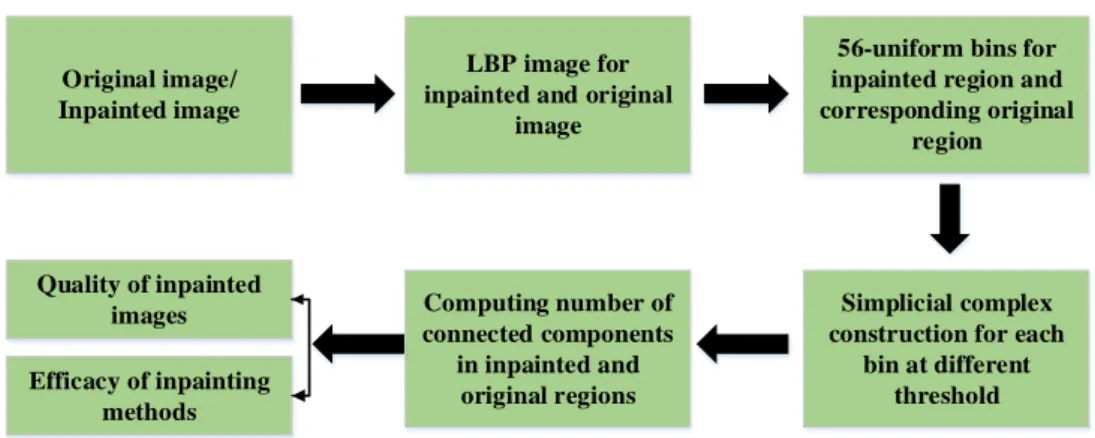
2.6.2 Topological Data Analysis for Image Quality Assessments ... 44
2.6.2.1 Local Binary Patterns (LBP) ...45
2.6.2.2 Simplicial Complex Construction ...47
2.7 SUMMARY AND CONCLUSION ... 48
3 Chapter 3. COLOURISING GREYSCALE IMAGES BASED ON PDE ALGORITHMS ...49
3.1 GENERAL COLOURISATION CONCEPTS ... 49
3.2 LITERATURE OVERVIEW ... 51
3.3 BASICS OF SEMI-AUTOMATIC GREYSCALE IMAGE COLOURISATION... 57
3.3.1 Image Colour Models ... 58
3.4 GEOMETRIC CONSIDERATION OF THE COLOURISATION PROBLEM ... 60
3.4.1 The Mathematics of Sapiro's Colourisation Scheme ... 61
3.4.2 Further Variation -based Formulation of Image Colourisation ... 66
3.4.2.1 Minimisation of Directional Derivative of Gradient in Colour Channels ...66
3.4.2.2 Minimisation of the Laplacian in Colour Channels ...69
3.4.2.3 Summary of the above colourisation algorithms ...72
3.5 EXPERIMENTAL RESULTS ... 72
3.5.1 Using Non-Segmented Images ... 74
3.5.2 Using Pre-Segmented Images ... 74
3.6 IMAGE QUALITY ASSESSMENTS ... 76
3.6.1 Database Description ... 77
3.6.2 Experiment 1: Results of Berkeley Segmentation Database ... 78
3.6.3 Results Analysis ... 81
3.6.4 Experiment 2: Examples of Semi-Automatic Image Colourisation Algorithms ... 82
3.7 SUMMARY AND CONCLUSION ... 84
4 Chapter 4. PDE BASED FULL INPAINTING METHODS ...85
4.1 GENERAL CONCEPTS AND MATHEMATICS OF PDE-BIMETHODS ... 86
4.1.1 Variational Methods ... 86
4.1.2 Non-Variational Methods ... 88
4.1.3 Literature Overview ... 88
4.2 SECOND-ORDER PDE-BI METHODS... 90
4.2.1 Isotropic Diffusion (Tikhonov Regularisation Technique) ... 90
4.2.2 Harmonic Extension Equation ... 92
4.2.3 Anisotropic Diffusion (TV Regularisation Technique) ... 93
4.2.4 Mumford-Shah Model (MSM) ... 95
4.3 HIGHER-ORDER PDE-BI METHODS ... 97
4.3.1 Mumford-Shah-Euler Model (MESM) ... 97
4.3.2 Bertalmio Approach (Transport Model) ... 99
4.3.3 Modified Cahn-Hilliard Model (mCH) ... 102
4.3.4 Fourth-Order Total Variation Model ... 103
4.4 EXAMPLES OF PDE-BIMETHODS IN SPATIAL DOMAIN ... 104
4.4.1 Second-Versus Higher-Order PDE Methods in Inpainting ... 108
4.5 INPAINTING BASED ON PDE AND COLOURISATION METHODS IN SPATIAL DOMAIN ... 109
4.6 PDE-BIMETHOD IN THE FREQUENCY DOMAIN ... 110
4.7 IMAGE QUALITY ASSESSMENT POST INPAINTING ... 114
4.7.1 Databases Description ... 114
4.7.2 Statistical Measurements for Image Quality ... 116
4.7.2.1 Experiment 1: Results of using PDE on the natural dataset ...116
4.7.2.2 Experiment 2: Results of using PDE on the face dataset ...121
4.7.2.3 Experiment 3: Results of using PDE and colourisation methods...128
4.7.2.4 Results Analysis ...128
4.7.3 TDA for Image Quality Assessment ... 132
4.7.3.1 Results Analysis ...140
4.7.4 TDA for PDEs Performance ... 141
vi
4.8 SUMMARY AND CONCLUSION ... 147
5 Chapter 5. TOPOLOGICAL EXEMPLAR-BASED INPAINTING ... 149
5.1 INTRODUCTION ... 149
5.2 EXISTING EXEMPLAR-BASED INPAINTING (EBI) ... 151
5.3 LITERATURE REVIEW ... 152
5.4 TOPOLOGICAL EXEMPLAR-BASED INPAINTING METHOD (TEBI) ... 156
5.4.1 Topological Image analysis ... 157
5.4.1.1 Experimental Dataset and Protocols ...157
5.4.1.2 Classification Results ...159
5.4.1.3 Determination of Patch Size ...161
5.4.2 Patch Filling Function ... 162
5.4.2.1 Innovative Adaptive Priority Function ...163
5.4.3 Matching Criteria ... 166
5.5 EXPERIMENTAL RESULTS ... 167
5.6 IMAGE QUALITY ASSESSMENT ... 170
5.6.1 Statistical measurements for image quality ... 172
5.6.1.1 Results Analysis ...174
5.6.2 Topological Data analysis for image quality ... 175
5.6.2.1 Results Analysis ...179
5.7 SUMMARY AND CONCLUSION ... 180
6 Chapter 6. HYBRID IMAGE INPAINTING TECHNIQUE ... 182
6.1 HYBRID INPAINTING TECHNIQUES -ALITERATURE REVIEW ... 183
6.2 HYBRID INPAINTING TECHNIQUE IN THE SPATIAL DOMAIN ... 186
6.2.1 Image decomposition methods ... 186
6.2.2 Inpainting methods for reconstructing the texture and structure images ... 190
6.2.3 Experimental results in the spatial domain ... 193
6.3 HYBRID INPAINTING TECHNIQUE IN THE FREQUENCY DOMAIN ... 196
6.4 PERFORMANCE OF THE HYBRID SCHEME IN TERMS OF IMAGE QUALITY... 200
6.4.1 Statistical image quality measures ... 200
6.4.1.1 Results analysis ...205
6.4.2 Topological Data Analysis for image quality ... 207
6.4.2.1 Results analysis ...210
6.5 SUMMARY AND CONCLUSION ... 211
7 Chapter 7. INPAINTING LARGE MISSING REGIONS BASED ON SEAM CARVING ... 213
7.1 INPAINTING RELATIVELY LARGE MISSING REGIONS -INTRODUCTION ... 213
7.2 SEAM CARVING –INTRODUCTION AND IMPLEMENTATION ... 217
7.3 SEAM-CARVED APPROACH TO INPAINTING... 221
7.4 EXPERIMENTAL RESULTS ... 221
7.5 IMAGE QUALITY ASSESSMENT ... 225
7.5.1 Statistical measurements for image quality ... 226
7.5.1.1 Quality measures for removing large regions ...228
7.5.1.2 Quality measures for reconstructing large missing regions ...229
7.5.1.3 Results analysis ...229
7.5.2 Topological Data analysis for image quality ... 231
7.6 SUMMARY AND CONCLUSION ... 233
8 Chapter 8. CONCLUSIONS AND FUTURE RESEARCH ... 235
8.1 WORK SUMMARY ... 235
8.2 ONGOING AND FUTURE RESEARCH DIRECTIONS ... 240
References ... 242
Appendix ... 270
vii
B. EVALUATION OF PERFORMANCE OF EBI METHODS ... 280 C. EVALUATION OF PERFORMANCE OF HYBRID TECHNIQUES ... 285 D. EVALUATION OF PERFORMANCE OF PROPOSED TECHNIQUE BASED ON SEAM CARVING ... 290
LIST OF FIGURES
Figure 1-1: The digital grayscale image. ... 6
Figure 1-2: The inpainting task. It is taken from (Sc et al. 2011). ... 7
Figure 2-1: Inpainting processing in the frequency domain. ... 21
Figure 2-2: Process of the Haar wavelet transform for the 1st level. ... 24
Figure 2-3: Pyramid of wavelet transform for 1st, 2nd and 3rdlevels. ... 25
Figure 2-4: The level curves of a poorly scaled problem.. ... 31
Figure 2-5: A straight line segment connecting two points in a set. ... 32
Figure 2-6: A straight line segment connecting two points at a function. ... 32
Figure 2-7: Finite difference of U(x). ... 34
Figure 2-8: The representative mesh point P(ih, jk). ... 35
Figure 2-9: General idea of the finite-difference method ... 36
Figure 2-10: The finite-difference grid of heat equation. ... 38
Figure 2-11: Heat inpainting process ... 38
Figure 2-12: Image quality assessment approaches: Full Reference. ... 39
Figure 2-13: Image quality assessment approaches: No-Reference. ... 41
Figure 2-14: Local binary operator.. ... 45
Figure 2-15: The 58 different uniform patterns in (8, 1) ... 46
Figure 2-16: Simplicial complex construction for the quality of image inpainting. ... 48
Figure 3-1: Schema of semiautomatic colourisation steps... 57
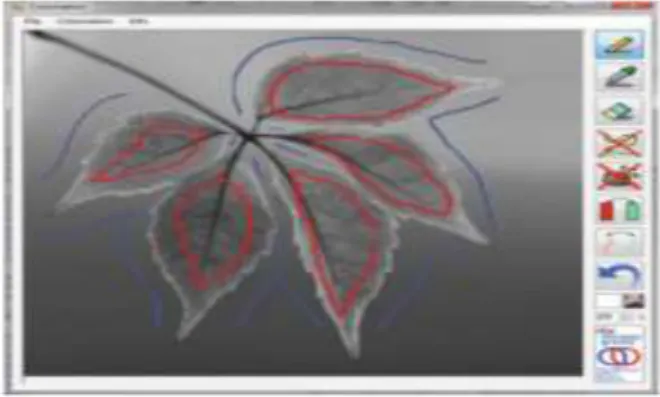
Figure 3-2: Example of a colourisation software layout. ... 58
Figure 3-3: Illustration of colour spaces. ... 60
Figure 3-4: Sapiro colourisation algorithm. ... 65
Figure 3-5: Sapiro colourisation algorithm.. ... 65
Figure 3-6: PDE colourisation algorithms. ... 72
Figure 3-7: Flowchart of an algorithm for inpainting the colours ... 72
Figure 3-8: Colourising missing colour regions. ... 73
Figure 3-9: Colourising whole grayscale image. ... 73
Figure 3-10: Adding colour to non-segmented images. ... 74
Figure 3-11: An image has segmented.. ... 75
Figure 3-12: Colourising segmented image in the spatial domain... 75
Figure 3-13: Colourising segmented image in frequency domain. ... 75
Figure 3-14: Examples of colourising grayscale images.. ... 76
Figure3-15: Example of eight out of 300 training natural images. ... 77
Figure 3-16: Masked colour natural image in the RGB colour space. ... 79
Figure 3-17: Masked colour natural image in the YCbCr colour space. ... 79
Figure 3-18: Examples of five out of 80 colourisation ... 79
Figure 3-19: A comparison of colourisation quality achieved ... 83
Figure4-1: Steps of inpainting based PDE method. ... 86
Figure4-2: Inpainting based isotropic model ... 91
v
Figure4-4: Explanation of Bertalmio module. ... 100
Figure4-5: Recovering hole in an image. ... 105
Figure4-6: Recovering large hole in an image. ... 105
Figure4-7: Removing text using a PDE inpainting method. ... 106
Figure4-8: Removing scratches PDEs inpainting methods. ... 106
Figure4-9: Removing bold text using PDEs inpainting methods. ... 106
Figure4-10: Removing bold text by PDEs inpainting methods. ... 107
Figure 4-11: Recovering missing regions using PDE-based inpainting and colourisation methods in the spatial domain.. ... 109
Figure 4-12: Recovering missing regions using PDE-based inpainting and colourisation methods in the spatial domain.. ... 110
Figure4-13: Inpainting based-PDE method in 1st and 2nd level Haar... 112
Figure4-14: Removing scratches using PDE inpainting methods in the frequency domain. ... 113
Figure4-15: Removing scratches using PDE inpainting methods in the frequency domain. ... 113
Figure4-16: Example of eight out of 300 training natural images. ... 115
Figure4-17: Example of eight out of 114 training face images. ... 115
Figure4-18: The same natural image with five different inpainting domains. ... 117
Figure4-19: Removing scratches using PDE-BI methods in the spatial domain. ... 118
Figure4-20: Removing scratches using PDE-BI methods in the spatial domain. ... 118
Figure4-21: Recovering missing regions using PDE-BI methods in the spatial domain. ... 118
Figure4-22: Recovering missing regions using PDE-BI methods in the wavelet domain. ... 119
Figure4-23: The same face image with five different inpainting domains. ... 122
Figure4-24: Scratch removal using the harmonic model in the spatial domain... 123
Figure4-25: Scratch removal using the mCH model in the spatial domain. ... 123
Figure4-26: Text removal using the harmonic model in the spatial domain. ... 123
Figure4-27: Scratches removal using the transport model in the spatial domain. ... 124
Figure4-28: Object removal using the transport model in the spatial domain. ... 124
Figure4-29: Scratches removal using PDE-BI methods in the frequency domain. ... 125
Figure4-30: Object removal using PDE-BI methods in the frequency domain. ... 125
Figure4-31: Example to the MSE of image.. ... 130
Figure4-32: First row; an example of two images ... 131
Figure4-33: LBP and simplicial complexes of the original and inpainted image ... 132
Figure 4-34: Example of drawing SC for two images that have same value of PSNR. 133 Figure4-35: Evaluation of performance of PDE-BI methods ... 135
Figure4-36: Evaluation of performance of PDE-BI methods ... 136
Figure4-37: Evaluation of performance of PDE-BI methods ... 138
Figure4-38: Evaluation of performance of PDE-BI methods ... 139
Figure4-39: Object removal using PDE-BI methods. ... 142
Figure4-40: Evaluation of performance of PDE-BI methods. ... 143
Figure4-41: Object removal using PDE-BI methods. ... 143
vi
Figure4-43: Object removal using PDE-BI methods. ... 144
Figure4-44: Evaluation of performance of PDE-BI methods. ... 145
Figure4-45: Object removal using PDE-BI methods. ... 145
Figure4-46: Evaluation of performance of PDE-BI methods ... 146
Figure5-1: The EBI procedures for recovering the missing region ... 152
Figure5-2: Flowchart of the proposed topological EBI method. ... 156
Figure5-3: Samples of low texture images selected from google image. ... 158
Figure5-4: Texture classification results using SVM classifier ... 160
Figure5-5: Texture classification results using an SVM classifier. ... 160
Figure5-6: Removing Objects ... 168
Figure5-7: Region reconstruction using EBI.. ... 168
Figure5-8: Region reconstruction using EBI.. ... 169
Figure5-9: Region reconstruction using EBI.. ... 169
Figure5-10: Example of eight out of 100 training low-information natural images. ... 171
Figure5-11: Example of eight out of 100 training high-information natural images... 171
Figure5-12: The same natural image with five different inpainting domains... 172
Figure5-13: Evaluation of performance of EBI techniques. ... 177
Figure5-14: Evaluation of performance of EBI techniques. ... 178
Figure6-1: Image denoising example. ... 188
Figure 6-2: Comparison of three denoising models.. ... 189
Figure6-3: Image decomposition example. ... 189
Figure6-4: Comparison of three decomposing models: ... 190
Figure6-5: Flowchart Hybrid technique in the spatial domain. ... 191
Figure6-6: Recovering missing texture region... 192
Figure6-7: Hybrid inpainting process. ... 194
Figure6-8: Recovering the missing region using the hybrid technique. ... 194
Figure6-9: Object removal by hybrid technique.. ... 195
Figure6-10: Comparison of the proposed hybrid technique ... 195
Figure6-11: The representative value of the wavelet transform ... 198
Figure6-12: Hybrid-Based Inpainting technique. ... 199
Figure6-13: Inpainting based-hybrid technique in 2nd and 3rd level wavelet ... 200
Figure 6-14: The same natural image with five different inpainting domains... 202
Figure6-15: Recovering missing regions in the spatial domain. ... 202
Figure6-16: Recovering missing regions in the spatial domain.. ... 203
Figure6-17: Recovering missing regions in the frequency domain. ... 203
Figure6-18: Recovering missing regions in the frequency domain. ... 203
Figure6-19: Evaluation of performance of hybrid techniques using TDA approach at 8 iterations in G6 ... 208
Figure6-20: Evaluation of performance of hybrid techniques using TDA approach at 8 iterations in G5 ... 209
Figure 7-1: Failure of wavelet-based Hybrid inpainting for large missing region. ... 216
Figure7-2: Different energy functions for the natural image.. ... 218
Figure7-3: The flowchart of the seam carving approach ... 219
Figure7-4: Seam carving process. ... 219
vii
Figure7-6: Inpainting-based seam-carving approach. ... 221
Figure7-7: Large object removal examples... 222
Figure7-8: Recovering large missing regions examples.. ... 224
Figure7-9: The same natural image with five different inpainting domains... 226
Figure 7-10: Recovering large missing regions examples.. ... 227
Figure7-11: Evaluation of performance of the proposed inpainting technique using TDA approach at 8 iterations in G5. ... 232
Figure7-12: Evaluation of performance of the proposed inpainting technique using the TDA approach at 8 iterations in G1 ... 232
Figure A-1: Evaluation of performance of PDE algorithms using TDA approach at 8 iterations in G1 ... 270
Figure A-2: Evaluation of performance of PDE algorithms using TDA approach at 8 iterations in G2 ... 271
Figure A-3: Evaluation of performance of PDE algorithms using TDA approach at 8 iterations in G4. ... 272
Figure A-4: Evaluation of performance of PDE algorithms using TDA approach at 8 iterations in G5 ... 273
Figure A-5: Evaluation of performance of PDE algorithms using TDA approach at 8 iterations in G7 ... 274
Figure A-6: Evaluation of performance of PDE algorithms using TDA approach at 8 iterations in G1 ... 275
Figure A-7: Evaluation of performance of PDE algorithms using TDA approach at 8 iterations in G2 ... 276
Figure A-8: Evaluation of performance of PDE algorithms using TDA approach at 8 iterations in G4 ... 277
Figure A-9: Evaluation of performance of PDE algorithms using TDA approach at 8 iterations in G5 ... 278
Figure A-10: Evaluation of performance of PDE algorithms using TDA approach at 8 iterations in G7 ... 279
Figure B-1: Evaluation of performance of EBI techniques using TDA approach at 8 iterations in G1 ... 280
Figure B-2: Evaluation of performance of EBI techniques using TDA approach at 8 iterations in G2 ... 281
Figure B-3: Evaluation of performance of EBI techniques using TDA approach at 8 iterations in G3 ... 282
Figure B-4: Evaluation of performance of EBI techniques using TDA approach at 8 iterations in G5 ... 283
Figure B-5: Evaluation of performance of EBI techniques using TDA approach at 8 iterations in G6. ... 284
Figure C-1: Evaluation of performance of hybrid techniques using TDA approach at 8 iterations in G1 ... 285
Figure C-2: Evaluation of performance of hybrid techniques using TDA approach at 8 iterations in G2. ... 286
Figure C-3: Evaluation of performance of hybrid techniques using TDA approach at 8 iterations in G3 ... 287
viii
Figure C-4: Evaluation of performance of hybrid techniques using TDA approach at 8
iterations in G4 ... 288
Figure C-5: Evaluation of performance of hybrid techniques using TDA approach at 8
iterations in G7 ... 289
Figure D-1: Evaluation of performance of the proposed technique using the TDA
approach at 8 iterations in G2 ... 290
Figure D-2: Evaluation of performance of the proposed technique using the TDA
approach at 8 iterations in G3. ... 291
Figure D-3: Evaluation of performance of the proposed technique using the TDA
approach at 8 iterations in G4. ... 291
Figure D-4: Evaluation of performance of the proposed technique using the TDA
approach at 8 iterations in G6. ... 292
Figure D-5: Evaluation of performance of the proposed technique using the TDA
LIST OF TABLES
Table 3-1: Values of conversion parameters from different colour spaces to RGB space. . 64
Table 3-2: The average of PSNR, SSIM and NCD values from original and inpainted images in the spatial domain for 8 different colour spaces. Poisson, Curvature and 4th -order methods have been used to obtain these error values. ... 80
Table 3-3: The average of PSNR, SSIM and NCD values from original and inpainted images, in the frequency domain for 8 different colour spaces. Poisson, Curvature and 4th-order PDE methods have used to obtain these values. ... 81
Table 3-4: Results of colourisation quality for all three algorithms, PSNR, SSIM, and NCD. ... 83
Table 4-1: The average values of MSE and PSNR of inpainted images of PDE methods in different levels of DWT. ... 112
Table 4-2: The average values of MSE, PSNR, SSIM, and entropy are shown for image inpainting using Harmonic Transport, MES and mCH models in the spatial domain. ... 120
Table 4-3: The average values of MSE, PSNR, SSIM, and entropy are shown for image inpainting using harmonic transport, MES and mCH models in the frequency domain. ... 121
Table 4-4: The average values of MSE, PSNR, SSIM, and entropy are demonstrated for image inpainting using harmonic, transport, MES and mCH models in the spatial domain. ... 126
Table 4-5: The average values of MSE, PSNR, SSIM, and entropy are demonstrated for image inpainting using harmonic, transport, MES and mCH models in the frequency domain. ... 127
Table 4-6: The average values of MSE, PSNR, SSIM, and entropy are demonstrated for image inpainting using only harmonic, MES and mCH models and these models with colourisation method in the spatial domain. ... 128 Table 5-1: Description of the priority functions tested in this study. ... 163
Table 5-2: comparing priority function, matching criteria and patch size in Criminisi, Anupam, Deng and TEBI. ... 168
Table 5-3: Inpainted image quality assessment comparison using MSE, PSNR, SSIM, CSQM and Entropy for low information dataset images. ... 173
Table 5-4: Inpainted image quality assessment comparison using MSE, PSNR, SSIM, CSQM and Entropy for high information dataset images. ... 173
Table 6-1: The average values of MSE, PSNR and SSIM are shown for image inpainting using Bertalmio, TEBI techniques and our proposed hybrid techniques in the spatial domain. ... 204
Table 6-2: The average values of MSE, PSNR and SSIM are shown for image inpainting using Bertalmio, TEBI techniques and our proposed hybrid techniques in the
frequency domain. ... 205
Table 7-1: Ratios of missing regions size to whole images in figure 7-7 before and after seam-carving. ... 223
Table 7-2: The size of the missing regions to the whole images in figure 7-8 before and after reduction using the seam-carving method. ... 224
Table 7-3: The size of the missing regions to the whole images in figure 7-9 before and after reduced using the seam-carving approach. ... 227
Table 7-4: Inpainted image quality assessment comparison using E, MSSIM, and CSQM. ... 228
Table 7-5: Inpainted image quality assessment comparison using MSE, PSNR, SSIM, CSQM and Entropy. ... 229
DECLARATION
This work has not previously been submitted for a degree or diploma in the University of Buckingham or any other university. To the best of my knowledge and belief, the thesis contains no material previously published or written by another person except where due reference is made in the thesis itself.
1
Chapter 1
INTRODUCTION
Image inpainting is a process that has been investigated for a long time as the concept of reconstructing old photos that have degraded over time or modifying a photo to remove unwanted objects/persons from it. However, a variety of malicious as well as genuine use of image inpainting started to grow fast as a result of the recent rapid advances in technology that have led to exponential growth of deployment of cheaply available computing devices (mobiles) of high computational power endowed with free software that enable fast transmission of high-resolution digital images/videos. Indeed, the concept of inpainting has expanded in many directions that go well beyond repairing images. As an instant of missing data, interpolation has long been recognised as the underlying tool of inpainting. Consequently, calculus of variation and numerical solutions of partial differential equations have been the natural source of solutions for the filling missing data version of image inpainting. The main aim of this thesis is to investigate the use of Partial Differential Equation (PDE) for dealing with the emergent aspects and application of inpainting with focus on developing innovative efficient inpainting tools, testing the performance of these tools in terms of various image quality measures as well as detection of malicious image modifications by inpainting.
The aim of this introductory chapter is to describe the general idea of image inpainting and its challenges in image inpainting. First there is an overview of emerging inpainting research challenges, briefly highlighting related approaches and directions of research, if any, that have been adopted in the literature and the bases of our innovation to improve and complement these efforts. Then the main modern applications that form our motivations for doing this research are described, and the overall objectives of the research reported in this thesis are stated. This will be followed by brief descriptions of the main contributions of this thesis including the list of publications produced so far, and of the thesis organisational structure.
1.1
Overview of the Research
In image processing and analysis, the success of most applications depends on the quality of the image signal. The quality of digital images is a variety of
2
actions/decisions that occur during recording, digitisation, compression, and in transit over channels that are subject to signal interference. At each of these stages, factors influencing the image quality include camera properties, lighting and environmental conditions, compression rates and communication channel capacity and their effects are manifested by the appearance of different types of noise and artefacts as well as blurring and other type's degradations. In contrast, printed photographs, portraits, and pre-digital age recorded films may over time degrade, fade and suffer from loss of image data in irregular strokes-like regions and torn material as a result of storage/display related conditions or sabotage. The most common feature in these cases, is the presence of regions with missing/incomplete image data/information. Repairing such images/photos/paintings and restoring missing data/ information to its “original state” is referred to as image inpainting.
A well-established example of inpainting application is the regular restoration of old paintings kept in museums carried out by skilled artists. Since the early days of the discovery of photography, inpainting has been used, albeit sparingly, to remove undesired objects/persons or superposing photos of unrelated objects/persons onto an existing photo. The advent of digital imaging created not only new applications in a variety of human activities but the digitisation process and other basic image processing tasks such as compression result in a variety of image degradations that need to be dealt with to ensure adequate image quality. To some extent, most image degradations result in spurious local features not blending well with their surroundings, and inpainting-related procedures may be useful for quality enhancements.
There are different types of missing image information such as missing colour, and missing regions caused by, e.g. noise, blur, degradation, etc. In the digital world, image inpainting (also known as interpolation image/video) refers to the application of advanced algorithms to supersede lost or damaged data from an image portion. The aim of inpainting is to blend the modification within the undegraded surrounding and success is measured by how difficult the repair can be detected visibly or by image analysis.
In recent years, the above two main approaches have been modified and improved in various directions, and in general image inpainting approaches are classified into several categories (Vadhel & Limbasiya 2016), (Nileshbhai Patel 2016), and (Suthar et al. 2014):
3
1. PDE based Inpainting.
2. Texture Synthesis based Inpainting. 3. Exemplar-based Inpainting (EBI). 4. Semi-automatic and Fast Inpainting. 5. Hybrid Inpainting.
Each of these approaches recovers the damaged regions in accordance to certain requirements of expectation of the repaired image content, and hence have own limitations and shortcomings. Next, the main ideas in these approaches are briefly explained. There are different inpainting techniques, the most prominent inpainting techniques are variational/PDE-based inpainting and exemplar-based inpainting techniques. The variational/PDE based approaches justified by the expectation that image information flow along image features are interrupted through the missing region and accordingly have been used to restore relatively small missing image regions, (Sc et al. 2011). In this case, the small missing region is reconstructed pixel by pixel based on propagating the information from the immediate boundary pixels of the missing area. The larger the missing region is, the less likely image features flow continuously/smoothly along their paths for long spatial periods. Moreover, image features may not flow in the same directions of the way numerical solutions of PDE propagate information. The exemplar-based inpainting approach, complements the idea of using flow of information along image features with the idea that in most images there are a lot of similarities between image blocks, and reconstruct the missing regions block by block using block similarities in the surrounding regions (Criminisi et al. 2004). The exemplar-based techniques have been used for reconstructing relatively large missing regions, and it fill-in the missing region with information in such a way that isophote lines arriving at the regions’ boundaries are completed inside the region. This technique does not require to specify where the new information comes from the borders, but its success relies on compatibility of information between the missing region and its surrounding regions in terms of simple textures and structures.
The texture synthesis approach recovers the missing texture region in the image by searching for similar missing pixels neighbour around the missing region and copy its pixel value to the missing pixel. This algorithm performs reasonably well, but it is very slow due to the extensive searching (Efros & Leung 1999).
4
Whereas, hybrid inpainting is combined of two inpainting methods which are texture-based synthesis and PDE-texture-based inpainting methods for filling the missing regions. The first step of this approach is to divide the image into texture and structure regions. Then these regions are reconstructed with corresponding methods which they need a relatively long time (Rane et al. 2003).
The semi-automatic inpainting approach is a two-stage process. In the first stage, the user provides essential missing information manually by sketching object boundaries from the surrounding areas to the missing area. The patch-based texture synthesis method is utilised to produce the texture (Telea 2018) in the second stage. This approach takes a long time in proportion to the inpainting region size.
The challenges of applying these inpainting approaches to recover the missing regions are the large size of the missing regions and the complexity of texture and structure in the surrounding of the missing regions. The main premise of our optimism comes from the fact that images convey significant amount of information that can be modelled in much more sophisticated and well-understood ways than that exploited by the current models of texture similarity and distribution as well as variational relation between different channels of image colour spaces. Moreover, the wealth of innovative techniques developed over the years in the field of image processing and image analysis provide a rich source of mathematically based procedures that one can exploit in dealing with these challenges. For example, the properties of variation in image information, across different colour channels, captured by gradient, Laplacian and other transformations can be used to propose new methods for adding colour to grayscale images. The use of different order PDE-based inpainting techniques is an obvious candidate approach for investigating inpainting missing regions of larger size than that dealt with in the literature. Compression, or related, techniques provide another source of methods to deal with the challenge of missing region size. For example, the concept of seam carving that results in compressing/resizing images horizontally and/or vertically with minimal loss of important image information is a natural approach to improve the performance of existing inpainting schemes, such as the EBI, for recovering large missing regions. Together, these various ideas will be investigated and used to introduce more ways of building hybrid inpainting techniques.
In order to measure the success of any inpainting solutions, it is natural to simulate loss of various types of image on publicly available image dataset and compare the quality
5
of the inpainted images with those of the original images. Unfortunately, commonly used image quality measures, such as MSE, PSNR, NCD, SSIM, MSSIM, CSQM and Entropy are not adequately capable of assessing the success of various image inpainting techniques. The recent work, conducted at Buckingham, on the extension/realisation of the emerging new Topological Data Analysis (TDA) approach to image analysis seem to provide an innovative image quality assessment tool. Indeed, the fact that the TDA approach model image texture at different filtration/proximity thresholds is an obvious mathematically rich candidate for incorporation into our assessment test of the success of inpainting techniques. In particular, the performance of innovative techniques of image inpainting is developed and tested to overcome their limitations and to reconstruct the large missing regions in natural and face images that lead to improvements in the accuracy. In addition, the topological data analysis approach could help to refine block similarity concept used in the EBI-based inpainting technique, to allow recovering large missing regions with complex texture and structure around them.
1.2
The Problem of Image Inpainting
This section is devoted to the mathematical definition of the problem under investigation (image inpainting) and we shall highlight the need for this research by giving an overview of the various modern applications that have expanded over the last few years beyond the obvious image restoration. In order to describe the concept of image inpainting, we shall first describe basic mathematics of digital images. This is done for the benefit of readers who have little or no background in Image processing and can be skipped by others.
1.2.1 Digital Image
A digital image is obtained from an analogue image (representing the photograph of a scene, object or phenomena in the continuous world) by sampling and quantization. Basically, this means that the digital camera superimposes a regular grid on an analogue image and assigns a value to each grid element e.g. the mean brightness in this area element. cf. (Aubert & Kornprobst 2006). Mathematically, a digital image 𝑓 is a rectangular array/matrix structure where each element at position (𝑖, 𝑗) of the structure function pixel is assigned an intensity values 𝑓(𝑖, 𝑗).In grayscale images, the value 𝑓𝑖,𝑗 is a single number, a scalar value normally ranging between 0 (black) and 255 (white). For colour images each 𝑓𝑖,𝑗is a vector of three colour values, e.g., (r, g, b), where each
6
channel r, g and b represents the red, green, and blue component of the colour and ranges, each 𝑓𝑖,𝑗 is a vector of three values,
𝑓𝑖,𝑗 = (𝑟𝑖,𝑗, 𝑔𝑖,𝑗, 𝑏𝑖,𝑗),
that denotes the intensity of red, green, and blue channels at the point(𝑖, 𝑗). As in the case of greyscale images, the values in these channels are also integers in the range from 0 to 255. A digital image can also be defined mathematically as a two-dimensional image function defined on a flat rectangle called the image domain. This function is single-valued in case of the grayscale image while it is 3-dimensional vector-valued in the case of a colour image. The pixel value 𝑓(𝑥, 𝑦) denotes the gray value, i.e., colour value, of the image at the pixel position (𝑥, 𝑦) of the image domain. Figure 1-1 describes the digital image and its image function (a matrix) for the case of a grey value image.
Figure 1-1: The digital grayscale image with a small red square in (a), a red region to the data matrix in (b).
Now, an image function (a matrix) is known as a mathematical object on which a variety of mathematical operations can act. These mathematical operations are often used analyse or extract different types of information for image processing purposes, including statistical methods, morphological operations, and other filtering. We are especially concerned with operations that use PDE and variational methods image inpainting and filling missing regions.
1.2.2 Image Inpainting
This section is devoted to the mathematical definition of the problem under investigation (image inpainting) and we shall highlight the need for this research by giving an overview of the various modern applications that have expanded over the last few years beyond the obvious image restoration. Inpainting is the process of
7
reconstructing the missing regions of the damaged images based on information which that obtained from the surrounding regions, this process is called image inpainting, and it considers an important task in image processing.
Let 𝑓 represents a given image which that defined on an image domain 𝛺. Generally speaking, the task is to reconstruct the missing region of damaged image 𝑢 in the damaged domain 𝐷 ⊂ 𝛺, called inpainting domain (or a gap/hole), see Figure 1-2.
Figure 1-2: The inpainting task. It is taken from (Sc et al. 2011).
The task of reconstructing the missing region of the damaged image has been called term inpainting by the art restoration workers, see in (Ekeland & Temam 1976). The framework of digital restoration has introduced for the first time by Bertalmio et al. in (Bertalmio et al. 2000). Therein the authors in (Bertalmio et al. 2000) introduced a new PDE which intends to mimic the restoration work of museum artists. This equation will be discussed in more detail in section 4.3.2. The next section gives some applications for image inpainting.
1.2.3 Applications of Inpainting
There are several applications which use the concept of inpainting in image processing for a variety of reasons. One important application of digital inpainting is automatic text removal and object removal in images and films for special effects; different mathematical models have been used to remove the objects and to recover the missing regions based on the PDE methods described by (Bertalmio et al. 2000), (Chan & Shen 2002), and (Cocquerez et al. 2003). These PDE methods have been proposed based on total variation, isophote, curvature driven diffusion and so on, and these methods propagated the information in the missing regions based on the information in the surrounding areas. Furthermore, these PDE methods can also be used to remove the dates, texts, subtitles, or publicity from an image (Bertalmio et al. 2000), (Chan & Shen 2002), (Ballester et al. 2001), and (T. Chan and J.Shen 2001), by propagating
8
information from the surrounding areas into the missing regions. In addition, old or damaged images and films can be restored by detecting missing regions and reconstructing the information without causing distortion to those areas of the frames (images) that are not affected. Different statistical detector models have been used and then the detected missing regions have been reconstructed (Kokaram et al. 1995a) and (Kokaram et al. 1995b). In lossy perceptual image coding and compression based on the edge information, where the edge has played a crucial role in vision and image analysis, in image coding, the performance of a scheme is very much determined by its reaction to edges. The inpainting based PDE approach has been used for (lossy) image coding and compression based on the edge information (Chan & Shen 2002) and(Saha & Vemuri 2000). Moreover, PDE-based inpainting methods have been used for adding colour to grayscale images; these methods have been proposed based on the geometric relations between the channels in the colour space (Sapiro 2005). Furthermore, disocclusion is required (using the variational model to reconstruct the missing region based on the geometry of objects in the image), the numerical solutions of PDE methods recovers the missing regions. (Nitzberg et al. 1993), and (Masnou & Morel 1998). In the context of error control and concealment of it in video communication, where the inpainting methods attempt to recover the lost information by estimation and interpolation without depending on additional information from the encoder, these inpainting methods are called interactive error concealment methods (interpolation and statistical methods) (Yao Wang & Qin-Fan Zhu 1998). For image super-resolution, the inpainting based PDE method have been used to reconstruct high-resolution images. This method for super-resolution is based on a total variation prior and variational distribution approximations (Babacan et al. 2008). For image zooming (Chan & Shen 2002), and (Malgouyres & Guichard 2001), digital zoom-in has wide applications in digital image processing, image super-resolution, data compression, etc. Zoom- out is a process entailing loss of detail, including in the framework of wavelets and multi-resolution analysis. The inpainting method has been used to zoom-in which is the inverse of zoom-out and thus belongs to the general category of image restoration problems. A digital zoom-in model almost identical to the continuous TV inpainting model is constructed based on the self-contained digitised PDE method developed by authors in (Chan & Shen 2002). On the other hand, the inpainting methods can be used for malicious purposes such as fake news and images. The development of the software for use in phones and computers in recent years has facilitated dealing with digital
9
images. This software is available to anyone who can use it. As a result the world has become susceptible to fake news and so it is increasingly important for researchers to acquire understanding of how these inpainting methods are working so that they can try to reverse the inpainting process to detect the forged images, this field of work is now called image forgery detection for object removal by image inpainting methods (Muhammad et al. 2012), (Liang et al. 2015) and (Yang et al. 2017). These algorithms have been used to detect forged images and identify the manipulated regions in them.
1.3
Research Questions
The main focus of this work is investigating the numerical solutions of certain PDEs that have applications in image processing such as image inpainting. The questions arising from this are:
1. Can high order PDE methods do better than second order PDE methods for recovering missing region?
The high order PDE methods essentially expected to recover missing regions of images better than second order PDE methods because they use relatively more information from the borders during the recovery process. Therefore, it’s interesting to know what the effect of the high order of PDE methods.
2. Can high order PDE methods be used to recover small missing regions with complex texture in the surrounding areas?
PDE methods generally recover non-textured missing regions in an image, so the effects of PDE order in recovering small missing regions with high texture in the surrounding areas need to be investigated in terms of the connection of edges over large distances (i.e. Connectivity Principle).
3. Can high order PDE methods be used to recover large missing regions with simple texture and structure in the surrounding areas?
PDE methods usually recover small missing regions in an image, so the effects of PDE order in recovering large missing regions in terms of the smooth propagation of level lines into the damaged domain (i.e. Curvature Preservation) need to be investigated and studied.
10
4. Are the statistical measurements good for image quality measurement? If not, are there other measurements which can be used to check the qualities of inpainted images?
Some of these statistical measurements (MSE and PSNR) have limitations revealed by their failures to gives results which correspond to visual quality assessments. An application that test the change in the image structure needs to be investigated and compared with the traditional image quality assessments methods.
5. Does the size of patch propagation in the EBI method affect the results? The EBI method is propagated the information in the missing region with a typical fixed size of patch propagation 9 × 9. Investigating the effects of changing the size of patch propagation in the missing regions is needed to be tested.
1.4
Aims and Objectives of this Research project
This thesis primarily aims to investigate and develop mathematically inspired and justified techniques that improve the treatment of the different missing regions in a variety of images. In summary, the main objectives are:
In partial missing regions, studying the geometric relations between the channels in the colour spaces such as RGB, and seven other spaces and exploiting these relations to propose a colourisation formula for adding colour to greyscale images in both spatial and frequency domains.
In total missing regions, analyses and evaluations the performances of inpainting-based PDE methods of various orders in recovering the missing regions in the image. This will help to choose the best PDE method that will be used with other inpainting techniques to recover texture and structure in images in both spatial and frequency domains.
Carrying out theoretical and empirical analyses of current inpainting methods (i.e. PDE methods), which aim to evaluate their performance in reconstructing the contents of missing regions of various sizes and with various quantities of texture and structure in the surrounding areas.
Developing an innovative hybrid technique that uses high order-PDE and Topological EBI methods to recover small missing regions with high texture and structure in the surrounding areas.
11
Developing a novel technique to recover large missing regions with high texture and structure in the surrounding areas using a seam-carving approach.
Rigorous evaluation of the quality of image inpainting obtained using different inpainting methods based on the proposed TDA approach that is used to check the performances of these inpainting algorithms.
Investigation of the performances of EBI method with different-size patch propagations in recovering missing regions of different sizes. The TDA approach is used to improve the EBI method, and is applied to adaptively determine the patch size based on the quantity of texture in the surrounding areas.
Our approaches to meet these objectives rely in many ways on the wealth of mathematical techniques and concepts developed over the last few decades in the field of image processing and analysis.
1.5
Thesis Main Contributions
Our extensive investigations and experimental work have led to a number of advances in meeting the main objectives and modifying existing inpainting schemes with improved capability in restoring missing image regions in different scenarios. Our review of the different existing inpainting schemes revealed that their deployment under different circumstances in various applications continues to entail many challenges. Many studies have been conducted to handle textured large missing regions in natural images of high quality. Three main shortcoming issues are identified that face these algorithms, which arise when the missing region is large, when there is a high quantity of texture around the missing region and when the surrounding areas of the missing regions contain geometrically complex features. New algorithms are developed to remedy the above shortcomings. The implementations of these new algorithms reconstruct the textured large missing regions in natural images, based on the contents of the areas surrounding missing regions. Therefore, this thesis claims the following major contributions:
1. In (Sapiro 2005), G. Sapiro proposed a PDE-based colourisation technique that deals with the loss of 2 specific colour channels in a region where the 3 channel is available. The author has shown that the (scalar) luminance channel faithfully represents the geometry of the whole (directional) colour image. The performance
12
of this technique was good in adding colour to the greyscale image. However, it has a problem at edges where the colours overlap with each other.
To overcome this problem, new colourisation formulas are deduced to reduce the effect of the colour overlapping at object edges, which are tested on non-segmented images and pre-non-segmented images.
These formulas are implemented on 8 different colour spaces, both in the spatial and frequency image domains.
The performance of this technique was tested on 80 publicly available natural images, and compared with those of three existing algorithms introduced in (Sapiro 2005), (Levin et al. 2004), and (Popowicz & Smolka 2014). The evaluation was based on statistical measurements such as MSE, PSNR, NCD, and SSIM. The results confirmed that our technique successfully propagates the missing colours into the greyscale regions of the images.
2. Our next contribution focused on the more general colourisation problem to the case of missing all colour in a region, i.e. colour information is only available outside and on the border of the region. Existing PDE-based inpainting algorithms can be divided into two groups: inpainting algorithms based on energy function, and inpainting algorithms based on PDEs directly. Inpainting-based PDE algorithms have first been developed, in this thesis, for the reconstructions of small missing regions without texture. Our contributions, in this respect, relate the overcoming these limitations and can be summarised as follows:
Several PDE algorithms of 2nd and higher orders have been studied to reconstruct the small missing regions.
We propose to use PDE algorithms to recover missing regions in Y channel, then PDE-based colourisation methods have been applied to reconstruct the missing regions in Cb and Cr channels.
The performance of inpainting-based PDE algorithms is evaluated by statistical measurements and topological data analysis-based quality measure.
The performance of 2nd and higher order PDE methods have been tested on the connection of edges over large distances (i.e. Connectivity Principle) and the smooth propagation of level lines into the damaged domain (i.e. Curvature Preservation).
13
The performance of these algorithms has been assessed by studying their iterations and their convergence properties.
Also, these PDE algorithms have been applied to natural and face images datasets in the frequency domain, and their results are compared with the results of the spatial domain. MSE, PSNR E, MSSIM and CSQM are used to evaluate these techniques in both the spatial and frequency domains. TDA scheme is used to check the quality of image inpainting and to check the efficacy of the PDE algorithms.
The PDE algorithms have tested on the natural images in both the spatial and frequency domains. The results of these algorithms in the spatial domain have compared the results of them in the frequency domain.
To sum up, these PDE algorithms have been applied to several natural images and shown to successfully reconstruct small non-textured missing regions with edges and corners, but there is still challenging existing with textured missing regions. Therefore, we attempted to handle this challenge as our next contribution.
3. As mentioned before, inpainting-based PDE algorithms cannot reconstruct textured missing regions. Our review of existing schemes to deal with this issue revealed two interesting schemes: an EBI method (Jassim et al. 2018) and high order PDE algorithm (Esedoglu & Shen 2002). A novel hybrid inpainting technique is developed which is inspired by (Bertalmio et al. 2000). The basic idea is to divide the image into texture and structure components. The missing regions of these components are restored separately by EBI and PDE-based methods respectively. The specific contributions of this work can be summarised as follows:
Three types of decomposing methods have been tested to divide the image into texture and structure components (Rudin et al. 1992).
Different order PDE-based algorithms such as Mumford-Shah (Esedoglu & Shen 2002), and Cahn-Hilliard (A. L. Bertozzi et al. 2007), have been used to reconstruct missing regions in the structure component.
An EBI method has been applied to reconstruct the missing regions in the texture image component; the use of different block sizes, based on the quantities of the texture in the surrounding of the missing regions is proposed.
14
The hybrid technique has been applied to natural dataset images in both the spatial and frequency domains, its results in the spatial domain has compared with its results in the frequency domain.
To conclude, the proposed technique has been applied to a sufficiently large dataset of natural images, and their performances have been compared with those resulting from the use of the algorithm in (Bertalmio et al. 2000). Statistical measurements and TDA approach are used to evaluate the results of the mentioned techniques. This technique successfully reconstructed the small textured missing regions with edges and corners, but it still has the challenge to recover the large missing regions with high structure and texture. Therefore, the next step will deal with this issue by applying the EBI algorithm.
4. An EBI technique was proposed in (Criminisi et al. 2004) for reconstructing large missing regions with simple textures and structures. It is somewhat limited to recovering missing regions with rich textures and structures. To overcome this drawback, an innovative topological exemplar-based inpainting (TEBI) technique is developed whereby the assessment of the similarity of patches includes the application of topological parameters gained by topological data analysis scheme (Jassim et al. 2018). Furthermore, the ideas in (Anupam et al. 2010), (Hesabi & Mahdavi-Amiri 2012), (Deng et al. 2015), and (Asaad & Jassim 2017) are improved by using geometrical structure features of the images. Below are the main achievements in this part:
The size of the patch (a window to be searched for its match in the whole image) is determined based on the quantity of the texture in the surrounding of the missing region via Topological Data Analysis (TDA) scheme.
The filling priority of the patch is determined by the geometrical properties of curvature of isophotes.
Introducing new patch-matching scheme, which can be divided into two stages; 1- Calculating the sum -of -squared distance (SSD) for Laplacian, gradient and
spatial domains of the image and selecting the nearest 30 patches.
2- Measuring the normalised cross-correlation coefficient of the 30 patches defined in stage one to select the nearest patch.