COMPETENCY-BASED CURRICULUM FOR A MASTER’S PROGRAM IN SERVICE SCIENCE, MANAGEMENT AND ENGINEERING (SSME):
AN ONLINE DELPHI STUDY
______________
A Dissertation Presented to
the Morgridge College of Education University of Denver
______________
In Partial Fulfillment
of the Requirements for the Degree of Doctor of Philosophy
_______________ by
Rahul Choudaha November 2008 Advisor: Dr. Frank Tuitt
©Copyright by Rahul Choudaha 2008 All Rights Reserved
Author: Rahul Choudaha
Title: COMPETENCY-BASED CURRICULUM FOR A MASTER’S PROGRAM IN SERVICE SCIENCE, MANAGEMENT AND ENGINEERING (SSME):
AN ONLINE DELPHI STUDY Advisor: Dr. Frank Tuitt
Degree Date: November 2008
ABSTRACT
The overarching purpose of this research was to provide theoretical and conceptual foundations for developing a competency-based curriculum for an
interdisciplinary master’s program in Service Science, Management and Engineering (SSME). Specifically, the objective was to ascertain the competencies and courses that are relevant for developing a competency model for a service scientist and a
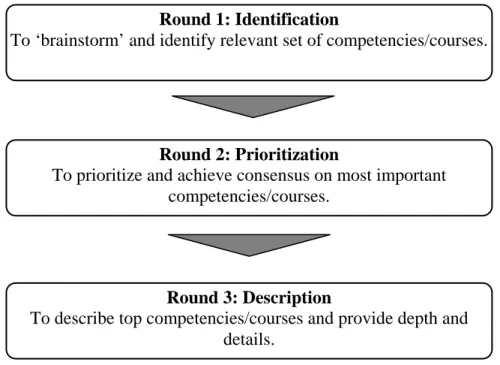
curriculum blueprint for SSME. The study employed three rounds of the online Delphi survey to achieve the research objectives. The three rounds were used to identify, prioritize, and define competencies and courses. A panel of industry professionals and university faculty were invited to participate as experts. A total of 51, 40, and 39 respondents participated in Round 1, Round 2 and Round 3 survey respectively.
Overall, a high degree of consensus was observed among the participants for the importance of competencies and courses, however, there were some differences noted by the disciplinary expertise and professional background of the respondents. Based on the consensus of the study participants, a final list of 10 competencies and 14 courses was generated. These competencies were used to develop a competency model and the courses were used to create a curriculum blueprint.
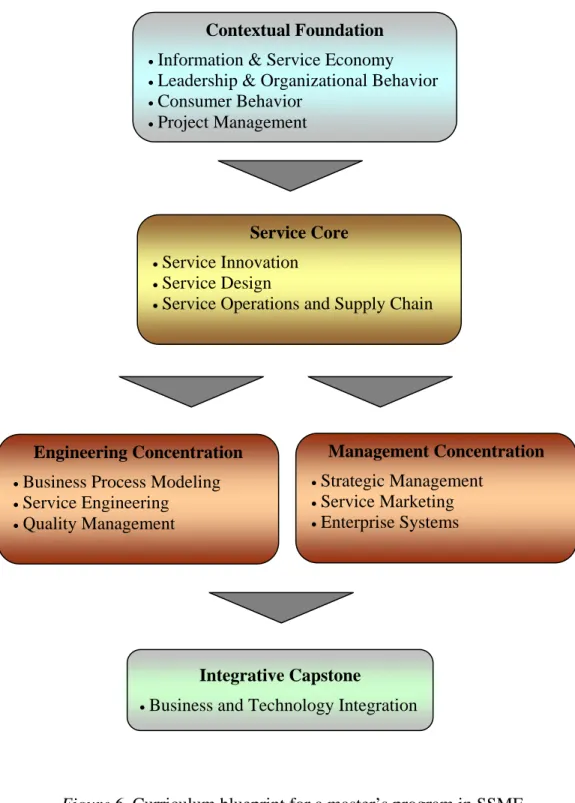
The final 14 courses were categorized into four modules, Module 1: Contextual Foundation (Information & Service Economy, Consumer Behavior, Leadership & Organizational Behavior, Project Management); Module 2: Service Core (Service Innovation, Service Design, Service Operations and Supply Chain); Module 3(a): Engineering Concentration (Business Process Modeling, Service Engineering, Quality Management); Module 3(b): Management Concentration, Strategic Management, Service Marketing, Enterprise Systems) and; Module 4: Integrative Capstone (Business and Technology Integration).
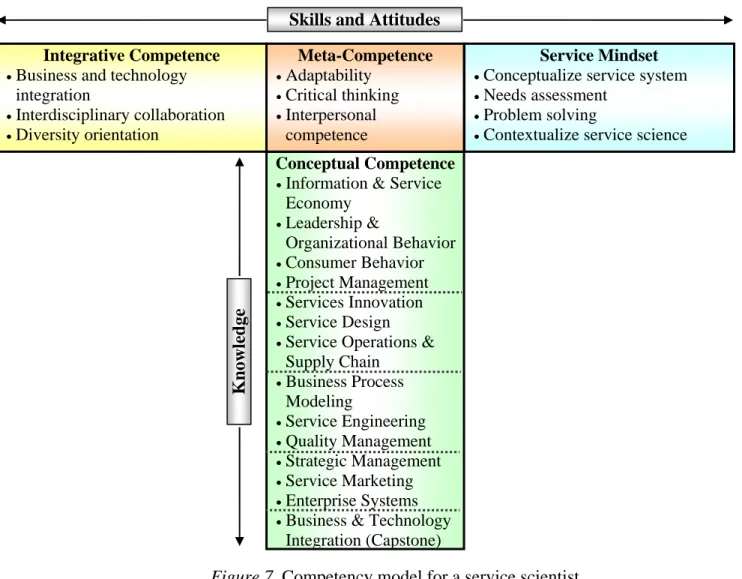
The final 10 competencies were categorized into three clusters; Cluster 1: Service Mindset (Needs assessment, Conceptualize service system, Problem-solving, Contextualize service science); Cluster 2: Integrative Competence (Business and technology integration, Interdisciplinary collaboration, Diversity orientation) and; Cluster 3: Meta-competence (Adaptability, Interpersonal communication, and Critical thinking).
The results of this study may serve as a common language among stakeholders to prepare future service scientists or “T-shaped” professionals for the service
economy. This study also contributed to the body of literature of competency-based curriculum development in higher education.
TABLE OF CONTENTS
LIST OF TABLES….………..………..vi
LIST OF FIGURES………….………...vii
CHAPTER 1: INTRODUCTION... 1
1.1 Statement of the Problem ... 4
1.2 Purpose of the Study... 7
1.3 Research Questions ... 8
1.4 Significance of the Study ... 9
1.5 Assumptions and Delimitations... 11
1.6 Conceptual Framework ... 13
1.7 Organization of the Study... 16
1.8 Definition of Key Terms ... 17
CHAPTER 2: LITERATURE REVIEW... 20
2.1 Context ... 21
2.1.1 Changing Nature of the Economy and Work... 21
2.1.2 Professional Master’s Education ... 24
2.1.3 Influence of Industry on Curriculum ... 27
2.2 Competency-based Curriculum Development ... 29
2.2.1 Engineering ... 34 2.2.2 Management ... 37 2.3 Competencies ... 39 2.3.1 Engineering ... 42 2.3.2 Management ... 46 2.4 Interdisciplinary Education ... 51 2.5 Evolution of SSME... 58 CHAPTER 3: METHODOLOGY... 62 3.1 Delphi Method... 65 3.2 Research Design ... 69 3.3 Participants ... 72 3.4 Instruments ... 75 3.5 Procedures ... 78 3.6 Data Analysis ... 80 3.7 Role of Researcher ... 82
CHAPTER 4: RESULTS... 84
4.1 Delphi Panel Profile ... 85
4.2 Delphi Survey Results ... 88
4.2.1 Round 1... 88
4.2.2 Round 2... 93
4.2.3 Round 3... 111
4.3 Summary of Results ... 121
CHAPTER 5: DISCUSSION... 124
5.1 Blueprint of SSME Curriculum... 125
5.2 Competency Model for a Service Scientist ... 129
5.3 Recommendations ... 135
5.4 Implications for Future Research ... 140
5.5 Limitations of the Study ... 142
5.6 Conclusions ... 144
REFERENCES... 148
APPENDICES... 167
Appendix A. Round 1 Email Invitation... 167
Appendix B. Round 1 Delphi Survey... 169
Appendix C. Round 2 Email Invitation... 173
Appendix D. Round 2 Delphi Survey ... 174
Appendix E. Round 3 Email Invitation ... 177
Appendix F. Round 3 Delphi Survey ... 178
LIST OF TABLES
Table 1. Comparison of Traditional Survey with Delphi Method... 64
Table 2. Doctoral Dissertations using Delphi method for Curriculum Development .. 67
Table 3. Profile of Participants across Delphi Rounds... 87
Table 4. Panel Ratings of Courses in Round 1 ... 89
Table 5. Changes made in the Courses based on Round 1 Responses ... 90
Table 6. Panel Ratings of Competencies in Round 1 ... 91
Table 7. Changes made in the Competencies based on Round 1 Responses ... 92
Table 8. Panel Ratings of Courses in Round 2 ... 94
Table 9. Shift in Panel Ratings of Courses in Round 2 ... 95
Table 10. Degree of Consensus for Courses by Participants’ Profession ... 97
Table 11. Comparison of Consensus for Courses by Participants’ Profession ... 97
Table 12. Degree of Consensus for Courses by Participants’ Discipline... 99
Table 13. Comparison of Consensus for Courses by Participants’ Discipline... 99
Table 14. Panel Ratings of Competencies in Round 2 ... 102
Table 15. Shift in Panel Ratings of Competencies in Round 2 ... 103
Table 16. Degree of Consensus for Competencies by Participants’ Profession... 105
Table 17. Comparison of Consensus for Competencies by Participants’ Profession. 106 Table 18. Degree of Consensus for Competencies by Participants’ Discipline ... 107
Table 19. Comparison of Consensus for Competencies by Participants’ Discipline . 109 Table 20. Panel Ratings of Courses in Round 3 ... 112
Table 21. Description of Courses in Round 3 ... 114
Table 22. Panel Ratings of Competencies in Round 3 ... 117
LIST OF FIGURES
Figure 1. Conceptual framework ... 16
Figure 2. Purpose of Delphi rounds... 77
Figure 3. Delphi study administration process ... 80
Figure 4. Frequency distribution of degree of agreement with courses in R3 ... 113
Figure 5. Frequency distribution of degree of agreement with competencies in R3.. 118
Figure 6. Curriculum blueprint for a master’s program in SSME... 126
CHAPTER 1: INTRODUCTION
The structure and nature of the U.S. economy is changing and so is the nature of the work. For example, in a “flat world” where technology and globalization is leveling the competitive landscape (Friedman, 2005), the nature of knowledge work is changing at the interface of technology and services (Darr, 2007) and the demand for knowledge workers is increasing as the complexity of knowledge work intensifies (Cortada, 1998). These shifts indicate emergence of a “new knowledge-based service economy” that differs from the industrial economy. The distinctive characteristic of “knowledge-based economy is its dependence on human capital inputs, on know-how and skill, competence and expertise” (Alic, 1997, p. 8). While this new service
economy is promising, higher education has not developed an academic community of scholars who focus on innovation and productivity of the service sector (Chesbrough & Spohrer, 2006; Siegel, Hefley, Evenson & Slaughter, 2008).
An emerging knowledge-based service economy poses new challenges for the U.S. professional education system as curriculum needs to be aligned with the
corresponding demand for new competencies (Everwijn, Bomers & Knubben, 1993; Jones, 2002). In addition, as the demand for accountability and responsiveness from the American higher education system shifts towards learning outcomes and
prominent (Banta, 2001; Lemaitre, Le Prat, de Graaff & Bot, 2006; Paulson, 2001; Vaatstra & de Vries, 2007; Voorhees, 2001). The confluence of the above mentioned changes in the economy and challenges faced by the professional higher education has resulted in a call for reform by government, professional associations, national
research bodies, and accreditors. Within professional education the expectations for relevancy, accountability, and effectiveness seem to be higher for engineering and management education, as they have an intricate relationship with economic activity and competitiveness. For example, according to the AACSB International (2002), “Management education is at risk, and industry-wide leadership is needed to position business schools to respond to emerging priorities and challenges” (p. 5). Similarly, the National Academy of Engineering (2004) asserts that “…engineering will only contribute to success if it is able to continue to adapt to new trends and educate the next generation of students so as to arm them with the tools needed for the world as it will be, not as it is today” (p. 5). Moreover, a report by the Council of Graduate Studies (2007) reiterates the relevance of graduate education in general and interdisciplinary education in particular, in preparing knowledge creators and innovators for a knowledge-based global economy. Thus, there is a widespread recognition of the changes in the economy and the need for engineering and management education to effectively respond to these changes.
The demand for qualified and competent workers in the labor market in general and in the professions in particular influences higher education’s decisions about developing new courses, programs, and disciplines (Karseth, 1995). One such
emerging field is Service Science, Management and Engineering (SSME). SSME attempts to develop new professionals who would have a service mindset and a capacity to integrate elements of the disciplines like engineering and management to solve the complex and unique problems of service economy (IfM & IBM, 2008). At a time when complex problems of the service economy are demanding innovative solutions, higher education institutions need “to explore emerging interdisciplinary fields such as services sciences, management and engineering and to implement new models of curriculum development and delivery” (Spellings Commission, 2006, p. 23). Likewise, policymakers are also recognizing the potential of service science and hence the recently enacted America COMPETES Act (2007) emphasizes that to maintain the competitiveness and innovation in the U.S. economy there is a need to “better understand and respond strategically to the emerging management and learning discipline known as service science” (p. 577).
This call for focus on service education and research is not new. The need for service education and research has been emphasized for more than 30 years, however, “the urgency for rigorous study to guide service managers in improving the design, competitiveness, efficiency, and effectiveness of service delivery, both at the firm and industry levels, has never been greater” (Metters and Marucheck, 2007, p. 196). As a field of study, service gained prominence with the emergence of service marketing in the 1970s. However, this time service science is encouraged to integrate several disciplines such as engineering and computer science, industrial systems engineering, organization theory, and economics (Bitner & Brown, 2006). This urgent demand for
an interdisciplinary focus on education and research for the service economy is a reflection of the rapidly changing nature of knowledge work and the critical role played by professional higher education in preparing talent for the future.
Within the continuum of higher education from undergraduate to doctoral degree, the master’s degree is uniquely positioned to provide professional
competencies for a changing economy without compromising the value of liberal education at the undergraduate level or disciplinary research at the doctoral level. Conrad, Haworth, and Millar (1993) define master’s degree as the “silent success” of American higher education. They note that since the 1980s more than four-fifth of the master’s education occurred in professional programs, further validating the role of the master’s degree in enriching knowledge and skills for the economy. The professional master’s degree provides a new direction for the production of knowledge, one that is likely to be interdisciplinary, with emphasis on core and applied knowledge,
technological and communication skills, and involves problem-solving practica or internship (Glazer-Raymo, 2005). The master’s degree is becoming fully
professionalized and interdisciplinary, reflecting the entrepreneurial, competitive, and accountable nature of professions (Glazer-Raymo, 2005).
1.1 Statement of the Problem
A discussion paper released by the University of Cambridge and IBM, calls for preparing “adaptive innovators” or “T-shaped” professionals through an
(IfM & IBM, 2008). According to IfM and IBM (2008) adaptive innovators or T-shaped professionals are system thinkers who are well educated in their home disciplines and at the same time have the ability to work across multiple disciplines. The interdisciplinary initiative of SSME focuses on “the application of scientific, management, and engineering disciplines to tasks that one organization (service provider) beneficially performs for and with another (service client)” (Spohrer, Maglio, Bailey & Gruhl, 2007, p. 71).
Henry Chesbrough (2005) in his Harvard Business Review article entitled
Breakthrough ideas for 2005: Toward a new science of services, claims that the new discipline of service science holds promise but faces several challenges. He mentions that the emergence of computer science as a discipline from the shadows of
engineering, physics and mathematics was not easy. Likewise, service science may also have to overcome the disciplinary barriers of engineering and management (Chesbrough, 2005). In addition, SSME has to clearly position itself against the existing interdisciplinary approach already offered by Systems Engineering and Engineering Management programs.
Interdisciplinary Engineering Management programs have existed for several years. Engineering Management programs gained prominence in the early 1980s as they provided required educational support to the engineers’ natural career progression into managerial roles (Dieter, 1984). The American Society for Engineering
Management (2007) defines Engineering Management as “the art and science of planning, organizing, allocating resources, and directing and controlling activities
which have a technological component.” However, most of the Engineering
Management programs are narrowly focused on technology based applications for the manufacturing sector (Badawy, 1998).
Systems Engineering was organized as a field of study in the early 1960s and today there is a strong need to apply these principles to the service sector (Tien & Berg, 2003). The International Council on Systems Engineering (2008) defines Systems Engineering as “an engineering discipline whose responsibility is creating and executing an interdisciplinary process to ensure that the customer and
stakeholder’s needs are satisfied in a high quality, trustworthy, cost efficient and schedule compliant manner throughout a system’s entire life cycle.”
Both Systems Engineering and Engineering Management fields have a strong relationship with the proposed SSME, however, it is evident from the above
mentioned definitions that Systems Engineering and Engineering Management
programs are still predominantly engineering disciplines and they have not recognized the unique nature of the service economy nor they have moved away from their home discipline to embrace true interdisciplinarity. This exposes an immediate need to bridge the gap and offer an interdisciplinary program in engineering and management which studies and improves the service systems (Davis & Berdrow, 2008; Spohrer, et al., 2007; Tien & Berg, 2003).
Consequently, the need and relevance for a new program in SSME at the master’s level is based on the following assertions. First, the nature of the work and competencies required for innovation and productivity improvement has significantly
changed with technology and globalization. Second, the existing Engineering
Management and Systems Engineering programs were designed for the manufacturing based economy, while the current context of the economy is service and knowledge based. Third, the existing programs lack a systematic inclusion of the competency-based approach in curriculum development. Fourth, the origin of current Engineering Management programs was to develop managerial skills among engineers and the Engineering Management programs were not philosophically or theoretically grounded in interdisciplinarity. Finally, the master’s level education is uniquely positioned to develop interdisciplinary professional competencies as compared to liberal education at the undergraduate level or disciplinary specialization at the doctoral level.
1.2 Purpose of the Study
The overarching purpose of this research is to provide theoretical and conceptual foundations for developing a competency-based curriculum for an
interdisciplinary master’s program in Service Science, Management and Engineering (SSME). Specifically, the objective is to ascertain the competencies and courses that are relevant for developing a competency model for a service scientist and a
curriculum blueprint for SSME. The research objectives are addressed by the process of identification, prioritization and description of specific competencies and courses by an expert panel of university faculty and industry professionals. In other words, the study aims at identification of specific competencies and courses that may serve as a
common language between university faculty and industry employers to prepare future talent for the knowledge-based service economy. Through this study, the stakeholders will be able to brainstorm and arrive at a consensus on a blueprint of the competency-based curriculum for SSME. University faculty may use this blueprint to adapt and design their program. This study also aims to contribute to the body of literature of competency-based curriculum development in the field of higher education and to encourage other disciplines like engineering and management to draw on extensive research available in higher education.
1.3 Research Questions
Taking into consideration the changing nature of competencies required by the economy and the role of higher education in providing those competencies, the
overarching purpose of this research is to provide theoretical and conceptual foundations for developing a competency-based curriculum for an interdisciplinary master’s program in Service Science, Management and Engineering (SSME). Specifically, the study will investigate the following research questions:
1) What are the most important competencies required for a graduate of the master’s level interdisciplinary program in SSME?
2) What courses/content domains may provide the most important
competencies required for a graduate of the master’s level interdisciplinary program in SSME?
1.4 Significance of the Study
The 21st century has seen numerous reports from stakeholders highlighting the changing nature of the knowledge-based service economy and the urgency to bring change in higher education (AACSB International, 2002; Council of Graduate Studies, 2007; National Academy of Engineering, 2004; IfM & IBM, 2008). These reports raised several issues related to teaching and learning, accountability, and effectiveness of higher education. Specifically, in the context of the changing needs of the
knowledge-based services economy, SSME is proposed as an interdisciplinary field to develop adaptive innovators and T-shaped professionals for the service economy. However, the legitimization of SSME in academia would require investment in development and delivery of the required curriculum from undergraduate to doctoral levels to foster development of competent professionals in service science (Siegel et al., 2008). Further, developing a relevant and globally available curriculum for SSME is a huge undertaking for a single higher education institution and requires
collaboration across several institutions, industry and government (Siegel et al., 2008). For an emerging field like SSME, it is critical to encourage multiple
perspectives and at the same time attempt to bring some consensus among the
stakeholders about future directions. This study engaged two key stakeholders, faculty and employers, using online Delphi method to identify, prioritize and describe the future competencies and courses that may be provided by a master’s level program in SSME.
This study contributes to the theory and practice of curriculum development in higher education in general and SSME in particular. First, it advances the theoretical perspectives of competency-based curriculum and interdisciplinary education. Second, this may be the first dissertation to develop a blueprint for the competency-based curriculum for master’s level program in SSME. In other words, this study will provide a platform for systematically identifying and prioritizing the set competencies required for an interdisciplinary program in SSME. Third, this dissertation engages dialogue among industry professionals and university faculty to create a common language for the emerging discipline of SSME. Fourth, this study uses the conceptual framework and theoretical background from the higher education discipline and encourages future studies in other disciplines to leverage the intellectual and rigorous research base of curriculum development from the field of higher education.
Further, in an era where demand for accountability by stakeholders is more than ever before, interdisciplinary competency-based curriculum may satisfy the demands for defining and measuring the student learning outcomes for continuous improvement. Faculty may use the blueprint to design and adapt their courses in line with the overall competencies expected out of the curriculum. Students would be in a better situation to make informed decisions and set expectations about the programs as they may see a relationship between outcomes and curriculum. The economy in general and employers in particular would gain from the increased productivity and capacities of the workforce to deliver the expected performance. Individuals would acquire high end competencies that are of relevance and demand in the labor market
and hence would be able to foster their personal and professional growth. University administrators would benefit from having an understanding of the interactions and interface between learning outcomes in the form of competencies and curriculum designed by faculty for better program planning. Policymakers, accrediting agencies, and professional associations would benefit from an improved measure of
accountability, quality, and performance.
1.5 Assumptions and Delimitations
This dissertation research rests on a few assumptions and delimitations as described below.
Curriculum, instruction, and assessment form the triad of educational process (Pellegrino, 2006). Curriculum consists of offering knowledge and skills in a subject matter with a planned sequence of learning (Pellegrino, 2006). This study excludes instruction and assessment and focuses only on curriculum and competencies. This is due to several reasons: (1) emerging nature of the SSME, which still lacks a consensus on the curriculum and competencies (2) expansion of the scope and hence a longer survey for a three round Delphi may result in higher dropout rates and loss of focus among participants (3) this study uses both university faculty and industry
professionals as participants. While faculty may serve as experts on instruction and assessment related questions, it seems infeasible to expect similar expertise from industry professionals.
The study focuses on preparing a blueprint of competency-based curriculum for a master’s program in SSME by identifying and prioritizing both courses and competencies. This study recognizes the diversity, autonomy, and uniqueness of educational programs and hence does not claims to be definitive or all encompassing. The curriculum blueprint may be used by faculty and administrators to adapt existing programs or develop new programs in line with their institutional missions. The study attempts to align the problem statement (lack of curricular standards for an emerging interdisciplinary field of SSME) with research question and method (identifying possible competency-based curricular standards using experts’ opinions).
The study delimits the scope to the key competencies that are required for a graduate of a master’s program in SSME. It acknowledges that the process of
continuous workplace learning and its influence on the competencies required for an experienced professional as compared to an entry-level professional. Thus, the focus of this study is on the competencies required for a graduate of a master’s program in SSME for an entry-level position as a service scientist. On a similar note, the study acknowledges the rapidly changing context of the work and hence the competencies identified in this study may have to be revisited in future.
The study rests on the premise that effective interdisciplinary education requires deep understanding of the disciplines. In other words, interdisciplinary programs should build on the complementary strengths and overcome weaknesses of the underlying disciplines. SSME is proposed to be built on management and
respective disciplines and then integrated to identify the potential of interdisciplinary curriculum for SSME.
The study assumes that university faculty and industry professionals would be able to interpret the instructions correctly, and they would make their best efforts to respond to the survey. In addition, the study assumes that the participants are experts in the field of SSME and hence understand the context and need of the study. Few more limitations of the study are discussed under section 3.8.
1.6 Conceptual Framework
Theory and research on curriculum development from the higher education discipline may aid faculty in other disciplines in organizing and developing their curriculum (Ball, 2006). Ball (2006) claims that the curriculum development process at business schools is less holistic and impactful as the business school faculty are not quite aware of the formal theory and research of curriculum development available in the discipline of higher education. Ball (2006) uses the case of academic plan model of Stark and Lattuca (1997) to exemplify its application and relevance to the curriculum development in graduate management education and claims that bridging the gap “between the business and higher education disciplines has great potential for graduate management curricular reforms” (p. 94). This study also uses the conceptual
framework from the field of higher education for building the research foundations. Stark, Lowther, Hagerty and Orczyk (1986) proposed a conceptual framework which defines various influences, processes, and outcomes, for a better understanding
of the professional education programs. They asserted that the professional programs are influenced by internal, interorganizational, and external forces. These forces interact to create a professional “environment”, which in turn, influences the
educational processes to achieve expected outcomes. Stark et al. (1986) acknowledged that the professional programs differ in terms of interaction among three influences, environment, educational processes, and outcomes. The external influences are factors outside the specific program and is divided in two primary categories—societal
influences and professional community characteristics. The intraorganizational influences are derived from the organizational structure and context. The internal influences are the components of the specific program and are divided into four categories—staffing, structure, curricular tensions, and continuing professional education. The curriculum acts both as a resultant of various forces and also as a contributing force.
Stark et al. (1986) asserted that the “amount of curricular conflict among professional faculty about core knowledge issues is a significant element of the preparation environment” (p. 245). The educational processes are the strategies and actions to achieve the goals of the program. The outcomes of the professional program are defined as a set of competencies and attitudes that characterize the graduate of the program. Specifically, competence is further divided into six categories—conceptual competence, technical competence, integrative competence, contextual competence, adaptive competence, and interpersonal competence (Stark et al.). The authors encouraged future studies to use the conceptual model for designing interdisciplinary
programs within a university and also examine the influence of expected outcomes on the educational processes (Stark et al., 1986).
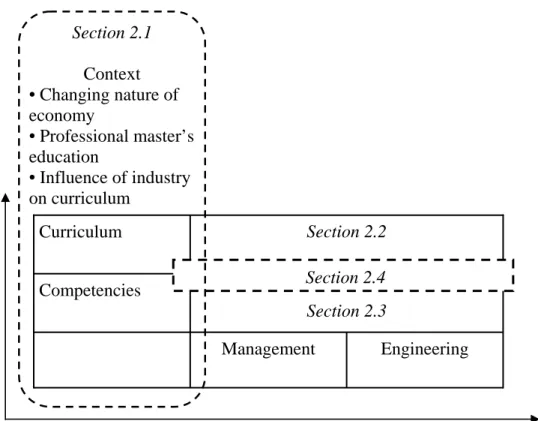
The curriculum framework proposed by Stark et al. (1986) is adapted to develop a conceptual framework for investigating the research questions. This
framework guided the literature review so as to understand the theoretical and research foundations for developing a competency-based curriculum for the service economy. In the adapted framework (see Figure 1) external influences set the context of the study, internal influences are limited to the curriculum, and outcomes are the expected competencies. Intraorganizational influences are not included as they are organization specific. The literature review presented in the next chapter, intersects bodies of literature in competency-based higher education in general and management and engineering education in particular.
Figure 1. Conceptual framework
1.7 Organization of the Study
The study is organized in five primary chapters. Chapter 1—Introduction, sets the context, need, significance and conceptual framework of the study along with the definition of key terms. Chapter 2—Literature Review, presents the synthesis of theoretical and research foundations related to the competency-based education in engineering and management disciplines, and interdisciplinary education. Chapter 3— Methodology, discusses the relevancy of the Delphi method and its application for
Engineering Management Disciplines Section 2.3 Competencies Section 2.2 Curriculum Section 2.4 Section 2.1 Context • Changing nature of economy • Professional master’s education • Influence of industry on curriculum Theor y
summarizes the data and reports the key findings of the study. Finally, Chapter 5— Discussion, presents the competency model and curriculum blueprint along with the limitations, conclusions, recommendations, and implications of the study.
1.8 Definition of Key Terms
Competency: Competency, competence (plural competencies), outcomes, and attributes are used interchangeably to define a combination of knowledge, skills, and attitude to achieve a desired performance in a particular context. Banta (2001) used the term competence interchangeably with skills, learning objectives, or expected learning outcomes.
Consensus: One of the primary goals of Delphi method is to achieve consensus among participants on the topic of study. Consensus is defined as the reduction in the variance of responses i.e. smaller variance indicates greater consensus (Rowe & Wright, 1999). For this study, consensus is reached when at least 75% of the
participants rate any competency or course item as Very Important (4) or Important (3) on a four-point scale.
Competency-based curriculum: A set of courses or content domain offered to students with specific emphasis on identification and integration of competencies expected from the students.
Curriculum: A set of courses or content domain offered to students as learning plan (Pellegrino, 2006). Curriculum is also conceptualized as a site of interaction and communication between external stakeholders and educators.
Delphi: The Delphi method facilitates group communication among geographically dispersed participants for idea generation and consensus, which is characterized by feedback mechanism, multiple rounds, and anonymity of participants.
Expert: An expert for the Delphi panel is defined as “someone who possesses the knowledge and experience necessary to participate in a Delphi” (Clayton, 1997, p. 377). University faculty and industry professionals who are already actively engaged with the advancement of SSME are considered experts for this study.
Interdisciplinary: Interdisciplinary is used as a generic or umbrella term that integrates two or more disciplines to provide more holistic solutions to complex problems. I have not attempted to distinguish between the nuances in the definitions of interdisciplinary, multidisciplinary, crossdisciplinary, transdisciplinary, and integrative education.
Service economy: Knowledge economy, service economy, new economy, knowledge-based service economy is used interchangeably. The term refers to the nature of economy that involves service interaction, complex problem-solving and technology or information based transactions. Knowledge work is an integral part of this service economy.
Professional education: Here professional education is used loosely for degree programs that focus on developing competencies for specific roles, industries or sectors. For example, MBA degree for business sector or MA in Student Affairs degree for education sector. It is not restricted to professions like law or medicine that may require licensure for practice. The focus of the study is on full-time traditional
education. There are several other interpretations and modes of offering professional education including distance learning, part-time, certifications, and executive
education that are not part of this study.
Service Science, Management and Engineering (SSME): Service Science, Management and Engineering (SSME) and service science are used interchangeably to refer to the emerging interdisciplinary field that studies the service systems for
innovation and productivity improvement.
Service Scientist or T-shaped professional: IfM and IBM (2008) define the T-shaped professional or service scientist as an individual with deep problem-solving and expert thinking skills in their home discipline coupled with complex
communication skills to interact with specialists across a wide range of disciplines. As SSME is an emerging field, there is some level of ambiguity and vagueness about the conceptualization of the T-shaped professional (Glushko, 2008). This study attempts to explicate the key competencies expected from a service scientist or a T-shaped professional.
CHAPTER 2: LITERATURE REVIEW
In order to build theoretical and empirical foundations for the research questions, the review is presented in five major sections. First section presents the context for developing a competency-based curriculum for the new service economy. Second section reviews the literature related to the competency-based curriculum in the disciplines of engineering and management. Third section discusses the concept of competencies and its application in the disciplines of engineering and management. Fourth section presents theory and literature related to the interdisciplinary curriculum. Fifth section discusses the evolution of SSME.
The literature search for answering the research questions was conducted in three broad stages. First, generic online search tools and indexes including Web of Science, ERIC, Google Scholar, Academic Search Premier, and a combination of keywords—competency, skill, curriculum, program, professional education, and interdisciplinary education were used to identify relevant literature. Second, the above combinations of keywords were used to search discipline specific databases like ERIC, Business Source Premier, and Engineering Village for higher education, management and engineering respectively. Third, the references mentioned in the articles found in first two stages were used to identify more articles relevant to the study.
2.1 Context
This section sets the context for developing a competency-based curriculum for the new service economy in three subsections—the changing nature of economy and work, professional master’s education, and the influence of industry on
curriculum.
2.1.1 Changing Nature of the Economy and Work
The world around us has undergone dramatic transformations in terms of social, political, economic, and technological changes. Friedman (2005) identified ten flatteners that have changed the world around us. The ten flatters are opening of Berlin Wall, Netscape, work flow, outsourcing, offshoring, open-sourcing, insourcing,
supply-chaining, in-forming, and the steroids amplifying and reinforcing each other. Friedman asserts that the complementary convergence of these flatteners resulted in “…the creation of a global, Web-enabled playing field that allows multiple forms of collaboration—the sharing of knowledge and work—in real time, without regard to geography, distance, or , in the near future, even language” (p. 176). He defines this phenomenon of convergence and collaboration as the flattening of the world. Further, the flat world is demanding a large cadre of managers, innovators, IT specialists and workers to develop and deploy new value-creation processes and perspective that could take advantage of the flat world (Friedman, 2005). America will do well in a flat world provided it “…continues to churn out knowledge workers who are able to produce idea-based goods that can be sold globally and who are able to fill the
knowledge jobs that will be created as …there is no limit to the number of idea-generated jobs in the world” (Friedman, 2005, p. 230).
In addition, to the impact of technology and globalization on the demand for knowledge workers, the American economy is increasingly becoming services driven. This is also manifested in the projected changes in the occupational structure and growth. According to the U.S. Bureau of Labor Statistics (BLS), professional and related occupations, and service occupations are two occupational groups that are projected to show highest increase in employment between 2006 and 2016 of nearly 17 percent as against a decline of nearly 5 percent for production and manufacturing occupations (Dohm & Shniper, 2007).
The scale and scope of the service activity is wide and quite different from agricultural and manufacturing sectors (Chesbrough & Spohrer, 2006). While the service sector comprises nearly 80% of the economic activity but it does not have an academic community of scholars focused on innovation and productivity improvement (Chesbrough & Spohrer, 2006). Further, service exchange involves a complex
combination of both tacit and codified knowledge (Chesbrough & Spohrer, 2006). Codified knowledge is easily transmittable as information in standardized form while tacit knowledge is difficult to transfer as it is person and context dependent. It is this high level of tacit knowledge combined with codified knowledge which complicates the service exchange. Thus, both the scale of services economy and its characteristics have implications for the knowledge involved in innovation and productivity
innovation needs “…an interdisciplinary effort that unites academic silos around common set of problems” (p. 39).
Within the overall service sector, the knowledge-based services are the
becoming more complex and influential in driving the economic growth. According to BLS, occupations requiring a bachelor’s degree or higher are expected to increase by 15.3 percent and add about 5 million new jobs, by 2016 (Dohm & Shniper, 2007). The focus of this study is on knowledge-based service occupations like computer systems analysts and teachers that require at least a bachelor’s degree (Dohm & Shniper, 2007). The core of knowledge-based economy is the set of occupations that are at the interface of service and technology (Darr, 2007). In its simplest form a knowledge-based economy refers to economic wealth generation “through the creation, production, distribution and consumption of knowledge and knowledge-based
products” (Harris, 2001, p. 22). According to Davenport (2005) “Knowledge workers have high degrees of expertise, education, or experience, and the primary purpose of their jobs involves the creation, distribution, or application of knowledge” (p. 10). There are several definitions and interpretations of knowledge economy, however, there has is a consistent emphasis on “…new information-handling skills and knowledge expertise, requiring more specialised [sic] and educated employees” (Williams, 2007, p. 512).
This new knowledge-based economy calls for a need to understand the nature of work and the types of skills required for delivering effective knowledge work (Darr, 2007). The higher education system has been slow in identifying and capitalizing on
the changing nature of the knowledge work, technological sophistications, economic impacts of globalization and the massification opportunities (Williams, 2007). The demands of knowledge-based service sector are not being met by existing education system and therefore it should integrate future skills in the curriculum (Darr, 2007). Within the higher education system, professional education especially at the master’s level plays an integral role in providing skills and competencies required by the society and the economy (Council of Graduate Schools, 2007).
2.1.2 Professional Master’s Education
The professions exist in the context of the market and societal needs, and the higher education system plays an integral role in producing the professionals for the society and the economy. Rudolph (1984) asserts that the American educational practices reflect the growth of the specialized professionals. He claims that “[a] profession does not exist until a group of practitioners is accorded autonomy and prestige by society in return for certain services for which there is a market” (p. 15). Likewise, professional education is primarily offered through universities and universities are characterized by the presence of professional schools as
“…professions rest on knowledge and universities are the seat of knowledge in modern societies” (Abbott, 1988, p. 194).
Professional education influences the quality of services provided and “[p]rofessional education is directed toward helping students acquire special
taking appropriate action” (Hoberman & Mailick, 1994, p. 3). Abbott (1988)
identified at least four roles played by universities in professions—universities serve as legitimators by providing credible and exclusive opportunity to practice profession, they support knowledge advancement of professionals to develop new techniques outside of practice, they train young professionals, often in collaboration with research and finally universities may become another arena for interprofessional competition (Abbott, 1988). Vocationalism remains deeply rooted in the American higher education and there is need to leverage the strengths of professional education by integrating it with the larger educational purposes (Grubb & Lazerson, 2005). It is critical to distinguish between professional education and vocational training.
Generally, the knowledge-based professions relate to the professional education while, the labor-intensive services correspond to the vocational education. At the core, the focus of vocational and professional education may be same—to fulfill the
requirements of the society and economy, however, they differ substantially in terms of impact, engagement, and complexity of educational offerings.
The master’s degree has been a critical channel for preparing professionals in the United States (Council of Graduate Schools, 2007). While the original intent of the master’s degrees was to be an entry-level qualification for the college teachers; by late nineteenth century its purpose had transformed to prepare talent for the professions (Conrad et al., 1993). Since the early 1980s, more than 80 percent of the master’s degree is awarded in professional fields like engineering, and business (Conrad et al., 1993). Recently, the Council of Graduate Schools (2007) in its report Graduate
Education: The Backbone of American Competitiveness and Innovation, emphasizes the role of graduate education in preparing professionals with skills to compete in a knowledge-based global economy and encourages stakeholders in the U.S. higher education to engage with the graduate education. It highlights the growth of
professional master’s education and urges development of new collaborative programs across disciplines to prepare future workforce, which needs both technical competence along with social consciousness. According to Glazer-Raymo (2005) “Operating at the interstices of academic degree, it [master’s degree] contributes to the discourse of interdisciplinary innovation and organizational change” (p. 3).
There are several catalyzing forces that contribute to the professionalization of the master’s degree including technological advances, global initiatives, quality control and accountability, and the convergence of academic and professional field across disciplinary, departmental, and institutional boundaries (Glazer-Raymo, 2005). Master’s degree has witnessed unprecedented growth and has become a critical
component of the university strategy and operations (Glazer-Raymo, 2005). The future projections of master’s degree also reflect the demand of the new economy. From nearly 575,000 master’s degree awarded in 2004-05, master’s degrees are projected to grow by 35 percent to nearly 778,000 degrees by 2016-17 (Hussar & Bailey, 2007).
The unprecedented expansion of master’s education along with the increasing importance of master’s education to growing numbers of students and employers, has also led to issues of program quality and relevancy (Haworth & Conrad, 1997). For example, Conrad et al. (1993) in a national study of the master’s degree investigated
how people view their master’s education experiences, and what are the characteristics of an ideal master’s degree. This research resulted in a typology of four “idealized” program types—ancillary, career advancement, apprenticeship, and community centered. Among the four program types, MBA programs were generally
characterized as career advancement programs that relied heavily on prescribed core curricula, and emphasized theory-to-practice model of pedagogy. Engineering programs were generally characterized as apprenticeship model where faculty emphasized on “doing-centered learning”, and committed to master’s program in engineering for preparing future professionals.
2.1.3 Influence of Industry on Curriculum
The relevancy and quality of professional education with the needs of the new economy requires collaboration across stakeholders including employers (Jones, 2002). There is abundant research literature available on university-industry collaborations in the area of research and development, however, the focus of this review is on the role of industry in education, new program development, and curriculum development. Barnett (1994) argues that the relationship between knowledge, higher education and society is under constant interaction and transformation. The higher education system is an integral part of the knowledge industry and society expects it to develop operationally competent and efficient students (Barnett, 1994).
In engineering field, there are several cases where corporate involvement and partnerships fostered development of new programs and curriculum. Chesbrough and Spohrer (2006) mention that in the 1940s, Computer Science was still not accepted as a discipline and external support played a critical role in bringing credibility and acceptance of the Computer Science as a discipline. For example, Thomas Watson Sr., then chairman of IBM also served as a trustee of the Columbia University and
promoted the Computer Science discipline (Chesbrough & Spohrer, 2006). More than two decades ago, when computer-based tools were gaining prominence in
manufacturing, IBM contributed ten million dollars across five universities to develop graduate programs in manufacturing systems engineering (Dieter, 1984). More
recently, IBM is taking lead in promoting the service science and is sponsoring events, and awarding research and course development grants (Lohr, 2006). Universities are also taking proactive role in collaborating with the industry. For example, Bodmer et al. (2002) discussed the case of MIT that actively engages with industry to offer a “broad, fundamental, yet practical education that …is influenced by the curriculum and the co-op program with industry and the industrial connection program” (p. 205).
The business schools in 1950s and 1960s were relevant to the needs of the industry, however, they lacked academic rigor and were considered as trade schools (Zell, 2005). In search for gaining professional credential, business schools adopted a more theoretical and scientific approach (Zell, 2005). The adoption of scientific model led business schools to loose relevancy with the practice (Bennis & O’Toole, 2005). Better engagement and involvement with the employers is recommended to improve
the relevancy of management education (Doria, Rozanski & Cohen, 2003; Hamilton, McFarland & Mirchandani, 2000). Bennis and O’Toole (2005) assert that the business community has the strongest potential of creating changes in the professional higher education and “business leaders have not demanded enough from the educational institutions purporting to serve them” (p. 103). According to AACSB International (2006) “[e]ngaging business leaders in discussions about curriculum, the assurance of learning process, and other assessments of learning activities could be valuable” (p. 9).
This section reviewed the context for developing a competency-based curriculum for the new service economy. In summary, it seems that the changing nature of economy is influencing the demand for a new set of professional competencies. This new set of competencies may be effectively delivered by the professional education at the master’s level. Higher education plays a critical role in providing talent for the professions and industry supports higher education through funding and feedback. Thus, design and development of curriculum for the new service economy has to be collaborative and competency driven.
2.2 Competency-based Curriculum Development
This section of the review presents the theoretical and conceptual foundations of the curriculum development with specific discussion on the need and benefits of the competency-based curriculum. This section also includes two subsections on
engineering and management education and reviews the literature on competency-based curriculum from the respective disciplines.
Curriculum is the centerpiece of academic decision-making, institutional values, professional lives of students and faculty, and reason for the existence of universities, however, “…the literature on college and university curriculum is unquestionably amorphous” (Conrad & Pratt, 1986, p. 235). Curriculum in higher education literature has been defined from several perspectives. Lattuca (2006) suggests that curriculum is better conceptualized as a site for social interaction among students, faculty, and content. By defining curriculum as the site for social interaction, we acknowledge several factors that influence the curriculum planning (Lattuca, 2006). She traces the history of the evolution of the curricula and notes that the changes in the educational purposes is a result of changes in the social, political, economic, professional, institutional, and cultural needs. For example, early 1800s marked the inclusion of the scientific studies like agriculture and natural sciences as there was a consistent pressure to prove the utility of the higher education. Likewise, demand for specialized professional led to the introduction of elective system and academic majors in the latter half of 1850s. In more recent times, social and political movements of 1960s demanded more student-centered curriculum from the
universities and the beginning of this century called for greater accountability and outcome-based curriculum as there are concerns about the quality of graduates (Lattuca, 2006).
Another perspective conceptualizes curriculum as a site for epistemological debate where stakeholders contest for what counts as valid and acceptable knowledge. Gumport and Snydman (2002) support this perspective and suggest that organizational
structures and knowledge legitimation processes are interdependent and that academic innovation is also manifested in the educational programs and curricula. Karseth (1995) argues for a dual perspective on new educational program and curriculum development where one perspective uses cognitive and epistemological debates to define what counts as valid knowledge and the other perspective uses social legitimation process where external socioeconomic and political factors demand practical utility.
Curriculum is also conceptualized as a set of student learning outcomes or competencies. Diamond (1998) suggests that the goals of curriculum should be well defined in terms of required student competencies, “…beginning with an institutional statement of goals and ending with the assessment of each student prior to graduation and after” (p. 51). Thus, Diamond (1998) emphasizes the role of outcomes and student competencies in defining the quality of the educational process including curriculum. According to Conrad and Pratt (1986) “…academic programs or curricula denote those educational experiences that encourage purposeful learning. Academic programs are forms at the core of higher learning that organize the acquiring, transmitting, and applying of knowledge” (p. 235).
Curriculum is at the core of the relationship between higher education and employer (Geiger, 1980). The changing economy is demanding a better alignment between competencies demanded and the curriculum offered. According to Fincher (1986) the most significant influence on college curriculum since the 1960s has been the demand for measured or assessed outcomes that would ensure the competency and
proficiency of graduates. There is growing loss of confidence among the stakeholders including students, employer, trustees, and policymakers that the higher education system is adequately preparing individuals for the demanding challenges facing the current and future workplace (Banta, 2001; Jones, 2002; Haworth & Conrad, 1997). Higher education institutions are under pressure to convince their stakeholders about the value addition they bring to students’ knowledge, skills, and attitude (Banta, 2001; Vaatstra & de Vries, 2007).
The demand from the stakeholders is leading to the emphasis on competency-based education. Masters and McCurry (1990) highlight that the competency-competency-based movement is gaining prominence as it attempts to make explicit the skill standards necessary for performing competently within a profession. Competency-based
curriculum identifies and includes set of knowledge and skill, which may be neglected in traditional discipline based course structures (Toohey, 1999). Van der Klink and Boon (2003) assert that the current curriculum design processes is slow to adapt to the labor market requirements, however, “[c]ompetency-based education holds the
promise of curricula with a practical orientation that are tuned to the needs of employers” (p. 129). Competencies serve as a conceptual framework and a common communication language between education providers and employers to design curricula (Van der Klink & Boon, 2003).
Literature presents several benefits for using the competency-based
curriculum. Brownell and Chung (2001) identified five major benefits of competency-based education—a change in the student-teacher relationship, an increase in emphasis
on internal information sharing, improvement in clarity of desired student outcomes and program effectiveness, better articulation of the competencies of program graduates, and an increase in student satisfaction and learning. Toohey (1999) notes three advantages of competency-based curriculum—first, competency-based
curriculum is more likely to produce graduates with competencies that a conventional curriculum may not provide. Second, competency-based curriculum is developed in concert with industry to ensure that it is relevant to the job requirements. Third, competency-based curriculum offers promise of more flexibility and continuous learning (Toohey, 1999).
Within the higher education system, professional programs are more receptive to the competency-based curriculum (Banta, 2001). Jones (2002) believes that a gap exists between ideal expected professional education outcomes and actual
competencies of graduates, and urges professional education programs to
“…reexamine their overall curriculum, including the important outcomes that all college graduates should master to be more effective in the changing workplace” (p. 5). Likewise, Hoberman and Mailick (1994) note that “[b]asic professional education should ensure general competence at an acceptable level in the entire field. However, as conditions change, knowledge increase, and better services are demanded, earlier levels of competence are not considered sufficient for effective practice” (p. 10). This requires a systematic approach to curriculum reform in professional education as piecemeal changes do not deliver expected results (Hoberman & Mailick, 1994; Jones, 2002; Van der Klink & Boon, 2003).
Curriculum development in professional education also faces several challenges. They are—(1) knowledge acquisition may not lead to successful
application, (2) successful knowledge application may not be a result of conceptual comprehension, (3) subject-specific knowledge and skills may lead to inability to apply beyond the very subject, and (4) possession of general knowledge and skills may not imply mastery over specific subject areas (Everwijn et al., 1993). Everwijn et al. (1993) propose that the ability or competence-based approach provides a solution to above problems in professional education as apart from “disciplinary and functional instruction, simultaneously attention is paid to the development of such basic abilities and generic skills as problem solving, communication, information handling, social interaction and leadership” (p. 426).
2.2.1 Engineering
The practice of engineering dates back to 5th and 6th centuries B.C. and the core responsibility of engineer is to provide solutions to the technological and societal problems (Turmeau, 1982). However, engineering education has been criticized for not keeping pace with the change in the societal and technological needs. Even more than 25 years ago, the issues of relevancy of the engineering curricula were being raised (Turmeau, 1982). The curricular issues of engineering education relate to its focus on knowledge acquisition and “neglect the process of personal and social construction of knowledge and the development of professional competence”
Journal of Engineering Education on engineering competencies highlighted that the primary goal of engineering curricula is to develop professionally competent engineers (Lemaitre et al., 2006).
In recent years, competency-based curriculum in engineering education is gaining support to “…reflect the changing nature of society, the world of work and education” (Walkington, 2002, p. 133). Curriculum development is no longer the sole responsibility of the university professor, and curriculum development process should engage internal and external stakeholders to bring a holistic view (Walkington, 2002). There are several approaches discussed for the competency-based curriculum
development in engineering education. Walkington (2002) proposes a four stage interactive and iterative process with a goal to produce actionable engineering curriculum that influences effective student outcomes. Lachiver and Tardif (2002) conceptualize learning as the transformation of information into knowledge and competency and hence propose curriculum development on two primary
frameworks—learning framework on how students learn and conceptual framework describing the design of learning activities. Rompelman and de Graaff (2006) propose a systems design approach for developing a competency-based engineering
curriculum, where input is the course content, output is the students’ competencies, assessment provides a feedback mechanism, and teaching is educational process.
Competency-based curriculum development process has been applied for master’s level programs. For example, Sutcliffe, Chan and Nakayama (2005) discuss the competency-based curriculum development for a master’s level degree in
information systems (MSIS). Sutcliffe et al. (2005) mention that the MSIS curriculum development process involved four primary stages—review of curriculum model and conceptualization of competency-based approach, feedback from industry, feedback from faculty outside the information systems discipline, and consultation with
information system faculty. They conclude that the MSIS curriculum developed with above framework is inclusive of stakeholders’ views and provides a flexible modular approach to competency-based education.
Gorgone, Gray, Stohr, Valacich and Wigand (2006) propose a model curriculum for graduate degree programs in information systems—MSIS 2006 and add that the model curriculum provides a balance of flexibility and consistency to faculty, students, and employers as they can be assured that graduates are “competent in a set of professional knowledge and skills” (p. 129) and at the same time
accommodates diversity by being “sufficiently flexible to meet both institutional and student needs and objectives” (p. 137).
Shah (2004) used Delphi method to identify a set of competencies that are considered important by practitioners for developing a master’s degree in engineering management. He asserts that most engineers move into a managerial role based on their work experience and find themselves unprepared for managerial tasks. Shah (2004) developed a competency-based curriculum for a traditional engineering management program focused on operation and technology and not on the services nature of the economy.
2.2.2 Management
Over last decade, business management education has been constantly
criticized for its inability to produce business ready professionals. Bennis and O’Toole (2005) argue that irrelevancy of the curriculum is the reflection of the culture of the business school, which has been focusing too much on scientific research and has been out of alignment with practice. Bennis and O’Toole (2005) conclude that “The entire MBA curriculum must be infused with multidisciplinary, practical, and ethical questions and analyses reflecting the complex challenges business leaders face” (p. 104). Boyatzis, Cowen and Kolb (1995) suggest that “Managing change in the
academic curriculum, in what is taught and how it is learned, must rank among the top twenty-first-century management challenges for higher education” (p. 1).
There is a shift in curriculum debate in business education from traditional functional areas to more integrated cross-functional curriculum focused on skills and competency development (Doria et al., 2003; Hamilton et al., 2000). Consequently, “…redesigned curriculum curricula must cut across traditional boundaries to develop and reinforce the appropriate bundles of technical knowledge as well as social and organizational skills” (Hamilton et al., 2000, p. 103). According to Brownell and Chung (2001), competency-based models are bound to gain prominence in graduate business education as they “…emphasize learner outcomes and suggest that regardless of how well planned the academic intervention, success can only be measured by the changes that take place in students’ performances, whether demonstrating cognitive, affective, or skills-based learning” (p. 125). Business schools need to improve on the
curriculum in the area of social skills, relationship management, problem solving and leadership (Doria et al., 2003).
Competency-based curriculum development process has been applied for master’s level management programs. Boyatzis et al. (1995) presented the process of curriculum innovation at the Weatherhead School of Management and concluded with a set of design and process principles for an ideal professional program. They claim that generally curriculum development and planning is driven more by the faculty's professional and knowledge needs rather than students’. Boyatzis et al. suggest that there is a need to focus on learning from the student’s perspective who may be seeking less discipline specific and more problem-centered and contextually defined learning.
Wooten and Elden (2001) discuss the process of moving from a conventional human resources (HR) functions-based program to a competency-based program. They used a cogenerative learning process to include stakeholders in all stages of curriculum development. The four key stages of competency-based curriculum development were—identification of stakeholders and resources, data collection and analysis, curriculum revision and rollout, and assessment evaluation. Sims and Sauser (1985) propose Kolb’s Experiential Learning Model as a framework for developing a competency-based business curriculum.
Chyung, Stepich and Cox (2006) present the case of developing a competency-based curriculum at the Boise State University. According to Chyung et al. (2006) “[t]he core of competency-based curriculum design is to ensure that learners will be able to demonstrate their learned capabilities after they have acquired a necessary
combination of knowledge, skills, and abilities” (p. 307). Competence-based
curriculum focuses on enabling student to achieve minimum acceptable standards and not necessarily providing expertise. Chyung et al. (2006) note that certain
competencies are context-specific and hence competency-based curriculum should be contextualized.
This section reviewed the theoretical foundations of competency-based curriculum development in the disciplines of management and engineering. In summary, the competency-based curriculum seems to provide necessary framework for meeting the demands of accountability and relevancy in professional education for the new economy. The literature in engineering and management disciplines provided several studies that effectively used the competency-based curriculum development model. However, there is very little literature available that specifically addresses the use of competency-based curriculum development for a master’s level program in SSME.
2.3 Competencies
This section of the review presents the theoretical and conceptual foundations of the competencies. This section also includes two subsections on engineering and management education and reviews specific competencies that are found to be important in the respective disciplines.
Competency-based education is based on the premise that competencies differ with respect to their context of application and require different bundles of knowledge
and skills (Voorhees, 2001). The challenge for higher education system is to
“…determine which competencies can be bundled together to provide different types of learners with the optimal combination of skills and knowledge needed to perform a specific task” (Voorhees, 2001, p. 9). Competency-based education brings clarity and consensus of outcomes among all stakeholders involved in the learning process and enables them to work towards competencies in a focused and relevant manner
(Voorhees, 2001). Employers are demanding more from higher education institutions for curricular integration of transferable skills such as leadership, communication, quantification, adaptability to change, and interpersonal relations (Banta, 2001). Jones (2002) discussed several case studies and concluded that the success of curriculum initiatives rests on systematic and collaborative effort to identify the learning outcomes in terms of professional knowledge, skills, and attitudes that the educated professional graduate should achieve. These outcomes are best defined by consulting with external stakeholders including accrediting agencies, employers, and professional associations.
Accrediting associations both at regional levels and disciplinary levels had traditionally focused on input and processes as compared to outcomes (Banta, 2001). From late 80s onwards, accrediting associations have also started emphasizing on the outcomes in their standards (Banta, 2001). Engineering education accreditor, ABET, Inc. (formerly the Accreditation Board for Engineering and Technology) moved from being an input-oriented to output-oriented accreditation process and defined 11 competencies which every engineer should be able to exhibit (Muffo, 2001). Business