ADDRESSING CLIMATE CHANGE
Global Energy
Technology Strategy
JA Edmonds, MA Wise, JJ Dooley, SH Kim, SJ Smith, PJ Runci, LE Clarke, EL Malone, GM Stokes
May 2007
ADDRESSING CLIMATE CHANGE
Global Energy
Technology Strategy
PHASE 2 FINDINGS FROM AN INTERNATIONAL PUBLIC-PRIVATE SPONSORED RESEARCH PROGRAM
LEGAL NOTICE
This report was prepared by Battelle Memorial Institute (Battelle) as an account of sponsored research activities. Neither Client nor Battelle nor any person acting on behalf of either: MAKES ANY WARRANTY OR REPRESENTATION, EXPRESS OR IMPLIED, with respect to the accuracy, completeness, or usefulness of the information contained in this report, or that the use of any information, apparatus, process, or composition disclosed in this report may not infringe privately owned rights; or
Assumes any liabilities with respect to the use of, or for damages resulting from the use of, any information, apparatus, process, or composition disclosed in this report.
Reference herein to any specific commercial product, process, or service by trade name, trade-mark, manufacturer, or otherwise, does not necessarily constitute or imply its endorsement, recommendation, or favoring by Battelle. The views and opinions of authors expressed herein do not necessarily state or reflect those of Battelle.
TABLE
OF
CONTENTS
TO THE READER ... 5
EXECUTIVE SUMMARY ... 6
The Challenge ... 24
Global Commitment: The Framework Convention on Climate Change ... 26
CO2 Emissions and Concentrations ... 27
The Non-CO2 Gases ... 29
The Global Energy System—From Yesterday to Today ... 30
Energy Today ... 30
Tomorrow: Emissions, Energy, and Change ... 31
Responding to the Challenge of Climate Change ... 32
The Future Global Energy System ... 34
Stabilizing Greenhouse Gas Concentrations Means Fundamental Change to the Global Energy System ... 36
The Challenge of Scale ... 38
Technology Improvements Can Dramatically Reduce the Costs of Stabilization ... 39
A Technology Investment Portfolio: A Risk Management Approach ... 41
Six Energy Technologies that Could Make a Critical Contribution to Addressing Climate Change ... 43
Carbon Dioxide Capture and Geologic Storage ... 44
Description of CCS Systems and Their Current Market Deployment ... 46
Cost and Performance of CCS Systems under Emissions Constraints ... 49
The Permanence of Stored CO2 ... 51
The Effort Required for Large-Scale Commercial Deployment ... 52
The Value of Continued Research and Development ... 52
Biotechnology and Biomass ... 54
What Do We Mean by Biomass and Biotechnology? ... 56
Biomass for Energy ... 56
Resource Limitations ... 60
The Value of Continued Research and Development ... 62
Hydrogen Systems ... 64
Hydrogen Systems Technology ... 66
Cost and Performance ... 68
The Future Deployment of Hydrogen ... 69
The Value of Continued Research and Development ... 71
1
2
3
4
Nuclear Energy ... 72
The Evolution of Nuclear Power Plant Technologies ... 74
Uranium: The Key Fuel Resource for Nuclear Power ... 76
Scenarios of Nuclear Energy Deployment ... 78
Other Considerations ... 80
The Value of Continued Research and Development ... 83
Wind and Solar Power ... 84
Wind Power ... 86
Solar Power ... 86
Wind and Solar in the Electric System ... 87
The Role of Storage ... 88
Resources ... 89
Cost and Performance ... 90
Other Considerations ... 91
The Future Deployment of Wind and Solar ... 92
The Value of Continued Research and Development ... 93
End-Use Energy Technologies ... 94
A Global Perspective on End-use Energy Demands ... 96
Building Energy Services and End-Use Energy Technologies ... 96
Transportation Energy Services and End-Use Technologies ... 99
Industrial Energy Services and End-Use Technologies ... 101
Across All Sectors: The Role of Electrification, Efficiency Gains, and the Costs of Mitigation ... 104
The Value of Continued Research and Development ... 105
Non-CO2 Emissions and Projections of Future Climate Change ... 106
Radiative Forcing Today ... 108
The Role of Technology ... 111
Future Radiative Forcing ... 114
Future Climate Change ... 116
The Value of Continued Research and Development ... 117
Research, Development, and Large-Scale Commercial Deployment ... 118
The Recent History of Support for Energy R&D ... 120
Research, Technology and Managing the Risks of Climate Change ... 122
The Value of Continued Research and Development ... 124
The Power Lies in the Portfolio ... 129
Overall Findings of the GTSP ... 130
APPENDIX 1: Acronyms and Abbreviations ... 134
APPENDIX 2: Notes and References ... 135
6 7 8 9 10 11
This report is the capstone to nine years of
research in two phases of the Global Energy
Technology Strategy Program (GTSP). That
research was conducted at the Joint Global
Change Research Institute and in collaboration
with partner research institutions around the
world. The first phase of that work began at a
time when the importance of a technology
strat-egy in addressing climate change was
unap-preciated. GTSP Phase 1 made the case that
a technology strategy was an important part
of a larger strategy to address climate change
and needed to be included along with the other
major components: climate science research,
adaptation to climate change, and emissions
mitigation.
The second phase of the GTSP recognized that
to craft a global energy technology strategy it
was important to develop a deeper
under-standing of potentially important technologies
and technology systems, and to embed that
knowledge in the context of the larger global
energy and economic systems. In Phase 2 we
identified six energy technologies and
technol-ogy systems with the potential to play a major
role in a climate-constrained world: CO
2cap-ture and storage, biotechnology, hydrogen
systems, nuclear energy, other renewable
energy, and end-use technologies that might
be deployed in buildings, industry and
trans-portation. Knowledge gained in each area has
been integrated into a larger global
energy-economy-climate frame. That combination of
depth of study and integrated assessment
pro-duced a unique strategic perspective and a
bounty of fresh insights. In this document, we
have distilled and summarized some of the
most salient.
The past nine years have flown by and,
look-ing back from the present, it is amazlook-ing to see
how far we have come. The GTSP has
accom-plished much, but much work remains. As we
enter Phase 3, we will build on the knowledge
gained thus far. We will continue to deepen
our understanding of technology and we will
continue to integrate that understanding into
a larger energy and economic context. And, we
will add a new dimension to our work to
pro-vide a deeper understanding of the
regional
and institutional contexts in which technology
is developed and deployed.
Our research has been supported by numerous
firms, nongovernmental organizations, and
gov-ernment agencies. Their support has enabled
us to continue to explore the implications of
designing and implementing a technology
strategy. Moreover, we have received the help of
many peer reviewers, who throughout the
pro-cess of developing this document provided their
expertise and advice. And for that support we
are grateful. Of course, the views and opinions
of the authors expressed herein do not
neces-sarily state or reflect those of the sponsoring,
participating institutions, or reviewers and any
errors that remain are our own.
Jae Edmonds
Executive Summary
Global climate change is one of the most complex environmental, energy,
economic, and political issues confronting the international community.
Its time and geographic scales are unprecedented in their scope, touching
every human activity that involves energy or land and requiring a strategy
that stretches a century or more into the future. The actions needed to
man-age the risks of climate change require long-term commitments to severely
limit net emissions of greenhouse gases to the atmosphere by developing
and deploying new ways of producing and using energy across the world.
Human activities release greenhouse and
other gases to the atmosphere at a rate that
raises concerns about human-induced climate
change. Greenhouse gases include carbon
dioxide (CO
2), which accounts for most of the
projected human influence on climate, and
such gases as methane, nitrous oxide, sulfur
hexafluoride, and several fluorinated gases.
Other emissions such as aerosols (e.g., sulfur
dioxide) also affect the Earth’s climate system.
The total concentration of CO
2and other
green-house gases in the atmosphere at any given time
is much more important in determining climate
than are emissions in any single year. Limiting
the risk of human impact on the climate system
therefore requires that atmospheric
concentra-tions be stabilized (see Figure ES-1).
Recognizing this fact, the United States and 188
other countries have ratified the 1992 United
Nations Framework Convention on Climate
Change (UNFCCC), and it has entered into
force under international law. The ultimate
objective of this treaty as articulated in Article
2 is to achieve “stabilization of greenhouse gas
concentrations in the atmosphere at a level
that would prevent dangerous anthropogenic
interference with the climate system.”
The UNFCCC process has not yet specified
a particular target concentration. The
pre-industrial CO
2concentration was
approxi-mately 280 parts per million (ppm); in 2004 the
level had risen to 377 ppm. In order to stabilize
concentrations of CO
2at any level between 450
and 750 parts per million, very large reductions
of worldwide emissions (compared to emissions
that might be anticipated if present trends
con-tinue) would be required during the course of
this century (see Figure ES-1).
THE CHALLENGE OF STABILIZING
CO
2CONCENTRATIONS
Stabilizing the
concentration of CO
2, the
most important greenhouse gas, is
fundamen-tally different from stabilizing CO
2emissions.
Because emissions accumulate in the
atmo-sphere, emissions of greenhouse gases can
affect the atmosphere for hundreds of years.
Some of the CO
2emitted during the earliest
days of the Industrial Revolution is still in the
atmosphere, and today’s emissions will cast
a shadow a thousand years into the future.
The long-lived nature of greenhouse gases—
and in particular CO
2—lies at the heart of the
crucial difference between stabilizing annual
emissions levels and stabilizing atmospheric
concentrations. Stabilizing emissions at today’s
levels would cause the concentration of CO
2to
continue to rise. Stabilizing global annual
emis-sions levels is not sufficient to stabilize
atmo-spheric concentrations.
The goal of stabilizing CO
2atmospheric
con-centrations has profound implications for the
nature, scale and timing of needed changes in
the global energy system. Stabilizing
concen-trations implies:
•
Global net CO
2emissions to the atmosphere
must peak and then decline year after year
until, eventually, they are virtually zero.
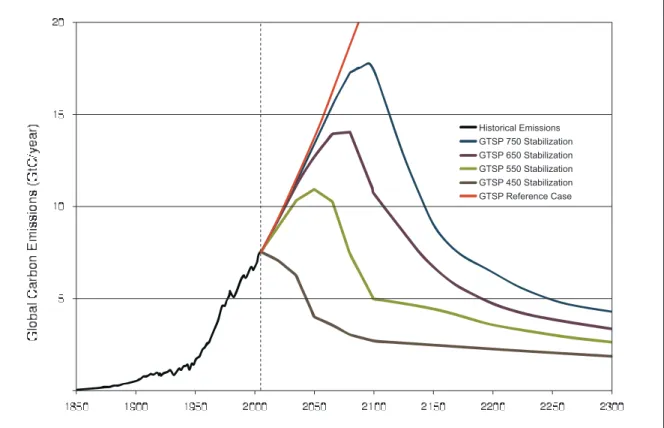
Figure ES-1. GTSP-generated global CO2 emissions paths: historical emissions to 2005, a reference case (i.e., with no emissions-control policies), and four alternative paths that illustrate how emissions must eventually decline in order to stabilize CO2 concentrations.
Historical Emissions GTSP 750 Stabilization GTSP 650 Stabilization GTSP 550 Stabilization GTSP 450 Stabilization GTSP Reference Case
•
Every ton of emissions released to the
atmosphere counts against a budget of total
allowable emissions, regardless of sector
or region of origin. Over time, this global
CO
2emissions budget is drawn down and
the remaining allowable emissions become
scarcer and therefore more valuable. Thus,
the price of carbon begins relatively low and
will rise steadily with time.
•
The key reason to develop and deploy advanced
energy technologies is to control the cost of
sta-bilizing greenhouse gas concentrations.
•
The technical challenge, to invent and
glob-ally deploy energy systems that
progres-sively release less CO
2, is unprecedented.
The century-scale challenge implies that
better technologies will be continuously
needed in the near, middle, and long terms
if costs are to be controlled.
RESPONDING TO
THE CHALLENGE OF
CLIMATE CHANGE
Addressing the challenge of climate change
requires responses in at least four different
domains:
•
Improved scientific understanding
•
Adaptation to climate change
•
Emissions mitigation
•
Development and implementation of a global
energy technology strategy.
The focus of GTSP research is on energy
tech-nology. The development of a global energy
ENERGY TECHNOLOGIES
ARE ESSENTIAL
Energy and the technologies used to convert
it into a myriad of goods and services are
cen-tral to the global economy, to standards of
living throughout the world—and to the
cli-mate issue. The large-scale, widespread use of
energy technologies has been and continues to
be a primary contributor to increases in
green-house gas concentrations, mostly through CO
2emissions from burning fossil fuels such as
coal, gas, and oil.
Expected increases in world population,
together with the desire for economic
devel-opment, will lead to growing demand for the
products and services that the energy
tem provides. The current global energy
sys-tem is dominated by fossil fuels, and there
are enormous quantities of fossil fuels still
underground, more than enough to power
the global economy for the remainder of this
century and perhaps well beyond. How these
fossil fuels and other energy sources are used
will determine the future human influence on
the global climate and whether there will be
a rapid increase in greenhouse gas
concentra-tions during this century. Managing the risks
of climate change will require a profound,
sys-tematic, and global transformation in the
pro-duction and consumption of energy.
ENERGY TECHNOLOGY
STRATEGY
Fundamental changes in the world’s
expand-ing energy system are required to stabilize
concentrations of greenhouse gases in the
atmo-Figure ES-2. The future without technol-ogy change (highest curves), with technology change that does not take climate change into account (middle curves), and with tech-nology change aimed at climate stabilization (lowest curves). Carbon Emissions
CO2 Concentration
stabilization. Figure ES-2 shows projected CO
2emissions and concentrations if the world
con-tinues to use today’s technologies (top curves),
if changes are made without accounting for
climate change (middle curves, the Reference
Scenario), and if more transformative changes
are implemented to address climate change
(lowest curves).
Reference scenarios that describe potential
future emissions absent measures to limit
cumulative CO
2emissions already assume
dra-matic improvements in energy technology. But
these technology developments should not be
taken for granted. If assumed improvements
are not realized in vehicle fuel economy and
per-formance, in industrial processes, in buildings
energy use, and in the development and
deploy-ment of renewable and other non-emitting
tech-nologies across the globe, then greenhouse gas
emissions will be even larger than predicted.
On the other hand, improvements in familiar
technologies beyond those assumed in
refer-ence cases, combined with the development and
deployment of new technology options, as shown
in Figure ES-3, could dramatically reduce the
costs of achieving the UNFCCC goal.
A technology strategy is therefore an essential
complement to national and international
pol-icies aimed at limiting greenhouse gas
emis-sions and enhancing adaptation to climate
change. A technology strategy will provide
value by reducing costs over a wide range of
possible futures—an essential role, given the
uncertainties in the science, policies,
technolo-gies, and energy resources.
GTSP has identified and analyzed six energy
technology systems whose large-scale global
deployment could have a profound impact
on the cost of addressing climate change and
therefore make it easier for society to take on
the challenge of addressing climate change
while simultaneously meeting a myriad of
other societal needs. These advanced energy
technologies are:
•
CO
2capture and storage (CCS)
•
Biotechnology and biomass
•
Hydrogen systems
•
Nuclear energy
•
Wind and solar energy
•
End-use energy technologies.
In addition, the development and deployment
of technologies to address emissions of non-CO
2greenhouse gases can have important
implica-tions for global, national, and regional energy
systems and for the rate and ultimate extent
of the development and adoption of these six
advanced energy technologies.
The six technology systems neither exhaust
the possible range of technologies in the future
global energy system, nor are they mutually
exclusive. Instead, some of these
technolo-gies reinforce and enhance each other,
yield-ing larger and more cost-effective emissions
reductions when deployed in tandem.
None of these six technology systems is a “silver
bullet”—that is, none alone can stabilize
green-house gas concentrations without cost—but
together they have the potential to significantly
reduce the cost of stabilizing greenhouse gas
concentrations.
Each technology system is in a different
state of development and deployment. Each
is characterized by different challenges and
will require different tools to enable dramatic
expansion in a climate-constrained world.
Some technologies will play transitional roles
or serve niche markets in certain regions of the
world, while other regions might utilize these
same technologies intensively. Yet, despite all
that is uncertain about the precise timing,
location, and ultimate extent of deployment
of these six advanced energy technologies,
research conducted under the GTSP validates
that these technologies are potential core
ele-ments of a robust solution set, even across
widely different potential futures.
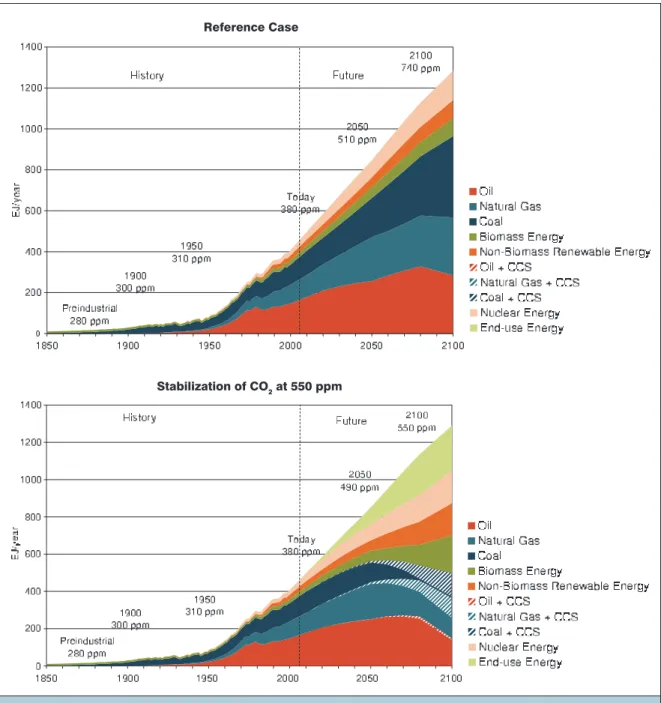
Figure ES-3. Technologies that produce energy will be radically different if climate change is addressed. The Reference Case is dominated by fossil-fueled technologies (shown in the upper chart as projected without climate constraints). The lower climate-stabilization chart shows that coal, oil, and gas use depends to a great extent on whether CO2 capture and storage technologies can be employed. Also, improvements in energy efficiency (shown on the charts as “end-use energy”) become much more important.
In the sections that follow, we briefly
sum-marize insights from the GTSP about the
present state of each of these six technology
systems, their potential to participate in the
future global energy system, and the R&D and
deployment challenges they face.
We then present a set of research findings
that have emerged from the GTSP and a brief
glance at the future of GTSP.
Reference Case
CARBON DIOXIDE CAPTURE
AND STORAGE (
See Chapter 3
)
In a greenhouse-gas-constrained world, carbon
dioxide capture and storage (CCS)
technolo-gies offer the potential for continuing to use the
Earth’s resources of fossil fuels while
prevent-ing their CO
2emissions from being released
to the atmosphere.
CCS technologies could be widely deployed in
many regions of the world as part of a global
commitment to reduce greenhouse gas
emis-sions. Such large-scale deployment under such a
commitment could greatly lower the cost of
emis-sions reductions. There is potential geological
capacity to store more than 11,000 billion tonnes
of carbon dioxide globally—far more than what
will be needed over the course of this century.
Most of the components for complete CCS
sys-tems exist; however, they are too small and
inefficient to work at the scales necessary to
address climate change, and current knowledge
and experience with complete end-to-end CCS
systems is very limited.
Also, geologic CO
2storage reservoirs are not
dis-tributed evenly throughout the world. Nations
like Australia, Canada, and the United States
have abundant supply, which will allow them to
maintain a more balanced energy portfolio even
in a greenhouse-gas-constrained world.
CCS technologies will be most economical when
deployed with new advanced coal-fired baseload
electric power plants. Therefore, an important
cri-terion for siting baseload plants is nearby storage
capacity for 50 or more years of CO
2emissions.
cement manufacturing, oil refining, steel
pro-duction, chemicals processing and hydrogen
production. Currently, 60 percent of all
anthro-pogenic CO
2emissions come from stationary
CO
2point sources that could adopt CCS.
R&D and Deployment Challenges
•
Continually improve CO
2capture
technolo-gies and tune them to a wide array of
indus-trial sectors.
•
Survey global candidate CO
2reservoirs,
especially in rapidly industrializing
coun-tries such as China and India.
•
Develop a more advanced and broader set
of measuring, monitoring, and verification
technologies for stored CO
2.
•
Obtain more experience with end-to-end
CCS systems in real-world conditions and
increase technical, infrastructural, and
institutional understanding of the factors
needed to bring about large-scale
deploy-Key Advanced Energy Technologies
BIOTECHNOLOGY
AND BIOMASS (
See Chapter 4
)
Since mankind’s earliest days, bioenergy has
been a component—and until the Industrial Age
the dominant component—of the global energy
system. Currently, approximately 10 percent
of the world’s primary energy comes from
bio-mass. In some places, modern commercial
biomass energy technology has been deployed
extensively. For example, Brazil is the world’s
largest producer of ethanol, and more than half
of that nation’s automobiles can run on 100
per-cent ethanol or petroleum-based fuels.
In a future greenhouse-gas-constrained world,
the large-scale use of bioenergy is likely to
be significant in the transport, industrial,
and electric power sectors of the economy.
As carbon prices rise, the use of bioenergy
will tend to shift to higher value-added uses
so as to serve markets where there are few
or significantly more expensive abatement
options. For example, bioenergy will move
from electricity production toward steam
gen-eration for industry and low-carbon fuels for
the transportation sector. Over the course of
this century, the nature of bioenergy will also
likely go through significant changes,
transi-tioning from the use of agricultural waste and
excess crops to the purposeful growing of energy
crops such as switchgrass to the application
of advanced genetic engineering techniques.
To avoid a large inadvertent release of carbon
to the atmosphere if land is cleared to grow
bioenergy crops, the carbon locked up in soils
and standing biomass must be valued at the
same rate as the prevailing carbon price. The
imposition of such a constraint could have
potentially huge consequences for farming and
for land use in general.
R&D and Deployment Challenges
•
Develop less costly and less
energy-inten-sive processes for converting biomass into
liquid and gaseous fuels.
•
Continue progress in agricultural
produc-tivity for food crops so that land can be freed
up for growing energy crops.
•
Explore coupling biomass production with
carbon dioxide capture and storage
technol-ogies, which could be a paradigm-shifting
technology system that actually removes
CO
2that has already been emitted to the
atmosphere.
•
Improve understanding of the potential for
competition between agricultural and
bio-energy uses for land, and explore possible
ways to alleviate adverse consequences.
HYDROGEN AS AN ENERGY
CARRIER (
See Chapter 5)
Hydrogen is appealing in the context of climate
change because it is a portable energy carrier
that does not emit any CO
2as it is consumed.
Hydrogen is also appealing in terms of
conven-tional pollutants since water vapor is the only
byproduct of its use.
Because hydrogen is portable, it could be used
to serve transportation energy
demands—auto-mobiles, trucks, and other commercial
carri-ers—which now rely almost completely on fossil
fuel-based liquids that do emit CO
2. The promise
of hydrogen is that it could provide a
non-emit-ting fuel to compete with these fossil fuel-based
liquids. In addition, hydrogen could displace
direct fossil fuel use in buildings and industry.
However, a greenhouse-gas-emissions
con-straint will not create widespread use of
hydro-gen. Rather, its expanded use will depend on
the overall efficiency and relative cost of the
entire system of hydrogen production,
trans-port, storage, and end-use. The extent to which
hydrogen makes substantial contributions
to addressing climate change will depend on
the CO
2emissions associated with hydrogen
production as well as on hydrogen’s cost
com-petitiveness with other low- or non-emitting
energy systems.
Hydrogen use in stationary applications may
be as important as its use in transport. And, if
it were to develop first, the infrastructure
sup-porting stationary applications might provide
the foundation for later expansion to a more
distributed set of hydrogen distribution points
for transportation.
R&D and Deployment Challenges
•
Develop and use hydrogen production
meth-ods that do not create or release CO
2to the
atmosphere. Carbon dioxide capture and
stor-age enabled fossil fuel, biomass and nuclear
thermal hydrogen production technologies
could all play important roles in this regard.
•
Improve the cost and performance of future
hydrogen storage and end-use technologies.
NUCLEAR ENERGY
(
See Chapter 6
)
Nuclear energy emits no CO
2in operations and
is already a significant component of the global
energy system. In 2006, existing nuclear power
stations accounted for approximately 16 percent
of global electric power generation, 20 percent of
United States electric power generation, 40
per-cent in South Korea, and more than 75 perper-cent
in France.
Nuclear power generation technology
contin-ues to evolve. Third-generation nuclear
reac-tors have lower costs of power generation,
improved safety characteristics, and better
waste and proliferation management features
than previous reactor designs. This third
gen-eration of nuclear reactors is economically
competitive at present electricity prices and is
beginning to be deployed around the world.
While most nuclear power plants are currently in
industrialized countries, rapidly growing demand
for electric power in countries such as China,
India, and South Africa imply rapidly growing
potential for deployment of nuclear power.
The supply of uranium, which is the principal
feedstock for nuclear power, is not likely to
be a limiting factor on the future deployment
of nuclear power. The potentially significant
expansion of nuclear power will require the use
of lower quality and more expensive grades of
uranium in the long term, but this will have
only a modest impact on the cost of electricity
from nuclear power.
Sufficient uranium is likely to be available to
support an expansion of nuclear energy
with-out reprocessing well into the second half of
the century. If uranium should prove to be in
short supply, then reactors capable of breeding
nuclear fuels, along with recycling of used fuels,
could continue to support the global expansion of
nuclear energy.
R&D and Deployment Challenges
•
Establish the economic viability of
next-generation nuclear energy systems.
•
Demonstrate the feasibility of high-level
waste disposal in geologic repositories.
•
Develop recycling and fuel processing
tech-nologies and advanced reactor designs that
enable a long-term transition from the
once-through to a closed nuclear fuel cycle.
•
Develop nuclear capacity to generate
hydro-gen for use in transportation and other
end-use sectors.
•
Create innovative international policies for
trade in nuclear technology and fuel that
allow for global expansion of nuclear energy
for electric power generation while
address-ing proliferation concerns.
WIND AND SOLAR POWER
(See Chapter 7)
Wind and solar power are renewable resources
characterized by large potential, no direct
emissions of pollutant or greenhouse gases,
and the capability of sustainable energy
pro-duction indefinitely. With or without a
cli-mate policy, the contribution of wind and solar
power technologies will continue to increase.
Their role would become even more important
under greenhouse gas emissions constraints.
Wind power in favorable locations is already
cost-competitive with other technologies.
Solar technologies have not penetrated the
market to a great extent. Thermal central
station solar electric plants are currently the
most cost-effective solar electric technology,
although these fascilities are only practical
in fairly cloud-free regions. Photovoltaic (PV)
and direct heating systems are more versatile
and require much less land, but PV systems
are also more expensive.
R&D and Deployment Challenges
•
Reduce the capital costs of solar
photovol-taic and concentrating thermal technologies
to be more competitive with conventional
sources.
•
Improve grid management systems to
incor-porate the intermittency of wind and solar
energy.
•
Reduce costs of large-scale energy storage so
that wind and solar resources can be fully
utilized when they are not available but
their electricity is needed or most valued.
•
Continue to develop and refine wind turbines
that are optimized to work in environments
that are offshore or have low wind speeds.
•
Reduce the cost of transmission from remote
sites with large wind and solar potential to
electric load centers.
END-USE ENERGY
TECHNOLOGIES (
See Chapter 8
)
End-use technologies consume energy from
sources such as electricity, natural gas, and
gasoline to provide a multitude of services
for businesses and individuals, such as
cool-ing, heatcool-ing, and lighting homes; transporting
people and freight; and heating and powering
a range of industrial processes. This diversity
necessitates a portfolio perspective when
con-sidering the role of end-use technologies in
cli-mate change mitigation.
End-use energy technology improvements
con-tribute to emissions mitigation both directly
and indirectly whether or not a climate
con-straint exists. Efficiency gains in end-use
tech-nologies are leveraged, reducing the demand
for energy, but also reducing energy losses
in converting primary fuels to electricity and
delivered fuels. The continued development
and deployment of more efficient end-use
technologies also helps to conserve natural
resources, reduce the impact of energy
produc-tion on the environment (air quality, other
pol-lution), and enhance energy security.
The importance of increased electrification
in response to a CO
2policy is one of the key
findings of our research on end-use energy. The
development of improved, more cost-effective
end-use energy technologies that use electricity
can reduce emissions through both efficiency
improvements and the use of electricity from
low-carbon emission sources.
R&D and Deployment Challenges
Buildings Sector
•
Make substantial efficiency gains in specific
end-uses such as solid state lighting and
heat-pump-based technologies for space
conditioning, but also through integrated
building design.
•
Develop smart appliances that could also
help stabilize the grid, increase reliability,
and perhaps expand the deployment of
non-dispatchable renewable energy.
Transportation Sector
•
Realize the substantial potential for efficiency
gains in light-duty vehicles, with further
opportunities for shifting to low-emission
technologies such as electricity, hydrogen,
and biofuels.
•
Improve battery technologies to benefit all
electric-based vehicles, whether fuel-cell,
hybrid, or plug-in hybrid.
Industrial Sector
•
Re-engineer industrial processes to require less
energy services, such as the use of membrane
technologies for chemical separation processes
that would use much less heat and steam.
•
Explore burning commercial biomass as a
non-fossil option where processes still require high
temperatures for steam or heat.
NON-CO
2GREENHOUSE GASES
(
See Chapter 9
)
People contribute to climate change chiefly
through emissions of CO
2. However, other
greenhouse gases are important components.
After CO
2, methane is the second most
impor-tant greenhouse gas. Tropospheric ozone is
also a significant greenhouse gas as well as an
air pollutant, the levels of which are regulated
in many countries. Nitrous oxide is a long-lived
greenhouse gas, the largest source of which is
agricultural activities. Fluorinated gases are
used in a variety of industrial processes and as
working fluids in refrigeration systems.
The effect of aerosol particles on the climate is
still very uncertain. The uncertainty in aerosol
forcing is one of the largest contributors to the
uncertainty in the climate response to
increas-ing greenhouse gases.
In all sectors of the economy and for most of
these non-CO
2greenhouse gases, analysis
indicates that cost-effective mitigation options
exist, e.g., in opportunities to reduce methane
released in mining operations. Development
and deployment of technologies that address
non-CO
2greenhouse gas emissions can be an
important component in an overall technology
strategy to address climate change. In fact, the
potential reductions are equivalent to a
cumu-lative reduction of CO
2amounting to hundreds
of billions of tons of carbon by the end of the
21
stcentury.
Most non-CO
2abatement technologies deploy
relatively early in a carbon policy regime. Even
larger reductions early in the policy phase
could be achieved if the abatement
poten-tial of non-CO
2abatement technologies were
increased by research and development.
OVERALL FINDINGS
OF THE GTSP
Fundamental insights stemming from GTSP
research frame the economic and technology
issues associated with climate change. These
insights affirm the nature of the challenges
and pathways to meet those challenges for
those who make decisions about R&D and
technology deployment.
1. Stabilizing atmospheric concentrations of
greenhouse gases requires fundamental
transformations, especially in the energy
system.
•
Energy is central to the climate change
issue. Carbon dioxide (CO
2) emissions from
the production and consumption of fossil
fuels are the largest contributor to human
emissions of greenhouse gases.
•
If present trends continue, CO
2emissions
from energy will continue to rise, resulting
in increased concentrations of greenhouse
gases in the atmosphere. The influences
of future population growth and economic
development on the demand for energy
services are likely to outstrip currently
projected improvements in energy intensity
and the ongoing transition to less
carbon-intensive fuels.
•
Stabilization of greenhouse gas
concentra-tions will require commitments for both
limiting net global emissions of greenhouse
gases and for developing and deploying
a broad portfolio of advanced energy
tech-nologies across the globe.
2. Technology development and deployment
are essential both to stabilizing greenhouse
gas concentrations and to controlling costs.
•
The role of technology is to help control
costs. Limiting cumulative global CO
2emis-sions implies economic costs, but these can
be minimized through the development and
deployment of advanced technologies.
•
If non-CO
2emissions reduction technologies
are developed and deployed, the energy sector
can minimize the extent of premature
retire-ment of capital assets, which will lower the
cost of stabilizing concentrations. If deployed
widely, non-CO
2emission reduction
technolo-gies could achieve the equivalent of hundreds
of billions of tons of carbon emissions
reduc-tions over the course of the 21
stcentury.
3. A portfolio of technologies is necessary
to manage the risks and costs of climate
change and to respond to evolving
con-ditions, including the challenge of
ever-increasing emissions mitigation needed to
stabilize greenhouse gas concentrations.
•
No single advanced energy technology can
solve the greenhouse gas problem. CO
2cap-ture and storage, biotechnology, hydrogen,
nuclear, solar and wind, and end-use energy
technologies may all have roles in
address-ing climate change, but none is capable of
delivering all possible energy services (e.g.,
electricity, transportation, heat, industrial
steam) across the globe and over the course
of this century. The portfolio must also
include technologies to reduce the
emis-sions of non-CO
2greenhouse gases.
•
Investing in research, development, and
implementation in multiple technology
areas will provide the foundation for
deploy-ment of a broad portfolio of advanced energy
technologies. The large-scale deployment and
use of these advanced energy technologies has
the potential to reduce the cost of
stabiliza-tion by trillions of dollars. Removing any one
of them from the mix will increase the cost.
•
The value of this portfolio increases as
technologies are added and improved.
Figure ES-4 shows that each individual
technology can lower the cost of climate
stabilization by $4–8 trillion—but the
sav-ings are significantly higher when a
port-folio approach is implemented.
4. A portfolio of advanced energy technologies
also helps manage the risks and costs of
cli-mate change inherent in diverse national and
regional energy systems, natural resource
endowments, and rates of economic
devel-opment and growth—heterogeneities that will
likely persist during this century.
•
Society and even individual nations and firms
benefit from the development and
deploy-ment of a broad suite of energy technologies to
meet the diversity of technology needs likely
to be present over time and across regions.
•
The mix of technologies deployed around
the world varies over time and from place
to place. The heterogeneous distribution of
resources potentially relevant to a technology
strategy (e.g., geologic storage sites for CO
2or sunny locations for solar power) as well as
regional differences in culture, institutions
and economic systems imply heterogeneous
technology needs that must evolve over time.
5. Realizing the potential of energy
technolo-gies and technology systems presents
chal-lenges in expanding the scale of deployment
at every time and spatial scale ranging from
the next few years to the entire century.
•
The scale of the technology challenge implied
by the goal of stabilization is daunting. For
example, Figure ES-5 shows that
deploy-ment of CCS technologies was about 1 million
tons of carbon in 2000; to realize its potential
contribution to climate change mitigation,
the amount of CCS stored would need to
increase dramatically over the century—to
70 million tons per year in 2020, 600 million
tons per year in 2050, and 6,000 million tons
per year by 2095. The same kind of scale-up
challenge exists for all key technologies and
for any given stabilization goal.
•
Technology deployment will vary with time
and place for any given stabilization goal.
•
Technology deployment depends on not only
the technology’s own performance, but also
on the performance of other available
tech-nology options—both direct competitors and
technology complements. The deployment
of bioenergy crops depends not only on the
productivity of the bioenergy crop itself, but
also on the continued growth of food crop
pro-ductivity. If food crop productivity does not
increase, the demand for food could take most
productive lands, leaving little for bioenergy
crops. Similarly, the use of CCS with
bioen-ergy holds the potential of large-scale enbioen-ergy
production with negative CO
2emissions.
•
Technology choice depends on the policy
environment—as do economic costs. That
is, different policies (taxes, trading regimes,
standards, voluntary programs, corporate
policies, R&D tax credits, etc.) will result in
different sets of technology choices and those
choices in turn will have cost implications.
Figure ES-5. CCS deployment over the 21st century. The projected scale of CO
2 capture and storage technologies
illustrates the almost-unprecedented rapid growth needed to address climate change—more than several orders of magnitude over the amount of CO2 captured and stored in 2000.
MtC/year
70 1
589
MEETING THE CHALLENGE:
GTSP PROVIDES ESSENTIAL
INSIGHTS FOR MITIGATING
CLIMATE CHANGE
Although much progress has been made,
eco-nomically efficient greenhouse gas emissions
reductions will remain an elusive goal without
a long-term global technology strategy.
The challenge is to craft policies that promote
the development, demonstration, and
commer-cial adoption of the advanced energy
technolo-gies described in this report.
•
Economic efficiency requires the creation
and implementation of mitigation regimes
that engage the world’s major emitters and
that become predictably and progressively
more restrictive over time (e.g., carbon
per-mit prices that rise at a predictable rate over
time). Knowing the likely trajectory of future
carbon prices enables public and
private-sector decision-makers to rationally plan
their R&D and capital investment decisions.
•
Long-term, consistent financing for technology
development and demonstration is also
essen-tial. Much of the support for the early stages
of this process will likely come from the public
sector or other means of collective action.
Both the overall level and the allocation
strategy for energy R&D are integral parts of
a global energy technology strategy. After
declining for almost a quarter-century, global
funding for energy R&D has been stable over
the past decade—but it continues to decline
relative to the size of the economy (GDP).
•
To be most cost-effective, institutional
mechanisms should treat all carbon as
hav-ing equal value, regardless of the sector of
origin. Maximal economic efficiency implies
that policies should treat carbon emissions
from land-use change as having the same
value as carbon emissions from fossil fuels.
•
Varied institutional developments—from
setting standards to public education—are
necessary to realize the full potential of any
given technology.
•
Institutions will also be critical in effectively
communicating, to both investors and
con-sumers, the value of reducing CO
2and other
greenhouse gas emissions.
As the GTSP research program further
evolves, it will build on its established
foun-dations—its capacity to describe and analyze
the complex interactions between energy, the
economy, technology, and natural systems over
century-long time scales for global, national,
and regional systems; its ability to explore in
depth specific technology systems and to
artic-ulate the strategic and tactical implications
of their deployment; and its ability to work
at geographic scales ranging from the power
plant to the planet.
An important lesson for society, given the uncertain-ties, is this:
Act, then learn, then act again. No strategy to address climate change can anticipate all future developments. Society will need to regularly review and revise technology strategies in the light of new information in the realms of science, technology, economics, and society.
The Challenge
This chapter explains the foundations of the climate challenge.
The
challenge has profound implications for energy systems and for technology development,
deploy-ment, and innovation. Climate change involves time and geologic scales that humanity has never
before faced, and requires strategic responses that are inherently different from responses that
have served societies well in addressing local and regional environmental problems. The major
points established in this chapter are:
•
Humans are releasing greenhouse gases to
the atmosphere through a myriad of economic,
agricultural, and land-use activities. The human
activities that emit greenhouse gases are
per-vasive and needed for societal well-being.
•
Greenhouse gases contribute to climate
change by trapping more of the sun’s heat
energy in the Earth’s atmosphere.
•
Carbon dioxide (CO
2) is the most important
greenhouse gas emitted by human
activi-ties, and most of CO
2emissions come from
burning fossil fuels for energy. But
emis-sions of other greenhouse gases are also
an important part of the human influence
on the climate.
•
Mitigation of the human causes of climate
change requires stabilizing concentrations
of greenhouse gases in the atmosphere at
levels that would prevent “dangerous”
cli-mate change. Stabilizing the concentration
of CO
2means that global emissions of CO
2to the atmosphere from all sources must
peak and begin to decline during this
cen-tury. Eventually—centuries from now—net
emissions of CO
2must decline to virtually
ZERO so that CO
2concentrations can be
stabilized.
1
ATMOSPHERESURFACE SUN
CO
cement, 55%
2fuel and
CO
2land use
change and
forestry, 19%
Methane, 16%
Nitrous oxide
9%
High GWP
gases, 1%
•
Even without a consensus on the
appro-priate stabilization level, it is clear that for
any level a fundamental set of changes in
the way energy is produced and consumed
must occur.
•
There is little reason to expect that climate
change is a self-correcting problem.
Histor-ical trends in technology development and
the continuing abundance of fossil fuels
imply that the world will likely continue
to rely on these fuels and will continue to
emit the resulting CO
2to the atmosphere,
without measures that explicitly limit
green-house gas emissions.
The challenge is to formulate
and implement a strategy
to reduce the risks of climate
change—including a technology
strategy for transforming global
energy and industrial systems.
ATMOSPHERE
SURFACE
SUN
Since its inception in 1998, the Global Energy Tech-nology Strategy Program has been focused on the important—and all too often overlooked—role that the development and deployment of advanced energy technologies can play in addressing climate change. To show why technology development and deployment is an essential element in a strategy to address climate change, we begin by considering the basic principles at work, starting with the greenhouse effect.
Greenhouse gases trap solar radiation (heat that would otherwise leave the Earth’s atmosphere) and radiate it back to the Earth’s surface, providing additional warming (see Box 1-1). The naturally occurring “green-house effect” makes the planet livable for humans and all other life forms—but increasing concentrations of greenhouse gases have led to concerns that human activities could warm the Earth and fundamentally change the natural processes controlling the climate. Since the middle of the 18th century and the start of
Box 1-1. The Earth’s climate is governed primarily by complex interactions among the sun, oceans, terrestrial biosphere and atmosphere. These interactions are all part of the greenhouse effect.
Much of the incoming solar radiation that falls on the Earth is absorbed, allowing it to warm the surface. Some is radiated back toward space as heat. Various constituents of the atmosphere—water vapor, carbon dioxide, meth-ane, nitrous oxide, and minor trace gases—retain heat and create a natural greenhouse effect. Rather than passing through the atmosphere to space, most of that heat is absorbed by these gases in the atmosphere and redirected back to the surface where it further warms the Earth.
The heat-trapping property of these greenhouse gases is well established, as is the role of human activities in the buildup of these gases. Uncertainty remains about when and how significantly humans might be affected by the resulting intensified greenhouse effect. However, global climate change poses significant risks that people need to be prepared to manage.
the Industrial Revolution, human societies have been significantly increasing their energy use and produc-tion, changing the uses of land, manufacturing new products, and conducting other activities that result in emissions of greenhouse gases. The activities that pro-duce these emissions are pervasive in human societies and essential to society’s well-being.
GLOBAL COMMITMENT:
THE FRAMEWORK CONVENTION
ON CLIMATE CHANGE
Concerns about possible changes in climate induced by a rapid increase in greenhouse gases from human activities have led 189 countries to ratify the United Nations Framework Convention on Climate Change (UNFCCC). The UNFCCC establishes an ultimate
Solar energy absorbed by Earth
Solar energy
reflected by Earth’s surface and atmosphere
Heat energy re-radiated to Earth from greenhouse gases
Energy emitted to space
objective, expressed in Article 2, to stabilize concentra-tions of greenhouse gases in the atmosphere “at a level that would prevent dangerous anthropogenic interfer-ence with the climate system.” The stabilization is to be achieved “within a time-frame sufficient to allow ecosys-tems to adapt naturally to climate change, to ensure that food production is not threatened, and to enable economic development to proceed in a sustainable manner.” In addition, these 189 countries agreed “that policies and measures to deal with climate change should be cost-effective so as to ensure global benefits at the low-est possible cost.” They also agreed to adopt national policies and take corresponding measures to mitigate (moderate or lessen) climate change.
CO
2EMISSIONS AND
CONCENTRATIONS
The parties to the UNFCCC have agreed in principle to undertake a huge task. Of the many greenhouse gases emitted by human activities, CO2 is by far the most important—and by far the largest fraction of CO2 emissions come from the use of fossil fuels. Stabilizing
Box 1-2. STABILIZING CONCENTRATIONS— AT WHAT LEVEL?
Societies must determine what level of greenhouse gas concentrations will “prevent dangerous anthro-pogenic inference with the climate system.” The scientific community has focused a great deal of at-tention and productive research on the issue of what the appropriate concentration level might be; however, the level that meets this criterion has not yet been determined. Even without a firm consensus on the appropriate stabilization level, the GTSP has shown that for any level a profound set of changes in the way energy is produced and consumed must occur.
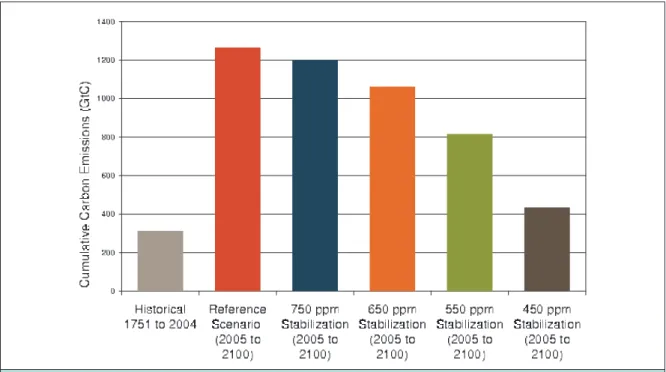
the concentration of CO2 presents special challenges unlike those that human society has faced previously (Box 1-2). The concentration of CO2 depends on cumula-tive, not annual, global emissions. Figure 1-1 shows that one way to relate global emissions and concentra-tions is to calculate the cumulative global emissions that would be allowed over the course of the 21st century (2005 to 2100) to achieve each concentration target.
atmo-In essence, any specified stabilization target has an associated finite amount of CO2 that can be emitted to the atmosphere—a “planetary CO2 emissions budget.” That budget can be allocated in a number of different ways. The four lines that rise and fall in Figure 1-2 show four paths that are designed to allocate these emissions in an economically efficient manner over time. Each results in a different CO2 concentration level. The concept of a cumulative global emissions budget has several implications:
•
Global annual net CO2 emissions to the atmosphere must peak and then decline year after year until, eventually, they are virtually zero.•
Every ton of emissions released to the atmosphere counts against a budget, regardless of sector or region of origin. Over time, this planetary CO2 emis-sions budget is drawn down and the remaining allowable emissions become scarcer and therefore more valuable.•
Climate change is not a national problem; it is a global problem. No nation alone can control the concentration of CO2.•
The key reason to develop and deploy advanced energy technologies is to control the cost of stabiliz-ing greenhouse gas concentrations.•
The technical challenge, to invent and globally deploy energy systems that progressively release less CO2, is unprecedented. The century time scale challenge implies that better technologies will be needed in the near, mid, and long terms if costs are to be controlled.•
Lastly, because it is the concentration of CO2—and not annual emissions—that drives climate change, minimizing the cost of stabilizing CO2 concentrations implies that the price of carbon begins relatively low and rises steadily with time. Put another way, in an economically efficient world the price of carbon doesFigure 1-2. Emissions Trajectories Consistent with Various Atmospheric CO2 Concentration Ceilings. The paths
pictured here are designed to limit the economic impact of achieving the target concentrations—thereby achieving the goal of the UNFCCC at the lowest economic cost. For all concentration targets, emissions rise, peak, and begin a long decline. The highest line represents an emissions pathway without limits on greenhouse gas emissions.
Historical Emissions GTSP 750 Stabilization GTSP 650 Stabilization GTSP 550 Stabilization GTSP 450 Stabilization GTSP Reference Case
not begin high and fall over time. Even though peri-odic adjustments will likely be made to the strategy to address climate change, the overall price of carbon will rise with time.
THE NON-CO
2GASES
Although CO2 is the most important greenhouse gas emitted by human activities, other gases play significant roles in contributing to increased greenhouse gas con-centrations. Other greenhouse gases have many differ-ent characteristics, origins, and potdiffer-ential for emissions mitigation, including:
•
Gases that occur naturally and from human-made sources: water vapor, methane (the second- largest contributor to greenhouse gas emissions) and nitrous oxide•
Manufactured gases, like the CFCs, HFCs, PFCs, and sulfur hexafluoride•
Gases with indirect effects: carbon monoxide, non-methane hydrocarbons, and nitrogen oxides•
Aerosols, such as sulfur dioxide, black carbon, and organic carbon.As Figure 1-3 illustrates, the non-CO2 gases as a group cannot be ignored. Like CO2 they contribute to climate change. Non-CO2 gases represent a substantial com-ponent of the greenhouse gases that are implicated in climate change, and they play sizeable roles in energy producing, transforming, and consuming activi-ties. Thus, while this report is principally concerned with CO2 and energy-related sources, non-CO2 gases influence the cost of meeting any climate change goal and therefore the cost, timing, and degree of deploy-ment of CO2 emissions mitigation technologies.
Although CO
2is the
most important gas, other
emissions play significant
roles in contributing to
increased greenhouse gas
concentrations.
CO
2fuel and
cement, 55%
CO
2land use
change and
forestry, 19%
Methane, 16%
Nitrous oxide
9%
High GWP
gases, 1%
THE GLOBAL ENERGY SYSTEM—
FROM YESTERDAY TO TODAY
Before the Industrial Revolution, most goods and services were produced with the use of energy from humans, animals, wood and other biomass, and early forms of hydropower. The Industrial Revolution and the growth in the world’s energy use were made pos-sible by harnessing ever more powerful and denser forms of energy, as Figure 1-4 shows.
Some of the major transitions in the world’s use of energy over the past 150 years include:
•
In 1850 the dominant commercial fuel (that is, excluding traditional energy sources like dung, human labor, and animal power) was wood, holding more than 80 percent of the market.•
By 1880, coal had eclipsed wood to become the world’s most commonly used fuel. In 1916, coal held 70 percent of the global market.•
Coal was eventually surpassed by oil, which by 1973 held 40 percent of the global market for pri-mary energy.ENERGY TODAY
Energy is an essential and ubiquitous part of our daily lives. However, while people experience the benefits of energy—heat, light, transportation, manufactured goods and services—they do not usually see the infra-structure supporting energy—coal mines, oil pipelines, power plants, refineries, etc.—nor do they think about the immense scale of the global energy system. Energy touches every aspect of modern life, and the systems providing this energy vary from use to use and from place to place.
Today’s energy system—the supply, conversion, trans-port, and end-use of energy—is dominated by fossil fuels. Of the more than 400 exajoules used today world-wide, 86 percent was supplied by fossil fuels and only 14 percent by non-fossil energy sources such as nuclear, hydroelectric, solar, biomass, and wind power. Each of
Figure 1-4. Historically the global energy system has been dominated by carbon-based fuels—initially wood, and more recently coal, oil, and gas. The use of each type of carbon-based fuel continues to grow as the entire energy system grows.
the fossils fuels (natural gas, oil, and coal) individually provided a larger percentage than all of the world’s com-mercial non-fossil energy sources combined in 2003. Although virtually all global transportation needs are fueled by fossil energy, the electricity sector uses more diverse sources of energy. Approximately one-third of global electricity in 2003 was generated using non-fossil energy. Use of natural gas, another fossil fuel, is growing rapidly—both in direct uses and in electricity generation. At the national level, the fuels used to generate electric-ity depend on natural resource endowments, public pol-icy, relative energy prices, and past investments in power plants and their supporting infrastructure. This wide assortment of factors leads to significant differences in national electricity systems. For example, nuclear power provides about 75 percent of electricity in France but only about 2 percent of China’s electricity supply.
Figures 1-4 and 1-5 provide another lesson from the 150-year history of the global energy system: the global energy system continues to diversify. No one fuel
simply replaced the others. Even fuels whose market shares decline show trends of expanded deployment as the energy system grows overall. For example, produc-tion of wood, coal, and oil are larger today than when their market shares were at their peaks.
TOMORROW: EMISSIONS,
ENERGY, AND CHANGE
The world of the 21st century will be challenged by the need to expand the energy supply and reduce green-house gas emissions, again principally from the use of fossil fuels in the energy system, but also including the wider context of human development and activities that release non-CO2 greenhouse gases.
The world’s future energy system will evolve from today’s energy system. Its evolution will be shaped by actions and investments made today and in the coming years.