Family based intervention against child abuse
and neglect for young parents involved in a
youth and livelihoods program in Liberia:
A pilot project to build evidence around the potential
for parenting skills trainings to protect children from
abuse, neglect, and exploitation
NOVEMBER 2011
RESEARCH & EVALUATION
From Harm to Home | Rescue.org
2
Contents
Acknowledgements ... 3 Abbreviations ... 4 Executive Summary ... 5 Section 1: Background ... 61.1 The case for family-strengthening interventions with a nurturing parenting component in Liberia . 7 1.2 Overview of the IRC’s Parenting Program for Young Mothers in Liberia ... 8
Section 2: Methodology ... 10
2.1 Overview ... 10
2.2 Limitations and Challenges ... 18
2.3 Informed Consent and Confidentiality ... 19
Section 3: Research Findings ... 20
3.1 Demographics ... 20
3.2 Research Question 1: What are the most problematic parenting practices in Liberia? ... 22
3.3 Research Question 2: Can the group of young mothers acquire parental skills through a short training program? Do young parents change parental behaviour or are they willing to change their parenting behaviours after a parenting skills training? ... 23
3.4 Research Question 3: Is the program selected suitable for the Liberia context? Can it be replicated? Why? ... 30
3.5 Additional findings of interest ... 32
Section 4: Recommendations and Conclusion: ... 36
Works Cited ... 39
Appendix A: Baseline Assessment Focus Group Discussion Guide ... 41
Appendix B: Evaluation--Fidelity and Acceptability Questionnaire and Focus Group Discussion Guide ... 42
3
Acknowledgements
This research is the result of a collaborative effort between the International Rescue Committee’s Child and Youth Protection and Development Technical Unit, the IRC country team in Liberia, and Family Development Resources, Inc. Nurturing Parenting Programs trainer and consultant Bettie Murchison played a vital role in the development and implementation of the pilot project by collecting baseline data, adapting a Nurturing Parenting Program curriculum, training the trainers, and assisting in the analysis of program results. Dr. Stephen Bavolek, President of Family Development Resources, Inc. and Executive Director of the Family Nurturing Centers, authored the Nurturing Parenting Programs and played an advisory role throughout the life of the pilot project.
This research would not have been possible without the efforts of the IRC’s staff in Liberia including Child and Youth Protection and Development Coordinator, Sandra Maignant; Project Manager, Abu Macpherson; Monitoring and Evaluation Officer, Dominic Massaquoi; and Private Sector Liaison Officer, Issac Capehart. Special thanks to the Economic Empowerment of Adolescent Girls and Young Women Program (EPAG) trainers and to the young women who joined the program enthusiastically and want more than anything a better and happier life for their children.
4
Abbreviations
AAPI: Adult/Adolescent Parenting Inventory
CYPD: Child and Youth Protection and Development
EPAG: Empowerment of Adolescent Girls and Young Women Program
I/NGOs: International/Non-governmental Organizations
NPP: Nurturing Parenting Programs
The IRC: TheInternational Rescue Committee
5
Executive Summary
“Family Based Intervention against Child Neglect and Abuse for young parents involved in a Youth and Livelihoods program in Liberia”was a pilot project to address the family-based protection risks facing children in Liberia; advance the Child and Youth Protection and Development Unit’s (CYPD) technical priorities; and respond to the gap in knowledge around the adaptability, acceptability, effectiveness, and scalability of parenting program models implemented in conflict, post-conflict and disaster affected settings.
Between December 2010 and April 2011, the pilot parenting program provided approximately 200 young mothers between the ages of 17 and 31 with a ten session parenting program. The pilot parenting program utilized the Nurturing Parenting Programs Easy Reader Curriculum and was implemented through the existing training and program structure of the IRC’s Empowerment of Adolescent Girls and Young Women Program (EPAG), a three year initiative supported by the World Bank, the Nike Foundation, the Government of Denmark and the Government of Liberia.
As part of the IRC’s commitment to implementing programs that are both evidence based and evidence generating, with the pilot project, the CYPD unit’s child protection team set out to answer the following questions:
1. What are the most problematic parenting practices in Liberia?
2. Can the group of young mothers acquire parental skills through a short training program? Do young parents change parental behavior or are they willing to change their parenting behaviors after a parenting skills training?
3. Is the program selected and adapted suitable for the Liberia context? Can it be replicated? Why? This paper provides an overview of the pilot project, “Family Based Intervention against Child Neglect and Abuse for young parents involved in a Youth and Livelihoods program in Liberia”, presents the findings from the pilot project; and provides insight into the strengths and weaknesses of the research methodology. Finally, this paper offers recommendations to guide future research and monitoring and evaluation efforts and to inform the implementation of future phases of the IRC’s parenting program for young mothers in Liberia, the first of which is being implemented as an integrated part of the EPAG program’s second round of trainings.
6
Section 1: Background
It is widely acknowledged that protecting children from abuse, neglect, exploitation and violence requires interventions that strengthen the protective capacities of each layer of children’s ecological system. Such interventions are essential to children’s survival, development, and psychosocial wellbeing. This is particularly true in conflict, disaster and post-conflict development settings where family, community, and national level protective systems are often weak and fragmented.1 In these settings, I/NGOs, working with local and national level counterparts, have taken steps to strengthen the protective capacities of government systems, schools, community groups and children themselves. However, although families play the most significant role in children’s protection and development (Brofenbrenner, 1979) in conflict, disaster, and post-conflict settings, interventions aimed at strengthening the capacity of families to protect, nurture, and provide for their children have been limited and little evidence exists as to which family-strengthening models best address children's protection needs in these contexts. To address this gap in knowledge and service, the child protection team under IRC's Child and Youth Protection and Development Unit has identified family-strengthening interventions as a technical priority2.
Drawing on an extensive literature review and meetings with leading academics and child protection practitioners, the IRC has piloted different kind of projects for family-strengthening that may be
successful in enhancing the capacities of families to protect, nurture and provide for children in conflict, disaster, and post-conflict settings. These include: (a) programs that support income generation and provide an added component of group discussion around positive discipline practices and children’s rights; (b) programs for both parents and children that aim to strengthen parent-child interactions; and (c) parenting skills training. While there are a number of existing, evidence-based and promising program models that fall into these categories, research is needed to identify which program models are most adaptable, acceptable, effective, and scalable in resource poor, disaster, conflict, and post-conflict settings.
1
Machel, 1996; UNICEF, 2006; Boothby, Strang & Wessels, 2006; Levy-Shiff, Hoffman, & Rosenthal, 1993
2
Technical priorities are areas where the IRC actively seeks to develop knowledge and expand programming. This
2 Technical priorities are areas where the IRC actively seeks to develop knowledge and expand programming. This
entails conducting literature reviews; piloting evidence based models; generating evidence; and further integrating technical priorities into our existing programming.
7
1.1 The case for family-strengthening interventions with a nurturing parenting
component in Liberia
Liberia suffered a brutal and devastating civil war from 1989 until 2003. The war resulted in over 200,000 deaths and led to the internal and external displacement of hundreds of thousands (LISGIS, 2007). By the end of the war, Liberia’s infrastructure was destroyed, the social fabric was torn and a whole generation of Liberians had grown up without access to basic educational and health services (the IRC, 2010).3
Although Liberia is no longer in an acute emergency phase, the transition from conflict to social and economic stability and development is rife with challenges, particularly for children. Today, the government of Liberia is ranked as one of the least child-friendly in Africa (ranked 47th out of 52 countries) due to the lack of legal mechanisms for child protection and a grossly inadequate budget allocated to address children’s protection and development needs (Forum, 2008, pp. 7-8). According to UNICEF Statistics on Liberia, 25% of children under five are moderately or severely underweight ; 21 % are engaged in child labor; and less than 5% of children under the age of 5 years have registered births (UNICEF, 2010).
Particularly salient for the IRC’s family strengthening efforts is the fact that many children in Liberia are living in households with only one parent or with caregivers who are not their biological parents. In Monrovia, 25.9 % of girls and 32.9% of boys between the ages of 10 and 14 lived with only one parent, most commonly, the mother ( UNFPA and Population Council, 2008, p. 15); and 42.3 % of girls and 33.3% of boys in this age group lived with neither parent in the household ( UNFPA and Population Council, 2008, p. 15).
In Liberia, the high rates of children living with neither parent or with only one parent, combined with the high rates of poverty (UNDP, 2010) are concerning. Caregivers are responsible for protecting
children from physical harm and ensuring that their nutritional, medical, and educational needs are met. They also play a significant role in children’s social, emotional and intellectual development and ability to cope with stressful and traumatic situations (Smokowski, 1998; Masten, 2001) including natural disasters and conflict. However, as acknowledged by Secretary-General Ban Ki-moon in his Message for 2011, when families face enduring hardship, children's needs are often neglected and children are left with "lifelong physical and cognitive scars." Children living in foster families where resources are stretched thin may be particularly vulnerable.4 Children of young single mothers may also face heightened risk due to the low earning, protection and social power of women in Liberia, (UNFPA and Population Council, 2008, p.13). This may be particularly true when the young mother lacks social support systems, including strong family relationships (Flanagan P, 1995).
3
The IRC. Liberia Country Profile. (2010).
4
According to Reaching Out to Africa’s Orphans: A Framework for Public Action (2004), orphan care tends to fall on the poorest households and reduces consumption and resources per capita (Subbarao, 2004, p. 14) . 7% of children in Liberia are orphans (Liberia Insititute of Satistics and Geo-Information Services (LISGIS) [Liberia], 2007, p. 10)
8 According to the 2007 Demographic and Health Survey (DHS), children in Liberia experience alarmingly high rates of physical and psychological punishment. In the month prior to the DHS survey, 83% of children between the ages of 2 and 14 had experienced psychological punishment such as yelling and name calling; 76% had experienced minor physical punishment (being slapped on the face head, arm or leg); and 15% had experience severe physical punishment such as severe beating with an object (LISGIS, 2007, p. 47). Common, traditional methods of discipline in Liberian culture include beating children with objects such as switches or belts or rubbing hot pepper in children’s eyes and mouths or on their genitals (Schmidt, 2009, p. 9). In line with the high rates of physical and psychological punishment experienced by children in Liberia, corporal punishment has traditionally been seen in Liberia as not only accepted but as necessary “to prepare a child to be a good citizen” (Schmidt, 2009, p. 9).
1.2 Overview of the IRC’s Parenting Program for Young Mothers in Liberia
“Family Based Intervention against child neglect and abuse for young parents involved in a youth and livelihoods program in Liberia”5was designed as a pilot project to address the family-based protection risks facing children in Liberia; advance the Children and Youth Protection and Development (CYPD) unit’s technical priorities; and respond to the gap in knowledge around the adaptability, acceptability, effectiveness, and scalability of parenting program models implemented in conflict, post-conflict and disaster affected settings. The proposal was developed with the invaluable support of the IRC-Liberia country team and was part of a collaborative effort between the Child Protection and the Youth and Livelihoods subsectors within the Child and Youth Protection and Development technical unit. Funding was awarded in August 2010.
Program Selection
The IRC selected Nurturing Parenting Programs Trainer, Bettie Murchison, and Family Development Resources, Inc., publisher of the Nurturing Parenting Programs, as partners for the implementation of the pilot project. Nurturing Parenting Programs was chosen because: 1) it was backed by a number of validation studies and was therefore in line with the IRC’s commitment to implementing evidence based programs; 2) it included evidence-based methods for pre and post evaluation of participants, namely the Adult and Adolescent Parenting Inventory-2 (AAPI-2); 3) the program was possible to implement at a low-cost in resource poor environments; 4) it had been implemented successfully with diverse populations; and 5) it included curricula for participants with low-levels of literacy for the welfare system in the US.
Nurturing Parenting Programs
Nurturing Parenting Programs (NPP), authored by Family Development Resources, Inc. President, Dr. Stephen Bavolek, include a range of parenting curricula and tools designed to treat and prevent child abuse and neglect. Because positive (and negative) parenting beliefs and practices are learned, the programs are targeted at helping parents develop the skills and knowledge that they need to be
5
9 nurturing parents. The program focuses on building parents’ competency in five areas: (a) appropriate expectations of their children; (b) empathy; (c) understanding of positive discipline practices; (d) understanding of appropriate parent-child roles; and (e) healthy beliefs towards children’s power and independence. The programs have been implemented with Haitian, Arab, Hispanic, African-American, Caucasian, Somali, and Hmong populations in the United States, as well as with U.S military families abroad. The effectiveness of the NPP curricula and the reliability of the AAPI-2 has been demonstrated through a number of validation studies6 conducted in the United States.
Program Participants
Implementation of the pilot program
The IRC’s Parenting Program was implemented through the IRC’s Empowerment of Adolescent Girls and Young Women Program (EPAG), a three year initiative supported by the World Bank, the Nike
Foundation, the Government of Denmark and the Government of Liberia. The EPAG program aims to provide business and life skills training to adolescent girls and young women in five communities (New Kru Town, Doe, Red Light, West Point, and Bentol). The first round of EPAG training was conducted between March 2010 and December 2010 and benefited 355 adolescent girls and young women. Of these participants, 263 volunteered to participate in the IRC’s pilot parenting program. The pilot parenting program was facilitated in each of the five communities by EPAG trainers. The decision to implement the pilot parenting program through the EPAG program was made because working through the existing training structure was time and cost effective and because many of the EPAG trainees are young, poor, single mothers who the IRC Liberia program staff believed could benefit from parenting support.
The baseline assessment and adaptation phase of the program began on August 2010, with the pilot parenting program running from December 15, 2010 to April 28, 2011. We set out to answer three research questions:
1.
What are the most problematic parenting practices in Liberia?
2.
Can the group of young mothers acquire parental skills through a short training
program? Do young parents change parental behavior or are they willing to
change their parenting behaviors after a parenting skills training?
3.
Is the program selected and adapted suitable for the Liberia context? Can it be
replicated? Why?
6
10
Section 2: Methodology
2.1 Overview
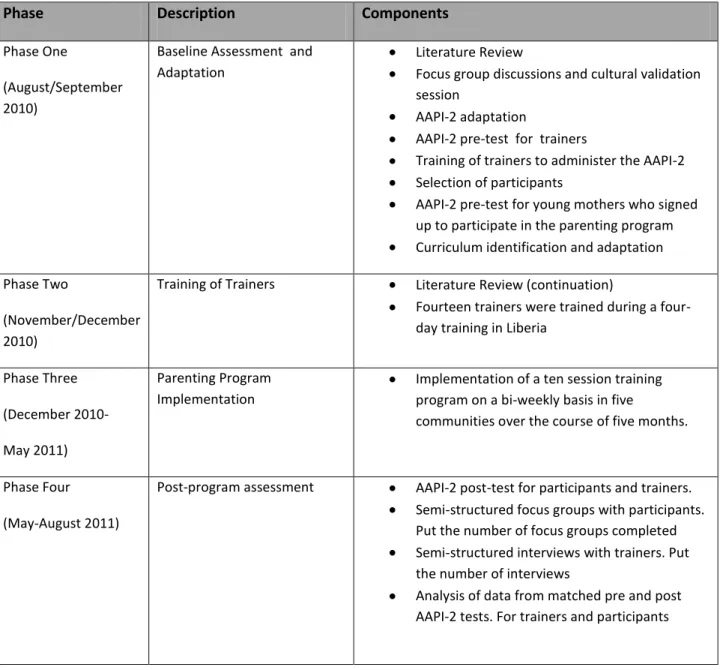
The Parenting Program was implemented in four phases. See below Table 1:
Table 1. Overview of pilot parenting program activities
Phase Description Components
Phase One
(August/September 2010)
Baseline Assessment and Adaptation
Literature Review
Focus group discussions and cultural validation session
AAPI-2 adaptation
AAPI-2 pre-test for trainers
Training of trainers to administer the AAPI-2 Selection of participants
AAPI-2 pre-test for young mothers who signed up to participate in the parenting program Curriculum identification and adaptation Phase Two
(November/December 2010)
Training of Trainers Literature Review (continuation)
Fourteen trainers were trained during a four-day training in Liberia
Phase Three (December 2010- May 2011)
Parenting Program Implementation
Implementation of a ten session training program on a bi-weekly basis in five
communities over the course of five months.
Phase Four (May-August 2011)
Post-program assessment AAPI-2 post-test for participants and trainers. Semi-structured focus groups with participants. Put the number of focus groups completed Semi-structured interviews with trainers. Put the number of interviews
Analysis of data from matched pre and post AAPI-2 tests. For trainers and participants
11
Phase One ~ Baseline Assessment and Adaptation
The first phase of the pilot project began in August 2010 with a brief literature review and planning meetings with the IRC Liberia staff. Following the preparatory work, in September 2010 the Nurturing Parenting Programs Trainer and the IRC’s Child Protection Technical Advisor visited the IRC Liberia country program to:
conduct focus group discussions with EPAG trainers and trainees to identify common discipline practices in Liberia and inform the selection and adaptation of the Nurturing Parenting Program curriculum;
assess EPAG trainers’ perceptions of the acceptability of the Adult/Adolescent Parenting Inventory;
train fourteen EPAG trainers on how to conduct the Adult/Adolescent Parenting Inventory (AAPI-2); and
determine the baseline parenting beliefs of the trainers and trainees through the AAPI-2 pre-test. Trainers took the AAPI-2 pre-test before their 4-day training; participants took the AAPI-2 pre-test before beginning the Nurturing Parenting Program curriculum.
Focus Groups Discussions and Cultural Validation Session
Five group discussions were held with participants in the EPAG training program in the five communities in which the EPAG program is operational (New Kru Town, Doe, Red Light, West Point, and Bentol). These were intended as focus group discussions for 8-10 trainees; however, the number of participants in the groups exceeded this in 4 of the 5 communities: 7 participated in New Kru Town, 22 in Bentol, 44 in Doe, 14 in Redlight, and 27 in Westpoint. In light of these large numbers, the focus group discussions instead became large group discussions.
As participants in these five group discussions were EPAG trainees, all were females between the ages of 17 and 31 and had similar educational and economic backgrounds. For a more comprehensive picture of common parenting practices in Liberia, the IRC’s Child Protection Advisor and the NPP Trainer held three additional focus group discussions: one contained eight female Liberian IRC staff members with different educational and economic backgrounds; one included seven EPAG trainers; and the other contained six EPAG trainers. The questions posed to participants in each of the eight groups were consistent and can be found in Appendix A.
At the end of the field visit, a validation session was held with three EPAG mentors and three supervisors7 to verify information received in the focus groups and gain input to guide the program design. To ensure stakeholder support for the program communities were informed in advance, but as the program was under the implementation of a larger EPAG intervention, special meetings with community leaders were judged not to be necessary by the IRC Liberian personnel.
7
Mentors are older women that serve as role models and advisers to the EPAG participants in their own communities. Supervisors play a management role working with trainers and other EPAG personnel.
12
The AAPI-2 Assessment
The AAPI-2 assessment was the primary instrument used to collect quantitative data at baseline and endline regarding the parenting and child-rearing beliefs of adult and adolescent parent participants and trainers. The assessment was filled out by participants themselves using pencil and paper; each
question was read aloud giving participants time to write the answer though a multiple choice methodology. The AAPI-2 assessment contains forty questions designed to identify parenting beliefs with a known correlation to abusive childrearing behaviours. These parenting beliefs fall into five constructs: (a) inappropriate parental expectations; (b) lack of an empathetic awareness of children’s needs; (c) belief in the use and value of corporal punishment; (d) parent-child role reversal; and (e) oppressing children’s power and independence. The AAPI-2 is a norm-referenced inventory. As such, raw scores are converted into sten scores (based on a standard ten scale), which identify “where an individual stands in relation to a normal distribution of scores” (Bavolek, 2005). Sten scores range from 1-10. Low sten scores (1-3) have been demonstrated to indicate a high risk for abusive parenting behaviours; scores ranging from 4-7 represent the “normal” range of parenting beliefs and moderate risk for abuse. High sten scores (8-10) indicate positive, nurturing parenting beliefs.
Research has revealed that the correlation between raw scores in the five construct areas and abusive parenting behaviours varies depending on age and gender. For this reason, separate norm tables have been established and tested for male and female adults and adolescents. Separate norm tables also exist for Haitians, Arabic populations, Hispanic populations, and Asian populations in the U.S as a result of the AAPI-2 being translated, thus resulting in a different inventory. In the past, separate norm tables were also developed for Caucasians, Hispanics, and African-Americans in the U.S. The AAPI-2 has since been re-normed to account for differences between these groups which likely correspond more to income and education than to race or culture. However, as no normative scale currently exists for Liberians, the normative scale for African-Americans was used to determine the sten scores of the pilot project participants. The decision was made based on perceived similarities between the two groups: poverty, low education, poor health resources, high degree of violence.
Adaptation of the AAPI assessment
The Nurturing Parenting Programs Trainer and the IRC Child Protection Technical Advisor (CP TA) conducted semi-structured focus group discussions with seven EPAG trainers and supervisors to get feedback on the relevance of the items in the AAPI-2 assessment.
Adaptations were made to the AAPI-2 assessment based on this feedback. Questions regarding race, nationality, and income were removed, and questions including number of children delivered, number of children still alive, and tribe/community were added. The word spanking was replaced with beating; potty training was replaced with chamber or stool; wellbeing and nurture were replaced with take care of; confide was changed to tell secrets; and strong willed was changed to strong opinions. Dr. Stephen Bavolek approvedall changes to the AAPI-2 assessment to ensure that they did not affect the integrity of the assessment or results.
13
Selection of Participants
Participants in the pilot parenting program were selected on the basis of their participation in the EPAG trainings; having at least one child; and participating voluntarily in the pilot parenting program. By nature of their being part of the EPAG program, program participants fulfilled additional criteria of having dropped out of school and having basic numeracy and literacy skills8.
AAPI-2 Pre-tests
The NPP Trainer and the IRC Child Protection Technical Adviser administered the adapted AAPI-2 to the fourteen EPAG trainers who would be facilitating the IRC’s Parenting Program for Young Mothers in Liberia. The EPAG trainers were then trained fastidiously on how to administer the AAPI pre-test to program participants. A total of 263 AAPI-2 pre-tests were administered: 67 in Bentol; 58 in Doe; 54 in New Kru Town; 45 in Redlight; and 39 in West Point.
Curriculum identification and adaptation
Taking into account the low literacy levels of the trainees, AAPI-2 assessment results of trainers and trainees, and findings from the group discussions, the IRC and the NPP Trainer identified the “Easy Reader Nurturing Parenting Program for Parents and Their Infants, Toddlers and Preschoolers” as the most suitable for the Parenting Program. Due to time and financial resources constraints, the fifty-session curriculum was consolidated into ten two hour fifty-sessions that focused on those construct areas that the focus group discussions and AAPI assessments revealed as most needing improvement:
Session One: Nurturing as a Lifestyle;
Session Two: Children’s Brain Development; Session Three: Ages and Stages;
Session Four: Developing Empathy/Getting Needs Met;
Session Five: Recognizing, Understanding and Handling Feelings; Session Six: Building Self-Worth and Personal Power;
Session Seven: Discipline with Dignity—Techniques to Use; Session Eight: Family Rules/Rewards & Punishment/Praise;
Session Nine: Touch History/Stress and the Need for Nurturing Routines; and Session Ten: Anger, Criticism/Confrontation, and Violent Relationships.
The Easy Reader parent handbooks that are designed to accompany the sessions were adapted to reflect the changes that were made in the number of sessions.
8 Participants in the EPAG program are also supposed to be between the ages of 16 and 27. Dates of birth show
that the age range may actually be 16-30 and that participants in the pilot parenting program were between the ages of 17 and 31.
14
Phase Two ~ Training of Trainers (ToT)
In the second phase of the project, the Nurturing Parenting Programs Trainer and the IRC Child
Protection Technical Advisor conducted an intensive four-day training to the fourteen EPAG trainers and supervisors who would facilitate the parenting program. Because the AAPI scores of the EPAG trainers were below the recommended scores for well-prepared trainers9 (according to NPP, effective trainers should score in the low-risk category), the ToT modules were adapted to include cognitive and affective ways of introducing nurturing parenting concepts.
Training modules included:
Nurturing Parenting Constructs; Brain development;
Philosophy, Morals and Values; Communication Skills;
Basic Needs and How to Get Them Met; Conflict versus Confrontation.
Facilitation Tips;
Data Collection and Implementation; Program Fidelity;
Phase Three ~ Implementation of the Parenting Program
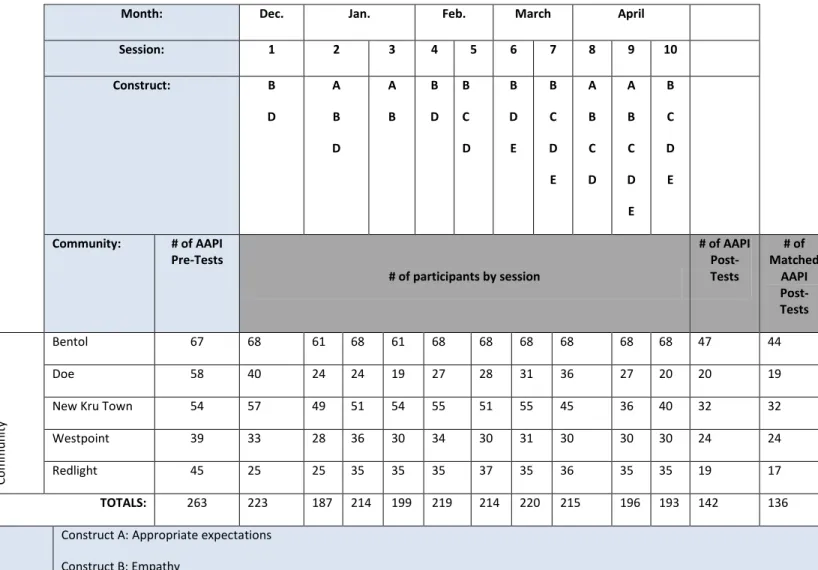
The parenting program began on December 15, 2010 following the first round of EPAG business and life skills training. Each community had two trainers (one male and one female), with the exception of New Kru Town, which had four trainers (2 males and 2 females) as the community was divided into two groups for the EPAG business and life skills training sessions that are independent from this research. Ten 2-hour sessions were conducted over the course of five months, concluding on April 28, 2011. Table 2 outlines the training sessions by community, month, topic, construct and number of participants in attendance. Attendance keeping records were poor, as no names were recorded at the beginning and at the end of each session. This, combined with a lack of punctuality, may have caused inaccuracies in attendance records..
9
The average trainer score on a standard ten scale was 2.64 in Construct A: Parental expectations; 2.91 in
Construct B: Empathetic awareness of children’s needs; 4.82 in Construct C: Belief in the use and value of corporal punishment; 1.91 in Construct D: Parent-child role reversal; and 4.36 in Construct E: Oppressing children’s power and independence.
15
Attrition
As can be seen in Table 2, in all communities except Bentol, attendance records show high rates of attrition between the first and final sessions. Attrition rates are particularly high in Doe (50%) and New Kru Town (29.82%). Qualitative data from program questionnaires given to trainers and post-program focus groups with participants to assess post-program fidelity and acceptability provide some insight into the main causes of attrition: lack of payment, transportation, and employment or schedule conflict.
Table 2. Pilot parenting program training sessions and AAPI pre and post-tests, by
community
Month: Dec. Jan. Feb. March April
Session: 1 2 3 4 5 6 7 8 9 10 Construct: B D A B D A B B D B C D B D E B C D E A B C D A B C D E B C D E Community: # of AAPI Pre-Tests # of participants by session # of AAPI Post-Tests # of Matched AAPI Post-Tests Co mmu n ity Bentol 67 68 61 68 61 68 68 68 68 68 68 47 44 Doe 58 40 24 24 19 27 28 31 36 27 20 20 19 New Kru Town 54 57 49 51 54 55 51 55 45 36 40 32 32 Westpoint 39 33 28 36 30 34 30 31 30 30 30 24 24 Redlight 45 25 25 35 35 35 37 35 36 35 35 19 17
TOTALS: 263 223 187 214 199 219 214 220 215 196 193 142 136
Construct A: Appropriate expectations Construct B: Empathy
Construct C: Corporal Punishment
Construct D: Parent-Child Roles (Self-Awareness) Construct E: Children’s Power and Independence
16 Lack of payment
According to trainers in Doe, lack of payment for attendance in the session was an obstacle to attendance and motivation, particularly since attending sessions required participants to leave their businesses.
According to one trainer: “What was difficult about the program was the issue of cards to call trainee for session because we have to call more than two times to come to session meaning before training day and on the day of training. Also some complain that they would love for funds to be made to them instead of Snaps10 because they will leave their businesses to come for session and they are engage in susu11, so if they leave their businesses how will they pay their susu at the end of the day.”
According to another: “Supplies were made available to trainee to keep the session on (snaps) but most of them complain that they prefer money be given to them.”
The problem of lack of payment, while particularly acute in Doe, was also seen in other communities. As stated by one participant in Redlight for example: “The biscuit and drinks was a serious problem for the sessions as it serve as a de-motivating factor. As Africans, we need heavy food or the equivalent in money.”
Transportation
Transportation challenges also affected attendance. “From the start, there was problem. And the problem was about refreshment,” one trainer in New Kru Town reported. “Participants said they needed transportation allowance. Instead of what was given them for refreshment.”
This challenge was echoed by participants in New Kru Town and Bentol. According to one participant, “there was something about the program that created problem. I had problem sometimes coming to session. I never had transportation all of the time. So I feel so hurt if I don’t come or if I missed session.” According another participant, “The juice and biscuit was okay but transportation was a problem making most of us to come late to sessions as we live far from the training.”
Employment/schedule conflict
Attendance in the sessions was also problematic as many of the participants were employed or had their own businesses to run. Several participants reported having to miss whole or partial sessions due to work and trainers in each of the communities mentioned difficulty in gathering participants for the sessions. One participant said: “Every time I didn’t attend a session was either I didn’t have someone to leave at my business or I went to go and buy my goods.”
In the words of one trainer in Redlight: “There were few things that made the program difficult and created problems: getting the girls to come due to their business schedules; getting them to come on
10
Snaps is a soft-drink that was provided to participants as refreshment during the sessions
11
17 time and together; and less scratch12 cards to contact the girls.” According to another in New Kru Town, “I could not start session on time because I had to get these girls from their homes or business sit before starting session. It was really difficult getting these girls.”
Despite the challenges, trainers and participants alike reported that when participants began to
appreciate what they were learning in the parenting program, many of the challenges, particularly those related to payment and refreshments, became less problematic. As stated by a participant in the post-program focus group session in New Kru Town, “At first we complain about leaving our various business areas and homes and even about the refreshment given us but we later realize that we were benefiting or learning something.”
Pre and Post Tests
Of the 263 participants who took the pre-tests, fewer took both pre and post tests. The post-test was administered at the end of the last session; however, only 74% of participants in the last session took the post-test. This is particularly marked in Redlight where only 54% of participants in the last session took the post-test and in Bentol where only 69% took the post-test. Interestingly, in both communities, attendance records provided by the trainers show nearly perfect attendance (after the initial drop outs in Redlight). The IRC Liberia country team reported that Bentol participants were particularly motivated and interested in the program, but could not explain why few completed the post-test.
Phase Four ~ Post-Program Assessment
To assess the impact of the parenting program on participants and trainers’ parenting beliefs in the five construct areas and to determine their risk for abusive behavior, the sten scores of the AAPI-2 pre-tests were compared with those from the AAPI-2 post-tests. Of the 142 post-tests administered by the trainers at the end of the final session and entered into the database, only 138 were matched, meaning that the participant had also taken a pre-test. Of these, 2 were disregarded as a result of duplication. As a result, only 136 matched tests were considered in the data analysis.
After the AAPI-2 post-tests had been administered, discussion groups were carried out with trainees in each community to collect qualitative information regarding participant satisfaction with the program. 20 EPAG trainees participated in Doe; 40 in New Kru Town; 30 in Westpoint; 35 in Redlight, and 68 in Bentol. To assess trainer fidelity to the program, trainers were provided with a short questionnaire. The discussion questions and the trainer questionnaires can be found in Appendix B.
12
Scratch cards contain credit for phone use that made possible contacting participants in the parenting pilot project.
18
2.2 Limitations and Challenges
Assessment and monitoring plan
Although the research questions were clearly stated at the outset of the project, the data collection process and methods were limited. Data collection methods heavily relied on the quantitative AAPI-2 methodology which was not sufficient to answer all research questions adequately, particularly question 2.
No processes were in place to assess trainer fidelity to the program or to adequately track unique participant attendance per session. Attendance was tracked by number of participants in each session, rather than by individual participant participation in sessions at the beginning and at the end. This posed challenges for adequately monitoring attendance and exposure to the program, limiting the extent of analysis that could be done to determine factors contributing to attrition or to identify the effect of attendance on AAPI-2 results.
Focus Group Discussions
Focus group discussions provided invaluable qualitative data. A number of challenges were posed, however, by the way in which focus group discussions were conducted. During the focus group discussions that were held during the baseline assessment, the number of participants was not restricted and thus a core requirement for a focus group discussion was not met (small group size of between 5-8 participants, and a controlled process and environment). The process for data collection relied solely on facilitators’ note taking. In the focus group discussions that were held at the end of the program, the extent of detail provided in facilitator notes varied greatly by community and facilitator. Brief summaries were often provided rather than direct quotes and notes taken by trainers who facilitated the focus group discussions provided no indication of how many participants contributed to the discussion. Weaknesses in the qualitative data collection, particularly during the evaluation phase, can be attributed to insufficient training in qualitative data collection and insufficient planning and preparation.
Selection bias
There were high rates of attrition. Those who stayed in the program may have been more open than those who left the program to learning new ways to improve their parenting.
AAPI-2 Norm Table
The AAPI-2 was not re-normed for Liberians. Rather, the normative table for African-Americans was used. Although there are similarities between populations (i.e poverty, low education, and poor health resources), whether or not the normative scale for African-Americans provides an adequate assessment of the child protection risk associated with parenting beliefs in Liberians is unknown.
19 AAPI-2 trainer's scores
Despite the training on nurturing concepts, the fact that the EPAG trainees scored low on the APPI-2 constructs, could have affected the positive results of the program. The correlation between trainer and participant scores is further explored on page 36.
Curriculum adaptation
The drastic consolidation of the curriculum from 50 to 10 sessions could have affected the positive results of the program.
2.3 Informed Consent and Confidentiality
Participation in the focus group discussions was voluntary. The Nurturing Parenting Programs Trainer and the IRC Child Protection Technical Advisor who facilitated the focus group discussions as part of the baseline assessment explained to the participants how the information collected during the focus groups would be used. In order to ensure anonymity, names of participants were not documented during the focus group discussions. Oral consent was gained.
Before administering the AAPI-2 pre-tests, participants were introduced to the purpose and background of the AAPI-2 as well as to how the IRC planned to use the data. The IRC staff informed participants in the parenting program as well as trainers that participation in the AAPI-2 tests was voluntary and that their participation in the program would not be affected by their participation in the AAPI-2 or by their scores on the test.
20
Section 3: Research Findings
3.1 Demographics
According to reported birthdates, the 136 participants who took both the AAPI-2 pre and post tests were between the ages of 17 and 31. The reported ages of participants at the time of the pre and post tests, however, varied significantly. Reported ages ranged from 15-32 according to the AAPI-2 pre-tests. Post-tests for the same participants seven months later showed ages ranging from 17-31, and the frequency of ages within this age range differed noticeably. It is worth noting that the dates of birth reported during the AAPI-2 tests were often inconsistent with those documented in the EPAG Trainee Directory, though the age range according to dates of birth is similar.
Having at least one child was required for entry into the program. Although the data collected pre and post test was inconsistent, the majority of participants reported having 1-2 living children. Two participants during the pre-test, and one during the post test, reported having no children.
Table 3:
Number of Children #of children
delivered who are still alive # of Participants Pre-Test % of participants # of Participants Post-Test % of participants 0 2 1% 1 1% 1 51 38% 48 35% 2 63 46% 49 36% 3 17 13% 27 20% 4 3 2% 10 7% 5 0 0% 1 1%
Results of the pre and post-tests indicate that the majority of participants had education beyond grade school. However, as shown in Table 4, there were inconsistencies in the data collected in the pre and post tests.
Table 4:
Highest level of education completed according to participants (% )
Pre-Test Post-Test Grade School 40% 25% High school 4% 24% Some college 13% 4% 7th grade 7% 9% 8th grade 9% 9% 9th grade 6% 11% 10th grade 8% 5% 11th grade 6% 7% Unknown 7% 6%
21 According to AAPI-2 post-tests, the majority of participants were unemployed (49.3 %); however, a comparision of the pre and post tests shows that durin the post tests, a larger percentage of participants self-identified as employed full-time (11.8% post-test compared to 1.5% pre-test) or part-time (21.3% post-test compared to 2.2% post-test). The variation between pre-test and post-test could reflect true changes in employment status or it could reflect participants understanding the answer categories in different ways. The high number of respondents reporting “don’t know” in the pre-test may be due to high rates of employment in the informal sector.
As seen with data on age, level of education, and employment status, there were significant,
unexplained discrepancies between participants’ pre and post test marital status reports. Table 6 shows the proportion of single participants almost tripled from pre-test to post-test while the number of married individuals decreased by almost half. The other categories did not see changes that were as dramatic.
Table 6:
Reported Marital Status Single
Unmarried
Partners Married Divorced Widowed Separated
Pre-Test 18% 14% 54% 6% 1% 7% Post Test 50% 17% 27% 2% 1% 1%
Table 5:
Reported Employment Status (# and %) of participants
Pre-Test Post-Test Unemployed 62 (45.6%) 67 (49.3%) Employed Full-Time 2 (1.5%) 16 (11.8%) Not employed due to disability
9 (6.6%) 10 (7.4%) Employed part-time 3 (2.2%) 29 (21.3%) Don't know 60 (44.1%) 14 (10.3%)
22 Rese ar ch Ques tio n
3.2 Research Question 1: What are the most problematic parenting practices
in Liberia?
Based on focus group discussions from Phase I of the pilot parenting project with the IRC staff, EPAG trainers, and program participants and data from the 2007 DHS (LISGIS, 2007) and the Bridging Refugee Youth and Children’s Services (2009) report, common parenting practices in Liberia include13:
1) forcing a child to go without food; 2) mocking a child in public;
3) locking a child in a room;
4) putting pepper on a child’s eyes, noses, mouth and genitals;
5) beating a child forcefully with the hand, fist or objects or kicking a child; and 6) burning a child with hot spoons, boiling water, or wax.
During the focus group discussions that were held in September, participants and trainers were asked: “What kind of discipline do Liberian parents use to train children, to make children do what they expect? Do you hit them, punish them, give them gifts…?”
Beating children was the most frequently mentioned method of discipline and often involved using fists or objects like sticks or slippers or kicking the child. Although many participants spoke of having loving families or supportive adults in their lives, many also mentioned having themselves been beaten. Two participants in Redlight summed up the inter-generational nature of the practice. Holding up her fist, one participant said, “Our parents hit us, and we hit our children.” Another agreed: “We treat them like we saw from our mothers, hit them, *keep them+ all day without food.”
Another discipline practice mentioned in Phase I focus group discussions by participants, trainers, and the IRC staff members was putting pepper on children’s eyes, nose, mouth, and genitals. According to one trainer:
“One day, I was reading my papers, and I saw a child misbehaving… I saw how his mother shook the kid, and put paper with spicy pepper in his mouth, nose, anus, and penis. That is why children are so strong! The kid was punished because he left to bike for a day without saying goodbye.”
There is some indication, however, that the practice of peppering is less common among the younger generation, or at least less common among program participants. As stated by a program participant in Doe:
“ My mother will pepper me everywhere, nose, eyes, ears, sex. I do not do that to my children. It was our parents.”
13
Currently, national child protection systems in Liberia lack the capacity to monitor and collect data on child abuse so the only national data available comes from the 2007 DHS.
“Badly beating children
is a common way of
disciplining children in
Bentol, Liberia.”
23 Some alternative discipline methods mentioned included mocking children, forcing children to go without food, and locking them in a room. “We beat the children. We got beat,” one participant in Doe said. “If you whip the child they get used to it, so you hold the child’s food hungry.” According to
another participant, “You can also lock them in a room or you force the child with blocks on the hands or holding your ears and go up and down. We call [this] pump tired.”
Only two participants mentioned talking to the child as an effective alternative to corporal punishment. One in Doe stated, “I used to beat my children. But they did not understand me. Now talking it works better. The beating was making worse as the child was used to it.” Another participant mentioned that she had begun talking to her children rather than beating them when then got older because beating them became more difficult: “I used to beat my children,” she said, “but when they started being old teenagers I talked to them now, because they are big. When I finish my body is not ok I go and take tablet (medicine).”
Burning children with hot spoons, boiling water, or wax was also mentioned as a method of discipline in more than one focus group discussion. As mentioned by a program participant in New Kru Town:
“Some parents beat their kids with rod, slap, slippers and sometimes any odd object. Some uses stick, some uses hot pepper; some burn their kids with fire candle and hot oils, etc.”
Across all groups, discipline was largely equated with physical punishment. Children living in foster-care or with step parents were reported as particularly at risk for physical abuse and servitude, being forced to earn their keep. One participant in Redlight noted this, saying:
“Especially if it is a step- child, it is not strange that the child is a slave for the family. My older sister had a little girl living with her. She was not going to school. She was fetching fresh water and clean when while my sisters’ children would go to school.”
During the focus group discussions participants were asked to discuss common methods of disciplining children in Liberia but they weren’t asked to identify which ones were most problematic. There were no focus group discussions organized with children to validate what adults said during this assessment.
3.3 Research Question 2: Can the group of young mothers acquire parental
skills through a short training program? Do young parents change parental
behaviour or are they willing to change their parenting behaviours after a
parenting skills training?
Data show that the pilot parenting program appears to have been modestly successful. AAPI-2 results indicate that participants in the pilot parent program developed more positive parenting beliefs across the 5 NPP constructs, moving away from high-risk parenting beliefs. Qualitative data from focus group discussions suggests that at least in some cases, participants changed their parenting behavior.
24
Acquisition of parental skills
The methodology used in this pilot project significantly limits our ability to identify whether, as a result of a short parenting program, young mothers acquire parental skills. The AAPI-2 measures beliefs, not skills or competencies, and indicators or methods for measuring parenting skills or competencies were not part of the research. Despite the limitations of the research, qualitative data from the focus group discussions conducted in each of the five communities at the end of the program provide anecdotal information (through self-evaluation methodology) suggesting that many participants and trainers can identify specific knowledge they have gained. They were also taught parenting techniques like time-out, dialogue, ignoring, praising, setting family rules, feelings management, etc. Examples of improved knowledge across communities included information about children’s brain and emotional
development:
“What touched *participant x+ most in the session is that mothers need to hold their baby after birth at which time the baby and parent begin to know each other. She was also touched when she learned that crying is a form of communication- when babies crying are communicating a need “ (Trainer, Bentol).
“I remember learning about how we as a parent should help our children handle their feelings. I learned that praising children can make children know that we parents are proud of what they do. And that they children and feel good because they pleased their parents” (Participant, New Kru Town).
“The girls interviewed all said the parenting program was good, and new to them. And that they were taught the different stages children grow, how their brain develop and that they need to spend time with their child/children” (Trainer, Westpoint).
Participants also identified the importance of empathy and alternatives to corporal punishment. For example:
“For me personal the program have made me change, I as a parent should not expect too much from children, I have develop empathy and also how to discipline children with dignity not through corporal punishment” (Trainer, Doe).
“I enjoyed every lesson in this package as they help to shape my behaviour toward my kids. I show them love, empathize with them and praise them when did something good” (Participant, Bentol).
“*I+ learned that punishment is different from discipline and that the best form of discipline for younger kids is timeout” (Participant, Bentol).
There is also qualitative evidence suggesting some participants have successfully applied the knowledge they gained during the pilot parenting program. One participant, for example, told the following story about using time out with her child:
25 “The program influenced me because it was once upon a time when I told my
son to purchase something for me. He came back home without those things I told him to buy. He also came back without the money I give him. I did not wait for him to go into detail. I caught him and beat on him badly and he had cuts or wounds on him. I decided to put away the training aside. I sent him another time and he did exactly the same thing. This time, I decided not to beat him but for him to sit alone behind my market table for almost the whole day. I also sent him another time but this time around, he came with what I wanted him to buy. I beat him for the first time because I didn’t applied what was taught me. For the second time, I decided to applied the training. I took time-out from him (being alone for brief period of time). That makes him to buy what was needed because he did not want to be alone for a brief period of time” (Participant, New Kru Town).
Another participant saw similarly positive results from applying nurturing parenting practices she learned during the training:
“I learned something from the session that I applied with my children. One time two of my children failed miserably in their lesion and the other one came home very dirty. These two that failed tonight I was going to beat on them but I did not beat on them instead, I waited for sometime then I got closer to them and encouraged them to do better next time. And for the other one, I praise him that he is a nice boy but should take his clothes or uniform off him and wait it clean. I help him with water to wash the uniform, he wash it clean then I praise him for washing his uniform clean and told him to be a decent boy. For that time, he told his friends that his mother did not beat him but instead his mother helped him with water to wash and to him to be decent so he no longer dirty his uniform” (Trainee, New Kru Town).
To build upon these qualitative reports and more definitively determine the program’s effect on parenting skills, in the future, indicators will need to be in place to determine which skills the IRC wants to measure and methods will need to assess these skills at the baseline and end line as well as how those skills are practiced (behaviours) and how they affect children’s lives.
Willingness to change
According to the trans-theoretical model of change, there are five stages of change: Pre contemplation (having no thought of changing behaviour), contemplation (having the thought of changing behaviour), preparation (making plans to change behaviour), action (changing behaviour), and maintenance (sustaining change in behaviour)) (Osvaldo F. Morera, 1998, p. 182). Change in beliefs is a pre-requisite for moving beyond the pre-contemplation stage. Nurturing Parenting Program research suggests that when people change their beliefs about their parenting patterns and child rearing habits, behaviour change is likely to follow (Also see Andrew Newberg 2006). Beliefs and behavior are difficult to change, particularly when this change conflicts with deeply engrained social norms. While one might adopt different behavior and experience positive effects from this change, if the change in behavior is not supported by one’s broader environment, it may be difficult to sustain.
26 .
The Parenting Program worked with a group of young mothers who chose to be participants of the program. Participation in the program can therefore be seen as an indication of the participants being in the contemplation stage. These women were motivated to improve the lives of their children and were willing to have their traditional child rearing beliefs and practices challenged.
Change in beliefs
A comparison of pre and post AAPI-2 tests allows us to assess changes in beliefs that NPP believes are required for changes in parenting behaviour to occur. Table 7 shows that while participant scores were low overall, the majority of communities saw improvements in participant scores at post-test.
Table 7:
Participants’ Average Sten Scores Pre and Post-Test, by Community and Construct Avg. Score Construct A: Expectations Avg. Score Construct B: Empathy Avg. Score Construct C: Corporal Punishment Avg. Score Construct D: Role Reversal Avg. Score Construct E: Children's Power and Independence
Pre-Test Post-Test Difference (Avg. points) Pre-Test Post-Test Difference ( Avg points) Pre-Test Post-Test Difference ( Avg points) Pre-Test Post-Test Difference ( Avg points) Pre-Test Post-Test Difference ( Avg points) Doe Community 1.68 4.32 2.63 1.58 4.84 3.26 4.47 5.37 0.89 1.26 2.79 1.53 2.11 3.63 1.53 Bentol 3.27 2.34 -0.93 1.89 2.25 0.36 4.57 5.36 0.8 2.25 2.16 -0.09 2.75 4.84 2.09 New Kru Town 2.5 3.84 1.34 1.84 2.69 0.84 4.41 5.75 1.34 1.56 2.91 1.34 2.47 1.78 -0.69 West Point 1.79 3.33 1.54 1.5 1.71 0.21 3.83 4.63 0.79 1.67 1.25 -0.42 2.25 2.63 0.38 Red Light 3.12 4.29 1.18 2.24 2.82 0.59 3.71 4.65 0.94 2.41 2.76 0.35 3.12 3.12 0 Total average 2.59 3.39 0.8 1.81 2.69 0.88 4.28 5.24 0.96 1.87 2.34 0.47 2.55 3.35 0.79
27 Table 8 shows the percentage of participants that moved between risk categories from pre-test to post-test. During the AAPI-2 pre-test, the majority of participants fell into the high-risk category across all 5 constructs. While the majority of participants remained in the high risk category at the time of the AAPI-2 post-test for each of the construct areas, an average of 15% of participants moved out of the high-risk category into the medium risk category for each of the constructs.
Table 8:
% Participants in each risk category, pre and post AAPI-2
% High Risk % Medium Risk % Low Risk
Pre Post Difference Pre Post Difference Pre Post Difference
Construct A: Expectations 76.47% 52.94% -23.53 23.53% 45.59% 22.06 0.00% 1.47% 1.47 Construct B: Empathy 90.44% 76.47% -13.97 9.56% 23.53% 13.97 0.00% 0.00% 0.00 Construct C: Corporal Punishment 22.06% 7.35% -14.71 77.94% 90.44% 12.50 0.00% 2.21% 2.21 Construct D: Role Reversal 87.50% 82.35% -5.15 12.50% 17.65% 5.15 0.00% 0.00% 0.00 Construct E: Children's Power and Independence 80.15% 62.50% -17.65 19.12% 36.03% 16.91 0.74% 1.47% 0.73
28 A paired t-test of participant results pre- and post-test was done to examine the likelihood that the improvement in participant results was due to chance, rather than to the pilot parenting program. The results in all construct areas were either very or extremely statistically significant. Thus, we can report with a 95% confidence level, that the pilot parenting program is effective at promoting more positive parental beliefs.
Reports from the focus group discussions conducted at the end of the program support the AAPI-2 data related to change in beliefs. As demonstrated through the following excerpts from a focus group in Redlight, several participants mentioned that as a result of the program they learned new information that has changed their way of thinking:
“The program was very helpful in many ways. We never use to have time with our kids, beat them up in the name of discipline. The program have helped change this mentality.”
“I used to beat my son so badly thinking that I was a well-disciplined mother not knowing that I was harming him.”
“The program had influenced me positively as an African we believe that children have no right, but the program has help change my mentality.”
Table 9: Two-tailed p values Paired Results
Construct: Two tailed p-value:
Construct A: Inappropriate Expectations P< 0.0002**
Construct B: Empathy P< 0.0001**
Construct C: Corporal Punishment P< 0.0001**
Construct D: Role Reversal P< 0.0053*
Construct E: Oppression of Children's Power and Independence P< 0.0002**
*very statistically significant **extremely statistically significant N=136, confidence level of 95%
29 These qualitative reports, combined with the results of the AAPI-2 post-tests and the fact that all
participants in the program attended voluntarily without receiving a stipend, suggest that pilot program participants may be inclined towards changing their parenting behaviour. This said, there are different stages of willingness, or readiness to change. Change in belief, while a pre-requisite for change in behaviour, does not mean that change in behaviour, particularly sustained change is a given.
Change in parenting behaviour
As mentioned, the AAPI-2 did not ask about or observe parenting behaviours. Drawing on the qualitative results of the post-program focus group discussions, however, we do have a wealth of anecdotal evidence that program participants changed their parenting behaviour as a result of the pilot parenting program. The following story provides just one example of how participants have taken deliberate measures to change their behaviour based on lessons learned in the pilot parenting program:
“The program influenced me because once upon a time my three year old son took my lampton and just knock it on the ground/ floor and broke it has it not been for the training I could have kick him and do beat him also. But because I learned how I should handle our feelings I decided to pen my window and look through it without saying a word to him. That really help me to control my anger” (Participant, New Kru Town).
Although use of alternative forms of discipline was the most commonly mentioned change discussed by participants in the focus group discussions, some also mentioned changes in behaviour related to other lessons learned in the sessions. One participant in Bentol stated, for example: “I never used to talk with my kids, I always yell at them but now I sit and talk with them and get their opinion on issues.”
According to a trainer, one mother in the program, “when her daughter was crying one night, she begin to look at to find out what was happening to her. She find out that she was feeling warm/ heatly in her body.” According to the trainer’s report, the mother’s response to her child’s cry can be attributed to her having learned that “crying is a form of communication- when babies crying [they] are
communicating a need.”
Another participant, according to a trainer in Bentol, drew on information she learned about setting family rules and boundaries and the importance of the parent-child bond on children’s development: “Besides trying to build to attach herself to her children [more] than before, she was able to set family rules along with her children after the session.”
The participants were not alone in mentioning that they had changed their behaviour as a result of the program. Several trainers also stated that they had learned new information that they were applying with their children. “I enjoy the training,” one trainer said, “because I applied those things that I taught those girls.” Another agreed: “The program was very helpful in that we as trainers also have a new approach to our own kids and kids of our community. For me in particular, the training has help to improve my human relationship with my kids and others.”
30 These testaments from participants and trainers provide some evidence that as a result of the pilot parenting program, at least some participants (and trainers) changed their parenting behaviour. What we are not able to tell from the qualitative data is what behaviours have changed beyond those mentioned in the focus group discussions; how widespread is the change in behaviour among program participants; and how sustainable the change is.
3.4 Research Question 3: Is the program selected suitable for the Liberia
context? Can it be replicated? Why?
Suitability of the Nurturing Parenting Program
There are a number of factors to consider when determining the suitability of the Nurturing Parenting Program for the Liberian context. These include: relevance of the program to the needs of parents and children; cultural suitability of program content and training materials; and availability of resources and materials for program implementation. Although the questionnaires and focus group discussions that trainers completed at the end of the program were not designed to specifically asses program
suitability, they do provide some insight suggesting that all in all, the adapted NPP program is relevant and culturally suitable. This said, it is important to note that the IRC is unable to draw conclusions about the suitability of the program for populations other than the EPAG trainees who may or may not be receptive to the program in Liberia.
Program relevance to the needs of parents and children
There are several indicators that parenting support and training is needed in Liberia. These include large numbers of children living in foster care or with young mothers ( UNFPA and Population Council, 2008, p. 15); high rates of child abuse (Liberia Insititute of Satistics and Geo-Information Services (LISGIS) [Liberia], 2007, p. 47); and focus group discussion reports of discipline commonly involving severe forms of corporal punishment. The need for parenting support and training related to the five construct areas is also affirmed by the low AAPI-2 scores of participants (see table 7) and by participant comments during the post-program focus group discussions. For example:
“I feel that we have just started learning and that we need more from you people.”
“We were blind and I feel that we still need to learn more.”
Trainers also attested to the relevance of the program. In the words of one trainer in New Kru town: “Things went very well in that the training was appropriate timing and
31
Cultural suitability
The question of whether the Nurturing Parenting curriculum is culturally suitable for the Liberian context was raised during the preparation phase with Liberian communities in the US who agreed on the suitability of the program for the Liberian context. The same question was asked at the beginning of the Training of Trainers (ToT). When trainers were invited, using a participatory exercise, to express their fears and concerns about the program, they mentioned a concern (which was also raised in a validation focus group) that the IRC was attempting to bring Western values to Liberia and make people conform to Western ideas. At the end of the ToT, trainers were asked to re-visit the fears they raised at the beginning of the training. Participants agreed that their fears in regards to the cultural suitability of the program had been assuaged and they saw how the program could benefit them as Liberians. The NPP trainers indicated that the trainees also raised their fears of suitability in the beginning of the training, however, the trainers were able to make them feel comfortable with the philosophy of the training. Another indicator of the cultural suitability of the program is participant identification with the program content and materials. While the quantitative and qualitative methods were not aimed at determining the extent to which participants identified with the program content and materials, according to the CYPD coordinator in Liberia, the fact that the parenting Handbook included illustrations of black families that participants could relate to was important for making participants feel that the program was relevant to them as Africans.
Accessibility of program content
Beyond the reports from participants which suggest that they learned from the program, the primary indicator of the accessibility of program content is that the literacy requirement of the Easy Reader curriculum and parent handbook corresponded with the literacy skills of the participants in the pilot program. The Easy Reader curriculum and parent handbook were designed for low functioning or functionally illiterate parents and all participants in the pilot parenting program were EPAG trainees who demonstrated basic literacy and numeracy skills as a pre-requisite for entry into the EPAG program. Trainer responses to the post-program questionnaire address the accessibility of the program content. According to a trainer in Redlight, one of the things that went well with the program is that “the lessons were easily understood.” According to another in West Point: “The manual was written for everyone to understand was good and it help me with the teaching.”
Acceptability of the program content
Focus group discussion questions and questionnaires for trainers included questions to assess the acceptability of the program. Participants and trainers alike expressed appreciation for the content of the Nurturing Parenting Program curriculum:
“I enjoy the training. Those...things that we learn that we never knew” (Trainee New Kru Town).