Eindhoven, June 2009
BSc Industrial Engineering and Management Science — Eindhoven University of Technology 2005 Student identity number 0551848
In partial fulfillment of the requirements for the degree of Master of Science
in Innovation Management
Supervisors:
Prof.dr. L.H.J. Verhoef, TU/e, ITEM Dr. M.M.A.H. Cloodt, TU/e, ITEM
A Value Discipline-Based Strategy
Design Method
By
2
TUE. Department Industrial Engineering & Innovation Sciences. Series Master Theses Innovation Management
3
Management summary
This project is in partial fulfillment of the requirements for the degree of Master of Science in Innovation Management. It is a research project in the field of entrepreneurship.
This research project is about designing a new method for companies to define a focused strategy that supports them in making trade-offs. Porter (1996; p. 68) defines such a strategy as “the creation of a unique and valuable position, involving a different set of activities. This strategic position is not sustainable unless there are trade-offs with other positions.”
The proposed design method is based on existing academic literature and is tested in practice on case-specific problems.
Proposed design method
At the basis of a strategic focus lies a value discipline. The concept of value disciplines is proposed by Treacy and Wiersema (1993). Value disciplines can be considered generic strategic directions that define the overall focus of an organization’s strategy. Only one value discipline should be picked and vigorously pursued in order to obtain the focus required to gain and sustain value leadership. However, still of key importance is to meet industry standards in the other two, to avoid being too focused. The initial three value disciplines proposed are those by Treacy and Wiersema (1993):
• Operational excellence: this value discipline focuses on optimizing the production and delivery of products or services. This results in products or services that are reliable as well as competitively priced and delivered with minimal difficulty or inconvenience (Treacy & Wiersema; 1993).
• Product leadership: a product leader focuses on offering leading-edge products and services to customers that consistently enhance the customer’s use or application of the product, thereby making rivals’ goods obsolete (Treacy & Wiersema; 1993). It has to be creative and open-minded to new ideas and be quick in commercializing them.
• Customer intimacy: companies focused on customer intimacy segment their target markets precisely and subsequently tailor their offerings to closely match the demands of those niches. Companies focus on long-term relationships with its customers instead of customer transactions. Therefore customer satisfaction is crucial.
A fourth value discipline has been derived by linking the original three value disciplines to the framework of Quinn and Rohrbaugh (1983) and discovering that this framework suggests a fourth value discipline: • Supply comport: a concept proposed by Kellogg and Chase (1995). Companies pursuing supply
comfort are not so much focused on the products they are selling but on the configuration of services around the product. The focus lies on customers who seek comfort and customers who feel urgency. To link the value disciplines to the business model, the business model framework of Osterwalder (2004) has been proposed. This framework consists of ten business model building blocks that cover both the value creation and value capturing aspects of a company (as shown in Figure 1). These aspects lead to a value proposition and a change in the company’s financial situation.
Each of the value disciplines has its own effect on where the focus lies in the business model framework and in each of the business model building blocks. The focus of each value discipline lies on a specific
4
business model building block on either the value creation or value capturing side of the business model. This focus influences the focus of all other building blocks so that a reinforcing fit between building blocks is created.
Initially, the company has to decide upon which of the four value disciplines it is pursuing. This can be determined by an analysis of its current business model and strategy. Based on the value discipline and on the business model framework focused on that particular value discipline, the company can redesign its current business model into one that has a reinforcing fit with the value discipline it is pursuing. Based on the company’s new business model, on its current external and internal environment, and on its current strategy, a new and more focused strategy can be proposed.
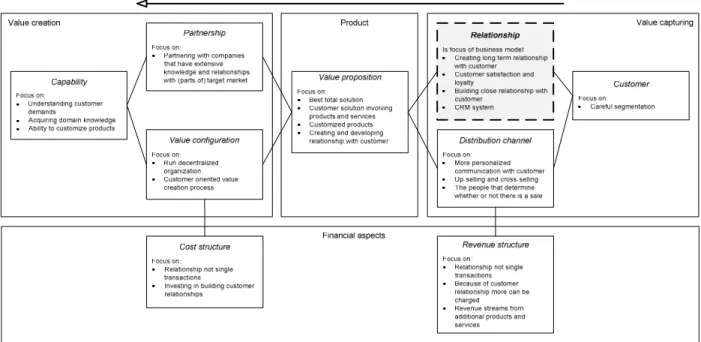
Figure 1 Business model based on customer intimacy Conclusions
The underlying and recurring notion this research project is based on is the need for a company, independent of size or form, to pursue a focused strategy. Even though it is noticed that there are many ways to approach strategy, the need for focus has widely been preached in academic literature. Focus helps companies to create a unique mix of values, which subsequently allows the company to head into a distinctly different direction than its competitors. A reinforcing fit between a company’s activities further strengthens its focus.
The contribution to academic knowledge that emerges from this research is a value discipline-based business model framework for each of the identified value disciplines. Extensive relationships between theories have been found, in particular the finding that each value discipline focuses on one business model building block and thereby affecting all of the other building blocks.
Whether a company has not yet defined a strategy and wants to create one or already has a strategy defined but wants to evaluate it, the design method emerging from this research helps companies in defining a more focused and internally consistent strategy and thereby becoming more successful.
5
Acknowledgements
This master thesis is the result of my graduation project. The project is the conclusion of the master program Innovation Management at the Eindhoven University of Technology (TU/e). The project was supervised by the department Industrial Engineering & Innovation Sciences (IE&IS).
First of all, I would like to thank my university supervisors, Prof.dr. L.H.J. Verhoef and Dr. M.M.A.H. Cloodt, for giving me the opportunity to find a company in the United States, for their flexibility, and for their continuous support during the project.
My sincere thanks go out to Sara Beckman and Jack Fuchs from the Haas School of Business (University of California Berkeley) who have been so generous in helping me with my project.
And last but not least, my gratitude goes out to my family, my friends and my girlfriend, Victoria, for their unconditional support during my time of study. None of this would have been possible without them. I hope you can use this master thesis to your advantage.
Frank te Pas
6
Table of contents
1 Project definition ... 9
1.1 Research objectives ... 9
1.2 Research questions ... 10
1.3 Research methodology and report structure ... 10
2 A value discipline-based strategy design method ... 12
2.1 Strategy ... 12 2.1.1 Strategic management ... 13 2.1.2 Strategic focus ... 14 2.1.3 Strategic fit ... 15 2.1.4 Core competencies ... 15 2.1.5 Organizational growth ... 15 2.2 Value disciplines ... 16
2.2.1 The three value disciplines by Treacy and Wiersema (1993) ... 16
2.2.2 Fourth value discipline: supply comfort ... 18
2.2.3 Theories related to the four value disciplines ... 20
2.3 Business model ... 22
2.3.1 Business model definitions ... 22
2.3.2 Business model concept hierarchy ... 23
2.3.3 Business model components and frameworks ... 24
2.4 Aspects of value ... 26
2.5 Value discipline-based business model framework ... 27
2.5.1 Customer intimacy ... 28
2.5.2 Product leadership ... 30
2.5.3 Operational excellence ... 32
2.5.4 Supply comfort ... 33
2.6 Proposed strategy creation process ... 34
2.7 Strategic focus across value disciplines ... 35
3 Conclusions ... 37
3.1 Answers to research questions ... 37
3.2 Conclusions ... 38
3.3 Research limitations ... 38
3.4 Future research ... 39
4 References ... 41
5 Appendices ... 45
7
List of figures
Figure 1 Business model based on customer intimacy ... 4
Figure 2 Reflective cycle (Van Aken; 2004) including regulative cycle (Van Strien; 1997) ... 11
Figure 3 The strategy process (Harvard Business Essentials; 2005) ... 13
Figure 4 Five phases of growth by Greiner (1972) ... 16
Figure 5 Value disciplines of Treacy and Wiersema (1993) ... 18
Figure 6 Four value disciplines ... 19
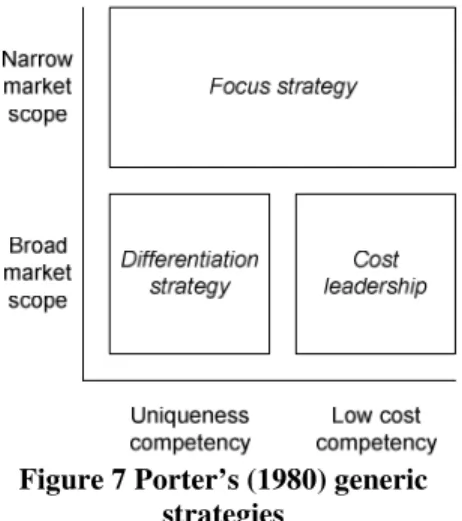
Figure 7 Porter’s (1980) generic strategies ... 20
Figure 8 Four strategic orientations ... 21
Figure 9 Business model concept hierarchy ... 23
Figure 10 Business model framework by Osterwalder (2004) ... 25
Figure 11 The link to strategy ... 26
Figure 12 Business strategy and business model (Osterwalder; 2004) ... 27
Figure 13 Focus of value disciplines... 28
Figure 14 Business model based on customer intimacy ... 30
Figure 15 Business model based on product leadership ... 31
Figure 16 Business model based on operational excellence ... 33
Figure 17 Business model based on supply comfort ... 34
8
List of tables
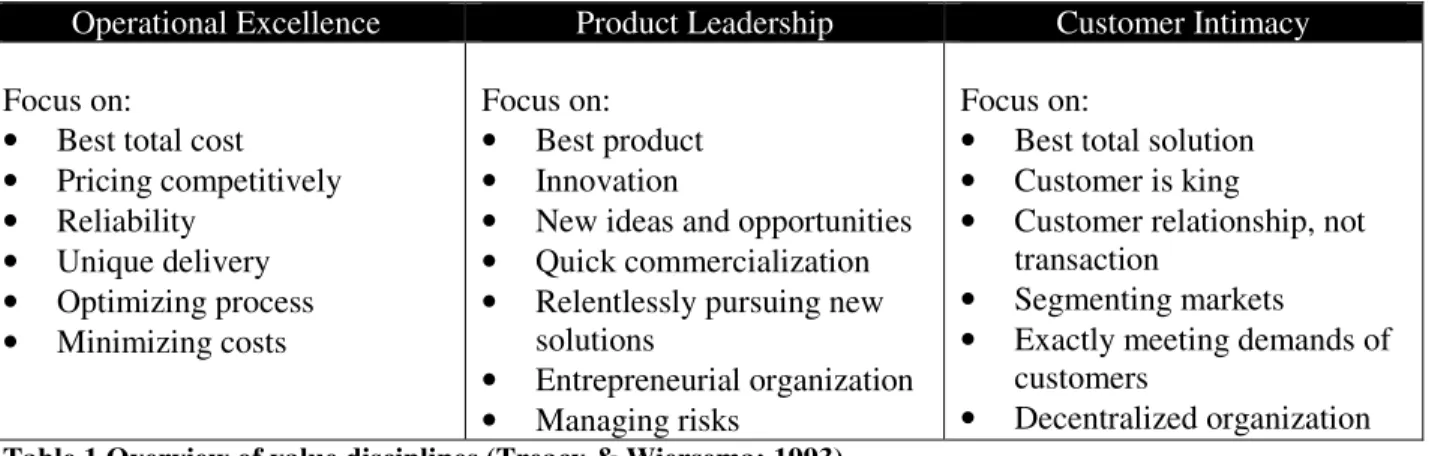
Table 1 Overview of value disciplines (Treacy & Wiersema; 1993) ... 18
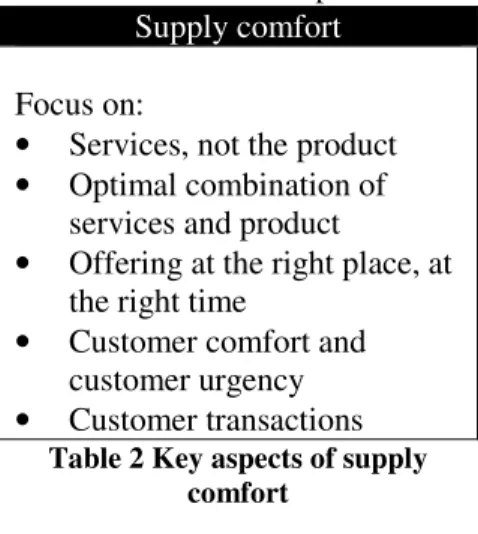
Table 2 Key aspects of supply comfort ... 19
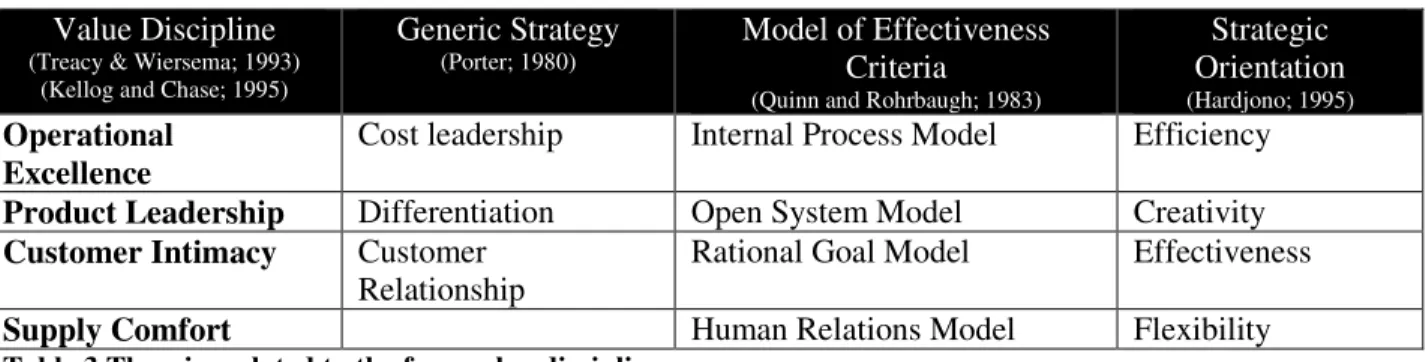
Table 3 Theories related to the four value disciplines ... 21
9
1 Project definition
This project is in partial fulfillment of the requirements for the degree of Master of Science in Innovation Management. It is a research project in the field of entrepreneurship.
Recent developments in the globalization of the market space and in the rise of new economies, such as in China and India, are leading to an increasingly competitive market space. Not only is the number of organizations increasing, but also their ability to operate and compete globally. Companies of all kinds will find themselves in an increasingly fierce competitive environment. Running a business successfully is crucial and requires not only a clear strategy, but also a strategy that focuses on what the company does best.
Companies of all sizes often have an inadequately defined strategy that does not provide a clear direction the company as a whole is heading towards. Sometimes companies do not even have a defined strategy at all.
This common diagnosis of a company’s strategy is also extensively covered in academic literature. Porter (1996; p. 75) wonders: “Why do so many companies fail to have a strategy? Why do managers avoid making strategic choices? Or, having made them in the past, why do managers so often let strategy decay and blur?” He observes how companies find trade-offs frightening; many companies succumb to the temptation to chase “easy” growth by adding hot features, products, or services without screening them or adapting them to their strategy, and how in many companies leadership has degenerated into orchestrating operational improvements and making deals.
This research project is about designing a new method for companies to define a focused strategy that supports them in making trade-offs. Porter (1996; p. 68) defines such a strategy as “the creation of a unique and valuable position, involving a different set of activities. This strategic position is not sustainable unless there are trade-offs with other positions.”
The proposed design method is based on existing academic literature and is tested in practice on case-specific problems.
In the remainder of this chapter the research objectives and questions are defined and an overview of the research methodology used and the report structure is provided.
1.1 Research objectives
A widely recognized theory of coming to a focused strategy is proposed by Treacy and Wiersema (1993) and revolves around value disciplines. The authors define three value disciplines –operational excellence, product leadership, and customer intimacy – and explain that a company’s focus should be on only one. In this research their framework is extended by a fourth value discipline – supply comfort – proposed by Kellogg and Chase (1995).
Another relevant concept in the strategy research field is that of the business model. Where strategy is about what differentiates the company in the eyes of the customers and gives it competitive advantage, the business model describes how the pieces of a business fit together (Harvard Business Essentials; 2005). To come to a truly focused strategy, the pieces of the company have to form a reinforcing fit. Therefore, the business model is a key aspect in designing a focused strategy.
10
The design method proposed in this research is therefore based on both value disciplines and the business model and translates the company’s goals into a focused strategy based on its internal and external environment.
In conclusion, this research has the following key objective:
• To contribute to academic literature by proposing a design method that is based around value disciplines and the business model and which companies can use to become more successful by pursuing a focused strategy.
1.2 Research questions
To effectively approach the research objectives defined in Chapter 1.1, they are further defined into research questions for the purpose of guiding the research project.
1. What are the value disciplines that are the basis for the proposed design method? 2. How do the value disciplines relate to the business model concept?
3. What does the design method look like that can be used by organizations to become more successful by pursuing a more focused strategy?
In the concluding chapter (Chapter 3) of this research report the answers to the research questions are provided.
1.3 Research methodology and report structure
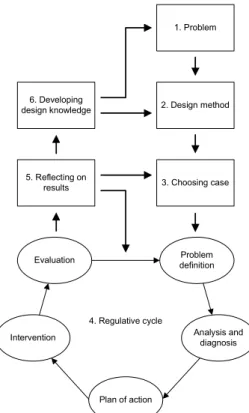
The research project is approached by following a process for the scientific testing of practical propositions, referred to as the reflective cycle (Van Aken; 2004). The reflective cycle consists of six steps. The fourth step, “Planning and implementing interventions”, is replaced by the regulative cycle of Van Strien (1997) that describes the process of this step in greater detail. The steps of the research process used are described below. With each step is described where the information related to that step can be found in the report.
11
1. Problem: earlier on in this chapter a set of distinctions was used to diagnose a class of situations and to define a class of problems. This class of problems is related to companies having an unfocused strategy.
2. Design method: a practical method is defined to provide a general solution to the class of problems. This design method is described in Chapter 2. This design method is based on strategy concepts (Chapter 2.1), value disciplines (Chapter 2.2), and business model concepts (Chapter 2.3). 3. Choose case: the design method has been tested on several
cases.
4. Regulative cycle: to test the cases, regulative cycle has been used.
5. Reflecting on results: in this step, the results of the case are reflected on. This is done in the concluding chapter of this research, Chapter 3.
6. Developing design knowledge: in the final step of the reflective cycle the reflection of the results leads to the development of the design knowledge (in other words, knowledge we can use in designing solutions to the class of problems [Van Aken; 2004]). This design knowledge
may lead to improvements in the method, to alterations in how we diagnose the class of situations, or to changes in the way the problem is defined (Andriessen; 2004). Hence the arrows to previous steps. These results are also shared in the conclusions of this research (Chapter 3).
1. Problem 2. Design method 3. Choosing case 5. Reflecting on results 6. Developing design knowledge Problem definition Analysis and diagnosis Plan of action Intervention Evaluation 4. Regulative cycle
Figure 2 Reflective cycle (Van Aken; 2004) including regulative cycle (Van
12
2 A value discipline-based strategy design method
In this chapter a new design method for defining and refining a company’s strategy is proposed, based on four value disciplines defined by Treacy and Wiersema (1993) and Kellogg and Chase (1995) and on the business model framework by Osterwalder (2004).
First the concept of strategy is explored after which the framework of the four value disciplines is discussed. In order to define a company’s strategy based on these four more generic strategic directions, the concept of business models is introduced. Explored are the effects of a particular value discipline on a company’s business model and the relationships between a business model and strategy. Based on these outcomes, a new process for defining and refining a company’s strategy is proposed.
2.1 Strategy
Strategy provides insights into how a business differentiates itself and what its competitive advantage is. “Strategy is a deliberate search for a plan of action that will develop a business’s competitive advantage and compound it. The differences between you and your competitors are the basis of your advantage“ (Harvard Business Essentials; 2005). Porter (1996) also defines competitive strategy as being different and deliberately choosing a different set of activities to deliver a unique mix of value.
Different kinds of strategies can be distinguished and grouped into a hierarchy that flows from a corporate strategy (intentions concerning the portfolio of a business), to a business strategy (intended positions on specific product-markets), to functional strategies (include marketing strategies, new product development strategies, human resource strategies, financial strategies, legal strategies, supply-chain strategies, and information technology management strategies) (Mintzberg; 2000). Drucker (1954) proposes an additional level of strategy, namely the operational strategy which is very narrow in focus and deals with day-to-day operational activities.
There is an important difference between operational effectiveness and strategy. Whereas operational effectiveness means performing similar activities better than rivals perform them, strategic positioning means performing different activities from rivals’ or performing similar activities in different ways (Porter; 1996). So activities involving tools and techniques such as outsourcing, partnering, benchmarking, and total quality management contribute to operational effectiveness, but are not strategy.
Much has been written about strategy – in business literature as well as academic literature. Mintzberg and Lampel (1999) attempt to provide an overview of the evolution of the field by categorizing it in terms of ten “schools”. These schools represent fundamentally different processes of strategy making, as well as different parts of the same process.
These ten “schools of thought” are grouped into three categories:
• Prescriptive or normative group: consists of the information design and conception school, the formal planning school, and the analytical positioning school (includes such concepts as generic strategic positions, strategic groups, value chains, and game theories).
• Category consisting of schools that are more concerned with how strategic management is actually done rather than prescribing optimal plans or positions. Consists of six schools, namely the
13
entrepreneurial school, cognitive school, learning school, power school, culture school, and environmental school.
• Configuration school: this school represents the third category and is a hybrid of the other schools. It integrates the claims of the other schools and applies them based on the configuration of an organization.
The significant differences between the schools suggest that there is no one right way to create strategy. Mintzberg and Lampel (1999) consider strategy creation to be judgmental designing, intuitive visioning, and emergent learning which can include aspects of different schools. They notice that “the greatest failings of strategic management have occurred when management took one point of view too seriously” (Mintzberg and Lampel; 1999; p. 26).
The strategy creation field has moved from planning, to positioning, to learning as its prominent school out of the ten schools listed above (Mintzberg and Lampel; 1999). Core concepts of these schools are described in the remainder of this chapter.
2.1.1 Strategic management
To gain further insights into strategy, this segment gives an overview of the field that is related to managing it. Strategic management can be defined as “an ongoing process that evaluates and controls the business and the industries in which the company is involved; assesses its competitors and sets goals and strategies to meet all existing and potential competitors; and then reassesses each strategy annually or quarterly (i.e. regularly) to determine how it has been implemented and whether it has succeeded or needs replacement by a new strategy to meet changed circumstances, new technology, new competitors, a new economic environment, or a new social, financial, or political environment.” (Lamb; 1984; p. ix)
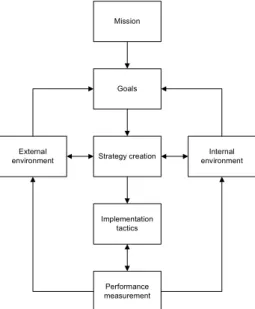
This definition suggests that strategic management can be split into three main processes: strategy creation, implementation, and evaluation. Figure 3 (Harvard Business Essentials; 2005) provides a graphical overview of the strategy process.
The three processes are described in more detail below:
• Strategy creation follows from the mission of the company in which its purpose and what it aims to do for its stakeholders is defined.
Goals as well as strategy creation should be based on the company’s internal and external environment. These environments can be analyzed through conducting a SWOT analysis.
The SWOT analysis is used to identify the key internal (strengths and weaknesses) and external (opportunities and threats) factors that are important to achieving a particular objective. Therefore if a SWOT item generates no strategies relevant to the objective, it is not important.
When evaluating a company’s strengths and weaknesses only those resources and capabilities should be included that would be recognized and valued by the customer. Opportunities and threats only
Mission Goals Strategy creation Implementation tactics Performance measurement Internal environment External environment
Figure 3 The strategy process (Harvard Business Essentials; 2005)
14
exist in the outside world, the things a company proposes to do about them are its strategies (Piercy & Giles; 1989).
The SWOT analysis should not only be used during strategy creation, but a company should always go back and see how the new situation it is building changes the SWOT model.
The overarching company strategy can be translated into implementation tactics (which is the next step, as shown in Figure 3). To obtain optimal results, operating units should be involved when defining implementation tactics (Harvard Business Essentials; 2005).
The final step in the strategy process is performance measurement (see Figure 3). Based on measuring performance, the perception of the company’s internal and external environment is adapted which could have consequences for the company’s goals and strategies. Performance measurement influences the implementation tactics as well.
• Strategy implementation: Strategy creation is about doing the right things, strategy implementation is about doing things right (Harvard Business Essentials; 2005). A popular implementation method is the strategy map and the balanced scorecard (Kaplan & Norton; 1996). By 2004 an estimated 57% of global companies use the method (Balanced Scorecard Institute; 2009).
• Strategy evaluation: strategy is developed and evolves over time to meet the changing conditions posed by the external environment and internal capabilities (Kaplan & Norton; 2004). Therefore it requires evaluation which involves measuring the effectiveness of the organizational strategy. Johnson et al. (2008) propose three key success criteria that can be used to assess the viability of strategic options:
o Suitability: relates to whether the strategic option fits with the strategic direction or value
discipline chosen.
o Acceptability: is concerned with the expected performance outcomes and whether they are
aligned with the expectations of stakeholders.
o Feasibility: is concerned with whether the company has the capabilities to make the strategy work
in practice.
2.1.2 Strategic focus
Various authors in academic literature denote the importance of a focused strategy. The essence of strategy is choosing what to but also what not to do (Porter; 1996). Focus helps companies to create a unique mix of value which makes it different from its competitors (Porter; 1979). The more an organization has the discipline to stay within its area of focus, with almost religious consistency, the more it will have opportunities for growth (Collins; 2001).
Not having a focused value proposition but trying to be all things to all customers confuses employees in their day-to-day operations because they have to make decisions without a clear framework (Porter; 1996). It creates a company that does not go into any direction at all and that gets surpassed on all sides by competitors who do focus and provide customers with a more appealing value proposition.
Academic literature proposes various ways of bringing focus into a company’s strategy. Porter (1980) in his early work proposes generic strategies – cost leadership, differentiation, and focus – to represent the
15
alternative strategic positions. Porter (1996) proposes further bases for positioning by distinguishing varieties based, needs based, and access based positions. Treacy and Wiersema (1993) propose similar concepts, referred to as value disciplines, namely operational excellence, customer intimacy, and product leadership. These concepts and the reasons for including them in this research are described in more detail in Chapter 2.2. Prahalad and Hamel (1990) propose that companies should focus on what their core competencies are, described in more detail in Chapter 2.1.4.
2.1.3 Strategic fit
Not only focus (as discussed above) but also fit is a key aspect of strategy. Both aspects are interrelated in that if the activities of a company fit with each other, the company’s direction becomes even more focused. Therefore the most valuable fit is strategy-specific because it enhances a position’s uniqueness and amplifies trade-offs (Porter; 1996). This enhanced a company’s competitive advantage since it will be much harder for the competition to imitate its strategy. The strategy namely involves an entire system of activities, and fit amongst these activities creates a chain that is as strong as its strongest link (Porter; 1996).
When activities fit, it means they do not contradict each other. Porter (1996) defines three different kinds of fit. First-order fit involves simple consistency between each activity and the overall strategy. Second-order fit occurs when activities are reinforcing each other. Third-Second-order fit is referred to as optimization of effort which goes beyond activity reinforcement. These types of fit are not mutually exclusive.
2.1.4 Core competencies
A concept related to strategic focus and fit is that of core competencies, described by Prahalad and Hamel (1990). A core competency is defined as a competence that should provide potential access to a wide variety of markets, should make a significant contribution to the perceived customer benefits of the end product, and should be difficult for competitors to imitate. It’s a particular strength relative to other organizations in the industry which provides the fundamental basis for the provision of added value. Examples are Sony’s capacity to miniaturize, Philips’s optical-media expertise, and Honda’s ability to build engines and power trains.
Many authors emphasize the importance of core competencies. Since it is the bases for providing added value they should be developed continuously. Therefore a company should be focusing on and creating a reinforcing fit around developing its core competencies (Osterwalder; 2005).
2.1.5 Organizational growth
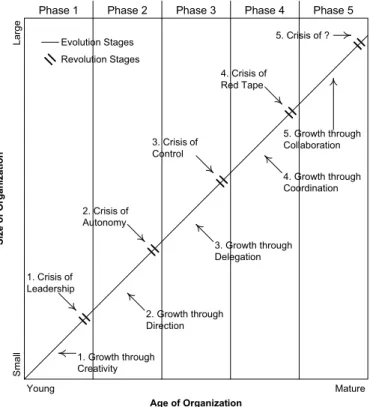
As a company grows, its strengths, weaknesses, opportunities and threats change (Figure 10). Therefore its strategy has to be adapted to the new situation. Greiner (1972) proposes a model that describes the growth of an organization and identifies moments in an organization’s life (referred to as a revolution or crisis) that require a change in management style. A graphic overview is provided in Figure 4. The phases between revolutions are characterized by a dominant management style and are referred to as evolutions.
16 Greiner (1972) distinguishes five phases of
evolution. In order to grow into the next phase, a revolutionary period has to be overcome that is characterized by a dominant management problem that must be solved. The first phase is the creativity phase. As the organization grows the founders are not capable of managing it themselves anymore which leads to a leadership crisis. By hiring strong management to lead the organization, it enters the direction phase which leads to a crisis of autonomy since a centralized hierarchy is not appropriate anymore for controlling a larger, more diverse and complex organization. By delegating and decentralizing, the organization enters the delegation phase. This phase ends with a control crisis that can be overcome by implementing more formal management systems. The coordination phase has been entered. A red tape crisis will occur when the organization has become too large to be managed by formal management systems where bureaucratic procedures take
precedence over problem solving. The fifth and final phase is driven by collaboration, where social control and self-discipline take over from formal control.
A company has to adapt its strategy based on the phase it finds itself in. Only if the strategy fits the organizational situation the crises can be overcome and the organization can continue to grow (Greiner; 1972).
2.2 Value disciplines
Because of the importance of a focused strategy, the concept of value disciplines, introduced by Treacy and Wiersema (1993), is further explored in this segment. Value disciplines can be considered as generic strategic directions that define the overall focus of an organization’s strategy. Based on the value discipline an organization is pursuing, its strategy can be defined in more detail.
2.2.1 The three value disciplines by Treacy and Wiersema (1993)
Treacy and Wiersema (1993) introduce the concept of value disciplines. They distinguish three value disciplines, namely operational excellence, customer intimacy, and product leadership. Only one value discipline should be picked and vigorously pursued while meeting industry standards in the other two to avoid a focus that is too strong.
By doing this, the business focus of a company is being narrowed. This is something that companies that have taken leadership in their industries in the last decade typically have done. It creates a sustainable competitive advantage which makes it harder for the competition to catch up. Therefore, the key to gaining and sustaining value leadership is focus.
Phase 5 Phase 4 Phase 3 Phase 2 Phase 1 Mature Young Age of Organization S m a ll L a rg e S ize o f Or g a n iza tio n Evolution Stages Revolution Stages 1. Growth through Creativity 2. Growth through Direction 3. Growth through Delegation 4. Growth through Coordination 5. Growth through Collaboration 1. Crisis of Leadership 2. Crisis of Autonomy 3. Crisis of Control 4. Crisis of Red Tape 5. Crisis of ?
17
As is explained in Chapter 2.2.1 the value disciplines of Treacy and Wiersema (1993) show many similarities to Porter’s (1980) three generic strategies. The reason for building on the value disciplines in this study is that they are a more recent contribution to academic knowledge compared to Porter’s (1980) three generic strategies which date back to 1980. Furthermore the value disciplines of Treacy and Wiersema (1993) are widely acknowledged in academic literature.
The three value disciplines are described below. For each value discipline an example is given.
• Operational excellence: this value discipline focuses on optimizing the production and delivery of products and services. This results in products and services that are reliable as well as competitively priced and delivered with minimal difficulty or inconvenience (Treacy & Wiersema; 1993).
Toyota focuses on operational excellence. In its management philosophy, the Toyota Way, that is the source for its competitive advantage, principles related to eliminate waste, to get it right the first time, and to improve continuously are emphasized (Liker; 2004).
• Product leadership: a product leader focuses on offering leading-edge products and services to customers that consistently enhance the customer’s use or application of the product, thereby making rivals’ goods obsolete. To be a product leader, companies face three challenges. First, they must be creative and open-minded to new ideas and opportunities that usually originate outside the company. Second, they must be quick in commercializing their ideas. This asks for the company to be organized like a small, entrepreneurial company. And third, they must relentlessly pursue new solutions to the problems that their own latest product or service has just solved. Product leaders are their own fiercest competitors (Treacy & Wiersema; 1993).
An example is Apple Computer Inc. Apple is open-minded to new ideas (such as entering the music industry with its iPod and the mobile phone industry with its iPhone), brings these ideas to market quickly, and cannibalizes its own products (by replacing their industry leading products with even more advanced products).
• Customer intimacy: companies focused on customer intimacy segment their target markets precisely and then tailor their offerings to closely match the demands of those niches. It’s not about the profit or loss of a single transaction but about the profit over the lifetime of the relationship with a single customer. This makes customer satisfaction crucial. Such a company’s organization structure is decentralized so that it empowers the people that are working close to the customers (Treacy & Wiersema; 1993).
A well-known example is Dell. Through its website customers have the possibility to fully customize their computer they are about to buy so that it matches their needs.
18
Operational Excellence Product Leadership Customer Intimacy
Focus on:
• Best total cost • Pricing competitively • Reliability • Unique delivery • Optimizing process • Minimizing costs Focus on: • Best product • Innovation
• New ideas and opportunities • Quick commercialization • Relentlessly pursuing new
solutions
• Entrepreneurial organization • Managing risks
Focus on:
• Best total solution • Customer is king
• Customer relationship, not transaction
• Segmenting markets
• Exactly meeting demands of customers
• Decentralized organization Table 1 Overview of value disciplines (Treacy & Wiersema; 1993)
2.2.2 Fourth value discipline: supply comfort
Although the three value disciplines proposed by Treacy and Wiersema (1993) seem to adequately cover the major strategic positions a company can focus on, the framework for organizational analysis proposed by Quinn and Rohrbaugh (1983) suggests the consideration of a fourth value discipline.
The framework for organizational analysis proposed by Quinn and Rohrbaugh (1983) is based around the concept of three value dimensions that underlie conceptualizations of organizational effectiveness. These value dimensions are:
• Focus: organizational focus can either be internal or external.
• Structure: organizational structure can either be flexible or stable, considering innovation and change versus order and control.
• Means and ends: with means there is an emphasis on important processes (i.e. planning and goal setting) and with ends on final outcomes (i.e. productivity).
The value disciplines proposed by Treacy and Wiersema (1993) apply to the value dimensions of focus and structure as shown in Figure 5. With operational excellence the organization focuses on its internal processes and on control in order to optimize these processes. An organization pursuing customer intimacy has an external look so it can identify and segment its markets and exactly meet the demands of these markets. This requires control in the sense of understanding its target markets. Product leaders focus on opportunities and ideas that are usually outside the organization which requires an external focus. Flexibility is required to quickly commercialize these opportunities and ideas.
From Figure 5 can be noted that a value discipline that has an internal focus and a focus on flexibility is not defined.
As is the case for operational excellence the fourth value discipline is focused internally, but in this case the focus is not
Figure 5 Value disciplines of Treacy and Wiersema (1993)
19
related to making products in the most efficient way. The fourth value discipline also focuses on flexibility but not on delivering the best product like product leadership. Therefore the fourth value discipline is not so much about the product but about the configuration of services around the product. A company pursuing the fourth value discipline is focused
internally on being flexible when it comes to configuring an optimal combination of services around an averagely priced averagely performing product they offer. This combination of services is offered at the right place, at the right time.
Therefore the focus lies on customers who seek comfort and customers who feel urgency. These customers engage into relationships with the company that are purely transactional which means that even if customers have been helped and are satisfied, they might not return for a long time or at all (as opposed to customer intimacy where customers engage into a long-term relationship with the company).
An overview of the aspects of the comfort supply value discipline mentioned above is provided in Table 2).
Kellogg and Chase (1995) explore this value discipline and refer to it as the supply comfort model. Another reference from academic literature comes from Schneider (1994) who points out the existence of a fourth value discipline and refers to it as enrichment. Even though this term deviates from the term used by Kellogg and Chase (1995), it covers the same concept (Gerstberger; 2007).
Customer contact, which is defined as the interface between the customer and the service provider (Soteriou & Chase; 1998), is a key concept of supply comfort (Scheer & Loos; 2002) since the focus of this value discipline lies on the services that are provided with the product. Kellog and Chase (1995) propose a model to measure customer contact consisting of three variables: communication, intimacy, and time. Soteriou and Chase (1998) propose a model that link customer contact to perceived service quality. They expressed service quality through five dimensions: reliability, tangibles, responsiveness, assurance, and empathy.
An example of a company pursuing supply comfort is Zipcar. Zipcar is an innovative membership-based car rental company. It provides automobile rental to its members. Zipcar does not offer a competitive price for its cars, nor
does it offer a large choice of rental cars. Still, Zipcar is a huge success, not because of the product it offers, but because of the service it provides. Members can rent a car by the hour, conveniently over the internet, iPhone, or telephone. Zipcars are conveniently parked all over big cities in the States so that there is always a car near the location of the renter. Over the internet, the renter can locate the car, based on Google Maps, it would like to rent. After the renter reserved a particular car for a particular timeslot, he/she can conveniently open the car with the credit card (called Zipcard) the renter received when he/she became a member. Gas and insurance are already included in the hourly rate of the car to make the renter’s experience even more convenient.
All four value disciplines are shown in Figure 6.
Supply comfort
Focus on:
• Services, not the product • Optimal combination of
services and product
• Offering at the right place, at the right time
• Customer comfort and customer urgency • Customer transactions
Table 2 Key aspects of supply comfort
20 2.2.3 Theories related to the four value disciplines
Various theories are related to the four value disciplines and provide deeper insights into them. These theories are described below. An overview of how these theories relate to the four value disciplines is given in Table 3.
2.2.3.1 Generic strategies Porter (1980)
Porter (1980) distinguishes three different strategies, namely cost leadership, differentiation, and focus. Porter proposes that one of these three generic strategies has to be pursued in order to maintain a competitive advantage (Porter; 1980). Porter’s (1980) three generic strategies are strongly related to Treacy and Wiersema’s (1993) three value disciplines as explained below.
The three generic strategies can be outlined in a schema that includes market scope (that can either be narrow or broad) and competency (distinguished are low cost and uniqueness). The schema is shown in Figure 7 and the three generic strategies are described in more detail below.
• Cost leadership strategy: this strategy is related to the operational effectiveness value discipline and emphasizes efficiency. The key to using the low-cost strategy is to deliver the customer’s expected level of value at a cost that assures an adequate level of profitability (Harvard Business Essentials; 2005). Companies that successfully pursue a differentiation strategy usually have a broad market scope.
• Differentiation strategy: the differentiation strategy is related
to the product leadership value discipline. It is aimed at a broad market and is about developing a product or service that is perceived throughout the respective industry as unique. Differentiation only matters to the extent that customers value the difference. If this is the case they will select your offering over those of others and/or are willing to pay a premium price for what you offer (Harvard Business Essentials; 2005).
• Focus strategy: this strategy is related to the customer intimacy value discipline and is also called segmentation strategy or niche strategy. It is about focusing on a select few target markets and tailoring your offering to the specific needs of those markets (Harvard Business Essentials; 2005). Because of this narrow market focus the company is less vulnerable to competition.
2.2.3.2 Models of effectiveness criteria Quinn and Rohrbaugh (1983)
Quinn and Rohrbaugh (1983) propose four models of effectiveness criteria based on the value dimensions as shown in Figure 5, namely: the human relations model (flexibility and internal focus), the open system model (flexibility and external focus), the internal process model (control and internal focus), and the rational goal model (control and external focus).
Note that the human relations model is focused internally, therefore it refers to cohesion and morale of employees as well as human resource development (Quinn and Rohrbaugh; 1983).
Figure 7 Porter’s (1980) generic strategies
21
These four models are related to the four value disciplines because they are based on the same value dimensions.
2.2.3.3 Strategic orientations Hardjono (1995)
Hardjono (1995) proposes a model to analyze the present organization and to determine what the organizational control points and interventions must be in relation to its strategy. This model is called the Four-Phase Model.
The Four-Phase Model is based on a two dimensional orientation layer. The four organizational orientations – external orientation, internal orientation, orientation on control, and orientation on change – are based on the value dimensions proposed by Quinn and Rohrbaugh (1983) (except they refer to change as flexibility) (see Chapter 2.2.2). Therefore the organizational orientations are also related to the four value disciplines.
Based on the four organizational orientations, four
strategic orientations are defined. A market orientation is directed towards increasing effectiveness, a productivity orientation is directed towards increasing efficiency, an orientation towards making organizations lean is directed at increasing flexibility, and an orientation towards innovativeness is aimed at the creativity of an organization (Hardjono; 1995). Based on these four strategic orientations, guidelines for a program of organizational change are provided but are not further relevant to this research. They could be relevant for future research, as described in Chapter 3.4. Therefore more information about the Four-Phase Model is provided in Appendix 5.1.
In addition, Hardjono (1995) identifies four core competencies, namely the material competency, the commercial competency, the socialization competency, and the intellectual competency. In Chapter 2.6 the relationships between these four core competencies and the strategy creation process are described.
Value Discipline (Treacy & Wiersema; 1993)
(Kellog and Chase; 1995)
Generic Strategy (Porter; 1980)
Model of Effectiveness Criteria
(Quinn and Rohrbaugh; 1983)
Strategic Orientation (Hardjono; 1995)
Operational Excellence
Cost leadership Internal Process Model Efficiency Product Leadership Differentiation Open System Model Creativity Customer Intimacy Customer
Relationship
Rational Goal Model Effectiveness
Supply Comfort Human Relations Model Flexibility
Table 3 Theories related to the four value disciplines
Table 3 provides an overview of the theories related to each of the value disciplines. Whereas the definition of the generic strategies by Porter (1980) are closely related to the value disciplines, the other theories are related to the value disciplines in that they are based on the same value dimensions.
The related theories provide further insights into the focus of each of the value disciplines. These insights are used as the value disciplines are integrated into the proposed design method (Chapter 2.5 and Chapter 2.6).
22 2.3 Business model
A business model is related to strategy, but it is not the same thing. Business models describe how the pieces of a business fit together but does not factor in competition. That’s where strategy comes in (Magretta; 2002). Because a business model is strongly related to strategy, it is explored in more detail in this segment. The relationship between a business model and a strategy is described in more detail in the first part of Chapter 2.5.
2.3.1 Business model definitions
Over the past few years the concept of business models gained significantly in popularity, especially in the mid 1990’s when “dot-com” firms pitched business models to attract funding. Since then businesses in general started to rely increasingly on the concept. For example, approximately 27% of the Fortune 500 firms used the term in their 2001 annual reports (Shafer et al.; 2005).
The main conclusion that can be drawn about how academic as well as business literature defines the concept of a business model is that definitions and proposed components of a business model vary greatly and that business models are still relatively poorly understood (Linder and Cantrell; 2000).
In research from Osterwalder et al. (2005) participants were asked to give a definition of what they understand is a business model. Answers from 62 respondents resulted in 54 different definitions. 55% of the responses were related to a more value/customer-oriented approach while the other 45% leaned more towards an activity/role-related approach.
As therefore a clear definition of the concept cannot be given here, an overview of some of the most prominent definitions in academic literature is provided and conclusions are drawn.
Magretta (2002) writes that business models are stories that explain how enterprises work. She describes a business model as some variation of the value chain that supports every business. This value chain has two parts, namely one that includes all the activities associated with making something and another that includes all the activities associated with selling something.
Osterwalder et al. (2005; p. 3) define the term business model based on the separate meanings of the term “business” and “model” which lead them to defining a business model as “a conceptual tool containing a set of objects, concepts and their relationships with the objective to express the business logic of a specific firm. Therefore we must consider which concepts and relationships allow a simplified description and representation of what value is provided to customers, how this is done and with which financial consequences.”
Chesbrough and Rosenbloom (2002; p. 532) consider a business model to be “a description of how your company intends to create value in the marketplace. It includes that unique combination of products, services image, and distribution that your company carries forward, it also includes the underlying organization of people, and the operational infrastructure that they use to accomplish their work.”
Morris et al. (2003) conducted research on definitions of business models as well and defined three categories in which these definitions fall. They are labeled economic, operational, and strategic. Based on these definitions and the categories identified, they give their definition of a business model, which is: “a concise representation of how an interrelated set of decision variables in the areas of venture strategy,
23
architecture, and economics are addressed to create sustainable competitive advantage in the defined markets” (Morris et al.; 2003; p. 727).
Based on 12 definitions proposed by academic literature Shafer et al. (2005; p. 202) define a business model as “a representation of a firm’s underlying core logic and strategic choices for creating and capturing value within a value network.”
The essence of these definitions all seem to evolve around “how you get paid” or “how you make money” (Chesbrough & Rosenbloom; 2002) or “What is the underlying economic logic that explains how we can deliver value to customers at an appropriate cost?” (Magretta; 2002; p. 4). Based around this core concept the various definitions connect components to it in order to specify the business model concept in more detail. Below both definition and components of the business model are placed in a hierarchy that provides a complete view of the various ways to think about a business model.
2.3.2 Business model concept hierarchy
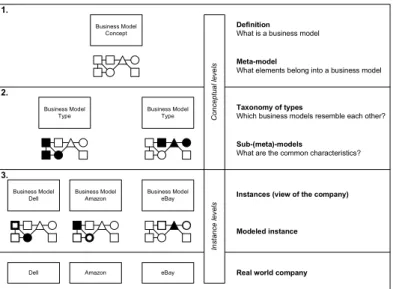
When people mention business models they often refer to various things, such as parts of a business model, types of business models, real word business models, or concepts. Osterwalder et at. (2005) provide a hierarchy (Figure 9) that attempts to clarify the different ways people think and write about business models. In this hierarchy, three categories can be distinguished as outlined below.
1. Authors that propose overarching definitions of the business model concept as well as the elements that belong into a business model. An overview of these overarching definitions is given in Chapter 2.3.1. In Chapter 2.3.3 insights are given into the elements of a business model that various authors propose.
2. Authors proposing abstract types of business models as a way to categorize businesses with common characteristics. Various authors propose ways to categorize business models. For example, Timmers (1998) based architectures for business models on value chain de-construction
and re-construction to come to 11 possible architectures of e-business models. Chesborough (2006) distinguishes open and closed business models. With a more open business model, open innovation offers the prospect of lower costs for innovation, faster times to market, and the chance to share risks with others. Below further examples of more general categories to distinguish business models are given:
o Subscription business model: rather than selling products individually, a subscription sells
periodic use or access to a product or service.
Business Model Concept Business Model Type Business Model Type Business Model Amazon Business Model Dell eBay Amazon Dell Business Model eBay Definition
What is a business model
Meta-model
What elements belong into a business model
Taxonomy of types
Which business models resemble each other?
Sub-(meta)-models
What are the common characteristics?
Instances (view of the company)
Modeled instance
Real world company
C o n c e p tu a l le v e ls In s ta n c e l e v e ls 1. 2. 3.
24
o Razor and blades business model: the concept of either giving away a sellable item for nothing or
charging extremely little in order to generate a continual market for another, generally disposable, item.
3. Authors describing the business models of real world companies. Frequently cited models in academic literature are those from Dell, Nucor, Wal-Mart, IKEA, and Walgreens (Morris et al.; 2003). For example, the model Dell created is well known: while other personal-computer makers sold through resellers, Dell sold directly to end customers. That not only cut out a costly link from the value chain but also gave Dell the information necessary to manage inventory better than any of its competitors (Magretta; 2002).
2.3.3 Business model components and frameworks
Not only is the diversity in available definitions of the business model concept vast, so are the unique building blocks or elements proposed by different authors a business model consists of.
A business model framework widely referred to is proposed by Chesbrough and Rosenbloom (2002) and is based on 35 case studies. It consists of six different functions. These functions are: to articulate the value proposition, to identify a market segment, to define the structure of the value chain, to estimate the cost structure and profit potential of producing the offering, to describe the position of the firm within the value network, and to formulate a competitive strategy.
Many other authors have proposed similar frameworks which lead to research analyzing and comparing these various perspectives. Based on those results further frameworks are proposed. Insights into this research and the frameworks it resulted in, are discussed below.
Shafer et al. (2005) found 42 different business model components based on 12 definitions. Based on the number of times these components appear in the definitions, four major categories of business model components are proposed: strategic choices, creating value, capturing value, and the value network. Taken together, these four categories contain a total of 20 business model components.
A similar kind of research was conducted by Morris et al. (2003) who compared 19 frameworks proposed by different academic sources (including the framework by Chesbrough and Rosenbloom [2002] described above) in order to come to consensus on the key components of a business model. A total of 24 different items are mentioned as possible components, with 15 receiving multiple mentions. Based on this analysis an integrative framework is proposed consisting of six key questions a well-formulated model must address. These questions are: how do we create value? Who do we create value for? What is our source of competence? How do we competitively position ourselves? How do we make money? What are our time, scope, and size ambitions?
The research by Osterwalder (2004) analyses the business model contributions of 14 authors. From this analysis, a new model consisting of nine building blocks is constructed that covers all business model components mentioned by at least two authors.
The business model framework by Chesbrough and Rosenbloom (2002) mentioned earlier is also analyzed in the research by Osterwalder (2004). He concluded the business model misses critical components, namely distribution channel, customer interface, capability, and revenue model.
The aim of the research by Osterwalder (2004) was not only to propose a business model that integrates existing work but also to conceptualize every single element and subsequently integrate them into a whole.
25
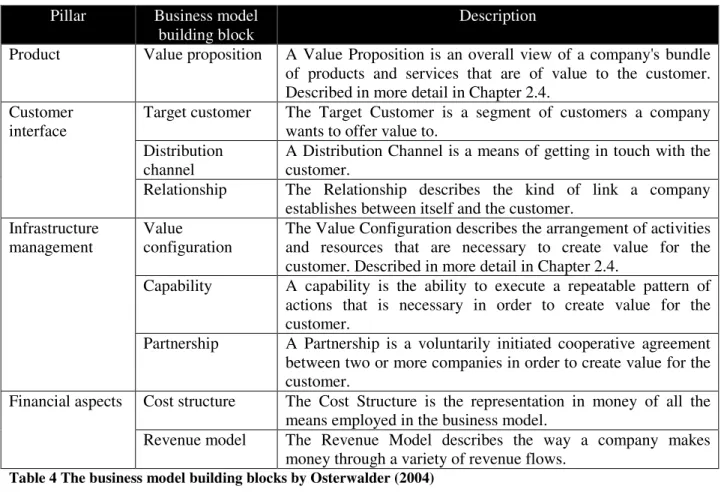
His business model framework is based on four pillars that are divided into nine building blocks. Table 4 describes the business model ontology in more detail, while Figure 10 visualizes the model.
Pillar Business model
building block
Description
Product Value proposition A Value Proposition is an overall view of a company's bundle of products and services that are of value to the customer. Described in more detail in Chapter 2.4.
Customer interface
Target customer The Target Customer is a segment of customers a company wants to offer value to.
Distribution channel
A Distribution Channel is a means of getting in touch with the customer.
Relationship The Relationship describes the kind of link a company establishes between itself and the customer.
Infrastructure management
Value configuration
The Value Configuration describes the arrangement of activities and resources that are necessary to create value for the customer. Described in more detail in Chapter 2.4.
Capability A capability is the ability to execute a repeatable pattern of actions that is necessary in order to create value for the customer.
Partnership A Partnership is a voluntarily initiated cooperative agreement between two or more companies in order to create value for the customer.
Financial aspects Cost structure The Cost Structure is the representation in money of all the means employed in the business model.
Revenue model The Revenue Model describes the way a company makes money through a variety of revenue flows.
Table 4 The business model building blocks by Osterwalder (2004)
Capability Partnership Value configuration Infrastructure management Value proposition Relationship Distribution channel Customer Customer interface Product Cost Revenue Financial aspects
Figure 10 Business model framework by Osterwalder (2004)
This research builds on the business model framework of Osterwalder (2004) since it describes the business model concept in great detail and is a more recent contribution to academic literature. It builds
26
on a number of well established studies that are also used to validate the elements his business model framework consists of. Osterwalder (2004) furthermore explicitly linked the business model framework to strategy – one of the key concepts in this research – in that its four pillars can be compared to the four perspectives of Kaplan and Norton’s Balanced Scorecard approach for implementing strategy (Kaplan & Norton; 1992) and to Markides’ business strategy recipe (Markides; 1999).
The Balanced Scorecard approach was mentioned in Chapter 2.1.1. Markides (1999) defines strategy as looking at the “who”, the “what”, and the “how” of a business.
Figure 11 gives an overview.
Business model pillar (Osterwalder et al.; 2005)
Balanced Scorecard (Kaplan & Norton; 1992)
Business strategy recipe (Markides; 1999)
Product Innovation and learning
perspective
What?
Customer interface Customer perspective Who?
Infrastructure management Internal business perspective How? Financial aspects Financial perspective
Figure 11 The link to strategy
2.4 Aspects of value
Value is a central concept in the business model and strategy literature. For reasons of clarification an overview of the key aspects of value in this field of research is listed below.
• Value capturing: capturing value by looking at the market and finding ways to capture value and to generate profit (Shafer et al.; 2005).
• Value chain: first described and popularized by Porter (1980). A value chain is a sequence of activities. Products go through the value chain and each activity adds value to the product. The chain of activities gives the products more added value than the sum of added values of all activities. Porter (1980) proposes a framework that categorizes the generic value-adding activities of an organization. The primary activities include: inbound logistics, operations, outbound logistics, marketing and sales, and services. The support activities include: administrative infrastructure management, human resource management, information technology, and procurement. Organizations can use this framework by determining the value they add at each of these activities.
• Value configuration: the value configuration is part of the business model framework of Osterwalder (2004) and is based on Porter’s (1980) value chain.
• Value creation: refers to value that is created by organizational members (Bowman & Ambrosini; 2000). From success within the organization, firms can create substantial value by doing things in ways that differentiate them from the competition. Value can be created by developing core competencies (described in Chapter 2.1.4), capabilities, and positional advantages that are different from those of competitors (Shafer et al.; 2005).
• Value dimension: Quinn and Rohrbaugh (1983) introduce the concept of value dimensions that underlie conceptualizations of organizational effectiveness. Described in more detail in Chapter 2.2.1. • Value discipline: the concept of value disciplines, introduced by Treacy and Wiersema (1993), has
27
• Value network: a value network generates economic value through complex dynamic exchanges including customers, suppliers, partners, distribution channels, coalitions and the community. Through the value network the company’s own resources are extended (Allee; 2000) (Shafer et al.; 2005).
• Value proposition: Kaplan & Norton (2004, p. 40) define the value proposition as “the company’s strategy for the customer by describing the unique mix of product, price, service, relationship, and image that a company offers its targeted group of customers. The value proposition should communicate what the company expects to do for its customers better or differently than its competitors.” It is the core of any business strategy (Kaplan & Norton; 2000). Osterwalder (2004) refers in his business model framework (Chapter 2.3.3) to the value proposition.
2.5 Value discipline-based business model framework As noted earlier, a company’s business model and
strategy are related to each other. The difference is that the business model is more about the mechanisms through which a company produces and delivers a product or service, whereas the strategy is about what differentiates it in the eyes of customers and gives it competitive advantage (Harvard Business Essentials; 2005).
Osterwalder (2004) considers the business model to be the strategy’s implementation into a conceptual blueprint of the company’s money earning logic. It translates the company’s mission and strategy (as shown in Figure 3) into value propositions, customer relations and value
networks. Figure 12 provides an overview of the dynamics between strategy and business model.
In this segment a value discipline-based business model is proposed that defines detailed relationships between business model and strategy by linking the four value disciplines discussed in Chapter 2.2 to the business model framework of Osterwalder (2004). Basing the components of the business model framework on a specific value discipline creates not only focus but also fit amongst the business model components.
Since each value discipline is based on different value dimensions (Figure 6) each value discipline focuses on different parts of the business model framework. To identify relationships across models, the value dimension that defines internal focus relates to business model building blocks that are grouped under infrastructure management. Both of these concepts are about creating value. A focus on capturing value relates to a focus on the external value dimension and a focus on the customer interface side of the business model framework. As noted earlier (Chapter 2.2.1) and in Chapter 2.7, if for example an organization focuses on value creation, based on the value discipline it is pursuing, it does not mean it should ignore the value capturing aspect of its business. Capturing value is crucial, too, but in this case the focus lies on creating value.
Figure 12 Business strategy and business model (Osterwalder; 2004)
28
Not only can be distinguished whether the value disciplines focus on either value creation or value capturing, the focus of a value discipline can even be further defined by linking it to a specific business model building block. Figure 13 provides an overview. The focus of a value discipline on a specific building block affects all other business model building blocks. The focus of each building block changes according to the value discipline applied to the business model, which results in a strong focus on the aspects of the particular value discipline that really matter and in a strong fit amongst business model building blocks. Focus and fit, as noted earlier, are key aspects of strategy.
In the following sections the building blocks on which the value
disciplines focus are defined in more detail and the four value discipline-based business model frameworks are proposed. These sections are primarily based on the research of Treacy and Wiersema (1993).
2.5.1 Customer intimacy
The customer intimacy value discipline is externally orientated which means it is focused on the value capturing side of the business model. In order to best understand the needs of the target market so that products and services can be adapted accordingly and to create long-term relationships with customers, the focus lies on the relationship building block of the business model. A strong relation with the customer is crucial to successfully pursue this value discipline.
It adds to the strong relationship if there are as few different company representatives as possible that interact with the customer in order to build a more meaningful and personal relationship between the customer and the company. These representatives have to get in touch with the company relatively frequently to ensure the customer is satisfied.
To closely manage the relationship with its customers, a customer relationship management (CRM) system is beneficial in which all interactions with the customer are registered. This way, the company has detailed information about its customers’ backgrounds.
Therefore this building block affects all other building blocks. All of the remaining building blocks should contribute to strengthening the relationship with the customer which creates a strong fit in the business model. The focus of each business model building block is influenced by the importance of the relationship with the customer and is defined below:
• Value proposition: the focus should lie on providing the customer not just with a product but with a solution that closely meets the demands of the customer. Therefore products have to be customized to the specific customer segments. It is the relationship that matters. The company creates a relationship with the customer, makes sure the customer is satisfied and thinks with the customer to solve its problems with the goal for both company and customer to succeed.
• Target customer: in order to be able to fully understand the needs and requirements of the target customers, they have to be carefully segmented. Key is to target a market that is not too broad since it will then be more difficult for the company to tailor is offerings to the specific customer requirements. • Distribution channel: since the focus lies on the relationship with the customer, the company has to
get in touch with the customer in a more personal way. An ad in a paper will be relatively less Figure 13 Focus of value disciplines