A Two Factor Theory for Website Design
Ping Zhang
School of Information Studies
Syracuse University
Email:
[email protected]
Gisela M. von Dran
School of Management
Syracuse University
Email:
[email protected]
Ruth V. Small
School of Information Studies
Syracuse University
Email:
[email protected]
Silvia Barcellos
School of Information Studies
Syracuse University
Email:
[email protected]
Abstract
This study was designed to verify whether an analogy to Herzberg’s hygiene-motivational theory about workplace could be used in the web environment. According to this analogy, the presence of hygiene factors would provide the basic functionality of a website, while their absence would create user dissatisfaction. Motivating factors are those that contribute to user satisfaction. They add additional value and may entice users to keep returning to a website. In Phase I, we identified 44 core features in the web environment that were classified into 12 categories by subjects. In Phase II, a different group of subjects in a pilot study were asked to distinguish between the hygiene and motivational characteristics of these features and categories. The preliminary results show that 4 categories and 14 features were judged to be primarily motivational, while 3 categories and 13 features were perceived to be primarily hygiene in nature. The remaining 5 categories and 17 features were perceived to be both.
1. Introduction
The availability of rapidly changing technological advancements and capabilities simultaneously challenges and frustrates website designers. They face increasingly difficult decisions to choose between an array of features that can make their sites more stimulating, visually pleasing, comprehensive, and commercially viable. The need to capture and hold the attention of users who surf the web for a multitude of purposes, ranging from pure entertainment to highly competitive electronic commerce, increases the urgency to present information and merchandise creatively as well as functionally. Although there are many opinions and heuristics, few studies have provided theoretical frameworks and empirical evidences
on the nature of the design features and how to use them. This study took a theoretical perspective and was intended to be a systematic investigation of the website design features. By verifying whether an analogy to Herzberg’s [8, 9] two-factor theory about workplace motivation can be applied to the web environment, the study was to discriminate those features that ensure basic functionality from those that increase customer satisfaction and motivate their return to a website.
The application of motivational theories to an evolving technological context is not new [7, 14, 12]. DeSanctis [5], who used expectancy theory to study whether motivation to use an information system was a function of expectancy, found that a user’s positive attitudes toward information systems increase the actual use of the system. Similarly, Burton, Chen, Grover and Stewart [3], who used the same theoretical base, concluded that users of a newly implemented system will continuously evaluate the outcomes of system use and subjectively assess the likelihood that their actions will lead to desired outcomes. Markus and Keil [14] highlighted the role of individual factors that influence high or low motivation to use a system, and described the huge monetary loss to U.S. businesses as the result of nonuse or under-use of technically successful information systems. Gill [7] suggested that user satisfaction with a system could be enhanced through intrinsic motivational factors similar to those identified by Herzberg. Among them are the increased sense of user control, more task variety, less task routine, and providing capabilities to move task performance to higher levels.
Website evaluations or usability studies have been fruitful in the past several years. There are conceptual discussions on what should be evaluated and how to do it [e.g. 10, 16]. Several people recommended applying the traditional usability criteria [e.g. 17] to the Web environment [10, 13]. There are other studies that developed criteria specifically for the web. Small [19] used the ARCS model in the instructional design as a base
and developed WebMAC (Web Motivational Assessment Checklist). Most of the work in web evaluation provide heuristics or checklists for website evaluation with little or unknown theoretical bases nor unclear empirical data support [6, 11]. Among the handful empirical studies, Wilkinson, Bennett and Oliver [23] first took a bottom-up approach by compiling Internet evaluation criteria from different sources. Then they asked 30 web evaluation experts to judge the importance of the criteria and whether a particular indicator is for information quality or website quality. Spool et al. [20] focused on information retrieval tasks and conducted usability studies on several large companies' websites.
In the web environment, the challenge is to identify design features that help attract users to a website and cause them to return at a later time [24]. A proliferating list of evaluation criteria for websites provide little guidance to web designers as to the relative value of features. Herzberg’s two-factor theory could provide a theoretical framework for systematically distinguishing those web features that supply the functional underpinning of a website, the hygiene features, from those that entice users to stay with the website and contribute to their satisfaction, the motivational features.
Based on the description of situations when engineers and accountants felt exceptionally good or bad about their jobs, Herzberg found that certain characteristics tend to be consistently related to job satisfaction and others to job dissatisfaction. Factors, having the potential to lead to job dissatisfaction, were called hygiene factors by Herzberg because, if they were present, they tend to provide the basic conditions needed in normal work environments. They satisfy the basic physiological, safety, and social needs in the workplace [15]. Such factors include company policies, supervision, working conditions, salary and so on. If not adequately provided, hygiene factors contribute to dissatisfaction with work life. Factors, having the potential to lead to job satisfaction, were called motivators by Herzberg. They tend to be more intrinsic to or under the control of individuals and appeal to their need for growth and advancement, responsibility, achievement, and recognition. When motivators were present, individuals felt satisfied with their work, when absent, they felt not satisfied, but not necessarily dissatisfied either. Herzberg concluded that the presence of hygiene factors is necessary, but not sufficient for work satisfaction.
In this study, we tested the assumption that an analogy to Herzberg’ two-factor work satisfaction theory can be applied to the web environment. According to the assumption, website hygiene factors would be those that provide the basic architecture and content of a website. While their presence makes a website useful and serviceable, their absence causes user dissatisfaction. A good example of a feature that may be defined as a
hygiene factor is “live/broken links”, because if a link is live or functional, users take it for granted, but if it is broken, users will be frustrated and dissatisfied. Motivating factors, on the other hand, are those that contribute to user satisfaction. They add value to the functional aspects of good website design by appealing, among others, to aesthetic, cognitive, and emotional preferences of users. An example would be the use of multimedia in a website. The presence of motivators will enhance satisfaction with the website, while their absence will leave users feeling neutral, but not dissatisfied as long as the fundamentals or hygiene factors are in place.
2. Methodology
The goal of the research was to empirically validate that there are hygiene or motivational factors in the web environment. These factors needed to be first clearly defined. Current practice on website design and existing studies on website evaluation seem to focus on two levels of granularity: specific web environment features, and categories that refer to a group of similar features. In this study, we consider both levels as factors. In this paper, when we need to refer to a specific level, we use either the term "feature" or "category." Otherwise, the term "factor" refers to both levels. This study was conducted in two phases: Phase I defines features and categories, and Phase II studies their hygiene and motivational nature. The two phases are described in detail next.
Phase I: Identification of Features and Categories
The objective of Phase I was to construct a list of understandable features and categories. In order to do this, we divided Phase I into two stages. Stage 1 was to ask subjects to group a set of pre-identified features into commonly acceptable categories. Stage 2 was to verify the classification and refine the features and categories.
We first constructed a list of 74 features in the web environment by using Herzberg's two-factor theory in work place as an analogy. Then several existing web checklists [4, 10, 11, 13, 16, 23, 21] were examined and compared to refine the theoretically driven list. The resulting list of 65 features was used in Stage 1.
The method used to gather data in Stage 1 was a "sorting game". Subjects received the set of features and were asked to sort features into categories according to their own criteria. After sorting, participants were asked to give names to the categories created and write a definition for each of the categories. They were advised to classify features into only one category, corresponding to the best fit. Lastly, the participants were asked to identify features that were not clear to them. A total of 39 students (six undergraduates, 30 graduate and three doctoral students) generated usable data. These 39 subjects can be
considered as experienced web users because demographic information gathered showed that they have an average of 4.5 years of experience using the Internet/Web and they spend an average of 11 hours per week on the Web. The 39 subjects spent an average of 56 minutes (std. is 18 minutes) doing the classification task. They generated a total of 305 different categories. The number of categories per subject ranged from 4 to 13 with a mean of 7.8 (std. = 2.05), showing different levels of granularity.
Cluster analysis was used in Stage 1 to identify which features would group together. The similarity coefficient
chosen for the analysis was Dice (also known as
Czekanowski or Sorensen) because we had the need of diminishing the effect of the various degrees of granularity in the classifications done by the subjects. As pointed out by Bailey [2], the task of choosing a “correct” cluster solution is not straightforward. We adopted a more heuristic approach combining a detailed analysis of the dendrograms and a content analysis of the names and definitions of the categories created by the subjects. The analysis of the dendrogram was intended to identify the “significant jumps” in the fusion coefficients [1]. Three cut points in the dendrogram showed equal maximum jumps, each of them generating 6, 10 and 15 clusters. The choice for the 10-clusters solution was based on the semantic characteristics of the generated clusters. We decided, additionally, to split one of the clusters into two clusters (one level below in the dendrogram) based on semantics. As a result, 11 categories were found to represent a common classification of the features. Subjects also identified features that were not clear. Based on their comments, some features were re-worded, some were combined and others were divided.
The majority of the subjects (more than 80%) in Stage 1 had classified the features in similar ways, although the names they used for the categories varied. We consequently renamed and described categories by using the most commonly referred to terms by the participants. Two additional categories were added based on the theoretical perspective. The results are 66 features and 13 categories.
In Stage 2 of Phase I, subjects were 37 students, ranging from sophomores to doctoral students, all of whom were experienced web users and did not participate in Stage 1 of Phase I. They were given the set of features and the categories with names and descriptions. Their primary task was to classify each feature into the best matching category. They were then asked to identify other features that were missing from the feature lists but belonging to any given category.
A cluster analysis of the data resulted into a total of twelve categories with two of the original 13 categories (privacy and security) merged as suggested by the data. Although clear clusters emerged from the cluster analysis,
features were classified into categories at different degrees of agreement. Some features exhibited a high level of agreement in belonging to a certain category; while for other features the level of agreement among subjects was relatively low.
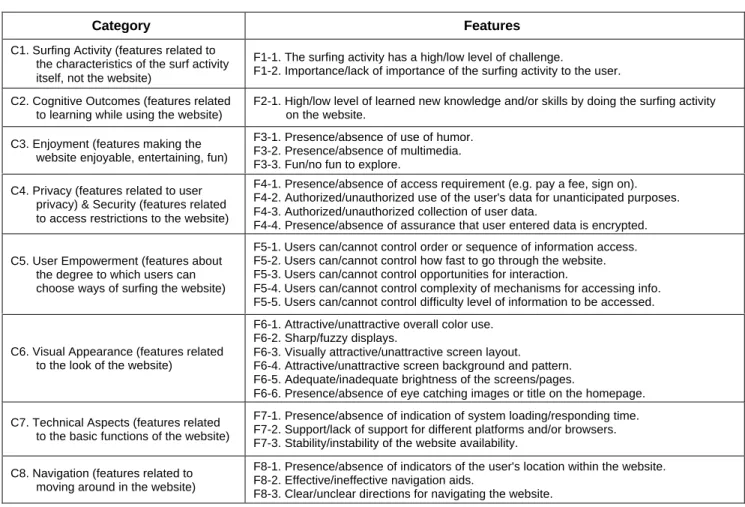
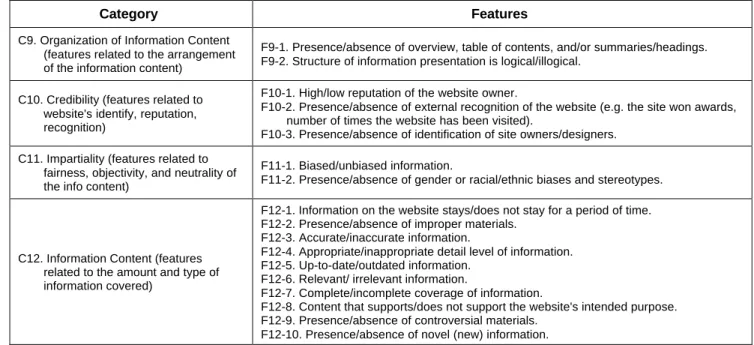
Based on the results of this analysis, we identified a list of 44 features that seem unambiguous and have high agreement to belong to definite categories. These features
are called core features for their categories. That is, given
a feature, the majority of the web users would classify it into a certain category. These core features and the categories are listed in Table 1 and were used in Phase II to determine their hygiene and motivational nature. As a result of the secondary task of this phase, the subjects identified no new features.
Phase II: Identification of Hygiene and Motivational Factors
The goal of Phase II was to identify the hygiene and motivational characteristics of the categories and features developed and refined in Phase I. For this paper, a pilot with a limited number of subjects was conducted to test the feasibility of the study and to eliminate potential problems. Since previous pilot studies of Phase II had indicated that some participants had difficulties in understanding the hygiene and motivational concepts in a survey instrument, this pilot for Phase II was conducted in a class setting composing eight subjects as a focus group. These subjects were experienced web users who had not participated in Phase I. They included one information professional, four doctoral students, and three master students. Subjects were asked to browse the CNN website prior to the pilot study. The reason for using the CNN website was to create a common context for the pilot study.
The pilot study started with a short lecture on Herzberg’s theory. Then a quiz was administered to verify and ensure correct understanding of the hygiene or motivational concepts in the work setting. The subjects then completed an instrument where for each factor (features and categories) in the web environment they selected one of the four options: Hygiene, Motivator, Never saw, Unclear. Subjects also provided demographic data and were tested for pre-existing individual motivational orientation [18]. After all participants finished, an open discussion session was held.
3. Preliminary Results of the Pilot
Based on the preliminary analysis of the instrument data, we discuss the hygiene and motivational factors in the web environment at three levels: (1) categories, (2) features, and (3) features within the corresponding
categories. We then briefly discuss some of the comments from the open discussion session.
Hygiene and Motivational Categories
Figure 1 depicts the hygiene and motivational nature of the categories. As indicated, the length of a bar represents the frequency of subjects' judgement (the hygiene side is represented by negative values in order to make the distinction from motivational side). For example, all eight subjects agree that C3 is a motivational category, while six think C10 is motivational and two think the opposite. The categories are ordered by motivational frequency. It
appears that three categories (C7 Technical Aspects, C8
Navigation, and C4 Privacy & Security) can be primarily
identified as hygiene factors (as judged by six or more subjects and below the second dashed line). Four
categories (C2 Cognitive Outcomes, C3 Enjoyment, C6
Visual Appearance, and C10 Credibility) are primarily
regarded as motivational factors (above the first dashed line). For the remaining five, even though two (C11
Impartiality and C12 Information Content) tend to have a
more hygiene orientation than the other three (C1 Surfing
Activity, C5 User Empowerment, and C9 Organization of
Information Content), there are two possible explanations:
they are either both hygiene and motivational factors just as the salary factor in Herzberg’s study, or the nature of these five categories cannot be determined yet in this pilot.
Hygiene and Motivational Features
Among the 44 features, ordered by motivational frequency and divided by dashed lines in Figure 2, 13 can be perceived as hygiene factors (below the second dashed line) and 14 as motivational (above the first dashed line). The remaining 17 features are similar to the five categories discussed above. They are either both hygiene and motivational, or a larger sample size is needed to determine their nature. Table 2 lists the 13 hygiene and 14 motivational features.
Hygiene & Motivational Categories & Their Features
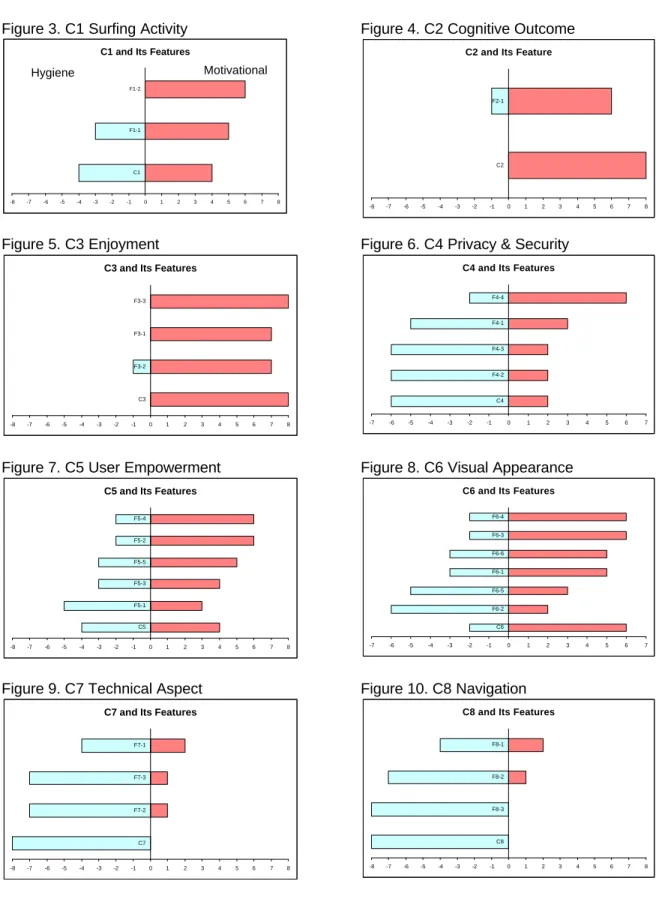
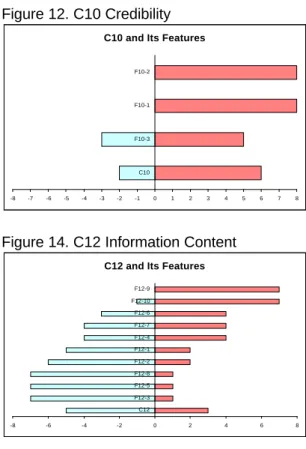
Examining each category in detail, it appears that, in general, the H/M nature of the features tends to agree with that of the category to which they belong, although there are exceptions. Figures 3-14 depicts all twelve categories and their features.
Among the three hygiene categories, two seem have
strong “support” from their features. C7 Technical Aspect
consists of two hygiene features (F7-2, F7-3). The nature of the third feature F7-1 is less clear since one subject
selected “Never saw” and the other “Unclear.” C8
Navigation is also composed of two hygiene features
(F8-2 and F8-3). The third one F8-1 shares the same situation with F7-1. The third hygiene category C4 contains two hygiene features (F4-2 and F4-3), one motivational feature (F4-4), and one feature (F4-1) that leans towards being hygiene.
For the four motivational categories, three of them (C2, C3, and C10) have strong supportive motivational
features. The feature F2-1 and its category C2 Cognitive
Outcomes share the same motivational characteristics. C3
Enjoyment has three features (F3-1, F3-2, and F3-3) that
are all motivational. C10 Credibility consists of two
strong motivational features (F10-1 and F10-2) and another one (F10-3) that leans toward being motivational.
For C6 Visual Appearance, some features are clearly
motivational (F6-3, F6-4). Two tend towards being motivational (F6-1 and F6-6). Two tend towards being hygiene (F6-2 and F6-5).
The nature of C6 and those of its features imply that paying attention to the categories alone may not be enough since within each category, there might be features that are necessary to meet basic conditions and
features that go beyond. For C6 Visual Appearance, F6-2
and 5 are clearly hygiene features, while 3 and F6-4 are motivational.
This may help to explain the nature of the less definable categories such as C1, C5, C9, C11, and C12. The categories are given by names and descriptions. Since some categories may contain both hygiene and motivational features, the determination of the nature of a particular category depends on the emphasis subjects put on either the hygiene or the motivational aspects.
Open Discussion Session
The comments from the subjects centered on two issues. Firstly, while there might be a common set of features that are regarded as hygiene or motivators on most websites, the nature of H/M of some features or categories could be dependent on the context of and tasks (or needs and goals) of individuals. Secondly, in the fast changing environment of the Web, some motivational factors may change into hygiene as time passes.
Limitations
The current study was exploratory and the interpretation of its results is therefore preliminary and confounded by a number of factors. Among those are the small sample size, the particular group of subjects, and the specific information-seeking task (browsing the CNN website) within a specific domain (news). In addition, the effect of individual differences on study outcomes was not considered. Because of these limitations, we plan to
complete the study with a larger sample of subjects in the near future, controlling as much as possible for factors that may bias the results of the study.
4. Summary
The preliminary results obtained from the focus group show that certain categories and features were clearly identified as hygiene or motivational in nature. For example, those features and categories describing the functionality of a website are consistently identified as hygiene in nature by most or all of the focus group participants. Conversely, among the motivational characteristics of websites are those that enhance cognitive outcomes, enjoyment, visual appearance and credibility. These preliminary results suggest that a two-factor theory may provide a framework for web designers who want to increase user satisfaction and decrease dissatisfaction. The pilot also showed that the methodology used can be applied to the full-scope study. Given the exploratory nature, the limited scope of this study and the nature of the task (browsing) employed,
website users appear nevertheless to be able to distinguish hygiene factors and motivators on a website.
The identification of web design features and categories that create a sense of user satisfaction or minimize dissatisfaction therefore adds value to the proliferating lists of design features. In an increasingly competitive web environment, motivational websites may prove to be a competitive advantage. The results of this preliminary study also indicate that some features and categories are judged to be primarily hygiene or motivational in nature, while others are perceived as both. This suggests a number of research questions for further investigation that we are already planning: (1) which individual differences and needs account for variations in evaluation? (2) Does the accelerated pace of change in the web environment contribute to user expectations that today's motivational factors are considered to be hygiene factors tomorrow? (3) Does the domain of the website or the specific task performed influence user perceptions about what is motivational or hygiene? And (4) are some features and categories more or less important in creating user satisfaction or dissatisfaction?
Table 1. Categories and Core Features
Category Features
C1. Surfing Activity (features related to the characteristics of the surf activity itself, not the website)
F1-1. The surfing activity has a high/low level of challenge.
F1-2. Importance/lack of importance of the surfing activity to the user. C2. Cognitive Outcomes (features related
to learning while using the website)
F2-1. High/low level of learned new knowledge and/or skills by doing the surfing activity on the website.
C3. Enjoyment (features making the website enjoyable, entertaining, fun)
F3-1. Presence/absence of use of humor. F3-2. Presence/absence of multimedia. F3-3. Fun/no fun to explore.
C4. Privacy (features related to user privacy) & Security (features related to access restrictions to the website)
F4-1. Presence/absence of access requirement (e.g. pay a fee, sign on). F4-2. Authorized/unauthorized use of the user's data for unanticipated purposes. F4-3. Authorized/unauthorized collection of user data.
F4-4. Presence/absence of assurance that user entered data is encrypted. C5. User Empowerment (features about
the degree to which users can choose ways of surfing the website)
F5-1. Users can/cannot control order or sequence of information access. F5-2. Users can/cannot control how fast to go through the website. F5-3. Users can/cannot control opportunities for interaction.
F5-4. Users can/cannot control complexity of mechanisms for accessing info. F5-5. Users can/cannot control difficulty level of information to be accessed.
C6. Visual Appearance (features related to the look of the website)
F6-1. Attractive/unattractive overall color use. F6-2. Sharp/fuzzy displays.
F6-3. Visually attractive/unattractive screen layout.
F6-4. Attractive/unattractive screen background and pattern. F6-5. Adequate/inadequate brightness of the screens/pages.
F6-6. Presence/absence of eye catching images or title on the homepage. C7. Technical Aspects (features related
to the basic functions of the website)
F7-1. Presence/absence of indication of system loading/responding time. F7-2. Support/lack of support for different platforms and/or browsers. F7-3. Stability/instability of the website availability.
C8. Navigation (features related to moving around in the website)
F8-1. Presence/absence of indicators of the user's location within the website. F8-2. Effective/ineffective navigation aids.
Category Features
C9. Organization of Information Content (features related to the arrangement of the information content)
F9-1. Presence/absence of overview, table of contents, and/or summaries/headings. F9-2. Structure of information presentation is logical/illogical.
C10. Credibility (features related to website's identify, reputation, recognition)
F10-1. High/low reputation of the website owner.
F10-2. Presence/absence of external recognition of the website (e.g. the site won awards, number of times the website has been visited).
F10-3. Presence/absence of identification of site owners/designers. C11. Impartiality (features related to
fairness, objectivity, and neutrality of the info content)
F11-1. Biased/unbiased information.
F11-2. Presence/absence of gender or racial/ethnic biases and stereotypes.
C12. Information Content (features related to the amount and type of information covered)
F12-1. Information on the website stays/does not stay for a period of time. F12-2. Presence/absence of improper materials.
F12-3. Accurate/inaccurate information.
F12-4. Appropriate/inappropriate detail level of information. F12-5. Up-to-date/outdated information.
F12-6. Relevant/ irrelevant information.
F12-7. Complete/incomplete coverage of information.
F12-8. Content that supports/does not support the website's intended purpose. F12-9. Presence/absence of controversial materials.
F12-10. Presence/absence of novel (new) information.
Table 2. Hygiene and Motivational Features
Hygiene
F4-2. Authorized/unauthorized use of the user's data for unanticipated purposes. F4-3. Authorized/unauthorized collection of user data.
F6-2. Sharp/fuzzy displays.
F7-2. Support/lack of support for different platforms and/or browsers. F7-3. Stability/instability of the website availability.
F8-2. Effective/ineffective navigation aids.
F8-3. Clear/unclear directions for navigating the website.
F9-1. Presence/absence of overview, table of contents, and/or summaries/headings. F9-2. Structure of information presentation is logical/illogical.
F12-2. Presence/absence of improper materials. F12-3. Accurate/inaccurate information. F12-5. Up-to-date/outdated information.
F12-8. Content that supports/does not support the website's intended purpose.
Motivational
F1-2. Importance/lack of importance of the surfing activity to the user.
F2-1. High/low level of learned new knowledge and/or skills by doing the surfing activity on the website. F3-1. Presence/absence of use of humor.
F3-2. Presence/absence of multimedia. F3-3. Fun/no fun to explore.
F4-4. Presence/absence of assurance that user entered data is encrypted. F5-2. Users can/cannot control how fast to go through the website.
F5-4. Users can/cannot control complexity of mechanisms for accessing information. F6-3. Visually attractive/unattractive screen layout.
F6-4. Attractive/unattractive screen background and pattern. F10-1. High/low reputation of the website owner.
F10-2. Presence/absence of external recognition of the website (e.g. the site won awards). F12-9. Presence/absence of controversial materials.
Figure 1. Categories as Hygiene and Motivational Factors
Categories as Hygiene and Motivational Factors
-8 -7 -6 -5 -4 -3 -2 -1 0 1 2 3 4 5 6 7 8 C7 C8 C4 C11 C12 C1 C5 C9 C6 C10 C2 C3 Frequency
Figure 2. Features as Hygiene and Motivational Factors
Features as Hygiene and Motivational Factors
-8 -7 -6 -5 -4 -3 -2 -1 0 1 2 3 4 5 6 7 8 F8-3 F12-3 F12-5 F12-8 F7-2 F7-3 F8-2 F12-2 F4-2 F4-3 F6-2 F9-1 F9-2 F12-1 F11-2 F7-1 F8-1 F11-1 F4-1 F5-1 F6-5 F12-4 F12-7 F12-6 F5-3 F10-3 F1-1 F5-5 F6-1 F6-6 F4-4 F5-2 F5-4 F6-3 F6-4 F2-1 F1-2 F12-10 F3-2 F12-9 F3-1 F10-1 F10-2 F3-3 Frequency Hygiene Motivational
Figure 3. C1 Surfing Activity Figure 4. C2 Cognitive Outcome
C1 and Its Features
-8 -7 -6 -5 -4 -3 -2 -1 0 1 2 3 4 5 6 7 8
C1 F1-1 F1-2
C2 and Its Feature
-8 -7 -6 -5 -4 -3 -2 -1 0 1 2 3 4 5 6 7 8
C2 F2-1
Figure 5. C3 Enjoyment Figure 6. C4 Privacy & Security
C3 and Its Features
-8 -7 -6 -5 -4 -3 -2 -1 0 1 2 3 4 5 6 7 8
C3 F3-2 F3-1 F3-3
C4 and Its Features
-7 -6 -5 -4 -3 -2 -1 0 1 2 3 4 5 6 7 C4 F4-2 F4-3 F4-1 F4-4
Figure 7. C5 User Empowerment Figure 8. C6 Visual Appearance
C5 and Its Features
-8 -7 -6 -5 -4 -3 -2 -1 0 1 2 3 4 5 6 7 8 C5 F5-1 F5-3 F5-5 F5-2 F5-4
C6 and Its Features
-7 -6 -5 -4 -3 -2 -1 0 1 2 3 4 5 6 7 C6 F6-2 F6-5 F6-1 F6-6 F6-3 F6-4
Figure 9. C7 Technical Aspect Figure 10. C8 Navigation
C7 and Its Features
-8 -7 -6 -5 -4 -3 -2 -1 0 1 2 3 4 5 6 7 8
C7 F7-2 F7-3 F7-1
C8 and Its Features
-8 -7 -6 -5 -4 -3 -2 -1 0 1 2 3 4 5 6 7 8 C8 F8-3 F8-2 F8-1 Hygiene Motivational
Figure 11. C9 Organization of Info. Content Figure 12. C10 Credibility
C9 and Its Features
-8 -7 -6 -5 -4 -3 -2 -1 0 1 2 3 4 5 6 7 8
C9 F9-1 F9-2
C10 and Its Features
-8 -7 -6 -5 -4 -3 -2 -1 0 1 2 3 4 5 6 7 8
C10 F10-3 F10-1 F10-2
Figure 13. C11 Impartiality Figure 14. C12 Information Content
C11 and Its Features
-8 -7 -6 -5 -4 -3 -2 -1 0 1 2 3 4 5 6 7 8
C11 F11-2 F11-1
C12 and Its Features
-8 -6 -4 -2 0 2 4 6 8 C12 F12-3 F12-5 F12-8 F12-2 F12-1 F12-4 F12-7 F12-6 F12-10 F12-9
5. Acknowledgement
The authors wish to thank Dr. Michael D'Eredita, and doctoral students Jiangping Chen and Naybell Hernandez in the School of Information Studies at Syracuse University for their assistance in conducting some of the experiments. This study is partially supported by a research grant from the School of Information Studies at Syracuse University.
6. References
[1]. M. S. Aldenderfer, & Blashfield, R. K. (1984).
Cluster Analysis. (Vol. 44). Newbury, Park, CA:
Sage Publications
[2]. K. D. Bailey (1994). Typologies and Taxonomies:
An Introduction to Classification Techniques. (Vol.
102 Sage Publications)
[3]. F.G. Burton, Y. Chen, V. Grover, and K.A. Stewart
“An Application of Expectancy Theory for Assessing User Motivation to Utilize an Expert
System”, Journal of Management Information
Systems, 1993, Vol. 9, No. 3, 183-198.
[4]. S.A. Conger, and R.O. Mason, Planning and
Designing Effective Web Sites, Course Technology,
Cambridge, MA, 1998.
[5]. G. DeSanctis, “Expectancy Theory As An
Explanation of Voluntary Use of a Decision-Support
System,” Psychological Reports, 1983, Vol. 52, pp.
247-260.
[6]. V. Flanders and M. Willis, Web Pages that Suck,
SYBEX Inc., San Francisco, 1998.
[7]. T. G. Gill, “Expert Systems Usage: Task Change
and Intrinsic Motivation”. MIS Quarterly, 1996,
Summer, 301-329.
[8]. F. Herzberg, Work and the Nature of Man. Chapter
6, World Publishing, NY, 1966, 71-91.
[9]. F. Herzberg, “One More Time: How Do You
Motive Employees?” Harvard Business Review, 46
(January-February), 1968, 53-62.
[10].K. Instone, Usability Heuristics for the Web,
http://webreview.com/97/10/10/usability/sidebar.ht ml
[11].K. Keeker, Improving Web Site Usability and Appeal: Guidelines Compiled by MSN Usability
Research, July24, 1997,
http://www.microsoft.com/workshop/management/p lanning/improvingsitusa.asp
[12].A.L. Lederer, D.J. Maupin, M.P. Sena and Y.
Zhuang, “The Role of Ease of Use, Usefulness and Attitude in the Prediction of World Wide Web Usage”
[13].M. Leviand and F. Conrad, A Heuristic Evaluation
of a World Wide Web Prototype, Interactions, 3:4,
July-August 1996, 50-61.
[14].L.M. Markus, and M. Keil, M. “If We Build It, They
Will Come: Designing Information Systems That
People Want to Use” Sloan Management Review,
Summer, 1994, 11-25.
[15].A. Maslow, Motivation and Personality, Harper &
Row, New York, 1954.
[16].J. Nielsen, Alertbox, http://www.useit.com/alertbox.
[17].J. Nielsen, Usability Engineering, AP Professional,
New York, 1993
[18].J.B. Rotter, Generalized expectancies for internal
versus external control of reinforcement.
Psychological Monographs, 1966, 80 (Whole No.
609).
[19].R.V. Small, Assessing the Motivational Quality of
World Wide Websites, ERIC Clearinghouse on
Information and Technology, Syracuse, NY, (ED 407 930).
[20].J. Spool, et al., Web Site Usability - A Designer's
Guide, Morgan Kaufmann Publishers, Inc., 1999.
[21].T. Sullivan, User Testing Techniques - A
Reader-Friendliness Checklist,
http://www.pantos.org/atw/35317.html
[22].User Interface Engineering, Surprises on the Web:
Results from Usability Testing,
http://world.std.com/~uieweb/surprise.htm [23]. G. L. Wilkinson, L.T. Bennett, and K.M. Oliver,
Evaluating the Quality of Internet Information Sources: Consolidated Listing of Evaluation
Criteria and Quality Indicators.
http://www.capecod.net/schrockguide/eval.htm.
[24].Zhang, Ping, Gisela von Dran, Ruth Small, Silvia
Barcellos (1999), Web Sites that Satisfy Users: A Theoretic Framework for Web User Interface
Design and Evaluation, Proceedings of the
International Conference on Systems Science