Copyright to IJIRSET DOI:10.15680/IJIRSET.2016.0505265 8683
Electronic Support System for Deaf and Dumb
to Interpret Sign Language of Communication
Sunita V. Matiwade1, Dr. M.R.Dixit2
M.E. Student, Dept. of Electronics & Telecomm. Engineering, KITCOE, Shivaji University, Kolhapur, Maharashtra,
India1
HOD, Dept. of Electronics & Telecomm. Engineering, KITCOE, Shivaji University, Kolhapur, Maharashtra, India2
ABSTRACT:Communications between deaf-dumb and a normal person have always been a challenging task. About nine billion people in the world are deaf and dumb. The communication between a deaf and hearing person poses to be a serious problem compared to communication between blind and normal visual people. The blind people can talk freely by means of normal language whereas the deaf-dumb have their own manual-visual language known as Gestures and sign language. Human hand plays an important role while conveying information in between deaf and normal person. Gestures are powerful tools of communication among humans and are of particular interest to the deaf and dumb community.
KEYWORDS:Hand Gesture, Text To Speech Conversion, ARM7TDMI, Flex Sensor
I. INTRODUCTION
Communication is the best media used by the people to communicate with each other. The problem arises when normal people and deaf-dumb people want to communicate with each other. Sign Language is a language which is used for communication by the deaf and dumb people. This project is used to reduce the communication barrier between the deaf-dumb people and the normal people. The Sign language interpreter developed uses a hand glove fitted with flex sensors that can interpret the English letters, numbers and some words in American Sign Language (ASL) & some one-handed letters in Indian sign language (ISL) [1].
The proposed system is sign language recognition system for the vocally disabled people who use sign language for communication. The use of specially designed sensor gloves connected to system while a disabled person wearing the gloves makes the signs and gestures. System will analyze these gestures and synthesize the sound for the corresponding word or letter for normal people to understand.
Proposed system is to utilize single handed gestures for American Sign Language (ASL) and some one handed gestures for Indian sign language (ISL) for implementation of Sign Language Interpreter.
II. RELATEDWORK
Traditionally, the technology of gesture recognition was divided into two categories, vision -based and glove-based methods and also the colored marker approaches. In vision-based methods, computer camera is the input device for observing the information supplied by various gestures of hands & fingers. In glove based systems data gloves are used which can archive the accurate positions of hand gestures as its positions are directly measured.
edge method, using orientation histogram & thinning method. Present technologies for recognizing gestures are divided into vision based,data glove based, and colored marker approaches. Jonathan Alon et al. [6] proposed a novel gesture spotting algorithm which is accurate and efficient, is purely vision-based. This system robustly recognizes gestures, even when the user gestures without any aiding devices in front of a complex background. Shoaib Ahmed .V et al. [2] proposed the Prototype version, in which system the user forms a sign and holds it for two seconds to ensure recognition. Thad Starner et al. [10] proposed two real-time hidden Markov model based systems for recognizing sentence-level continuous American Sign Language (ASL) using a single camera to track the user’s unadorned hands.
Laura Dipietro et al. [8] proposed an Instrumented (data) glove approaches system in which sensor devices used for capturing hand position, and motion. In this approach, detection of hand is eliminated by the sensors on the hand and it can easily provide exact coordinates of palm and finger’s location and orientation, and hand configurations. However using data gloves become a better approach than camera as the user has the flexibility of moving the hand around freely, unlike the camera where the user has to stay in position before the camera. Light, electric or magnetic fields or any other disturbance does not affect the performance of the glove. Nils Karlsson et al. [9] proposed a method where a glove generates commands based on position measurements. When the angles of the fingers change the output of the sensors will change. The combined sensor outputs form a pattern that corresponds to different finger flexions. Different finger flexion’s generates different Commands. The glove is simple and it generates sufficient signals for a fuzzy control system.
Copyright to IJIRSET DOI:10.15680/IJIRSET.2016.0505265 8685 III.PROPOSEDMETHODOLOGY
3.1BLOCKDIAGRAMOFPROPOSEDSYSTEM:
FIGURE 1: BLOCK DIAGRAM OF PROPOSED SYSTEM
3.2 DESCRIPTION:
Generally dumb people use sign language for communication but they find difficulty in communicating with others who don’t understand sign language. The aim of proposed system is to reduce the barrier in communication. Now days it’s a need of developing an electronic support system that can translate sign language into text and speech in order to make the communication between the deaf & dumb communities with the general public. A data gloves is used which is normal cloth driving gloves fitted with flex sensors along the length of each finger and the thumb. Deaf & dumb people will use the gloves to perform hand gesture and it will be converted into text and speech so that normal people can understand their expression [2].
In this electronic support system data glove is implemented to capture the hand gestures of a user. s the major role, Flex sensors are sensors that change in resistance depending on the amount of bend on the sensor [2]. The data glove is fitted with flex sensors along the length of each finger and the thumb. The flex sensors output is a stream of data that varies with degree of bend. The analog outputs from the sensors then fed to the ARM7TDMI. It processes the signals and perform analog to digital signal conversion. The resulting digital signal is fed to the gesture recognition section [1]. In this section the gesture is recognized and the corresponding text information identified. Text to speech conversion takes place in the voice section and play out through the speaker.
ARM7TDMI FLEX
SENSOR
KEYPAD
DATABASE OF GESTURE SENSOR BIT PATTERN DATA
(CODE BOOK)
AUDIO AMPLIFIER
LOUD-SPEAKER
DATABASE OF AUDIO FILES
DATABASE OF CAPTURED IMAGES FOR
3.3 American Sign Language (ASL)
Table 1: Gesture for American Sign Language (ASL) for A-Z letters
Table 2: Gesture for American Sign Language (ASL) for 0- 9 numbers
American Sign Language (ASL) is a sign language. It is used by deaf and dumb people for communication. Table 1 and 2 shows the gestures for English lettersand number used in American sign language.
IV.EXPERIMENTALRESULTS
Flex sensors are fitted on hand gloves. As per the hand gesture movement it will bend the flex sensors of all fingers. The value of bending is in resistance. All fingers give different resistance value depending on bending. The output of flex sensor is given to the ADC of ARM7TDMI LPC-2148 which used to convert analog signal into digital signal. The required program written in embedded c language.Depending on code generated by hand movement text is displayed on LCD and also the text is converted into speech by the Visual Basic 2008 software installed on computer.
A B C D E F G H I J
K L M N O P Q R S T
U V W X Y Z
Copyright to IJIRSET DOI:10.15680/IJIRSET.2016.0505265 8687
Table 3:Hand gesture of sign language for alphabet A,B,C,D& E with Logic Levels as per values of Flex Sensor
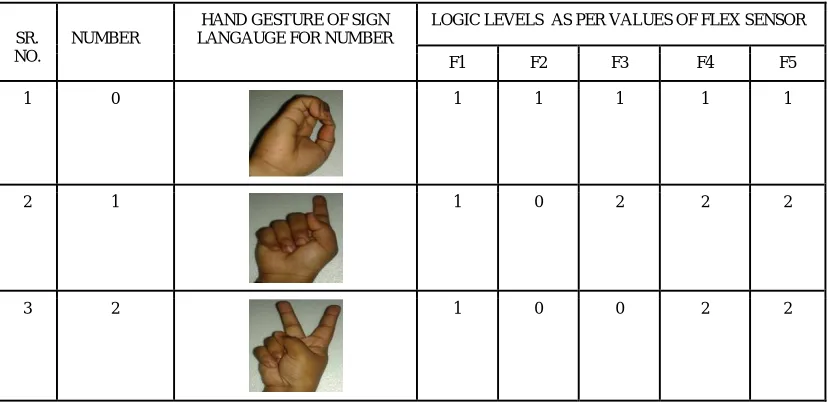
Table 4:Hand gesture of sign language for Number 0,1& 2 with Logic Levels as per values of Flex Sensor
SR. NO.
ALPHABET HAND GESTURE OF SIGN
LANGAUGE FOR ALPHABET
LOGIC LEVELS AS PER VALUES OF FLEX SENSOR
F1 F2 F3 F4 F5
1 A 0 2 2 2 2
2 B 2 0 0 0 0
3 C 0 1 1 1 1
4 D 1 0 1 1 1
5 E 1 2 2 2 2
SR. NO.
NUMBER
HAND GESTURE OF SIGN LANGAUGE FOR NUMBER
LOGIC LEVELS AS PER VALUES OF FLEX SENSOR
F1 F2 F3 F4 F5
1 0 1 1 1 1 1
2 1 1 0 2 2 2
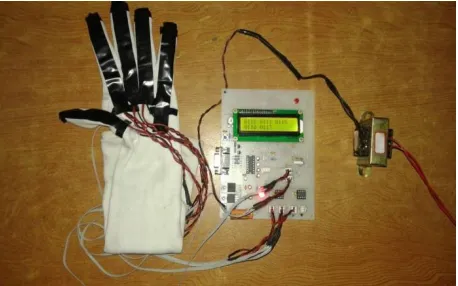
As shown in Table 3 it gives information of gesture for English letters A to E with logic levels, similarly we can obtain for remaining English letters and as shown in Table 4 it gives information of gesture for numbers 0 to 2 with logic levels, similarly we can obtain for remaining numbers. The snapshot of project hardware in Figure 2 shows flex sensors are placed on hand gloves and hand gloves are connected to the ADC of ARM7TDMI. The recognized gesture values are displayed on LCD display .
Snapshot of Project Hardware:
Figure 2 Snapshot of project hardware
V. CONCLUSION
In the proposed support system we have recognized alphabets (A-Z), Numbers (0-9) and some words by using hand gloves with flex sensor. The proposed support system is useful for communication between deaf and dumb people with normal person.
VI.ACKNOWLEDGEMENTS
I take this opportunity to gratefully acknowledge the inspiration, encouragement, guidance, help and valuable suggestions received from all my well-wishers. I would like to thanks my Project guide Dr.M.R.Dixit madam who has helped me and made available much useful information to complete this project.
I would like to express my sincere thanks to the Principal sir Dr.V. V. Karjinni,& other faculty members & non-teaching staffof Electronics department, Kolhapur Institute Of Technology,COE,Kolhapur, for encouragement during completion of this project.
REFERENCES
[1] Kamalpreet Sharma, Naresh Kumar Garg, ”Hand Gestures Recognition For Deaf And Dumb”, International Journal of Computer Application and Technology (s), May - 2014, pp. 10-13.
[2]Shoaib Ahmed .V, “MAGIC GLOVES (Hand Gesture Recognition and Voice Conversion System for Differentially Able Dumb People)”, Tech Expo-The Global Summit, London 2012.
[3] DeepikaTewari, Sanjay Kumar Srivastava,“A Visual Recognition of Static Hand Gestures in Indian Sign Language based on Kohonen Self- Organizing Map Algorithm”, International Journal of Engineering and Advanced Technology(IJEAT), Vol.2, Dec 2012, pp. 165-170.
Copyright to IJIRSET DOI:10.15680/IJIRSET.2016.0505265 8689
[6]Jonathan Alon, VassilisAthitsos, Quan Yuan, Student Member, IEEE, and Stan Sclaroff, Senior Member, IEEE, “A Unified Framework for- Gesture Recognition and Spatiotemporal Gesture Segmentation” IEEE Transactions On Pattern Analysis And Machine Intelligence, Vol. 31, No. 9, September 2009
[7] Vasiliki E. Kosmidou, Student Member, IEEE, and Leontios J. Hadjileontiadis, Member,IEEE,”Sign Language Recognition Using Intrinsic- Mode Sample Entropy on sEMG and Accelerometer Data”, IEEE Transactions On Biomedical Engineering, Vol. 56, No. 12, December 2009. [8] Laura Dipietro, Angelo M. Sabatini, Senior Member, IEEE, and Paolo Dario, Fellow, IEEE,”A Survey of Glove-Based Systems and Their Applications”, IEEE Transactions On Systems, Man, And Cybernetics—Part C: Applications And Reviews, Vol. 38, No. 4, July 2008
[9] Nils Karlsson, Bj¨ornKarlsson, and Peter Wide, Member, IEEE,”A Glove Equipped with Finger Flexion Sensors as a Command Generator used in a Fuzzy Control System”, IEEE Transactions On Instrumentation And Measurement, Vol. 47, No. 5, October 1998.
[10] T. Starner, J. Weaver, and A. Pentland, “Real-Time American Sign Language Recognition Using Desk and Wearable Computer Based Video,” IEEE Trans. Pattern Analysis and Machine Intelligence, vol. 20, no. 12, pp. 1371-1375, Dec. 1998.