Chapter Seven
Case Study Number 1: A Performer’s Guide to Severance by Chris Dench
7.1 Introduction: genesis of the work
Chris Dench composed Severance for solo guitar1 between 1988 and 1991 but completely revised (that is, reworked and recopied) the work in March 1994. Whilst the piece was written at the request of Magnus Andersson, and is dedicated ‘belatedly for Magnus’, the premiere was given by Geoffrey Morris who subsequently recorded it2. According to the composer, Andersson declined to perform it once Morris had performed it, and he speculates that an obsession with giving first performances was the reason for his (Andersson’s) loss of interest in the piece3. Carl Rosman gives a different account4:
Severance has a somewhat tortuous history. It commenced life in 1988 as a guitar concerto intended for Magnus Andersson; this eventually became a flute concerto, and the remainder a work for solo guitar at Geoffrey Morris’ insistence. This work exemplifies a particular characteristic of much recent music – the effort of coming to terms with near-‐impossible demands which one might think would remove all possibility of projecting an individual interpretation, in fact has the effect of rendering the entire performance acutely expressive of the performer’s abilities and personality (in this case Morris’ particular blend of violence and finesse).
The piece is described as being edited by Geoffrey Morris. In his notes for the piece Dench states5:
Fingerings given are the composer’s suggestions, and are by no means mandatory. Better solutions may well be available.
It is therefore of interest to speculate what Morris contributed to the process.
The piece is prefaced by a quotation from On the Marble Cliffs, the novella published in 1939 by the German author Ernst Juenger:
“You all know the wild grief that besets us when we remember times of happiness. How far beyond recall they are, and we are severed from them by something more pitiless than leagues and miles. In the afterlight, too, the images stand out more enticing than before… And constantly in our thirst – haunted dreams we grope for the past in its every detail, in its every line and fold. Then it cannot but seem to us as if we had not had our fill of love and life; yet no regret brings back what has been let slip.”
This quotation can be construed, on one level, as an aid to the interpretation of the work with its references to ‘wild grief’, ‘regret’ and the remembrance of happier times. There is a wider context however; the book from which it is taken was interpreted at the time as a parable of the brutalism of National Socialism, though this was denied by Juenger6. It will be noted that the book was not censored or banned by the Nazis and Juenger (1895-‐1988) did not go in to exile (as did many anti-‐Nazi authors) during the Nazi rule.
7.2 The score
One of the most problematic aspects of Severance is the rhythmic/temporal notation used by Dench. He writes7:
The score is to be understood as inhabiting a world dominated by interpretive rubato. It is nominally notated at 3½ centimetres to 1 second (in performance, however, the time – space seems to average out nearer 2 cm per second ( = mm 36 ish)), and players may, if they wish, go through the score and mark the seconds in, but it is the composer’s preference that unfolding time be ‘felt’ rather than ‘calculated’.
Consequently, the rhythmical life is notated unusually; in place of exact detailed ‘intellectual’ – information, beaming is a reinforcement of distances between noteheads, which are directly proportional to durations. This lessening of rhythmical specificity is not to be understood as licence to waywardness, the musical substance having been composed as rigorously as ever; the character of the resulting music implies a certain elasticity. An ideal performance, therefore, would be one of considered, and consistent, inexactitude.
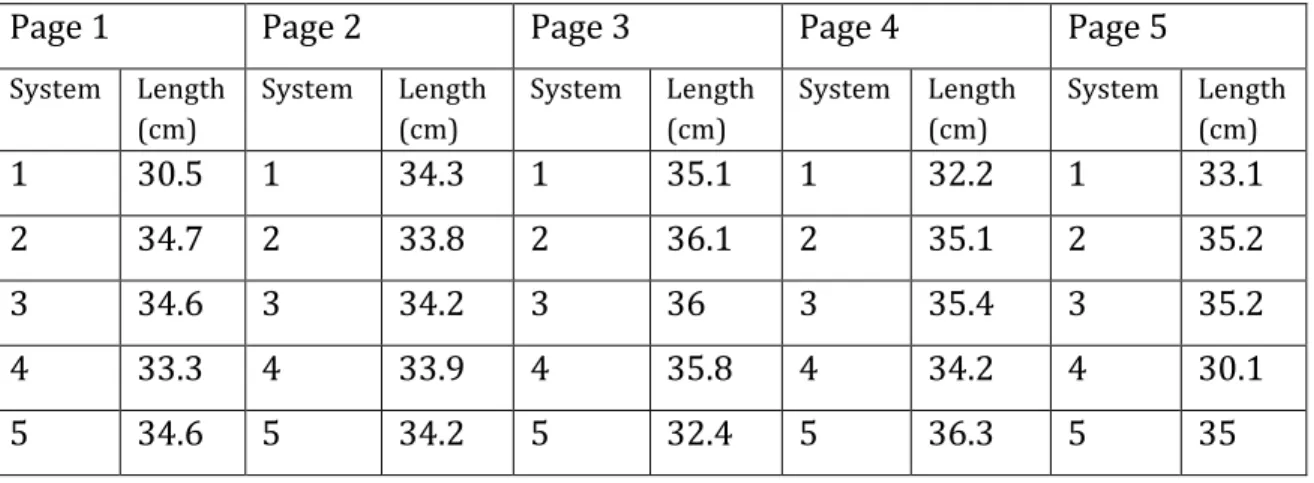
There are many problems with this. The first is that it relies on this edition (described on the cover as being the composer’s autograph) being an accurate rendition of the composer’s original manuscript. If the dimensions are different – even slightly – then the calculation of the tempo in centimetres will be different. Any subsequent edition will have to retain the same format. The reproduction of the score in this paper is, therefore, deceptive. The system lengths are mostly different, but if one is known a calculation can be made for a specific instance of reproduction. Table 7.1 shows the lengths of each system determined from the vertical line immediately after the clef sign to the end of that system. This line is understood to indicate the start of the system, rather than the actual beginning before the clef.
Table 7.1 Dench, Severance, system lengths
Page 1 Page 2 Page 3 Page 4 Page 5
System Length (cm) System Length (cm) System Length (cm) System Length (cm) System Length (cm) 1 30.5 1 34.3 1 35.1 1 32.2 1 33.1 2 34.7 2 33.8 2 36.1 2 35.1 2 35.2 3 34.6 3 34.2 3 36 3 35.4 3 35.2 4 33.3 4 33.9 4 35.8 4 34.2 4 30.1 5 34.6 5 34.2 5 32.4 5 36.3 5 35
The total length is therefore 855.3 cm.
At a scale of 3.5 cm per second this corresponds to a duration of slightly over 4 minutes and at 2 cm per second, just over 7 minutes – his suggested duration (given just after the quotation). This is quite ambiguous.
Marking the seconds (as suggested, but not recommended, by the composer) might help the performer working on a section of the piece, for example where the passages are separated by pauses (marked by the composer in seconds), or where there is an obvious cessation of activity (for example the sustain of a relatively long note). However, the flexibility implied by the composer in his acknowledgement of the difference between the notated and performance cm/sec rate is significant when coupled with his last sentence and the accepted use of rubato. Marking the seconds in the sense of a global timing from start to finish is, therefore, probably futile. On the other hand, it is not difficult to interpret the note values in a reasonably conventional way, even in acciaccatura or grace note groupings, and in practice, pragmatics and technical expediency are probably limitations on any attempt at a more rigorous interpretation of his rhythmic notation. One might add that in remarking on the difference in cm/sec between his ‘nominal’ notation (whatever he means by this) and performance, he could have warned the player
not to play it too slowly! Dench seems to accept the notion of a performance that is about 0.6 times (that is, slightly over half) as slow as his (nominal) notation implies. Translated into simple metronomic markings this means that, if his mm of 36 is used for calculation, his intention is about mm 60. But he doesn’t specify what he means by mm = 36. It is meaningless without an assigned note value. We are in the dark as to whether he means ¼ note = 36 or 8th note = 36 and so on. In fact, each note ‘value’ he uses is represented by many different note beam lengths indicating that the notion of a note value to represent a pulse is not what he intends at all. His setting of metronome markings therefore seems unhelpful and redundant. Whilst the stated pause durations (in seconds) do correspond to 3.5 cm per second, the simple fact is that his suggested duration for the piece corresponds to the rate of 2 cm per second. His 3.5 cm per second figure seems quite irrelevant and only confuses the issue. Any editor should surely have spotted this. It now seems superfluous to remark that the specified lengths of the pauses in seconds removes the relative effect such pauses might have had if they had been left as
fermata (possibly with some additional description such as lunga, breve or similar) and the composer’s desire for musical time to be ‘felt’ achieved more efficiently.
With this degree of rhythmic imprecision we might speculate as to whether or not this piece should be associated with the rubric ‘new complexity’.
In his performance notes, Dench writes8:
In addition to the modified rhythmical notation, the gracenote (sic) life of the piece is more elaborate than usual, utilising several degrees of rapidity. These are beamed as if they were quavers, semiquavers, and demisemis (8ths, 16ths, and 32nds), although the ratios between their tempi should not be fully 4:2:1, but a narrower ratio … 2:1½:1, for instance. They should always be rapid, but varyingly so. To distinguish them from metrically uneven ‘in time’ music all groups have a slash at
one end. These motoric gracenotes should always have the psychological effect of an uncomfortable intrusion, whether of agitation or respite.
The grace note activity in the first section is wholly in 32nd notes or note groups. For the Cantabile e Malinconico section, the grace note groups are all in 16th notes, although there are a few 32nd individual acciaccaturas. For the third section, Con
Passione, only 32nd and 8th grace note groups and singletons appear. In the final section, Desolato e Morendo, there are only 32nd and 16th groups and singletons. Some of the 8th grace note groups are problematic. For instance, those in the third system of page three occupy space that could easily be construed in Dench’s time-‐ space notation (the first of these is simply eleven notes in 6.6 cm, that is just over two or three seconds depending on which cm/sec rate is taken). It is, therefore, not easy to see how these can be seen or performed as grace notes in any conventional sense of the term and the ‘psychological effect of an uncomfortable intrusion’, a request that is ambiguous and unclear in a musical sense, must be conveyed by some other means.
7.3 Form
The piece broadly takes the form of four sections:
Section 1 – Poco Martellato e Non Legato
Section 2 – Cantabile e Malinconico, (non troppo presto!) un po’ Agitato Section 3 – Con Passione: Agitato, Feroce e Presto
Section 4 – Desolato e Morendo (fragile thin and inelegant.) Slowly.
7.4 Effects and special notation
Dench specifies many of the usual standard guitaristic effects; golpe (‘preferably flat hand slapped on body’)9 and Bartok pizzicato, and exploits the tonal range with the normal indications of ponticello (sp), ord (ordinary). There is, unaccountably, only one instance of tasto (ST) at the very end of the first section where its presence above a harmonic renders it largely redundant (although the accompanying A sharp could be so played despite the ppp!). Again, unaccountably, there are no further timbral indications apart from the ord that starts the second section and the isolated sul ponticello notes. There seems to be no reason why the performer should not use the full palette of tonal range with some discretion. There is the somewhat unusual, but serviceable, notation, however, that notes with a dotted ring around them are to be played ‘isolatedly sul pont’10. This causes no problem until the very last note where, as well as the dotted ring, there is the additional, contradictory, requirement (written over the note in the score) for the performer to ‘REST PALM ON BRIDGE – PICK OVER SOUNDHOLE’ (Example 7.1)
Example 7.1 Dench, Severance – the last note of page 5, system 5
Passing rapidly over the fact that playing over the soundhole will not be ponticello, the left hand is precluded from realizing this gesture as this B flat can only be played with a left hand finger on the 1st fret, fifth string (the notated suggestion) or 6th fret, sixth string. In order for the guitarist to use the right hand with the palm resting on the bridge, a thumb about 11½ cm (somewhat more than 4 inches) long, measured from the base of the thumb nearest the index finger, is required. It is
probably best to ignore the above direction completely and just play the note
pizzicato. At the given ppp dynamic the result is probably satisfactory. The question of the nature of Morris’s editing must be recalled again.
To indicate half–fretted notes Dench marks a cross on the note stem. This effective muting technique is used only once in one four note gesture in system 5 of page 1 (Example 7.2).
Example 7.2 Dench, Severance, page 1, system 5, 17-‐22.5 cm
He does, however use the same cross on one note in the last system of page 3 (Example 7.3) with the extra instruction to hammer on (presumably with the left hand). This is quite a different effect that possibly should have had a different symbol assigned to it to avoid confusion.
Example 7.3 Dench, Severance, page 3, system 5, 9-‐12.5 cm
On page 4, system 1, there is another instruction to ‘RH hammer on’ but this time with no cross on the stem. In this case it is much easier to ‘hammer on’ with the left
hand (the note is readily available while the left hand is holding the previous chord) and it is doubtful that any musical difference is detectable, although the composer may have had a more dramatic gesture in mind (Example 7.4).
Example 7.4 Dench, Severance, page 4 system 1, 14-‐19 cm
At the start of the last section, Desolato e Morendo, the performer is required to play the chords with the right hand always close to the left hand (Example 7.5).
Example 7.5 Dench, Severance, page 4, system 3, 0-‐21 cm
Although the duration of this effect is not clear, it should probably end at the ‘suddenly animated’ passage towards the end of that system where the dynamic is
mf. It is not possible to play loudly with the right hand over the fingerboard. The effect is awkward and the uniqueness of the resultant sound debatable as it results in an essentially quiet ponticello sound. The performer might well decide to substitute this instead.
In connection with the disappearance of timbral effects after the first section, it might be worth recalling that James Dillon begins Shrouded Mirrors11 with
meticulous tonal markings but rather quickly ceases to include them12. It might be that whilst the composer’s attention is drawn to the use of such effects at the opening of a piece, the possibilities inherent in such a multiplicity of parameters adds a degree of complexity that can safely be left to the discretion of the performer.
There is one string bend on page 5 but otherwise, nothing controversial in Dench’s use of guitaristic effects.
Dench’s use of harmonics, both ‘natural’ and ‘artificial’ is standard.
7.5 Dynamics
In his ninth note to the performer, Dench writes:
Dynamics are tiered through seven levels: ppp – pp – p – mf – f – ff – fff
All marcati within prevailing local dynamic unless otherwise indicated.
It is odd that he avoids using mp. It would be interesting to know why this indication was withheld or deemed unhelpful in the compositional process as in practice the performer is unlikely to make such a discrimination discernable in performance. Another possibility is that Dench’s compositional strategy encodes the number seven as significant in some way (see section 7.10).
Another unusual aspect of Dench’s use of dynamics is the employment of exclamation marks after some of them. This starts with the last dynamic of the first section – ppp! There are seven instances in the 3rd section – each ff! but none
afterwards. Its use in a Con Passione section does perhaps add emphasis. On the other hand, it is hard to see how the performer is to interpret them differently to the unemphasised ff, fff, sfz, sffz, sfffz marks also used in this section.
Scores can be thought of as opportunities for a performer or performers to convey the subtlest of musical ideas. The obscurities and ambiguities in them may be the composer’s way of giving some license to the interpreter. There is an inevitable tension between the desire of the composer to accurately convey their intentions, and their desire that performers add a unique quality to their performance.
7.6 Special difficulties
The penultimate three-‐note chord on page 2, system 1 (Example 7.6) contains two harmonics: one played on the 4th string 3rd fret and the other on the 5th string 5th fret, and an open 6th string E.
Example 7.6 Dench, Severance page 2, system 1, 17-‐34 cm
The dynamic, given as f, is unrealistic as these particular harmonics (and, in fact most harmonics) cannot be played loudly and the 6th string is certain to dominate. The dynamic must probably be ignored and the chord played as loudly as is feasible. The contrast can be made by making the next chord as quiet as possible.
There is an impossible chord sequence on page 5, system 2, shortly after the string bend (Example 7.7). Not all the tied notes can be held for the duration. It is highly unlikely that this will affect the end result but an editor might have pointed it out.
Example 7.7 Dench, Severance, page 5, system 2, 6-‐25 cm
Care must be taken to establish what Dench means by his use of the curved line. There are many instances where notes appear to be tied but which are only to be sustained until the following note is played.
There are several places where the performer could substitute a harmonic for a written note, thus preventing the potential miss-‐hit of a note somewhere beyond the 12th fret after an heroic leap from somewhere near the first position. For example:
Page 1, system 3 – the last E on the 1st string 12th fret.
Page 3, system 4 – the first high E
Page 4, system 2 – the high B flat on 1st string 18th fret could be played as an artificial harmonic.
Different performers will undoubtedly come to different conclusions about the necessity, or perceived advantage of making changes, and it has to be admitted that Morris does not take advantage of any of these suggested changes in his recording.
Any such alterations would ideally be considered in consultation with the composer and a balance struck between the practicability and realisation of the composer’s possibly dramatic intent.
7.7 Interpretation: my responses to the aesthetics of the piece
Notwithstanding the above, the presence of the quotation at the beginning of the piece presents a peculiar problem for the performer. Doubtless it isn’t meant to be read out to the audience before performance (though of course it could be), and it is unlikely that the composer is seeking to write programmatic music where the sounds are supposed to suggest, or represent, the ideas present in the text. The text could be a metaphor for the composition of the piece, the musical substance of which Dench asserts has been composed ‘as rigorously as ever’ (see the quote above in section 7.2) and we might look for musical material that attempts to recall earlier material, presumably from the same piece. Musical material might be said to be ‘severed’ from subsequent musical events. On the other hand, it is hard to see how ‘wild grief’, ‘regret’, ‘enticing images’ and the like can be conveyed by other than rather jejune gestures.
The first section of the piece does contain the most violent passages; enfilades of cracking Bartok pizzicato, martellato notes, wild, sudden leaps from the lowest notes to the highest available on the instrument. The rapid changes from p to ff – and apart from the very last chord these are the quietest and loudest dynamics in this section – are punctured or separated (severed?) by sforzandi of various degrees. The changes of timbre from sp to ord are present in almost all the note groups. Some repose is gained by the five or six pauses notated in seconds (six, if the one connecting to the next section is admitted), but the barrages that follow all begin with a very strong dynamic (mfz being the quietest). These pauses have the effect of a necessary taking of breath before another battery of notes. As suggested
(probably longer than the stated number of seconds), while retaining their relative durations, in order to support the idea of musical time ‘unfolding’ 13. This section finally ends on a ppp! chord A sharp, with a G sharp harmonic and a three second pause.
The A sharp links to the second section Cantabile e Malinconico, un poco Agitato, where there is (for the first two systems at least) the considerable repetition of a B flat, E flat pairing. Despite the beaming of notes in various registers, the presence of a cantabile line, mostly on the first string, is easily perceived because of the guitaristic nature of the writing (Example 7.8).
Example 7.8 Dench, Severance, page 2, system 2
In the following system the same B flat, E flat pair is augmented by A flat, F and E natural for a series of arpeggio 16th grace note groups (Example 7.9).
Example 7.9 Dench, Severance, page 2, system 3, 0-‐17.5 cm
The sheer repetition imposes a tonal quality and it is hard to see how these passages can be seen as ‘uncomfortable intrusions’ (see the quote above). The
dynamics rarely move from the piano end of the spectrum, with only brief excursions to forte. This tranquility is briefly but rudely interrupted (page 2, the start of system 4) by four evenly spaced fortissimo chords marked Molto Rit., the first three tenuto (Example 7.10).
Example 7.10 Dench, Severance, page 2, system 4, 0-‐8 cm
The arpeggio figure returns but the Agitato mood starts to assert itself and the dynamic increases. Repetitive figures start but end inconsequentially (Example 7.11) but the descending arpeggios at the very end of page 2 and beginning of page 3 (Example 7.12), hint at quasi-‐tonal harmony and restore the cantabile feel. This is lost as the section ends with a crescendo over a molto rall. and a sudden diminuendo to a 2 second pause before section 3.
Example 7.11 Dench, Severance, page 2, system 4, 17-‐26cm
Example 7.12 Dench, Severance, page 2, system 5, 28-‐34 cm and page 3, system 1, 0-‐6.5 cm
Section 3, Con Passione, Agitato, Feroce e Presto contains the most dramatic, wild and frenzied passages punctuated by quiet arpeggio-‐like 8th note grace note groups recalling those of section 2. The guitar writing is virtuosic and the rapid execution of special techniques likely to cause some difficulty. The golpes, Bartok pizzicati and left hand only hammered notes appear in rapid 32nd note or 32nd note acciaccatura figurations (Example 7.13).
Example 7.13 Dench, Severance, page 3, system 3
Dench is possibly evoking the wild grief of the quotation and perhaps even the violence that causes it in the original story. The listener who is ignorant of this background should still find the effect of this section exhilarating and never agonistic. The dynamic rarely falls below forte, and then only briefly, before further
crescendos. There is one extended softer moment at the very end of page 3 system 4 and continuing to system 5 where the B flat, E flat, A flat, F arpeggio groups of the second section appear to similar effect but this time in 8th grace note groups. The serenity is violently destroyed, after an almost redundant 16th note rest, by a rapid
golpe, hammered note and Bartok pizzicato (Example 7.14) – an almost onomatopoeic rifle shot!
Example 7.14 Dench, Severance, page 3, system 5, 0-‐21.5 cm
Another attempt at tranquility is made but comes to a similar violent end. The music quickly becomes more passionate again, retaining the tension for another two systems. The section ends with a fast, but laboured descent to a golpe and a
fortissimo chord (See Example 7.5).
The final section, Desolato e morendo, is roughly three systems longer than the others, which are all about five or six systems long. There are fewer grace note groups – implying fewer uncomfortable intrusions – and unsurprisingly, the dynamic is mostly piano or softer. The movement is subtitled ‘fragile, thin and inelegant’ and there is a hesitant feel to some of the passages. The music becomes animated at times but collapses before another attempt at animation. The several violent interjections, recalling the previous section, are swiftly extinguished as the desolate mood inevitably returns (see for instance Example 7.15).
Example 7.15 Dench, Severance, page 4, system 5, 0-‐22cm
This is perhaps the most programmatic section of the music. As the music slows the pauses, absent since the end of section 2, return and become more frequent. After one final ‘suddenly animated’, violent gesture at the start of the very final system, the sounds decay to an icy, gelid silence.
7.8 Performance practice
A performance of Severance by me is included with this thesis. As the piece has not yet established itself in the repertoire and only one commercial recording is known, there can hardly be said to be any performance practice as such. A brief analysis, using the Audacity music editing software, of the recording by Morris revealed the following:
1) His performance lasts approximately 8 minutes and 12 seconds. The vagueness is due to the estimation of the decay of the last note. The track is 8 minutes 21 seconds but he starts 1.2 seconds after the beginning of the recording and strikes the last note at 8 minutes, 6 seconds. No further sound was perceptible after 8 minutes 13 seconds.
2) Within acceptable tolerance, his interpretation is quite accurate in terms of dynamics, articulation and rhythm. Not all the timbral variation is clear but this may be a limitation of the recording.
3) The 16th note grace note groups in the second section are often taken at an extremely fast speed – possibly his way of realising the composer’s intention regarding the intrusive aspect of such groups.
4) He inserts a distinct pause between the end of page one and the beginning of page 2 where the notation would imply no pause.
5) He ignores the pause at the end of page 5, system 4.
6) He is accurate in counting the pauses marked in seconds. It must be questioned though whether this subconsciously imposes a quarter note = 60 pulse on the rest of the music.
7.9 Performance notes
The following notes are my practical solutions to technical problems.
The peculiar nature of the score means referring to specific instances presents a problem. The only solution that occurs to me is to indicate the page and system number, together with other identifying features so as to isolate the particular issue. Should there be a subsequent edition of this piece these means of identification will probably not be sufficient.
Page 1
System 3: The high E on the first string, 12th fret is more easily played as a harmonic.
System 4: The B harmonic indicated first string, 7th fret can be played with the right hand at the 19th fret.
System 5: To facilitate the page turn the last group of notes from SP to the end of the system can be copied and attached to page 2. The page can then be turned just before this last group of page 1.
Page 2
System 1: The fourth string, 3rd fret harmonic in the penultimate chord is not reliable and certainly not feasible at a forte dynamic. Whilst it is possible to play, its effective realisation might be considered aspirational.
Page 3
System 4: The first high E on the first string, 12th fret is more easily played as a harmonic.
Page 4
System 1: I play the high D just before the 6th fret artificial harmonic B flat, as a natural harmonic on the third string, 7th fret.
System 1: The composer has indicated a right hand hammer on. This is more easily achieved with second finger of the left hand.
System 2: I play the D harmonic with the indication to play on the fourth string at the 5th fret, with the right hand on the third string at the 19th fret.
System 2: The sixth string, 7th fret harmonic has a slur before it. I play the open sixth string and then touch the 7th fret of that string to produce the harmonic.
System 2: The C sharp harmonic immediately after the above should be played with the artificial harmonic technique. The subsequent F sharp on the second string, 7th fret can also be played in the same way.
Page 5
System 1: I play the F sharp harmonic indicated second string, 19th fret on the second string, 7th fret.
System 2: The ‘bending’ of the B flat has to be on the fifth string as it has to sustain over the following G sharp. It is therefore not possible to bend this note very much.
System 5: The last note has contrary indications by the composer. I play the note
pizzicato.
7.10 Wider aesthetic considerations for the performer
A précis of Dench’s own views on his compositional aesthetics was given in Chapter Two, where they were those selected by Toop for the purpose of his proposition that new complexity is a distinct genre, and Chapter Three which were from his own contribution to the Complexity? booklet. Unlike Ferneyhough, Finnissy and Dillon, there have been no substantial overviews of his work though there are several analyses of individual works and numerous reports of performances. There are several recordings of his music on CD that often contain notes by Dench himself and occasionally some insightful writing by the performers.
Toop’s analysis of Sulle Scale della Fenice for solo flute (Toop 1991/1992) is a reminder that Dench’s compositional structures are astonishingly detailed and labyrinthine. It is highly probable that Severance had a similar level of pre-‐ compositional preparation though it is arguable to what extent the performer needs to inform him or herself of the details. Dench writes14:
tend to experience post-‐completion amnesia – or at least, divorce.
Dench is often inspired or prompted by the imagery invoked by certain texts. As was noted at the start of this chapter, Severance has a quote from a novella by Juenger. Topologies (for piano) takes its title from a novel of Robbe-‐Grillet15,
driftglass for chamber ensemble (including the guitar) from a short story by Samuel Delany16 and there are others. These inspirations may be metaphorical but Dench acknowledges them as part of his compositional strategy.
Another of his compositional methods is his use of significant names – most notably that of the flautist Laura Chislett who was to become his wife. Toop (Toop 1991/2) gives a detailed account of how the letters of her name were encoded and incorporated into the technical structure of the Sulle Scale della Fenice. Driftglass was constructed:
gematrically out of the names of Daryl Buckley and Liza Lim, for whom it was a ‘belated epithalamion’ – which explains its warm character.17
According to Toop:
Dench’s compositional method in Sulle Scale and other recent works is a frankly hazardous one. Its starting point is the name of someone the composer wishes to “apotheosize”, as he puts it, the letters being converted into numbers according to their position in the alphabet. Naturally, this involves a certain arbitrariness, and some names simply do not provide useable proportions. On the other hand, it imbues what would otherwise be an abstract mechanism with a personal quality: “I am using the names of people I care for to drive these pieces – I wanted to somehow benignly reflect my affection for these people. I wouldn’t want to use just an arbitrary set, because it wouldn’t give the piece any kind of internal meaning. I wouldn’t have the same affection for the
piece, and I wouldn’t invest it with the same degree of quality.” (Toop 1991, 78)
Dench has acknowledged that the rhythmic strategy of Severance is problematic. In an email response to an earlier draft of this chapter he wrote:
Most of the issues you describe arose out of my not being a guitarist and being terrified of writing for the instrument. I started off writing in strict rhythm and soon worried that what I was writing couldn’t be done so I loosened up the notation. It’s one of only two I have ever written that way. (Dench 2013)
The score of Topologies (composed 1979-‐1980) is conventionally ‘complex’ (see Example 7.16) and it is easy to see why Toop included Dench in his group of new complexity composers. Dench’s notes for Pace’s Tracts CD describe the influence of the novel and how this was transformed into the:
Music of two complementary characters, the one filiamentary and ceaselessly unfamiliar, and the other girder-‐like: chordal, densely compacted, oscillatory and cyclical18.
Example 7.16 Dench, Topologies, page 2, bars 1-‐5
Dench has written two other pieces for solo guitar, asymptotic freedom written in 1997-‐9, and fundamental processes for 10-‐string guitar (tuned diatonically) in 2008. He has also written a guitar concerto in Platonia (2011). The score of
asymptotic freedom is more rhythmically specific than severance, but not as rigorously notated as Topologies for instance. Example 7.17 shows the start of section 5.
Example 7.17 Dench, asymptotic freedom, page 8, systems 1-‐3
Dench writes19:
The material of my piece is globally strict but locally loose, and is based on the logarithms of the gematric values for the letters in its title. The paradigm is that of variation-‐form, and this is true at more than one
structural level – some of the variations are themselves sets of microvariations.
This huge work for guitar has been recorded privately by Geoffrey Morris but is not generally available.
Dench has used the guitar several times in chamber and ensemble works, most notably driftglass for solo percussion, flute/piccolo, E-‐flat clarinet, guitar and double bass, and ik(s)land(s) for mezzo-‐soprano, flute, clarinet, guitar, percussion, violin and cello20.
Finally, Dench’s view that ‘for him, music is the medium by which the metaphorical nature of human thought can be revealed’ and that music is ‘the most effective way by which the myths of humanity can be understood’ (see Chapter Three) has – possibly unexpected – support from Meyer:
The fact that music cannot specify and particularize the connotations which it arouses has frequently been cited as a basic difficulty with any attempt to theorize about the connotative meanings of music. Yet from one point of view, this flexibility of connotation is a virtue. For it enables music to express what might be called the disembodied essence of myth, the essence of experiences which are central to and vital in human existence. (Meyer 1956, 265)
7.11 Conclusion
Severance is a substantial contribution to the guitar repertoire coming as it does from a composer who is central, albeit reluctantly, to new complexity. Notwithstanding the minor criticisms made above, the piece has been composed
practicalities of performance. Whilst it could be argued that the composer has not been well served by his editor, it is equally the case that any competent guitarist could make any necessary minor changes. Morris’s recording is persuasive and could help to promote the piece to a wider public, were it more easily available. Despite its more dissonant moments, Severance contains many lyrical, cantabile passages. Its neglect over the years since its completion is to be regretted.
Notes
1. Chris Dench, Severance for guitar – Composers autograph, Australian Music Centre.
2. ELISION Ensemble, After The Fire – CD, Vox Australis VAST019-‐2. This is the only known recording of Severance.
3. (Dench 2008).
4. Carl Rosman, notes in the CD as detailed in Note 2 above.
5. Composer’s note number 3 in the score.
6. (Wikipedia 2011). The full entry is as follows:
On the Marble Cliffs (Auf den Marmorklippen) is a novella by Ernst Jünger published in 1939 describing the upheaval and ruin of a serene agricultural
society. The peaceful and traditional people, located on the shores of a large bay, are surrounded by the rough pastoral folk in the surrounding hills, who feel increasing pressure from the unscrupulous and lowly followers of the dreaded head forester. The narrator and protagonist lives on the marble cliffs as a botanist with his brother Otho, his son Erio from a past relationship and Erio's grandmother Lampusa. The idyllic life is threatened by the erosion of values and traditions, losing its inner power. The head forester uses this opportunity to establish a new order based on dictatorial rule, large numbers of mindless followers and the use of violence, torture and murder.
The tale may readily be understood as a parable on national socialism but remarkably was not censored in Nazi Germany, perhaps due to Jünger's significant repute in right-‐wing circles. Its sharp disapproval of violent masses, as well as its prediction of death camps, was noted and helped Jünger's rehabilitation after the Second World War although he had not gone into exile like most anti-‐Nazi authors. Jünger himself, however, refused the notion that the book was a statement of resistance, describing it rather as a "shoe that fits various feet".
The work is typical for Jünger's Aestheticism that responds to destruction with placidity. It displays the determination to conserve values even in the face of annihilation, perhaps all the more so because the victory of the mindless masses follows brutalization as a virtual force of nature.
7. Composer’s note number 5.
8. Composer’s note number 6.
9. Composer’s note number 8.
11. James Dillon, Shrouded Mirrors, Edition Peters 7359
12. See the case study, Part 2, Chapter Eleven James Dillon -‐ Shrouded Mirrors
13. Composer’s note number 5.
14. Dench’s notes for the track ruins within on the CD ik(s)land(s) performed by Elision NMC D089
15. Dench’s notes for the track Topologies on the CD Tracts performed by Ian Pace
16. Dench’s notes on CD ik(s)land(s) – see note 14
17. Dench’s notes on CD ik(s)land(s) – see note 14
18. Dench’s notes for the track Topologies on the CD Tracts performed by Ian Pace
19. Dench’s notes on the score of asymptotic freedom. My copy of this piece was obtained directly from the composer.
20. Dench’s use of lower case letters for the titles of his pieces is somewhat erratic. They are spelled with a capital letter in some references.