DIPLOMARBEIT
„ The German Retail Banking Market
Business Models and Entry Mode Choice of Multinational
Angestrebter
Magister der Sozial
Wien, im Juli 2010
Studienkennzahl lt. Studienblatt: 157
Studienrichtung lt. Studienblatt: Internationale Betriebswirtschaft Betreuer/Betreuerin: Univ.-Prof. Dr. Windsperger
DIPLOMARBEIT
Titel der Diplomarbeit
German Retail Banking Market
Business Models and Entry Mode Choice of Multinational
Banks“
Verfasser
Timm Rufo
Angestrebter akademischer Grad
Magister der Sozial- und Wirtschaftswissenschaften
(Mag. rer. soc. oec.)
Internationale Betriebswirtschaft Windsperger
German Retail Banking Market -
Business Models and Entry Mode Choice of Multinational
II
Eidesstattliche Erklärung
Hiermit erkläre ich von Eides Statt, die vorliegende Arbeit eigenständig und nur unter Verwendung der angegebenen Hilfsmittel angefertigt zu haben.
Die aus fremden Quellen direkt oder indirekt gewonnenen Gedanken sind als solche kenntlich gemacht.
Die Arbeit wurde bisher in gleicher oder ähnlicher Form keiner Prüfungsbehörde vorgelegt und auch noch nicht veröffentlicht.
Wien, im Juli 2010 Timm Rufo
IV
Acknowledgements
Foremost, I thank my parents for supporting and encouraging me to pursue this degree.
Moreover, I would like to thank my brother Marc for his direction and assistance. In particular, Marc`s recommendations and suggestions have been invaluable for my studies and this thesis.
In addition, I would like to thank Professor Josef Windsperger, who provided scientific support to make this work possible.
I would also like to thank Bennett Schwartz, Director of International Banking at TD Bank, who gave me the opportunity to work in his department and sparked my interest in the theme of this thesis.
Last but not least, special thanks should be given to my student colleagues, who helped me in many ways. In particular, I thank Urszula Gudacz, who has been an exceptional friend and a great support during my years of study.
VI
Table of contents
List of Figures ... VIII List of Abbreviations ... IX 1. Introduction ... 1 1.1 Research Objective ... 2 1.2 Structure ... 2 2. Classification of Banks ... 5 2.1 Bank ... 5 2.2 Direct Bank ... 5
2.3 Brick and Mortar Bank ... 6
2.4 Multinational Bank ... 6
2.5 Retail Bank ... 6
3. Market Entry Theories and Strategies... 7
3.1 Transaction Costs Theory ... 7
3.2 Eclectic Theory ... 8
3.3 Strategy of Defensive Expansion ... 10
3.4 Strategy of Offensive Expansion ... 11
4. Structure Analysis: German Retail Banking Market ... 12
4.1 Porter`s Five Forces ... 12
4.2 Rivalry Among Existing Competitors ... 14
4.3 Threats of New Entrants ... 23
4.4 Threats of Substitutes ... 25
4.5 Bargaining Power of Suppliers ... 26
4.6 Bargaining Power of Buyers ... 27
5. Foreign Bank Entry Strategies in Germany ... 28
5.1 Cross-border lending ... 30
VII
5.3 Joint Ventures ... 32
5.4 Representations ... 33
5.5 Entry Mode Choice: Greenfield-Branch vs. Acquisition-Subsidiary ... 34
5.6 Business Model Choice: Direct Bank vs. Brick and Mortar Bank ... 38
5.6.1 Demographical Trends ... 40
5.6.2 Technological Trends ... 42
6. Case Study: ING DiBa ... 45
6.1 Corporate Profile: ING Group ... 45
6.2 Market Entry and Market Penetration... 45
6.3 SWOT Analysis ... 46
6.4 ING DiBa: SWOT Analysis ... 48
6.4.1 Strengths ... 48
6.4.2 Weaknesses ... 48
6.4.3 Opportunities ... 49
6.4.4 Threats ... 49
6.5 The Service Marketing Mix ... 50
6.6 ING DiBa: Marketing Mix (7Ps) ... 52
6.7 Summary ... 55
7. Conclusion ... 56
Literature Appendix
VIII
List of Figures
Figure 1 : Classification of retail banking clients ... 6
Figure 2 : Michael E. Porter`s Five Forces model ... 12
Figure 3 : Structure of the German banking sector ... 15
Figure 4 : Customers of German banks at the end of 2007 (in millions) ... 16
Figure 5 : Estimated development of the German population (in millions) ... 19
Figure 6 : Development of total bank branches in Germany ... 20
Figure 7 : Market share development of accounts that mature daily ... 21
Figure 8 : Market share development of consumer loans ... 22
Figure 9 : Comparison of former and modern retail banking customers ... 27
Figure 10 : A hierarchical model of entry mode choices for banks ... 28
Figure 11 : Greenfield vs. acquisition and B&M banks vs. direct banks ... 30
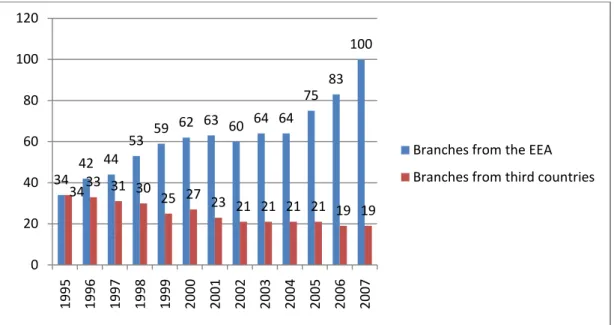
Figure 12 : Development of foreign MNBs branches in Germany ... 35
Figure 13 : Development of foreign MNBs subsidiaries in Germany ... 37
Figure 14: SWOT analysis ... 47
IX
List of abbreviations
ATM Automated Teller Machine B&M Brick and Mortar
CEE Central and Easter European EEA European Economic Area FDI Foreign Direct Investment GBA German Banking Act
ICT Information and Communication Technology JV Joint Venture
MNB Multinational Bank MNE Multinational Enterprise RDC Remote Deposit Capture
SMEs Small and Medium Sized Enterprises TCE Transaction Costs Economics
WOS Wholly Owned Subsidiary
1.
Introduction
In the aftermath of the recent financial crisis1 and in times in which banks rediscover the private individual – also described as the renaissance of retail banking2 - significant attention is now being paid to the market entries of foreign multinational banks.3
The German retail banking market is highly competitive. Private, cooperative and state-controlled savings banks compete intensely for market share with hardly any cooperative activities among the groups. As savings banks are owned by German states, towns or local authorities, they are protected by law from takeovers by institutes from the other banking sectors.4 Due to the high fragmentation of the German market, hardly any bank has dominant market power. The five largest banks have a total market share of only 20 percent and new competitors enter the market and attract customers with aggressive price differentiation offers.5 The strong competition among private banks, savings banks and co-operative banks results in low profit margins by international comparison. The profit potential in German private-customer business has fallen for many years. From 2000 to 2006 total income from the financial service providers in Germany, measured by the distribution of financial products with private customers, fell approximately 15% from € 67.5 billion to € 57.4 billion.6 Though the retail banking sector has experienced some increase in profits due to cost reduction and reduced loan failures in 2007, market potential still stagnated in 2009.7
Since the financial crisis has raised the awareness of the threats of investment banking, many banks have refocused on core business activities in order to maintain their solvency through increased account deposits. Banks need money to grant loans to private individuals or enterprises, provide investment opportunities, finance consumer goods or simply realize baking transactions. Yet, the recent financial crisis caused distrust among the banks and loans will not be granted as
1 Plickert (2009) 2 Deutsche Bank (2009) 3
Köhler and Lang (2008)
4 Spiegel Online (2007) 5 Welp (2009) 6 Zeb/rolfes.schierenbeck.accosiates (2008) 7
2
easily as before. On the consumer side, the financial crisis has increased the demand for secure money investments. A survey of 230 highly ranked managers from private, savings and co-operative banks on the effects of the crisis on their business indicates that banks have concentrated more intensively on business with private customers both during and after the latest crisis. Moreover, customer demand for certificates, company shares or funds has fallen significantly, while the demand for standard retail banking products such as call money accounts or account books has increased substantially.8
In spite of its high competitiveness and low profit margins, the German retail banking market is still attractive for foreign banks. Foreign MNBs are increasingly able to penetrate the market for private individuals.9 In particular, they gain market share through new products, decreasing prices, standardized processes and innovative marketing, whereas domestic banks have often relied on continued customer loyalty.10 Although foreign multinational banks in Germany have usually concentrated on large domestic corporations engaged in international transactions11, they now enter the market for private and small corporate clients as well12- a trend that has been supported by the development of internet technology and other new marketing - channel options.
The distinctive characteristics of the German banking market raise several questions concerning both entry mode and business model considerations of multinational banks. Should a multinational bank engage in cross-border lending or rather enter the market via foreign direct investment? How do the development of economic, political-legal and social-cultural factors in the German market affect a multinational bank`s entry mode and business model choice?
This thesis distinguishes between the non - equity entry modes of cross-border lending and alliances as well as the equity entry modes of representative offices, branches, subsidiaries, and JVs, both from a Greenfield investment and an acquisition point of view. Each of these organizational entry mode forms has
8 Welp (2009) 9 Reitz (2005) 10
McKinsey & Company (2007)
11
Hersh and Weller (2002)
12
3
distinctive advantages and disadvantages. Hence, the main focus of this thesis is to provide a broad understanding of the distinctive market entry and penetration strategies in light of macro and micro economical developments in Germany.
1.1
Research Objective
This thesis examines entry mode choice decisions and business model considerations of multinational banks entering the German retail banking sector. The objective is to evaluate the affect of current market developments on their entry mode decisions.
In light of the financial crisis and the banks` rediscovery of the private individual, the German banking sector is currently experiencing a renaissance, resulting in increasing industry rivalry. At the same time, the processing of bank transactions and customer services is becoming increasingly independent of the branch distribution channel and the adoption of new technologies is substantially affecting the allocation of retail banking services.13 The technological evolution is exemplified by the emergence of web-based direct banks, which have been able to penetrate the retail banking market with low-cost structures, innovative ideas and distinctive service thinking.
Eventually, the growing importance of the internet and other technological means as distribution channels on the one hand and the remaining strong demand for personal consultation on the other hand require a customer-oriented multi-channel management of the banks.14
This paper contrasts the two opposing ends in the field of retail banking distribution channels. It simplifies the entry mode choice between direct banks that solely operate through the internet and brick & mortar banks, which solely operate through a branch network. Furthermore, it differentiates between branch entry via Greenfield investment and subsidiary entry via acquisition.
Two major questions will be addressed:
13
Deloitte (2010)
14
4
Firstly, to what extent do demographic and technical developments favor a direct bank entry mode over a brick and mortar bank approach in Germany?
Secondly, what affects the decision in favor of a branch entry mode via Greenfield investment as compared to a subsidiary entry mode via acquisition in Germany?
1.2
Structure
This thesis is systematically divided into two different complexes - a theoretical and a practical. After a classification of essential banking terms in the section 2, Section 3 then describes relevant market entry theories – namely the Transaction Costs Theory and the Eclectic Theory as well as market entry strategies – namely the offensive and the defensive strategies of expansion.
In section 4, the German retail banking market is analyzed within the five forces framework. The goal of this examination is to evaluate market attractiveness and to identify micro and macroeconomic developments that may shape the market in the future.
Given the theoretical framework of section 3 and the knowledge of industry structure and trends of section 4, section 5 explores the decision driving factors of entry mode choice. In this section, cross-border lending, alliances, joint ventures and representations will be discussed. Furthermore, this section indicates what affects the decision in favor of a branch entry mode via Greenfield investment as compared to a subsidiary entry mode via acquisition and to what extent demographic and technical developments favors a direct bank entry mode over a brick and mortar bank entry mode in Germany.
Section 6 introduces the SWOT analysis as well as the Service Marketing Mix and applies these concepts to the ING - DiBa case study. It illustrates how ING- DiBa penetrated the German retail banking market with both the implementation of the direct banking business model and the exploitation of external opportunities.
5
2.
Classification of Banks
2.1 Bank
This paper refers to banks as defined in the German Banking Act. Section 1 GBA defines financial institutes as enterprises which pursue banking transactions, insofar as the extent of these transactions requires commercial business operations. At least one of the following transactions has to be carried out: security transactions, credit transactions, payments transactions or other banking business. The enterprise which pursues banking transactions in Germany requires the permission of the BaFin (Federal Institution for Finance Service Supervision) according to section 32 GBA.
2.2 Direct Bank
Direct banks are credit institutes which operate without a branch network and utilize the internet and the telephone as direct communication channels through which banking transactions are realized and marketing and customer service takes place. Thus, direct banks establish cost advantages which they usually transmit in the form of attractive terms.15
2.3 Brick and Mortar Bank
A brick and mortar (B&M) company is a traditional "street-side" business that deals with its customers face to face in an office that the company owns or rents.16 A brick and mortar bank serves consumers in a physical facility as distinct from providing online or telephone services only. The term brick and mortar is not a generally valid classification of a bank, but in the jargon of e-commerce it is frequently employed to distinguish from internet based enterprises. In this thesis, the term brick and mortar bank is employed to differentiate between a direct bank that operates through direct channels and one which operates solely through its branch network. The term brick and mortar is also distinguished from the term click and mortar, which is an expression for a form of multi-channel retailing in
15
Deutsche Bundesbank (2010)
16
6
which both electronic distribution channels (click) and physical premises (mortar) are utilized.17
2.4
Multinational Bank
Multinational banks are defined as banks that have a physical presence in more than one country. In contrast, international banks engage in cross-border operations but do not establish a physical presence in foreign countries.18
2.5 Retail Bank
There is no generally valid classification of retail banking in theoretical literature or in practice.19 A distinction in retail banking is often made with regard to its target clientele. In this regard, some authors define retail banking as the offering of banking and financial services to individuals and small and medium sized enterprises.20 Other sources define retail banking as the provision of these services solely to individuals.21 This paper employs the following classification of retail banks: `A retail bank is a bank that caters for ordinary individuals and small business, as distinct from large corporations. Retail banking operations offer deposit facilities, lend money, transfer funds and are prepared to deal in relatively small amounts.`22 In contrast to private and corporate banking, retail banking considers private clients with low to average income as well as small corporate clients
2.
Figure 1: Classification of retail banking clients (own illustration based on Swoboda, 2004)
17
Gabler Wirtschaftslexikon (2010)
18
Hersh and Weller (2002)
19
Müller and Jöhnk (2005)
20
Pond (2007); FinanceWiki (2008); Tremblay and Tremblay (2007)
21
Frei, Harker and Hunter (1998); Online: Businessdictionary.com (2010); Investoglossary.com (2010),
22
Essvale Corporation Limited (2007)
Retail Banking Medium and large corporate clients Wealthy private clients Small Corporate clients Private clients
7
3. Market Entry Theories and Strategies
3.1 Transaction Costs Theory
In the transaction cost theory, developed by Ronald Coase and Oliver E. Williamson, a comparison of transaction costs determines the optimal form of organization. In TC Theory the entry mode decision is a tradeoff between the control and the costs of resource commitment. Entry modes vary in three major aspects: the cost of resource commitment, control as the level of ownership and environmental risks that may affect the committed resources. Hence, high-control modes increase both risk and the potential return.23
Williamson differentiates between ex-ante and ex-post transaction costs. Information and searching costs are incurred ex-ante in the process of collecting market information and identifying suitable partners. Negotiation and contract costs arise ex-ante due to negotiations, legal advisory and the determination of contractual terms. Monitoring costs develop ex-post for activities which serve to control contractual obligations. Conflict and enforcement costs arise ex-post due to the different interpretation of the contract and the costs of enforcing contractual regulations with sanctions, negotiations or through court proceedings. Adaption costs are incurred due to ex-post changes in contractual agreements that become necessary because of unpredictable developments.24
TCE assumes the existence of bounded rationality and opportunism. Bounded rationality describes the limitation in human processing of information and the planning of possible outcomes. Opportunism describes the notion that humans may act in a self-interested manner by manipulating information and being dishonest. The consequences of these assumptions are incomplete contracts and moral hazards.25 Vice versa, opportunism occurs because firms can not write complete contracts.
The size of the transaction costs is determined in each case by the characteristics of asset specificity, uncertainty and frequency. Asset specificity arises when the actor in the market undertakes specific investments in order to fulfill his contractual
23
Chen and Mujtaba (2007) p.322
24
Kieser and Ebers (2006) p.278
25
8
obligations. It refers to the degree to which long-lasting human or physical assets are bound in a specific relationship and thus to the extent to which they provide value in the context of a different situation.26 In TCE, markets can hardly solve the problems that high uncertainty creates in combination with bounded rationality and threats of opportunism. Uncertainty includes environmental and behavioral uncertainty. Environmental uncertainty refers to political, legal, cultural and economic uncertainties that may affect the success of business transactions. Behavioral uncertainty states that bounded rationality and the threat of opportunism result in the high costs of monitoring a partner company.27 If the similar transactions are repeated frequently, learning effects and economies of scale occur and will reduce the transaction costs.
3.2 Eclectic Theory
The eclectic theory28 (or OLI paradigm) was developed by John Dunning and is a framework that merges different economic theories which explain foreign market entry patterns of multinational corporations.29 It states that the internationalization of MNCs is determined by three sets of independent variables: ownership advantages (or firm- specific advantages), location advantages (or country specific advantages) and internationalization advantages.
The ownership advantage considers the competitive advantages of MNCs arising from firm-specific characteristics such as size, monopoly power, economies of scale, management, brand name, technology and other resource capabilities.30 These advantages are usually intangible assets and can be transferred at low costs.31 The greater the competitive advantage of the MNC is, the more likely it is able to start or to increase its foreign production.32
The location advantages arise from country specific benefits that can be divided into three categories. Firstly, a host country may have economic advantages, comprising qualitative and quantitative factors such as production, transports costs,
26
Dietrich (1994) p.18
27
Brouthers and Brouthers (2003) p.1183 - 1185
28
Dunning (1980); Dunning (1988); Hill, Kwang and Kim (1990)
29
Dunning (2002)
30
Forsbaeck and Oxelheim (2004)
31
Griffin and Pustay (2006)
32
9
communication costs, market size or tax incentives. Secondly, a host country may offer political advantages, in particular governmental policies that may influence market entry. Thirdly, a host country may provide social and cultural advantages, including the psychic distance between the foreign and the domestic country as well as language or cultural aspects that may have an impact on the market entry decision. The higher the attractions of the specific location, the more likely it is that MNCs will exploit their ownership advantage by entering the foreign market.33 Because of the existence of transactions costs, the internationalization incentive advantage states that it must be profitable for the MNC to exploit these advantages itself rather than through local companies (e.g licensing).34
In economic literature, the OLI paradigm has also been applied to the banking sector. In this regard, ownership advantage may include easy access to a vehicle currency. Locational advantages may include country-specific regulations and entry barriers. Internationalization advantages can be information advantages and access to local deposit bases.35
Many empirical studies on the banking market have utilized the eclectic paradigm as a basic framework. For example, a study of bank entry into CEE markets concludes that the ownership advantages of foreign MNBs are strong compared to banks in emerging markets, and especially when the foreign country experiences a banking crisis.36 An application of the OLI paradigm to the Spanish banking market has shown that bank size and multinational experience of MNBs favor stronger commitment in the foreign country, whereas distance is an entry barrier.37 However, theoretical literature also states that in service industries clients close to the MNBs headquarters may be served from this location, whereas clients in distant markets require a physical presence of the MNB in the foreign country, which favors a foreign market entry with increasing distance.38
33 Dunning (2002) 34 Hagen (1997) 35 Yannopoulus (1983) 36
Uiboupin and Sorg (2006)
37
Blandón (1998)
38
10
3.3 Strategy of Defensive Expansion
A common approach employed to explain the expansion of MNBs involves the theory of defensive expansion, which is also referred to as the ´follow-the-customer´ argument.
This theory states that MNBs expand abroad in order to provide services for domestic clients, which are often large enterprises that have entered a foreign market.39 The provision of financial services in the foreign country usually requires a presence at important economic centres. Hence, to some degree, expanding corporations impose pressure on their domestic banks to follow-up.40
The term ´defensive´ is derived from the idea that a failure to expand may lead to a loss of the client, not only in the foreign country, but also in the domestic one, as the client may associate with a foreign MNB.41 Consequently, MNBs which pursue this strategy seek to prevent losses rather then to generate new profits in the foreign market.42 Furthermore, the domestic bank has an incomparable competitive advantage over banks in the foreign country with regard to the knowledge of customer needs , the respective risk of credit default as well as an interest in cross-selling products such as financial advisory.43
Due to earlier business relationships with the client, the domestic bank has reduced costs for examining the financial capacities of the respective enterprise and thus can offer cheaper services.44 Most foreign entry evidence supports the defensive expansion theory.45
A study on this theory with respect to retail banking has revealed that MNBs sometimes expand abroad in order to provide banking services to specific communities.46
39 Trend im retail-banking , köhler 40
Henneberger and Graf (2000)
41
Mullineux and Murinde (2003)
42 Naaborg (2007) 43 Knoop (2006) 44 Bhattacharya (1994) 45 Bhattacharya (1994); Naaborg (2007) 46 Tschoegl (1987)
11
3.4 Strategy of Offensive Expansion
MNBs that offensively expand abroad primarily seek to increase their customer base both in the home and in the foreign country. Firstly, the establishment of foreign branches and subsidiaries enables the MNB to expand their services to domestic residents who benefit from the international orientation of the bank. These may include customers that have business partners in the foreign country. Secondly, MNBs may target new customers in the foreign country, in particular MNEs or foreign subsidiaries of domestic enterprises. As the MNB must in both cases entice customers away from other banks, the MNB has to offer attractive and competitive conditions for their financial services.47
47
12
4. Industry
Analysis: German Retail Banking Sector
4.1 Porter`s Five Forces
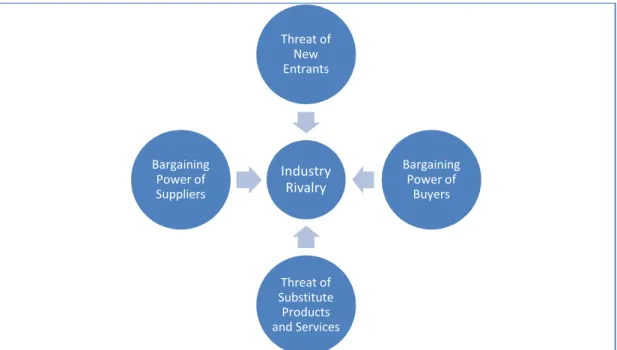
In the school of Industrial Economics, the five-forces model has established itself as a core element of industry analysis. Porter`s analysis framework is built on the following five market forces that shape the strategy of competitors: threat of new entrants, threat of substitute products or services, bargaining power of buyers and suppliers as well as rivalry among existing competitors.
Porter’s concept is based on the knowledge that the strategy of an enterprise must orient itself to its market environment, whereby the competitive strategy arises from a differentiated understanding of the market structure and the knowledge of how it changes. The effects of these forces determine the intensity of the competition in a market and with it its profitability and attractiveness. Therefore, the aim of the enterprise strategy should be reflected in the search for possibilities for the reduction or use of these competitive forces relative to its own enterprise. In this regard, Porter`s model is conducive to the analysis of the driving forces working in the respective industry.
Figure 2: Michael E. Porter`s five forces model (Own illustration based on Porter, 1979)
Industry Rivalry Threat of New Entrants Bargaining Power of Buyers Threat of Substitute Products and Services Bargaining Power of Suppliers
13
Porter`s framework is a useful and frequently utilized analytical tool to describe the foundations of industry competition.
A high degree of rivalry among the existing enterprises leads to high competitive pressure and can lower profit margins and the profitability of individual enterprises. In situations in which a large number of enterprises target similar market segments with comparable strategies, in which the market grows slowly, price is the most important differentiation factor and high exit barriers exist, a negative impact on the industry’s profitability is effected.48
The threat of new entrants can be determined by the entry barriers of a market. The competitive pressure on existing enterprises increases with low entry barriers. In such a situation important elements of the market (e.g, shares of the market, price level) can change due to the entry of new market participants.49
The bargaining power of buyers determines to what extent customers can influence enterprises by the amount of consumption and the pressure on margins. Important indexes of a high degree of buyer power include: high fixed costs in the industry, existence of supplements of the product or service, high degree of customer concentration, customers` knowledge of production costs, possibility of a reverse integration of customers, high growth rates of the market and a strong individualization of customer demand.50
The bargaining power of suppliers affects industry profitability if, for example, a concentrated supplier group dominates over existing enterprises in the market, which are not important buyers for the suppliers. Then the industry faces high margin pressure by the suppliers.
A threat of substitute products and services exists in particular if cheaper or higher-quality products and services are able to reduce existing sales volumes of a market or an enterprise.51 The future sales potential of existing enterprises becomes limited and industry competition increases.
48 Porter (1985) 49 Porter (1979); Recklies (2001) 50 Recklies (2001) 51 Recklies (2001)
14
Critics of this model state that it neglects the impact of complements as a sixth force of the industry, since they may facilitate or hinder the commercialization of certain goods. However, Porter argues that complements are not a force itself but they affect profitability in the way that they influence the five forces and that `the strategist must trace the positive or negative influence of complements on all five forces to ascertain their impact on profitability`.52
One limitation of this model is based on studies which indicate that company-specific factors may have a more important impact on profit than industry forces.53 Furthermore, the modelsuggests relatively static and stable market structure, which makes it difficult to assess contemporary dynamic markets.54
The model does not assess the impact of the parent company on its subsidiary, which is especially important in the banking sector, in which parent companies often have a strong impact on the performance of their subsidiary or branch. The parenting advantage includes the stand-alone influence through monitoring and influence on management decisions or capital expenses. Furthermore, parents create value by enhancing synergies within the group, offering corporate functions or managing portfolios.55
4.2 Rivalry among existing competitors
In this section the intensity of competitive rivalry among existing competitors in the German retail banking sector is discussed. In this regard an analysis of industry structure, industry growth and exit barriers will be conducted.
Industry structure: The German banking market is characterized by a three-pillar system which is reflected by the strict distinction between public-law banks, cooperative banks, and private banks.56 Each pursues different goals and is subject to different regulations. Private commercial banks pursue the goal of profit maximization, whereas saving banks serve the public contract of offering secure
52 Porter (1997)p.11 53 Zack (1999) 54 Recklies (2001) 55
Goold, Cambpell and Alexander (1994)
56
saving possibilities and loans. C interest of their members.
banking market is structured as follow
Figure 3
(own illustration, based on Sch
Public-law banks, including saving banks and state banks total balance sheet volume of banks in Germany.
do not participate in retail banking. The cooperative bank sector amounts to 11% the total, including cooperative banks
cooperative central banks
commercial banks, including large German Banks (Deutsche Bank, Commerce Bank, Post Bank, Hypovereins Bank), private banks and foreign banks
31% of total balance sheet volume.
European Research (ZWE), 43 % of experts state that the three important or very important and
for the low number of cross
In order to describe industry rivalry among maj
retail sector, the following table illustrates the number of customers per bank in Germany: 57 Engerer (2006) 58 Köhler (2008b) banks, 24% Private commercial banks, 31% 15
possibilities and loans. Cooperative banks primarily serve the economic interest of their members.57 In terms of total balance sheet volume, the German banking market is structured as follows.
Figure 3: Structure of the German Banking Sector
(own illustration, based on Schrooten, 2009)
law banks, including saving banks and state banks, amount to 33% of the total balance sheet volume of banks in Germany. However, state banks
do not participate in retail banking. The cooperative bank sector amounts to 11% , including cooperative banks, which participate in retail ban
cooperative central banks, which primarily serve large corporate clients. Private including large German Banks (Deutsche Bank, Commerce Bank, Post Bank, Hypovereins Bank), private banks and foreign banks
alance sheet volume. According to a recent survey of the Center for European Research (ZWE), 43 % of experts state that the three-pillar system is important or very important and 33 % state that it is the critical factor responsible
cross-border mergers and acquisitions in Germany.
In order to describe industry rivalry among major banks that participate in the , the following table illustrates the number of customers per bank in
Savings banks, 13% State banks, 20% Cooperative central banks; 3% Credit cooperative banks, 8% Other banks, 24%
serve the economic sheet volume, the German
: Structure of the German Banking Sector
amount to 33% of the However, state banks generally do not participate in retail banking. The cooperative bank sector amounts to 11% of participate in retail banking and serve large corporate clients. Private including large German Banks (Deutsche Bank, Commerce Bank, Post Bank, Hypovereins Bank), private banks and foreign banks, amount to According to a recent survey of the Center for pillar system is 33 % state that it is the critical factor responsible border mergers and acquisitions in Germany.58
or banks that participate in the , the following table illustrates the number of customers per bank in
State
banks, 20%
Cooperative central banks;
16
Figure 4: Customers of German Banks at the end of 2007 in millions
(own illustration based on Deutsche Bank, 2008)
With approximately 50 million customers, savings banks are the market leader in the German retail banking sector. Although state liability assumption for savings banks was abolished in 2005 because the EU saw in it an unacceptable subsidy to the disadvantage of private banks, customers still associate the name `Sparkasse` with state guarantees. The specific characteristic of a saving bank is based on its public contract in that it has to accept customers with poor credit-worthiness, that profits should be used to enhance public wealth and that the middle class should be supplied with loans.59
With approximately 30 million customers, cooperative banks are the second major player in the German retail banking sector. Nearly half of these customers are members of the cooperative banks.60 In contrast to the profit maximization goal of private commercial banks, their aim is to fund their members and secure their economic independence. Although cooperative banks are economically and legally independent in the different regions, they appear uniformly as a group under the brand of “Volks- und Raiffeisenbanken”. With regard to growth in customer base, cooperative banks benefit from the advantage of having the regional flexibility that
59
Kruck (2008)
60
Online: Raiffeisen Bank Homepage
3.1 4 6.1 11.8 24.2 30 50 0 10 20 30 40 50 60 Citibank Hypovereinsbank ING DiBa Commerzbank and Dresdner Bank Postbank and Deutsche Bank Credit Unions (Volksbanken) Savings Banks (Sparkassen)
17
allows for topical advertisement as well as a centralized management focus on improving reputation.61
The third group comprises the major private commercial banks, including Deutsche Bank, Postbank, Commerzbank and Hypovereinsbank. Deutsche Bank is a leading multinational investment bank, but with relatively low market share in the retail banking market. Deutsche Bank (9.7 million clients) is acquiring Postbank (14.5 million clients) with its broad branch network in a three-step process. Together they have 24,2 million clients. However, Heino Ruland from the analyst company Frankfurt Finanz Partner argues that Deutsche Bank might not be able to capitalize on the financially weaker Postbank clients, as Deutsche Bank is specialized in corporate clients.62 With regard to rivalry intensity and market profitability, Rainer Neske, supervisory board member and head of private & business clients of Deutsche Bank, emphasizes that the German retail banking market is too fragmented to be highly profitable and that Deutsche Bank does not seek to compete on the price level but defines itself through performance, quality and consultancy.63
Commerzbank is the second largest private commercial bank in Germany. After the acquisition of Dresdner Bank in 2009, Commerzbank now serves more than 12 million clients (of these 11 million private and one million corporate clients) and pursues the goal of becoming the market leader in Germany.64
UniCredit Bank AG, with the brand name Hypovereinsbank (HVB) is a subsidiary of UniCredirS.pA and is the third largest private commercial bank in Germany. HVB serves approximately four million clients, predominantly in north Germany and in Bavaria. As its retail banking segment could only report marginal profits in 2009, speculation about a sale or acquisition in this segment has come up. As the Swedish SEB (Skandinaviska Enskilda Bank) is considering selling its German retail segment with 174 branches and one million clients, experts now regard HVB as a major buying candidate.65
61 Schwarzbauer (2009) 62 Kreiler (2008) 63 Deutsche Bank (2009) 64 Kreiler (2008) 65
18
ING DiBa AG is a subsidiary of the Dutch ING Group and serves over 6 million clients. In contrast to savings, cooperative and the major private commercial banks, ING DiBa is specialized in direct banking, which distributes services via telephone, the internet or post instead of through branches. In Germany ING DiBa is the leader in direct banking, but there are many other direct banks, such as Comdirect (a subsidiary of Commerzbank), Volkswagen Bank or DAB Bank (a subsidiary of HVB). Competition takes place not only among direct banks but also between direct and branch banks. For instance, many saving banks have blocked the opportunity for customers of direct banks to withdraw cash from their automated teller machines. As savings banks can only charge Euro 1.74 for withdrawals via visa cards, they fear that direct banks can gain market share by offering attractive account options, with a convenient wide-area ATM provision.66 Targobank (former Citibank Deutschland) was acquired by the French cooperative bank Crédit Mutel and now serves more than 3.4 million clients in Germany in 2010. The bank is specialized in private retail customers with branches and direct banking.67
In conclusion, the degree of concentration in the German retail banking market is very low, which reduces the overall profitability of this sector for two main reasons: Banks earn higher profits in concentrated markets, as they obtain either monopoly rents (structure-conduct-performance paradigm) or due to high market shares that are gained by more efficient and profitable banks (efficient structure hypothesis)68. As retail banking services are largely standardized, product differentiation is low and price differentiation is often the only option. As public-law banks serve other interests than profit maximization, existing private banks and MNBs that want to enter this market have a competitive disadvantage. The low switching costs of clients intensifies competition on the price level and thus reduces the profitability of the market. However, brand identification and customer relationships are also important, which decreases the willingness of clients to switch solely on the basis of price comparison. In summary, market structure indicates a very high degree of rivalry among existing competitors.
66
Online: Financial Times Deutschland (2010)
67
Targobank (2010)
68
19
Industry growth: In this section, industry growth will be examined in a dynamic analysis of three relevant market growth indicators: the future long-run development of the German population, the historical development of the number of banks and branches in Germany and the historical development of market-share allocation in the context of major retail banking activities.
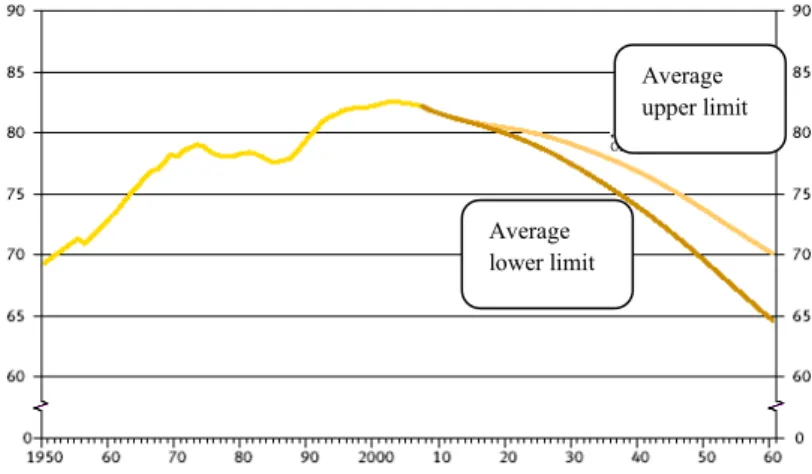
In the long-run, market growth depends on the future numerical development of the market`s customers - the German population. As the growth of population through birth and immigration is smaller than its decrease by virtue of the mortality rate and emigration, the Federal Statistical Office in Germany estimates a sharp decline of the German population.
Figure 5: Estimated Development of German Population (in millions)
(Federal Statistical Office, 2009)
The Federal Statistical Office predicts that the trend of decline in population since 2003 will continue and intensify. Whereas approximately 82 million people lived in Germany in 2008, only between 65 million (average lower limit of the population with 100.000 immigrants yearly) and 70 million people (average upper limit of the population with 200.000 immigrants yearly) will reside in Germany in 2060. Furthermore, the decreasing number of births and the ageing of the current, strongly represented, middle age group will lead to substantial changes in the age structure of the population. From 2008 to 2060, the proportion of people from 65 to 80 years will increase 15 % to 20 % and the proportion of people over 80 years of age will increase from 5 % to 14% of the population.69 The
69
Federal Statistical Office (2009)
Average lower limit
Average upper limit
20
implications of the aging population for banks will be discussed in the comparison between direct banks and B&M banks in section 6.6 of this thesis.
The second indicator of industry growth deals with the number of banks and bank branches in the German market. The overall number of banks in Germany decreased from 3785 in 1995 to 2300 in 2006. As retail banking usually depends on the number branches maintained, their development in Germany will be examined.
Figure 6: Development of Total Bank Branches in Germany (own illustration based on Köhler,2008a)
Savings banks and cooperative banks have reduced the number of branches significantly. Public-sector banks (savings banks, state banks etc.) with 18,757 branches and cooperative banks with 16,028 branches in 1998 reduced the number of branches to 14,252 and 12,303 respectively in 2006. Moreover, the number of branches of major commercial banks decreased from 19,055 in 1998 to 8,879 in 2006.
The main cause for the decrease of branches is the high fixed costs, which can not be recouped from low-revenue standard products that can also be distributed through alternative low-cost channels such as the internet.70
70
Köhler and Land (2008) 67930 66663 63186 59929 5854656936 53931 50868 47244 4546744100 40332 0 10000 20000 30000 40000 50000 60000 70000 80000 1995 1996 1997 1998 1999 2000 2001 2002 2003 2004 2005 2006
21
As a third indicator of industry growth, this paper reflects on the allocation of market share within the retail banking sector in order to indentify trends that may affect overall market growth. This paper will reflect on market share in two major retail banking segments - savings deposits and loans. The German Central Bank classifies the banking market in terms of savings banks, cooperative banks, direct banks and credit banks. The latter include universal banks, which are private commercial banks, branches of foreign banks, regional banks and other private banks.
This section reflects the development of market share regarding short-, medium- and long-term saving accounts and examines the allocation of loans to corporate clients, consumers (consumer loans), private households and self-employed persons.
In the period from 1998 to 2006, the market for medium-term saving deposits with a cancellation period under three months has been dominated by saving banks (53 % market share in 2006) and cooperative banks (29% market share in 2006). In the same period, the market share for long-term saving deposits with a cancellation period above three months has also continuously been dominated by savings banks (65 % market share in 2006) and cooperative banks (24 % market share in 2006). However, with regard to deposits that mature daily, direct banks were able to increase market share from approximately 1.5 % in 1998 to over 15 % in 2006.
Figure 7: Market share development of saving accounts that mature daily
(own illustration based on Deutsche Bundesbank, 2007) 0.00% 5.00% 10.00% 15.00% 20.00% 25.00% 30.00% 35.00% 40.00% 45.00% 1998 1999 2000 2001 2002 2003 2004 2005 2006 Direct Banks Cooperative Banks Savings Banks Credit Banks
22
From 1998 to 2006, market share for loans for corporate clients has been continuously dominated by credit banks (53 % market share in 2006) and savings banks (34 % market share in 2006). However, this data also comprises loans for medium and large corporations, which are not part of the retail banking market. Loans for private households and self-employed persons have predominately been granted by savings banks (39% market share in 2006), credit banks (30 % market share in 2006) and cooperative banks (25 % market share in 2006), though direct banks were able to gain some market share from 0 % in 1998 up to 5 % in 2006. Even more significantly, direct banks were able to gain over 16 % market share in the segment of consumer loans.
Figure 8: Market share development of consumer loans
(own illustration based on Deutsche Bundesbank, 2007)
Hence, the most significant growth indicator of the retail banking market results from the emergence of direct banks, which were able to gain substantial market share in consumper loans and deposits that mature daily.
In conclusion, the industry growth analysis indentifies the following growth indicators: Firstly, a sharp decrease in the German population in the following decades will reduce growth and increase industry rivalry. Moreover, the demographic change increases the proportion of old people in the population. Secondly, the number of branches in Germany is decreasing due to high fixed costs of branches. In order to be profitable in retail banking, the existing branches must serve a large quantity of customers, which leads to strong competition relative to market share. Thirdly, the development of market share allocation
0.00% 10.00% 20.00% 30.00% 40.00% 50.00% 60.00% 70.00% 2002 2003 2004 2005 2006 Savings Banks Cooperative Banks Direct Banks Credit Banks
23
indicates that only direct banks have experienced significant growth from 1995 to 2006.
Exit barriers: From a perspective of Transaction Costs Economics, one can argue that exit barriers in branch banking are high for market participants as branches and staff are highly specific assets that lose value when used in another situation. To a large extent, these assets are locked into the context of retail banking. Moreover, public-law banks usually have to serve the population, regardless of whether they are profitable or not. In a situation in which a bank continuously experiences losses, staff and branches may be considered as sunk costs and thus economically `irrational´ exit barriers. However, theories suggest that staff and branches are practically valid exit barriers and cause MNCs to stay in a market.71 The high degree of exit barriers intensifies the strong rivalry among existing competitors.
4.3 Threat of New Entrants
New entrants usually seek to gain market share while applying pressure on prices and costs and thus increasing the investments necessary to compete. An expert survey conducted by the ZEW emphasizes the importance of entry threat to the German retail-banking market: 66.66 % of market experts state that new competitors (e.g foreign banks) have an important or a very important impact on industry rivalry.72
In this section the threat of new entrants to existing market participants in the German retail banking sector is discussed. In this regard, this section evaluates legal entry barriers, capital requirements, the necessity of large scale operations, customer switching costs and incumbency advantages of existing domestic banks. Legal entry barriers are determined by governmental regulations in the German Banking Act (GBA) and are supervised by the Federal Supervisory Authority73: According to section 32 para 1 (1) GBA, companies that intend to pursue commercial banking transactions or financial services in Germany require written
71
Hill, Hwang and Kim (1990)
72
Köhler and Lang (2008)
73
24
permission from the Federal Financial Supervisory Authority ( “Bundesanstalt für Finanzdienstleistungaufsicht”). The execution of banking transactions or financial services also exists when the operator has its headquarters or primary residence abroad but repeatedly targets companies or individuals who have their primary residence in Germany. In order to obtain the permit, several requirements are examined (e.g business plan, qualified management etc).
Companies from third countries which intend to conduct banking transactions and provide financial services in Germany must establish a subsidiary (section 32 para 1 in connection with ection 33 para 1 (6) GBA) or a branch (section 32 para 1 in connection with section 53 GBA) in Germany. Companies from third countries can apply for an exemption according to section 2 para 4 GBA, if the company is supervised utilizing international accounting standards in the home country and the responsible authority works together with the BaFin. According to section 53b GBA, companies of EEA states are allowed to establish branches (section 53b para 2) but are also free to conduct cross-border financial services without a domestic presence (section 53b para 2a). Section 32 para 1 GBA does not apply to business that is motivated by the initiative of the domestic individual or enterprise (so called passive service freedom).
Representations are limited to their representative function and are not allowed to conduct or initiate any banking business.
Capital requirements are low for cross-border lending and and relatively low for representations. With high equity modes such as branches and even more so with subsidiaries, capital requirements are relatively high as capital is required for building a broad network of facilities and offering credit to customers. Capital requirements for direct banks are relatively low compared with those of B&M banks.
The necessity of large scale operation is related to the competitive advantage of economies of scale. A company that serves the market in the context of larger quantities benefits from lower cost per unit. In retail banking profit is gained by having a large number of clients. It is expensive to build up these numbers and to establish a distribution network to serve them. This necessity relates directly to the strategy of the bank. An acquisition offers a shortcut to these facilities, although the
25
costs of integration can be high as well.74 A MNB may also decide to target only a certain geographical area with certain clients and therefore do not have to enter on a very large scale.
Customer switching costs are different for each individual. In general, customers can easily change their banks and open a deposit account or apply for a loan at another bank. However, they have to compare the different terms for usually small transactions, to evaluate the convenience of having a bank nearby and then to decide to terminate the relationships with their current bank.75
Finally, the incumbency advantages of existing banks are important entry barriers. In particular, they include established brand reputation, possession of the most favorable geographical locations and market knowledge. Moreover, established banks may already have exclusive contracts with SMEs.76
To conclude, legal entry barriers are low and particularly low for banks from the EEA. Capital requirements for entering the market are high, yet as far as equity entry modes are concerned, direct banks require relatively low capital as they distribute their services through low-cost channels. Banks need to attract many customers to be profitable but banks strategy dictates whether or not to entrance should occur on a large scale. Moreover, the incumbency advantages of existing banks constitute important entry barriers.
4.4 Threat of Substitute Products or Services
A substitute in retail banking is a service that offers an attractive trade-off to a bank service or product. As individuals and small firms do not regularly report financial information as do large enterprises, they rely primarily on bank lending. However, there are additional forms of financing in the private equity or dept market.77 Many non- and near- banks provide substitute products and services. Near-banks or quasi-banks are suppliers of financial services, but are not classified as credit institutes according to section 1 GBA. Near-banks, such as insurance companies or credit card organizations, however, do provide substitute products or services. Non-
74
Hughes and MacDonald (2009)
75
Adams (2002)
76
Adams (2002)
77
26
banks, such as department store chains, catalog companies or car producers also provide substitute services.78 For instance, instead of taking out a loan in order to pay for a product, individuals or small enterprises may decide to take on a leasing contract for a certain asset or small enterprises can obtain a trade credit as well. Individuals may decide on buying products from insurance companies instead of putting money into a bank account.
Another substitute for both direct and B&M banks is the person-to-person (p2p) lending business, a new form of borrowing and lending money that takes place in a web-based market place. In this online platform, borrowers are connected to lenders through an auction-like process in which a lender who bids to provide a loan for the lowest interest rate will be awarded the loan contract with the borrower. A p2p company mediates between private or company borrowers and lenders and also executes transactions between the parties, similar to the role which e-bay plays in the trade of commercial goods.79 The p2p lending business does not involve traditional banks and thus can offer superior interest rates to borrowers and higher returns for lenders.
4.5 Bargaining Power of Suppliers
When a supplier group is more concentrated than the industry, does not primarily depend on the industry and when the industry faces high switching costs, the supplier group has strong bargaining power and can reduce the profit potential of an industry. In the retail banking market the most relevant suppliers include human resources, suppliers of capital resources and suppliers of information and communication technology (ICT).80 Highly talented or experienced specialists are strongly canvassed and have strong bargaining power with respect to their salary and working conditions. However, in the aftermath of the financial crisis, many banks are planning a reduction of staff. According to a study of Ernst & Young, every fifth bank intends to decrease staff and only every 10th bank is planning an increase.81 Given the current situation of the employment market, the bargaining power of employees is relatively low. Suppliers of highly specialized banking ICT
78 Gabler Wirtschaftslexikon (2010) 79 Deloitte (2009) p. 12 80
Büschgen and Börner (2003)
81
27
solutions have strong bargaining power, as switching costs for these systems are very high. Moreover, the higher yield requirements of shareholders can be interpreted as supplier power.
4.6 Bargaining Power of Buyers
In retail banking there are many buyers with relatively low transaction volumes, which weakens their bargaining power. However, retail banking services are standardized and buyers can easily find similar services. Switching costs have usually been relatively high for these low volume transactions, but in the age of the internet the market is very transparent and buyers can screen different offerings more easily. This does not necessarily imply that the cheapest banking service will be chosen automatically, as customers also seek a trustworthy brand, especially in times of financial crisis. Moreover, there are other factors that affect the switching cost of the individual such as the location of the branch. Yet, there is a tendency towards the increasing bargaining power of buyers.
This is also substantiated by the ZEW survey: 79.84 % of market experts state that decreasing customer loyalty and increasing price sensibility are important or very important factors with respect to the intensity of competition in the German retail banking sector. A comparison of former and modern retail customers also indicates that the bargaining power of retail banking service users has increased.
Former Retail Customer Modern Retail Customer
Passive information seeking behavior
Active information seeking behavior
Hardy or little informed Good to very good know-how High customer loyality Increasing willingness to switch
Fixation on the branch Expects multi-channel banking at all times and places
Little market transparency High price transparency
Relatively undemanding Demanding
Figure 9: Comparison of former and modern retail customers
28
5. Foreign Bank Entry Strategies in Germany
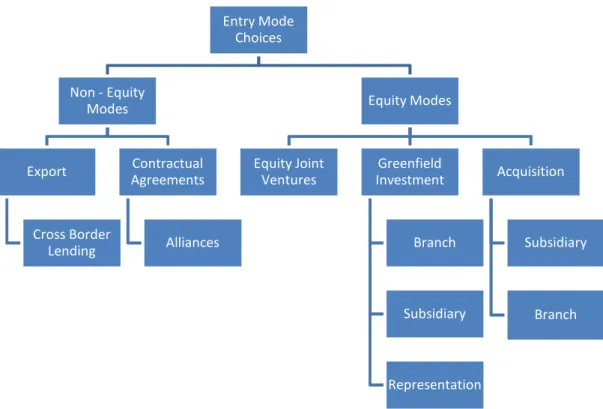
This section illustrates mode choices for foreign bank entry in Germany. Based on the hierarchical model of market entry modes82, the foreign bank has the choice of equity and non – equity modes of entry. An advantage of the hierarchical model is that it allows comparing between entry modes on different levels. The main difference between equity and non – equity modes is the degree of resource commitment in the foreign country. As classified at the beginning of this thesis, non-equity entry refers to international banking and equity entry refers to multinational banking.
The research question of this thesis considers multinational bank entry modes. International banking, however, is often a first step towards multinational banking. Hence, this thesis will also discuss cross-border lending and alliances as non – equity entry modes. The following figure illustrates a comprehensive view of market entry modes for banks.
Figure 10: A hierarchical model of entry mode choices for banks
(own illustration based on Pan and Tse, 2000)
82
Pan and Tse (2000)
Entry Mode Choices Non - Equity Modes Export Cross Border Lending Contractual Agreements Alliances Equity Modes Equity Joint Ventures Greenfield Investment Branch Subsidiary Representation Acquisition Subsidiary Branch
29
The hierarchical model illustrates the various entry mode choices for entering the German retail banking market. The creation of a common European financial market in which banks can integrate freely is a major goal of the European Union.83 The previous section of this paper indicates that entry barriers are relatively low and that the German market is highly competitive. Hence, the choice of a proper entry mode which is appropriate to the capabilities and the strategy of the bank is even more significant. Therefore, the following section will reflect on the strategic concept governing the choice of entry modes as well as the proliferation of these entry modes in the German retail banking market.
An international bank that is not interested in investing equity in the foreign market, can enter by means of cross-border lending or by forming a non-equity alliance. These non-equity entry modes can help the bank to access niche markets or to exploit locational advantages when the bank is located near the German border.
However, a retail bank, defined in the beginning of this paper, as a bank that `caters for ordinary individuals and small business´ and that seeks to enter the German market in order to gain significant revenue from deposits and loan business, might have to consider a physical presence in the foreign country.
The analysis considers entry modes that are perceived as international banking: cross-border lending and non-equity strategic alliances. Furthermore, the equity modes JVs and representations will be discussed.
Subsequently, this section compares the market entry of a branch through Greenfield investment with the market entry of a subsidiary by virtue of acquisition, as these modes of entry are the most common in the German retail banking market.
Finally, the following question will be addressed: to what extent do demographic and technical trends favor a direct bank entry mode over a brick and mortar bank approach in Germany?
83
30
Figure 11: Greenfield vs. acquisition and B&M banks vs. direct banks (own illustration)
5.1 Non – equity modes: Export – Cross-Border Lending
Cross-border lending is equivalent to the export entry mode and is a simple non-equity strategy to enter a foreign market. A bank which participates in cross-border lending must assess the creditworthiness of the individual borrower as well as the country risk, which involves the possibility that these loans will be impaired by economic or political proceedings in the foreign country.84 The country risk in Germany is rather low, as it is perceived to have a solid political and economic situation (Country Rating A2) with a stable and a very efficient business environment (Country Rating A1).85 As a bank will only have limited access to soft information about the creditworthiness of the borrower, the availability of loans usually decreases and the interest on loans usually increases with distance.86 Soft information for private loans includes the previous experience with the account management of the credit user, environmental facts and a judgment relative to his employment contract.87 For corporate loans, soft facts may include the market environment, corporate structure, management, a business plan as well as
84
Hughes and McDonald (2003)
85
Online: www.trade-safely.com (2009)
86
Agrawal and Hauswald (2007)
87 Dizil (2009) Entry Mode Choices of MNBs Greenfield Investment Branch Brick and
Mortar Bank Direct Bank
Acquisition
Subsidiary
Brick and
31
existential risks.88 Foreign banks may require a cost advantage and should be capable of taking on the higher risk.
A recent study on cross-border lending at the German – Austrian border suggests that German SMEs which are located near a border may use this opportunity to take out a competitive loan from a bank that is located next to the border but in a foreign country, due to the fact that soft information about the SME is easier to transfer with little physical and functional distance.89 The study also suggests that this advantage will be maintained for a distance up to 100 kilometers and that in the recent past a phenomenon occurred in that cross-border lending has been only the first step towards an FDI. In this regard, another study on German banks that operate abroad examined the relationship between FDI and the provision of financial services without affiliates in the foreign market.90 As many German banks provide financial services abroad without any affiliates, this may imply that cross-border financial services are a substitutes to FDI. However, the study concludes that more cross-border financial services are provided to countries in which foreign affiliate exits than when this is not the case. Therefore, FDI and the provision of cross- border financial services abroad complement rather that substitute for or exclude each other.
5. 2 Non – equity modes: Contractual Agreements –
Alliance
A strategic alliance is a market entry mode in which the MNB enters into medium- or long-term co-operative contractual agreements with enterprises (vertical alliance) or banks (horizontal alliance) in the foreign country. The partners in the alliance may pursue common or different goals. In the non-equity alliance, no new entity is founded (Joint Venture) and the contractual agreements are not secured by any capital participations (equity alliance).91 An example of a strategic non-equity alliance is the cooperation between the BHW Bank AG and the automobile club ACE, which exclusively offers motorcar financing and the investment products of
88
Reichling, Beinert and Henne (2005)
89
Fidrmuc and Hainz (2008)
90
Buch and Lipponer (2004)
91
32
the bank to its 550.000 members.92 Alliances offer a broad variety of starting points, including not only strategic alliances but also models of in- and outsourcing in which other enterprises are utilized within the value-creation chain.93 The advantages and disadvantages of non-equity strategic alliances are similar to those of joint ventures and will be discussed in the subsequent section. The main advantage involves the sharing of risks and costs while utilizing the local partner`s knowledge and networks in the foreign country. In contrast to a JV, a non-equity alliance allows the MNB to gain access to resources and capabilities with very low resource and capital commitment in the foreign country. However, a bank can hardly penetrate the highly competitive German retail banking market in the long-run with such a low resource commitment and presence in the market.
5.3 Equity Joint Ventures: Joint Venture (JV)
An e