Zurich Open Repository and Archive University of Zurich Main Library Strickhofstrasse 39 CH-8057 Zurich www.zora.uzh.ch Year: 2019
Interaction Embeddings for Prediction and Explanation in Knowledge
Graphs
Zhang, Wen ; Paudel, Bibek ; Zhang, Wei ; Bernstein, Abraham ; Chen, Huajun
Abstract: Knowledge graph embedding aims to learn distributed representations for entities and relations, and are proven to be effective in many applications. Crossover interactions — bi-directional effects between entities and relations — help select related information when predicting a new triple, but hasn’t been formally discussed before. In this paper, we propose CrossE, a novel knowledge graph embedding which explicitly simulates crossover interactions. It not only learns one general embedding for each entity and relation as in most previous methods, but also generates multiple triple specific embeddings for both of them, named interaction embeddings. We evaluate the embeddings on typical link prediction task and find that CrossE achieves state-of-the-art results on complex and more challenging datasets. Furthermore, we evaluate the embeddings from a new perspective — giving explanations for predicted triples, which is important for real applications. In this work, explanations for a triple are regarded as reliable closed-paths between head and tail entity. Compared to other baselines, we show experimentally that CrossE is more capable of generating reliable explanations to support its predictions, benefiting from interaction embeddings.
DOI: https://doi.org/10.1145/3289600.3291014
Posted at the Zurich Open Repository and Archive, University of Zurich ZORA URL: https://doi.org/10.5167/uzh-162876
Conference or Workshop Item Published Version
Originally published at:
Zhang, Wen; Paudel, Bibek; Zhang, Wei; Bernstein, Abraham; Chen, Huajun (2019). Interaction Em-beddings for Prediction and Explanation in Knowledge Graphs. In: International Conference on Web Search and Data Mining (WSDM), Melbourne, 11 February 2019 - 15 February 2019.
Interaction Embeddings for Prediction and Explanation in
Knowledge Graphs
Wen Zhang
Zhejiang University Alibaba-Zhejiang University Joint Institute of Frontier Technologies
Bibek Paudel
Department of Informatics University of Zurich Switzerland [email protected]Wei Zhang
Alibaba GroupAlibaba-Zhejiang University Joint Institute of Frontier Technologies
Abraham Bernstein
Department of Informatics University of Zurich Switzerland [email protected]Huajun Chen
∗ Zhejiang University Alibaba-Zhejiang University Joint Institute of Frontier TechnologiesABSTRACT
Knowledge graph embedding aims to learn distributed represen-tations for entities and relations, and are proven to be effective in many applications.Crossover interactionsÐ bi-directional effects between entities and relations Ð help select related information when predicting a new triple, but hasn’t been formally discussed before. In this paper, we proposeCrossE, a novel knowledge graph embedding which explicitly simulates crossover interactions. It not only learns one general embedding for each entity and relation as in most previous methods, but also generates multiple triple specific embeddings for both of them, namedinteraction embeddings. We evaluate the embeddings on typical link prediction task and find that CrossE achieves state-of-the-art results on complex and more challenging datasets. Furthermore, we evaluate the embeddings from a new perspective Ð giving explanations for predicted triples, which is important for real applications. In this work, explanations for a triple are regarded as reliable closed-paths between head and tail entity. Compared to other baselines, we show experimentally that CrossE is more capable of generating reliable explanations to support its predictions, benefiting frominteraction embeddings. ACM Reference Format:
Wen Zhang, Bibek Paudel, Wei Zhang, Abraham Bernstein, and Huajun Chen. 2019. Interaction Embeddings for Prediction and Explanation in Knowledge Graphs. InThe Twelfth ACM International Conference on Web Search and Data Mining (WSDM ’19), February 11ś15, 2019, Melbourne, VIC, Australia.ACM, New York, NY, USA, 10 pages.
1
INTRODUCTION
Knowledge graphs (KGs) like Yago [31], WordNet [20], and Free-base [1] have numerous facts in the form of (head entity,relation, tail entity), or (h,r,t) in short. They are useful resources for many
AI tasks such as web search [32] and question answering [42]. Knowledge graph embedding(KGE) learns distributed represen-tations [10] for entities and relations, calledentity embeddingsand relations embeddings. The embeddings are meant to preserve the
∗Corresponding author.
Paper to be presented at WSDM ’19, February 11ś15, 2019, Melbourne, VIC, Australia
2019.
information in a KG, and are represented as low-dimensional dense vectors or matrices in continuous vector space.
Many KGEs have been proposed, such as tensor factorization based RESCAL [25], translation-based TransE [3], neural tensor network NTN [29] and linear mapping method DistMult [40]. They are proven to be effective in many applications like knowledge graph completion, question answering and relation extraction.
Despite their success in modeling KGs, none of them has formally discussedcrossover interactions, which are the bi-directional ef-fects between entities and relations. Crossover interactions are quite common and help select related information when predicting new triples. Proper information selection is necessary during pre-diction because there are various information about each entity and relation in KGs. Crossover interactions includeinteractions from relations to entitiesandinteractions from entities to relations.
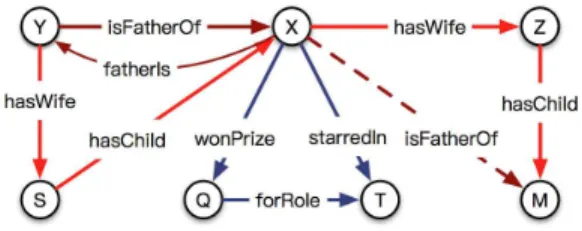
Figure 1:A hypothetical knowledge graph. Nodes and edges repre-sent entities and relations. Solid lines reprerepre-sent existing triples and dashed lines represent triples to be predicted.
We explain the notion of crossover interactions with a running example. Given the subgraph in Figure 1, consider the task of pre-dicting (X, isFatherOf, ?). There are six triples about entityX, but only four of them Ð (X, hasWife, Z), (X, fatherIs, Y), (Y, isFatherOf, X), (S, hasChild, X) Ð are related to this prediction, because they describe family relationships and are helpful to infer father-child relationship. The other two triples describing the career ofXdo not provide valuable information for this task.In this way, the rela-tionisFatherOf affects the information of entities to be chosen for inference. We refer this asinteraction from relations to entities.
In Figure 1, there are also two inference paths about the relation isFatherOf, but only one of them Ð (X −−−−−−−−→hasW i f e Z−−−−−−−−→hasChild M)
Ð is relevant for predicting (X, isFatherOf, ?), because information about (X, hasWife, ?) is available but (?, fatherIs, X) is not. In this way, the information of entities also affect the inference path of relations to use for inference. We refer this asinteractions from entities to relations.
Consideringcrossover interactionsin KGE, the embeddings for both entities and relations in specific triples should capture their interactions, and be different when involving different triples. However, most previous methods like TransE [3] learn a general embedding, which is assumed to preserve all information for each entity and relation. They ignore theinteractionsfor both entities and relations. Some methods like TransH [37] and TransG [38] learn either multiple entity or relation embeddings but not both at the same time. They ignore that the crossover interactions are bi-directional and affect both entities and relations at the same time. In this paper, we proposeCrossE, a novel KGE which explicitly simulatescrossover interactions. It not only learns one general em-bedding for each entity and relation, but also generates multiple triple specific embeddings, calledinteraction embeddings, for both of them. Theinteraction embeddingsare generated via a relation specific interaction matrix. Given a(h,r,t), there are mainly four
steps in CrossE: 1) generateinteraction embeddingshI for head
entityh; 2) generateinteraction embeddingsrI for relationr; 3)
combine interaction embeddingshI andrI together; 4) compare
the similarity of combined embedding with tail entity embeddingt. We evaluate the embeddings on canonical link prediction task. The experiment results show that CrossE achieves state-of-the-art results on complex and more challenging datasets and exhibits the effectiveness of modeling crossover interactions in KGE.
Furthermore, we also propose an additional evaluation scheme for KGEs from the perspective of explaining their predictions. Link prediction task only evaluates the accuracy of KGEs at predicting missing triples, without explaining the predictions. But in real applications, it is valuable to give explanations for predictions, as they will likely improve the reliability of predicted results. To the best of our knowledge this is the first work to address bothlink prediction and its explanationof KGE.
The process of generating explanations for one triple(h,r,t)is
modeled as searching reliable paths fromhtotand similar struc-tures to support the path explanations. We evaluate the quality of explanations based onRecallandAverage Support.Recallreflects the coverage of triples that a KGE can generate explanations for andAverage Supportreflects the reliability of the explanations. Our evaluation on explanations show that CrossE, benefiting from inter-action embeddings, is more capable of giving reliable explanations than other methods, including TransE [3] and ANALOGY [19].
In summary,our contributionsin this paper are the following:
•We propose CrossE, a new KGE which models crossover inter-actions of entities and relations by learning an interaction matrix. •We evaluate CrossE with various other KGEs on link prediction task with three benchmark datasets and show that CrossE achieves state-of-the-art results on complex and more challenging datasets with a modest parameter size.
•We propose a new evaluation scheme for embeddings, search-ing explanations for the predictions, and show that CrossE is able to generate more reliable explanations than other methods. The
evaluations suggest that interaction embeddings are better at cap-turing similarities between entities and relations in the different contexts of triples.
This paper is organized as follows. We review the literature in Section 2. We describe our model in Section 3 and explanation scheme in Section 4. We present the experimental results in Sec-tion 5 before concluding in SecSec-tion 6.
2
RELATED WORK
Knowledge graph embedding (KGE) aims to embed a knowledge graph into continuous vector space and learns dense low dimen-sional representations for entities and relations. Various types of KGE methods have been proposed and majority of them learn the relationship between entities using training triples in a knowledge graph. Some methods also utilize extra information, such as random walks, external text corpus and hierarchical type information to improve the quality of embeddings. Our work focuses on learning from triples in a knowledge graph without extra information, so we mainly summarize those methods in this section. Considering the requirement of multiple representations for entities and relations from crossover interactions, prior studies are classified into two classes: (1) methods learning a general embedding for each entity and relation, and (2) methods learning multiple representations for either of them. In the end we also briefly summarize the methods that learn embeddings using extra information.
KGEs with general embeddings.Existing embedding meth-ods with general embeddings all represent entities as low-dimensional vectors and relations as operations that combine the representa-tions of head entity and tail entity. Most methods are proposed with different assumptions in vector space and model the knowl-edge graph from different perspectives. The first translation-based method TransE [3] regards a relation as translation from head en-tity to tail enen-tity and assumes that the relation-specific translation of head entity should be close to the tail entity vector. It repre-sents each relation as a single vector. RESCAL [25] regards the knowledge graph as a multi-hot tensor and learns the entity vector representation and relation matrix representation via collective tensor factorization. HOLE [24], which is a compositional vector space model, utilizes the interactions between different dimensions of embedding vectors and employs circular correlation to create compositional representations. RDF2Vec [26] uses graph walks and Weisfeiler-Lehman subtree RDF kernels to generate entity sequence and regards the entity sequence as sequence of words in natural lan-guage, then follows word2vec to generate embeddings for entities but not relations. NTN [29] represents each relation as a bilinear tensor operator followed by a linear matrix operator. ProjE [28] users a simpler but effective shared variable neural network method. DistMult [40] learns embeddings from a bilinear objective where each relation is represented as a linear mapping matrix from head entity to tail entity. It successfully captures the compositional se-mantics of relations. ComplEx [34] makes use of complex valued embeddings to handle both symmetric and antisymmetric relations because the Hermitian dot product of real values is commutative while for complex values it is not commutative. ANALOGY [19] is proposed from the analogical inference point of view and based on the linear mapping assumption. It adds normality and commuta-tively requirement constrains to the matrices for relations so as to
improve the capability of modeling analogical inference.It achieves the state-of-the-art results on link prediction task.
All these methods learn a general embedding for each entity and relation. They ignore the crossover interactions between entities and relations when inferring a new triple in different scenarios.
KGEs with multiple embeddingsSome KGEs learn multiple embeddings for entities or relations under various considerations. Structured Embedding (SE) [4] assumes that the head entity and tail entity in the same triple should be close to each other in some subspace that depends on the relation. It represents each relation with two different matrices to transfer head entity and tail entity. ORC [43] focuses on the one-relation-circle and proposes to learn two different representations for each entity, one as a head entity and another as a tail entity. TransH [37] notices that TransE has trouble dealing with 1-N, N-1, and N-N relations. It learns a specific hyperplane for each relation and represents the relation as a vec-tor close to its hyperplane. Entities are projected onto the relation hyperplane when involving a triple with this relation. TransR [18] considers that various relations focus on different aspects of entities. It represents the aspects by projecting entities from entity space to relation space and gets various relation specific embeddings for each entity. CTransR [18] is an extension of TransR that considers correlations under each relation type by clustering diverse head-tail entity pairs into groups and learning distinct relation vectors for each group. TransD [12] is a more fine-grained model which constructs a dynamic mapping matrix for each entity-relation pair considering the diversity of entities and relations simultaneously. TranSparse [13] is proposed to deal with the heterogeneity and im-balance of knowledge graph for relations and entities. It represents the transfer matrices with adaptive sparse matrices and the sparse degrees for the transfer matrices is determined by the number of entities linked by this relation.
These methods mostly consider the effects on entities from rela-tions and learn multiple representarela-tions for entities. But they learn general embeddings for relations and ignore the interaction from entities to relations.
KGEs that utilize extra informationSome KGEs learn em-beddings utilizing not only training triples in a knowledge graph, but also extra information such as path rules from random walks. RTransE [6], PTransE [17] and CVSM [21] utilize the path rules as additional constrains to improves the embeddings. [35] considers three types of physical rules and one logical rule, and formulates the inference in knowledge graph as an integer linear programming problem. [15] and TKRL [39] propose that the hierarchical type information of entities is of great significance for representation learning in knowledge graphs. [15] considers entities types as hard constraints in latent variable models for KGs and TKRL considers hierarchical types as projection matrices for entities.
3
CrossE: MODEL DESCRIPTION
In this section we provide the details of our model CrossE. Our model simulates the crossover interactions between entities and relations by learning aninteraction matrixto generate multiple specific interaction embeddings.
In our method, each entity and relation is represented by multiple embeddings: (a)a general embedding, which preserves high-level properties, and (b) multipleinteraction embeddings, which preserve
specific properties and information about crossover interactions. The interaction embeddings are obtained through Hadamard prod-ucts among general embeddings and aninteraction matrixC
We denote a knowledge graph asK={E,R,T}, whereE,R,T
represent the sets of entities, relations and triples respectively. The number of entities isne, the number of relations isnr, and the
dimension of embeddings isd. Bold letters denote embeddings. E∈Rne×dis the matrix of general entity embeddings with each row representing an entity embedding. Similarly,R∈Rnr×dis the matrix of general relation embeddings.C∈Rnr×dis theinteraction matrixwith each row related to a specific relation.
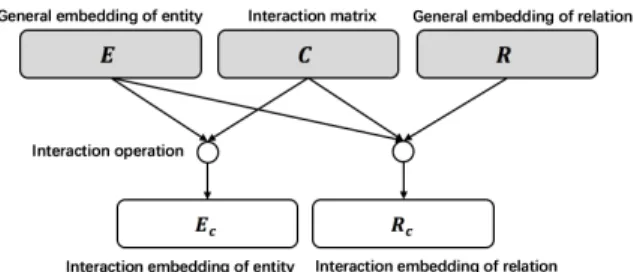
The basic idea of CrossE is illustrated in Figure 2. The general embeddings (Efor entities andRfor relations) and interaction matrixCare represented in the shaded boxes. The interaction embeddingsEcandRcare the results of crossover interactions
between entities and relations. Note thatE,R, andCare parameters that need to be learned. The interaction embeddingsEcandRcdo
not need to be learned as they are fully specified by the interaction operation on general embeddings.
Figure 2: Overview of CrossE. Crossover interactions be-tween general embeddings (E and R) and interaction matrix (C) resulting in interaction embeddings (unshaded boxes).
We now explain the score function and training objective of CrossE. Head entityh, tail entityt, and relationrcorrespond to high-dimensional ‘one-hot’ index vectorsxh,xt andxr. The learned
general embeddings ofh,randtare written as:
h=x⊤hE, t=xt⊤E, r=x⊤rR (1)
In CrossE, we define a score function for every triple such that valid triples receive high scores and invalid triples receive low scores. The score function has four parts and we describe them next.
(1) Interaction Embedding for Entities.To simulate the ef-fect from relation to head entity, we define the interaction operation applied to head entity as:
hI =cr ◦h (2)
, where◦denotesHadamard product, an element-wise operator that has been proved to be effective and widely used in previous methods, such as [24] and [34]. We callhI the interaction embedding ofh.
Here,cr ∈R1×dis a relation specific variable which we get from
the interaction matrixCas in (3). Ascrdepends on relationr, there
are as many interaction embeddings ofhas there are relations.
cI =x⊤IC (3)
(2) Interaction Embedding for Relations.The second inter-action operation applies to the relations so as to simulate the effects from head entities. This interaction operation is defined in (4). Sim-ilar to (2), this is the Hadamard product ofhI andrand we callrI
the interaction embedding ofr. For every head entity, there is an interaction embedding ofr.
rI =hI◦r (4)
(3) Combination OperatorThe third step is to get the com-bined representation and we formulate it in a nonlinear way:
qhr =tanh(hI +rI +b) (5) , whereb ∈ R1×d is a global bias vector.tanh(z) = ez−e−z
ez +e−z, in which the output is bounded from−1 to 1. It is used to ensure the combined representation share the same distribution interval (both negative values and positive values) with the entity representation. (4) Similarity OperatorThe fourth step is to calculate the sim-ilarity between combined representationqhrand general tail entity representationt:
f(h,r,t)=s(h
,r,t)=σ(qhrt
⊤) (6)
,where dot product is used to calculate the similarity andσ(z)= 1
1+e−z is a nonlinear function to constrain the scores(h ,r,t)∈ [0
,1].
The overall score function is as follows:
f(h,r,t)=σ(tanh(cr◦h+cr◦h◦r+b)t⊤) (7)
To evaluate the effectiveness of the crossover interactions, we devise a simplified CrossE called CrossESby removing the
inter-action embeddings and using only the general embeddings in the score function:
fS(h,r,t)=σ(tanh(h+r+b)t⊤) (8)
Loss functionWe formalize a log likelihood loss function with negative sampling as the objective for training:
L(K)=− Õ (h,r,t)∈K Õ x∈B(h,r,t) loд(l(x)f(x)) +loд(1−l(x))(1−f(x)) +λÕ∥θ∥22
Here,B(h,r,t)is the bag of positive examples with label 1 and
negative examples with label 0 generated for(h,r,t). The label
of examplex is given byl(x). For(h,r,t), positive examples are
(h,r,e) ∈ Kand negative examples are(h,r,e)<K. The factorλ
controls the L2 regularization of model parametersθ ={E,R,C,b}.
The goal of the training procedure is to minimizeL(K)and we train it iteratively using a gradient based approach.
Number of Parameters.The total number of parameters for CrossE is(ne+2nr+1)×d, as there arene+nrgeneral embeddings,
nr additional embeddings from the interaction matrix, and a bias
term. Note that interaction embeddings are fully specified by these parameters. While predicting head entities, we model the task as the inverse of tail entity prediction, e.g., (t,r−
1
,h). In such cases, we
need 2nr more embeddings for inverse relations. Sincenr ≪nein
most knowledge graphs, this does not add a lot of extra parameters. The main benefits of CrossEcompared to existing KGEs are as follows: (1) For an entity and a relation, the representations used during a specific triple inference are interaction embeddings (not general embeddings), which simulate the selection of different in-formation for different triple predictions. (2) Multiple interaction embeddings for each entity and relation provide richer representa-tions and generalization capability. We argue that they are capable of capturing different latent properties depending on the context of interactions. This is because each interaction embedding can
select different similar entities and relations when involving differ-ent triples. (3) It learns one general embedding for each differ-entity and relation, and uses them to generate interaction embeddings. This results in much less extra parameters than when learning multiple independent embeddings for each entity and relation.
4
EXPLANATIONS FOR PREDICTIONS
In this section, we describe how we generate explanations for pre-dicted triples. Explanations are valuable when KGEs are imple-mented in real applications as they help improve the reliability of and trust from people on the predicted results. The balance between predicting accuracy and explanation has already attracted research attention in other areas, such as recommender systems [9, 36].
We first introduce the motivation for our explanation scheme, followed by our embedding-based path-searching algorithm.
4.1
Background
Similar to inference chains and logical rules, meaningful paths from htotcan be regarded as explanations for a predicted triple(h,r,t).
For example, in Figure 1, the fact that X is father of M can be inferred by(X,hasW i f e,Z)and(Z,haschild,M).
X −−−−−−−−→hasW i f e Z−−−−−−−−→hasChild M⇒X −−−−−−−−−−−→is F at her O f M (9) The right-hand side of the implication "⇒" is calledconclusionand the left-hand side ispremise.Premiseis an explanation for the conclu-sion. In the above example, the pathX −−−−−−−−→hasW i f e Z−−−−−−−−→hasChild M is one explanation for the triple(X,isFatherO f,M).
Searching paths between head entity and tail entity is the the first step for giving explanations for a triple. There are multiple works focusing on mining such paths as rules or features for predic-tion, e.g., AMIE+ [5] and PRA [16], in which the paths are searched and pruned based on random walks and statistical significance. An important aspect of efficient path search is the volume of search space. Selecting the candidate start entities and relations is the key point of reducing search space. Good embeddings can be useful for candidate selection with less effects on path searching results, because they are supposed to capture the similarity semantics of en-tities and relations. Thus giving explanations for predicted triples by searching for reliable paths based on embeddings not only improve the reliability of predicted results but also is a new perspective of evaluating embedding qualities.
In this paper, the explanation reliability for triple(h,r,t)is
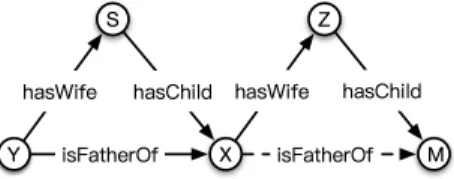
eval-uated with the number ofsimilar structuresin knowledge graph, on which the inferences are mainly based, as noted by [23]. Two similar structures contain same relations but different specific en-tities. For example, Figure 3 is a subgraph with similar structures from Figure 1.
The left and right subgraph in Figure 3 are similar structures, as they both contain three entitiese1,e2,e3, a triplee1
is F at her O f
−−−−−−−−−−−→ e3, and a pathe1
hasW i f e
−−−−−−−−→ e2 −−−−−−−−→hasChild e3. Thus the left
sub-graph is asupportfor(X,isFatherO f,M)with path explanation
X −−−−−−−−→hasW i f e Z −−−−−−−−→hasChild M and vice versa. They support the reasonable existence and path explanation of each other. In general, the more similar structuresupportan explanation has, the more reliable it is.
4.2
Embedding-based explanation search
During the embedding-based explanation search, we first select candidate entities and relations embedding similarity to reduce the search space before generating explanations for a triple(h,r,t). Thecandidate selection is related with the quality of embeddings and will directly affect the final explanations. We assume the similarity of vector embeddings are related to Euclidean distance and matrix embeddings are related to Frobenuis norm. Then based in selected candidates, we do exhaustive search for explanations which in-volves (1) searching closed-paths fromhtotas explanations and (2) searching similar structures for the explanations assupport.
More specifically, there are four main steps:
•Step 1: Search similar relations.Find topkr relations
sim-ilar tor, denoted by the setSr ={r1,r2, . . .,rt}, as possible first
steps for path search. This step helps to prune unreasonable paths. For example, the pathh −−−−−−−−−−→has F r iend c −−−−−→l ikes b doesn’t indicate the relationshiph −−−−−−→l ive I n beven if it may have a lot of support, becausehasFriendis not related with the inference ofliveIn. To avoid such meaningless paths, the search is constrained to begin with relations similar tor, which are more likely to describe the same aspect of an entity.
•Step 2: Search paths betweenhandt.Search a set of path P={p|(h,p,t) ∈ K}. For simplicity, we consider paths with length
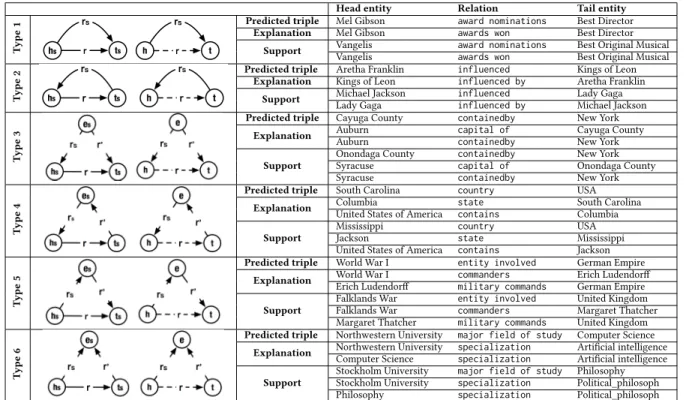
less than three as in [40]. There are six types of paths corresponding to six similar structures as shown in Table 1. The six possible paths are:p1 ={h−−→rs t},p2 ={h ←−−rs h},p3 ={h ←−− ◦rs r ′ −→h},p4 = {h←−− ◦rs ←−r′ h},p5={h r s −−→ ◦−→r′ h},p6={h r s −−→ ◦←−r′ h}. Here, ◦andr′denote any entity and relation in KG. To search for paths with length two, we apply a bi-direction search strategy. Takep5
as an example, we first find two entity setsE1={e|(h,rs,e) ∈ K}
andE2 = {e|(e,r′,t) ∈ K,r′ ∈ R}. Then we get the path via
intersection entities ofE1andE2,p={(h−−→ ◦rs r
′
−→t)|(e,r′,t) ∈
K,e ∈ E1∩ E2}.
•Step 3: Search similar entities.Find topkesimilar entities
for h, denoted by the setSh ={h1,h2, . . .,hk}. and check for
cor-responding tail entityts of(hs,r,?)in the KG, wherehs ∈ Sh.
The tail checking results depend on the quality of selected similar entities, therefore the more capable a KGE is in capturing similarity between entities, the higher is the probability that(hs,r,ts)exist.
•Step 4: Search similar structures as support.Find support for pathp∈ Pfrom step 2 based on the similar entities from step 3. If(hs,p,ts) ∈ K, regard the pathpas an explanation for(h,r,t)
and((hs,p,rs),(hs,r,ts))as a support for this explanation. We only
consider the paths with at least one support in knowledge graph as explanations.
We summarize the process of embedding-based explanation search in Algorithm 1.
Algorithm 1Search explanations for predicted triple(h,r,t) Require: Knowledge graphK, relation and entity embeddingsRandE Ensure: Explanations for(h,r,t)and their supports.
1: Explanation setE=∅, Support setS=∅ 2: Select the setSrof topkrsimilar relations forr
3: Search the corresponding path setP={p|(h,p,t) ∈ K }for each type: direct search for similar structure type 1 and type 2, and bidirectional search for type 3, type 4, type 5, and type 6.
4: Select the setShof topkesimilar entities forh 5: forp ∈ Pdo 6: if(hs,p,ts) ∈ Kand hs ∈ Shthen 7: E←E∪p 8: S←S∪ ((hs,p,ts),(hs,r,ts)) 9: end if 10: end for
In order to make explanations and support more clear, in Table 1, we give real examples of path explanations and their supports based on the CrossE embeddings (Section 5.3 provides details about the implementation). For each types of path, we list a predicted triple with this kind of path explanation and one example support from the embedding-based explanation search results of CrossE. It is expected that the reliability of predicted triple increases when end-users are also provided with the explanation and its support in the form of similar path structures.
5
EXPERIMENTAL EVALUATION
We begin this section by describing datasets used in our experi-ments. We then explain a comparative study of different KGEs on two main tasks: (a) link prediction, and (b) generating explanations for predicted triples.
5.1
Datasets
We use three popular benchmark datasets: WN18 and FB15k in-troduced in [3], and FB15k-237 proposed by [33]. They are either subset of WordNet [20], a large lexical knowledge base about Eng-lish, or Freebase [1], a huge knowledge graph describing general facts in the world. The details of these datasets are given in Table 2.
5.2
Evaluation I: Link Prediction
In this section, we evaluate the embeddings on canonical link predic-tion task, which contains two subtasks, one is tail entity predicpredic-tion (h,r,?)and the other one is head entity prediction(?,r,t).
5.2.1 Evaluation Metrics.The link prediction evaluation follows
the same protocol as in previous works, in which all entities in the dataset are candidate predictions. During head entity prediction for (h,r,t), we replace thehwith each entity and calculate their scores
according to score function given by (7). Then we rank the scores in descending order and regard the rank ofhas prediction result. The tail entity prediction is done similarly.
Head entity Relation Tail entity
T
yp
e
1 Predicted triple Mel Gibson award nominations Best Director
Explanation Mel Gibson awards won Best Director
Support VangelisVangelis award nominations Best Original Musical
awards won Best Original Musical
T
yp
e
2 Predicted triple Aretha Franklin influenced Kings of Leon
Explanation Kings of Leon influenced by Aretha Franklin
Support Michael JacksonLady Gaga influencedinfluenced by Lady GagaMichael Jackson
T
yp
e
3
Predicted triple Cayuga County containedby New York
Explanation AuburnAuburn capital of Cayuga County
containedby New York
Support
Onondaga County containedby New York
Syracuse capital of Onondaga County
Syracuse containedby New York
T
yp
e
4
Predicted triple South Carolina country USA
Explanation ColumbiaUnited States of America statecontains South CarolinaColumbia
Support
Mississippi country USA
Jackson state Mississippi
United States of America contains Jackson
T
yp
e
5
Predicted triple World War I entity involved German Empire
Explanation World War IErich Ludendorff commandersmilitary commands Erich LudendorffGerman Empire
Support
Falklands War entity involved United Kingdom Falklands War commanders Margaret Thatcher Margaret Thatcher military commands United Kingdom
T
yp
e
6
Predicted triple Northwestern University major field of study Computer Science
Explanation Northwestern UniversityComputer Science specialization Artificial intelligence
specialization Artificial intelligence Support
Stockholm University major field of study Philosophy Stockholm University specialization Political_philosoph Philosophy specialization Political_philosoph Table 1: Six similar structures with real examples of explanations and support for predictions made by CrossE. Dataset | E | | R | |Train Set| |Validation Set| |Test Set|
WN18 40,943 18 141,442 5,000 5,000
FB15k 14,951 1,345 483,142 500,00 59,071 FB5k-237 14,541 237 272,115 17,535 20,466
Table 2:Datasets statistics.
Aggregating the head and tail entity prediction ranks of all test triples, there are three evaluation matrices: TheMean Rank(MR), Mean Reciprocal Rank(MRR)and Hit@N, which is the proportion of ranking scores withinNof all test triples.MRRis similar toMRbut more immune to extremely bad case. Similar to most recent works, we evaluate CrossE onMRRandHit@1, Hit@3andHit@10.
We also applyfilterandrawsettings. Infiltersetting, we filter all candidate triples in train, test or validation datasets before ranking, as they are not negative samples.Rawis the setting without filtering.
5.2.2 Implementation Details. Parameter initialization are as
fol-lows:E,RandC are initialized from the uniform distribution
U[−√6
d,
6
√
d]as suggested in [7].bis initialized to zero.
The positive samples for training triple(h,r,t)are generated
by retrieving all(h,r,e) ∈ Kt r ain. Negative triples are generated
randomly by samplingnentities such that(h,r,e)<Kt r ain.
The head entity prediction(?,r,t)is transformed to(t,r−1,?)in
whichr−1is the inverse relation ofr. We generate inverse triples (t,r−1,h)for each(h,r,t)during training, as done in [17, 21].
We implement our model using TensorFlow with Adaptive Mo-ment Estimation (Adam) [14] optimizer and dropout [30] with dropout rate 0.5 applied to similarity operator given in (6). The
maximum training iteration is set to 500 for all datasets.
The configurations for the results of CrossE are as follows: num-ber of negative examplesn=50, learning rater=0.01, dimension
parameters WN18 FB15k Unstructured [2] ned 38.2 6.3 RESCAL[25] ned+nrd2 52.8 44.1 NTN [29] ned+nr(sd2+2sd+2s) 66.1 41.4 SE [4] ned+2nrd 80.5 39.8 LFM [11] ned+nrd2 81.6 33.1 TransH[37] ned+2nrd 86.7 64.4 TransE[3] ned+nrd 89.2 47.1 TransR[18] ned+nrd2+nrd 92.0 68.4 RTransE [6] ned+nrd - 76.2 TransD[12] 2ned+2nrd 92.2 77.3 CTransR [18] ned+nrd2 92.3 70.3 KG2E [8] 2ned+2nrd 93.2 74.0 STransE [22] ned+nrd+2nrd2 93.4 79.7 DistMult [40] ned+nrd2 93.6 78.3 TranSparse [13] ned+nrd+(1−θ)nrd2 93.9 79.9 PTransE-MUL [17] ned+nrd - 77.7 PTransE-RNN [17] ned+nrd+d2 - 82.2 PTransE-ADD [17] ned+nrd - 84.6
ComplEx [34] 2ned+2ned 94.7 84.0
ANALOGY [19] ned+nrd 94.7 85.4
HolE [24] ned+nrd 94.9 73.9
CrossE ned+2nrd+d 95.0 87.5†
CrossES ned+nrd+d 87.3 72.7
Table 3: HIT@10(filter) results of 22 KGEs on WN18 and FB15k. "-" indicates missing results form original paper. Boldface scores are the best results among all methods. Underlined scores are the better ones between CrossE and CrossES. Inparameterscolumn,ne
andnrdenote number of entities and relations respectively,dis the embedding dimension,sis the number of hidden nodes of a neural network,θis the sparse degree of matrix.
d=100, regularizer parameterλ=10−4and batch-sizeB=2048 for WN18;n=50,r =0.01,d=300,λ=10−
6andB
=4000 for FB15K;n =50,r = 0.01,d = 100,λ =10−5andB = 4000 for
FB15k-237. CrossESis trained with the same parameters.
5.2.3 Link Prediction Results. In Table 3, we show the results of
CrossE and 21 baselines with their published results ofHit@10 (filter)on WN18 and FB15k from the original papers1. This repre-sents the most applied evaluation metric on the most commonly used datasets in prior works, as we want to compare with as many baselines as possible.
For fair comparison, models using external information such as text are not considered as baselines.
All CrossE results that are significantly different from the second-best results are marked with†. We used one-sample proportion test at the 5% p-value level for testing the statistical significances2.
In Table 4, we compare CrossE with seven baseline methods whoseMRR, Hit@1andHit@3results are available. The perfor-mance score of TransE, DistMult and ComplEx are from [34], RESCAL and HOLE from [24], ANALOGY from [19] and R-GCN from [27].
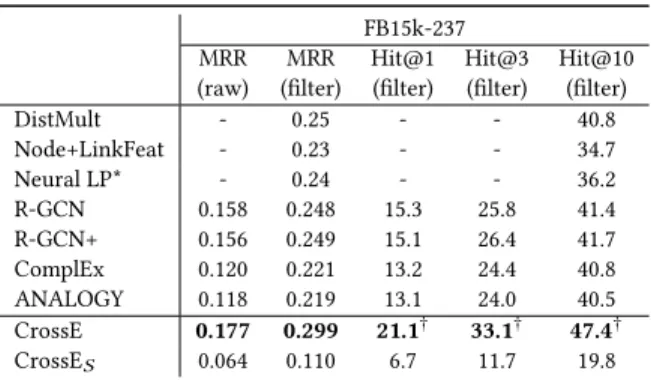
In Table 5, we separately show the link prediction results of CrossE on FB15k-237, as this is a recently proposed more challenge dataset and there are fewer baselines to compare than with WN18 and FB15k. We gather as many baselines as possible for FB15k-237 and list them in Table 5. The results of DistMult, Node+LinkFeat and Neural LP are from [41], and of R-GCN and R-GCN+ from the original paper [27]. For ComplEx and ANALOGY, we used the published code of [19]3to search the best parameters among all possible combination of embedding dimensiond∈ {100,200}and
regularizer weightλ∈ {10−1
,10−2,10−3}with six negative samples
as used in the ANALOGY paper [19]4. The parameters used for ComplEx and ANALOGY ared=100,λ=10−1.
WN18 FB15k MRR Hit@ MRR Hit@ filter/raw 1 3 filter/raw 1 3 RESCAL 0.890 / 0.603 84.2 90.4 35.4 /18.9 23.5 40.9 TransE 0.455 / 0.335 8.9 82.3 38.0 / 22.1 23.1 47.2 DistMult 0.822 / 0.532 72.8 91.4 65.4 / 24.2 54.6 73.3 HolE 0.938 / 0.616 93.0 94.5 52.4 / 23.2 40.2 61.3 ComplEx 0.941 / 0.587 93.6 94.5 69.2 / 24.2 59.9 75.9 ANALOGY 0.942/0.657 93.9 94.4 72.5 / 25.3 64.6 78.5 R-GCN 0.819 / 0.561 69.7 92.9 69.6/26.2 60.1 76.0 CrossE 0.830 / 0.570 74.1 93.1 72.8/26.7 63.4 80.2† CrossES 0.469 / 0.396 21.7 70.6 46.4 / 25.4 28.4 61.9
Table 4:Link prediction results on WN18 and FB15k. For WN18 (Table 3), CrossE achievesHit@10results that are comparable to the best baselines. On the same dataset (Table 4), CrossE achieves better results than a majority of baselines onMRR, Hit@1andHit@3. With only 18 relations, WN18 is a simpler dataset
1We follow the established practice in the KGE literature to compare link-prediction performance with published results on the same benchmarks.
2Similar to [19], we conducted the proportion tests on the Hit@k scores but not on MRR. Proportion tests cannot be applied to non-proportional scores such as MRR. 3https://github.com/quark0/ANALOGY
4Our parameter search includes the same range of values used in the original papers, and the best parameters obtained for FB15.
FB15k-237
MRR MRR Hit@1 Hit@3 Hit@10 (raw) (filter) (filter) (filter) (filter)
DistMult - 0.25 - - 40.8 Node+LinkFeat - 0.23 - - 34.7 Neural LP* - 0.24 - - 36.2 R-GCN 0.158 0.248 15.3 25.8 41.4 R-GCN+ 0.156 0.249 15.1 26.4 41.7 ComplEx 0.120 0.221 13.2 24.4 40.8 ANALOGY 0.118 0.219 13.1 24.0 40.5 CrossE 0.177 0.299 21.1† 33.1† 47.4† CrossES 0.064 0.110 6.7 11.7 19.8
Table 5:Link prediction results on FB15k-237.
compared to FB15k. We can see in Table 4 that each method per-forms well on WN18 and much better than FB15k. For example, the
scores ofHit@3on WN18 with all methods are above90%while
the best score on FB15k is just around80%.
For FB15k (Table 3 and Table 4) we see that CrossE achieves state-of-the-art results on majority evaluation metrics, including MRR,Hit@3, andHit@10. These results support that CrossE can better encode the diverse relations in knowledge graph, as FB15k is a
complex linked dataset with1,345relations and is more challenging
to model than WN18. Compared to ANALOGY, which achieves best
results onHit@1, CrossE performs better onHit@3andHit@10,
two metrics that we think are more fair to evaluate all relations, because there are four different relation types in knowledge graph, 1-to-1, 1-to-many, many-to-1 and many-to-many. Based on the Open World Assumption, the correct answer for link prediction on 1-to-many, many-to-1 and many-to-many relations might be more
than1even under thefiltersetting. Thus we thinkHit@3, Hit@10
are better evaluation metrics for those datasets with diverse types
of relations such as FB15k, in which there are26.2%1-to-1 relations,
22.7%1-to-many,28.3%and22.8%many-to-many relations.
For FB15k-237 (Table 5), CrossE achieves state-of-the-art results and significant improvements compared to all baselines on all eval-uation metrics. Compared to FB15k, FB15k-237 removes the redun-dant triples containing inverse relation information leakage that can be captured by simpler approaches to achieve good prediction result [33]. Without properly encoding the diverse semantics in knowledge graph, a method can’t achieve good performance on FB15k-237. The significant performance improvement achieved by CrossE indicates that it is more capable of capturing and utilizing the complex semantics in knowledge graph during prediction.
Compared to the simpler model CrossES, CrossE performs much
better on all three datasets(Table 3, Table 4, Table 5). As the only
difference between them is whether there arecrossover interactions
between entities and relations or not, the huge performance
dif-ference shows the importance of modelingcrossover interactions,
which is common during inference on knowledge graphs with di-verse topics.
Table 6 comparesHit@10 (filter)results on FB15k after mapping
different relation types, 1-to-1, 1-to-many, 1 and many-to-many represented as 1-1, 1-N, N-1 and N-N respectively, because we want to investigate which type of relations CrossE can encode better. The separate rules of relation types follows [3].
ANALOGY TransE CrossE Method 0.0 0.2 0.4 0.6 0.8 1.0 Recall 0 100 200 300 400 500 AvgSupport Recall AvgSupport (a) 1 2 3 4 5
Number of similar relations (kr)
0.28 0.30 0.32 0.34 0.36 0.38 Recall 0 200 400 600 800 1000 AvgSupport Recall AvgSupport (b) 1 2 3 4 5
Number of similar relations (kr)
0 200 400 600 800 1000 AvgSupport CrossE ANALOGY TransE (c)
Figure 4: Evaluation results on generating explanations with different KGEs. 4(a) showsRecallandAvgSupportwithke =10, kr =3. 4(b) showsRecallandAvgSupportfor CrossE withkr ∈ [1,5]. 4(c) showsAvgSupportwithke =10andkr ∈ [1,5].
1-1 1-N N-1 N-N
(head/tail) (head/tail) (head/tail) (head/tail) Unstructured 34.5/34.3 2.5/4.2 6.1/1.9 6.6/6.6 SE 35.6/34.9 62.6/14.6 17.2/68.3 37.5/41.3 SME(linear) 35.1/32.7 53.7/14.9 19.0/61.6 40.3/43.3 SME(Bilinear) 30.9/28.2 69.6/13.1 19.9/76.0 38.6/41.8 TransE 43.7/43.7 65.7/19.7 18.2/66.7 47.2/50.0 TransH 66.8/65.5 87.6/39.8 28.7/83.3 64.5/67.2 TransD 86.1/85.4 95.5/50.6 39.8/94.4 78.5/81.2 TransR 78.8/79.2 89.2/37.4 34.1/90.4 69.2/72.1 CTransR 81.5/80.8 89.0/38.6 34.7/90.1 71.2/73.8 CrossE 88.2†/87.7† 95.7†/75.1† 64.2†/92.3 88.1†/90.8† CrossES 78.6/81.6 85.1/54.2 45.3 /85.8 71.7/76.7 Table 6:Hit@10 on FB15k by mapping to different relation types.
From Table 6 we see that CrossE significantly outperforms all other embedding methods except in the tail prediction for N-1 rela-tions. CrossE achieves significant improvement, with11.7%average
improvement, on the more difficult tasks with more multiple correct answers including the head prediction for N-1 relations, the tail prediction for 1-N relations and both head and tail prediction for N-N relations. As a result, CrossE performance is more balanced than other methods on different types of relations.
5.3
Evaluation II: Generating Explanations
5.3.1 Evaluation. Aggregating all the path explanations and their
supports from embedding results, we evaluate the capability of a KGE to generate explanations from two perspectives: (1) the fraction of triples (out of all test triples) that it can give explanations for (Recall), (2) the average support among the triples for which it can find explanations (AvgSupport). We argue that higher the AvgSupportfor a triple, the more reliable the explanation will be.
Generally, a KGE that can generate better explanations will achieve higherRecallandAvgSupportwhen selecting the same number of similar entities (ke) and relations (kr).
5.3.2 Experimental Details. For the explanation experiment, we
use the FB15k dataset. We choose two different KGEs as baselines to compare with CrossE. One is the popular translation-based em-bedding method TransE and the other is the linear-mapping based
embedding method ANALOGY which achieves one of the best results in the link prediction task.
The embeddings of CrossE used for searching explanations are those used in the link prediction experiment. We re-implement TransE ourselves and the implementation of ANALOGY is from [19]. The embeddings used for similar entity and relation selection are the representations for head entities and relations when they involved specific triples, which are interaction embeddings in CrossE and general embeddings in TransE and ANALOGY.
5.3.3 Explanation Results.The results are summarized in Figure 4.
In Figure 4(a), we see that when selecting ten similar entities and three similar relations, therecallof three methods varies from0.26
to0.43and theAvgSupportvaries from5to566. ANALOGY achieves
the best results onRecallwhile it can give only a few examples for each explanation, quantified by itsAvgSupportperformance. TransE achieves the lowestrecallbut has about ten times moreAvgSupport than ANALOGY for each triple. CrossE achieves the second best result inrecall and has about100times moreAvgSupport than ANALOGY. From the perspective of giving reliable explanations for predicted triples, CrossE outperforms the baselines.
The explanation and similar structures search are based on the similar entity and relation selection results. CrossE generates mul-tiple crossover embeddings for entities and relations. Based on the interaction embeddings, the similar items for each entity or relation are different when it involves different triples. This makes CrossE more efficient at selecting similar items which will results in better explanation results. Based on the general embeddings, the similar items selection results will always be the same regardless of the triple-specific context. In our opinion, this is why theAvgSupport of CrossE is much higher than of TransE and ANALOGY.
In Figure 4(b), we see thatrecallimproves slightly when increas-ing the number of similar relations to select while theAvgSupport increase a lot. This behavior is the same when increasing the num-ber of similar entities to select. Figure 4(c) shows thatAvgSupport for CrossE increases much faster than with TransE and ANALOGY. This also demonstrates the effectiveness of CrossE at selecting similar entities and relations.
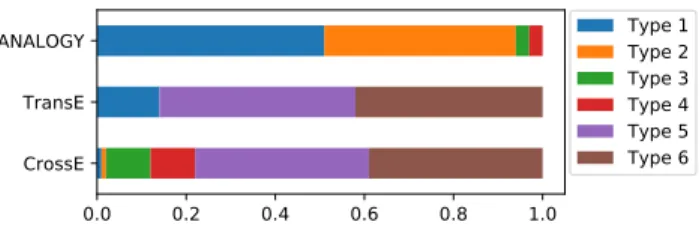
To figure out what types of paths and similar structures are easier to find for the compared models, in Figure 5 for each model we show the share ofAvgSupportfor the six types of similar structures.
0.0 0.2 0.4 0.6 0.8 1.0 CrossE
TransE
ANALOGY Type 1Type 2
Type 3 Type 4 Type 5 Type 6
Figure 5: Share ofAvgSupportfor six similar structure types. We can see that among all types of similar structures, type 5 is the one that both TransE and CrossE have the mostAvgSupportfor. From our point of view, type 5 is the most natural path in which the two relation along the path are in same direction with the relation betweenhandt. Thus it may be likely to be constructed when a knowledge graph is constructed. Although the shares of type 1 and 2 are high for ANALOGY, AvgSupport is very low (Figure 4(c)).
In summary, we can state that the modeling and vector-space assumptions of different KGEs effect the way they explain the pre-dictions, including the types of path-explanations they can provide. From these two evaluation tasks, we can conclude that the capa-bility of KGE on link prediction and explanations are not directly related. A method that performs well on link prediction may not necessarily be good at giving explanations. The balance between prediction accuracy and giving explanations is important.
6
CONCLUSION
In this paper, we described a new knowledge graph embedding named CrossE. CrossE successfully captures the crossover inter-actions between entities and relations during new triple inference and achieves state-of-the-art results on link prediction task with complex linked datasets. We believe that improving the reliability of embedding method is as important as achieving high accuracy for prediction. This work is a first step for explaining the prediction results. There are still much work to do with explanations, such as how to enable KGEs to give explanation for all predicted triples. In our future work, we will focus on improving the capability of KGEs in predict missing triples and also giving more reliable explanations.
ACKNOWLEDGMENTS
This work is funded by NSFC 61473260/61673338, and supported by Alibaba-Zhejiang University Joint Institute of Frontier Tech-nologies and SNF Sino Swiss Science and Technology Cooperation Programme program under contract RiC 01-032014.
REFERENCES
[1] Kurt D. Bollacker, Colin Evans, Praveen Paritosh, Tim Sturge, and Jamie Taylor. 2008. Freebase: a collaboratively created graph database for structuring human knowledge.Proceedings of SIGMOD(2008), 1247ś1250.
[2] Antoine Bordes, Xavier Glorot, Jason Weston, and Yoshua Bengio. 2014. A semantic matching energy function for learning with multirelational data -Application to word-sense disambiguation.Machine Learning94, 2 (2014), 233ś 259.
[3] Antoine Bordes, Nicolas Usunier, Alberto García-Durán, Jason Weston, and Ok-sana Yakhnenko. 2013. Translating Embeddings for Modeling Multi-relational Data.Proceedings of NIPS(2013), 2787ś2795.
[4] Antoine Bordes, Jason Weston, Ronan Collobert, and Yoshua Bengio. 2011. Learn-ing Structured EmbeddLearn-ings of Knowledge Bases.Proceedings of AAAI(2011). [5] Luis Galárraga, Christina Teflioudi, Katja Hose, and Fabian M. Suchanek. 2015.
Fast rule mining in ontological knowledge bases with AMIE+. VLDB J.24, 6 (2015), 707ś730.
[6] Alberto García-Durán, Antoine Bordes, and Nicolas Usunier. 2015. Composing Relationships with Translations.Proceedings of EMNLP(2015), 286ś290. [7] Xavier Glorot and Yoshua Bengio. 2010. Understanding the difficulty of training
deep feedforward neural networks.Proceedings of AISTATS(2010), 249ś256. [8] Shizhu He, Kang Liu, Guoliang Ji, and Jun Zhao. 2015. Learning to Represent
Knowledge Graphs with Gaussian Embedding. Proceedings of CIKM(2015), 623ś632.
[9] Reinhard Heckel, Michail Vlachos, Thomas P. Parnell, and Celestine Dünner. 2017. Scalable and Interpretable Product Recommendations via Overlapping Co-Clustering.Procedding of ICDE(2017), 1033ś1044.
[10] G. E. Hinton, J. L. McClelland, and D. E. Rumelhart. 1986. Distributed Repre-sentations.Parallel distributed processing: explorations in the microstructure of cognition(1986).
[11] Rodolphe Jenatton, Nicolas Le Roux, Antoine Bordes, and Guillaume Obozinski. 2012. A latent factor model for highly multi-relational data.Proceddings of NIPS
(2012), 3176ś3184.
[12] Guoliang Ji, Shizhu He, Liheng Xu, Kang Liu, and Jun Zhao. 2015. Knowledge Graph Embedding via Dynamic Mapping Matrix. Proceedings of ACL(2015), 687ś696.
[13] Guoliang Ji, Kang Liu, Shizhu He, and Jun Zhao. 2016. Knowledge Graph Comple-tion with Adaptive Sparse Transfer Matrix.Proceedings of AAAI(2016), 985ś991. [14] Diederik P. Kingma and Jimmy Ba. 2014. Adam: A Method for Stochastic
Opti-mization.CoRRabs/1412.6980 (2014).
[15] Denis Krompaß, Stephan Baier, and Volker Tresp. 2015. Type-Constrained Repre-sentation Learning in Knowledge Graphs.Proceddings of ISWC(2015), 640ś655. [16] Ni Lao, Tom M. Mitchell, and William W. Cohen. 2011. Random Walk Inference and Learning in A Large Scale Knowledge Base. InProceedings of the 2011 Con-ference on Empirical Methods in Natural Language Processing, EMNLP 2011, 27-31 July 2011, John McIntyre Conference Centre, Edinburgh, UK, A meeting of SIGDAT, a Special Interest Group of the ACL. 529ś539.
[17] Yankai Lin, Zhiyuan Liu, Huan-Bo Luan, Maosong Sun, Siwei Rao, and Song Liu. 2015. Modeling Relation Paths for Representation Learning of Knowledge Bases.
Proceedings of EMNLP(2015), 705ś714.
[18] Yankai Lin, Zhiyuan Liu, Maosong Sun, Yang Liu, and Xuan Zhu. 2015. Learning Entity and Relation Embeddings for Knowledge Graph Completion.Proceedings of AAAI(2015), 2181ś2187.
[19] Hanxiao Liu, Yuexin Wu, and Yiming Yang. 2017. Analogical Inference for Multi-relational Embeddings. InProceedings of the 34th International Conference on Machine Learning, ICML 2017, Sydney, NSW, Australia, 6-11 August 2017. 2168ś 2178.
[20] George A. Miller. 1995. WordNet: A Lexical Database for English.Commun. ACM
38, 11 (1995), 39ś41.
[21] Arvind Neelakantan, Benjamin Roth, and Andrew McCallum. 2015. Composi-tional Vector Space Models for Knowledge Base Completion.Proceedings of ACL
(2015), 156ś166.
[22] Dat Quoc Nguyen, Kairit Sirts, Lizhen Qu, and Mark Johnson. 2016. STransE: a novel embedding model of entities and relationships in knowledge bases. In
NAACL HLT 2016, The 2016 Conference of the North American Chapter of the Association for Computational Linguistics: Human Language Technologies, San Diego California, USA, June 12-17, 2016. 460ś466.
[23] Maximilian Nickel, Kevin Murphy, Volker Tresp, and Evgeniy Gabrilovich. 2016. A Review of Relational Machine Learning for Knowledge Graphs.Proc. IEEE104, 1 (2016), 11ś33.
[24] Maximilian Nickel, Lorenzo Rosasco, and Tomaso A. Poggio. 2016. Holographic Embeddings of Knowledge Graphs.Proceedings of AAAI(2016), 1955ś1961. [25] Maximilian Nickel, Volker Tresp, and Hans-Peter Kriegel. 2011. A Three-Way
Model for Collective Learning on Multi-Relational Data.Proceedings of ICML
(2011), 809ś816.
[26] Petar Ristoski and Heiko Paulheim. 2016. RDF2Vec: RDF Graph Embeddings for Data Mining.Procedings of ISWC(2016), 498ś514.
[27] Michael Schlichtkrull, Thomas N. Kipf, Peter Bloem, Rianne van den Berg, Ivan Titov, and Max Welling. 2018. Modeling Relational Data with Graph Convolu-tional Networks.Proceddings of ESWC(2018).
[28] Baoxu Shi and Tim Weninger. 2017. ProjE: Embedding Projection for Knowledge Graph Completion.Proceedings of AAAI(2017), 1236ś1242.
[29] Richard Socher, Danqi Chen, Christopher D. Manning, and Andrew Y. Ng. 2013. Reasoning With Neural Tensor Networks for Knowledge Base Completion.
Prodeddings of NIPS(2013), 926ś934.
[30] Nitish Srivastava, Geoffrey Hinton, Alex Krizhevsky, Ilya Sutskever, and Ruslan Salakhutdinov. 2014. Dropout: A Simple Way to Prevent Neural Networks from Overfitting.Journal of Machine Learning Research 15(Jun)(2014), 1929ś1958. [31] Fabian M. Suchanek, Gjergji Kasneci, and Gerhard Weikum. 2007. Yago: a core
of semantic knowledge.Proceedings of WWW(2007), 697ś706.
[32] Sean R. Szumlanski and Fernando Gomez. 2010. Automatically acquiring a semantic network of related concepts. (2010), 19ś28.
[33] Kristina Toutanova and Danqi Chen. 2015. Observed versus latent features for knowledge base and text inference. Inn Proceedings of the 3rd Workshop on Continuous Vector Space Models and their Compositionality. 57ś66.
[34] Théo Trouillon, Johannes Welbl, Sebastian Riedel, Éric Gaussier, and Guillaume Bouchard. 2016. Complex Embeddings for Simple Link Prediction.Proceedings ICML(2016), 2071ś2080.
[35] Quan Wang, Bin Wang, and Li Guo. 2015. Knowledge Base Completion Using Embeddings and Rules.Proceedings of IJCAI(2015), 1859ś1866.
[36] Xiang Wang, Xiangnan He, Fuli Feng, Liqiang Nie, and Tat-Seng Chua. 2018. TEM: Tree-enhanced Embedding Model for Explainable Recommendation. In
Proceedings of WWW. 1543ś1552.
[37] Zhen Wang, Jianwen Zhang, Jianlin Feng, and Zheng Chen. 2014. Knowledge Graph Embedding by Translating on Hyperplanes.Proceedings of AAAI(2014), 1112ś1119.
[38] Han Xiao, Minlie Huang, and Xiaoyan Zhu. 2016. TransG : A Generative Model for Knowledge Graph Embedding.Proceedings of ACL(2016).
[39] Ruobing Xie, Zhiyuan Liu, and Maosong Sun. 2016. Representation Learning of Knowledge Graphs with Hierarchical Types. Proceedings of IJCAI(2016), 2965ś2971.
[40] Bishan Yang, Wen tau Yih, Xiaodong He, Jianfeng Gao, and Li Deng. 2015. Em-bedding Entities and Relations for Learning and Inference in Knowledge Bases.
Proceedings of ICLR(2015).
[41] Fan Yang, Zhilin Yang, and William W. Cohen. 2017. Differentiable Learning of Logical Rules for Knowledge Base Reasoning. InNIPS. 2316ś2325.
[42] Jun Yin, Xin Jiang, Zhengdong Lu, Lifeng Shang, Hang Li, and Xiaoming Li. 2016. Neural Generative Question Answering. InProceedings of IJCAI.
[43] Wen Zhang. 2017. Knowledge Graph Embedding with Diversity of Structures.