Machine Learning Methodologies for
Interpretable Compound Activity
Predictions
Kumulative Dissertation
zur Erlangung des Doktorgrades (Dr. rer. nat.)
der Mathematisch-Naturwissenschaftlichen Fakultät
der Rheinischen Friedrich-Wilhelms-Universität Bonn
vorgelegt von
Raquel Rodríguez Pérez
aus Barcelona, Spanien
Bonn
November, 2019
Angefertigt mit Genehmigung
der Mathematisch-Naturwissenschaftliche Fakultät
der Rheinischen Friedrich-Wilhelms-Universität Bonn
1. Referent: Univ.-Prof. Dr. rer. nat. Jürgen Bajorath
2. Referent: Univ.-Prof. Dr. rer. nat. Holger Fröhlich
Tag der Promotion: 20.02.20
Abstract
Machine learning (ML) models have gained attention for mining the
phar-maceutical data that are currently generated at unprecedented rates and
po-tentially accelerate the discovery of new drugs. The advent of deep learning
(DL) has also raised expectations in pharmaceutical research. A central task
in drug discovery is the initial search of compounds with desired biological
ac-tivity. ML algorithms are able to find patterns in compound structures that
are related to bioactivity, the so-called structure-activity relationships (SARs).
ML-based predictions can complement biological testing to prioritize further
experiments. Moreover, insights into model decisions are highly desired for
fur-ther validation and identification of activity-relevant substructures. However,
the interpretation of complex ML models remains essentially prohibitive. This
thesis focuses on ML-based predictions of compound activity against multiple
biological targets. Single-target and multi-target models are generated for
rele-vant tasks including the prediction of profiling matrices from screening data and
the discrimination between weak and strong inhibitors for more than a hundred
kinases. Moreover, the relative performance of distinct modeling strategies is
systematically analyzed under varying training conditions, and practical
guide-lines are reported. Since explainable model decisions are a clear requirement
for the utility of ML bioactivity models in pharmaceutical research, methods
for the interpretation and intuitive visualization of activity predictions from
any ML or DL model are introduced. Taken together, this dissertation presents
contributions that advance in the application and rationalization of ML models
for biological activity and SAR predictions.
Contents
Motivation
1
1
Introduction
3
2
Prediction of Compound Profiling Matrices Using Machine
Learning
27
Introduction . . . .
27
Publication . . . .
29
Summary . . . .
41
3
Multitask Machine Learning for Classifying Highly and Weakly
Potent Kinase Inhibitors
43
Introduction . . . .
43
Publication . . . .
45
Summary . . . .
55
4
Influence of Varying Training Set Composition and Size on
Sup-port Vector Machine-Based Prediction of Active Compounds
57
Introduction . . . .
57
Publication . . . .
59
Summary . . . .
67
5
Relative Performance of Multitask Deep Learning and
Ran-dom Forest Classification on the Basis of Varying Amounts of
Training Data
69
Introduction . . . .
69
Publication . . . .
71
Summary . . . .
79
6
Support Vector Machine Classification and Regression
Prior-itize Different Structural Features for Binary Compound
Ac-tivity and Potency Value Prediction
81
Publication . . . .
83
Summary . . . .
93
7
Interpretation of Compound Activity Predictions from
Com-plex Machine Learning Models Using Local Approximations
and Shapley Values
95
Introduction . . . .
95
Publication . . . .
97
Summary . . . 115
8
Conclusions
117
List of abbreviations
1D, 2D, 3D
One-, two-, three-dimensional
ADMET
Absorption, distribution, metabolism, excretion, and toxicity
CNN
Convolutional neural network
DL
Deep learning
DNN
Deep neural network
DT
Decision tree
ECFP
Extended-connectivity fingerprint
HTS
High-throughput screening
MACCS
Molecular access system
ML
Machine learning
MMP
Matched molecular pair
MT
Multitask
QSAR
Structure-activity relationship
QSPR
Structure-property relationship
RECAP
Retrosynthetic combinatorial analysis procedure
RF
Random forest
SAR
Structure-activity relationship
SMILES
Simplified molecular-input line-entry system
SPR
Structure-property relationship
ST
Single-task
SV
Support vector
SVM
Support vector machines
SVR
Support vector regression
Tc
Tanimoto coefficient
Motivation
Machine learning (ML) and, more recently, deep learning models have gained
attention in pharmaceutical research due to the emergence of “big data” at
different levels including medicinal chemistry.
1–3The exploration of
structure-activity relationships (SARs) represents a critically important task in medicinal
chemistry and is essential for the development of novel bioactive compounds.
4,5ML models are suitable for leveraging and mining the nearly exponential
in-creasing amounts of compound activity data that are currently generated and
published.
6,7ML enables qualitative or quantitative SAR modeling and the
sub-sequent prediction of compound bioactivity from structural representations.
8,9The identification of active compounds by computational methods plays an
im-portant role in drug discovery and complements high-throughput screening.
10Virtual screening protocols can be implemented using ML so that experimental
testing is prioritized on the basis of model predictions. Some small molecules
specifically interact with multiple targets, which might cause higher drug
effi-cacy or undesired side effects. Therefore, multi-target predictions or activity
profile predictions are currently a fundamental challenge of high interest.
11With
the rise of deep learning techniques, the potential benefit of deep neural
net-works (DNNs) for bioactivity modeling requires a systematic assessment.
12,13Hence, prediction scenarios that mimic real-life screening or introduce
challeng-ing test systems are required.
14Moreover, despite being decisive for ML model
quality, the influence of the nature of training data on activity predictions is
still an underinvestigated issue. Finally, interpretable ML models would
pro-vide insights into structural patterns driving changes in predicted compound
activity and enable the extraction of SAR information. However, ML-based
predictions are difficult to rationalize, especially for DNNs, which are often
considered as “black boxes”.
13,15Thus, insights into complex model decisions
are essentially prohibitive which often hinders the practical use of ML models
in pharmaceutical research.
16In this thesis, ML models are systematically
de-veloped, analyzed, and rationalized for the prediction of compound bioactivity
against multiple targets. More specifically, the main objectives of this thesis
are: (i) the application and comparison of ML strategies for the prediction of
compound activity profiles, (ii) the study of the influence of training set
condi-tions on model performance, and (iii) the improvement of the interpretability
of ML-based compound activity predictions.
Thesis outline
This dissertation consists of eight chapters structured as follows.
Chapter 1
presents an introduction to drug discovery and important applications of ML
models in pharmaceutical research, with emphasis on compound activity
predic-tions.
Chapter 2
to
Chapter 7
contain six original publications representing the
main work of this thesis.
Chapter 2
reports the development and benchmark
of ML approaches for the prediction of compound profiling matrices.
Chapter
3
presents the ML-based classification of weakly and highly potent inhibitors
against a panel of kinases. In
Chapter 4
, guidelines for training set size and
composition are derived for support vector machines models applied to activity
predictions.
Chapter 5
investigates the relative performance of single-target
ML and multi-target DNNs for the prediction of multiple assays from
screen-ing data.
Chapter 6
systematically studies the feature importance in support
vector machines models for activity and potency prediction. In
Chapter 7
, a
method for the interpretation of activity predictions from any ML algorithm
is introduced and validated. Finally,
Chapter 8
summarizes and discusses the
major findings of this thesis.
Chapter 1
Introduction
Drug discovery
The ultimate goal of pharmaceutical research is the identification of novel
compounds with desired properties for the treatment of a given disease. Drug
discovery research broadly includes (i) target identification, (ii) hit discovery,
and (iii) lead optimization.
4,17A biological target, generally a protein, is
in-volved in a dysfunctional biological process and its modulation alleviates
symp-toms or modifies the disease state.
18The identification of putative
therapeu-tic targets implies the understanding of the connection between the molecular
mechanisms and the disease. Identified targets are subsequently validated to
confirm the relationship between target and disease.
Currently, two major
groups of drug targets are G protein-coupled receptors and kinases.
19,20Next,
a search for active compounds (or hits) that bind to the target and modify
its function is pursued. Hit identification mainly relies on high-throughput
screening (HTS) technologies, which include miniaturized and robotized assay
platforms that test the activity of thousands or hundreds of thousands of
com-pounds against a biological target in a short time.
21,22Once hits are found, lead
compounds or classes that serve as starting points are obtained and undergo
multi-parametric optimization to improve other desired properties.
At this
stage, absorption, distribution, metabolism, excretion, and toxicity (ADMET)
properties of lead compounds are characterized and improved.
4Compound
op-timization consists of many cycles of synthesis of close analogs to improve the
properties based on small structural modifications. After these discovery
search stages, a promising drug candidate must satisfy pre-clinical and clinical
development requirements. Only if clinical evaluation in human cohorts is
suc-cessful, a drug could be approved by the pharmaceutical regulatory agencies.
Figure 1
schematizes the main phases of drug discovery and clinical
develop-ment of a new drug, which take an average time of 12 years and are very costly
(
∼
$2
.
6
billion according to a recent estimation).
23Moreover, pharmaceutical
R&D investment has considerably increased during the last years without a
pos-itive impact on the number of discovered drugs,
18which reflects the existence
of some issues and bottlenecks.
24Clinical
development
Pre-clinical
development
Lead
optimization
Hit
discovery
Target
identification
Figure 1: Drug discovery and development. An overview of the main stages in drug discovery and development is shown.
The role of computational approaches
A variety of computational approaches have been introduced to improve
and accelerate drug discovery.
25Bioinformatics and chemoinformatics focus on
data processing and thus differ from computational biology, which
mathemat-ically models and simulates biological systems, and computational chemistry,
which has its foundation in theoretical and quantum chemistry. Bioinformatics
typically studies “omic”-data such as genomics or proteomics, whereas
chemoin-formatics focuses on small molecules and their role as ligands.
26,27As such, this
thesis covers chemoinformatic approaches for drug discovery. Chemoinformatics
was firstly defined as
“the mixing of information resources to transform data into
information, and information to knowledge, for the intended purpose of making
better decisions faster in the area of drug lead identification and optimization”
.
28Bio- and chemoinformatics disciplines, which contribute to pharmaceutical
re-search with considerable overlap, have been continuously evolving both with
novel algorithms and applications.
29,30Machine learning in pharmaceutical research
Machine learning (ML) approaches have been established as essential tools
for bio- and chemoinformatics.
3There is a need for new data mining methods
able to cope with growing amounts of heterogeneous data sets, which offer many
opportunities but are difficult to analyze and utilize. ML belongs to the
spec-trum of artificial intelligence methods, which are closely linked to the big data
era and have currently become a hot topic in many areas including
pharmaceuti-cal research.
31,32ML uses statistical pattern recognition algorithms that enable
a system to learn from experience and subsequently make predictions about
new data. Supervised ML can be used to predict discrete or continuous
vari-ables, whereas unsupervised methods are mainly used for exploratory analysis,
visualization and clustering. Particularly, deep learning (DL) is a subdiscipline
of ML that encompasses non-linear methods which can model complicated
re-lationships between input and output data using low-level representations.
33DL has surpassed standard ML methods in disciplines such as computer vision
and natural language processing.
34–36Consequently, DL has also experienced
an increasing interest in pharmaceutical research.
12,37,38Both ML and DL have
encountered applications across all stages of drug discovery and development.
16Models have yielded accurate predictions for distinct bioinformatics tasks
including target
39,40or biomarker discovery.
41Some studies have shown the
potential of ML methods to distinguish between cancer and non-cancer targets
on the basis of gene expression
42or predict the suitability of targets for drug
development from physicochemical, structural and geometric features of
pro-tein cavities.
43ML has also been used to predict drug response across cell lines
on the basis of gene expression data.
44DL offers opportunities to deal with
large amounts of single-cell RNA sequencing data, reduce dimensionality, and
identify cell-specific biomarkers or characterize cell states and types.
45–47Using
pre-clinical data, ML models also enabled the identification of gene signatures
for patient sub-groups that respond better to drug treatment.
48In addition,
pathology image processing has experienced a considerable improvement
af-ter the introduction of DL methodologies which prevent the need of manually
identifying “handcrafted” task-specific features.
49DL models have been used
for the classification and segmentation of microscopy images
50as well as the
identification of breast cancer regions in a large data set of pathology images.
51Chemoinformatics has also benefited from ML modeling.
Recently,
computer-aided synthesis planning has become a relevant application
52and
some studies have focused on the prediction of the major reaction products
given a set of reactant molecules
53or the conditions of organic synthesis
reac-tions.
54For the task of novel chemical structures generation or
de novo
design,
a variety DL methods, such as variational autoencoder,
55generative adversarial
networks,
56,57recurrent neural networks,
58,59and deep reinforcement learning,
60have been recently proposed. These approaches seem promising for generating
compounds with desired properties, but the chemical diversity and validity of
output samples are currently still debated.
Since the chemical structure of a compound determines its properties,
medic-inal chemistry studies structure-property relationships (SPRs), which can be
modeled using ML.
9Distinct ML methods
61,62including deep neural networks
(DNNs)
63,64have been applied to quantitative SPRs (QSPRs) modeling. One of
the most relevant compound properties is biological activity. Compound
activ-ity predictions generally help at the hit identification stage, whereas QSPRs for
potency or ADMET properties are often considered in lead optimization.
13,65Compound activity predictions
The understanding and analysis of structure-activity relationships (SARs)
is a central goal in medicinal chemistry and drug discovery. Since the big data
era has arrived in medicinal chemistry, influenced by HTS and combinatorial
chemistry,
66,67ML has become a method of choice to mine chemical information
and find molecules with desired bioactivity. Going beyond volume, compound
activity data fulfills other big data-related terms such as heterogeneity,
confi-dence, complexity, variability, and veracity.
1In this context, ML-based activity
predictions have found some relevant applications.
Virtual screening
A key application of bioactivity prediction is virtual screening (VS), which
complements HTS through a prioritization of experimental testing.
68,69Despite
the numerous experiments performed by HTS, few bioactive compounds are
found and hit rates are typically below 1-2%.
70Thus, VS aims at selecting
small numbers of potentially active compounds from in-house, commercial or
virtual combinatorial libraries.
71Aside from ligand-based methods, which use compound activity data for
pre-dictions and are at the heart of the research presented in this thesis, methods
relying on structural information about the targets present alternative relevant
approaches.
72Structure-based VS requires the three-dimensional (3D) structure
of the target macromolecule, which can be obtained by X-ray crystallography
or nuclear magnetic resonance spectroscopy.
73Molecular docking is the most
popular structure-based approach, which aims to find the preferred orientation
or binding conformation of a ligand to a receptor through a computationally
intensive optimization.
74,75Docking uses a mechanism to explore the space of
protein-ligand geometries and a scoring function to rank the possibilities.
76Re-cently, ML methods have been proposed to score protein-ligand interactions,
77including convolutional neural networks.
78On the other hand, ligand-based VS requires active compound data and
of-ten becomes the method of choice when 3D structures are not available.
10Sim-ilarity searching is the classical approach for the detection of active compounds
based on known ligand data,
79but ML models have become widely used.
80Dif-ferent studies have shown the ability of ML to identify structurally distinct
com-pounds with similar activity (task also known as scaffold hopping),
81which is a
pre-requisite for successful VS.
82,83In retrospective studies, Doddareddy
et al.
trained linear discriminant analysis and support vector machines (SVM)
mod-els on the basis of compound fingerprints and detected blockers of potassium
ion channels potentially leading to cardiotoxic effects.
84VS approaches have
also shown successful results in prospective applications
85–87including a
sup-port vector regression model that detected new inhibitors of histone deacetylase
1
88and a naïve Bayes model which identified inhibitors of phosphatidylinositol
3-kinase.
89With the integration of experimental and computational screening, ML
models trained on the basis of biological screening data might select less but
“smarter” experiments for the next round.
10Active learning approaches have
been developed for VS,
90,91where the model iteratively selects compounds to
test and is updated with the acquired data. The choice of the next
experi-ments can rely on exploration (i.e. selection of useful data for model building)
or exploitation (i.e. selection of compounds likely to be active) strategies.
92Nevertheless, HTS and VS integration is challenging due to the inherent noise,
experimental variance, large data volumes, diversity of chemical classes,
possi-ble presence of distinct binding modes, as well as strong statistical imbalance
between hits and inactive compounds in HTS data.
73Multi-target activity
ML models can be trained to predict multi-target activities of compounds,
also referred to as activity profiles.
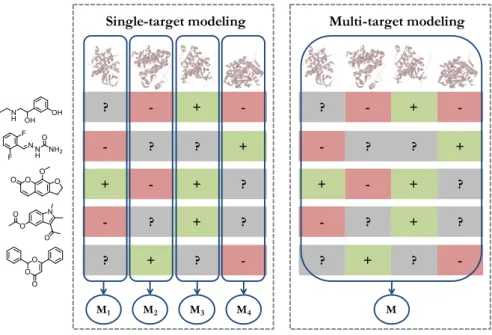
Figure 2
illustrates compound
activ-ity profiles for exemplary compounds and schematizes the difference between
single-target and multi-target modeling. An important limitation of the “one
target, one drug” paradigm is the non-consideration of multi-target activity
at early stages of the drug discovery.
93,94The ability of small molecules to
specifically engage in interactions with multiple receptors is the molecular
ba-sis of polypharmacology. Therapeutic polypharmacology achieves a stronger
therapeutic effect by simultaneously targeting distinct points in a particular
pathogenic process.
11,95and is promising to combat complex diseases, such as
cancer or neurological disorders, that might require a more elaborate
pharma-cological action.
96However, multi-target activities might also be responsible for
undesired side effects. The ultimate objective of chemogenomics is fully
char-acterizing the interactions between all available chemical ligands and biological
targets, which is practically unfeasible.
71Hence, chemogenomics focuses on
the exploration and navigation of limited ligand-target spaces, typically on the
basis of protein families or related receptors. Since compound bioactivity
pro-files would enable a better prioritization of drug candidates, activity prediction
against multiple targets is a highly relevant topic.
97However, the optimization
of multi-target SARs is complicated.
11,95Some approaches have been proposed
such as SVM modeling with distinct kernel functions that account for protein
sequence, structure, and hierarchy information for compound-target binding
prediction.
98Moreover, the performance of chemogenomics models that predict
the interaction or non-interaction of protein-ligand pairs has been assessed
91and compared to individual SAR models.
99Recently, DL architectures have
also been applied to multi-target activity predictions.
100v + ? - -? - ? + + + - ? + - ? ? ? ? + -+ ? - -? - ? + + + - ? + - ? ? ? ? + -M M1 M2 M3 M4
Single-target modeling Multi-target modeling
Figure 2: Single-target and multi-target modeling. A compound-target matrix with activity annotations (red: inactive, green: active, gray: unknown or missing) is schematized. Single-target (left) and multi-target (right) models predict compound bioactivity for one or multiple targets, respectively.
Orphan or novel targets
In principle, SAR modeling is not applicable to targets for which no actives
are known, so-called orphan targets. However, some approaches have been
im-plemented to overcome this limitation. The most simplistic method relies on
ligands from homologous targets.
97More sophisticated approaches have been
proposed including SVM with specialized target-ligand kernels or linear
com-binations of SVM models.
101,102Furthermore, chemogenomics models that
dis-criminate between compound-target interacting or non-interacting pairs allow
ligand binding prediction for orphan or novel targets.
103As stated above, ML and DL models are attractive for drug discovery
be-cause they enable handling large amounts of heterogeneous and noisy data. ML
strategies have been successfully validated for many prediction tasks.
104How-ever, a “hype” is typically encountered when new technologies are first
intro-duced to drug discovery
2and this also applies to artificial intelligence methods.
Hence, the real benefits of DL approaches remain unknown for many desired
tasks. ML applications are often burdened by the lack of interpretability and
rationalization of model success and failure, which is further aggravated in DL,
given its extreme black box nature.
16,105Even accurate DL models are often
compromised in different application scenarios.
106Therefore, if model decisions
cannot be understood, the practical use of ML might be limited despite its
undisputed potential.
Structure-activity relationships modeling
In addition to activity prediction, ML models statistically relate compound
structure patterns to biological activity.
107For SAR and quantitative SAR
(QSAR) modeling, compounds are numerically represented by a feature vector
and a learning algorithm maps these feature vectors to activity.
108In
particu-lar, the chosen molecular representation defines the theoretical chemical space
under study and the model accounts for similarity measures in such space.
109,110Molecular representations
Following graph theory concepts, chemical structures can be represented
as graphs, in which atoms and bonds correspond to nodes and edges,
respec-tively.
111Linear notations such as the simplified molecular-input line-entry
sys-tem (SMILES)
112or the IUPAC international chemical identifier (InChI)
113allow efficient storage of large compound data sets and can be converted to the
molecular graph.
73For predictive modeling, descriptors of molecular structure
and properties are typically calculated either from the one-dimensional (1D)
molecular formula, two-dimensional (2D) graph or 3D conformation.
109Some
examples of distinct complexity are molecular weight or atom counts (1D),
con-nectivity indexes or structural fragments (2D), and van der Waals volume or
v OH OH OOH O OH OH OH O N H OH OH OH OH OH O OH O OH OH OH 1 1 1 1 0 0 0 1 1 0 1 1 ECFP OH O OH 1 0 0 1 0 1 0 0 1 1 1 1 C C F O N H OH N MACCS O OH O N H OH b) a) O OH
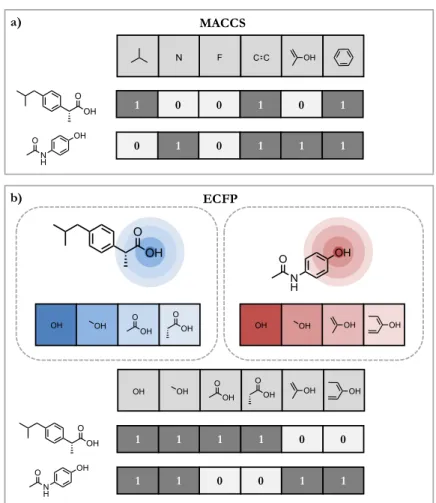
Figure 3: Molecular fingerprints. Schematic visualization of MACCS (a) and ECFP (b) for two exemplary compounds. These molecular fingerprints codify the presence (1) or absence (0) of chemical substructures or patterns. MACCS includes pre-defined structural keys or substructures, and ECFP encodes atom circular environments for each compound. In (b) atom environments are only generated for one exemplary atom.
spatial pharmacophores (3D).
10Molecular 2D fingerprints are a well-known
rep-resentation that encodes the presence or absence of chemical substructures or
patterns in a binary vector. Structural keys codify pre-defined chemical patterns
or substructures of a fixed length.
73Molecular access system (MACCS) keys are
a prominent example consisting of 166 bit positions,
114which provide an
easy-to-rationalize fingerprint as shown in
Figure 3a
. The extended-connectivity
fingerprint (ECFP) is a hashed fingerprint that encodes circular atom
environ-ments up to a given diameter, as illustrated in
Figure 3b
.
115Therefore, ECFPs
are more general than structural keys and result in a higher-dimensional
rep-resentation. ECFP length is variable by design, but it can be transformed to
a fixed-length vector through modulo mapping (folding). Recently, DL
archi-tectures that directly learn from the compound SMILES
116or 2D graphs have
been reported,
117,118which alleviate the feature engineering process.
Structural similarity
SAR modeling is based on the “similarity property principle” which states
that
“compounds with similar chemical structure share similar properties”
.
119Structural similarity has been intensively studied in chemoinformatics for the
comparison of compounds and their properties, mainly bioactivity.
120,121Never-theless, a clear and consistent similarity assessment by computational methods
is complicated due to the subjective nature of the concept.
122The matched
molecular pair (MMP) formalism is a chemically intuitive way to determine
analogs.
123A pair of compounds forming an MMP only differs by a structural
modification at a single site, as shown in
Figure 4
. Therefore, an MMP consists
of a common core or key fragment, and a chemical transformation. The
frag-mentation required for MMP generation can be based on retrosynthetic
combi-natorial analysis procedure (RECAP) rules.
124RECAP fragmentation is
com-putationally efficient and accounts for synthetic accessibility. RECAP-MMPs
can be organized in molecular networks, where nodes and edges represent
com-pounds and MMP relationships, respectively. As a result, each disjoint cluster
of the network is considered a unique analog series.
125,126v S N N N N Cl H N Br S N N N N Cl H N
Figure 4: MMP concept. Exemplary MMP formed by two compounds with common core that only differ by a chemical transformation (highlighted in blue).
There are different metrics that can be used to quantify similarity (i.e.
1-distance) on the basis of molecular representations. Tanimoto coefficient (Tc)
or Jaccard index is very popular for 2D fingerprints, and is given by (1) for two
compound fingerprints.
79Here
A
and
B
represent the sets of features present
in either of the two molecules.
Tc
(
A, B
) =
|A
∩
B
|
|A
∪
B
|
=
|A
∩
B
|
|A|
+
|B| − |A
∩
B|
(1)
Similarity searching
Similarity searching is the classic ligand-based approach for identifying new
active compounds.
127,128Following the similarity property principle, fingerprint
similarity based on the Tc (or another metric) is used as an indicator of
ac-tivity.
122In particular, database molecules with unknown activity are ranked
according to their decreasing similarity to an active reference molecule. Despite
its simplistic nature, this approach is often effective providing an early
enrich-ment of actives on the top of the ranking.
129A variety of extensions of standard
similarity searching have been introduced to improve performance including the
combination of multiple searches (data fusion) or fingerprint modification.
73,130Some exemplary methods are Turbo similarity searching,
131,132consensus bit
scaling,
133,134and conditional correlated Bernoulli model.
135With the advent
of ML models, traditional similarity searching has mainly found its application
in descriptive statistics, exploratory analysis and fast extensive calculations,
such as large-scale VS.
Machine learning models for SAR analysis and
prediction
The influence of chemical modifications on compound activity can be
mod-eled using ML either in a qualitative (classification) or quantitative (regression)
fashion. Based on their structural fingerprints, compounds are projected onto
a well-defined
m
-dimensional chemical space. In such a feature space, similar
molecules map closely together and ML models aim at recognizing differential
patterns that enable accurate predictions. Formally, a supervised ML model
relates a feature vector
x
= (
x
1, ..., x
m)
∈ X
to an output label
y
, where
y
=
{
+1
,
−
1
}
for binary classification and
y
∈
R
for regression, through a
func-tion
f
so that
f
(
x
) =
y
. The ML model attempts to minimize the expected test
error, which can be decomposed into bias, variance and a constant irreducible
noise term, as shown in (2) for a test instance
x
with label
y
. Bias refers to
the error introduced by approximating a real-life problem using a much simpler
model. Variance measures the variability or sensitivity of the prediction
func-tion to a particular choice of data. Clearly, a successful model simultaneously
achieves low bias and variance.
E
y
−
f
ˆ
(
x
)
2=
h
Bias
f
ˆ
(
x
)
i
2+
h
Var
f
ˆ
(
x
)
i
+
(2)
x1 x2 ⇧Bias ⇩Variance Model complexity P re di ct io n er ro r Training Internal validation x1 x2 x1 x2 ⇩ Bias ⇧Variance ★Underfitting Optimum Overfitting
Figure 5: Optimization of model complexity. The prediction error in training and internal validation sets depends on model complexity. Very simple models, which generally have high bias and low variance, are not able to model the data properly (underfitting). Complex models are often characterized by low bias and high variance and model peculiarities of training data (overfitting). The optimum model complexity is obtained by minimizing the internal validation error.
As illustrated in
Figure 5
, model complexity determines the bias and
vari-ance trade-off, which reflects the need of complexity optimization when models
rely on tuning hyper-parameters.
136Simple models might be unable to capture
the underlying patterns (underfitting) and complex models tend to fit the
inher-ent noise of training data (overfitting). Validation is an essinher-ential part of model
building aiming at complexity optimization as well as performance estimation.
Thus, it requires three data partitions: training set (model fitting), internal
validation set (model selection), and test or external validation set (model
as-sessment).
136,137Cross-validation might be utilized to account for different splits
or folds and make better use of the available data.
138Naïve Bayes
Naïve Bayes is a binary classifier that relies on the Bayes’ theorem.
139The
term “naïve” refers to the assumption of conditional feature independence.
De-spite this simplification, naïve Bayes classifiers have been successfully applied in
problems with correlated features.
140Bayes’ theorem is used to determine the
probability that a compound
x
belongs to class
y
, i.e.
P
(
y|
x
)
. The likelihood
function
P
(
x
|y
)
plays a central role. It can be estimated from the training set
and related to the posterior probability through the Bayes’ theorem (3).
P
(
y|
x
) =
P
(
x
|y
)
P
(
y
)
P
(
x
)
(3)
P
(
y
)
is the prior, i.e. either the known class probability distribution or
its estimation over the training set, and
P
(
x
)
refers to the evidence, which
acts as a normalization constant. Class likelihoods require an event model for
feature distributions and, for binary fingerprints, features follow a multivariate
Bernoulli distribution. For test predictions, the class with maximum likelihood
estimate for the observed data
x
will be selected, as shown in (4).
y
= argmax
ˆ y∈Y
P
(ˆ
y|
x
)
(4)
Random forest
A random forest (RF) consists of an ensemble of decorrelated decision trees
(DTs) that elicit variance reduction.
141A DT is a non-parametric method that
infers a sequence of binary decision rules to split training data into subsets with
better class separation. Splitting starts from the root (or top) node into child
nodes using rules built on the basis of compound features. DT is a recursive
partitioning method where each child node might in turn split until a stopping
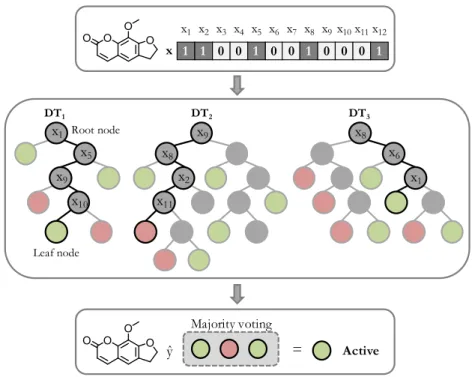
criterion is reached. As illustrated in
Figure 6
, non-leaf nodes represent the
decision rules, edges are possible outcomes, and the predominant class on the
leaf nodes determines the prediction. A tree path from the root to the terminal
node directly indicates the chain of feature-based decisions. DTs can capture
complex interaction structures in the data and have a low bias, but it comes at
the expense of high variance.
136DT1 DT2 DT3 x 1 1 0 0 1 0 0 1 0 0 0 1 x3 x1 x2 x4 x5 x6 x7 x8 x9x10x11x12 ŷ Majority voting = Active x1 x5 x9 x10 x9 x8 x2 x11 x8 x6 x1 Root node Leaf node
Figure 6: Principles of RF modeling. A compound with fingerprintxis predicted by a RF model with three DTs. Each non-leaf node represents a decision rule based on a feature (xm). The tree path from the root to the leaf node is highlighted in black. The color of leaf
nodes indicates the predicted label, e.g. active (green) or inactive (red). The final prediction forxis given by a consensus across individual tree predictions.
The classification and regression trees or CART algorithm
142constructs DTs
using feature thresholds yielding minimal Gini impurity values. This criterion
encourages the formation of regions with high proportions of data assigned to
one class,
139and becomes zero when all instances in a node belong to the same
class.
G
in a node
τ
is formally defined by (5), where
C
refers to the total
number of classes and
p
cto the probability of selecting a sample from class
c
.
G
(
τ
) =
C
X
c=1
p
c(1
−
p
c)
(5)
RF builds a collection of individual DTs using random samples with
replace-ment from the training set, which is known as bagging or bootstrap
aggregat-ing. Furthermore, RF randomly selects a feature set for node splitting (feature
bagging) to prevent DTs relying on the same strong predictors.
141These two
bagging strategies decorrelate the trees and introduce variability within the
ensemble model.
143Final predictions are driven by a consensus across trees.
RF model achieves reduced variance without increasing the bias of individual
models.
Support vector machines
Classification
The SVM algorithm was initially proposed for binary classification. The
SVM classifier attempts to find a hyperplane
H
=
{
x
|h
w
,
x
i
+
b
= 0
}
, defined
by a normal vector
w
and a bias
b
that separates the positive and negative
classes.
144,145For that purpose, SVM maximizes the margin, i.e. the distance
between the closest training instances from each class and the hyperplane.
These training instances are called support vectors (SVs). The hard-margin
(or maximum margin) hyperplane can be obtained by minimizing the distance
from
H
to the SVs of each class. However, said minimization problem has no
solution when data is not separable by a linear function. Slack variables (
ξ
i) are
added to derive a soft-margin hyperplane that enables training errors.
146To
al-low limited numbers of training compounds to map inside the margin or on the
incorrect side of the hyperplane, the minimization problem can be formulated
as indicated in (6).
minimize:
w,b1
2
k
w
k
2+
C
X
iξ
isubject to:
y
i(
h
w
,
x
ii
+
b
)
≥
1
−
ξ
iwith
ξ
i≥
0
∀i
(6)
The cost or regularization hyperparameter
C
balances the magnitude of
per-mitted training errors and the margin maximization. Small
C
values tolerate
larger errors, whereas large cost factors lead to a complex model. The primal
optimization problem can be expressed in a dual form using Lagrange
multi-pliers
α
i, and the solution yields the normal vector of the hyperplane in (7).
Training examples with non-zero
α
icoefficients represent the SVs and solely
determine the hyperplane position. These data points lie on the edge, within
the margin or even on the incorrect side of the hyperplane. The binary SVM
classification is schematized in
Figure 7
.
w
=
X
i
α
iy
ix
i(7)
Once the hyperplane is derived, test data are projected into the feature
space. A ranking can be obtained using the real value
g
(
x
) =
P
i
α
iy
ih
x
i,
x
i
+
b
,
which geometrically corresponds to sliding the hyperplane from the most distant
data point on the positive half space toward the negative side.
147Test instances
can be classified according to the side of the plane on which they fall, i.e.
f
(
x
) =
sgn
(
g
(
x
))
, which means that compounds with
f
(
x
) = +1
will be
assigned to the positive class (e.g. active) and
f
(
x
) =
−
1
to the negative class
(e.g. inactive).
v H+ H -H: <w,x> + b = 0 y = <w,x> + b w bSupport vector machines (SVM) Support vector regression (SVR)
x1 x2 x1 x2 Margi n ε-tube
Figure 7: Principles of SVM and SVR modeling. In SVM (left), a hyper-plane is generated for binary classification by margin maximization. The goal is differentiating between active (green) and inactive (red) compounds. In SVR (right), a regression function is derived for real value prediction. The gradient from light to dark blue indicates increasing numerical values (e.g. potency). SVs are represented by a black circle and lie within the margin (SVM) or outside the-tube (SVR).
Regression
Support vector regression (SVR) is an extension of the SVM algorithm for
real value predictions.
148In this case, SVR aims at mapping
x
as close as
possi-ble to their real label
y
by deriving a function of the form
f
(
x
) =
h
w
,
x
i
+
b
.
149,150Tolerated differences from observed and predicted values of training data are
at most
. However, slack variables are introduced to allow larger positive and
negative deviations (
ξ
i, ξ
i∗) from the so-called
-tube.
149In SVR, the
hyperpa-rameter
C
also controls the relaxation of error minimization problem and thus
penalizes large slack variables. Analogously to classification, the optimization
problem is formulated in (8) and can be solved using Lagrangian reformulation,
giving the final regression function in (9).
minimize:
w,b1
2
k
w
k
2+
C
X
i(
ξ
i+
ξ
i∗)
subject to:
y
i− h
w
,
x
ii −
b
≤
+
ξ
i∀i
h
w
,
x
ii
+
b
−
y
i≤
+
ξ
i∗∀i
with
ξ
i, ξ
i∗≥
0
(8)
f
(
x
) =
X
i(
α
i−
α
∗i)
h
x
i,
x
i
+
b
(9)
In SVR, SVs are the training data points that have either positive
α
ior
α
i∗.
SVs lie on the
-tube or outside of it and are the only training data used for the
prediction of new test examples.
Figure 7
illustrates the generation of a SVR
model.
Kernel trick
For nonlinear data that cannot be accurately modeled in the feature space
X
, the scalar product
h·,
·i
can be replaced by a kernel function
K
(
·,
·
)
.
146,151Conceptually, the kernel function transfers the scalar product to a higher
di-mensional space
W
in which the data might be linearly separated, as shown in
Figure 8
. The advantage is that the non-linear mapping
φ
:
X → W
does not
need to be explicitly computed. The generation of the hyperplane or regression
function only depends on SVs and not on the dimension of the input space,
which allows calculations in a higher dimensional space. A variety of kernel
functions exist including, among others, the Gaussian or radial basis function
kernel and the polynomial kernel. In addition, the Tanimoto kernel expression
is shown in (10) for two compounds with fingerprints
x
aand
x
b. This kernel
function is based on the Tc and widely used in chemoinformatics.
152K
Tc(
x
a,
x
b) =
h
x
a,
x
bi
h
x
a,
x
ai
+
h
x
b,
x
bi − h
x
a,
x
bi
(10)
The kernel trick allows non-linear SVM and SVR models but confers “black
box” character to the models.
Input space
𝓧
Higher dimensional space
𝓗
Mapping
𝜙
x
1x
2x
1x
2x
3Figure 8: Kernel trick SVM applies a non-linear mapping (φ) to project molecular rep-resentations into a higher-dimensional (W) space and enable a linear separation, when it is not possible in the original feature or input space (X).
Deep learning
Deep neural networks
Feedforward deep neural networks (DNNs) are a series of functional
transfor-mations given by a collection of connected units that are organized in sequential
layers.
153,154Units in a layer act in parallel. These units are also referred to as
neurons or basis functions. DNNs need to be constituted by at least an input
layer, two hidden layers, and an output layer.
153Each neuron receives inputs
from units in the previous layer and computes its activation value, representing
a vector-to-scalar function. The DNN schematic in
Figure 9
illustrates how
each input to a node is modified by a unique set of weights and biases, thus
giving unique combinations per activation. In particular, the neuron applies a
nonlinear activation function to the weighted sum of its inputs to generate its
output.
139The activation
a
lj
of neuron
j
in layer
l
is given by (11), where
σ
is
the activation function;
w
ljk
indicates the weights at the hidden unit
j
of layer
l
;
a
(kl−1)are the activations from the previous layer;
b
lj
is the bias of the neuron;
and the sum is over all neurons
k
in the layer
(
l
−
1)
.
153a
lj=
σ
X
kw
ljka
lk−1+
b
lj!
=
σ z
jl(11)
Hidden Input Output∑
Sum Activation function w1 w2 wm ... x1 x2 xm wm bm xm am x1 x2 x4 x3 am amFigure 9: Principles of a DNN.The schematic representation of a DNN shows an input layer with five neurons (blue), two hidden layers with four neurons each (gray) and an output layer with three neurons (orange). Each edge has a unique weight wi and each node has
a unique bias bi. Each neuron considers a weighted sum of the inputs xi and applies an
activation function to obtain the activation ai, which is an input for the units of the next
layer.
During the training phase, network weights and biases are modified so that
the predicted output matches or approximates the correct label
y
. The cost
function refers to the discrepancy between the output of the network and the
real label and has to be minimized during training. Minor changes in weights
and biases need to be related to small changes in the cost function, which is
facilitated by the gradient of the cost function
∇C
≡
∂C∂w1
,
∂C ∂b1, ...,
∂C ∂wl,
∂C ∂blT
.
21
The gradient defines the rate at which the cost will vary with respect to a
change in the weights or biases.
153Gradient descent methods can be used to
minimize the cost
C
(
w, b
)
, updating the weights and biases according to (12),
where
η
is the so-called learning rate. This process is illustrated in
Figure
10
. The learning rate hyper-parameter needs to be small enough so that the
approximation is accomplished but must also not be too small to avoid an
extremely slow gradient descent process resulting in unfeasibly long training
times.
w
→
w
0=
w
−
η
∂C
∂w
b
→
b
0=
b
−
η
∂C
∂b
(12)
w
1w
2 + -Cost −𝜂∇𝐶(𝑤', 𝑤)+
)+
+
+
+
+
+ +
Figure 10: Gradient descent. The error surface is shown with respect to two weight components (w1 and w2), where the color gradient from blue to red represents increasing
error or cost value. Since the gradient of the cost function indicates the direction of steepest ascent, the negative of the gradient is taken.
Backpropagation is an efficient method to compute the partial derivatives
of the cost function with respect to any weight and bias in the network.
155In
practice, backpropagation applied to random training subsets or “mini batches”
and the average is taken, which is known as stochastic gradient descent.
156Backpropagation in combination with stochastic gradient descent gives an
ap-proximation of the cost function gradient that depends on all the training data,
and weights and biases are updated accordingly. Cost and activation functions
that capture small changes in the weights and biases are required. For instance,
cross-entropy is generally used as loss function in DNNs to calculate the
dis-tance between the predicted probabilities and the real labels, and rectified linear
units are very popular in current DNN design. In addition, L2 and dropout
reg-ularization are the most common approaches to implicitly reduce the number of
free parameters and thus prevent model overfitting.
153Finally, the output layer
determines whether a DNN is for binary, multi-class, multi-label classification
or regression.
139Graph convolutional networks
Graph convolutional neural nets (CNNs) are another type of DNNs that
have been extensively used in computer vision. CNNs search for a given
pat-tern in different sections of the input matrix such as pixels in an image.
34A
filter or feature detector, which contains units with the same weight and bias
pa-rameters, is applied multiple times. Since CNNs enable representation learning
as well as the mapping to the output, they have been recently applied to
di-rectly learn from the molecular graph.
117Graph convolutional networks rely on
the 2D compound graph to automatically generate molecular representations
inspired by ECFP or the Morgan algorithm.
118A CNN applies convolutions
centered on atoms where the weights and biases are the learnable parameters
to construct molecular representations. The convolution proceeds at different
levels by considering contributions of neighboring atoms, which corresponds to
the circular fingerprints concept of extending the radius of atom environments.
Initially, a set of atom features summarizing the local atom environment (e.g.
atom type, valence, formal charge or hybridization) and a neighbor list
repre-senting molecular connectivity are obtained for every atom.
157Weight matrices
and bias vectors are used to update the atom features, and pooling is applied
using the maximum value. This process is typically repeated and finally a
graph gathering layer is introduced to sum up all feature vectors across atoms.
This final compound representation serves as input to a fully-connected layer.
Hence, a CNN combines feature extraction and model building in a trainable
model. This method is schematized in
Figure 11
. Representation learning
enables the consideration of task-specific features and eliminates the necessity
to pre-compute fixed compound descriptors.
O N H OH
Convolutional layer
OH OH Transformation (parameters W, b)Input
OH OH Atom features and neighbors listOH OH
Pooling
Softmax function + =Summation
Graph gathering Final representation …Figure 11: Fundamentals of a graph CNN. The process of representation learning is illustrated for a single central atom (O) and considering two neighbor levels, but in practice it is applied to all the graph nodes. Atom features (gray/white squares) and neighbors list (graph connectivity) are the inputs for the convolutional layer. Convolutions transform the inputs with a weight matrix W and bias b (learnable parameters) to obtain new feature vectors. In the pooling layer, a single vector is obtained per node (in the example, O atom) considering the maximum value for each feature across the neighbors. Finally, all feature vectors in the graph are summed up to obtain the final representation, which is the input for a fully-connected layer.
Modeling strategies
The prediction of compound bioactivity profiles represents a multi-label
clas-sification task, in which small molecules might bind to distinct targets. Models
can learn on the basis of ligand data for a single target or multiple targets.
Therefore, for the prediction of activity profiles, distinct modeling strategies
can be considered. Single-task (ST) modeling builds one model per target and
is often the default choice for label classification. Accordingly, the
multi-target problem is decomposed into distinct binary tasks and standard binary
classifiers are applied, as shown in
Figure 12a
. Other strategies exist to
trans-form the prediction problem into binary tasks, e.g. one-vs-one. On the other
hand, some ML methods can be algorithmically modified or adapted to enable
multitask (MT) learning.
158MT learning simultaneously models the activity
against multiple targets, as illustrated in
Figure 12b
. Many ML algorithms
support multi-label classification, but some methods do not enable MT
model-ing with missmodel-ing labels. For MT learnmodel-ing with DNNs, the output layer requires
as many units as tasks (or targets). Hence, all tasks share network parameters
and feature selection until they are submitted into separate classifiers at the
output layer. For handling missing compound-target annotations, MT-DNN
can be algorithmically adapted. Finally,
in silico
chemogenomic approaches or
proteochemometric models can be directly applied to interaction prediction.
159Following this approach, ligand and protein descriptors are combined
160,161and
used as input for a binary model, which discriminates between interacting and
non-interacting compound-target pairs, as schematized in
Figure 12c
.
,
[
]
-Minteract Minteract
+
,[
]
[
]
MT1,T2+
-[
]
-MT2 MT1
+
[
]
c) b) a)Figure 12: Modeling strategies for activity prediction. Three modeling strategies are illustrated for the simplified problem of predicting compound activity against two protein targets (T1 and T2). In (a) and (b), ST and MT models, respectively, aim at discriminating between active (green) and inactive (red) compounds from their molecular representations. In (a), two models MT1 and MT2(one per target) are used. In (b), the MT1,T2simultaneously
models activity against targets T1 and T2. Thus, this MT model outputs two predictions per compound. In (c), the chemogenomics model Minteractdiscriminates between interacting
(green) and non-interacting (red) compound-target pairs, from the combined input represen-tation.