UNIVERSITY OF KWAZULU-NATAL
A Framework to Improve Access to External Finance by Small and Medium Enterprise Start-ups
By
Nkombe Herman Bamata 210523167
A thesis submitted in partial fulfilment of the requirements for the degree of Doctor of Philosophy in Entrepreneurship
Supervisor: Prof Ziska Fields Co-supervisor: Prof Krishna K. Govender
DECLARATION
I, Nkombe Herman Bamata declare that:
(i) The research reported in this thesis, except where otherwise indicated, is my
original research
(ii) This thesis has not been submitted for any degree or examination at any other
university
(iii) This thesis does not contain other persons’ data, pictures, graphs or other information, unless specifically acknowledged as being sourced from other persons
(iv) This thesis does not contain other persons’ writing, unless specifically
acknowledged as being sourced from other researchers. Where other written sources have been quoted, then:
a) their words have been re-written but the general information attributed to them has been referenced
b) where their exact words have been used, their writing has been placed inside quotation marks, and referenced
(v) Where I have reproduced a publication of which I am an author, co-author or
editor, I have indicated in detail which part of the publication was actually written by myself alone and have fully referenced such publications
(vi) This thesis does not contain text, graphics or tables copied and pasted from
the Internet, unless specifically acknowledged, and the source being detailed in the dissertation/thesis and in the References sections
Signature:
KNOWLEDGEMENTS
“I can do all things through Christ who strengthens me.” Philippians 4:13 I am grateful to my Lord Jesus Christ for seeing me through this difficult project.
I would like to extend my exceptional gratitude to all those who somehow have contributed to the achievement of this research project:
My supervisor, Professor Ziska Fields and Co-supervisor, Prof Krishna K Govender, for their dedication and invaluable supervision, constructive guidance, and motivation
My love and innermost thanks to my beloved wife Constantine Bowey, for the affection and continual support she has given me throughout my studies
My daughter Asenath and my son Ariel, for their tolerance in respect of all the time not spent with them while busy with my studies
My mum Celine Tshitshi, who always supports and encourages me to achieve my dreams in life
My brothers and sisters, nephews and nieces, and all my close friends, for their assistance through this study
This work is dedicated to the memory of my late dad, Lieutenant-Colonel Joseph Nkombe Botek’Amata, who was my inspiration and
ABSTRACT
Despite the efforts of the South African government to develop the Small Medium Enterprise (SME) sector, start-up businesses not only face restricted access to but also challenges in accessing external finance, which acts as the main barrier to their growth and development. In light of the aforementioned, this study aims to propose a framework to improve access to external financing by SME start-ups. The formulation of the framework is based on a review and critique of the literature on the key determinants of the success of SME start-ups, namely, start-up awareness, management skills, and the requirements of finance providers. SME start-ups may be considered as a special case of resource-based theory due to limited resources of the firm. Start-up awareness and management skills are considered as necessary resources that will help the SME to acquire and develop other resources that will lead to a competitive advantage and superior performance.
This study has adopted a quantitative approach to collect and analyse data since this is the only way to test the various hypotheses postulated based on the resource-based theory. A sample of 252 SME start-ups was randomly selected from among SMEs located in Pietermaritzburg, the capital city of KwaZulu-Natal province in South Africa. Researchers may extent and roll out the research at the national level or other regions of the world. The data was used to conduct descriptive and inferential statistical analyses and structural equation modelling, using the Smart PLS statistical software. Seven hypothesised relationships were tested, and it was found that start-up awareness and management skills positively influence access by SME start-ups to government, corporate and personal/social sources of finance.
This study provides the necessary tools to start-up entrepreneurs to improve their access to external finance in South Africa. This study specifically highlights the different determinants of start-up awareness and management skills, and explains how the SME start-ups’ applicability of these determinants would influence their external financing accessibility. Also, this study highlights how finance providers could be able to develop matured relationships with SME start-ups, assess their finance applications based on the determinants of start-up awareness and management skills. The proposed framework maps the start-up entrepreneur’s business awareness and the requisite management skills with the finance providers’ requirements for granting finance and provides the entrepreneur with a clear idea of the type of finance to apply for and the optimal financing options for their businesses.
TABLE OF CONTENTS DECLARATION ... II KNOWLEDGEMENTS ... III ABSTRACT………...IV LIST OF TABLES ... X 1 CHAPTER ONE INTRODUCTION ... 1 1.1 Introduction ... 1
1.2 Background of the study ... 1
1.3 Problem statement ... 4
1.4 Research Objectives ... 6
1.5 Research questions ... 6
1.6 Conceptual model and hypotheses ... 7
1.7 Research methodology ... 10
1.7.1 Population, Sample and Sampling ... 10
1.7.2 Data Collection and Analysis ... 10
1.8 Research context ... 11
1.9 Significance of study ... 14
1.10 Outline of Study ... 15
1.11 Summary ... 16
2 CHAPTER TWO FINANCING OF SME START-UPS ... 17
2.1 Introduction ... 17
2.2 The importance of entrepreneurship and SME sector ... 17
2.2.1 Global perspective ... 17
2.2.2 The South African context ... 20
2.3.1 SME life-cycle and financing options in developed countries ... 24
2.3.2 SME life-cycle and financing options in South Africa ... 26
2.3.3 SME life-cycle and financing options by size and maturity ... 29
2.4 Business start-ups ... 30
2.5 Funding Options for SME Start-ups ... 31
2.6 Financing options for SME start-ups in South Africa ... 34
2.6.1 Government funding ... 36
2.6.2 Commercial bank funds ... 41
2.7 Challenges in accessing bank financing ... 47
2.7.1 Information asymmetry ... 49
2.7.2 Risks in lending to the SMEs ... 49
2.7.3 Requirements set by commercial banks ... 50
2.7.4 Specific requirements by Commercial Banks in South Africa ... 56
2.8 Access to private equity finance by SME start-ups ... 61
2.8.1 Direct Lenders and Microfinance Institutions ... 61
2.8.2 Organisations facilitating Access to Finance for SMEs ... 63
2.9 Summary ... 66
3 CHAPTER THREE START-UP AWARENESS AND REQUISITE MANAGEMENT SKILLS ... 67
3.1 INTRODUCTION ... 67
3.2 Resource-based theory ... 67
3.3 Key determinants of the success of SME start-ups ... 70
3.3.1 Start-up Awareness ... 71
3.3.2 Management skills as key determinants of the success of SME start-ups ... 76
3.3.3 Other determinants of business success ... 83
3.4 RELATIONSHIPS BETWEEN SUA, MS AND EXTERNAL SOURCES OF FINANCE ... 86
3.5 Conceptual Model and Hypotheses Development... 88
4 CHAPTER FOUR RESEARCH METHODOLOGY ... 91
4.1 INTRODUCTION ... 91
4.2 Research philosophy ... 91
4.3 Research design and approach ... 92
4.4 Research context ... 93 4.5 Target population ... 94 4.6 Sample size ... 94 4.7 Primary Data ... 95 4.7.1 Questionnaire ... 95 4.7.2 Questionnaire Design ... 96
4.7.3 Administration of the Questionnaire ... 99
4.8 Validity and Reliability ... 100
4.8.1 Validity ... 100
4.8.2 Reliability ... 102
4.8.3 Ethical Considerations ... 102
4.9 Data analysis ... 103
4.9.1 Quantitative Data Analysis ... 103
4.10 Summary ... 108
5 CHAPTER FIVE RESEARCH FINDINGS ... 109
5.1 INTRODUCTION ... 109
5.2 Demographics of respondents and characteristics of the business ... 110
5.3 Key determinants of the success of SME start-ups ... 127
5.3.1 Start-up Awareness ... 129
5.3.2 Management Skills ... 132
5.4 Access to finance ... 134
5.4.1 Sources of finance to start a SME ... 134
5.4.2 Current Financing ... 136
5.4.4 Aware of the availability of external finance for SMEs ... 138
5.4.5 Financing from Government ... 141
5.4.6 Financing from Banks ... 142
5.5 The influence of the key determinants of the success of SME start-ups on their access to external finance ... 145
5.5.1 T-test for Start-up Awareness and Government Funding... 145
5.5.2 ANOVA for bank funding ... 153
5.5.3 Robust Test of equality of means for bank funding ... 156
5.5.4 ANOVA Test Results for bank funding ... 157
5.5.5 Summary of the influence of the key determinants of the success of SME start-ups on their access to external finance ... 160
5.6 Measurement Model Assessment ... 162
5.6.1 Reliability Assessment ... 162
5.6.2 Validity Assessment ... 162
5.7 Summary ... 174
6 CHAPTER SIX KEY FINDINGS, CONCLUSION AND RECOMMENDATIONS ... 175
6.1 INTRODUCTION ... 175
6.2 Key Findings ... 175
6.2.1 To determine the challenges SME start-ups experience in accessing external financing ... 175
6.2.2 To analyse the key requirements of external finance providers to SME start-ups ... 176
6.2.3 To determine the access to alternative external financing by SMEs in the start-up phase ... 176
6.2.4 To examine the relationship between the key determinants of the success of SME start-ups and their access to different sources of external finance ... 176
6.2.5 To develop a framework to improve access to external finance by SME start-ups ... 178
6.3 RECOMMENDATIONS ... 181
6.3.2 Recommendations to South African government and policy-makers... 183
6.3.3 Recommendations to the SME finance providers ... 184
6.4 Limitations of the study ... 184
6.5 Recommendations for further research ... 185
6.6 Conclusion ... 185
REFERENCES ... 187
APPENDICES 221 APPENDIX 1: BINOMIAL TEST TABLE FOR REASON/S FOR STARTING OWN BUSINESS ... 221
APPENDIX 2: BINOMIAL TEST TABLE FOR SOURCES OF FINANCE TO START A SME ... 223
APPENDIX 3: BINOMIAL TEST TABLE FOR SME CURRENT FINANCING ... 224
APPENDIX 4: BINOMIAL TEST TABLE FOR REASONS FOR APPLYING FOR FUNDING ... 225
APPENDIX 5: BINOMIAL TEST TABLE FOR TYPE OF FINANCIAL ASSISTANCE RECEIVED ... 226
APPENDIX 6: BINOMIAL TEST TABLE FOR IMPACT OF THE FINANCIAL ASSISTANCE RECEIVED ... 227
APPENDIX 7: BINOMIAL TEST TABLE FOR REASONS FOR NOT APPLYING FOR BANK CREDIT ... 228
APPENDIX 8: BINOMIAL TEST TABLE FOR REASONS FOR UNSUCCESSFUL APPLICATION FOR BANK CREDIT ... 229
APPENDIX 9: QUESTIONNAIRE ... 230
APPENDIX 10: INFORMED CONSENT DOCUMENT ... 243
APPENDIX 11: ETHICAL CLEARANCE APPROVAL LETTER ... 244
APPENDIX 12: TEXT EDITOR APPROVAL ... 245
LIST OF TABLES
Table 2.1: SME growth phases and funding cycle in the UK ... 25
Table 2.2: SME life and funding cycles in South Africa ... 27
Table 2.3: The relative importance of PDIs among SMEs ... 28
Table 2.4: South African government grants for SMEs ... 39
Table 2.5: Requirements for accessing financing ... 66
Table 4.1: Sample size ... 95
Table 5.1: Race of respondents ... 110
Table 5.2: Race and Funding to use a business mentor ... 111
Table 5.3: Chi-Square – Race and Funding for the use of a business mentor ... 112
Table 5.4: Highest Education Level ... 113
Table 5.5: Prior experience and finance from a government agency ... 116
Table 5.6: Chi-Square Tests – Prior experience and finance from a government agency ... 117
Table 5.7: Age of business and loan from a bank ... 119
Table 5.8: Chi-square – Age of business versus Loan from a bank ... 120
Table 5.9: Business sector and Loan from a bank in my start-up company name ... 124
Table 5.10: Chi-Square Tests for Business sector and Loan from a bank ... 125
Table 5.11: Business sector and Funding to use an external consultant ... 126
Table 5.12: Chi-Square Tests Business sector and Funding to use an external consultant ... 127
Table 5.13: One-Sample Statistics ... 131
Table 5.14: One-Sample Test ... 131
Table 5.15: One-Sample Statistics ... 133
Table 5.17: One-Sample statistics ... 140
Table 5.18: One-Sample Test ... 140
Table 5.19: Group statistics ... 146
Table 5.20: Independent Samples Test ... 147
Table 5.21: Group Statistics... 150
Table 5.22: Independent Samples ... 151
Table 5.23: ANOVA ... 154
Table 5.24: Robust Tests of Equality of Means ... 156
Table 5.25: ANOVA ... 158
Table 5.26: Correlation between the constructs ... 163
Table 5.27: Scale accuracy analysis ... 164
Table 5.28: Model Fit Summary – Measurement Model ... 166
Table 5.29: Coefficient of determination (R²) ... 167
Table 5.30: VIF results in the structural model ... 168
Table 5.31: Hypothesis testing results ... 169
LIST OF FIGURES
Figure 1. 1: Conceptual hypothesized research model ... 9
Figure 1. 2: Map of Pietermaritzburg ... 12
Figure 2. 1: SME finance coverage ... 30
Figure 3. 1: Resource-based view concept ... 68
Figure 3. 2: Proposed Conceptual Model ... 89
Figure 5. 1: Educational career ... 112
Figure 5. 2: Field of study ... 114
Figure 5. 3: Years of experience ... 115
Figure 5. 4: Age of business ... 118
Figure 5. 5: Number of employees ... 121
Figure 5. 6: Type of business ... 121
Figure 5. 7: Business sector ... 122
Figure 5. 8: Reason for starting own business ... 128
Figure 5. 9: Start-up awareness ... 130
Figure 5. 10: Management skills ... 132
Figure 5. 11: Source of finance during start-up ... 135
Figure 5. 12: Current financing ... 136
Figure 5. 13: Reasons for applying for funding ... 138
Figure 5. 14: Awareness of financing options ... 139
Figure 5. 15: Type of financial assistance received ... 141
Figure 5. 16: Reasons for not applying for bank credit ... 143
Figure 5. 17: Reasons for unsuccessful application for bank credit ... 144
Figure 5. 18: Structural Model Results ... 170
LIST OF ABBREVIATIONS
ABSA : Amalgamated Banks of South Africa
AMFISA : Association for Pro-Poor Micro Finance Institutions for South Africa
ANOVA : Analysis of variance
ASGISA : Accelerated and Shared Growth Initiative of South Africa
AVE : Average Variance Extracted
BBSDP : Black Business Supplier Development Programme
BPS : Business Process Services
CB : Covariance Based
CBO : Communities Based Organisation
CF : Corporate source of Finance
CFA : Confirmatory Factor Analysis
CIP : Critical Infrastructure Programme
CIPC : Companies and Intellectual Property Commission
CIS : Co-operative Incentive Scheme
CMIN/DF : Minimum discrepancy divided by Degree of Freedom
CPFP : Capital Projects Feasibility Programme
CPI : Corruption Perception Index
CR : Composite Reliability
CTCIP : Clothing and Textile Competitiveness Improvement Programme
CV : Curriculum Vitae
DCA : Development Credit Application
DF : Degree of Freedom
DTI : Department of Trade and Industry
EIP : Enterprise Investment Programme
FICA :Financial Intelligence Centre Act
FNB : First National Bank
FSB : Financial Service Board
GAA : Global Accounting Alliance
GDP : Gross Domestic Product
GF : Government source of Finance
GFI : Goodness of Fit Index
HSV : highest shared variance
ICC : International Chamber of Commerce
IFC : International Finance Corporation
IPO : Initial Public Offering
IPR : Intellectual Propriety Rights
ISP : Incubation Support Programme
KRA : Key Result Area
KSF : Key Success Factor
KZN : KwaZulu-Natal
MCP : Micro-credit Programme
MFI : Microfinance Institution
MFSA : Microfinance South Africa
MIS : Management Information System
MS : Management Skills
NBFC : Non-Bank Financial Companies
NCA : National Credit Act
NEF : National Empowerment Fund
NFI : Normed Fit Index
NGO : Non-Governmental Organisation
NPO : Non-Profit Organisation
NYDA : National Youth Development Agency
PCB : Pietermaritzburg Chamber of Business
PDI : Previously Disadvantaged Individuals
PLS : Partial Least Squares
PSF : Personal/ Social source of Finance
QLFS : Quarterly Labour Force Survey
RBT : Resource-Based Theory
SACCI : South African Chamber of Commerce and Industry
SARB : South African Reserve Bank
SD : Standard Deviation
SEDA : Small Development Agency
SEF : Small Enterprise Foundation
SEM : Structural Equation Modelling
SETA : Sector Education and Training Authority
SME : Small and Medium-sized Enterprise
SMEs : Small and Medium-sized Enterprises
SMME : Small, Micro and Medium-sized Enterprises
SPII : Support Programme for Industrial Innovation
SPSS : Statistical Package for Social Sciences
SRMR : Standardised Root Mean Residual
STP : SEDA Technology Programme
SUA : Start-Up Awareness
SV : Shared Variance
TCP : Tšhomisano Credit Programme
TEA : Total Entrepreneurial Activity
TWIB : Technology for Women in Business
UK : United Kingdome
US : United Stated
USA : United States of America
VIF : Variance Inflation Factor
1 CHAPTER ONE INTRODUCTION
1.1 INTRODUCTION
Small and medium-sized enterprises (SMEs) have and continue to play a critical role in the economic growth of most countries worldwide (Lekhanya, 2016). From survivalist micro enterprises such as hawking, small businesses have been central in the development of several developing countries, often serving as the primary source of livelihood (Bongini, Ferrando, Rossi & Rossolin, 2017). According to Domeher, Abdulai and Yeboah, (2016), SMEs account for over 60% of the GDP and over 70% of total employment in low-income countries, and over 95% of total employment and about 70% to the GDP of middle-income countries.
Access to external finance for SME start-ups has always been an issue of debate within the circle of scholars and researchers. Issues related to capital structure decision have attracted lot of attention, because of the reason that these issues are primarily dominant in small sized and young firms. This study will therefore address the financing options that are available to these start-ups along with their pattern and duration of availability. Furthermore, with the emphasis over possible alternatives the start-ups firms can adopt in order to make sure the smooth availability of finance in crucial times.
This chapter presents the background, problem statement and significance of this study, based on global entrepreneurial development, challenges faced by South African SMEs in the start-up phase, inter alia, constraints to accessing external finance, by referring specifically to SMEs in Pietermaritzburg, the capital city of KwaZulu-Natal province in South Africa. The specific objectives emanating from the overall aim of this study are highlighted and the research questions derived from the problem statement are articulated. An overview of the research methodology, the conceptual model and research hypotheses are also presented.
1.2 BACKGROUND OF THE STUDY
The European Central Bank (2013) reported that SMEs are special since they are the backbone of the euro area economy; they constitute about 98% of all euro area firms,
employ approximately 75% of the euro area employees and generate about 60% of value added (Cœuré, 2013). Mmako, Shambare, Radipere and Dhliwayo (2017) state that any country’s economic development is attributed to the level of entrepreneurial activity in that country and entrepreneurs are the primary source of the wellbeing of communities and nations (Mariotti & Glackin, 2014).
Most South African small businesses do not grow and develop, and their failure rate of 75% is one of the highest in the world (Fatoki & Garwe, 2010; Bisseker, 2014; Wagner, 2015). The authors above highlight that new entrepreneurs in South Africa do not move their businesses from the stage of existence and survival to success, take-off, growth and maturity. For small businesses to compete or have a competitive advantage, they have to grow beyond the survival stage and keep on growing (Ayandibu & Houghton, 2017).
According to the Global Entrepreneurship Monitor (GEM) 2016 – 2017 Report (2017),
South Africa’s rate of entrepreneurial activity is very low for a developing nation, thus placing South African entrepreneurial activities below other African countries such as Burkina Faso and Tunisia.
Ayandibu and Houghton (2017) state that the vital role that the SME sector plays in the South African economy is to address sustainable development. They further argued that in South Africa, it is estimated that 90% of all formal businesses are small, medium or micro enterprises. The SME sector is one of the largest contributors to the South African economy (Gatt, 2012). SMEs are not only seen as an employment creator, but this sector also acts as an absorbent of retrenched people coming from the private and public sector
(Smit, 2012).Garwe and Fatoki (2012) indicated that South Africa suffers from high levels
of unemployment, poverty and income inequality. According to the Quarterly Labour Force Survey (QLFS Q3) (2017), the expanded South African unemployment rate is around 36.8%, which includes those who wanted to work, but did not look for work. SMEs in South Africa are expected to be an important vehicle to address the challenges of job creation, sustainable economic growth, equitable distribution of income and the overall stimulation of economic growth (Ayandibu & Houghton, 2017). According to Baldry (2016), the degree of spatial inequality in South Africa implies that the development challenges faced by the nine provincial governments differ considerably between
provinces, and the KwaZulu-Natal (KZN) province faces disproportionately large development challenges. For example, in 2017, the unemployment rate was 41%, (QLFS– Q3:2017) and KZN is the third poorest province in South Africa, with 68,1% of its population surviving on an income below the international poverty line of US$ 1.90 per day, per person, as identified by the World Bank (2015). The World Bank Task Team (2015) asserts that the promotion of SMEs is a key area of employment generation and that SMEs having access to external financing could provide a substantial share of new job creation in South Africa.
According to the International Finance Corporation (2017), in Sub Saharan Africa, SMEs account for up to 90% of all businesses and are important drivers of economic growth in
the region. Domeher, et al. (2016) further argued that in Africa, the symptoms of under
development remain pervasive, it is a situation in which SMEs are largely failing to live up to expectations, which results in blaming SME’s for their inability to significantly contribute to economic development, without examining the challenges which confront them. SMEs require an enabling environment to thrive, with access to external funding being a major
factor (Domeher et al., 2016; Carbó-Valverde, Rodríguez-Fernández & Udell, 2016). The
South African Government through the Office of the Presidency and the National Planning Commission, launched the National Development Plan 2030, which aims to eliminate poverty and reduce inequality by 2030 (Manuel, 2012). Although priority has been given to enabling SMEs to access banking services, it is of concern that South Africa's banks do not extend sufficient credit to smaller firms, despite greater access to credit for small firms leading to the potential for higher levels of business investment and jobs (Manuel, 2012).
Despite the importance of SMEs in national economies, Bongini et al. (2017) indicated
that SMEs are financially more constrained than larger firms, and are less likely to have access to external finance compared to larger businesses. Mazanai and Fatoki (2012) also reported that compared to German, Italian and Spanish firms, South African SMEs experience particular challenges in accessing external finance. This constraint appears to be more severe in the case of start-up businesses because of their limited choice of financing (Abor & Quartey, 2010). Many of these firms are not able to finance their
operating expenses from retained earnings or to internally invest in the firm’s development. SMEs’ tangible assets and profitability exhibit high volatile performances, which restricts their ability to access external finance, and in addition, finance providers view them as high-risk borrowers that limit the will of financial institutions to fund their projects. Also because of low rankings such as Global Entrepreneurship Monitor (GEM) (2016/2017) and their own risk models (Li, 2015).
Small business ventures in South Africa are fraught with uncertainties, because of the complex relationship between the key determinants of the success of SME start-ups and access to external finance by the owner-managers of SMEs (Chawla, Khanna & Chen, 2010; Fatoki & Odeyemi, 2010). The aforementioned has however not prevented managerial prescriptions from being devised on what to do and which determinants to use to improve access to external finance by these organisations (Simpson, Padmore & Newman, 2011). Although it is reasonable to expect finance providers to require that certain fundamentals or indicators (determinants) of business success to be in place before considering granting finance to SMEs, there is no general consensus on the determinants of business success. Kwatalo (2010) suggested that a determinant of start-up business success is any competitive asset or competence that is needed to succeed in the marketplace, be it a strategic competitive advantage, representing a sustainable point of advantage or merely a point of parity with the firm’s competitors.
It is against the above background that this study investigates the relationship between the key determinants of the success of SME start-ups and their access to external financing in the South African context, with the intention of developing a Framework for SMEs in the start-up phase to access external finance. More specifically, the study will also assess the importance of the determinants (of business success) in ensuring that SMEs obtain start-up funding, by empirically analysing the influence of an entrepreneur’s business awareness and management skills, on the SME’s access to external finance. 1.3 PROBLEM STATEMENT
Pihie (2009) states that entrepreneurship can be measured in two ways, namely, actual entrepreneurship, where people that have started a business, and entrepreneurial intention or latent entrepreneurship, where people intend to start a business. In South
Africa, the percentage of adult South Africans involved in entrepreneurial activity has dropped by 34% since 2013 (Yu, 2016), and the percentage of adults in South Africa involved in a business that is less than three-and-a-half years old, also known as early-stage entrepreneurs, has decreased to 6.97% in 2015, from a 13-year high of 10.6% in 2013 (Dludla, 2015).
Total Entrepreneurial Activity (TEA) which is a measure of people in the 18-64 age group who are actively involved in the start-up process or those managing businesses for less than forty-two months old (Peroni, Riillo, & Rodrigues, 2017) reports that the TEA rate in South Africa in 2017 was 9.2% which, is significantly below the average of 13.2%, for the countries that participated in the annual GEM review. The Global Entrepreneurship Monitor (2016 – 2017) indicated that South Africa’s rate of entrepreneurial activity is very low for a developing nation, thus placing South African entrepreneurial activities below other African countries, such as Angola, Botswana, Burkina Faso and Cameroon (Peroni, Riillo, & Rodrigues, 2017). In KwaZulu-Natal, there are a host of challenges that entrepreneurs may encounter. These include a lack of start-up finance, access to markets and gaining market credibility, access to appropriate technology, access to resources, especially human resources and other barriers such as the lack of entrepreneurial skills, awareness and preparedness amongst entrepreneurs; forecasts, which are rarely accurate; sub-optimal infrastructure, which is impairing the culture of entrepreneurship in KwaZulu-Natal (Nieman & Nieuwenhuizen, 2014).
A survey by Abor and Quartey (2010) showed that many small to medium entrepreneurs and business owners perceive access to funds as their major constraint, especially in establishing or expanding their businesses. Dludla (2015) also indicated that included among the main reasons for a decline in the entrepreneurship rate in South Africa is access to funding. More specifically concerning small business owners in Pietermaritzburg, the greatest challenge is raising finance (Ayandibu & Houghton, 2017). While there are a number of ways by which medium and large corporations can raise finance, access to these sources is fraught with technical restrictions, which include requests for security or collateral and capping of the minimum loan amount, which can make it too expensive for the small business owners to use this avenue to access funding
(Nieuwenhuizen, 2011). SMEs need finance to support the selling process, in terms of procuring inventory, or marketing the products or services, for paying salaries and wages, for purchasing different types of assets, and for paying business taxes (Nyoka, 2013) and as long as the business is in operation, it will constantly need financing in the short, medium and long term (Timm, 2011).
In light of the above, this study seeks to empirically identify the key determinants of the success of SME start-ups which impact access to external finance by SME start-ups in Pietermaritzburg, South Africa and, to analyse the relationships between the aforementioned determinants and access to external funding and develop a Financing Framework, which will improve access to external financing by the SMEs.
1.4 RESEARCH OBJECTIVES
The primary objective of this study is to develop a Financing Framework to improve access to external finance by SME start-ups in Pietermaritzburg, South Africa. The secondary objectives of the study are:
To determine the challenges SME start-ups experience in accessing external financing
To analyse the key requirements of external finance providers to SME start-ups To determine the access to alternate external financing by SMEs start-up
To analyse the relationships between the key determinants of the success of SME start-ups and their access to different sources of external finance
To develop a financing framework to improve access to external finance by SME start-ups
1.5 RESEARCH QUESTIONS
The following research questions have been generated to direct the research study: What challenges do start-up SMEs (in Pietermaritzburg) experience in accessing
What are the key requirements of finance providers to SME start-ups to access external finance?
What sources of finance are available for SME start-ups in Pietermaritzburg? What key determinants of the success of SME start-ups that impact their ability to
access external finance?
Which key determinants of the success of SME start-ups that can be used to develop a financing framework to assist their access to external finance?
1.6 CONCEPTUAL MODEL AND HYPOTHESES
Access to external financing is the most challenging condition experienced by SME start-ups (Bongini et al., 2017). Since at different stages of a SME life-cycle, the financing needs and options change, it is necessary to design a financing framework that will improve their access to external financing at the start-up stage. The framework will be built on a combination of the determinants of an entrepreneur’s business awareness and management skills, with business processes that lead to preferable external finance options for SMEs.
It is reasonable to expect the existence of the key proficiencies which finance providers should consider before financing SME start-ups. Those proficiencies are defined as key determinants of the success of SME start-ups. However, there is no general consensus on the determinants of the business success (Doom et al., 2009). For the purpose of this research study, start-up awareness (SUA) and management skills (MS) are considered. The reason is that SUA and MS are considered to be the most key determinants of business success that are related to external financing and evaluated by most of the external finance providers. The key determinants of the success of SME start-ups, namely start-up awareness and management skills refer to external and internal factors respectively. While the internal determinants are organisation (individual) related elements which are controlled by the business owner or entrepreneur, and external determinants are all related to the business environment and not controlled by the entrepreneur. For this research, external determinants are referred to as start-up awareness and the internal determinants are referred as management skills. Once these
determinants are isolated, they will be evaluated about the type of finance required, and then linked to the available provision.
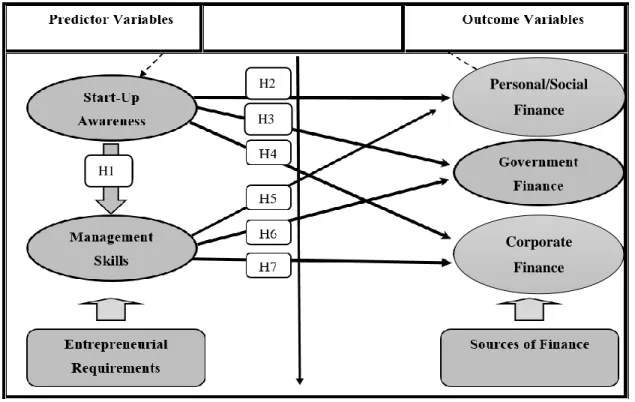
The key determinants of the success of SME ups include the determinants of start-up awareness such as opportunity awareness, differentiation factors, business model, strategy, feasibility study, business plan, location, amount and source of seed capital, and decision-making ability (Doom et al., 2009; Fatoki & Odeyemi, 2010; Smorfitt, 2008). It is proposed that the aforementioned may be related to access to different sources of external finance available to SME start-ups. Thus, in order to investigate this proposal, it is hypothesized that:
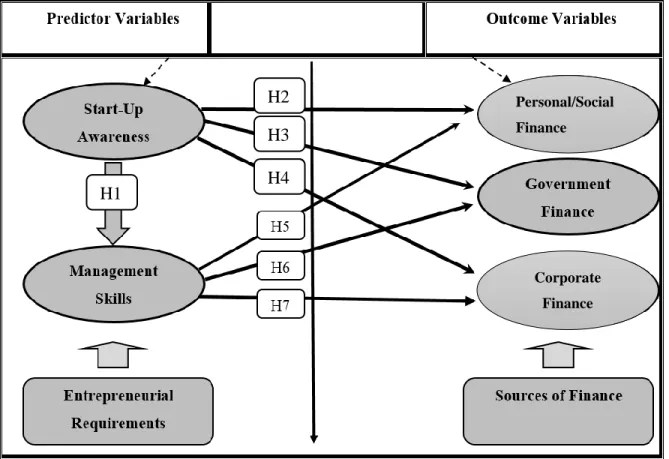
H1: There is a relationship between start-up awareness and management skills Considering that start-up awareness and management skills are postulated to be related to the source of external funding available for SME start-ups, it may also be hypothesized that:
H2: There is a positive relationship between start-up awareness and the choice of
personal/social networks as a source of finance
H3: There is a positive relationship between start-up awareness and the choice of
Government as a source of finance
H4: There is a positive relationship between start-up awareness and the choice of
corporate as a source of finance
Management skills such as general, strategic, organisational, technical, inventory, and financial, as well as leadership and communication, marketing, contingency, control and
system, and being growth-oriented (Doom et al., 2009; Fatoki & Odeyemi, 2010; Smorfitt,
2008) may influence access to varying forms of external finance by start-up SMEs. Thus, in order to investigate this further with respect to the SMEs in Pietermaritzburg, South Africa, it is hypothesized that:
H5: There is a positive relationship between management skills and the choice of
personal/social networks as a source of finance
H6: There is a positive relationship between management skills and the choice of
H7: There is a positive relationship between management skills and the choice of corporates as a source of finance
Figure 1.1 represents the proposed conceptual model whose development will be explained in detail in Chapter 3.
Figure 1. 1: Conceptual hypothesized research model
The constructs SUA and MS characterise, condition, and determine variables that have a direct and serious impact on the effectiveness, efficiency and viability of an organisation, programme or project (Skrinjar & Trkman 2013:50). Both two groups of constructs are linked in a sense that are external and internal factors of business success. The entrepreneur should carefully consider the determinants of start-up awareness to achieve an intended goal and overall objectives. If these determinants are identified in relation to a general population of entrepreneurs and then applied to start-up businesses, it is highly probable that the business failure rate in accessing external finance will be considerably reduced and that a good level of organisational performance will be achieved (Ahmad & Cuenca 2013). H2 H1 H3 Personal/Social Finance Corporate Finance
1.7 RESEARCH METHODOLOGY
According to Olsen (2012), research methodology is a systematic manner to solve the research problem where the researcher will explain the different steps to logically solve the research problem. There are three main research approaches which can be used by the researcher, namely, quantitative, qualitative and mixed methods research (Sedmak
& Longhurst, 2010; Henry, Foss& Ahl 2015). The quantitative approach generates data
that can be subject to rigorous analysis using advanced statistical techniques, whereas the qualitative approach involves using narratives and textual data to develop a conceptual framework. Mixed methods represents research that involves collecting, analysing, and interpreting quantitative and qualitative data in a single study or in a series of studies that investigate the same underlying phenomenon (Cameron, 2015; Saunders, Lewis & Thornhill, 2012). In this study, a quantitative approach was adopted since this is the only way to test the various hypotheses postulated in the context of the Resource-based theory.
1.7.1 Population, Sample and Sampling
The targeted population is all SME owners and managers in Pietermaritzburg, and the population is members of the Pietermaritzburg Chamber of Business (PCB), which is a registered Non-profit Organisation affiliated to the South African Chamber of Commerce and Industry (SACCI). The PCB which comprises 832 businesses, is the fourth largest Chamber of Commerce in South Africa (PCB, 2016). From the universum, Government and non-government organisations, schools and honorary members of PCB have been excluded, which resulted in the population being reduced to 678. Random sampling technique was used to select a sample of 252 participants from different SME start-ups located in Pietermaritzburg, South Africa.
1.7.2 Data Collection and Analysis
A self-developed structured questionnaire comprising closed-ended questions was used to collect data from respondents. The researcher hired a fieldworker who after being fully trained, went to the premises of sample participants in different areas in Pietermaritzburg and personally handed over the questionnaires. During the two-month period of field
research, the researcher and the fieldworker managed to collect 252 completed questionnaires. The fieldwork was conducted from September to October 2016.
The questions in the questionnaire were derived from the objectives of the study guided by the literature review. A covering letter was necessary which aimed to ensure that the respondents were informed of the nature and purpose of the research. The questions included multiple-choice questions which offered a list of alternative responses. The questionnaire was designed in English and the researcher and fieldworker administered the questionnaires to the respondents. To ascertain that all the respondents could completely understand all the questions, the researcher assisted the respondents with proper and accurate explanations/translations where necessary. The data collected, was coded, captured and analysed using Statistical Package for Social Sciences (SPSS) version 24.0. The relevant statistical analysis techniques used included descriptive and inferential statistics; the stastistics which were conducted by a professional statistician. Secondary data was collected by reviewing journal articles, textbooks, e-books, databases, policy documents, newspapers and magazine reports, Government and non-governmental organisations publications and other relevant sources (Sedmak & Longhurst, 2010). Secondary data was helpful as it provided the necessary background and foundation for this research.
1.8 RESEARCH CONTEXT
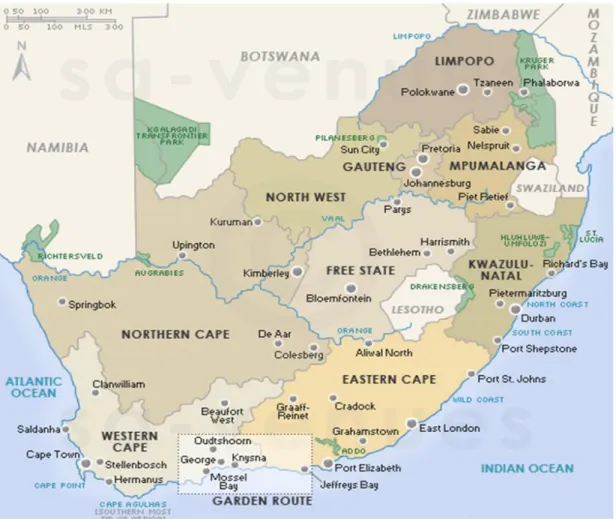
This research was conducted in Pietermaritzburg, the capital and second-largest city in the province of KwaZulu-Natal (KZN), South Africa. Statistics South Africa reports that Pietermaritzburg falls within the boundaries of Msunduzi municipality with a current population of 750,864 (Msunduzi, 2017). Pietermaritzburg is both the administrative and legislative capital of the KZN province, which boosts investor confidence, resulting in the city’s economy growing at an astounding rate. The Business Confidence Index for the city for the third quarter of 2017 was 93, a clear indication that businesses are positive and confident about the current and future state of business in Pietermaritzburg. Pietermaritzburg is more than just a favourable investment destination; it is one of South Africa’s most desirable residential cities with well-laid-out suburbs (Pietermaritzburg Tourism, 2016; SACCI, 2017). Despite economic progress in Pietermaritzburg, its
population still experiences poverty, inequality and unemployment, and 33% of the 229 672 economically active (employed or unemployed but looking for work) people are unemployed (Msunduzi, 2017). Figure 1.2 depicts the geographic location of the city where the research was conducted.
Figure 1. 2: Map of Pietermaritzburg Source: SA-venues.com, 2017
Incentives South Africa (2014) reported that South Africa is estimated to have approximately two (2) million small businesses, representing 98% of the total number of firms in the country. Small enterprises employ about 55% of the country’s labour force and contributes approximately 42% to the country’s wage bill. However, a problem which the country (South Africa) faces is that 87% of the small enterprises are survivalist. The SA government has long recognised the vital contribution that entrepreneurs can make
to economic development and the social upliftment of its people (Ayandibu & Houghton, 2017). A pivotal part of the government’s 10-year vision of the Accelerated and Shared Growth Initiative of South Africa (ASGISA) (2004 – 2014) is for South Africa to become an entrepreneurial nation that rewards and recognises those who see a business opportunity and pursues it. The aforementioned sees South Africa as a country using a vibrant and competitive small enterprise sector with enterprises that grow in both turnover and employment. Those who were once excluded from full participation in the economy will have access to support and development services and be fully integrated into the different sectors of the South African economy, with access to local, national, African and
other international markets (ASGISA, 2004 – 2014). This process will contribute
significantly to helping South Africa to meet and sustain the material needs of all its people.
The South African national and KwaZulu-Natal provincial governments adopted a policy for entrepreneurial development, and the emphasis has been on the youth, creating a conducive environment for the start-up and development of small and medium business ventures as key drivers to economic growth and job creation in KwaZulu-Natal (Mahadea & Pillay, 2011). Small businesses in Pietermaritzburg need to grow beyond their survival stage, to become competitive and gain a competitive advantage (Brand, Schutte & Du Preez, 2013). However, there is no contextualised growth model that a policy maker could rely on to know which steps to take to transform small-scale, informal enterprises, into dynamic firms operating in the formal economy, particularly those in rural areas, surrounding Pietermaritzburg (Wynne & Lyne, 2010).
Wynne and Lyne (2010) further indicated that, for small businesses in the Pietermaritzburg and surrounding areas, the transaction costs associated with accessing start-up finance are substantial, because the cost of information required to determine creditworthiness might exceed the benefits gained from a relatively small loan amount. Lenders therefore rarely have enough information to determine which businesses are productive and present a low risk (KZN Top Business Portfolio, 2017). In light of the above, this research identifies the key determinants of the success of SME start-ups and their impact on access to external finance by SMEs which are the start-up phase, with the
objective of developing a Framework for them to access external finance in South Africa. It is hoped that this framework will help improve access to start-up finance for SMEs and help them grow and develop and thus, make their rightful contribution to the economy and societal development.
1.9 SIGNIFICANCE OF STUDY
This study highlights the influence of the key determinants of the success of SME start-ups on access to various external sources of finance by SMEs in South Africa. These research findings will provide the necessary tools SME owner-managers need to improve their access to start-up finance. The study will specifically highlight the different key determinants of the success of SME start-ups, and explain how the start-up awareness and management skills of the SME owner-managers will influence their financing options. By utilising this framework, SME owner-managers would become aware of their financing needs and be ready to choose the most suitable source of external finance. Each of the external sources including Government grants, commercial banks and private equity finance also respectively called Government finance, Corporate source of finance and Personal/ Social source of finance, will be thoroughly discussed to ensure that the SME owner-managers can make appropriate choices from among the available alternatives. Also, this study will identify some areas that policy-makers may draw on to improve policies and develop new ones which could improve access to external finance by SMEs during their start-up phase. Recommendations will be made to relevant government departments on pertinent interventions either through policy or practice, which if implemented, could contribute to more successful SMEs. This study will also highlight how banks and SME owner-managers in Pietermaritzburg could improve their relationships through better understanding of each other’s needs and requirements. Banks will be able to develop mature relationships with start-up SMEs, assess their finance applications based on the proposed Framework, and increase their chances of success on obtaining external finance. The proposed framework maps the start-up entrepreneur’s business awareness and the requisite management skills with the finance providers’ requirements for granting finance and provides the entrepreneur with a clear
idea of the type of finance to apply for. The proposed framework will assist start-up entrepreneurs in designing optimal financing options for their businesses.
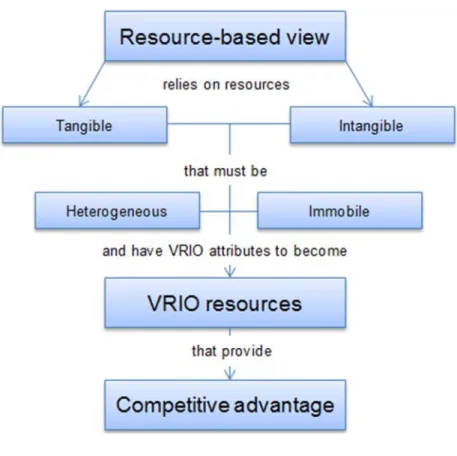
This research study relies on the resource-based theory (RBT) of the firm as a basis for identifying determinants of the entrepreneurial conceptual framework that are likely to influence the SME access to external finance. Resource-based theory traditionally focuses on the relationship between resources and competitive advantage (Chiu, 2015). Resources that are valuable, relatively scarce, and difficult to imitate are strategic assets that have the ability to deliver competitive advantage (Gillis, Combs & Ketchen, 2014:450). Start-up businesses are special case of RBT. SME start-up possess no resources other than the knowledge of the entrepreneur. This knowledge (competencies) is used in the acquisition, development and application of other resources that will lead to competitive advantage and superior performance (Norhasni, Sofri & Harashid, 2014; Yu, 2016).
1.10 OUTLINE OF STUDY
This thesis comprises six (6) chapters.
Chapter 1 provides the introduction to the study, focusing on the research background,
research problem, objectives and research questions. It provides a basic outline of the research methodology and thesis structure.
Chapter 2 reviews the theoretical framework for this study. It presents the need for and
supply of finance to South African SMEs to identify the challenges faced by SMEs in KwaZulu-Natal, South Africa in accessing finance.
Chapter 3 is a review of the key determinants of the success of SME start-ups, which explores the entrepreneur’s start-up awareness and management skills, and culminates in the development of the conceptual research model.
Chapter 4 provides a detailed discussion of the research methodology, together with the theoretical justification for the research design for this study.
Chapter 6 highlights the conclusions and presents the recommendations, and limitations of this research, as well as suggestions for further research.
1.11 SUMMARY
This chapter provided the introduction, background and context of the research study which will grant the reader the opportunity to understand the research problem, research objectives and research questions. A brief mention of the methodology adopted for the study is also explained in this chapter. The potential contributions of the study to the body of knowledge were also presented. This chapter highlights the influence of the key determinants of SME start-up success on accessing to various external sources of finance in South Africa. These research findings will propose a framework to assist start-up entrepreneurs in designing optimal financing options for their businesses and constitute the necessary tools that SME owner-managers need to improve their access to start-up finance. In the next chapter, the researcher will provide a detailed discussion of the relevant literature reviewed.
2 CHAPTER TWO
FINANCING OF SME START-UPS 2.1 INTRODUCTION
This chapter reviews the literature on the challenges experienced by South African SMEs in accessing external finance. Different sources of external finance, mainly, Government grants, commercial banking services, and funds from microfinance institutions, NGOs and other sources will be reviewed. Although there is financial support for SMEs, access to these sources of finance remains problematic and a challenge for SME start-ups. The literature reveals various reasons, inter alia, a high rate of business failure, lack of collaterals, and lack of awareness of available support programmes by start-up entrepreneurs (Daskalakis, Jarvis & Schizas, 2013). For this research, three external sources of finance for SME start-ups are explored, namely, Government grants, commercial bank funds, and private equity finance. Respectively identified as Government source of Finance (GF), Corporate source of Finance (CF), and Personal/Social source of Finance (PSF). The funding requirements of these financial institutions are identified and analysed.
2.2 THE IMPORTANCE OF ENTREPRENEURSHIP AND SME SECTOR 2.2.1 Global perspective
Several researchers (Westhead, Wright & McElwee, 2011) concur that entrepreneurship is important in any economy since it can make several economic and non-economic contributions to development, reducing unemployment and poverty. It is also the major creator of new jobs when large firms are downsizing, irrespective of the economic cycle (Järvi, 2015), since entrepreneurial activities not only enhance national productivity and generate employment, but also help to develop economic independence, as well as strengthen personal and social capabilities among rural communities (Sarma, 2014; Ramukumba, 2014; Gutha, 2015). Chand (2015) argued that entrepreneurship can both benefit the organisation itself and the macro-environment, and help in identifying and developing managerial capabilities of entrepreneurs and sharpening the decision-making skills of an entrepreneur (Storey & Greene, 2010). Mmako et al. (2017) argue that
entrepreneurship results in the creation of organisations when entrepreneurs assemble and coordinate physical, human and financial resources and direct them towards achievement of objectives through managerial skills. By creating productive organisations, entrepreneurship helps in making a wide variety of goods and services available to the society, which results in higher standards of living for the people (Westhead, Wright & McElwee, 2011).
Scherdin and Zander (2014) argues that entrepreneurship is often regarded as a crucial tool that facilitates the transformation of a country’s economy from a developing to a developed one. It achieves this by facilitating the structural transformation of countries from low-income, factor driven societies, into high-income technology-based societies. Thus, through the application of existing technologies in innovative ways or launching new technology, entrepreneurs not only increase competition in the market but also create positive market externalities (Cassim, Soni & Karodia, 2014).
Van-Praag and Versloot (2007:360) classify the economic benefits of entrepreneurship into four main categories, namely, employment generation; innovation; productivity and growth; increasing individuals’ utility levels. Entrepreneurship generates economic wealth, since the firm, entrepreneurs and employees can be taxed, and government can reinvest this tax into economic development projects (Westhead, Wright & McElwee, 2011). Entrepreneurship stimulates competition, which limits the ability of dominant firms to raise prices (Yu, 2016); however, competition can lead to a reduction in prices, more consumer choices, better quality products and services. Moreover, competition encourage more efficient use of resources and the displacement of non-viable inefficient businesses (Yu, 2016).
Start-up entrepreneurial ventures are labour intensive, capital saving and capable of helping create most of the one billion new jobs the world will need by the end of the century (Agwu & Emeti, 2014). Start-up entrepreneurial activities often offer specialised services or products more efficiently, as opposed to larger companies (Gjini, 2014). Mazumdar and Ahmed (2015) stated that start-up entrepreneurship plays an important role in ensuring the survival of poor households and in building up women’s confidence, skills and socio-economic status.
All over the world, SMEs play crucial roles in a variety of different economies (Mmbengwa et al., 2009; Akugri, Bagah & Wulifan, 2015; Almutairi & Sathiyanarayanan, 2015). According to Witbooi, Cupido and Ukpere (2011), entrepreneurial activities over the world account for, on average, about 70 percent of the global gross domestic product (GDP). According to the Global Entrepreneurship Monitor (GEM) 2016 – 2017 report, on average, 42% of working-age adults see good opportunities for starting a business in their area, with very little difference between the three economic development levels about opportunity perception. In efficiency-driven economies, a little more than half the adults believe that they have the required skills to start a business, while a third indicate that fear of failure would inhibit them from pursuing entrepreneurial opportunities. The GEM (2016 – 2017) report further revealed that in general, 22% of the people surveyed in the 65 economies expressed an intention to start a business in the next three years. Individuals in Africa display the highest levels of entrepreneurial intention (42%), while those in Latin America and the Caribbean report the highest capability perception (63%), and the second highest rate of entrepreneurial intention (32%). On the other hand, less than 40% of Europeans perceive opportunities in their area, and less than half believe they have the skills to pursue entrepreneurial opportunities (Peroni, Riillo, & Rodrigues, 2017).
The 2013 GEM, National Entrepreneurial Assessment for the United States of America (USA) reported that, while the high number of entrepreneurs in the US tells a compelling story, it is not a complete one. The hallmark of entrepreneurship in a developed economy is the quality of its entrepreneurs, even if they are fewer compared to less developed parts of the world. In many ways, entrepreneurship may be more selective in developed economies, particularly since people frequently have other options for work. The availability of other work thus creates opportunity costs, which means that entrepreneurship needs to offer something more rewarding to justify the associated risks (Ayala & Manzano, 2014).
While every business environment has a unique set of conditions that can constrain or enable entrepreneurship in various ways, developed economies generally rate higher on factors such as the availability of financial capital, an educated workforce, legal systems,
and so forth. This environment facilitates a range of entrepreneurial endeavours, from those starting businesses that provide sufficient income to allow for an independent lifestyle, to those launching highly innovative concepts that are positioned for high growth and international markets. However, a healthy economy depends on entrepreneurship that collectively exhibits sustainability and impact.
The US has among the highest levels of innovative entrepreneurs, where slightly more than one-third of these entrepreneurs sell products or services that are new to some or all customers, and with few or no competitors (Brush & Cooper, 2012). Given its high Total Early-stage Entrepreneurial activity (TEA) rates and large population, the US clearly has large numbers of innovative entrepreneurs (Peroni, Riillo, & Rodrigues, 2017). In addition, given the high level of competition that characterises most industry environments in the US, as well as the market’s receptiveness to innovations, it can safely be assumed that innovations must meet a relatively high standard, which has the potential to lead to globally competitive concepts (Poposka, Nanevski & Mihajlovska 2014).
In Africa, a study conducted by Okpara (2007) in Nigeria, reveals that lack of financial support, poor management, corruption, lack of training and experience, poor infrastructure, insufficient profits, and low demand for products and services are the most
common constraints hindering small business survival and growth. Chowdhury and
Maung (2013) point out that, in the emerging economies, the main limitations small business entrepreneurs face are insufficient working capital and marketing difficulties, along with low support of SME development through government programmes. Also, Agwu and Emeti (2014) maintain that major challenges to performance of SMEs are poor financing and inadequate social infrastructure, as well as the lack of managerial skills, and multiple taxation. Start-up owner-managers encounter environmental difficulties, and they highlighted that financing problems, and the lack of know-how are significantly associated with growth plans (Kozani, Oksoy & Ozsoy, 2006; Eniola & Entebang, 2015). 2.2.2 The South African context
In South Africa, entrepreneurial activities account only for 40 % of the country’s GDP, with an official unemployment rate of approximately 25%, thus accelerating entrepreneurial activity becomes crucial in a developing country, such as South Africa (Witbooi, Cupido
& Ukpere, 2011). The unemployment crisis in South Africa, with now more than 25 percent of the population being jobless, and the situation is dire if those that have given up the search for work are included, the out-of-work South Africans increases to nearly 40 percent (Witbooi, Cupido & Ukpere, 2011).
The important contribution of a vibrant and thriving SME sector, in the national socio-economic development of a country, has been widely recognised (Sefiani & Bown, 2013). SMEs are increasingly being acknowledged as productive drivers of economic growth and development in African countries, including South Africa (Gatt, 2012). According to Kim (2011), in South Africa, which is considered the most economically developed African country, SMEs generate more than 55 percent of all jobs and 22 percent of the country’s GDP. The national Department of Trade and Industry’s (DTIs) annual report (2016 – 2017) indicated that a substantial contribution is made by SMMEs to GDP, with the contribution to employment being even greater. However, most SMEs are micro and survival enterprises with little potential for growth (Fatoki & Garwe, 2010; Bisseker, 2014; Wagner, 2015).
Cant and Ligthelm (2013) are of the opinion that the number of failed SMEs can be estimated at 70-80 percent. In many cases Radipere and Dhliwayo (2014) stated that the failure rate could be attributed to the fact that South African SMEs are unable to overcome the primary obstacle of access to funding; this translates into an inability to attain the
necessary physical, human and consulting resources. Furthermore, Witbooi et al.(2011)
indicate that the absence of entrepreneurial success factors makes it impossible for the many survivalist businesses which are active in the informal sector, to be sustainable and show any form of growth.
According to Cassim, Soni and Karodia (2014), although South Africa is one of the strongest economies in Africa, its current economic and socio-economic conditions demand serious economic reform. Naudè (2010) affirmed that entrepreneurs are the main vehicle for economic development, adding that, as the number of entrepreneurs in an economy grows, so does the economy. Entrepreneurs in developing countries have more opportunities to exploit, thereby increasing the potential for entrepreneurship to contribute to decreasing unemployment and increasing economic growth.
At the provincial level, entrepreneurs in KwaZulu-Natal, like those in some of other provinces in South Africa, experience a host of challenges, which include lack of start-up and expansion finance, access to markets and gaining marketing credibility, access to appropriate technology, access to other resources, especially human resources (Nieman & Nieuwenhuizen, 2014). Other challenges include the lack of entrepreneurial skills, awareness and preparedness among entrepreneurs, and sub-optimal infrastructure (Nieman & Nieuwenhuizen 2014).
Ayandibu and Houghton (2017) recommended a serious exploring of SME activities to reduce poverty in the province of KwaZulu-Natal. SMEs are often located in geographical areas outside the typical large urban centres. Whatever the reason, the point is that economic activity outside of the major metropolitan areas leads to job creation, and the good old 'multiplier effect', much treasured by economists, kicks in, helping to reduce the poverty in rural areas (Clover & Darroch, 2010). Not every SME is in a non-metro area, but both non-metro and metro based SMEs assist with poverty reduction through employment, training and softer social benefits (Wynne & Lyne, 2010).
Abor and Quartey (2010) found that many small to medium entrepreneurs and business owners perceive access to funds as the major constraint, especially in establishing or expanding their businesses. Dludla (2015) indicates that the major reasons for the decline in the entrepreneurship rate in South Africa are the country’s poor ratings of Government programmes, poor primary education, restricted and inhibiting regulatory environment and restrictive labour laws. Those above further demonstrates that education plays a major role in entrepreneurial activity in that the more educated the person is, the more likely that person is to start a business and that the business continues to be sustainable (Dludla 2015).
It is obvious that access to knowledge, and research and development (R&D) ability, play a fundamental role in new firm formation (Desai, Nijkamp & Stough, 2011). Leadership talent is also seen as an important part of becoming a successful entrepreneur since leadership and leadership development requires an updated understanding to enhance the quality of general leadership practice withdrawing innate leadership talent and acceptance of individual learning (Ostergaard, 2014).
Regarding financial support from Government, the GEM South Africa 2016-2017 report highlights that most youth entrepreneurs are not aware of the various support programmes available and as a result, youth with entrepreneurial tendencies perceive that there is no support from Government (Peroni, Riillo, & Rodrigues, 2017). Herrington and Kew (2010) ascertained that access to Government financial support is a problem in South Africa since lack of awareness of the existence of government support programmes is another problem faced by youth. Hove (2016) added that access to finance is a major problem for the South African entrepreneur, and lack of financial support is the second most reported contributor to low new firm creation and failure, after education and training in South Africa (Fatoki & Garwe, 2010).
Another obstacle to the success of an enterprise is the lack of willingness to take risk, and fear of failure and embarrassment prevent people with business ideas not to explore them and venture into a competitive stage. Many young entrepreneurs become risk averse because of their social environment (Kazela, 2009), and social and cultural factors can also influence latent entrepreneurial intention (Fatoki & Chindoga, 2011). Also, considering that South Africa is characterised as a high-crime-rate country and this acts also as a deterrent since crime increases expenditure or investment in security measures to eliminate or minimise the likelihood of crime. Corruption both in the public and private establishments in South Africa is growing (Fatoki & Garwe 2010).
Ehlers and Lazenby (2007) stated that economic forces can influence market opportunities and ultimately result in prosperity or adversity of organisations in different industries and different locations. If entrepreneurs have negative perceptions regarding the environment of the business, they might decide not to start their own business. Vermeulen (2017) stated that South Africa’s current economic environment is characterised not only by high interest rates but also by low growth rates, high inflation rates and weakening exchange rates. The country is experiencing economic recession mainly due to the world economic meltdown which causes high unemployment rates. All these can negatively affect sales, revenues and market potential for local entrepreneurs (Wonglimpiyarat, 2015).