on Application Layer Protocols
Basil Elmasri
Submitted for the Degree of
Doctor of Philosophy
from the
University of Surrey
The Institute of Communication Systems (ICS)
Formerly the Centre for Communication Systems Research (CCSR)
Department of Electronic Engineering
Faculty of Engineering and Physical Sciences
University of Surrey
Guildford, Surrey GU2 7XH, UK
October 2014
This research investigates Denial of Service (DoS) attacks targeting the Internet’s Application Layer protocols, namely Session Initiation Protocol (SIP), and SPDY, the proposed second version of the Hyper Text Transfer Protocol (HTTP 2.0). The attack detection methodology was set using a Statistical Process Control (SPC) technique and Monitoring charts, as well as Cumulative Summation (CUSUM) and Exponential Weighted Moving Average (EWMA). The techniques tackle different possible flooding attacks, typically through monitoring the incoming messages. The system works by sensing sudden changes and detecting abnormal traffic increases alerting for an attack, and then triggering an alarm on the DoS attack. The scenarios are designed for SIP to simulate normal traffic behaviour and attack traffic behaviour; some scenarios were set to have a large ratio of the non-acknowledged requests, and another scenario was set to simulate a slight increase in the ratio. There was a scenario in which its traffic was imported from another SIP related research. In addition, the thesis discusses the results of DoS attacks targeting the SPDY protocol; one scenario is about a large increase in the total number of the sent requests by a user towards a SPDY proxy, and another scenario is set with a slight increase. SPC was tested on all previously mentioned scenarios; they have shown significant results in detecting the attacks, either it was large sudden flooding, or slight low rate DoS flood, as the low rate DoS attacks are very difficult and sometimes impossible to detect. SPC was tested to aim in false attack alarms reduction, as they are also difficult to deal with. These techniques were applied in two approaches: in the first approach, the Offline implementation, the statistical values of the whole observations, the mean and the standard deviation, are found and then applied to the equations. In the second approach, the Online implementation, the statistical values were updated on getting a new observation and immediately applying the SPC equations; there has not been any other research that discussed such an approach. The first approach represents a system with previous knowledge and experience of the ongoing traffic. This reduces the overhead spent in finding the mean and the standard deviation every time a new observation is added to the sequence. The second approach represents a system that is newly starting with no knowledge, or a system which was reset after detecting an attack. Finally, a framework was suggested to effectively employ the previous contributions in detecting the flood of the traffic.
Key words: DoS, SIP, SPDY, HTTP, SPC, CUSUM, EWMA, traffic behaviour. Email: [email protected]
A sincere acknowledgement and loyalty to Professor Khader Elmasri, and Mrs Amineh Haimour, my beloved parents for the kindness, moral support, strong positive encouragement, patience, and the financial fund they have gifted me along the years of my higher education; the completion of this work will be impossible without their care. I would like also to deeply thank Dr. Aseel Elmasri, Ms. Bara Elmasri, Dr. Muhammad Elmasri, and Ms. Tala Elmasri, my close siblings that I missed for the whole time I was absent and for their support and encouragement.
In addition, not to forget my close best friends who I consider like my family, for all their potential help and support at the time I needed someone close to trust their advice and support, Dr. Juan Awad, Dr. Alia Ibrahim, Dr. Muhammad Alimari, Dr. Weam Abou Hamdan, Mrs. Safa Sway, and Eng. Yosef Sayed.
Many special thanks to Dr. Haitham Cruickshank, for accepting me as his PhD student at the University of Surrey, and for the continuous effort, direct supervision and help during the years of PhD research and work. Also many special thanks to Prof. Zhilli Sun for his support and his great opinion towards producing this thesis.
Table of Contents
Abstract ... i
Acknowledgments ... ii
Table of Contents ... iii
List of Figures ... vi
Glossary of Terms ... xii
Introduction ... 1
Objectives ... 1
Motivations ... 2
Thesis Contribution ... 2
Thesis Outline ... 5
The Computer Network Applications and Security ... 6
Networks and Internet Applications ... 6
Session Initiation Protocol ... 7
Hyper Text Transfer Protocol (HTTP) ... 10
2.3.1 HTTP 2.0 / SPDY ... 11
Security Goals: CIA and DAD Triads ... 15
2.4.1 Confidentiality ... 16
2.4.2 Integrity ... 17
2.4.3 Availability ... 18
Computer Security and Denial of Service ... 18
2.5.1 Definition ... 18
2.5.2 Previous Literature about DoS ... 20
2.5.3 SIP security and DoS ... 22
2.5.3.1 SIP message flooding ... 24
2.5.4 HTTP and SPDY Security and DoS ... 28
Quality Control: Statistical Process Charts (SPC) ... 37
Cumulative Summation (CUSUM) ... 38
3.1.1 CUSUM Control Limits ... 40
Exponentially Weighted Moving Average (EWMA) ... 40
3.2.1 EWMA Control Limits ... 41
Statistical Process Control and Denial of Service ... 43
SPC Ways of Application ... 44
3.4.1 Offline ... 44
3.4.2 Online ... 45
Summary ... 46
DoS Targeting SIP: Results and Analysis ... 47
DoS impact on SIP: OPNET Simulation ... 47
4.1.1 Small network simulation ... 47
4.1.2 Large network simulation ... 51
4.1.3 Experimental Limitations ... 55
Traffic Generation ... 56
4.2.1 Simulation Generated Data set ... 57
4.2.2 Imported Traffic ... 61
Detecting DoS attacks on SIP using CUSUM ... 62
4.3.1 Generated SIP Traffic Simulation Results using CUSUM ... 63
4.3.1.1 CUSUM on First Scenario: Large Differences ... 63
4.3.1.2 CUSUM on Second Scenario: Small Differences ... 70
4.3.2 CUSUM on Imported Traffic’s Data Set ... 77
4.3.2.1 Offline implementation ... 77
4.3.2.2 Online implementation ... 79
Detecting DoS attacks on SIP using EWMA ... 83
4.4.1 EWMA on Simulation Generated Data Set ... 83
4.4.1.1 EWMA on First Scenario: Large Differences ... 83
4.4.1.2 EWMA on Second Scenario: Small Differences ... 86
4.4.2 EWMA on SIP Imported Data Set ... 91
4.4.2.1 Offline implementation ... 91
Summary ... 95
DoS Targeting SPDY / HTTP 2.0: Results and Analysis ... 98
Traffic Generation ... 98
Detecting DoS attacks on SPDY using CUSUM ... 100
5.2.1 CUSUM on SPDY First Scenario: Large increase ... 100
5.2.1.1 Offline implementation ... 100
5.2.1.2 Online implementation ... 102
5.2.2 CUSUM on SPDY Second Scenario: Slight Increase ... 104
5.2.2.1 Offline implementation ... 104
5.2.2.2 Online implementation ... 106
Detecting DoS attacks on SPDY using EWMA ... 109
5.3.1 EWMA on First Scenario: Large increase ... 109
5.3.1.1 Offline implementation ... 109
5.3.1.2 Online implementation ... 111
5.3.2 EWMA on Second Scenario: Slight Increase ... 112
5.3.2.1 Offline implementation ... 112
5.3.2.2 Online implementation ... 113
Summary ... 115
A DoS resilience Framework ... 117
Architecture of the DoS resilient frame work ... 117
Framework’s First Part: Inbound Traffic Monitor ... 118
Framework’s Second Part: Outbound Traffic Monitor ... 121
Framework’s Components Collaboration ... 124
Summary ... 125
Conclusions and Future Work ... 126
Conclusions ... 126
Future Work ... 127
List of Figures
Figure 1-1: Contributions Matrix ... 4
Figure 2-1: Five-layer Internet protocol stack ... 6
Figure 2-2: SIP main flow of VoIP call transactions ... 9
Figure 2-3: SPDY communication flow ... 13
Figure 2-4: Security CIA and DAD Triad ... 16
Figure 2-5: SIP flooding DoS example ... 25
Figure 2-6: OPNET simulation package main screen ... 34
Figure 3-1: Flowchart for the Offline detection application ... 45
Figure 3-2: Flowchart for the Online detection application ... 46
Figure 4-1: SIP OPNET small network design ... 48
Figure 4-2: Small network’s SIP server; Active calls, and Calls durations in seconds ... 49
Figure 4-3: Small network’s Callee active Calls ... 50
Figure 4-4: Small network’s Attacker; active calls, and call durations ... 50
Figure 4-5: SIP OPNET large network design ... 52
Figure 4-6: Large Network’s server active calls ... 53
Figure 4-7: Large Network’s first and fourth caller active calls ... 54
Figure 4-8: Large Network’s callers 2,3, and 5; rejected calls ... 54
Figure 4-9: Large Network’s callee 5; active calls ... 55
Figure 4-10: SIP scenario network architecture ... 57
Figure 4-11: SIP First generated scenario simulated traffic, large differences ... 58
Figure 4-12: SIP second generated scenario simulated traffic, slight increase ... 59
Figure 4-13: SIP second generated scenario, zoom at the attack, t=[95,110] ... 60
Figure 4-14: SIP second generated scenario, zoom at t = [ 26 , 31 ] ... 60
Figure 4-15: SIP imported traffic scenario ... 61
Figure 4-16: SIP First scenario, large differences, basic CUSUM, Offline implementation ... 63
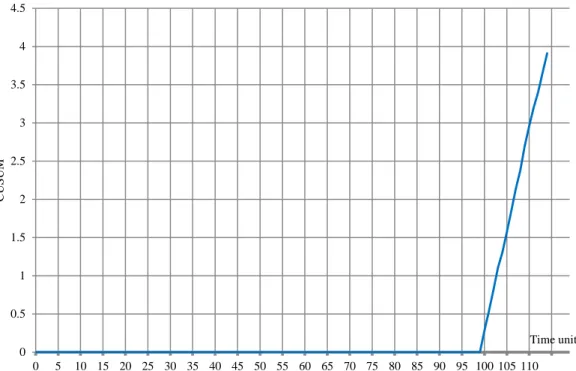
Figure 4-17: SIP First scenario, large differences Upper sided, Offline implementation . 64 Figure 4-18: SIP First scenario, large differences, basic and Upper sided CUSUM, Offline implementation ... 64
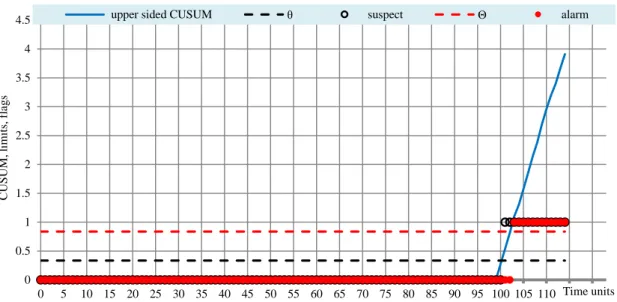
Figure 4-19: SIP First scenario, large differences, Upper-sided CUSUM with alert and alarm limits, Offline implementation ... 66 Figure 4-20: SIP First scenario, large differences, zoom at the attack periodt = [ 95 , 110 ]
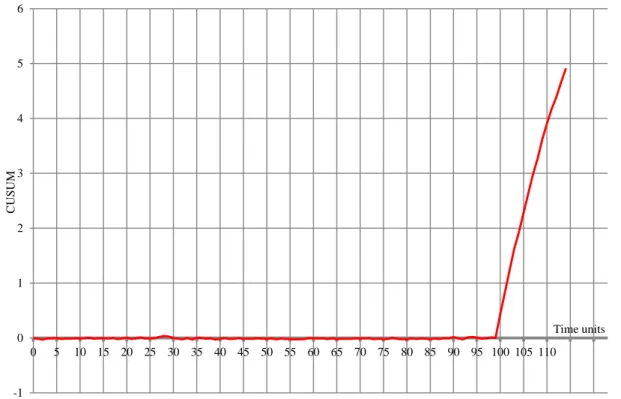
, Offline implementation ... 66 Figure 4-21: SIP First scenario, large differences, basic CUSUM, Online implementation
... 67 Figure 4-22: SIP First scenario, large differences, upper-sided CUSUM, Online
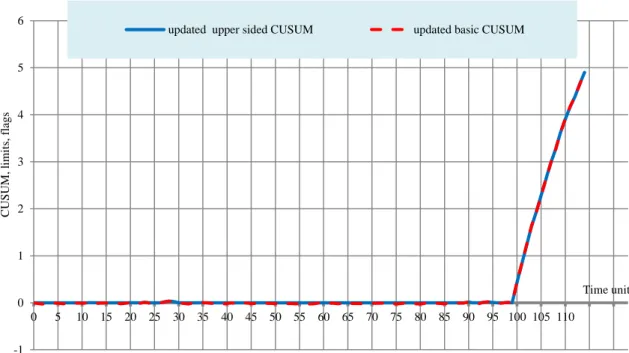
implementation ... 68 Figure 4-23: SIP First scenario, large differences, basic and upper sided CUSUM, Online
implementation ... 68 Figure 4-24: SIP First scenario, large differences, upper sided CUSUM with alert and
alarm limits, Online implementation ... 69 Figure 4-25: SIP First scenario, large differences, zoom at the attack, t = [ 95 , 110 ] ,
Online implementation ... 69 Figure 4-26: SIP second scenario, slight differences, basic CUSUM, Offline
implementation ... 70 Figure 4-27: SIP second scenario, slight differences, upper sided CUSUM, Offline
implementation ... 71 Figure 4-28: SIP second scenario, slight differences, basic and upper sided CUSUM,
Offline implementation ... 71 Figure 4-29 SIP second scenario, slight differences, offline upper-sided CUSUM with
alert and alarm limits, Offline implementation ... 72 Figure 4-30: SIP second scenario, slight differences, zoom at the attack period, Offline
implementation ... 72 Figure 4-31: SIP second scenario, slight differences, zoom at the slight increase, Offline
implementation ... 73 Figure 4-32: SIP second scenario, slight differences, basic CUSUM, Online
implementation ... 74 Figure 4-33: SIP second scenario, slight differences, upper-sided CUSUM, Online
implementation ... 74 Figure 4-34: SIP second scenario, slight differences, basic and upper-sided CUSUM,
Figure 4-35: SIP second scenario, slight differences, upper-sided CUSUM with alert and alarm limits, Online implementation ... 76 Figure 4-36: SIP second scenario, slight differences, Zoom at the attack period, Online
implementation ... 76 Figure 4-37: SIP second scenario, slight differences, zoom at the slight increase period,
Online implementation ... 77 Figure 4-38: SIP imported traffic, basic CUSUM, Offline implementation ... 77 Figure 4-39: SIP imported traffic, upper sided CUSUM, Offline implementation ... 78 Figure 4-40: SIP imported traffic, Offline basic and upper-sided CUSUM, Offline
implementation ... 78 Figure 4-41: SIP imported traffic, upper-sided CUSUM with the alert and alarm levels,
Offline implementation ... 79 Figure 4-42: SIP imported traffic, zoom at the reset Offline upper-sided CUSUM and the
levels, Offline implementation ... 79 Figure 4-43: SIP imported traffic, updated basic CUSUM, Online implementation ... 80 Figure 4-44: SIP imported traffic, updated upper-sided CUSUM, Online implementation
... 80 Figure 4-45: SIP imported traffic, updated basic upper-sided CUSUM, Online
implementation ... 81 Figure 4-46: SIP imported traffic, updated upper sided CUSUM with suspicion and alarm limits, Online implementation ... 81 Figure 4-47: SIP imported traffic, zoom at the attack period, Online implementation ... 82 Figure 4-48: SIP imported traffic, zoom at the slight increase, Online implementation ... 82 Figure 4-49: SIP imported traffic, large differences, basic EWMA, Offline
implementation ... 83 Figure 4-50: SIP imported traffic, large differences, EWMA with alert and alarm limits,
Offline implementation ... 84 Figure 4-51: SIP imported traffic, large differences, zoom at the attack periodt = [ 95 ,
110 ] , Offline implementation ... 84 Figure 4-52: SIP imported traffic, large differences, updated EWMA, Online
implementation ... 85 Figure 4-53: SIP imported traffic, large differences, updated EWMA with alert and alarm limits, Online implementation ... 86
Figure 4-54: SIP imported traffic, large differences, zoom at the attack period ( t = [ 95 , 109 ] ) , Online implementation ... 86 Figure 4-55: SIP second scenario, slight differences, Basic EWMA, Offline
implementation ... 87 Figure 4-56: SIP second scenario, slight differences, EWMA, alert alarm, Offline
implementation ... 87 Figure 4-57: SIP second scenario, slight differences zoom at the attack period t = [ 95 ,
110 ] , Offline implementation ... 88 Figure 4-58: SIP second scenario, slight differences, zoom at the slight increase, Offline
implementation ... 88 Figure 4-59: SIP second scenario, slight differences, updated EWMA, Online
implementation ... 89 Figure 4-60: SIP second scenario, slight differences, updated EWMA with alert and alarm
limits, Online implementation ... 89 Figure 4-61: SIP second scenario, slight differences, zoom at the attack period ( t = [ 95 ,
110 ] ) , Online implementation ... 90 Figure 4-62: SIP second scenario, slight differences, zoom at the slight increase, Online
implementation ... 90 Figure 4-63: SIP Imported traffic, basic EWMA on imported traffic, Offline
implementation ... 92 Figure 4-64: SIP Imported traffic, basic EWMA with alert and alarm limits, Offline
implementation ... 92 Figure 4-65: SIP Imported traffic, zoom at the attack t = [ 70 , 180 ] , Offline
implementation ... 93 Figure 4-66: SIP Imported traffic, updated EWMA on imported traffic, Online
implementation ... 94 Figure 4-67: SIP imported traffic, updated EWMA with alert and alarm limits, Online
implementation ... 94 Figure 4-68: SIP Imported traffic, zoom at the attack t = [ 70 , 180 ] , Online
implementation ... 95 Figure 4-69: Detection DoS on SIP, EWMA vs. CUSUM, attack start at t = 100, EWMA
goes up slightly before CUSUM ... 96 Figure 4-70 Zoom at the attack time t = [ 95 , 104 ], DoS on SIP, EWMA vs. CUSUM . 97
Figure 5-1: SPDY Scenario network architecture ... 98 Figure 5-2: First scenario, large increase, total number of resources requested by user 1
and user 6 per minute ... 99 Figure 5-3: Second scenario, slight increase, total number of resources requested by user
1 and user 6 per minute ... 100 Figure 5-4: SPDY First scenario, large increase, user 6 basic and upper-sided CUSUM,
offline implementation ... 101 Figure 5-5: SPDY First scenario, large increase, user 6 upper sided CUSUM with alert
and alarm limits, offline implementation ... 101 Figure 5-6: SPDY First scenario, large increase, zoom at the attack period, offline
implementation ... 102 Figure 5-7: SPDY First scenario, large increase, basic and upper-sided CUSUM on the
updated method, online implementation ... 103 Figure 5-8: SPDY First scenario, large increase, user 6 updated upper-sided CUSUM with
alert and alarm limits, online implementation ... 103 Figure 5-9: SPDY First scenario, large increase, zoom at the attack period, online
implementation ... 104 Figure 5-10: SPDY Second scenario, slight increase, user 6 basic and upper-sided
CUSUM, online implementation ... 105 Figure 5-11: SPDY Second scenario, slight increase, user 6 upper-sided CUSUM with
alert and alarm limits, online implementation ... 106 Figure 5-12 : SPDY Second scenario, slight increase, a zoom at the attack period, online
implementation ... 106 Figure 5-13: SPDY Second scenario, slight increase, basic and upper-sided CUSUM on
the updated method, online implementation ... 107 Figure 5-14: SPDY Second scenario, slight increase, user 6 updated upper-sided CUSUM with alert and alarm limits, online implementation ... 108 Figure 5-15: SPDY Second scenario, online implementation, slight increase, zoom at the
attack period, online implementation ... 108 Figure 5-16: SPDY first scenario, large increase, basic EWMA, offline implementation
... 110 Figure 5-17: SPDY first scenario, large increase, EWMA with alert and alarm limits,
Figure 5-18: SPDY first scenario, large increase, a zoom at the attack period, offline
implementation ... 110
Figure 5-19: SPDY first scenario, large increase, updated EWMA, online implementation ... 111
Figure 5-20: SPDY first scenario, large increase, updated EWMA with alert and alarm limits, online implementation ... 111
Figure 5-21: SPDY first scenario, large increase, zoom at the attack level, online implementation ... 112
Figure 5-22: SPDY Second scenario, slight increase, Basic EWMA, offline implementation ... 112
Figure 5-23: SPDY Second scenario, slight increase, EWMA with alert and alarm limits, offline implementation ... 113
Figure 5-24: SPDY Second scenario, slight increase, zoom at the attack period ... 113
Figure 5-25: SPDY Second scenario, slight increase, updated EWMA, online implementation ... 114
Figure 5-26: SPDY Second scenario, slight increase, updated EWMA with alert and alarm limits, online implementation ... 114
Figure 5-27: SPDY Second scenario, slight increase, a zoom at the attack level, online implementation ... 115
Figure 5-28: Detection DoS on SPDY, EWMA vs. CUSUM attack start at t = 22, EWMA goes up slightly before CUSUM ... 116
Figure 5-29: A zoom at the attack time t = [ 22 , 26 ], DoS on SPDY, EWMA vs. CUSUM ... 116
Figure 6-1: General design and component of the proposed framework ... 118
Figure 6-2: Inbound traffic monitor ... 120
Glossary of Terms
AS Autonomous SystemsATM Asynchronous Transfer Mode BGP Border Gateway Protocol CA Certificate Authority CASC The CA Security Council
CCSR Centre for Communication Systems Research CDN Content Distribution/Delivery Network CIA Confidentiality, Integrity, and Availability CPM Change Point Monitoring
CPU Central Processing Unit CUSUM Cumulative Summation
DAD Disclosure, Alteration, and Denial DADP DNS Attack Detection and Prevention DAMA Demand Assignment Multiple Access DASH Dynamic Adaptive Streaming over HTTP DDoS Distributed Denial of Service
DiffServ Differentiated services DMZ DeMilitarized Zone DNS Domain Name System DoS Denial of service
DVB - RCS Digital Video Broadcasting - Return Channel via Satellite or Return channel over system
D-WARD DDoS Network Attack Recognition and Defense EWMA Exponential Weighted Moving Average
FQDM Fully Qualified Domain Name FSM Finite State Machines
GMA Geometric Moving Average HTML Hyper Text Markup Language HTTP Hyper Text Transfer Protocol
HTTPS “ HTTP over TLS ” , “ HTTP over SSL ” , or “ HTTP Secure ” HX-DoS HTTP and XML flood DoS
ICI Interface Control Information ICMP Internet Control Messaging Protocol IDS Intrusion Detection System
IETF Internet Engineering Task Force IM Instant Messaging
IMAP Internet Message Access Protocol IMS IP Multimedia Subsystem
IP Internet Protocol IPsec IP Security
ITU International Telecommunication Union
ITU-T ITU Telecommunication Standardization Sector LAN Local Area Networks
MPEG The Moving Picture Experts Group OPNET Optimised Network Engineering Tools PaaS Platform as a Service
PDF Probability Density Function PEP Performance Enhancing Proxies PKI Public Key Infrastructure POP3 Post Office Protocol PPP Point to Point Protocol
PSTN Public Switched Telephone Network QoS Quality of service
RDP Remote Desktop Protocol RFC Requests for Comments RMI Remote Method Invocation RMON Remote Monitoring
RSA Ron Rivest, Adi Shamir, and Leonard Adleman cryptosystem. RTP Real Time Protocol
SaaS Software as a Service
S-HTTP Secure Hyper Text Transfer Protocol
SIMPLE Session Initiation Protocol for Instant Messaging and Presence Leveraging Extensions
SIP Session Initiation Protocol SIPS Secure SIP
SMTP Simple Mail Transfer Protocol
SNMP Simple Network Management Protocol SPC Statistical Process Control
SPDY pronounced speedy, an Internet Draft to standardise HTTP/2 SPIT Spam over Internet Telephony
SQL Structured Query Language SSL Secure Sockets Layer
TCP Transmission Control Protocol TSL Transport Layer Security
TTCN-3 Testing and Test Control Notation version 3 UAC User Agent Client
UAS User Agent Server UMS User Mobility Service
UMTS Universal Mobile Telecommunications System UPC Usage Parameter Control
URI Uniform Resource Identifier VLAN Virtual Local Area Networks VoIP Voice Over IP
VPN Virtual private network
W3C World Wide Web Consortium WSN Wireless Sensor Networks XML eXtended Markup Language
Introduction
A network service can be any kind of application or legitimate activity offered over the Internet, which is used by a computing system or by an end user, such as web browsing, video and audio conferencing and broadcasting. Security goals of an information system are Confidentiality, Integrity, and Availability, the (CIA) Triad. The Availability goal is to make sure that a service or several services, or a running system offering some services, is obtainable during all the dedicated running time. Denial of Service (DoS) attacks aim to prevent the availability; it purposes to temporarily or indefinitely interrupt, suspend, or at least to reduce the access to the available service on a specific victim. In other words, technically DoS attacks attempt to exhaust resources on targeted victims, mainly network bandwidth, memory and data storage, processing unit, or energy.
Objectives
This thesis aims to give an overview of Denial of Service (DoS) attacks targeting Session Initiation Protocol (SIP) and SPDY, the future HTTP 2.0.
The focus of the DoS security issue in this research is the messages flooding type of DoS attack, which is the most common type of DoS.
Show the impact of flooding DoS attacks and defence against them using the traffic flow behaviour of SIP and SPDY.
Utilise SIP and SPDY traffic behaviour to monitor the ongoing flow and sense any change in the behaviour to detect a flooding DoS.
Utilise the Statistical Process Control (SPC) techniques, the Monitoring Charts, mainly Cumulative Summation (CUSUM), and Exponentially Weighted Moving Average (EWMA), to monitor the traffic for flow abnormalities.
Run several simulation scenarios based on the behaviour of each SIP and SPDY, simulate flood behaviour, and simulate CUSUM and EWMA to detect the flood.
Study the slow rate of DoS flooding and the reduction of triggered false alarm issue using the SPC techniques.
Motivations
The flooding type of DoS attacks are still an open issue; an attacker finds it an easy way to target a certain system and apply a bulky impact on the victim and stop it from offering its services for a valuable period of time, so there has not yet been a final optimal solution to such a problem.
The application level protocols are often the common protocols non-expert users deal with in the Internet, and such a thing eases the mission for a less expert attacker to be involved in malicious activity that effectively harms and results in damaging other systems on the Internet. Therefore an attacker requires less effort to launch a flooding Denial of Service attack (DoS) against a victim, than the effort needed to perform other types of security attacks.
SIP is the protocol which is responsible for managing multimedia sessions on the internet; the networked media are non-tolerant services, denying a service will cause huge damage on such a service.
SPDY is the current draft for the future HTTP 2.0, which means it will be the main application protocol for the everyday usage of the web; the flow behaviour of SPDY makes it an easily vulnerable target by flooding DoS attacks.
Traffic monitoring using Statistical Process Control allows useful techniques to observe flow behaviour of SPDY and SIP, and to implement the defence techniques against the flooding DoS attacks.
Thesis Contribution
The thesis has contributed to the field of Computer Science; the areas the research includes are Computer Networks, their Applications and Security, Internet traffic flow and
behaviour, message flooding and DoS attacks, and the field of Statistical Process Control (SPC) and Monitoring Charts.
Cumulative Summation (CUSUM) and Exponentially Weighted Moving Average (EWMA) are the two main techniques used from SPC to detect flooding DoS. The detection was proven to work on large numbers as it was tested in SPDY simulated traffic; in addition the detection was proven to work on small numbers as the techniques were tested in SIP. The techniques used were proven to detect the slow rate DoS flood, which also helped to reduce the False Alarm that might happen. The main contributions are listed here:
DoS attacks are characterised as a high sudden increase in the traffic received by a certain service. SPC techniques were used to classify such an increase, and to set a threshold to classify abnormal traffic behaviour as an attack.
Elimination of false flooding DoS alarms was discussed and optimised by setting an alert limit using SPC equations to raise the suspicion before triggering the attack’s alarm.
With slow rate DoS flood detection, such an attack is difficult or impossible to detect in most cases. SPC techniques were used to set a threshold that detects a very slight and unnoticeable increase in the received flow. A continuous slow increase will accumulate in the results of the SPC equations that will be sensed by the alert and alarm limits.
The utilisation of SIP flow behaviour, the two way communication, request/response ratio, and the utilisation of SPDY proposed flow behaviour, where a client sends a single TCP stream to the SPDY proxy server, to retrieve all the objects and the web resources needed.
In order to illustrate the areas, the concept, and the different cases that have been examined within this research and thesis, a matrix model adds up what has been already mentioned as components with the relationships between them, and how they connect with each other. Figure 1-1 shows the Matrix Model which consists of the utilised SPC techniques and how they were applied, with each type of the quantitative observation input, the tested application protocols and the traffic flow behaviour of each protocol, the different scenarios of each protocol’s flow behaviour, and the classes of the defence against the DoS flood
Thesis Outline
The second chapter introduces the Computers Networks and Security, and the Internet Applications, definition of SPDY, Denial of Service, and Session Initiation Protocol. The third chapter is about the Quality Control and Statistical Process Charts (SPC), Cumulative Summation (CUSUM), and Exponential Weighted Moving Average (EWMA). Chapter four is about Denial of Service targeting Session Initiation Protocol, and how CUSUM and EWMA were implemented to detect the attacks.
Chapter five is about Denial of Service targeting SPDY, and how CUSUM and EWMA were implemented to detect the attacks.
Chapter six describes a framework for a design to apply and employ the powerful technique of SPC in detecting DoS attacks.
The Computer Network Applications and
Security
Networks and Internet Applications
The Internet protocol stack was designed to provide structure to the design and organisation, and define services’ functionality of network protocols [5], [55], and [89]. The Application Layer is the location of the internet protocols and its applications that end users deal with either at the start or the end of the data communications. Application layer protocols are implemented in software in the end systems, distributed over multiple end systems, and the exchanged packet of information at the application layer is expressed as a message [55]. Figure 2-1 shows the Five-layer Internet protocol stack, where the Application Layer is on the top of the stack.
Figure 2-1: Five-layer Internet protocol stack
Internet applications are vulnerable to Denial of Service (DoS) attacks, especially the message flooding attacks, as all that an attacker has to do is to send a swarm of data packets targeting a certain Internet application. The behaviour of data traffic of the communicating application layer protocols is a key element in detecting flooding DoS attacks. The vast majority of the inter-connected application and services have similar traffic behaviour regardless of the running protocols in the bottom layers. The flow behaviour is a two-way
Physical Data Link
Network Transport Application
communications, request/response or, in other words, a Connection Oriented communication; this means any sent request must be acknowledged with one or more responses. This behaviour was used as the principle in this research for detecting DoS, simply a noticeable difference between the requests and the acknowledged responses indicates a flooding attack is in progress and targeting the system hosting the running application.
Two main protocols are used in the daily life of the internet: the Hyper Text Transfer Protocol (HTTP), and the Session Initiation Protocol (SIP). These were the protocols used in the study. HTTP is the protocol responsible for web services access; so far, HTTP 1.0 and HTTP 1.1 are the only versions formally used, and SPDY is the draft for the near future HTTP 2.0. SIP is a protocol that is responsible for managing, creating, and finalising multimedia sessions over the internet. Its job is not to carry multimedia messages; this is the job of other protocols, e.g. the Real Time Protocol (RTP).
Session Initiation Protocol
Session Initiation Protocol (SIP) is a protocol that is responsible for creating sessions for multimedia communication, i.e. Voice, VoIP, real-time video stream, remote conferences [52] and [53]. SIP is also responsible in managing the session during its run, and to finalise the session.
SIP design employs elements similar to the HTTP request/response transaction model. Each transaction consists of a client request that invokes a particular method or function on the server with at least one response. SIP reuses most of the header fields, encoding rules and status codes of HTTP, providing a readable text-based format. SIP clients typically run over either the Transmission Control Protocol (TCP) or the User Datagram Protocol (UDP) on port numbers 5060 or 5061, or both.
RFC 2543 in [53] defines the main elements of a SIP Logical network over the internet: 1. SIP user agent (UA) is a logical network end point element; it is used to create or
receive SIP messages and thereby participate in managing a SIP session. A SIP UA can perform the role of a User Agent Client (UAC), which sends SIP requests, and the User Agent Server (UAS), which receives the requests and returns a SIP response. These roles of UAC and UAS only last for the duration of a SIP transaction.
2. Proxy server is an intermediary entity that acts as both a server and a client for the purpose of making requests on behalf of other clients. A proxy server primarily plays the role of routing, which means its job is to ensure that a request is sent to another entity "closer" to the targeted user. Proxies are also useful for enforcing policy (for example, making sure a user is allowed to make a call). A proxy interprets and, if necessary, rewrites specific parts of a request message before forwarding it.
3. Registrar is a server that accepts REGISTER requests and places the information it receives in those requests into the location service for the domain it handles.
4. Redirect server is a user agent server that generates (3xx) responses to requests it receives, and further action needs to be taken (typically by sender) to complete the request, by directing the client to contact an alternate set of URIs. The redirect server allows SIP Proxy Servers to direct SIP session invitations to external domains. SIP is a text-based protocol with syntax similar to that of HTTP. So there are two different main types of SIP messages: requests and responses. The first line of the head of a request has a method, defining the nature of the request, and a Request-URI, indicating where the request should be sent. The first line of a response has a response code. The main Request methods are:
1. REGISTER: Used by a UA to indicate its current IP address and the URIs for which it would like to receive calls.
2. INVITE: Used to establish a media session between user agents. 3. ACK: Confirms reliable message exchanges.
4. CANCEL: Terminates a pending request.
5. BYE: Terminates a session between two users in a conference.
6. OPTIONS: Requests information about the capabilities of a caller, without setting up a call.
The SIP response types are three digits decimal, the most significant digit (far left) defines the type of the response;
1. Provisional (1xx): Request received and being processed.
3. Redirection (3xx): Further action needs to be taken (typically by sender) to complete the request.
4. Client Error (4xx): The request contains bad syntax or cannot be fulfilled at the server. 5. Server Error (5xx): The server failed to fulfil an apparently valid request.
6. Global Failure (6xx): The request cannot be fulfilled at any server.
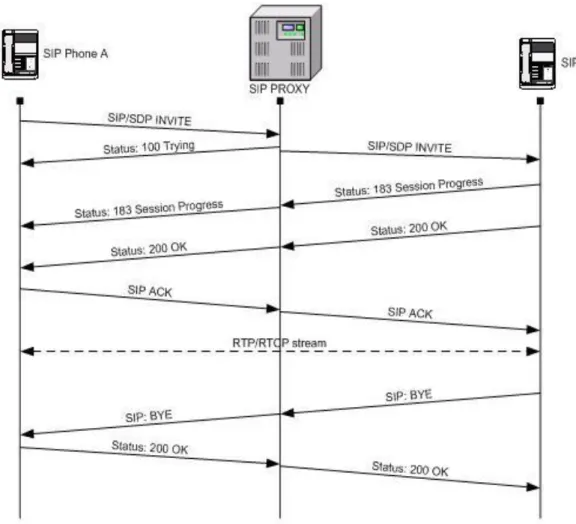
Figure 2-2 below shows the main transactions to start a multimedia call, i.e. a VoIP call. An INVITE message is sent by a source agent to the proxy server first, and then forwarded to the destination agent. Then the destination replies with 200 OK response. The multimedia session starts afterwards, such as VoIP or video. After the multimedia transmission finishes, SIP again works to finalise the connection by sending a BYE request by one of the agents, and responding with an OK response to the other agent.
Hyper Text Transfer Protocol (HTTP)
The Hyper Text Transfer Protocol (HTTP) is an application protocol for distributed, collaborative, hypermedia information systems. HTTP is the foundation of data communication for the World Wide Web. Hypertext is structured text that uses logical links (hyperlinks) between nodes containing text. HTTP is the protocol to exchange or transfer hypertext, which provides for Web document request and transfer, [121] and [124]. The standards development of HTTP was coordinated by the Internet Engineering Task Force (IETF) and the World Wide Web Consortium (W3C), culminating in the publication of a series of Requests for Comments (RFCs), most notably RFC 2616 (June 1999), which defines HTTP/1.1, the version of HTTP in common use.
HTTP is implemented in two programs: a client program and a server program. The client program and server program, executing on different end systems, talk to each other by exchanging HTTP messages. HTTP defines the structure of these messages and how the client and server exchange the messages.
A Web document or a Web page consists of a base HTML file and several referenced objects. An object is simply a file that is addressable by a single URL. An object could be an HTML file, a JPEG image, a Java applet, or a video clip. A Web page may contain a variety or a combination of all objects.
HTTP uses TCP as its underlying transport protocol; this may be either a persistent or a non-persistent HTTP. In non-persistent HTTP a brand new connection must be established and maintained for each requested object. This can place a significant burden on the Web server, which may be serving requests from hundreds of different clients simultaneously for each of these connections. TCP buffers must be allocated and TCP variables must be kept in both the client and server.
With persistent connections, the server leaves the TCP connection open after sending a response. Subsequent requests and responses between the same client and server can be sent over the same connection, an entire web page can be sent over a single persistent TCP connection when all its objects reside on the same server; multiple web pages residing on the same server can be sent from the server to the same client over a single persistent TCP connection. But if there are several objects on several servers, which are now the most
common in the current complex web pages, there is a need to open multiple connections of TCP.
The most common methods of HTTP request messages are GET, POST, HEAD, PUT, and DELETE. The great majority of HTTP request messages use the GET method. The GET method is used when the browser requests an object. An HTTP client often uses the POST method when the user fills out an HTML form. The HEAD method is similar to the GET method: when a server receives a request with the HEAD method, it responds with an HTTP message but it leaves out the requested object. For this reason, the HEAD method is often used for debugging. The PUT method is often used in conjunction with Web publishing tools. It allows a user to upload an object to a specific path on a specific Web server. The PUT method is also used by applications that need to upload objects to Web servers. The DELETE method allows a user or an application to delete an object on a Web server. Some common status codes and associated phrases include:
200 OK: Request succeeded and the information is returned in the response.
301 Moved Permanently: Requested object has been permanently moved; the new URL is specified in Location: header of the response message. The client software will automatically retrieve the new URL.
400 Bad Request: This is a generic error code indicating that the request could not be understood by the server.
404 Not Found: The requested document does not exist on this server.
505 HTTP Version Not Supported: The requested HTTP protocol version is not supported by the server.
2.3.1
HTTP 2.0 / SPDY
SPDY protocol is a new application-layer communication protocol that was proposed by Google in order to overcome the defects of HTTP [100] and [102]. SPDY has been studied in the IETF standardisation process that would be used as a basis of the technical specification of the HTTP 2.0 protocol, [32], [73] , [93], and [95]. SPDY is a protocol to realise high-speed Web access by using the SPDY session that has been established between the client and the Web server for transmitting and receiving page resources. Since a modern Web page usually consists of multiple page resources that are stored in multiple
with multiple Web servers. In this case, SPDY is not able to realise high-speed Web access since it takes several seconds to establish multiple SPDY sessions in a mobile environment with high latency [31].
On the basis of the HTTP protocol, SPDY offers four improvements to shorten the page loading time: multiplexed requests, prioritised requests, server pushed streams and compressed headers. Most of these techniques are already implemented in Performance Enhancing Proxies (PEP) [1], [13], [17], [37], [78], and [79]. One of the bottlenecks of HTTP implementation is that HTTP relies on multiple connections for concurrency. This causes several problems, including additional round trips for connection setup, slow start delays, and connection rationing by the client, where it tries to avoid opening too many connections to any single server. HTTP pipelining helps, but only achieves partial multiplexing. In addition, pipelining has proven to be non -deployable in existing browsers due to intermediary interference.
SPDY adds a framing layer for multiplexing multiple, concurrent streams across a single TCP connection (or any reliable transport stream). The framing layer is optimised for HTTP-like request response streams, such that applications that run over HTTP can today work over SPDY with little or no change on behalf of the web application writer. Figure 2-3 shows SPDY traffic flow.
The SPDY session offers four improvements over HTTP:
1. Multiplexed requests: There is no limit to the number of requests that can be issued concurrently over a single SPDY connection.
2. Prioritised requests: Clients can request certain resources to be delivered first. This avoids the problem of congesting the network channel with non-critical resources when a high-priority request is pending.
3. Compressed headers: Clients today send a significant amount of redundant data in the form of HTTP headers. Because a single web page may require 50 or 100 sub requests, this data is significant.
4. Server pushed streams: Server Push enables content to be pushed from servers to clients without a request.
Figure 2-3: SPDY communication flow
SPDY attempts to preserve the existing semantics of HTTP. All features such as cookies, ETags, Vary headers, Content-Encoding negotiations, etc., work as they do with HTTP; SPDY only replaces the way the data is written to the network.
Form [36], Multiplexed streams – The fundamental enhancement of SPDY is that multiple resources can be retrieved via a single TCP connection. The expectation (and current implementation in Google Chrome) is for the client to open a single TCP connection to each server, and to request all resources of the server over that single connection. The use of a single TCP connection in this way allows the congestion avoidance algorithm in TCP
multiple requests in a single message, thereby reducing overhead and the number of round-trip times necessary to begin file transfer for requests beyond the first. Although this is similar to HTTP pipelining, the difference introduced by SPDY is that the server can transfer all of the resources in parallel (multiplexed) without the “head of line blocking” problem that can occur with HTTP pipelining.
The interaction property of SPDY protocol was analysed in [102], according to the SPDY protocol draft specification, and a novel test was implemented by using Testing and Test Control Notation version 3 (TTCN - 3) [28]. A SPDY accelerator has been proposed in [31] that can considerably accelerate Web access speed by combining the SPDY protocol and cache system even in a multi-domain configuration. They have confirmed that the proposed system can reduce the page-loading time by one third compared to the existing SPDY. Using extensive experiments, SPDY's performance was evaluated in [127]. They identified the impact of network characteristics and website infrastructure on SPDY's potential page loading benefits; they found that these factors are decisive for an optimal SPDY deployment strategy, and they found SPDY offers maximum improvement over HTTPS when operating in challenging environments such as low bandwidth and high delay situations. A wider debate is taking place regarding the impact of future protocols, through exploring the previous key aspects that affect SPDY, and accordingly HTTP/2.0.
SPDY is expected to provide benefits for satellite communications resource management [1], which are adopted in geostationary satellite systems to optimise TCP-based application performance. They have provided a careful assessment of SPDY performance over satellite links, compliant to Digital Video Broadcasting - Return Channel via Satellite or Return channel over system (DVB - RCS) standard, with return link resources assigned on demand through a Demand Assignment Multiple Access (DAMA) method. Such a reference scenario constitutes a challenging communication environment due to both the limited return link bandwidth and the relatively high latency. Performance evaluation has been carried out through a satellite network emulator, which reproduces physical layer satellite impairments, while running real implementations both the TCP/IP stack and SPDY. C. Mueller et al. in [15] and [16] discussed MPEG Dynamic Adaptive Streaming over HTTP (DASH) as a new streaming standard, , the ISO/IEC MPEG standard, which enables
the convenient and smooth transportation of multimedia data to heterogeneous end devices over networks with variable bandwidth conditions.
A design and prototype was proposed in [133]; the implementation was a cross-platform mobile activity monitoring system on the mobile cloud computing, as mobile cloud computing is becoming a hot topic of the industry, especially in healthcare. Using a combination of mobile computing and cloud computing, they described their system which incorporates HTTP 2.0 with SPDY to enable a secure and fast server push of medical information to individual users. Moreover, the system uses MATLAB graphs to show the vital data and analysis results and provides a user-friendly way to access personalised healthcare. A hypothesis about smart grids end users was shown in [92], which these links can be used to exchange data between the meter/controller, at the user, and a service, at the web, using application protocols SPDY and HTTPS. This hypothesis is verified studying the connectivity capabilities/constraints that a third party service may experience in broadband links. A quantitative evaluation was performed in an emulated IPv6 network to delimit the throughput, latency and reliability available to smart grids services. The results showed that SPDY and HTTPS can meet typical QoS requirements using a proper architecture (e.g. centralised or distributed), and can drive the development of new web-based energy services. Here, practical connectivity aspects to deploy such services are discussed.
Security Goals: CIA and DAD Triads
Within the Computer and Information Security community, professionals and practitioners tend to describe security as the sum of its component parts: Confidentiality, Integrity, and Availability (CIA). These are the three requirements that users demand from information systems, and they are the corner stones of any well-designed information security program. Together, these three attributes are known as the CIA triad. Malicious individuals or, in other words, attackers, have a model of their own—the Disclosure, Alteration, and Denial (DAD), which outlines the three primary mechanisms used to defeat the security goals of an organization [67].
Figure 2-4: Security CIA and DAD Triad
2.4.1
Confidentiality
Confidentiality is the most commonly cited goal of information security programs; simply no end user is keen to get their confidential information falling into the hands of unauthorised personnel. The security community invests a large amount of time and money in developing and implementing systems to ensure that the goal of confidentiality is maintained. Access controls protect the confidentiality of data by preventing unauthorised personnel from entering a system and preventing legitimate users from accessing information that they are not authorised to access. Encryption systems software implements mathematically designed algorithms to prevent a third party who intercepts a message from determining the contents of the communication. This type of technology facilitates the confidential exchange of information over an otherwise insecure communications channel, such as the Internet.
Disclosure occurs when an unauthorised party abuses Confidentiality, and gains access to the confidential information. It occurs when security professionals fail, in one way or
another, to achieve the CIA triad’s goal of confidentiality. Examples of actions that constitute disclosure include:
1. An attacker gains access, without any authorised permissions, to a certain system and reads confidential information.
2. An insider disseminating confidential information to unauthorised third parties. 3. A programming failure that causes customers accessing a Web site to see the account
information of other customers.
2.4.2
Integrity
Organizations also charge security practitioners with protecting the integrity of organizational data. The basic definition of integrity is ensuring that data may be modified only through an authorised mechanism. Integrity involves protecting data from the following types of unauthorised modification:
1. Unauthorised users altering data, such as an attacker breaking into a database and altering records.
2. Authorised users making unauthorised changes to data, such as a bank teller adding money to his personal account, rather than that of the customer.
3. Data being altered through an inappropriate mechanism, such as a power surge causing database corruption.
It is the responsibility of security professionals to ensure that these eventualities do not come to fruition, using many of the mechanisms used to protect the confidentiality of data, which are also used to protect the integrity of data. For example, access control mechanisms help prevent the first two types of data modification in the preceding list. Encryption systems use digital signature technology to prevent the modification of data by an unauthorised (either accidental or malicious) mechanism.
Data Alteration occurs when security mechanisms fail to ensure the integrity of data. As mentioned in the discussion of integrity, there are a number of ways that this could occur. The reader should keep in mind that unauthorised alteration can be the result of either malicious or accidental activity.
2.4.3
Availability
The third goal of information security programs is to guarantee the availability of information systems and services; the ability of authorised users to access data for legitimate purposes. After all, an organization's data is not useful if it is not available for its intended use. An attacker who manages to prevent authorised access to a system may often be considered just as successful as one who manages to steal or manipulate the data stored within it.
Denial occurs when events take place that prevent authorised users from accessing a system for legitimate reasons. This includes actions as basic as a computer crashing, leaving users unable to access it until IT professionals restore it to proper working order or bring a backup system online. It also includes an entire class of malicious activity known as Denial of Service or DoS attacks. Over the past few years, DoS attacks have become more prevalent and dangerous as attackers harness the power of many computers worldwide to flood a target system with traffic. This kind of attack will be further explored within this thesis, which is the purpose of the research.
Computer Security and Denial of Service
2.5.1
Definition
Availability is one of the information and systems security goals; that is, to make sure that some services or running system offering some services are available all the time. Denial of Service (DoS) attacks aim to prevent availability, or at least reduce the access to the available service on a specific victim. More precisely, DoS attacks attempt to exhaust resources on targeted victims; mainly network bandwidth, memory, and processing unit. There have been several RFCs and IETF internet drafts about DoS attacks as in [22], [48], [68], [70], [84], [90], and [119].
A service offered by any computing system can be any kind of legitimate activity that can be used by any other computing system or an end user; for example, web browsing, email system, video and audio broadcasting.
corruption or deletion of any data is considered as a Denial of Service attack. The main and the most well-known method of DoS attack is to send a massive number of messages and internet data packets over what can be handled by a certain victim’s system, so the victim starts receiving data chunks from its network interface, filling up the internal memory by storing the received massages, and using its CPU to spend a longer time in processing what is required in these messages.
From [5], all network servers can be subject to DoS attacks that attempt to prevent responses to clients by tying up the resources of the server. It is not possible to prevent such attacks entirely, but you can do certain things to mitigate the problems that they create. Often the most effective anti-DoS tool will be a firewall or other operating-system configurations. For example, most firewalls can be configured to restrict the number of simultaneous connections from any individual IP address or network, thus preventing a range of simple attacks. Of course, this is no help against Distributed Denial of Service attacks (DDoS).
Any kind of computing related system, whether it is physical or a service, is vulnerable to DoS attacks: targeted victims were mentioned in RFC 4732 [68], mainly:
End Systems are the most common victims, such as web servers, firewalls and IDS systems, DNS systems, or any other normal host. To exhaust the resources of a running application or the Operating System itself, an attack can be made by exploiting poor software quality, such as buffer overflow, or any other attack that causes the system to crash and stop.
Routers: DoS attacks that make routers unavailable are very serious. Preventing a router’s offered service can sometimes put that router in a critical state and the attack impact can prevent a lot of users and other routers from communicating with each other, therefore many services will be stopped from being accessible. An Autonomous System (AS) within routing would be down due to a DoS attack, especially if the attacked router was a gateway to a subnet, or it could be the router connecting to other routers in a certain area or other areas. A router can be attacked as a normal computing end system, or an attack can be performed on a router using the routing protocols, [18], [120], [60], [20], and [3]. RFC 3882 [22] has presented a Border Gateway Protocol (BGP) configuration to Block Denial of Service Attacks.
Links: sending enough non-congestion controlled traffic such that a link becomes excessively congested, and legitimate traffic suffers unacceptably high packet loss. For wireless access, a strong frequency conflict can be a cause for a DoS attack. Any kind of physical damage could be considered as an attack; for example, cutting a power cable or destroying an access link will definitely stop a system and the services running on it.
Ongoing communications: a reset towards that connection or to de-synchronise it, so there will be no further date communication progress. A malicious user might be able to significantly reduce the throughput of an on ongoing connection, [87] and [4]. An example of disrupting an ongoing communications: a SIP flow can be interrupted by some attacker spoofing one of the communicating entities, then sending a request message with session cancellation or communication reset [104].
Any service that has the ability to send or receive data packets is vulnerable to flooding DoS attacks, e.g. DoS on wireless sensor networks (WSN) [21].
2.5.2
Previous Literature about DoS
There are different protocols on which to launch a flooding DoS attack; one of the well-known attacks is the TCP SYN flood attack [14], [119], and [128]. This is when an attacker floods a victim with TCP SYN packets, and the victim gets busy in responding to each packet with SYN-ACK packets, but the attacker will not complete the three way hand shake, by not sending back the ACK packets. A lot of work has been done on this issue; initial work on this issue was done by [42] and [130].
A detailed analysis of the SYN flooding attack and a discussion of the existing and proposed countermeasures was made in [14]. They designed a solution called “SynKill”; it is based on the philosophy that this active anomaly detection tool can detect the conditions of a SYN flooding attack and react appropriately to defeat, or at least lessen the impact of, an attack. It does not require any special hardware or operating systems, network stacks, or even modifications in the protected end systems. In [130], the Usage Parameter Control (UPC) mechanisms, adopted in Asynchronous Transfer Mode (ATM) networks, are applied to prevent the network server from a SYN flooding attack. The basic idea of the proposed scheme is to consider the server being congested during a SYN flooding attack, and the UPC is used as a traffic control mechanism to regulate a great number of arriving SYN
packets so that the server can be prevented from denials of services (DoS). Both the sliding window and leaky bucket mechanisms are studied to examine the defence’s effectiveness. Parameters of the sliding window and leaky bucket are determined according to the abort time, buffer status of the server, and the predicted packet arrival rate. This method provides an alternative concept on security management of network servers. The experimental results also show that the proposed method can effectively prevent the server from a SYN flooding attack. A good survey is in [65]: A Comparison of SYN Flood Detection Algorithms.
Another well-known attack is an ICMP attack, where an attacker floods the victims with ICMP requests, i.e. ping messages so the victim gets busy in responding to these requests. The attacker amplifies the attack by launching a Distributed DoS (DDoS) that involves many attackers, or an attacker can send IP spoofed (victim’s IP) requests to many systems, then these systems start to respond to the spoofed address, so the victim is flooded. Such attack is called a Smurf attack, or a Distributed Reflected Denial of Service (DRDoS) attack. The work in [12] presents a trace-back approach for the reflective ICMP messaging DoS attacks.
Work is presented in [123] in detecting flood-based DoS attacks through polling of Remote Monitoring (RMON) capable devices, such as switches and routers. RMON is a special purpose Management Information Base designed for the Simple Network Management Protocol (SNMP), which tracks low-level network usage indicators, such as byte and packet count, packet size, and packet transmission error events. They developed two models to distinguish the attack flow from the normal flow: a machine learning model, and a statistical model. Through simulations, the machine learning model achieved a detection rate of 98.6%, and a false alarm rate of 1.4%, while the statistical model resulted in a detection rate of 93.1% and a false alarm rate of 6.9%. They validated their simulated machine learning model by emulating the network traffic using a live network test bed; it achieved a 96.2% detection rate with a 3.8% false alarm rate.
Jelena Morvic et al. [57] wrote a book about DoS; it is the first of its type to present DoS in a published book. It included a definition of DoS, techniques to tackle it, in addition to some research about that area. Jelena Morvic and P. Reiher proposed a new defence mechanism against DDoS in [50]. The mechanism is called DDoS Network Attack Recognition and Defence (D-WARD), a source-end DDoS defence system that achieves
autonomous attack detection and accurate response. D-WARD is installed at the source network’s router as a gateway to the rest of the Internet. It consists of observation, rate-limiting, and traffic policing components. At the Observation, the D-WARD finds the anomalies in the monitored connections, mainly the (1) Nonresponsive foreign host: aggressive sending rate coupled with low response rate, and (2) Spoofed IP. In the first case, D-WARD finds the persistent aggressive sending rate coupled with a low response rate: this indicates a high flooding attack with no ability to respond, and this technique applies only in the case of two-way communications that has a request/response flow, or acknowledged communications, like TCP and ICMP. However, any one-way flow cannot be observed, such as UDP flood attacks. On the other anomaly, the outgoing packets that do not carry local addresses are discarded, at all times, and when a foreign destination receives a large number of packets from a local source it is suspected as an attacker. This could be beneficial for one-way communications, such as UDP, but is still inaccurate. It is possible and common to have some UDP multimedia streaming, or having a “flash crowd” for some destination, a large surge in traffic to a particular Web site causing a dramatic increase in server load and putting severe strain on the network links leading to the server, which results in considerable increase in packet loss and congestion [54]. The flash crowd or the Slashdot effect was investigated by several researchers, as in [39], [74], [126], and [75]. The second component in [50], which is the rate-limiting, is a response when an attack has been detected, by limiting all outgoing traffic to the victim, allowing faster recovery from any false alarms. This response would perform well with connection oriented systems, i.e. TCP, where mechanisms such as Random Early Detection [99] are employed for congestion avoidance. However, it is impossible to employ the previously mentioned second component techniques in connectionless cases, such as UDP flooding. The traffic-policing component receives information from the rate-limiting component, to build classification and decisions on each on-going packet.
2.5.3
SIP security and DoS
From [45], the very openness and ubiquity that make IP networks such powerful infrastructures also make them a liability. Risks include Denial of Service (DoS), Service Theft, Unauthorised Call Monitoring, Call Routing Manipulation, and Identity Theft and Impersonation, among others. Not only does VoIP inherit all data security risks, it also
introduces new vehicles for threats related to the plethora of new emerging VoIP protocols that have yet to undergo detailed security analysis and scrutiny.
There is relatively little research on analysis of behaviour characteristics of SIP traffic in [45], the critical control flow of VoIP services, to help design effective problem diagnosis tools and attack detection mechanisms.
The goal of a Denial of Service attack is to render the service or system inoperable; hence an attack can be directed toward different entities in the network, depending on the attacker’s intent. If the aim is to render the service as a whole inoperable, the main target will be the core servers in the SIP infrastructure, such as SIP proxies, but also other servers which are necessary in a SIP infrastructure: like DNS, RTP proxies, gateways to other networks. Direct attacks on the user agent are also possible; however, they will have a lesser impact. The survey in [36] classifies three different types of SIP:
1. SIP message payload tampering. 2. SIP message flow tampering. 3. SIP message flooding.
SIP message payload tampering:SIP is a text-based protocol and messages are transported usually in clear text. This class of attack is based on tampering with the actual SIP message or, more specifically, the SIP payload. Attackers can try to inject harmful content into a message, e.g. by entering meaningless or wrong information with the goal of exploiting a buffer overflow at the target. Also, such messages can be used to probe for vulnerabilities in the target. Harmful code that will be executed in an unforeseen context can be introduced into the payload, e.g. SQL injection.
SIP message flow tampering:DoS attacks in real-time communication, in order to disturb the on-going communication between users. SIP real-time communication networks involve communicating parties to establish a constant connection with each other whereby content is transmitted continuously between these parties. An attacker can now target this connection by introducing fake signalling messages into the communication channel. Several different SIP signalling messages can be misused for this task. A BYE message with the right credentials can prematurely terminate a session. An injected CANCEL request can prohibit even the establishment of the request. Using an INVITE message, an attacker can renegotiate session parameters and redirect on-going sessions. An attacker
needs to know the session parameters for these attacks to succeed. He can sniff them from the network. These attacks are targeted at SIP UAs only.
2.5.3.1
SIP message flooding
Session Initiation Protocol (SIP) operation depends on many entities and agents in order to establish a connection, so there would be many possible victims for a DoS flooding attack, mainly SIP Servers and User Agents. A flooding attack can consume a victim’s Network Bandwidth by simply flooding a SIP network, or a single SIP system such a SIP proxy or a SIP Agent at a much higher rate above what can be handled by their network interfaces; this is simply a DoS attack that is similar to other possible DoS attacks on different kinds of victims and networks.
It is conventional that any SIP message needs to be processed by any SIP receiver’s system in order to complete any SIP procedure, especially as SIP is a text-based protocol, so the header needs some interpretation and text parsing before looking into the contained parameters. An attacker can launch an attack by flooding a large number of SIP messages appended with overhead operations; for example, a comparatively complex SIP authentication. This simply would cause the Central Processing Unit (CPU) of a victim to get busy for a while, especially when an operation requires an input value to continue, while the attacker will not send anything causing the victim utilising the CPU for the whole time. To illustrate an example about flooding a SIP victim, Figure 2-5 shows how a malicious user can send a flood towards either a SIP proxy server or a SIP phone (user B) or even both; this leads to some user like (user A) trying to send a request to the server, the server will not process it, this means (user A) will not receive a response from the server, in other words, the service the proxy offers is denied.
A mutual authentication mechanism was proposed in [109], to help in reducing DoS (Denial of Service) attacks, detecting server identity spoofing and ensuring basic mutual authentication with comparison to HTTP digest, but it is implemented by default within all SIP environments. The mechanism consists of providing meaning and semantics to some of the parameters' values generated by the participating end-points during SIP session establishment, especially to the “nonce” values, which is an arbitrary number or the current time on a certain machine or a combination of the two, which is used only once in a cryptographic communication [110].
Figure 2-5: SIP flooding DoS example
A. Keromytis [9] presents a comprehensive survey of VoIP security: analysis of VoIP/IMS disclosed vulnerabilities, classification, and recommendations for securing VoIP Systems. In an analysis of security implications in Session Initiation Protocol in [7], they have explored the plausibility of an attacker exploiting one of the most popular and commonly used VoIP - SIP. They identified and described security issues significant to the SIP protocol that may lead to DoS, flooding attacks, attacks exploiting vulnerabilities at the application layer, and Spam over Internet Telephony (SPIT). They explored the various security issues pertinent to the SIP protocol in diverse ways in which a VoIP system leveraging SIP can be attacked.
![Figure 4-13: SIP second generated scenario, zoom at the attack, t=[95,110] 01002003004005006007009596979899100101102103104105106107108 109 110Number of MessagesTime Units](https://thumb-us.123doks.com/thumbv2/123dok_us/9949781.2487709/76.892.175.781.155.548/figure-second-generated-scenario-attack-number-messagestime-units.webp)