EFFECTIVE REMOTE DESIGN THINKING: A BASIC ESSENTIAL FOR
GLOBAL COMPANIES TO DEVELOP INNOVATIVE SOLUTIONS
Vidya Priya Rao
Faculty, Institute for Future Education Entrepreneurship & Leadership
Dr. Raja Roy Choudhury
Director, Institute for Future Education Entrepreneurship & Leadership
ABSTRACT
At present, the state-of-the-art supplies for conducting a face-to-face design thinking workshop
typically consists of self-stick notes and stickers, markers, and whiteboards. However, this
analog way of working is incongruent with the realities of global software companies, where
most products and services are developed by distributed teams. This paper explores the process
of facilitating remote design thinking workshops, using information technology and
communication tools. The paper is based on a participatory action research undertaken by the
author as a part of the doctoral thesis - ‘a study on an approach to prepare the organization
mindset to build design-led innovation culture to become a customer-centric and future driven
software company’ in the Indian IT sector. The participating company realized the innovation
breakthroughs using design thinking can happen only when their organization can collaborate
across disciplines, silos, time zones; and were looking for a solution to scale design thinking in
their organization.
KEYWORDS: Collaboration, Digital Design Thinking, Distributed Teams, Innovation, Remote Design Thinking, Scale Design Thinking
International Research Journal of Marketing and Economics ISSN: (2349-0314) Impact Factor- 5.779, Volume 5, Issue 7, July 2018 Website- www.aarf.asia, Email : [email protected] , [email protected]
1. INTRODUCTION
Design thinking (DT) as an innovation methodology is increasingly being adopted by companies to achieve successto satisfy customer‟s needs (Bergiel et al., 2008). Many regard face-to-face
collaboration as the most effection form of team interactions to design innovative organizational structures, products, services and processes (Dixon, 2000; Von Krogh, Nonaka, I., & Ichijo, 2000).However, due to the rapid development of information systems (IS), the new norms of digital economy are creating virtual global corporations and shifting the workforce to work from remote locations and embrace online collaboration(Grantham, 2000). There are many
information and communication technologies (ICT) and visual tools available that can enable distributed teams to solve problems creatively. DT has been used in analog settings (Brown,
2009; Muller and Thoring, 2012) and many practitioners still can‟t imagine how that is possible remotely. However, as the DT process, methods, and mindset form the practice that is focused towards people-centric innovations, it is essential to add digital tools to the list to enable the global organizations to scale DT and nurture a design culture.
2. MOTIVATION FOR RESEARCH
An Indian software company (the participating organization, henceforth referred to as TechCo) was undergoing a major shift and trying to embrace DT across its organization. While the leadership team and other participants realized the benefits of DT, few points started emerging as barriers to scale DT across its globally distributed offices.
Firstly, the finance team was on a spree to cut down on real estate costs and operational expenses. As DT demands a dedicated space for the team to work; they made it clear that they could not allocate dedicated rooms throughout the project. Secondly, as DT is an iterative process, the participants often realized the need to refer the artifacts they had developed along the way. With no dedicated rooms, carting the artifacts and sticking them on different walls every other day was painful. There were few participants suffering from workshop amnesia, while they waited for transcription and actionable items. They also found transcribing information from sticky notes time-consuming and making sense of the photos of whiteboards
barriers to information sharing among the virtual teams. The fourth was a wish list, by the Managing Director. As the TechCo was playing the role of digital transformation catalysts for their customers, they should start conceiving of work in such a way that it is digital from the outset. It is about quickly developing the new skills, to translate the opportunities the customers have sensed into innovative human-centric products, services, and operating models, and helping them to enter new markets.
2.1. RESEARCH PROPOSITION
In a highly competitive economy, the TechCo‟s dispersed team need to create relevant products,
services, and processes for their global customers. The modern workforce prefers using
technology to expedite the progress of the task in hand (Vilhelmson & Thulin, 2016). By engagingan online task board during virtual meetings, product/process owners could improve trust and understanding with distributed team, and increase code quality (Dingsøyr et al., 2006). Gibson & Cohen (2003) and Riley (2008) argue when virtual teams experience communication and information-sharing problems, they risk dysfunctional outcomes. To realize the common goals of the project and 24/7 production cycle, the company needed a structured collaborative process (de Vreede et al., 2005). The two research propositions are:
1. In order to scale design thinking, a digital design thinking platform can support globally distributed and remote teams to deliver meaningful innovation to their clients, henceforth referred to as Remote Design Thinking (RDT).
2. By minimizing the communication and information sharing problems faced by virtual teams, they can communicate better remotely for creative problem solving and innovation, to meet their shared goals.
3. RESEARCH DESIGN AND METHODS
As the guiding approach, the researcher applied Design Science Research Methodology (DSRM) and surveyed. The researcher chose DSRM as it is recognized in Information Systems research
need identified by the participatory action researcher at TechCo.As there is scarce research on the digitization of the DT process, the developed artifact was tested under real conditions with a globally distributed team from the TechCo.
Step 1 of the DSRM refers to the significance of the problem (Peffers et al., 2008). In lines of what Bell and Kozlowski (2002) propose, DT the task environment is dynamic and filled with uncertainties that have to be observed and new information that has to be digested very quickly. The failure of a team to detect a change in the real-world interactions can have a significant
impact on their ability to accomplish the task.
The objective (Step 2) is to show that virtual teams can innovate as effectively as physical teams, by using ICT (Peffers et al., 2008). Cramton and Orvis (2003) identify the extent of the information-sharing task, the spread of participating members, and the inability to anticipate what is important to share as barriers to information sharing risks in virtual teams. Cramton (2002) identified misinterpreting the meaning of their partners‟ silence as barriers. For
technology to be applied successfully, it has to interface with business structures, culture, and people (Newman, 2016).
The designed artifact in Step 3 can be viewed as an instantiationof the solution, which can establish the viability of an RDT platform (Peffers et al., 2008). The DT process features in each phase was analyzedregarding communication (synchronous and asynchronous), development of creativity and interaction between stakeholders to derive the vital features for an effective RDT platform. The researcher also took into consideration the existing infrastructure of the TechCo, their information system security policies, the cost versus benefits of the tools for enterprise adoption.
The researcher demonstrated the artifacts (Step 4) in the participatory action research case study with geographically dispersed TechCo teams joining from four distinct locations (Peffers et al., 2008). By performing a CSI survey, the study evaluated, how well this worked (Step 5) and
work, enable effective real-time collaboration, and social interaction like in any regular physical DT sessions; while keeping the cost in control. This would enable to get the buy-in from the management, and the virtual team participants, once they understand the convenience and other associated benefits while being aware of some of the limitations. (Peffers et al., 2008).
3.1. REMOTE DT USING INFORMATION TECHNOLOGY AND COMMUNICATION
TOOLS
Step 3 of DSRM requires the instantiation of a viable artifact (Peffers et al., 2008). The use of
synchronous and asynchronous meeting capabilityshared workspace; online whiteboards is a must for virtual team performance (Weimann et al., 2013). Martin and MacDonnell (2006)
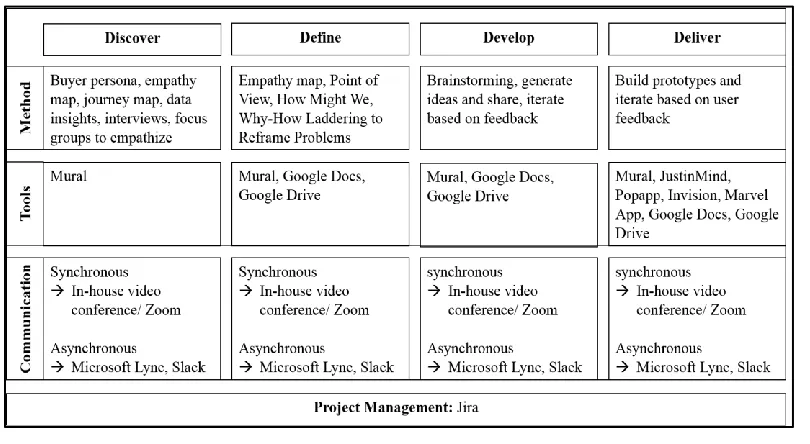
describe telework as the “substitution of ICT for work-related travel, it can include a satellite office, a telework center work from home, or any other workstation outside of the main offline.” Harpaz (2002) argues due to the developments of IS, people while working from remote locations, can still be within the context of an organizational framework. As creative team interactions are integral in DT and highlight the significance of cross-functional collaboration and communication, the framework proposed by Voigt et al. (2013) was selected. The ICT tool selection was a derivative from the four-key characteristics of DT process: collaboration, communication, creative work, and interaction, to support the DT phase is shown in Figure 1.
The study identified three ICT tools, which are usedin all four DT phases. The currently used tool Microsoft Lync or Slack was chosen for text-based asynchronous communication. Jira was currently being used as a project management tool by the TechCo, as it helped the agile project teams to be efficient, aided in making the team‟s goals clear. For synchronous communication, the existing video conferencing set-up with screen sharing for synchronous communication was chosen. Zoom for audio, video and screen sharing was selected, if team members were not working from the TechCo offices or the smaller facilities which did not have the video conferencing set-up or when customers and business partners were invited. The Mural was a new software tool introduced as the digital dashboard, that would enable participants to share texts in
The ICT tools, which are pertinent in each DT phase is described below:
Tools for the „Discover’ phase - The virtual team in this phase has to get familiar with the problem, by immersing themselves in the life of the customers and gain deep-insights to empathize with users (human-centered-approach).
Tools for the „Define‟ phase - In this stage, asynchronous and synchronous communication is vital since remote teams may choose to write down their understanding of the problem independently and deliberate their observation together to reframe the problem.
Tools for the „Develop‟ phase - The ideation stage is an extremely interactive and creative phase,
where the participants look beyond the stereotype answers to problems, question the status quo.Typically diverse ideas spark from the cross-functional team, where they get inspired to build on each other's ideas to develop the solution keeping the end-users needs and wants in mind.
[image:6.612.108.513.432.654.2]Tools for the „Deliver‟ phase - The different design tools used to develop rapid prototypes in this phase include storyboards, mockups, wireframes to virtual role plays (just to name a few). The goal is to present and validate the prototype, by documenting user feedback (text, video, and photo) and share with the participants to iterate the solution.
3.2. DESIGN EVALUATION OF TECHCO: PARTICIPATING ACTION RESEARCH
SOFTWARE COMPANY
By applying the DSRM methodology, the researcher evaluated the proposed ICT artifact within the TechCo. The survey was well designed to capture the participant‟s perceived effectiveness of
the artifact (Fink, 2002) and the roadblocks to information sharing by the virtual teams (Gibson and Cohen 2003). Fourteen people participated in the study, including the researcher who played the role of the DT facilitator from separate locations in Mumbai, India. The subject matter expert (acts as the customer) was asked to work from home,and one UI/UX (user interface and user
experience) designer worked from a co-working space. The project manager, two software developers, one enterprise software architect, and one UI/UX designer including the facilitator
participated from the first location. The business analyst, one software developer, one functional tester, one quality professional, database specialist and a marketing expert joined the second office. All participants were between 23 and 45 years old. The facilitator is a research scholar with professional experience in consulting, marketing, and customer experience. The study was limited to eight sessions over three weeks. All participants were used to working with remote teams. However, they were curious to know how they could improve the innovation process using RDT.
CASE STUDY STRUCTURE: To curtail the need for moderation and extensive coaching during the workshops, the researcher created an instructional video giving an overview of DT and the motive of this study as nine participants were new to DT. As Mural was a new tool introduced and none of the participants were familiar with it, they were given a remote training session before the study. At the start of the study, watching the instructional video was a prerequisite for the participants to get introduced to the initial assignment. The task of the remote team was to co-create anomnichannel solution with their retail client. During the „Discover‟ phase, the facilitator acquainted the participants with the task and deliberated the session goal with the virtual team. Using the different activities, they had to understand and empathize with the retailer‟s end. In the „Define‟ phase, participants were asked to visit multiple formats of the
and develop a paper prototype using POP, to get feedback on the idea. In the „Deliver‟ phase, and the UI developer had built a mock-up using JustINMIND before the session, and gathered feedback and revises the mock-up and received new feedback. A surveywas conducted after the completion of this experiment.
3.3. QUESTIONNAIRE AND DATA ANALYSIS
To evaluate if the RDT platform ratified creative group work, for each of the four phases of the DT, questionswere determined based on suggestions by Fink (2002). Before the studybegan, the
virtual team was asked two control questions to understand their preferred way of collaboration, communication, and interaction in teamwork. This helped to discover if there was a change in
the preferences of the remote teams, after experiencing the RDT platform. Qualitative, open-ended questions were asked (Appleton, 1995) in order to capture the participant‟s experience with RDT. Furthermore, at the end of the study, researcher asked the participants their experiences in terms of the applicability, degree of support, and usefulness of theproposed ICT tools, along each phase of the DT process. The questions were referred from the Creativity Support Index (CSI) (Cherry et al., 2014) as shown in Table 1. As the researcher played the role of a facilitator and was involved in coaching, communication and coordination capacity, and was not directly engaged in group work. However, the reflection journal maintained by the researcher also helped gather information about the RDT study.
Table 1:12 AGREEMENT STATEMENTS ON CSI (CHERRY ET AL., 2014, P. 21:6) Each agreement statement is answered on a scale of “Highly Disagree” (1) to “Highly Agree”
(10). In deployment, the factor names are not shown, and the participant does not see the statements grouped by a factor.
COLLABORATION
1. The system or tool allowed other people to work with meeasily.
2. It was really easy to share ideas and designs with other people inside this system or tool. ENJOYMENT
1. I would be happy to use this system or tool on a regular basis. 2. I enjoyed using the system or tool.
EXPLORATION
1. It was easy for me to explore many different ideas, options, designs, or outcomes, using this system or tool.
EXPRESSIVENESS
1. I was able to be very creative while doing the activity inside this system or tool. 2. The system or tool allowed me to be very expressive.
IMMERSION
1. My attention was fully tuned to the activity, and I forgot about the system or tool that I was using.
2. I became so absorbed in the activity that I forgot about the system or tool that I was using.
RESULTS WORTH EFFORT
1. I was satisfied with what I got out of the system or tool.
2. What I was able to produce was worth the effort I had to exert to produce it.
4. DATA ANALYSIS AND RESULTS
To gather qualitative data, the researcher used a three-staged analysis method (Appleton, 1995) including (a) data reduction, (b) data presentation, and (c) outliningthe inference. For this study, to achieve a data reduction, the data gatheredfrom discussions, observations and survey findings were abstracted and metamorphosed into insights. The responses were grouped on a whiteboard, patterns were analyzed, and inferences were drawnusing a strategic narrative approach.
VIRTUAL VERSUS FACE-TO-FACE TEAMWORK- Ten participants felt that the process itself is very structured and they never realized how time flew by and geographical distances is not a blocker for learning and changing perspectives. Five participants who were exposed to the face-to-face DT sessions in the past felt digital tools saved time transcribing sticky notes into digital artifacts and could be referred anytime.
THE EFFICIENCY OF VIRTUAL COLLABORATION- All participants expressed that the
disturbed by the loud noise of other people talking and it interfered with the quality of calls or his ability to speak openly.
QUALITY OF COMMUNICATION- Video conference calls using Zoom was considered a viable alternative to face-to-face communication, by all participants as they could see each other. However, the participant working from home cited slow Internet bandwidth as a restraining factor for effective virtual collaboration.
NECESSARY SKILLS- The participants agreed that it is essential to have skills to setup the ICT tools. They also highlighted familiarity with Mural was vital as it was an essential virtual
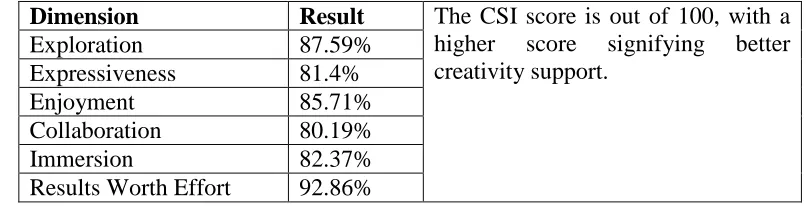
tool to enhance creativity at all stages of DT process. Table 2 presents Mural tools analysis using CSI.
TABLE 2: Six dimensions of CSI Outcomes for Mural as anRDTcreativity tool Cherry et al., 2014)
Dimension Result The CSI score is out of 100, with a higher score signifying better creativity support.
Exploration 87.59% Expressiveness 81.4%
Enjoyment 85.71%
Collaboration 80.19%
Immersion 82.37%
Results Worth Effort 92.86%
[image:10.612.101.504.346.449.2]5. DISCUSSION
The paper used the logic of DSRM to build the theoretical foundation for the RDT artifact, a digital depiction of the innovativeproblem-solvingtechnique applying DT. Withsurvey as the evaluation approach, the study results validateproposal 1, i.e.,anRDT or digital DT platform can support globally dispersed and remote teams to gather deep-insights of the customer and arrive at innovation solutions enhancing the customer experience. The survey revealed that the RDT platform enabled the participants to reach a common goal(De Vreede and Briggs, 2005). With clarity on how the virtual team shared and accessed information throughout the RDT, and the
difficulties highlighted), the second proposition was supported - by minimizing the information sharing problems faced by virtual teams, how they can communicate better remotely for creative
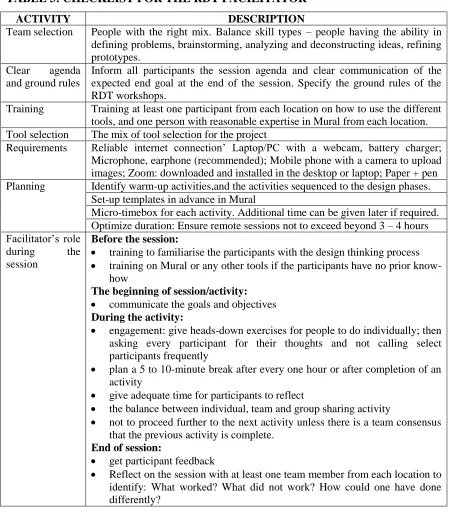
TABLE 3: CHECKLIST FOR THE RDT FACILITATOR
ACTIVITY DESCRIPTION
Team selection People with the right mix. Balance skill types – people having the ability in defining problems, brainstorming, analyzing and deconstructing ideas, refining prototypes.
Clear agenda and ground rules
Inform all participants the session agenda and clear communication of the expected end goal at the end of the session. Specify the ground rules of the RDT workshops.
Training Training at least one participant from each location on how to use the different tools, and one person with reasonable expertise in Mural from each location. Tool selection The mix of tool selection for the project
Requirements Reliable internet connection‟ Laptop/PC with a webcam, battery charger; Microphone, earphone (recommended); Mobile phone with a camera to upload images; Zoom: downloaded and installed in the desktop or laptop; Paper + pen Planning Identify warm-up activities,and the activities sequenced to the design phases.
Set-up templates in advance in Mural
Micro-timebox for each activity. Additional time can be given later if required. Optimize duration: Ensure remote sessions not to exceed beyond 3 – 4 hours Facilitator‟s role
during the session
Before the session:
training to familiarise the participants with the design thinking process training on Mural or any other tools if the participants have no prior
know-how
The beginning of session/activity: communicate the goals and objectives During the activity:
engagement: give heads-down exercises for people to do individually; then asking every participant for their thoughts and not calling select participants frequently
plan a 5 to 10-minute break after every one hour or after completion of an activity
give adequate time for participants to reflect
the balance between individual, team and group sharing activity
not to proceed further to the next activity unless there is a team consensus that the previous activity is complete.
End of session:
get participant feedback
Reflect on the session with at least one team member from each location to identify: What worked? What did not work? How could one have done differently?
6. CONCLUSION
Companies realize the value of collaborative creativity and distributed teams as key to business success. RDT done well is a strategic asset to innovation, fail fast, and rapid prototyping in today‟s agile business environment. The study has several limitations that need to reflectin future
the experience of the facilitator is a vital factor that needs to be considered to evaluate the success of RDT. The participants in this study were from the technology savvy software industry. Hence, further research could be directed to assess how the RDT process works with members from diverse backgrounds and industries, various levels of computer literacy, diverse age groups,and experience; more multidisciplinary, multicultural, in the team formation. Furthermore, the multiple approaches for DT phase progression in lines with the ones suggested by IDEO, MIT, d.School and so on could be established.
REFERENCES
1. Appleton, J.V. (1995). Analysing qualitative interview data: addressing issues of validity
and reliability. J. Adv. Nurs. 22, 993–997.
2. Bell, B. S., and Kozlowski, S.W.J. (2002). A Typology of Virtual Teams: Implications for Effective Leadership Group and Organization Management, 27(1), 14 - 4
3. Bergiel, B.J., Bergiel, E.B., Balsmeier, P.W. (2008). Nature of virtual teams: A summary of their advantages and disadvantages.Manag. Res. News 31, 99-110
4. Brown, T. (2009). Change by Design: How DT Transforms Organizations and Inspires Innovation. Harper Collins, New York.
5. Cherry, E., Latulipe, C. (2014). Quantifying the creativity support of digital tools through the creativity support index. ACM Trans. Comput.-Hum. Interact. 21, 21:1–21:25
6. Cramton, C. D. (2002). Finding Common Ground in Dispersed Collaboration, Organizational Dynamics 30(4), 356-367.
7. Dekeyser, S., & Watson, R. (2006). Extending google docs to collaborate on research papers. University of Southern Queensland, Australia, 23, 2008.
8. De Vreede, G.J., Briggs, R.O. (2005). Collaboration engineering: designing repeatable processes for high-value collaborative tasks. In: Proceedings of the 38th Annual Hawaii International Conference on System Sciences, p. 17.
9. Dingsøyr, T., Hanssen, G. K., Dyba, T., Anker, G., & Nygaard, J. O. (2006). Developing software with scrum in a small cross-organizational project. In I. Richardson, P. Runeson,
& R. Messnarz (Eds.), Lecture notes in computer science (Software process improvement, Vol. 4257, pp. 5–15). Berlin/Heidelberg: Springer.
11.Gibson, C. B., & Cohen, S. G. (Eds.). (2003). Virtual teams that work: Creating conditions for virtual team effectiveness. John Wiley & Sons.
12.Grantham, C. E. (2000). The future of work: The promise of the new digital work society. New York, NY: McGraw-Hill.
13.Harpaz, I. (2002). Advantages and disadvantages of telecommuting for the individual, organization and society. Work Study, 51, 74–80.
14.Hevner, A. R., March, S. T., Park, J., Ram, S., (2004). Design Science in Information Systems Research",MIS Quarterly, 28, 1, 75-105
15.Mabrito, M.(2006). A study of synchronous versus asynchronous collaboration in an online business writing class. Am. J. Distance Educ. 20, 93–107.
16.Martin, B.H., MacDonnell, R. (2006). Is Telework Effective for Organizations? A Meta-Analysis of Empirical Research on Perceptions of Telework and Organizational Outcomes. Research Gate.
17.Müller, R.M., Thoring, K.(2012). DT vs. lean startup: a comparison of two user-driven innovation strategies. In: Leading Innovation Through Design, 151–161.
18.Newman, D. (2016).https://www.forbes.com/sites/danielnewman/2016/04/12/people-not-technology-are-the-most-important-business-upgrades/2/#5b02092234fe
19.Peffers, K., Tuunanen, T., Rothenberger, M. A., & Chatterjee, S. (2007). A design science research methodology for information systems research. Journal of management information systems, 24(3), 45-77.
20.Riley, M. (2008). The real challenges of leading virtual teams. Paper presented at PMI Global Congress North America, Denver, CO Newtown Square, PA: Project Management Institute.
https://www.pmi.org/learning/library/real-challenges-leading-virtual-teams-communication-6959
21.Von Krogh, G., Nonaka, I., &Ichijo, K. (2000). Enabling knowledge creation: How to unlock the mystery of tacit knowledge and release the power of innovation. Oxford: Oxford University Press.
23.Weimann, P., Pollock, M., Scott, E., &Brown, I. (2013). Enhancing Team Performance Through Tool Use: How Critical Technology-Related Issues Influence the Performance of Virtual Project Teams. IEEE Transactions on Professional Communication, 56(4), 332-352.
24.Vilhelmson, B., Thulin, E. (2016). Who and where are the flexible workers? Exploring the current diffusion of telework in Sweden. New Technol. Work Employ. 31, 77–96 25.Slack: Where work happens https://slack.com/
26.Mural. https://mural.co/
27.Prototyping tool for web and mobile apps – Justinmind. https://www.justinmind.com/ 28.Mobile App Prototyping Made Easy. https://marvelapp.com/