Document ID : D10.0
Document Name : Security Target for EJBCA v5.0.4
Status : Draft
Dissemination Level : Public
Document Version : 1.2
Version Date : 02-07-12
Author(s): Tomas Gustavsson, Pedro Borges, Nuno Ponte, Nuno Santos, Hasan Subaşi
Abstract: This document defines the Security Target according to which the EJBCA product will be EAL 4+ Common Criteria evaluated.
History
Version Date Modification reason Modified by Approved by
0.1 26-12-2010 Initial draft Tomas Gustavsson Admir Abdurahmanovic
0.2 02-03-2011 Include comments received from Oppida and internal reviewers Pedro Borges Admir Abdurahmanovic 1.0 28-03-2012 Include comments received from Oppida Pedro Borges Admir Abdurahmanovic 1.1 29-04-2012 Perform changes requested by the certifier Pedro Borges Admir Abdurahmanovic 1.2 02-07-2012 Perform changes requested by the certifier Pedro Borges Admir Abdurahmanovic
Table of contents
HISTORY...2 TABLE OF CONTENTS...3 LIST OF FIGURES...5 LIST OF TABLES...6 1 INTRODUCTION...7 1.1 DESCRIPTIONOF EJBCA...7 1.2 TOE REFERENCE...7 1.3 TOE OVERVIEW...7 1.3.1 COMPONENTS... 9 1.4 TOE DESCRIPTION...11 1.4.1 SECURITYFUNCTIONS... 11 1.4.2 TOE BOUNDARY... 141.4.3 TOE PHYSICALSCOPE... 15
2 CONFORMANCE CLAIMS...16
2.1 CC CONFORMANCE CLAIM...16
2.2 PP CONFORMANCECLAIM...16
2.3 CONFORMANCE RATIONALE...16
3 SECURITY PROBLEM DEFINITION...17
3.1 INTRODUCTION...17 3.2 THREATS...17 3.2.1 AUTHORIZEDUSERS... 17 3.2.2 SYSTEM... 17 3.2.3 CRYPTOGRAPHY... 18 3.2.4 EXTERNALATTACKS... 18
3.3 ORGANISATIONAL SECURITY POLICIES...18
3.4 ASSUMPTIONS...19
3.4.1 PERSONNEL... 19
3.4.2 CONNECTIVITY... 20
3.4.3 PHYSICAL... 20
4 SECURITY OBJECTIVES...21
4.1 HIGH-LEVELSOLUTION...21
4.2 SECURITYOBJECTIVESFORTHE TOE...21
4.2.1 AUTHORIZEDUSERS... 21
4.3 SECURITYOBJECTIVESFORTHEOPERATIONALENVIRONMENT...22
4.3.1 NON-IT SECURITYOBJECTIVESFORTHEENVIRONMENT... 22
4.3.2 IT SECURITYOBJECTIVESFORTHEENVIRONMENT... 24
4.4 SECURITYOBJECTIVESFORBOTHTHE TOE ANDTHEOPERATIONALENVIRONMENT...24
4.5 SECURITYOBJECTIVESRATIONALE...26
5 EXTENDED COMPONENTS DEFINITION...27
6 SECURITY REQUIREMENTS...28
6.1 SECURITYFUNCTIONALREQUIREMENTS...28
6.1.1 SECURITY AUDIT... 30
6.1.2 ROLES... 34
6.1.3 BACKUPAND RECOVERY... 35
6.1.4 ACCESS CONTROL... 36
6.1.5 IDENTIFICATIONAND AUTHENTICATION... 37
6.1.6 REMOTE DATA ENTRYAND EXPORT... 38
6.1.7 KEY MANAGEMENT... 39
6.1.8 CERTIFICATEAND PROFILE MANAGEMENT... 40
6.2 SECURITYASSURANCEREQUIREMENTS...44
6.3 SECURITYREQUIREMENTSRATIONALE...45
6.3.1 SFR DEPENDENCIES... 46
6.3.2 SAR DEPENDENCIES... 49
7 TOE SUMMARY SPECIFICATIONS...55
7.1 SECURITY AUDIT...55
7.2 ROLES...56
7.3 BACKUPAND RECOVERY...57
7.4 ACCESS CONTROL...57
7.5 IDENTIFICATIONAND AUTHENTICATION...58
7.6 REMOTE DATA ENTRYAND EXPORT...59
7.7 KEY MANAGEMENT...61
7.8 CERTIFICATEAND PROFILE MANAGEMENT...62
REFERENCES...63
GLOSSARY...64
A CIMC TOE ACCESS CONTROL POLICY...66
List of figures
FIGURE 1: EJBCA ARCHITECTURE...8
List of tables
TABLE 1: FIPS 140-1 (ORHIGHER) LEVELFOR VALIDATED CRYPTOGRAPHIC MODULE...11
TABLE 2: EXTENDED COMPONENTS DEFINITION...27
TABLE 3: TOE FUNCTIONAL SECURITY REQUIREMENTS...30
TABLE 4: TOE FUNCTIONAL SECURITY REQUIREMENTS – SECURITY AUDIT...31
TABLE 5: AUDITABLE EVENTSAND AUDIT DATA...33
TABLE 6: TOE FUNCTIONAL SECURITY REQUIREMENTS – ROLES...34
TABLE 7: AUTHORIZED ROLESFOR MANAGEMENTOF SECURITY FUNCTIONS BEHAVIOUR...35
TABLE 8: TOE FUNCTIONAL SECURITY REQUIREMENTS – BACKUPAND RECOVERY...35
TABLE 9: TOE FUNCTIONAL SECURITY REQUIREMENTS – ACCESS CONTROL...36
TABLE 10: ACCESS CONTROLS...37
TABLE 11: TOE FUNCTIONAL SECURITY REQUIREMENTS – IDENTIFICATIONAND AUTHENTICATION...38
TABLE 12: TOE FUNCTIONAL SECURITY REQUIREMENTS – REMOTE DATA ENTRYAND EXPORT...39
TABLE 13: TOE FUNCTIONAL SECURITY REQUIREMENTS – KEY MANAGEMENT...40
TABLE 14: TOE FUNCTIONAL SECURITY REQUIREMENTS – CERTIFICATEAND PROFILE MANAGEMENT...43
TABLE 15: ASSURANCE REQUIREMENTS...44
TABLE 16: SUMMARYOF SFR DEPENDENCIESFOR SECURITY LEVEL 3...49
TABLE 17: SUMMARYOF SAR DEPENDENCIESFOR SECURITY LEVEL 3...54
TABLE 18: RATIONALEFORTHE SECURITY AUDIT SECURITY REQUIREMENTS...56
TABLE 19: RATIONALEFORTHE ROLES SECURITY REQUIREMENTS...56
TABLE 20: RATIONALEFORTHE BACKUPAND RECOVERY SECURITY REQUIREMENTS...57
TABLE 21: RATIONALEFORTHE ACCESS CONTROL SECURITY REQUIREMENTS...58
TABLE 22: RATIONALEFORTHE IDENTIFICATIONAND AUTHENTICATION SECURITY REQUIREMENTS...59
TABLE 23: RATIONALEFORTHE REMOTE DATA ENTRYAND EXPORT SECURITY REQUIREMENTS...60
TABLE 24: RATIONALEFORTHE KEY MANAGEMENT SECURITY REQUIREMENTS...61
TABLE 25: RATIONALEFORTHE CERTIFICATEAND PROFILE MANAGEMENT SECURITY REQUIREMENTS...62
1 Introduction
1.1 Description of EJBCA
EJBCA is an enterprise class PKI1 Certificate Authority built on JEE technology, allowing the
issuance and life cycle management of public key certificates compliant with the X.509 v3 [4] and CVC BSI TR-03110 [3] standards. Additionally, EJBCA can also be set up a CA independent, high performance, highly available OCSP responder service.
As the most flexible CA on the market, EJBCA PKI is the leading open source enterprise PKI. Designed to be a robust, high performance, platform independent, flexible and component based CA to be used stand-alone or integrated in other JEE applications.
Functionalities offered by EJBCA can be used through web interfaces (by end users or TOE users) or APIs (by relying applications that integrate it). More information can be found at the project website [6].
The rest of this document describes the EJBCA Target of Evaluation (TOE) that is in the scope of this Common Criteria evaluation and the corresponding Security Target (ST).
1.2 TOE Reference
ST Title Security Target for EJBCA v5.0.4 ST Reference D10.0
TOE Identification EJBCA v5.0.4
CC Conformance Common Criteria for Information Technology Security Evaluation, Version 3.1 (revision 3)
PP Conformance Certificate Issuing and Management Components (CIMC) Security Level 3 Protection Profile, Version 1.0, October 31, 2001 Assurance Level Evaluation Assurance Level 4 augmented with ALC_FLR.2
1.3 TOE Overview
The usage of Public-key Cryptography relies on the usage of digital certificates, in order to authenticate relying parties. However, given the complex nature of the issuance and management of the digital certificates lifecycle, organizations that want to carry out those types of operations usually need to use Certificate Authority applications
As an enterprise class PKI Certificate Authority, EJBCA is compliant with the X.509 v3 [4] and CVC BSI TR-03110 [3] standards, allowing the issuance of public key certificates for different purposes, such as:
• Strong authentication for users accessing your intranet/extranet/internet resources;
• Smart card logon to Windows and/or Linux;
• Signing and encrypting email;
• VPN connections by issuing certificates to your VPN routers such as OpenVPN, Cisco, Juniper etc.;
• Client VPN access with certificates in users VPN clients;
• Single sign-on by using a single certificate to secure logon to Web applications;
• Creating signed documents;
• Issue citizen certificates for access to government resources, used in passports etc.;
• Create CVCAs and DVs and issue CV certificates (CVC) to Document Verifiers and Inspection Systems for EU EAC ePassports.
Additionally, and besides being robust, highly flexible and customizable, the TOE also can act as a CA independent OCSP responder service.
Technology wise, given that it is composed by a set of Java Enterprise Edition (JEE) modules, EJBCA is platform independent.
Regarding its usage, EJBCA is deployed as a regular JEE application, making most of its functionalities available through a set of customizable Web interfaces. However, applications that need to integrate or build upon EJBCA's services in order to deliver higher level features may either use its APIs or, given the TOE's open-source nature, change it to fit their specific needs.
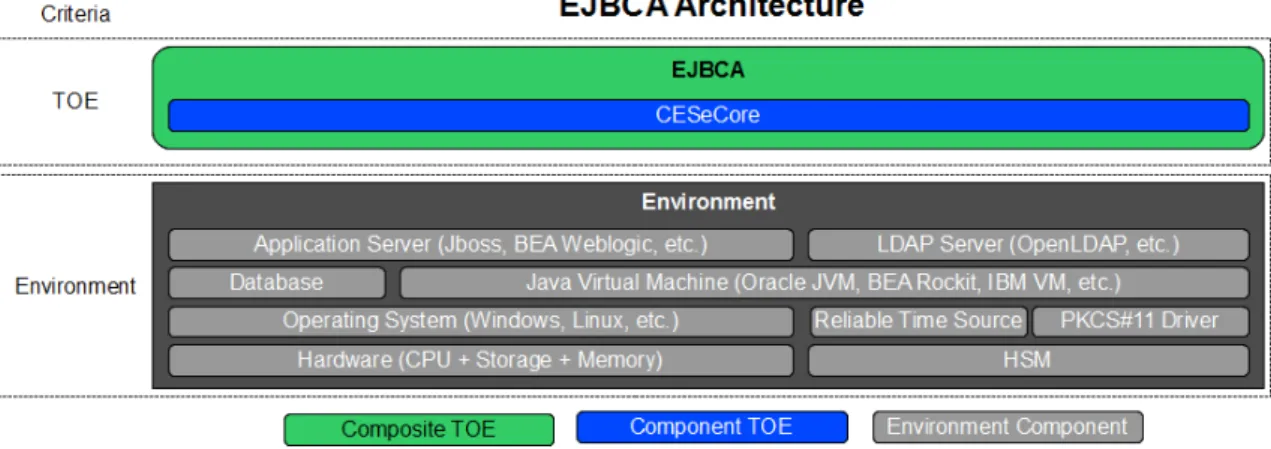
Figure 1 depicts the layered architecture that can be observed in a system where the TOE is deployed.
Figure 1: EJBCA Architecture
1.3.1 Components
The usage of EJBCA relies not only on its implementation, but also on several other additional components described in the following subsections.
1.3.1.1 EJBCA
The EJBCA component consists of a set of Java classes that provide such functionalities as:
• Create digital certificates and CRLs;
• OCSP support;
• Certificate Authority management;
• Key recovery;
• Profile management;
• User registration and management;
• Certificate and CRL publishing;
• Certificate and CRL retrieval;
• Backup of TOE data.
In order to achieve some of its goals and deliver the above mentioned features, the TOE relies on the usage of CESeCore, described in the following section.
1.3.1.2 CESeCore
CESeCore is a CC EAL4+ evaluated product (compliant with the CIMC SL3 PP) that implements security functionalities needed to create PKI-based applications, available through a set of APIs (either Java APIs or JEE specific APIs).
For more information about the CESeCore, please visit the project website (https://www.cesecore.eu).
1.3.1.3 Configuration artifacts
Configuration artifacts are basic TOE configuration items provided by the TOE users. The configuration artifacts define details on how the specific instance of the TOE works and consist of key-value pairs, stored in a configuration file or in a database. Examples of configuration artifacts are PKCS#11 library path for the hardware security module (HSM), key labels for cryptographic keys and modes for secure audit.
However, in order to run in an CC-certified configuration certain restrictions on the configuration artifacts may apply.
1.3.1.4 Java Virtual Machine
EJBCA is developed in the Java programming language and, as such, runs in a Java Virtual Machine (JVM). Additionally, since the JVM specifications are public, it can be implemented by independent vendors.
1.3.1.5 Application server
EJBCA can be (optionally) deployed on an JEE 5 compliant application server, which provides a number of resources and services to EJBCA, namely:
• Database connectivity services (e.g. object mappings and connection pooling);
• Component creation and management (e.g. session bean pooling and life-cycle management);
• Communication interfaces (e.g. HTTP and JEE).
These resources and services not only make development and maintenance more efficient, but also enable high performance, scalability and availability.
1.3.1.6 Database
Data persisted by EJBCA is handled by a standard relational database, where the following information is kept:
• Key pairs2 for key recovery, along with their respective passphrase;
• Publisher configuration;
• End user registration data, along with their respective passwords;
• Service configuration;
• Approval information (events waiting for approval by TOE users);
• CA configuration (additional to the one kept in CESeCore's database);
• System configuration;
• End user hard token information and issuer configuration (e.g. information about smartcards issued to end users).
Additionally, EJBCA relies on additional information kept in the CESeCore's relational database, namely:
• Key pairs3 and references to key pairs;
• Certificates and CRLs;
• Basic CA configuration;
• Audit logs of all security relevant operations;
• Authentication data, such as TOE user information;
• Authorization data, such as which TOE user is authorized to which resources. EJBCA enforces access control and maintains integrity of the data for which it is required.
1.3.1.7 Cryptographic module
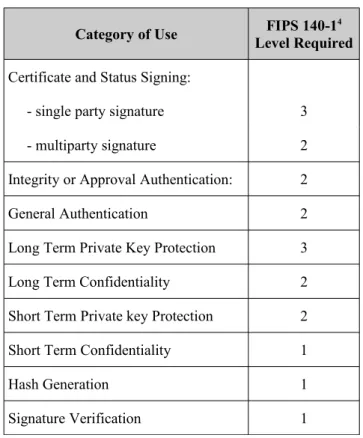
All cryptographic operations performed at the request of the TOE should take place in FIPS 140-1 (or higher) validated cryptographic modules, either in software or in a hardware (HSM). The interaction with the cryptographic module is performed through a standard PKCS#11 library provided by the respective vendor.
2Where the private key is encrypted. 3Where the private key is encrypted.
However, the level of FIPS 140-1 (or higher) required varies according to the type of operation performed, as depicted in Table 1.
Category of Use Level RequiredFIPS 140-14 Certificate and Status Signing:
- single party signature 3
- multiparty signature 2
Integrity or Approval Authentication: 2
General Authentication 2
Long Term Private Key Protection 3
Long Term Confidentiality 2
Short Term Private key Protection 2
Short Term Confidentiality 1
Hash Generation 1
Signature Verification 1
Table 1: FIPS 140-1 (or higher) Level for Validated Cryptographic Module
1.4 TOE Description
The EJBCA TOE comprises all the security functions required by a Certification Authority, allowing the issuance of public key certificates and CRLs, the lifecycle management of those certificates and capability to provide realtime information about their revocation status, according to the OCSP protocol. Additionally, the TOE depends on several external components for it's operation.
1.4.1 Security functions
Though the security functions can be used independently of each other, the implementation of some functions depends on others. For example, the secure audit security function depends on
data integrity protection and electronic signatures creation.
1.4.1.1 Electronic signatures creation
Creation of electronic signatures is a vital part of PKI applications. Electronic signatures can be created in a number of ways, low level and high level. The TOE will provide means to obtain a private key reference (compliant with the standard JCA) that can be used by relying applications for signing of specific document types. Signatures can be created in FIPS 140-1 (or higher) validated cryptographic modules, both using software or hardware (such as HSMs and smart cards).
1.4.1.2 Create digital certificates and CRLs
PKI management systems need to be able to create and process certificates and CRLs. These sets of security functions are aimed at systems that need to create and sign certificates and CRLs. The functions are also used by PKI enabled client systems that need to generate and process certificate services requests (CSRs) using standard formats such as PKCS#10 and CRMF (Certificate Request Message Format).
1.4.1.3 OCSP support
Though CRLs may be enough for some digital certificate usage scenarios, business-critical applications tend to require a more flexible and up to date source of revocation information. Therefore, the TOE natively supports OCSP request parsing and response generation, providing realtime revocation status information.
1.4.1.4 Data integrity protection
The functions for data integrity protection are used to ensure that data, in transit or in storage, cannot be tampered without detection. Integrity protection can be ensured using several techniques, where the most common are message authentication codes and digital signatures.
1.4.1.5 Secure audit
One very common requirement on sensitive systems is to provide secure audit records. Though creating audit records is simple, ensuring that they are not tampered with is much more difficult. By using the security audit functions of the TOE, an application will be able to create audit trails that meets CWA 14167-1 requirements for secure audit.
1.4.1.6 Authentication and authorization
Authentication and authorization are the most basic security functions needed in order for an application to provide services to TOE users.
Authentication is the process of identifying the TOE users. Authentication can be performed in many ways and the TOE provides a framework that can be extended by relying applications in order to meet their specific authentication needs
Authorization approves or rejects a request for accessing a specific resource. In order to control authorization, the TOE also keeps a database of access rules. The access rules are connected to the authorization system so that TOE user's access to resources can be controlled. Some access rules are already built-in in the TOE but they can be changed by the relying application.
Additionally, access control is also enforced through role separation, based on a combination of access rules.
1.4.1.7 Token management
The private keys used by the TOE to perform cryptographic operations are kept inside tokens, which can be activated/deactivated in order to allow/prevent using the keys they hold.
1.4.1.8 Key generation and management
The TOE is able to generate key pairs for its own usage, kept inside a FIPS 140-1 (or higher) validated cryptographic module.
1.4.1.9 Backup of TOE data
The various security functions of the TOE manage different types of data, including configuration data and recoverable key pairs. Disaster recovery procedures require that it must be possible to restore a security system in a determined state recovered from existing backups. Therefore, the
backup functions of the TOE make it possible not only to perform secure backup operations, but also to restore the contents of those backups at another installation. The security functions of the backup makes it possible to ensure that the backup, and thus the restored system, cannot be compromised and that confidential data is not revealed.
Additionally, and given the its dependency towards CESeCore, the backups generated by the TOE also include the information needed to recover CESeCore's state.
1.4.1.10 Certificate Authority management
As an enterprise class Certificate Authority software, EJBCA allows the configuration of several CAs in the same TOE instance, providing a flexible solution for organizations that need to deploy more than one CA (e.g. one CA for issuing signature certificates, another to issue SSL certificates, etc.).
1.4.1.11 Key recovery
The TOE is able to generate extractable key pairs for use in encryption certificates that, in case of loss of the respective encryption key, may be recovered by a TOE Officer. While kept by the TOE, these key pairs (and respective passphrases) are encrypted and stored in the database.
1.4.1.12 Profile management
Since, according to [1], the contents of the X.509 certificates and CRLs can be extended to include additional relevant information, the TOE supports the configuration of profiles that define the fields and default values that should be included in the issued certificates and CRLs. For each existing CA, it is possible to configure one CRL profile and one or more certificate profiles.
1.4.1.13 User registration and management
Issued digital certificates are associated to users, created during the enrolment process. In addition to collect his certificate(s), authenticated users can regain access to his key pairs kept by the TOE for key recovery purposes (after approval by a TOE user).
Additionally, certain users can be assigned one or more roles that grant them access to specific features of the TOE, like certificate suspension/revocation/activation, key recovery approval, configuration, administration or user management.
1.4.1.14 Certificate and CRL publishing
In order to make them widely available to external users and applications, the TOE supports the configuration of domain-specific publishers that are responsible to relay issued digital certificates and CRLs to third-party repositories where they can be accessed or used.
1.4.1.15 Certificate and CRL retrieval
Besides being able to publish them in the relevant repositories, EJBCA also allows the lookup and retrieval of specific certificates and CRLs.
1.4.2 TOE boundary
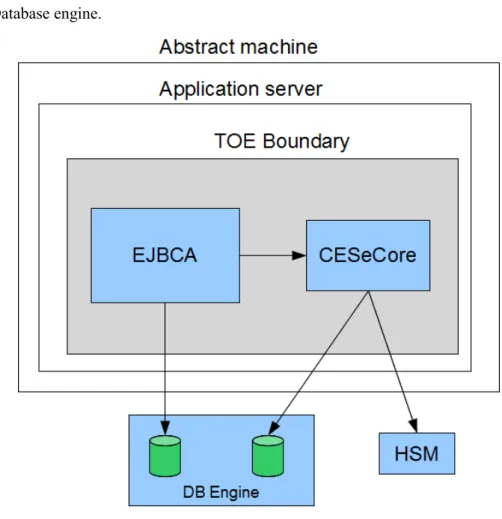
As illustrated by Figure 2, the TOE includes:
• The EJBCA component;
• The CESeCore library and its configuration files. Excluded from the TOE is:
• Hardware and operating system platform (abstract machine);
• Application server and execution environment;
• Hardware security module (HSM);
• Database engine.
Figure 2: TOE boundary
The rationale for excluding components from the TOE is elaborated in the following sections.
1.4.2.1 Hardware and operating system platform
EJBCA is independent of hardware and operating system and is expected to work on any platform that provides a reliable time source and is capable of running a JVM. The TOE security functions do not depend on the security functions of the underlying platform.
1.4.2.2 Application server and execution environment
EJBCA is independent of the application server and execution environment where it is used, as long as the execution environment is a compliant Java VM and the application server implements the Enterprise Java Beans (EJB) standard. The TOE security functions do not depend on the security functions of the application server or execution environment.
1.4.2.3 Hardware security module
The HSM supplies its own set of security functions and is FIPS5 140-1 (or higher) evaluated and,
as such, is regarded as a trusted device.
1.4.2.4 Database
All connections to the database are performed using the appropriate JDBC6 drivers. Given that it
is located in the same machine as the TOE, no specific mechanisms are needed to ensure the integrity and confidentiality of the information transferred to/from the database by the TOE.
1.4.3 TOE physical scope
By running on an application server inside a JVM, the TOE is independent of the underlying hardware and software platforms. Therefore, as long as a fully compliant JVM is available and may be used on such a platform, it should be possible to use the TOE.
Nevertheless, since there are several versions of the JVM specification, we have chosen to explicitly support Oracle JDK 1.6.0_27 (64 bit) in Linux and Oracle JDK 1.6.0_24 (32 bit) in Windows.
To perform the evaluation process we limit the hardware platform to the the most commonly used: Generic x86 32 or 64 bit server.
Moreover, and though it should be possible to deploy and use it in any Linux (32 or 64 bit) or Windows (32 bit) operating system, the TOE has been successfully tested in Red Hat Enterprise Linux 5.5 x86 (64 bit) and Windows Server 2008 (32 bit).
Regarding the database, any SQL7 compliant database can be used, with successful tests already
performed in the following versions:
• MySQL 5.1;
• PostgreSQL 9.0.
Additionally, EJBCA should run on any JEE 5 certified application server, having been successfully tested in the following:
• JBoss 5.1.0;
• Glassfish v2.
Finally, using the PKCS#11 interface makes it possible to use virtually any of the FIPS 140-1 (or higher) evaluated HSMs available on the market, with SafeNet Luna SA and Utimaco CryptoServer having been successfully tested.
2 Conformance Claims
2.1 CC Conformance Claim
The TOE conforms to:
• Common Criteria for Information Technology Security Evaluation, Version 3.1 (revision 3), part 2 extended;
• Common Criteria for Information Technology Security Evaluation, Version 3.1 (revision 3), part 3 conformant;
• Evaluation Assurance Level 4 augmented with the ALC_FLR.2 component.
2.2 PP conformance claim
As previously mentioned in this ST, EJBCA is demonstrably conformed to the following Protection Profiles (PP):
• Certificate Issuing and Management Components (CIMC) Security Level 3 PP, version 1.0, October 31, 2001.
2.3 Conformance Rationale
All of the assumptions, threats, policies, objectives and security requirements defined for CIMC PP Security Level 3 have been reproduced in this ST and adapted for CC v3.1. No additional assumption, threat, policy, objective or security requirement has been used.
All operations performed on the IT security requirements are within the bounds set by the CIMC PP for Security Level 3. Assignment and selection operations on security requirements are indicated in Section 6.
3 Security problem definition
3.1 Introduction
The security problem definition is extracted from the CIMC family of protection profiles and includes the following parts:
• Threats;
• Organizational security policies;
• Secure usage assumptions.
3.2 Threats
The threats are organized in four categories: authorized users, system, cryptography, and external attacks.
3.2.1 Authorized users
T.Administrative errors of omission Administrators, Operators, Officers or Auditors fail to perform some function essential to security. T.User abuses authorization to
collect and/or send data User abuses granted authorizations to improperly collect and/or send sensitive or security-critical data. T.User error makes data
inaccessible User accidentally deletes user data rendering user data inaccessible. T.Administrators, Operators,
Officers and Auditors commit errors or hostile actions
An Administrator, Operator, Officer or Auditor commits errors that change the intended security policy of the system or application or maliciously modify the system’s configuration to allow security violations to occur.
3.2.2 System
T.Critical system component fails Failure of one or more system components results in the loss of system critical functionality.
T.Malicious code exploitation An authorized user, IT system, or hacker downloads and executes malicious code, which causes abnormal processes that violate the integrity, availability, or confidentiality of the system assets. T.Message content modification A hacker modifies information that is intercepted
from a communications link between two unsuspecting entities before passing it on to the intended recipient.
T.Flawed code A system or applications developer delivers code that does not perform according to specifications or contains security flaws.
3.2.3 Cryptography
T.Disclosure of private and secret
keys A private or secret key is improperly disclosed.
T.Modification of private/secret
keys A secret/private key is modified.
T.Sender denies sending information The sender of a message denies sending the message to avoid accountability for sending the message and for subsequent action or inaction.
3.2.4 External attacks
T.Hacker gains access A hacker masquerades as an authorized user to perform operations that will be attributed to the authorized user or a system process or gains undetected access to a system due to missing, weak and/or incorrectly implemented access control causing potential violations of integrity, confidentiality, or availability.
T.Hacker physical access A hacker physically interacts with the system to exploit vulnerabilities in the physical environment, resulting in arbitrary security compromises.
T.Social engineering A hacker uses social engineering techniques to gain information about system entry, system use, system design, or system operation.
3.3 Organisational Security Policies
P.Authorized use of information Information shall be used only for its authorized purpose(s).
P.Cryptography FIPS-approved or NIST-recommended
cryptographic functions shall be used to perform all cryptographic operations.
3.4 Assumptions
The usage assumptions are organized in three categories: personnel, connectivity and
physical.
3.4.1 Personnel
Personnel assumptions about administrators and users of the system, as well as any threat agent.
A.Auditors Review Audit Logs Audit logs are required for security-relevant events and must be reviewed by the Auditors.
A.Authentication Data Management An authentication data management policy is enforced to ensure that users change their authentication data at appropriate intervals and to appropriate values (e.g., proper lengths, histories and variations) (Note: this assumption is not applicable to biometric authentication data.)
A.Competent Administrators,
Operators, Officers and Auditors Competent Administrators, Operators, Officers and Auditors will be assigned to manage the TOE and the security of the information it contains.
A.CPS All Administrators, Operators, Officers, and
Auditors are familiar with the certificate policy (CP) and certification practices statement (CPS) under which the TOE is operated.
A.Disposal of Authentication Data Proper disposal of authentication data and associated privileges is performed after access has been removed e.g., job termination, change in responsibility).
A.Malicious Code Not Signed Malicious code destined for the TOE is not signed by a trusted entity.
A.Notify Authorities of Security
Issues Administrators, Operators, Officers, Auditors, and other users notify proper authorities of any security issues that impact their systems to minimize the potential for the loss or compromise of data.
A.Social Engineering Training General users, administrators, operators, officers and auditors are trained in techniques to thwart social engineering attacks.
A.Cooperative Users Users need to accomplish some task or group of tasks that require a secure IT environment. The users require access to at least some of the information managed by the TOE and are expected to act in a cooperative manner.
3.4.2 Connectivity
Connectivity assumptions about other IT systems that are necessary for the secure operations of the TOE.
A.Operating System The operating system has been selected to provide
the functions required by this ST to counter the perceived threats for the the CIMC Security Level 3 PP.
3.4.3 Physical
Physical assumptions about the physical location of the TOE or any attached peripheral devices.
A.Communications Protection The system is adequately physically protected against loss of communications i.e., availability of communications.
A.Physical Protection The TOE hardware, software, and firmware critical to security policy enforcement will be protected from unauthorized physical modification.
4 Security objectives
The security objectives are based on the CIMC family of protection profiles and include the following parts:
• High-level solution;
• Security objectives for the TOE;
• Security objectives for the operational environment;
• Security objectives for both the TOE and operational environment;
• Security objectives rationale.
4.1 High-level solution
In general terms, this TOE aims to ensure:
• That all information generated by the system (e.g. certificates, CRLs and status information) is trustworthy;
• Protection against unknown/malicious communication traffic;
• The preservation and (if needed) recovery of a coherent and viable system state, despite component failures or security incidents (e.g. malicious code);
• Non-repudiation and auditability of relevant events;
• Control over its development and deployment, by implementing a configuration management plan;
• Confidentiality of sensitive information received or generated by the TOE;
• The protection of system and data integrity (including backup information), allowing prompt detection of unauthorized modification;
• An appropriate access control policy that restricts actions of unauthenticated users, fosters segregation of duties and grants only the essential access rights required by each role;
• The sequencing of events through the usage of reliable time stamps;
• Tamper protection of audit records.
4.2 Security objectives for the TOE
The objectives are organized in four categories: authorized users, system, cryptography, and external attacks.
4.2.1 Authorized users
O.Certificates The TSF must ensure that certificates, certificate revocation lists, and certificate status information are valid.
4.2.2 System
O.Preservation/trusted recovery of
secure state Preserve the secure state of the system in the event of a secure component failure and/or recover to a secure state.
O.Sufficient backup storage and
effective restoration Provide sufficient backup storage and effective restoration to ensure that the system can be recreated.
4.2.3 Cryptography
O.Non-repudiation Prevent user from avoiding accountability for sending a message by providing evidence that the user sent the message. (Security Levels 3 and 4) .
4.2.4 External attacks
O.Control unknown source
communication traffic Control (e.g., reroute or discard) communication traffic from an unknown source to prevent potential damage.
4.3 Security objectives for the operational environment
4.3.1 Non-IT security objectives for the environment
O.Administrators, Operators, Officers and Auditors guidance documentation
Deter Administrator, Operator, Officer or Auditor errors by providing adequate documentation on securely configuring and operating the CIMC. O.Auditors Review Audit Logs Identify and monitor security-relevant events by
requiring auditors to review audit logs on a frequency sufficient to address level of risk.
O.Authentication Data Management Ensure that users change their authentication data at appropriate intervals and to appropriate values (e.g., proper lengths, histories and variations) through enforced authentication data management (Note: this objective is not applicable to biometric authentication data.).
O.Communications Protection Protect the system against a physical attack on the communications capability by providing adequate physical security.
O.Competent Administrators,
Operators, Officers and Auditors Provide capable management of the TOE by assigning competent Administrators, Operators, Officers and Auditors to manage the TOE and the security of the information it contains.
O.CPS All Administrators, Operators, Officers and Auditors shall be familiar with the certificate policy (CP) and the certification practices statement (CPS) under which the TOE is operated.
O.Disposal of Authentication Data Provide proper disposal of authentication data and associated privileges after access has been removed (e.g., job termination, change in responsibility). O.Installation Those responsible for the TOE must ensure that the
TOE is delivered, installed, managed, and operated in a manner which maintains IT security.
O.Malicious Code Not Signed Protect the TOE from malicious code by ensuring all code is signed by a trusted entity prior to loading it into the system.
O.Notify Authorities of Security
Issues Notify proper authorities of any security issues that impact their systems to minimize the potential for the loss or compromise of data.
O.Physical Protection Those responsible for the TOE must ensure that the security-relevant components of the TOE are protected from physical attack that might compromise IT security.
O.Social Engineering Training Provide training for general users, Administrators, Operators, Officers and Auditors in techniques to thwart social engineering attacks.
O.Cooperative Users Ensure that users are cooperative so that they can accomplish some task or group of tasks that require a secure IT environment and information managed by the TOE. (Security Levels 1 – 3).
O.Lifecycle security Provide tools and techniques used during the development phase to ensure security is designed into EJBCA. Detect and resolve flaws during the operational phase. (Security Levels 2 – 4)
O.Repair identified security flaws The vendor repairs security flaws that have been identified by a user. (Security Levels 2 – 4)
O.Require inspection for downloads Require inspection of downloads/transfers.
O.User authorization management Manage and update user authorization and privilege data to ensure they are consistent with organizational security and personnel policies.
4.3.2 IT security objectives for the environment
O.Cryptographic functions The TOE must implement approved cryptographic
algorithms for encryption/decryption,
authentication, and signature
generation/verification; approved key generation techniques and use validated cryptographic modules. (Validated is defined as FIPS 140-1 or higher validated.)
O.Operating System The operating system used is validated to provide adequate security, including domain separation and non-bypassability, in accordance with security requirements recommended by the National Institute of Standards and Technology (available at
http://checklists.nist.gov).
O.Periodically check integrity Provide periodic integrity checks on both system and software.
O.Security roles Maintain security-relevant roles and the association of users with those roles.
O.Validation of security function Ensure that security-relevant software, hardware, and firmware are correctly functioning through features and procedures.
O.Trusted Path Provide a trusted path between the user and the system. Provide a trusted path to security-relevant (TSF) data in which both end points have assured identities. (Security Levels 3 and 4)
4.4 Security objectives for both the TOE and the operational
environment
This section specifies the security objectives that are jointly addressed by the TOE and the environment.
O.Configuration Management Implement a configuration management plan. Implement configuration management to assure identification of system connectivity (software, hardware, and firmware), and components (software, hardware, and firmware), auditing of configuration data, and controlling changes to configuration items.
O.Data import/export Protect data assets when they are being transmitted to and from the TOE, either through intervening untrusted components or directly to/from human users.
O.Detect modifications of firmware,
software, and backup data Provide integrity protection to detect modifications to firmware, software, and backup data. O.Individual accountability and
audit records Provide individual accountability for audited events. Record in audit records: date and time of action and the entity responsible for the action.
O.Integrity protection of user data
and software Provide appropriate integrity protection for user data and software. O.Limitation of administrative
access Design administrative functions so that Administrators, Operators, Officers and Auditors do not automatically have access to user objects, except for necessary exceptions. Control access to the system by Operators and Administrators who troubleshoot the system and perform system updates.
O.Maintain user attributes Maintain a set of security attributes (which may include role membership and access privileges) associated with individual users. This is in addition to user identity.
O.Manage behavior of security
functions Provide management functions to configure, operate, and maintain the security mechanisms. O.Object and data recovery free
from malicious code Recover to a viable state after malicious code is introduced and damage occurs. That state must be free from the original malicious code.
O.Procedures for preventing
malicious code Incorporate malicious code prevention procedures and mechanisms. O.Protect stored audit records Protect audit records against unauthorized access, modification, or deletion to ensure accountability of user actions.
O.Protect user and TSF data during
internal transfer Ensure the integrity of user and TSF data transferred internally within the system. O.Respond to possible loss of
stored audit records Respond to possible loss of audit records when audit trail storage is full or nearly full by restricting auditable events.
O.Restrict actions before
authentication Restrict the actions a user may perform before the TOE authenticates the identity of the user. O.Security-relevant configuration
management Manage and update system security policy data and enforcement functions, and other security-relevant configuration data, to ensure they are consistent with organizational security policies.
O.Time stamps Provide time stamps to ensure that the sequencing of events can be verified.
O.React to detected attacks Implement automated notification (or other responses) to the TSF-discovered attacks in an effort to identify attacks and to create an attack deterrent. (Security Levels 2 - 4)
Common Criteria version 3.1 requires the strict separation between security objectives for the TOE and security objectives for the operational environment.
This section is directly extracted from the CIMC protection profile and is however considered as acceptable because:
• separation between security requirements for the TOE and security requirements for the environment is clearly defined in the rationale for objectives coverage (section 6.3);
• security requirements statement is the basis for CC 3.1 evaluation tasks (e.g. for ADV class evaluation workunits).
4.5 Security objectives rationale
The Security Problem Definition and the Security Objectives are identical to the CIMC protection profile.
5 Extended components definition
Extended components have been defined in the CIMC Protection Profile.
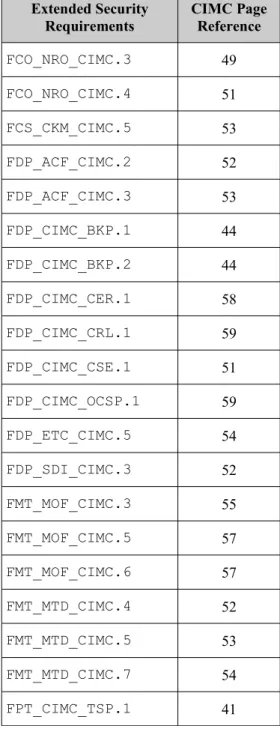
Extended security requirements are explicitly identified in Table 2, and thoroughly described in the PP.
Extended Security
Requirements CIMC Page Reference
FCO_NRO_CIMC.3 49 FCO_NRO_CIMC.4 51 FCS_CKM_CIMC.5 53 FDP_ACF_CIMC.2 52 FDP_ACF_CIMC.3 53 FDP_CIMC_BKP.1 44 FDP_CIMC_BKP.2 44 FDP_CIMC_CER.1 58 FDP_CIMC_CRL.1 59 FDP_CIMC_CSE.1 51 FDP_CIMC_OCSP.1 59 FDP_ETC_CIMC.5 54 FDP_SDI_CIMC.3 52 FMT_MOF_CIMC.3 55 FMT_MOF_CIMC.5 57 FMT_MOF_CIMC.6 57 FMT_MTD_CIMC.4 52 FMT_MTD_CIMC.5 53 FMT_MTD_CIMC.7 54 FPT_CIMC_TSP.1 41
6 Security requirements
The security requirements are based on the CIMC family of protection profiles and include the following parts:
• Security functional requirements (SFRs);
• Security assurance requirements (SARs);
• Security requirements rationale.
6.1 Security functional requirements
Table 3 lists all the TOE's functional security requirements.
Security Functional Requirement CIMC PP Section CC Part 2 Extended FAU_GEN.1 Audit data generation 6.1 Security Audit
FAU_GEN.2 User identity
association 6.1 Security Audit
FAU_SEL.1 Selective audit 6.1 Security Audit FAU_STG.1 Protected audit trail
storage 6.1 Security Audit
FAU_STG.4 Prevention of audit
data loss 6.1 Security Audit
FCO_NRO_CIMC.3 Enforced proof of origin and verification of
origin
6.6 Remote Data Entry and Export
yes FCO_NRO_CIMC.4 Advanced
verification of origin 6.6 Remote Data Entry and Export yes FCS_CKM_CIMC.5 CIMC private and
secret key zeroization 6.7 Key Management yes
FDP_ACC.1 Subset access control 6.4 Access Control FDP_ACF.1 Security attribute
based access control 6.4 Access Control FDP_ACF_CIMC.2 User private key
confidentiality protection 6.7 Key Management yes
FDP_ACF_CIMC.3 User secret key
confidentiality protection 6.7 Key Management yes
FDP_CIMC_BKP.1 CIMC backup and
recovery 6.3 Backup and Recovery yes
FDP_CIMC_BKP.2 Extended CIMC
backup and recovery 6.3 Backup and Recovery yes
FDP_CIMC_CER.1 Certificate
Generation 6.11 Certificate Registration yes
FDP_CIMC_CRL.1 Certificate
Revocation 6.12 Certificate Revocation yes
FDP_CIMC_CSE.1 Certificate
status export 6.6 Remote Data Entry and Export yes
FDP_CIMC_OCSP.1 Basic Response
Validation 6.12 Certificate Revocation yes
FDP_ETC_CIMC.5 Extended user
private and secret key export 6.7 Key Management yes
FDP_ITT.1 Basic internal
transfer protection (iteration 1 and 2)
6.6 Remote Data Entry and Export
FDP_SDI_CIMC.3 Stored public key
integrity monitoring and action 6.7 Key Management yes
FDP_UCT.1 Basic data exchange
confidentiality 6.6 Remote Data Entry and Export
FIA_UAU.1 Timing of
authentication 6.5 Identification and Authentication FIA_UID.1 Timing of
identification 6.5 Identification and Authentication FIA_USB.1 User-subject binding 6.5 Identification and Authentication FMT_MOF.1 Management of security
functions behaviour 6.2 Roles
FMT_MOF_CIMC.3 Extended
certificate profile management 6.8 Certificate Profile Management yes FMT_MOF_CIMC.5 Extended
certificate revocation list profile management
6.9 Certificate Revocation List Profile
Management yes
FMT_MOF_CIMC.6 OCSP Profile
Management 6.10 Online Certificate Status Protocol (OCSP) Profile Management yes FMT_MTD_CIMC.4 TSF private key
confidentiality protection 6.7 Key Management yes
FMT_MTD_CIMC.5 TSF secret key
confidentiality protection 6.7 Key Management yes
FMT_MTD_CIMC.7 Extended TSF
private and secret key export 6.7 Key Management yes
FPT_CIMC_TSP.1 Audit log signing
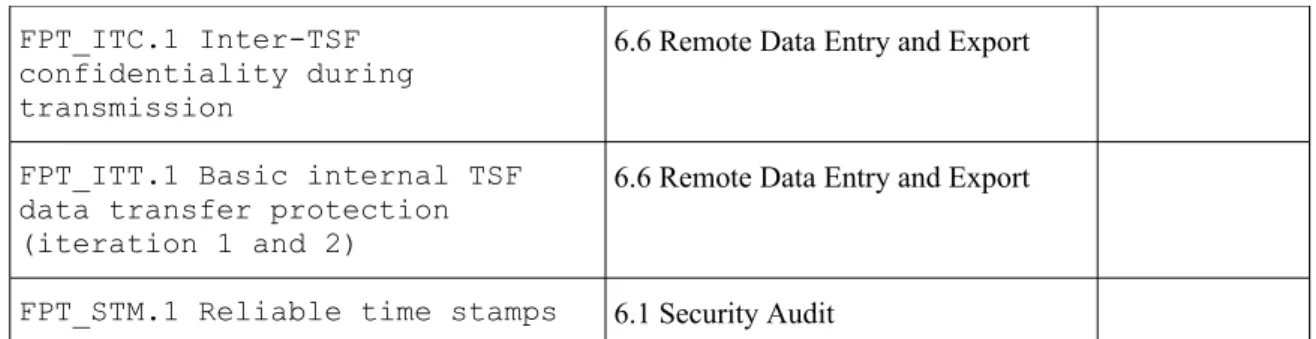
FPT_ITC.1 Inter-TSF confidentiality during transmission
6.6 Remote Data Entry and Export
FPT_ITT.1 Basic internal TSF data transfer protection (iteration 1 and 2)
6.6 Remote Data Entry and Export
FPT_STM.1 Reliable time stamps 6.1 Security Audit
Table 3: TOE Functional Security Requirements
6.1.1 Security Audit
Table 4 describes the SFRs related to security audit.
FAU_GEN.1 Audit data generation
FAU_GEN.1.1 The TSF shall be able to generate an audit record of the following auditable events:
a) Start-up and shutdown of the audit functions;
b) All auditable events for the minimum level of audit; and c) The events listed in Table 5 below .
FAU_GEN.1.2 The TSF shall record within each audit record at least the following information:
a) Date and time of the event, type of event, subject identity (if applicable), and the outcome (success or failure) of the event; and
b) For each audit event type, the information specified in the Additional Details column in Table 5 below .
Additionally, the audit shall not include plaintext private or secret keys or other critical security parameters.
FAU_GEN.2 User identity association
FAU_GEN.2.1 For audit events resulting from the actions of identified users, the TSF shall be able to associate each auditable event with the identity of the user that caused the event.
FAU_SEL.1 Selective audit
FAU_SEL.1.1 The TSF shall be able to select the set of events to be audited from the set of all auditable events based on the following attributes:
a) object identity, subject identity and event type; b) date.
FAU_STG.1 Protected audit trail storage
FAU_STG.1.1 The TSF shall protect the stored audit records in the audit trail from unauthorised deletion.
FAU_STG.1.2 The TSF shall be able to detect unauthorised modifications to the stored audit records in the audit trail.
FAU_STG.4 Prevention of audit data loss
FAU_STG.4.1 The TSF shall prevent audited events, except those taken by the Auditor and no other actions if the audit trail is full.
FPT_CIMC_TSP.1 Audit log signing event
FPT_CIMC_TSP.1.1 The TSF shall periodically create an audit log signing event in which it computes a digital signature, keyed hash, or authentication code over the entries in the audit log.
FPT_CIMC_TSP.1.2 The digital signature, keyed hash, or authentication code shall be computed over, at least, every entry that has been added to the audit log since the previous audit log signing event and the digital signature, keyed hash, or authentication code from the previous audit log signed event.
FPT_CIMC_TSP.1.3 The specified frequency at which the audit log signing event occurs shall be configurable.
FPT_CIMC_TSP.1.4 The digital signature, keyed hash, or authentication code from the audit log signing event shall be included in the audit log.
FPT_STM.1 Reliable time stamps
FPT_STM.1.1 The TSF shall be able to provide reliable time stamps. Table 4: TOE Functional Security Requirements – Security Audit
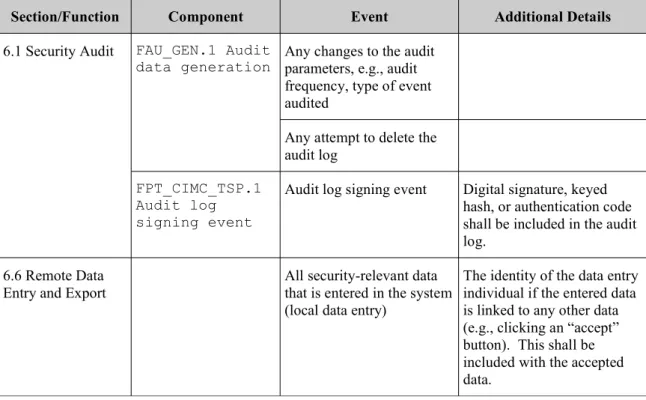
Table 5 describes the auditable events and respective data.
Section/Function Component Event Additional Details
6.1 Security Audit FAU_GEN.1 Audit
data generation Any changes to the audit parameters, e.g., audit frequency, type of event audited
Any attempt to delete the audit log
FPT_CIMC_TSP.1 Audit log signing event
Audit log signing event Digital signature, keyed hash, or authentication code shall be included in the audit log.
6.6 Remote Data
Entry and Export All security-relevant data that is entered in the system (local data entry)
The identity of the data entry individual if the entered data is linked to any other data (e.g., clicking an “accept” button). This shall be included with the accepted data.
Section/Function Component Event Additional Details All security-relevant
messages that are received by the system (remote data entry)
All successful and unsuccessful requests for confidential and security- relevant information (Security Levels 2, 3, 4) 5.6 Key Management FCS_CKM.1 Cryptographic Key Generation
Whenever the TSF requests generation of a
cryptographic key (except single session or one-time use symmetric keys)
The public component of any asymmetric key pair
generated
The loading of Component private keys8
6.7 Key
Management All access to certificate subject private keys
retained within the TOE for key recovery purposes All changes to the trusted public keys, including additions and deletions
The public key and all information associated with the key
The manual entry of secret keys used for authentication (Security Levels 3 and 4) FDP_ETC_CIMC.4
User private and secret key export;
FMT_MTD_CIMC.6 TSF private and secret key export
The export of private and secret keys (except keys used for a single session or message)
6.11 Certificate
Registration FDP_CIMC_CER.1 Certificate Generation
All certificate requests If accepted, a copy of the certificate. If rejected, the reason for rejection (e.g., invalid data, request rejected by Officer, etc.).
Certificate Status
Change Approval All requests to change the status of a certificate Whether the request was accepted or rejected. CIMC
Configuration Any security-relevant changes to the
configuration of the TSF
8Audit log not generated since this operation is not supported by the TOE.
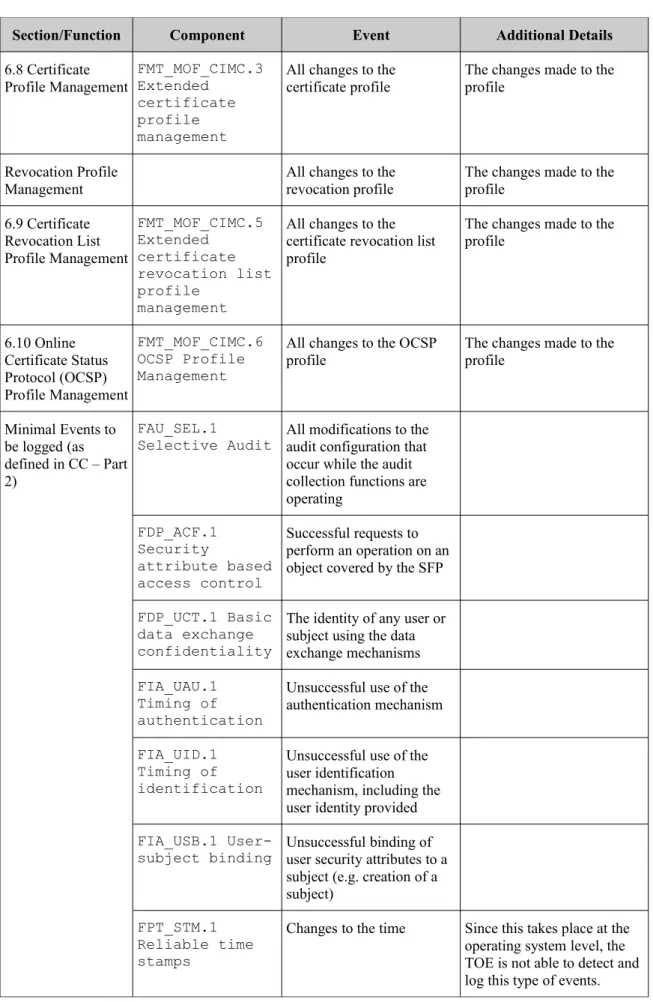
Section/Function Component Event Additional Details 6.8 Certificate Profile Management FMT_MOF_CIMC.3 Extended certificate profile management
All changes to the
certificate profile The changes made to the profile
Revocation Profile
Management All changes to the revocation profile The changes made to the profile
6.9 Certificate Revocation List Profile Management FMT_MOF_CIMC.5 Extended certificate revocation list profile management
All changes to the certificate revocation list profile
The changes made to the profile 6.10 Online Certificate Status Protocol (OCSP) Profile Management FMT_MOF_CIMC.6 OCSP Profile Management
All changes to the OCSP profile
The changes made to the profile Minimal Events to be logged (as defined in CC – Part 2) FAU_SEL.1
Selective Audit All modifications to the audit configuration that occur while the audit collection functions are operating FDP_ACF.1 Security attribute based access control Successful requests to perform an operation on an object covered by the SFP FDP_UCT.1 Basic
data exchange confidentiality
The identity of any user or subject using the data exchange mechanisms FIA_UAU.1
Timing of authentication
Unsuccessful use of the authentication mechanism FIA_UID.1
Timing of identification
Unsuccessful use of the user identification mechanism, including the user identity provided FIA_USB.1
User-subject binding Unsuccessful binding of user security attributes to a subject (e.g. creation of a subject)
FPT_STM.1 Reliable time stamps
Changes to the time Since this takes place at the
operating system level, the TOE is not able to detect and log this type of events. Table 5: Auditable Events and Audit Data
6.1.2 Roles
Table 6 describes the SFRs related to role management.
FMT_MOF.1 Management of security functions behaviour
FMT_MOF.1.1 The TSF shall restrict the ability to modify the behavi or of the functions listed in
Table 7 to the authorized roles as specified in Table 7 . Table 6: TOE Functional Security Requirements – Roles
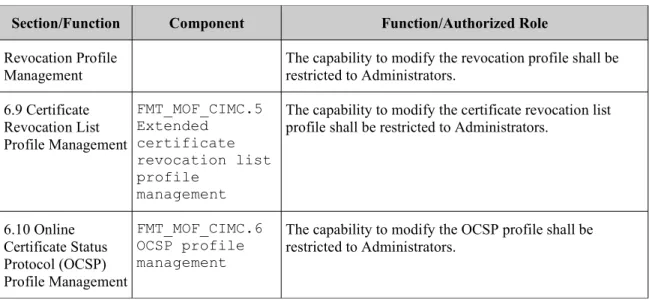
Table 7 describes the roles authorised to manage the security functions behaviour.
Section/Function Component Function/Authorized Role
6.1 Security Audit The capability to configure the audit parameters shall be
restricted to Administrators.
The capability to change the frequency of the audit log signing event shall be restricted to Administrators. (Security Levels 2-4).
6.3 Backup and Recovery
The capability to configure the backup parameters shall be restricted to Administrators.
6.11 Certificate Registration
The capability to approve fields or extensions to be included in a certificate shall be restricted to Officers. If an automated process is used to approve fields or extensions to be included in a certificate, the capability to configure that process shall be restricted to Officers. Data Export and
Output
The export of CIMC private keys shall require the authorization of at least two Administrators or one Administrator and one Officer, Auditor, or Operator. (Security Levels 3 and 4)
Certificate Status
Change Approval Only Officers shall configure the automated process used to approve the revocation of a certificate or information about the revocation of a certificate.
Only Officers shall configure the automated process used to approve the placing of a certificate on hold or
information about the on hold status of a certificate. CIMC
Configuration The capability to configure any TSF functionality shall be restricted to Administrators. (This requirement applies to all configuration parameters unless the ability to configure that aspect of the TSF functionality has been assigned to a different role elsewhere in this document.)
6.8 Certificate Profile Management FMT_MOF_CIMC.3 Extended certificate profile management
The capability to modify the certificate profile shall be restricted to Administrators.
Section/Function Component Function/Authorized Role Revocation Profile
Management The capability to modify the revocation profile shall be restricted to Administrators. 6.9 Certificate Revocation List Profile Management FMT_MOF_CIMC.5 Extended certificate revocation list profile management
The capability to modify the certificate revocation list profile shall be restricted to Administrators.
6.10 Online Certificate Status Protocol (OCSP) Profile Management FMT_MOF_CIMC.6 OCSP profile management
The capability to modify the OCSP profile shall be restricted to Administrators.
Table 7: Authorized Roles for Management of Security Functions Behaviour
6.1.3 Backup and Recovery
Table 8 describes the SFRs related to the backup and recovery operations.
FDP_CIMC_BKP.1 CIMC backup and recovery
FDP_CIMC_BKP.1.1 The TSF shall include a backup function.
FDP_CIMC_BKP.1.2 The TSF shall provide the capability to invoke the backup function on demand. FDP_CIMC_BKP.1.3 The data stored in the system backup shall be sufficient to recreate the state of
the system at the time the backup was created using only:
a) a copy of the same version of the CIMC as was used to create the backup data;
b) a stored copy of the backup data;
c) the cryptographic key(s), if any, needed to verify the digital signature, keyed hash, or authentication code protecting the backup; and
d) the cryptographic key(s), if any, needed to decrypt any encrypted critical security parameters.
FDP_CIMC_BKP.1.4 The TSF shall include a recovery function that is able to restore the state of the system from a backup. In restoring the state of the system, the recovery function is only required to create an “equivalent” system state in which information about all relevant CIMC transactions has been maintained.
FDP_CIMC_BKP.2 Extended CIMC backup and recovery
FDP_CIMC_BKP.2.1 The backup data shall be protected against modification through the use of digital signatures, keyed hashes, or authentication codes.
FDP_CIMC_BKP.2.2 Critical security parameters and other confidential information shall be stored in encrypted form only.
6.1.4 Access Control
Table 9 describes the SFRs related to access control.
FDP_ACC.1 Subset access control
FDP_ACC.1.1 The TSF shall enforce the CIMC TOE Access Control Policy specified in appendix A on users, profiles, view, edit, create, delete, approve.
FDP_ACF.1 Security attribute based access control
FDP_ACF.1.1 The TSF shall enforce the CIMC TOE Access Control Policy specified in appendix A to objects based on the identity of the subject and the set of roles that the subject is authorized to assume.
FDP_ACF.1.2 The TSF shall enforce the rules specified in Table 10 to determine if an operation among controlled subjects and controlled objects is allowed.
FDP_ACF.1.3 The TSF shall explicitly authorise access of subjects to objects based on the following additional rules: no additional rules.
FDP_ACF.1.4 The TSF shall explicitly deny access of subjects to objects based on the following additional rules: no additional explicit denial rules.
Table 9: TOE Functional Security Requirements – Access Control
Table 10 describes the access controls enforced by the TOE.
Section/Function Component Event
Certificate Request Remote and Local Data Entry
The entry of certificate request data shall be restricted to Officers and the subject of the requested certificate. Certificate
Revocation Request Remote and Local Data Entry
The entry of certificate revocation request data shall be restricted to Officers and the subject of the certificate to be revoked.
Data Export and
Output The export or output of confidential and security-relevant data shall only be at the request of authorized users. 5.6 Key
Management
FCS_CKM.1 Cryptographic Key Generation
The capability to request the generation of Component keys (used to protect data in more than a single session or message) shall be restricted to Administrators.
6.7 Key
Management The capability to request the loading of Component private keys into cryptographic modules shall be restricted to Administrators.
6.7 Key Management
At least two Officers or one Officer and an Administrator, Auditor, or Operator shall be required to request the decryption of a certificate subject private key. (Security Levels 3 and 4)
The TSF shall not provide a capability to decrypt
certificate subject private keys that may be used to generate digital signatures.
Section/Function Component Event Trusted Public Key
Entry, Deletion, and Storage
The capability to change (add, revise, delete) the trusted public keys shall be restricted to Administrators. 6.7 Key
Management The capability to request the loading of CIMC secret keys into cryptographic modules shall be restricted to Administrators.
6.7 Key
Management The capability to zeroize CIMC plaintext private and secret keys shall be restricted to Administrators. 6.7 Key
Management The capability to export a component private key shall be restricted to Administrators. 6.7 Key
Management The export of a certificate subject private key shall require the authorization of at least two Officers or one Officer and an Administrator, Auditor, or Operator. (Security Levels 3 and 4)
Certificate Status Change Approval
Only Officers and the subject of the certificate shall be capable of requesting that a certificate be placed on hold. Only Officers shall be capable of removing a certificate from on hold status.
Only Officers shall be capable of approving the placing of a certificate on hold.
Only Officers and the subject of the certificate shall be capable of requesting the revocation of a certificate. Only Officers shall be capable of approving the revocation of a certificate and all information about the revocation of a certificate.
Table 10: Access Controls
6.1.5 Identification and Authentication
Table 11 describes the SFRs related to identification and authentication.
FIA_UAU.1 Timing of authentication
FIA_UAU.1.1 The TSF shall allow enrolment and public information retrieval requests on behalf of the user to be performed before the user is authenticated.
FIA_UAU.1.2 The TSF shall require each user to be successfully authenticated before allowing any other TSF-mediated actions on behalf of that user.
FIA_UID.1 Timing of identification
FIA_UID.1.1 The TSF shall allow enrolment and public information retrieval requests on behalf of the user to be performed before the user is identified.
FIA_USB.1 User-subject binding
FIA_USB.1.1 The TSF shall associate the following user security attributes with subjects acting on the behalf of that user: the set of roles that the user is authorized to assume.
FIA_USB.1.2 The TSF shall enforce the following rules on the initial association of user security attributes with subjects acting on the behalf of users: the user subject object shall represent the user’s identify and be mapped to the set of roles the user is authorized to assume.
FIA_USB.1.3 The TSF shall enforce the following rules governing changes to the user security attributes associated with subjects acting on the behalf of users: None. Table 11: TOE Functional Security Requirements – Identification and Authentication
6.1.6 Remote Data Entry and Export
Table 12 describes the SFRs related to remote data entry and export operations.
FCO_NRO_CIMC.3 Enforced proof of origin and verification of origin
FCO_NRO_CIMC.3.1 The TSF shall enforce the generation of evidence of origin for certificate status information and all other security-relevant information at all times.
FCO_NRO_CIMC.3.2 The TSF shall be able to relate the identity and no other attributes of the originator of the information, and the security-relevant portions of the information to which the evidence applies.
FCO_NRO_CIMC.3.3 The TSF shall verify the evidence of origin of information for all security-relevant information.
FCO_NRO_CIMC.4 Advanced verification of origin
FCO_NRO_CIMC.4.1 The TSF shall, for initial certificate registration messages sent by the certificate subject, only accept messages protected using an authentication code, keyed hash, or digital signature algorithm.
FCO_NRO_CIMC.4.2 The TSF shall, for all other security-relevant information, only accept the information if it was signed using a digital signature algorithm.
FDP_CIMC_CSE.1 Certificate status export
FDP_CIMC_CSE.1.1 Certificate status information shall be exported from the TOE in messages whose format complies with the X.509 standard [4] for CRLs and the OCSP standard [2] as defined by RFC 2560.
FDP_ITT.1 Basic internal transfer protection (iteration 1)
FDP_ITT.1.1 The TSF shall enforce the CIMC TOE Access Control Policy specified in appendix A to prevent the modification of security-relevant user data when it is transmitted between physically-separated parts of the TOE.
FDP_ITT.1 Basic internal transfer protection (iteration 2)
FDP_ITT.1.1 The TSF shall enforce the CIMC TOE Access Control Policy specified in appendix A to prevent the disclosure of confidential user data when it is transmitted between physically-separated parts of the TOE.
FDP_UCT.1 Basic data exchange confidentiality
FDP_UCT.1.1 The TSF shall enforce the CIMC TOE Access Control Policy specified in appendix A to be able to transmit user data in a manner protected from unauthorised disclosure.
FPT_ITC.1 Inter-TSF confidentiality during transmission
FPT_ITC.1.1 The TSF shall protect all TSF data transmitted from the TSF to another trusted IT product from unauthorised disclosure during transmission.
FPT_ITT.1 Basic internal TSF data transfer protection (iteration 1)
FPT_ITT.1.1 The TSF shall protect security-relevant TSF data from modification when it is transmitted between separate parts of the TOE.
FPT_ITT.1 Basic internal TSF data transfer protection (iteration 2)
FPT_ITT.1.1 The TSF shall protect confidential TSF data from disclosure when it is transmitted between separate parts of the TOE.
Table 12: TOE Functional Security Requirements – Remote Data Entry and Export
6.1.7 Key Management
Table 13 describes the SFRs related to key management operations.
FCS_CKM_CIMC.5 CIMC private and secret key zeroization
FCS_CKM_CIMC.5.1 The TSF shall provide the capability to zeroize plaintext secret and private keys within the FIPS 140-1 (or higher) validated cryptographic module.
FDP_ACF_CIMC.2 User private key confidentiality protection
FDP_ACF_CIMC.2.1 CIMS personnel private keys shall be stored in a FIPS 140-1 (or higher) validated cryptographic module or stored in encrypted form. If CIMS personnel private keys are stored in encrypted form, the encryption shall be performed by the FIPS 140-1 (or higher) validated cryptographic module. FDP_ACF_CIMC.2.2 If certificate subject private keys are stored in the TOE, they shall be encrypted
using a Long Term Private Key Protection Key. The encryption shall be performed by the FIPS 140-1 (or higher) validated cryptographic module.
FDP_ACF_CIMC.3 User secret key confidentiality protection
FDP_ACF_CIMC.3.1 User secret keys stored within the CIMC, but not within a FIPS 140-1 (or higher) validated cryptographic module, shall be stored in encrypted form. The encryption shall be performed by the FIPS 140-1 (or higher) validated cryptographic module.
FDP_ETC_CIMC.5 Extended user private and secret key export
FDP_ETC_CIMC.5.1 Private and secret keys shall only be exported from the TOE in encrypted form or using split knowledge procedures. Electronically distributed secret and private keys shall only be exported from the TOE in encrypted form.