General Pest Management
A Guide for Commercial Applicators
General Pest Management i Preface
General Pest Management
A Guide for Commercial Applicators
Category 7A
Editor:
Carolyn Randall
Extension Associate
Pesticide Education Program
Michigan State University
Technical Consultants:
Melvin Poplar, Program Manager
John Haslem
Insect and Rodent Management
Pest Management Supervisor
Michigan Department of Agriculture
Michigan State University
Adapted from Urban Integrated Pest Management, A Guide for Commercial Applicators, written by Dr. Eugene Wood, Dept. of Entomology, University of Maryland; and Lawrence Pinto, Pinto & Associates; edited by Jann Cox, DUAL & Associates, Inc. Prepared for the U.S. Environmental Protection Agency Certification and Training Branch by DUAL & Associates, Arlington, Va., February 199
1.
Acknowledgements
We acknowledge the main source of information for
this manual, the EPA manual Urban Integrated Pest
Management, from which most of the information on structure-infesting and invading pests, and vertebrates was taken.
We also acknowledge the technical assistance of Mel Poplar, Program Manager for the Michigan Department of Agriculture’s (MDA) Insect and Rodent Management and John Haslem, Pest Management Supervisor at Michigan State University. With their help, we were able to adapt the pest information from the EPA manual so that it had greater relevance to the pest situation in Michigan. Thanks also to Julie Stachecki Johanningsmeier for arranging the initial review of the EPA manual and for obtaining permission to use
Truman’s Scientific Guide to Pest Control Operations.
Equipment information in Chapter 3 was improved substantially through the use of Truman’s Scientific Guide to Pest Control Operations (fifth edition), Purdue University/Advantsar Communications Project, 1997. The Guide was also the main source of information for Chapter 4, Pest Management in Food-handling and Other Specialized Facilities. We appreciate the publish-er’s permission to use portions of this book.1
In addition, we acknowledge the University of Florida for the use of several illustrations from the manual
General Household Pest Control, Applicator Training Manual,
University of Florida, 1994, Philip Koehler and William Kern, editors.2 Special thanks go to Jane Medley of the University of Florida for arranging the use of the pho-tographs.
We would also like to acknowledge the University of Wisconsin manual Structural Pest Control(fourth edition) 1997, (Dan Wixted, Roger Flashinski, Phil Pellitter, and Scott Craven, editors) for use of the calibration example for a hand-held sprayer in Chapter 3 and the Illinois
Acknowlegements ii General Pest Management
Natural History Survey for the picture of a mole (Figure 19.8).
We acknowledge numerous reviewers of the manu-script including Mark Sheperdigian of Rose Exterminator Co., Bob England of Terminix, Jerry Hatch of Eradico Services Inc., David Laughlin of Aardvark Pest Control, Ted Bruesch of LiphaTech, Val Smitter of Smitter Pest Control, Dan Lyden of Eradico Services Inc., Tim Regal of Orkin Exterminators, Kevin Clark of Clarks Critter Control, George Baker of DowElanco, Marian Tyrkus of Pest Control Supply Co., Joan Martin of the Huron River Watershed Council, Phil McConnell of Ann Arbor Public Schools, Clay Porter of Wayne State University, Ron Dice of Delta College, Chris Difonzo of Michigan State University, and Jeff Zimmer, Larry Swain, and Gina Davis of the MDA.
Our thanks also to the 1998 Michigan Pest Control Association (MPCA) members who contributed with their comments and recommendations regarding the manual including Bob England of Terminix, Joe Carnegie of Unlimited Pest Control, Inc., Chuck Russell of Eradico Services Inc., John Ostlund of Ostlund Pest Control, John Wells of Wells Exterminating Service, David Driver of Van Waters & Rogers Inc., and David Laughlin of Aardvark Pest Control.
1 The following illustrations were reproduced from Truman’s Scientific Guide to
Pest Control,5th ed., copyright by Advanstar Communications, Inc: Figures 2.2, 2.3, 2.4, 4.1, 4.2, 5.1, 5.2, 5.3, 5.4, 6.15, 19.3, 19.9 (some original drawings by Arwin Provonsha, Purdue University).
2 The following illustrations were reproduced from General Household Pest
Control, Applicator Training Manual,with the permission of the University of Florida: Figures 2.1, 2.6, 6.1, 6.2, 6.4, 6.8, 6.9, 6.10, 6.11, 6.12, 6.14, 7.5, 7.8, 8.1, 8.2, 8.5, 8.6, 8.11, 8.12, 8.13, 8.19, 8.20, 8.23, 9.1, 10.1, 10.3, 10.4, 10.5, 11.1, 11.3, 11.4, 11.5, 11.7, 11.8, 11.9, 11.10, 12.1, 12.2, 12.3, 12.8, 12.9, 12.13, 12.14, 13.2, 13.3, 13.8, 14.1, 14.3, 14.4, 14.6, 14.9, 15.1, 15.2, 15.3, 15.4, 15.5, 15.6, 17.2, 17.3; the following color photographs in Appendix F: sawtoothed grain beetle, book louse, black carpet beetle, flea eggs and feces, bedbug; and all other color pho-tographs in Appendix F which match the black and white figures already listed.
How to Use This Manual
This manual contains the information needed to become a certified commercial applicator in Category 7A, General Pest Management. This manual is intended for
use in combination with the Pesticide Applicator Core
Training Manual (Extension Bulletin E-2195), available through the Michigan State University Bulletin Office. However, this manual would also be useful to anyone interested in learning more about general management of structure-infesting pests.
Category 7A—General Pest Management—covers the management and control of pests in homes, businesses, office buildings, hospitals, health care facilities, storage areas, industrial plants, schools and other structures. It discusses control and management of insects, other arthropods (such as spiders and ticks), and vertebrate pests (such as mice and rats) that may become problems inside buildings. The chapters contain basic scientific information as well as guidelines for practical solutions to pest control problems. The manual is divided into four sections:
• Section I—General Pest Management Information— covers general pest management and control includ-ing legalities, equipment use, and basic methods of pest control.
• Section II—Structure-infesting Pests—covers insects that commonly live inside buidings.
• Section III—Invading Pests—covers insects that invade buildings from outside habitats.
• Section IV—Rodents and Other Vertebrate Pests— covers vertebrate animals such as mice, rats, and rac-coons that can become pests of structures.
General Pest Management iii Introduction
The Category 7A certification exam will be based on information found in this booklet. Each chapter begins with a set of learning objectives that will help you focus on what you should get out of each chapter. The table of contents for each section of the manual is provided to help you identify important topics and understand how they relate to one another through the organization of headings and subheadings. As you prepare for the exam, read each chapter and answer the review questions locat-ed at the end. These questions are not on the certification exam. They are provided to help you prepare for the exam. Questions on the exam will pertain directly to the learning objectives.
The appendices and glossary, including an answer key (Appendix A), at the end of this manual provide supple-mental information that will help you understand the topics covered in the chapters. Terms throughout the manual text that are bold and italicized can also be found in the glossary.
This certification manual benefits the applicator and the general public. By learning how to handle pesticides correctly, applicators will be able to protect themselves, others, and the environment from pesticide misuse. For more specific information on how to become a certified applicator in Michigan, refer to the beginning of the core manual (E-2195) or the Michigan Department of Agriculture’s web site at: http:\\www.MDA.State.MI.US.
General Pest Management iv
General Pest Management v Contents
GENERAL PEST MANAGEMENT
A Guide for Commercial Applicators
ACKNOWLEDGEMENTS
. . . iiINTRODUCTION
. . . iiiSECTION ONE TABLE OF CONTENTS
. . . viSECTION TWO TABLE OF CONTENTS
. . . viiSECTION THREE TABLE OF CONTENTS
. . . ixSECTION FOUR TABLE OF CONTENTS
. . . xSECTION ONE
GENERAL PEST MANAGEMENT INFORMATION
. . . 1Chapter 1 Legalities of General Pest Management . . . 3
Chapter 2 Using Equipment in General Pest Management . . . . 11
Chapter 3 Pest Management and Control . . . 25
Chapter 4 Pest Management in Food-handling and Other Specialized Facilities . . . 31
SECTION TWO
STRUCTURE-INFESTING PESTS
. . . 41Chapter 5 Insects and Their Relatives . . . 43
Chapter 6 Cockroaches . . . 47
Chapter 7 Ants . . . 61
Chapter 8 Stored-product and Fabric Pests . . . 73
Chapter 9 Silverfish and Firebrats . . . 87
Chapter 10 Fleas . . . 91
SECTION THREE
INVADING PESTS
. . . 97Chapter 11 Houseflies and Their Relatives . . . 99
Chapter 12 Stinging Pests . . . 107
Chapter 13 Spiders . . . 117
Chapter 14 Ticks, Mites, Bedbugs and Lice . . . 125
Chapter 15 Miscellaneous Invaders . . . 143
SECTION FOUR
RODENTS AND OTHER VERTEBRATE PESTS
. . . 151Chapter 16 Rats . . . 153
Chapter 17 House Mice . . . 165
Chapter 18 Birds . . . 175
Chapter 19 Other Vertebrate Pests . . . 187
APPENDICES
Appendix A Answers to Review Questions . . . 199Appendix B Glossary . . . 204
Appendix C Pesticides Used in Structural Pest Management . . . 211
Appendix D Convenient Conversion Factors . . . 214
Appendix E Selected Bibliography . . . 218
Appendix F Common Structure-infesting, Invading and Vertebrate Pests . . . 223
Contents vi General Pest Management
INTRODUCTION
. . . 1CHAPTER 1: LEGALITIES OF GENERAL
PEST MANAGEMENT
. . . 3Protection: The Applicator’s Responsibility . . . 3
More Than Just Pesticide Application . . . 4
State and Federal Laws . . . 4
Federal Laws . . . 4
State Laws . . . 4
Regulation 637 Requirements . . . 5
Summary . . . 8
Review Questions . . . 9
CHAPTER 2: USING EQUIPMENT IN
GENERAL PEST MANAGEMENT
. . . 11Equipment for Conducting Pest Control Inspections 11 Flashlight . . . 11
Monitoring Traps . . . 11
Flushing Agents . . . 12
Hand Mirrors . . . 12
Utility Tools . . . 12
Inspection Diagram, Inspection Reports, and Building Plans . . . 12
Miscellaneous Inspection Equipment . . . 12
Equipment for Applying Pesticides . . . 13
Sprayers . . . 13
Hand-held Compressed-air Sprayers . . . 13
Components . . . 13
Pressure . . . 14
Routine Sprayer Use . . . 14
Backpack Sprayers . . . 15
Power Sprayers . . . 15
Equipment Calibration . . . 16
Why Calibrate Spraying Equipment? . . . 16
How to Calibrate Sprayers . . . 16
Calibration of Hand-held (Single-nozzle) Sprayers . . . 17
Canned Insecticides . . . 18
Canned Aerosol Pesticides . . . 18
Canned-pressurized Liquid Sprays . . . 18
Aerosol and Fog Generators . . . 19
Cold Foggers . . . 19
Thermal Foggers . . . 19
For General Application . . . 19
Dusters . . . 19
Hand Dusters . . . 19
Power Dusters . . . 20
Traps . . . 20
Traps, Bait Boxes, Monitoring Devices, and Pheromone Dispensers . . . 20
Bait Stations . . . 20
Bait Applicators . . . 20
Summary . . . 21
Review Questions . . . 21
CHAPTER 3: PEST MANAGEMENT AND CONTROL
25 What are Pests? . . . 25Ecosystem . . . 25
Methods of Pest Control . . . 25
Inspection . . . 26
Habitat Alteration . . . 26
Pesticide Application . . . 26
Follow-up . . . 26
Approaches to Pest Control . . . 26
Preventive Pest Control . . . 26
Reactive Pest Control . . . 26
Pest Elimination or Pest Extermination . . . 27
Integrated Pest Management . . . 27
Integrated Pest Management Components . . . 27
Monitoring and Record Keeping . . . 27
Education, Training, and Communication . . . 28
Integrated Control Methods . . . 28
Thresholds . . . 28
Evaluation, Quality Control, and Reporting . . . 28
A Case for IPM: Resistance . . . 28
How Pests Become Resistant to Pesticides . . . 28
How to Recognize Resistance . . . 28
The Way to Prevent Resistance . . . 29
Summary . . . 29
Review Questions . . . 29
CHAPTER 4: PEST MANAGEMENT IN
FOOD-HANDLING AND OTHER
SPECIALIZED FACILITIES
. . . 31Pest Management in Food-handling Establishments 31 Laws and Regulations . . . 31
Sanitation and Inspection . . . 32
Insecticides in Food-handling Establishments . . . 33
SECTION ONE
General Pest Management vii Contents
Rodenticides in Food-handling Establishments . . 34
Pest Management in Supermarkets . . . 34
Pest Management in Other Specialized Facilities . . . 35
Schools and Day-care Centers . . . 35
Health Care Facilities . . . 36
Zoos and Pet Stores . . . 37
Computer Facilities . . . 37 Summary . . . 38 Review Questions . . . 38
SECTION TWO
STRUCTURE-INFESTING PESTS
INTRODUCTION
. . . 41CHAPTER 5: INSECTS AND THEIR RELATIVES
. . . . 43Insects as Part of the Animal Kingdom . . . 43
Phylum Arthropoda . . . 43
Arachnida . . . 43
Crustacea . . . 43
Myriapoda . . . 44
Insecta . . . 44
Other Divisions Used in Classification . . . 44
Growth and Development . . . 44
Growth . . . 44
Development . . . 44
Group 1. Simple Metamorphosis . . . 44
Group 2. Gradual Metamorphosis . . . 45
Group 3. Complete Metamorphosis . . . 45
Considerations of Pest Management . . . 45
Summary . . . 45
Review Questions . . . 46
CHAPTER 6: COCKROACHES
. . . 47Common Cockroaches . . . 47
German Cockroach . . . 47
Control and Management . . . 49
Brown-banded Cockroach . . . 50
Control and Management . . . 51
American Cockroach . . . 51
Control and Management . . . 52
Oriental Cockroach . . . 52
Control and Management . . . 53
Plant-associated Cockroaches . . . 53
Australian Cockroach . . . 53
Control and Management . . . 53
Brown Cockroach . . . 53
Control and Management . . . 54
Smoky Brown Cockroach . . . 54
Control and Management . . . 55
Surinam Cockroach . . . 55
Control and Management . . . 55
Outdoor Cockroaches . . . 55
Woods Cockroach . . . 55
Control and Management . . . 56
Asian Cockroach . . . 56
Control and Management . . . 56
Using Baits to Control Cockroaches . . . 56
Summary . . . 57
Review Questions . . . 59
CHAPTER 7: ANTS
. . . 61Introduction to Ants . . . 61
The Ant Colony . . . 61
Foraging . . . 62
Ant and Termite Swarmers . . . 62
Ant Control and Management . . . 62
Inspection . . . 63 Habitat Alteration . . . 63 Pesticide Application . . . 63 Follow-up . . . 64 Large Ants . . . 64 Carpenter Ants . . . 64
Black Carpenter Ant . . . 64
Control and Management . . . 65
Small- to Medium-sized Ants . . . 65
Acrobat Ants . . . 65
Control and Management . . . 66
Small Ants . . . 66
Pavement Ants . . . 66
Control and Management . . . 66
Tiny Ants . . . 67
Contents viii General Pest Management
Control and Management . . . 67
Pharaoh Ants . . . 68
Control and Management . . . 68
Little Black Ants . . . 69
Thief Ants . . . 69
Using Baits to Control Ants . . . 69
Summary . . . 69
Review Questions . . . 70
CHAPTER 8: STORED-PRODUCT AND
FABRIC PESTS
. . . 73Stored-product Pests . . . 73
Control and Management . . . 73
Inspection . . . 73
Habitat Alteration . . . 74
Pesticide Application . . . 74
Follow-up . . . 74
Pests of Whole Grains and Seeds . . . 74
Rice Weevils and Granary Weevils . . . 74
Angoumois Grain Moth . . . 75
Lesser Grain Borer . . . 75
Seed Beetles or Pea and Bean Weevils . . . 75
Pests of Ground, Milled, or Processed Grain, Spices, Seeds, and Nuts . . . 76
Indian Meal Moth . . . 76
Saw-toothed Grain Beetle . . . 76
Cabinet or Warehouse Beetles . . . 77
Cigarette and Drugstore Beetles . . . 77
Flour Beetles . . . 78
Spider Beetles . . . 78
Pests of Moldy, Damp, or Out-of-Condition Grain and Grain Products . . . 79
Psocids . . . 79
Grain Mites . . . 79
Fabric Pests . . . 80
Carpet Beetles . . . 81
Hide and Carpet Beetles . . . 81
Hide and Larder Beetles . . . 81
The Black Carpet Beetle . . . 81
Common, Furniture, and Varied Carpet Beetles . . . 82
Control and Management of Carpet Beetles . . . 82
Clothes Moth Species . . . 82
Control and Management of Clothes Moths . . . 83
Summary . . . 84
Review Questions . . . 84
CHAPTER 9: SILVERFISH AND FIREBRATS
. . . 87Common Silverfish . . . 87
Gray Silverfish . . . 88
Four-lined Silverfish . . . 88
Firebrats . . . 88
Control and Management . . . 88
Inspection . . . 88 Habitat Alteration . . . 88 Pesticide Application . . . 88 Follow-up . . . 89 Summary . . . 89 Review Questions . . . 89
CHAPTER 10: FLEAS
. . . 91 Cat Flea . . . 91Fleabite and Flea Allergy . . . 93
Range . . . 93
Control and Management . . . 93
Inspection . . . 93 Habitat Alteration . . . 93 Pesticide Application . . . 93 Follow-up . . . 94 Summary . . . 94 Review Questions . . . 95
General Pest Management ix Contents
SECTION THREE
INVADING PESTS
INTRODUCTION
. . . 97CHAPTER 11: HOUSEFLIES AND THEIR
RELATIVES
. . . 99Large Flies . . . 100
Houseflies, Blowflies, and Others . . . 100
Appearance . . . 100
Control and Management . . . 100
Inspection . . . 100
Habitat Alteration . . . 101
Pesticide Application . . . 101
Follow-up . . . 101
Attic Flies, Cluster Flies . . . 101
Control and Management . . . 101
Small Flies . . . 102
Fruit Flies . . . 102
Control and Management . . . 102
Phorid Flies . . . 102
Control and Management . . . 103
Moth Flies or Drain Flies . . . 103
Fungus Gnats . . . 103
Midges . . . 103
Summary . . . 104
Review Questions . . . 104
CHAPTER 12: STINGING PESTS
. . . 107Wasps, Yellow Jackets, and Hornets . . . 107
Paper Wasps . . . 108
Control and Management of Paper Wasps . . . . 108
Yellow Jackets . . . 108
Aerial Nesters . . . 109
Underground Nesters . . . 109
Both Aerial and Ground Nesters . . . 109
Common Yellow Jacket . . . 110
Eastern Yellow Jacket . . . 110
German Yellow Jacket . . . 110
Control and Management of Yellow Jackets . . . 110
Inspection . . . 110 Habitat Alteration . . . 110 Pesticide Application . . . 111 Follow-up . . . 111 Honeybees . . . 111 Carpenter Bees . . . 112
Control and Management of Carpenter Bees . . . . 113
Mud Dauber Wasps and Cicada Killer Wasps . . . 113
Summary . . . 114
Review Questions . . . 114
CHAPTER 13: SPIDERS
. . . 117Black Widow Spider . . . 118
Control and Management . . . 118
Brown Recluse Spider . . . 118
Control and Management . . . 119
Yellow House Spider . . . 120
Control and Management . . . 120
Web-weaving Spiders . . . 120 Orb-weaving Spiders . . . 120 Cobweb Spiders . . . 121 Spiders in Boathouses . . . 121 Spiders on Monuments . . . 121 Wandering Spiders . . . 121 Wolf Spiders . . . 121 Jumping Spiders . . . 121 Crab Spiders . . . 122
Control and Management . . . 122
Summary . . . 122
Review Questions . . . 123
CHAPTER 14: TICKS, MITES, BEDBUGS
AND LICE
. . . 125Ticks and Mites . . . 125
Ticks . . . 125
Life Cycle . . . 126
Attachment and Feeding . . . 126
Brown Dog Tick . . . 126
Control and Management . . . 127
Ticks and Diseases . . . 127
Lyme Disease . . . 127
Responses to Lyme Disease: Education . . . 128
Rocky Mountain Spotted Fever . . . 128
Ticks That Carry Disease . . . 128
Deer Ticks . . . 129
American Dog Tick . . . 129
Lone Star Tick . . . 129
Control and Management of Disease-carrying Ticks . . 130
Inspection . . . 130
Habitat Alteration . . . 130
Pesticide Application . . . 130
Follow-up . . . 131
Precautions for At-risk Group Members . . . 131
Tick Removal . . . 131
Mites . . . 131
Human Itch or Scabies Mite . . . 131
Contents x General Pest Management
Bird Mites . . . 132
Control and Management of Mites . . . 132
Inspection . . . 132 Habitat Alteration . . . 132 Pesticide Application . . . 132 Follow-up . . . 132 Bedbugs . . . 132 Common Bedbug . . . 133
Control and Management of Bedbugs . . . 133
Inspection . . . 133 Habitat Alteration . . . 133 Pesticide Application . . . 133 Follow-up . . . 134 Human Lice . . . 134 Head Lice . . . 134
Control of Head Lice . . . 135
Body Lice . . . 135
Control of Body Lice . . . 135
Crab or Pubic Lice . . . 136
Control of Pubic Lice . . . 136
Imaginary Pest Infestations . . . 136
Entomophobia . . . 136
Contagious Hysteria . . . 136
Delusory Parasitosis . . . 137
Summary . . . 137
Review Questions . . . 138
CHAPTER 15: MISCELLANEOUS INVADERS
. . . 143Centipedes . . . 143
Millipedes . . . 144
Crickets . . . 144
Field Crickets . . . 144
Camel or Cave Crickets . . . 144
Control and Management . . . 145
Sowbugs and Pillbugs . . . 145
Earwigs . . . 145
European Earwig . . . 145
Control and Management . . . 146
Western Conifer-seed Bug . . . 146
Control and Management . . . 146
Box Elder Bug . . . 146
Control and Management . . . 147
Clover Mite . . . 147
Control and Management . . . 147
Summary . . . 148
Review Questions . . . 149
Social Behavior . . . 155
Senses of Rats . . . 155
Fear of New Objects . . . 155
Food and Water . . . 155
Range . . . 155 Nests . . . 156 Inspection . . . 156 Flashlight . . . 156 Sounds . . . 156 Droppings . . . 156 Urine . . . 156 Grease Marks . . . 156 Runways . . . 157 Tracks . . . 157 Gnawing Damage . . . 157 Burrows . . . 158 Pet Excitement . . . 158
SECTION FOUR
RODENTS AND OTHER VERTEBRATE PESTS
INTRODUCTION
. . . 151Rodents: Pictorial Key to Some Common United States Genera . . . .152
CHAPTER 16: RATS
. . . 153Rats as Disease Carriers . . . 154
Plague . . . 154
Murine Typhus Fever . . . 154
Rat-bite Fever . . . 154
SalmonellaFood Poisoning . . . 154
Leptospirosis or Weil’s Disease . . . 154
Trichinosis . . . 154
About Rabies . . . 154
The Norway Rat . . . 154
Habits of Rats . . . 155
General Pest Management xi Contents
Odor . . . 158
Estimating Rat Numbers . . . 158
Control and Management . . . 158
Sanitation . . . 158
Eliminate Hiding Places . . . 158
Rat-proofing (Exclusion) . . . 159
Traps . . . 159
Rodenticides . . . 160
Summary . . . 161
Review Questions . . . 162
CHAPTER 17: HOUSE MICE
. . . 165Losses Due to Mice . . . 165
Mice as Disease Carriers . . . 166
SalmonellaFood Poisoning . . . 166
Rickettsial Pox . . . 166
Meningitis . . . 166
Leptospirosis (Weil's Disease) . . . 166
Rat-bite Fever, Ray Fungus and Ringworm . . . 166
Dermatitis . . . 166
Appearance . . . 166
Habits of House Mice . . . 166
Life Cycle . . . 166
Social Behavior . . . 167
Senses of Mice . . . 167
Curiosity . . . 167
Physical Abilities . . . 167
Food and Water . . . 167
Range . . . 168 Nests . . . 168 Inspection . . . 168 Sounds . . . 168 Droppings . . . 168 Urine . . . 168 Grease Marks . . . 168 Runways . . . 168 Tracks . . . 168 Gnawing Damage . . . 168 Visual Sightings . . . 168 Nest Sites . . . 168 Pet Excitement . . . 168 Mouse Odors . . . 168
Estimating Numbers of Mice . . . 169
Control and Management . . . 169
Sanitation . . . 169 Mouse-proofing . . . 169 Traps . . . 169 Rodenticides . . . 170 Summary . . . 171 Review Questions . . . 171
CHAPTER 18: BIRDS
. . . 175 Pigeons . . . 175 Habits of Pigeons . . . 176 Starlings . . . 176 Habits of Starlings . . . 176 House Sparrows . . . 177Habits of House Sparrows . . . 177
Other Birds . . . 177
Health Hazards Associated with Birds . . . 177
Histoplasmosis . . . 178
Cryptococcosis . . . 178
Ectoparasites . . . 178
Defacement and Damage to Structures and Equipment . . . 178
Legal Considerations . . . 179
Tools and Methods for Managing Pest Birds . . . 179
Inspection . . . 179 Habitat Modification . . . 179 Exclusion . . . 179 Ultrasonic Devices . . . 181 Trapping . . . 181 Lethal Alternatives . . . 181 Avitrol . . . 181 Toxic Perches . . . 182 Ornitrol . . . 182 Shooting . . . 182 Risks to Non-targets . . . 183 Public Relations . . . 183
Bird Droppings Removal and Cleanup . . . 183
Summary . . . 183
Review Questions . . . 184
CHAPTER 19: OTHER VERTEBRATE PESTS
. . . 187Bats . . . 187
Bats and Disease . . . 188
Habits of Bats . . . 188
Inspection . . . 188
Control and Management . . . 189
Tree Squirrels . . . 189
Control and Management . . . 190
Ground Squirrels and Chipmunks . . . 190
Control and Management . . . 190
Moles . . . 191
Control and Management . . . 192
Snakes . . . 192
Control and Management . . . 192
Skunks, Raccoons, and Opossums . . . 193
Skunks . . . 193
Racoons . . . 193
Opossums . . . 193
Control and Management . . . 194
Summary . . . 195
General Pest Management xii
General Pest Management 1 Section 1
GENERAL PEST MANAGEMENT INFORMATION
S
E
C
T
I
0
N
1
This section provides basic information on the laws, methods, and equipment fundamental to structural pest management. Chapter 1 describes some state and feder-al laws affecting pesticide use with a particular focus on the State of Michigan’s law, Regulation 637. Regulation 637 includes several regulations that directly affect Category 7A commercial applicators. Pesticide applica-tors must understand this law and their responsibilities to protect the public and the environment from pesticide misuse. Keep in mind that other state and federal laws also affect pesticide use; some of these are discussed in the Core Manual.
Chapter 2 describes the basic types of equipment needed for pest control operations. This information should be studied with regard to Regulation 637’s rules about equipment safety and use. Safety is essential to every part of equipment use, and precautions must be taken to prevent off-target application of pesticides, to
wear the appropriate personal protective equipment (PPE), and to use the pesticide consistent with the label instructions.
The basic pest management methods and approaches are outlined in Chapter 3. It is important for pest control technicians to realize that pesticide use may not be required in every situation. Pest control techniques that do not involve pesticides, such as removing or changing the pest’s food and shelter, may control the pest to the client’s satisfaction. A variety of integrated pest manage-ment (IPM) techniques that minimize the use of pesti-cides may also be worthwhile.
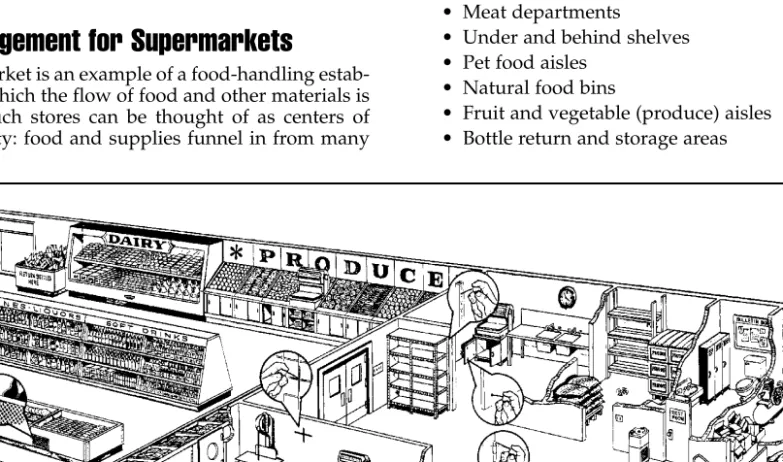
Finally, Chapter 4 discusses how the pest control approaches described in Chapter 3 can be adapted to con-trol pests under certain circumstances that require special consideration. These include pest management in super-markets, zoos/pet stores, and food-handling, health care, and computer facilities.
General Pest Management 3 Section 1: Chapter 1
SECTION 1
C
H
A
P
T
E
R
1
category are responsible for pest management in and around structures including homes, schools, hospitals, businesses, warehouses, etc. It is important that Category 7A pesticide technicians understand and keep up-to-date with the laws that affect pesticide application inside or around buildings. Ignorance of the law is never an accepted excuse for a violation.
PROTECTION: THE APPLICATOR’S
RESPONSIBILITY
Ultimately, responsibility for protecting the environ-ment from the possible adverse effects of pesticide use rests on the pesticide applicator. Preserving the biological diversity of our planet by protecting the environment contributes to the overall quality of life. Each plant and animal is part of a complex food chain; break one of the links and others are adversely affected. One disappearing plant can take with it up to 30 other species that depend on it, including insects, higher animals and even other plants. Pest management technicians may see their nor-mal work as unlikely to affect the environment, but spills and leaks during mixing, loading, and transporting, or incorrect disposal can lead to pesticides in ground or sur-face water or in the habitat of non-target organisms.
Commercial pest control operators often service national parks, schools, and other sensitive areas. Category 7A applicators have an even greater responsi-bility toward the public because of the indoor use of ticides. There is a greater risk of exposing people to pes-ticides in these enclosed environments. All efforts should be made to achieve pest management goals through min-imal use of pesticides in and around buildings. When pesticides are used, they should be applied in a manner that will prevent human contact.
Pest management can be complex. It is a matter of using the right technologies and requires special equip-ment and safety measures. To be successful, it must be effective and not adversely affect people or the environ-ment. The number and variety of pesticides has increased and pesticide technicians need to know more about safe-ty and proper use than ever before. For these reasons, among others, many state and federal laws and regula-tions have been adopted to help protect the public, the environment, and pesticide handlers from the possible adverse effects caused by pesticide use. In this chapter, you will learn about the state and federal laws that regu-late pesticide applicators with a particular focus on com-mercial pesticide applicators certified in Category 7A— General Pest Management. Applicators certified in this
LEGALITIES OF
GENERAL PEST MANAGEMENT
LEARNING OBJECTIVES
After completely studying this chapter, you should:
■ Understand why protecting the public and the
envi-ronment from exposure to pesticides is the applica-tor’s responsibility.
■ Know the role of a technician working in the pest con-trol industry.
■ Understand the various state and federal laws that
govern pesticide use, handling, and storage.
■ Be able to explain the legal responsibilities of a pesti-cide applicator according to the rules of Regulation 637.
■ Describe the elements that should be included in the
laws discussed in this chapter. Pesticide technicians should keep up-to-date copies of the laws and review their contents periodically. Copies of these laws can be obtained from MDA regional offices.
Federal Laws
FIFRA—This is the basic federal law, administered by the Environmental Protection Agency (EPA), that regu-lates pesticides—their use, handling, storage, transporta-tion, sale, disposal, etc. The Michigan Department of Agriculture (MDA) has a cooperative agreement with the EPA to enforce some provisions of FIFRA in Michigan. Some of the provisions of FIFRA are that the EPA must register all pesticides before they can be sold or used. The pesticides must be classified as either “general-use” or
“restricted-use.” General-use pesticides are those that can be purchased without restriction. Restricted-use pes-ticides are those that can be used only by (or under the direct supervision of) a certified applicator. FIFRA also stipulates that persons who misuse pesticides (in a way that is “inconsistent with the pesticide labeling”) are sub-ject to penalties.
OSHA—OSHA is administered by the U.S. Department
of Labor (DOL). OSHA governs the record-keeping and reporting requirements of all work-related deaths, injuries, and illnesses of businesses with 10 or more workers.
Endangered Species Act—This act requires the U.S. EPA to ensure that endangered or threatened plant and ani-mal species are protected from pesticides. This act requires each pesticide labelto limit its use in areas where these species could be harmed. Category 7A
applicators must consider the possibility that endangered or threatened species may be affected by pesticides applied in and around buildings. The Michigan Department of Natural Resources (MDNR) Land and Water Management Division administers the Michigan Endangered Species Act (Act 451, Part 365) and maintains the federal and state endangered or threatened species lists. Michigan applicators who want to be sure they are complying with the Act must take the initiative and consult with the MDNR to be sure that there are no endangered or threatened species in their area. One of the goals of pest
man-agement is to protect off-target plants and animals from pesticides, whether they are endangered or not.
State Laws
Natural Resources and Environmental Protection Act, Act No. 451, Part 83, Pesticide Control—This legislation gives the director of the MDA authority to register or certify private and commercial applicators and to prescribe standards for certification and registration. Category 7A applicators are considered commercial applicators. Commercial applica-tors can be divided into two subclasses:
MORE THAN JUST PESTICIDE
APPLICATION
Structural pest managers use many other activities to control pests besides pesticide application. These other practices increase the effectiveness of the control pro-gram and often reduce pesticide use or make such use a secondary operation of the program. In recognition of the many tasks that individuals in pest control must perform, the title technicianis used in this manual to denote a pes-ticide applicator, a pest control operator, and other indi-viduals with titles that refer to the job of suppressing or exterminating pests.
An important area addressed throughout the manual is communication. Pest management and control is a ser-vice. Technicians must not only know their job, they must also be able to communicate effectively with their clients. The technician should be able to explain the basic proce-dures to the client’s satisfaction. The client should feel confident that the technician is able to meet their pest control needs safely and effectively. Also, there is infor-mation that must be communicated to the customer as required by the State of Michigan, (see Rule 12, Regulation 637).
Section 1: Chapter 1 4 General Pest Management
STATE AND FEDERAL LAWS
The Pesticide Applicator Core Training Manual (E-2195) discusses federal and state laws that govern the handling and use of pesticides. Review the Core Manual and understand how laws and regulations affect pesticide practices and use. These laws include federal laws such as the Federal Insecticide, Fungicide, and Rodenticide Act (FIFRA), Occupational Safety and Health Act (OSHA), and the Endangered Species Act. State laws include the Natural Resources and Environmental Protection Act, Regulation 636, Regulation 637, and the Michigan Occupational Safety and Health Act (MIOSHA). These are just some of the laws that affect commercial pesticide applicators. They are briefly described below. Only Regulation 637 is discussed in fur-ther detail because of its particular relevance to Category 7A. Refer to the Core Manual to learn more about other laws affecting pesticide use and for further details on
Subclass A—Any person (including homeowners) who uses or supervises the use of restricted-use pesti-cides (RUPs) for a non-agricultural purpose.
Subclass B—Any person who either (1) applies pesti-cides other than ready-to-use pestipesti-cides in the course of his or her employment, or (2) applies a pesticide for a commercial purpose (for hire).
Ready-to-use pesticides are those used from the man-ufacturer’s original container (aerosols, pump sprays, strips, baits) with no need to mix or load into applica-tion equipment.
Regulation 636 (Pesticide Applicators)—This establishes the types of certified applicators and expands the pesticide record-keeping requirements. All commercial applicators shall maintain records of pesticide use for a time period not less than the following:
General-use Pesticides:One year following application.
Restricted-use Pesticides:Three years following appli-cation.
All records shall contain the following:
■ The name and concentration of the pesticide
applied
■ The amount of pesticide applied
■ The target pest or purpose
■ The date the pesticide was applied
■ The address or location of pesticide application
■ Where applicable, the method and rate of
application
The records must be made available to the MDA upon request.
Michigan Occupational Safety and Health Act (MIOSHA)—The MIOSHA Right-to-Know act requires employers to:
■ Obtain and retain material safety data sheets (MSDS) on all hazardous chemicals (including pesticides) for employee review.
■ Develop and implement a written employee
training program.
■ Ensure that all containers of hazardous materials are properly labeled.
REGULATION 637 (PESTICIDE USE)
REQUIREMENTS
One of the pertinent state laws that Category 7A appli-cators must be familiar with and understand is Regulation 637,titled Pesticide Use.Regulation 637 establishes sever-al legsever-al standards for pesticide use. It requires that pesti-cides be used in a manner consistent with their labels, that applications be made in a manner that prevents off-target discharges of pesticides, and that pesticide appli-cation equipment be properly calibrated and in sound mechanical condition. The following discussion high-lights some of the primary responsibilities of Category 7A pesticide applicators, according to Regulation 637. Obtain a copy of the entire regulation to understand the
General Pest Management 5 Section 1: Chapter 1
components of each rule and how your pest management business and practices must comply.
Rules 1 - 3 of Regulation 637 establish the definitions and terms used throughout the regulation. Rule 4 out-lines several activities surrounding the safe and legal use of pesticides. It states that a pesticide application must be made in compliance with the following provisions:
■ A pesticide must be used in a manner consistent
with its label.
■ Applications must be made so that off-target direct discharges are prevented.
■ Pesticide application equipment will be in sound
mechanical condition and be free of leaks and other defects that might cause a pesticide to be deposited off-target or in a way inconsistent with its label.
■ Application equipment must be properly calibrated.
■ Pesticide application or loading equipment that is designed to draw water must have an antisiphon-ing device.
■ Any person who mixes, loads, or otherwise uses
pesticides must have immediate access to a spill kit. The spill kit requirement does not apply to a person using single containers of use-dilution pesticides in a quantity less than 16 ounces.
■ Applications shall not occur when conditions favor
off-target drift of pesticides or prevent the proper deposition of pesticide to the target area.
■ Before applying a pesticide, the applicator will identify any sensitive areas that are located adjacent to the target area and will use appropriate precau-tionary measures to prevent the direct discharge of pesticides to those areas.
■ Each vehicle that is used to transport pesticides must have the following information printed on its exterior:
• Name of the pesticide applicator firm • Business telephone number, address, or U.S.
Department of Transportation census number of the applicator firm
Rule 5 of Regulation 637 establishes a registry of per-sons who must be notified before turfgrass or ornamen-tal pesticide applications occur on adjacent and/or addi-tional distance properties. At this time, structural pest control operators (7A) are not responsible for notifying persons on this list prior to a pesticide application.
Rule 6 of Regulation 637 requires that pesticide mixing and loading operations occur on a pad that complies with the following:
■ The pad must be constructed with impervious
materials.
■ To prevent release of pesticides to the environment, the pad must be bermed, curbed, sloped, or
designed to contain spills, leaks, releases, or other discharges generated during the mixing and load-ing of pesticides.
■ Pesticides or pesticide-containing materials that are collected by the pad must be contained either by the pad itself or drained, pumped, or transferred to an additional impermeable, aboveground holding tank or reservoir until utilized or disposed of in compliance with applicable laws.
■ The pad or holding tank/reservoir must be able to
contain the amount of pesticide that could be dis-charged from mixing, loading, or application equip-ment during one minute of the mixing or loading operation.
■ The mixing or loading of pesticides cannot occur
unless a primary shutoff valve or switch is within immediate reach of the person who is engaged in the mixing or loading operation. (See the complete regulation for more details.)
The above specifications do not apply to pesticide applicators using only hand-held equipment.
Rule 7 of Regulation 637 requires that washing and rinsing of pesticide equip-ment be performed on a pad designed similarly to the mixing and loading pads. The requirements do not apply to applicators that use just hand-held equipment. (See the complete regulation for details.)
Regulation 637, Rule 8, discusses the most acceptable manner in which to handle excess pesticides and pesti-cide-containing material. Pestipesti-cide-containing materials are any materials that contain a mixture of active (pest controlling) or inactive (non-pest controlling) ingredi-ents. These materials should be used in accordance with the label instructions. Both of the following uses of pesti-cides or pesticide-containing material are considered to be in accordance with label directions:
■ Apply the pesticide or pesticide-containing
mater-ial to a site that is specified on the label in a manner so that the total rate of application of the active ingredient is not more than the rate allowed on the label.
■ Pesticide-containing materials may be used as
diluents in subsequent mixtures of pesticides and diluents if the next application of such mixtures is in compliance with the above.
Refer to a complete copy of Regulation 637 for further details.
Section 1: Chapter 1 6 General Pest Management
Regulation 637, Rule 9, Personal Protective Equipment (PPE), requires the applicator to follow label directions regarding PPE. This rule also sets minimum PPE require-ments for commercial applicators. Unless otherwise directed by the pesticide product label, while performing pesticide tasks, applicators must wear:
■ Long pants.
■ Protective footwear.
■ Long-sleeved clothing, (short-sleeved clothing may
be worn if wash water or waterless soap is immedi-ately available).
■ Gloves impervious to the pesticide being used
when the applicator’s hands are likely to come in contact with the pesticide, unless a program is in place that offers comparable applicator protection. Regulation 637, Rule 10, discusses pesticide drift con-siderations when making applications outdoors. Category 7A applicators need to keep in mind the air cir-culation patterns and ventilation systems inside build-ings and how these may influence the movement of their pesticide application. The rule also specifies that if pesti-cide off-target drift is anticipated, due to the nature of the application, the applicator must use a drift management plan that includes specifications to secure the informed consent of residents in the affected area before making the application. For further specifications of the drift management plan, consult the regulation.
Regulation 637, Rule 11, Notification and Posting Requirements Part 4, pertains to persons who make insecticide applications to commercial buildings, health care facilities, licensed day-care centers, or schools. This part of the rule requires that upon completing insecticide applications, the applicator must provide a sign to be dis-played in a readily observable place at the primary point of entry by the agent or representative of the building. The applicator must tell the building representative to keep the sign posted for not less than 48 hours after the
most recent insecticide application. The signs must com-ply with certain size minimums, and dating procedures, and contain certain illustrations. An illustration of a cloud symbol encompassing a house serves to inform the public that insecticides have been applied on the premises; this sign is available from the Michigan Pest Control Association (MPCA). Note the illustration on this page. See a complete copy of the regulation for additional posting details.
works.
3. Why pesticides are used.
4. General toxicity information related to the fol-lowing:
■ The type of compound used.
■ The environment where the pesticide is applied.
■ General exposure information.
■ The amount or rate of pesticide applied.
■ Proper pesticide applications in compliance with
the label.
5. Common-sense precautionary measures to the customer regarding pesticides.
6. General information on the environmental fate of pesticides.
7. Instructions to the customer to discuss site preparation and precautionary measures with the pesticide applicator.
8. Instructions to the customer to consult with a physician if an unusual reaction occurs.
Rule 12 also specifies that the duration of a service contract cannot exceed 12 months unless either written notification of continuation of service is provided annu-ally or unless the service agreement is a signed contract that specifies a definite period of time during which the contract is valid. The written notification of continuation of service must provide information to the customer on how to discontinue service.
Further, Rule 12 of Regulation 637 requires a commer-cial applicator to provide all of the following documents to the customer, if requested:
■ Pesticide product labels
■ Material safety data sheets (MSDS)
■ Environmental Protection Agency fact sheets, if
available
■ A document that specifies the rate of application of the active ingredients of the products applied Rule 13 prohibits misrepresentation of pesticide safety. Such claims or statements that would imply that the pesti-cide is recommended or endorsed by a federal or state agency, that the pesticide is “absolutely safe,” or compara-tive statements of pesticide safety such as “contains all nat-ural ingredients,” “among the least toxic chemicals known,” and “pollution approved” are strictly prohibited. Rule 14 requires commercial applicator training in integrated pest management (IPM).
In order to make certain types of pesticide applications in schools, health care facilities and public buildings, Category 7A applicators must participate in a training program that includes the following IPM elements:
■ Site evaluation, description, inspection and moni-toring
■ The concept of threshold levels
■ The relationship between pest biology and pest
management methods
■ Pest population reduction (including mechanical,
biological and chemical techniques) and pest pre-vention (including habitat modification)
General Pest Management 7 Section 1: Chapter 1
Regulation 637, Rule 12, Applicator Service Agreements, requires commercial pesticide applicators to enter into an oral or written service agreement with the customer or authorized agent. The agreement must specify:
1. The customer’s consent to services.
2. The name, address, and telephone number of the company that provides the pesticide appli-cation services.
3. The approximate schedule and frequency of anticipated services.
Further, according to Rule 12, not later than at the time of each pesticide application, the commercial pesticide applicator must provide all of the following written information to the customer:
1. The name, address, and telephone number of the company providing the pesticide application service. 2. The full name of the applicator who is making the
pesticide application.
3. A general description of the target pest or pests to be controlled.
4. A list of pesticides applied, including the common name of the active ingredient.
5. The time and date of the application.
6. Precautionary warnings that are pertinent to the protection of humans, animals, or the environment at the application site and that appear on the label of the pesticide(s) applied.
More information must be provided to the customer according to Regulation 637, Rule 12. Not later than at the time of the initial pesticide application, a commercial applicator must provide risk and benefit informationto the customer. Risk and benefit information contains but is not limited to:
1. Definition of a pesticide.
■ The development and implementation of an IPM program with consideration for reducing the possi-ble impact of pesticide use on human health and the environment
■ The evaluation of an IPM program to determine its
effectiveness
■ The record-keeping requirements of the IPM program
Rule 14 also specifies the elements that should be included in IPM programs applied to schools, public buildings, and health care facilities, and lists further details on evaluation and record-keeping requirements.
tor’s responsibility to notify the school’s building man-ager of the time period for reentry. The school district administrator or designee must provide written notifica-tion to parents before any pesticides are applied except in the case of emergencies, in which case notification is pro-vided after the pesticide is applied.
Finally, Rule 16 establishes a registry of certified organic farms, and Rule 17 details the penalties for viola-tion of local pesticide ordinances.
SUMMARY
A number of state and federal laws are designed to pro-tect the public and the environment from the improper use of pesticides. It is the pest control technician’s respon-sibility to understand and to comply with these laws. Category 7A technicians often apply pesticides in public areas. Therefore, they must be particularly sensitive about preventing contact between people and pesticides. Category 7A technicians should be trained in IPM and other methods that limit the use of pesticides while still achieving pest management goals. Regulation 637 out-lines the details of this training along with other details pertaining to the safe and legal use of pesticides. Proper communication, notification, representation, and record keeping are essential whenever pesticides are used.
Section 1: Chapter 1 8 General Pest Management
Rule 15 specifies the provisions regarding pesticide applications made in and around schools, including a provision that insecticide applications can not be made in school rooms unless the room(s) will be unoccupied for at least four hours (a longer time period may be required if specified by the product label). It is the pesticide
applica-Write the answers to the following questions and then check your answers with those in Appendix A in the back of this manual.
1. To control pests of structures, pesticide application is the only means for suppressing pests.
A. True B. False
2. When technicians use other practices in addition to pesticide use for controlling pests:
A. It may decrease the effectiveness of the control program.
B. These practices often reduce pesticide use or make such use a secondary operation of the program. C. It is not a legal procedure.
D. They must describe these tactics in writing for the customer.
3. The title technicianis used in this manual to denote: A. A pesticide applicator.
B. A pest control operator.
C. Individuals with the job of suppressing or exterminating pests.
D. All of the above.
4. Which Michigan regulation requires that pesticide applications be made in a manner that prevents off-target discharges of pesticides, and that pesticide application equipment be properly calibrated and in sound mechanical condition?
A. Regulation 636 B. Regulation 637 C. FIFRA
D. Natural Resources and Environmental Protection Act
E. OSHA
5. Which Michigan legislation gives the MDA authority to certify commercial applicators and to prescribe standards for certification?
A. Regulation 636 B. Regulation 637 C. FIFRA
D. Natural Resources and Environmental Protection Act
E. OSHA
6. Which federal legislation specifies that all pesticides be classified as either general-use or restricted-use? A. Regulation 636
B. Regulation 637 C. FIFRA
D. Natural Resources and Environmental Protection Act
E. OSHA
7. Which Michigan legislation establishes the types of certified applicators and expands the pesticide record-keeping requirements?
A. Regulation 636 B. Regulation 637 C. FIFRA
D. Natural Resources and Environmental Protection Act
E. OSHA
8. Structural pest managers do not have to concern them-selves with the possibility of harming endangered species.
A. True B. False
9. In Michigan, a vehicle used to transport pesticides for a pesticide application business must:
A. Be yellow or red.
B. Have the name of the pesticide(s) being carried posted in an appropriate location in the vehicle. C. Have the name of the pesticide applicator firm
and the business phone number printed on the exterior.
D. Be registered with the MDA and the MDEQ.
General Pest Management 9 Section 1: Chapter 1
Review Questions
Chapter 1: Legalities of
General Pest Management
SECTION 1
C
H
A
P
T
E
R
1
10. In Michigan, commercial pesticide applicators must provide their customer written information in the Applicator Service Agreement including:
A. The time and date of application.
B. A general description of the target pest or pests to be controlled.
C. A list of pesticides applied. D. All of the above.
11. Describe what type of pesticide information should be a part of the risk and benefit information provid-ed to customers.
12. If requested, a commercial pesticide applicator must provide the customer with pesticide product labels and MSDS sheets.
A. True B. False
13. Pesticide drift is not a concern to Category 7A appli-cators.
A. True B. False
14. Notification and posting requirements include: A. Posting a sign for at least 48 hours after insecticide
application.
B. Posting a sign for at least 24 hours after insecticide application.
C. The sign must comply with certain size mini-mums, and dating procedures, and contain cer-tain illustrations.
D. A & C E. B & C
15. List the minimum PPE requirements for commercial applicators.
16. Commercial pesticide applicators may represent pesticides as being endorsed by federal or state agencies. A. True
B. False
17. List the elements that should be included in IPM training of commercial applicators.
18. What is the time interval for reentry after insecticides have been applied in a school room?
A. A minimum of 4 hours B. A minimum of 6 hours
C. It depends on the product label D. A & C
E. B & C
The most important part of a pest management pro-gram is the ability of a technician to use his knowledge of pest management along with well cared-for equipment and good supplies. A successful pest management pro-gram includes regular cleaning, calibration, and repair of tools; time, training, and planning are required to achieve the desired level of pest control.
EQUIPMENT FOR CONDUCTING PEST
CONTROL INSPECTIONS
The inspection is the most critical phase of any pest management operation. To be effective in solving pest problems, you must correctly identify the pest, the
loca-tions and extent of the pest infestation, and the structur-al and/or environmentstructur-al conditions encouraging pest problems. Therefore, professional pest management pro-grams begin with professional inspections.
Equipment is necessary for conducting professional inspections and to enable you to gain access to structural areas and equipment voids to apply a treatment, if neces-sary.
Flashlight
Though simple in form and function, the flashlight is probably the most important piece of inspection equip-ment in the pest manageequip-ment industry. Many insects, rodents, and other pests are secretive by nature. They hide in inaccessible or difficult-to-reach areas. Rarely do such areas contain enough light to expose hiding pests or evidence of their presence. Thus, a flashlight is a must in all pest management operations. When used properly, it can make the difference between successfully solving a pest problem or overlooking a critical aspect of the prob-lem and having to make several callbacks.
Select a heavy-duty, waterproof and corrosion-resis-tant flashlight. The flashlight should be durable and pro-vide a strong light intensity—consider halogen bulbs.
Monitoring Traps
Monitoring traps have become one of the most impor-tant tools in structural IPM. These devices are tools that alert you to the severity of an insect infestation and to the location of insect hot spots. Monitoring traps can record the presence or absence of pests and/or the numbers of pests before and after a control program. This procedure assists in proving to you and the customer the overall effectiveness of the control program.
General Pest Management 11 Section 1: Chapter 2
LEARNING OBJECTIVES
After completely studying this chapter, you should:
■ Know the basic types of pest management equipment
and how they function.
■ Know the benefits and limitations of pesticide
appli-cation equipment.
■ Know how to calibrate structural pesticide application equipment and why it is important.
■ Understand how safety is part of every phase of
equipment use.
■ Know how to select the proper tool for a specific job.
■ Be familiar with equipment maintenance to ensure
safe, economical, and efficient use.
SECTION 1
C
H
A
P
T
E
R
2
USING EQUIPMENT IN
Traps are available that incorporate German cockroach
pheromones (i.e., a chemical substance produced by an insect of the same species that will attract them to the trap). Other pheromone traps are available for various fabric and stored-product pests. As this technology advances, the industry is likely to see more pest-specific monitoring traps.
an outline of the building and its surrounding environ-ment. Such an overview often helps you see the big pic-ture and thus to consider all the factors inside and out-side the structure that may affect the pest problem. Diagrams also are invaluable in helping recall details at a later date.
Inspection reportsshould list the specific pests pre-sent, the extent of the infestation, the control tools and chemicals to be used, structural deficiencies contributing to the pest problem, and so on.
For pest management operations in large or complex buildings (hospitals, high-rise condominiums, schools, etc.), building plansenable you to visualize floors and rooms above, below, and on all sides of problem areas. Knowing where the utility lines, heating/cooling ducts, shaft connections, pipe chases, and so on are located helps to pinpoint warm and humid areas within the building. This, in turn, can aid in identifying the high-activity areas of insects that require such environments (e.g., pharaoh ants, cockroaches, silverfish, and others). Building plans are also valuable for determining entry points and migration paths of pests from one part of the building to another. Finally, building plans can serve as a checklist to organize large pest management programs and help to ensure that all pertinent areas of the building complex receive attention.
Miscellaneous Inspection Equipment
Where permitted, cameras are useful tools for
docu-menting situations and building conditions that need to
be corrected. A ladder should be kept on the truck to
enable you to inspect above suspended ceilings, cathe-dral ceilings, and outdoor roof areas. Never use a cus-tomer’s chair or ladder.
Moisture meters and sound detection devices
may be useful when inspecting for wood-destroying insects. Many wood-infesting pests seek wood or struc-tural environments with high levels of moisture and humidity. The sound devices can help you detect the sounds of the pest working inside wooden areas.
EQUIPMENT FOR APPLYING PESTICIDES
Regardless of how well trained and knowledgeable a pest management professional may be, effective pest management cannot be achieved unless the professional is backed up with high-quality and dependable equip-ment. It is essential to know how to choose equipment best suited to each job and how to use it properly and safely to obtain the best results.
Keep in mind that there are many types of pest man-agement equipment, and each type may have many mod-els. This chapter focuses only on the basic models of each equipment group. New equipment technology and improvements to existing equipment are on-going, so even well equipped professionals need to regularly reex-amine equipment to benefit by new developments. To keep up-to-date, regularly review current trade maga-zines and equipment brochures, attend educational
con-Section 1: Chapter 2 12 General Pest Management
Flushing Agents
A flushing agent contains an insecticide that stimu-lates insects. Flushing agents are an essential inspection tool because they force insects from their hiding spots. In many cases, it is impossible to physically see into some insect habitats (e.g., hollow legs of tables, light sockets, cracks and crevices, and cabinet and wall voids). Only by using a flushing agent can you determine if insects are in these hidden places.
Hand Mirrors
A small, metal hand mirror enables you to see under-neath, on top of, and behind equipment and objects. By reflecting the flashlight beam off the mirror, you can gain visual access into many out-of-sight areas, such as the inside corners of equipment, furniture, and air ducts.
Utility Tools
A small, portable tool set containing a few types of screwdrivers and ratchets allows you to disassemble var-ious inspection plates, ventilation grills, and access pan-els for inspection or treatment purposes.
Inspection Diagram, Inspection Reports,
and Building Plans
Inspection diagrams giving an overview of the structure and surrounding buildings and areas are often helpful. In some cases, inspection diagrams need only be
Figure 2-1. Several styles of pheromone traps are available, depending on the type of pest and on the location being monitored.
ferences and seminars, and visit and talk with local pest management suppliers. These sources of information are invaluable to today’s pest control operator.
SPRAYERS
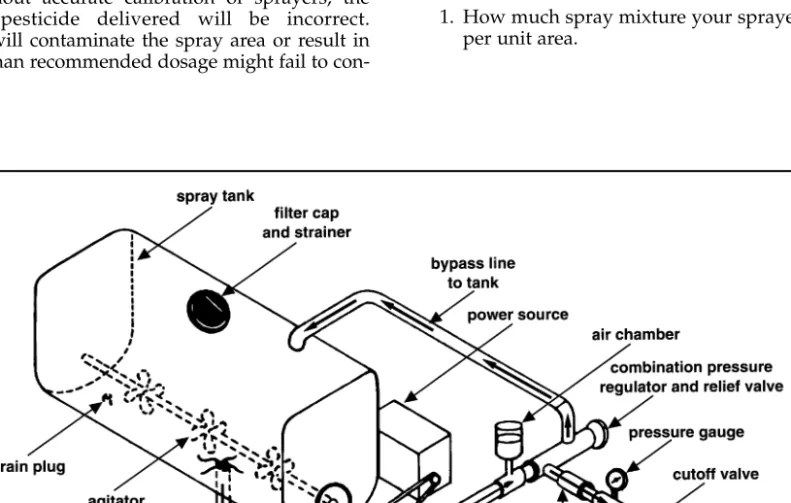
Sprayers vary from the hand-pumped flit gun with a tank capacity of as little as one cup to large hydraulic machines powered by gasoline engines and with tanks that can hold several hundred gallons of pesticide for-mulation. All sprayers have basic characteristics in com-mon. There is usually a tank, a device to pressurize the liquid, a delivery line leading to a valve, and another delivery line leading from the valve to a nozzle. All other items found on any sprayer, whether simple or complex, are merely accessories and are incidental to this basic design.
Hand-held Compressed-air Sprayers
The small (1- or 2-gallon) stainless steel spray tank is the workhorse of the pest control industry. It is the tool most familiar to pest control technicians. Nevertheless, the general trend in structural pest management seems to be moving away from the sprayers as the mainstay of insect control equipment. More emphasis is being put on monitoring, baiting, and various non-chemical control techniques, and sprayer technology is evolving into devices designed for much more precise applications.
The hand-held compressed-air sprayer is used in many different ways. In pest management, the spray tank is used to apply a flushing agent or a residual pesticide. Depending on the nozzle selection, it applies various spray patterns; and depending on the amount of pump-ing, it delivers the pesticide under high or low pressure. A thorough understanding of the compressed-air sprayer—its basic construction, how it works, how to maintain it, and how to make repairs—can save time and money, and prevent misapplication.
Components.
There are three major parts to the com-pressed air sprayer:1. Tank. 2. Pump unit.
3. Applicator wand and hose.
The tankforms the body of the sprayer. Tank
capaci-ties range from 1/
2gallon to 3 gallons. Most professional
tanks are made of stainless steel to resist the corrosive nature of many pesticide formulations. The tank serves two purposes: first, it is the reservoir for the spray mix-ture, and secondly, it acts as a pressure chamber. A dis-charge tubeis attached on the inside of the tank. The air pressure inside the tank forces the spray mixture through this tube into the hose.
The pump unit consists of a pump cylinder contain-ing a plunger rodand various soft gasketsand valves. The pump unit is hand-operated to generate air pressure inside the tank.
The applicator wand is made up of the valve trigger and the nozzle,and it is connected to the tank via a
syn-thetic rubber (usually neoprene) hose that acts as the
delivery tube from the tank to the applicator wand. Some
wands are a stubby-nose design, but most sprayers today
have an extension tubebetween the valve and the
noz-zle. The extension tube provides reach when applying pesticides on hard-to-get-to spots. It also helps reduce splash back of pesticides onto the applicator. Some man-ufacturers offer telescoping wands for convenience.
The nozzleis the smallest component on the sprayer, but it plays a very large role in proper pesticide applica-tion. Much of the effectiveness of a pesticide application depends on the proper functioning of the nozzle. Nozzle tips are designed to give specific shapes of spray at a set pressure. Most nozzles on the handheld sprayer offer a
four-way multi-tip that can produce two different
pin-stream spray patterns and two different flat-fan spray patterns. The applicator can easily and quickly change from a pin stream to a fan spray by rotating the tip.
Pin-stream nozzles produce solid streams of spray and are used to spray insecticides into various cracks and crevices. When set for fine spray, a stream is produced that can splash back from all but the widest cracks. Specialized nozzles are available with one pin-stream ori-fice adapted to the use of a plastic or metal crack and crevice extension tube.This is extremely useful because it permits the professional to apply pesticide directly into cracks and crevices with little worry of spilling or splash-ing pesticide on surroundsplash-ing surfaces.
Flat-fan nozzles produce a fan-type spray pattern. These patterns provide an even coat of spray on flat
sur-General Pest Management 13 Section 1: Chapter 2
Figure 2-2. The major parts of a compressed-air sprayer (Provonsha).
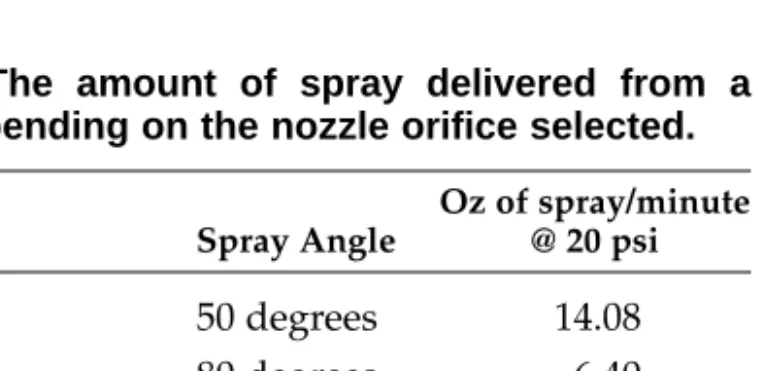
faces, such as walls, and may also be used to apply pesti-cide into a crack wherever there is room enough for such application. Recognize that liquid dispersed into a crack using a fan pattern usually will not penetrate as deeply as when applied as a pin stream. Commonly on multi-tip nozzles, the smaller fan opening produces an 80 degree fine-fan spray pattern: the larger orifice produces 50 degree coarse-fan spray pattern. The coarse-fan orifice delivers more than twice as much spray per minute as the fine-fan orifice (see Table 2-1).
■ Sprayer pressure affects the amount of insecticide
applied and the type of pesticide coverage. Too much or too little pressure often causes spotty and uneven coverage, which results in poor insect control.
■ High pressure is seldom necessary. Furthermore,
excessive pressure may increase the hazards both to the applicator and to the public because of the pos-sibility of hoses bursting under pressure. Also, insecticide particles at high pressures tend to bounce off the target surface. This is wasteful and dangerous—the pesticide may drift onto other peo-ple, objects, food, or food preparation surfaces.
■ Continual excessive pressure on the sprayer causes
premature wear and possible damage to the sprayer software.
■ Some insecticide labels dictate the particular pres-sure appropriate for applications against specific pests.
■ Always wear the appropriate personal protective
equipment (PPE) as specified by the label and/or required by Regulation 637.
Sprayers should be equipped with a pressure gauge.
The gauge allows the applicator to control and monitor the pressure in the tank at all times. This is important not only to prevent using excessively high pressures but also to monitor the pressure drop in the tank when the pesti-cide is being sprayed.
The correct pressure for the sprayer varies according to the type of insecticide application. For example, for crack and crevice treatments, pressures of less than 10 psi are most effective. Achieving pressures in this range requires only two to four strokes of the pump handle with a full 1-gallon sprayer.
General and spot treatments are most often performed using either the fine-fan or coarse-fan nozzle openings. A general, effective operating pressure for fan spray appli-cations is between 20 and 25 psi. This pressure produces a uniform spray pattern. Fine-fan applications at this pressure include flea treatments on carpeting; coarse-fan applications include treating along outside foundation walls. To achieve 20 to 25 psi on a full 1-gallon sprayer requires between nine and eleven strokes of the pump handle.
Routine Sprayer Use.Proper routine use of the sprayer is critical for effective insect control and safety, and for keeping the sprayer in good working order. The follow-ing discussion provides key basics for effective and safe daily use of the s p r a y e r . F a m i l i a r i z e yourself with your equipment and be prep