NBER WORKING PAPER SERIES
NEASURING RISK AVERSION FROW EXCESS RETURNS ON
A
STOCK INDEXRay Chou Robert F. Engle
Alex Kane
Working Paper No. 3643
NATIONAL BUREAU OF ECONONIC RESEARCH 1050 Nassaohusetts Avenue
Cambridge, MA 02138 Noroh 1991
he would like to thank Stephen Brown, Angelo Nelino, Michael Rothschild, Ross Starr, Larry Wall, and an anonymous referee far helpful oormsents. We are also grateful to participants at various conferences and seminars where this paper was presented, inoludinp the NBER, WFA, UCSD, UC Santa Barbara, Georgia Tech, and Emory University. This paper is part of the NBER's research program in Financial Narkets and Monetary Economics. Any
opinions expressed are those of the authors and not those of the Notional Bureau of Economic Research.
MEASURING RISK AVERSION FROM EXCESS RETURNS ON A STOCK INDEX ABSTRACT
We distinguish the measure of risk aversion from the slope coefficient in the linear relationship between the mean excess return on a stock index and its variance. Even when risk
aversion is constant, the latter can vanj significantly with the relative share of stocks in the risky wealth portfolio, and with the beta of unobserved wealth on stocks.
We introduce a statistical model with ARCH disturbances and a time-varying parameter in the mean (TVP ARCH-N). The model decomposes the predictable component in stock returns into two parts: the time-varying price of volatility and the time-varying volatility of returns. The relative share of stocks and the beta of
the
excluded components of wealth on stocks are instrumented bymacroeconomic
variables.
The ratio of corporate profit over national income and the inflation rate ore found to be important forces in the dynamics of stock price volatility.Ray Chou Robert F. Engle
Ivan Allen College of Management, Department of Economics Policy and International Affairs University of California, Georgia Institute of Technology San Diego
225 North Avenue, NW La Jolla, CA 92093-0508 Atlanta, GA 30332
Alex Kane
Graduate School of Internaticnal Relations and Pacific Studies
University of California, San Diego La
Jolla,
CA92093-0519
MEASURING RISK AVERSION FROM EXCESS RETURNS ON A STOCK INDEX
I. Introduction
The trade—off between risk and return is central to the theory of finance. The Capital Asset Pricing Model (CAPM( of Sharpe (1964), Lintner (1965) , and Mossin (1966) was first to provide a comprehensive
framework for detennining asset prices with the theme that only systematic risk is rewarded by the market. The risk premium on the market portfolio was linked to investor risk aversion by Totin (1958)
and Pratt (1964)
Morton (1969, 1973) shows that a lifetime consumption—investment model yields risk premia of the same form as the single period model when the investment opportunity set is constant and portfolios are continuously rebalanoed. This result will still hold when the variance of the market portfolio varies randomly and cannot be hedged.
Bodie, Kane, and McDonald (1953) and Pindyck (1985) assume a single factor CAPM, and use a 'reasonable" parameter for relative risk aversion
(between 3 and 4), as defined in Pratt (1964), in an attempt to infer risk premiums from estimated variances. Inferring in the opposite direction Friend and Blume (1975) attempt to estimate the coefficient of
relative risk aversion of a representative investor using estimates of relative portfolio shares of financial assets, and the ax-post excess return average and variance of these assets. While tney pot the estimate of relative risk aversion at about 2, their method uses the unconditional variance, which is not consistent with the model
assumption of portfolio rebalancing. There, the risk premium ougho to
be determined by the conditional or expected vsrience.
GARCH-M models of stock returns (see Bollerslev, Chou, and Kroner (5CR, 1990)) for an extensive review and references of ARCH modeling in finance) jointly estimate the time varying conditional variance and a
constant mean-variance ratio that represents the risk—return trade—off. 5CR document the extensive use of these models (with multivariate
extensions) in empirical work in financial economics.
A
numier
of studies question
the
existence of a
positive
mean/variance
ratio, directly
challenging
the
mean—varianceparadigm.
In
Glosten, Jagannathan and Runkle (1900), whenthey
explicitly
include
the
nominal risk—free rate in the conditioning information set, obtain anegative ARCH—H parameter. While Harvey (1989) finds the ratio of expected return to stock index volatility non—constant and counter
cyclical, Backus and Gregory (1988) argue that the relationship between the conditional mean and the conditional variance is non—linear. Abel
(1988) claims that in a general equilibrium the mean/variance
relationship is not necessarily positive when the investor's preference
is not logarithmic.
At the same time, there is some evidence that the static CASH performs empirically better than the intertemporal consumption—based model. (See among others Mankiw and Shapiro (1936) and Attanesic
(1989)) Moreover, the static CASH may be attracting some new interest.
As Grossman and Larocue (1987) show, explicit consideration of
relevant even in an intertemporal context. Others to make a case for the validity of the static CAPM are Epstein and Zin (1989), who derive an lntertemporal non-expected utility model.
In a model economy where a representative agent maximizes a time— additive von Neumann—Morgenatern utility, the mean/variance ratio can still change as a result of any combination of: changing preferences toward risk, or changing investment opportunities. Only absent of any
suon change, with constant relative risk aversion, will the CAPM deliver a constant mean/variance ratio for the market portfolio and its
components -
we begin by systematically examining the temporal instability of the mean/variance ratio, first by rolling regressions and then in a more sphistioated manner by introducing a time-varying parameter (TVP) into
the ARCH—M model. Finally, we seek to identify empirical macroeconomic proxies for the unobserved components of wealth. (Related work om the sensitivity of the CAPM with respect to changes in the market portfolio is found in Stambaugh (1982)
Section II applies the ARCH-h model to the CAPH with two risky assets, and provides further evidence of the time-varying pattern of the mean/variance ratio. A time—varying parameter model is then presented in Section III. In Section Iv we examine the relation between the estimated time—varying parameter and some particular economic variables. The final section presents conclusions and suggestions for future
II. Estimating Risk Aversion in the CAPH Framework with the
ARCH-M Model
11.1 The cAPM
and
the
Market PortfolioConsider
an exchange econony where
there
are three
asset classes:
one
risk—free asset, and two risky asset classes. The risky assetsconsist
of
astock
portfolio,
whosereturns
are
observed, and an
unobserved
portfolio
of the renaming
risky assets.
Theexcess returns
(over
the
risk—free
rate)
on
the
tworisky
assets
are, respectively,
r1
2 2
ant
rN
witn
variances
C
and
Ok)With a
joint
normal
distribution of
the
excess
returns, the
CAPMpredicts
that
all
investors
will
hold
the
market
portfolio, the
value
weighted
portfolio
of
all
risky assets.
Individuals hold only
combinations
of the riskless asset and the market portfolio in relativeproportions
determined
byindividual
risk
aversion.
In
equilibrium, the
expected excess return of the market portfolio,E)rW). will be related to the means of the asset class portfolios by
E)rM) =
wE)r5) (1 — w)E(rN) (11.1)
where w is the weight of the stock index portfolio in the market, and (l—w) is the proportion of the unobserved class in the value of the market portfolio. The parameter w can also be interpreted as the
relative demand for stocks. (l—w) is the sum of the weights of all unobserved risky assets and
rN is the value weighted average of their excess returns.
5
The CAPM predicts that each risky asset will be priced to earn a risk premium
that
is given by,&ov(r.,r
M
(11.2)
where is the harmonic mean of individual relative risk aversion, which may be changing over time, because of a structural change in preferences or with the distribution of wealth. Equation 11.2 has to hold also for any portfolio, and so r, may be replaced with r1 and
r.
(11.1) and (11.2) imply that, for stocks,
(1 —
w)a3
(11.3)
where
SMOv(rStN).
Equation
11.3 indicates that the expected stock— index return is proportional to the weighted average of its variance and covariance with the unobserved portfolio. That is, the stock—index risk premium depends not only on its own volatility but also on itscovariances
with returns of other
risky assets.
Thus,the relative
shares of the asset
classes
and
uncertainty
about
the
unobserved
risky
portfolio
will
affect
the stock index.
Most empirical studies of the intertemporal CAPM use broad stock indexes to proxy the market portfolio, e.g., Fama and MacSeth (1973), Black, Jensen, and Scholes (1972) .
This
approach would be justified byeither of two assumptions:
wl,
that is, stocks are the only relevant risky assets, or that the unobserved assets covariance with stocks is equal to the stock variance, that is, In each case (11.3)(11.4)
None of these assumptions is supported by evidence, however,
and findings demonstrate that (11.4) is not adequate to explain movements in stock— index returns.
11.2 The ARcH-M Model and Some Empirical Anomalies
The ARCN-M model proposed by Engle, Lilien, and Robins (1987)
consists of the system:
y = ch + e (11.5)
lit =
a0 +
a1e1
a2h1
(11.6)where et is the prediction error assumed to be Gaussian and serially uncorrelated with mean zero and conditional variance ht. More
specifically, ht is the conditional variance of the variable yt given all information up to time t—1. This model characterizes the evolution
of the mean and variance of a time series simultaneously.
The process specifying the conditional variance, equation 11.6, is
a GARtH (1,1) process. It implies that the conditional variance is
driven by three factors: the autonomous component, the surprise, and last period's variance. Thus, (11.5) and (11.6) are really GARCN)l,l)—
N, Richer dynamic patterns of variances can be modeled by introducing
higher—order terms of past prediction errors or conditional variances, but empirical studies frequently suggest that GARtH (1,1) is edequate.'
1
French, Schwert, and
Staaugh
(1987), use a GARtH (2,1) in (11.6)with an intercept in the mean equation (11.5), but these variations do
not makc much difference. For detailed specification and estimation of the GARON and ARCN—M models, see Bollerslev (1986) and Engle, Lilien,
7
The ARCH-K model (11.5) and (11.6) can be used to estimate the CAPM (11.4) if the stock index is the market portfolio, and its volatility follows the GARCH process. The model will fail, however, if the estimate of relative risk aversion (the mean/variance ratio), c in
(11.5), or if the GARCH parameters, a in (11.6), vary over time.
French, Schwert and Stambaugh (1987), or FSS, estimates of the risk aversion parameter are very unstable across sample periods For the entire sample period 1928—1984 they obtain a value of
1693
using the NYSE monthly value—weighted index. Estimates for 1928-1952 and 1953—1984 sub—periods are 1.510 and 7.220, respectively. Kith the Standard & Poor's daily composite index, the two sub—sample estimates are 0.598 and 7.809, even further apart. Estimates obtained in Chou (1988) seem to be more stabler 4.50,
5.05,
and 6.15 for the periods 1962—1985, 1962—1973, and 1974-1985, respectively, using the weekly NYSE value—weighted index. Differences in the two studies' estimates could be attributable to the latter shorter sample period.II 3 Ro11nq Samole E.stiinatwn
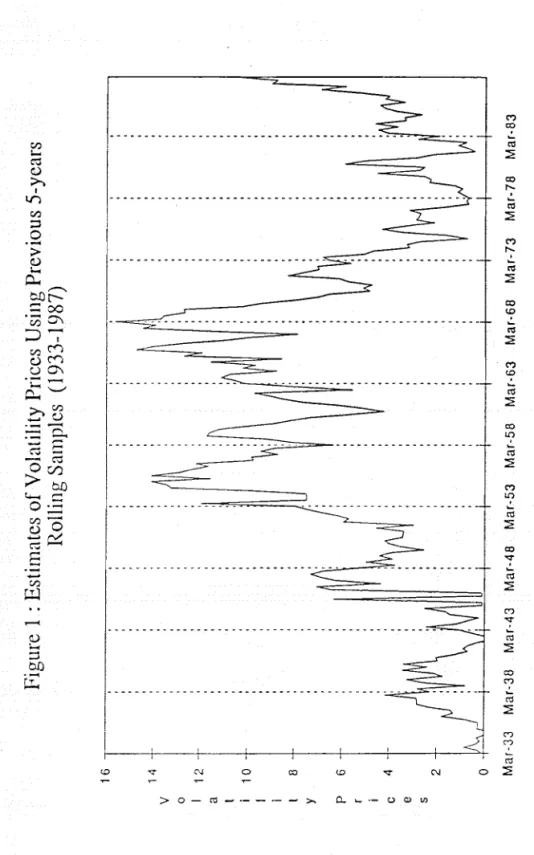
We use rolling samples to examine the temporal behavior of the ARCH-K coefficients. To obtain precise estimates, we need data that are more frequent than monthly. Because daily NYSE stock index data are not available until July 1962, we use the Standard & Poor's Composite Index as a proxy for the market portfolio; it is available daily from January 1928 through December 1987.2
intercept in the mean eauation because excess returns should be determined only by systematic risk.
We prefer weekly over daily returns to avoid documented anomalies of day—of—the—week effects, e.g., Hem (1986) . Weekly excess returns
are obtained by differencing the logs ef weekly Tuesday closing prices. The risk—free rate used to construct the weekly excess returns is the short—term interest rate from the Ibbotson and Sinquefield database.
ARCH—N coefficients were estimated for every quarter from 1933 through
1987. For each quarter estimate, the sample contains five previous
years of weekly data, amounting to approximately 260 observations. The rolling estimation procedure yields a muarterly time series of the coefficient c in (11.5), with 221 quarterly observations.
The graph of this series in Figure 1 is strongly time—varying. The
coefficient ranges from —0.4 to 15.6, with a mean of 5.4 and standard
deviation of 4.1. Both the dynamic pattern and the magnitude of the coefficient are similar to the results in Friend and Blume (1975) who report mean/variance ratios of 0.925, 8.673, 14.165, and 1.372 for the respective four decades between 1932 and 1971. That is, the ARCH-N
model, which uses the conditional distribution, confirms the instability of the mean/variance ratio. The erratic behavior of this coefficient
indicates the inadequacy of the ARCH—N model to fit the stock return
data.
Another empirical anomaly reported by FOS is that the ARCH-N model
seems to predict risk pcemiums which are too high, with the average predicted excess return almost twice the average realized excess
returns.3 It is hard to accept a model that performs so badly in this respect.
To sum up, although the ARCH-H model is a useful tool in modeling the stock index return, adjustments to the model seem necessary. The
instability of the estimated value for risk aversion end the
inconsistent behavior of excess returns that the ARCH—H model predict are important empirical anomalies that should be resolved.
The estimated parameters from the rolling sample estimation
indicates that a time—varying approach may be appropriate. The rolling sample estimated series is only an approximation because it uses relatively short sample periods (five years is arbitrary), and it is unlikely that quarter to quarter changes of the ooeffioient would be so large. Further, it is inconsistent to estimate a time—varying
parameter, while at the same time assuoting it to be constant within five—year sample periods.
The next section introduces an ARCH-H model with a time-varying mean/variance ratio, which allows formal estimation and explanation of the variation of this parameter.
III. The Time-Varying Parameter ARCH-H Model 111.1 The Model
Consider
the
time—varying parameter
ARCH-H(henceforth
TV? ARCH-H)model
5FSS report
the
cx
post
meanof the
index
return
to
be
0.61%per
month,wnile
the average risk premium (the expected excess return predicted) from the ARCH—H model is 1.34%. In other words, the residual terms do not sum up to zero as the model assumes.y t
bh
tt
+e
t (111.1) bb
+V
(111.2)
t t—s t ht = a0 +a11
a2h (111.3)where the PARCH surprise veriabie is
— Et
The errors
e
endv
are assumed to be unrorrelated Geussians with sero means and with Variances h and Q, respectively, This model is adirect extension of the ARCH—H model where the parameter characterizing the mean/Variance trade—off is assumed as a random walk. In the
literature of state space models, (111.1) and (111.2) are called the
-
measurement and the transition eauations; b is called the state t
variable. When h is observable, the two equations together formalise the usual time—varying regression model. As
h
measures volatility ofstock returns, bt measures the increment of the risk premium pet unit of volatility and will be called the "price of volatility" of stock
returns.
In our model, h, is assumed to be driven by a "modified" GARtH (1,1)
process specified by (111.3) .
In
(111.3), the original souaredprediction error,
4_
of
111.6), is replaced by a newly definedprediction error or "innovation." This replacement is necessary berause both
bt and bt are unobservable. The innovation 1)
is
determined by= — Et 1(b(h = e +
[b
—E1(b(]h
(111.4) whereEti(b(
is the optimal forerast of b given all infonsatior up to time t-l. As Q, the variance of the state variable becomes small, the model converges to the fixed-parameter (FR) ARCH-H model.11
There are three sets of unknowns to be estimated: b the states;
t,
h, the variances of e; and
a,
2'
a3, and Q, the fixed parameters. The estimation of these unknowns is carried out simultaneously by a Kalman filter and maximum likelihood. Estimates of the states ace produced by the Kalmsn filter conditional on the parameter values. Given values of the parameters, the variance of the measurement errors can be obtained through the BARON equation. After each pass of the Kalmsn filter and the BARON equation, the value of the likelihood can be computed, and nonlinear routines can then be used to maximire the likelihood. These steps are repeated until ccnvergence is reached.4At each point in time, the contemporaneous variance of (denoted N) is obtained from the valuea of the parameters. The log likelihood function
for
this
model canbe
written
in
terms
of the innovations
(see
Schweppe
(1965)),
as
= . (111.5)
The
quasi
Gauss-Newtonalgorithm
is
used
to
maximire
the
likelihood
crcton
Nor-regsta;aty
constraints are
..nposed
on n byrestnctitg
to be non-negative and
l
and
a2
to
be between
3and
1.Numerical
The Kslman filter is widely used in systems engineering, It has been applied also to economic models with time—varying coefficients and unobservable components. Basically it is a recursive algorithm that produces optimal estimates of the state variable. It is optimal in the aense that it produces the minimum mean square error estimates of the states, conditional on the newly available information. Anderson and Moore (1971) give a comprehensive exposition of Kalman filter methods,
and Engle and Watson (1985) provide a survey of applications of the Kaimsn filter in economics.
derivatives are used to compute the gradient using the IMSL sub—routine
"EOONF."
Initial values are required for both state and variance variables, b0, h0, as well as for the parameters a. and 0. Values from estimating a Ft (fixed—parameter) ARCN—M are natural candidates for the ai's and
ho, and indeed turn out to be cuite efficient in approaching the final
estimated values. A diffuse prior distribution is assumed for the
initial value of the state, b0, i.e., we assign a large value (1000) to
its variance.
111.2 Results
The data used for estimation are the monthly excess returns (in percents) of the NYSE value—weighted index for 1926—1985. There are 720 observations. The Ft ARCH—M model estimates (with t—ststistics in
brackets) are: r = 3.OOh e (III.6( 5,0 t t (5.24) h 0.996 +
0.1294.
+0.835h1
(111.7) (3.40) (5.97) (38.89)These parameter estimates are used for initial values in estimating
the TVP ARCH-N model. The final converged values for the parameters in
the variance equation, a0, a1, and a2 are, respectively, 0.989, 0.127,
and 0.836, very close to the estimates in the fixed—parameter model. The estimated value of Q is 0.032, much smaller than that of h (average
of 31.995). The average vslue of
ht corresponds to a standard deviation of 19.6% per year, which is close to that of Ibbotson and Sinquefield.
13
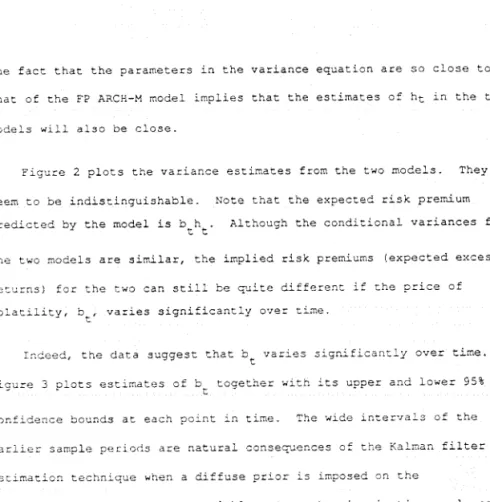
The fact that the parameters in the variance equation are so close to that of the F? ARCH—N model implies that the estimates of ht in the two models will also oe close.
Figure 2 plots the variance estimates from the two models. They seem to be indistinguishable. Note that the expected risk premium predicted by the model is bht. Although the conditional variances from
the two models are similar, the implied risk premiums (expected excess ruturna( for the two can still be quite different if the price of volatility,
b, varies significantly
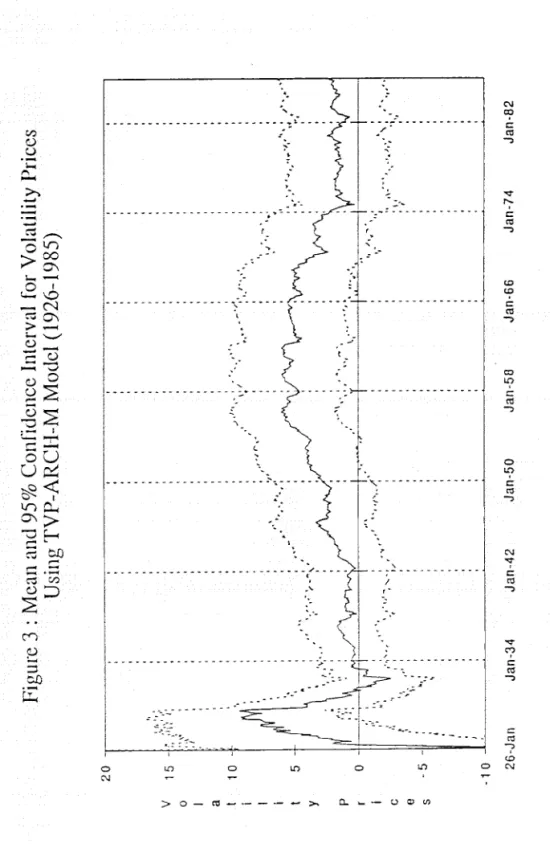
over time,Inuoed, the data suggesc that bt varoes significantly over time. Figure 3 plots estimates of b together woth its upper end lower 95% confidence oounds et eacn poont in time. The wide intervals of the earlier sample periods are natural consequences of the Kalman filter ertomation teonnoque wnen a diffuse prior is imposea on the
nitialiration of the state variable. At each point in time, only past i:.forrutocn (which includes the large variance set for the initial state; is incorporated in estimating the state variable. Tmprecise estimates are obtained during earlier periods of the sample, because little information from the data is used, leaving only che effect of the diffuse prior. This phenomenon explains the initial broad confidence onoervals
of
o whi ongradually
narrow
to
areasonsoly
stationary level.
Except
for
the earlier
periods,
b
is
mostly
significantly
positive,
conformongthe
existence of
time—varyingrisk
premiums.
Forsome
periods the significance levels are greater than
5%,but
except
for
a fewearly
periods the point estimates are
alwayspositive.
Excluding
the first ten years, b ranges during the five decades 1936—1985 from
017
to 5.99 with an average of 3.04 and standard deviation of 1.68. The averaoe - bt
is virtually identical - to the estimate uaino the fixed- paramater model, 1.00.It's interesting to comoare this
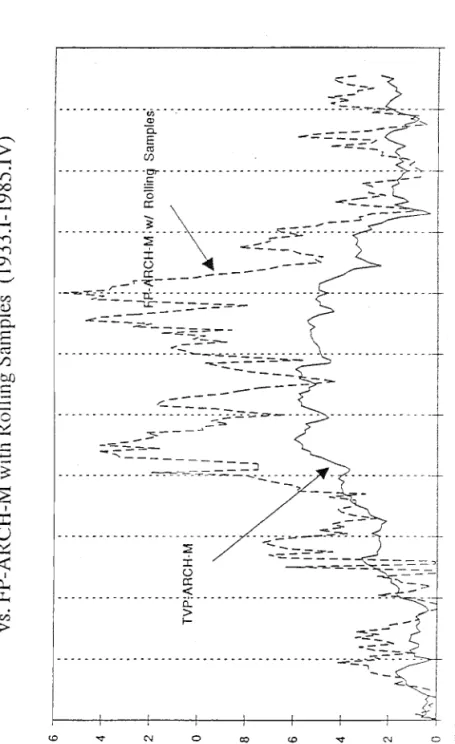
ht series with the rolling sample
result (see Figure 4) . The general patterns of these two series are ouita similar. They are low in the thirties and gradually increase
during the forties. They remain high during the fifties and sixties,
then drop hack to a lower level after the oil shocks and recession uf
the mid—seventies. The correlation coefficient of these two series for their overlapping sample perioda (quarterly 1933—1985) is 0.87. The TVP series is notably smoother than the rolling sample estimates, which
suggests that the extreme fluctuat
ma
of the rolling sample estimatesmay be partly due to sampling errors.5
As we noted earlier, although the volatility series from the F? ARCH—N end the TV? ARCH-N models are indistinguishable, the implied equity prer.iuma or the expected excess returns can be quite different,
as is evident from variations in the price of volatility. Comparison of
these two series provides an opportunity to resolve the "puzzle"
reported by FOS that the ARCH—N model gives an average risk premium that is twice as high as the average realized excess return.
Table 1 shows that the average risk premium for the TV? ARCH—N
model is .54 or .60, depending on the treatment of negative values,
5Some fluctuation in the rolling sample estimates may be attributable
to shifts in parameters in the variance equation that the time—varying parameter model, which assumes constancy for all these parameters,
15
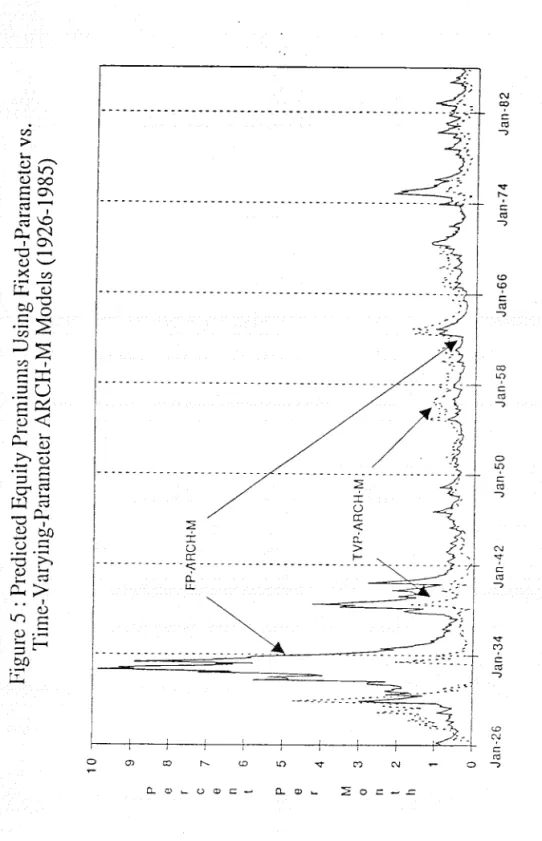
while the F? ARC!{-M average is .96. The sample average excess return is .64 close to rhe TV?—ARCH-M average risk premium. Figure 5 graphs equity premiums (predicted excess returns) from both models, During
highly
volatile
periuds,
the
fixed-parameter
model seemsto
overestimate
the level of risk
premiums.For
less
erratic
periods, rhe difference
between these
twoseries
is
not obvious,
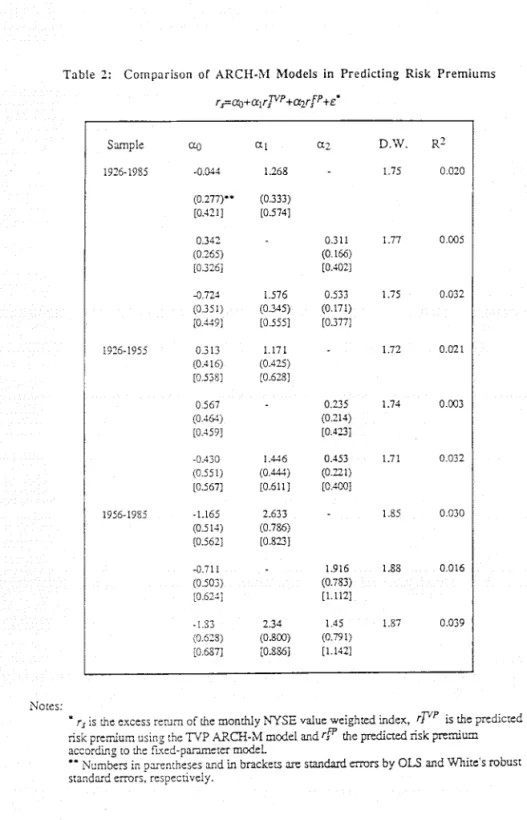
To compare the predictive powers of the two methods, we regress the realired
excess
return
oneach
of the predicted
premiums.
Regressions
with both
predicted
premiumsas explanatory
variables
are
also
eotimated. Table
2presents the regression
results
for the
full
sample
period
andfor
two sub—periods. Bothordinary
standard
errors
and
Whotes
consistent, standard
errors are
given.
The R2of
the
regression
wion a
regressor
fromthe
TV? ARCR—M modetis
significantly
higher than
the regression using
F? ARCH—Min all
samples.
Whenboth
regressors are
incicued
in the
reg:ession,
the
premiumpredicted
bythe
TV? ARCHM modelhas
a higher t-value than
that
predicted
bythe
fixed parameter
modelin all
samples.
IV.
Explaining Variationa
in the ?rioe
of
Volatility
IV,1
EconomicVariaoles Affecting
thePrice
of Volatility
Application
of
a TV? ARCW—M modelappears
to correct
the biased
forecasts
of
risk
premiumsthat
are generated
by
the
F? ARCH—Mmodel.
Hecc we try to explaIn variations in 5 , estimatesof
the price
of
t
volatility,
byexamining
its
relation
with
some macroeconomicvariables
under
the
assumption
that
the
true
modelis
a CA?Mwith
aconstant
price
of risk. As b is the mean/variance ratio of the stock-index excess
catucn, dividing both sides of (11.3) by
o
yields
b_ = S[wt +
(l_)3ll]
)IV.l)The
sensitivity
of the return on the unobserved portfolio to the retucnsof
stocks,
that
is,
the
beta
coefficient
of the
unobservable
sssets
onthe
stock index isLetting
Band
3be
tirLe varying,bt
3Ct
+(lwt)N
)IV.2)Thus,
the
price
of
volatility
of stock returns
depends not only
onthe
risk
aversion
parameter,
3,but
is
also affected
bythe
poctfolio
weight
wand
the sensitivity
psrameter
.
b
will
be
identicsl to
3
in
twoextreme
oases:
w1
or
=l,
Weuse
economicvariables
that
proxy
changes in'
and3
to test the velidity of the TUg model in explaining variations in the price of volatility.Inferences about the CAPM are sensitive to the set of assets used
in the test. Stathaugh (1982) examines the effect of moving from narrow
to broader stock indexes. But even if we could compile an index of
dl
I the incorporated enterprises in the U.S., it would account for less then
10% of wealth if we included human carital, and less than one third of
I the total wealth of U.S. citirens excluding human capital (See Ibbotson
end Erinson (1987, ppp.18—3S) ) We choose to treat the aggregate of all
essets other than equities as the unobservable complement of total wealth -
17
We use four different proxies for
w.
The first two proxies are the broadest in that they refer to all U.S. assets; real (including numan capital), and financial. The flow of income from ownership of stocks is approximately measured by corporate profits while the income from all wealth is simply national income. If each is 1(1), and each is discounted at the same rate, their ratio will approximately equal the ratio of the value of stocks to total wealth. Hence the share of corporate profit in national,w1, income is a possible proxy for w.
The second proxy, w2, is the ratio of the value of all NYSE stocks to gross consumption. The single—factor OAPN with a constant
cpportunity set (which is equivalent to the consumption beta model) imploes chat changes in gross oonsumption reflect changes in total wealth, ht best, tins measure tan only be proportional to the share of equities in total wealth. Both consumption figures and the value of NYSE stocks are available monthly from 1959 to 1985; quarterly observations are iveilable from 1946 to 1985.
Two more proxies for w correspond to narrower definitions of wealth. For
w3, total wealth is am estimate of physical wealth which
includes all financial and tangible assets for the total U.S. economy, while for
w4 only financial assets are included. Total equity value is used for tne numerator instead of the aggregate value of NYSE-listed stocas.6 Tnese nate come from the "Balance Sheets for the U.S. Economy"
(1987, published by the Federal Reserve Board. Only annual observations are availaole,
6 As of Oeoember 1985, the total value of stocks listed on the NYSE was about 79% of the value of all U.S. corporate equity.
eatate. There is little doubt that the beta of real estate on storks is less than one, indeed, it may very well be negative (See Ibbotson and
Brinson (1987, pp.35—43)) . The beca of human capital on storks is also
must likely small. While business ryrles affect labor income and
corporate
profits
similarly,
they
affect
highly
skilled
labor less
thanunskilled labor.
Indeed, investmentin
humancapital
mayvery
well
becounter cyclical. While it is impossible to compute 3,.
directly,
time-varying elements of i may be captured nevertheless by eccncrdr
variables, We use the rate of inflation and the reel interest rate. It
is plausible that: the sensotlvicy of wealth—asset prices to the prices
of stocks differ In period of different levels of inflacion and real
interest rates.
The third source of variaticns in b comes from
'
the
riskeversion parameter. For a broad class of stylized utility functions, e.g., tIARA, relative risk aversion will depend on the level of wealth,
and ccnseouently may be correlated with changes in the level of
consumption. There
is neither
evidence mcrstylized fact
on whetherrelative
risk
aversion
is
increasing,
decreasing, ccconstant
in
wealth,
although it is a stylized fact that absolute risk aversion decreases with wealth (see Wachina (1987) ) ,
IV.2
Correlacioo ofbt
with
Eccncmic VariablesTable
3 presents regressions of b_ cmi h,, on the four proxies forthe stock—portfolio weight, the two economic variables that are expected
19
rate of interest and the rate of inflation), and the instrument for risk aversion (real per-capl.ta consumption) . We report results for the value
ieighted series only, since
they
are almost identical to the equally weighted series. All the variables in Table 3 are estimated to be 1(1), and hence differenced. These estimates are approximations for the variables in equation (IV.2) and are estimated with quarterly data.The economic variables, particularly the proxies for the relative portfolio shares of stocks, are, by design, contemporaneously correlated with the stock returns. As a result they will also be highly correlated with the estimated b and, but not with the h series. To minimize the
t t
effect of this spurious correlation, the second panel of Table 3 presents identical regressions with lagged values of the economic variables. Each panel in Table 3 presents estimates from three
regressions on the economic variables, two for the price of volatility and one for the volarility itself. The first regression of the price of volatility excludes the volatility itself, the second includes it.
The regression results clearly support the hypothesis that the price of volatility can be varying due to changes in the relative value of stocks, and the beta of unobserved assets, even if risk aversion remains constant. The next to last row of Table 3 gives the X2
I
statistic
(with 4 degrees of freedom) for the hypothesis that the coefficients of all four proxies for portfolio share of stocks are zero. The critical value for z.OOl is 14.85, while the test statistic is greater than 30 in all four regressions.
The positive coeffioient of all
w's
is consistent with (IV.2) forbets less thsn one. When the value of stooks rises relative to other
oomponents of wealth, a rise i: the price of volatility oan be attributable to the increased marpinal risk of storks, rather than to higher risk aversion, At the sane tine, the variance of the rate of return of stooks is attually lower, as suggested by the negative coefficients of the proxies (in 7 out of 8 oases) in the regression of conditional variance on the economd,c variables (and as might be predirted by a leversge argument)
Both proxies for the beta of unobserved assets with stocks, the rate of inflation and the real rate of interest, have a significant
(negative) impact on the price of volatility. Equation Iv,2 predicts that bets will be negatively correlated with the price of volatility.
0cc results agree if we assume that the beta of unobserved assets on stocks is greater in periods of high inflation and real interest rates.
Real per—capita consumption, the proxy for the coefficient of risk aversion, shows a
contemporaneous
strong
(negative) impact
onbtf
and
hardly
any impact: whenlagged
oneq-uarter.
Withconstant
relative risk
aversion, the
result
of the
contemporaneous
regression
is attributable
to
the positive
correlation
of
changes
in
consumption
with
changes
in
wealth, and hence with
rates of
return
onstocks.
Theabsence
of
significant
impact
of
consun.ption
in
the lagged eqvation
is
consistent
with
this
explanation.
Onthe other
hand,if
taken
at
face value, the
positive coefficient of
consumption
in the
contemporaneous
regression
suggests that
risk
aversion
is
increasing with
wealth. Risk
aversion
21
The results presented in Table 3 make a case for our argument that
C
risk
aversion may not easily be inferred from rates of return on stocksand
that
economicvariables affect
the
price
of
volatility.
IV.3
Further Tests of
the
Dependenceof
b
on Economic Variables Theregression analysis
so
far
has been
descriptive since
it
uses
as
dependent variable estimates from the entire sample. We nowsubstitute (17.2) for (111.2) and recognize that the economic variables must interact with the volatility. If only a single variable is
relevant, the model becomes
r5
=c,,t
+c2(,t1
+e0
(17.3)
2 2
=
a0
a,ts,t_l
+a2O,t_l
(17.4)
where
r is
the
excess
return
onstocks,
and
is
one
of
the proxies or
related
variables of w,,
and 5.This
is
the ARtH—M model with cross— productterms
in
the
meaneruation,
and can be estimated
by maximumlikelihood.
Monthly
data
are
used
for
formal
tests
onthe significance of
the
coefficient
c2because
higher
freouency
data
provide
better
estimates of
conditional
variances. The sample covers the period 1959-1985,corresponding
to
the
availability
of
the
consumption
data. Estimation
results
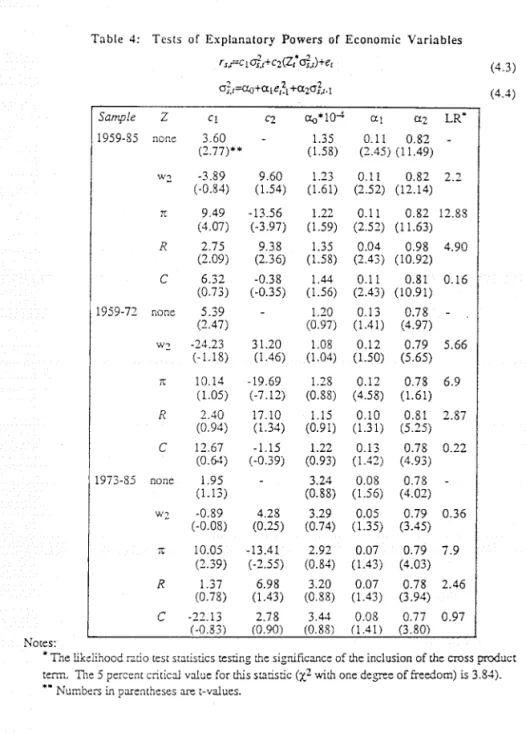
are also reported for sub sample periods 1989—1972, and 1973— 1985. Table 4 presents the results.Except
for
per
capita real
consumption,
estimatiot.
results
support
variables, consistent with the regression result of Tatle 3, Once the
cross
product termw2C,
is included in the model, the coefficienc ofbecomes insignificant and even assumes the wrong sign. The low t—
statistic
values of the coefficient of the cross—product term mayreflect multicollinearity. Estimation with only the cross-product term yields a t-statistic of 2.82 for the full sample, with 2.8? and 1.00 for
sub sample periods.
The
role
of
inflation
appears
to be
the
mostimportant.
When oheinflation
rate
is
used
for
I in the
estimation, the
t—valueoof
izC
are
alwayssignificant
at
the
5%level.
In
an attempt to
estimate a
structural
model we assumethat the
sensitivity
factor,'
is
linearly
dependent
onthe rate of inflation,
i.e.,
A0 +A1it, and
that
the
stock return
is
driven
by
aprocess
with
mean given by (11.3) with a GARCN)l,1) variance specification. Themodel
can
then be written as
r50
= S[w_1 +A0(l
—w1)
+ A1(1— w
1)r11,c
+e
IV.t)
=a0 +
a1e1
+a2,t1
(IV.6)
Ecuation (IV.5) can
also
be
rewritten as
r5
=C1w_,,t
+C2(l
—w1),t
+ C3(1 —w1)r.,t
+e
(17.7)
where
C1=
C2=A03,
and
C3=A16, Note that all explanacory economic variables are lagged once to ensure that the expected return depends23
measured by the ratio of corporate profit to national income becauoe it is available from 1946.
It turns out that very large standard errors are obtained for estimates of C1 and C_. The reason is that
w
is very smooth compared with so the collinearity between and(l—w1),t
is high. The model is also estimated assuming A3=1, i.e,=l±Alrt implying
CrC2
and
that equals one wich no inflation. Table S gives theresults,
including estimation
with
wl,
wnicn corres
onds
to the
usual
fixed-parameter
ARCh-kmodel.
As
the
likelihood function values
indicate,
both
modelswitn and
without
unit restriction
for
A3outperform
the usual
ARCH—kmodei.
Therestricted
version
(Al)
cannot be
rejected
and reduces
the
standard
error of
the coefficient
C1,which
is
also
an
estimate of
the risk
aversion parametar
& Inthis
procedure,
the point estimate of
this
parameter
becomes positive for the full period and toe second sub sample period. The estimates of C, and C, are reasonably stable across the twosub sample periods, although both are less significant for the period 1966—1985. The likelihood ratio test for model stability across sample periods suggests that the restricted model is stable, wnile the fixed— parameter ARCH—k model is not.
To investigate the robustness of our model we perform some fortoer diagnostic tests. We have restricted our variance specification to GARCH(1,1). Sut there are no theories to exclude other economic variables that may be important in driving the conditional variances as well as the conditional mean. It is possible therefore that the effects
of econoric variables on the price of volatility are attributable to
this relationship through the second moment.
Researchers who follow thia strategy in modeling stock variances
include Campbell and Shiller (1989), Harvey (1989), Attanasio (1989), and Attanasio and Wadhwani (1989) among others. Abtanaaio and Wadhwani
(1989) ,
for
example, find that the predictability of expected stockreturns given lagged dividend yields reported in Fama and Frenob (1988) can be explained by a risk measure estimated by an ARCH with laooed dividend yields.
We hence re-estimate our final model (with the restriction
A6=l) while allowing lagged inflation rates and lagged portfolio weights to
enter into the variance egustion.
A
likelihood ratio test of ouroriginal model against this general model gives a test statistic of 8.88, which is significant at the 5% level but not at the 1% level This result indicates that a better forecast of the volatilities may be obtained by including economic variables in the GARCH)l,l) model.
Cur original conclusion concerning the mean effect, however, is not
much affected by thom re—estimation. The estimates of
C1 and C are 7.32 (with t—value of 4.92) and —7.04 (with t—value of —3.26), which are
fairly close to the riginsl estimates in Table 5. Further, the
significance of the two economic variables
(w2 and m) added to the variance equation is weaker according to the Wald test )t—values 1.67 and —0.75, respectively, not significant at the 5% level) -
According to the result of the restricted model for the foil sample
25
most likely too hIgh. The two standard error low bound for this parameter is 4.67, which is more in acrord with other estimates.
V. Conclusion
Analysis of an econometric model estimating a time—varying risk! return relation of the stock market indicates that the TVP ARCH—M model provides more precise estimates of the expected return of the stock market index than the fixed—parameter ARCH-k model. The model takes explicit account of the role of risky assets other then stocks in explaining the time variation of the mean/variance rstio for stooks. Proxies for portfolio weights end the bets of the unobserved assets on stocks
are
found to he
tmoortsnt
in
deterraning expected stock
returns.
Although oor
oeoinoel
workis
only
nreliminsry,
further studies
in
this
vein
seempromising.
Moredetailed investigations
mayexplain
the
role
of
the
rate
of
inflation
in
stock prioe
movements. Therelationship
of
our
findings
with
the recent
literstuoe
onpredictability
of
excess
stock returns
maybe
fruitful
for future
Appendix: Notatcn
rM : excess return of the market portfolio total return —
rf
: riskless rater5 : excess return of a comprehensive stock index
excess
return of the
unobserved
risky
asset
other than
stocks
w :
portfolio
weight
of stocks
in the
market
portfolio
(or
the
relattve
demandfor storks)
proxies for
wcorporate
profit/national
incometotal
NYSEvalue/gross
consumption
toral
stock value/value of
total financial assets
tangible
assets
total
stock value/value of
total financial assets
sensitivity
of returns of the unobserved risky asset to stocks =Cov(r
,r )/var)rN S S
m :
inflstioo
rate
measured by
the
ConsumerPrice
Index
R : real interest rate =
r
— StC : real per capita consumption
b : time—varying
parameter measuring
price of
volatility
of
stocks
27
References
Acel, A. 1988, "Stock Prices Under Time Varying Dividend Risk : An Exact
Solution In An Infinite-Horizon General Equilibrium Model," Journal of Monetary Economics, 22, pp.375—393.
Akgiray, V., 1989, "Conditional Neteroskedasticity in Time Series of Stock Returns: Evidence end Forecasts," Journal of Business, 62,
55—80.
Anderson, B. and J. Moore, 1971, Optimal Filtering, Prentice Mall, Inc., Englewood Clifts, N.J.
Attanasio, 0., 1989, "Risk, Time Varying Second Moments and Market Efficiency," Manuscript, Stanford University.
Attanasio, 0. and S. Wadhwani, 1989, "Risk and the Predictability of Stock Market Returns," Manuscript, Stanford University.
Backus, D. and A. Gregory, 1988, "Theoretical Relations Between Risk Premiums ani crrilitional Variances, " Manuscript, Federal Reserve Bank
of
Minneapc- Li 5Balance
Sheets
for
the
U.S. Economy, 1987, Boardof
Governors
of
the
Federal Reserve
System.Black,
F., N. Jensen, and N. Schuies, 1972, "The Capital Asset Pricing Model: Some Esipirocal Tests," in N. Jensen, ad., Studies in theTheory of Capital Markets. Praegar, New York, 79—124.
Bodia, 1., A. Kane, and R. McDonald, 1983, "Mhy Are Real Interest Rates So Nigh?" NBER Working Paper No. 1141.
Bollarslav, Tim P., tn, "generalized Autoregressive Conditional Neteroscadastici':y, "
Journal
of Econometrics, 31, 307—327.Bollarslev, T., R, Chou and K. Kroner, 1990, "ARCH modeling in Finance: A Review of the Theory and Empirical Evidance," Journal of
Econometrics, thLs issue.
Campbell, J. and R. ihLller, 1989, "The Dividend Price Ratio and Expactations of t'utura Dividends and Discount Factors, " Review of Financial
Studies,
195—228.Chou, R. Y., 1983 "Vniatility Persistence and Stock Valuations," Journal of Applied Euoncmatrics, 3, 279—294.
Conn R., N. tawetien, K. Lease and 0. Schlarbauxs, 1974, "Individual Investoc Risk Aversion and Investment Portfolio Composition," Journal of Finance, 30, 603—620.
Engle, R. F., 1982 "Autoregressive Conditional Nataroscadasticity with Estimates of tne Variance of U.K. Inflation," Economatrica, 50, 987—1008,
Engle,
R. F., D. tilien and R. Robins, 1987 "Estimating Time Varying RiskPramia
in
the
TermStructure:
The ARCH-NModal,"
Engle, R. F., and M. W. Watson, 1985 "Applications of Kalman Filtering in Economics," Paper presented at the World Congress of the Econometric Society.
Epstein, L., and S. Sin, 1989, "Substitution, Risk Aversion and the Temporal aehavior of Consumption and Asset Returns: A Theoretical Framework," Econometrica, 57,4, 937—969.
Fama, E., and K, French, 1988, "Dividend Yield and Expected Stock Returns," Journal of Financial Economics, 22, 3—26.
Fam.a, E., and J. MacBeth, 1973, "Risk, Return and Eiilibrium: Emmiriosl Test," Journal of Political Economy, 607—636. French, K. R., C. Schwert, and R. Stambaugh, 1987 "Expected Stock
Returns and Volatility," Journal of Financial Economics, 19, 3—30. Friend, I., and N. i3tume, 1975, "The Demand for Risky Assets," .Roerioon
Economic Review, 65, 900—922.
Glosten, L., R. Jagaunathan and D. Runkle, 1989 "Relationship Between
the
Expected Value
andthe
Volatility
of the
NominalExcess
Retuot
on
Stocks,"
Manuscript, Northwestern
University.
Grossman,
S,
and
C.Leroque,
1987"Asset
Pricing
end Cptimal
Portfolio
Choice
in the Presence of Illiquid Durable Consumption Goodt," USSRW.P. No. 2369.
Marvey, C., 1969, "tn the Expected Compensation for Market Voletility
Constant Through Time 7" Manuscript, Duke University.
Tbbotson, R. C. end C. Brinson, 1987 Investment Markets, McGraw—Hill
Book Co.
Keim, D. 1986, "The CAPM and Equity Return Regularities," Financial Analyst Journal, May—June, pp.19—34.
Lintner, J. 1965, "The Valuation of Risky Assets end the Selection of
Risky Tnvestments in Stock Portfolios end Capital Budgets," Review of Economics and Statistics, 47, 13—37.
Machine, N., 1981, "The Economic Theory of Individual aehevior Toward
Risk: Theory, Evidence, and New Directions," Manuscript, UCSO. Mankiw, N., end N. Shapiro, 1986, "Risk and Return: Consumption versus
Market Pete," Review of Economics and Statistics, 68, 452—459.
Merton, R. C., 1913, "An Intertemporal Capital Asset Pricing Model,"
Econometrica, 41, 867—887.
Merton, R. C., 1960, "Cn Estimating the Expected Return on the Market,"
Journal of Financial Economics, 8, 323—361.
Mossin, J., 1966, "Squllibrium in a Capital Asset Market," Econometrics,
29
Pindyck, R. S., 18U, 'Risk Aversion and Determinants of Stock Market Behavior,' The Review of Economics and Statistics, LXX,2 pp.l53— 190.
Pratt, J.W., 1964, "Risk Aversion in the Small and in the Large," Econometrica, 32,1—2 pp.122—136
Roll, R., 1977, "A Critique of Asset Pricing Theory's Tests: Part I," Journal
of
Financial Economics, 4, 129—176.Schwepe, F., 1965,"Evaluation of Likelihood Functions for Gaussian Signals," I.E.E.E. Transactions on
Information
Theory, 11,
61—70.Sharpe, W., 1964, "Capital Asset Prices: A Theory of Market Equilibrium Under Conditions of Risk," Journal
of
Finance,19,
425—442.Stambaugh, R., 1982, "On the Exclusion of Assets From Tests of the Two— Parameter Model," Journal
of
Financial Economics, 10, 237—268 Tobin, J., 1958, "Ltquidity Preference as Behavior Toward Risk," ReviewRisk Premium Mean Std Dcv Minimum Maximum
064
560
-29.03 38.16rT
0.54 0.63 -3.51 4.73r'
0.60 0.47 0.00 4.73 0.96 1.28 0.24 9.86 Notes:rI"
is the predicted dsk premium using the TV? ARCH-M model, andrif
thepredicted risk premium according to the fixed-parameter model
Table 2: Comparison
of
ARCH-M Models in Predicting Risk Premiums r_—ci.o+alrT"+a2rff+e Sampleao
D.W. R2 1926-1985 -0044 1.268 - 1.75 0.020 (0.277)* (0333) [0.421) [0.574) 0.342 - 0.311 1.77 0.005 (0265) (0.166) [0326) [0.402) -0.724 1.576 0.533 1.75 0.032 0351) (0345) (0.171) [0.449) [0.555) [0.377) 1926-1955 0313 1.171 - 1.72 0.021 (0416) (0.425) [0.538) [0.628) 0.567 - 0.235 1.74 (0.464) (0.214) [0.459) [0,423) -0.430 1.446 0,453 1.73 0.032 (0.551) (0.444) (0.221) [0.567) [0.611) [0.400) 1956-1985 -1.165 2.633 - 1 85 0.030 (0.514) (0.786) [0.562) [0.823) -0.711 - 1.916 1.88 0.016 (0.503) (0.783) [0.624) [1.112) -1.53 2.34 1.45 1,87 0.039 0.62S) (0.800) (0.791) [0.6871 [0.886) [1.1421 Notes:r4 is the excess return of the monthly NYSE value weighted index,
rT'
is the predictedrisk premium using the TVP ARCH-M model and
rff
the predicted risk premium according to the fixed-parameter modeLNumbers in parentheses and in brackets are standard errors by OLS and Whites robust standard errors, respectively.
With contenporaneous With explanatory
explanatory variables variables lagged one period Dependent
b'R
b'R
h'WR bt'WR b''wRh'R
variable wI 3.92 3.89 -10.77 4.77 5.02 -79.48(i.75)
(1.73) (-0.14) (1,22) (1.33) (-1.04) W2 3.05 3.06 4.48 0.74 0.69 -38.32 (14.51) (1455) (0.60) (2.00) (1.91) (-5.26) W3 -4.59 -4.88 -111.48 1.21 2.56 -6.39 (-1.55) (-1.65) (-1.06) (0.24) (0.52) (-0.06) W4 10.27 10.10 -63.50 7.66 8.74 -15.96 (3.30) (3.24) (-0.58) (1.43) (1.68) (-0.15)n
-0.11 -0.12 -3.14 -0.28 -0.24 2.11 (-2.19) (-2.33) (-1.78) (-3.22) (-2.79) (1.22) R -0.13 -0.14 -2.85 -0.29 -0.25 2.46 (-2.48) (-2. 61) (-1.53) (-3.10) (-2.74) (1.36) C 0.60 0,54 -24.81 -0.65 -0.34 -3.81 (2.65) (2.28) (-3.08) (-1.69) (-0.88) (-0.51) 6VWR - -0.003 - - 0.01 - (-1.08) (3.25) CONST. -0.04 -0.03 0.93 0.01 0.003 0.14 (-2.57) (-2.36) (1.93) (0.60) (0.12) (0.30) R2 0.77 0.78 0.24 0.30 0.35 0.28 D.W. 2.21 2.21 1.85 2.03 2.09 2.03y2(4)**l0535
104.13 15.65 32.23 39.64 35.19p-vue
<0.01% <0.01%<1%
<0.01% <0.01% <0.01% Notes:Wj'S are poro1io shares
of
stocks with different weaith measures, tt is the inflation rare,R is the real interest rate, and C is the real per capita consumption in thousands
of
dollars. The sample period is quarterly 1951.1- 1985W with 140 observations. All variablcs inthe regressions are
flrt
differenced. Numbers lit the parentheses are t-values.x2(4) is the test statistic for the joint hypothesis that all coefficients for Wj5, i =
Table 4: Tests
of
Explanatory Powers of Economic Variables (43) (4.4) SampleZ
cj c2a1O4
a
U7LR
1959-85 none 3.60 - 1.35 0.11 0.82 - (2.77)** (158) (2.45) (11.49) W2 -3.89 9.60 1.23 0.11 0.82 2.2 (-0.84) (1.54) (1.61) (2.52) (12.14)z
9.49 -13.56 1.22 0.11 0.82 12.88 (4.07) (-3.97) (1.59) (2.52) (11.63) R 2.75 9.38 1.35 0.04 0.98 4.90 (2.09) (2.36) (1.58) (2.43) (10.92) C 6.32 -0.38 1.44 0.11 0.81 0.16 (0.73) (-0.35) (1.56) (2.43) (10.91) 1959-72 none 5.39 - 1.20 0.13 0.78 - (2.47) (0.97) (1.41) (4.97)w
-24.23 31.20 1.08 0.12 0.79 5.66 (-1.18) (1.46) (1.04) (1.50) (5.65)t
10.14 1969 1.28 0.12 0.78 6.9 (1.05) (-7.12) (0.88) (4.58) (1.61) R 2.40 17.10 1.15 0.10 0.81 2.87 (0.94) (1.34) (0.91) (1.31) (5.25) C 12.67 -1.15 1.22 0.13 0.78 0.22 (0.64) (-0.39) (0.93) (1.42) (4.93) 1973-85 none 1.95 - 3.24 0.08 0.78-
(1.13) (0.88) (1.56) (4.02) w-' -0.89 4.28 3.29 0.05 0.79 0.36 (-0.08) (0.25) (0.74) (1.35) (3.45) z 10.05 -13.41 2.92 0.07 0.79 7.9 (2.39) (-2.55) (0,84) (1.43) (4.03) R 1.37 6.98 3.20 0.07 0.78 2.46 (0.78) (1.43) (0.88) (1.43) (3.94) C -22.13 2.7g 3.44 0.08 0.77 0.97 (-0.33) (0.90) (0.88) (1.41) (3.80) Notcs: *The likelihood ratio test statistics testing the significance
of
the inclusionof
the cross product term. The 5 percent critical value for this statistic (y2 with one degree of freedom) is 3.84).Sample
Cj
C2 C3a104
i
az
lLkelihood 1946-85 -5.6 9.5 -9.0 1.27 0.09 0.83 -1331.23(.012)*
(1.54) (-3.34) (1.78) (2.67) (13.00) 7.81 - -8.69 1.27 0.09 0.83 -1331.26 (4.98) (-3.61) (1.98) (2.69) (13.08) w=1 4.62 - - 1.47 0.09 0.82 -1337.32 (4.12) (1.74) (2.63) (11.46) 1946-65 110.8 -4.7 -7.5 1.63 0,10 0.76 -633.00 (0.96) (-0.28) (-2.02) (1.05) (1.45) (4.38) 9.81 - -7.96 1.69 0.10 0.76 -633.34 (4.77) (-2.19) (1.03) (1.41) (4,16) w=i 7.96 - - 2.22 0.13 0.69 -636.07 (4.19) (1.23) (1.65) (3.47) 1966-85 -119.7 20.2 -9.9 2.06 0.08 0.82 -693.10 (-1.59 (2.26) (-2.22) (1.22) (1.78) (7.43) 6.22 - -8.35 2.07 0.08 0.82 -694.63 (2.04) (-1.92) (1.20) (1.77) (7.50) w=1 2.2 - - 2.37 0.07 0.81 -696.16 (1.52) (1.13) (1.83) (6.37) Notes:Monthly data are used, wtl is the rado of corporate profit over national income, rnd7r41 is the inflation rate measured by CPI.
16 14 V 0 I 12 a i 10 8 y
P6
c
4 e S 2 0Figure
1:
Estimates
of
Volatility
Prices
Using
Previous
5-years
Rolling
Samples
(1933-1987)
Mar-33 Mar-38 Mar-43 Mar-48 Mar-53 Mar-58 Mar-63 Mar-68 Mar-73 Mar-78 Mar-83s 450
q 400 5;o 350
P 300C 250
0 n 200 P 0 M0
n h 150 100 50 0Figure 2 Volatility Estimates Using
Fixed-Parameter vs. Time
Varying Parameter ARCFI-M Models (1926-1985)
Jan-26 Jan-34 Jan-42 Jan-50 Jan-50 Jan-66 Jan-74 FP-ARCH-M
Figure
3
:Mean
and
95%
Con!dence
Interval
for
Volatility
Prices
Using
TVP-ARCH--M
Model
(1926-1985)
20
—
—______________
V 15 o:
: a I 10 I__
_
26-Jan Jan-34 Jan-42 Jan-50 Jan-58 Jan-66 Jan-74 Jan-82V 0 a y p C 0 S
Figure 4 Estimates of Volatility Prices Using TVP-ARCI-l-M Model
8 P
nO
C 0 C 7 6PS
e 10Figure
5
:Predicted
Equity
Premiums
Using
Fixed-Parameter
vs.
rfiIe.varyiIgparaI11cter
ARCH-M
Models
(1926-
1985)
4 M