University of Wollongong
University of Wollongong
Research Online
Research Online
Faculty of Engineering and Information
Sciences - Papers: Part A
Faculty of Engineering and Information
Sciences
1-1-2015
Absent multiple kernel learning
Absent multiple kernel learning
Xinwang Liu
National University of Defence Technology
Lei Wang
University of Wollongong, [email protected]
Jianping Yin
National University of Defense Technology
Yong Dou
National University of Defense Technology
Jian Zhang
University of Technology Sydney
Follow this and additional works at: https://ro.uow.edu.au/eispapers
Part of the Engineering Commons, and the Science and Technology Studies Commons
Recommended Citation
Recommended Citation
Liu, Xinwang; Wang, Lei; Yin, Jianping; Dou, Yong; and Zhang, Jian, "Absent multiple kernel learning" (2015). Faculty of Engineering and Information Sciences - Papers: Part A. 5373.
https://ro.uow.edu.au/eispapers/5373
Research Online is the open access institutional repository for the University of Wollongong. For further information contact the UOW Library: [email protected]
Absent multiple kernel learning
Absent multiple kernel learning
Abstract
Abstract
Multiple kernel learning (MKL) optimally combines the multiple channels of each sample to improve classification performance. However, existing MKL algorithms cannot effectively handle the situation where some channels are missing, which is common in practical applications. This paper proposes an absent MKL (AMKL) algorithm to address this issue. Different from existing approaches where missing channels are firstly imputed and then a standard MKL algorithm is deployed on the imputed data, our algorithm directly classifies each sample with its observed channels. In specific, we define a margin for each sample in its own relevant space, which corresponds to the observed channels of that sample. The proposed AMKL algorithm then maximizes the minimum of all sample-based margins, and this leads to a difficult optimization problem. We show that this problem can be reformulated as a convex one by applying the representer theorem. This makes it readily be solved via existing convex optimization packages. Extensive experiments are conducted on five MKL benchmark data sets to compare the proposed algorithm with existing imputation-based methods. As observed, our algorithm achieves superior performance and the improvement is more significant with the increasing missing ratio.
Disciplines
Disciplines
Engineering | Science and Technology Studies
Publication Details
Publication Details
Liu, X., Wang, L., Yin, J., Dou, Y. & Zhang, J. (2015). Absent multiple kernel learning. Proceedings of the Twenty-Ninth AAAI Conference on Artificial Intelligence (pp. 2807-2813). United States: IEEE.
Absent Multiple Kernel Learning
Xinwang Liu
School of Computer National University of Defense Technology Changsha, China, 410073Lei Wang
School of Computer Science and Software Engineering University of Wollongong
NSW, Australia, 2522
Jianping Yin, Yong Dou
School of Computer National University of Defense Technology Changsha, China, 410073
Jian Zhang
Faculty of Engineering and Information Technology University of Technology SydneyNSW, Australia, 2007
Abstract
Multiple kernel learning (MKL) optimally combines the mul-tiple channels of each sample to improve classification perfor-mance. However, existing MKL algorithms cannot effectively handle the situation where some channels are missing, which is common in practical applications. This paper proposes an absent MKL (AMKL) algorithm to address this issue. Dif-ferent from existing approaches where missing channels are firstly imputed and then a standard MKL algorithm is de-ployed on the imputed data, our algorithm directly classifies each sample with its observed channels. In specific, we de-fine a margin for each sample in its own relevant space, which corresponds to the observed channels of that sample. The pro-posed AMKL algorithm then maximizes the minimum of all sample-based margins, and this leads to a difficult optimiza-tion problem. We show that this problem can be reformulated as a convex one by applying the representer theorem. This makes it readily be solved via existing convex optimization packages. Extensive experiments are conducted on five MKL benchmark data sets to compare the proposed algorithm with existing imputation-based methods. As observed, our algo-rithm achieves superior performance and the improvement is more significant with the increasing missing ratio.
Introduction
Multiple kernel learning (MKL) has been an active topic in machine learning community during the last decade (Lanck-riet et al. 2004; Rakotomamonjy et al. 2008; Cortes, Mohri, and Rostamizadeh 2012; Liu et al. 2012; Xu et al. 2010; G¨onen 2012; Liu et al. 2014). Current research on MKL mainly focuses on improving the efficiency of MKL algo-rithms (Rakotomamonjy et al. 2008; Xu et al. 2010; Orabona and Luo 2011; G¨onen and Alpaydın 2011), designing non-sparse and nonlinear MKL algorithms (Xu et al. 2010; Yan et al. 2012; Kloft et al. 2011), developing two-stage MKL algorithms (Cortes, Mohri, and Rostamizadeh 2012; Kumar et al. 2012) and integrating radius information into traditional margin-based MKL algorithms (Do et al. 2009; Gai, Chen, and Zhang 2010; Liu et al. 2013). These re-search works on MKL usually take the following assump-tion: all channels (or base kernels) of each sample are ob-served. However, this assumption may not hold anymore
Copyright c2014, Association for the Advancement of Artificial Intelligence (www.aaai.org). All rights reserved.
when some channels of samples become missing, which is common in neuroimaging (Yuan et al. 2012), computa-tional biology (Chechik et al. 2008), medical analysis (Mar-lin 2008), etc. This issue is known as missing value (Smola, Vishwanathan, and Hofmann 2005; Marlin 2008) or absent data learning (Chechik et al. 2008), and it has been studied in the literature (Smola, Vishwanathan, and Hofmann 2005; Chechik et al. 2008; Ghahramani and Jordan 1993; Yuan et al. 2012). Nevertheless, the research on designing novel MKL algorithms to effectively handle absent channels has not been explored in existing MKL literature.
The violation to this assumption makes existing MKL al-gorithms unable to handle the above issue. A straightforward remedy may firstly impute the absent channels with zero (known as zero-filling in the literature) or mean value (mean-filling) or by more sophisticated expectation-maximization (EM-filling) (Ghahramani and Jordan 1993) approach. A standard MKL algorithm is then deployed on the imputed data. Such imputation methods usually work well when missing ratio is small. However, they may produce inaccu-rate imputation with the increase of missing ratio, and this could deteriorate the performance of the subsequent MKL.
Different from the imputation approach, this paper pro-poses to directly classify samples with absent channels with-out imputation. It is inspired by the concept of sample-based margin developed in (Chechik et al. 2008). In this paper, we first immigrate the concept of sample-based margin into multiple kernel-induced feature spaces, and maximize the minimum of all sample-based margins. On one hand, this approach is able to effectively handle the issue of absent channels. On the other hand, it yields a difficult optimiza-tion problem due to the minimizaoptimiza-tion over all training sam-ples. In this paper, we reformulate it as a convex optimiza-tion problem and make it readily solvable via off-the-shelf optimization packages. We highlight the main contributions of this paper as follows:
• Our work extends existing MKL algorithms by enabling them to handle samples with absent channels, which broadens the application scope of MKL.
• By applying the representer theorem (Sch¨olkopf, Her-brich, and Smola 2001), we reformulate the optimization problem as a convex one in its primal space. It can be readily solved by existing convex optimization packages
such as CVX (CVX Research 2012).
• We conduct comprehensive experiments to compare the proposed algorithm with existing imputation-based meth-ods on multiple MKL benchmark data sets. The results verify the superiority of the proposed algorithm, espe-cially in the presence of intensive absence of channels. We end up this section by discussing the differences be-tween our work and the work in (Chechik et al. 2008) which inspires us. Both papers classify samples with miss-ing observations by maximizmiss-ing the sample-based margin. However, they have the following important differences: (1) Our algorithms directly work on kernel matrices and han-dle the case where some entries of kernel matrices are miss-ing. However, the algorithm in (Chechik et al. 2008) only considers the absence of input features; (2) Different from developing a two-step iterative algorithm to solve the re-sulting optimization problem as in (Chechik et al. 2008), we design a novel algorithm that directly solves the prob-lem in the primal space by employing the representer the-orem (Sch¨olkopf, Herbrich, and Smola 2001). More impor-tantly, the latter consistently achieves significant improve-ments over the former, as validated by our experimental re-sults; and (3) In addition, our work assumes that some chan-nels1of samples are missing, while the work in (Chechik et al. 2008) studies the problem that someindividual features
of samples are missing. Form this perspective, the work in (Chechik et al. 2008) can be treated as a special case when a linear kernel is applied to all channels and each single fea-ture is viewed as a channel.
Related Work
The Sample-Based Margin
The sample-based margin is firstly proposed in the semi-nal work (Chechik et al. 2008) and applied to absent data learning where some features of a sample are missing. An important assumption for the sample-based margin is that the learnt classifier should have consistent parameters across samples, even if those samples do not reside in the same space, i.e., having different sets of observed features. Based on this assumption, the marginρi(ω)for thei-th (1≤i≤
n) sample is defined as ρi(ω) =yi(ωi>xi)/kωik, where
{(xi, yi)}n
i=1is a training data set,xiis characterized by a
subset of features from a full setF,yi ∈ {+1,−1},ω is the normal vector of SVMs on the full feature setF,ωi is a vector obtained by taking the entries ofωthat are relevant toxi, namely those for which the samplexi has observed features, andf(xi) =ωi
>
xiis the decision score ofxi. The above equation defines the margin for each sample in its own relevant space. As can be seen, it will reduce to a traditional margin as in SVMs when all samples have a full setF. From this perspective, the work in (Chechik et al. 2008) provides an elegant approach to handling samples with absent features. Though bearing such advantages, the maximization over the sample-based margins makes the re-sultant optimization problem more difficult to solve than the
1
Each channel can be composed of a group of features.
one in traditional SVMs. In (Chechik et al. 2008), a two-step iterative optimization procedure is proposed to solve the problem. However, the optimization in (Chechik et al. 2008) is non-convex and the global optimum is not guaranteed to be obtained.
Multiple Kernel Learning
MKL provides an elegant framework which not only learns a data-dependent optimal kernel for a specific application but also integrates multiple heterogeneous channels (Rako-tomamonjy et al. 2008; Xu et al. 2010; Cortes, Mohri, and Rostamizadeh 2010). In MKL, each sample can be treated as a concatenation of multiple base kernel mappings. Specifi-cally, each sample in MKL takes the form of
φ(·) = [φ>1(·), φ > 2(·),· · ·, φ > m(·)] > , (1)
where{φp(·)}mp=1 are the feature mappings corresponding
to m pre-defined base kernels {κp(·,·)}m
p=1, respectively.
Based on this definition, the seminal work in MKL (Lanck-riet et al. 2004) proposes to optimize the problem in Eq. (2),
min ω,b,ξ 1 2 Xm p=1kωpkHp 2 +C n X i=1 ξi, s.t. yi Xm p=1ω > pφp(xi) +b ≥1−ξi, ξi≥0,∀i, (2)
where ωp is the normal vector corresponding to the p-th base kernel,b is the bias, ξconsists of the slack variables andHpis a Hilbert space corresponding to base kernelκp. Note that the MKL formulation in Eq. (2) can be equiv-alently rewritten as those in (Rakotomamonjy et al. 2008; Xu et al. 2010) according to (Xu et al. 2010).
As can be seen in Eq. (1), each sample in current MKL is assumed to beφ(xi) = [φ>1(xi), φ2>(xi),· · · , φ>m(xi)]>. A question naturally raised is that how to perform MKL when some channels, i.e., part of {φp(xi)}m
p=1, are absent in a
sample2? In the following parts, we extend the sample-based margin to address this situation and call it absent multiple kernel learning (AMKL).
Absent Multiple Kernel Learning
The Sample-based Margin in AMKL
We are given n training samples {(φ(xi), yi)}ni=1 and a
missing matrixs ∈ {0,1}n×m, where φ(xi)is defined as in Eq. (1) ands(i, p) ∈ {0,1}(1 ≤ i ≤ n, 1 ≤ p ≤ m) indicates whether the p-th channel of the i-th sample is absent or not. Specifically, s(i, p) = 0implies absent and
s(i, p) = 1otherwise.
Similar to (Chechik et al. 2008), we assume that a nor-mal vector should be consistent across samples, no matter whether they have the same observed channels or not. Un-der this assumption, we define the margin for thei-th (1≤
2
Note that the absence of channels essentially leads to missing entries in base kernel matrices in practice. We present this problem from the perspective of channel absence for the sake of clarity and convenience of analysis.
i≤n)sample as, ρi(ω) = yi Pm p=1s(i, p)ω > pφp(xi) Pm p=1s(i, p)kωpkHp , (3)
whereω = [ω>1,· · ·,ω>m]> andωp(1 ≤p≤ m)are the normal vectors corresponding to the whole channels and the
p-thchannel, respectively.kωpkHpis the norm in a Hilbert space induced by thep-th base kernel.
As can be seen, Eq. (3) defines the margin in multiple kernel-induced feature spaces for the samples with absent channels, i.e., some of{φp(xi)}m
p=1(1≤i≤n)are absent,
as indicated bys(i, p). At this point, we have extended the sample-based margin in (Chechik et al. 2008), where some features of the samples are missing, to MKL where some channels of the samples are missing. In AMKL, we propose to maximize the minimum of all sample-based margins so that the resultant classifier separates the two classes as far as possible. This objective is fulfilled as in Eq. (4),
max ω min 1≤i≤n yi Pm p=1s(i, p)ω > pφp(xi) Pm p=1s(i, p)kωpkHp . (4)
This problem is more difficult to solve than a traditional MKL one because the denominator varies with samples.
The proposed C-AMKL
We now show how to reformulate the optimization prob-lem in Eq. (4) as a convex one such that it could be solved via existing convex optimization packages such as CVX (CVX Research 2012). We first express the optimization problem in Eq. (4) as a constrained one,
max ω 1min≤i≤n 1 m P p=1 s(i, p)kωpkHp , s.t. yi m X p=1 s(i, p)ω>pφp(xi) ! ≥1, (5)
which can be equivalently reformulated (Rakotomamonjy et al. 2008) as in Eq. (6), min ω,γ∈Qmaxi 1 2 Xm p=1s(i, p) kωpk2Hp γp , s.t. yi Xm p=1s(i, p)ω > pφp(xi) ≥1,∀i, (6) whereQ={γ∈Rm|Pmp=1γp= 1,0≤γp≤1,∀p}.
The problem in Eq. (6) can be further rewritten as
min ω,γ∈Qu s.t. yi Xm p=1s(i, p)ω > pφp(xi) ≥1,∀i, 1 2 Xm p=1s(i, p) kωpk2Hp γp ≤u,∀i. (7)
After adding the bias term b and slack variablesξ to deal with non-separable cases, we obtain
min ω,γ∈Q,b,ξ, uu+C Xn i=1ξi s.t. yi Xm p=1s(i, p)ω > pφp(xi) +b ≥1−ξi, ξi≥0,∀i, 1 2 Xm p=1s(i, p) kωpk2Hp γp ≤u,∀i. (8)
As can be seen in Eq. (8), the objective function as well as the first and third constraints are all linear in variables. Be-sides, the second constraint, which is a quadratic cone, is also convex. As a consequence, the optimization problem in Eq. (8) is convex. However, solving such a problem di-rectly is still difficult since the feature mapping functions
{φp(·)}mp=1 are usually not explicitly known. A commonly
used trick to handle this problem is to derive its dual prob-lem where{φp(·)}m
p=1appears in the form of inner product
in the kernel-induced feature space. Nevertheless, it is hard to solve its dual problem due to the complicated ratio op-timization caused by the second constraint of Eq. (8). Here we show that these issues can be removed via applying the well-known representer theorem (Sch¨olkopf, Herbrich, and Smola 2001). According to this theorem, a solution ofωpin Eq. (8) should take the form of
ωp=
Xn
i=1αiκp(xi,·),∀p (9)
whereκp(·,·)is thep-thbase kernel. According to the ker-nel reproducing property (Aronszajn 1950), we have
fp(x) =hωp, κp(x,·)iHp= Xn i=1αiκp(xi,x), (10) and kωpk2Hp=hωp,ωpiHp= Xn i,j=1αiαjκp(xi,xj). (11)
With Eq. (10) and (11), the optimization problem in Eq. (8) can be equivalently rewritten as
min α,γ∈Q,b,ξ, uu+C Xn i=1ξi s.t. yi Xm p=1s(i, p)α > Kp(:,xi) +b≥1−ξi, ξi≥0,∀i, 1 2 Xm p=1s(i, p) α>Kpα γp ≤u,∀i, (12)
whereKp(:,xi) = [κp(x1,xi),· · · , κp(xn,xi)]>. The optimization problem in Eq. (12) is called convex AMKL (C-AMKL) in this paper, which has some intuitive explanation. Specifically, the first constraint implies that the resultant classifier classifies samples with the observed channels, i.e., those for whichs(i, p)6= 0, without imputa-tion. The second constraint takes the maximum of the recip-rocal of each sample-based margin. After that, the objective function minimizes this maximum to control the generaliza-tion performance of the learnt classifier. We apply the CVX package to solve the problem in Eq. (12). After obtainingα andb, the decision score of a test samplextis
ˆ
y(xt) =Xm
p=1t(p)α
>
Kp(:,xt) +b, (13)
wheret∈ {0,1}mis a vector indicating the absence of the channels forxt.
Discussion
The difference between AMKL and zero-filling MKL (ZF-MKL) is the way in calculating the margin. ZF-MKL first imputes the absent channels with zeros and maximizes the margin defined on the imputed samples. Differently, in
AMKL the margin of each sample is calculated in its own relevant space and the minimum of these sample-based mar-gins is maximized. Note that calculating the margin in a rel-evant space does not imply that the unobserved channels are set to zero. This difference can be clearly seen from Eq.(3). For ZF-MKL, all the term s(i, p)in the denominator will simply become one and this will result in a denominator dif-ferent from the one optimized by AMKL.
Besides the difference in calculating the margin, mean-filling MKL (MF-MKL) fills the absent channels with the value averaged on the samples for which the channels are observed. Note that both zero-filling and mean-filling may not be accurate in the presence of intensive channel absence, which would deteriorate the performance of the learnt clas-sifier. The above drawback of ZF-MKL and MF-MKL will be shown in our experiments.
Experimental Results
Experimental Settings
In this section, we conduct experiments to compare the proposed C-AMKL, with the commonly used imputation methods, including ZF-MKL, MF-MKL and EM-MKL. The mean margin of all sample-based margins MKL (MM-MKL) is also included into comparison. A variant of C-AMKL, termed mean margins MKL (MM-MKL), which maximizes the mean (instead of the minimum) of all sample-based margins is also included for comparison. In addition, an algorithm called “classifiers fusion (CF)” is also com-pared as a baseline. In this algorithm, multiple classifiers are trained on each channel separately using available data only. In the test phase, the decision score of a test sample is the mean of scores calculated by the multiple classifiers.
We show how to construct the absent matrix s ∈ {0,1}n×mon the training data, wherenandmare the num-ber of training samples and channels. In specific, we ran-domly generate a row ofsand set its firstround(ε0∗m)3 smallest values as zeros and the rest as ones, respectively. We repeat this process for each row ofs. The absent ma-trix on test data is generated in the same way. The parameter
ε0, termed missing ratio in this paper, will affect the
per-formance of the above algorithms. Intuitively, the larger the value ofε0is, the worse the performance that the algorithms
can achieve. In order to show this point in depth, we com-pare these algorithms with respect toε0. In specific,ε0 on all the five data sets is set to be[0 : 0.1 : 0.9], whereε0= 0
implies no channel missing.
The aggregated performance is used to evaluate the goodness of the above algorithms. Taking the aggregated F1score for example, it is obtained by averaging the av-eraged F1 score achieved by an algorithm with different
ε0. We repeat this procedure ten times and report the av-eraged aggregated results and standard deviation. Further-more, to conduct a rigorous comparison, the paired stu-dent’s t-test is performed. The regularization parameterC
for each algorithm is chosen from an appropriately large range[10−1,1,· · · ,104]by5-fold cross-validation on the
training data.
3
round(·)denotes a rounding function.
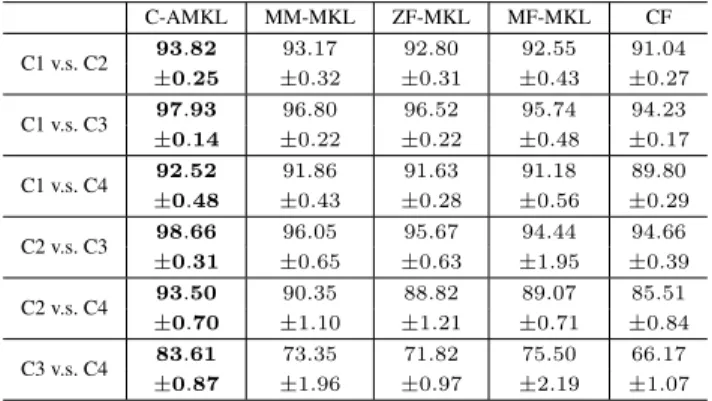
Table 1:Aggregated F1score comparison with statistical test on psortPos. Each cell represents mean aggregated F1score±standard deviation. Boldface means no statistical difference from the best one (p-value≥0.05).
C-AMKL MM-MKL ZF-MKL MF-MKL CF C1 v.s. C2 93.82 93.17 92.80 92.55 91.04 ±0.25 ±0.32 ±0.31 ±0.43 ±0.27 C1 v.s. C3 97.93 96.80 96.52 95.74 94.23 ±0.14 ±0.22 ±0.22 ±0.48 ±0.17 C1 v.s. C4 92.52 91.86 91.63 91.18 89.80 ±0.48 ±0.43 ±0.28 ±0.56 ±0.29 C2 v.s. C3 98.66 96.05 95.67 94.44 94.66 ±0.31 ±0.65 ±0.63 ±1.95 ±0.39 C2 v.s. C4 93.50 90.35 88.82 89.07 85.51 ±0.70 ±1.10 ±1.21 ±0.71 ±0.84 C3 v.s. C4 83.61 73.35 71.82 75.50 66.17 ±0.87 ±1.96 ±0.97 ±2.19 ±1.07
The above algorithms are evaluated on five benchmark MKL data sets, including psortPos, psortNeg, plant data sets, the protein fold prediction data set and Caltech101. In the first part, we report these algorithms on binary classifi-cation tasks, where the one-versus-one strategy is adopted to convert the psortPos, psortNeg and plant data sets to six, ten, and six binary classification problems. After that, we compare their performance on two multi-class classification tasks, i.e., the protein fold prediction and Caltech101 data sets. By following the same settings in (Zien and Ong 2007), the F1score is used to measure the performance of each al-gorithm on the PsortPos and PsortNeg data sets, while the matthew correlation coefficient (MCC) is used for the plant data set. The classification accuracy is taken as a measure-ment on the last two data sets.
Results on the protein subcellular localization
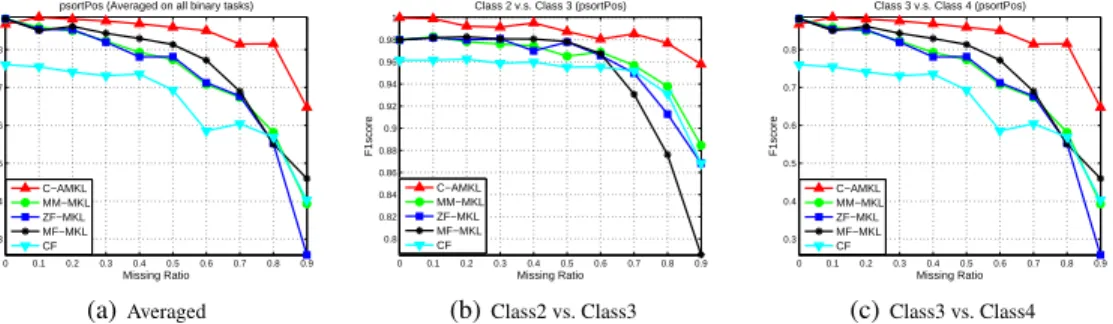
4Results on psortPos: Binary Classification Figure 1(a) is the F1score of these algorithms averaged on all pairwise binary tasks and Figures 1(b)-1(c) are the results on two bi-nary classification tasks shown as examples. As observed: (1) The proposed C-AMKL algorithm (in red) are on the top in all sub-figures, indicating its best performance; (2) The improvement of C-AMKL is more significant with the increase of missing ratio. When the missing ratio is0.9, C-AMKL improves the second best algorithm (MF-MKL) by over18%on class 3 vs. class 4 task (see Figure 1(c)); and (3) The variation of C-AMKL is much smaller with the increase of the missing ratio when compared with other algorithms. It implies that C-AMKL is more stable, which is a desired characteristic for a good classifier.
We attribute the superiority of C-AMKL to the sample-based margin maximization. In contrast, ZF-MKL, MF-MKL and EM-MF-MKL algorithms maximize the margin on the imputed samples. As can be seen, such imputation is not reliable when channel absence is intensive, leading to poor performance.
The aggregated F1score, standard deviation and the p -value of statistical test are reported in Table 1, where the highest accuracy and those whose differences from the high-est one are not statistically significant are shown in bold. As
4
0 0.1 0.2 0.3 0.4 0.5 0.6 0.7 0.8 0.9 0.3 0.4 0.5 0.6 0.7 0.8 Missing Ratio F1score
psortPos (Averaged on all binary tasks)
C−AMKL MM−MKL ZF−MKL MF−MKL CF (a)Averaged 0 0.1 0.2 0.3 0.4 0.5 0.6 0.7 0.8 0.9 0.8 0.82 0.84 0.86 0.88 0.9 0.92 0.94 0.96 0.98 1 Missing Ratio F1score
Class 2 v.s. Class 3 (psortPos)
C−AMKL MM−MKL ZF−MKL MF−MKL CF (b)Class2 vs. Class3 0 0.1 0.2 0.3 0.4 0.5 0.6 0.7 0.8 0.9 0.3 0.4 0.5 0.6 0.7 0.8 Missing Ratio F1score
Class 3 v.s. Class 4 (psortPos)
C−AMKL MM−MKL ZF−MKL MF−MKL CF (c)Class3 vs. Class4
Figure 1:F1score comparison of the above algorithms with variation of missing ratio on psortPos. (a)Averaged, (b)Class2 vs. Class3and (c)Class3 vs. Class4
Table 2:Aggregated F1score comparison with statistical test on psortNeg.
C-AMKL MM-MKL ZF-MKL MF-MKL CF C1 v.s. C2 96.27 94.46 94.40 91.70 93.84 ±0.16 ±0.58 ±0.33 ±0.52 ±0.33 C1 v.s. C3 90.53 89.29 89.52 88.98 88.90 ±0.26 ±0.51 ±0.57 ±0.89 ±0.35 C1 v.s. C4 95.25 94.26 93.31 90.95 92.91 ±0.19 ±0.35 ±0.50 ±0.41 ±0.19 C1 v.s. C5 95.87 94.95 94.83 93.05 94.58 ±0.24 ±0.35 ±0.31 ±0.36 ±0.16 C2 v.s. C3 95.40 94.67 94.66 92.92 93.50 ±0.23 ±0.19 ±0.19 ±0.88 ±0.34 C2 v.s. C4 95.22 95.40 94.91 93.75 93.63 ±0.19 ±0.25 ±1.03 ±0.28 ±0.21 C2 v.s. C5 97.34 96.61 96.33 93.87 96.08 ±0.19 ±0.21 ±0.16 ±0.73 ±0.31 C3 v.s. C4 89.48 88.52 86.16 88.75 77.16 ±0.56 ±0.39 ±0.58 ±0.45 ±0.57 C3 v.s. C5 89.46 88.73 88.50 87.10 86.88 ±0.47 ±0.43 ±0.55 ±0.52 ±0.28 C4 v.s. C5 90.96 90.92 91.03 89.73 87.26 ±0.27 ±0.34 ±0.35 ±0.41 ±0.21
observed, C-AMKL usually significantly outperforms MM-MKL, ZF-MM-MKL, MF-MKL and CF, which is consistent with our observations in Figure 1.
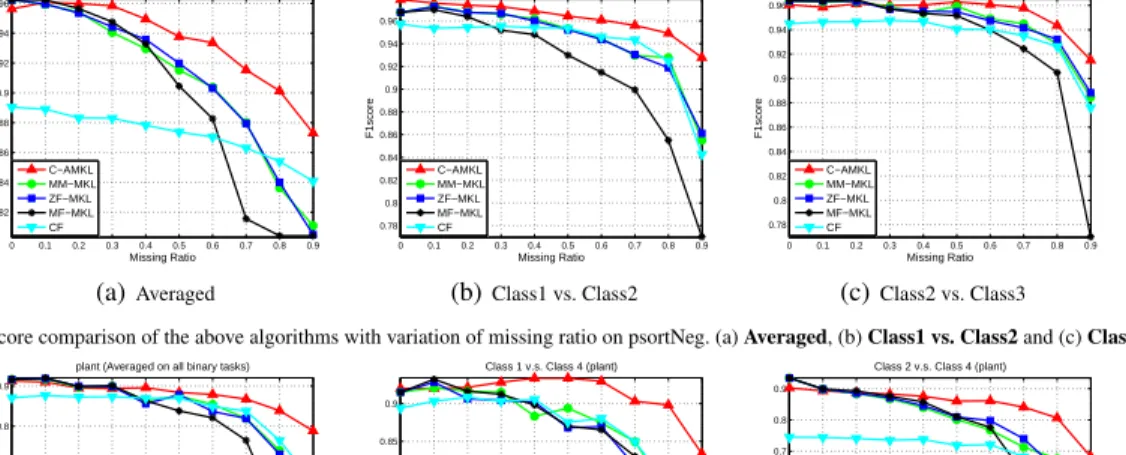
Results on psortNeg: Binary Classification The F1score achieved by the above algorithms with different missing ra-tio is plotted in Figure 2. As can be seen, C-AMKL is still on the top in most of the cases. The improvement of C-AMKL over the others becomes more significant with the increase of missing ratio. It outperforms the second best one (ZF-MKL) by seven percent on the class1 vs. class2 task (Figure 2(b)) when the missing ratio is0.9. We also report the mean aggregated F1score, standard deviation and thep-value of statistical test in Table 2. Again, C-AMKL demonstrates sta-tistically significant improvement over the others.
Results on plant: Binary Classification The MCC of the above algorithms with different missing ratio on the plant data set is plotted in Figure 3. Again, C-AMKL obtains su-perior performance to the others. Also, when the missing ratio is high, C-AMKL demonstrates more improvement. The corresponding mean aggregated MCC, standard devi-ation and the statistical results are reported in Table 3. We can see that C-AMKL is consistently superior to other ones. The above experimental results demonstrate the
advan-Table 3:Aggregated MCC comparison with statistical test on plant.
C-AMKL MM-MKL ZF-MKL MF-MKL CF C1 v.s. C3 75.81 73.53 70.46 69.34 57.62 ±1.04 ±2.21 ±1.45 ±1.90 ±0.81 C1 v.s. C3 93.20 88.33 86.70 80.43 90.77 ±0.71 ±1.28 ±1.00 ±1.35 ±0.54 C1 v.s. C4 91.21 86.59 85.92 85.17 85.32 ±0.55 ±1.14 ±0.62 ±0.37 ±0.49 C2 v.s. C3 92.05 89.78 88.73 85.06 87.29 ±0.44 ±0.77 ±0.72 ±1.15 ±0.58 C2 v.s. C4 84.91 79.08 77.42 72.16 69.87 ±0.49 ±1.27 ±1.72 ±1.28 ±1.01 C3 v.s. C4 87.67 84.13 82.18 78.24 83.44 ±0.61 ±0.87 ±0.63 ±1.11 ±0.71
tages of the proposed C-AMKL. At the same time, we no-tice that C-AMKL may become slightly inferior to the oth-ers when the missing ratio is relatively small, for example, Figure 2(c) and 3(c). We conjecture that this subtle differ-ence is caused by the approach to solving SVMs. Specifi-cally, C-AMKL solves the SVMs in the primal space, while the other algorithms solve it in the dual space. Though the two approaches are conceptually equivalent, they may pro-duce slightly different solutions in practice and this in turn leads to different classification results.
Results on protein fold prediction
5: Multi-class
Classification
Besides the above five algorithms, we also compare the EM-filling approach (EM-MKL) and max-margin absent fea-tures (MMAF) algorithm (Chechik et al. 2008) on the pro-tein fold prediction data set since its input features are avail-able6. It is a27-class classification task. To make these two
algorithms applicable, we first concatenate the features of each sample from all channels into a long vector. After-wards, EM-MKL firstly imputes the missing features with the EM algorithm (Ghahramani and Jordan 1993) and then performs SimpleMKL (Rakotomamonjy et al. 2008) on the imputed data. Differently, MMAF classifies each sample di-rectly in the concatenated space without imputation.
As plotted in Figure 4(a), the proposed C-AMKL shows significant improvement after the missing ratio reaches0.4. When the missing ratio equals to0.7, C-AMKL gains nearly
5
http://mkl.ucsd.edu/dataset/protein-fold-prediction/
6
Note that EM-filling and max-margin absent features need to access the raw input features, which are not publicly available from the internet for other data sets.
0 0.1 0.2 0.3 0.4 0.5 0.6 0.7 0.8 0.9 0.82 0.84 0.86 0.88 0.9 0.92 0.94 0.96 Missing Ratio F1score
psortNeg (Averaged on all binary tasks)
C−AMKL MM−MKL ZF−MKL MF−MKL CF (a)Averaged 0 0.1 0.2 0.3 0.4 0.5 0.6 0.7 0.8 0.9 0.78 0.8 0.82 0.84 0.86 0.88 0.9 0.92 0.94 0.96 Missing Ratio F1score
Class 1 v.s. Class 2 (psortNeg)
C−AMKL MM−MKL ZF−MKL MF−MKL CF (b)Class1 vs. Class2 0 0.1 0.2 0.3 0.4 0.5 0.6 0.7 0.8 0.9 0.78 0.8 0.82 0.84 0.86 0.88 0.9 0.92 0.94 0.96 Missing Ratio F1score
Class 2 v.s. Class 3 (psortNeg)
C−AMKL MM−MKL ZF−MKL MF−MKL CF (c)Class2 vs. Class3
Figure 2:F1score comparison of the above algorithms with variation of missing ratio on psortNeg. (a)Averaged, (b)Class1 vs. Class2and (c)Class2 vs. Class3
0 0.1 0.2 0.3 0.4 0.5 0.6 0.7 0.8 0.9 0.4 0.5 0.6 0.7 0.8 0.9 Missing Ratio MCC
plant (Averaged on all binary tasks)
C−AMKL MM−MKL ZF−MKL MF−MKL CF (a)Averaged 0 0.1 0.2 0.3 0.4 0.5 0.6 0.7 0.8 0.9 0.65 0.7 0.75 0.8 0.85 0.9 Missing Ratio MCC
Class 1 v.s. Class 4 (plant)
C−AMKL MM−MKL ZF−MKL MF−MKL CF (b)Class1 vs. Class4 0 0.1 0.2 0.3 0.4 0.5 0.6 0.7 0.8 0.9 0.2 0.3 0.4 0.5 0.6 0.7 0.8 0.9 Missing Ratio MCC
Class 2 v.s. Class 4 (plant)
C−AMKL MM−MKL ZF−MKL MF−MKL CF (c)Class2 vs. Class4
Figure 3:MCC comparison of the above algorithms with the variation of missing ratio on plant. (a)Averaged, (b)Class1 vs. Class4and (c)Class2 vs. Class4
Table 4:Aggregated accuracy comparison with statistical test on protein fold prediction.
C-AMKL MM-MKL ZF-MKL MF-MKL CF MMAF EM-MKL
51.99±0.62 48.13±0.75 48.04±0.86 42.25±0.79 44.50±0.56 48.64±0.46 44.24±1.39 0.1 0.2 0.3 0.4 0.5 0.6 0.7 0.8 0.9 0.1 0.2 0.3 0.4 0.5 0.6 Missing Ratio ACC
Protein Fold Prediction
C−AMKL MM−MKL ZF−MKL MF−MKL CF MMAF EM−MKL
(a)protein fold prediction
0 0.1 0.2 0.3 0.4 0.5 0.6 0.7 0.8 0.9 0.05 0.1 0.15 0.2 0.25 0.3 0.35 0.4 0.45 0.5 Missing Ratio ACC Caltech101 C−AMKL MM−MKL ZF−MKL MF−MKL CF (b)Caltech101
Figure 4:Classification accuracy comparison of the above algorithms with varia-tion of missing ratio. (a)Protein Fold Prediction. (b)Caltech101.
eight percent improvement over the second best one (MM-AF). The mean aggregated classification accuracy, standard deviation and the statistical test results are reported in Table 4. Again, C-AMKL achieves significantly better classifica-tion accuracy than the rest ones.
Results on Caltech101
7: Multi-class Classification
The Caltech101 used in our experiments has a101 object categories, with15randomly selected samples per class for training and up to50randomly selected samples per class for testing. The classification accuracy of the above algorithms on Caltech101 is plotted in Figure 4(b). The proposed C-AMKL is significantly better than the others after the miss-ing ratio is larger than0.2. When the missing ratio reaches 0.9, C-AMKL achieves nearly19% improvement over the second best one (MM-MKL). We also report the mean ag-gregated classification accuracy, standard deviation and the
7
http://kahlan.eps.surrey.ac.uk/featurespace/web/mkl/
Table 5:Aggregated accuracy comparison with statistical test on Caltech101.
C-AMKL MM-MKL ZF-MKL MF-MKL CF
44.58 38.04 38.07 37.13 24.81
±0.14 ±0.26 ±0.24 ±0.19 ±0.82
statistical test results in Table 5. Again, C-AMKL achieves the highest classification accuracy.
From the above experiments, we conclude that the pro-posed C-AMKL: (1) effectively addresses the issue of chan-nel absence in MKL, and (2) achieves superior performance over the comparable ones, especially in the presence of in-tensive absence.
Conclusion
While MKL algorithms have been used in various applica-tions, they are not able to effectively handle the scenario where there are some absent channels in samples. To ad-dress this issue, this paper proposes to maximize the min-imum of all sample-based margins in the multiple kernel-induced feature spaces. After that, we propose C-AMKL to solve the optimization problem. Extensive experiments have demonstrated the effectiveness of our proposed algorithms, especially when the missing ratio is relatively high. In the fu-ture, we plan to improve the computational efficiency of C-AMKL by solving it via more advanced optimization tech-niques. Moreover, considering the radius of minimum en-closing ball (MEB) may vary due to the channel absence of samples, it is worth trying to integrate the sample-based ra-dius information to further improve our approach.
Acknowledgements
This work was supported by the National Basic Research Program of China (973) under Grant No. 2014CB340303, the National Natural Science Foundation of China (project No. 61125201 and 61403405).
References
Aronszajn, N. 1950. Theory of reproducing kernels. Trans-actions of the American Mathematical Society68(3):337– 404.
Chechik, G.; Heitz, G.; Elidan, G.; Abbeel, P.; and Koller, D. 2008. Max-margin classification of data with absent features.Journal of Machine Learning Research9:1–21. Cortes, C.; Mohri, M.; and Rostamizadeh, A. 2010. Two-stage learning kernel algorithms. InICML, 239–246. Cortes, C.; Mohri, M.; and Rostamizadeh, A. 2012. Al-gorithms for learning kernels based on centered alignment.
Journal of Machine Learning Research13:795–828. CVX Research, I. 2012. CVX: Matlab soft-ware for disciplined convex programming, version 2.0. http://cvxr.com/cvx.
Do, H.; Kalousis, A.; Woznica, A.; and Hilario, M. 2009. Margin and radius based multiple kernel learning. In
ECML/PKDD (1), 330–343.
Gai, K.; Chen, G.; and Zhang, C. 2010. Learning kernels with radiuses of minimum enclosing balls. InNIPS, 649– 657.
Ghahramani, Z., and Jordan, M. I. 1993. Supervised learn-ing from incomplete data via an em approach. InNIPS, 120– 127.
G¨onen, M., and Alpaydın, E. 2011. Multiple kernel learn-ing algorithms. Journal of Machine Learning Research
12:2211–2268.
G¨onen, M. 2012. Bayesian efficient multiple kernel learn-ing. InICML.
Kloft, M.; Brefeld, U.; Sonnenburg, S.; and Zien, A. 2011.
lp-norm multiple kernel learning. Journal of Machine Learning Research12:953–997.
Kumar, A.; Niculescu-Mizil, A.; Kavukcuoglu, K.; and III, H. D. 2012. A binary classification framework for two-stage multiple kernel learning. InICML.
Lanckriet, G. R. G.; Cristianini, N.; Bartlett, P. L.; Ghaoui, L. E.; and Jordan, M. I. 2004. Learning the kernel matrix with semidefinite programming.Journal of Machine Learn-ing Research5:27–72.
Liu, X.; Wang, L.; Yin, J.; and Liu, L. 2012. Incorporation of radius-info can be simple with simplemkl.Neurocomputing
89:30–38.
Liu, X.; Wang, L.; Yin, J.; Zhu, E.; and Zhang, J. 2013. An efficient approach to integrating radius information into multiple kernel learning.IEEE Transactions on Cybernetics
43(2):557–569.
Liu, X.; Wang, L.; Zhang, J.; and Yin, J. 2014. Sample-adaptive multiple kernel learning. InAAAI, 1975–1981.
Marlin, B. M. 2008. Missing Data Problems in Machine Learning. Ph.D. Dissertation, Department of Computer Sci-ence, University of Toronto.
Orabona, F., and Luo, J. 2011. Ultra-fast optimization algo-rithm for sparse multi kernel learning. InICML, 249–256. Rakotomamonjy, A.; Bach, F. R.; Canu, S.; and Grandvalet, Y. 2008. Simplemkl.Journal of Machine Learning Research
9:2491–2521.
Sch¨olkopf, B.; Herbrich, R.; and Smola, A. J. 2001. A gener-alized representer theorem. InCOLT/EuroCOLT, 416–426. Smola, A. J.; Vishwanathan, S. V. N.; and Hofmann, T. 2005. Kernel methods for missing variables. In Cowell, R. G., and Ghahramani, Z., eds.,AISTATS05, 325–332. Xu, Z.; Jin, R.; Yang, H.; King, I.; and Lyu, M. R. 2010. Simple and efficient multiple kernel learning by group lasso. InICML, 1175–1182.
Yan, F.; Kittler, J.; Mikolajczyk, K.; and Tahir, M. A. 2012. Non-sparse multiple kernel fisher discriminant analy-sis.Journal of Machine Learning Research13:607–642. Yuan, L.; Wang, Y.; Thompson, P. M.; Narayan, V. A.; and Ye, J. 2012. Multi-source learning for joint analysis of incomplete multi-modality neuroimaging data. In KDD, 1149–1157.
Zien, A., and Ong, C. S. 2007. Multiclass multiple kernel learning. InICML, 1191–1198.