A Pattern-Based Game Mechanics Design Assistant
Riemer van Rozen
∗Amsterdam University of Applied Sciences Duivendrechtsekade 36-38 1096 AH
Amsterdam, The Netherlands
[email protected]
ABSTRACT
Video game designers iteratively improve player experience by play testing game software and adjusting its design. De-ciding how to improve gameplay is difficult and time-con-suming because designers lack an effective means for explor-ing decision alternatives and modifyexplor-ing a game’s mechan-ics. We aim to improve designer productivity and game quality by providing tools that speed-up the game design process. In particular, we wish to learn how patterns en-coding common game design knowledge can help to improve design tools. Micro-Machinations (MM) is a language and software library that enables game designers to modify a game’s mechanics at run-time. We propose a pattern-based approach for leveraging high-level design knowledge and fa-cilitating the game design process with agame design assis-tant. We present the Mechanics Pattern Language (MPL) for encoding common MM structures and design intent, and a Mechanics Design Assistant (MeDeA) for analyzing, ex-plaining and understanding existing mechanics, and gener-ating, filtering, exploring and applying design alternatives for modifying mechanics. We implement MPL and MeDeA using the meta-programming language Rascal, and eval-uate them by modifying the mechanics of a prototype of Johnny Jetstream, a 2D shooter developed at IC3D Media.
1.
INTRODUCTION
Video game designers work to improve player experience by iteratively play testing game software and adjusting the game’s design. Improving gameplay is difficult and time-consuming because designers lack an effective means for quickly exploring design alternatives and modifying a game’s mechanics. Specifically, designers cannot efficiently 1) au-thor, modify and fine-tune mechanics—rules of games that influence gameplay—without help of programmers; 2) re-ceive immediate feedback for comparing design intent to change result; and 3) explore decision alternatives efficiently.
∗This work is part of the Automated Game Design Project, and this
research is carried out at the SWAT group of CWI, Amsterdam, NL.
Since making well-informed design decisions is costly due to long iteration times, play testing is limited to fewer software versions than necessary for achieving the best game quality. We aim to improve designer productivity and game quality by providing tools that speed-up the game design process. In particular, we wish to learn how patterns encoding common game design knowledge can help to improve such tools. Micro-Machinations (MM) is a visual language and soft-ware library that facilitates brief design iterations by en-abling game designers to modify a game’s mechanics while it is running, and to play test simultaneously [10, 21]. MM programs can be represented as visual diagrams that are directed graphs describing game-economic mechanics using various kinds of nodes and edges. A diagram works inside a game, steering its mechanics, and when set in motion through run-time and player interaction, the nodes redis-tribute resources along the edges between the nodes. Un-derstanding the dynamics of diagrams is hard because signers combine elements in non-trivial ways, expressing de-sign intent by providing choices, challenges, trade-offs and strategies for interesting gameplay. Adams and Dormans have suggested patterns for MM’s evolutionary predecessor Machinations, as a mental framework for understanding, ex-plaining and designing game mechanics, and they provide a mechanics design rationale with example diagrams [1]. We propose a pattern-based approach that assists design-ers in the discipline of modeling mechanics for modifying game software. We define parameterized micro-mechanism patterns (patterns for short) that capture a wide range of diagrams with shared structures and design intent. We pro-vide a Mechanics Pattern Language (MPL) for programming patterns and a Game Mechanics Design Assistant (MeDeA) that recognizes patterns in existing diagrams, explains in-tent of design choices in understandable text and enables interactively and visually exploring design choices that can be step-by-step filtered and applied yielding new diagrams and software versions. We contribute the following:
• A Mechanics Pattern Language (MPL) for program-ming patterns that capture a wide range of diagrams with shared structures and design intent.
• A Mechanics Design Assistant (MeDeA) implemented in the Rascalmeta-programming language for analyz-ing, explaining and understanding existing mechanics and generating, filtering, exploring and applying de-sign alternatives for modifying mechanics.
scope/concern language tool/system goals/functionality
“2D games” (research platform) PyVGDL [15] PyVGDL lib. Design games and analyze dynamics and learning algorithms board games GDL / Ludemes [3] Ludi system Playing, measuring, and synthesizing board games
mechanics of “board-games” Prolog subset [16] BIPED Prototype complete board-like games and analyze their dynamics mechanics (avatar-centric) PDDL subset [23] Generator sys. Generate playable mechanics using a constraint solver+planner mechanics (game-economic) Machinations [1] Flash Tool Conceptually analyze mechanics designs (not software artefacts)
MM, MPL [this paper] MeDeA Statically analyze & modify embedded mechanics using patterns discrete domain games Gamelan [14] “Tool set” Analyze Gamelan game dynamics against Computational critics stories of Zelda-like 2D RPGs Plot points sequence [7] GameForge Generate & render playable game world & story configurations stories in interactive drama Praxis [6] Prompter Author & analyze stories in agent-based interactive drama
Table 1: Game Description Languages and tools for authoring, analyzing and modifying different game facets
Gameplay Gameplay Design Patterns Player Game Software User Interface MM Library MM Game Mechanics
MeDeA MPL MechanicsDesign Patterns Game Designer
modify analyze
program
runs on
author, explore, fine-tune
implemented by emerge
describe and explain
describe and explain interact
Figure 1: Relating design patterns to a game system
2.
RELATED WORK
We relate our work to languages, game design patterns and design tools providing analysis or procedural generation tech-niques. Fig. 1 schematically shows how a designer modifies mechanics during play testing for improving the gameplay of a working game system, which includes both players and software. Before we elaborate on our approach for improving designer productivity we first sketch the research context. Languages.Game designers have expressed the need for a common game design vocabulary [4]. Languages and tools are necessary for describing, communicating and improving game designs using both mental frameworks and authoring tools for constructing parts of game software. We relate our perspective to the Mechanics Dynamics and Aesthetics (MDA1) framework of Hunicke et al. who describe an ap-proach to game design and game research [8]. As shown in Fig. 1, we view mechanics as part of the game software, dynamics as its run-time and player interaction, and aes-thetics as good player experience (gameplay) that emerges. MeDeA is an authoring tool that uses Micro-Machinations (MM), a language for game-economic mechanics described by Klint, van Rozen and Dormans [10, 21]. MM is an evolu-tionary successor of Machinations, a mental framework for understanding the effect of game mechanics on gameplay introduced by Adams and Dormans [1]. MM and MPL are so-called Domain-Specific Languages (DSLs) [20], declara-tive languages that offer designers expressive power focussed specifically on game-economic mechanics [10]. Domains other 1Not to be confused with the Model-Driven Architecture (MDA), a software design approach for developing software systems by the Object Management Group (OMG) and a proprietary form of Model Driven Engineering (MDE).
than game development have benefited from DSLs and seen substantial gains in productivity and software quality at the cost of maintenance and education of DSL users [20]. Unlike ontologies [22] or mental frameworks that focus on analyz-ing and understandanalyz-ing games, DSLs also serve to modify software systems.
Patterns. Kreimeier made a general case for game design patterns [11]. Design patterns have been used to describe recurring patterns of gameplay [2] and game mechanics [1]. Bj¨orket al.propose game design patterns for analyzing and describing gameplay that enable understanding and explain-ing games and how they relate, and together form a game design body of knowledge [2]. We view these patterns as
gameplay design patterns, which can be used to understand what gameplay goals a completed game has, or should have while play testing during a game’s construction. In con-trast,game mechanics patternscan be used to describe how a game’s mechanics work before it is built, and to modify them afterwards, offering a way to achieve gameplay goals. MPL can be used to model mechanics design patterns and MM offers a way to implement a game’s mechanics aimed at improving gameplay as shown in Fig. 1. We view both pat-tern kinds as complementary, and discovering relationships between them as an exciting direction of future research. Unlike gameplay design patterns, MeDeA facilitates under-standing mechanics by recognizing and visualizing patterns that run in software, and offering high-level explanations about their dynamics.
Tools. Game Description Languages (GDLs) are DSLs for the game domain. GDLs, tools and libraries have been described that offer game designers affordances for author-ing, analyzauthor-ing, understanding and modifying different game facets, e.g., measuring a game’s qualities or by procedurally and/or iteratively generating content in a mixed-initiative way [17] or for automatic improvements. Comparing GDLs is hard because their goals, tools and notations differ, and their expressive power over specific or general abstractions and behaviors for achieving novel gameplay goals vary greatly. Therefore their effectiveness and usage scenarios range from game- or genre-specific, to more general and abstract. Ta-ble 1 shows a small list of representative GDLs. Disci-plines include modeling mechanics of game-economies [10, 21], avatar acts [23] and board games [3, 16] but also lev-els [17], missions and stories of e.g., Zelda-like 2D games [7] or interactive drama [6]. Declarative textual notations have been proposed for specific classes of games. Nelson an Mateas’ game design assistant facilitates iteratively pro-totyping micro-games with stock mechanics by authoring nouns, verbs and constraints [13]. Smithet al.propose pro-totyping abstract board-like games in a lightweight
logic-Figure 2: Screenshot of a Johnny Jetstream prototype that embeds the Micro-Machinations library
based sketching language that models game state and muta-tion events on the BIPED system, which integrates the logi-cal LUDOCORE engine and produces gameplay traces using answer-set-programming [16]. Browne and Maire demon-strate the feasibility of evolutionary techniques for closed-system combinatorial board games by measuring specific playability qualities in Ludi [3]. In contrast, Osbornet al. ar-gue for a more general procedural language. They propose Gamelan for games over discrete domains (e.g., board, card games), and modular computational critics that can mea-sure rule coverage, turn-taking fairness and existence of un-interesting strategies [14]. Evans and Short describe the Versu storytelling system, which is specific for interactive drama but also more generally reusable. Their Praxis lan-guage describes autonomous agents and social practices, and Prompter is a tool for debugging emergent stories [6]. MM is a visual and textual DSL aimed at reuse that raises the abstraction level above that of game- or genre-specific, tightly integrated languages. MM separates the concern of game economies and supports both closed systems and in-tegration into larger systems composed of parts. In prior work, MM was analyzed against invariants using model-checking [10], and used to rapidly modify the mechanics of a tower defense game iteratively at run-time using the embed-dable reusable MM library2[21]. MeDeA extends MM’s tool set and the spectrum of mixed-initiative interactive game de-sign tools with a novel and general pattern-based approach for deciding how to improve a game’s mechanics, offering alternatives designers might otherwise overlook.
3.
MECHANICS DESIGN ASSISTANT
We present a Game Mechanics Design Assistant (MeDeA) and evaluate it using game mechanics of Johnny Jetstream (JJ), a 2D side-scrolling shooter developed at Dutch game business IC3D Media that embeds MM. Fig. 2 shows a screen-shot of JJ. MM programs can be represented as visual dia-grams which are directed graphs that consist of two kinds of elements,nodes andedges. Both may be annotated with ex-tra textual or visual information. These elements describe the rules of internal game economies, and define how re-sourcesare step-by-step propagated and redistributed through the graph. A diagram works inside a game, controlling its internal economy, and when set in motion through run-time and player interaction, the nodes redistribute resources along the edges through the graph.
2 https://github.com/vrozen/MM-Lib costUpgrade: 10 * bonus^2 buyShield hp getMedkit: 20 dmgHp: (100-shield)*0.1 Income: bonus kill costShield: 10 + shield getShield: 10 0 $ gold buyMedkit costMedkit: 10 0 + shield 100 + getBonus: 1 upgrade * * dmgShield: 5 damage bonus 2 +
Figure 3: MM diagram of example mechanics of JJ
pattern + Property Benefit: BenefitExp $ Energy Cost: CostExp Acquire
Intent: Activating converterhAcquireicostshCostExpiresources from poolhEnergyias specified by resource connectionhCostiand yields hBenefitExpi resources in pool hPropertyi as specified by resource connectionhBenefiti.
Figure 4: Palette: an Acquisition pattern
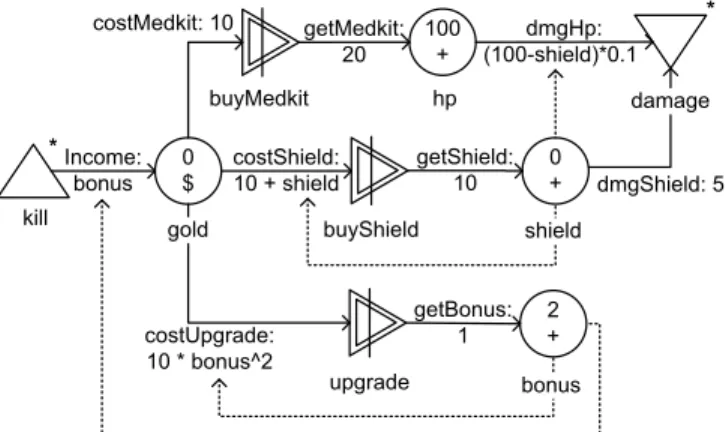
Fig. 3 shows a sample MM implementation part of JJ that is hard to read for novices. This is our running example. We introduce MM and the Mechanics Pattern Language (MPL) by analyzing it against patterns with MeDeA. The tool ex-plains the design by generating explanations from patterns and templates explained in Section 3.1. Next, we describe the mixed-initiative decision making process of MeDeA in Section 3.2 and show how MeDeA also assists in authoring the example using the same patterns in Section 3.3. We sketch MeDeA’s architecture in Section 3.4.
3.1
Pattern-Based Analysis and Explanation
We analyze and explain example mechanics of JJ using a collection of patterns we call our pattern palette. Although usually such a collection is called a catalogue, we will show that the term palette more closely resembles its uses. Our example palette is written in MPL, which enables palette composition and maintenance. It is based on a subset of patterns proposed by Adams and Dormans, to whom we refer for a high level discussion that omits programmed pa-rameterized patterns as discussed here [1]. We introduce MM and MPL by example, briefly stating pattern intent. For conciseness we omit general explanations on motivation and applicability, focusing on how the patterns work. We do not claim these patterns are complete for explaining and authoring all interesting MM diagrams, and we expect that designers will have varying opinions on what makes a good palette. Here we give concise explanations. We provide a complete description3 and a movie4 as supplemental mate-rial. We now begin MeDeA’s automated analysis.
3https://vrozen.github.io/fdg2015/fdg2015_rozen.pdf 4
role A1 A2 A3
Energy gold gold gold
Acquire buyMedkit buyShield upgrade
Property hp shield bonus
Cost costMedkit costShield costUpgrade CostExp 10 10 + shield 10 * bonus2 Benefit getMedit getShield getBonus
BenefitExp 20 10 1
Table 2: Acquisition pattern cases in JJ
Acquisition. Designers can apply the Acquisition pattern for offering players a way to acquire property by spending currency. The visual representation of the Acquisition pat-tern is shown in Fig. 4. Visual MPL can be distinguished from MM by the a rectangle with a crooked edge pattern label on the top left, its name appearing in the top center. Patterns consist of named elements calledparticipants. Ac-quisition has five participants, three nodes and two edges. Each participant name represents the role the participant plays in its context. We explain them one by one.
• Energy is a node of type pool, which abstracts from an in-game entity modeled by an MM diagram and can contain resources. Pools appear as a circle that contains an optional amount of starting resources, and zero or morecategories that specify design intent. In our example palette, the category symbol ($) marks that a node abstracts from currency such as gold, crys-tals or lumber, and is intended for spending.
• Property is another pool. Its category symbol (+) marks that it abstracts from a diagram node whose resources players desire to have such as health (hp).
• Costis aresource connection, an edge with aflow rate expression that specifies the amount of resources that can flow, in this case how much the acquisition costs.
• Benefitis another resource connection that specifies how much Property the acquisition yields.
• Acquireis aconverter, appearing as a triangle point-ing to the right with a vertical line through the mid-dle, that converts one type of resource into another. Acquire is the only node that acts in this pattern by
pulling resources along itsinput (Cost), and pushing
resources along itsoutput (Benefit). Using the game’s user interface, players can activate nodes that have an
interactive activation modifier, visually marked with a double line, but converters only work when all re-sources on its inputs are available.
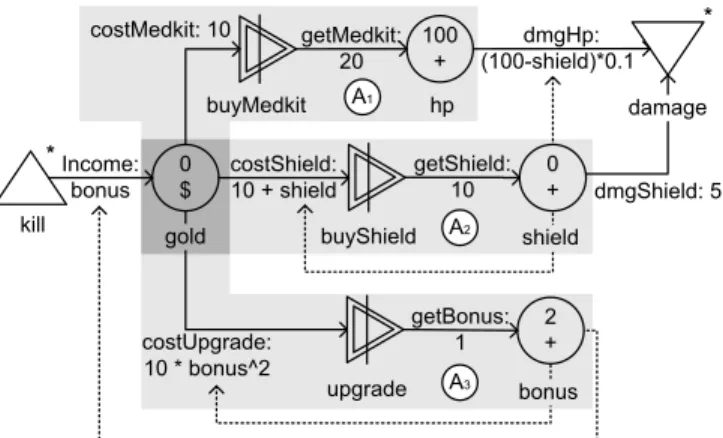
MeDeA analyzes our example diagram of Fig. 3 against the Acquisition pattern, and recognizes three cases. Fig. 5 shows pattern instancesA1,A2andA3(in light gray) that overlap in role Energy played by diagram pool gold (dark gray). Table 2 shows how roles are assigned over diagram elements and flow rates. MeDeA uses the pattern template to explain each pattern case to designers as shown in Table 3. Dynamic Engine. Players require resources for activating one or more game-economic actions, in this casegold. The Dynamic Engine pattern, shown in Fig. 6, introduces income
costUpgrade: 10 * bonus^2 buyShield hp getMedkit: 20 dmgHp: (100-shield)*0.1 Income: bonus kill costShield: 10 + shield getShield: 10 0 $ gold buyMedkit costMedkit: 10 0 + shield 100 + getBonus: 1 upgrade * * dmgShield: 5 damage bonus 2 + A1 A2 A3
Figure 5: MM diagram showing three Acquisition cases case explanation
A1 Activating converter buyMedkit costs10 resources from pool gold as specified by resource connection costMedit and yields20resources in poolhpas specified by resource connectiongetMedkit.
A2 Activating converterbuyShieldcosts10+shieldresources from poolgold as specified by resource connection cost-Shield and yields10 resources in poolshield as specified by resource connectiongetShield.
A3 Activating converter upgrade costs 10*bonus2 resources from pool gold as specified by resource connection cos-tUpgradeand yields1 resources in poolhpas specified by resource connectiongetBonus.
Table 3: MeDeA explains three Acquisition cases in JJ
+ Upgrades Benefit: BenefitExp Cost: CostExp pattern IncomeExp Upgrades Producer Income: IncomeExp * Invest Spend: SpendExp Act $ Energy
Intent:SourcehProduceriproduces an adjustable flowhIncomeiof
hIncomeExpiresources. Players can invest using converterhInvesti
to improve the flow. Apply when:Apply Dynamic Engine for in-troducing a trade-off between spending currencyhEnergyion long-term investmenthInvestiand short-term gainshActi.
Figure 6: Palette: a Dynamic Engine pattern and a tradeoff between long-term investments and short-term gains [1]. We explain its participants.
• Producer is a source. A source node, appearing as a triangle pointing up, is the only element that can generate resources. A source can be thought of as a pool with an infinite amount of resources. It can push any amount of resources, and therefore provides the flow rates specified by its outputs to the respec-tive targets. The automatic activation modifier (*) of
Producer specifies it automatically provides Income-Expresources via resource connectionIncome.
costUpgrade: 10 * bonus^2 buyShield hp getMedkit: 20 dmgHp: (100-shield)*0.1 Income: bonus kill costShield: 10 + shield getShield: 10 0 $ gold buyMedkit costMedkit: 10 0 + shield 100 + getBonus: 1 upgrade * * dmgShield: 5 damage bonus 2 + D1 D2
Figure 7: MM diagram showing two Dynamic Engine cases
Energy Loss: LossExp * Lose pattern
Intent:DrainhLoseicauses a loss by pulling flow ratehLossExpi
via resource connectionhLossifrom poolhEnergyi.
Figure 8: Palette: a Static Friction pattern
• Investis a converter converting Energy into Upgrades.
• Actis anabstract node, visually represented as a star, that represents any kind of node that players can ac-tivate for spending Energy. In this pattern it also rep-resents an alternative user action to Invest.
• Upgradesis a pool whose resource amount influences
Income positively and is marked as property (+).
• Incomeis a resource edge where its flow rate Income-Exp grows monotonically with Upgrades, as defined by the constraint on the left bottom of the diagram. This has to be the case for investment to be beneficial. A dashed edge signifying Upgrades is used in Income makes the feedback loop explicit.
• Cost is a resource edge specifying the cost of Invest from Energy.
• Benefitis resource edge specifying the benefit of In-vest to Upgrades.
• Spendis a resource edge specifying the cost of Act.
MeDeA again analyzes our example diagram, now using the Dynamic Engine pattern and finds it twice as shown in Fig. 7, and the pattern roles are distributed as shown in Table 4. The difference between instancesD1 andD2 is
buyMedkit is replaced by buyShield. MeDeA’s explanation of pattern caseD1is shown in Table 5. We omit its explana-tion ofD2. We remark that in JJkillhappens automatically, but only when a player shoots an enemy, not every step. Static Friction. So far our palette contains only patterns for gaining and converting resources. We need just one more
role D1 D2
Producer kill kill
Energy gold gold
Invest upgrade upgrade Act buyMedkit buyShield Upgrades bonus bonus Income income income IncomeExp bonus bonus Cost costUpgrade costUpgrade CostExp 10 + bonus2 10 + bonus2 Benefit getBonus getBonus
BenefitExp 1 1
Spend costMedkit costShield SpendExp 10 10 + shield
Table 4: Dynamic Engine pattern cases in JJ case explanation
D1 Source killproduces an adjustable flowincomeofbonus resources. Players can invest using converter upgradeto improve the flow. Apply Dynamic Engine for introducing a trade-off between spending currencygoldon long-term investmentupgradeand short-term gainsbuyMedkit.
Table 5: MeDeA explains a Dynamic Engine case in JJ
role F1 F2
Energy shield hp Loss dmgShield dmgHp LossExp 5 (100-shield)*0.1 Lose damage damage
Table 6: Static Friction pattern cases in JJ case explanation
F1 Drain damage causes a loss by pulling flow rate (100-shield)*0.1 via resource connectiondmgHpfrom poolhp.
F2 Draindamagecauses a loss by pulling flow rate5 via re-source connectiondmgShieldfrom poolshield.
Table 7: MeDeA explains Static Friction cases in JJ Pattern
Palette
Pattern Selection 1
Pattern 2RestrictionPattern
Search Parameters Diagram Analysis 3 Diagram Design Decisions Decision Filtering 4 Filtered Decisions Decision Selection 5 Selected Decision Decision Application 6
Figure 9: MeDeA iterative decision making process
pattern to explain all elements in the diagram. The Static Friction pattern is intended to counter positive effects a player tries to achieve, posing a challenge [1]. Its visual representation and pattern cases and MeDeA’s explanations are shown in Fig. 8, Table 6 and Table 7. This concludes our concise explanation of MeDeA’s pattern-based analysis.
3.2
Mixed-Initiative Design Decision Making
MeDeA facilitates the process of understanding and making game design decisions as we have seen in the previous sec-tion. It supports a process that consists of a sequence of simple steps as shown in Fig. 9. Rectangles represent data structures and rounded rectangles represent processes either
Figure 10: MeDeA: A Pattern-Based Game Mechanics Design Assistant
primarily controlled by the user (light gray) or MeDeA (dark gray). By default MeDeA recognizes a full pattern in a dia-gram, associating a diagram element to each role in the pat-tern. However, MeDeA can also recognize partial matches, where not all roles in the pattern are represented, yielding a possibly large set ofextension pointsto the diagram with respect to the pattern. Each extension point is associated with a set of pattern elements that did not match we call the
extension. Given a designer’s decision to apply the pattern, we reason that each extension is a possibledesign decision. The problem is that exploring a large set of decisions alter-natives is not feasible. Our solution is to step-by-step filter the design alternatives by letting the designer associate roles to diagram elements for cherry picking from a restricted set of alternatives. We explain the decision-making process and detail the steps designers take.
1. Pattern Selection. Select a pattern from the palette displayed by MeDeA for modifying a diagram. 2. Pattern Restriction. Choose the minimum amount
of pattern elements (minimum match size) for which roles must be mapped to diagram elements, affecting the size of the extension point. Optionally, restrict the search for design decisions by step-by-step assigning roles to names of elements in the diagram. This yields role constraints that target the search.
3. Diagram Analysis. Initiate the analysis of the di-agram against the pattern. MeDeA generates a po-tentially large set of design decisions, every way the pattern applies to the diagram, given the minimum match size and predefined role constraints.
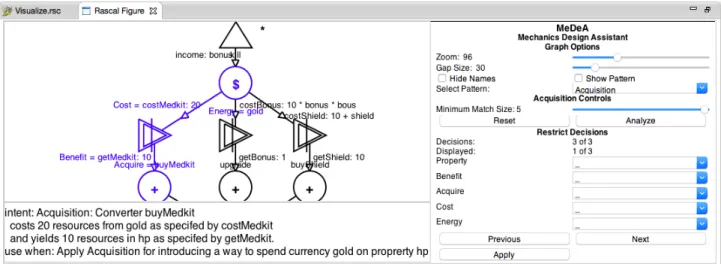
4. Decision Filtering. Filter the generated design de-cisions by further assigning roles to names of elements in the diagram. This yields additional role constraints that exclude generated decisions by filtering them out. 5. Decision Selection. Visually inspect the remaining design decisions, and select one that expresses design intent. MeDeA shows a visual rendering of diagram resulting from the design decision, providing colors for distinguishing between existing (black), found (blue),
added/not found (green). For each visual representa-tion MeDeA also shows the design intent specified by the pattern in which roles and amounts are replaced by their concrete names and values in the diagram. 6. Decision Application. Apply the selected design
de-cision after providing MeDeA with names for all added elements (green) and flow amounts for all added edges. Additionally, found elements (blue) are optionally ad-justed and replaced. MeDeA then then replaces the current diagram by the newly created one. This con-cludes the iteration, continue at step 1.
3.3
Assisted Game Mechanics Authoring
We now demonstrate how MeDeA assists in authoring5 the mechanics of our running example shown in Fig. 3 by follow-ing the decision process of Fig. 9. We start with an empty diagram that we view as an empty canvas. First we select the Acquisition pattern from our palette. The pattern can-not match, because the canvas is empty, but we restrict the pattern to a minimum match size of zero, allowing us to add it. We provide MeDeA with the role names and edge flow rates specified byA1shown in Table 2 and apply the change. We again select Acquisition, restricting the pattern to a min-imum match size of one, which yields seven decisions. We restrict the roleEnergy togold, leaving four decisions. We select the decision where the other roles are added, provid-ing values for them fromA2as before and repeat these steps forA3. Our diagram now has the elements highlighted with gray in Fig. 5.
Next we select the Dynamic Engine pattern from our palette and restrict the minimum match size to five. MeDeA offers twenty-seven design decisions. We associate the role Up-gradestobonus,EnergytogoldandInvest toupgrade, leav-ing just three decisions. We pick one of two wherebuyMedkit
orbuyShieldplay roleActand apply it. The unassigned roles are Producer and Income, which we name kill and income
respectively. We giveincome a flow rate ofbonus, thereby satisfying the pattern constraint. Our diagram now contains the elements highlighted in gray in Fig. 7.
5
diagram d parse MM td1 desugarMM td2 1 pattern p parse MPL tp1 desugar MPL tp2 2 generate match 4 Rascal source eval 5 extension points generate decisions 6 decisions filter 7 filtered decisions visualize 3 8
Figure 11: MeDeA: Model Transformation Steps
Next we select the Static Friction pattern from our palette, restrictingEnergy to hp yielding one design decision. We apply it, providing vales for pattern rolesLoss andLose as specified byF1 shown in Table 6. Finally, we select Static Friction one more time for also applying Static Friction to
shieldusing the values specified byF2for pattern roleLoss. With these simple steps our diagram is now complete.
3.4
Tool Architecture
MeDeA is implemented in Rascal, a functional metapro-gramming language and language workbench for source code analysis and manipulation [9]. MeDeA’s implementation6 counts just 2.7K lines of code excluding comments and white-space. Each of MeDeA’s analysis and transformation steps is controlled from its UI shown in Fig. 10, which is programmed using the RascalFigure library as interactive visualization offering designers UI elements for mixed-initiative decision making as explained in Section 3.2.
Fig. 11 schematically shows the steps of how MeDeA pro-cesses diagrams and patterns. MM and MPL each have their owngrammar for parsing 1 textual programs that are represented as visual diagrams and patterns in this paper. MM and MPL parse trees areimplodedagainst an Algebraic Data Type (ADT) such that we get Abstract Syntax Trees (ASTs). These ASTs aredesugared 2, a transformation in which syntactic constructs added for user convenience are transposed to a more fundamental ADT that we visualize 3. In our case the desugared ADT is the same for MM and MPL, which is necessary for our approach because we rely on a Rascalfeature calledset matching for our results.
We generate Rascal programs 4 in which parameterized ADTs for patterns are matched against the ADTs of di-agrams. Some ADT fields are parameters and some are constants, depending on the pattern, the diagram and op-tional user-supplied constraints for limiting the search space. When we evaluate 5 these programs with Rascal it uses
backtracking to bind the parameters to constants in every possible way, yielding a possibly large set of extension points to the diagram with respect to the pattern. From these ex-tension points we generate design decisions 6, which are visualized as partial diagrams without values for the added diagram elements. Filtering 7 happens over this set us-ing constraints posed by assignus-ing diagram element names to roles. We again use Rascal’s matching to filter out un-wanted solutions in which the roles (the pattern parameters) are bound to different constants. When applying a decision the current diagram is replaced with a new one 8 in which added elements have their variables bound to user supplied constants such as element names and flow rate expressions. 6
https://github.com/vrozen/MeDeA
4.
DISCUSSION
MeDeA simplifies authoring, understanding and modifying a game’s game-economic mechanics, and for its users is an im-provement over editing textual MM programs. However, the tool is currently limited to text or pattern-based authoring because Rascal does not yet support visual edits on fig-ures. Moreover, MeDeA is intended for game designers that can work as gameplay engineers, because mechanics mod-eling is an inherently complex technical discipline. MeDeA performs exhaustive calculations, which means that larger diagrams matched against patterns with fewer user-defined constraints result in larger search spaces, more extension points and longer calculation times. However, diagrams are composed of modular constructs called components [10] (ab-stracted away in this paper), which ensures that diagrams are relatively small. MeDeA supports a programmable ex-tensible pattern palette for maintaining patterns, which mit-igates the lack of MPL patterns mined from software.
5.
CONCLUSION
We have presented a Mechanics Pattern Language (MPL) for programming patterns that capture a wide range of game-economic mechanics with shared structures and design in-tent, and a Mechanics Design Assistant (MeDeA) for analyz-ing, explaining and understanding existing mechanics that also supports exploring and applying decision alternatives for modifying mechanics. Its simple interface enables gen-erating decisions from patterns, filtering and selecting us-ing simple point-and-click controls, and all mechanics mod-ifications result from applying generated design decisions. MeDeA is implemented in the Rascal, a meta-programming language and language workbench. Of course, MeDeA is an academic prototype, and the case study on modifying the mechanics of Johnny Jetstream is a relatively small informal evaluation. Because the approach is general, embeddable, reusable and maintainable we believe it is a step towards in-dustrially applicable game design tools. A more systematic evaluation is part of future work.
5.1
Future Work
Our pattern-based mixed-initiative model-driven game de-sign approach can be extended by automating additional game disciplines and facets representing separated concerns.
• Our approach for generating alternative design deci-sions for modifying mechanics can also be used for fully automatic game design. It complements evolutionary approaches [18], which can also provide an alternative for filtering, and can drive a game generator such as the Game-O-Matic [19], Ludi [3] or the Angelina sys-tem [5]. Because MM is a reusable embeddable for-malism that expresses extensible game economies in general, it is less dependent on specific generators and
constrained input. Recipes can consist of names of patterns, resources and actions, and designers can an-alyze, modify and fine-tune the generated results.
• Modifying gameslive—while they run—may help tackle adaptivity challenges [12]. Modeling player behaviors and player experience respectively enable automating mechanics testing and play testing.
• The gap between high-level game design patterns and programming game mechanics may be bridged by fur-ther automating pattern-based transformations. Case studies on games embedding MM can help evaluate how MPL patterns relate to game design patterns, and how predictive they are for emergence. MPL can support pattern mining, relating palettes to existing game design knowledge for forming genre-specific pat-tern palettes of game-economic game design lore.
• A major challenge remains engineering languages and tools for different experts participating in game de-velopment processes. We argue for software language engineering of game languages which entails domain analyses and meta-programming of game design tools, e.g., writers require view points on storylines whereas game designers need view points on game mechanics, gameplay, levels and missions. Each of these view points could exist as separated concerns modified via
liveuser interfaces designed to model, analyze and gen-erate content for composing high quality games that are pieced together from sets of expressive, reusable, extensible, interoperable and embeddable formalisms. Acknowledgements. I thank Paul Klint for discussions and proof reading, and the anonymous reviewers for their insightful comments that helped restructure this paper.
6.
REFERENCES
[1] E. Adams and J. Dormans.Game Mechanics: Advanced Game Design. New Riders Publishing, Thousand Oaks, CA, USA, 1st edition, 2012. [2] S. Bj¨ork, S. Lundgren, and J. Holopainen. Game
Design Patterns. InLevel Up: Digital Games Research Conference 2003, pages 4–6, 2003.
[3] C. Browne and F. Maire. Evolutionary Game Design.
Computational Intelligence and AI in Games, IEEE Transactions on, 2(1):1–16, March 2010.
[4] D. Church. Formal Abstract Design Tools.Game Developer, 1999.
[5] M. Cook and S. Colton. Multi-faceted Evolution of Simple Arcade Games. InComputational Intelligence and Games (CIG), 2011 IEEE Conference on, pages 289–296, Aug 2011.
[6] R. Evans and E. Short. Versu - A Simulationist Storytelling System.Computational Intelligence and AI in Games, IEEE Transactions on, 6(2):113–130, June 2014.
[7] K. Hartsook, A. Zook, S. Das, and M. Riedl. Toward Supporting Stories with Procedurally Generated Game Worlds. InComputational Intelligence and Games (CIG), 2011 IEEE Conference on, pages 297–304, Aug 2011.
[8] R. Hunicke, M. Leblanc, and R. Zubek. MDA: A Formal Approach to Game Design and Game
Research. InIn Proceedings of the Challenges in Games AI Workshop, Nineteenth National Conference of Artificial Intelligence, pages 1–5. Press, 2004. [9] P. Klint, T. v. d. Storm, and J. Vinju. RASCAL: A
Domain Specific Language for Source Code Analysis and Manipulation. InProceedings of the 2009 Ninth IEEE International Working Conference on Source Code Analysis and Manipulation, SCAM ’09, pages 168–177, 2009.
[10] P. Klint and R. van Rozen. Micro-Machinations: A DSL for Game Economies. In M. Erwig, R. Paige, and E. Van Wyk, editors,Software Language Engineering, volume 8225 ofLecture Notes in Computer Science, pages 36–55. Springer International Publishing, 2013. [11] B. Kreimeier. The Case For Game Design Patterns.
Gamasutra, 2002.
http://www.gamasutra.com/view/feature/4261/the_ case_for_game_design_patterns.php?print=1. [12] R. Lopes and R. Bidarra. Adaptivity Challenges in
Games and Simulations: a Survey.Computational Intelligence and AI in Games, IEEE Transactions on, 3(2):85–99, 2011.
[13] M. J. Nelson and M. Mateas. An Interactive Game-Design Assistant. InProceedings of the 2008 International Conference on Intelligent User Interfaces, pages 90–98, 2008.
[14] J. C. Osborn, A. Grow, and M. Mateas. Modular Computational Critics for Games. InAIIDE, 2013. [15] T. Schaul. A Video Game Description Language for
Model-Based or Interactive Learning. In
Computational Intelligence in Games (CIG), 2013 IEEE Conference on, pages 1–8, Aug 2013. [16] A. M. Smith, M. J. Nelson, and M. Mateas.
Computational Support for Play Testing Game Sketches. InAIIDE, 2009.
[17] G. Smith, J. Whitehead, and M. Mateas. Tanagra: An Intelligent Level Design Assistant for 2D Platformers. InAIIDE, 2010.
[18] J. Togelius and J. Schmidhuber. An Experiment in Automatic Game Design. InComputational Intelligence and Games, 2008. CIG’08. IEEE Symposium On, pages 111–118. IEEE, 2008.
[19] M. Treanor, B. Blackford, M. Mateas, and I. Bogost. Game-O-Matic: Generating Videogames That Represent Ideas. InWorkshop on Procedural Content Generation in Games, PCG’12, pages 11:1–11:8, New York, NY, USA, 2012. ACM.
[20] A. van Deursen, P. Klint, and J. Visser. Domain-Specific Languages: An Annotated Bibliography.ACM SIGPLAN NOTICES, 35:26–36, 2000.
[21] R. van Rozen and J. Dormans. Adapting Game Mechanics with Micro-Machinations. InProceedings of the Foundations of Digital Games Conference, 2014. [22] J. P. Zagal, M. Mateas, C. Fern´andez-vara,
B. Hochhalter, and N. Lichti. Towards an Ontological Language for Game Analysis. InProceedings of International DiGRA Conference, pages 3–14, 2005. [23] A. Zook and M. O. Riedl. Automatic Game Design via
Mechanic Generation. InProceedings of the Twenty-Eighth AAAI Conference on Artificial Intelligence, July 27 -31, 2014, Qu´ebec City, Qu´ebec, Canada., pages 530–537, 2014.
APPENDIX
This appendix is a supplement to the above paper.
A.
MECHANICS DESIGN ASSISTANT
This section details the automated pattern-based analysis of Section 3 using three additional patterns.
A.1
Pattern-Based Analysis and Explanation
Static Friction. We detail the Static Friction pattern, which is intended to counter positive effects a player tries to achieve, posing a challenge [1]. Its visual representation and pattern cases and MeDeA’s explanations are shown in Fig. 8, Table 6 and Table 7. We explain the participants.
• Energyis a pool that represents currency or property a player has (no symbol).
• Lossis a resource edge that specifies the (usually con-stant, i.e. static) flow rate of resources lost.
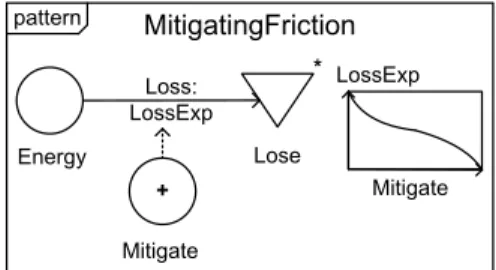
• Loseis adrain that acts automatically (*), e.g., when an enemy shoots the player’s ship. A drain node, ap-pearing as a triangle pointing down is the only element that can delete resources. Drains can be thought of as pools with dan infinite negative amount of resources, and have capacity to pull whatever resources are avail-able, or whatever resources are pushed into them. Lose pulls all resources specified by Loss from Energy. MeDeA finds two casesF1 andF2 of Static Friction in our example shown in Table 6 and explains them in Table 7. Mitigating Friction.Mitigating Friction, a pattern shown in Fig. 12, is form of dynamic friction that enables players to counter the effect of losing resources [1]. Its roles differ from Static Friction as follows.
• Mitigateis an added pool whose resource amount neg-atively influences the amount of resources lost.
• Loss is a resource edge whose flow rate expression is modified such that it shrinks monotonically with Mit-igate. Visually, this added constraint is shown inside the pattern by a diagram on the right. Additionally, a dashed edge signifiesMitigateis used inLoss, which makes the feedback loop explicit.
MeDeA finds one caseF3of Mitigating Friction that extends Static Friction caseF2where poolshieldplays roleMitigate
shown in Table 8. The explanation MeDeA gives is shown in Table 9.
Stopping. The Stopping pattern, shown in Fig. 13, is a way to express the law of diminishing returns [1]. Compared to the Acquisition pattern we just impose one extra constraint, namely that the flow amountCostExpon resource edgeCost
increases monotonically with the amount ofPropertyowned. Visually, this is represented by the constraint diagram ap-pearing on the right. MeDeA finds two cases of Stopping that are also Acquisition casesA2 and A3. The explana-tions MeDeA gives are shown in Table 10.
Energy Loss: LossExp + Mitigate * Lose pattern LossExp Mitigate
Intent: Mitigates a loss caused by drainhLosei, because the flow ratehLossExpion resource connectionhLossidecreases with the amount of resources in poolhMitigatei.
Figure 12: Palette: a Mitigating Friction pattern
role F1 F2 F3
Energy shield hp hp
Loss dmgShield dmgHp dmgHp
LossExp 5 (100-shield)*0.1 (100-shield)*0.1
Lose damage damage damage
Mitigate shield
Table 8: Friction pattern cases in JJ
case explanation
F1 Drain damage causes a loss by pulling flow rate (100-shield)*0.1 via resource connectiondmgHpfrom poolhp.
F2 Draindamagecauses a loss by pulling flow rate5 via re-source connectiondmgShieldfrom poolshield.
F3 Mitigates a loss caused by draindamage, because the flow rate(100-shield)*0.1on resource connectiondmgHp de-creases with the amount of resources in poolshield.
Table 9: MeDeA explains Friction cases in JJ
pattern + Property Benefit: BenefitExp $ Energy Cost: CostExp Acquire CostExp Property
Intent: Makes activating converterhAcquireiincreasingly expen-sive because flow ratehCostExpion resource edgehCostiincreases with the resource amount in poolhPropertyi.
Figure 13: Palette: a Stopping pattern
case explanation
A2 Makes activating converterbuyShieldincreasingly expen-sive because flow rate 10+shield on resource edge cost-Shield increases with the resource amount in poolshield.
A3 Makes activating converterupgradeincreasingly expensive because flow rate10*bonus2on resource edgecostUpgrade increases with the resource amount in poolbonus.