Synthesis of Solid Acid Catalysts Based on
and Pt/
Applied in
n
-Hexane Isomerization
2-2
4
TiO - SO
2-2
TiO - SO
4
Juan Manuel Hernández Enríquez1*, Luz Aracely Cortez Lajas1, Ricardo García Alamilla1, Estefanía
Ángeles San Martín1, Pedro García Alamilla2, Edward Brent Handy3, Guadalupe Cárdenas Galindo3,
Luz Arcelia García Serrano4
1Instituto Tecnológico de Cd. Madero, División de Estudios de Posgrado e Investigación, Juventino Rosas y Jesús Urueta S/N,
Col. Los Mangos, 89440 Cd. Madero, Tamaulipas, México
2Universidad Juárez Autónoma de Tabasco, División Académica de Ciencias Agropecuarias, Avenida Universidad S/N,
Zona Cultura, Colonia Magisterial, 86040 Villahermosa Tabasco, México
3CIEP, Facultad de Ciencias Químicas, Universidad Autónoma de San Luis Potosí, Av. Dr. Manuel Nava #6,
Zona Universitaria, 78210 San Luis Potosí, San Luis Potosí, México
4Instituto Politécnico Nacional, Centro Interdisciplinario de Investigaciones y Estudios sobre Medio Ambiente y Desarrollo
30 de Junio #1520, Barrio La Laguna Ticomán, 07340 México D.F., México Email: *[email protected]
Received June 22,2013; revised July 22, 2013; accepted July 30, 2013
Copyright © 2013 J. M. Hernández Enríquez et al. This is an open access article distributed under the Creative Commons Attribution License, which permits unrestricted use, distribution, and reproduction in any medium, provided the original work is properly cited.
ABSTRACT
The physicochemical properties and catalytic activity of pure and sulfated titanium oxide (TiO2 and TiO -SO2 42
) is
described in this work. Titanium hydroxide synthesized by the sol-gel method was impregnated with a 1 N H2SO4 solu-
tion, varying amount of sulfate ions (SO4 ) in the range from 10 to 20 wt%. Pure and modified hydroxides were cal- cined at 500˚C for 3 h and then characterized by TGA-DTG, XRD, BET, FT-IR, potentiometric titration with n-butylamine and 2-propanol dehydration. Catalytic activity of materials was tested in the n-hexane isomerization at 350˚C. The results showed that TiO2 and 2 4
2
TiO -SO2 mainly developed anatase phase. All have accept-
able specific surface area (95 - 105 m2/g). Potentiometric titration with n-butylamine revealed that
2 4 2 2 4
2
-SO TiO -SO
TiO showed higher acidity (430 - 530 mV) than compared to pure TiO2 (−15 mV), indicating that this oxide only has weak acidity.
The results showed good relationship between acidity determined by potentiometric titration with n-butylamine and the catalytic activity evaluated by 2-propanol dehydration and n-hexane isomerization. Titanium oxide with 20 wt% of
ions was the material that demonstrated the highest catalytic activity for both reactions.
2 4
SO
Keywords: Acid Catalysts; Sulfated Titanium Oxide; Physico-Chemical Properties; n-Hexane Isomerization
1. Introduction
Solid acid catalysts have assumed a great importance due to their huge application potential in chemical industry, specifically in the oil refining industry [1-4]. The su- per-acid liquid catalysts such as HF, H2SO4, AlCl3 and
BF3, which are efficient and selective at low tempera-
tures, are not profitable for such processes due to severe problems of corrosion and their difficult separation from the stream of the products. Chlorinated alumina, zeolites modified by ionic exchange, heteropolyacids, as well as some bifunctional catalysts are examples of solid acid catalysts applied in the types of processes mentioned above and also reported in the literature. Most of these catalysts suffer from various drawbacks such as high
working temperature, continuous supply of chlorine and the use of high hydrogen pressure [5]. For these reasons, current researches about heterogeneous acid catalysts have been focused on the synthesis of new materials that are capable of replacing the liquid acid catalysts and halogenated solids mentioned previously. Sulfated oxide supports demonstrate strong acidity and catalytic activity at low temperatures for catalytic cracking, alkylation, and light paraffin isomerization [6-9]. One of the most stud- ied materials for these reactions has been sulfated zircon- nium oxide [10-14], although the possibility of using sulfated titanium oxide ( ) for such purposes is not discarded. The sulfate ion can be introduced from H2SO4, (NH4)2SO4, SO2 and H2S. It was reported that the
existence of covalent S-O bonds in sulfur complexes formed on metal oxides are responsible for the genera-
2 2 4
TiO -SO
tion of acidity [15-17]. The substitution of oxygen atoms in the titania lattice with sulfur and other anionic species [18] are reported to show photocatalytic activity en- hancement in visible light [19,20] due to the existence of oxygen vacancies, greater surface area [21-25], and lar- ger fraction of the anatase phase. These physicochemical properties can be controlled from the synthesis process [26]. Although most of these catalytic supports are pre- pared via the precipitation method [27-29], the sol-gel process offers better control over synthesis parameters, especially to obtain uniform textural and chemical cha- racteristics down to the nanometric level [29-34]. Ohno et al. [35] reported the incorporation of sulfur in titania by sol-gel precipitation using titanium isopropoxide and thiourea and showed the enhancement in photocatalytic degradation of 2-propanol and partial oxidation of ada- mantane at wavelengths longer than 440 nm. Arata [36] synthesized sulfated titania by exposing Ti(OH)4 to
aqueous sulfuric acid followed by calcination. Ohno et al. [35] studied the hydroxylation of adamantane using sul- fated titania as catalyst, a reaction of relevance (green process) using molecular oxygen. It is reported that the activity of sulfated titania could be improved by opti- mizing the surface area of the sample. In general, it is conceived that Brönsted and Lewis acidity are improved by modifying TiO2 with H2SO4. The superacid properties
of sulfated titania were considered to be responsible for the high catalytic activity in various acid-catalyzed reac- tions such as the alkylation of derivatives of benzene, cracking of paraffins and dimerization of ethylene [37- 41]. The increase in activity for CFC-12 decomposition obtained with sulfated titania was due to the superacid properties of the catalysts [21,42]. Other reactions cata- lyzed by sulfated titania due to its acidic properties are acylation of aromatics [43], acylation of Friedel-Crafts [44], esterification [45] and transesterification of vegetal oils [46].
In the search for new solid acid catalysts with im- proved properties, this work focuses on the synthesis and characterization of a sulfated titanium oxide by sol-gel method, and presents a preliminary evaluation of its cat- alytic properties for the n-hexane isomerization reaction.
2. Experimental
2.1. Supports Preparation
The preparation of titanium hydroxide [Ti(OH)4] was
carried out via sol-gel by dissolving titanium n-butoxide IV (Ti[O(CH2)3CH3]4; Sigma-Aldrich; 97 wt%) in tert-
butyl alcohol ((CH3)3COH; Baker; 99.6 %) and the hy-
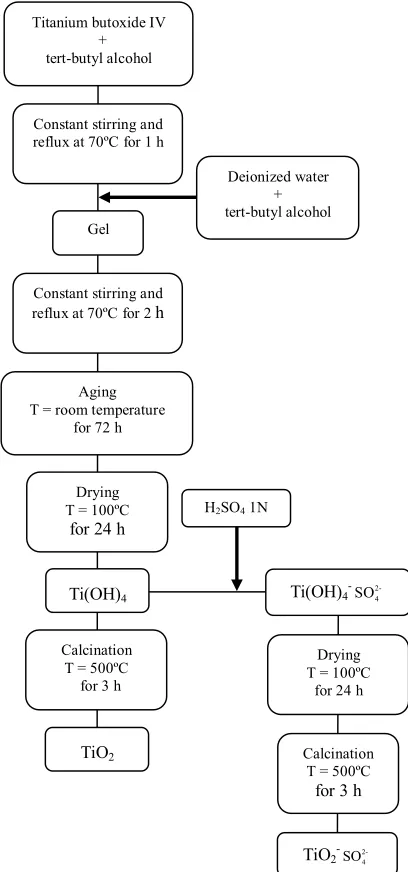
drolysis and condensation proceed via the drop-wise ad- dition of a water/tert-butyl alcohol solution. The gel was then aged during 72 h and dried at 100˚C for 24 h. Ti(OH)4 impregnation with acid agent was done by the
incipient wetness method, using a 1 N H2SO4 solution
and adding the necessary amount of acid reagent to ob-
tain supports with 10, 15 and 20 wt% of 2 4
SO ions. Pure and modified hydroxides were dried at 100˚C du- ring 24 h and then calcined in dynamic air atmosphere at 500˚C for 3 h. Taking the calcination temperature and the weight percentage of 2
4
SO ions as reference, the syn- thesized materials were named as follows: T0500, T10500, T15500 and T20500. The method for the prepa- ration of the catalytic supports is illustrated in the flow diagram of Figure 1.
2.2. Catalyst Preparation
To test activity for the light paraffin isomerization, the catalytic supports were impregnated with platinum (Pt) by the incipient wetness method, using an ammonia solution
H2SO4 1N
Constant stirring and reflux at 70ºC for 1 h
Gel
Constant stirring and reflux at 70ºC for 2 h
Deionized water + tert-butyl alcohol
Aging T = room temperature
for 72 h
Drying T = 100ºC
for 24 h
Ti(OH)4
Calcination T = 500ºC
for 3 h
TiO2
Ti(OH)4-SO2-4
Calcination T = 500ºC
for 3 h
TiO2-SO2-4 Drying T = 100ºC
for 24 h Titanium butoxide IV
[image:2.595.321.525.270.706.2]+ tert-butyl alcohol
of Pt(NH3)2(NO2)2; Sigma-Aldrich; 3.4 wt%, followed by
a drying at 100˚C for 6 h and a calcination in air flow at 400˚C for 3 h. The theoretical concentration of Pt was fixed at 0.3 wt% for all catalysts. The Pt-containing cat- alysts are designated: Pt/T0500, Pt/T10500, Pt/T15500 and Pt/T20500.
2.3. Characterization Techniques
Catalytic supports were characterized by thermal analysis, X-ray diffraction, nitrogen physisorption, infrared spec- troscopy, potentiometric titration with n-butylamine and 2-propanol dehydration. Thermogravimetric analyses were conducted on a TA Instruments STD 2960 simulta- neous DSC-TGA. The samples were analyzed in air flow (10 mL/min) at a heating rate of 10˚C/min from a room temperature to 900˚C. Powder X-ray diffraction patterns were recorded on a Bruker diffractometer using Cu Kα
radiation (λ = 1.5406 Å) and a graphite secondary beam monochromator; the intensities of the diffraction lines were obtained in the 2θ range between 20 and 80˚ with a step size of 0.02˚ and a measuring time of 2.7 s per point. The crystallite size of the materials was determined with the Scherrer equation. Nitrogen physisorption was used to determine the specific surface areas of the materials at the temperature of liquid nitrogen (−196˚C) in a Quanta- chrome Autosorb-1 instrument. Prior to the measurements, samples were outgassed at 350˚C for 2 h. The specific surface area was calculated using the BET equation and the BJH method was used to determine the pore size dis- tributions and the pore volume of the samples. Infrared spectroscopic analyses were carried out in a Fourier Transform spectrometer (Perkin-Elmer Spectrum One) with transparent wafers containing the sample to be ana- lyzed and KBr as a binding agent (9:1 dilution), co-adding 16 scans at a resolution of 4 cm−1. The acidity of the cata-
lytic supports was determined by potentiometric titration with n-butylamine. A small quantity of n-butylamine dis- solved in acetonitrile (0.025 M solution) was added to a known mass of solid which was suspended in the solution and stirred for 3 h. After this, the suspension was titrated with the same base at a rate of 0.2 mL/min, and the varia- tion in the electrical potential was measured with a JEN- WAY-3310 digital pH meter. The potentiometric titration method used in this work has been previously reported by Cid and Pecchi [57]. In order to evaluate the acid-base properties of catalytic materials, 2-propanol dehydration reaction was performed. The reaction was carried out in a fixed-bed reactor operating at 80˚C, atmospheric pressure and WHSV = 5 h−1. Approximately 0.1 g of the catalyst
was loaded into the reactor. Prior to the reaction, the catalyst was preheated at 350˚C for 1 h in a purified ni- trogen flow. During the reaction, the effluent collected periodically and analyzed by a Varian 3400 gas chroma-
tograph equipped with a FID detector and a column packed with Carbowax 1540 on Chromosorb.
2.4. Catalytic Activity
The n-hexane isomerization was carried out in a conven- tional flow fixed-bed reactor, operating at 350˚C, atmos- pheric pressure and WHSV = 0.5 h−1. The catalyst (0.3 g)
was reduced at 350˚C for 1 h in a flow of hydrogen prior to running the test reaction. The products were analyzed on-line by a Varian 3400 gas chromatograph equipped with a FID detector and a column packed with 23 SP- 1700 on 80/100 Chromosorb.
3. Results and Discussion
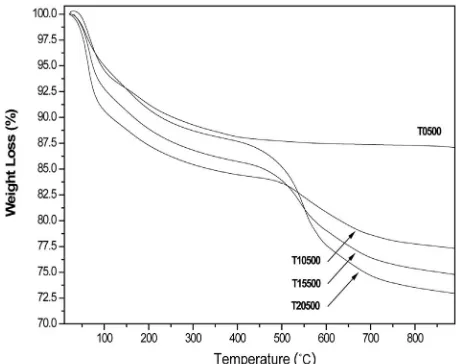
3.1. Thermal AnalysesFour different weight loss stages were identified during thermal analysis of the as-prepared titanium oxide and sulfated titanium oxide materials (Figures 2 and 3). The first two stages, evidenced by two DTG peaks centered at 70˚C and 160˚C correspond respectively to the elimination of water and solvent occluded in the matrix of the inorganic polymer gel. The third stage of weight loss occurs within the range of 250˚C and 400˚C and is more gradual, associated with the trans- formation of Ti(OH)4 into TiO2 and involves the elim-
ination of some terminal hydroxyl groups [47,48]. The sulfated titanium oxide precursors showed a fourth weight loss stage between 400˚C and 900˚C, the DTG peaks being centered around 550˚C and attributed to the decomposition and loss of sulfate ions [49]. It should be noted that samples prepared for catalysis studies were air-calcined at 500˚C, thus sulfate levels in the catalysts may be slightly lower than the theo- retical levels assumed from the incipient wetness addi- tion of H2SO4. The FT-IR data (see below) clearly
show the presence of sulfate groups in all three sulfated TiO2 materials.
3.2. Textural Properties
The nitrogen physisorption results indicate that the spe- cific surface area of the titanium oxide (35 m2/g) in-
Figure 2. TG profiles developed by TiO2 and
precursors.
-
2-2 4
[image:4.595.57.284.315.476.2]TiO SO
Figure 3. DTG profiles developed by TiO2 and
precursors.
-
2-2 4
[image:4.595.309.537.347.504.2]TiO SO
Table 1. Textural properties of synthesized titanium oxides.
Material Surface area (m2/g) Pore diameter (Å) Pore volume (cm3/g)
T0500 35 673 0.05
T10500 97 28 0.13
T15500 103 34 0.14
T20500 104 49 0.16
T15500 and T20500) showed type IV isotherms with H2 hysteresis loops that represent a uniform mesoporous structure [52]. Pore size distributions were obtained by the BJH method. The sulfated titanium oxides (T10500, T15500 and T20500) presented a monomodal distribu- tion with most frequent pore diameters in the 30 to 50 Å range. In contrast, pores in pure titanium oxide (T0500) are considerably larger (200 - 1000 Å) and the distribu- tion is broader.
3.3. X-Ray Diffraction
Figure 6 shows the X-ray diffraction patterns obtained
[image:4.595.57.287.538.617.2]for pure titanium oxide (T0500) and for the sulfated tita- nium oxides (T10500, T15500 and T20500) calcined at 500˚C. The crystalline anatase (tetragonal) form of tita- nia is evidenced by lines appearing at 2θ = 25.22˚, 36.97˚, 37.88˚, 38.58˚, 47.99˚, 53.90˚, 55.07˚, 62.70˚, 68.84˚ and 70.31˚, which correspond to crystallographic planes (101), (103), (004), (112), (200), (105), (211), (204), (116), and (220), in reference to JCPDS card number 021-1272. In comparison to the pure titania sample, these diffraction lines are noticeably broadened in the diffract- tograms of the sulfated titania, indicative of a decrease in crystallite size [53]. Average crystal sizes were calcu- lated using the Scherrer equation to quantify line broad- ening on the most intense (101) anatase peak, and results are plotted in Figure 7 as a function of sulfate content. The average anatase crystal size decreases to one-half its value upon sulfate addition to pure titania at any of the loadings used. There is no evidence of rutile formation in any of the samples.
Figure 4. Nitrogen adsorption-desorption isotherms obtain- ed with synthesized titanium oxides, TiO2 and TiO SO2- 2-4 .
[image:4.595.310.536.546.706.2]2 Thetha (˚)
Figure 6. X-ray diffraction patterns of synthesized titanium oxides, TiO2 and TiO SO2- 2-4 .
0 5 10 15 20
0 2 4 6 8 10 12 14 16 18 20 Cri s ta l si ze , (n m)
[image:5.595.60.289.289.464.2]Sulfate ion, (wt.%)
Figure 7. Crystal size as a function of sulfate ion content in the titanium oxide.
500 1000 1500 2000 2500 3000 3500 4000 3 841. 30 3 747. 90 T0500 T10500 T15500 597. 00 337 5. 6 0 3795 .3 0 5 97. 00 1625 .5 0 16 25. 50 1213 .6 0 1 142 .00 1050 .0 0 59 7. 00 38 41. 30 340 3. 8 0 1 625 .50 121 3. 6 0 1 142. 00 Tr an smitt a n c e ( a .u.)
Wavenumber (cm-1 )
1050
.0
0
T20500
Figure 8. Infrared spectra of TiO2 and TiO SO2- 2-4 .
3.4. Infrared Spectroscopy
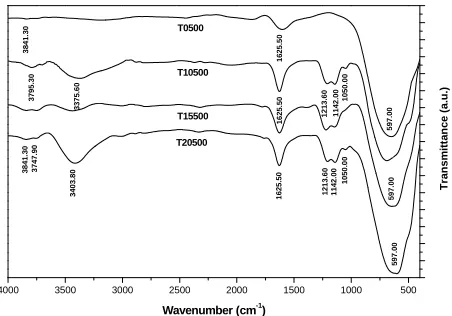
In Figure 8 are shown the infrared spectroscopy analyses performed on synthesized titanium oxides. All materials
of this study presented bands that appear in the 3800 - 1600 cm−1 region, which characterize -OH groups and
hydrogen bonding. The absorption bands located at 3841, 3795, and 3747 cm−1 are attributed to the (OH) stretch-
ing vibration modes of isolated hydroxyl groups associ- ated with Ti4+ cations. The broad adsorption band at 3400
cm−1 and the band at 1625 cm−1 are assigned to the stre-
tching and bending modes characteristic of physisorbed water on oxide supports [54]. The sulfated materials (T10500, T15500 and T20500) present bands character- istic of surface 2
4
SO groups. In the sulfated titania sam- ples, the bands observed at 1213, 1142, and 1050 cm−1
are attributed to the vibrational bands of S-O bonds in the sulfate ( 2
4
SO ) groups anchored to the titanium oxide surface [54]. The exact frequency is usually red-shifted when perturbed by the presence of physisorbed water. It is important to point out that the signals located at 3400 and 1625 cm−1 are intensified in the infrared spectrum of
sulfated materials. From this result it can be inferred that sulfated metal oxide support materials have a greater capacity for water adsorption from moist environments than pure titanium oxide (T0500). In principle, the ab- sence of (S = O) band frequency at 1370 cm−1 can be
related to a particular degree of surface hydration, which in turn relates to the density of Brönsted and Lewis acid sites. Lewis acid sites exist at the sulfur (S6+) center in
the surface sulfate groups [55]. The Lewis acid site den- sity will increase with increasing calcination temperature, as the surface progressively dehydroxylates. The broad adsorption bands that appear in the low frequency region of infrared spectrum, located in the range 450 - 600 cm−1
are characteristic of a Ti-O-Ti symmetric stretching vi- bration mode [56], which could be formed during con- densation reaction of sol-gel synthesis.
3.5. Acidic Properties
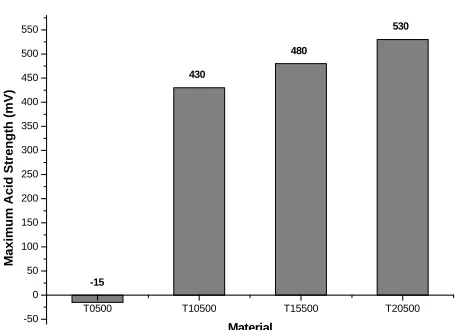
[image:5.595.60.286.503.661.2]strength above 400 mV, while pure titanium oxide only reached values below zero as maximum acid strength (−15 mV). Also, the total quantity of miliequivalents of n-butylamine used per catalyst gram (meq n-BTA/g) confirmed that concentration of acid sites is greater in sulfated samples than the non-treated material (Figure 10).
The n-butylamine titration results clearly establish that sulfate groups on titania exhibit a strong acid strength, and that sulfate loading at the levels employed here (10 - 20 wt%) enables one to control the site density of these acid sites. Given the presence of hydroxyl bands in all three of the sulfated titania samples, as shown in the IR spectra, it can be inferred that the samples exhibit both Brönsted and Lewis acidity, although this was not invest- tigated more directly with pyridine adsorption IR studies.
3.6. 2-Propanol Dehydration
The decomposition of 2-propanol is a model reaction to determine the acid-base nature of catalytic materials and can serve as a characterization technique to evaluate the relative acidity between catalysts. It has been reported in the literature that the 2-propanol decomposition reaction can follow three possible routes: 1) intra-molecular de- hydration that produce propylene, 2) inter-molecular de- hydration to generate diisopropyl ether, and 3) alcohol de-hydrogenation to produce acetone [59]. It is known that, under inert atmosphere, the alcohol dehydration reactions take place through acid sites, whereas the de- hydrogenation reaction is catalyzed by basic sites [60]. Thus, reaction selectivity is a measure of the relative amounts of each site type in the catalyst. The results are presented in Table 2. The un-sulfated titania (T0500) did not show any catalytic activity at 80˚C, whereas all three sulfated titanias were active. The activity order is the following: T20500 > T15500 > T10500, with a 4-fold activity increase going from 10 to 15 wt% sulfate, and a smaller increase when increasing sulfate content from 15 to 20 wt%. This correlates with the potentiometric titra- tion with n-butylamine results showing increasing M.A.S. (Figure 9), although the total acid concentration does not increase in the same proportions (Figure 10), indicating that intrinsic site activity must change considerably, cer- tainly when going from 10 to 15 wt% sulfate content. In
Figure 11, the predominance of acid sites is evident,
since reaction leads exclusively to the dehydration prod- ucts of propylene and diisopropyl ether, the former being favored in all cases. Propylene is formed over Brönsted sites via the E1 elimination mechanism, whereas diiso- propyl ether is formed via a SN2 mechanism. The E1
mechanism, characteristic in the dehydration of second- dary and tertiary alcohols, starts with the protonation of the -OH group, which then leaves as water to produce a carbenium ion. This step is unimolecular and rate-limit-
T0500 T10500 T15500 T20500
-50 0 50 100 150 200 250 300 350 400 450 500
550 530
480
430
-15
Ma
x
im
u
m
A
c
id Str
e
ngth (m
V
)
[image:6.595.309.537.79.244.2]Material
Figure 9. Maximum acid strength developed by synthesized titanium oxides (TiO2 and ) determined by po-
tentiometric titration with n-butylamine. -
2-2 4
TiO SO
T0500 T10500 T15500 T20500
0.00 0.25 0.50 0.75 1.00 1.25 1.50 1.75 2.00 2.25
2.1
1.5
1.3
meq n
-BTA
/g
Material
[image:6.595.311.536.300.457.2]0.6
[image:6.595.309.538.542.604.2]Figure 10. Total acidity obtained by potentiometric titration with n-butylamine for TiO2 and TiO SO2- 2-4 .
Table 2. 2-propanol dehydration, conversion and reaction rate evaluated at 60 min, T = 80˚C, P = 1 atm, WHSV = 5 h−1.
Material Conversion (%) Reaction rate (mol g−1 s−1)
T10500 6 1.394 × 10⁻⁴
T15500 27 6.274 × 10⁻⁴
T20500 38 8.831 × 10⁻⁴
ing, and followed by the rapid loss of a β hydrogen to the surface and desorption an olefin product. Diisopropyl ether is the lesser product, occurring via a SN2 substitu-
limits to some extent the carbenium ion formation. The production of diisopropyl ether result is attractive, how- ever, since this oxygenated compound can be mixed with gasoline as an additive to increase octane number.
3.7. n-Hexane Isomerization
The results obtained for the n-hexane isomerization reac- tion are presented in Table 3. The sulfated titanium ox- ides were active in the isomerization of hydrocarbon at 350˚C and atmospheric pressure in contrast with pure titania, which did not show catalytic activity. This fact can be explained considering that the isomerization of alkanes depends on the density of the acid sites as well as of the acid strength of the catalyst [63], parameters that are not satisfied in the non-sulfated titanium oxide, ac- cording to the results obtained by the potentiometric ti- tration with n-butylamine. The materials activity ob- tained at 350˚C indicates that the acid strength of
is lower than that of
2 2 4
TiO -SO 2
2 4
ZrO -SO because
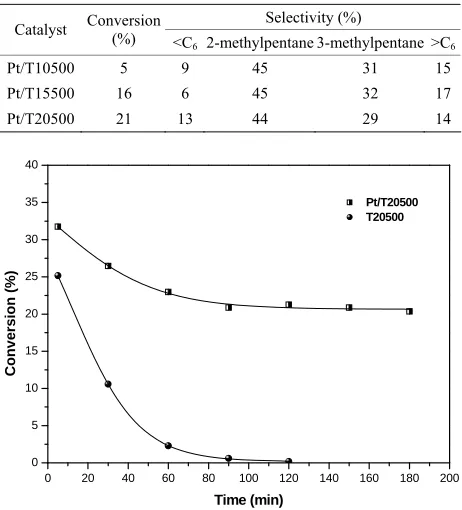
this material catalyzes the n-hexane isomerization at 250˚C [64]. As with the 2-propanol dehydration reaction, the catalytic activity for isomerization increases with sulfate ion content. The maximum conversion of the hy- drocarbon (21%) was obtained with the catalyst Pt/ T20500, a four-fold activity increase with respect to the catalyst with lowest sulfate content (Pt/T5500). All the catalysts presented excellent selectivity values around 80% for isomerized products. These selectivity values do not depend significantly of conversion level. Only mono- branched paraffins such as 2-methylpentane and 3- methylpentane were identified during the reaction. The lack of 2,2-dimethylbutane formation is due to the im- possibility of forming a quaternary carbon within the framework of carbenium ion chemistry and alkyl or hy- dride shift mechanisms [65]. The selectivity pattern sug- gests only minor hydrocracking activity (<C6) and oligo-
merization activity (>C6). Finally, it is clear that the
catalyst with highest content of sulfate ions (Pt/T20500) presents the highest selectivity towards disintegration reactions, which require strong acid sites. This is consis- tent with the 2-propanol reaction and n-butylamine data showing that this catalyst possesses the highest total acid density and acid strength among the three sulfated sam- ples. Hence, an effective catalyst for n-hexane isomeriza- tion should have a medium or low density of highly acidic sites in order to avoid side reactions and to main- tain high isomerization activity.
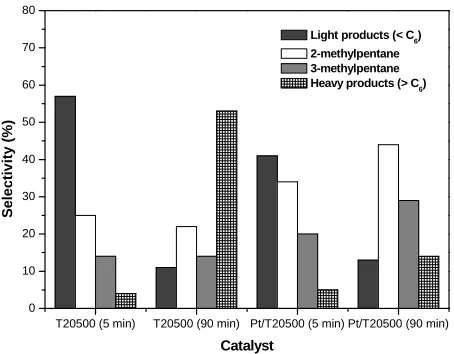
The activity and selectivity of the Pt/T20500 catalyst was compared with that obtained by the material T20500 and both are showed in Figure 12 and Figure 13, re- spectively. has a moderate activity, al- though the catalytic activity rate drops very quickly and is completely lost in 120 min, while the reaction pro- duces a lot of cracking products. We assumed that this
2 2 4
TiO -SO
T10500 T15500 T20500
0 10 20 30 40 50 60 70 80 90 100
Co
n
versio
n
-S
el
ec
tivi
ty,
(
%
)
Material
[image:7.595.310.538.85.250.2]Conversion Propylene selectivity diisopropyl ether selectivity
[image:7.595.308.539.342.597.2]Figure 11. 2-propanol dehydration, conversion and selecti- vity evaluated at 60 min, T = 80˚C, P = 1 atm and WHSV = 5 h−1.
Table 3. n-hexane isomerization with Pt/ cata- lysts evaluated at 120 min, T = 350˚C, P = 1 atm, WHSV = 0.5 h−1.
-
2-2 4
TiO SO
Selectivity (%) Catalyst Conversion(%)
<C6 2-methylpentane 3-methylpentane >C6
Pt/T10500 5 9 45 31 15
Pt/T15500 16 6 45 32 17
Pt/T20500 21 13 44 29 14
0 20 40 60 80 100 120 140 160 180 200
0 5 10 15 20 25 30 35 40
Conv
er
sion
(%)
Time (min)
Pt/T20500 T20500
Figure 12. Conversion profiles for n-hexane isomerization
catalyzed by and Pt/ catalysts. Re-
action conditions: T = 350˚C, P = 1 atm, WHSV = 0.5 h−1.
-
2-2 4
TiO SO -
2-2 4
TiO SO
deactivation was due to longer residence time of surface intermediates species, associated with lower hydrogen availability caused by the absence of platinum. Over Pt/ 4 , the activity is much more stable and the
selectivity for isomers are very high during the run. These results suggest that the addition of platinum and hydrogen is required to prevent the rapid deactivation of
2-2
T20500 (5 min) T20500 (90 min) Pt/T20500 (5 min) Pt/T20500 (90 min) 0
10 20 30 40 50 60 70 80
Sele
ctiv
ity (%
)
Catalyst
Light products (< C6)
[image:8.595.60.287.84.261.2]2-methylpentane 3-methylpentane Heavy products (> C6)
Figure 13. Selectivity to products of n-hexane conversion in
the presence of and Pt/ . Reaction
conditions: T = 350˚C, P = 1 atm, WHSV = 0.5 h−1.
- 2-2
TiO SO4
-
2-2 4
TiO SO
the catalyst. The role of platinum in the presence of hy- drogen is still a controversial issue. Some authors report that platinum imparts a metallic catalysis function within the classical bifunctional mechanism [66]. Ebitani et al. [67-69] observe a promoting effect of hydrogen on the isomerization. They suggest that strong protonic acidity is generated via dissociation and spillover of hydrogen species. Iglesia et al. and Comelli et al. [70-72] also ob- serve a promoting effect of platinum and hydrogen and attribute it to the conversion of hydrogen atoms into hy- drides, accelerating the desorption of the carbenium in- termediates. It is important to note that in this work, the influence of the hydrogen is always limited to low hydro- gen pressures and this could lead to low conversions.
The n-hexane isomerization over bifunctional catalysts Pt/ can be explained by the classical bifunc- tional mechanism including the paraffin dehydrogenation on the metal sites, the skeletal rearrangement of the ole- fin on the acid sites via a carbenium ion mechanism also including cracking reactions, oligomerization or cycliza- tion and finally the rehydrogenation of the isomerized olefin on the metal sites. On the catalyst
2 2 4
TiO -SO
2 2 4
TiO -SO the
reaction can take place solely on the acid sites via a monofuncional mechanism featuring a hydride-transfer chain reaction. The sequence starts with a hydride ab- straction from the hydrocarbon on the acid sites, creating the carbenium ion which is rapidly isomerized. The iso- carbenium ion is desorbed by the hydride species created in the initial step. On the catalyst 2
2 4
TiO -SO we
speculate that the desorption step is rate-limiting, leading to an accumulation of iso-carbenium species on the sur- face and a fast deactivation of the material.
4. Conclusion
The addition of sulfate ions to sol-gel derived titanium
hydroxide gel delays the structural transformation from the anatase to rutile phase and produces 2
2 4
TiO -SO
supports with controlled pore structure and suitably high specific surface area (95 - 105 m2/g) relative to the un-
sulfated gel (35 m2/g). Furthermore, the sulfated supports
demonstrated strong acidity of varying site densities de- pending upon sulfate content up to 20 wt%. The catalytic activity for 2-propanol dehydration and n-hexane isom- erization correlates with maximum acid strength and the total acid site densities as determined from the potenti- ometric titration with n-butylamine. The absence of ace- tone from 2-propanol conversion indicates that only acid sites are formed in these catalysts. The isomerization selectivity to mono-branched paraffins is favorably high and stable over the testing period for these catalysts, suggesting a viable catalytic system.
5. Acknowledgements
The authors wish to thank to División de Estudios de Posgrado e Investigación from Tecnológico de Ciudad Madero by its support given during development of this research work.
REFERENCES
[1] J. R. Shon, “Recent Advances in Solid Superacids,”
Journal of Industrial and Engineering Chemistry,Vol. 10, No. 1, 2004, pp. 1-15.
[2] K. Tanabe, M. Misono, Y. Ono and H. Hattori, “New Solids Acids and Bases,” Elsevier Science Publisher B-V, Amsterdam, 1989, p. 300.
[3] K. Arata, “Solid Superacids,” Advances in Catalysis,Vol. 37, 1990, pp. 165-211.
[4] B. H. Davis, R. A. Keogh and R. Srinivasan, “Sulfated Zirconia as a Hydrocarbon Conversion Catalyst,” Cataly- sis Today,Vol. 20, No. 2, 1994, pp. 219-256.
doi:10.1016/0920-5861(94)80004-9
[5] J. R. Shon, Y. H. Kim, B. L. Lee and H. W. Kim, “Physi- cochemical and Catalytic Properties of NiSO4 Supported
on Fe2O3 for Acid Catalysis,” Journal of Industrial and Engineering Chemistry, Vol. 13, No. 6, 2007, pp. 1035- 1042.
[6] X. Bokhimi, A. Morales, E. Ortiz, T. López, R. Gómez and J. Navarrete, “Sulfate Ions in Titania Polymorphs,”
Journal of Sol-Gel Science and Technology,Vol. 29, No. 1, 2004, pp. 31-40.
doi:10.1023/B:JSST.0000016135.02238.0e
[7] F. Lonyi, J. Valyon, J. Engelhardt and F. Mizukami, “Characterization and Catalytic Properties of Sulfated ZrO2-TiO2 Mixed Oxides,” Journal of Catalysis,Vol. 160,
No. 2, 1996, pp. 279-289. doi:10.1006/jcat.1996.0146 [8] J. P. Chen and R. T. Yang, “Selective Catalytic Reduction
of NO with NH3 on SO24
/TiO
[9] D. Das, H. K. Mishra, K. M. Parida and A. K. Dalai, “Preparation, Physico-Chemical Characterization and Ca- talytic Activity of Sulphated ZrO2-TiO2 Mixed Oxides,” Journal of Molecular Catalysis A: Chemical, Vol. 189, No. 2, 2002, pp. 271-282.
doi:10.1016/S1381-1169(02)00363-1
[10] G. D. Yadav and J. J. Nair, “Sulfated Zirconia and Its Modified Versions as Promising Catalysts for Industrial Processes,” Microporous and Mesoporous Materials, Vol. 33, No. 1, 1999, pp. 1-48.
doi:10.1016/S1387-1811(99)00147-X
[11] T. Kimura, “Development of Pt/SO24/ZrO2 Catalyst for
Isomerization of Light Naphtha,” Catalysis Today, Vol. 81, No. 1, 2003, pp. 57-63.
doi:10.1016/S0920-5861(03)00102-0
[12] C. R. Vera, C. L. Pieck, K. Shimizu and J. M. Parera, “Tetragonal Structure, Anionic Vacancies and Catalytic Activity of SO24-ZrO
2 Catalysts for n-Butane Isomeri-
zation,” Applied Catalysis A: General, Vol. 230, No. 1, pp. 137-151.
[13] K. Tomishige, A. Okabe and K. Fujimoto, “Effect of Hy- drogen on n-Butane Isomerization over Pt/ 2
4
SO -ZrO2
and Pt/SiO2 +SO24
-ZrO
2,” Applied Catalysis A: General,
Vol. 194-195, 2000, pp. 383-393.
[14] Y. Ono, “A Survey of the Mechanism in Catalytic Isome- rization of Alkanes,” Catalysis Today, Vol. 81, No. 1, 2003, pp. 3-16. doi:10.1016/S0920-5861(03)00097-X [15] A. Kayo, T. Yamaguchi and K. Tanabe, “The Effect of
Preparation Method on the Acidic and Catalytic Proper- ties of Iron Oxide,” Journal of Catalysis,Vol. 83, No. 1, 1983, pp. 99-106. doi:10.1016/0021-9517(83)90033-7 [16] T. Yamagushi, T. Jin and K. Tanabe, “Structure of Acid
Sites on Sulfur-Promoted Iron Oxide,” The Journal Phy- sical Chemistry, Vol. 90, No. 14, 1986, pp. 3148-3152. doi:10.1021/j100405a022
[17] T. Jin, T. Yamagushi and K. Tanabe, “Mechanism of Acidity Generation on Sulfur-Promoted Metal Oxides,”
The Journal Physical Chemistry, Vol. 90, No. 20, 1986, pp. 4794-4796. doi:10.1021/j100411a017
[18] R. Asahi, T. Morikawa, T. Ohwaki, K. Aoki and Y. Taga, “Visible-Light Photocatalysis in Nitrogen-Doped Tita- nium Oxides,” Science, Vol. 293, No. 5528, 2001, pp. 269-271. doi:10.1126/science.1061051
[19] A. Zaleska, P. Górska, J. W. Sobczak and J. Hupka, “Thioacetamide and Thiourea Impact on Visible Light Activity of TiO2,” Applied Catalysis B, Vol. 76, No. 1-2,
2007, pp. 1-8. doi:10.1016/j.apcatb.2007.05.005
[20] T. Ihara, M. Miyoshi, M. Ando, S. Sugihara and Y. Iri- yama, “Preparation of a Visible-Light-Active TiO2 Photo-
catalyst by RF Plasma Treatment,” Journal of Materials Science,Vol. 36, No. 17,2001, pp. 4201-4207.
doi:10.1023/A:1017929207882
[21] D. S. Muggli and L. Ding, “Photocatalytic Performance of Sulfated TiO2 and Degussa P-25 TiO2 during Oxida-
tion of Organics,” Applied Catalysis B, Vol. 32, No. 3, 2001, pp. 181-194. doi:10.1016/S0926-3373(01)00137-0 [22] W. Y. Su, X. Z. Fu and K. M. Wei, “Effect of Sulfation
on Structure and Photocatalytic Performance of TiO2,”
Acta Physico-Chimica Sinica, Vol. 17, No. 1, 2001, pp. 28-31.
[23] X. Fu, W. A. Zeltner, Q. Yang and M. A. Anderson, “Catalytic Hydrolysis of Dichlorodifluoromethane (CFC- 12) on Sol-Gel-Derived Titania Unmodified and Modified with H2SO4,” Journal of Catalysis, Vol. 168, No. 2, 1997,
pp. 482-490. doi:10.1006/jcat.1997.1660
[24] J. F. Tanguay, S. L. Suib and R. W. Coughlin, “Dichlo- romethane Photodegradation Using Titanium Catalysts,”
Journal of Catalysis, Vol. 117, No. 2, 1989, pp. 335-347. doi:10.1016/0021-9517(89)90344-8
[25] G. Colón, M. C. Hidalgo and J. A. Navío, “Photocatalytic Behaviour of Sulphated TiO2 for Phenol Degradation,” Applied Catalysis B: Enviromental, Vol. 45, No. 1, 2003, pp. 39-50. doi:10.1016/S0926-3373(03)00125-5
[26] S. N. Aisyiyah, D. S. Kusuma, A. Kristiani, J. A. Laks- mono and S. Tursiloadi, “Preparation and Characteriza- tion of Sulfated Titania Catalysts for the Isomerisation of Citronellal,” International Journal of Basic & Applied Sciences, Vol. 10, No. 6, 2010, pp. 5-10.
[27] O. Rodríguez, F. González, P. Bosh, M. Portilla and T. Viveros, “Physical Characterization of TiO2 and Al2O3
Prepared by Precipitation and Sol-Gel Methods,” Cataly- sis Today, Vol. 14, No. 2, 1992, pp. 243-252.
doi:10.1016/0920-5861(92)80026-J
[28] E. N. S. Muccillo and D. M. Ávila, “Synthesis and Cha- racterization of Submicron Zirconia-12 mol% Ceria Cera- mics,” Ceramics International, Vol. 25, No. 4, 1999, pp. 345-351. doi:10.1016/S0272-8842(98)00046-7
[29] S. Rossignol, F. Gerard and D. Duprez, “Effect of the Preparation Method on the Properties of Zirconia-Ceria Materials,” Journal of Materials Chemistry, Vol. 9, No. 7, 1999, pp. 1615-1620. doi:10.1039/a900536f
[30] J. Wenzel, “Trends in Sol-Gel Processing: Toward 2004,”
Journal of Non-Crystalline Solids, Vol. 73, No. 1-3, 1985, pp. 693-699. doi:10.1016/0022-3093(85)90389-8
[31] J. D. Mackenzie, “Applications of the Sol-Gel Process,”
Journal of Non-Crystalline Solids, Vol. 100, No. 1-3, 1988, pp. 162-168. doi:10.1016/0022-3093(88)90013-0 [32] J. Livage and C. Sanchez, “Sol-Gel Chemistry,” Journal
of Non-Crystalline Solids, Vol. 145, 1992, pp. 11-19. [33] M. Barrera, M. Viniegra, J. Escobar and J. A. De Los
Reyes, “Control de las Propiedades Texturales de ZrO2-TiO2 Sol-Gel. Efecto de Parámetros de Síntesis,” Journal of the Mexican Chemical Society, Vol. 46, No. 2, 2002, pp. 73-78.
[34] M. A. Santana, M. Morán, J. Hernández, S. Castillo and R. Gómez, “Physical Properties of TiO2 Prepared by
Sol-Gel under Different pH Conditions for Photocataly- sis,” Superficies y Vacío, Vol. 18, No. 1, 2005, pp. 46-49. [35] T. Ohno, M. Akiyoshi, T. Umebayashi, K. Asai, T. Mitsui
and M. Matsumura, “Preparation of S-doped TiO2 Photo-
catalysis and their Photocatalytic Activities under Visible Light,” Applied Catalysis A: General, Vol. 265, No. 1, 2004, pp. 115-121. doi:10.1016/j.apcata.2004.01.007 [36] K. Arata, “Preparation of Superacids by Metal Oxides for
Reactions of Butanes and Pentanes,” Applied Catalysis A:
doi:10.1016/0926-860X(96)00046-4
[37] M. Hino, S. Kobayashi and K. Arata, “Reactions of Bu- tane and Isobutane Catalyzed by Zirconium Oxide Treat- ed with Sulfate Ion. Solid Superacid Catalyst,” Journal of American Catalysis Society, Vol. 101, No. 21, 1979, pp. 6439-6441. doi:10.1021/ja00515a051
[38] M. S. Scurrell, “Conversion of Methane-Ethylene Mix- tures over Sulphate-Treated Zirconia Catalysts,” Applied Catalysis, Vol. 34, 1987, pp. 109-117.
doi:10.1016/S0166-9834(00)82449-5
[39] M. Hino and K. Arata, “Acylation of Toluene with Acetic and Benzoic Acids Catalyzed by a Solid Superacid in Heterogeneous System,” Journal of the Chemical Society,
Chemical Communications, Vol. 1, No. 3, 1985, pp. 112- 113. doi:10.1039/c39850000112
[40] J. C. Yori, J. C. Luy and J. M. Parera, “n-Butane Isome- rization on Solid Superacids,” Catalysis Today, Vol. 5, No. 4, 1989, pp. 493-502.
doi:10.1016/0920-5861(89)80013-6
[41] J. R. Shon and H. J. Kim, “High Catalytic Activity of NiO-TiO2/SO22− for Ethylene Dimerization,” Journal of Catalysis, Vol. 101, No. 2, 1986, pp. 428-433.
doi:10.1016/0021-9517(86)90270-8
[42] S. Imamura, T. Shiomi, S. Ishida, K. Utani and H. Jindai, “Decomposition of Dichlorodifluoromethane on TiO2/
SiO2,” Industrial and Engineering Chemistry Research,
Vol. 29, No. 9, 1990, pp. 1758-1761. doi:10.1021/ie00105a003
[43] K. Tanabe, T. Yamaguchi, K. Akiyama, A. Mitoh, K. Iwabuchi and K. Isogai, “The Catalytic Synthesis of Acy- lated Compounds by Using Solid Superacid,” 8th Inter- national Congress on Catalysis, Berlin, 2-6 July 1984, p. 601.
[44] W. Hua, Y. Xia, Y. Yue and Z. Gao, “Promoting Effect of Al on SO2−
4/MxOy(M=Zr, Ti, Fe) Catalysts,” Journal of
Catalysis, Vol. 196, No. 1, 2000, pp. 104-114. doi:10.1006/jcat.2000.3032
[45] J. Lim, R. Liu and R. Zhao, “The Catalytic Synthesis of Isoamyl Butyrate by SO42−/TiO2/La3+ Rare-Earth Solid
Superacid,” Chinese Journal of Inorganic Chemistry, Vol. 16, No. 5, 2000, pp. 829-832.
[46] R. M. de Almeida, L. K. Noda, N. S. Gonçalves, S. M. P. Meneghetti and M. R. Meneghetti, “Transesterification Reaction of Vegetal Oils, Using Superacid Sulfated TiO2-
Base Catalysts,” Applied Catalysis A: General, Vol. 347, No. 1, 2008, pp. 100-105.
doi:10.1016/j.apcata.2008.06.006
[47] Q. Sheng, S. Yuan, J. Zhang and F. Chen, “Synthesis of Mesoporous Titania with High Photocatalytic Activity by Nanocrystalline Particle Assembly,” Microporous and Mesoporous Materials, Vol. 87, No. 3, 2006, pp. 177-184. doi:10.1016/j.micromeso.2005.06.036
[48] R. López, R. Gómez and S. Oros, “Photophysical and Photocatalytic Properties of TiO2-Cr Sol-Gel Prepared
Semiconductors,” Catalysis Today, Vol. 166, No. 1, 2011, pp. 159-165. doi:10.1016/j.cattod.2011.01.010
[49] P. Ciambelli, D. Sannino, V. Palma and V. Vaiano, “The Effect of Sulphate Doping on Nanosized TiO2 and
MoOx/TiO2 Catalysts in Cyclohexane Photooxidative
Dehydrogenation,” International Journal of Photoenergy, Vol. 1, 2008, Article ID: 258631.
doi:10.1155/2008/258631
[50] S. Storck, H. Bretinger and W. F. Maier, “Characteriza- tion of Micro- and Mesoporous Solids by Physisorption Methods and Pore-Size Analysis,” Applied Catalysis A:
General, Vol. 174, No. 1, 1998, pp. 137-146. doi:10.1016/S0926-860X(98)00164-1
[51] G. Leonfanti, M. Padovan, G. Tozzola and B. Venturelli, “Surface Area and Pore Texture of Catalysts,” Catalysis Today, Vol. 41, No. 1-3, 1998, pp. 207-219.
doi:10.1016/S0920-5861(98)00050-9
[52] K. S. W. Sing, D. H. Everett, R. A. Haul, L. Moscou, R. A. Pierotti, J. Rouquérol and T. Siemieniewska, “Re- porting Physisorption Date for the Gas/Solid Systems with Special Reference to the Determination of Surface Area and Porosity,” Pure and Applied Chemistry, Vol. 57, No. 4, 1985, pp. 603-620. doi:10.1351/pac198557040603 [53] L. González, I. Hernández, F. C. Robles, H. Dorantes and
E. M. Arce, “Sonochemical Synthesis of Nanostructured Anatase and Study of the Kinetics among Phase Trans- formation and Coarsening as a Function of Heat Treat- ment Conditions,” Journal of the European Ceramic So- ciety, Vol. 28, No. 8, 2008, pp. 1585-1594.
doi:10.1016/j.jeurceramsoc.2007.10.013
[54] D. A. Skoog and J. J. Leary, “Análisis Instrumental,” Mc-Graw Hill, México City, 2003.
[55] T. Mishra, “Anion Supported TiO2-ZrO2 Nanomaterial
Synthesized by Reverse Microemulsion Technique as an Efficient Catalyst for Solvent Free Nitration of Haloben- zene,” Catalysis Communications, Vol. 9, No. 1, 2008, pp. 21-26. doi:10.1016/j.catcom.2007.05.013
[56] J. Rubio, J. L. Oteo, M. Villegas and P. Duran, “Charac- terization and Sintering Behaviour of Submicrometre Ti- tanium Dioxide Spherical Particles Obtained by Gas- Phase Hydrolysis of Titanium Tetrabutoxide,” Journal of the Chinese Chemical Society, Vol. 32, No. 3, 1997, pp. 643-652.
[57] R. Cid and G. Pecchi, “Potentiometric Method for Deter- mining the Number and Relative Strength of Acid Sites in Colored Catalysis,” Applied Catalysis, Vol. 14, 1985, pp. 15-21. doi:10.1016/S0166-9834(00)84340-7
[58] L. Pizzio, P. Vázquez, C. Cáceres and M. Blanco, “Tung- stophosphoric and Molybdophosphoric Acids Supported on Zirconia as Esterification Catalysts,” Catalysis Letters, Vol. 77, No. 4, 2001, pp. 233-239.
doi:10.1023/A:1013218307792
[59] Y. S. Hsu, Y. L. Wang and A. N. Ko, “Effect of the Sul- fation of Zirconia on Catalytic Performance in the Dehy- dration of Aliphatic Alcohols,” Journal of the Chinese Chemistry Society, Vol. 56, No. 2, 2009, pp. 314-322. [60] J. E. Rekoske and M. A. Barteau, “Kinetics and Selecti-
vity of 2-Propanol Conversion on Oxidized Anatase TiO2,” Journal of Catalysis, Vol. 165, No. 1, 1997, pp.
57-72.doi:10.1006/jcat.1997.1467
[62] C. G. Gómez Sierra, R. G. Márquez Nuño and F. C. Domínguez Sánchez, “Introducción a la Química Orgá- nica,” Instituto Politécnico Nacional, México City, 2009. [63] R. A. Comelli, C. R. Vera and J. M. Parera, “Influence of
ZrO2 Crystalline Structure and Sulfate Ion Concentration
on the Catalytic Activity of SO2−
4-ZrO2,” Journal of Ca- talysis, Vol. 151, No. 1, 1995, pp. 96-101.
doi:10.1006/jcat.1995.1012
[64] O. B. Belskaya, I. G. Danilova, M. O. Kazakov, T. I. Gulyaeva, L. S. Kibis, A. I. Boronin, A. V. Lavrenov and V. A. Likholobov, “Investigation of Active Metal Species Formation in Pd-Promoted Sulfated Zirconia Isomeriza- tion Catalyst,” Applied Catalysis A: General, Vol. 387, No. 1, 2010, pp. 5-12. doi:10.1016/j.apcata.2010.07.052 [65] J. G. Santiesteban, D. C. Calobro, C. D. Chang, J. C.
Vartuli, T. J. Fiebig and R. D. Bastian, “The Role of Platinum in Hexane Isomerization over Pt/FeOy/WOx/
ZrO2,” Journal of Catalysis, Vol. 202, No. 1, 2001, pp.
25-33. doi:10.1006/jcat.2001.3229
[66] J. C. Duchet, D. Guillaume, A. Monnier, C. Dujardin, J. P. Gilson, J. van Gestel, G. Szabo and P. Nascimento, “Isomerization of n-Hexane over Sulfated Zirconia: In- fluence of Hydrogen and Platinum,” Journal of Catalysis, Vol. 198, No. 2, 2001, pp. 328-337.
doi:10.1006/jcat.2000.3152
[67] K. Ebitani, H. Hattori and K. Tanabe, “Generation of Protonic Acid Sites Originating from Molecular Hydro- gen on the Surface of Zirconium Oxide Promoted by Sul-
fate Ion and Platinum,” Langmuir, Vol. 6, No. 12, 1990, pp. 1743-1744. doi:10.1021/la00102a006
[68] K. Ebitani, J. Konishi and H. Hattori, “Skeletal Isomeri- zation of Hydrocarbons over Zirconium Oxide Promoted by Platinum and Sulfate Ion,” Journal of Catalysis, Vol. 130, No. 1, 1991, pp. 257-267.
doi:10.1016/0021-9517(91)90108-G
[69] K. Ebitani, J. Tsuji, H. Hattori and H. Kita, “Dynamic Modification of Surface Acid Properties with Hydrogen Molecule for Zirconium Oxide Promoted by Platinum and Sulfate Ions,” Journal of Catalysis, Vol. 135, No. 2, 1992, pp. 609-617. doi:10.1016/0021-9517(92)90057-O [70] E. Iglesia, S. L. Soled and G. M. Kramer, “Isomerization
of Alkanes on Sulfated Zirconia: Promotion by Pt and by Adamantly Hydride Transfer Species,” Journal of Cata- lysis, Vol. 144, No. 1, 1993, pp. 238-253.
doi:10.1006/jcat.1993.1327
[71] E. Iglesia, D. G. Barton, S. L. Soled, S. Miseo, J. E. Baumgartner, W. E. Gates, G. A. Fuentes and G. D. Meitzner, “Selective Isomerization of Alkanes on Sup- ported Tungsten Oxide Acids,” Studies in Surface Science and Catalysis, Vol. 101, 1996, pp. 533-542.
doi:10.1016/S0167-2991(96)80264-3
[72] R. A. Comelli, Z. R. Finelli, S. R. Vaudagna and N. S. Figoli, “Hydroisomerization of n-Hexane on Pt/SO42