LANGUAGE AND COGNITIVE TASKS MOST PREDICTIVE OF MILD COGNITIVE IMPAIRMENT
A Thesis by Brooke Holt
Submitted to the Graduate School at Appalachian State University
in partial fulfillment of the requirements for the degree of Speech-Language Pathology, M.S.
August 2016
LANGUAGE AND COGNITIVE TASKS MOST PREDICTIVE OF MILD COGNITIVE IMPAIRMENT
A Thesis by Brooke Holt August 2016 APPROVED BY: Kimberly McCullough, Ph.D. Chairperson, Thesis Committee
Angela Losardo, Ph.D. Member, Thesis Committee
Louise Keegan, Ph.D. Member, Thesis Committee
Lauren Renkert, Ph.D.
Chairperson, Department of Communication Sciences and Disorders
Max C. Poole, Ph.D.
Copyright by Brooke Holt 2016 All Rights Reserved
Abstract
LANGUAGE AND COGNITIVE TASKS MOST PREDICTIVE OF MILD COGNITIVE IMPAIRMENT
Brooke Holt
B.S., North Carolina State University M.S., Appalachian State University
Chairperson: Dr. Kimberly McCullough
Mild cognitive impairment (MCI) is characterized by a decline in cognition greater than expected given age and education level. Multiple screening instruments aim to detect subtle cognitive deficits associated with MCI. However, there are inconsistencies in the sensitivity and specificity of the instruments and tasks most reliable for identification of MCI. The present study aims to identify which tasks, task combinations and/or question items best discriminate MCI from healthy older adults (HOA). Ten participants with ages ranging from 55 to 82 were administered the Montreal Cognitive Assessment (MoCA), the Mini Mental State Examination (MMSE), and Arizona Battery for Communication Disorders (ABCD). Results revealed the MoCA accurately screened for MCI in three out of four participants. However, the MoCA misdiagnosed two HOA. While individuals with MCI consistently scored lower than HOA on the MMSE, all ten participants scored within normal limits. Analysis of the findings revealed the subtests from the ABCD with the greatest sensitivity for identifying MCI included: repetition, reading comprehension- sentences, mental status, story retelling-immediate, generative naming, and confrontation naming.
Acknowledgments
I am incredibly grateful for the consistent guidance and encouragement from my chairperson, Dr. McCullough. Additionally, I would like to express my sincerest gratitude towards my committee members, Dr. Keegan and Dr. Losardo. Your feedback and support has helped me throughout the compilation of my thesis. Lastly, I would like to thank all of the professors and clinical supervisors in Appalachian State University’s Communication Sciences and Disorders department for creating an optimal environment for higher education.
Dedication
The present thesis is dedicated to my loving family who has continually supported me through all of my endeavors.
Table of Contents
Abstract... iv
Acknowledgments ...v
Dedication... vi
List of Tables ... viii
List of Figures... ix
Literature Review ...1
Aim and Hypothesis...17
Methodology...18 Results...20 Discussion...23 Conclusion ...34 References...36 Vita...47
List of Tables
Table 1. MCI Subtypes ...1 Table 2. Participant’s Performance on Administered Tasks...22
List of Figures
Figure 1. Domains Most Predictive of MCI ...9 Figure 2. MCI Performance on the ABCD’s Subtests...22
Literature Review Classification of Mild Cognitive Impairment
Mild Cognitive Impairment (MCI) is defined as “deterioration in cognitive functioning greater than expected for a person’s age and education level, which does not affect basic activities of daily living, and therefore, does not meet the criteria for dementia” (McLennan, Mathias, Brennan, & Stewart, 2011). Based on the revised Mayo Clinic criteria from the Key Symposium in 2003, MCI is categorized according to four main diagnostic criteria (Petersen et al., 2014). The current widely accepted criteria for MCI include: 1) concerns regarding a change in cognitive functioning by the patient, family member, or clinician; 2) classification of impairment in one or more cognitive domains; 3) maintenance of functional abilities; 4) and the individual does not meet the criteria for dementia (Bayles & Tomoeda, 2013). Based on cognitive performance in multiple domains, MCI is classified into four subtypes outlined in table 1. While amnestic (aMCI) is dependent on subjective and objective memory impairment, nonamnestic (naMCI) is classified as impairments in one or more cognitive domain other than memory. Classification of aMCI and naMCI are further divided into single and multiple domain impairments dependent on the number impaired cognitive domains. Amnestic: Memory Impairment Nonamnestic: Nonmemory Impairment Single Domain: Impairment in 1 Cognitive Domain Amnestic MCI Single Domain Nonamnestic MCI Single Domain Multiple Domain: Impairment in >1 Amnestic MCI Multiple Domain Nonamnestic MCI Multiple Domain Table 1 MCI Subtypes
According to McLennan et al. (2011), aMCI occurs between 3% and 5%of the elderly population while multiple domain MCI (mdMCI) is prevalent in approximately 17% of the elderly population. Although there is a lower prevalence of aMCI among the elderly, aMCI has high rate of conversion to Alzheimer’s disease (AD) (Migo et al., 2015). Dong et al. (2012) report findings from previous studies indicating that between 21% and 53.4% of clients with single domain MCI (sdMCI) revert to normal cognitive function while only 6.3%-16.4% of clients diagnosed with mdMCI revert to normal cognitive function. These findings support mdMCI to have an increased association with further cognitive decline. The large percentage of individuals with mdMCI is concerning given the growing evidence suggesting amnestic mdMCI is correlated with an increased likelihood of conversion to dementia (Irish, Lawlor, Coen, & O’Mara, 2011). Although various studies have supported mdMCI to have a higher risk of conversion to dementia than sdMCI, there is no known causation between MCI subtypes and cognitive impairment progression (Sachdev et al., 2012).
Risk factors associated with MCI include: age, diabetes, cardiovascular disease, high cholesterol, high blood pressure, lack of exercise, increased alcohol consumption, a lack of social participation, Apolipoprotein E (APOE) carrier status (Bayles & Tomoeda, 2013; McLennan et al., 2011). While there are widely accepted subtypes and risk factors for the classification of MCI, findings vary on the instruments most reliable for identifying subtle language and cognitive impairment.
Prevalence of Mild Cognitive Impairment
MCI is present in 20% of individuals over the age of 65 years old, and it is estimated that this population will double within the next 15 years, reaching nearly 70 million (Tung,
Chen, & Takahashi, 2013). The National Institute of Aging and Alzheimer’s Association Workgroup has identified MCI as a precursor to AD along with various other types of dementia (Tung et al., 2013). It is critical to highlight the correlation between individuals diagnosed with MCI and their progression to AD. In comparison to MCI, AD is a
progressive disorder that impacts an individuals daily functioning (Albert et al., 2011). DeCarli (2003) found that within the first five years of being diagnosed with MCI, between 40% and 60% of patients converted to AD. Yamao et al. (2011) report that within three years, nearly 30% of individuals with amnestic MCI (aMCI) are diagnosed with AD. Given the high rate of conversion from aMCI to AD, Yamao et al. (2011) emphasize the importance of identifying individuals with aMCI to prevent their cognitive impairment from progressing. Although individuals with MCI often progress to further cognitive declines, early diagnosis paired with behavioral intervention may delay cognitive impairment. Petersen et al. (2014) found reversion from MCI to normal cognition in nearly 40% of the individuals.
Assessment of Mild Cognitive Impairment
A variety of instruments are currently used to identify and diagnose MCI. These instruments commonly include, however are not limited to, the Montreal Cognitive Assessment (MoCA), Mini Mental State Examination (MMSE), Wechsler Memory Scale-Revised (WMS-R), Repeatable Battery for the Assessment of Neuropsychological Status (RBANS), Functional Linguistic Communication Inventory (FLCI), Rivermead Behavioural Memory Test-Third Edition (RBMT-3) and the Arizona Battery for Communication
Disorders (ABCD). Of the assessment tools available to clinicians, there is a lack of evidence for one optimal tool superior for identifying early subtle changes in language and cognitive impairment. Albert et al. (2011) argue for longitudinal cognitive evaluations,
however acknowledge that multiple assessments are not always feasible. Since there is no laboratory test used for diagnosis of MCI, clinicians must use their best judgment to determine which instruments are optimal for assessing clinical, cognitive, and functional criteria for diagnosing of MCI (Albert et al., 2011). The sensitivity of various screening tools directly influences the identification of non-memory deficits (Kounti et al., 2011).
There is a large amount of inconsistency among literature with respect to which assessments or screening tools are optimal for identification of MCI. Dong et al. (2012) report findings from previous studies indicating a wide use of the MMSE among clinicians for classification of dementia. In agreement, Damian et al. (2011) argue that the MMSE is one of “the most widely used cognitive screening instrument[s] worldwide, available in a multitude of translations, and validated in as many clinical populations” (p. 126). The MMSE is a screening instrument used to quantify one’s severity of cognitive impairment through orientation, registration, attention and calculation, recall, and language subtests (Papathanasiou, Coppens & Potagas, 2013). While the MMSE has been used for the
detection of dementia, researchers found this instrument to be poor for identification of MCI (Dong et al., 2012). Multiple studies support the MoCA as a superior instrument to the MMSE for detection of subtle changes in cognitive decline predictive of MCI (Algiakrishnan et al., 2013; Damian et al., 2011; Dong et al., 2012; Markwick, Zamboni, & de Jager, 2012; Razali, 2014; Tsai et al., 2012). Similar to the MMSE, the MoCA is a screening instrument used to quantify one’s severity of cognitive impairment through alternating trail making, visuoconstructional skills, naming, memory, attention, sentence repetition, verbal fluency, abstraction, delayed recall, and orientation subtests (Papathanasiou, Coppens & Potagas, 2013). Dong et al. (2012) suggest the MoCA is more predictive of the MMSE due to the
increased level of cognitively demanding tasks including the executive function and memory recall items and higher sensitivity for detection of MCI in memory clinics. Higher
cognitively demanding tasks administered in the MoCA include the Copy Cube, Trail A-B, Draw a Clock, and five word recall items. While there is ample evidence supporting the MoCA as a screening instrument, there are discrepancies in the literature regarding its ability to detect MCI (Moafmashhadi & Koski, 2013). Although Markwick et al. (2012) found the MoCA to be optimal for identification of MCI when using tasks to assess orientation, language, visuospatial, and executive function performance, results of a contrasting study found no difference in visuoconstructive performance between cognitively impaired individuals versus healthy older adults (Perrochon, Kemoun, Dugue, & Berthoz, 2014). Damian et al. (2011) compared the MMSE and MoCA’s ability to detect cognitive
impairment using 135 subjects and also found the MoCA to have increased sensitivity and specificity as compared to the MMSE, however specific tasks from the MoCA had a higher predictive value for identification of cognitive impairment. One study, conducted on individuals with cardiovascular pathology, analyzed the sensitivity and specificity of the MoCA for identification of MCI. The findings indicate the MoCA has high sensitivity paired with low specificity resulting in an over diagnosis of nearly 2/3 of the individuals classified as having MCI (McLennan et al., 2011). In addition to their findings, the MoCA identified 83% of clients with mdMCI and all individuals with aMCI. While these findings may seem to support the MoCA, 70.8% of patients diagnosed with aMCI were misdiagnosed causing the specificity to equivocate to 29.3% (McLennan et al., 2011).
While many studies directly compared the MoCA and MMSE, a variety of other assessment instruments have been studied to determine their ability to detect subtle linguistic
and cognitive deficits indicative of MCI. Papathanasiou, Coppens, and Potagas (2013) suggest the Arizona Battery for Communication Disorders (ABCD) of Dementia is an appropriate assessment instrument for Speech-Language Pathologists to determine the linguistic communication abilities for individuals with mild to moderate dementia. The ABCD includes vision and hearing screening subtests in addition to assessing the client’s mental status, episodic memory, linguistic expression, linguistic comprehension, and visuospatial construct abilities. Ally (2012) argues the Hopkins Verbal Learning Test and California Verbal Learning Test may underestimate verbal memory decline for individuals with aMCI since executive function abilities are not impaired and therefore may increase results on verbal memory tests. In a longitudinal study, Irish et al. (2011) found individuals with MCI perform significantly worse at baseline than healthy older adults (HOA) on the ability to learn and retain new material on the RBANS story task. Similar results indicate participants with MCI perform significantly worse across all face-name learning trials. Howieson et al. (2011) administered the Consortium to Establish a Registry for Alzheimer’s Disease (CERAD) to individuals with MCI, AD, and normal cognition to assess serial position effects for discriminating MCI. Participants with MCI scored lower on both the Acquisition and Delayed Recall items and demonstrated reduced primacy effects. Given these findings, serial position analyses would aid in identification of individuals with MCI. Chong et al. (2010) evaluated the diagnostic value of the Chinese education adjusted Frontal Assessment Battery and the memory-based MMSE and found administration of both
assessments increase diagnostic performance for identification of early cognitive impairment. The increased diagnostic value from combining these instruments are due to their construct differences, which supplement each other (Chong et al., 2010). Malek-Ahmadi, Small, and
Raj (2011) administered the Controlled Oral Word Association Test-FAS (COWAT-FAS) and Category Fluency to determine their ability to detect aMCI. Although individuals with MCI scored significantly lower than individuals with normal cognition, when these
assessments were combined with the Hopkins Verbal Learning Test-Revised (HVLT-R) delayed recall, diagnostic accuracy was not significantly improved. Therefore, individuals with MCI may display decreased performance on both the COWAT-FAS and Category Fluency, however these measures do not increase the HVLT-R’s ability to identify MCI. These studies display inconsistencies throughout literature regarding an optimal assessment for linguistic and cognitive declines.
Conflicting literature arises when studies address tasks most predictive of MCI. For example, literature is inconsistent when discussing the predictive value of subjective memory ratings by the client or their family members. While Gold (2012) defends the use of
Instrumental Activities of Daily Living questionnaires, contrasting literature has disputed against the used of subjective memory complaint due to its poor correlation with objective memory performance leading to increased false negative and false positive diagnoses (Lenehan, Klekociuk, & Summers, 2012). Irish et al. (2011) administered a modified Mundane Memory Questionnaire and found higher subjective ratings of memory
performance in individuals with MCI. These results indicate that although individuals with AD are unaware of their memory deficits, individuals with MCI may obtain insight to their deficits (Irish et al., 2011). The presented findings display consistent patterns of disparity throughout current literature on MCI.
While a variety of commonly used tasks are evaluated throughout literature, studies also propose new approaches for identification of MCI. Kaya et al. (2014) argue that the
next generations of seniors use various technologies and therefore implementation of a new approach examining personal daily computer use would be useful to detect MCI. Results indicate a significant decline in mean daily use and the number of days the individual uses their computer in addition to an increase in day-to-day variability could identify MCI. One study evaluated the hard Test Your Memory (H-TYM), a tool created by Jeremy M. Brown with five recall tasks, and results indicate it is an excellent tool for distinguishing both aMCI and mild AD from normal cognition (Brown et al., 2014). Montero-Odasso et al. (2014) found distinct differences in motor skills during dual-task gait using an electronic gait mat. Specifically, the motor signature differed between individuals with aMCI, nonamnestic MCI, and normal cognition suggesting dual-task gait could improve the identification of MCI subtypes.
Analysis of current literature indicates that ones type and level of cognitive
impairment directly influences the tasks necessary for identification and diagnosis of MCI, leading to challenges for creating a universally accepted assessment tool. In addition,
assessment instruments for MCI must have high sensitivity to detect subtle deficits in clients’ cognitive abilities. The wide discrepancy in literature emphasizes the need for understanding which domains assessed are most predictive of cognitive and linguistic impairment.
Regardless of contrasting literature, there is agreement that early identification of cognitive impairment and the implementation of intervention are essential to provide preventative measures against further cognitive decline. Configuration of a screening instrument to detect MCI is critical for implementation of intervention and focused clinical management (Dong et al., 2012). Ally (2012) encourages the development of a widely accepted diagnostic
leading to earlier diagnosis of MCI. Early identification of MCI provides the opportunity for prevention of further cognitive decline leading to dementia (Kaya et al., 2014). There is a need for identification of a quick, effective, low cost solution to prevent cognitive decline due to the growing population of elderly adults (Kueider, Parisi, Gross, & Rebok, 2012). Given the common progression from MCI to AD paired with the growing population of elderly adults over the age of 65, clinicians are in urgent need of conclusive literature supporting an assessment instrument for identification of MCI.
Domains Predictive of Mild Cognitive Impairment
MCI is associated with declines in one or more cognitive domains such as memory, executive function, attention, language, and visuospatial abilities (Albert et al., 2011). While researchers agree there are various domains affected by cognitive impairment, there are inconsistencies within literature regarding tasks for identifying subtle changes accompanying the onset of MCI. As displayed in Figure 1, most research supports assessment in the
domains of episodic memory, language, executive function, visuospatial, attention, and orientation tasks. Consensus regarding domains most predictive of MCI provides a fundamental basis for development of an accurate assessment tool for early detection of cognitive decline. 0 5 10 15 20 Episodic Memory Language Visuospatial Executive Function Attention Orientation
Domains Most Predictive of MCI
Number of
1. Episodic Memory
Episodic memory is cited as one of the most frequently used domains to identify cognitive impairments in MCI. Episodic memory or “the ability to learn and retain new information,” is commonly observed in individuals with aMCI or mdMCI (Albert et al., 2011). Irish et al. (2011) explain “decline in episodic memory is one of the hallmark features of Alzheimer’s disease (AD) and is also a defining feature of amnestic Mild Cognitive Impairment (MCI), which is posited as a potential prodrome of AD” (p. 1). According to Chong et al. (2010) two of the earliest affected cognitive domains impaired by MCI or early dementia are episodic memory and executive function. The initial and most salient cognitive deficit observed in individuals with aMCI occurs in episodic memory (Perri, Carlesimo, Serra, Caltagirone, & the early diagnosis group of the Italian Interdisciplinary Network on Alzheimer’s disease, 2005). Researchers suggest subtests assessing memory are critical for detecting subtle early impairments accompanying the onset of MCI. A review of the
literature found 24 articles supporting memory items as tasks most predictive of MCI. Out of these articles, four supported working memory tasks and 19 supported episodic memory items to be most predictive of MCI. Therefore, episodic memory has the strongest evidence supporting it as a domain commonly affected by cognitive impairment.
Sixteen studies support various recall item tasks to be most predictive of MCI. Although compilations of literature agree episodic memory is most predictive of MCI, studies vary in the specific recall item that should be administered for optimal identification of subtle early deficits associated with cognitive decline. While Irish et al. (2011) argues for the use of immediate and delayed story recall tasks, contrasting studies support immediate and delayed recall tasks using word list learning (Albert et al., 2011). Dong et al. (2012)
argue five word recall tasks, such as the item administered in the Montreal Cognitive
Assessment (MoCA), are superior to three word recall tasks, such as the item administered in the Mini-Mental State Examination (MMSE). Tsai et al. (2012) support five word delayed recall arguing it was sensitive to mild stages of cognitive impairment, however proceeded to explain this task may lead to floor effects for both moderate and severe cognitive
impairment. Contrasting studies support three word recall tasks to be optimal for detection of cognitive impairment (Kurz, Leucht, & Lautenschlager, 2011; Prigatano et al., 2014). Three and five word recall are not the only tasks with conflicting evidence throughout literature. Bondi and Smith (2014) suggest verbal episodic memory while Sheldon et al. (2015) argue both verbal and visual episodic memory to be most predictive of MCI. Irish et al. (2011) conducted a longitudinal study aiming to characterize memory impairment in individuals with MCI using tasks targeting episodic memory. The results indicate patients with MCI, in comparison to healthy older adults (HOA), performed significantly worse on all tasks assessing episodic memory. Specifically, participants with MCI performed poorly on tests of acquisition, delayed recall, and associative memory. These findings indicate that although there are wide variations among literature for specific tasks optimal for assessing memory, it is more important to understand the underlying themes throughout literature. These common threads highlight that despite discrepancies over which specific tasks should be administered for assessing episodic memory, individuals with MCI perform significantly worse on all tasks and therefore episodic memory as a whole is a critical domain requiring evaluation for identification of MCI.
2. Language
Language impairment gradually precipitates from MCI and continues to be affected throughout further cognitive decline such as AD (Tsantali, Economidis, & Tsolaki, 2013). Analysis of the conducted literature review found seventeen studies that argue language tasks as imperative components for identification of early cognitive decline. Various language tasks are used among screening instruments including items such as naming, fluency,
expressive speech, and comprehension tasks (Albert et al., 2011). Former research indicates individuals with aMCI have impaired semantic processing abilities and therefore tasks involving semantic networks would discriminate individuals with MCI and HOA (Malek-Ahmadi et al., 2011). Although there is consistency among literature in regards to the relationship between language and MCI, Tsai et al. (2012) found language and visuospatial tasks to poorly identify very mild and advanced stages of cognitive impairment due to ceiling and floor effects. The discrepancy among literature even persists for domains most
commonly argued for. While findings indicate language, including semantics, is impaired by cognitive decline there is inconclusive evidence regarding specific tasks optimal for
assessing linguistic abilities.
Language can be assessed through a variety of subtests. The majority of subtests assessing language deficits, ten studies, support generative naming tasks assessing linguistic expression as the best predictor of cognitive impairment however, the support for
administration of specific subtest items vary among literature. For example, multiple studies argue for the use of category fluency tasks (Albert et al., 2011; Doi et al., 2013; Irish et al., 2011; Malek-Ahmadi et al., 2011). A category fluency task administered in the ABCD asks the individual to name as many items as they can in a given category for one minute. In
comparison, studies indicate verbal fluency tasks are the items most predictive of MCI (Clark et al., 2013; Doi et al., 2013; Malek-Ahmadi et al., 2011; O’Caoimh et al., 2012; Tsantali et al., 2013). A verbal fluency task administered in the MoCA involves asking the individual to list as many words as they can that start with a specific letter for one minute. Tsantali, Economidis, and Tsolaki (2013) conducted a study to detect and evaluate language deficits in participants with aMCI, mild AD, and HOA. The findings indicate individuals’ level of cognition directly influences the tasks most predictive of cognitive decline, allowing identification of tasks most predictive of aMCI. They suggest the initial areas of cognitive decline in participants with aMCI affect performance on language subtests such as, verbal fluency, auditory, reading and oral spelling comprehension tasks. Specifically, participants with aMCI performed significantly worse than the group of HOA in the comprehension of oral spelling and reading of phrases and paragraph tasks, supporting the use of these items for detection of MCI. The presented findings highlight the array of subtests currently used to assess language abilities and emphasize the predictive value of language impairments for identification of MCI.
3. Executive Function
“Executive function encompasses multiple higher-order cognitive abilities such as decision making, planning, self monitoring, initiation, organization, cognitive flexibility, and inhibition” (Mahendra, Scullion, & Hamerschlag, 2011, p. 279). After examining the
cognitive abilities affected by executive function, one may see how cognitive decline in this domain may affect a multitude of cognitive functions. The analysis of literature found sixteen studies emphasize the importance of executive function abilities in early detection of MCI. Kounti et al. (2011) report findings from previous literature indicating individuals with
MCI frequently display deficits in attention and executive function abilities. Kume et al. (2011) discussed previous studies indicating impaired frontal lobe functions are associated with MCI. Since impairment to ones frontal lobe would directly affect their executive function abilities, Kume et al. (2011) suggest individuals with MCI should perform worse than HOA on executive function tasks. Irish et al. (2011) found participants with MCI to have statistically significant results on the digit span backwards, Trails B-A, category fluency, and stroop tasks suggesting these tasks are predictive of MCI. Irish et al. (2011) found memory and executive function deficits in the majority of individuals diagnosed with mdMCI. One study reports executive function has a predictive value in the identification of aMCI and early AD (Gold, 2012). In summary, it is evident that impairments to ones executive function abilities are an important diagnostic indicator of MCI.
4. Visuospatial
Visuospatial tasks, which often include drawing tasks, assess the individual’s visual memory and visuomotor response (Ally, 2012). Although visuospatial items are less supported throughout literature than episodic memory and language deficits as a predictive domain associated with MCI, nine studies supported these tasks as pertinent for the
identification of MCI. Various tasks are used to assess visuospatial skills. Visuospatial subtests such as the Trails B, Copy Cube, and Draw a Clock likely increase the accuracy of screening instruments for identification of MCI (Dong et al., 2012). The MoCA includes the Copy Cube task, which involves having an individual attempt to draw a cube while looking at a picture of one. It also includes the administration of the Draw a Clock task in which individuals are asked to draw a clock including the numbers and set the time to 10 past 11. Clark et al. (2013) argue that visuospatial tasks such as the block design are useful for
identification of mdMCI. Dong et al. (2012) conducted a study using 136 participants and found 75% of individuals with mdMCI primarily had impairments in visual memory, visuomotor speed, verbal memory, and visuoconstruction abilities. Of interest is their finding than only one third of the participants with mdMCI demonstrated impaired language and attention abilities. This suggests that although visuospatial skills may not be the domain most prevalently impaired for individuals with aMCI, it is necessary to screen visuospatial abilities for individuals with mdMCI.
5. Attention
Attention is “the ability to focus on sensations received from the environment and internal needs and desires” (Hopper, Bayles, & Kim, 2001, p. 262). Mahendra, Scullion, and Hamerschlag (2011) explain various categories of attention including selective attention, sustained attention, divided attention, and alternating attention. Klekociuk, Summers, Vickers, and Summers (2014) argue for the implementation of measures assessing complex sustained attention and selective attention. Sustained attention involves “maintaining focus on a stimulus for a specific length of time” while selective attention involves “focusing on a specific stimulus” (Mahendra, Scullion, & Hamerschlag, 2011, p. 279). Results from one study indicate classification of 80% of individuals and a lower rate of false positive diagnoses compared to previous studies when using the compilation of complex sustained attention, selective attention, semantic memory, working memory, and episodic memory for identification of MCI (Klekociuk et al., 2014). Multiple items are administered to assess attention. Albert et al. (2011) recommends the use of the digit span forward while Doi et al. (2013) support the digit span backward task. Other studies also recommend the digit span test without making recommendations for the specific use of either the digit span forward or
backward subtests (Sánchez, Jiménez, Ampudia, & Merino, 2012; Tsai et al., 2012). While Tsai et al. (2012) support the use of cancellation and subtraction tasks, Markwick et al. (2012) recommend the use of calculation tasks. Although there is a lack of consistency within literature of items most sensitive for detecting MCI when assessing attention, attention may be impaired in individuals with MCI and therefore is necessary to evaluate when
diagnosing MCI. 6. Orientation
Orientation tasks administered in the MoCA include asking an individual to answer various questions that often address the date, year, month, or day of the week. One study contends the most predictive items from the MoCA to differentiate individuals with MCI from HOA are the orientation tasks (Damian et al., 2011). Similarly, Prigatano et al. (2014) found patients with MCI performed significantly worse than HOA on subtests including orientation. After administering the MoCA paired with the MMSE, Markwick et al. (2012) suggest tasks such as orientation items increased the MoCA’s sensitivity and specificity for identification of MCI. While Tsai et al. (2012) argue that orientation is a strong domain for identification of moderate and severe cognitive impairment, they also suggest it is poor at identification of minimal changes in cognitive impairment. These findings predominately highlight studies supporting the use of orientation tasks for detection of MCI however also demonstrate the disparity throughout literature.
Analysis of Domains Predictive of Mild Cognitive Impairment
Although each domain has been discussed independently, it is important to address the interconnectivity between each of these domains. The relationship between domains is important for developing an accurate assessment instrument for identification of MCI. Ally
(2012) explains that when clinicians screen episodic memory, they must acknowledge the influence other cognitive domains have on the individuals performance. For example, subtests used to assess visual memory, which often involve drawing tasks, are also
influenced by the individuals’ visuospatial skills and executive functioning abilities (Ally, 2012). Therefore, if the intended domain does not directly affect performance on a given task, there will be an overestimation and underestimation of cognitive abilities that may result in misdiagnosis of MCI.
Overall, the presented findings emphasize that cognitive decline manifests itself differently in every individual and does not occur in isolation of other cognitive domains. Given these findings, one would expect the combination of episodic memory, language, executive function, visuospatial, attention, and orientation subtests would be most sensitive for detection of early subtle changes caused by MCI. Conclusive data regarding domains most predictive of MCI are fundamental for developing an appropriate assessment
instrument. Development of a valid and reliable instrument for early detection of MCI is dependent on identification of which domains and tasks are impaired during early cognitive decline.
Aim and Hypothesis
This study aimed to document the performance of individuals with probable MCI on a battery of language and cognitive subtests previously shown to be valid and reliable for differentiating individuals with early AD from HOA. In addition, it aimed to identify which tasks, task combinations and/or question items best discriminate MCI. Given the findings previously discussed, one would expect subtests assessing episodic memory, language, executive function, visuospatial, attention, and orientation would be most sensitive for
predicting MCI. Therefore, if the ABCD, MMSE, and MoCA were administrated, individuals with MCI would perform significantly worse than HOA on episodic memory, language, executive function, visuospatial, attention, and orientation subtests.
Methodology Participants
Probable MCI participants were recruited through cooperating institutions in Watauga County and the region of Western North Carolina such as the Appalachian State University Audiology Clinic, senior centers, and churches. Healthy Older Adults (HOA) were recruited from the community through senior centers, churches, and spouses of individuals with MCI. Participants provided informed consent, spoke English, were literate, and reported no history of alcohol/drug abuse, or previous neurologic or psychiatric agnosia. All passed (per ABCD scoring guidelines) the speech discrimination, visual perception, visual field, agnosia, and literacy screenings that rule out conditions that could have confounded test results. Recruitment of participants with MCI and HOA occurred during an 8-month period throughout the Summer and Fall of 2015. The goal of recruitment was a minimum of 5 participants with probable MCI and 5 HOA. Care was taken to make participation enjoyable and testing methods prevented participant awareness of error responses.
Research Protocol
Questionnaire: The MCI participants’ demographic information regarding race, ethnicity, drug regimen, occupational and educational history were obtained from interview at the time of testing. All participants were questioned about perceived changes in memory, thinking and mood (sadness, depression) and health in the past year and their level of concern, if any, was noted (Albert et al., 2011).
MoCA: The Montreal Cognitive Assessment (MoCA), designed as a rapid screen for MCI, was also administered. The total possible score is 30 points and a score of greater than or equal to 26 is considered normal. The MoCA has been shown to be more sensitive than the widely used MMSE for detection of MCI and mild AD in the general population (Nasreddine et al., 2005).
MMSE: Because of its wide use, the Mini-Mental State Examination (MMSE) was given (Crum, Anthony, Bassett, & Folstein, 1993; Folstein, Folstein, & McHugh, 1975). It is an 11- item 30 point test for quantifying mental status. Of interest in this study is the relation of age- and education-correct MMSE scores and MoCA scores to the various subtest scores of individuals diagnosed as MCI.
ABCD: From a decade of NIH-funded longitudinal studies of the effects of AD and other dementing diseases on language and cognition, several types of tests were identified as being sensitive to early stage AD (Bayles & Boone, 1982; Bayles, Boone, Tomoeda,
Slauson, & Kaszniak,1989; Bayles, Kaszniak, & Tomoeda, 1987; Bayles, Tomoeda, & Boone 1985; Bayles, Tomoeda, & Trosset, 1992; Martin & Fedio, 1983). These formed the core of the ABCD, a clinical battery that is now widely used by clinicians to characterize AD effects on cognitive-linguistic functions. User friendly, it takes approximately 45 minutes to complete. Fourteen subtests assess five constructs: language expression, language
comprehension, verbal memory, mental status, and visuospatial construction. Subtests can be given individually or grouped to obtain a construct score. After assessing the client’s mental status, the 14 subtests were given to assess the five constructs. Episodic memory was assessed using the story retelling immediate and delayed tasks in addition to the word
using object description tasks, generative and confrontation naming tasks, and concept definition tasks. Linguistic comprehension was assessed using following command tasks, comparative questions, repetition tasks, and reading comprehension tasks of words and sentences. Visuospatial construction was assessed using generative drawing and figure copying tasks.
Results
A total of 11 participants were evaluated using the speech discrimination, visual perception, visual field, agnosia, and literacy screenings from the ABCD. Ten participants, seven males and three females, met the inclusion criteria and were administered the
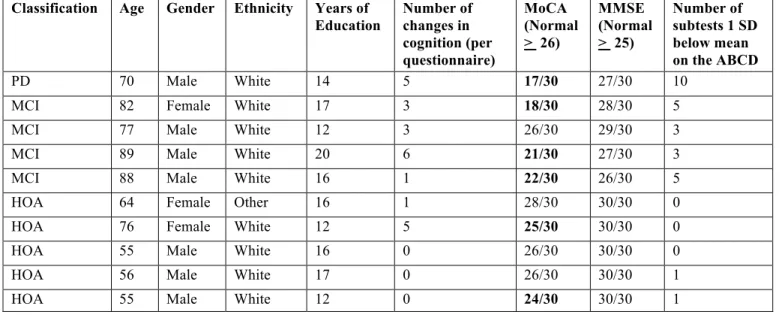
questionnaire, MoCA, MMSE, and ABCD. Participant ages ranged from 55 to 82 years old, with a mean age of 71. The following neurobehavioral criteria established by the NIH-NIA (Albert, 2011) was used to make a clinical diagnosis of MCI: 1) concerns regarding a change in cognitive functioning by the patient, family member, or clinician; 2) classification of impairment in one or more cognitive domains; 3) maintenance of functional abilities; 4) and the individual does not meet the criteria for dementia. Classification of MCI was determined based on participants’ responses from the questionnaire and performance on the ABCD. Four participants presented with MCI, five were HOA, and one had a previous diagnosis of Parkinson’s disease (PD). Table 2 shows the participants’ demographic information, number of subjective memory complaints recorded on the questionnaire, and their performance on the MoCA, MMSE, and ABCD. The MoCA accurately screened for MCI in three of four participants and the participant with PD, however, it misdiagnosed two HOA. While
individuals with MCI consistently scored lower than HOA on the MMSE, all ten participants scored within the normal limits. Figure 2 depicts tasks from the ABCD on which individuals
with MCI scored one or more standard deviations (SD) below the mean. Three participants with MCI scored at least one SD below the mean on the repetition and reading
comprehension- sentences tasks. Two participants with MCI scored at least one SD below the mean on the mental status, story retelling- immediate, generative naming, and
confrontation naming tasks. One participant with MCI scored at least one SD below the mean on the following commands and object description tasks. Similarly, participants with MCI demonstrated impairments during the delayed recall, repetition, letter generative
naming, orientation, attention, naming, clock drawing, and copy cube tasks from the MoCA. All of the participants with MCI scored within one SD of the mean on the comparative questions, word learning- total recall, word learning- recognition, reading comprehension- word, concept definition, generative drawing, figure copying, and story retelling- delayed tasks from the ABCD, indicating individuals with MCI are less likely to demonstrate deficits during these tasks. Therefore, the tasks from the ABCD with the greatest predictive value for identification of MCI include: repetition, reading comprehension- sentences, mental status, story retelling-immediate, generative naming, and confrontation naming. These subtests assess the following domains: linguistic comprehension, mental status, episodic memory, and linguistic expression.
Classification Age Gender Ethnicity Years of Education Number of changes in cognition (per questionnaire) MoCA (Normal > 26) MMSE (Normal > 25) Number of subtests 1 SD below mean on the ABCD PD 70 Male White 14 5 17/30 27/30 10
MCI 82 Female White 17 3 18/30 28/30 5
MCI 77 Male White 12 3 26/30 29/30 3
MCI 89 Male White 20 6 21/30 27/30 3
MCI 88 Male White 16 1 22/30 26/30 5
HOA 64 Female Other 16 1 28/30 30/30 0
HOA 76 Female White 12 5 25/30 30/30 0
HOA 55 Male White 16 0 26/30 30/30 0
HOA 56 Male White 17 0 26/30 30/30 1
HOA 55 Male White 12 0 24/30 30/30 1
0 1 2 3 4 N u m b er o f i n d iv id u al s w it h M CI w h o sc or ed a t l ea st 1 S D b el ow O ld N or m al C on tr ol s
Subtests from the ABCD
MCI Performance on the Arizona Battery for
Communication Disorder's Subtests
Figure 2. MCI Performance on the Arizona Battery for Communication Disorder’s Subtests. This figure
Table 2
An analysis of the relationship between education and performance was conducted by comparing participants years of education with their performance on the ABCD, however the results were inconclusive due to the small sample size. There was minimal difference in the performance of individuals with 17 years of education, versus those with 12 years of
education. There was one individual with 20 years of school, whose performance suggested a positive correlation between years of education and cognitive performance, however, given the small sample size, these findings are speculative.
Discussion
Analysis of ten participants’ performance on the MoCA and MMSE yielded concerning results. While there are a wide number of screening instruments available to clinicians, the MoCA and MMSE are commonly used to assess cognition (Damian et al., 2011; Dong et al., 2012). In the present study the MoCA only detected three of four participants with MCI, and it misdiagnosed two HOA. Additionally, the MMSE lacked the appropriate sensitivity to identify any individuals with MCI. These results align with
findings from previous studies that argue the MoCA is superior for detecting subtle cognitive decline when compared to the MMSE (Algiakrishnan et al., 2013; Damian et al., 2011; Dong et al., 2012; Markwick et al., 2012; Razali, 2014; Tsai et al., 2012). The present findings support McLennan et al.’s argument that the MoCA has high sensitivity paired with low specificity resulting in an over diagnosis of individuals classified as having MCI (2011). These findings highlight the need for development of an assessment instrument that accurately assesses cognition to ensure accurate identification of MCI. As previously emphasized, early detection of MCI paired with behavioral intervention may delay further cognitive decline. Therefore, identification of the subtests and constructs most frequently
impaired in individuals with MCI may lead to construction of an instrument with the necessary accuracy to detect the subtle deficits associated with MCI.
Analysis of five HOA, four MCI, and one PD participant from the current study revealed six subtests that best differentiate MCI from HOA. The subtests with the greatest sensitivity from the ABCD included: repetition, reading comprehension- sentences, mental status, story retelling- immediate, generative naming, and confrontation naming.
The tasks found to be most appropriate for discriminating MCI assess the following constructs: linguistic comprehension, mental status, episodic memory, and linguistic expression. If a battery comprised of these subtests had been administered, all individuals with MCI would have been accurately detected and there would not have been any false positive diagnoses. These findings aligned with anticipated results based on previous literature.
An extensive review of literature revealed episodic memory, linguistic, and executive function tasks were most heavily supported to yield the appropriate sensitivity for detecting MCI. While the findings from the present study support episodic memory and linguistic tasks from the ABCD to be tasks most predictive of MCI, it is important to note that the ABCD does not explicitly assess executive function skills. However, the digit span forward, digit span backward, and trail making tasks from the MoCA were administered to all
participants. The digit span forward and digit span backward task had the necessary
sensitivity to identify two of four participants with MCI. The trail making task detected one of four participants with MCI, and executive functioning deficits in the individual with PD. Based on these findings, the digit span forward and digit span backward tasks appear superior to the trail making task for assessing executive function performance since two
individuals with MCI presented with deficits on the digit span tasks while only one participant with MCI presented with deficits on the trail making task. Additionally, both tasks had high specificity since neither task detected deficits in HOA. Given these findings, executive functioning tasks appear to aid in accurately detecting MCI and therefore should be provided when assessing cognitive functioning. Overall, the results were surprisingly similar to Damian et al.’s (2011) findings that showed the optimal combination of tasks for
identification of MCI entailed orientation, language, and visuospatial-executive tasks from the MoCA and the recall task from the MMSE.
Linguistic Comprehension
According to the review of current literature, language is the second most frequently argued domain predictive of MCI. Results from the current study show the repetition and reading comprehension-sentences tasks, which both assess linguistic comprehension, were critical in identifying MCI. The repetition task administrated in the ABCD involves the administrator stating a non-sense phrase, which the participant must repeat (Bayles & Tomeoda, 1993). The reading comprehension-sentences task assesses reading
comprehension at the sentence level (Bayles & Tomeoda, 1993). Bayles and Tomeoda (1993) highlight the importance of the reading comprehension task by explaining that one’s ability to read aloud typically remains unimpaired in individuals with AD, however an individual’s comprehension of these sentences is typically affected. Given the present findings, the same argument holds true for individuals with MCI.
A variety of receptive language tasks have been studied extensively to determine their ability to distinguish MCI. Results from the current study align with previous studies that indicate performance differences between individuals with MCI and HOA were observed on
repetition tasks (Nasreddine et al., 2005; Nordlund et al., 2005). Additional receptive language tasks have been found to discriminate MCI. For example, word reading thresholds and verbal irony comprehension tasks appear beneficial for the identification of MCI (Brune & Bodenstein, 2005; Massoud, Chertkow, Whitehead, Overbury, & Bergman, 2002). The correlation between linguistic receptive abilities and cognitive decline is evident and
therefore receptive language tasks appear necessary for detecting MCI (Brune & Bodenstein, 2005; Massoud et al., 2002; Nasreddine et al., 2005; Nordlund et al., 2005). However, further investigation is warranted to determine which tasks are most sensitive to the subtle cognitive deficits associated with MCI.
Linguistic Expression
In addition to receptive linguistic tasks, the expressive linguistic tasks of generative naming and confrontation naming had the necessary sensitivity to detect MCI. The
generative naming semantic category task administered in the ABCD entails having the individual name items in a specific category. During the standardization of the ABCD, both letter and semantic category generative naming tasks were assessed and there was no
significant difference in performance on either task (Bayles & Tomeoda, 1993). The confrontation naming task involves naming objects presented to the individual via visual stimuli. Bayles and Tomeoda warn clinicians that failure to name an object may be due to a plethora of reasons such as lexical access problems, inattention, deteriorated object
knowledge, or perceptual deficits (1993). Therefore, the clinician should not assume that failure to name an object is due to semantic memory deficits (Bayles & Tomeoda, 1993).
Linguistic expression abilities have been assessed using a variety of tasks and have been correlated with MCI. Expressive language tasks that have been studied include verbal
fluency tasks (Ostberg, Fernaeus, Hellstrom, Bogdanovic, & Wahlund, 2005; Teng et al., 2013) and confrontational naming tasks (Brouillette et al., 2011; Tsantali et al., 2013). Roark Mitchell, Hosom, Hollingshead, and Kaye (2011) found speech measures such as pauses per retelling, total pause time, total phonation time, total locution time, and verbal rate differed significantly between participants with MCI and HOA. Roark et al.’s (2011) argument for the use of linguistic expression tasks aligns with the current findings. When comparing the performance of individuals with MCI to HOA on tasks from various domains, Nordlund et al. found the clearest difference between MCI and HOA on expressive language tasks such as repetition tasks and executive function tasks (2005). Although various linguistic expression tasks have been assessed and their findings differ regarding which linguistic expression task is most predictive of MCI, the correlation between linguistic expression abilities and
cognitive decline is heavily supported (Chapman et al., 2002; Garrard, Maloney, Hodges, & Patterson, 2005; Nordlund et al., 2005; Ritchie et al., 1993; Snowden et al., 1996; Taler & Phillips, 2008). While there is support for various linguistic expression tasks throughout literature, the majority of previous studies assessed the predictive value of tasks for
discriminating MCI from HOA or MCI from AD. Future research should determine which tasks best discriminate MCI from both HOA and AD. Overall, these results highlight the critical importance and predictive value of both expressive and receptive language tasks for detecting MCI.
Episodic Memory
Associative memory, or episodic memory deficits are evident in individuals with MCI (Irish et al., 2011; Price et al., 2012). Evaluation of previous literature revealed episodic memory was the most frequently argued domain predictive of MCI. These findings led to the
prediction that episodic memory tasks would encompass the necessary sensitivity for
discriminating MCI. As predicted, in the current study, performance on the episodic memory task of story retelling- immediate differentiated MCI participants from HOA. The story retelling- immediate task requires the individual to verbally recall a story immediately after the administrator reads the story aloud (Bayles & Tomeoda, 1993).
Episodic memory tasks may include story retelling, everyday memory, or
remembering faces tasks. Everyday memory includes retrieving details about the previous day or weeks. The face-name pairs task, an associative memory task, entails showing the participant faces and names, and then showing the faces in a random order to determine their ability to accurately retrieve the names associated with each face. Irish et al. (2011) argued delayed recall, measures of acquisition, and associative memory tasks best discriminated MCI at baseline. Although there are discrepancies among literature regarding the specific episodic memory tasks that are superior for detecting MCI, episodic memory appears to be a critical domain impacted by cognitive decline.
Orientation
The fourth subtest found to be most predictive of MCI was mental status, which assesses orientation. The mental status task administered in the ABCD includes 13 questions such as, “What year were you born?” Orientation tasks are administered in multiple
screening and assessment instruments assessing cognitive functioning (Crum et al., 1993; Folstein & Folstein, 1975; Nasreddine et al., 2005). Findings from this study support that participants with MCI perform worse than HOA on orientation tasks (Damian et al., 2011; Prigatano et al. 2014). The orientation task was even found to increase the sensitivity and specificity of screening instruments for identification of MCI (Markwick et al. 2012).
Orientation tasks may include a variety of questions such as today’s date or the date of the participant’s birthday. Investigators have assessed the predictive value of orientation tasks for the identification of MCI. Similar to the present results, Damian et al. (2011) found the orientation task from the MoCA could identify cognitive impairment as well as the entire MMSE. In the present study, two participants with MCI received five out of six points on the MoCA orientation task and those same participants received nine out of ten points on the MMSE. Two participants with MCI presented with no orientation deficits. The participant with PD received four out of six points on the MoCA and eight out of ten points on the MMSE. The orientation questions on the MMSE include all of the questions from the MoCA (date, month, year, day, place, city), in addition to four more questions, which include:
season, state, country, and floor/room. All participants with orientation deficits were identified when provided the orientation questions from the MoCA. Also, all participants who incorrectly answered orientation questions from the MoCA accurately answered the additional four questions on the MMSE. Therefore, the orientation questions administered in the MoCA hold the necessary sensitivity to assess orientation. The orientation questions from the MoCA are similar to the questions administered in the ABCD. Although less research has analyzed the importance of orientation tasks, orientation deficits were observed in individuals with MCI.
Of the six domains most frequently supported throughout literature as being predictive of MCI, orientation had the smallest number of supporting articles. Potentially, one reason being that orientation tasks are often administered in addition to other tasks since orientation deficits are a widely accepted distinctive feature of cognitive decline. Therefore,
when researchers investigate tasks most predictive of MCI in isolation, there has been less emphasis on assessing the predictive value of orientation in isolation.
Further Analysis
Although it is evident episodic memory, language, and orientation tasks are superior for identifying individuals with MCI, there are a variety of tasks that can assess each of these domains. As previously highlighted, there are wide discrepancies throughout literature regarding which tasks are superior for detecting the deficits in each domain. Since various linguistic comprehension, episodic memory, and linguistic expression tasks were
administered, one may conclude that out of the tasks given to assess each construct,
repetition, reading comprehension- sentences, story retelling- immediate, generative naming, and confrontation naming are the optimal tasks for detecting the subtle cognitive deficits indicative of MCI. Therefore, these subtests were superior to the additional tasks
administered in the ABCD to assess episodic memory, linguistic comprehension, and mental status.
It is important to stress that the combination of tasks found to significantly identify MCI must all be administered to increase the sensitivity and specificity of detecting MCI. Howieson et al. (2008) support the use of administering multiple subtests for the
identification of MCI. While they suggest verbal episodic memory tasks aid in
discriminating MCI, they argue that assessing episodic memory alone is insufficient for the identification of MCI. Similarly, Klekociuk et al. (2014) argue episodic memory deficits are predictive of MCI, however, episodic memory deficits are only predictive when the
individual also has deficits in additional domains. While the current study identified subtests predictive of MCI, the sensitivity and specificity for identifying MCI is strengthened when
all of the subtests predictive of MCI are administered collectively. Administration of these tests in isolation would likely weaken their accuracy for detecting cognitive impairment. Therefore, the repetition, reading comprehension- sentences, mental status, story retelling- immediate, generative naming, and confrontation naming tasks from the ABCD should be jointly administered for improved sensitivity and specificity for the identification of MCI.
One of the participants had a diagnosis of PD, which likely impacted his performance on various tasks. The individual with PD had ten subtests at least one SD below the mean, which was five subtests more than any other individuals performance on the ABCD. Subtests that may have been directly influenced by PD include the visuospatial construction tasks: generative drawing and figure copying. However, subjects with PD were included in the standardization of the ABCD and the participant’s scores were assessed using the mean and SD from the “non demented PD” standardization. Therefore, while PD may have impacted the participant’s performance, the procedures were appropriate to administer regardless of the individual’s diagnosis of PD. Based on the standardization sample, the ABCD provides a total overall score for “non demented PD;” however, it does not provide a total overall score for “demented PD.” The participant’s total score indicated that the individual did not classify as “non demented.” Since there was no total overall score
provided for “demented PD,” the extent of the participant’s deficits were unclear. Therefore, the participant with PD did not meet the neurobehavioral criteria for MCI.
Limitations
Although all attempts were made to minimize limitations, confounding variables may have influenced the results. One limitation was the inability to know the participant’s
the participant’s cognitive status when recruiting participants. This is one reason there were more HOA than MCI participants. Optimal results would be obtained if there were an equal number of HOA and MCI participants. A second limitation was that participants completed the procedures in one session. Fatigue may have influenced results since the procedures required completion of three instruments in addition to the questionnaire. Perhaps optimal procedures would involve splitting the procedures into two or three sessions. While participants were informed this was an option, all participants chose to complete the procedures in one session. In efforts to minimize fatigue and learning effect, if the same question was asked on the ABCD, MoCA, or MMSE, the question was only administered once and their performance was recorded on corresponding questions on the other
instruments. The third and largest limitation was the sample size. Identification of the tasks discriminating MCI may differ from the present findings if the procedures were conducted using a larger sample size.
Future Research
Therefore, future researchers should replicate the current procedures with a larger sample size. A larger sample would increase the validity of the results. Currently, a study with similar procedures to those administered in the present study is being conducted on a larger sample size. Preliminary findings from this study indicate story retelling- delayed, object description, repetition, and mental status tasks are most predictive of MCI.
Additionally, preliminary findings suggest education correlates significantly with all tasks except the following: reading comprehension- word level, word learning- recognition, word learning- cued recall, and comparative questions. Therefore, education appears to be an important factor correlated with performance outcomes on all tasks the preliminary findings
show to be statistically significant for detecting MCI. Further research should be conducted to determine the correlation between education and performance on cognitive tasks which best distinguish MCI. Additionally, education adjusted scoring would yield increased accuracy for detecting MCI.
Conducting a longitudinal study aimed at determining which tasks are most
predictive of conversion to AD would be greatly beneficial. Perhaps specific subtests have the predictive value necessary to determine the likelihood of progression to further cognitive decline. Identification of these tasks would aid clinicians in determining a patient’s
likelihood of progression to AD. While identifying MCI in the earliest stages is critical, knowing the anticipated rate of progression would aid in clinical advances. Various
treatments could then be assessed in individuals at early and late stages of cognitive decline to determine the efficacy of specific treatments. In addition, researchers should administer the repetition, reading comprehension- sentences, mental status, story retelling- immediate, generative naming, and confrontation naming tasks from the ABCD to determine their sensitivity and specificity for detecting each subtype of MCI. Accurate detection of all subtypes of MCI is needed to ensure the development of a new assessment instrument distinguishes deficits associated with all types of MCI. Researchers should also administer the six subtests to determine their efficacy for identifying individuals with MCI. These tasks appear to have the accuracy needed to identify MCI, without administering additional
subtests. Constructing an instrument which takes less time to administer and has the accuracy needed to identify MCI is critical for speech-language pathologists and other healthcare professionals. Perhaps a shorter screener would be feasible to administer at annual doctor visits for individuals over 50 years of age. Not only would this aid in
identification of individuals with MCI at the earliest stages of cognitive or linguistic decline, it would provide baseline data to compare individual’s scores to and document cognitive progression as they age.
Conclusion
In summary, current literature is inconclusive in supporting which domains, subtests, and tasks comprise the strongest sensitivity and specificity for identifying MCI. The present study aimed to document the performance of individuals with probable MCI on a battery of language and cognitive subtests previously shown to be valid and reliable for differentiating individuals with early AD from HOA. In addition, it aimed to identify which tasks, task combinations and/or question items best discriminate MCI. Analysis of the results from the MMSE, MoCA, and the ABCD revealed six subtests best differentiated MCI from HOA. These tasks included: repetition, reading comprehension- sentences, mental status, story retelling- immediate, generative naming, and confrontation naming. Based on these tasks, the domains most predictive of MCI were: linguistic comprehension, mental status, episodic memory, and linguistic expression. These findings aligned with anticipated results. Three of the six most frequently identified domains predictive of MCI distinguished MCI from HOA. Although further research is necessary, one would anticipate administration of the most predictive tasks from the current study would accurately discriminate individuals with MCI. This study provides promising evidence for the development of a widely accepted instrument to accurately identify MCI. Future research should aim to replicate this study with a larger sample size, determine which tasks predict conversion to AD, and assess the validity of administering the six recommended tasks for detecting MCI. Speech-language pathologists and health care professionals are in urgent need for the development of a widely accepted
instrument with the appropriate sensitivity and specificity to detect the early subtle deficits associated with MCI.
References
Alagiakrishnan, K., Zhae, N., Mereu, L., Senior, P., & Senthilselvan, A. (2013). Montreal Cognitive Assessment is superior to standardized Mini-Mental Status Exam in
detecting mild cognitive impairment in the middle-aged and elderly patients with type 2 diabetes mellitus. Biomed Research International, 1-5. doi:10.1155/2013/186106 Albert, M., Dekosky, S., Dickson, D., Dubois, B., Feldman, H., Fox, N., . . . Phelps, C.
(2011). The diagnosis of mild cognitive impairment due to Alzheimer’s disease: Recommendations from the National Institute on Aging-Alzheimer’s Association workgroups on diagnostic guidelines for Alzheimer's disease. Alzheimer's & Dementia, 7(3), 270-279.
Ally, B. A. (2012). Using pictures and words to understand recognition memory deterioration in amnestic mild cognitive impairment and Alzheimer's disease: A review. Current Neurology and Neuroscience Reports, 12(6), 687-694. doi: 10.1007/s11910-012- 0310-7
Armstrong, L., Bothwick, S. E., Bayles, K. A., & Tomoeda, C. K. (1996). Use of the Arizona battery for communication disorders of dementia in the UK. International Journal of Language and Communication Disorders, 31(2), 171-180. doi:
10.3109/13682829609042219
Bayles, K. A., & Boone, D. R. (1982). The potential of language tasks for identifying senile dementia. Journal of Speech and Hearing Disorders, 47(2), 210-217.
Bayles, K. A., Boone, D. R., Tomoeda, C. K., Slauson, T. J., & Kaszniak, A. W. (1989). Differentiating Alzheimer’s patients from the normal elderly and stroke patients with aphasia. Journal of Speech and Hearing Disorders, 54(1), 74-87.
Bayles, K. A., Kaszniak, A. W., & Tomoeda, C. K. (1987). Communication and cognition in normal aging and dementia. San Antonio, TX: Pro-Ed. Publishing.
Bayles, K. A., & Tomeoda, C. K. (1993). Arizona battery for communication disorders of dementia. Canyonlands Publishing: Tucson, AZ
Bayles, K. A., & Tomoeda, C. K. (2013). MCI and Alzheimer's dementia: Clinical essentials for assessment and treatment of cognitive-communication disorders. San Diego, CA: Plural Publishing.
Bayles, K. A., Tomoeda, C. K., & Boone, D. R. (1985). A view of age-related changes in function. Developmental Neuropsychology. 1(3), 231-264. doi:
10.1080/87565648509540312
Bayles, K. A., Tomoeda, C. K., & Trosset, M. W. (1992). Relation of linguistic communication abilities of Alzheimer’s patients to stage of disease. Brain and Language, 42(4), 454-472.
Bondi, M. W., & Smith, G. E. (2014). Mild cognitive impairment: A concept and diagnostic entity in need of input from neuropsychology. Journal of the International
Neuropsychological Society, 20(2), 129-134. doi:10.1017/S1355617714000010 Brouillette, R. M., Martin, C. K., Correa, J. B., Davis, A. B., Han, H., Johnson, W. D., . . .
Keller, J. N. (2011). Memory for names test provides a useful confrontational naming task for aging and continuum of dementia. Journal of Alzheimer’s Disease, 23(4), 665-671. doi: 10.3233/JAD-2011-101455.
Brown, J. M., Wiggins, J., Dong, H., Harvey, R., Richardson, F., Hunter, K., . . . Parker, R. A. (2014). The hard Test Your Memory. Evaluation of a short cognitive test to detect
mild Alzheimer's disease and amnestic mild cognitive impairment. International Journal of Geriatric Psychiatry, 29(3), 272-280. doi:10.1002/gps.4005
Brune, M., & Bodenstein, L. (2005). Proverb comprehension reconsidered- ‘theory of mind’ and the pragmatic use of language in schizophrenia. Schizophrenia Research, 75(2-3), 233-239.
Chapman, S., Zientz, J., Weiner, M., Rosenberg, R., Frawley, W., & Burns, M. (2002). Discourse changes in early Alzheimer disease, mild cognitive impairment, and normal aging. Alzheimer Disease and Associated Disorders, 16(3), 177-186. Chong, M., Lim, W., Chan, S., Feng, L., Niti, M., Yap, P., . . . Ng, T. (2010). Diagnostic
performance of the Chinese frontal assessment battery in early cognitive impairment in an Asian population. Dementia and Geriatric Cognitive Disorders, 30(6), 525-532. doi: 10.1159/000321665
Clark, L. R., Delano-Wood, L., Libon, D. J., McDonald, C. R., Nation, D. A., Bangen, K. J., . . . Bondi, M. W. (2013). Are empirically-derived subtypes of mild cognitive
impairment consistent with conventional subtypes? Journal of The International Neuropsychological Society, 19(6), 635-645. doi:10.1017/S1355617713000313 Crum, R. M., Anthony, J. C., Bassett, S. S., & Folstein, M. F. (1993). Population-based
norms for the Mini-Mental State Examination by age and educational level. Journal of the American Medical Association, 269(18), 2386–2391.
Damian, A. M., Jacobson, S. A., Hentz, J. G., Belden, C. M., Shill, H. A., Sabbagh, M. N., . . . Adler, C. H. (2011). The Montreal Cognitive Assessment and the Mini-Mental State Examination as screening instruments for cognitive impairment: Item analyses and threshold scores. Dementia and Geriatric Cognitive Disorders, 31(2), 126-131. doi: