econ
stor
www.econstor.eu
Der Open-Access-Publikationsserver der ZBW – Leibniz-Informationszentrum Wirtschaft The Open Access Publication Server of the ZBW – Leibniz Information Centre for Economics
Nutzungsbedingungen:
Die ZBW räumt Ihnen als Nutzerin/Nutzer das unentgeltliche, räumlich unbeschränkte und zeitlich auf die Dauer des Schutzrechts beschränkte einfache Recht ein, das ausgewählte Werk im Rahmen der unter
→ http://www.econstor.eu/dspace/Nutzungsbedingungen nachzulesenden vollständigen Nutzungsbedingungen zu vervielfältigen, mit denen die Nutzerin/der Nutzer sich durch die erste Nutzung einverstanden erklärt.
Terms of use:
The ZBW grants you, the user, the non-exclusive right to use the selected work free of charge, territorially unrestricted and within the time limit of the term of the property rights according to the terms specified at
→ http://www.econstor.eu/dspace/Nutzungsbedingungen By the first use of the selected work the user agrees and declares to comply with these terms of use.
von Schlippenbach, Vanessa; Teichmann, Isabel
Working Paper
The strategic use of private quality standards in food
supply chains
DICE Discussion Paper, No. 62 Provided in Cooperation with:
Düsseldorf Institute for Competition Economics (DICE)
Suggested Citation: von Schlippenbach, Vanessa; Teichmann, Isabel (2012) : The strategic use of private quality standards in food supply chains, DICE Discussion Paper, No. 62, ISBN 978-3-86304-061-1
This Version is available at: http://hdl.handle.net/10419/59579
No 62
The Strategic Use of Private
Quality Standards in Food
Supply Chains
Vanessa von Schlippenbach
Isabel Teichmann
IMPRINT
DICE DISCUSSION PAPER
Published by
Heinrich‐Heine‐Universität Düsseldorf, Department of Economics, Düsseldorf Institute for Competition Economics (DICE), Universitätsstraße 1, 40225 Düsseldorf, Germany
Editor:
Prof. Dr. Hans‐Theo Normann
Düsseldorf Institute for Competition Economics (DICE) Phone: +49(0) 211‐81‐15125, e‐mail: [email protected]
DICE DISCUSSION PAPER
All rights reserved. Düsseldorf, Germany, 2012
ISSN 2190‐9938 (online) – ISBN 978‐3‐86304‐061‐1
The working papers published in the Series constitute work in progress circulated to stimulate discussion and critical comments. Views expressed represent exclusively the authors’ own opinions and do not necessarily reflect those of the editor.
The Strategic Use of Private Quality Standards in
Food Supply Chains
Vanessa von Schlippenbach
yIsabel Teichmann
zMay 2012
Abstract
We explore the strategic role of private quality standards in food supply chains. Considering two symmetric retailers that are exclusively supplied by a …nite number of producers and endogenizing the suppliers’delivery choice, we show that there exist two asymmetric equilibria in the retailers’quality requirements. Our results reveal that the retailers use private quality standards to improve their bargaining position in the intermediate goods market. This is associ-ated with ine¢ ciencies in the upstream production, which can be mitigassoci-ated by enforcing a minimum quality standard.
JEL Classi…cation: L15, L42, Q13
Keywords: private quality standards, vertical relations, buyer power, food supply chain
We would like to thank Pio Baake, Özlem Bedre-Defolie, Stéphane Caprice, Claire Chambolle, Clémence Christin and Vincent Réquillart, as well as participants of the Annual Conference of the GeWiSoLa (Halle, 2011), of the EAAE Congress (Zurich, 2011), of the Verein für Socialpolitik (Kiel, 2010), and seminar participants at DIW Berlin, Humboldt-Universität zu Berlin, Toulouse School of Economics and INRA-ALISS Paris for helpful discussions and suggestions. Financial support from the Deutsche Forschungsgemeinschaft (FOR 986 and "Market Power in Vertically Related Markets") is gratefully acknowledged.
yCorresponding Author: Deutsches Institut für Wirtschaftsforschung (DIW) Berlin and
Univer-sity of Düsseldorf, Düsseldorf Institute for Competition Economics (DICE), e-mail: [email protected]
Food scandals, like the British BSE1 crisis, the melamine found in Chinese milk in
2008, and the dioxin contamination of animal feed in Germany in 2010, tend to cause serious consumer concerns about food quality. These crises have encouraged both governments and the food industry to tighten food safety regulations. In particular, food retailers have implemented private quality standards in the area of fresh fruits, vegetables, meat, and …sh products, e.g. Tesco’s Nature’s Choice and Carrefour’s Fil-ière Qualité, which are above and beyond public regulations. Quality standards clarify product and process speci…cations, stipulate how these speci…cations are met and de-…ne each trading partner’s responsibilities. While product standards refer to physical properties of the …nal products, such as maximum residue levels (MRLs) for pesti-cides and herbipesti-cides, threshold values for additives and requirements for packaging material, process standards relate to properties of the production process, including hygiene, sanitary and pest-control measures, the prohibition of child labor, animal-welfare standards and food quality management systems. Moreover, quality standards may vary widely among the individual retailers.2 Even when adopting collective
pri-vate standards, such as the British Retail Consortium (BRC) Global Standard for Food Safety and GlobalGAP, retailers tend to supplement them with individual re-quirements (OECD 2006).3 This has triggered strong debates as to whether retailers
1Bovine spongiform encephalopathy (BSE).
2In Germany, for example, the MRLs for pesticides established by some large retail chains in
2008 ranged from 80% of the public MRL (Aldi, Norma), to 70% (REWE, Edeka, Plus), to as low as 33% (Lidl) (PAN Europe 2008). The British retailer Marks & Spencer plans to have all of its fruits, vegetables and salads free of any pesticide residues by 2020 (Marks & Spencer 2010).
3In the U.S., for example, collective private standards were …rst adopted by Wal-Mart on a
nation-wide basis in 2008 (Wal-Mart 2008a). In addition, Wal-Mart implemented steps towards reduced packaging by its suppliers (Wal-Mart 2008b) and a more sustainable global supply chain (Wal-Mart 2011).
use private quality standards as a strategic instrument to gain buyer power in pro-curement markets.4 So far, this conjecture has not been formally analyzed.5 We
intend to narrow this gap by investigating the retailers’ quality choice in a vertical bargaining setting.
More precisely, we consider a vertical structure with two downstream retailers that are supplied by a …nite number of upstream producers with increasing marginal costs of production. The retailers are assumed to impose private quality requirements that must be ful…lled by their respective suppliers. Taking the retailers’ quality standards as given, the upstream producers decide which retailer they exclusively supply and, thus, which quality standard they meet. Compliance with a higher quality standard is associated with higher quality costs.6 Furthermore, the suppliers are not
4Further incentives for retailers to set private quality standards might be to prevent a potential
decrease in revenue due to reputation losses (OECD 2006), to respond to public minimum stan-dards (e.g., Valletti 2000; Crampes and Hollander 1995; Ronnen 1991), to pre-empt or in‡uence public regulation (e.g., McCluskey and Winfree 2009; Lutz, Lyon and Maxwell 2000), to counter producers’lobbying for low public minimum quality standards (Vandemoortele 2011), to substitute for inadequate public regulation in developing countries (e.g., Marcoul and Veyssiere 2010), or to safeguard against liability claims (e.g., Giraud-Héraud, Hammoudi and Soler 2006; Giraud-Héraud et al. 2008). There is also a …erce debate on whether increasing quality requirements by large retailers may impose entry barriers for suppliers in developing countries, in particular for small-scale producers (e.g., OECD 2007, 2006; García Martinez and Poole 2004; Balsevich et al. 2003; Boselie, Henson and Weatherspoon 2003).
5Hammoudi, Ho¤mann and Surry (2009) even state that the understanding of the strategic
aspects of private quality standards in vertical relations is still underdeveloped.
6Production costs in the food sector are increasing in quality due to the necessary replacement
of pesticides, herbicides or fertilizer by more expensive raw materials, increased management duties and higher labor inputs. Further quality-related cost increases are associated with the development and implementation of quality-management systems, stricter testing and documentation, changes in
able to adjust the quality of their production in the short-term since the product quality depends on the underlying production processes. Given the retailers’quality requirements and the suppliers’ delivery decision, both retailers enter into bilateral negotiations with their respective suppliers about the delivery conditions. If a supplier fails to …nd an agreement with its selected retailer, it is able to switch the delivery to the other retailer as long as it complies with the respective quality requirements. Upon successful completion of the negotiations, each supplier produces and delivers its product to the retailer. Each retailer transforms the received inputs into a …nal good and sells it to consumers in a perfectly competitive market.
We …nd that there exist two asymmetric equilibria in the retailers’quality choice. If one retailer sets a relatively high quality standard, the other retailer has an incen-tive to undercut this quality requirement. The reason is that the suppliers cannot adjust their product quality in the short-term. Accordingly, the suppliers complying with the lower quality standard lose their outside option, which improves the bar-gaining position of the low-quality retailer. In turn, if one retailer sets a relatively low quality standard, the other retailer has an incentive to implement stricter quality requirements. By increasing its quality standard, the high-quality retailer weakens the outside option of its suppliers since they incur the production costs for the high quality standard but are rewarded for the lower quality only when supplying the low-quality retailer. This improves the bargaining position of the high-low-quality retailer. In equilibrium, more suppliers decide to deliver to the high-quality retailer than to the low-quality retailer. This induces ine¢ ciencies in the upstream market as an e¢ cient production structure requires that both retailers set the same quality standard and the suppliers split equally between the retailers. Overall, our analysis reveals that the retailers use the private quality standards as a strategic instrument to improve their bargaining position in the intermediate goods market, resulting in ine¢ cient
upstream production.
Although quality standards are receiving growing attention, few articles address retailers’private standards in vertical relations.7 Insights can be found in studies on
premium private labels (PPLs). Considering a vertical chain with a …nite number of upstream producers delivering to a …nite number of local retail monopolies via a spot market, Giraud-Héraud, Rouached and Soler (2006) analyze the incentive of a retailer to establish a PPL, which is based on direct contracting between the retailer and its PPL suppliers. They …nd that the incentive for a retailer to di¤erentiate its business via a PPL is the higher the lower the public minimum quality standard (MQS). In a similar framework, Bazoche, Giraud-Héraud and Soler (2005) analyze the interest of producers to commit to a retailer’s PPL. They show that fewer producers have an incentive to deliver the PPL when the quality of the MQS is increasing. Furthermore, they …nd that the introduction of a PPL results in higher prices in the intermediate goods market. In contrast to our …ndings, however, both articles show that the aim of a PPL is not to increase the bargaining power of the retailer.8
Our analysis is also related to the large theoretical literature on the sources of buyer power. Potential sources of buyer power include credible threats to vertically integrate or to support market entry at the upstream level (e.g., Katz 1987; She¤man
7For example, Valletti (2000), Crampes and Hollander (1995) and Ronnen (1991) analyze private
standard setting in response to the introduction of a public minimum standard. Focussing on product di¤erentiation, private quality decisions of …rms are also studied by Motta (1993) and Gal-Or (1985, 1987). However, all these papers neglect vertical supply structures.
8Collective standard setting of retailers is analyzed by Giraud-Héraud, Hammoudi and Soler
(2006) as well as Giraud-Héraud et al. (2008). Both articles analyze the introduction of a collective standard for a given public MQS, assuming that retailers are price takers in the procurement market. In their models, the retailers’incentive to implement a collective standard depends on the existence of a legal liability rule.
and Spiller 1992), potential delisting strategies after downstream mergers (e.g., In-derst and Sha¤er 2007), producers’di¤erentiation (Chambolle and Berto Villas-Boas 2010) as well as a greater degree of retailers’di¤erentiation compared to producers’ di¤erentiation (Allain 2002).9 We show that downstream …rms’quality requirements
may constitute an additional source of buyer power.
The remainder of the article is organized as follows. First, we present our model. Subsequently, we conduct the equilibrium analysis and investigate the private quality standards of the retailers under perfect competition. To check the robustness of our results, we further extend our analysis to imperfect competition. Finally, we conclude and derive the relevant policy implications.
The Model
We consider a food supply chain with two symmetric downstream retailersDi,i= 1;2, andN 2symmetric upstream suppliers. Each retailer implements a private quality standardqi;which has to be met by their respective suppliers. The higherqi, the more demanding the quality requirements. Taking as given the retailers’ private quality standards, the N upstream …rms decide which retailer they supply and, thus, which quality standard they comply with. LetUij denote the suppliers that deliver to retailer
Di:Without loss of generality, we assume that theN1 upstream …rmsU11; :::; U1N1 sell
exclusively to the downstream …rmD1; while the remainingN2 =N N1 upstream
…rms U2N1+1; :::; U2N deliver exclusively to the downstream …rm D2. The delivery
conditions are based on bilateral and simultaneous negotiations between the retailers and their respective suppliers, specifying the quantity to be delivered and a …xed
9For extended surveys on buyer power, see Inderst and Mazzarotto (2008) as well as Inderst and
payment to be made in return.
Each retailer transforms the received inputs on a one-to-one basis into a single consumer good. The total quantity Xi retailerDi sells of goodi consists of the sum of intermediate inputs delivered by its upstream suppliers, i.e.
(1) Xi = Ai X j=ai xij with: 8 > < > : ai = 1; Ai =N1 for i= 1 ai =N1+ 1; Ai =N for i= 2 ;
where xij denotes the quantity delivered by each individual supplier. The retailers are assumed to incur costs K(Xi) for distributing the products to the …nal con-sumers. The retailers’cost functions are twice continuously di¤erentiable, increasing and strictly convex inXi;i.e. K0(Xi); K00(Xi)>0andK(0) = 0:These assumptions refer to retailers’scarce shelf space and limited storage capacities.
Moreover, each supplier incurs total costs of C(xij; qi) for producing the quantity
xij at the quality levelqi;whereC(0; qi) = 0 andCxij(0; qi) = 0:
10 The suppliers’cost
functions are twice continuously di¤erentiable, increasing and strictly convex in both
xij and qi:For all xij; qi >0; we, thus, have C (xij; qi); C (xij; qi); Cxijqi(xij; qi)>0
for = xij; qi: The convexity in quantities re‡ects decreasing returns to scale and approximates suppliers’capacity constraints, while the convexity in qualities charac-terizes decreasing marginal e¤ects from quality investments.
For ease of exposition, we assume that the retailers sell their products in perfectly competitive markets, regardless of their individual quality decision.11 In other words,
10Subscripts denote partial derivatives.
11The assumption of perfect competition allows us to minimize the complex role of downstream
market features. Later, we relax this assumption by considering imperfect competition in the down-stream market.
we consider perfect competition for each quality level qi.12 Hence, each retailer acts
as a price taker in the downstream market, facing a perfectly elastic inverse demand curve13 P(q
i)with P0(qi)>0 and P00(qi)<0.14 The game consists of four stages:
1. In stage one, each retailer implements a private quality standard, qi.
2. In stage two, theN upstream …rms decide which retailer they supply and, thus, which quality standard they comply with.
3. In stage three, the two retailers negotiate simultaneously and bilaterally with their respective suppliers about a quantity-forcing delivery contract. Production takes place upon successful completion of the negotiations.
4. In stage four, the retailers sell to …nal consumers.
The delivery contracts are assumed to be short-term, which corresponds to the observation that contracts in the agrifood sector tend to be single-season (Jang and Olson 2010). Additionally, we assume that the suppliers cannot adjust the quality of their products in the short-term. The rationale for this assumption is that quality
12For simplicity, we assume that the quality levels are continuously distributed. In reality,
how-ever, the quality levels are often discrete.
13Note, however, that the aggregated inverse demand for any quality level is downward sloping
in quantity.
14These assumptions re‡ect the observation that consumers are willing to pay a premium for
high-quality products (i.e. P0(q
i)>0), such as eco-labeled food (Bougherara and Combris 2009), organic
products (Gil, Gracia and Sánchez 2000) or high-quality attributes of milk (Bernard and Bernard 2009; Brooks and Lusk 2010; Kanter, Messer and Kaiser 2009) and beef (Gao and Schroeder 2009). However, the higher the quality level the less consumers are willing to pay for additional quality, i.e.
P00(q
adjustments often require changes in the underlying production process (Codron, Giraud-Héraud and Soler 2005) and the adoption of di¤erent production technologies (Mayen, Balagtas and Alexander 2010), which are based on long-term investments in speci…c technologies, production facilities or the implementation of a particular quality-management system.
Furthermore, we make the following bargaining assumptions:
Simultaneous and E¢ cient Bargaining. Each retailer bargains simultaneously and bilaterally with its respective suppliers about quantity-forcing delivery con-tracts Tij(xij; Fij); determining the quantity xij to be delivered by the supplier
Uij and the …xed payment Fij to be made in return by the retailer Di.15 This could, for instance, re‡ect a situation where the retailer delegates representa-tives that negotiate in parallel with the suppliers (see, e.g., Inderst and Wey 2003). Thereby, any retailer-supplier pair Di Uij chooses the quantity xij so as to maximize their joint pro…t, taking as given the outcome of all other si-multaneous negotiations. The …xed feeFij serves to divide the joint pro…t such that each party gets its disagreement payo¤ plus half of the incremental gains from trade, which refer to the joint pro…t minus the disagreement payo¤s. This approach is consistent with the commonly used bargaining solutions, such as the symmetric Nash bargaining solution (Nash 1953) and the Kalai-Smorodinsky bargaining solution (Kalai and Smorodinsky 1975).16
15Non-linear tari¤s in the form of quantity-forcing contracts account for the fact that relations
between sellers and buyers are often based on more complex contracts than simple linear pricing rules (Rey and Vergé 2008). Empirical evidence is provided by Bonnet and Dubois (2010) and Berto Villas-Boas (2007).
16The cooperative approach described can also be interpreted in terms of a non-cooperative
Non-Contingent Contracts. We assume that the terms of delivery are not con-tingent on the negotiation outcome of a rival pair. Likewise, we do not allow for renegotiation in the case of negotiation breakdown between any retailer-supplier pair (see, e.g., Horn and Wolinsky 1988, O’Brien and Sha¤er 1992, McAfee and Schwartz 1994, 1995). This might be the case when a breakdown in the ne-gotiations between the retailer and one of the suppliers is observable but not veri…able (in court) and, therefore, cannot be contracted upon (Caprice 2006). Disagreement Payo¤s. If the negotiations between the retailer Di and one of its suppliers Uij fail, the retailer Di is left to sell the quantities obtained from the remaining suppliers. In turn, the supplier Uij can switch to the retailer
Dk; k = 1;2; k 6= i; when complying with the respective quality requirements
qk: Note that a switching supplier cannot change its product quality and, thus, its quality-related production costs. However, it is able to adjust the quantity to be produced since production starts only after successful completion of the negotiations.
Using our assumptions, the downstream …rms’pro…ts refer to17
(2) Di( ) = R(X i; qi) K(Xi) Ai X j=ai Fij with: 8 > < > : ai = 1; Ai =N1 for i= 1 ai =N1+ 1; Ai =N for i= 2 ;
where R(Xi; qi) := P(qi)Xi denotes the revenue of retailer Di. Our assumptions
the time interval between o¤ers becomes relatively small, the solution of the dynamic non-cooperative process converges to the symmetric Nash bargaining solution (Binmore, Rubinstein and Wolinsky 1986).
17In order to simplify the notation, we omit the arguments of the functions where this does not
on the retailers’costs and the inverse demand faced by each retailer guarantee that the pro…t Di( ) is strictly concave in Xi. For the upstream …rm U
ij supplying the downstream …rmDi; the pro…t is given by
(3) Uij( ) =F
ij C(xij; qi):
Negotiation Outcomes and Delivery Choice
Since our solution concept is subgame perfection, we solve the game by backward induction. In the last stage of the game, each retailer sets its quantity so as to maximize its pro…t given the delivery contracts negotiated before. Hence, the quantity choice of the downstream retailers is constrained by the negotiation outcomes with the upstream suppliers, such that the retailers cannot sell more than they get from their suppliers.18 Proceeding further backwards, we solve for the negotiation outcomes in the intermediate goods market. We then turn to the delivery choice of the suppliers. The retailers’decision about their private quality standards is examined in the next section.
Intermediate Goods Market. To analyze the negotiation outcomes in the intermediate goods market, we have to specify the players’disagreement payo¤s. In the case of negotiation breakdown with supplier Uij, the retailer Di is left to sell the deliveries made by the other suppliers. The supplier Uij; however, can enter into negotiations with the other retailer Dk as long as it complies with the respective quality requirements qk: Otherwise, the supplier’s disagreement payo¤ equals zero.
18Note that the retailers always have an incentive to sell a larger quantity in the …nal consumer
market than they receive from the suppliers as they do not account for the suppliers’ production costs.
We denote an upstream …rmUij that switches fromDi toDk byUekj:
(i) Disagreement Payo¤s. Assuming without loss of generality q1 q2; a supplier
U1j initially delivering to D1 can switch its delivery to D2 when the negotiations
with retailer D1 fail. Then, the switching supplier Ue2j negotiates with D2 about a
quantity-forcing delivery tari¤Te2j(xe2j;Fe2j);taking the contractsT2j(x2j; F2j)between
D2 and all its initial suppliers U2j as given. Since the suppliers cannot adjust their product quality in the short-term, the switching supplier still incurs the variable costs associated with the higher quality requirements q1. However, it is able to adjust the
quantity as production starts after successful completion of the negotiations. Thus, the pro…t of the switching supplierUe2j refers to
(4) eUe2j( ) =Fe
2j C(xe2j; q1):
The pro…t of the downstream retailer D2 in the negotiations with Ue2j is given by
(5) eD2( ) =R(X 2+ex2j; q2) K(X2+xe2j) N X l=N1+1 F2l Fe2j:
For given contracts between D2 and suppliers U2j; the retailer and the switching supplier choose a quantity that maximizes their joint pro…t denoted by
e2( ) = eD2( ) + eUe2j( ) (6) = R(X2+ex2j; q2) K(X2+ex2j) N X l=N1+1 F2l C(ex2j; q1):
de-termined by the solution of (7) @e2( ) @ex2j =P(q2) K0(X2+xe2j) @C(xe2j; q1) @ex2j = 0:
The equilibrium quantity xe2j(X2; q1; q2) is decreasing in q1 due to higher production
costs for higher qualities: In contrast, xe2j(X2; q1; q2) is increasing in q2 as consumer
willingness-to-pay is increasing in the product quality. Moreover, ex2j(X2; q1; q2) is
increasing inN1 (decreasing inN2). That is, the equilibrium quantity to be delivered
by the switching supplier Ue2j is the lower the more suppliers are already delivering toD2 due to the convexity of the cost functions.
The joint pro…t is divided by the …xed fee such that each party gets its disagree-ment payo¤ plus half of the incredisagree-mental gains from trade, i.e. the joint pro…t minus the respective disagreement payo¤s. While the switching upstream …rm Ue2j has no further outside option in the case of negotiation breakdown with D2; the retailerD2
can still sell the quantities of suppliers U2j it has already made an agreement with. Accordingly, the disagreement payo¤ of retailerD2 is given by
(8) D2( ) = R(X 2; q2) K(X2) N X l=N1+1 F2l:
Using (6) and (8), the incremental gains from trade are obtained as
(9) Ge2( ) = R(X2 +xe2j; q2) R(X2; q2) K(X2+ex2j) K(X2) C(ex2j; q1):
Thus, the equilibrium …xed fee Fe2j is chosen such that
(10) eUe2j( ) = Fe
2j C(ex2j; q1) =
1
implying
(11) Fe2j(X2; q1; q2) =
R(X2+xe2j; q2) K(X2+ex2j) +C(ex2j; q1)
2 ;
where we denote the di¤erence in revenues by R(X2+ex2j; q2) :=R(X2+ex2j; q2)
R(X2; q2)and the di¤erence in retail costs by K(X2+xe2j) := K(X2+ex2j) K(X2):
Due to our assumptionq1 q2;an upstream …rmU2j;initially negotiating with re-tailerD2;can switch its delivery to retailerD1in the case of disagreement withD2only
if q1 =q2: By the same argument as above, we get ex1j(X1; q1; q2)and Fe1j(X1; q1; q2):
Lemma 1 For givenXi andTij(xij; Fij), there exists an equilibrium delivery contract speci…ed asTeij(xeij;Feij)withi; k= 1;2; i6=k;wherexeij(Xi; q1; q2)maximizes the joint
pro…t of each retailer-supplier pair Di Ueij and the …xed fee Feij(Xi; q1; q2)shares the
joint pro…t. Comparative statics reveal that xeij(Xi; q1; q2) is increasing in qi; while it is decreasing in qk and Ni:
Proof. See Appendix A.
(ii)Negotiations. Using our above results, the disagreement payo¤ of the upstream …rmU1j when negotiating with its initially selected retailer D1 is given by
(12) bU1j( ) := eUe2j ( ) = Fe
2j C(xe2j; q1):
Correspondingly, the disagreement payo¤ of the upstream …rm U2j; initially negoti-ating with the retailer D2; is given by
(13) bU2j( ) = 8 > < > : 0 if q1 > q2 e F1j C(xe1j; q2) if q1 =q2 :
The retailers, in turn, can still sell the quantities delivered by the remaining suppliers in the case of disagreement. Thus, the retailers’disagreement payo¤s are given by
(14) bDi( ) = R(X i xij; qi) K(Xi xij) Ai X l=ai;l6=j Fil;
where ai and Ai are de…ned as in (2).
In the negotiations, the retailer Di agrees with each supplier Uij on a delivery quantity that maximizes their joint pro…t given by
(15) i( ) = Di( ) + Uij( ) =R(Xi; qi) K(Xi)
Ai
X
l=ai;l6=j
Fil C(xij; qi).
Accordingly, the symmetric equilibrium quantity xij = xi(Ni; qi) each supplier Uij delivers to Di is implicitly given by the solution of
(16) @ i( ) @xij =P(qi) K0(Xi) @C(xi; qi) @xij = 0;
where the total equilibrium quantity sold by retailerDi refers to Xi =Nixi.
The …xed fee divides the joint pro…t such that each party gets its disagreement payo¤ plus half of the incremental gains from trade. Using (12), (14) and (15), the incremental gains from trade of retailer D1 and supplier U1j; i.e. G1( ) := 1( )
bD1( ) bU1j( ), can be written as
(17) G1( ) = R(X1; q1) K(X1) C(x1; q1) Fe2j C(ex2j; q1) ;
where we denote the di¤erence in revenues by R(X1; q1) := R(X1; q1) R(X1
the symmetric equilibrium …xed fees F1j =F1 are chosen such that (18) U1j( ) =F 1 C(x1; q1) = bU1j( ) + 1 2G1( ); implying (19) F1(N1; q1; q2) = R(X1; q1) K(X1) +C(x1; q1) +Fe2j C(ex2j; q1) 2 ;
where Fe2j C(xe2j; q1) refers to the value of the supplier’s outside option (see 12).
Analogously, the incremental gains from trade of retailer D2 and supplier U2j are given by (20) G2( ) = 8 > < > : R(X2; q2) K(X2) C(x2; q2) if q1 > q2 R(X2; q2) K(X2) C(x2; q2) Fe1j C(xe1j; q2) if q1 =q2 ;
where we denote the di¤erence in revenues by R(X2; q2) := R(X2; q2) R(X2
x2; q2) and the di¤erence in retail costs by K(X2) := K(X2) K(X2 x2): The
symmetric equilibrium …xed fees F2j =F2 are chosen such that
(21) U2j( ) =F 2 C(x2; q2) = bU2j( ) + 1 2G2( ); implying (22) F2(N2; q1; q2) = 8 > < > : R(X2;q2) K(X2)+C(x2;q2) 2 if q1 > q2 R(X2;q2) K(X2)+C(x2;q2)+Fe1j C(xe1j;q2) 2 if q1 =q2 :
It turns out that the suppliers get a larger share of the joint pro…t if they deliver to the high-quality retailer than if they supply the low-quality retailer.
Lemma 2 For given Ni; q1 and q2, there exists a symmetric equilibrium delivery
contract Ti(xi; Fi) 8i; k = 1;2; i 6= k; where xi(Ni; qi) maximizes the joint pro…t of the retailer-supplier pairDi Uij and the …xed feeFi (Ni; q1; q2)shares the joint pro…t.
Comparative statics reveal that xi(Ni; qi) is decreasing (increasing) in Ni (Nk);while the overall quantityXi is increasing (decreasing) in Ni (Nk): Furthermore,xi(Ni; qi) is decreasing in qi as long as P0(qi) (@2C(xi; qi)=@xij@qi)<0:
Proof. See Appendix A.
Our results reveal thatxi(Ni; qi) is decreasing inNi due to the convexity of both production and distribution costs. The increase of xi(Ni; qi) in Nk is just a mir-ror image of its decrease in Ni since Nk = N Ni: Furthermore, xi(Ni; qi) is de-creasing in qi as long as the marginal costs of production are su¢ ciently high, i.e.
@2C(x
i; qi)=@xij@qi > P0(qi).
Using our previous results and taking into account the discontinuity in the equi-librium …xed fees (see 22), the retailers’reduced pro…t functions are given by
(23) Di ( ) =R(X
i; qi) K(Xi) NiFi :
Correspondingly, the reduced pro…t functions of the suppliers are obtained as
(24) U1j ( ) = R(X1; q1) K(X1) C(x1; q1) +Fe2j C(ex2j; q1) 2 and (25) U2j ( ) = 8 > < > : R(X2;q2) K(X2) C(x2;q2) 2 if q1 > q2 R(X2;q2) K(X2) C(x2;q2)+Fe1j C(xe1j;q2) 2 if q1 =q2 :
q1 and q2 as given, the upstream suppliers decide whether they deliver to retailer
D1 or D2: Any upstream supplier has an outside option if both retailers impose the
same quality standards. Hence, for q1 = q2, half of the suppliers would opt for
retailer D1; while the other half would opt for retailer D2: If, in turn, the retailers’
quality requirements di¤er, i.e. q1 > q2; only the suppliers delivering to the
high-quality retailerD1 have an outside option in the case of negotiation breakdown. This
makes adherence to the higher quality standard more attractive at …rst. However, as the retailers’ marginal costs of distribution are increasing, i.e. K0(X
i) > 0, not all upstream …rms decide to supply the high-quality retailer.19
In equilibrium, the upstream …rms are indi¤erent as to which retailer they supply. Considering q1 > q2 and using the reduced pro…t functions given in (24) and (25), it
must hold in equilibrium that
(26) U1j (N
1; q1; q2) = U2j (N N1; q2):
Lemma 3 For q1 > q2; equation (26) has a unique solution N1(q1; q2); indicating
the equilibrium number of suppliers that deliver to retailer D1: Correspondingly, the
equilibrium number of upstream …rms delivering to D2 is obtained as N2(q1; q2) =
N N1(q1; q2):
Proof. See Appendix A.
Denoting xi (q1; q2) := xi(Ni ( ); qi); Xi (q1; q2) := Ni ( )xi (q1; q2) and 19Note that we would get a similar e¤ect without considering convex retail costs if there was
imperfect competition in the downstream market. Under imperfect competition, retailers can a¤ect the market price of their goods by their output decisions. Since the market price is decreasing in the overall quantity of the good sold in the market, the marginal contribution of the individual suppliers is decreasing in the number of suppliers delivering to the same retailer.
e
xkj(q1; q2) :=xekj(Nk( ); q1; q2);the comparative statics of N1(q1; q2) are as follows:
Lemma 4 Forq1 > q2;comparative statics reveal that N1(q1; q2)is increasing inq1 if
@C(x1 ; q1)=@q1 < P0(q1)x1 @C(xe2j; q1)=@q1 K00(X1 )(N1 1)x1 (@x1 =@q1) :
Moreover, N1(q1; q2) is decreasing in q2 if @C(x2 ; q2)=@q2 < P0(q2) x2 ex2j=2
K00(X
2 ) (N2 1)x2 N2xe2j=2 (@x2 =@q2):
Proof. See Appendix A.
Considering q1 > q2; an increase in q1 has two countervailing e¤ects on the
pro…ts of suppliers U1j given in (24). First, it results in a higher gross pro…t, i.e. @[ R(X1 ; q1) K(X1 ) C(x1 ; q1)]=@q1 > 0: Second, it implies a decline
in the suppliers’outside option, i.e. @hFe2j(N2; q1; q2) C(ex2j; q1)
i
=@q1 <0:As long
as the …rst e¤ect dominates the second, a higherq1 results in a larger number of
sup-pliers delivering to the high-quality retailer and, thus, in fewer supsup-pliers delivering to
D2. This is the case if the production costs are not increasing too strongly in q1 (see
lemma 4).
A rise in q2; however, results in a higher pro…t for the suppliersU2j delivering to the low-quality retailerD2;i.e. @[ R(X2 ; q2) K(X2 ) C(x2 ; q2)]=@q2 >0:At
the same time, it improves the outside option of the suppliers U1j delivering to the high-quality retailer D1: Again, if the …rst e¤ect dominates the second, a higher q2
leads to a lower number of suppliers delivering to the high-quality retailer, implying a larger number of suppliers opting for the low-quality retailer. This holds if the production costs are not increasing too strongly in q2 (see lemma 4).
Private Quality Standards
In this section, we analyze the retailers’choice of quality requirements. Both retailers set their private quality standards so as to maximize their respective pro…t functions. Denoting Fi :=Fi(Ni; q1; q2), the equilibrium quality requirements are, thus, given
by qi : = arg max qi Di ( ) (27) with : Di ( ) = [R(X i ; qi) K(Xi ) NiFi ]:
Equilibrium Analysis. In our setting, there exists no symmetric equilibrium in the retailers’quality requirements.20
Consideringq1 =q2;the upstream …rms can deliver to both retailers when
comply-ing with the respective quality standard. Thus, all suppliers have an outside option in the case of disagreement with their initially chosen retailer.
If retailer D1 increases its quality requirements by an arbitrarily small amount to
q1 =q2+", two e¤ects emerge: The suppliersU2j delivering toD2 lose their outside
option and the outside option of the suppliers U1j becomes less valuable. The reason for the latter is that the suppliers still incur the production costs associated with q1
when switching to D2, while they are only rewarded for supplying q2: As long as "
is su¢ ciently small, the …rst e¤ect dominates the second. Accordingly, delivery to
D1 becomes more attractive, resulting in a higher N1. A larger number of suppliers
delivering to the high-quality retailer, in turn, induces the following trade-o¤: First, the higher N1 results in a lower quantity delivered by each supplier (see lemma 2),
20If the suppliers generally have no possibility to switch their delivery to the other retailer, there
such that the joint pro…t of retailerD1 and any of its suppliers is increasing. Second,
a higher N1 implies a lowerN2; which improves the disagreement payo¤ of suppliers
U1j: In other words, the marginal contribution of the switching supplier Ue2j to the joint pro…t with the retailer D2 is increasing if N2 is decreasing (lemma 1). As the
…rst e¤ect dominates the second, the retailers have an incentive to deviate from the symmetric candidate equilibrium.
Proposition 1 There exists no symmetric equilibrium in the retailers’ quality re-quirements as the retailers always have an incentive to deviate from the symmetric candidate equilibrium.
Proof. See Appendix A.
To ensure the existence of an asymmetric equilibrium in the retailers’ quality choice, the marginal costs of production need to be su¢ ciently convex in quality and quantity as this eliminates the incentive for retailers to leapfrog each other. Consistent with our above assumptions, we apply the following inverse demand functionsP (qi) = pq
i;production-cost functionsC(xij; qi) = qi3x2ij=3and retail-cost functionsK(Xi) =
X2
i for i= 1;2 to illustrate our results numerically.21
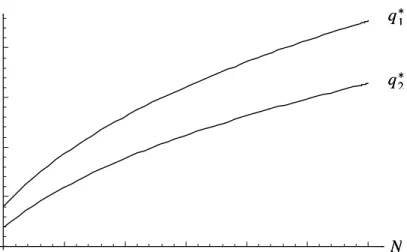
Result 1 Numerical analysis shows that there exists an asymmetric equilibrium in the retailers’ quality choice, i.e. q1 > q2; if the suppliers’ production costs are su¢ -ciently convex in quality and quantity.
<Insert …gure 1 >
21Numerical results for the equilibrium quantities, …xed fees and the number of suppliers delivering
Considering a relatively low value ofq2, the best response of retailerD1 is to raise
its quality requirements above q2 (…gure 1, upper panel). As described above, an increase in q1, starting from q1 = q2, leads to more suppliers delivering to D1 and,
thus, to a larger joint pro…t of the retailerD1 and any of its suppliersU1j due to the lower quantity delivered by each supplier. However, for very high values of q1, the
rise in the quality-related production costs dominates the favorable quantity e¤ect. This puts limits to the rise in q1:
Taking now a relatively high quality standard q1 as given, the best response of retailerD2 is to considerably undercut the quality requirements of D1 (…gure 1, lower
panel). If q2 drops just below q1; i.e. q2 = q1 "; the suppliers U2j lose their outside option: This makes delivery to the now low-quality retailer less attractive than supplying the high-quality retailer. Furthermore, a lower number of upstream …rms supplying the same retailer leads to a larger quantity to be delivered by each of these suppliers (lemma 2). This results in a disproportionately strong increase in the production costs since these are strictly convex in quantity. Retailer D2; therefore,
has an incentive to considerably undercutq1: First, lower quality requirements result in lower quality-related production costs. Second, a lowerq2 relative toq1 reduces the
outside option of suppliersU1j; making delivery toD1 less attractive. Note, however,
that the retailer D2 has no incentive to decrease its quality requirements unlimitedly
since the reduced quality implies lower prices in the …nal consumer market and, thus, decreases the retailer’s revenue.
Result 2 Numerical analysis further reveals that the quality requirements q1 and q2
as well as the di¤erence q1 q2 are increasing in N.
The higherN; the more suppliers decide to deliver to the high-quality retailerD1
since N1 N=2:This results in a decrease in the quantity delivered by each supplier
U1j (lemma 2), leading to a reduction in the quantity-related production costs. On this basis, the retailerD1is able to increase its quality requirements in order to strengthen
its bargaining position by weakening the suppliers’ outside option. A higher q1, in turn, enables the retailer D2 to increase its quality requirementsq2 as well, resulting
in a higher joint pro…t with the suppliers. Due to the disproportionate increase ofN1
inN; a relatively higher quantity is produced by each supplier delivering to the low-quality retailer. This implies that the low-quality requirement of the low-low-quality retailer is less increasing inN than the quality requirement of the high-quality retailer. Hence, the spread between q1 and q2 is increasing in N (…gure 2).
Under the assumption of perfect competition, the retailers’choice of private qual-ity standards is not a¤ected by downstream market features. In other words, the retailers do not di¤erentiate in quality in order to soften the competition in …nal con-sumer markets. The only reason to di¤erentiate in quality is driven by the retailers’ incentive to improve their bargaining position vis-à-vis their suppliers and, thus, to gain buyer power in the intermediate goods market. We …nd that the joint pro…t of the low-quality retailer with any of its suppliers is smaller than the respective joint pro…t obtained by the high-quality retailer as long as the quality requirements have a stronger impact on the retailers’revenue than on production costs. Referring to the above-described outside-option e¤ect, the low-quality retailer gets a larger share of a smaller pie, while the high-quality retailer gets a smaller share of a larger pie. Note that the suppliers make the same pro…t in equilibrium, no matter which retailer they supply.
up-industry pro…t is maximized if both retailers implement the same quality requirements and the suppliers split equally between the retailers.22 However, from proposition 1
we know that there is no symmetric equilibrium in the retailers’ pro…t-maximizing quality choice. Hence, we get:
Proposition 2 The strategic use of private quality standards by retailers results in an ine¢ cient production structure. The ine¢ ciency rises in N since the spread between
q1 and q2 is increasing in N.23
Extension: Imperfect Competition
In the following, we relax the assumption of perfect competition to account for the highly concentrated retail sector in many European countries (Dobson, Waterson and Davies 2003; OECD 2006). Leaving the underlying bargaining mechanism un-changed, we now assume that the retailers are horizontally di¤erentiated and compete in quantities in the …nal consumer market. This allows us to analyze the impact of downstream market features on the retailers’quality choice. We consider a represen-tative consumer with the utility function24
(28) U(X1; X2) = 2 X i=1 pq iXi 1 2 2 X i=1 Xi2+ 2 X1X2 ! 2 X i=1 PiXi,8i= 1;2;
22Note that under our assumptions the quality level that maximizes industry pro…t equals the
socially optimal quality level.
23The negative impact of private quality standards on the production structure can be limited
by enforcing a binding public MQS (see Appendix C).
24This utility function is based on the symmetric, additively separable utility function proposed
where 2 [0;1) indicates the degree of substitutability between the retailers 1 and 2: The closer approaches one, the more the retailers are substitutable. The dif-ferentiation is based on parameters associated with the retail outlet, such as store atmosphere, product range and location. Di¤erentiating (28) with respect toXi; the inverse demand functions refer to Pi(qi; Xi; Xk) = max pqi Xi Xk;0 ; with
i; k = 1;2; i 6= k: That is, the inverse demand functions are twice continuously dif-ferentiable in qi with @Pi(qi; )=@qi > 0 and @2Pi(qi; )=@q2i < 0 for Pi(qi; ) > 0: The production-cost functions and the retail-cost functions remain the same as under perfect competition with C(xij; qi) = q3ixij2=3 and K(Xi) = Xi2. Moreover, we still assume that q1 q2.
Equilibrium Analysis. Solving the third stage of the game, we get the equilib-rium quantitiesxekj(Xi; q1; q2)and xi(Ni; q1; q2)as well as the …xed feesFekj(Xi; q1; q2)
andFi(Ni; q1; q2):In the second stage of the game, we obtainNi;which leads us to the reduced formsxi :=xi(Ni; q1; q2); Xi :=Nixi andFi :=Fi(Ni; q1; q2):25Finally,
in the …rst stage, we analyze the equilibrium quality choice of the retailers. There is an asymmetric equilibrium in the retailers’quality requirements as in the case of perfect competition (…gure 3). The reasoning is as before: Retailer D1 strengthens
its quality requirements to attract more suppliers and, at the same time, to improve its bargaining position in the negotiations with the suppliers. The best response of retailerD2 is to reduce its quality requirements. However, the prevalence of imperfect
competition gives rise to an additional e¤ect as the quantities sold by the retailers now a¤ect the overall market outcome. By increasing its quality requirements, D1
commits itself to sell a higher quantity to …nal consumers. The reason is that the retailer attracts more suppliers by increasingq1;resulting in a largerX1 (lemma 2). 25Numerical results for the equilibrium quantities, …xed fees and the number of suppliers delivering
As quantities are strategic substitutes in our setting, the best response of the com-petitorD2 is to decrease its quantity in the …nal consumer market. D2is able to do so
by reducing its quality requirements. This e¤ect becomes less pronounced the more di¤erentiated the retailers are and, thus, the softer downstream competition. This also implies that the ine¢ ciency induced by the retailers’private standard setting is decreasing in the degree of retail di¤erentiation.
<Insert …gure 3 >
Result 3 The results obtained under perfect competition in the downstream market do not qualitatively change when imperfect downstream competition is considered.
Minimum Quality Standard. The ine¢ ciency in upstream production induced by the retailers’quality choice under imperfect competition can be limited by enforc-ing a bindenforc-ing public MQS. Under such a MQS, the retailer with the lower quality requirements cannot unrestrictedly reduce its quality standard in response to increas-ing quality requirements of the other retailer. As a consequence, the high-quality retailer has less incentive to increase its quality standard, such that the spread in the high and low quality requirements is reduced.26
26Under perfect competition, the low-quality retailer also increases its quality requirements when
a public MQS is enforced. In contrast to the case of imperfect competition, the best response of the high-quality retailer is to increase its quality requirements as well. Overall, the …rst e¤ect dominates the second, such that a public MQS also mitigates the unfavorable e¤ects of private quality standards under perfect competition (see Appendix C).
Conclusion
Our analysis indicates that retailers use private quality standards to improve their buyer power in the food supply chain, leading to ine¢ cient production structures in the upstream market. The ine¢ ciency in the upstream production is increasing in both the number of upstream suppliers and, in the case of imperfect competition, the degree of substitutability among retailers. We …nd that the implementation of a binding public MQS mitigates the unfavorable e¤ects from the retailers’strategic use of quality standards.
These results hold for both perfect and imperfect competition in the downstream retail market. However, our …ndings are limited to production costs that are su¢ -ciently convex in quality and quantity. Moreover, it is required that suppliers cannot easily change their production process to comply with di¤erent quality requirements. This refers mainly to industries where producers face high quality-related production costs and are locked in their production processes in the short-term, such as in the production of fruits and vegetables.
References
Allain, M.-L. 2002. The Balance of Power between Producers and Retailers: A Dif-ferentiation Model. Louvain Economic Review 68(3): 359-370.
Balsevich, J., A. Berdegué, L. Flores, D. Mainville and T. Reardon. 2003. Su-permarkets and Produce Quality and Safety Standards in Latin America. American Journal of Agricultural Economics 85(5): 1147-1154.
Bazoche, P., E. Giraud-Héraud and L.-G. Soler. 2005. Premium Private Labels, Supply Contracts, Market Segmentation, and Spot Prices. Journal of Agricultural
and Food Industrial Organization 3: Article 7.
Bernard, J. C. and D. J. Bernard. 2009. What Is It About Organic Milk? An Experimental Analysis. American Journal of Agricultural Economics 91(3): 826-836. Berto Villas-Boas, S. 2007. Vertical Relationships between Manufacturers and Retailers: Inference with Limited Data. Review of Economic Studies 74(2): 625-652. Binmore, K., A. Rubinstein and A. Wolinsky. 1986. The Nash Bargaining Solution in Economic Modelling. Rand Journal of Economics 17(2): 176-188.
Boselie, D., S. Henson and D. Weatherspoon. 2003. Supermarket Procurement Practices in Developing Countries: Rede…ning the Roles of the Public and Private Sectors. American Journal of Agricultural Economics 85(5): 1155-1161.
Bonnet, C. and P. Dubois. 2010. Inference on Vertical Contracts between Manu-facturers and Retailers Allowing for Nonlinear Pricing and Resale Price Maintenance. RAND Journal of Economics 41(1): 139-164.
Bougherara, D. and P. Combris. 2009. Eco-Labelled Food Products: What are Consumers Paying for? European Review of Agricultural Economics 36(3): 321-341.
Brooks, K. and J. L. Lusk. 2010. Stated and Revealed Preferences for Organic and Cloned Milk: Combining Choice Experiment and Scanner Data. American Journal of Agricultural Economics 92(4): 1229-1241.
Caprice, S. 2006. Multilateral Vertical Contracting with an Alternative Supply: The Welfare E¤ects of a Ban on Price Discrimination. Review of Industrial Organi-zation 28(1): 63-80.
Chambolle, C. and S. Berto Villas-Boas. 2010. Buyer Power through Producers’ Di¤erentiation. mimeo.
Codron, J.-M., E. Giraud-Héraud and L.-G. Soler. 2005. Minimum Quality Stan-dards, Premium Private Labels, and European Meat and Fresh Produce Retailing. Food Policy 30(3): 270-283.
Crampes, C. and A. Hollander. 1995. Duopoly and Quality Standards. European Economic Review 39(1): 71-82.
Dixit, A. K. and J. E. Stiglitz. 1977. Monopolistic Competition and Optimum Product Diversity. American Economic Review 67(3): 297-308.
Dobson, P. W., M. Waterson and S. W. Davies. 2003. The Patterns and Implica-tions of Increasing Concentration in European Food Retailing. Journal of Agricultural Economics 54(1): 111-125.
Gal-Or, E. 1985. Di¤erentiated Industries without Entry Barriers. Journal of Economic Theory 37(2): 310-339.
Gal-Or, E. 1987. Strategic and Non-Strategic Di¤erentiation. Canadian Journal of Economics 20(2): 340-356.
Gao, Z. and T. C. Schroeder. 2009. E¤ects of Label Information on Consumer Willingness-to-Pay for Food Attributes. American Journal of Agricultural Economics 91(3): 795-809.
García Martinez, M. and N. Poole. 2004. The Development of Private Fresh Pro-duce Safety Standards: Implications for Developing Mediterranean Exporting Coun-tries. Food Policy 29(3): 229-255.
Gil, J. M., A. Gracia and M. Sánchez. 2000. Market Segmentation and Will-ingness to Pay for Organic Products in Spain. International Food and Agribusiness Management Review 3(2): 207-226.
Giraud-Héraud, E., L. Rouached and L.-G. Soler. 2006. Private Labels and Public Quality Standards: How Can Consumer Trust Be Restored after the Mad Cow Crisis? Quantitative Marketing and Economics 4(1): 31-55.
Giraud-Héraud, E., H. Hammoudi and L.-G. Soler. 2006. Food Safety, Liability and Collective Norms. Cahiers du Laboratoire d’Econométrie de l’Ecole
Polytech-Giraud-Héraud, E., H. Hammoudi, R. Ho¤mann and L.-G. Soler. 2008. Vertical Relationships and Safety Standards in the Food Marketing Chain. Working Paper ALISS 2008-07.
Hammoudi, A., R. Ho¤mann and Y. Surry. 2009. Food Safety Standards and Agri-Food Supply Chains: An Introductory Overview. European Review of Agricul-tural Economics 36(4): 469-478.
Horn, H. and A. Wolinsky. 1988. Bilateral Monopolies and Incentives for Merger. RAND Journal of Economics 19(3): 408-419.
Inderst, R. and N. Mazzarotto. 2008. Buyer Power in Distribution. In: Collins, W. D. (ed.). ABA Antitrust Section Handbook, Issues in Competition Law and Policy. Volume III: 1953-1978.
Inderst, R. and G. Sha¤er. 2008. Buyer Power in Merger Control. In: Collins, W. D. (ed.). ABA Antitrust Section Handbook, Issues in Competition Law and Policy. Volume II: 1611-1636.
Jang, J. and F. Olson. 2010. The Role of Product Di¤erentiation for Contract Choice in the Agro-Food Sector. European Review of Agricultural Economics 37(2): 251-273.
Kalai, E. and M. Smorodinsky. 1975. Other Solutions to Nash’s Bargaining Problem. Econometrica 43(3): 513-518.
Kanter, C., K. D. Messer and H. M. Kaiser. 2009. Does Production Labeling Stigmatize Conventional Milk? American Journal of Agricultural Economics 91(4): 1097-1109.
Katz, M. L. 1987. The Welfare E¤ects of Third Degree Price Discrimination in Intermediate Goods Markets. American Economic Review 77(1): 154-167.
Lutz, S., T. P. Lyon and J. W. Maxwell. 2000. Quality Leadership when Regula-tory Standards are Forthcoming. Journal of Industrial Economics 48(3): 331-348.
Marcoul, P. and L. Veyssiere. 2010. A Financial Contracting Approach to the Role of Supermarkets in Farmers’ Credit Access. American Journal of Agricultural Economics 92(4): 1051-1064.
Marks & Spencer. 2010. How We Do Business Report 2010. Marks and Spencer Group plc, United Kingdom.
Mayen, C. D., J. V. Balagtas and C. E. Alexander. 2010. Technology Adaption and Technical E¢ ciency: Organic and Conventional Dairy Farms in The United States. American Journal of Agricultural Economics 92(1): 181-195.
McAfee, R. P. and M. Schwartz. 1995. The Non-Existence of Pairwise-Proof Equilibrium. Economics Letters 49(3): 251-259.
McAfee, R. P. and M. Schwartz. 1994. Opportunism in Multilateral Vertical Contracting: Nondiscrimination, Exclusivity, and Uniformity. American Economic Review 84(1): 210-230.
McCluskey, J. J. and J. A. Winfree. 2009. Pre-Empting Public Regulation with Private Food Quality Standards. European Review of Agricultural Economics 36(4): 525-539.
Motta, M. 1993. Endogenous Quality Choice: Price vs. Quantity Competition. Journal of Industrial Economics 41(2): 113-131.
Nash, J. 1953. Two-Person Cooperative Games. Econometrica 21(1): 128-140. OECD. 2007. Private Standard Schemes and Developing Country Access to Global Value Chains: Challenges and Opportunities Emerging from Four Case Studies.
OECD. 2006. Final Report on Private Standards and the Shaping of the Agro-food System.
O’Brien, D. P. and G. Sha¤er. 1992. Vertical Control with Bilateral Contracts. RAND Journal of Economics 23(3): 299-308.
Available at: http://www.pan-europe.info/Resources/Factsheets/Supermarkets.pdf (accessed March, 2 2011).
Rey, P. and T. Vergé. 2008. Economics of Vertical Restraints. In: Buccirossi, P. (ed.). Handbook of Antitrust Economics. The MIT Press: 353-390.
Ronnen, U. 1991. Minimum Quality Standards, Fixed Costs, and Competition. RAND Journal of Economics 22(4): 490-504.
Rubinstein, A. 1982. Perfect Equilibrium in a Bargaining Model. Econometrica 50(1): 97-109.
She¤man, D. T. and P. T. Spiller. 1992. Buyers’Strategies, Entry Barriers, and Competition. Economic Inquiry 30(3): 418-436.
Valletti, T. M. 2000. Minimum Quality Standards under Cournot Competition. Journal of Regulatory Economics 18(3): 235-245.
Vandemoortele, T. 2011. When are Private Standards more Stringent than Public Standards? mimeo.
von Schlippenbach, V. and I. Teichmann. 2011. The Strategic Use of Private Quality Standards in Food Supply Chains. DIW Discussion Paper 1120. German Institute for Economic Research (DIW Berlin).
Wal-Mart. 2008a. Wal-Mart Becomes First Nationwide U.S. Grocer To Adopt Global Food Safety Initiative Standards. Available at:
http://walmartstores.com/pressroom/news/7918.aspx (accessed March, 8 2011). Wal-Mart. 2008b. Wal-Mart is Taking the Lead on Sustainable Packaging. Available at: http://walmartstores.com/pressroom/factsheets/ (accessed March, 2 2011).
Wal-Mart. 2011. China Sustainability Summit: Fact Sheet. Available at: http://walmartstores.com/pressroom/factsheets/ (accessed March, 2 2011).
Appendix A
Proof of lemma 1. To determine the comparative statics of xeij( ), we apply the implicit-function theorem and use
ei( ) = eDi( ) + eUeij( ) =R(X i+xeij; qi) K(Xi+xeij) Ai X l=ai Fil C(exij; qk) with : 8 > < > : ai = 1; Ai =N1 for i= 1 ai =N1+ 1; Ai =N for i= 2 : Since (29) @2ei( )=@ex2ij = K00(Xi+xeij( )) +@ 2C( e xij( ); qk)=@xe2ij <0;
the comparative statics of xeij( ) are given by sign @xeij( )=@ =
sign @2ei( )=@exij@ for =qi; qk; Ni. Thus, it holds that
sign @exij( ) @qk < 0 since @ 2e i( ) @exij@qk = @ 2C(ex ij( ); qk) @xeij@qk <0; (30) sign @exij( ) @qi > 0 since @ 2e i( ) @xeij@qi =P0(qi)>0; (31) sign @exij( ) @Ni < 0 since @ 2e i( ) @exij@Ni = K00(Xi+xeij)exij <0: (32)
Proof of lemma 2. To determine the comparative statics of xi ( ), we apply the implicit-function theorem. Denoting H(Ni; xi(Ni; qi)) = 0 the …rst-order condition given in (16) and using @H( )=@xij = NiK00(Xi ( )) +@2C(xi ( ); qi)=@x2ij < 0,
we get sign @xi ( ) @Ni = sign @H(Ni; xi ( )) @Ni = K00(Xi ( ))xi ( )<0; (33) sign @xi ( ) @Nk = sign @H(Ni; xi ( )) @Nk =K00(Xi ( ))xi ( )>0: (34)
Considering the overall quantity, we have
@Xi ( ) @Ni =xi ( ) 1 NiK 00(X i ( )) NiK00(Xi ( )) +@2C(xi ( ); qi)=@x2ij >0:
Correspondingly, it holds that @Xi ( )=@Nk<0: Furthermore, we have
sign @xi ( ) @qi = sign @H(Ni; xi ( )) @qi =P0(qi) @2C(x i ( ); qi) @xij@qi ? 0; (35) sign @xi ( ) @qk = 0 since @H(Ni; xi ( )) @qk = 0: (36)
Proof of lemma 3. To prove the existence of N1 ( ); we …rst show that the di¤erence in the upstream …rms’ pro…ts, U( ) = U1j (N
1; q1; q2) U2j (N
N1; q2)is monotonically decreasing in N1:That is, we show that @ U( )=@N1 <0,
i.e. (37) @ U( ) @N1 = 1 2[ 1+ 2 3]<0
with 1 = (K0(X1 ( )) K0(X1 ( ) x1( ))) x1( ) + (N1 1) @x1( ) @N1 ; 2 = 1 2 K 0(X 2 ( ) +ex2j( )) K0(X2( )) x2( ) + (N N1) @x2( ) @N1 ; 3 = (K0(X2 ( )) K0(X2 ( ) x2( ))) x2( ) + (N N1 1) @x2( ) @N1 :
From lemma 2, we immediately getx1( ) + (N1 1) (@x1( )=@N1)>0;which implies 1 >0: Analogously, we obtain (38) x2( ) + (N N1 1) @x2( ) @N1 < x2( ) + (N N1) @x2( ) @N1 <0:
It remains to show that 2 3 >0; which holds as long as
(39) 1
2 K
0(X
2( ) +ex2j( )) K0(X2( )) (K0(X2 ( )) K0(X2 ( ) x2( )))<0:
Since ex2j( )< x2( )due to the comparison of (7) and (16), we can consider ex2j( ) =
x2( ) and get that (39) is obviously ful…lled for K000( ) = 0. However, condition (39) is likewise ful…lled ifK00( )is not too large, i.e. the retailers’costs are not too convex in quantity.
Second, we show that U1j (1; ) > U2j (N 1; ). Considering q
1 = q2+" and
N1 = N2 = 1 for given N = 2, we get U1j (1; ) > U2j (1; ) as supplier U1j has a strictly positive outside option in contrast to supplier U2j: U2j (N2; ) is decreasing
in N2 since the marginal contribution of any individual supplier is the lower the
more suppliers deliver to the same retailer. Accordingly, it holds that U1j (1; ) >
U2j (N 1; ) for any N 2: For N su¢ ciently large, it holds analogously that
Proof of lemma 4. To determine the comparative statics of N1(q1; q2) in q1
and q2; i.e. @N1 ( )=@q1 > 0 and @N1 ( )=@q2 < 0 for q1 > q2; we apply the
implicit-function theorem. Since @ U( )=@N
1 < 0; we have sign(@N1 ( )=@ ) =
sign @ U( )=@ for =q
1; q2: We write the suppliers’pro…ts given in (24) and
(25) as U1j ( ) =GP 1+DP1 and U2j ( ) =GP2 with GP1 = R(X1 ( ); q1) K(X1 ( )) C(x1 ( ); q1) 2 ; (40) GP2 = R(X2 ( ); q2) K(X2 ( )) C(x2 ( ); q2) 2 (41) and (42) DP1 = R(X2 ( ) +xe2j( ); ) K(X2 ( ) +ex2j( )) C(ex2j( ); q1) 4 : If P0(q1) (@2C(x1 ( ); q1)=@x1j@q1)<0 and P0(q1)x1 ( ) @C(x1 ( ); q1)=@q1 >0; we have @GP1 @q1 =P0(q1)x1 ( ) @C(x1 ( ); q1) @q1 | {z } >0 (43) (N1 ( ) 1) (K0(X1 ( )) K0(X1 ( ) x1 ( )))@x1 ( ) @q1 | {z } <0 >0
and analogously@GP2=@q2 >0: Furthermore, we have
@DP1 @q2 =P0(q2)xe2j( ) (44) N2 ( ) K0(X2 ( ) +ex2j( )) K0(X2 ( )) @x2 ( ) @q2 | {z } <0 >0
and (45) @DP1 @q1 = @C(xe2j( ); q1) @q1 <0:
Turning to the comparative static results, we get
(46) sign @N1 ( ) @q1 =sign @ U( ) @q1 =sign @GP1 @q1 +@DP1 @q1 >0 and (47) sign @N1 ( ) @q2 =sign @ U( ) @q2 =sign @DP1 @q2 @GP2 @q2 <0: Condition (46) is ful…lled if @C(x1 ( ); q1) @q1 < P0(q1)x1 ( ) @C(xe2j( ); q1) @q1 (48) (N1 ( ) 1) (K0(X1 ( )) K0(X1 ( ) x1 ( )))@x1 ( ) @q1 :
Applying the …rst-order Taylor approximation, (48) can be rewritten as
@C(x1 ( ); q1) @q1 < P0(q1)x1 ( ) @C(xe2j( ); q1) @q1 (49) K00(X1 ( ))(N1 ( ) 1)x1 ( )@x1 ( ) @q1 :
Likewise, condition (47) is ful…lled if
@C(x2 ( ); q2) @q2 < P0(q2)(x2 ( ) ex2j( )=2) (50) 2(N2 ( ) 1) K0(X 2 ( )) N2 ( ) K0(X2 ( ) +ex2j( )) 2 @x2 ( ) @q2 ;
with : K0(X2 ( )) =K0(X2 ( )) K0(X2 ( ) x2 ( ))
and : K0(X2 ( ) +xe2j ( )) =K0(X2 ( ) +ex2j( )) K0(X2 ( )):
Applying the …rst-order Taylor approximation, (50) can be rewritten as
@C(x2 ( ); q2) @q2 < P0(q2) 2x2 ( ) xe2j( ) 2 (51) K00(X2 ( )) (N2 ( ) 1)x2 ( ) N2 ( ) 2 ex2j( ) @x2 ( ) @q2 :
Proof of proposition 1. To prove that there exists no symmetric equilibrium in the retailers’ quality choice, we show that the retailers always have an incentive to deviate from the symmetric candidate equilibrium. We, thus, compare the pro…t of retailerD1 in the case of equal quality requirements, i.e. q1 =q2;with its pro…t in the
case ofq1 =q2+":If retailerD1 exceeds the quality requirements of retailerD2 by an
arbitrarily small amount "; delivery to D1 becomes more attractive as the suppliers
delivering toD2lose their outside option. Accordingly,N1( )is increasing. Neglecting
any quality e¤ect from the small increase inq1; we show that @ D1 ( )=@N1 >0in
order to prove proposition 1.
First, we show that the overall pro…t of retailer D1 and all its N1( ) suppliers
U1j; i.e. ( ) = P(q1)X1 ( ) K(X1 ( )) N1( )C(x1 ( ); q1); is increasing in N1:
Applying the envelope theorem, we have
(52) @ ( )
@N1
= (P(q1) K0(X1 ( )))x1 ( ) C(x1 ( ); q1):
By using (16), (52) can be rewritten as
(53) @ ( )
@N1
= @C(x1 ( ); q1)
@x1j
Condition (53) is ful…lled due to the assumed convexity of production costsC(x1j; q1).
Second, denote Uij ( ) := Uij (N
i ( ); ). Using ( ) = D1 ( ) +N1 U1j ( ),
we compare the overall pro…t ( )for q1 =q2 withN1 :=N1(q2; q2); x1 :=x1 (q2; q2)
and X1 := X1 (q2; q2) to ( ) for q1 = q2 +" with N1 := N1(q2 +"; q2); x1 :=
x1 (q2+"; q2); X1 :=X1 (q2+"; q2); ex2j :=xe2j(q2+"; q2) andFe2j :=Fe2j(q2+"; q2): Denoting D1 := D1 (N 1; ), D1 := D1 (N 1; ); U1j := U1j (N1; )and U1j := U1j (N 1; ), we write ( ) = D1 +N1 U1j U1j + N1 N1 U1j . Evaluating the di¤erence ( ) = ( ) ( ), we get
(54) ( ) = D1 D1 +hN 1 U1j U1j + N1 N1 U1ji ;
which can be rewritten as
(55) D1 D1 = ( ) hN 1 U1j U1j + N1 N1 U1ji :
Note that U1j U1j <0. This is due to the fact that all the suppliers have an outside
option if q1 = q2: If, instead, q1 increases by " to q2+"; the suppliers delivering to
D2 lose their outside option, implying a lower pro…t U2j ( ): This implies that
more suppliers decide to deliver to D1; resulting in a higher pro…t of those suppliers
delivering toD2: As, in equilibrium, the pro…ts of the suppliers delivering toD1 and
D2 are equal, the pro…t U1j ( )must decrease inN1 ( ); i.e.
U1j U1j <0:
Furthermore, from (53) we know that ( )>0. Accordingly, it remains to show
that ( ) N1 N1
U1j
: Using …rst-order Taylor approximation, we rewrite ( ) = N1(P(q1)x1 C(x1; q1)) K(X1) [N1(P(q1)x1 C(x1; q1)) K(X1)]
Thus, we show that N1 N1 P(q1)x1 C(x1; q1) K0(X1)x1 > (56) N1 N1 2 P(q1)x1 K 0(X 1)x1 C(x1; q1) +Fe2j C(xe2j; qi) ; which simpli…es to (57) P(q1)x1 C(x1; q1) K0(X1)x1 > P(q2)xe2j C(ex2j; q1) K0(X2+xe2j)ex2j:
The left-hand side of inequality (57) is equal or larger than the incremental gains from trade between D1 and U1j given in (17). The right-hand side of (57) equals the o¤-equilibrium incremental gains from trade as given in (9). Therefore, we can conclude that (57) is always ful…lled due to the properties of the bargaining solution. Accordingly, we have ( ) hN1 U1j U1j + N 1 N1 U1ji >0, such that D1 D1 cannot be negative.
Appendix B
Numerical Results under Perfect Competition. Plugging the functionsP(qi) = pqi, C(x
ij; qi) = q3ix2ij=3 and K(Xi) = Xi2 into equations (19) and (22), the equilib-rium …xed fees F1 ( )and F2 ( )for q1 q2 are given by
(58) F1 ( ) = pq 1x1( ) (2N1 1)x1( )2+ q3 1 3x1( )2 +Fe2j( ) q3 1 3ex2j( )2 2 ;
(59) F2 ( ) = 8 > < > : pq 2x2( ) (2N2 1)x2( )2+ q23 3 x2( )2 2 if q1 > q2 pq 2x2( ) (2N2 1)x2( )2+ q23 3 x2( )2+Fe1j( ) q23 3 ex1j( )2 2 if q1 =q2 ; with (60) Fekj( ) = 1 2xekj( ) pq k 2Nkxk( ) +exkj( ) + qi3 3exkj( ) ; 8k = 1;2; i6=k: For the equilibrium quantities xi( ), i= 1;2;and xekj( ),k = 1;2; i6=k;we have
(61) xi( ) = pq i 2 Ni+ q3 i 3 ; (62) xekj( ) = 3q 7=2 k 2 (3 +q3 i) (3Nk+q3k) :
Furthermore, the following identity holds for Ni( )
1Ni( ) 1 q3 i 3 xi ( ) + pq i xi ( ) 2 (63) 1 q 3 k 3 xk ( ) + pq k xk ( ) 2 1 + q 3 i 3 xekj( ) pq k e xkj( ) 4 + 2xk ( ) xekj( ) N xk ( ) 2 ; with (64) 1 =xi ( ) 2 1 2xk ( )xekj( ) +xk ( ) 2 :