White Rose Research Online URL for this paper:
http://eprints.whiterose.ac.uk/134063/
Version: Accepted Version
Article:
Porcedda, MG orcid.org/0000-0002-9271-3512 (2018) Patching the patchwork: appraising
the EU regulatory framework on cyber security breaches. Computer Law and Security
Review, 34 (5). pp. 1077-1098. ISSN 0267-3649
https://doi.org/10.1016/j.clsr.2018.04.009
© 2018 Maria Grazia Porcedda. Published by Elsevier Ltd. This manuscript version is
made available under the CC-BY-NC-ND 4.0 license
http://creativecommons.org/licenses/by-nc-nd/4.0/.
[email protected] https://eprints.whiterose.ac.uk/ Reuse
This article is distributed under the terms of the Creative Commons Attribution-NonCommercial-NoDerivs (CC BY-NC-ND) licence. This licence only allows you to download this work and share it with others as long as you credit the authors, but you can’t change the article in any way or use it commercially. More
information and the full terms of the licence here: https://creativecommons.org/licenses/ Takedown
If you consider content in White Rose Research Online to be in breach of UK law, please notify us by
Patching the patchwork appraising the EU
regulatory framework on cyber security breaches
© 2018 Maria Grazia Porcedda, School of Law, University of Leeds, Leeds, UK, Published by Elsevier Ltd. All rights reserved.ABSTRACT
Breaches of security, a.k.a. security and data breaches, are on the rise, one of the reasons being the well-known lack of incentives to secure services and their underlying technologies, such as cloud computing. In this article, I question whether the patchwork of six EU instruments addressing breaches (Framework Directive, e-Privacy Directive, eIDAS Regulation, PSD2, GDPR, NIS Directive) is helping to prevent or mitigate breaches as intended. At a lower level of abstraction, the question concerns appraising the success of each instrument separately. At a higher level of abstraction, since all laws converge on the objective of network and information security – one of the three pillars of the EU cyber security policy – the question is whether the legal ‘patchwork’ is helping to ‘patch’ the underlying insecurity of network and information systems thus contributing to cyber security. To answer the research question, I look at the regulatory framework as a whole, from the perspective of network and information security and consequently I use the expression cyber security breaches. I appraise the regulatory patchwork by using the three goals of notification identified by the European Commission as a benchmark, enriched by policy documents, legal analysis, and academic literature on breaches legislation, and I elaborate my analysis by reasoning on the case of cloud computing. The analysis, which is frustrated by the lack of adequate data, shows that the regulatory framework on cyber security breaches may be failing to provide the necessary level of mutual learning on the functioning of security measures, awareness of both regulatory authorities and the public on how entities fare in protecting data (and the related network and information systems), and enforcing self-improvement of entities dealing with information and services. I conclude with some recommendations addressing the causes, rather than the symptoms, of network and information systems insecurity.
Keywords: Data breaches, security breaches, cyber security, data protection, network and information security, cloud computing, data security breaches, GDPR, NIS Directive, Telecom Framework, eIDAS, PSD 2
This is the final manuscript for academic use only. Please always
refer to the published version:
M. G. Porcedda, Patching the patchwork: appraising the EU regulatory
framework on cyber security breaches, Computer Law and Security
Review (CLSR), 2018, Vol. 34 (5), ISSN: 0267-3649.
1.
Introduction
News of public and private organizations being breached proliferate. While not all breaches of security are caused by cybercrime,1 the term generally refers to the unauthorized access to network
and information systems, which can lead to further cybercrimes, such as the ‘exfiltration’ of data, i.e. the creation of unauthorized copies for dissemination, sale, or for blackmailing through the information contained in such data. Breaches of security affecting personal data, usually referred to as ‘data breaches’, have on average increased in size in 2017,2 and are almost a daily occurrence, so
much so that it has become difficult to keep track of them. The security firm Gemalto3 boldly suggests
that the question is not whether one’s network and information system will be breached or not, but rather when the breach will take place.
Such a bleak scenario may not fully reflect reality yet, but could provide an accurate description of the (near) future, if the root causes of security breaches remain unaddressed. A well-known root cause of breaches is the underinvestment in network and information security, which is often seen as a burden, rather than an asset.4 Hence, in addition to attaching criminal liability to
perpetrating, or aiding and abetting, data and security breaches, several jurisdictions,5 including the
EU, have opted for the imposition of legal obligations to protect one’s systems and data. These have been coupled with the adoption of legal devices such as the notification of breaches to a supervisory authority and, possibly, to the (affected) public.
In its Impact Assessment accompanying the proposed General Data Protection Regulation (hereafter GDPR), the European Commission identified three advantages of notification. In detail, “breach notifications provide a systematic feedback about the actual risk and the actual weaknesses of existing security measures; they enable authorities and consumers to assess the relative capabilities of data controllers with respect to data security; they force data controllers to assess and understand their own situation regarding security measures”.6I dub the three advantages of notification as ‘mutual
learning’, ‘public awareness’ and ‘self-improvement’ respectively. However, notification is not without faults: Burdon and others submit that it is conceptually incoherent, because it tries to balance conflicting concepts, “namely the provision of effective consumer protection and the prioritisation of corporate compliance cost mitigation.”7 Instead of being included in one overarching instrument,
provisions on the notification and mitigation of data and security breaches have been inserted in separate instruments. Hence, I refer to the ensemble of EU laws on security breaches, including data breaches, as a regulatory ‘patchwork’.
In this article, I question whether the EU regulatory framework is helping to prevent or mitigate breaches of security as intended. At a lower level of abstraction, the question concerns
1 Other causes include human error, system glitch and natural disasters: David Wall, ‘Enemies within:
Redefining the insider threat in organizational security policy’ 26 Security Journal 107-124; Larry Ponemon, 2017 Cost of Data Breach Study. Global Overview (2017).
2 Ponemon (2017), 2017 Cost of Data Breach Study. Global Overview.
3 See at: http://breachlevelindex.com/data-breach-risk-assessment-calculator (last accessed on 19th
December 2017). Some commentators go in the same direction, suggesting that the focus should be on harm reduction rather than prevention. Ioannis Agrafiotis and others, Cyber Harm: Concepts, Taxonomy and Measurement (Saïd Business School WP 2016-23, 2016).
4Ross Anderson and Tyler Moore, ‘The Economics of Information Security’ (2006) 314 Science 610
-661; Mark Burdon, Bill Lane and Paul von Nessen, ‘Data breach notification law in the EU and Australia -
Where to now?’ 28 Computer Law & Security Review 296-307.
5 The first law was passed by the State of California. Burdon, Lane and von Nessen (2012), ‘Data breach
notification law in the EU and Australia e Where to now?’. See also at: https://iapp.org/news/a/eu-data-breach-notification-rule-the-key-elements/.
6 European Commission, Commission Staff Working Paper SEC(2012) 72 final. Impact Assessment
Accompanying the General Data Protection Regulation (2012), p. 100.
7Burdon, Lane and von Nessen (2012), ‘Data breach notification law in the EU and Australia - Where to
appraising the success of each instrument separately – to the extent feasible with respect to the availability of data and state of implementation of the rules. At a higher level of abstraction, since, as I will demonstrate, all laws converge on the objective of network and information security (one of the three pillars of the EU cybersecurity policy8), the question is whether the legal ‘patchwork’ is helping
to ‘patch’ the underlying insecurity of network and information systems – thus contributing to cybersecurity. To answer the research question, I will look at the regulatory framework as a whole, from the perspective of network and information security, rather than focussing on the distinction between personal/non-personal data. To refer to all breaches, I use the expression ‘cyber security breaches’.9This is in agreement with the suggestion advanced by Burdon et al.10 I appraise the
regulatory patchwork by using the three goals of notification identified by the European Commission as a benchmark; I further enhanced them with policy documents, legal analysis, and academic literature on data and security breaches legislation,11 to which I endeavour to contribute.
I begin by illustrating the EU regulatory patchwork on breaches of security, which is composed of six instruments emerged through three regulatory waves. I subsequently illustrate the ‘state of the framework’, by focussing in particular on the definition of breaches, the rules on the notification and mitigation of breaches, and provisions on inventories, sanctions and liabilities. In the next section, I appraise the regulatory framework. The only instruments that can be appraised individually and hence lead to answering the research question at a lower level of abstraction, are those relating to the first regulatory wave. Based on the (unsatisfactory) evidence gathered, I propose a method to evaluate the regulatory framework as a whole at the higher level of abstraction. I then reason on the implications of my findings with reference to the case of cloud computing, which is addressed in both the second and third regulatory wave. There, I propose to reflect on the possible consequences of the state of the art with reference to the scenario of universities with teaching hospitals. I must warn the reader that the analysis is speculative due to the evolving legal landscape. In the conclusion, I address the pun in the title, i.e. whether the legal patchwork ‘patches’ the insecurity of network and information systems causing breaches, and further fuelled by breaches, and whether it needs patching to do so.
8 European Commission and High Representative of the European Union for Foreign Affairs and
Security Policy, Resilience, Deterrence and Defence: Building strong cybersecurity for the EU ((Joint Communication )JOIN(2017) 450 final, 2017); European Commission and High Representative of the European Union for Foreign Affairs and Security Policy, Cyber Security Strategy: An Open, Safe and Secure Cyberspace ((Joint Communication) JOIN (2013) 01 final, 2013).
9 The term cyber security breaches does not have legal significance, but, as I hope to illustrate in section
3, nicely captures the gist of the problem. It is currently used in the UK yearly official statistics on breaches (see at: https://www.gov.uk/government/collections/cyber- security- breaches- survey).
10Burdon, Lane and von Nessen (2012), ‘Data breach notification law in the EU and Australia - Where
to now?’
11Burdon, Lane and von Nessen (2012), ‘Data breach notification law in the EU and Australia - Where
to now?’; Apostolos Malatras and others, ‘Pan-European personal data breaches: Mapping of current practices
and recommendations to facilitate cooperation among Data Protection Authorities’ 33 Computer Law and
Security Review 458-469; Rachel M. Peters, ‘So You've Been Notified, Now What? The Problem with Current
Data Breach Notification Laws’ (4) 56 Arizona Law Review 1171-1202; Rosa Barcelo, ‘EU: Revision of the
ePrivacy Directive.’ (2009) 31 Computer Law Review International 31; Rebecca Wong, Data Security Breaches and Privacy in Europe (Springer 2015).
2.
The EU law on cyber security breaches: 3 regulatory waves, 2 regimes, seven
addressees
There are at least eleven instruments of EU law having a bearing on breaches, five in the Area of Freedom, Security and Justice (AFSJ)12 and six in the internal market.13 This article concerns
instruments that mostly find their legal basis in Article 114 of the Treaty on the Functioning of the European Union (TFEU, former Article 95, internal market), which were adopted in three waves, and are usually grouped into two different regimes, as I articulate in the following. Rules on breaches of security are covered in multiple instruments because the matter is mostly dealt with in a sectorial manner. There are at least seven different addressees, which I illustrate in the last section of this part.
2.1. THREE WAVES,TWO SEEMING REGIMES
Rules concerning breaches of security were introduced in three waves. The first wave occurred with the adoption of the so-called Telecom Package, composed of the Citizens’ Rights Directive,14 which amended the e-Privacy Directive, and the Better Regulation Directive15 amending
the Framework Directive. The former introduced in the e-Privacy Directive16 rules on the prevention
and mitigation of data breaches. The latter amended the Framework Directive17 by adding rules on
breaches of security.
The second regulatory wave includes four instruments, whose rules will enter into force in the course of 2018. The first is the Electronic Identification and Assurance Services (hereafter eIDAS) Regulation18 (based on art. 294 TFEU), which contains provisions on breaches of security relating to
12 Title V of the Treaty on the Functioning of the European Union, which deals with rapprochement of
legislation in the area of criminal law, as well as police and judicial cooperation. Consolidated versions of the Treaty on European Union (TEU) and the Treaty on the Functioning of the European Union (TFEU), OJ C 83/01 (Lisbon Treaty). Three are generic instruments that may be of use in case of computer crime-related investigations: the European Investigation Order Directive; the Proceeds of Crime Directive; and the European Arrest Warrant. The fourth AFSJ-related instruments is the Directive on attacks against information systems, which lays down substantive provisions on computer-related crimes to which data breaches usually refer. The fifth instrument is the Europol Regulation.
13 I describe five of these instruments in detail in Maria Grazia Porcedda, ‘Regulation of Data Breaches
in the European Union: Private Companies in the Driver’s Seat of Cybersecurity?’ in Carrapico Helena and Olrdich Bures (eds), Security Privatization How Non-security-related Private Businesses Shape Security Governance (Springer 2018).
14 Directive 2009/136/EC of the European Parliament and of the Council of 25 November 2009
Amending Directive 2002/22/EC on Universal Service and Users’ Rights relating to Electronic Communications Networks and Services, Directive 2002/58/EC Concerning the Processing of Personal Data and the Protection of Privacy in the Electronic Communications Sector and Regulation (EC) No 2006/2004 on Cooperation between National Authorities Responsible for the Enforcement of Consumer Protection Laws, OJ L 337 (Citizens' Rights Directive).
15 Directive 2009/140/EC of the European Parliament and of the Council of 25 November 2009
amending Directives 2002/21/EC on a common regulatory framework for electronic communications networks and services, 2002/19/EC on access to, and interconnection of, electronic communications networks and associated facilities, and 2002/20/EC on the authorisation of electronic communications networks and services, OJ L 337 (Better Regulation Directive).
16 Directive 2002/58/EC of the European Parliament and of the Council of 12 July 2002 Concerning the
Processing of Personal Data and the Protection of Privacy in the Electronic Communications Sector, OJ L 201 (e-Privacy Directive).
17 Directive 2002/21/EC of the European Parliament and of the Council of 7 March 2002 on a Common
Regulatory Framework for Electronic Communications Networks and Services (Framework Directive), OJ L 108.
18 Regulation 910/2014/EU of the European Parliament and Council of 23 July 2014 on Electronic
Identification and Trust Services for Electronic Transactions in the Internal Market and Repealing Directive 1999/93/EC, OJ L257.
identity assurance services and trust services. The second is the reviewed Payment Services Directive (hereafter PSD2)19 which introduced rules on operational and security incidents affecting in particular
electronic payments enabled by payment services providers. The third is the Network and Information Security (hereafter NIS) Directive,20 laying down rules on security incidents for the operators of
essential services and digital service providers. The last instrument is the General Data Protection Regulation (hereafter GDPR),21 originally based on both Arts. 114 and 16 TFEU, yet the GDPR fulfils
the Digital Single Market), which includes wide-ranging provisions on data breaches. Art. 114 was dropped in the final draft, but the internal market objective is expressed by several Recitals, and the GDPR is an integral part of the Digital Single Market.
The third regulatory wave, which is happening at the time of writing, concerns the overhaul of the Telecom Package. The European Electronic Communications Code (hereafter EECC)22 updates
the Framework Directive and broadens the addressees of such rules. In contrast, the proposed e-Privacy Regulation23 (to be based, like the GDPR, on both Arts. 114 and 16 TFEU) is stripped off any
norms on data breaches. This is because the GDPR is supposed to provide comprehensive and exhaustive legislation for all data breaches in this area, irrespective of the addressee.
The six internal market instruments tend to be conceptually grouped into two regimes. The e-Privacy Directive and the GDPR concern breaches affecting personal data, ‘data breaches’ for short. Their rationale is to create incentives of a legal and reputational nature that were hitherto missing so that entities processing personal data implement both security and privacy measures. The remaining four instruments concern ‘incidents’ or ‘breaches of security’ or ‘loss of integrity’ or ‘security incidents’ which do not necessarily affect personal data, and which are not always dealt with by means of creating incentives. However, as I will demonstrate in Section 3, the two regimes converge and, for the sake of averting breaches, they should be dealt with together, under the common label of ‘cyber security breaches’.
2.2. ADDRESSEES
Multiple instruments cover rules on breaches because the matter is mostly dealt with in a sectorial manner. There are at least seven different addressees, though this does not immediately translate into seven clear-cut regimes of security breaches.
The e-Privacy and Framework Directives concern “electronic communications services”, which are defined in article 2(c) of the Framework Directive.24 ‘Communications’ is “any information
19 Directive 2015/2366/EU of the European Parliament and of the Council of 25 November 2015 on
Payment Services in the Internal Market, amending Directives 2002/65/EC, 2009/110/EC and 2013/36/EU and Regulation (EU) No 1093/2010, and repealing Directive 2007/64/EC, OJ L 337.
20 Directive 2016/1148/EU of the European Parliament and of the Council of 6 July 2016 Concerning
Measures for a High Common Level of Security of Network and Information Systems across the Union, OJ L 194.
21 Regulation 2016/679/EU of the European Parliament and of the Council of 27 April 2016 on the
Protection of Natural Persons with Regard to the Processing of Personal Data and on the Free Movement of such data, and Repealing Directive 95/46/EC (General Data Protection Regulation), OJ L 119/1. Note that the GDPR i the Digital Single Market.
22 European Commission, Proposal for a Directive Establishing the European Electronic
Communications Code ((Communication) COM(2016) 590 final, 2016/0288 (COD), 2016).
23 European Commission, Proposal for a Regulation of the European Parliament and of the Council
concerning the respect for private life and the protection of personal data in electronic communications and repealing Directive 2002/58/EC (Regulation on Privacy and Electronic Communications) ((Communication) COM (2017) 10 final, 2017/0003(COD), 2017).
24“A service normally provided for remuneration which consists wholly or mainly in the conveyance of signals on electronic communications networks, including telecommunications services and transmission services in networks used for broadcasting, but exclude services providing, or exercising editorial control over, content transmitted using electronic communications networks and services; it does not include information
exchanged or conveyed between a finite number of parties” (Art. 2 (d)). Broadcast communications (e.g. TV or radio) do not fall within this definition, unless “the information can be related to the identifiable subscriber or user receiving the information”. Typically, communications by means of a publicly available electronic communication service would take place on a public communications network.25 In brief, these rules apply to Telcos over electronic networks that are available to the public
(i.e. not private), but concern neither content providers, nor Information Society Services, a category embracing many web-based businesses, as I will discuss further below. Note that, in the current draft, the EECC will also apply to e-mail providers.
The eIDAS Regulation concerns two categories: e-identification schemes notified by Member States, and trust service providers established in the Union, except those “used exclusively within closed systems resulting from national law or from agreements between a defined set of participants” (Art. 2). A trust service is an electronic service consisting of the creation, verification, and validation of electronic signatures, electronic seals or electronic time stamps, electronic registered delivery services and certificates related to those services, and certificates for website authentication, as well as the preservation of electronic signatures, seals or certificates concerning those services (Art. 3 (16)). These are fundamental for e-government: by mid-2018, it will be mandatory to recognise mutually forms of e-identification across the Member States of the EU.26 Trust services can be qualified or
unqualified, and the latter can include commercial services.
The PSD2 addresses ‘payment service providers’, which engage in the business activities listed in Annex I. These include: traditional credit institutions, such as banks and building societies; electronic money institutions;27 post office giro institutions; payment institutions, which include credit
cards, money remittances and forex services;28 and, under certain circumstances, the ECB, national
central banks, as well as Member States and their regional entities (Art. 1 (a) to (e) and Recital 24). The Directive also covers payment institution services (PIS), which are third parties enabling online merchants to accept credit transfers,29 and account information services (AIS), which aggregate
financial information on the payer’s behalf30 (Art. 4 (3) and Annex I).
The NIS Directive also has two addressees, although they are broadly defined. The first are operators of essential services, i.e. public or private entities whose service: i) is ‘essential for the maintenance of critical societal and/or economic activities’; ii) its provision ‘depends on network and information systems’; and iii) would be highly disrupted by ‘an incident’ as seen above (arts. 4 (4) and 5 (1)). Annex II of the Directive contains a list of essential services, which are in the sectors of energy, transport, banking, financial market infrastructures, health, the drinking water supply and distribution, as well as digital infrastructure. The latter include Internet exchange points (IXPs), domain name system (DNS) service providers and Top Level Domain name registries, which can be exposed to breaches. The second addressees of the NIS Directive are three types of ‘digital services’, namely three types of (art. 4 (5)) Information Society Services offered in the EU (defined in section 4): search engines, online marketplaces and cloud computing. ‘Online marketplace’ are e-commerce
society services … which do not consist wholly or mainly in the conveyance of signals on electronic
communications networks”.
25 Further discussed in Section 2.1.
26 The website of DG Connect has a list of the qualified trust service providers
(https://webgate.ec.europa.eu/tl-browser/#/) and the free e-signature package (https://ec.europa.eu/cefdigital/wiki/display/CEFDIGITAL/DSS).
27 These deal with digital money. Examples of e-money providers can be found at:
https://www.e-ma.org/our-members (last accessed on February 18th 2018).
28 For a list of other services, see
https://paymentinstitutions.eu/about-epif/the-payment-institutions-sector/about (last accessed on February 18th 2018).
29 David Baker, New Payment Initiation Service Providers & The Card Networks (The London Institute
of Banking and Finance 2017) <https://www.libf.ac.uk/news-and-insights/news/detail/2017/04/04/new-payment-initiation-service-providers-the-card-networks>.
30 Editor, FCA moves to clarify scope of regulation of account information services under PSD2
services allowing purchasing of goods or services. Online search engines are the likes of Google, StartPage, or DuckDuckgo. ‘Cloud computing services’, which I will discuss in Section 5, include webmail services, platforms for the development of smartphone apps, and data servers and farms.
Finally, the GDPR is a horizontal instrument that will apply, broadly speaking, to any entity established in the Union that processes whosoever personal data, or to an entity not established in the Union that offers goods or services to data subjects in the Union. This includes the addressees of data breaches legislation described above,31 such as digital services, as well as other Information Society
Services, i.e. providers of content online.
3.
Definition, goals, and tools of the EU regulatory framework on cyber security
breaches
In this section, I compare and contrast the six instruments addressing cyber security breaches. First, I expound the different understandings of ‘breach’ contained in the legislation, and propose a common definition. Secondly, I revise the goals that the different instruments purport to pursue; while individual laws differ as to the final harm that they try to avert, they all share the overarching goal of achieving network and information security (understood as the first pillar of cybersecurity32). Thirdly,
I illustrate the ‘tools’ commonly found in the three instruments to curb the occurrence of breaches: the adoption of technical and organisational measures, rules on notification of breaches and the timing thereof, and further instruments such as inventories, insurance, liability, burden of proof and sanctions.
3.1. DEFINITION OF BREACHES
Article 2 (h) (i) of the e-Privacy Directive defines a personal data breach as “a breach of security leading to the accidental or unlawful destruction, loss, alteration, unauthorised disclosure of, or access to, personal data transmitted, stored or otherwise processed”33 (“in connection with the
provision of a publicly available electronic communications service in the Community”). While this definition may not have been translated equally in the 28 national laws of the Member States (plus EFTA countries) transposing the Directive, nevertheless, as of 2018, it will apply uniformly throughout the EU thanks to the fact that the definition has been copied into the GDPR (Art. 4(12)).
Conversely, the Framework Directive does not define ‘breach’. The notion is referred to in Article 13a(3), whereby “undertakings … notify the competent national regulatory authority of a breach of security or loss of integrity” affecting the operation of networks or service. Moreover, Article 13a(1) concerns “security incidents”, which is also not defined.
Similarly, the eIDAS Regulation refers to “a breach of security or loss of integrity” (Recital 38 and Art. 17 (4)) impacting “on the trust service provided or on the personal data maintained therein” (Article 19 (2)), but does not define it. Also similarly to the Framework Directive, paragraph 1 of Art. 19 refers to ‘security incidents’ (see also Rec. 31). The same can be said for breaches “that affect…the cross-border authentication of that scheme” (Art. 10 (1)), whose meaning must be derived from the provision on notification in which they are mentioned. However, integrity is referred to in Article 3(5) of the Regulation, as a defining element of ‘authentication’, i.e. “an electronic process that enables the
31 It should be noted that the only exception is represented by personal data processed by Telecoms, to
whom the rules of the e-Privacy Directive apply for as long as the Directive will be in force.
32 European Commission and High Representative of the European Union for Foreign Affairs and
Security Policy (2013), Cyber Security Strategy, JOIN (2013) 01 final.
33 For a discussion of the scope of the article, see Burdon, Lane and von Nessen (2012), ‘Data breach
notification law in the EU and Australia - Where to now?’; Wong (2015), Data Security Breaches and Privacy in Europe.
electronic identification of a natural or legal person, or the origin and integrity of data in electronic form to be confirmed.”
The PSD2 refers to ‘breach’ only once, with reference to strong customer authentication (Art. 4 (30)); Art. 96 (1) on breaches refers to operational and security incidents. The NIS Directive features the expression ‘breach’ three times: twice, in relation to personal data (Recital 63 and Art. 15 (4)), and once, in relation to security. The rest of the text refers to ‘incident’, as “any event having an actual adverse effect on the security of network and information systems” (Art. 4 (7)).
Three notions can be singled out from this brief survey of definitions: ‘breach of security’, ‘loss of integrity’, and ‘(security) incident’. I argue that these notions converge, with the partial exception of ‘loss of integrity’. To prove my point, it is necessary to make a digression on network and information systems, and the equivalence between information and data. Let us start with the term (security) incidents. As seen, the NIS Directive defines ‘incident’ as an event negatively affecting the security of network and information systems. Network and information security is defined as “the ability of network and information systems to resist, at a given level of confidence, any action that compromises the availability, authenticity, integrity or confidentiality of stored or transmitted or processed data or the related services offered by, or accessible via, those network and information systems” (Art. 4 (2)).
Availability, authenticity, integrity and confidentiality are classic information security goals or canons,34 or criteria used to assess the good level of security of network and information systems (as
is authentication, referred to in Art. 4(30) of the PSD2).35Integrity is the opposite of “the accidental or
unlawful destruction, loss, alteration” and confidentiality is the opposite of “unauthorised disclosure of, or access”, contained in the definition of ‘data breaches’ provided by the e-Privacy Directive. According to the NIS Directive, information systems are either a (group of interconnected) device(s) which perform automatic processing of data pursuant to a program (Art. 4 (1)(b)), or digital data processed by information systems and networks “for the purposes of their operation, use, protection and maintenance” (Art. 4(1)(c)). This definition highlights the interrelatedness between data, information systems, and networks. The latter are understood as an electronic communications network within the meaning of Art. 2(a) of Framework Directive. Briefly, an ‘electronic communications network’ is a transmission system, which permits the conveyance of signals, “irrespective of the type of information conveyed” (note that ‘signals’ are not defined in the law).36
Based on this discussion, I can draw a first conclusion: given the near equivalence of networks in the NIS and Framework Directive,37 security incidents affecting networks should be similarly
construed under both Directives. The same could be said for the PSD2, in that, based on the guidelines developed by the European Banking Agency (hereafter EBA) pursuant to Art. 96 (3) (a), an operational or security incident is one “which has or will probably have an adverse impact on the
34 International Telecommunication Union, Security in Telecommunications and Information Technology.
An overview of issues and the deployment of existing ITU-T Recommendations for secure telecommunications
(ITU, Geneva, 2015); European Network and Information Security Agency (ENISA), ‘Glossary’ (ENISA) <https://www.enisa.europa.eu/topics/threat-risk-management/risk-management/current-risk/risk-management-inventory/glossary> accessed 2 February 2015.
35Understood as “the property of a source being what it claims to be.” European Banking Agency, Final
Report on Guidelines on Major Incident Reporting under Directive (EU) 2015/2366 (PSD2). 15EBA/GL/2017/10 (2017), p. 18.
36 Commission Implementing Regulation 2018/151 of 30 January 2018 laying down rules for application
of Directive (EU) 2016/1148 of the European Parliament and of the Council as regards further specification of the elements to be taken into account by digital service providers for managing the risks posed to the security of network and information systems and of the parameters for determining whether an incident has a substantial impact. OJ L 26/48.
integrity, availability, confidentiality, authenticity and/or continuity of payment-related services”.38
Moreover, given the understanding, in the NIS Directive, of information systems as (systems of) data, and network and information security as the preservation of, among others, integrity and confidentiality, I can draw a second conclusion. Accordingly, there is a convergence between ‘security incidents’ and ‘breaches of security’,39 irrespective of the fact that personal or non-personal
data are affected, and irrespective of the service exposed to the breach. This conclusion is supported by the legislation itself, and the way in which it has been interpreted. For the legislation, suffice to take as an example Recital 63 of the NIS Directive, whereby “personal data are in many cases compromised as a result of incidents.”40 As for the interpretation of legislation,41 according to a
survey run by the European Network and Information Security Agency (hereafter ENISA) with regard to the Framework Directive,42 the majority of respondents (54%) said that article 13a covers security
of electronic communications together with Article 4 in the e-Privacy Directive (compared to 23% of those who thought Article 13a to be sufficient). This understanding finds its confirmation in technical circles: the Annex to the ISO/IEC Standard 29100 promotes the correspondence between privacy breaches and information security incidents.43
Based on the above, I can define cyber security breaches as “an event leading to the [accidental or] unlawful destruction, loss, alteration, unauthorised disclosure of, or access to [personal] data transmitted, stored or otherwise processed in connection with the provision of a given service offered by, or accessible via, network and information systems [or that compromises the availability, authenticity and authentication thereof].” The elements in square brackets are those that are not found across all definitions.
Let us now look into ‘loss of integrity’. In most national laws transposing the Framework Directive,44 the expression was understood to mean loss of continuity, i.e. fruition of a service, due to
causes other than the violation of information security canons. Hence, this interpretation is not compatible with the understanding of breach or incident I propose above. However, this understanding is not retained in the revised Art. 13a of the proposed EECC (Art. 40 in the current version), which has been rephrased to address “a breach of security that has had a significant impact on the operation of networks or services” (where significance is defined by the same parameters introduced in the NIS Directive, see Section 3.2.2). However, a loss of continuity due to causes other than the violation of security canons affects availability of data and systems and integrity of data and addressing it contributes to the higher goal of Network and Information Security. In fact, Art. 2 (b) of Commission Regulation 2018/151 clarifies that physical security should be part of an “all-hazard risk-based approach”.45 In the PSD2, ‘operational’ incidents are not clearly distinguished from ‘security’
38 European Banking Agency (2017), Guidelines on Major Incident Reporting under SPD2, p. 18. This
is also further corroborated by recitals 7 and 95 of the PSD2, which express elements of NIS as part of the EU cybersecurity policy.
39 This is further supported by the use of both expressions in the Framework and NIS Directive.
40See also recital 46 of the NIS Directive, whereby “The security of network and information systems
comprises the security of stored, transmitted and processed data”.
41 Furthermore, the Court of Justice of the European Union decided that the confidentiality of
communications is part of the essence of the right to respect for private and family life, whereas “the security, confidentiality and integrity of that data” is part of the essence of the right to the protection of personal data. Respectively Judgment of 8 April 2014 in Digital Rights Ireland and Seitlinger and Others, Joined cases C-293/12 and C-594/12, ECLI:EU:C:2014:238, § 39; Opinion 1/15 of the Court (Grand Chamber), ECLI:EU:C:2017:592, § 150.
42 Dan Tofan, Konstantinos Moulinos and Christoffer Karsberg, Impact evaluation on the implementation
of Article 13a incident reporting scheme within EU (European Network and Information Security Agency (ENISA), 2015) p. 13.
43 International Organization for Standarization (ISO), International Standard ISO/IEC 29100:2011(E)
Information technology — Security techniques — Privacy framework (2011).
44 European Network and Information Security Agency (ENISA), Annual Incident Reports 2016.
Analysis of Article 13a annual incident reports in the telecom sector (2017).
45 Commission Implementing Regulation 2018/151 of 30 January 2018 laying down rules for application
incidents. Yet, Annex 1 of the EBA guidelines contains an interesting definition of operational incidents as “stemming from inadequate or failed processes, people and systems or events of force majeure that affect the integrity, availability, confidentiality, authenticity and/or continuity of payment-related services”. Moreover, security incidents may stem from “inadequate physical security”.46 These interpretations suggest that the notion of loss of continuity due to environmental
elements (such as natural calamities, cables accidentally broken and human error) can be subsumed under the pursuit of NIS, which has a bearing on the goals that the instruments are trying to pursue, as I address in the next section.
3.2. GOAL OF THE REGULATORY FRAMEWORK
Based on the above, it becomes possible to conclude that the legal framework converges on the understanding of breach of security, and the overarching goal of addressing breaches as part of NIS, which, in turn, is a component of cybersecurity. This concerns the violation of security canons affecting information systems and networks (or engendering cybercrimes), in terms of the availability thereof, or the authenticity, integrity and confidentiality of (personal) information, or both. I corroborate this view in the first sub-section. Instruments diverge with respect to sector-specific threats to NIS, of which environmental elements can be part, and the harms that may ensue, which I discuss in the second sub-section. Fig. 1 exemplifies the hierarchy of goals and harms that the legal framework on cyber security breaches tries to address.
Figure 1 Diagram on harms addressed by legislation on cyber security breaches
3.2.1 The overarching cyber security goal of legislation pursuing breaches
The finding that NIS is the primary concern of legislation addressing breaches is corroborated by an analysis of the articles in which rules on the notification and mitigation of cyber security y breaches are found. In all instruments reviewed here, rules on breaches are placed after provisions laying down an obligation to maintain the security of the service, namely: Art. 19(1) eIDAS Regulation; Art. 14(1) and 16(1) of the NIS Directive, the latter interpreted by Commission
the elements to be taken into account by digital service providers for managing the risks posed to the security of network and information systems and of the parameters for determining whether an incident has a substantial impact. OJ L 26/48.
Regulation 2018/151;47 Art. 32(1) of the GDPR; Arts. 13(a)(1) and (2) of the Framework Directive;
Arts. 1 and 1(a) of the e-Privacy Directive; and Art. 95 (1) of the PSD2. All those provisions express a risk-based approach, i.e. they require implementing technical and organisational measures to ensure a level of security appropriate to the risk.48 Furthermore, provisions on the notification of breaches are
also preceded by rules aimed at preventing and mitigating breaches, namely Art. 19(1) of the eIDAS Regulation, Art. 14 (2) of the NIS Directive, Art. 32(1)(c) of the GDPR, Art. 13(a)(1) of the Framework Directive, and to some extent Art. 4(2) of the e-Privacy Directive.
The structure of the articles under analysis, and the overarching goal they express, suggests that notifying a breach to a supervisory authority serves the ultimate goal of addressing harms to NIS, and hence cyber security. This can also be evinced from the European Commission’s impact assessment of the GDPR referred to in the introduction, according to which the notification of data breaches serves the highest purposes of ‘mutual learning (on the effectiveness of security measures)’, ‘public awareness’ and ‘self-improvement’ in the area of information security. Some of the instruments explicitly refer to these goals in their recitals, as illustrated in Table 1. Each column refers to one of the six instruments, whereas each row refers to one of the goals of notification.
e-Privacy Framework eIDAS NIS GDPR PSD2
Mutual learning Recitals
33 and 34 Public awareness Recital 20 Recital 38 Recital 40 and 49 Recital 87 Recital 91
Self-improvement Recital 20 Recital 4 Recital
87
Recital 91 Table 1 Recitals of legislation and the three goals of notification
3.2.2 Secondary (risks of) damage of cyber security
As discussed above, legislation on breaches aims at either avoiding or reducing the risk of damage to NIS. In turn, maintaining NIS helps avoiding ‘secondary’ harms that are expressed in the form of risks. Burdon et al.49 noted that, while the e-Privacy Directive does not qualify the risks ‘for
personal data and privacy’ (Recital 6), Recital 61 of the Citizens’ Directive lists the risks that could ensue where a data breach is not addressed in an appropriate and timely manner. Those risks have been transposed into the GDPR. Recital 8550 refers to “physical, material or non-material damage to
natural persons such as loss of control over their personal data or limitation of their rights, discrimination, identity theft or fraud, financial loss, unauthorised reversal of pseudonymisation, damage to reputation, loss of confidentiality of personal data protected by professional secrecy or any other significant economic or social disadvantage to the natural person concerned.” Moreover, the GDPR distinguishes between different at least five types of risk to the rights and freedoms of natural persons that may lead to damage (Recital 75). The first are generic risks. The second are low risks, as
47 Art. (2) of the Regulation provides very useful guidance for the understanding of the security
requirements. Even though this provision addresses digital service providers (as defined in Section 1.2 and further discussed in Section 5), it could be used, by analogy, in relation to other services.
48 Article 29 Data Protection Working Party, Statement on the Role of a Risk-based Approach in Data
Protection Legal Frameworks (14/EN WP 218, 2014); European Network and Information Security Agency (ENISA), Risk Management: Implementation principles and Inventories for Risk Management/Risk Assessment methods and tools (2006); Raphaël Gellert, ‘Data Protection: a risk regulation? Between the risk management of
everything and the precautionary alternative’ 5 International Data Privacy Law 3-19.
49Burdon, Lane and von Nessen (2012), ‘Data breach notification law in the EU and Australia - Where
to now?’.
in the case of pseudonymised data (Art. 4(5) of the GDPR). The third are significant risks, as in the case of special categories of data, a.k.a. sensitive data (Recital 51). The fourth are high risks, which are those that follow a specific assessment, e.g. in relation to data breaches or new technologies.51 The
last, but certainly not least, are data security risks (Recital 83).
Specific risks mentioned in the eIDAS Regulation are financial risks for the trust providers (Recital 37), the risk of loss, theft, damage or any unauthorised alterations to data transmitted via an electronic registered delivery service (Art. 3(36)); risk of misuse or alteration of identity (Art. 8 (2)(a)).
The PSD2 refers to risks relating to security (arguably in terms of information security canons, Recital 91), including “fraud and illegal use of sensitive and personal data (Art. 5 (1) (j)), e.g. “phishing” (Recital 96) and “unauthorized access to the payment account” (Recital 69). The guidelines issued by the EBA that concern the criteria establishing whether a breach should be notified can also be seen as risks. These are: transactions affected; payment service users affected; service downtime; economic impact; level of internal escalation; payment service providers or relevant infrastructures potentially affected; and reputational impact.52
The NIS Directive describes risks as “any reasonably identifiable circumstance or event having a potential adverse effect on the security of network and information systems” (Art. 4(9)). Methodologies to quantify harm are scant. If one discounts references to risk in the banking and financial sectors, the rules that concern the criteria establishing whether a breach should be notified contained in Arts. 6, 14 and 16 (and discussed later) offer a proxy for calculating the damage. The entity of damage depends on: (a) the number of users affected by the incident; (b) the duration of the incident; (c) the geographical spread with regard to the area affected by the incident; (d) the extent of the disruption of the functioning of the service; (e) the extent of the impact on economic and societal activities. These criteria have been copied into the EECC (thus redressing the shortcoming of the Framework Directive).53
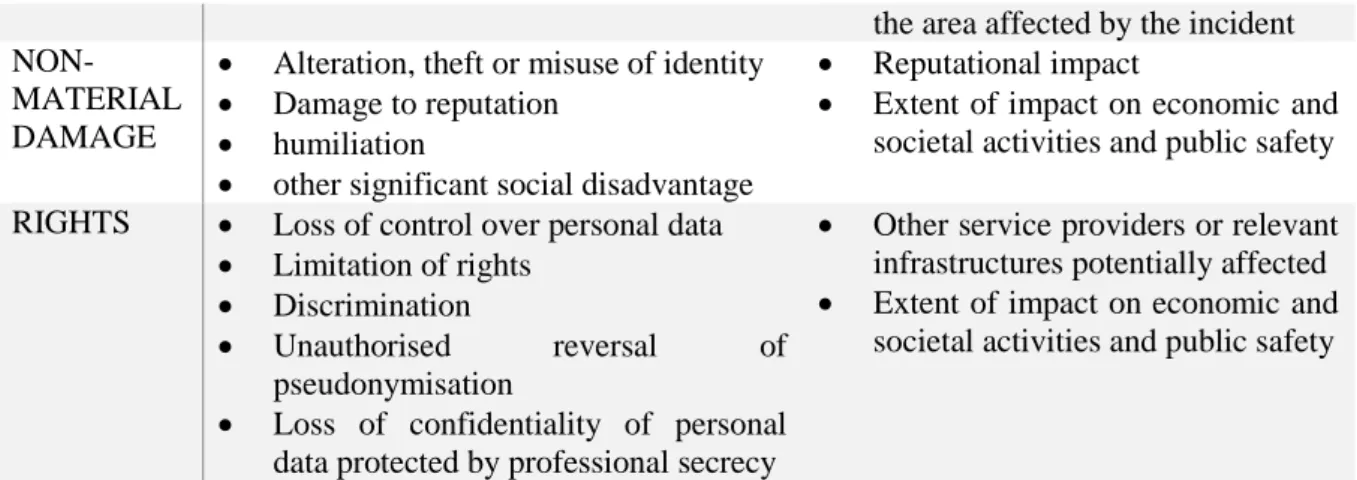
The risks expounded can be associated with harms/damage to natural persons, and harms/damage to the services and society, as exemplified in Table 2.
RISKS NATURAL PERSONS SERVICES (AND BEYOND)
TYPE OF
DAMAGE
Generic, significant, high, security Security and continuity of services MATERIAL
DAMAGE
Fraud
Financial loss
Other significant economic disadvantage
Number of users affected by incident
Economic impact
Other service providers or relevant infrastructures potentially affected Extent of impact on economic and
societal activities and public safety PHYSICAL
DAMAGE
Mental health Physical health Loss of life
Extent of disruption of the functioning of the service;
Duration of incident
Geographical spread with regard to
51The difference between ‘significant’ and ‘high’ risks is not immediately apparent; based on an analysis
of the relevant provisions, significance seems to concern the intensity of the damage that individuals may suffer
from, whereas ‘high’ seems to concern the likelihood of the damage. An in-depth analysis of the notion of risk in the GDPR is beyond the scope of this paper. However, see the work of Raphaël Gellert, mentioned supra, fn. 47.
52 European Banking Agency (2017), Guidelines on Major Incident Reporting under SPD2, pp. 20-21. 53 Art. 3 of Commission Regulation 2018/151 lays down parameters to determine whether the impact is
substantial. In relation to paragraph (a), it indicates the number of contracted natural or legal persons, or the number of affected users based on traffic data.
the area affected by the incident
NON-MATERIAL DAMAGE
Alteration, theft or misuse of identity Damage to reputation
humiliation
other significant social disadvantage
Reputational impact
Extent of impact on economic and societal activities and public safety RIGHTS Loss of control over personal data
Limitation of rights Discrimination
Unauthorised reversal of pseudonymisation
Loss of confidentiality of personal data protected by professional secrecy
Other service providers or relevant infrastructures potentially affected Extent of impact on economic and
societal activities and public safety
Table 2 Summary of instrument-specific harms of cyber security breaches
These may seem to pave the way for multiple combinations of security, continuity and impact on natural and legal persons, as well as society. None of the instruments suggests directly how risks, and related damages, are to be calculated. In some cases, further rules supplement primary legislation; this is the case of implementing acts, e.g. Regulation 2018/151 concerning Art. 16 of the NIS Directive, and of binding guidelines, e.g. those specifying art. 96 of the PSD2.54 In the Telecom
sector, bodies such as the ENISA,55 and the Article 29 Working Party56 have provided non-binding
examples of risks in relation to breaches. However, no cross-sectorial initiative exists.57 The private
sector has filled in the gap, be it in the form of privately financed studies, such as the one run by the Ponemon Institute,58 or cyber-insurance59 that, according to ENISA, has thus far limited adoption
compared to other sectors, but may quickly develop with the entry into force of the GDPR and NIS Directives.60 As a result, even though the instruments61 and regulatory authorities62 acknowledge the
overlap between the risks to personal and non-personal data, and the fact that breaches can be triggered by cybercrime, there does not seem to be any methodology to survey the combined effect of cyber security breaches across the different sectors.
3.3. MECHANISMSTOMANAGECYBERSECURITYBREACHES
In order to counter the harms, threats and risks, legislation relies on three approaches: first, the adoption of appropriate technical and organizational measures to counter the breach; second, notification of breaches that are likely to harm; and third, additional tools. Since I discussed the adoption of appropriate technical and organizational measures in Section 3.2.1, therefore here I focus on the remaining two approaches.
54 European Banking Agency (2017), Guidelines on Major Incident Reporting under SPD2.
55 European Network and Information Security Agency (ENISA), Technical Guideline on Security
measures for Article 4 and Article 13a (2014).
56 Article 29 Data Protection Working Party, Working Document 01/2011 on the Current EU Personal
Data Breach Framework and Recommendations for Future Policy Developments (WP 184) (2011).
57 Attempts are being made at a higher level of abstraction, which, however, does not embrace privacy
rights. A methodology to measure cyber harm was proposed in Agrafiotis and others (2016), Cyber Harm: Concepts, Taxonomy and Measurement.
58 The report covers direct and indirect costs of a personal data breach, both during the crisis and to
mitigate the damages suffered by individuals. Ponemon (2017), 2017 Cost of Data Breach Study. Global Overview.
59 See, for instance, the policy offered by Zurich:
https://www.zurich.com/en/products-and-services/protect-your-business/what-we-protect/cyber-risk (last accessed 19th December 2017).
60 European Network and Information Security Agency (ENISA), Cyber Insurance: Recent Advances,
Good Practices and Challenges (2016).
61 E.g. Recital 63 of the NIS Directive. 62 Tofan, Moulinos and Karsberg (2015).
3.3.1 Notification
All breached parties must notify the breach to the national regulatory/supervisory authority competent for each instrument. However, notification is ‘conditional’, in that only breaches that are likely to cause harm to individuals or to services, as discussed in Section 3.2.2, must be notified. This results from, and further feeds into, the incoherence of the concept of notification described by Burdon et al (Section 1).63 There is no obligation to notify the regulatory/supervisory authority if the
breach is either unlikely to result in an appreciable risk to the rights and freedoms of natural persons (Article 33 GDPR),64 for instance because of the adoption of ad hoc or post hoc measures of
protection,65 or if the provision of a service is not significantly, substantially, or majorly impacted
(Articles 13a(3) of the Framework Directive, 19 (2) of the eIDAS Regulation, 96 (1) of the PSD2, and 14 (3) and 16 (11) of the NIS Directive).Hence, ‘significance’ (i.e. significant, substantial, major) and ‘risk’ are the discriminating criteria in notification.
Unfortunately, however, as noted earlier the six instruments do not always provide metrics to evaluate the level of harm.66The Framework Directive does not clarify what constitutes a ‘significant’
impact; ENISA has elaborated some criteria67 to assess the significance, which are however not
mandatory. Moreover, “depending on the national implementation of Art. 13a, if one incident does not affect the continuity of the service (availability), although confidentiality or integrity might be affected, the incident does not need to be reported.”68
In the NIS Directive, the significance of a disruptive effect depends on the factors listed in Art. 6 (1) and the nature of the essential service, as exemplified by Recital 28. For the health sector, for instance, significance depends on “the number of patients under the provider's care per year. As for water production, significance depends on processing and supply, the volume and number and types of users supplied, including, for example, hospitals, public service organisations, or individuals, and the existence of alternative sources of water to cover the same geographical area”. The newly established Cooperation Group is to issue guidelines on the notification of incidents by operators of essential services (Art. 14 (7)).69 Pursuant to Commission Regulation 2018/151 (Art. 4 ), an incident
is substantial when: the service was unavailable for five million user-hours; 100 000 users suffered from loss of integrity, authenticity or confidentiality of data processed by the digital service provider; the incident put at risk public safety, public security or the life of individuals; and at least one user has suffered from material damage in excess of one million Euros. The Regulation, however, is silent about the case of an incident to a digital service used in the context of essential services, which I discuss later in Section 5.
63Burdon, Lane and von Nessen (2012), ‘Data breach notification law in the EU and Australia - Where
to now?’.
64 The exception is represented by the e-Privacy Directive, where Telcos must always notify a breach
relating to an individual or a subscriber; this exception is however bound to disappear with the overhaul of the e-Privacy Directive.
65 Commission Regulation 611/2013/EU of 24 June 2013 on the Measures Applicable to the Notification
of Personal Data Breaches under Directive 2002/58/EC of the European Parliament and of the Council on Privacy and Electronic Communications (Commission Regulation on Data Breaches); Burdon, Lane and von
Nessen (2012), ‘Data breach notification law in the EU and Australia - Where to now?’.
66 The situation may be further complicated by differences resulting from the national transposition of the
instruments.
67 Tofan, Moulinos and Karsberg (2015).
68 European Network and Information Security Agency (ENISA) (2017), Annual Incident Reports 2016.
Analysis of Article 13a annual incident reports in the telecom sector, p. 10.
69 European Commission, Making the most of NIS – towards the effective implementation of Directive
(EU) 2016/1148 concerning measures for a high common level of security of network and information systems across the Union. Annex to (Communication) COM(2017) 476 final/2 (2017), pp. 26-30.
The proposed EECC lists five mandatory criteria that have been derived from the NIS Directive, but even there, official guidance is needed to enforce a consistent notion of ‘significance’. Similarly, to the above, the eIDAS Regulation does not define the key terms ‘significant’ or ‘reliable’ used in the notification clauses.70
In the case of data breaches, criteria to assess the impact on the rights to data protection and private life (‘privacy rights’ for short) were developed by the Article 29 Working Party;71 however,
there is no evidence as to the extent to which they were implemented. Under the GDPR, it is the National Data Protection Authority that assesses the likelihood of adverse consequences for data subjects, and can thus still request data controllers to communicate the data breach to affected individuals irrespective of the conditions illustrated above (Art. 34 (4)).
The PSD2 represents an understandable exception, given the longer experience of the banking sector in elaborating cost-benefit analyses and the fact that financial loss is, possibly, easier to quantify. In fact, the EBA’s guidelines provide a more nuanced understanding of the notion of ‘incident’ than other instruments; this is based on a combination of seven criteria which are quantified in absolute and relative terms, and distinguished between lower and higher impact.72 A major incident
depends on the presence of either at least one criterion on the higher-level side of the impact spectrum,73 or at least three criteria on the lower level side of the impact spectrum.74 Notification by
the payment service provider, which is also due when a low-key incident becomes major as defined above, can be delegated to third parties by means of contracts. Once notified, the competent (supervisory) authority is to further assess the significance of the incident so as to notify relevant national authorities (Art. 96 (1) second indent), as well as the EBA and the European Central Bank (Art. 96 (2)).
Some instruments require notifying supervisory authorities other than the ones responsible for a given sector, such as data protection authorities, or law enforcement authorities (Articles 13a(3) of the Framework Directive and 19(2) of the eIDAS Regulation). When a breach is likely to include two or more Member States, notification should also be made to the responsible authority of the other Member State and the ENISA (Articles 13a(3) of the Framework Directive and 19(2) of the eIDAS Regulation). Pursuant to Art. 96 (2) of the PSD2, the notified competent (supervisory) authority shall notify national authorities that may be affected, the EBA and the European Central Bank, which in turn will assess whether the incident affects more than one Member country (and notifies accordingly).
Moreover, breached parties must notify natural persons, usually when the rights of natural persons are likely to be adversely affected by the breach (Articles 4 of the e-Privacy Directive and 19 (2) of the eIDAS Regulation), or there is a high risk thereof (Art. 34(1) GDPR); if the service provider satisfactorily demonstrates that he or she had applied technological protection measures to the
70 For the standard form, see Commission Implementing Decision (EU) 2015/1984 of 3 November 2015
defining the circumstances, formats and procedures of notification pursuant to Article 9(5) of Regulation (EU) No 910/2014 of the European Parliament and of the Council on electronic identification and trust services for electronic transactions in the internal market (notified under document C(2015) 7369).
71 Article 29 Data Protection Working Party (2011), Working Document 01/2011 on the Current EU
Personal Data Breach Framework and Recommendations for Future Policy Developments (WP 184).
72 See in particular table at p. 23 and Annex 1 in European Banking Agency (2017), Guidelines on Major
Incident Reporting under SPD2.
73 These are: the affected transactions (more than 25% of the regular level of transactions or five million
EUR); the affected payment service users (more than fifty thousand or 25% of the service users), the economic impact (more than Max. or more than five million EUR); and level of internal escalation whereby a crisis mode is likely to be called upon.
74 These are: the affected transactions (more than 10% of the regular level of transactions, or one hundred
thousand EUR); more than five thousand and 10% of users of the payment service; a service downtime of more than 2 hours; a high level of internal escalation; the possibility of affecting other service providers and their infrastructure; and reputational impact.
breached data, then he or she does not have to notify the breach.75 Under the eIDAS Regulation, legal
persons must also be notified. Payment service users must be notified if the incident has or may have an impact on their financial interests (Art. 96 (1) of the PSD2).
Finally, most instruments foresee that, if the authority believes that disclosure of the breach is in the public interest, it may either inform the public, or require the breached party to do so (Articles 13a(3) of the Framework Directive, 19(2) of the eIDAS Regulation and 16(7) of the NIS Directive). Disclosure to the public may also be seen as an alternative for disclosing the breach to individuals, when doing so is either disproportionate, or if otherwise the risk of damage is very low due to the adoption of either ex ante measures such as encryption, or of ex post measures of mitigation (Art. 34 (3) GDPR). Notification to the public “about individual incidents” may also occur “where public awareness is necessary in order to prevent an incident or to deal with an ongoing incident” under the NIS Directive.
Instruments also differ as to the time that can incur between discovering the breach and reporting it. The most stringent requirement is contained in the guidelines issued by the EBA on the PSD2, whereby payment services providers must initially notify the incident to the competent authority four hours after it was first detected, and provide two additional follow-up on reports.76
These requirements are followed by the eIDAS Regulation, according to which data breaches must be notified within 24 hours, and by the GDPR (72 hours), whereas the e-Privacy and NIS Directives use the blander expression ‘without undue delay’.
3.3.2 Inventories, liability and sanctions
The last of three mechanisms put in place by the six instruments to counter harms of breaches are inventories, liability and sanctions.
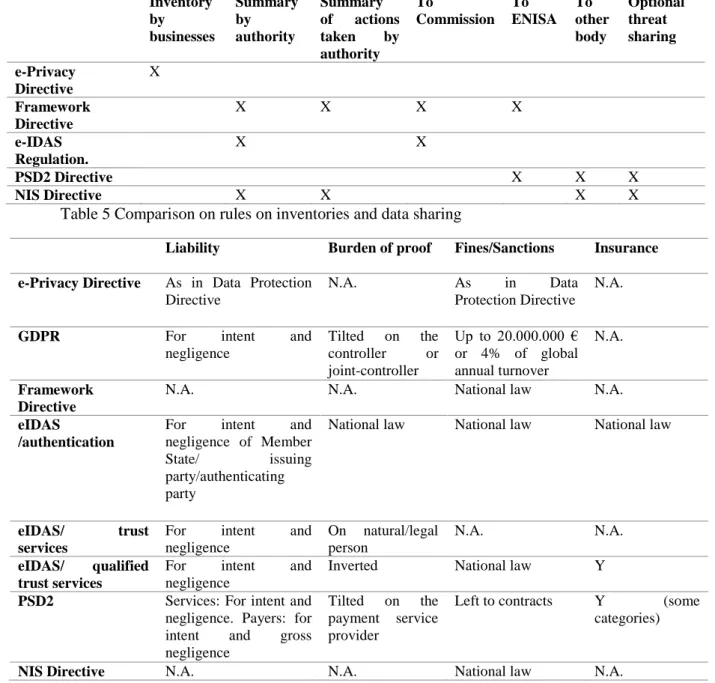
Several instruments require keeping inventories of the notification of breaches received. The requirements, however, vary from instrument to instrument. Sometimes the inventory must simply be kept by the services for the sake of the supervisory authority’s record (Art. 4(4) of the e-Privacy Directive). In other cases, the national authority must send each year a ‘summary report’ on the notifications received, either to the Commission (Articles 13(a)(3)) Framework Directive and 17(6) of the eIDAS Regulation) and ENISA, or to the Cooperation Group in anonymised form (Art. 10(3) of the NIS Directive), and explain the actions taken to mitigate the breaches (Framework Directive). As for the GDPR, pursuant to Article 33(5), the controller must document any personal data breaches, comprising the facts relating to the personal data breach, its effects and the remedial action taken, so that the supervisory authority can verify compliance.
The six instruments differ sharply on the question of liability, with the exception, perhaps, of the fact that mostly the laws relate to services, which enjoy a different liability regime than that applicable to goods.77 Explicit rules are contained in the GDPR, the eIDAS Regulation and the PSD2.
In the GDPR, there are two provisions relevant to liability. The first is the principle of the accountability of the controller, i.e. the party who decides the purposes and means of the processing of personal data, alone or jointly with another controller (Art. 4(7)). Accountability means that a controller is responsible for, and able to demonstrate compliance with the principles relating to the processing of personal data contained in Art. 5 (Art. 5(2)). The effect of this principle is taking a first
75 E.g. as defined in Commission Regulation 611/2013/EU on Data Breaches.
76 European Banking Agency (2017), Guidelines on Major Incident Reporting under SPD2, pp. 24-27. 77 On this point, see European Commission, Building a European Data Economy ((Communication)
COM(2017) 9 final, 2017). The Commission is due to publish an appraisal of the Directive on liability for defective products in mid-2018 European Commission, Mid-Term Review on the implementation of the Digital Single Market Strategy. A Connected Digital Single Market for All ((Communication) COM(2017) 228 final, (Staff Working Document) SWD(2017) 155 final, 2017), p.11.