Volume
29
—
Number
2
—
2014
—
ISSN
2190-6858
Journal for Language Technology and Computational Linguistics
Building and Annotating
Corpora of Computer-Mediated
Communication: Issues and
Challenges at the Interface of
Corpus and Computational
Linguistics
Herausgegeben von/Edited by
Michael Beißwenger, Nelleke Oostdijk,
Angelika Storrer, Henk van den Heuvel
Contents
EditorialMichael Beißwenger, Nelleke Oostdijk, Angelika Storrer, Henk van den Heuvel . . . iii The CoMeRe corpus for French: structuring and
an-notating heterogeneous CMC genres
Thierry Chanier, Celine Poudat, Benoit Sagot, Georges Antoniadis, Ciara Wigham, Linda Hriba, Julien Longhi, Djam´e Seddah . . . 1 Challenges of building a CMC corpus for analyzing
writer’s style by age: The DiDi project
Aivars Glaznieks, Egon W. Stemle . . . 31 Building Linguistic Corpora from Wikipedia Articles
and Discussions
Eliza Margaretha, Harald L¨ungen . . . 59 Challenges and experiences in collecting a chat corpus
Wilbert Spooren, Tessa van Charldorp . . . 83 Variability in Dutch Tweets. An estimate of the
pro-portion of deviant word tokens
Hans van Halteren, Nelleke Oostdijk . . . 97 Author Index . . . 125
Impressum
Herausgeber Gesellschaft f¨ur Sprachtechnologie und
Computerlinguistik (GSCL)
Aktuelle Ausgabe Band 29 – 2014 – Heft 2
Gastherausgeber Michael Beißwenger, Nelleke Oostdijk,
Angelika Storrer, Henk van den Heuvel Anschrift der Redaktion Lothar Lemnitzer
Berlin-Brandenburgische Akademie der Wissenschaften
J¨agerstr. 22/23 10117 Berlin [email protected]
ISSN 2190-6858
Erscheinungsweise 2 Hefte im Jahr,
Publikation nur elektronisch
JLCL 2014 - Band 29 (2) – iii-iv
Editorial
Computer-mediated communication (CMC) is an umbrella term used for interpersonal communication mediated through computer networks and accessed via personal computers and/or mobile devices. Examples of CMC genres are written conversations in chats, online forums or instant messaging applications, tweets, comments on weblogs, conversations on Wikipedia talk pages and on “social network” sites (Facebook etc.), interactions in multi-modal communication environments such as Skype, online role-playing games (MMORPGs) or SecondLife, SMS messages, or conversations via smart phone “apps” such as WhatsApp or Threema.
In the past two and a half decades, the use of CMC genres has become an important part of everyday communication. To support empirical research on these new forms of commu-nication, standard text corpora need to be supplemented by linguistically annotated corpora covering the language use in CMC. Nevertheless, there have been no standards thus far for the representation of the structural peculiarities of CMC genres. In addition, it has become consistently apparent that NLP tools trained on written standard language (e.g. on newspa-per corpora) do not newspa-perform in a satisfactory manner on CMC data.
This special issue of the JLCL gathers five contributions of scholars and projects who aim to close the “CMC gap” in the corpora landscape for several European languages: the French CoMeRe project (Chanier et al.), the South Tyrolian DiDi project (Glaznieks & Stemle), the German Wikipedia corpus (Margaretha & Lüngen), the Dutch VU Chat corpus (Spooren & van Charldorp), and the research on language variation in Dutch Twitter data (van Halteren & Oostdijk).
Thierry Chanier, Céline Poudat, Benoit Sagot, Georges Antoniadis, Ciara Wigham,
Linda Hriba, Julien Longhi and Djamé Seddah present a TEI representation schema cen-tered on the model of ‘interaction space’ that has been applied to four French corpora. The schema extends the scope of annotation issues to environments in which several CMC mo-dalities (e.g. chat, email, and forums) are used simultaneously.
Aivars Glaznieks and Egon W. Stemle describe the DiDi project where they work with German CMC corpora of internet users from the Italian province of Bolzano – South Tyrol. One focus of this project is on the question of how L1 German speakers of South Tyrol from different age groups are using variants of German and other languages when communicating on social networking sites. The authors describe an approach for collecting Facebook post-ings and report on experiments to improve POS tagging results on their data by means of normalization.
Eliza Margaretha and Harald Lüngen present an approach developed at the IDS Mann-heim for the transformation of Wikipedia articles and talk pages into TEI-based corpora for integration in the German Reference Corpus (Deutsches Referenzkorpus, DEREKO). The article’s focus lies on issues of representing the conversations on talk pages in TEI. The authors describe a method for automatically segmenting these conversations into user post-ings and discuss the findpost-ings that arise from evaluating the segmentation results.
Wilbert Spooren and Tessa van Charldorp describe the design and data collection strate-gies of a chat corpus which is part of the SoNaR reference corpus for contemporary Dutch. To avoid the problem of collecting chat data “in the wild” with unclear legal status, the
iv
Editorial
authors created a setting in which data could be collected from a chatroom for secondary school students with the consent of both the participating pupils and their parents. The au-thors explain the logistical, ethical and technological challenges they encountered during the collection of the data and discuss general considerations regarding CMC data collection that can be derived from their experiences.
Hans van Halteren and Nelleke Oostdijk present results from their experiments in auto-matically estimating the proportions of word tokens in Dutch tweets that are not covered by standard resources and can therefore be expected to cause problems for standard NLP appli-cations. Based on a fully annotated pilot corpus, the authors present a detailed typology of types of non-word tokens, out-of-vocabulary tokens and in-vocabulary tokens whose form deviates from standard Dutch. The annotated corpus was used to calibrate automatic estima-tion procedures which were then applied to about 2 billion Dutch tweets. The discussion of their results is an important foundation for getting a better picture of challenges that are faced in adapting NLP tools to the peculiarities of (Dutch) CMC data.
The idea for this special issue developed from an international workshop “Building Cor-pora of Computer-Mediated Communication: Issues, Challenges, and Perspectives”, which was held at TU Dortmund University in February 2013 in connection with the German DFG network “Empirical research of Internet-Based Communication” (Empirikom)1 and with financial support from the Global Young Faculty program of the Mercator Research Center Ruhr. The workshop brought together CMC corpus projects from several European coun-tries. The participants discussed issues in collecting, representing, annotating and processing CMC data with the common goal of improving interoperability between CMC resources for different languages on the one hand, and between CMC corpora and standard text corpora on the other hand. The workshop resulted in the formation of a network of CMC corpus projects and a joint application for the installation of a special interest group (SIG) “Com-puter-mediated communication” in the Text Encoding Initiative (TEI)2, which was approved by the TEI Council in the autumn of 2013. The articles by Eliza Margaretha and Harald Lüngen and Thierry Chanier et al. are explicitly related to this initiative; the ongoing work in this SIG is documented on the SIG pages in the TEI wiki3.
Our gratitude goes to the colleagues who contributed to this special issue as external review-ers. We also thank Lothar Lemnitzer for supporting us while editing and finalizing the issue. Dortmund, Mannheim and Nijmegen, December 2014
Michael Beißwenger Nelleke Oostdijk Angelika Storrer Henk van den Heuvel
1 http://www.empirikom.net 2 http://tei-c.org
Thierry Chanier, Céline Poudat, Benoit Sagot, Georges Antoniadis, Ciara R. Wigham, Linda Hriba, Julien Longhi, Djamé Seddah
The CoMeRe corpus for French: structuring and
annotating heterogeneous CMC genres
Abstract
The CoMeRe project aims to build a kernel corpus of different computer-mediated commu-nication (CMC) genres with interactions in French as the main language, by assembling interactions stemming from networks such as the Internet or telecommunications, as well as mono and multimodal, and synchronous and asynchronous communications. Corpora are assembled using a standard, thanks to the Text Encoding Initiative (TEI) format. This im-plies extending, through a European endeavor, the TEI model of text, in order to encompass the richest and the more complex CMC genres. This paper presents the Interaction Space model. We explain how this model has been encoded within the TEI corpus header and body. The model is then instantiated through the first four corpora we have processed: three corpo-ra where intecorpo-ractions occurred in single-modality environments (text chat, or SMS systems) and a fourth corpus where text chat, email, and forum modalities were used simultaneously.
The CoMeRe project has two main research perspectives: discourse analysis, only alluded to in this paper, and the linguistic study of idiolects occurring in different CMC genres. As natural language processing (NLP) algorithms are an indispensable prerequisite for such research, we present our motivations for applying an automatic annotation process to the CoMeRe corpora. Our wish to guarantee generic annotations meant we did not consider any processing beyond morphosyntactic labelling, but prioritized the automatic annotation of any freely variant elements within the corpora. We then turn to decisions made concerning which annotations to make for which units and describe the processing pipeline for adding these. All CoMeRe corpora are verified thanks to a multi-stage quality control process that is designed to allow corpora to move from one project phase to the next.
Public release of the CoMeRe corpora is a short-term goal: corpora will be integrated into the forthcoming French National Reference Corpus, and disseminated through the national linguistic infrastructure Open Resources and Tools for Language (ORTOLANG). We, therefore, highlight issues and decisions made concerning the OpenData perspective.
1 Introduction: the CoMeRe project
Various national reference corpora have been successfully developed and made available over the past few decades, e.g. the British National Corpus (Aston and Burnard 1998), the SoNaR Reference Corpus of Contemporary Written Dutch (Oostdijk et al. 2008), the DWDS Corpus for the German Language of the 20th century (Geyken 2007), the DeReKo German Reference Corpus (Kupietz and Keibel 2009) and the Russian Reference Corpus (Sharoff 2006). Despite being in strong demand, no French national reference corpus currently exists. Thus, the Institut de la Langue Française (ILF) has recently taken the first steps to lay the groundwork for such a project. The aim is for the national project to both collect existing
JLCL
2
Chanier
et al.
data and to develop new corpora, in order to ensure the representativeness of the final data set.
The French CoMeRe project (CoMeRe 2014)1 is an ongoing pilot project whose deliver-ables will form part of the forthcoming French National Reference Corpus. It aims to build a kernel corpus of different computer-mediated communication (CMC) genres with interac-tions in French as the main language. Three fundamental principles underlie CoMeRe: variety, standards and openness.
“Variety” is one of our key words since we expect to assemble interactions stemming from networks such as the Internet or telecommunications (mobile phones), as well as mono and multimodal, and synchronous and asynchronous communications. Our interest covers genres such as text or oral chats, email, discussion forums, blogs, tweets, audio-graphic conferencing systems (conference systems with text, audio, and iconic signs for communica-tion), even collaborative working/learning environments with verbal and nonverbal commu-nication. A variety of discourse situations is also sought: public or more private conversa-tions, as well as informal, learning, and professional situations. One part of our (sub)corpora is taken from existing corpora, since partners involved in the project had previously col-lected almost all the genres mentioned earlier. Other parts, such as Wikipedia talk pages, will be extracted from the Web following the recommendations of the New Collections workgroup.
“Standards” is our second key word. It refers to two different aspects of corpus linguistics. Firstly, corpora will be structured and referred to in a uniform way. The Text Encoding Initiative (TEI) format (Burnard & Bauman 2013) has been chosen jointly with our Euro-pean partners, alongside existing metadata formats including the Dublin Core. The TEI is not only a format for corpus structure. First and foremost, it is a model of text. This model needs to be extended in order to encompass the Interaction Space (IS) of CMC multimodal discourse, as we will discuss in Section 2. The European TEI-CMC (2013) special interest group (SIG) aims to propose such extensions to the TEI consortium.
“Standard” also refers to the uniform basic level of automatic annotations, related to seg-mentation and part of speech (POS) tagging. This will be applied to all of our CMC genres, and is presented hereafter in Section 3.
The third key word is “openness”. At the end of the first stage (2013-2014) of the project, a sample of corpora (including those described in this paper, see Section 3.1) that are repre-sentative of CMC genres and that have been organized and processed in standard ways, will be released as open data on the French national platform of linguistic resources ORTO-LANG (2014). Dissemination will take two different forms: one version of a corpus with the “raw” text without any tokenization and annotation (v1), and a second version of the same corpus with the annotations (v2). This openness is motivated, on the one hand, by the fact that CoMeRe will become part of the larger reference corpus for the French language; the latter is expected to become a reference for studies in French linguistics. On the other hand, the wish to release CoMeRe corpora as open data stems from the fact that, although studies
1 CoMeRe stands for “Communication Médiée par les Réseaux,” an updated equivalent to
The CoMeRe corpus for French
on new CMC communication genres draw much attention, there is currently no existing dataset with significant coverage or that encompasses a variety of genres to form the basis for systematic research. This situation is not specific to the French language, as aforemen-tioned languages, which already benefit from reference corpora, also face the same chal-lenge. That being said, a few genre-based corpora are being developed (e.g. Rehm et al. 2008). This may explain why a common motivation amongst European partners encouraged, from the outset, the design of a shared framework for the development of models of CMC genres. Indeed, there is a need for open-access corpora that can be cross examined in order to exemplify the way models could be instantiated.
This OpenData perspective paves the way for scientific examination, replication and cu-mulative research. Of course, this type of openness implies specific considerations of li-censes, ethics and rights, as discussed in Section 4.2. In order to achieve this goal, CoMeRe is supported by the research consortium Corpus-Écrits (2014), a subsection of the national infrastructure Huma-Num(2014, cf. Digital Humanities), and ORTOLANG, French infra-structures linked to DARIAH (2014), the European infrastructure for humanities.
2 CoMeRe 2013: moving from existing data to models of CMC interaction
The CoMeRe project developed out of collaborations between researchers who had previ-ously collected and structured different types of CMC corpora within their local teams. Once the project was officially underway, it was decided, building upon the SoNaR experience (Oostdijk et al., ibid), to organize workgroups (WG) with distinct tasks in the project: TEI & Metadata, New Collections, Automatic Processing, and Quality.
The present section firstly describes four of the corpora that individual researchers brought to the CoMeRe project (Section 2.1). Secondly, we discuss how these four corpora helped the TEI & Metadata WGto instantiate a model of CMC interaction, working col-laboratively with the TEI-CMC SIG (Sections 2.2 and 2.3). Section 2.4 details how the same WG then structured corpora according to this model. The work of other WGs will be the focus of Sections 3 (Automatic Processing WG), 4 (Quality), and 5 (New Collections). 2.1 Gathering existing data
Illustrations in this article will be based on the first four corpora processed by the CoMeRe project in fall 2013. They were collected within the frameworks of national and/or internati-onal projects. After their conversion to the new TEI format, they were renamed cmr-smsalpes, cmr-smslareunion, cmr-simuligne and cmr-getalp_org.
Our first corpus, cmr-getalp_org (Falaise 2014), is a text chat corpus, collected from a
public Internet Relay Chat (IRC) website. Eighty different discussion channels focusing on a variety of, mainly informal, topics were collected in 2004. The corpus includes more than three million messages. The first version of the corpus (Falaise 2005) had been organized using a simple eXtensible Markup Language (XML) structure.
The data we organized in cmr-smsalpes (Antoniadis, 2014) and cmr-smslareunion (Lede-gen, 2014) emanated from the international project “Faites don de vos SMS à la science” (Fairon et al. 2006) that began in 2004 and was coordinated by the Institute for Computa-tional Linguistics (CENTAL) of the Catholic University of Louvain (Belgium). The project,
JLCL
4
Chanier
et al.
named sms4science, aims to collect SMS text messages worldwide (Panckhurst et al. 2013).
It regroups researchers from several countries to collaboratively conduct scientific research on a large number of languages with the objective of contributing to SMS message commu-nication studies.
Data from cmr-smslareunion were issued between April and June 2008 within the framework of the first French investigation which led to the collection of 12,622 SMS mes-sages sent by 884 participants. The Laboratoire de recherche dans les espaces créolophones et francophones (LCF) of the Université de La Réunion was responsible for the local coor-dination. As described in the project presentation (LaRéunion4Science, 2008), the unique-ness of the investigation in Réunion is the new scientific dimension that it adds: French-Creole bilingualism, the ludic neographies in SMS messages, and the communication prac-tices of young people which are characterized by multiple alternating languages (French, Creole, English, and Spanish).
Data from cmr-smsalpes were collected in 2011 (Antoniadis et al. 2011). The corpus in-cludes 22,117 messages sent by 359 participants mainly living in the French Alps. The project was coordinated by the Laboratoire de linguistique et didactique des langues étran-gères et maternelles (LIDILEM) of the Université Stendhal in Grenoble.
For both SMS text message corpora, the harvesting of SMS messages required the inter-vention of technical partners. Indeed, the companies Orange Informatique and Cirrus Pri-vate were responsible for receiving the SMS messages and transferring them to the laborato-ries concerned.Researchers in charge of compiling data for the two corpora anonymized and structured the messages in different formats: XML for the French Alps corpus and in the form of a spreadsheet for the Réunion corpus. Note that researchers from Réunion also added manual annotations to the messages, providing orthographic transcription and lan-guage identification(either pidgin or French), as we will see further on.
Lastly, the cmr-simuligne corpus was built out of interaction data resulting from an online language learning course, Simuligne. Data have been extracted from the LETEC (LEarning and TEaching Corpus) Simuligne (Reffay et al. 2009), a corpus deposited in the MULCE repository (2013), which has its own XML schema. Sixty-seven participants (language learners, teachers, native speakers a.k.a. language experts) followed the same pedagogical scenario, but were divided into four groups. All interactions occurred within a Learning Management System (LMS), namely WebCT. They include text chat turns (7,000), emails (2,300), and forum messages (2,700). Since the LMS had no export facilities, data were extracted from its internal database by the LETEC corpus compiler, then structured and anonymized.
Such disparities in corpus compilation choices may have represented a major handicap for the CoMeRe project, particularly when in the linguistics field many individual research-ers still pose the question as to whether spending the time to make data shareable and acces-sible is worthwhile. However, data heterogeneity soon turned into a real asset, favoring exchanges between project participants concerning the data collection contexts and different ways of interpreting the data, as well as increasing our motivation to design a common model and share different areas of expertise.
The CoMeRe corpus for French
2.2 Rationales for modelling CMC discourse
Before determining the TEI-compliant structural markup of the corpus, the TEI & Metadata WG found it necessary to first settle on a common document model that would fit all of our CMC data as well as new collections of data to be added to the corpus repository in the future. Indeed, annotation is basically an interpretation and the TEI markup naturally en-compasses hypotheses concerning what a text is and what it should be. Although the TEI was historically dedicated to the markup of literature texts, various extensions have been developed for the annotation of other genres and discourses, including poetry, dictionaries, language corpora or speech transcriptions.
If one wants to still apply the word “text” to a coherent and circumscribed set of CMC in-teractions, it is not so much in the sense developed by the TEI. Indeed, it would be closer to the meaning adopted by Baldry and Thibault (2006). These authors consider (ibid: 4) “texts to be meaning-making events whose functions are defined in particular social contexts,” following Halliday (1989: 10) who declared that “any instance of living language that is playing a role some part in a context of situation, we shall call a text. It may be either spo-ken or written, or indeed in any other medium of expression that we like to think of.”
Bearing the above in mind, we found it more relevant to start from a general framework, that we will term “Interaction Space” (see next section), encompassing, from the outset, the richest and the more complex CMC genres and situations. Therefore, we did not work genre by genre, nor with scales that would, for instance, oppose simple and complex situations (e.g. unimodal versus multimodal environments)—as stated, our goal is to release guidelines for all CMC documents and not for each CMC genre. This also explains why we did not limit ourselves solely to written communication. Indeed, written communication can be simulta-neously combined with other modalities. For these reasons, the CoMeRe model takes mul-timodality into account and our approach is akin to the one adopted by the French research consortium IRCOM (2014). This consortium rejected the collection and study of oral cor-pora as self-contained elements and decided that it was preferable for oral and multimodal corpora to be studied within a common framework, before becoming part of the French reference corpus.
2.3 The notion of ‘Interaction Space’
2.3.1 Interaction space: time, location, participants
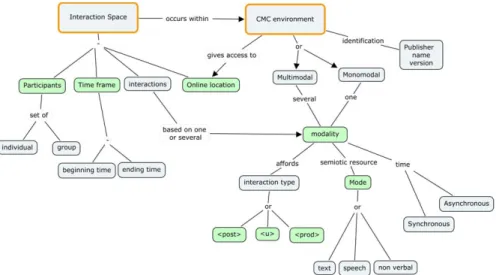
An Interaction Space (henceforth referred to as IS) is an abstract concept, located in time
(with a beginning and ending date with absolute time, hence a time frame) where interacti-ons between a set of participants occur within an online location (see Figure 1 for a
gene-ral overview). The online location is defined by the properties of the set of environments
used by the set of participants. Online means that interactions have been transmitted through networks; Internet, Intranet, telephone, etc.
The set of participants is composed of individual members or groups. It can be a
prede-fined learner group or a circumscribed interest group. A mandatory property of a group is the listing of its participants.
JLCL
6
Chanier
et al.
The range of types of interactions (and their related locations) is widespread. It is related to the environment(s) participants use and their corresponding modes and modalities.
2.3.2 Environment, mode and modality
An environment may be synchronous or asynchronous, mono or multimodal. Modes (text,
oral, icon, image, gesture, etc.) are semiotic resources which support the simultaneous gene-sis of discourse and interaction. Attached to this sense of mode orienteered towards commu-nication, we use the term modality as a specific way of realizing communication (this sense
refers to the Human Computer Interaction field (Bellik and Teil 1992)). Within an environ-ment, one mode may correspond to one modality, with its own grammar that constraints interactions. For example, the icon modality within an audio-graphic environment is compo-sed of a finite set of icons (raise hand, clap hand, is talking, momentarily absent, etc.). In contrast, within an environment, one mode may correspond to several modalities: a text chat has a specific textual modality that is different from the modality of a collective word pro-cessor, although both are based on the same textual mode. Consequently, an interaction may be multimodal because several modes are used and/or several modalities (Chanier and Vet-ter 2006; see also Lamy and Hampel 2007 for another presentation).
Environments may be simple or complex. On one end of the scale, we find simple types
with one environment based on one modality (e.g. one text chat system in the cmr-getalp_org corpus). On the other end of the scale, stand complex environments, such as the LMS of the aforementioned cmr-simuligne corpus, where several types of textual modalities are integrated, either synchronous—text chat— or asynchronous—email and forum), or in 3D environments, where several modes and modalities appear (see hereafter).
An environment offers the participants one or more locations/places in which to interact. For example, a conference system may have several rooms where a set of participants may work separately in sub-groups or gather in one place. In a 3D environment such as the syn-thetic world Second Life, a location may be an island or a plot. A plot may even be divided into small sub-plots where verbal communication (through text chat or audio chat) is impos-sible from one to another. Hence we say that participants are in the same location/place if they can interact at a given time. Notions of location and interaction are closely related and are defined by the affordances of the environment.
2.3.3 Interaction
As previously described, participants in the same IS can interact (but do not necessarily do it, cf. lurkers). They interact through input devices (microphone, keyboard, mouse, gloves, etc.), which let them use the modalities and output devices, mainly producing visual or oral sig-nals. (These however, will not be described in this article). Hence when participants cannot hear nor see the other participants’ actions, they are not in the same IS. Of course, partici-pants may not be participartici-pants during the whole time frame of the IS. They can enter late, or leave early. Note that an IS may have a recursive structure: in an online course when the same participants interact over several weeks, different ISs will be created, correspondingly to different occurrences of interaction sessions.
The CoMeRe corpus for French
In an IS, actions occur between participants. Let us call the trace of an action within an environment and one particular modality an “act”. Acts are generated by participants, and
sometimes by the system. Some of them may be considered as directly communicative(e.g. verbal acts in synchronous text or oral modalities). Others may not be directly communica-tive but may represent the cause of communicacommunica-tive reaction/interaction (e.g. when partici-pants write collaboratively in an online word processor and comment on their work). Par-ticipants see and hear what others are doing. These actions may represent the rationale for participants to be there and to interact (produce something collectively). Hence the distinc-tion between acts that are directly communicative, or not, is irrelevant.
A verbal act may be realized as an en bloc message or as an adaptive one. For example, there are situations where a participant does not plan an utterance as a one-shot process before it is sent as an en bloc message to a server, which in turn displays it to the other participants as a non-modifiable piece of language (e.g. as a text chat act which corresponds to what is generally called a chat turn) (Beißwenger et al. 2012). However, a participant’s utterance (e.g. in an audio chat act) can also be planned, then modified in the throes of the interaction while taking into account other acts occurring in other modalities of communica-tion (see Wigham and Chanier 2013 as an example).
Even if all the environments, corresponding to the first four corpora that we have proc-essed, form the basis of our current presentation and all these corpora correspond to mes-sages sent en bloc, our IS model still needs to take into account other corpora where this does not hold true. Within other multimodal environments from which we have already collected data and which we are currently processing, verbal (speech, text chat) and nonver-bal acts occur simultaneously. The main purpose of transcriptions is then to describe inter-relations amongst acts and within acts.
2.4 Describing the interaction space within TEI
Since TEI was the format adopted by national research networks (Corpus-écrits and IR-COM) and by the European TEI-CMC SIG, the challenge faced by the TEI & Metadata WG was to firstly find out how information related to the IS could be described within the TEI header, and secondly, decide how, within the corpus body, verbal acts could be coded in such a way that all information included in the original version of each corpus be kept.
The choice to adopt TEI was also motivated by two different research interests that mem-bers of CoMeRe shared: research on NLP models and research on discourse. The focus of these may appear quite different and although analysis work will only start once the CoM-eRe corpora have been disseminated, it was important for the TEI & Metadata WG to keep both perspectives in mind when making TEI coding decisions.
One interest of CoMeRe members is to study linguistic idiolects occurring in different CMC genres. NLP algorithms are an indispensable prerequisite for this. However, it should be noted that NLP models may be developed solely on the contents of the verbal acts, whilst ignoring the rest of the IS. However, for other CoMeRe members interested in completing studies on discourse, the IS is fundamental. This especially holds true if members later want to study research questions such as: how does discourse organization vary from one situa-tion to another? What type of interacsitua-tion supports or hinders discourse amongst
partici-JLCL
8
Chanier
et al.
pants? What features of participant groups influence online interactions? What are the rela-tionships between discourse organization and language complexity? These are current topics investigated by researchers in fields such as computer-supported collaborative learning (CSCL) and computer-assisted language learning (CALL).
The difference in the importance attributed to the IS when adopting one or other of these research perspectives seems, however, to be dialectical. Indeed research in CSCL and CALL may take advantage of linguistic annotations, which they previously have never considered, possibly because they had not been available to scientists in these fields.
We now move on to illustrate how the TEI & Metadata WG encoded the IS in TEI in the four corpora (cmr-smsalpes, cmr-smslareunion, cmr-getalp_org and cmr-simuligne) whilst taking the above research perspectives into account. Figure 1 illustrates the different con-cepts we introduced and which have to be described in TEI. Note that element <u>, used in speech transcriptions and the new (not yet present in TEI) element <prod> used in non-verbal transcriptions will not be presented, because they do not occur in the corpora used here as examples.
Figure 1: Description of concepts related to the Interaction Space
2.4.1 Environments and affordances
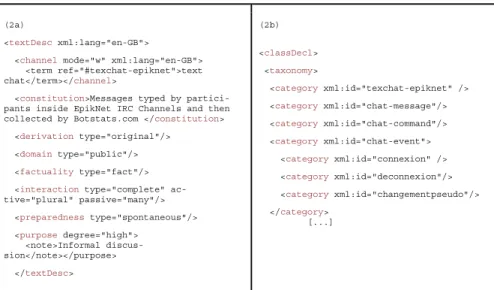
The first step when describing an environment is to define within the <teiHeader> the gene-ral features attached to the ovegene-rall environment type to which it belongs (e.g., IRC text chat systems). However, this needs to be refined in order to elicit specific features of the system. For example, Figure 2, (2a) describes, in TEI, the general text chat modality where inside
The CoMeRe corpus for French
one public channel2 every connected participant may interact with the other participants in a spontaneous way through discussions held in informal settings, in contrast to educational or professional discussions. Example (2b), however, details the affordances related to the specific IRC system used in cmr-getalp_org. This simplified extract displays the three main types of chat actions (message, command, and event), and part of the subtype of events. Relationships between this definition of the environment in the <teiHeader> and its actual use by participants in interactions, described in the <body> part of the TEI file, will appear through the attribute @type of the <post> element (see next section).
(2a)
<textDesc xml:lang="en-GB">
<channel mode="w" xml:lang="en-GB"> <term ref="#texchat-epiknet">text chat</term></channel>
<constitution>Messages typed by partici-pants inside EpikNet IRC Channels and then collected by Botstats.com </constitution> <derivation type="original"/>
<domain type="public"/> <factuality type="fact"/> <interaction type="complete" ac-tive="plural" passive="many"/> <preparedness type="spontaneous"/> <purpose degree="high"> <note>Informal discus-sion</note></purpose> </textDesc> (2b) <classDecl> <taxonomy> <category xml:id="texchat-epiknet" /> <category xml:id="chat-message"/> <category xml:id="chat-command"/> <category xml:id="chat-event"> <category xml:id="connexion" /> <category xml:id="deconnexion"/> <category xml:id="changementpseudo"/> </category> [...]
Figure 2: TEI description of a text chat environment in the <teiHeader> Figure 2 illustrates a monomodal environment. Distinctively, when the environment is com-plex, such as the one related to the cmr-simuligne corpus where interactions happened in ISs based on text chat, email, or forum modalities (cf. Section 2.1), it is described in the same way in the <teiHeader> thanks to a more complex taxonomy: with one category per modal-ity and each category having its own text description (<textDesc>). Here again, each cate-gory corresponds to a type of message appearing in the body of the corpus.
Besides its multimodal environment, the cmr-simuligne corpus has another more complex organization. On the LMS platform, there were four distinct interaction spaces where groups of participants completed the same activities. The participants within one group could only communicate with members of that group. These top level ISs have been encoded as distinct TEI texts, and all of them included within a <teiCorpus> file. Every TEI text in
2 The TEI term “channel”, which here corresponds to the environment, should not be confused with
channels of the Internet Relay Chat (IRC) environment, where every channel correspond to a particular location of the IS.
JLCL
10
Chanier
et al.
simuligne is organized around sets of learning activities that are either simple or complex. A learning activity may include one or several modalities (email, chat or forums). The organi-zation here is strikingly different to that adopted in other corpora. In cmr-smsalpes, cmr-smslareunion, and cmr-getalp_org, all messages are included within one division (<div> element), whereas in cmr-simuligne there is one division per modality and a division may be nested several times.
2.4.2 A common post element
As agreed upon in the TEI-CMC SIG, we decided to use a common main new element, called a “post” in order to encode all verbal acts produced by a participant in a textual mo-nomodal environment, prepared in advance by its author and sent en bloc to the server. The macro-structure3 of the post may vary from one modality to another. Every structure is detailed in the header of the TEI files and is accompanied by comments that are of foremost importance because they describe constraints that researchers will have to take into account when conducting future analyses.
Figure 3 provides a simplified extract of the <teiHeader> that describes the structure of a SMS message, specifying how time events and participants’ identifications should be inter-preted.
<tagsDecl> [...]
<post>one post corresponds to one SMS. @xml:id ID of the posting.
@when corresponds to the date of the message collected by the system. It depends on the date the participant sent to the system, but not the date of the conversation. Accordingly, one participant may have sent his/her messages to his/her correspondent at different times, but may have assembled her messages and sent them together to the server.
@who is the anonymized telephone number. Hence one ID identifies one par-ticipant over the whole corpus. If messages sent by the same parpar-ticipant (send-er) may be studied, it should be noted that we have no information about the receiver.
[...]</post> </tagsDecl>
Figure 3: Simplified structure of the <post> element for an SMS message as described in the <teiHeader> Figure 4, extracted (and simplified) from cmr-simuligne, describes the structure of email and forum messages. In the latter case, each message/<post> in a thread is either the first mes-sage of the thread or a response to another mesmes-sage within the thread. The difference is simply made by the XML attribute @ref: A message without an @ref opens a thread whe-reas a message which has a @ref is an answer to another message and is consequently
3 In this article, we only discuss text (taken in the Halliday (ibid.) sense) macrostructure: IS structure,
message/<post> structure (its title, elements which include its contents, relationships with other mes-sages, addressees, etc.). The micro-structure of the text refers to the type of elements found in the actual contents of the message/<post>, for example interaction words, emoticons, hash code, etc. See (Beiß-wenger et al. 2012) for linguistic consideration on the micro-structure.
The CoMeRe corpus for French
cluded in a thread4. It has a title (<Title>), may have an attached file (<trailer>) and may also include a list of addressees (<listPerson>). When the message has been read (i.e. opened), this is noted within the structure (@type=Read). The name(s) of the reader(s), as well as the time(s) at which the message was read appear. The latter information is impor-tant when studying networks of participants interacting in a group (see, as an example, a CSCL analysis based on Social Network Analysis in Reffay and Chanier 2003).
<tagsDecl> [...]
<post>one post corresponds to one email message or one forum message or one text chat act.
@xml:id ID of the post.
@when date of the message when created, given by the system @who id of the author of the message.
@type type of the post cf. taxononomy.
@ref reference to the post ID to which the current post responded to (for email and forum)
<head> contains all the rest of the structure of the post, which cannot be described as TEI elements.
<title> Title of the forum, or subject of an email. <listPerson> list of people who received / read the post. @type=SendTo addressee(s) of an email
@type=Read who opened (read?) an email or a forum message? [...]
<trailer>At the end of a post when there is an attached file </tagsDecl>
Figure 4: Simplified presentation of the structure of an email or a forum message in the <teiHeader>
2.4.3 Locations and time frame
Locations and time frame are also components of the IS. Different notions of locations need to be distinguished: the server location where data was collected firsthand; locations atta-ched to a modality (e.g., distinct chat rooms or channels); locations of participants (leaving areas, see below). Information on time is given at the level of the IS and also with every post. It is an indispensable component of the data, not only for studying interactions within one IS, but also for the study of group or individual activities within the overall corpus (for example by means of tools for displaying discussion forum time lines see Calico, 2013). For space reasons, we shall not detail here how locations and time frames have been encoded in TEI.
2.4.4 Participants
Since CoMeRe has collected different CMC genres, we have a large variety of participant description types—types which highly constrain further research analysis. On the one hand, in cmr-smsalpes and cmr-smslareunion, the only information we have about each participant is her/his identification number and information on his/her location given at a regional level (respectively in the French Alps or Réunion). On the other hand, in cmr-simuligne, we have
4 This simple description of the structure of a forum (also used in analysis tools of forums based on XML
structures such as Calico 2013) is a sufficient one. Describing the structure of the modality forum should not be confused with the visual description of a forum a participant can adjust when using it: threads of discussions visualized as a sequence of indented messages, or as messages ordered accordingly the date of posting, etc. Our structure includes all the information required for every specific visual display.
JLCL
12
Chanier
et al.
access to detailed information about participants (individuals and groups), as shown in Figure 5. An individual female learner, aged 51, who is affiliated to The Open University and who has adopted the alias Alba is detailed, as well as information about a learner group. <particDesc>
<listPerson>
<person role="learner" xml:id="Gl1"> <sex>female</sex><age value="51"/> <residence>United Kindom</residence>
<affiliation>The Open University</affiliation >
<persName><addName type="alias">Alba</addName></persName> </person >
[other participants]
<personGrp role="learnerGroup" xml:id="Simu-g-Ga">
<persName><addName type="alias">Gallia</addName></persName> </personGrp>
[other groups]
<listRelation corresp="#Simu-g-Ga">
<relation type="social" name="tutor" active="#Gt"/>
<relation type="social" name="native" active="#Gn1 #Gn2"/>
<relation type="social" name="learner" active="#Gl1 #Gl2 #Gl3 #Gl4 #Gl5 #Gl6 #Gl8 #Gl9 #Gl10"/>
<relation type="social" name="researcher" active="#Tm"/> </listRelation>
Figure 5: Description of one participant, one group and relationships within a group A common requirement in corpus linguistics is to associate each individual with a single identification code throughout the corpus. In CMC corpora, this is not always easy to achieve. On the one hand, in corpora built from experiments with a limited number of par-ticipants, such as cmr-simuligne, it was a tedious process to identify each participant every time s/he was named in a post (see example in a message forum in Figure 9). On the other hand, in a public chat channel, it may be difficult to identify participants due to constant changes in their alias names. In one case, analysis of individual contributions, activities, language level, lexical diversity, etc. can become an object of study. In the latter case, it is the variation in alias names which may be interesting to study: see Figure 6 taken from cmr-getalp_org where one participant uses suffixes attached to her/his alias in order to reflect different states of mind or activities (e.g. sport, school, busy, away, etc.).
<person xml:id="cmr-get-c027-p4215"> <persName> <addName type="alias">Farlin</addName> <addName type="alias">Farlin[AuStade]</addName> <addName type="alias">Farlin[AwAy]</addName> <addName type="alias">Farlin[IRL]</addName> <addName type="alias">Farlin[Lycee]</addName> <addName type="alias">Farlin[OqP]</addName> <addName type="alias">Farlin[Oral]</addName> <addName type="alias">Farlin[PALA]</addName> [...]
The CoMeRe corpus for French
2.4.5 Examples of posts
Let us now considerexamples of messages sent through different modalities. Whereas af-fordances of the Interaction Space were described previously in the <teiHeader>, here we discuss corpora bodies (element <body>).
Text chat
One of the interests of assembling heterogeneous corpora is to be able to step back from some forms of oversimplification. One such idea is that on the Internet there is one language, often called Netspeak (Crystal, 2001). Figure 7 shows two messages uttered in the same modality, text chat: (7a) is an extract from cmr-simuligne and (7b) from cmr-getalp_org. Whereas the author of (7b) types as if s/he were sending an SMS—writing some words such as ‘vé’ phonetically and not using the plural ‘s’, for example in ‘les equation’—the author of (7a), a learner of French, seeks to type full sentences. In the latter message, well-formedness is only endangered by a lack of knowledge in the target language or by the speed of typing which may cause typos e.g. ‘hueres’ in (7a) rather than ‘heures’. (7a) is prototypical of CALL interactions where topics such as lexical or grammatical diversity can be studied in comparison to the target language spoken offline. Whether (7b) is prototypical of text chat or only reflects an idiosyncratic behavior is a research question in itself.
(7a)
<post xml:id
="cmr-Simu-Chat_Lugdunensis_Room1_S47_00528"
when-iso="2001-05-11T12:30:13"
who="#cmr-Simu-Ll8" type ="chat-message">
<p>Le bateau est ammare a St Helier dans un marina qui s'ouvre seulement trois hueres avant la maree</p></post>
(7b)
<post xml:id="cmr-get-c043-a21693" when-iso="2004-03-18T14:09" who= "#cmr-get-c043-p39174" alias="cortex_taff" type="chat-message">
<p>Apres je vé faire ma physique c aussi les equation bilan</p> </post>
Figure 7: Linguistic diversity in text chat acts SMS
Idiosyncratic ways of communicating within a specific modality have also been identified within our SMS corpora. Messages (8a) and (8b) were sent by the same author, who regular-ly introduces spaces into her/his message, whereas (8c) and (8d) come from another author following a serious conversation with her/his correspondent. As we will later see in Section 3, both the whitespaces in (8a) and (8b) and the abbreviations and agglutination-abbreviations in (8c) and (8d) will pose issues for the process of automatic annotation of the corpora.
JLCL
14
Chanier
et al.
(8a) <post xml:id="cmr-slr-c001-a11644" when-iso="2008-06-16T11:59:00" who="#cmr-slr-c001-p868" type="sms">
<p>à k e l a d r e s e n v o y e r d e s f l e u r s ?</p> </post>
[…]
(8b) <post xml:id="cmr-slr-c001-a11647" when-iso="2008-06-16T12:00:39" who="#cmr-slr-c001-p868" type="sms">
<p>e n f o n t d e n t i s t e</p> </post>
[…]
(8c) <post xml:id="cmr-slr-c001-a00011" when-iso="2008-04-14T10:17:11" who="#cmr-slr-c001-p010" type="sms">
<p>é@??$?Le + triste c ke tu na aucune phraz agréabl et ke tu va encor me dir ke c moi ki Merde par mon attitu2! Moi je deman2 pa mieu ke klke mot agréabl échangé</p>
[…]
(8d) <post xml:id="cmr-slr-c001-a00304" when-iso="2008-04-15T20:23:59" who="#cmr-slr-c001-p010" type="sms">
<p>.2 te comporter comme ca avec moi. Je ve bien admettr mes erreur kan j'agi vraimen mal comm hier mé fo pa exagérer. Si t pa d'accor c ton droi. Si tentain.le rest c à dirreposer dé question sur 1 sujet déjà expliké c pa 1 raison valabl pr ke tu te monte contr moi.pr moi ossi ca suffi.</p>
Figure 8: Different composition of graphemes and lexical items between two authors of SMS messages Forum
As shown in Figure 9, the structure of a forum message is more complex. The example in this figure is taken from cmr-simuligne. The author of the message is a native speaker of French who is replying to a post made by a learner of French. Each person mentioned has been identified in the message structure (author, list of readers—here shortened) and in its contents (signature of the author). This information may lead to other types of research on discourse and group interactions. For example, who takes the position of a leader, or an animator within a group? Can subgroups of communication be traced within a group, thanks to an analysis of clusters or cliques (Reffay and Chanier ibid.)?
<post xml:id="cmr-Simu-Gall_e2a2_hymne-234" when="2001-06-06T08:17:00" who="#cmr-Simu-Gn2" type="forum-message" ref="#cmr-Simu-Gall_e2a2_hymne-209"> <head>
<title>constitution des groupes</title> <listPerson>
<person corresp="#cmr-Simu-Gt">
<event type="Read" when="2001-06-06T08:17:00"> <label>Read</label> </event> </person> [….] </head>
<p><name ref="#cmr-Simu-Gl4" type="person"><forename>Nick</forename></name>, Est ce que c'est de l'humour anglais? Tu risques de le regretter Amicalement <name ref="#cmr-Simu-Gn2"
ty-pe="person"><forename>Laurence</forename></name></p> </post>
Figure 9: Message posted in a forum Encoding manual annotations
Finally, Figure 10 illustrates another challenge faced by the CoMeRe editors when elabora-ting the TEI schema: the inclusion of manual annotations by researchers within the corpus.
The CoMeRe corpus for French
In cmr-smslareunion, a large number of the SMS messages mix French from France (French-fra) with French pidgin from Réunion (pidgin-cpf). The content of the post before the <reg> element (which is a standard element belonging to the core TEI) corresponds to the actual message sent. The contents of the <reg> includes the researcher’s manual annota-tions as s/he tries to identify, with various degrees of certainty (cf. @cert), whether part of the message is in French-fra or pidgin-cpf, and who, at the same time, transposes various segments into a more standard orthography.
<post xml:id="cmr-slr-c001-a2860" when="2008-05-01T09:49:36" who= "#cmr-slr-c001-p000424" type="sms">
<p>Oui ver20h mc do st benoit vu ke mi mange la ba. tu mange avan de venir? Tu me sone kan t la?</p>
<reg type="transortho"><seg xml:lang="fra" cert="medium">Oui vers 20h Mac Do Saint Benoît vu que </seg> <seg xml:lang="cpf">mi manj la ba.</seg> <seg
xml:lang="fra">Tu manges avant de venir ? tu me sonnes quand t’es
là ?</seg><add type="F"><seg xml:lang="cpf" cert="low"> Wi vèr 20h Mac Do Sin Benoi vu ke</seg> </add> <add type="trad"> <seg xml:lang="fra">je mange là-bas</seg> </add> </reg>
</post>
Figure 10: Annotation of an SMS The challenge here was to find out how the researcher’s annotations, contained within a spreadsheet, could be kept and coded into TEI. The next challenge is to measure the extent to which these manual annotations will correspond to automatic annotations made during the next phase of our project.
3 Automatic corpora annotations
Drawing on previous NLP experience applied to various types of linguistic data issued from social media, the Automatic Processing WG is in charge of processing the first layer of annotations on TEI-compliant corpora. This project stage will begin in spring 2014. In this section, we present our motivations for applying an automatic annotation process to the CoMeRe corpora (Section 3.1) before turning to the decisions made concerning which anno-tations to make for which units (Section 3.2) and to a description of the processing pipeline for adding such annotations to the CoMeRe data (Section 3.2).
3.1 Motivations
If the usefulness of corpora has already been proven in numerous studies and applications, the real value of these corpora relies, most of the time, on the quantity and quality of the information that has been added to them. This information (as annotations) allows content characteristics that are useful (and often essential) for operational use to be highlighted. For example, knowing the grammatical nature of the “words” of a text chat or SMS corpora allows the syntactic structure of each element of the corpora to be identified, as well as the possibility to calculate the vocabulary used and analyze the syntactic or semantic context of a word or class of words, etc.
Depending on the nature of annotations, they can be added automatically, when possible, or manually with the help of appropriate interfaces. The often high cost of manual annota-tions represents a real handicap for their elaboration. Most of the time, only automatic
anno-JLCL
16
Chanier
et al.
tations are used, due to limited budgets that cannot allow for better, more descriptive manual ones. The CoMeRe corpora do not overcome this constraint. Provided by the project part-ners (corpus compilers), the corpora can contain annotations added by the compilers (as detailed in Section 2.4). One goal of the CoMeRe project is to automatically add additional annotations that will prove useful to improve the operational use of the CMC corpora.
Our starting point for this automated annotation processing is based on anonymized initial corpora that partners brought to the CoMeRe project. Anonymization of the corpora had previously been completed by the compilers. However, the anonymization rules were often different from one corpus to the next, and the CoMeRe team have therefore made them consistent across corpora.
The automated processing of annotations that was performed concerns the textual corpora (or part of them), regardless of the text’s form (standard French, text chat, SMS, etc.). Its purpose is to split the interactions into minimal textual units and associate each of them with a label representing their membership to specific morphosyntactic classes as well as addi-tional information, for example, the lemma associated with each unit. This processing is based on automated language processing procedures and techniques.
If the CoMeRe annotated corpora are to be used by any researcher for his/her own per-sonal research questions (see Section 2.2), the set of morphosyntactic labels used (as well as the associated information) must be as “consensual” as possible. Ideally, they must be able to be projected/transformed into the specific model the researcher wants to use, without requiring extensive work and calculation. Even though such a configuration currently seems quite difficult to determine (does it even exist?), our goal is to get as close to this as possible, using a set of labels and “generic“ associated information, which are readily understood, and can be used and transformed at a minor cost. We especially think that the association of a lemma to each minimal unit should allow for easier “customization” for researchers to con-duct future studies on the contents of the CoMeRe repository.
This need for generic annotations led the Automatic Processing WG not to consider any processing beyond morphosyntactic labelling. Therefore, even though syntactic annotations (components, dependencies, etc.) could be considered, the diversity and specificity of exist-ing syntactic analysis models undermines our concern for “genericity” and substantially handicaps any use/adaptation of such annotated corpora.
As part of the CoMeRe corpora consists of text with freely variant spelling (see examples in 2.4), the robustness of the processing tools used is an important factor for their choice. Indeed, they must allow us to automatically process (annotate) any element of these corpora, regardless of the level of variation: misspelling, agglutination (e.g., “cp” instead of je ne sais pas ‘I do not know’), phonetic spelling (e.g. “2m1” instead of demain ‘tomorrow’), short-ened elements (e.g. “biz” instead of bises ‘kisses’), etc. These occurrences are present in several, if not all, of the CoMeRe corpora. Furthermore, they often represent the majority of the interactions within a corpus, e.g. the cmr-smsalpes corpus. Tools with such robustness are currently quite rare for morphosyntactic processing of French texts; they are close to non-existent (in the form of complete and autonomous tools) for syntactic process-ing/annotation. This aspect is an important reason for not processing and annotating the CoMeRe corpora beyond a morphosyntactic level.
The CoMeRe corpus for French
3.2 Which annotations for which units?
One of the first stages of processing consists of marking off the “processing units” (most of the time equivalent to a sentence) of the text, in order to apply the same processing to each of them. If splitting “normal” texts into these units does not pose any major problem (except for some specific cases), things are a bit different when it comes to CMC data. These corpo-ra include intecorpo-ractions that only contain partial punctuation, if any. Moreover, it is usually based on punctuation elements that the splitting into units is done. Based on this observation, the processing hypotheses and the processing itself that we apply to each type of corpora are different. For corpora with punctuation that is often missing (SMS, text chat, tweets) our processing unit will be each post; no splitting will be performed. Each SMS, tweet or text chat message will be considered the final unit. For the rest of the corpora (email, forum messages, etc.), content will be split into processing units akin to a sentence and annotated accordingly. We are aware that the absence of clear unit delimitation marks can result in troubles with the processing of further elements of these corpora, for example syntactic analysis.
Apart from the definition of the processing unit, the type of processing/annotations that we apply to the corpora (morphosyntactic annotations) requires the definition of the typo-graphic unit to which annotations can be associated. The targeted annotations being linguis-tic, they can only be obtained by relying on the linguistic notion of lexical unit (lexeme), which is, however, hard to automate due to the variety of possible ambiguities. For standard texts, these lexical units are often assimilated to units defined purely typographically, units that we will call tokens. These tokens are simply defined as a sequence of characters (ex-cluding punctuation and spaces) preceded and followed by a space or a punctuation mark. The morphosyntactic taggers thereby consider the tokens as lexical units based on which language calculations can be performed to select the correct labels. The same goes for the lemmatizers.
This purely typographic approximation of the splitting into lexical units is very simple to obtain automatically. However, this process will not suffice for corpora that contain non-standard text. Indeed, putting aside the partial or complete absence of punctuation, other phenomena, for example abbreviations (“bis” or “biz” for bises ‘kisses’) or agglutination-abbreviations (“chépa" for je ne sais pas ‘I do not know,’ “mdr” for mort de rire ‘LOL’, “ct” or “c t” for c’était ‘it was’), prevent any identification of lexical units and tokens, even in an approximative way. Following (partially or totally) the approach used in similar work (Fairon and Paumier 2006; Cook and Stevenson 2009; Chabert et al. 2012), the Automatic Processing WG decided upon the following: the tokens will receive the annotations but these annotations will provide as much information about the underlying lexical units as possible. As a consequence, “chépa" or “ct” will be considered as tokens, but will need to be annotated, through linguistic information describing the complexity of their correspondence, to the lexical units to which they are linked.
In order to obtain such annotations, some kind of mapping between tokens and (an ap-proximation of) lexical units is required, as only the sequence of lexical units could be suc-cessfully tagged by existing POS taggers. This raises a new question: what kind of lexical units should we try and associate with observable tokens? Today, the answer to this question
JLCL
18
Chanier
et al.
results from the following fact: virtually all POS taggers are trained on edited corpora (often journalistic data). This means that for now, the easiest way to get an acceptable POS tagging and lemmatization accuracy on CMC data is to temporarily transform the data so that it appears as “edited” (as journalistic) as possible—in order for the POS tagger and the lemma-tizer to be applied, and then to project the resulting information onto the original text.
3.3 Processing pipeline
The processing pipeline used in CoMeRe implements the ideas presented in Section 3.2. It has previously been applied to CMC data in two different ways: as a pre-annotation tool on French (Seddah et al. 2012a) and as a pre-parsing processing tool on English (Seddah et al. 2012b). It can be summarized in the following steps, which we criticize and illustrate be-low:5
• Pre-processing step: We first apply several regular-expression-based grammars
tak-en from the SxPipe shallow analysis pipeline (Sagot and Boullier 2008) to detect smileys, URLs, e-mail addresses, Twitter hashtags, and similar entities, in order to consider them as one token even if they contain whitespaces.
• Tokenization step: The raw text is tokenized (i.e., split into typographic units) and
segmented into processing units which play the role usually devoted to sentences (see above), using the tools included in SxPipe.
• Normalization step: We apply a set of 1,807 rewriting rules,6 together with a few
heuristics that rely on a list of highly frequent spelling variations (errors or on-purpose simplifications) and on the Lefff lexicon (Sagot 2010). The number of “cor-rected tokens” obtained by applying these rules might be different to the number of original tokens. In such cases, we use 1-to-n or n-to-1 mappings. For example, the rule ni a pa → n’_y a pas ‘[there] isn’t’ explicitly states that ni is an amalgam for n’ and y (negative clitic and locative clitic, which will be POS tagged and lemmatized as two distinct lexical units), whereas a should be left unchanged in this context (the lexical unit matches the typographic unit), and finally pas is the correction of pa (negative adverb, approx. ‘not’).
• Annotation step: Lexical units are POS tagged and lemmatized using standard
tools—in our case, the standard French model from the MElt tagger (Denis and Sagot 2012) and the associated lemmatizer. This POS tagging model was trained on the French TreeBank (FTB; Abeillé et al. 2003), “UC” version (FTB-UC), and on the Lefff lexicon (see Denis and Sagot 2012 for details).
• Post-annotation step: We apply a set of 15 generic and almost
language-independent manually-crafted rewriting rules that aim to assign the correct POS to tokens that belong to categories not found in MElt’s training corpus, i.e., in FTB; for example, all URLs and e-mail addresses are post-tagged as proper nouns whatever the tag provided by MElt; likewise, all smileys get the POS for interjections.
5 During the whole process, XML annotations in the corpus are protected and ignored (but preserved). 6 These rules were forged as follows: first, we extracted n-gram sequences involving unknown tokens or
occurring at an unexpectedly high frequency from various development corpora (the development part of the French Social Media Bank, parts of the CoMeRe data); then we manually selected the relevant ones and provided them manually with a corresponding “correction”.
The CoMeRe corpus for French
• Denormalization step: We assign POS tags and lemmas to the original tokens based
on the mappings between “normalized” lexical units and original token. If a unique lexical unit is associated with more than one original token, all tokens except the last one are assigned the tag Y and an empty lemma. The last token receives the tag of the lexical unit and its lemma. If more than one corrected tokens are mapped to one orig-inal token (non-standard contraction), the origorig-inal token is assigned a tag obtained by concatenating the tags of all the lexical units, separated by the ‘+’ sign. The same holds for lemmas. This convention is consistent with the existing P+D and P+PRO tags, which correspond to standard French contractions (e.g., aux ‘to the(plur)’, con-traction of à ‘to’ and les ‘the(plur)’). If the mapping is one-to-one, the POS tag pro-vided by MElt for the lexical unit is assigned to the corresponding token.
We shall now illustrate this process by way of three examples: first, a single (contracted) token, then a simple non-standard compound and, finally, a whole sentence. Let us first consider the token chépa ‘dunno’. Steps one and two (pre-processing, tokenization) have no particular effect on it. Step three normalizes this token by associating it with four lexical units, namely je ne sais pas ‘I do not know.’ Steps four and five POS tag and lemmatize these lexical units, thus producing, for example, the output je/CLS/je ne/ADV/ne sais/V/savoirpas/ADV/pas.7 Then step six denormalizes this output by associating these POS tags and lemmas with the single input token, thus producing the following output: chépa/CLS+ADV+V+ADV/je+ne+savoir+pas.
Let us now consider the sequence l’après midi. It contains three tokens, l’, après and midi. The underlying lexical units are l’ ‘the’ and après-midi ‘afternoon’. In other words, the two last tokens are a non-standard compound. The result of step three is l’ après-midi, thanks to an adequate normalization pattern, and step five produces l’/DET/leaprès-midi/NC/ après-midi. Then step six applies the convention mentioned above for compounds while denormal-izing: l’/DET/le is unchanged, the token après receives the special tag Y and no lemma, and the last token of the compound, midi, gets the tag of the corresponding lexical unit, NC, and the full lemma après-midi. Hence the final output: l’/DET/leaprès/Y/ midi/NC/après-midi.
Before moving on to the last example, it is important to be aware of the following three points concerning this approach. First, there is no clear-cut way of deciding what should be normalized and what should not. Second, normalization can sometimes be achieved in dif-ferent ways. For example, chépa could be normalized as je sais pas (informal) or je ne sais pas (standard, formal, would be used in journalistic data). For these two points, the answer is the same: as the normalization is only temporary (just for the POS tagger and lemmatizer to work), the general guideline is to “normalize” everything that departs from standard (journalistic) French in such a way that it matches as closely as possible to standard
7 This tagged and lemmatized example is given in the MElt format, an extension of the Brown Corpus
format, in which the “word”, its POS tag and its lemma are separated by slashes. A whitespace is a word-separator, and each sentence (i.e., each unit of treatment) is in one line. The tagset used here is the tagset used in the French Social Media Bank, which extends the so-called FTB-UC tagset (see Seddah et al. 2012a and references therein); CLS is the POS tag for subject clitics, V for finite non-imperative verbs and ADV for adverbs, including for negative adverbs such as pas and (maybe surprisingly) for the negative clitic ne.