A flat plane that is not the limit of periodic
flat planes
Daniel T. Wise
Abstract We construct a compact nonpositively curved squared 2-com-plex whose universal cover contains a flat plane that is not the limit of periodic flat planes.
AMS Classification 20F67; 20F06
Keywords CAT(0), periodic flat planes, C(4)-T(4) complexes
1
Introduction
Gromov raised the question of which “semi-hyperbolic spaces” have the prop-erty that their flats can be approximated by periodic flats [4, §6.B3]. In this note we construct an example of a compact nonpositively curved squared 2-complex Z whose universal cover ˜Z contains an isometrically embedded flat plane that is not the limit of a sequence of periodic flat planes.
A flat planeE֒→Z˜ isperiodicif the map E#Z factors as E→T →Z where E→T is a covering map of a torus T. Equivalently, π1Z contains a subgroup isomorphic to Z×Z which stabilizes Eand acts cocompactly on it. A flat plane f: E֒→Z˜ is the limit of periodic flat planes if there is a sequence of periodic flat planes fi: E֒→Z˜ which converge pointwise to f: E→Z˜. In our setting,
˜
Z is a 2-dimensional complex, and so E֒→Z˜ is the limit of periodic flat planes if and only if every compact subcomplex of E is contained in a periodic flat plane.
In Section 2 we describe a compact nonpositively curved 2-complex X whose universal cover contains a certain aperiodic plane called an “anti-torus”. In Section 3 we construct Z from X by strategically gluing tori and cylinders to X so that ˜Z contains a flat plane which is a mixture of the anti-torus and periodic planes. This flat plane is not approximable by periodic flats because it contains a square that does not lie in any periodic flat. Our example Z is a K(π,1) for a negatively curved square of groups, and in Section 4 we describe an interesting related triangle of groups.
2.1 The 2-complex X
Let X denote the complex consisting of the six squares indicated in Figure 1. The squares are glued together as indicated by the oriented labels on the edges. Note that X has a unique 0-cell, and that the notion of vertical and horizontal are preserved by the edge identifications. Let H denote the subcomplex con-sisting of the 2 horizontal edges, and let V denote the subcomplex consisting of the 3 vertical edges.
The complex X, which was first studied in [8], has a number of interesting properties that we record here: The link of the unique 0-cell in X is a complete bipartite graph. It follows that the universal coverXe is the product of two trees
˜
H×V˜ where ˜H and ˜V are the universal covers of H and V. In particular, the link contains no cycle of length <4 and so X satisfies the combinatorial nonpositive curvature condition for squared 2-complexes [3, 1] which is a special case of the C(4)-T(4) small-cancellation condition [6].
The 2-complexX was used in [8] to produce the first examples of non-residually finite groups which are fundamental groups of spaces with the above properties. The connection to finite index subgroups arises because while Xe is isomorphic to the cartesian product of two trees, X does not have a finite cover which is the product of two graphs.
2.2 The anti-torus Π
The exotic behavior of X can be attributed to the existence of a strangely aperiodic plane Π in Xe that we shall now describe. Let ˜x ∈ Xe0 be the basepoint of Xe. Let c∞ denote the infinite periodic vertical line in ˜X which is the based component of the preimage of the loop labeled by c in X. Definey∞
Figure 2: The Anti-Torus Π: The plane Π above is the convex hull of two periodically labeled lines in ˜X. A small region of the northeast quadrant has been tiled by the squares of X.
analogously. Let Π denote the convex hull in ˜X of the infinite geodesics labeled by c∞
and y∞
, so Π = y∞
×c∞
. The plane Π is tiled by the six orbits of squares in ˜X as in Figure 2. The reader can extend c∞∪y∞ to a flat plane by successively adding squares wherever there is a pair of vertical and horizontal edges meeting at a vertex. From a combinatorial point of view, the existence and uniqueness of this extension is guaranteed by the fact that the link of X is a complete bipartite graph.
The “axes” c∞
and y∞
of Π are obviously periodic, and using that X is compact, it is easy to verify that for anyn∈N, the infinite strips [−n, n]×Rand R×[−n, n] are periodic. However, the period of these infinite strips increases exponentially with n. Thus, the entire plane Π is aperiodic. Note that to say that [−n, n]×R is periodic means that the immersion [−n, n]×R#X
factors as [−n, n]×R →C # X where [−n, n]×R→ C is the universal covering map of a cylinder. The map Π#X is aperiodic in the sense that it
does not factor through an immersed torus.
We conclude this section by giving a brief explanation of the aperiodicity of Π. A complete proof that Π is aperiodic is given in [8]. Let Wn(m) denote the
word corresponding to the length n horizontal positive path in Π beginning at the endpoint of the vertical path cm. Thus, Wn(m) is the label of the side
opposite yn in the rectangle which is the combinatorial convex hull of yn and
cm. Equivalently, Wn(m) occupies the interval {m} ×[0, n]. For each n, the
words {Wn(m)|0≤m≤2n−1} are all distinct! Consequently every positive
y do not have nonzero powers which commute. Indeed, if cp and yq commuted for p, q6= 0 then the flat torus theorem (see [1]) would imply that c∞ and y∞ meet in a periodic flat plane, which would contradict that Π is aperiodic.
3
The
2
-complex
Z
with a nonapproximable flat
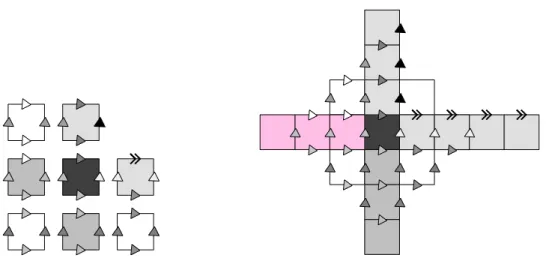
We first construct a new complex Y as follows: Start with a squares, and then attach four cylinders each of which is isomorphic to S1
×I. One such cylinder is attached along each side of s. The resulting complex Y containing exactly five squares is illustrated in Figure 3.
LetT2
denote the torusS1 ×S1
with the usual product cell structure consisting of one 0-cell, two 1-cells, and a single square 2-cell. We let Te2
denote the universal cover and we shall identify Te2 with R2.
At each corner of s⊂Y , there is a pair of intersecting circles in Y1, which are boundary circles of distinct cylinders. Note that they meet at an angle of 3π 2 in Y. At each of three (NW, SW, & SE) corners of s⊂Y we attach a copy of T2
by identifying the pair of circles in the 1-skeleton of T2
with the pair of intersecting circles noted above at the respective corner of s. At the fourth (NE) corner ofs, we attach a copy of the complex X. Here we identify the pair of circles meeting at the corner of swith the pair of perpendicular circles c and y ofX. We denote the resulting complex byZ. Thus,Z =T2
∪T2 ∪T2
∪Y∪X. See Figure 4 for a depiction of the 8 squares ofZ−X and their gluing patterns.
Definition 3.1 Infinite cross An infinite cross is a squared 2-complex iso-morphic to the subcomplex of Te2
consisting of [0,1]×R∪ R×[0,1]. The base squareof the infinite cross is the square [0,1]×[0,1].
Figure 4: Z−X and Z: The eight squares of the figure on the left are glued together following the gluing pattern to form Z−X. To form Z, we add a copy of X at the
N E corner, identifying the loops in X labeled by c and y, with the black single and double arrows of the diagram. The figure on the right represents an infinite cross whose convex hull in Z is not approximable by any periodic plane. Note that while the NW, SW, and SE quarters of this plane are periodic, the NE quarter is an aperiodic quarter of Π.
The planes containing s: Observe that Y contains various immersions of an infinite cross whose base square maps to s. In particular, there are exactly 16 distinct immersed infinite crosses C#Y that pass through s exactly once.
Each of these infinite crosses extends uniquely to an immersed flat plane in Z. Each such flat plane fails to be periodic because its four quarters map to distinct parts of Z. Our main result is that these immersed flat planes are not approximable by periodic flat planes because of the following:
Theorem 3.2 (No periodic approximation) There is no immersion of a torus T2 → Z which contains s. Equivalently, there is no periodic plane in Z˜ con-taining s˜.
Proof We argue by contradiction. Suppose that there is an immersed periodic plane Ω containing s. We shall now produce a rectangle as in Figure 5 that will yield a contradiction. We may assume that a copy of s in Ω is oriented as in Figure 4. We begin at this copy of s and travel north inside the northern cylinder until we reach another copy sn of s. The existence of sn is guaranteed
by our assumption that Ω is periodic. Similarly, we travel east from s to reach a square se. Travelling north from se and east from sn, we trace out the
Figure 5: The figure above illustrates one of the four possible contradictions which explain why no periodic plane contains the square s.
This yields a contradiction because the inside of this rectangle is tiled by squares in X, yet the boundary of this rectangle is a commutator c±n, y±m. As explained in Section 2, such a word cannot be trivial in π1X because of the anti-torus.
Remark 3.3 Using an argument similar to the above proof, one can show that these sixteen planes are the onlyflat planes in ˜Z containing ˜s. One considers the pair of “axes” intersecting at ˜s in a plane containing ˜s. If this plane is different from each of the 16 mentioned above, then some translate of ˜s must appear along one of these “axes”. The infinite strip in the plane whose corners are these twossquares yields a contradiction similar to the one obtained above.
Remark 3.4 While X is a rather pathological complex, we note that every flat plane in ˜X is the limit of periodic flat planes. Indeed this holds for any compact 2-complex X whose universal cover is isomorphic to the product of two trees [8].
4
Polygons of groups
4.1 The algebraic angle versus the geometric angle
Since the elements c and y have axes which intersect perpendicularly in a plane in ˜X, the natural geometric angle between the subgroups hci and hyi
y correspond to distinct factors, it follows that the only relations that must be checked are rectangular (i.e., |k|=|m|and |l|=|n|). However, these are easily ruled out by the anti-torus Π and the fact that X is nonpositively curved.
4.2 Square of groups and triangle of groups
The complexZ can be thought of in a natural way as a K(π,1) for a negatively curved square of groups (see [7, 5, 2]) with cyclic edge groups and trivial face group.
Because the algebraic angle betweenhci andhyiinπ1X is≤ π3, it is tempting to form an analogous nonpositively curved triangle of groups D. The face group of D is trivial, the edge groups of D are cyclic, the vertex groups of D are isomorphic to π1X, and each edge group of D is embedded on one (clockwise) side ashciand on the other (counter-clockwise) side ashyi. This can be done so that the resulting triangle of groups D hasZ3 symmetry. The tension between the algebraic and geometric angles should endow π1D with some interesting properties. For instance, I suspect that π1D fails to be the fundamental group of a compact nonpositively curved space, but it fails for reasons different from the usual types of problems.
Acknowledgments I am grateful to the referee for the helpful corrections. This research was supported by an NSERC grant.
References
[1] Martin R Bridson,Andr´e Haefliger,Metric spaces of non-positive curva-ture, Springer-Verlag, Berlin (1999)
[2] Jon Michael Corson,Complexes of groups, Proc. London Math. Soc. (3) 65 (1992) 199–224
[3] M Gromov, Hyperbolic groups, from: “Essays in group theory”, Math. Sci. Res. Inst. Publ. 8, Springer, New York (1987) 75–263
[4] M Gromov,Asymptotic invariants of infinite groups, from: “Geometric group theory, Vol. 2 (Sussex, 1991)”, Cambridge Univ. Press, Cambridge (1993) 1–295
Department of Mathematics and Statistics, McGill University Montreal, Quebec H3A 2K6, Canada
Email: [email protected]