Procedia Computer Science 20 ( 2013 ) 446 – 453
1877-0509 © 2013 The Authors. Published by Elsevier B.V.
Selection and peer-review under responsibility of Missouri University of Science and Technology doi: 10.1016/j.procs.2013.09.301
Complex Adaptive Systems, Publication 3 Cihan H. Dagli, Editor in Chief
Conference Organized by Missouri University of Science and Technology 2013- Baltimore, MD
Use of Big Data and Knowledge Discovery to Create Data
Backbones for Decision Support Systems
Rahul Sharan Renu, Gregory Mocko*, Abhiram Koneru
Department of Mechanical Engineering, Clemson University, Clemson SC
Abstract
The objective of this research is to provide decision support to assembly line planners when they perform assembly time estimations. There is a lack of consistency in the assembly time analysis performed by planners. The decision support system that was developed in this research is based on mapping controlled language assembly work instructions to Methods-Time Measurement (MTM) tables. Automated analysis of historical work instructions and their related time study analysis were performed by employing knowledge discovery and data mining (KDD) algorithms through the Waikato Environment for Knowledge Analysis (WEKA) interface. As a result of this automated analysis, forty-six mapping rules were created that related work instructions to MTM tables and the data backbone for the decision support system that was created. Analyzing large sets of historical data is crucial while creating decision support systems. KDD provides a sustainable method of analyzing big data. Future work of this research includes applying the KDD process to create data backbones for decision support systems to aid in ergonomic evaluations.
Keywords: Knowledge Discovery; Data mining; Decision Support System; Assembly Time Analysis
1.Frame of Reference
In the domain of manufacturing, process sheets are entities that contain assembly work instructions, assembly time estimates, assembly locations and ergonomic evaluations among other pieces of information [1,2] (see Figure 1). Authorship of a process sheet involves the gathering of necessary information, transforming it into a relevant format, and inserting it into its respective positions (on the sheet). Process sheets are not only a means to convey work instructions and other information to assembly line workers, but they also serve as the entities that get assigned to workstations during line balancing. These sheets are authored and used throughout the lifecycle of the product being manufactured. There are several owners of the information that figure on process sheets which can lead to inconsistencies in the process sheet data. Also, process sheets are enabling factors that allow for efficient operations management.
In the case of automotive applications, there are several thousand parts that get assembled (directly or indirectly) onto the body in white (skeleton of the automotive). The assembly of these parts warrants the need to have several hundred process sheets. In light of the possibility of inconsistent data being authored and the amount of data that needs to be authored, it is evident that a proactive, as well as a reactive knowledge management support system is required. There is a need to provide a system that records the authored information in a systematic manner (reactive), and also a system that provides decision support during the authorship of the various elements of a process sheet (proactive). The reactive system will ensure that there information storage and retrieval is efficient.
© 2013 The Authors. Published by Elsevier B.V.
Selection and peer-review under responsibility of Missouri University of Science and Technology
Open access under CC BY-NC-ND license.
1(a): Example process sheet Figure 1(b): Example MTM table Assembly Work Instructions
Assembly work instructions have the potential to be indicators of assembly time estimates and ergonomic evaluations among others [3]. A commonly used standard assembly time estimation method is the Methods-Time Measurement(MTM) [4]. There has been a research effort to link assembly work instructions to MTM assembly time estimations [5,6]. The research presented in this paper contributes towards automating the creation of the data backbone for the decision support system that has been developed [6].
A controlled language (controlled sentence structure + controlled vocabulary) to author work instructions has been established [1]. It has been shown that this controlled language ensures that a consistent sentence structure is used to communicate work instructions. This sentence structure is enforced as a part of the controlled language. A controlled vocabulary ensures that only a finite, consistent set of action verbs can be used to describe assembly operations. This controlled language is the basis for the MTM decision support system [5].
1.2. MTM decision support system
In order to perform MTM analysis, the analyst must select one MTM table (from a set of 22) based on the assembly process described in the work instructions. Next, the analyst must narrow down upon one MTM code by navigating the selected MTM table.
The MTM decision support system that has been developed uses mapping rules between work instruction elements and MTM tables to automate the selection of an MTM table (see Figure 1(b) for an example MTM table). The creation of the mapping rules involved the manual analysis of historical process sheets. It must be noted that these historical process sheets did not follow the controlled vocabulary [1]. The following points enumerate the analysis procedure that was followed:
1. Decompose historical work instructions such that they describe atomic actions. 2. For each of the atomic-action work instruction, retrieve the verb used (raw-data verb). 3. Find the corresponding controlled language verb for every raw-data verb.
4. Retrieve the MTM time study analyses for every assembly work instruction. 5. Record the MTM table used for every assembly work instruction.
It was found that the mapping between work instruction verb and MTM table was not always one-to-one. This necessitated the need to have multiple mapping rule types. The following table describes the mapping rule types and also shows examples of each [5].
Rule Type Example
Rule Type 1 Verb MTM table Align Place
Rule Type 2 Verb + Object type MTM table Inspect + tool Visual Control
Rule Type 3 Verb 1 + Verb 2 + Object type MTM table Get + Place Get and Place
Rule Type 1 is used to handle cases where there is a one-to-one mapping between assembly work instruction
verbs and MTM tables.
Rule Type 2 is used in cases where a verb can map to more than one MTM table. In such a case there is a need for additional information in order to unambiguously link the verb to an MTM table. The additional information comes in the form of primary object types. A primary object is one whose assembly state is directly influenced by the verb in the work instruction. The five objects types are:
1. Parts; 2. Consumables; 3. Plant Items; 4. Fixtures; 5. Tools
Rule Type 3 is used in cases where two single-action work instructions together map to an MTM table. The
following section describes the automated analysis approach that has been developed to create the data backbone of the MTM decision support system. The following table shows the rules that have been developed through manual analysis.
1.3.Knowledge Discovery and Data Mining
Literature shows that data has three primary characteristics: Volume, Variety and Velocity [7]. Volume refers to the amount/size of the data, Variety refers to the abundant formats that data can be presented in; and Velocity refers to the rate of generation of data.
The need for automated knowledge discovery and data mining has been recognized by several researchers [8 10]. While manual analysis of data can lead to the recognition of patterns, the manual approach becomes problematic when large volumes of data have to be analyzed. Also, when the velocity of analyzable data is high, manual analysis is not a viable option to recognize patterns. This gives rise to the need to have automated analysis of data.
Waikato Environment for Knowledge Analysis (WEKA) [8] provides an intuitive interface to apply data mining algorithms to large volumes of historical data. The application also provides an interface to view and analyze results generated by the data mining algorithms.
2. Method
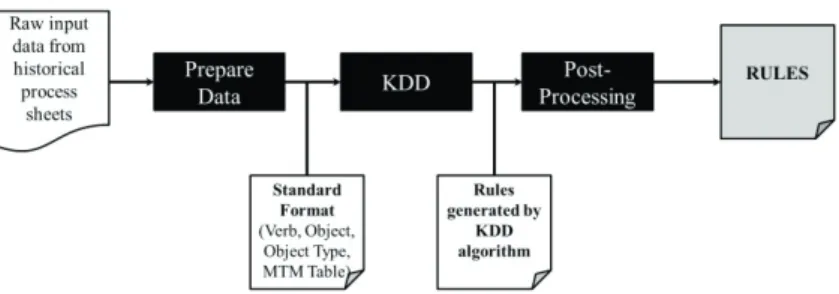
The automated analysis approach is needed in order to enable the processing of large volumes of historical process sheet data. Therefore, a key requirement of the automated analysis system is that the system should take raw process sheet data as an input and provide mapping rules between work instruction elements and MTM tables as output. In light of this requirement, a Knowledge Discovery and Data mining (KDD) approach, as described by Fayyad and colleagues [10], has been adopted. The process described by Fayyad and colleagues has been abstracted to the following three steps:
1.Preprocessing data
2.Knowledge Discovery and Data mining 3.Evaluation of results and Post processing
The research presented in this paper uses text as the raw input data. Therefore, the three steps enumerated above will be explained from this perspective. The first and most essential step of the process is to prepare the raw input data such that knowledge discovery and data mining algorithms can be applied to it. This step of the process is
lower case and vice versa when required, removing elements of raw data that contain spelling mistakes and other such actions.
In the second stage, the preprocessed data is input to a knowledge discovery and data mining algorithm. The research presented in this paper uses existing algorithms as opposed to developing a custom algorithm. Several knowledge discovery and data mining algorithms exist and the need to apply them to real world applications is a well-recognized shortcoming [8,10].
The final step of the process is to evaluate the outputs from the knowledge discovery and data mining algorithms. The Preprocessing step looks to eliminate all erroneous input data. However, in some cases contaminant input data
the outputs from the KDD algorithms involves the remov
the application of the non-erroneous knowledge to the desired application. In the research presented here, the output from the KDD algorithms are cleaned and stored on a web-database. This knowledge will be used by a decision support system. The following section describes the application of the previously mentioned KDD process to the creation of the data backbone for the decision support system [5].
Figure 2: Automated method for data analysisff 3. Application of KDD to MTM Decision Support System
The raw input data in this application 700 work instructions from historical process sheets. These work instructions are unstructured, i.e. they do not follow the standard language proposed by Peterson [1]. This would imply that a historical work instruction can potentially describe multiple actions and also, the elements of the work instruction can have words that are not a part of the standard vocabulary. The process of automated analysis is shown in Figure 2.
3.1. Preprocessing
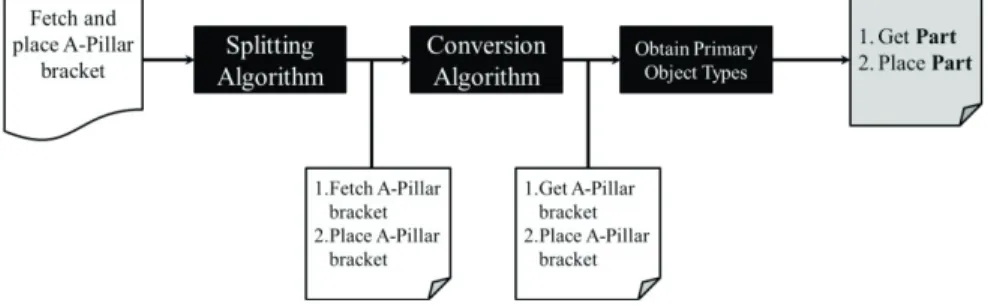
The following steps are required to convert the unstructured work instructions to the standard language. An example is shown in Figure 3:
i.Convert all multiple-action work instructions to single-action work instructions (Splitting Algorithm)
-two actions, fetch A-pillar bracket and place A-pillar bracket. The decision support system for which the data backbone is needed works with the standard language proposed by Peterson et al. This standard language requires each work instruction to describe only a single assembly action. Therefore the example unstructured work instruction (mentioned above) must be converted two structured work instructions first 1) Fetch A-pillar bracket 2) Place A-pillar bracket.
The raw data was obtained as a Microsoft Excel file. Each cell of a particular column in this Excel sheet contained a work instruction. The contents of these cells were parsed using Visual Basic for Applications (VBA)
- The next step in preprocessing the data is to convert raw work instruction verbs to their corresponding synonym, standard language verbs.
ii. Convert raw verb to standard language verb (Conversion Algorithm)
This stage of preprocessing looks to ensure that the verbs which will be input to the KDD algorithm are standard language verbs. The following technique was applied to perform this conversion.
The now structured work instructions (i.e. work instructions that describe only a single assembly action) are tagged with their parts-of-ff speech using the natural language processing techniques. The verbs are extracted from the work instructions and synonyms for each are found. For each verb, its list of synonyms is compared to the list of the standard language verbs. Fr
obtained.
iii. Obtain primary object types
As mentioned previously, the goal of the research is to automate the knowledge discovery that is required to create the data backbone for the MTM decision support system. In light of this, the input data to the KDDff algorithms is set up such that the rules that are generated would fit the three categories described in Table 1. It therefore becomes essential to automate the recognition of the primary object types.
associated with an object type. The primary object from the raw work instruction is string matched to its corresponding standard object description and the object type is retrieved.
Figure 3: Flowchart of Preprocessing stage with an example 3.2. Knowledge Discovery and Data mining
With the standard verbs and object types extracted from the raw input data, the next step is to apply KDD algorithms on this data. Waikato Environment for Knowledge Analysis (WEKA)[8,9,11 13] was chosen as an interface to apply KDD algorithms to the preprocessed data. Within WEKA the J48 decision tree [12] is used to classify the data and extract the rules.
3.3. Evaluation of the results and Post-processing
-At this stage it is necessary to evaluate the results that were obtained from the KDD algorithm. Preprocessing does not always succeed in removing all the error-causing input data. Evaluation of the results is necessary to ensure that outputs caused from the erroneous input data is filtered out and disregarded. This is an automatable process, butff was conducted manually in this research to ensure 100% confidence in the results that are to be used for the data backbone of the decision support system. Post-processing, in this case, involved the manual encoding of the KDD results onto a web-based database.
4. Results
The results and discussions are presented in three stages: Preprocessing, Knowledge Discovery and Data Mining, and Post-processing
4.1. Preprocessing
Seven hundred work instructions were input to the preprocessing stage. To test the accuracy of the Splitting Algorithm, 35 multiple-action work instructions were chosen at random and were checked to see the resulting single-action work instructions made sense. It was found that the splitting of 34 of multiple-action work instructions made sense, which implies that the resulting single-action work instructions described only one action. The one failing case was caused by the fact that there were three or more actions described by the unstructured work instruction and therefore the split at the conjunction yielded one single-action work instruction and another work instruction with two or more actions described and each of these actions was separated by a comma. From the 700 work instructions a list of 176 unique verbs was identified by the Natural Language Processing tool. The Conversion Algorithm was able to identify one or more synonym standard verbs for 75% of these verbs. The third step of preprocessing is to retrieve object types. The algorithm that was developed to do this performed with an accuracy of ff 100%.
4.2. Knowledge Discovery and Data mining
The J48 decision tree identified 62 mapping rules between standard vocabulary elements and MTM tables. The erroneous rules that were caused by incorrect input data were filtered out and 46 correct mapping rules were chosen. The manual rule generation method [5] resulted in 88 mapping rules, of which 50 rules were of Type 1 and Type 2.
4.3. Comparison of the rules recognized by both methods
The J48 algorith
2 rule during manual analysis and a Type 1 rule during automated analysis. The J48 algorithm found that the verb in 22 out of 23 cases. The set confidence level dictated that the
algorithm disregard the one errand case and associate the
a rule of Type 2 in the manual analysis. in the automated analysis. In some cases, verbs that exist in Type 1 from the manual method exist as Type 2 in the automated method. This can be attributed to subjective pruning of data during the manual method.
It must be noted that when the automated analysis method is extended to include Rule Type 3, the confidence in the rules will increase. For of the cases. However, if rule Type 3 is included in the automated analysis, this number will increase because the 9% will be absorbed by rule Type 3.
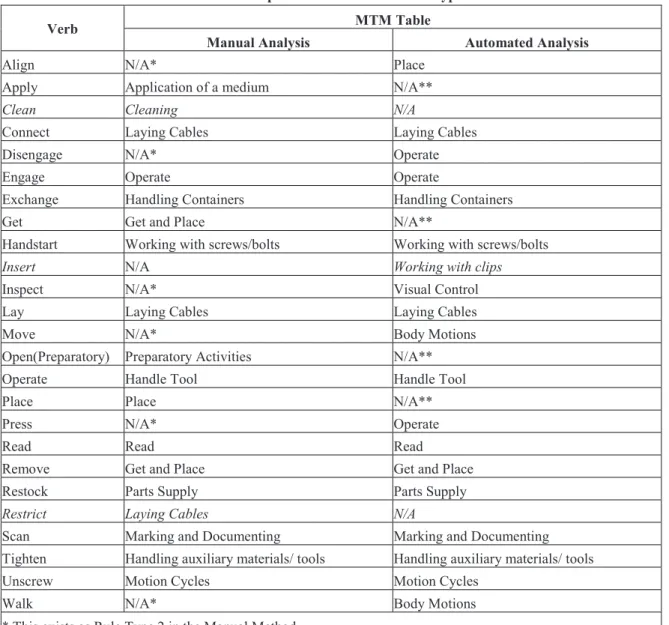
Table 2: Comparison of results for Rule Type 1
Verb MTM Table
Manual Analysis Automated Analysis
Align N/A* Place
Apply Application of a medium N/A**
Clean Cleaning N/A
Connect Laying Cables Laying Cables
Disengage N/A* Operate
Engage Operate Operate
Exchange Handling Containers Handling Containers Get Get and Place N/A**
Handstart Working with screws/bolts Working with screws/bolts
Insert N/A Working with clips
Inspect N/A* Visual Control Lay Laying Cables Laying Cables
Move N/A* Body Motions
Open(Preparatory) Preparatory Activities N/A** Operate Handle Tool Handle Tool
Place Place N/A**
Press N/A* Operate
Read Read Read
Remove Get and Place Get and Place Restock Parts Supply Parts Supply
Restrict Laying Cables N/A
Scan Marking and Documenting Marking and Documenting Tighten Handling auxiliary materials/ tools Handling auxiliary materials/ tools Unscrew Motion Cycles Motion Cycles
Walk N/A* Body Motions
* This exists as Rule Type 2 in the Manual Method ** This exists as Rule Type 2 in the Automated Method
Verb and Object Type
MTM Table Identified
Manual Analysis Automated Analysis
Align
& Fixture Place **
& Plant Item Place **
& Tool Motion Cycles N/A
Attach
& Consumable Work with adhesives Work with adhesives
& Fixture Get and Place Get and Place
& Plant Item Get and Place Get and Place
Disengage
& Plant Item Operate **
& Tool Motion Cycles N/A
Get
& Plant Item Advanced Level/ Car Body Advanced Level/ Car Body
& Fixture Get and Place Get and Place
Inspect
& Plant Item Read N/A
& Tool Visual control **
Move
& Plant Item Body Motions **
& Part Advanced Level/ Car Body N/A
& Tool Body Motions **
Operate
& Part Handle Tool **
& Plant Item Operate N/A
Press
& Fixture Operate **
& Plant Item Operate **
Push
& Fixture Motion Cycles Motion Cycles
& Plant Item Get and Place Get and Place
Remove (Preparatory)
& Consumable Preparatory Activities Preparatory Activities
& Part Get and Place Get and Place
Secure
& Part Laying Cables Laying Cables
& Fixture Operate Operate
Tighten
& Tool Handling Auxiliary Materials/Tools **
& Part Get and Place N/A
Walk
& Fixture Body Motions **
& Part Body Motions **
& Tool Body Motions **
& Plant Item Advanced Level/ Car Body N/A
Apply
& Part N/A Motion Cycles
& Consumable * Application of Medium
Place
& Part * Place
& Fixture * Place
& Plant Item * Place
& Tool N/A Handling auxiliary materials/ tools
Open(Preparatory)
& Tool N/A Operate
& Plant Item * Preparatory Activities
* This exists as Rule Type 1 in the Manual Method * This exists as Rule Type 1 in the Automated Method
5. Conclusions and Future Work
The research presented has shown that there is scope to automate the creation of the data backbone for the MTM decision support system. Future work includes a comprehensive comparison of the rules developed by the manual method and the automated method. It is hypothesized that the manual method will lead to inconsistency of rules based on the person analysing the data (subjectivity). It is also hypothesized that the automated method will require less time for analysis. On another note, the method presented in this paper is not completely automated.
1.If the Conversion Algorithm results in multiple synonym standard verbs for one raw data verb, the user must select the most appropriate synonym standard verb.
2.The preprocessed information is manually input to WEKA.
3.The results from WEKA are manually evaluated and manually encoded onto a web-based database.
The points listed above present an opportunity for automation. A completely automated system will allow for continual improvement and continual increase of the robustness of the data backbone. The number of preprocessing steps can be significantly reduced if the controlled language [1] is used to author assembly work instructions. The system will, however, be able to function on free text as well. As can be seen, the tool presented here works to identify rules of types one and two. It must be extended to indentify rules of Type 3. The system developed has been employed to create data backbone for a time estimate decision support system. The system can be adapted to discover knowledge from historical process sheets pertaining to ergonomics.
References
[1]
Assembly Instructions and Product-[2] Rychtyckyj N., an [3] p. 2479 2483. [4] -[5] -. [6] [7] -data/. [8] [9] 20(15), pp. 2479 81. [10] Fayyad U., Piatetsky-shapiro G., a
17(3), pp. 37 54.
[11] 361.
[12] 3.
[13]