R E S E A R C H
Open Access
Participants
’
understanding of a randomized
controlled trial (RCT) through informed consent
procedures in the RCT for breast cancer
screening, J-START
Yoko Narikawa Shiono
1,2†, Ying-Fang Zheng
3†, Masahiro Kikuya
2,4*, Masaaki Kawai
5, Takanori Ishida
1,
Shinichi Kuriyama
4,6,7and Noriaki Ohuchi
1Abstract
Background:It is often difficult to enrol healthy volunteers into a randomized controlled trial (RCT) as there are barriers to participants’proper understanding of a trial. This study aimed to evaluate degrees of understanding of the informed consent (IC) process among healthy volunteers who participated in an RCT. Additionally, factors associated with degree of understanding were investigated.
Methods:The J-START (the Japan STrategic Anti-cancer Randomized controlled Trial) is an RCT investigating the effectiveness of ultrasonography screening for breast cancer in women aged 40 to 49 years. To evaluate participants’ understanding of the J-START, we administered questionnaires to 376 Japanese women on the day of enrolment at five study sites across Japan. The respondents were asked to complete the anonymous questionnaire within 2 weeks. We assessed objective understanding and perceived subjective understanding of IC using a Japanese version of the Quality of Informed Consent scale (QuIC). Then we analyzed the characteristics of women whose understanding was poor, and clarified the association between providing information and their understanding of the study protocol.
Results:The average QuIC scores were 78.2 and 82.2 (out of 100 each) for objective and subjective understanding, respectively. These are generally acceptable scores for participants’understanding of an RCT. However, there were four domains with low scores, indicating poor understanding: (1) experimental nature of the study, (2) potential risks or discomfort, (3) benefit to self, and (4) compensation.
Conclusions:Healthy volunteers generally well understood the J-START. Nevertheless, there were some domains in need of improvement. In order to facilitate participants’understanding, it is necessary to provide training to reduce differences in information-providing procedures between medical centres and to endeavour to provide consistent information and conditions.
Trial registration:The J-START was registered with the University Hospital Medical Information Network Clinical Trial Registration (UMIN-CTR), Japan (registration number: UMIN000000757), on July 1, 2007.
Keywords:Breast cancer screening, participant understanding, RCT, informed consent
* Correspondence:[email protected]
†Equal contributors
2Division of Molecular Epidemiology, Tohoku University Graduate School of Medicine, 2-1, Seiryo-machi, Aoba-ku, Sendai, Japan
4Department of Preventive Medicine and Epidemiology, Tohoku Medical Megabank Organization, Tohoku University, 2-1, Seiryo-machi, Aoba-ku, Sendai, Japan
Full list of author information is available at the end of the article
Background
It has been suggested that the complex design of a clinical trial, such as a randomized controlled trial (RCT), is diffi-cult to understand for participants. Although participants are enrolled in a trial only after undergoing the informed consent (IC) process, their understanding of the trial in which they are participating is often insufficient [1-9]. The following two factors might account for this insuffi-cient understanding. First, participants cannot distinguish already established, evidenced examination and treatment procedures from study protocols necessitated by treat-ment that has not yet been established [1-5]. Second, it is difficult to understand the concepts that are characteristic of RCTs, such as randomization and placebos [5-9].
To our knowledge, no large-scale RCT with more than 70,000 healthy volunteers from the general population had been conducted in Japan before the Japan STrategic Anti-cancer Randomized controlled Trial (J-START) was initiated [10]. The J-START is an RCT on the effect-iveness of ultrasonography in breast cancer screening that was developed to assess breast cancer screening in Japan in 2007.
According to a survey conducted in Japan on the atti-tudes of the healthy general population toward clinical tri-als [11], participation in them is widely recognized as a volunteer activity that provides an opportunity to contrib-ute to society. However, it has been reported that partici-pants do not sufficiently understand the definitions and contents of clinical trials [11]. There are no reports on the understanding of an RCT targeting a general population of healthy women in Japan. Moreover, there are guidelines but no laws about clinical trials except for pharmaceutical products in Japan. Therefore, as a matter of ethics, clinical trials conducted in Japan should make an effort to provide understandable ICs for eligible participants. However, there is no validity of the ICs provided in Japan with re-spect to ethics compared with trials in other countries. Thus, we surveyed the degrees of objective and subjective understanding of the IC process among J-START parti-cipants. Additionally, factors associated with degrees of understanding were investigated. This is a survey study of the quality of IC given to participants of an RCT to clarify what would be helpful for future trials.
Methods
Overview of J-START
J-START is a multi-centre RCT with 42 participating me-dical centres in 23 prefectures across Japan. It is supported by science research funds from the Japan Ministry of Health Labour, and Welfare. The aim of the J-START is to assess the effectiveness of screenings for breast cancer among women in their 40s. As of 31 March 2011, 76,196 healthy female volunteers had enrolled [12]. The primary endpoints were sensitivity, specificity, and advanced
cancer ratio in both screening groups: the intervention group (women who received ultrasonography in addition to mammography) and the control group (women who re-ceived mammography only). The research coordinators verbally explained the purpose and method of the RCT to all eligible participants while collecting ICs.
J-START participants were recruited by trained re-search coordinators. Potential participants were given a supplementary leaflet by mail before visiting the medical centres. At the medical centres, an educational video re-cording of the study was presented and a verbal descrip-tion and a booklet were provided for IC. The total time of the educational video was almost 7 minutes, and it played continuously in the visitors’waiting rooms of the medical centres.
Participants and study methods
Of the 42 medical centres participating in J-START, five medical centres in Iwate, Yamagata, Tokyo, Okayama, and Okinawa participated in our study. From 10 Novem-ber 2010 to 31 January 2011, we distributed anonymous questionnaires to newly enrolled participants regarding their understanding of the RCT at the five medical cen-tres in different Japanese prefectures. At the time we re-ceived approval for this survey in September 2010, only the above-cited medical centres were recruiting new par-ticipants; furthermore, only those centres had the proper personnel for conducting the accompanying research.
We distributed the anonymous questionnaires regard-ing participants’ understanding of the RCT at the med-ical centres. Informed consent for participating in our investigation of participants’ understanding of the RCT was assumed by response to the questionnaire. The set of documents distributed to each participant included a letter describing the purpose and method of the study, the questionnaire, and a return envelope. Ethical ap-proval was obtained from the Institutional Review Board of Tohoku University Graduate School of Medicine on 27 September 2010 (No. 2010–279).
Questionnaire
Part A of the Japanese version of the QuIC contains 16 items measuring actual knowledge of the basic ele-ments of IC. The total QuIC Part A score represents an average of the 16 items on objective understanding, ran-ging from 0 (lowest) to 100 (highest) [6]. Each item is measured with a triple-bounded binary-choice format:
“Totally agree”, “Unsure”, and “Strongly disagree”. The points were given as follows: 100 points for the correct answer, 50 points for“Unsure”, which is neither correct nor incorrect, and 0 points for a wrong answer. Answers without a response were marked“No reply”. There were four negatively-phrased items, for which the correct an-swer was “Disagree”, so as to avoid agreement bias that might result from all correct answers being“Agree”[6].
Part B of the Japanese version of the QuIC consists of 14 items assessing subjective understanding of important elements of the trial. The total score of the QuIC Part B is an average of the scores for the 14 items [6]. Each item was measured with a quintuple-bounded binary-choice format: 100 points for“Understood very well”, 75 points for“Generally understood”, 50 points for“Neither understood nor did not understand”, 25 points for “ Al-most did not understand”, and 0 points for “Did not understand”.
The J-START is an RCT that enrolled healthy volun-teers as the participants for breast cancer screening. For that reason, the QuIC questions that pertained only to Phase I clinical studies were deleted (in the original QuIC full version: questions A6, A7, A8, and A10). We then had one Japanese and one Chinese healthcare worker who use English and Japanese on a daily basis translate the remaining questions into Japanese sen-tences that would be readily understandable in the context of current Japanese culture. Next, we had back-translated that Japanese into English by a different person who used English and Japanese on a daily basis. Finally, that back-translated version was checked by a person whose native language was English. The compre-hensibility of the technical terms and expressions in not only the Japanese QuIC, but also the full questionnaire including original items, was checked by having a med-ical ethics specialist and medmed-ical staffers complete the entire questionnaire. We then made revisions to the ma-terials based on their replies. To ensure the validity of the full questionnaire, we evaluated the materials’ reli-ability by test-retest as following. We asked the new par-ticipants in J-START, which has the same conditions as the present study, to answer the full questionnaire, including the Japanese version of QuIC and other items, twice, at a 2-week interval. Twenty-one participants an-swered all the questions in the questionnaire twice. Weighted kappa statistics for QuIC ranged from 0.32 (objective risks) to 0.67 (subjective experimental nature of study), respectively. Cronbach’s alpha values for QuIC
for internal consistency were 0.57 and 0.89 for Parts A and B, respectively.
Other questionnaires
We administered additional questionnaires to measure age, educational level, marital status, work status, and study allocation of the RCT. These also assessed im-pressions of materials provided and prior knowledge about J-START and RCTs. These questionnaires and the Japanese QuIC were validated by the pilot study at the same time.
Multimedia information materials had been prepared for J-START (for example, leaflets, educational DVDs). Their effectiveness was assessed with quintuple-bounded binary-choice items (“Very helpful”, “Almost helpful”,
“Neither helpful nor unhelpful”,“Almost unhelpful”, and
“Not at all helpful”). In addition, alternative responses were prepared as follows: “Have not read”, and “Have not watched”.
The effectiveness of the verbal description during IC was assessed with the following five questions: (1)“The re-search coordinator facilitated your understanding”. (2)
“You had an opportunity to ask questions”. (3) “You had sufficient time to understand the process”. (4)“It was easy to say‘no’, if you did not want to continue your participa-tion”. (5) “You sought further explanation of the study”. The answer to these five questions was coded as follows: 1 for“Yes”and 0 for“No”or“Unsure”.
Statistical analysis
Continuous variables are reported with means and standard deviations, whereas categorical variables are reported as percentages. Bivariate correlations were conducted between the QuIC scores and each inde-pendent variable. Correlations were assessed using chi-squared tests. All analyses were conducted using SAS statistical software (version 9.3; SAS Institute Inc., Cary, NC, USA).
Results
Participant characteristics
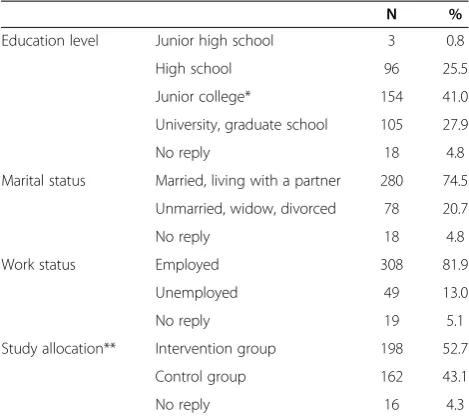
Participant characteristics are shown in Table 1. Of the 745 questionnaires distributed, 376 (50.4%) were returned. Among 376 survey respondents, almost 70% graduated from vocational school, junior college, or above. There were 280 married participants (74.5%), and 308 parti-cipants (81.9%) were employed. In relation to group allo-cation of the RCT, 198 participants (52.7%) were assigned to the intervention group, and 162 participants (43.1%) were assigned to the control group.
Objective understanding
78.2 (95% CI, 68.6 to 87.8). Participants generally under-stood most question items well. However, the accuracy rates for some items were low. Specifically, there were accuracy rates of 14.6% for Question A4 on the“ Expe-rimental nature of study”, 14.1% for Question A8 on
“Potential risks or discomforts”, 34.6% for Question A9 on “Benefit to self”, and 33.0% for Question A13 on
“Compensation”.
Subjective understanding
The results of the subjective understanding (QuIC Part B) are shown in Table 3. The average QuIC Part B score was 82.2 (95% CI, 69.3 to 95.1). However, for Question B11 on
“Compensation”,“Who will pay for treatment if you are in-jured or become ill because of participation in J-START?”, the combined percentage of participants who indicated that
“I understood very well”and“I generally understood” was only 44.7%. For Question B6 on“Potential risks or discom-forts”, the total percentage of participants who indicated that“I understood very well”and“I generally understood” was 78.2%. This question item corresponded to Question A8 on “Potential risks or discomforts”. It is worth noting that, although objective understanding of this item was low, subjective understanding was high.
Assessment of explanatory materials and information-providing procedures
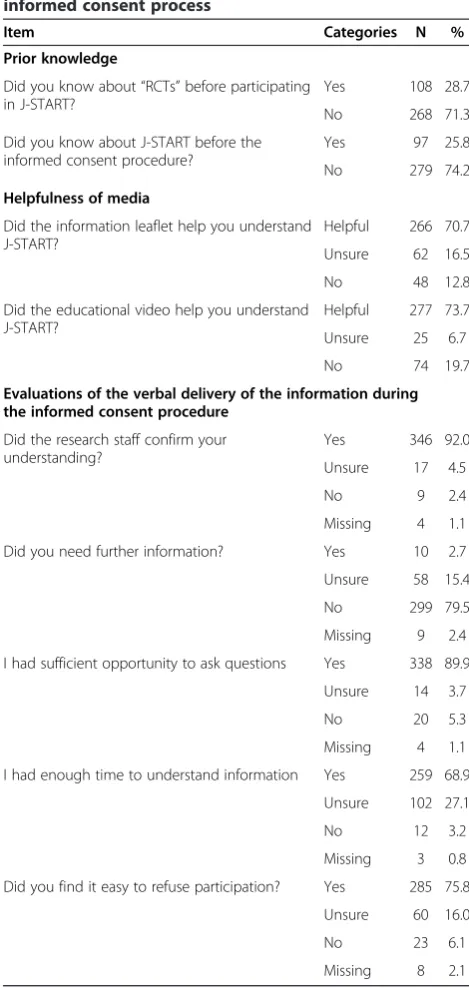
In order to examine how various information-providing procedures used during the IC process related to par-ticipants’understanding, we asked participants about their prior knowledge and asked them to give their impression
of the materials used for explanation and verbal descrip-tion, and to evaluate each procedure (Table 4). Although informational leaflets explaining the trial had been mailed to the participants in advance, 279 (74.2%) indicated that they did not have any prior knowledge of J-START. The participants highly valued the informational leaflets and the educational videos explaining the trial. These were regarded as “Helpful for understanding” by 266 (70.7%) and 277 participants (73.7%), respectively. Three hundred and forty-six participants (92.0%) reported that their un-derstanding had been confirmed by the research coordin-ator at the end of the oral description during the IC process. It would be expected that, at the time of that interaction, the research coordinator would become cognizant of the participant’s questions and points of con-fusion, but we do not know what sort of communication took place later in this study. Only 10 participants (2.7%) indicated that they sought further explanation of the trial at that time.
Factors associated with low objective understanding
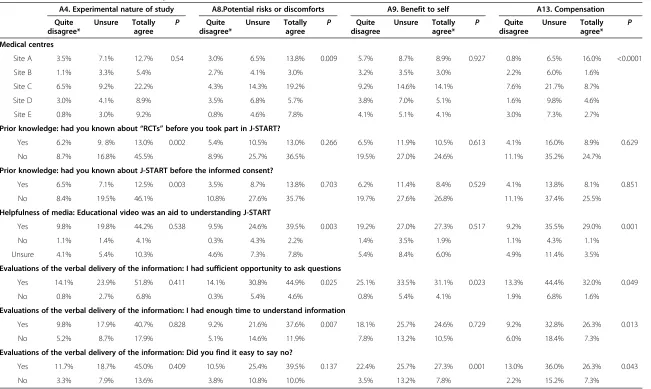
Table 5 shows the association between factors at the time of the IC process and the four objective under-standing items with low accuracy rates; that is, A4, A8, A9, and A13 of QuIC Part A. The medical centre showed a correlation with two questions: Question A8 on “Potential risks or discomforts” (P= 0.009) and Question A13 on“Compensation” (P< 0.0001). The ex-istence of prior knowledge of the RCT or J-START itself was statistically significant only for Question A4 on“ Ex-perimental nature of study”, (RCT, P= 0.002; J-START,
P= 0.003). The educational video showed a correlation with the two questions A8 on “Potential risks or dis-comforts”(P= 0.003) and A13 on“Compensation”(P= 0.001). Sufficient opportunity to ask a question showed correlations with Question A8 on “Potential risks or discomforts” (P= 0.025), Question A9 on “Benefit to self” (P= 0.023), and Question A13 on“Compensation” (P= 0.049), while enough time to achieve understanding showed correlations with Question A8 on “Potential risks or discomforts” (P= 0.007) and Question A13 on
[image:4.595.56.291.100.309.2]“Compensation” (P= 0.013). The atmosphere at the venue when the decision to participate was made showed correlations with Question A9 on “Benefit to self” (P= 0.001) and Question A13 on“Compensation” (P= 0.043), but for each case there was a low percentage of participants who felt the atmosphere made it hard to refuse to participate. No statistically significant correlation was found between the degree of understanding and the following factors: education level, marital status, work sta-tus, informational leaflet, whether the research staff con-firmed whether the participant understood, or whether the participant wanted to ask further questions at the time of IC.
Table 1 Characteristics of the study participants
N %
Education level Junior high school 3 0.8
High school 96 25.5
Junior college* 154 41.0
University, graduate school 105 27.9
No reply 18 4.8
Marital status Married, living with a partner 280 74.5
Unmarried, widow, divorced 78 20.7
No reply 18 4.8
Work status Employed 308 81.9
Unemployed 49 13.0
No reply 19 5.1
Study allocation** Intervention group 198 52.7
Control group 162 43.1
No reply 16 4.3
Discussion
The present study aimed to evaluate the degree of par-ticipants’ understanding of an RCT and investigate the associated factors. We administered questionnaires to 376 healthy Japanese women on the day of enrolment at five study sites using a Japanese version of the QuIC. Al-though healthy volunteers generally well understood J-START, there were some domains in need of improve-ment. Until the present study, there have been no re-ports on either the understanding of an RCT targeting the general population of healthy women or reports con-cerning evaluations using international and validated scales in Japan. The present study has demonstrated hints of improvement in the IC process in an RCT that targeted the general population of healthy people. The participants generally provided correct responses to the majority of the questions. Furthermore, the QuIC scores in the present survey were comparable to the scores in
[image:5.595.60.537.99.476.2]the preceding studies [14-16,18]. The results of the present study revealed a tendency for the degree of sub-jective understanding to be higher than the degree of ob-jective understanding, which is similar to the findings of earlier studies. The higher degree of subjective under-standing can be thought to be related to the ease of un-derstanding the IC and/or a feeling of satisfaction with the amount of information, but the reason for discrep-ancy with the degree of objective understanding war-rants further study. Thus, the purpose of IC seems to have largely been achieved. However, among the items specified by the US Federal Regulation (Chapter 45, Part 46) that should be explained to individuals eligible for participation in a clinical trial, “Experimental nature of study”, “Potential risks or discomforts”,“Benefit to self”, and “Compensation” were not correctly understood by some participants. In previous studies, “Experimental nature of study”[1,8,14,18],“Potential risks or discomfort”
Table 2 Percentage of participants by QuIC Part A score: an objective understanding of J-START
QuIC items QuIC scores No
1 2 3 reply
A1. Nature of research When I signed the consent form for J-START, I knew that I was agreeing to participate in a clinical trial
0.3 5.6 92.6* 1.6
A2. Purpose of research The main goal of J-START is improving breast cancer screening for future generations 0.0 2.7 95.7* 1.6
A3. Duration of procedures I have been informed about the duration of J-START 4.8 30.3 63.3* 1.6
A4. Experimental nature of study
All tests in J-START are standardized 14.6* 26.1 57.5 1.9
A5. Purpose of research The major purpose of J-START is to assess the effectiveness of ultrasound screening for breast cancer among Japanese women aged 40–49 years
1.1 10.6 86.7* 1.6
A6. Purpose of research Neither the mammography screening nor the combined use of mammography and ultrasound screening have been proven as the best screening method for Japanese women aged 40–49 years
0.8 25.3 72.3* 1.6
A7. Procedures to be followed
After I agreed to participate in J-START, my examination was chosen randomly between mammography screening or combined use of mammography and ultrasound screening
1.9 11.4 85.1* 1.6
A8. Potential risks or discomforts
Compared with standard breast cancer screening, J-START does not carry any additional risks or discomforts
14.1* 35.6 48.7 1.6
A9. Benefits to self I might not receive any direct medical benefits from my participation in J-START 25.5 38.3 34.6* 1.6
A10. Benefits to others By participating in J-START, I am helping the researchers gather information that might benefit future breast cancer screening procedures
0.3 10.4 87.8* 1.6
A11. Confidentiality Because I am participating in a clinical trial, it is possible that the study sponsor, various government agencies, or others who are not directly involved in my care will review my medical records
3.7 33.2 61.4* 1.6
A12. Alternatives to participation
My doctors did not offer me any alternative breast cancer screening procedures beyond J-START.
87.8* 9.3 1.3 1.6
A13. Compensation The consent form I signed indicates who will pay for treatment if I am injured or become ill as a result of participation in this clinical trial
14.9 50.3 33.0* 1.9
A14. Study contacts The informed consent form listed study contact persons 4.8 19.7 73.7* 1.9
A15. Voluntary nature of participation
If I had not wanted to participate in this clinical trial, I could have declined to sign the consent form
1.1 11.4 85.6* 1.9
A16. Voluntary nature of participation
I must remain in the clinical trial, even if I decide that I would like to withdraw someday 60.1* 30.1 8.2 1.6
[8,14,18,20],“Benefit to self” [5], and “Compensation” [14,18] were reported to be difficult for participants to understand. Therefore, strategies need to be developed to facilitate better understanding of these items among participants.
It is necessary to consider the current status of breast cancer screening in Japan, giving consideration to these three factors: “Experimental nature of the study”,
“Potential risks or discomforts”, and “Compensation”. Regarding“Experimental nature of the study” and “ Po-tential risks or discomforts”, because of the comfort level and familiarity derived from the fact that ultrason-ography is a well-known method, participants are un-likely to understand that a trial is conducted due to the lack of any established intervention, and that there are potential risks or discomforts involved. Moreover, re-garding “Compensation”, participants might not have paid attention to the explanation of compensation for any problems about intervention. Mammography, which is currently used for breast cancer screening, is known to sometimes cause pain from the compression of a breast, as well as minor exposure to x-rays during imaging. Ultrasonography is generally perceived to be more comfortable than mammography. Therefore, it
might be difficult to imagine that health problems could be caused by ultrasonography. Moreover, because breast ultrasonography has already been employed as a breast cancer screening method for opportunistic screening (for example, complete physical examination), a perception of this procedure as a well-established screening method might not reflect the true situation. In fact, scientific evi-dence for breast ultrasonography as a method for mass screening has remained under investigation in J-START since 2007. Because the procedure has been employed as an effective screening method in routine practice in breast surgery departments, the present survey might have in-cluded participants who had previously undergone ultra-sonography as a component of their medical care.
There were three possible reasons for participants’ misunderstanding of IC, which have been referenced in previous studies. First, the explanatory materials might have been difficult to understand [21,22]. Second, the comprehension ability of participants might have been insufficient [4,23]. Third, the information-providing procedures used during the IC process might have var-ied between medical centres [9].
[image:6.595.60.536.99.405.2]First, in relation to difficult explanatory materials, well-considered wording [22] and explanations using
Table 3 Percentage of participants by QuIC Part B score: a subjective understanding of J-START
QuIC questions QuIC scores No
1 2 3 4 5 reply
B1. Nature of research This breast cancer screening involves a research component 1.1 2.1 3.7 39.6 51.6 1.9
B2. Purpose of research What the researchers are trying to understand in J-START 0.3 1.1 1.6 36.7 59.0 1.3
B3. Duration of procedures How long you will be in J-START 1.9 7.2 9.0 33.8 46.8 1.3
B4. Procedures to be followed
The tests and procedures you will undergo 1.1 0.8 2.7 30.6 62.2 2.7
B5. Experimental nature of study
Which of these tests and procedures are experimental 1.1 4.3 7.5 38.6 39.4 9.3
B6. Potential risks or discomforts
The potential risks or discomforts associated with participating in J-START 1.9 4.5 13.8 34.8 43.4 1.6
B7. Benefits to self The potential benefit to you for participating in J-START 2.1 1.9 14.4 42.0 37.8 1.9
B8. Benefits to others How your participation in this clinical trial might benefit future patients 0.3 0.3 2.4 31.4 64.1 1.6
B9. Alternatives to participation
The alternative to participation in the clinical trial 0.8 1.3 6.4 28.5 61.4 1.6
B10. Confidentiality The effect of clinical trial participation on the confidentiality of your medical records
0.5 0.0 3.2 30.1 64.9 1.3
B11. Compensation Who will pay for treatment if you are injured or become ill due to participation in J-START
14.9 19.4 18.4 21.8 22.9 2.7
B12. Study contacts Whom you should contact if you have questions or concerns regarding J-START
4.5 6.4 11.7 31.9 43.9 1.6
B13. Voluntary nature of participation
The fact that participation in J-START is voluntary 0.5 0.3 0.3 17.8 79.8 1.3
B14. Overall Overall, how well did you understand your specified clinical trial when you signed the consent form?
0.8 2.4 4.5 65.7 25.3 1.3
written, paper-based information (for example, leaflets and booklets) appear to improve understanding of RCTs [21]. Further, it is preferable to provide information with a combination of several materials [24]. When we prepared the informational leaflets and the educational video, we sought to use simple words and considered a combination of materials. The resultant material was also approved by the institutional ethical review board. As shown in Table 4, the majority of the participants indicated that the
explanatory materials were “Helpful for understanding”. This demonstrates that the explanatory materials were perceived to be sufficiently easy to understand. Table 5 in-dicates that prior knowledge influenced misunderstanding of“Experimental nature of the study”, but prior knowledge had not always been given by our leaflet, and the educa-tional video did not help correct misconceptions. In a study simulating a situation in which children and their parents undergo the IC process, it was reported that multimedia materials with visual and auditory information are preferable to paper-based information and could be expected to improve understanding, particularly among parents [25]. Other studies have indicated that a simplified IC form with emphasis added by verbal description [26], and user testing, which examines not only the wording of leaflets, but also the layout and paper thickness, in order to design interesting materials for participants to read, leads to improved explanatory materials and better understanding [27]. However, in systematic reviews of understanding of RCTs [28] and of trials and ICs [29], it was reported that multimedia informational materials were not as effective for improving participants’ under-standing as test-feedback quizzes or discussion of the IC process [28,29]. The result of our survey corrobo-rated the systematic reviews. Improving face-to-face communication would foster better understanding than improving written materials.
[image:7.595.55.290.102.597.2]Second, regarding the comprehension ability of partici-pants, approximately 70% of the participants in the present study graduated from vocational school, junior college, or above (Table 1). Because the illiteracy rate in Japan is low due to the 9 years of mandatory education, in-sufficient comprehension ability is an unlikely explanation. Regarding the third possible reason for participants’ misunderstanding of IC, there were, unfortunately, signifi-cant gaps or inconsistencies between the IC information-providing procedures of the different medical centres (Table 5). Regrettably, we did not have the data on how IC was obtained from each of the participants. For the stan-dardized information dissemination process in J-START, the manual included specific procedures concerning IC and the use of materials, and held several training sessions for the research coordinators, who had previous experi-ence working at a medical centre (for example, nurses and public health nurses). To avoid misconceptions arising from verbal communication, explanatory materials were also integrated into the IC process. Despite this, a certain number of participants reported as being unsure about these materials. However, we did not have the IC process data, and it was not clear that the process was lost or the participants did not read or watch. Given that explanatory materials are reported to improve participants’ under-standing [8], the differences in underunder-standing observed in the present study might be attributable to insufficient use
Table 4 Questionnaire on participants’impression of the informed consent process
Item Categories N %
Prior knowledge
Did you know about“RCTs”before participating in J-START?
Yes 108 28.7
No 268 71.3
Did you know about J-START before the informed consent procedure?
Yes 97 25.8
No 279 74.2
Helpfulness of media
Did the information leaflet help you understand J-START?
Helpful 266 70.7
Unsure 62 16.5
No 48 12.8
Did the educational video help you understand J-START?
Helpful 277 73.7
Unsure 25 6.7
No 74 19.7
Evaluations of the verbal delivery of the information during the informed consent procedure
Did the research staff confirm your understanding?
Yes 346 92.0
Unsure 17 4.5
No 9 2.4
Missing 4 1.1
Did you need further information? Yes 10 2.7
Unsure 58 15.4
No 299 79.5
Missing 9 2.4
I had sufficient opportunity to ask questions Yes 338 89.9
Unsure 14 3.7
No 20 5.3
Missing 4 1.1
I had enough time to understand information Yes 259 68.9
Unsure 102 27.1
No 12 3.2
Missing 3 0.8
Did you find it easy to refuse participation? Yes 285 75.8
Unsure 60 16.0
No 23 6.1
Missing 8 2.1
A4. Experimental nature of study A8.Potential risks or discomforts A9. Benefit to self A13. Compensation
Quite disagree*
Unsure Totally agree
P Quite disagree*
Unsure Totally agree
P Quite disagree
Unsure Totally agree*
P Quite disagree
Unsure Totally agree*
P
Medical centres
Site A 3.5% 7.1% 12.7% 0.54 3.0% 6.5% 13.8% 0.009 5.7% 8.7% 8.9% 0.927 0.8% 6.5% 16.0% <0.0001
Site B 1.1% 3.3% 5.4% 2.7% 4.1% 3.0% 3.2% 3.5% 3.0% 2.2% 6.0% 1.6%
Site C 6.5% 9.2% 22.2% 4.3% 14.3% 19.2% 9.2% 14.6% 14.1% 7.6% 21.7% 8.7%
Site D 3.0% 4.1% 8.9% 3.5% 6.8% 5.7% 3.8% 7.0% 5.1% 1.6% 9.8% 4.6%
Site E 0.8% 3.0% 9.2% 0.8% 4.6% 7.8% 4.1% 5.1% 4.1% 3.0% 7.3% 2.7%
Prior knowledge: had you known about“RCTs”before you took part in J-START?
Yes 6.2% 9. 8% 13.0% 0.002 5.4% 10.5% 13.0% 0.266 6.5% 11.9% 10.5% 0.613 4.1% 16.0% 8.9% 0.629
No 8.7% 16.8% 45.5% 8.9% 25.7% 36.5% 19.5% 27.0% 24.6% 11.1% 35.2% 24.7%
Prior knowledge: had you known about J-START before the informed consent?
Yes 6.5% 7.1% 12.5% 0.003 3.5% 8.7% 13.8% 0.703 6.2% 11.4% 8.4% 0.529 4.1% 13.8% 8.1% 0.851
No 8.4% 19.5% 46.1% 10.8% 27.6% 35.7% 19.7% 27.6% 26.8% 11.1% 37.4% 25.5%
Helpfulness of media: Educational video was an aid to understanding J-START
Yes 9.8% 19.8% 44.2% 0.538 9.5% 24.6% 39.5% 0.003 19.2% 27.0% 27.3% 0.517 9.2% 35.5% 29.0% 0.001
No 1.1% 1.4% 4.1% 0.3% 4.3% 2.2% 1.4% 3.5% 1.9% 1.1% 4.3% 1.1%
Unsure 4.1% 5.4% 10.3% 4.6% 7.3% 7.8% 5.4% 8.4% 6.0% 4.9% 11.4% 3.5%
Evaluations of the verbal delivery of the information: I had sufficient opportunity to ask questions
Yes 14.1% 23.9% 51.8% 0.411 14.1% 30.8% 44.9% 0.025 25.1% 33.5% 31.1% 0.023 13.3% 44.4% 32.0% 0.049
No 0.8% 2.7% 6.8% 0.3% 5.4% 4.6% 0.8% 5.4% 4.1% 1.9% 6.8% 1.6%
Evaluations of the verbal delivery of the information: I had enough time to understand information
Yes 9.8% 17.9% 40.7% 0.828 9.2% 21.6% 37.6% 0.007 18.1% 25.7% 24.6% 0.729 9.2% 32.8% 26.3% 0.013
No 5.2% 8.7% 17.9% 5.1% 14.6% 11.9% 7.8% 13.2% 10.5% 6.0% 18.4% 7.3%
Evaluations of the verbal delivery of the information: Did you find it easy to say no?
Yes 11.7% 18.7% 45.0% 0.409 10.5% 25.4% 39.5% 0.137 22.4% 25.7% 27.3% 0.001 13.0% 36.0% 26.3% 0.043
No 3.3% 7.9% 13.6% 3.8% 10.8% 10.0% 3.5% 13.2% 7.8% 2.2% 15.2% 7.3%
*Correct answer. J-START, Japan STrategic Anti-cancer Randomized controlled Trial; RCT, randomized controlled trial.
2014,
15
:375
Page
8
o
f
1
0
al.com/cont
[image:8.794.62.713.104.493.2]of the materials. A previous systematic review reported that having a long discussion time with a team member and a neutral educator was effective for participants’ understanding, and it worked even over the telephone [29]. In J-START, this type of discussion was not pro-grammed officially. If we could have had the opportunity to include such a discussion, IC and accompanying materials might have been delivered more effectively. In order to more effectively perform the IC process, we must create opportunities for the team members to have frequent dis-cussions with the educator, with the topic of discussion to include better information-providing procedures.
A limitation of the present study was that not all of the J-START study sites were included. However, the val-idity of the QuIC was evaluated and the reliability of the questionnaire was tested. Significantly more participants in the intervention group returned the questionnaires than in the control group. Therefore, the present fin-dings were not derived from random sampling with respect to which participants received an explanation of J-START. Unfortunately, we had to use the most con-venient sampling method, and could not collect data on non-responders without authorization.
Conclusions
Healthy volunteers generally well understood the RCT in which they participated. The results of the present study suggest that when an RCT on a minimally invasive intervention is conducted, both the researchers who pro-vide explanations and the participants might neglect the following four items: the fact that interventions under investigation have not been standardized, the possible benefits and disadvantages of participating in the trial, and compensation in case of injury resulting from par-ticipation. In order to facilitate participants’ understand-ing, it is necessary to provide training for the research team members to reduce differences in information-providing procedures between medical centres and to en-deavour to provide consistent information and conditions.
Abbreviations
IC:informed consent; J-START: Japan STrategic Anti-cancer Randomized controlled Trial; QuIC: Quality of Informed Consent; RCT: randomized controlled trial.
Competing interests
The authors declare that they have no competing interests.
Authors’contributions
YNS and YFZ co-conceived the study, designed the protocol, conducted research and performed data collection, and YNS drafted the manuscript. YFZ and MKi participated in the design of the study and performed the statistical analysis. MKi, MKa, TI, SK, and NO helped to draft the manuscript. NO supervised all aspects of this study. All authors read and approved the final manuscript. YNS and YFZ contributed equally to this work.
Acknowledgements
This study was funded by the 3rd term comprehensive control research for cancer, the Ministry of Health, Labour and Welfare of Japan (Principal
investigator: Noriaki Ohuchi; Grant number: H23-Sanjigan-shitei-002). The authors wish to thank all the respondents and all research staff.
Author details
1Division of Surgical Oncology J-START research unit, Tohoku University Graduate School of Medicine, 2-1, Seiryo-machi, Aoba-ku, Sendai, Japan. 2Division of Molecular Epidemiology, Tohoku University Graduate School of Medicine, 2-1, Seiryo-machi, Aoba-ku, Sendai, Japan.3Department of Advanced Breast Cancer Imaging, Tohoku University Graduate School of Medicine, 2-1, Seiryo-machi, Aoba-ku, Sendai, Japan.4Department of Preventive Medicine and Epidemiology, Tohoku Medical Megabank Organization, Tohoku University, 2-1, Seiryo-machi, Aoba-ku, Sendai, Japan. 5Department of Breast Oncology, Miyagi Cancer Centre Hospital, 47-1 Nodayama, Medeshima-Shiode, Natori, Miyagi, Japan.6Division of Molecular Epidemiology, Environment and Genome Research Centre, Tohoku University Graduate School of Medicine, 2-1, Seiryo-machi, Aoba-ku, Sendai, Japan. 7Division of Disaster Public Health, International Research Institute for Disaster Science, Tohoku University Graduate School of Medicine, 2-1, Seiryo-machi, Aoba-ku, Sendai, Japan.
Received: 7 May 2014 Accepted: 11 September 2014 Published: 25 September 2014
References
1. Dunn LB, Jeste DV:Problem areas in the understanding of informed consent for research: study of middle-aged and older patients with psychotic disorders.Psychopharmacology (Berl)2003,171:81–85. 2. Taiwo OO, Kass N:Post-consent assessment of dental subjects’
understanding of informed consent in oral health research in Nigeria.
BMC Med Ethics2009,10:11.
3. Ballard HO, Shook LA, Desai NS, Anand KJ:Neonatal research and the validity of informed consent obtained in the perinatal period.J Perinatol 2004,24:409–415.
4. Ravina B, Swearingen C, Elm J, Kamp C, Kieburtz K, Kim SY:Long term understanding of study information in research participants with Parkinson’s disease.Parkinsonism Relat Disord2010,16:60–63. 5. Edwards SJ, Lilford RJ, Hewison J:The ethics of randomised controlled
trials from the perspectives of patients, the public, and healthcare professionals.BMJ1998,317:1209–1212.
6. Joffe S, Cook EF, Cleary PD, Clark JW, Weeks JC:Quality of informed consent: a new measure of understanding among research subjects.
J Natl Cancer Inst2001,93:139–147.
7. McDonald AM, Knight RC, Campbell MK, Entwistle VA, Grant AM, Cook JA, Elbourne DR, Francis D, Garcia J, Roberts I, Snowdon C:What influences recruitment to randomised controlled trials? A review of trials funded by two UK funding agencies.Trials2006,7:9.
8. Chappuy H, Bouazza N, Minard-Colin V, Patte C, Brugieres L, Landman-Parker J, Auvrignon A, Davous D, Pacquement H, Orbach D, Treluyer JM, Doz F:Parental comprehension of the benefits/risks of first-line randomised clinical trials in children with solid tumours: a two-stage cross-sectional interview study.
BMJ Open2013,3:1–10.
9. Behrendt C, Golz T, Roesler C, Bertz H, Wunsch A:What do our patients understand about their trial participation? Assessing patients’
understanding of their informed consent consultation about randomised clinical trials.J Med Ethics2011,37:74–80.
10. Ohuchi N, Ishida T, Kawai M, Narikawa Y, Yamamoto S, Sobue T: Randomized controlled trial on effectiveness of ultrasonography screening for breast cancer in women aged 40–49 (J-START): research design.Jpn J Clin Oncol2011,41:275–277.
11. Shinji Matsumura SF, Kiyoshi K:The national attitude survey of the general populations about the clinical trial.Japan Medical J2000,3962:14–19. 12. Ishida T, Suzuki A, Kawai M, Narikawa Y, Saito H, Yamamoto S, Tohno E, Sobue
T, Fukuda M, Ohuchi N:A randomized controlled trial to verify the efficacy of the use of ultrasonography in breast cancer screening aged 40–49 (J-START): 76,196 women registered.Jpn J Clin Oncol2014,44:134–140. 13. U.S. Department of Health and Human Services:45 Code of Federal
Regulations 46.Fed. Washington D.C: Regulations; 1991.
15. Jefford M, Mileshkin L, Matthews J, Raunow H, O’Kane C, Cavicchiolo T, Brasier H, Anderson M, Reynolds J:Satisfaction with the decision to participate in cancer clinical trials is high, but understanding is a problem.Support Care Cancer2011,19:371–379.
16. Truong TH, Weeks JC, Cook EF, Joffe S:Outcomes of informed consent among parents of children in cancer clinical trials.Pediatr Blood Cancer 2011,57:998–1004.
17. Paris A, Cornu C, Auquier P, Maison P, Radauceanu A, Brandt C, Salvat-Melis M, Hommel M, Cracowski JL:French adaptation and preliminary validation of a questionnaire to evaluate understanding of informed consent documents in phase I biomedical research.Fundam Clin Pharmacol2006,20:97–104. 18. Bergenmar M, Molin C, Wilking N, Brandberg Y:Knowledge and
understanding among cancer patients consenting to participate in clinical trials.Eur J Cancer2008,44:2627–2633.
19. Ford JG, Howerton MW, Lai GY, Gary TL, Bolen S, Gibbons MC, Tilburt J, Baffi C, Tanpitukpongse TP, Wilson RF, Powe NR, Bass EB:Barriers to recruiting underrepresented populations to cancer clinical trials: a systematic review.
Cancer2008,112:228–242.
20. Brezis M, Israel S, Weinstein-Birenshtock A, Pogoda P, Sharon A, Tauber R: Quality of informed consent for invasive procedures.Int J Qual Health Care2008,20:352–357.
21. Kruse AY, Kjaergard LL, Krogsgaard K, Gluud C, Mortensen EL, Gottschau A, Bjerg AM:A randomized trial assessing the impact of written information on outpatients’knowledge about and attitude toward randomized clinical trials. The INFO trial group.Control Clin Trials2000,21:223–240. 22. Bjorn E, Rossel P, Holm S:Can the written information to research subjects
be improved? An empirical study.JMedical Ethics1999,25:263–267. 23. Lansimies-Antikainen H, Pietila AM, Kiviniemi V, Rauramaa R, Laitinen T:
Evaluation of participant comprehension of information received in an exercise and diet intervention trial: The DR’s EXTRA study.Gerontology 2010,56:291–297.
24. Ford ME, Kallen M, Richardson P, Matthiesen E, Cox V, Teng EJ, Cook KF, Petersen NJ:Effect of social support on informed consent in older adults with Parkinson disease and their caregivers.J Med Ethics2008,34:41–47. 25. O’Lonergan TA, Forster-Harwood JE:Novel approach to parental permission and child assent for research: improving comprehension.Pediatrics2011, 127:917–924.
26. Carvalho AA, Costa LR:Mothers’perceptions of their child’s enrollment in a randomized clinical trial: poor understanding, vulnerability and contradictory feelings.BMC Med Ethics2013,14:52.
27. Knapp P, Raynor DK, Silcock J, Parkinson B:Can user testing of a clinical trial patient information sheet make it fit-for-purpose? A randomized controlled trial.BMC Med2011,9:89.
28. Nishimura A, Carey J, Erwin PJ, Tilburt JC, Murad MH, McCormick JB: Improving understanding in the research informed consent process: a systematic review of 54 interventions tested in randomized control trials.BMC Med Ethics2013,14:28.
29. Flory J, Emanuel E:Interventions to improve research participants’ understanding in informed consent for research: a systematic review.
JAMA2004,292:1593–1601.
doi:10.1186/1745-6215-15-375
Cite this article as:Shionoet al.:Participants’understanding of a randomized controlled trial (RCT) through informed consent procedures in the RCT for breast cancer screening, J-START.Trials201415:375.
Submit your next manuscript to BioMed Central and take full advantage of:
• Convenient online submission
• Thorough peer review
• No space constraints or color figure charges
• Immediate publication on acceptance
• Inclusion in PubMed, CAS, Scopus and Google Scholar
• Research which is freely available for redistribution