UC Santa Barbara Electronic Theses and Dissertations
TitleFrom Controlled Data-Center Environments to Open Distributed Environments: Scalable, Efficient, and Robust Systems with Extended Functionality
Permalink https://escholarship.org/uc/item/4t78g8q4 Author Zakhary, Victor Publication Date 2019 Peer reviewed|Thesis/dissertation
From Controlled Data-Center Environments to Open
Distributed Environments: Scalable, Efficient, and
Robust Systems with Extended Functionality
A dissertation submitted in partial satisfaction of the requirements for the degree
Doctor of Philosophy in Computer Science by Victor I. F. Zakhary Committee in charge:
Professor Divyakant Agrawal, Co-Chair Professor Amr El Abbadi, Co-Chair Professor Chandra Krintz
Professor Rich Wolski
Professor Chandra Krintz
Professor Rich Wolski
Professor Divyakant Agrawal, Committee Co-Chair
Professor Amr El Abbadi, Committee Co-Chair
Scalable, Efficient, and Robust Systems with Extended Functionality
Copyright c 2019 by
I would like to express my utmost gratitude to my advisors, Divy Agrawal and Amr El Abbadi. Thank you, thank you, thank you! Divy and Amr are, by far, the best advisors I have ever met and I am so grateful that I worked with them during my PhD. I am about to leave graduate school to join a super exciting career path that I would have never dreamed of, if it was not through their unconditional support. Divy and Amr are extremely passionate about both teaching and research and I have developed several important skills under their supervision. I learned how to put my heart into my work and how to critically think in different research directions. I was always encouraged to investigate new research ideas and think outside the box and outside the comfort zone of both myself and the community to come up with novel research problems and solutions. I worked as a teaching assistant for both Amr and Divy and it was a great pleasure and learning experience. Amr loves to teach and loves to teach how to teach. I owe Amr the several teaching awards I have earned during my PhD. I owe my thanks to both Divy and Amr for their patience and their unconditional support during my low moments during my PhD. Overall, I believe my PhD experience was amazing; so, thank you!
I am also thankful to both Professor Chandra Krintz and Professor Rich Wolski for serving on my dissertation committee. I truly enjoyed taking their graduate classes and I have learned a lot from them. I am also so grateful for their continuous support and precious advice during my PhD ease and tough times. Their guidance significantly helped me shape my PhD research directions. I truly appreciate how they always have their doors open to listen and provide support and advice to me during my PhD and during my job search as well.
I would like to also thank my labmates. I enjoyed our discussions, brain storming sessions, and our peer reviews of several paper drafts. I enjoyed working with Cetin
Amiri, Ishani Gupta, Rey Tang, Lawrence Lim, Caitlin Scarberry, and Xiaofei Du. There is no better source of support than my mother and my brother. I would like to express my sincere gratitude to my mom, Isis Awad, and my brother, Abraham Zakhary for their unconditional love and support through my life and during my PhD. They both are my role models and I am so grateful to have them in my life.
I would like to also thank my friends from Egypt who gave me support during my PhD. I would like to mention Mark, Sultan, Ramzy, Emiliooo, Joe, Solio, Wagdy, Zew, Peter, Mary, Nosa, Eve, Yasmine, Saeed, Kosba, and Fouad for being there for me during my good times and my tough times as well. I also would like to thank my friends in Santa Barbara who made the PhD time a pleasurable experience. I would like to mention Dev, Nick, Leida, Nadim, Wahba, Shadi, Mahmoud, Karim, Mai, Nevena, Deeksha, Sujaya, Sarah, Rema, Adam, Gehad, and Rita. Thank you for all the great time we had during this journey.
Finally, I would like to thank the January 25th 2011 Egyptian revolution for inspiring our generation in Egypt to become the best of ourselves. Although this revolution has failed on the nation level, I believe that it succeeded significantly on our personal level.
From Controlled Data-Center Environments to Open Distributed Environments: Scalable, Efficient, and Robust Systems with Extended Functionality
by
Victor I. F. Zakhary
The past two decades have witnessed several paradigm shifts in computing environments. Starting from cloud computing which offers on-demand allocation of storage, network, compute, and memory resources, as well as other services, in a pay-as-you-go billing model. Ending with the rise of permissionless blockchain technology, a decentralized computing paradigm with lower trust assumptions and limitless number of participants. Unlike in the cloud, where all the computing resources are owned by some trusted cloud provider, permissionless blockchains allow computing resources owned by possibly ma-licious parties to join and leave their network without obtaining permission from some centralized trusted authority. Still, in the presence of malicious parties, permissionless blockchain networks can perform general computations and make progress. Cloud com-puting is powered by geographically distributed data-centers controlled and managed by trusted cloud service providers and promises theoretically infinite computing resources. On the other hand, permissionless blockchains are powered by open networks of geograph-ically distributed computing nodes owned by entities that are not necessarily known or trusted. This paradigm shift requires a reconsideration of distributed data management protocols and distributed system designs that assume low latency across system compo-nents, inelastic computing resources, or fully trusted computing resources.
In this dissertation, we propose new system designs and optimizations that address scalability and efficiency of distributed data management systems in cloud environments.
tionality and enhance the robustness of permissionless blockchains. The work presented spans global-scale transaction processing, large-scale stream processing, atomic transac-tion processing across permissionless blockchains, and extending the functransac-tionality and the use-cases of permissionless blockchains. In all these directions, the focus is on rethinking system and protocol designs to account for novel cloud and permissionless blockchain assumptions. For global-scale transaction processing, we propose GPlacer, a placement optimization framework that decides replica placement of fully and partial geo-replicated databases. For large-scale stream processing, we propose Cache-on-Track (CoT) an adap-tive and elastic client-side cache that addresses server-side load-imbalances that occur in large-scale distributed storage layers. In permissionless blockchain transaction processing, we propose AC3WN, the first correct cross-chain commitment protocol that guarantees atomicity of cross-chain transactions. Also, we propose TXSC, a transactional smart contract programming framework. TXSC provides smart contract developers with trans-action primitives. These primitives allow developers to write smart contracts without the need to reason about the anomalies that can arise due to concurrent smart contract function executions. In addition, we propose a forward-looking architecture that unifies both permissioned and permissionless blockchains and exploits the running infrastructure of permissionless blockchains to build global asset management systems.
Abstract vii
List of Figures xii
List of Tables xv
1 Introduction 1
1.1 Paradigm Shifts in Global Data Management . . . 1
1.2 Dissertation Overview . . . 9
1.3 Organization . . . 15
Part I
Building Scalable and Efficient Cloud Data
Manage-ment Systems
17
2 GPlacer: Global-Scale Placement of Transactional Data Stores 18 2.1 Overview . . . 182.2 DB-Risk: The Game of Global Database Placement . . . 23
2.3 Background . . . 28
2.4 Framework formulation . . . 33
2.5 Surprising Placement Lessons . . . 38
2.6 GPlacer Evaluation . . . 44
2.7 GPlacer Extensions . . . 54
2.8 GPlacer Conclusion . . . 61
3 CoT: Decentralized Elastic Caches for Cloud Environments 63 3.1 Introduction . . . 63
3.2 System and Data Models . . . 68
3.3 Front-end Cache Alternatives . . . 71
3.4 Cache on Track (CoT) . . . 74
3.5 CoT Experimental Evaluation . . . 85
4 Express Your Online Persona without Revealing Your Sensitive
At-tributes 102
4.1 Overview . . . 102
4.2 Models . . . 108
4.3 Multifaceted Privacy . . . 115
4.4 Aegis System Design . . . 119
4.5 Aegis Experimental Evaluation . . . 124
4.6 Related Work . . . 134
4.7 Aegis Conclusion . . . 137
4.8 Aegis Future Extensions . . . 137
Part II
Robustness and Extending the Functionality of
Permission-less Blockchains
139
5 Atomic Commitment Across Blockchains 140 5.1 Overview . . . 1405.2 Open Blockchain Models . . . 145
5.3 Atomic Cross-Chain Transaction Model . . . 148
5.4 AC3: Atomic Cross-Chain Commitment . . . . 154
5.5 AC3WN Analysis . . . . 165
5.6 AC3WN Evaluation . . . 169
5.7 AC3WN Concluding Remarks . . . . 176
6 Towards Global Asset Management in Blockchain Systems 178 6.1 Overview . . . 178
6.2 Permissionless Blockchains . . . 181
6.3 Smart Contracts . . . 186
6.4 Permissioned Blockchains . . . 191
6.5 Global Asset Management System . . . 194
6.6 Challenges . . . 202
6.7 Related Work . . . 206
6.8 Conclusion . . . 210
7 Transactional Smart Contracts in Blockchain Systems 211 7.1 Introduction . . . 211
7.2 Concurrency Anomalies in Smart Contracts . . . 214
7.3 Data and Transaction Models . . . 219
7.4 Transactional Smart Contracts . . . 222
8 Concluding Remarks and Future Directions 230 8.1 Future Directions . . . 232
1.1 Latency of Wide-Area Network Round-Trip Time communication (WAN RTT) compared to memory access latency [181] and network latency within a datacenter (local RTT). . . 2 1.2 Open Blockchain Architecture Overview . . . 6 1.3 Overview of the system and protocol solutions proposed in this dissertation. 10 2.1 Latency of Wide-Area Network Round-Trip Time communication (WAN
RTT) compared to memory access latency [181] and network latency within a datacenter (local RTT). . . 19 2.2 The average latency, of all the clients in 9 datacenters, to reach the closest
quorum (2 out 3) for all the possible 93= 84 different placements sorted by latency. . . 21 2.3 A screenshot of the DB-Risk game. . . 25 2.4 A placement scenario that shows the importance of considering different
optimization aspects to minimize the average transaction latency. . . 27 2.5 The state-transition diagram of a distributed transaction adopted from [111]. 29 2.6 Five replicas of the database are deployed in datacentersI,V,SP,O, and
C. . . 41 2.7 An example to illustrate how overlay network paths can be used to reduce
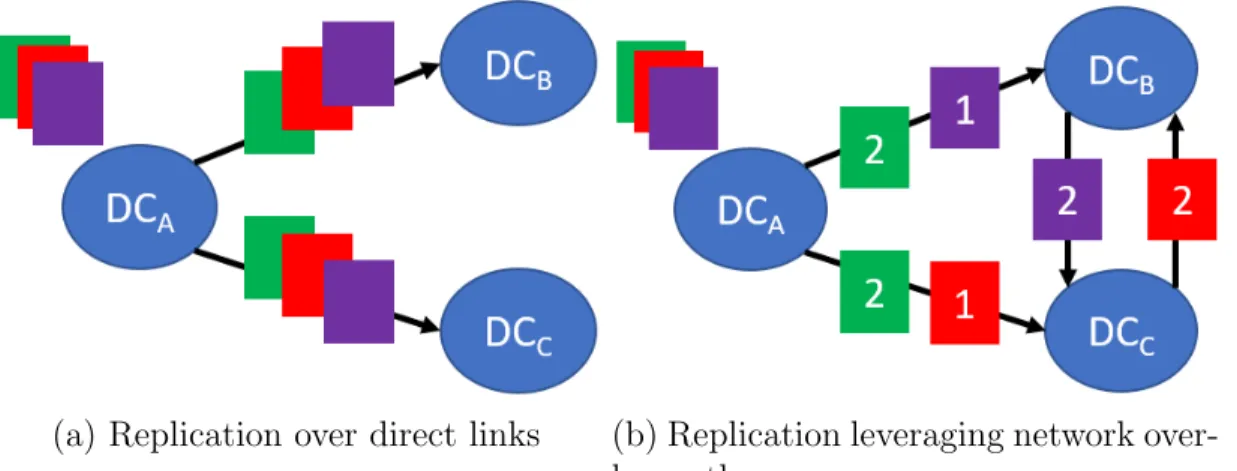
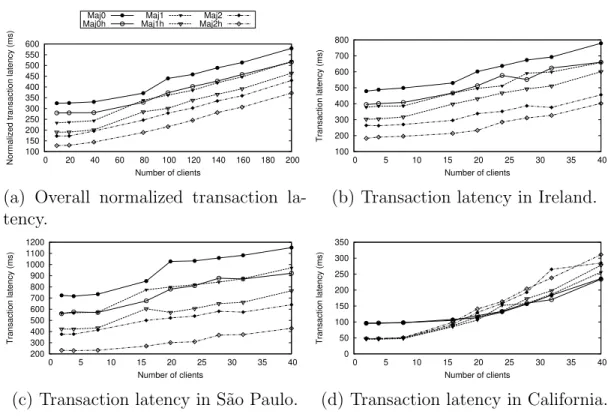
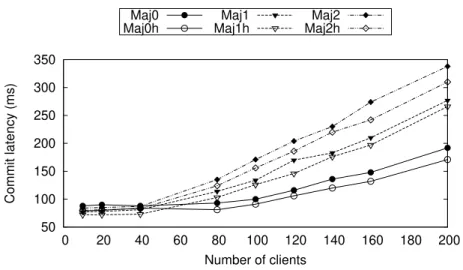
big data transfer time. . . 42 2.8 Transaction latency as number of clients increases. Figures 2.8a, 2.8b, 2.8c,
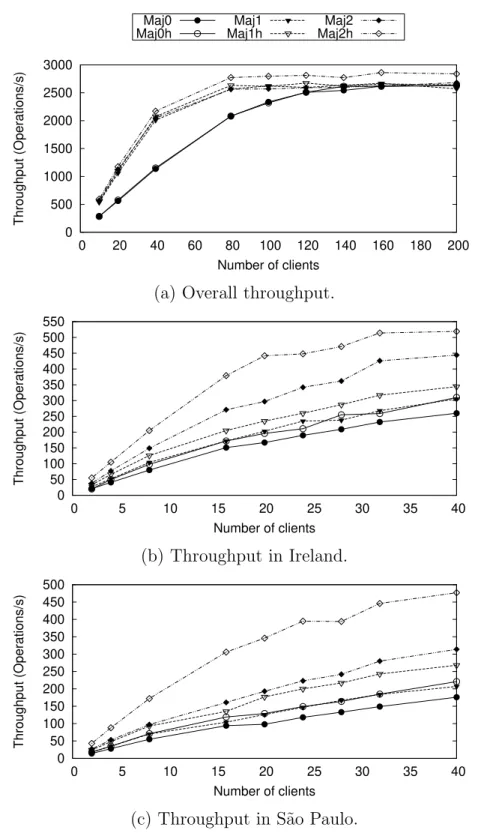
and 2.8d share one plotting legend. . . 47 2.9 Overall average commit latency as number of clients increases. . . 48 2.10 Throughput as number of clients increases. Figures 2.10a, 2.10b, and 2.10c
share one plotting legend. . . 49 2.11 Overall abort rate as number of clients increases. . . 50 2.12 The running time (seconds), in log scale, of exhaustive search and
place-ment heuristics as number of datacenters increases. Figures 2.12a and 2.12b show the running time when 5 replicas and 7 replicas are chosen respec-tively. Both figures share one plotting legend. . . 53
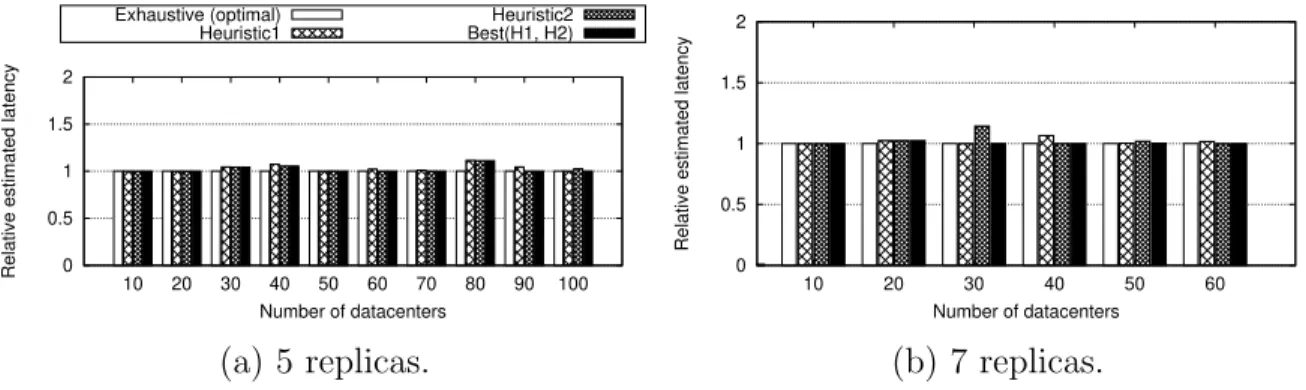
ures 2.13a and 2.13b compare the estimated latency when 5 replicas and 7 replicas are chosen respectively. Both figures share one plotting legend. 53 2.14 Comparison of the expected commit latency of the resulting leader
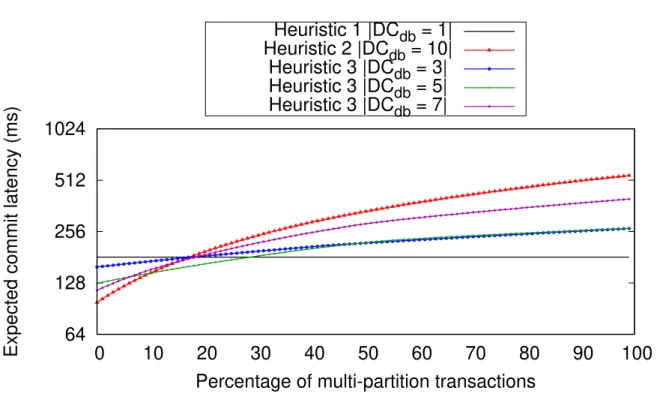
place-ments of heuristic 1 |DCdb| = 1 , heuristic 2 |DCdb| = 10, and heuristic 3 when|DCdb|= 3,|DCdb|= 5, and|DCdb|= 7 while varying the percentage
of distributed transactions. . . 58
2.15 The effect of varying the distanced among partition leaders of distributed transactions while varying the percentage of multi-partition transactions. 59 3.1 Overview of the system architecture. . . 69
3.2 CoT: a key is inserted to the cache if its hotness exceeds the minimum hotness of the cached keys. . . 78
3.3 Reduction in relative server load and load-imbalance among caching servers as front-end cache size increases. . . 80
3.4 Comparison of LRU, LFU, ARC, LRU-2, CoT and TPC’s hit rates using Zipfian access distribution with different skew parameter values (s= 0.90, 0.99, 1.20) . . . 87
3.5 The effect of front-end caching on the end-to-end overall running time of 1M lookups using different workload distributions. . . 92
3.6 The effect of front-end caching on the end-to-end overall running time of 50K lookups using different workload distributions sent by onlyoneclient thread. . . 93
3.7 CoT adaptively expands tracker and cache sizes to achieve a target load-imbalanceIt= 1.1 for a Zipfian 1.2 workload. . . 96
3.8 CoT adaptively shrinks tracker and cache sizes in response to changing the workload to uniform. . . 97
4.1 The dichotomy of multifaceted privacy: persona vs. privacy. . . 106
4.2 Illustrating k-attribute-indistinguishability . . . 114
4.3 Each attribute forms an independent hierarchy . . . 117
4.4 A dependent topic tree where public attributes are at the top while private attributes are at the bottom . . . 118
4.5 Aegis System Design and User Interaction Flow . . . 121
4.6 Examples of negligible, weak, and strong connection distribution topics for top-20 personas . . . 124
4.7 Illustrative Gender Obfuscation Example. . . 128
4.8 Effect of obfuscation posts on location and user persona given weak, mild and strong connected topics to locations . . . 128
4.9 Change in δ as obfuscation posts are added . . . 132
4.10 The effect of obfuscation posts on gender inference for strong connected topics to gender. . . 133
5.2 How miners of one blockchain could validate transactions in another
block-chain. . . 156
5.3 Coordinating AC2Ts using a permissionless witness network. . . . 159
5.4 Examples of complex graphs handled by the AC3WN protocol: (a) cyclic and (b) disconnected. . . 168
5.5 The overall transaction latency of 2·∆·Diam(D) when the single leader atomic swap protocol in [117] is used. . . 170
5.6 The overall transaction latency of 4· ∆ when the AC3WN protocol in Section 5.4.2 is used. . . 171
5.7 The overall AC2T latency in ∆s as the graph diameter, Diam(D), increases.172 6.1 Permissionless Blockchain Architecture Overview . . . 182
6.2 Transactions input and output in blockchain . . . 185
6.3 Smart contract state can span multiple blocks in the blockchain. . . 188
6.4 Permissioned Blockchain Architecture Overview . . . 192
6.5 Architecture overview of the permissioned and permissionless blockchain unification proposal. . . 196
6.6 Permissioned blockchains use validators key rotation to limit the damage that results from validator identity theft. . . 205
2.1 The average RTT latencies between different datacenters in milliseconds and the standard deviation inside parentheses. . . 20 2.2 Summary of GPlacer notation. . . 34 3.1 Summary of notation. . . 76 3.2 The minimum required number of cache-lines for different replacement
policies to achieve a back-end load-imbalance target It= 1.1 for different workload distributions. . . 90 4.1 Topic to persona connection strength categories and their corresponding
δ ranges . . . 126 4.2 Topic Analysis By Persona . . . 126 5.1 The throughput in tps of the top-4 permissionless cryptocurrencies sorted
Introduction
1.1
Paradigm Shifts in Global Data Management
Social networks, the web, and mobile applications have attracted hundreds of mil-lions of end-users [29, 39]. These users share their relationships and exchange images and videos in timely personalized experiences [59]. To enable this real-time experience, the underlying data management systems have to provide efficient, scalable, and highly available access to big data. Social networks, the web, and mobile applications are ex-amples of Global-Scale Data Management (GSDM) systems that aim to provide efficient and scalable big data access to hundreds of millions of end-users around the globe. The good news is that cloud computing provides the infrastructure needed to power GSDM systems. Cloud computing, a term that was initially coined by Compaq Computer [182] and popularized upon Amazon’s release of Elastic Compute Cloud (EC2) [1], offers the-oretically infinite infrastructure-as-a-service resources in a pay-as-you-go billing model. Cloud computing is powered by geographically distributed core data-centers and edge data-centers that offer elastic compute, memory, storage, network, and several services to GSDM systems. The unfortunate news is that moving GSDM systems to cloud
in-frastructures raises several challenges.
First, cloud applications strive for high-performance 24/7 service to clients dispersed around the world. Achieving this is threatened by complete datacenter scale outages; either planned or unplanned. Second, GSDM systems such as social networks aim to serve hundreds of millions of end-users with sub-second response latency. Social network users consume several orders of magnitude more data than they produce [51]. In addi-tion, a single page load requires hundreds of data object lookups that need to be served in a fraction of a second [59]. Therefore, traditional disk-based storage systems are not suitable to handle requests at this scale due to the high access latency of disks and I/O throughput bounds [222]. Third, moving end-user data to the cloud and allowing social network giants to have control over massive amounts of end-user personal data introduce several data privacy threats. Microtargeting (e.g., the Cambridge Analytica scandal [25]), surveillance, and discriminating ads are examples of threats to user privacy caused by social network end-user data mining. These three challenges, namely availability, scala-bility, and end-user data privacy require rethinking and building GSDM systems in novel ways that address these challenges while leveraging cloud infrastructure.
1us 10us 100us 1ms 10ms 100ms
Main-memory SSDLocal RTTDisk WAN RTT
0.1us 1s
Figure 1.1: Latency of Wide-Area Network Round-Trip Time communication (WAN RTT) compared to memory access latency [181] and network latency within a datacenter (local RTT).
To address the availability challenge, several GSDM systems and their backend databases are increasingly being deployed on multiple datacenters spanning large geographic regions (geo-replication). F1 [195], Spanner [79], and Tao [59] are examples of deployed systems that are geographically replicated for fault-tolerance and performance reasons.
Geo-replication servestwo important goals. First, it brings data copies closer to end-users to serve data lookup requests with low latency. Second, it allows applications to serve end-user requests even in the presence of datacenter scale outage. However, geo-replication raises the important question of replica placement: at which datacenters should data be placed?. Current cloud providers offer hundreds of datacenters and thousands of edge datacenters that are globally distributed all over the world. Unlike networks within a datacenter, the topology of the Wide-Area Network (WAN) is asymmetric and diverse— the latency connecting a pair of datacenters can be an order of magnitude larger than the latency connecting another pair. This makes placement a significant factor in per-formance. Figure 1.1 illustrates the latency difference between communication messages that occur within the same machine, among different machines in one datacenter, or in multiple datacenters in different geographical regions. This large communication latency of the WAN motivates systems like Yahoo’s PNUTS [77], Facebook’s Tao [59] and oth-ers [138, 167] to trade off replica consistency and/or multi-row transaction support with high availability and scalability. However, enterprise applications and applications with complex and evolving schemas have more interest in data management systems that pro-vide transactional ACID properties [196, 79, 53]. Application developers spend significant time to build transaction semantics and complex mechanisms, which are error-prone, on top of eventually consistent datastores in order to handle stale data items and reason about inconsistency [195, 79]. Therefore, the first question we ask in this dissertation is: ”Can we optimize the placement of geo-replicated databases to minimize transaction latency while achieving the ACID transaction guarantees and the required availability level?”.
To address the scalability challenge, distributed caching services have been widely de-ployed on top of persistent storage in order to efficiently serve user requests at scale [211]. Distributed caching systems such as Memcached [32] and Redis [35] are widely adopted
by cloud service providers such as Amazon ElastiCache [20] and Azure Redis Cache [22]. These caching services offer significant latency and throughput improvements to systems that directly access the persistent storage layer. Redis and Memcached use consistent hashing [128] to distribute keys among several caching servers. Although consistent hash-ing ensures a fair distribution of the number of keys assigned to each cachhash-ing shard, it does not consider the workload per key in the assignment process. Real-world workloads are typically skewed with few keys being significantly hotter than other keys [122]. This skew causes load-imbalance among caching servers. Load imbalance in the caching layer can have significant impact on the overall application performance. In particular, it may cause drastic increases in the latency of operations at the tail end of the access frequency distribution [121]. In addition, the average throughput decreases and the average latency increases when the workload skew increases [71]. This increase in the average and tail la-tency is amplified for real workloads when operations are executed in chains of dependent data objects [150]. A single Facebook page-load results in retrieving hundreds of objects in multiple rounds of data fetching operations [167, 59]. Finally, solutions that equally overprovision the caching layer resources to handle the most loaded caching server suffer from resource under-utilization in the least loaded caching servers. Therefore, the second question we ask in this dissertation is: ”Can we exploit the geo-distribution and elasticity of edge data-centers to design adaptive anddecentralized load-balancing solutions for GSDM imbalanced distributed storage layers?”.
The third challenge of preserving social networks and web end-user data privacy raises complicated tension between user utility and user data privacy. On one hand, end-users share their data and postings with social network and web giants. On the other hand, end-user data privacy must be preserved. Social network users develop, over time, online persona [220] that reflect their overall interests, activism, and diverse orientations. Users have numerous followers that are specifically interested in their personas and their
postings which are aligned with these personas. Due to the rise of machine learning and deep learning techniques, user posts and social network interactions can be used to accurately and automatically infer many user persona attributes such as gender, ethnicity, age, political interest, and location [133, 177, 225, 223, 72, 68]. Although social networks use end-user attributes to provide personalised services, recent news about theCambridge Analytica scandal [25] and similar data breaches [34] suggest that users cannot depend on the social network providers to preserve their privacy. User sensitive attributes such as gender, ethnicity, and location have been widely misused in illegally discriminating ads, microtargeting, and surveillance. Privacy risks vary from discrimination in job [19] and housing [31] ads, election manipulation [16, 17], activists of color targeting [11], to becoming a danger for our democracy [97]. To protect end-user data privacy, recent legislation like GDPR [12] and CCPA [24] have been proposed and passed to limit the usage of end-user personal data by social network and web giants. Although we believe that protecting end-user personal data by laws is the ideal path to follow, the legislation path is long and time-consuming. Until social network and web giants are forced to protect end-user personal data privacy, we believe that end-users should have fine control over which personal attributes to make public and which ones to keep private. Therefore, the third question we ask in this dissertation is: ”Can we develop decentralized, user-centric, and trust-free systems that allow end-users to have fine control of the privacy of their persona attributes?”
In 2008, the mysterious Nakamoto came up with a novel decentralized peer-to-peer computation model that enabled Bitcoin [164], the first successful global scale peer-to-peer cash system or cryptocurrency. The Bitcoin original protocol allows financial transactions to be transacted among participants without the need for a trusted third party, e.g., banks, credit card companies, or PayPal. Bitcoin eliminates the need for such a trusted third party by replacing it with a distributed ledger that is fully replicated
among a decentralized open network of computing nodes in the cryptocurrency system. This distributed ledger is referred to asblockchainand the open network is usually referred to as permissionless blockchain.
Figure 1.2: Open Blockchain Architecture Overview
An open permissionless blockchain system [155] (e.g., Bitcoin, Ethereum [205]) typ-ically consists of two layers: a storage layer and an application layer as illustrated in Figure 1.2. The storage layer comprises a decentralized distributed ledger managed by an open network of computing nodes. A blockchain system is permissionless if com-puting nodes can join or leave the network of its storage layer at any moment without obtaining a permission from a centralized authority. Each computing node, also called a miner, maintains a copy of the ledger. The ledger is a tamper-proof chain of blocks, hence named blockchain. Each block contains a set of valid transactions that transfer assets among end-users. The application layer comprises end-users who communicate with the storage layer viamessage passing through a client library. End-users have identities, defined by their public keys, and signatures, generated using their private keys. Digital signatures are the end-users’ way to generate transactions. End-users submit their trans-actions to the storage layer through a client library. Transtrans-actions are used to transfer assets from one identity to another. End-users multicast their transaction messages to
mining nodes in the storage layer. A mining node validates the transactions it receives and valid transactions are added to the current block of a mining node. Miners run a consensus protocol through mining to agree on the next block to be added to the chain. A miner who mines a block gets the right to add their block to the chain and multicasts it to other miners. To make progress, miners accept the first received mined block after verifying it and start mining the next block.
Since the publishing of the Bitcoin paper, many efforts have been developed to trans-fer the usage of permissionless blockchains from a cryptocurrency management system to the new public cloud [205, 64]. Instead of using the blockchain distributed ledger to store cryptocurrency transactions, end-users can store generic data and code within the dis-tributed ledger through smart contracts [200]. Smart contracts extend the simple abstract data type notion of blockchain transactions to include complex data type classes with end-user defined variables and functions. Also, instead of using the mining node to verify and validate cryptocurrency transactions, the compute power of the mining nodes can be used to process generic logic expressed in smart contract functions. Seeing permissionless blockchains as the new public cloud introduces several challenges and interesting prob-lems that need to be addressed. First, there is the trust issue. Most cloud data manage-ment protocols assume trusted infrastructure owned by a known cloud service provider. Also, cloud replication and transaction management protocols assume that all protocol participants are known and their number is fixed. On the other hand, permissionless blockchains run on top of an open network with unknown number of untrusted comput-ing nodes. This requires the redevelopment of common cloud data management protocols such as 2-Phase Commit (2PC) [112, 57] for atomic distributed transaction commitment and Paxos [140] for replication. Second, there is a lack of abstraction in smart contract programming languages. Modern programming languages provide application developers with many abstractions such as transaction abstractions. This allows application
devel-opers to leverage ACID transaction properties without rewriting the transaction manage-ment logic in each application. Currently, the transaction abstraction is not supported in smart contract languages like solidity [38]. This requires smart contract developers to reason about transaction semantics, concurrency, and isolation in every smart contract they write. The distributed database literature [79, 195] has shown that putting the burden of implementing transaction logic in the application layer is problematic. This is no simple task and serious smart contract concurrency bugs have been highlighted in the blockchain literature [132, 151, 193, 86]. In fact, from a financial point-of-view, two such famous anomalies in the context of blockchains, TheDAO [4, 62] and the BlockKing [9] have resulted in the loss of tens of millions of investors’ dollars [151]. Third, there is a disconnection between tangible assets and intangible assets in blockchain systems. In a cloud setting, a trusted third party can be leveraged to trade tangible assets such as houses and cars. The responsibility of verifying the existence of such assets is put on this trusted third party. However, in the absence of trust in permissionless blockchains, neither mining nodes nor end-users can be trusted to verify the existence of tangible assets. This requires the development of novel protocols and systems that leverage the infrastructure of permissionless blockchains to trade tangible assets. Finally, there is the issue of user data privacy. Since permissionless blockchains are built on transparency and all end-user transaction information are public, permissionless blockchains introduce several end-user privacy challenges that need to be addressed.
These challenges motivated us to ask several questions in this dissertation. First,
Can we develop atomic blockchain-based distributed transaction management protocols, like 2PC, that do not assume a trusted coordinator?. Second,Can the ACID transaction abstraction be supported in smart contract programming languages?. Finally, Can we design protocols and systems that leverage permissionless blockchain infrastructures to trade tangible assets?.
This dissertation addresses several of the aforementioned questions. Given the as-sumptions of cloud computing and permissionless blockchains as the new public cloud,
Can we develop decentralized systems and protocols that provide ACID transaction guarantees for scalable, fault-tolerant, and privacy preserving data management systems?. All the solutions explained in this dissertation focus on one or two of the following as-pects: decentralization and ACID transaction support on different environments and under different assumptions. In Section 1.2, we provide an overview of the works and solutions explained in this dissertation and which aspects are the focus of each solution. Section 1.3 provides an organization of the rest of this dissertation.
1.2
Dissertation Overview
Cloud computing and permissionless blockchains are two computing paradigm shifts that have shaken many traditional distributed system design assumptions. On one hand, the elasticity and the asymmetric and diverse Wide-Area-Network (WAN) latency across cloud data-centers require rethinking traditional transactional and stream processing system designs. On another hand, open permissionless blockchains powered by a highly decentralized, untrusted, and limitless open network of compute nodes require rethinking transaction management protocols that either assume trust among protocol participants or centralization of a protocol coordinator. The research in this dissertation leverages cloud and permissionless blockchain infrastructures to build scalable, efficient, and robust GSDM systems with extended functionality.
Figure 1.3 summarized the system and protocol solutions proposed in this disserta-tion. As shown, solutions in this dissertation focus on decentralization and/or ACID transaction support. These solutions provide answers to the questions raised in Sec-tion 1.1. First, we present GPlacer [218], a placement framework that optimizes the
Figure 1.3: Overview of the system and protocol solutions proposed in this dissertation.
placement of geo-replicated databases to minimize the transaction latency while achiev-ing the ACID transaction guarantees and the required availability level. Then, we propose CoT [213], a load-balancing solution for GSDM’s imbalanced distributed storage layers. CoT is a decentralized system that leverages the geo-distribution and elas-ticity of core and edge data-centers. Afterwards, we introduce Aegis [216]. Aegis is a
decentralized, user-centric, and trust-free system that allows social network and web
end-users to have fine control of the privacy of their persona attributes.
In permissionless blockchain environments, we present several decentralized primi-tives, building blocks, and abstractions that support correct ACID transaction semantics under the trust-free and the open network assumptions. First, we present AC3WN [212], the first correct atomic cross blockchain commitment protocol. AC3WN is decentral-ized and does not require a trusted coordinator to ensure the ACID guarantees of cross blockchain transactions. Then, we propose TXSC [214], a framework that provide ACID transaction support for smart contract programming languages. Finally, we present a for-ward looking platform that enables global asset management in blockchain systems [215]. We summarize the aforementioned solutions in the following Sections.
1.2.1
GPlacer
Current cloud providers offer hundreds of datacenters and thousands of edge datacen-ters that are globally distributed all over the world. Unlike networks within a datacenter,
the topology of the Wide-Area Network (WAN) is asymmetric and diverse—the latency connecting a pair of datacenters can be an order of magnitude larger than the latency connecting another pair. This makes placement a significant factor in performance. How-ever, it is not only placement. The specifics of the transaction management protocol play a crucial role in deciding which placement is ideal. GPlacer is a placement optimization framework that embeds the transaction protocol constraints into an optimization to de-rive both the data placement and the transaction protocol configuration that minimize the overall transaction latency. In developing GPlacer, we discover counter-intuitive lessons about data placement and transaction execution practices. Our evaluation shows that applying these lessons in addition to known best practices generate deployments that reduce the average transaction latency by up to 68%. GPlacer optimizes the replica placement and the transaction execution plan for both leader-based protocols and non-leader-based protocols (e.g., quorum based protocols). In addition, GPlacer optimizes the placement for multi-row transactional workloads with strong consistency requirements.
1.2.2
CoT
Cache-on-Track (CoT) is a decentralized, elastic, and predictive front-end
caching mechanism to address the load-imbalance across GSDM distributed storage lay-ers. CoT uses a small front-end cache to solve back-end load-imbalance as introduced in [96]. However, CoT does not assume perfect caching at the front-end as assumed in [96]. CoT proposes a new cache replacement policy specifically tailored for small front-end caches that serve skewed workloads. CoT uses the space saving algorithm [158] to track the top-k heavy hitters. The tracking information allows CoT to cache the exact top C hot-most keys out of the approximate top-k tracked keys preventing cold and noisy keys from the long tail to replace hot keys in the cache. CoT is decentralized in the sense
that each front-end independently determines its hot key set based on the key access distribution served at this specific front-end. This allows CoT to address back-end load-imbalance without introducing single points of failure or bottlenecks that typically come with centralized solutions. In addition, this allows CoT to scale to thousands of front-end servers, a common requirement of social network and modern web applications. CoT is elastic in that each front-end uses its local load information to monitor its contribution to the back-end load-imbalance. Each front-end elastically adjusts its tracker and cache sizes to reduce the load-imbalance caused by this front-end. In the presence of workload changes, CoT dynamically adjusts front-end tracker to cache ratio in addition to both the tracker and cache sizes to eliminate any back-end load-imbalance.
1.2.3
Aegis
Aegis is a decentralized and user-centric system that allows social network and web end-users to have fine control of the privacy of their persona attributes. First, we propose
multifaceted privacy, a novel privacy model that aims to obfuscate a user’s sensitive attributes while revealing the user’s public persona attributes. Multifaceted privacy allows users to freely express their online public personas without revealing any sensitive attributes of their choice.
To achieve multifaceted privacy, we build Aegis, a prototype user-centric social net-work stream processing system that enables social netnet-work users to take charge of pro-tecting their own privacy, instead of depending on the social network providers. Our philosophy in building Aegis is that social network users need to introduce some noisy interactions and obfuscation posts to confuse content based attribute inferences. Choosing this noise introduces a challenging dichotomy and tension between the utility of the user persona and her privacy. Obfuscation posts need to be carefully chosen to
achieve obfuscation of private attributes without damaging the user’s public persona. The main goal of Aegis is to automatically find and suggest the noise (obfuscation) postings that achieve the multifaceted privacy.
1.2.4
AC
3WN
An AtomicCross-Chain Transaction, AC2T, is a distributed transaction that spans multiple blockchains. This distributed transaction consists of sub-transactions and each sub-transaction is executed on some blockchain. AnAtomicCross-ChainCommitment, AC3, protocol is required to execute AC2Ts. This protocol is a variation of traditional distributed atomic commitment protocols (e.g., 2PC [112, 57]). This protocol should guarantee both atomicity and commitment of AC2Ts. Atomicity ensures the
all-or-nothing property where either all sub-transactions take place or none of them is
exe-cuted. Commitment guarantees that any changes caused by a cross-chain transaction must eventually take place if the transaction is decided to commit. Unlike in 2PC and other traditional distributed atomic commitment protocols, atomic cross-chain commit-ment protocols are also trust-free and therefore must toleratemaliciousness [117].
We proposeAC3WN, the first correct and decentralized all-or-nothingAtomicC ross-ChainCommitment protocol that uses an openWitnessNetwork. The commit and the abort decision of all sub-transactions in AC2T are modeled as conflicting decisions. A decentralized open network of witnesses is used to coordinate AC2T. The witness network guarantees that conflicting decision must never simultaneously take place and either all sub-transactions in an AC2T commit or all of them abort.
1.2.5
TXSC
Smart contracts have their own variables and multiple functions that may be ex-ecuted by different end-users results in transactions which might be incorporated in different blocks by different miners. This clearly results in complex concurrency chal-lenges which need to be handled by smart contract developers. We advocate leveraging the traditional transactional approach to address the concurrency violations in the con-text of smart contract executions in large scale blockchain systems. In particular, we propose Transactional Smart Contracts (TXSC) as a framework that allows developers to write smart contracts with correct transaction isolation semantics. Unlike previous works [132, 151, 193] that propose smart contract analysis tools to detect concurrency bugs in smart contracts, TXSC aims to free smart contract developers from the burden of implementing correct concurrency control semantics for each smart contract. Instead, de-velopers can focus on the smart contract application semantics and leave the concurrency semantics to TXSC.
TXSC addresses concurrency challenges in smart contract development. In particular, 1. We model smart contract concurrency anomalies as transaction isolation problems. Examples illustrate how different smart contract concurrency anomalies can be mapped to the problem of transaction isolation of either single domain or dis-tributed cross-domain transactions.
2. TXSC is the first framework to provide smart contract developers with transactional primitivesstart transaction andend transaction. TXSC takes a smart contract that contains these primitives as an input and translates it to a transactionally correct smart contract using the smart contract native language.
1.2.6
Asset Management in Blockchain Systems
Permissionless blockchains (e.g., Bitcoin) have shown a wide success in implement-ing global scale peer-to-peer cryptocurrency systems. In such blockchains, new currency units are generated through the mining process and are used in addition to transaction fees to incentivize miners to maintain the blockchain. Although it is clear how currency units are generated and transacted on, it is unclear how to use the infrastructure of permissionless blockchains to manage other assets than the blockchain’s currency units (e.g., cars, houses, etc.). We propose a global asset management system that leverages the infrastructure of permissionless blockchains as a marketplace for global assets. This proposal unifies both permissioned (trusted) and permissionless blockchains in order to build generic asset management system. A governmental permissioned blockchain au-thenticates the registration of end-user assets through smart contract deployments on a permissionless blockchain. Afterwards, end-users can transact on their assets through smart contract function calls (e.g., sell a car, rent a room in a house, etc). In return, end-users get paid in currency units of the same blockchain or other blockchains through atomic cross-chain transactions and governmental offices receive taxes on these transac-tions in cryptocurrency units.
1.3
Organization
The rest of the dissertation is organized as follows. Part I provides solutions to build scalable and efficient cloud data management systems. First, GPlacer is presented in Chapter 2. Chapter 3 describes the details of CoT. Afterwards, we propose multifaceted privacy and Aegis in Chapter 4. Part II includes robust primitives and abstractions that extend the functionality of permissionless blockchains. Chapter 5 presents the details and the correctness proofs of the AC3WN protocol. Chapter 6 describes how to leverage
the infrastructure of permissionless blockchains to build global asset managenment sys-tem. Chapter 7 explains the details of the TXSC framework. Part III summarizes the dissertation and discusses future directions in GSDM systems research in Chapter 8.
Building Scalable and Efficient
Cloud Data Management Systems
GPlacer: Global-Scale Placement of
Transactional Data Stores
2.1
Overview
Internet applications strive for high-performance 24/7 service to clients dispersed around the world. Achieving this is threatened by complete datacenter outages; either planned or unplanned. To overcome these challenges, application services and their backend databases are increasingly being deployed on multiple datacenters spanning large geographic regions (geo-replication). F1 [195], Spanner [79], and Tao [59] are examples of deployed systems that are geographically replicated for fault-tolerance and performance reasons.
Moving to Global-Scale Data Management (GSDM), despite its benefits, raises many challenges that are not faced by traditional deployments. The large WAN communi-cation latency is orders of magnitude larger than the traditional LAN communicommuni-cation latency. Figure 2.1 illustrates the latency difference between communication messages that occur within the same machine, among different machines in one datacenter, or
1us 10us 100us 1ms 10ms 100ms
Main-memory SSDLocal RTTDisk WAN RTT
0.1us 1s
Figure 2.1: Latency of Wide-Area Network Round-Trip Time communication (WAN RTT) compared to memory access latency [181] and network latency within a datacenter (local RTT).
in multiple datacenters in different geographical regions. This large communication la-tency of the WAN motivates systems like Yahoo’s PNUTS [77], Facebook’s Tao [59] and others [138, 167] to trade off replica consistency and/or multi-row transaction sup-port with high availability and scalability. However, enterprise applications and ap-plications with complex and evolving schemas have more interest in data management systems that provide transactional ACID properties [196, 79, 53]. Application devel-opers spend significant time to build transaction semantics and complex mechanisms, that are error-prone, on top of the eventual consistent datastores in order to handle stale data items and reason about inconsistency [195, 79]. Therefore, in the past few years, many solutions have emerged to provide strongly consistent transactions for geo-replicated databases [79, 154, 134, 166, 165, 145]. These solutions use different replication and isolation techniques in order to minimize the number of WAN messages required to achieve strong ACID transactional guarantees for geo-replicated databases, hence reduc-ing the transaction latency.
Data placement is the problem of deciding the subset of datacenters to host a full or a partial replica of the data to achieve a certain objective such as minimizing the transaction latency, minimizing the deployment monetary costs, and any combination of these and other user-defined objective functions.
We propose GPlacer; an optimization framework that solves the data placement prob-lem. GPlacer embeds the commit protocol constraints into an optimization framework to
derive both the data placement and the commit protocol configurations that minimize the overall transaction latency. In developing GPlacer, we discover counter-intuitive lessons about data placement and transaction execution practices. These lessons exploit the latency diversity and asymmetry of the WAN links and are widely applicable to Paxos-based commitment protocols [111, 154] and leader-Paxos-based commitment protocols [79, 53]. GPlacer incorporates these lessons, the commitment protocol constraints, and the appli-cation requirements in an optimization framework to find the placement that minimizes the average transaction latency.
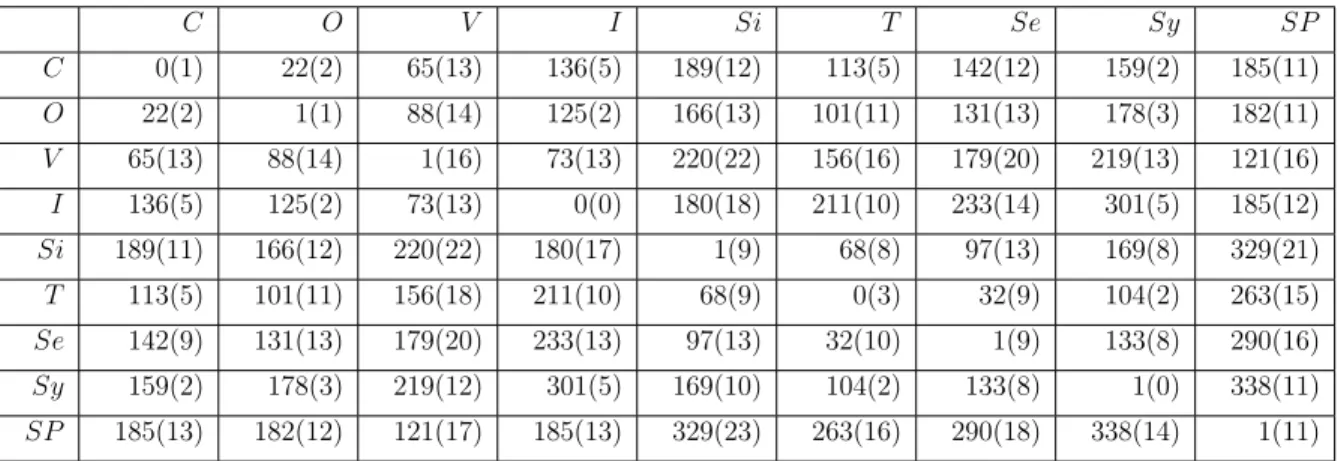
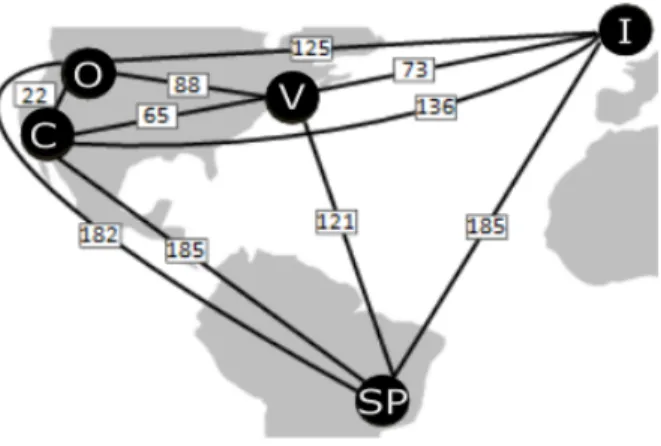
C O V I Si T Se Sy SP C 0(1) 22(2) 65(13) 136(5) 189(12) 113(5) 142(12) 159(2) 185(11) O 22(2) 1(1) 88(14) 125(2) 166(13) 101(11) 131(13) 178(3) 182(11) V 65(13) 88(14) 1(16) 73(13) 220(22) 156(16) 179(20) 219(13) 121(16) I 136(5) 125(2) 73(13) 0(0) 180(18) 211(10) 233(14) 301(5) 185(12) Si 189(11) 166(12) 220(22) 180(17) 1(9) 68(8) 97(13) 169(8) 329(21) T 113(5) 101(11) 156(18) 211(10) 68(9) 0(3) 32(9) 104(2) 263(15) Se 142(9) 131(13) 179(20) 233(13) 97(13) 32(10) 1(9) 133(8) 290(16) Sy 159(2) 178(3) 219(12) 301(5) 169(10) 104(2) 133(8) 1(0) 338(11) SP 185(13) 182(12) 121(17) 185(13) 329(23) 263(16) 290(18) 338(14) 1(11)
Table 2.1: The average RTT latencies between different datacenters in milliseconds and the standard deviation inside parentheses.
WAN links are diverse and asymmetric; a link connecting a pair of datacenters can be an order of magnitude larger than a link connecting another pair. Table 2.1 shows the average measured Round-Trip Time (RTT) between every pair of nine Amazon AWS datacenters in California (C), Oregon (O), Virginia (V), S˜ao Paulo (SP), Ireland (I), Sydney (Sy),Singapore (Si), Tokyo (T), and Seoul (Se). As shown, the average RTT between California and Oregon datacenters is 22ms while the average RTT between Singapore and S˜ao Paulo datacenters is 329ms. Therefore, the number of required WAN messages per transaction is not the only factor that dominates the transaction latency. Transaction latency is a product of both the transaction commit protocol, which controls
r0.6
Figure 2.2: The average latency, of all the clients in 9 datacenters, to reach the closest quorum (2 out 3) for all the possible 93= 84 different placements sorted by latency.
the number of required WAN messages per transaction, and the locations of the replicas, hence the placement, which controls the latency per WAN message.
To illustrate the placement effect on the average obtained transaction latency, we conduct the following experiment. We equally distribute clients among the nine AWS datacenters. Three out of the nine datacenters are chosen to host a data replica. The time to reach the closest quorum, two replicas out of these three, is measured for all the clients for all thepossible placements and the average latency is reported. Figure 2.2 shows the effect of only changing the placement on the average obtained latency for all the clients while fixing the protocol. As seen in Figure 2.2, changing only the placement while fixing all the other parameters (the protocol, the workload distribution, etc.) can lead to a significant change of 1.75x between the minimum and the maximum reported average latency. This latency difference amplifies for real workloads when transactions are executed in chains [150].
Unlike GPlacer that optimizes the placement for multi-row transactional workload with strong consistency requirements, many works focus on optimizing the placement for weaker consistency levels and single-row operations. SPANStore [208] develops an optimization framework to minimize the monetary cost of a geo-replicatedkey/valuestore
deployment. This framework optimizes the total cost of processing, storage, bandwidth, and I/O and finds the placement that achieves the minimum overall cost while meeting the application requirements. Liu et al. [146], like SPANStore, optimize the monetary cost of geo-replicated key/value store deployments. However, they consider cost savings exploiting resource reservation payment model instead of the pay-as-you-go payment model while avoiding over reservation. Ping et al. [178] propose the use of a utility function to derive a placement that achieves a balance between the availability and the speed of data access. Volley [44] analyzes data access logs and generates a migration plan for data partitions to minimize the access latency.
Sharov et al. [194] optimize the placement for strong consistent transactions using
leader-based protocols. Sharov assumes that a database is sharded into multiplepartitions
and each partition is independently replicated. Each partition has a leader replica that serializes all the transactions that span this partition to achieve isolation. This leader replicates the updates to a majority quorum of the partition replicas to achieve fault tolerance. Although they provide placements for strong consistent transactional workloads, their optimizations are tightly coupled with leader-based protocols and it does not apply to the many non-leader-based protocols that are widely used such as [111, 176, 154, 134, 54]. Also, their resulting optimal placement allocates all the partition leaders together in one datacenter. Placing all partition leaders in one datacenter introduces a single point of failure. A datacenter outage can lead to a temporal loss of access to the entire data until all partition leaders are re-elected. In addition, transactions that span a single partition might incur higher latency than the latency observed when the leader of each partition is placed closer to the clients that frequently access this partition.
The rest of the chapter is organized as follows. Section 2.2 builds the case for the importance of replica placement frameworks by showing the common placement mistakes committed by practitioners and theoreticians during our replica placement demonstration
in [217]. Section 2.3 explains the transaction model, the client requests, and the assump-tions and limitaassump-tions of application requirements. Although GPlacer can optimize the placement for different classes of commitment protocols, a Paxos-based protocol is used to explain the details of GPlacer. Section 2.4 formalizes the placement problem into an exhaustive search problem. Although the exhaustive search finds the optimal placement, it does not efficiently scale with the number of datacenters. Therefore, we introduce sev-eral placement heuristics that find sub-optimal placements while efficiently scale with the number of datacenters. Section 2.5 describes the counter-intuitive lessons learned during the development of GPlacer and their impact on the transaction latency. In Section 2.6, we evaluate the effect of the placement lessons on the transaction latency and the abort rate. We also evaluate the output and the performance of the proposed heuristics com-pared to the exhaustive search. In Section 2.7, we explain the changes that need to be done to extend GPlacer to optimize for other protocols. The chapter is concluded in Section 2.8.
2.2
DB-Risk: The Game of Global Database
Place-ment
DB-Risk [217] is a game that is designed to motivate deeper understanding of the challenges of data placement in geo-replicated environments. It also showcases the need for optimization frameworks to optimize the placement of geo-replicated databases. The game is designed to be played by the demo participants to introduce a competitive element. A live version of the DB-Risk game can be found in [10].
DB-Risk System model. The DB-Risk model of geo-replication consists of a
to a subset of AWS datacenters. Users issue transactions that consist of read and write operations. Each client executes transactions back-to-back. The execution of transac-tions depends on the replication protocol. DB-Risk focuses on majority based replication and commitment protocols explained as follows. A client executes a transaction by per-forming the reads and buffering the writes. Read requests are sent to a majority of datacenters. The highest version read is used. After executing reads and writes a vote request is sent to datacenters. The vote request consists of the read versions and the buffered write operations. Each datacenter, upon receiving a vote request, attempts to lock all objects that are being written. Additionally, it verifies that the read versions were not overwritten. If both are successful, the datacenter sends back a positive vote. Otherwise, a negative vote is sent. The client commits the transaction if a majority of positive votes is received and aborts the transaction otherwise. The client sends the decision to all replicas. Once a majority acknowledges the receipt of the decision, the transaction terminates. The transaction latency is the time from the beginning of ex-ecuting operations until terminating the transaction. We define the commit latency as the time spent committing the transaction, which is equivalent to the transaction latency without the time spent reading the data values.
DB-Risk Game Details. In DB-Risk, players are asked to place replicas in
dat-acenters around the world with the aim of minimizing the transaction latency. Each player gets a set of placement optimizations to choose from to enhance the transaction latency. The winner is the player with a placement and set of optimizations that achieve the lowest average transaction latency. Figure 2.3 shows a screenshot of the DB-Risk game. Participants are shown a map of nine AWS datacenters in California, Oregon, Virginia, Ireland, Sao Paulo, Singapore, Seoul, Tokyo, and Sydney. In addition, pairwise average Round-Trip Time (RTT) among the nine datacenters is provided. The workload at each datacenter is represented by the number of blue clients. Participants are asked
Figure 2.3: A screenshot of the DB-Risk game.
to place five data replicas in the nine available datacenters. In addition, participants are given the option to use some protocol optimizations like optimistic reads, passive replica reads, and request handoff. Optimistic reads allow transaction clients to read data values from any replica and validate the data version at commit time. Similarly, passive replica reads permit transaction clients to read data values from local caches that are asynchronously updated in each datacenter. Read versions must be validated at commit time as well. Request handoff enables transaction clients to handoff transaction read and commit operations to other datacenters aiming to reduce operation latency. Read optimizations are formally explained in Section 2.3.2 and request handoff is formalized in Section 2.5.1.
Data replica placement has twofold effect on transaction latency as follows:
• The distances between transaction clients and data replicas affect read and com-mit latency as clients have to reach a replica or a set of replicas to execute each operation.
as data replicas have to synchronously coordinate among each other to ensure transaction strong consistency.
Currently, there are hundreds of core datacenters and thousands of edge datacen-ters [13] distributed around the global and ready to host data replicas of different appli-cations. Therefore, Db-Risk’s search space for the optimal placement is considered small. However, many of the DB-Risk participants focused on one of the placement effects on transaction latency and ignore the other. Participants choose to place replicas in data-centers that have most of the clients ignoring the effect of coordination among replicas on transaction latency. Although this strategy is intuitive and reduces the time for a client to reach a replica, it does not find the optimal placement in many of DB-Risk’s scenarios. This is because the datacenters that have larger number of clients happen to be far from each other and the time to reach a quorum of replicas is maximized using this strategy. We use the following DB-Risk scenario to point out the problems of placing replicas near clients without considering the distance among different replicas.
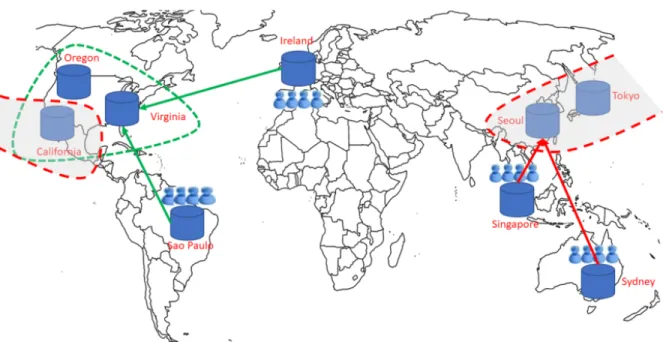
Consider the DB-Risk scenario shown in Figure 2.4. Clients are located in Ireland, Sao Paulo, Singapore, and Sydeny. However, the optimal placement of five replicas for DB-Risk’s majority-base protocol is to place data replicas in California, Oregon, Vir-ginia, Seoul, and Tokyo. This placement places quorums of replicas close to each other (quorums are shown using the green and red dotted curves). Clients in both Ireland and Sao Paulo handoff their commit requests to Virginia (green lines) and clients in both Singapore and Sydney handoff their requests to Seoul (red lines). This placement allows the replica in Virginia to quickly form a quorum (3 of 5) with the replicas in California and Oregon. Also, the replica in Seoul can rapidly form a quorum with the replicas in Tokyo and California. The intersection between the two quorums (in California) guar-antees serializability. Surprisingly, in this example, none of the chosen replicas
Figure 2.4: A placement scenario that shows the importance of considering different optimization aspects to minimize the average transaction latency.
are placed in datacenters that have clients.
We summarize the placement lessons we learned during DB-Risk as follows:
• The placement search space is currently huge considering the number of core and edge datacenters.
• Even with a restricted search spaces, manual approaches tend to use intuitive but not optimal placement strategies that result in higher average transaction latency.
• Placement optimization frameworks are necessary to find the replica placement that achieves the minimum average transaction latency
Hence, this chapter presents GPlacer, a placement optimization framework for multi-row transactional workloads with strong consistency requirements.
2.3
Background
Global-scale placement is the problem of deciding which datacenters should store a full or a partial replica of an application’s data subject to a certain objective function. Objec-tive functions can vary between minimizing the deployment monetary cost [208, 146] or minimizing the data access latency for a defined set of client operations [194]. Objective functions are always constrained by the application requirements (e.g., availability, upper bound access time, or bandwidth usage). In this section, we present our storage model and our assumptions about the workload distribution, the application requirements, and the objective function.
The universe of datacenters, denoted by DC, is defined as all the datacenters that can host an application1 instance and/or a replica2 of the database. We assume that the application is deployed on a subset of the datacenters DCapp ⊆ DC. The clients of the application are scattered around the globe and for simplicity, we assume that clients are collocated with their closest datacenter. The application is deployed in all the datacenters that have clients. However, these datacenters can be different from the datacenters that host replicas. DCdb ⊆DC is the subset of datacenters that host a database replica. We assume that the database ispartitioned and all the partitions arefully replicated inDCdb.
2.3.1
The Transaction Management Protocol
The clients of the application access the globally-distributed storage by issuing trans-actions, which are collections of read and write operations followed by a commit or an abort. GPlacer considers transactions with strong guarantees, i.e., serializability [57]. Strong consistent transactions on globally-distributed data require more coordination than weaker forms of access like eventual consistency or single-key atomicity— thus
mak-1Application refers to the middle tier logic. 2Replica refers to a copy of the backend database.
ing strongly consistent transactions more expensive. A strong consistency transactional interface is more natural to programmers and is required by many applications. Thus, we adopt such strong access semantics for GSDM as others did from both academia [154, 134] and industry [79].
Figure 2.5: The state-transition diagram of a dis-tributed transaction adopted from [111].
We adopt the distributed transaction model proposed by Gray and Lamport [111]. Fig-ure 2.5 shows the different states of a transaction and the corre-sponding execution phases. A client drives the execution of a transaction in three phases. The details of these three phases
dif-fer across difdif-ferent transaction management protocols. However, the abstract semantics behind these phases are the same for all the protocols that provide the same strong trans-actional guarantees. The three phases of a transaction are: the execution phase, the vote collection phase, and the apply phase.
During the execution phase, the transaction is in the working state when read and write operations are processed. We assume that writes are locally buffered at the client and the updates are sent to the data replicas in the second phase. This assumption is widely used in many geo-replicated transaction management protocols [79, 154, 134]. For a read operation, clients communicate with their read coordinator, rc. rc processes a read request and responds back to the client. The RTT between a client c and rc is denoted by RT Tc−to−rc and the time forrc to process the read request is denoted by Prc. The total execution phase latency is denoted by Le = nr.(RT Tc−to−rc +Prc) where nr is the average number of read requests per transaction. The transaction management
protocol determines the values of nr, RT Tc−to−rc, and Prc. Some protocols assume that the client is the read coordinator. In such case, RT Tc−to−rc = 0. Also, some protocols require that the client issues read requests one by one and others require that the client should batch all the reads in one request. The processing timePrc depends on how many replicas rc should communicate with to serve a read request. In our model protocol, rc has to communicate with a majority quorum to serve each read (we also consider read optimizations later in Section 2.3.2). As write requests are locally buffered, their effect on the execution phase latency is negligible. During the execution phase, a client might decide to abort the transaction by simply moving the transaction to the aborted state. However, if the client decides to commit the transaction, the transaction is moved to the prepared state and the vote collection phase starts.
During the vote collection phase, the client sends the transaction’s details to the commit coordinator cc which is responsible for coordinating with the other replicas to decide either to commit or to abort the transaction. Typically, the cc uses either two-phase commit (2PC) with two-two-phase locking (2PL) [79] or quorum-based approaches (e.g., Paxos) with 2PL [154]. The vote collection phase can be mapped to the first phase of the 2PC or the first round of Paxos. The latency of the voting phase is denoted by Lv = RT Tc−to−cc2 +RT Tcc−to−p where RT Tc−to−cc is the RTT between c and cc and
RT Tcc−to−p is the round-trip time between thecc and the furthest participantp included in the voting process.
If the decision of the vote collection phase is to abort, the client is notified, the transaction is moved to the aborted state, the other participants are asynchronously updated, and the obtained locks are released. However, if the decision is to commit,
cc starts the apply phase by sending the apply message to all the participants. Upon receiving the apply message, the participants commit the transaction, release the locks, and respond back to the coordinator. cc notifies the client and the transaction is moved
to the committed state. The latency of the apply phase is denoted byLa=RT Tcc−to−p+ RT Tc−to−cc
2 as the apply phase takes a round of communication with the participants in addition to the time to inform the client about the decision. A transaction commit latency
Lc is the time spent in the vote collection phase and the apply phase combined: Lc =
RT Tc−to−cc+2·RT Tcc−to−p. The transaction latencyLtis the time from the beginning till the end of a transaction: Lt =Le+Lc=nr·(RT Tc−to−rc+Prc)+RT Tc−to−cc+2RT Tcc−to−p. GPlacer optimizes the average overall transaction latency over all the clients in differ-ent datacdiffer-enters. It is designed to optimize the placemdiffer-ent for a wide class of transaction commitment protocols.GPlacer focuses on optimizing for multi-master Paxos-based pro-tocols [154, 111] and for leader-based propro-tocols [79] both on partitioned fully replicated databases. In multi-master Paxos, each replica can act as the commitment coordinator role and uses the two rounds of Paxos for both transaction isolation and replication. How-ever, in leader-based protocols, a transaction can fall into one of two categories: single-partition transactions or multi-single-partition transactions. Single-single-partition transactions span only one partition and the isolation between transactions that span this partition is man-aged by the leader of this partition. Multi-partition transactions span multiple partitions and typically 2PC is used between the leaders of the partitions involved in a transac-tion to achieve isolatransac-tion. In both categories, partitransac-tion leaders replicate the updates of committed transactions to a majority quorum of their partition replicas using only the second round of Paxos.
In Section 2.4, we formalize GPlacer. We use Replicated Commit [154] as our protocol model where reads are served from a majority of the replicas and commits are done using the two rounds of Paxos for isolation and replication. In Section 2.3.2, we explain some commonly used optimization to reduce the execution phase latency. In Section 2.7, we explain how to extend GPlacer to optimize placement for leader-based protocols like Spanner [79].
2.3.2
Read optimizations
In this section, we present two widely-used read optimizations that are considered in GPlacer. A read request latency Lr = (RT Tc−to−rc +Prc). The first optimization,
opti-mistic read, aims to eliminate the read processing time Prc. The second optimization,
passive replica read aims to eliminate the time to reach the coordinator RT Tc−to−rc
and the processing time Prc by bringing a copy of the data to the client’s datacenter. We define two different types of replicas a datacenter can host: active replica orpassive replica. An active replica contributes synchronously in the vote collection and the apply phases and can act the coordinator and the participant roles. However, a passive replica is a read-only replica. It is asynchronously updated after the transactions are committed.
Optimistic readaims to eliminate the read request processing time by optimistically
reading data values from the closest active replica without any coordination with other active replicas. This optimization has been introduced before as early as in Postgres-R local reads [130] and as fast reads in Zookeeper [123]. Applying optimistic reads require validating the value read in the commit phase to guarantee the freshness of the optimistically read values in the execution phase. In Spanner [79], reads are served by the leader of each partition. However, optimistic reads can be beneficial by reading from the closest partition replica instead from the partition leader. In Replicated Commit [154], a client is required to read from a quorum of the replicas. Applying optimistic read reduces the read latency by reading from one replica instead of a quorum.
Passive replica read aims to completely eliminate the read latency by processing
read requests from a local read-only replica or a passive replica. The reason behind this naming is that a passive replica does not participate actively in the commit decision. Therefore, adding more passive replicas does not affect the commit latency. However, these replicas need to be asynchronously updated which increases the bandwidth required
per committed transaction. Also, having many passive replicas increases the deployment cost. Data read from a passive replica needs to be validated in the commit phase to guarantee freshness. If the data is frequently updated at the active replicas, the data values read from a passive replica will be stale which increases the transaction abort rate. The concept of passive replica read has also been introduced in [194] as weak reads.
GPlacer chooses the set of active replicas and the set of passive replicas. In addition, it assigns rc and cc for clients in every datacenter. Application requirements are given as inputs to the framework. GPlacer takes as an input the fault tolerance level f, the total number of replicas t, and the workload distribution. f determines the number of active replicas and t determines the number of passive replicas. The workload distribu-tion deter