BORDER-BASED ANONYMIZATION METHOD FOR
SHARING PRIVATE SPATIAL-TEMPORAL DATA
HANI ABUSHARKH
A THESIS IN
THE CONCORDIAINSTITUTE FORINFORMATIONSYSTEMSENGINEERING
PRESENTED INPARTIALFULFILLMENT OF THEREQUIREMENTS
FOR THEDEGREE OF MASTER OFAPPLIEDSCIENCE ININFORMATIONSYSTEMSSECURITY CONCORDIA UNIVERSITY
MONTRÉAL, QUÉBEC, CANADA
SEPTEMBER2011 c
C
ONCORDIA
UNIVERSITY
School of Graduate Studies
This is to certify that the thesis prepared
By: Hani AbuSharkh
Entitled: Border-based Anonymization Method for Sharing Private Spatial-Temporal Data
and submitted in partial fulfillment of the requirements for the degree of
Master of Applied Science in Information Systems Security
complies with the regulations of this University and meets the accepted standards with respect to originality and quality.
Signed by the final examining committee:
Chair Dr. Z. Tian External Examiner Dr. S. Jahinuzzaman Examiner Dr. S. Li Supervisor Dr. B. Fung Approved Dr. Assi, Chadi , GPD
Concordia Institute for Information Systems Engineering
August 27 2011
Dr. R. Drew, Dean
Abstract
Border-based Anonymization Method for Sharing Private Spatial-Temporal Data
Hani AbuSharkh
Many location-based software applications have been developed for mobile devices. Conse-quently, location-based service providers often have a detailed trajectory history of their service recipients. The collected spatial-temporal information of their service recipients can be invalu-able for other organizations and companies in many ways; for example, it can be used for direct marking, market analysis, and consumer behavior analysis. Yet, releasing the spatial-temporal data together with other user-specific data in its raw format often leads to privacy threats to the service recipients. In this thesis, we study the problem of spatial-temporal data publishing with the consideration of preserving both privacy protection and information utility for data mining. The contributions are in twofold. First, we propose a service-oriented architecture to determine an appropriate location-based service provider for a given data request. Second, we present a border-based data anonymization method to transform a raw spatial-temporal data table into an anonymous version that preserves both privacy and information utility. Empirical results suggest that our proposed method can efficiently and effectively preserve the information required for data mining.
Acknowledgments
This dissertation would not have been possible without the guidance and the help of my supervisor, Dr. Benjamin Fung, who in one way or another contributed and extended his valuable assistance at every single level in the completion of this study. Dr. Fung has supported me thoughout my thesis with his patience and knowledge, while allowing me the room to work in my own way. I attribute the level of my Master’s degree to his encouragement and effort. One simply could not wish for a better or friendlier supervisor.
I am also very thankful to Maya Sevaldson, Ali Salem, and Khalil Al-Hussaeni for their con-tinuous friendly encouragement and technical support.
Finally, I would like to express my deep gratitude to the Hani Qaddoumi Scholarship Founda-tion, represesnted by Rana Diab and Afifah Kittaneh, for the financial assistance.
Contents
List of Figures vii
List of Tables viii
1 Introduction 1
1.1 Contribution . . . 6
1.2 Outline of Thesis . . . 6
2 Literature Review 8 2.1 Location-Based Services . . . 8
2.2 Privacy Protection on Relational Data . . . 11
2.2.1 Preserving Threats . . . 12
2.2.2 Privacy Models . . . 12
2.2.3 Anonymization Operations . . . 14
2.3 Anonymizing High-Dimensional Data . . . 16
2.4 Location Privacy . . . 18
3 Problem Definition 22
3.1 User-Specific Spatial-Temporal Data . . . 23
3.2 Information Utility . . . 24
3.3 Privacy Model . . . 25
3.4 Problem Statement . . . 29
4 Service-Oriented Architecture (SOA) for Sharing Private Spatial-Temporal Data 31 5 Spatial-Temporal Data Anonymization 34 5.1 Computing Violating Sequences . . . 34
5.2 Spatial-Temporal Anonymizer . . . 37
5.3 Border Representation . . . 38
5.4 Counting Function . . . 39
5.5 Border-based Suppression Algorithm . . . 41
6 Empirical Study 44 6.1 Utility Loss . . . 45
6.2 Scalability . . . 49
7 Conclusion and Future Work 50
List of Figures
1 Overview of Spatial-Temporal Data Sharing . . . 2
2 LBS as an Intersection of Technologies [10] . . . 9
3 The Basic Components of an LBS [40] . . . 10
4 Linking to Re-identify Record Owner [41] . . . 12
5 A Graphical Representation of an Uncertainty Trajectory Volume [1] . . . 20
6 Service-Oriented Architecture for Privacy-Preserving Spatial-Temporal Data Sharing 32 7 Violating Sequence Border . . . 41
8 Utility Loss vs. K . . . 46
9 Utility Loss vs. C . . . 47
10 Utility Loss vs. L . . . 48
List of Tables
1 Raw Spatial-Temporal Data Table . . . 4 2 Counterexample for Monotonic Property . . . 28
Chapter 1
Introduction
Turn on any smartphone and it is not too difficult to identify some location-based applications, such as a navigation system and social-networks applications. These location-based applications not only provide convenient, customized location-based services to the recipients but they also collect a large volume invaluable user-specific spatial-temporal information for the location-based service providers and their partners. Yet, simply sharing the raw data with their partners will compromise the privacy of the service recipients. The objective of this study is to propose a service-oriented architecture together with a privacy-preserving spatial-temporal data anonymization algorithm to preserve both the privacy of the service recipients and the information utility for data mining.
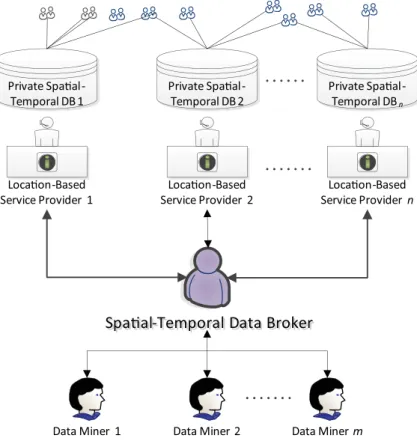
Figure 1 provides an overview of the research problem. The location-based service providers collect and store a large volume of user-specific spatial-temporal data in their private databases. Some third parties (data miners) would like to obtain an appropriate set of spatial-temporal data to perform data mining tasks such as traffic flow analysis and consumer behavior analysis. The first
Private Spaal-Temporal DB 1 Private Spaal-Temporal DB 2 Private Spaal-Temporal DBn Locaon-Based Service Provider 1 Locaon-Based Service Provider 2 Locaon-Based Service Provider n
Spaal-Temporal Data Broker
Spaal-Temporal Data Broker
Data Miner 2 Data Miner m
Data Miner 1
Figure 1: Overview of Spatial-Temporal Data Sharing
challenge is to develop a service-oriented architecture so data miners can identify the location-based service provider(s) who own the data through a service broker. The second challenge is to efficiently anonymize the spatial-temporal data in order to fulfill the data requests. In our model, we do not require the service broker to be a trustworthy entity. Therefore, the data must be anonymized when released by the location-based service providers.
A user-specific spatial-temporal data table contains a collection of spatial-temporal records. Each record consists of a sensitive attribute of a user and a spatial-temporal path that represents the sequence of visited locations with timestamps.
A spatial-temporal data table T is a collection of records in the form ⟨(loc1t1) → . . . →
path,si ∈ Si are the sensitive attributes, anddi ∈ Di are the quasi-identifying attributes (QID) of
an object. The sensitive and the QIDattributes are object-specific data in the form of relational data. Publishing a tableT, which might be for reference or analytical purposes, raises the problem of privacy.
Motivating Example
We use an example to demonstrate the potential privacy risks of releasing the spatial-temporal data in its raw format.
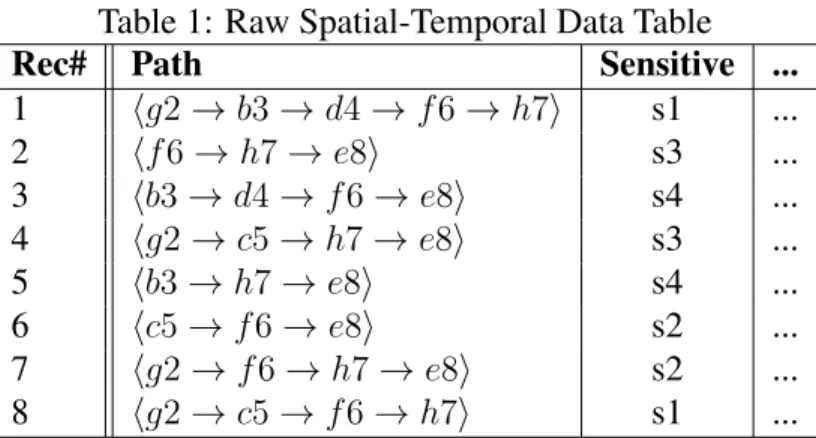
Suppose a location-based service provider wants to share Table 1 with a data miner. Record 2, for example, shows that a user with sensitive values3visited locations f, h, and eat times 6,
7, and 8, respectively. Without loss of generality, we assume that each record contains only one sensitive attribute in this example.
We identify and address two types of privacy linkage attacks [20]:
Record linkage: a privacy attack in which the adversary exploits the uniqueness of a path in the released data table. If a path is so specific that it only matches a small number of other paths, linking the victim’s record from the released spatial-temporal data table and the sensitive value may become possible. The assumption is that the adversary possesses some knowledge about the locations and timestamps (doublets) existing in a victim’s path. Suppose one of the data miners is an adversary who knows that the data record of a target victim, Daphne, is in Table 1. This adversary also knows that Daphne has visitedg2andb3. Daphne’s record, together with her sensitive values1, can be uniquely identified because Record 1 is theonlyrecord that containsg2
Table 1: Raw Spatial-Temporal Data Table
Rec# Path Sensitive ...
1 ⟨g2→b3→d4→f6→h7⟩ s1 ... 2 ⟨f6→h7→e8⟩ s3 ... 3 ⟨b3→d4→f6→e8⟩ s4 ... 4 ⟨g2→c5→h7→e8⟩ s3 ... 5 ⟨b3→h7→e8⟩ s4 ... 6 ⟨c5→f6→e8⟩ s2 ... 7 ⟨g2→f6→h7→e8⟩ s2 ... 8 ⟨g2→c5→f6→h7⟩ s1 ...
Attribute linkage: a privacy attack that occurs when a group of records that share some com-bination of doublets contains a frequently appearing sensitive value. Even though a target victim’s record might not be identified, inferring the victim’s sensitive value from such a group becomes possible. Suppose the adversary knows that Keith has visited g2and f6. Since two of the three records (Records 1, 7, 8) containingg2andf6have sensitive values1, the adversary can infer that Keith hass1with2/3 = 67%confidence.
We do not require the service broker to be a trustworthy entity in our model, which means that the data publisher is not trusted and may attempt to identify sensitive information from record own-ers. We also assume that the data miner could be an attacker. Thus, the data must be anonymized when released by the location-based service providers.
Spatial-temporal data are very different from traditional relational data due to their special properties:
• High dimensionality: This is an intrinsic characteristic of spatial-temporal data due to the huge number of possible combinations of locations and timestamps. Consider a subway system having 50 stations that operate 20 hours a day. The total number of dimensions of
potential piece of knowledge used by an adversary to perform record or attribute linkages; therefore, every dimension is considered a potential quasi-identifying (QID) attribute. If we apply a traditional privacy model, such asK-anonymity, all dimensions would be included in a singleQIDand every path would have to be indistinguishable from at leastK-1 other paths. In order to achieve K-anonymity, the highly dimensional nature of spatial-temporal data would likely cause most of the data to be suppressed. Consequently, the utility of the resultant anonymous data would be insufficient for further data analysis.
• Sparseness: Each path in spatial-temporal data is relatively short. Anonymizing these short, little-overlapping paths in a high-dimensional space poses a significant challenge for tra-ditional anonymization techniques because it is difficult to identify and group the paths together. Enforcing traditional K-anonymity on high-dimensional and sparse data would render the data useless.
• Sequentiality: The order of items in each sequence should be kept and considered; for exam-ple, a1 → b2is different fromb2 → a1. As a result, the number of possible combinations in sequential data is much higher than the number of possible combinations in set-valued data. In addition, in any path, timestamps are always increasing; therefore, sequences such asa2→a1are not valid, as an object cannot go from time 2 to time 1.
In the research area of privacy-preserving data publishing [20], many anonymization algo-rithms have been proposed to thwart record linkages and attribute linkages in relational data. Yet, the privacy models they employed, such as K-anonymity [38] [41] and its extensions [22] [32] [33] [50] [51], are not applicable to high-dimensional spatial-temporal data [4].
We adopt a novel privacy model, LKC-privacy, that addresses the challenges of spatial-temporal data.LKC-privacyprovides a practical solution to compensate for an adversary’s back-ground knowledge.
1.1
Contribution
Our contributions can be summarized as follows: First, based on the practical assumption that an adversary has limited knowledge, we adopt theLKC-privacy model[36] to address the special challenges of anonymizing high-dimensional, sparse, and sequential spatial-temporal data. Sec-ond, we propose a service-oriented architecture to determine an appropriate location-based service provider for a given data request. Third, we present an efficient border-based anonymization algo-rithm to achieveLKC-privacywhile preserving frequent sequences in the anonymous data. Finally, extensive experimental results suggest that our anonymization method is effective for information preservation and is scalable.
1.2
Outline of Thesis
In Chapter 2, we explain the concept of LBS and demonstrate the potential threats to privacy that stem from publishing raw data. Next we present different models proposed to protect the relational data. Then we discuss different techniques developed to anonymize high-dimensional data, and finally we present anonymization methods to protect location privacy.
Chapter 3 formally defines the problem. We define information utility, followed by a descrip-tion of theLKC-privacymodel and problem statement.
Chapter 4 presents a service-oriented architecture for privacy-preserving spatial-temporal data sharing.
Chapter 5 presents our proposed anonymizing algorithm, the concept and the construction of the borders, the counting function, and a detailed explanation of the steps in the border-based algorithm.
Chapter 6 presents an empirical study of the algorithm with a focus on information-utility loss and scalability.
And finally, we point out some possible future research directions, and conclude the work in Chapter 7.
Chapter 2
Literature Review
The use of Location-Based Services (LBS) has increased in the last few years. Publishing the col-lected data in raw format may violate the privacy of service recipients, and many privacy protection studies have been published. In this chapter we explain the concept of LBS and demonstrate the potential threats to privacy that stem from publishing raw data. Next we present different models proposed to protect the relational data. Then we discuss different techniques used to anonymize high-dimensional data, and finally we present anonymization methods to protect location privacy.
2.1
Location-Based Services
Location-Based Service is defined as an information service accessible through the mobile network by mobile devices, and it utilizes the location of the mobile device [44]. OpenGeospatial Consor-tium defines LBS as a wireless-IP service that uses geographic information to serve a mobile user.
Figure 2: LBS as an Intersection of Technologies [10]
Location and time of an object are usually sent through the Internet to some spatial (or spatial-temporal) database. LBS can be considered as an intersection of three following technologies: a spatial-temporal database, the Internet, and New Information and Communication Technologies (NICTs) [39]. Figure 2 demonstrates the LBS dimensions.
A typical LBS system consists of the following five components [40], as shown in Figure 3:
• Mobile device: a pocket-size computing device that can request services from providers. It can be a mobile phone, PDA, or other mobile device. This device sends and receives location and time information about the object.
• Communication network: the means through which a mobile device transfers the data back and forth. It can be a Wireless Local Network (WLAN), the Internet, or another network.
• Positioning components: a service used to determine the position of user service recipients. Examples include GPS, WLAN, and other communication networks.
• Service and application provider: a company or agency that offers a specific service on the network. For example, some mobile applications provide the recipient with the location of
Figure 3: The Basic Components of an LBS [40] the nearest cinema.
• Data and Content Provider: a party who collects the data or information, who may not be the service provider. Service providers may acquire the data from other data and content providers.
The use of LBS has significantly increased in the last few years. LBS applications include tracking, navigation, emergency services, billing, LBS-alerts, social networking, network operator applications, and many end-user applications [47]. However, collecting information about recipi-ents raises many concerns if people are tracked by their positions or by analyzing their preferences and action history. On one hand the analysis helps business applications get a perfect customer model, but on the other raises users’ fears about privacy invasion.
In our model, the data collected through different LBSs is passed to a data broker, an indepen-dent third party who researches information and data for clients, including different organizations. To address the problem of privacy, the collected data is anonymized before the service provider
transmits it to a data broker.
Next we present an overview of the data anonymization approach and the different privacy models that were used to achieve the same purpose.
2.2
Privacy Protection on Relational Data
Many privacy-preserving data publishing techniques have been proposed for anonymizing rela-tional data. We provide a high-level summary of the literature in this section. Relarela-tional data are typically stored in tables of the form:
D(Explicit Identifier, Quasi Identifier, Sensitive Attributes,Non-Sensitive Attributes).
Sweeney showed in [41] that even with the removal ofexplicit identifiers, privacy can still be violated through the linking attacks explained in Chapter 1. She indicated a real-life threat to a former governor of the state of Massachusetts. She linked the governor’s name in a public voter list with his record in a published medical database by combining the zip code, date of birth, and sex, as shown in Figure 4.
A combination of personal attributes, called a quasi-identifier, can be used to identify an indi-vidual’s record. In the above example, the victim was re-identified by linking hisquasi-identifier
and the victim’s record in released data. It was not difficult for the attacker to obtain her boss’s zip code, date of birth, and sex, gender which served as thequasi-identifier. She also noticed that her boss was hospitalized, and therefore knew that her victim’s medical record would appear in the released patient database.
Figure 4: Linking to Re-identify Record Owner [41]
2.2.1
Preserving Threats
Privacy threat occurs when an attacker is able to link a record owner to a record in a published data table, or to a sensitive attribute in a published data table. We call these events record linkage and attribute linkage. In the two types of linkages, we assume that the attacker knows the QID
of the victim, we further assume that the attacker knows that the victim’s record is in the released table, and seeks to identify the victim’s record or sensitive information from the table. A data table is considered to preserve privacy if it can effectively prevent the attacker from successfully performing these linkages.
2.2.2
Privacy Models
Privacy-preserving techniques on spatial-temporal data can be broadly grouped into two categories: data collection and data sharing. While the work on data collection focuses on the privacy and security issues of the sensors and readers at the communication level [30], the work in the data sharing phase focuses on privacy and utility at the data level [25].
k-1 other records also have the valueqid. In other words, the minimum group size on QIDis at leastk. A table satisfying this requirement is calledk-anonymous. In ak-anonymous table, each record is indistinguishable from at least k- 1 other records with respect toQID. Consequently, the probability of linking a victim to a specific record throughQIDis at most 1/k.
Machanavajjhala et al [33] propose a diversity model calledℓ-diversity. The purpose is to pre-vent attribute linkage. Theℓ-diversity requires everyqidgroup to contain at leastℓwell-represented
sensitive values. However, this model cannot prevent probabilistic inference attacks because some sensitive values are naturally more frequent than others in a group, enabling an attacker to conclude that a record in the group is very likely to have those values.
Confidence bounding [46] attempts to prevent attribute linkage. It bounds the confidence of inferring a sensitive value from a qidgroup by specifying one or more privacy templates of the form ⟨QID → s, h⟩; s is a sensitive value, QID is a quasi-identifier, andh is a threshold. Let
Conf(QID → s)bemax{conf(qid →s)}over allqidgroups onQID, whereConf(QID → s)denotes the percentage of records containingsin theqidgroup. A table satisfies⟨QID→s, h⟩
if Conf(QID → s) ≤ h. In other words, ⟨QID → s, h⟩ bounds the attacker’s confidence of inferring the sensitive valuesin any group onQIDto the maximumh.
The(α, k)-anonymity [50] privacy model requires everyqidin a TableT to be shared by at least
k records andConf(qid → s) ≤ αfor any sensitive value s, wherek and αare data publisher-specified thresholds. However, it does not limit an adversary’s knowledge, which results in high utility loss of data; additionally, it may result in high distortion if the sensitive values are skewed.
[51] proposes the notion of personalized privacy to allow each record owner to specify her own privacy level. This model assumes that each sensitive attribute has a taxonomy tree and that each
record owner specifies a guarding node in this tree. However, record owner privacy is violated if an attacker is able to infer any domain-sensitive value within the subtree of her guarding node with a probability, calledbreach probability, greater than a certain threshold.
Various cryptographic solutions [55], anonymous communications [11] [29], and statistical methods [48] have been proposed in which only authorized and trustworthy recipients are given the private key to access the data. However, it is difficult to guarantee that all staff in a given company are trustworthy. Our assumption defines the problem and solutions differently from the encryption and cryptographic approaches: Data miners and recipients are not trustworthy; thus, the data must be anonymized when released by the location-based service providers.
2.2.3
Anonymization Operations
Typically, a raw data table does not satisfy a specified privacy requirement and the table must be modified before being published.
The modification is composed of a sequence of anonymization operations that can be broadly divided into three categories as follows:
• Generalization and Suppression: Generalization and suppression aims at hiding some details in QID. Generalization replaces some values with a parent value in the taxonomy of an attribute.
In a full-domain generalization scheme [31] [38] [41], all values in an attribute are
general-ized to the same level of the taxonomy tree. In a Subtree generalization scheme [7] [22] [28] [31] [21], at a non-leaf node either all child values or none are generalized. The sibling generalization
scheme [31] is similar to the subtree generalization except that some siblings may remain ungeneralized. A parent value is then interpreted as representing all missing child values. In the cell generalization scheme [31] [49] [52], also known as local recoding, some instances of a value may remain ungeneralized while other instances are generalized.
Suppression on the other hand removes or deletes any value that can be used to launch the attack. There are also several different suppression schemes: Record suppression [7] [28] [31] [38] refers to suppressing an entire record. Value suppression [45] [46] refers to suppressing every instance of a given value in a table. Cell suppression (or local suppression) [13] [34] refers to suppressing some instances of a given value in a table.
• Anatomization and Permutation: Anatomization [51], unlike generalization and suppression, does not modify the quasi-identifier or the sensitive attribute, but instead deassociates the relationship between the two. Precisely, the method releases the data onQIDand the data on the sensitive attribute in two separate tables: a quasi-identifier table QIT contains the
QID attributes, a sensitive table ST contains the sensitive attributes, and both QIT and
ST have one common attribute, GroupID. All records in the same group will have the same value ofGroupIDin both tables, and are therefore linked to the sensitive values in the group in exactly the same way. If a group has ℓ distinct sensitive values and each distinct value occurs exactly once in the group, then the probability of linking a record to a sensitive value by GroupID is 1/ℓ. The attribute linkage attack can be distorted by increasingℓ. Permutation shares the same spirit of anatomization. In [57], Zhang et al. proposed an
approach called permutation. The idea is to deassociate the relationship between a quasi-identifier and a numerical sensitive attribute by partitioning a set of data records into groups and shuffling their sensitive values within each group.
• Perturbation: The general idea is to replace the original data values with synthetic data values so that the statistical information computed from the perturbed data does not signifi-cantly differ from the statistical information computed from the original data. The perturbed data records do not correspond to real-world record owners, so the attacker cannot perform sensitive linkages or recover sensitive information from the published data.
2.3
Anonymizing High-Dimensional Data
As discussed in Chapter 1, temporal-spatial data is high-dimensional. K-anonymity and the other privacy-preserving models mentioned so far suffer from the curse of high dimensionality [4] and render the high-dimensional data useless for data mining.
In this thesis, we solve the problem of high dimensionality by assuming that the adversary knows at most Ldoublets of a victim’s locations and the corresponding times. Mohammed [36] proposed a LKC-privacy model that addresses the privacy issues on high-dimensionalrelational data. In contrast, this thesis proposes an anonymization algorithm to achieve theLKC-privacy model on spatial-temporal data. Furthermore, none of the tested traditionalQID-based anonymiza-tion methods menanonymiza-tioned above, namely [22] [31] [33], are scalable to handle the high-dimensional data in our experiments.K-anonymity [38] [41], confidence bounding [46], and(α, k)-anonymity [50] are special cases of theLKC-privacy model; our anonymization algorithm can also be viewed as
a scalable solution for achieving these traditional privacy models. Dwork [16] proposed a privacy model calleddifferential privacythat ensures that the removal or addition of a single data record does not significantly affect the overall privacy of the database. Most of the works in differential privacy are based on the interactive privacy model, where the result of a query is in the form of aggregation [14] [17]. Yet, differential privacy may not prevent linkage attacks.
Other recent work has focused on anonymizing high-dimensional transaction data [3] [24] [43] [53] [54]. In [3] Aggarwal and Yu formalized an anonymity model for the sketch-based approach, and utilized it to construct sketch-based privacy-preserving representations of the original data. The sketch-based approach [6] reduces the dimensionality of the data by generating a new repre-sentation with a much smaller number of features, where each one uses a different set of random weights to produce a weighted sum of the original feature values. This technique is quite effective for high-dimensional data sets, as long as the data is sparse. The sketch-based method provides privacy protection while allowing effective reconstruction of many aggregate distance measures. Therefore, it can be used for a variety of data mining algorithms such as clustering and classifica-tion.
The models suggested in [53] and [54] limit the adversary’s power by a maximum number of knownitemsas background knowledge in order to solve the problem of high dimensionality. This assumption is similar to ours, but our problem has two major differences. First, a transaction is aset
of items, but a spatial-temporal path is asequenceof visited location-time doublets. Sequential data drastically increases the computational complexity for counting the support counts as compared to transaction data. Hence, their proposed models are not applicable to spatial-temporal data. Second,
we have different privacy and utility measures. The privacy model of [43] is based on only K-anonymityand does not consider attribute linkages. [53] [54] measure their data utility in terms of preserveditem instancesandfrequent itemsets, while we measure the utility based on the number of preservedfrequent sequences. Xu et al. [53] use a border-based method, but it was not used for sequential or spatial-temporal data.
2.4
Location Privacy
Location anonymity is achieved by mixing the user’s identity and request with those of other users. Examples of such techniques are Mix Zones [9], cloaking [26], and location-based k -anonymity [23]. The objectives of these techniques are very different from the solution presented in this thesis. First, their goal was to anonymize an individual user’s identity resulting from a set of LBS requests, but our goal is to anonymize high-dimensional data. Second, they dealt with small dynamic groups of users, but we anonymize a large static data set. Hence, their problem is very different from that of spatial-temporal data publishing.
In [2], Papadimitriou et al studied the privacy issue in publishing time-series data and exam-ined the trade-offs between time-series compressibility and partial information hiding and their fundamental implications for how one should introduce uncertainty about individual values by perturbing them. The study found that by making the perturbation similar to the original data, we can both preserve the structure of the data better, and simultaneously make breaches harder. However, as data becomes more compressible, a fraction of the uncertainty can be removed if true values are leaked, revealing how they were perturbed.
2.5
Anonymizing Moving Objects
Moving-object data poses new challenges to traditional database, data mining, and privacy-preserving technologies due to its unique characteristics: time-dependency, location-dependency, and high di-mensionality. Some recent works [19] [27] [37] [42] [56] address the anonymity of moving objects. Abul et al. [1] proposed a new privacy model called (k, δ)-anonymity that is an extension of traditionalK-anonymity. It exploits the inherent uncertainty of moving objects’ locations. Their method relies on a basic assumption that every path is continuous. In the 3-dimensional repre-sentation, a path is a polyline(x, y, t)where the coordinates (x, y, t) of each point in the polyline represent the moving object’s location(x, y)at a specific timet. A minimum ofk objects should appear within the radius of δ of the path of every moving object in the same period of time. To achieve the previous privacy requirement for a target data set, [2] uses space translation to change the location coordinates of some points on certain polylines. Figure 5 depicts the model. Although this assumption is valid for some spatial-temporal devices where the object can be traced all the time, it does not hold for others. Another major difference is that this model achieves anonymity by space translation that changes the actual location of an object. In contrast, our approach employs suppression for anonymity and thus preserves the data truthfulness and frequent sequences with true support counts.
In [27] an uncertainly-aware privacy algorithm for GPS traces is presented. The researchers selectively removed doublets to increase uncertainly between paths to hinder identification. The works target GPS-only traces and cannot be employed for anonymizing other spatial-temporal data, so the mechanism cannot be generalized for all spatial-temporal data.
Figure 5: A Graphical Representation of an Uncertainty Trajectory Volume [1]
The privacy model proposed in [42] assumes that different adversaries have different back-ground knowledge about the spatial-temporal paths, and thus their objective is to prevent adver-saries from gaining any further information from the published data. They consider the locations in a path as sensitive information and assume that the data holder has the background knowledge of all the adversaries. In reality, such complete information is difficult to obtain.
Pensa et al. [37] proposed a k-anonymity notion for sequence datasets. The proposed algo-rithm also aims to preserve frequent sequential patterns. However to achieve anonymity, they transformed a sequence into the other by insertion, deletion, or substitution of a single item. Thus, their approach also spoils data truthfulness.
Yarovoy et al. [56] consider time as a QID attribute. However, there is no fixed set of times for all moving objects. Each spatial-temporal path has its own set of times as its QID. It is unclear how the data holder could determine the QID attributes for each trajectory.
Fung et al. [18] [19] and Chen et al. [12] propose a method for anonymizing spatial-temporal data without preserving frequent sequences. Mohammed et al. [35] present a tree-based anonymiza-tion method to preserve both privacy and maximal frequent sequences. In contrast, this thesis
Chapter 3
Problem Definition
A data miner wants to perform a data mining task on a user-specific spatial-temporal dataset, and wants to obtain the dataset from some location-based data service providers. The data miner speci-fies a data request to a spatial-temporal data broker who is responsible for identifying the location-based service providers who own the requested data. The research problem is how to transform the raw spatial-temporal data (e.g., Table 1) into an anonymous version that simultaneously preserves both the privacy of the underlying users and utility of the information for data mining.
In this chapter, we first define the format of user-specific spatial-temporal data, followed by the LKC-privacy model [36], and the information utility measure in the context of spatial-temporal data. Finally, we provide the problem statement.
3.1
User-Specific Spatial-Temporal Data
We formally define the format of a specific spatial-temporal data table as follows: A user-specific spatial-temporal dataset is a collection of spatial-temporal records in which each user’s record consists of four types of information:
• Explicit identifiersare attributes that can uniquely identify a user, e.g., name, SSN, and phone number.
• Quasi-identifiers(QID) are some combinations ofQIDvalues may identify a user, e.g., job, age, and gender. They are not explicit identifiers.
• Sensitive attributescontain some sensitive information that a user may not want other people to know, e.g., disease and financial status.
• Spatial-temporal informationis a sequence of locations visited by a user within a period of time, e.g.,⟨a1→c4→b7⟩.
Explicit identifiers, e.g., name, SSN, and ID, are removed. Note, we keep the ID in our exam-ples for discussion purposes only. The spatial-temporal data, the user-specific QID, and sensitive attributes are assumed to be important for the data mining task; otherwise, they should be removed.
Definition 3.1.1 (Doublet) A doublet, denoted by ℓitimei, is a combination of location ℓi and
timestampti.
Definition 3.1.2 (Spatial-temporal path) A spatial-temporal path, denoted by ⟨ℓ1t1, . . . , ℓntn⟩,
is a sequence of doublets sorted by the timestamps in ascending order, representing a sequence of locations visited by a user between timestampst1andtn, inclusively.
A timestamp is the entry time to a location. A user is assumed to be staying in the same location until detected again in another location. A user may revisit the same location at different times but consecutive doublets having the same location are considered redundant and, therefore, are removed. For example, in⟨c1 → c2 → c3 → d4 → c5⟩, c2andc3are removed butc1, d4, andc5are kept. At any time, a user can appear in at most one location, so⟨a1→b1⟩is not a valid spatial-temporal path. In other words, the timestamps increase monotonically in a spatial-temporal path.
Definition 3.1.3 (User-specific spatial-temporal table) Auser-specific spatial-temporal table(or simply a spatial-temporal table)T consists of a collection of records in the form[⟨ℓ1t1, . . . , ℓntn⟩,
a1, . . . , ay, s1, . . . , sm], where ⟨ℓ1t1, . . . , ℓntn⟩ is a spatial-temporal path, a1, . . . , ay are
quasi-identifying values, ands1, . . . , smare sensitive values of a user.
3.2
Information Utility
The measure of information utility varies depending on the data mining task to be performed on the published data. In this thesis, we aim at preserving the frequent sequences. A sequence
q=⟨ℓ1t1 →. . .→ℓntn⟩is an ordered set of doublets.
Definition 3.2.1 (Frequent sequence) A sequence q is frequent in a spatial-temporal table T if |T(q)| ≥ K′, whereT(q) is the set of records in T containing q and K′ is a minimum support threshold.
tasks on sequential data, e.g., association-rules mining [5]. In the context of spatial-temporal data, association rules can be used to determine the subsequent locations of a moving object given the previously visited locations. This knowledge is important for workflow mining [25].
Ifqis a frequent sequence, every subsequencepwithp⪯qis also a frequent sequence.
3.3
Privacy Model
One data miner, who is an adversary, seeks to identify the record or sensitive values of some target victim inT. As explained earlier, we assume that the adversary knows at mostLdoublets that the victim has previously visited. We useρto denote such a prior known sequence of doublets, where |ρ| ≤L. Based on the prior knowledgeρ, the adversary could identify a group of records, denoted byT(ρ), that “contains"ρ. A record inT containsρifρis a subsequence of the spatial-temporal path in the record. For example in Table 1, Records #1,2,7,8 containρ = ⟨f6 → h7⟩, written as
T(ρ) = {Records#1,2,7,8}. Based on T(ρ), the adversary could launch two types of privacy attacks.
The first type of privacy attack is record linkage. Given prior knowledge ρ, T(ρ) is a set of candidate records that contains the victim’s record. If the group size ofT(ρ), denoted by|T(ρ)|, is small, then the adversary may identify the victim’s record from T(ρ)and, therefore, the victim’s sensitive value. For example, if ρ = ⟨g2 → b3⟩ in Table 1, T(ρ) = {Record#1}. Thus, the adversary can easily infer that the victim’s sensitive value iss1.
The second type of privacy attack isattribute linkage. Given prior knowledgeρ, the adversary can identifyT(ρ)and infer that the victim has sensitive valueswith confidenceP(s|ρ) = |T|T(ρ(∧ρ)s|)|,
where T(ρ∧s) denotes the set of records containing both ρ ands. P(s|ρ) is the percentage of records inT(ρ) containings. The privacy of a victim is at risk if P(s|ρ) is high. For example, givenρ =⟨g2→ f6⟩in Table 1,T(ρ∧s1) = {Records#1,8}andT(ρ) = {Records#1,7,8}; therefore,P(s1|ρ) = 2/3 = 67%.
To thwart the record and attribute linkages, we adopt theLKC-privacy model[36], which was originally proposed for relational data, and we apply the model in the context of spatial-temporal data. Intuitively, LKC-privacy requires that every sequence with a maximum length L in the spatial-temporal table has to be shared by at least a certain number of records, and the ratio of sensitive value(s) in every group cannot be too high.
Definition 3.3.1 (LKC-privacy) LetLbe the maximum length of the prior knowledge. LetSbe a set of sensitive values. A spatial-temporal data tableT satisfiesLKC-privacyif and only if for any non-empty sequenceqwith|q| ≤Lof any spatial-temporal path inT,
1. |T(q)| ≥K, whereK >0is an integer anonymity threshold, and
2. P(s|q)≤Cfor anys∈S, where0< C ≤1is a real number confidence threshold.
A location-based service provider specifies the thresholdsL, K, andC. The maximum length
Lreflects the assumption of the adversary’s power. LKC-privacy guarantees the probability of a successful identity linkage to be≤1/Kand the probability of a successful attribute linkage to be ≤C.
Intuitively, a sequenceqwith|q| ≤ Lis a violation inT with respect to a givenLKC-privacy requirement ifT(q)violates at least one of the conditions in Definition 3.3.1.
Definition 3.3.2 (Violating sequence) Letq be a sequence of a spatial-temporal path inT with
0≤ |q| ≤ L. qis aviolating sequencewith respect to aLKC-privacy requirement if|T(q)| < K
orP(s|q) > C for any sensitive value s ∈ S. V(T)denotes the set of violating sequences inT
with respect to aLKC-privacy requirement.
Observation 3.3.1 Ifq is a violating sequence, every supersequencepwithq ⪯ pand|q| ≤Lis also a violating sequence.
Example 3.3.1 LetL = 2, K = 2,C = 50%, andS ={s1}. In Table 1, a sequenceq1 =⟨g2→ d4⟩is a violating sequence because|T(q1)|= 1 < K. A sequenceq2 =⟨g2→ f6⟩is a violating
sequence becauseP(s1|q2) = 67% > C. However, a sequenceq3 = ⟨g2 → c5 → f6 → h7⟩is
not a violating sequence even if|T(q3)|= 1< KandP(s1|q3) = 100% > C because|q3|> L.
In order to achieve LKC-privacy, it is not correct to ignore sequences of size less thatL. In other words, if a table T satisfies LKC-privacyit does not mean it satisfies L ´KC-privacy, where
L′ < L.
Lemma 1 LKC-privacyis not monotonic with respect to adversary’s knowledge L.
P roof.To prove thatLKC-privacy is not monotonic with respect toL, it is sufficient to prove
that one of the conditions ofLKC-privacyin Definition 1 is not monotonic. In the following we provide a counterexample for both conditions:
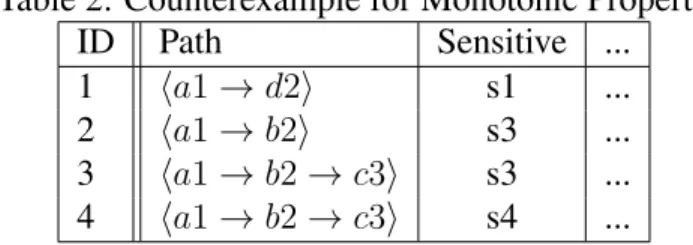
Condition 1: K is not monotonic with respect to L. In other words, If all of the size-L se-quences are nonviolating, it does not guarantee that a sequence with sizeL′ ≤Lis also nonviolat-ing. For example, in Table 2, though the size-3 sequences satisfy privacy requirement forK = 2, the size-2 sequence,q =⟨a1→d2⟩does not satisfy the requirement.
Table 2: Counterexample for Monotonic Property ID Path Sensitive ... 1 ⟨a1→d2⟩ s1 ... 2 ⟨a1→b2⟩ s3 ... 3 ⟨a1→b2→c3⟩ s3 ... 4 ⟨a1→b2→c3⟩ s4 ...
Condition 2: C is not monotonic with respect to L. If q is a nonviolating sequence with
P(s|q) ≤C and|T(q)| ≥ K, its subsequenceq′ may or may not be a nonviolating sequence. For example in Table 2, the sequenceq =⟨a1→ b2→ c3⟩satisfiesP(s3|q)= 50≤ C. However, its subsequenceq′ =⟨a1→b2⟩does not satisfyP(s3|q′) = 100% > C.
Therefore, in LKC-privacy, it is not sufficient to assure that every sequence q satisfies both conditions given length L in T. Instead, we have to ensure that every sequence q with length not greater thanLsatisfies the conditions. To overcome this bottleneck, we suppress the minimal violating sequences that exist within the violating sequences which sufficient to satisfy the LKC-privacymodel.
In our model, we useglobal suppression[20] to remove the violating sequences. Global sup-pression means deleting the item from all transactions that contain the item. Such item supsup-pression has the following properties:
1. Suppressing an item eliminates all sequences that contain the item.
2. Suppressing an item does not alter any sequence and its support that does not contain the item.
important for anonymizing high-dimensional data:
The data holder has the capability to determine the values ofL,K, andC. This gives the data holder the flexibility to determine the level of privacy based on the holder’s needs.
LKC-privacy guarantees the probability of a successful identity linkage to be≤1/K, and the probability of a successful attribute linkage to be≤C.
The LKC privacy model is flexible to adjust the trade-off between data privacy and data utility, and between an adversary’s power and data utility. IncreasingLand K, or decreasingC, would improve the privacy at the expense of data utility.
LKC-privacy generalizes several traditional privacy models. K-anonymity [38] [41] is a spe-cial case of LKC-privacy withC = 100% andL = |d|, where|d| is the number of dimensions, i.e., number of distinct doublets, in the table. Confidence bounding [46] is a special case ofLKC -privacy with K = 1 andL = |d|. (a, k)-anonymity [49] is also a special case of LKC-privacy withL=|d|,K =k, andC =a. Thus, the data holder can still achieve the traditional models, if needed.
LKC-privacy is a general privacy model that thwarts both identity linkage and attribute link-age. It is also a privacy model that is applicable to anonymize spatial-temporal data with or without sensitive attributes.
3.4
Problem Statement
1. Given a data mining request, the problem is to develop an effective service-oriented archi-tecture to determine the appropriate location-based service providers who own the data that satisfies the data mining request, and to establish a connection session between each service provider and the data miner.
2. Given a spatial-temporal tableT, aLKC-privacy requirement, a minimum support threshold
K′, and a set of sensitive valuesS, the problem is to identify a transformed version ofT that satisfies theLKC-privacy requirement while preserving the maximum number of frequent sequences|F(T)|.
The information sharing process can be divided into two phases. In the first phase (Chap-ter 4), the data broker receives requests from data miners and establishes connections with the location-based service providers who contribute their data in a privacy-preserving manner. In the second phase (Chapter 5), the location-based service providers anonymize their spatial-temporal data based on their own privacy requirement and the data miner’s information utility requirement, and then they submit the anonymous data to the data broker, who will then pass it to the data miner.
Chapter 4
Service-Oriented Architecture (SOA) for
Sharing Private Spatial-Temporal Data
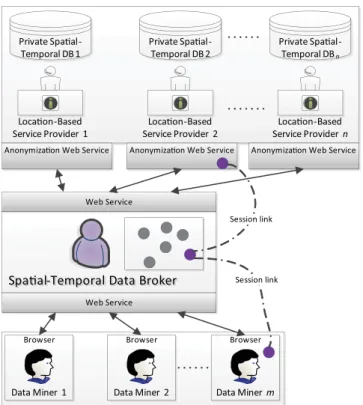
In this chapter we present a service-oriented architecture for sharing private spatial-temporal data. Figure 6 depicts an overview of the communication channels of the participants. Given a data request, thedata brokerplays the central role in identifying the contributing location-based service providers and presenting the final anonymous data to the data miner. The architecture does not
require the data broker to be a trusted entity. This makes our architecture practical because a trusted party is often not available in real-life scenarios.
The objective of this phase is to establish a common session context among the contributing location-based service providers and the data miner in four steps:data miner authentication, con-tributing data providers identification,session initialization, andrequirements negotiation.
Data miner authentication: The data broker first authenticates a data miner to the requested service, generates a session token for the current interaction, and then identifies the location-based
Private Spaal-Temporal DB 1 Private Spaal-Temporal DB 2 Private Spaal-Temporal DBn Locaon-Based Service Provider 1 Locaon-Based Service Provider 2 Locaon-Based Service Provider n
Spaal-Temporal Data Broker Spaal-Temporal Data Broker
Browser Data Miner 1 Web Service Web Service Browser Data Miner 2 Browser Data Miner m
Anonymizaon Web Service Anonymizaon Web Service Anonymizaon Web Service
Session link
Session link
Figure 6: Service-Oriented Architecture for Privacy-Preserving Spatial-Temporal Data Sharing service providers accessible by the data miner.
Contributing service providers identification: Next, the data broker queries the data schema of the accessible location-based service providers to identify which can contribute data for the requested service. To facilitate more efficient queries, the broker could periodically pre-fetch data schema from the service providers, or the providers could update their data with the broker.
Session initialization: Next, the data broker notifies all contributing location-based service providers with the session identifier. All prospective service providers share a common session context that represents a stateful presentation of information related to a specific execution of a spatial-temporal data anonymization algorithm calledST-Anonymizer, which will be discussed in Chapter 5. Due to the fact that multiple parties are involved and the flow of multiple protocol mes-sages is needed in order to fulfill the data integration, we use Web Service Resource Framework
(WSRF) to keep the stateful information along an initial data request. An established session con-text stored as a single web service resource contains several attributes to identify a ST-Anonymizer process withend-point reference(EPR), the client address, the data providers’ addresses and their certificates, and an authentication token that contains the data miner’s certificate.
Requirements negotiation: The data broker is responsible for communicating the negotiation of privacy and information requirements among the data providers and the data miner. Specifi-cally, this step involves negotiating the price, the privacy requirement in Definition 3.3.1, and the minimum support thresholdK′.
Chapter 5
Spatial-Temporal Data Anonymization
A spatial-temporal data table satisfies a givenLKC-privacy requirement if all violating sequences with respect to a given LKC-privacy requirement are removed. The objective of this phase is to anonymize a spatial-temporal table by eliminating all violating sequences while preserving as many frequent sequences as possible. We first present the algorithm used to compute the violat-ing sequences; followed by the suppression algorithm; then, a border-based representation of the violating sequences, frequent sequences, and the counting function; finally, we brief the steps of a border-based suppression algorithm.
5.1
Computing Violating Sequences
Lemma 2 A spatial-temporal data table T satisfies LKC-privacy if and only if T contains no MVS.
P roof.Suppose a data tableT does not satisfyLKC-privacyeven if it contains no MVS. Then, by Definition, table T contains a violating sequence. But, a violating sequence must be a MVS, or its subset is MVS, which contradicts the initial assumption. Therefore, the data table T must satisfyLKC-privacy.
Algorithm 1 presents a method to efficiently generate all the minimal violating sequences based on a LKC-Privacymodel. Line 1 puts all the size-1 sequences, i.e., all distinct doublets, as can-didates X1 of MVS. Line 4 scans T once to compute |T(q)| and BP r(s|q) for each sequence
q ∈ Xi and for each sensitive value s ∈ S. If the sequenceq violates theLKC-privacy
require-ment in Line 6, then we addq to the minimal violating sequences setVi (Line 7); otherwise, we
add q to the non-violating sequence set Wi (Line 9) for generating the next candidate set Xi+1,
which is a self-join of Wi (Line 12). Two sequences qx = ⟨(locx1t1x) → . . . → (locxitxi)⟩ and
qy =⟨(locy1t y 1)→ . . .→(loc y it y
i)⟩inWi can be joined only if the firsti−1doublets of qx andqy
are identical andtxi < tyi. The joined sequence is⟨(locx1tx1) →. . .→ (locxitxi)→ (locyityi)⟩. Lines 13-17 remove a candidateqfromXi+1 ifqis a supersequence of any sequence inVi because any
proper subsequence of a MVS cannot be a violating sequence. The set of VS, denoted byV(T), is the union of allVi.
Example 5.1.1 Consider Table 1 withL= 2,K = 2, andC = 50%. SupposeX1 ={g2, b3, h7, e8}.
After scanningT, we divideX1 intoV1 =∅andW1 ={g2, b3, h7, e8}. Next, fromW1 we
gener-ate the candidgener-ate setX2 = {g2b3, g2h7, g2e8, b3h7, b3e8, h7e8}. We scanT again to determine
V2 ={g2b3, b3e8}. We do not further generateX3 becauseL= 2.
Definition 5.1.1 (Violating doublet) A doubletpis aviolating doubletif it is part of a violating sequence.
Algorithm 1Generate minimal violating sequences
Input:Raw spatial-temporal data tableT Input:ThresholdsL,K, andC
Input:Sensitive valuesS
Output:minimal violating sequenceV(T)
1: X1 ←set of all distinct doublets inT;
2: i= 1;
3: whilei≤LandXi̸=∅do
4: ScanT to compute|T(q)|andBP r(s|q), for∀q∈Xi,∀s∈S;
5: for ∀q∈Xiwhere|T(q)|>0do 6: if|T(q)|< KorBP r(s|q)> Cthen 7: AddqtoVi; 8: else 9: AddqtoWi; 10: end if 11: end for 12: Xi+1←Wi⋊⋉Wi; 13: for∀q∈Xi+1 do
14: ifqis a super sequence of anyv∈Vithen
15: RemoveqfromXi+1; 16: end if 17: end for 18: i++; 19: end while 20: returnV(T) =V1∪. . .∪Vi−1;
Example 5.1.2 Given the set of minimal violating sequence,V(T) ={g2b3, b3e8}, the violating doublets are{g2, b3, e8}.
We have to remove all the violating sequences to satisfy theLKC-privacy requirement. We can remove all the minimal violating sequences by suppressing a subset of violating doublets. Given,
Algorithm 2ST-Anonymizer 1: Supp =∅;
2: while|V(T)|>0do
3: Select a doubletdwith the maximumScore(d);
4: Suppressd;
5: UpdateScore(d′)if any sequence inV(T)orF(T)containing bothdandd′; 6: end while
7: return TableT after suppressing doublets inSupp;
5.2
Spatial-Temporal Anonymizer
The elimination of violating sequences is achieved by suppressing a subset of doublets from the table. Specifically, we employ the global suppressionscheme [20] that was explained in chapter 3. Algorithm 2 provides an overview of the Spatial-Temporal (ST)-Anonymizer. The algorithm iteratively selects a doublet dfor suppression based on goodness function Score(d), updates the
Score(d) of remaining doublets, and terminates when all violating sequences have been
elimi-nated.
Intuitively, we prefer suppressing a doubletdthat maximizes the number of eliminated violat-ing sequences and minimizes the number of eliminated frequent sequences for suppression. Thus, we define a greedy function Score(d) that quantifies the goodness of suppression of a doubletd
with respect to the number of eliminated violating sequences|V(d)|and the number of eliminated frequent sequences|F(d)|.
Score(d) = |V(d)|
|F(d)|. (1)
5.3
Border Representation
The remaining challenge is to efficiently compute|V(d)|and|F(d)|. A naive approach is to first enumerate all possible violating and frequent sequences and then count the number of sequences containingd. Yet, Definitions 3.3.1 and 3.2 imply that the numbers of violating sequences and fre-quent sequences grow exponentially with respect to the number of distinct doublets. Therefore, this naive approach is not a feasible solution for a large dataset. We present a border-based approach to have the compressed representations of the notions. The compression is lossless. A similar approach was employed by [53] to represent itemsets, but we use borders to represent sequences in this paper.
Definition 5.3.1 (Anti-chain) A set of sequences S is an anti-chain if ∀x, y ∈ S, x ⪯̸ y and
y⪯̸x.
Definition 5.3.2 (Border) An upper boundU B and a lower boundLBform aborder, denoted by
[U B, LB], if (i) both U B and LB are anti-chains, (ii) each element of U B is a subsequence of some element in LB, and (iii) each element ofLB is a supersequence of some element in U. A border[U B, LB]represents the set of sequences{z | ∃x∈U,∃y∈Ls.t. x⪯z⪯y}.
To show that the set of violating sequencesV(T)and the set of frequent sequencesF(T)are representable by borders, we need to show that the borders are interval-closed.
Definition 5.3.3 (Interval-closed) A collection of sequencesSisinterval-closedifScontains all sequences{z | ∀x, y ∈S,∀z, x⪯z ⪯y}.
A violating sequenceqis aminimal violating sequence(MVS) if every proper subsequence of
qis not a violating sequence. The violating sequence and frequent sequence borders are defined as follows:
Definition 5.3.4 (Violating sequence (VS) border) The violating sequence (VS) border consists of an upper boundU Band a lower boundLB, whereU Bcontains all minimal violating sequences andLB contains all maximal sequencesywith support|T(y)| ≥1.
Definition 5.3.5 (Frequent sequence (FS) border) The frequent sequence (FS) border consists of an upper bound U B and a lower boundLB, whereU B contains all singleton doublets dwith support|T(d)| ≥ max(K, K′), andLB contains all maximal sequencesywith support|T(y)| ≥
K′.
The process of identifying a border[U B, LB]for an interval-closed collection has been studied in [15]. The process of identifying minimal violating sequences has been studied in [35] and is explained in Section 5.1. A border[U B, LB]can be represented by a set ofedges{⟨x, y⟩ | x ∈
U B, y ∈LB, x⪯y}.
5.4
Counting Function
Suppose a doubletdhas been suppressed in Line 4 in Algorithm 2. We need to efficiently compute
theScore(d′)of the remaining doubletsd′that share the same violating or frequent sequences with
d. Specifically, |V(d′)| and|F(d′)|are decreased by the number of violating/frequent sequences containing both d and d′ because such sequences have been eliminated. The question is how to
compute such numbers from the borders without materializing the actual sequences. Equation 2 returns the number of sequences with maximum length Lthat are supersequences of a given se-quenceqand are covered by a border[U B, LB][53].
NqL([U B, LB]) = {z |z ∈[U B, LB], q⪯z,|z| ≤L}. (2)
Consider a single edge⟨x, y⟩in a border. Equation 3 returns the number of sequences with maxi-mum lengthLthat are covered by⟨x, y⟩and are supersequences of a given sequenceq.
NqL(⟨x, y⟩) =|{z |x⪯z ⪯y, q⪯z,|z| ≤L}| = m ∑ i=0 P(|y−(x⋓q)|, i), (3)
where⋓unions two sequences and sorts the doublets by their timestamps,P(n, i) = (nn−!i)!, and
m=min(|y−(x⋓q)|, L− |x⋓q|). (4)
In the special case of x = ∅ and L = ∞, N(⟨x, y⟩) = 2|y−x| returns the number of sequences covered by⟨x, y⟩.
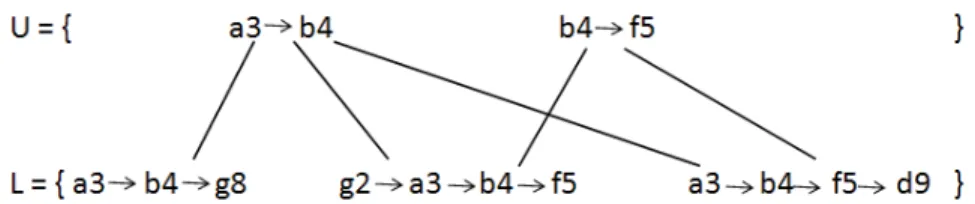
Example 5.4.1 Refer to the edge⟨b4→f5, g2→a3→b4→f5⟩in Figure 7. Suppose we want to suppress the sequenceq =⟨b4→f5⟩withL= 3. Thus, we have|x|= 2,|y|= 4,|q|= 2, and
m=min(|g2→a3→b4→f5|−|(b4→f5⋓b4→f5)|,3−|(b4→f5⋓b4→f5)|) = 1. The number of sequences removed due to the suppression isNqL(⟨x, y⟩) =
1
∑
i=0
P(|y−(x⋓q)|, i) = 3,
Figure 7: Violating Sequence Border
However, computingNqL([U B, LB])by simply summing upNqL(⟨x, y⟩)over all edges⟨x, y⟩in
[U B, LB]is incorrect because a sequence may be covered by multiple edges, and we cannot count the same sequence more than once. Xu et al. [53] introduced two operations,edge intersectionand
edge difference, to remove duplicate counting.
5.5
Border-based Suppression Algorithm
We now present our border-based suppression algorithm. Initially,E is the set of all edges⟨x, y⟩
in the border. d is the doublet to be suppressed with d ∈ y. d′ denotes any other doublet in the suppressed sequence. E∗ is the set of unexamined edges (initially E). E∧ is the set of examined edges (initially empty). Supp denotes the set of doublets to be suppressed. The algorithm itera-tively suppresses sequences inE∗ until all violating sequences are eliminated. It makes one pass of the edges inE∗. At each step, we consider the next edge⟨x, y⟩inE∗. Count the number of sup-pressed sequences, called losers, containingdd′ that are covered by⟨x, y⟩but not covered by any (examined) edge inE∧, and incrementδ(d′)by the count. Then move⟨x, y⟩fromE∗ toE∧. This process is repeated untilE∗becomes empty. The finalδ(d′)gives the number of losers containing dd’.
1. Select the doublet to be suppressed:Select doubletdnot contained inSuppwith maximum Score. AdddtoSupp.
2. Get affected edges: RetrieveE(d) = {⟨x, y⟩,d∈y}. SetE∗ =E(d),E∧ =⊘
3. Compute number of affected sequences:The counting function returns the number of af-fected sequences (losers) by the current suppression to update the score. Consider Algorithm 3. Before it increases the score, it identifies the set of all edges inE∧ that overlap with cur-rent edge⟨x, y⟩, denoted byovset ={e∧|e∧ ∈ E∧ such that⟨x, y⟩⋒e∧ ̸=∅}. To exclude the losers covered by ovset, consider in three cases:
Case 1: |ovset| = 0. The losers covered by ⟨x, y⟩ are not covered by E∧, so NqL(⟨x, y⟩)
gives the number of new losers containingdd′, whereq =dd′ andlen =L, the maximum length of the sequence. We updateδ(d′)toδ(d′) +NL
q (⟨x, y⟩).
Case 2: |ovset|= 1. In this case, only one edge inE∧, saye∧, has overlap with⟨x, y⟩. The number of losers covered by both⟨x, y⟩ande∧ is given byNL
q(⟨x, y⟩⋒e∧), whereq=dd′, len = L. We incrementδ(d′)byNqL(⟨x, y⟩ −NqL(⟨x, y⟩⋒e∧), where ⋒is the intersection of two edges.
Case 3: |ovset| > 1. In this case, more than one edge in E∧ has overlap with ⟨x, y⟩. Simply excluding the intersections⟨x, y⟩⋒e∧ for everye∧ inovsetdoes not work because intersections themselves might have intersection(s). Therefore, we pick anye∧ inovsetand compute⟨x, y⟩⋒e∧. This edge difference can be replaced with a set of new edges denoted
bynewset. Then we recursively count the losers covered by the unexaminedE∗ =newset
Algorithm 3Suppressing a Sequence
1: Procedure Computeδ(newset, ovset− {e∧}, v, len, δ);
2: whileE* is not emptydo
3: Pick any edgee∗ =⟨x, y⟩fromE∗;
4: letovset= edges inE∧∩e∗;
5: if |ovset|= 0then /*case 1*/then
6: δ(d‘) =δ(d′) +NL
q(e∗), ford′ ∈y−d;
7: else if |ovset|= 1then /*case 2*/then
8: lete∧be the edge inovset
9: δ(d′) =NL
q(∗)−NqL(e∗∩e∧) , ford′ ∈y−d;
10: else if |ovset|>1then /*case 3*/then
11: pick any edgee∧fromovset;
12: setnewest=e∗−e∧ ;
13: Computeδ(newset, ovset− {e∧}, v, len, δ);
14: end if
15: move E* from E* toE∧;
16: end while
2.
4. Update Score:For every doublet ind′, decrease|V S(d′)|byδ(d′).
5. Update the border: This step removes all violating sequences containingdfromV Sborder. For each⟨x, y⟩inE(d), ifd∈x, deletexfrom the upper bound of the border and delete all attached edges; if d∈/ x, replaceyby y′=y-d, deletey′ ify′⊆ y′′ for somey′′ on the lower bound.
Chapter 6
Empirical Study
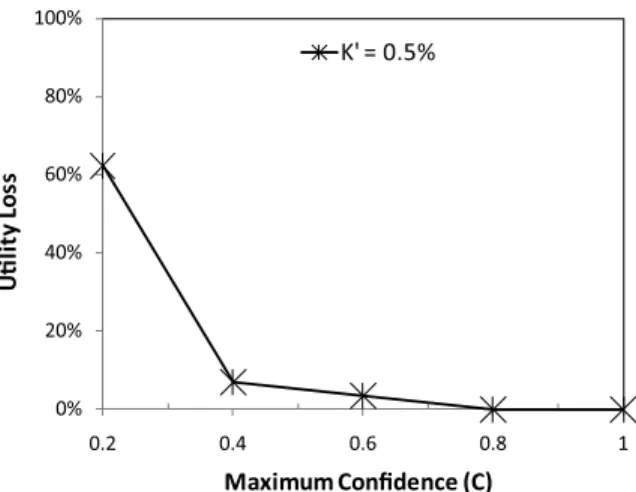
The main objective of our empirical study is to evaluate the performance of our proposed archi-tecture and ST-Anonymizer in terms of utility loss caused by anonymization and scalability for handling large datasets. The utility loss is defined as |F(T|)F|−|(TF)|(T)′|, where |F(T)| and |F(T)′|
are the numbers of frequent sequences before and after the anonymization of the dataset T. We converted the data into relational data and attempted to apply the state-of-the-art anonymization algorithms, such as [22] [31] [46]. Unfortunately, all of these methods were not scalable to high dimensionality and failed to finish the anonymization.
We conducted the experiments on theMetro100K dataset, which simulates the travel routes of 100,000 passengers in the Montreal subway transit system with 65 stations in 60 minutes, forming 3,900 dimensions. Each record in the dataset corresponds to the route of one passenger. The passengers’ traffic patterns are simulated based on information obtained from the Montreal metro i
![Figure 2: LBS as an Intersection of Technologies [10]](https://thumb-us.123doks.com/thumbv2/123dok_us/423821.2548676/17.918.288.630.106.333/figure-lbs-intersection-technologies.webp)
![Figure 3: The Basic Components of an LBS [40]](https://thumb-us.123doks.com/thumbv2/123dok_us/423821.2548676/18.918.250.672.106.383/figure-basic-components-lbs.webp)
![Figure 4: Linking to Re-identify Record Owner [41]](https://thumb-us.123doks.com/thumbv2/123dok_us/423821.2548676/20.918.309.610.107.325/figure-linking-to-re-identify-record-owner.webp)
![Figure 5: A Graphical Representation of an Uncertainty Trajectory Volume [1]](https://thumb-us.123doks.com/thumbv2/123dok_us/423821.2548676/28.918.295.631.107.335/figure-graphical-representation-uncertainty-trajectory-volume.webp)