
Implementing Monetary Policy
43
0
0
Full text
(2) Handbooks in Central Banking Lecture Series. No. 4. IMPLEMENTING MONETARY POLICY. William A Allen. Series editors: Gill Hammond & Andrew Blake Issued by the Centre for Central Banking Studies, Bank of England, London EC2R 8AH E-mail: [email protected] July 2004 © Bank of England 2004 ISBN 1 85730 148 X.
(3) Contents Abstract.....................................................................................................................................4 1.. General principles ......................................................................................................6 1.1. Introduction ..................................................................................................................6 1.2. Direct and indirect methods of monetary policy implementation ................................6 1.3. Why is indirect implementation of monetary policy preferable?.................................8 1.4. What indirect implementation of monetary policy requires from the central bank .....9 2. Managing the balance sheet of the central bank ...................................................10 2.1. The structure of the balance sheet ..............................................................................10 2.2. How can the central bank contain the growth of central bank money? .....................13 2.3. Advantages and drawbacks of central bank policy instruments.................................15 2.4. Profits and losses ........................................................................................................16 2.5. The maturity structure of the central bank’s balance sheet ........................................17 2.6. Credit risk in the central bank balance sheet ..............................................................19 3. Open market operations ..........................................................................................21 3.1. What open market operations are...............................................................................21 3.2. Forecasts.....................................................................................................................22 3.3. How the forecasts are made........................................................................................23 3.4. Managing uncertainty about cash flows .....................................................................24 3.5. Conducting open market operations...........................................................................25 3.5.1. What amount to buy .............................................................................................27 3.5.2. Period to maturity.................................................................................................27 3.5.3. Should the central bank specify the price at which securities are to be offered?.28 3.5.4. Choice of counterparties.......................................................................................28 3.5.5. What information to publish.................................................................................29 3.5.6. Logistical issues ...................................................................................................29 3.6. Dealing with surpluses ...............................................................................................29 3.7. Reserve averaging ......................................................................................................30 4. Foreign exchange intervention ................................................................................30 4.1. What is foreign exchange intervention? .....................................................................30 4.2. Reasons for discretionary intervention.......................................................................31 4.3. Purchases or sales of foreign exchange on behalf of the government or other customers.................................................................................................................31 4.4. Concern about inadequate market-making capacity ..................................................31 4.5. Concern about the level of the exchange rate, or desire to accumulate foreign exchange reserves....................................................................................................33 5. Direct controls as instruments of monetary policy................................................35 5.1. What are direct controls?............................................................................................35 5.2. Why are direct controls used, other than in state-controlled economies? ..................35 5.3. Drawbacks of direct controls......................................................................................37 5.4. Minimising the drawbacks .........................................................................................38 5.5. Credit controls ............................................................................................................38 5.6. Foreign exchange controls..........................................................................................39 5.7. Interest rate controls ...................................................................................................40. 3.
(4) Foreword. The series of Handbooks in Central Banking and the accompanying Lecture series form a key part of the activities of the Centre for Central Bank Studies (CCBS) at the Bank of England. The CCBS has been in existence since 1990, delivering seminars, workshops and expert advice to central banks all over the world. The Handbooks and Lectures cover the same subject matter; namely the technical and analytical aspects of central banking. The Handbooks and Lectures are aimed primarily at central bankers, and have proved an extremely popular and useful reference works for all those looking for materials that provide both a clear analytical framework together with the practical application of these ideas. Most of the CCBS Handbooks and Lectures are also available from our website www.bankofengland.co.uk/ccbshand.htm. Several have been translated into Spanish, Russian and Arabic, and these versions are also available on the website. Our aim is to continue to add to the series, covering new areas of interest and also updating existing Handbooks to take account of recent developments. Some of the latest Handbooks will include econometric exercises developed in our workshops, thus making these available to a wider audience. We hope you find the new additions to the series useful, and would welcome any comments on the Handbooks and Lectures and any suggestions for future topics. We should note that all views expressed are those of the authors and not necessarily those of the Bank of England or Monetary Policy Committee members.. Andrew Blake and Gill Hammond Series Editors. 4.
(5) Abstract The purpose of the paper is to discuss how monetary policy decisions made by the board or monetary policy committee of a central bank can be implemented. It distinguishes between the polar extremes of direct and indirect methods of implementation, and explains why indirect methods are generally preferred. It describes the circumstances in which various elements of a central bank’s balance sheet can grow very quickly, threatening to cause the growth rate of central bank money to rise to levels inconsistent with the objectives of monetary policy, and discusses what offsetting measures the central bank can take to contain the growth of central bank money. It describes in detail how open market operations can be conducted, and discusses techniques of intervention in foreign exchange markets. Finally, it reviews the usefulness of direct controls of instruments of monetary policy, and discusses the conditions in which such controls might be needed and how they can best be designed.. 5.
(6) 1. 1.1.. General principles. Introduction. Those of the liabilities of central banks which are redeemable on demand are known as central bank money, and represent the only ultimate means of settling debts within their currency area. Thus, central banks have a monopoly of the supply of the ultimate means of settling debts, and that implies that they have much power to influence economic developments. Because central banks have this monopoly, they also have a responsibility to ensure that there is a payments system which enables payments to be made securely and promptly, so as to meet the needs of the economy. The design of systems for making payments, and for transferring securities safely and efficiently from one holder to another, is an important subject, but it is not the subject of this paper. Central banks normally use their monopoly of the supply of central bank money to dictate the terms on which they will make central bank money available. Countries can choose among a range of monetary policy strategies in order to achieve their objectives. The available strategies can be classified into two categories – exchange-rate-oriented strategies and domestically-oriented strategies. Some of the exchange-rate-oriented strategies mean that monetary policy becomes purely automatic, with no autonomy allowed to the central bank. These include dollarisation – that is, the use of a foreign currency, such as the US dollar or the euro, as the national currency. Monetary policy is also purely automatic in countries where there is a currency board, in which the exchange rate is fixed by law against an anchor currency (eg the dollar or the euro), and the domestic currency has to be 100% backed by foreign exchange – in other words, the currency board has to hold high-quality liquid assets in the anchor currency which are at least equivalent to its domestic currency liabilities.2 Therefore the question of implementation of monetary policy does not arise if either of these techniques is employed. However, with a fixed-but-adjustable exchange rate, or with a domestically-oriented strategy like a monetary target or an inflation target, the central bank has the power to manage the supply of central bank money with some degree of autonomy. This paper is not about the choice of monetary policy strategy, or about the setting of macro-economic policy instruments, such as the level of the exchange rate peg in a fixed-but-adjustable exchange rate arrangement, or the level of short-term interest rates. It is about implementing the decisions that have been made about these things by the board or monetary policy committee of the central bank, exploiting the central bank’s monopoly of the supply of central bank money for the purpose. 1.2.. Direct and indirect methods of monetary policy implementation. There is a fundamental distinction between direct and indirect methods of implementing monetary policy. Direct methods involve the state (the government or the central bank) 2. If a currency board holds excess reserves – ie if it holds more foreign currency than it needs to back its domestic currency liabilities, then it does have some limited autonomy in monetary policy. This is currently the case in Hong Kong, for example.. 6.
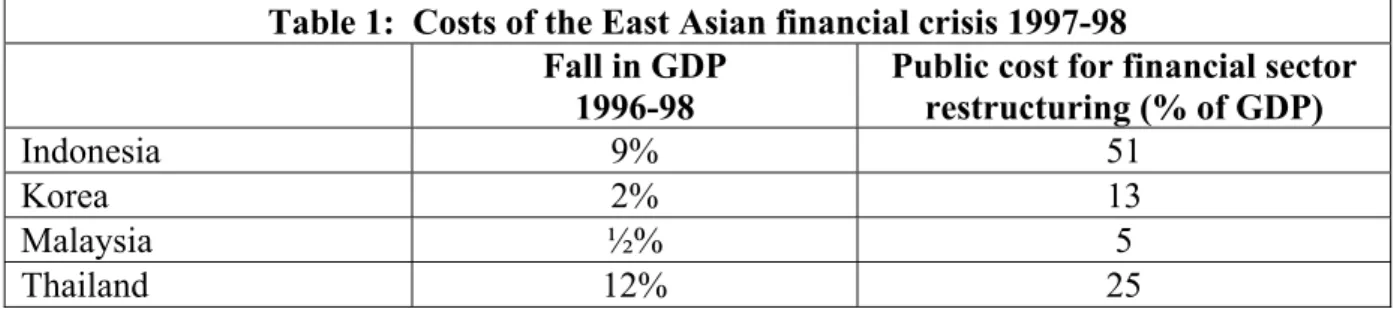
(7) giving instructions to the commercial banks on what loans they should and should not make, or on what interest rates they should charge to borrowers or pay to depositors, or on other aspects of their relationships with their customers. Direct methods of control are characteristic of state-controlled economies – for example, they were used in the Soviet bloc before it collapsed in the early 1990s. Indirect methods of monetary control, in their most idealised form, allow the state no role at all in the relationship between commercial banks and their customers. In the idealised model, the state, in the guise of the central bank, deals only with commercial banks and perhaps some other financial institutions. The role of the central bank is purely to supply central bank money to the financial system in such a way as to enable the objectives of monetary policy to be achieved. Decisions about how much credit to extend to non-bank borrowers, and at what interest rate, and about what interest rates to pay to depositors, are all left entirely to the private sector. Of course, those decisions are influenced by the behaviour of the central bank. To give an obvious example, if the central bank increases the interest rate at which it is willing to lend central bank money to commercial banks, then it can be expected that the commercial banks will increase the interest rates at which they lend money to borrowers. They may also reconsider the amounts of money which they are willing to lend. But the state does not directly control decisions about lending money. It is important to acknowledge that, in practice, no country in the world matches this idealised model in every respect. There are two particular respects in which they commonly differ from the idealised model: (i). All countries maintain lists of individuals, companies and countries with which financial institutions within its jurisdiction are forbidden to deal. For example, in the United Kingdom, commercial banks are forbidden to have any dealings with identified terrorists and their associates. More generally, anti-money laundering legislation requires commercial banks to report suspicious transactions to the authorities, and to check the identity of new customers who open accounts with them.. (ii). All countries conduct official supervision of commercial banks within their jurisdiction. The purpose of official supervision is to ensure that commercial banks are managed prudently. This is in order to reduce the risk of a commercial bank getting into financial distress. If a large commercial bank were to get into distress and fail, it would be likely to cause widespread losses to depositors and costly disruption to the economy. In order to avoid such consequences, the government might decide to recapitalise the bank using public funds. Such operations can be extremely costly. The table below shows some of the costs of the East Asian financial crisis of 1997-98, which took the form of both substantial falls in GDP in the affected countries (reflecting economic disruption arising from financial instability) and the financial cost to the government of restructuring the financial services industry.. 7.
(8) Indonesia Korea Malaysia Thailand Sources:. Table 1: Costs of the East Asian financial crisis 1997-98 Fall in GDP Public cost for financial sector 1996-98 restructuring (% of GDP) 9% 51 2% 13 ½% 5 12% 25. IMF |International Financial Statistics; C-J Lindren, T J T Balino, C Enoch, A M Gulde, M Quintyn and L Teo, Financial Sector Crisis and Restructuring: Lessons from Asia, IMF Occasional Paper No 188, 1999.. Official supervision of commercial banks is intended to help prevent financial instability of this kind. However, in doing so, it cannot avoid affecting in some degree the way in which commercial banks deal with their borrowing customers. In addition, in some countries, including the United Kingdom, competition law requires the government to regulate commercial banks’ dealings with their customers with the separate objective of ensuring that commercial banks do not collude or act as a cartel so as to increase the prices which they charge for their services, and more generally that customers are treated “fairly”. And governments sometimes encourage commercial banks to establish codes of practice which prescribe minimum standards for them to observe in dealing with customers. Thus, even in capitalist countries, the state regulates the commercial banks’ dealings with their customers in many ways in addition to simply managing the supply of central bank money. Nevertheless, certainly in long-established industrial countries, and increasingly in emerging market countries, commercial banks have a very large amount of discretion and autonomy in their dealings with their customers. It is true to say that credit decisions are made by the private sector and not by the state. In that sense, monetary policy implementation is truly indirect. 1.3.. Why is indirect implementation of monetary policy preferable?. Indirect implementation of monetary policy involves a very much smaller role for the state than direct implementation. The argument for indirect implementation is therefore much the same as the argument for relying on market forces rather than state control in economic affairs more generally. That argument is partly based on the belief that market forces allow more personal freedom than state control, and the political principle that personal freedom is intrinsically desirable. It is also based on the practical observation that market economies have grown faster, and met their citizens’ needs more fully and more effectively, than statecontrolled economies. Indeed, the collapse of the Soviet Union in 1991 can be explained mainly by the failure of its state-controlled economy, in which credit decisions in particular were made by the state rather than by the private sector, by comparison with capitalist economies. Most countries consider that these advantages of indirect methods of monetary policy implementation are decisive. There are now (2004) very few countries in which monetary policy is implemented through direct controls, and none of them has recently enjoyed any great economic success. However, one of the consequences of abandoning direct controls and adopting indirect monetary policy implementation is that the behaviour of the commercial banking system, and of the monetary and credit aggregates, becomes for a period. 8.
(9) very unpredictable, and hard for the monetary authorities to understand. In the United Kingdom, this happened in the 1970s. Monetary and credit aggregates grew very fast indeed after direct controls were removed in 1971, but it was very difficult to interpret their growth and to assess its significance for the economy. Specifically, it was impossible to say with any confidence whether the rapid growth was simply the natural result of the commercial banks expanding their businesses after a long period (of over 30 years) in which they had been subject to controls, or whether it represented a dangerous monetary expansion threatening a serious rise in inflation. In the United Kingdom, both interpretations turned out to be correct. The rapid growth of money and credit did represent a natural expansion of the commercial banking business after 30 years of controls, but it also carried a serious inflationary threat. In addition, some of the additional lending turned out to be of poor credit quality, and the United Kingdom consequently experienced a banking crisis in the mid-1970s. The general point is that managing the economy, and in particular managing monetary policy, is much more difficult during the temporary period of transition from direct to indirect methods of monetary policy implementation, because the transition process affects the information on which monetary policy decisions are based and makes it very hard to understand. Monetary policy has to “fly blind”. 1.4.. What indirect implementation of monetary policy requires from the central bank. Implementation of monetary policy through direct techniques involves issuing instructions to commercial banks about how they should manage their affairs. It is desirable that the central bank, when it formulates the instructions, should be familiar with the practical problems that the commercial banks will face in carrying out the instructions, so that the instructions do not add unnecessarily to the costs incurred by the commercial banks in managing their affairs. Therefore it is useful for the staff of the central bank to have a sympathetic understanding of the pressures on commercial banks. Indirect implementation changes the relationship between the central bank and the commercial banks. Central banks’ most important dealings with commercial banks are mediated through a financial market, rather than being conducted bilaterally. Central banks need to acquire the skills and ethics that are needed to deal in a market, and to understand and interpret the information that financial markets can provide about the current and likely future behaviour of the economy. They also need to be aware of the risks that the central bank is taking in its monetary policy implementation, including credit risk, as described below, and they need the ability to analyse and manage those risks. This will be explained in more detail later. In other words, the skills they need include not only the skills of a bureaucrat, formulating and implementing official policy, but also some of the skills of the commercial banker. Thus central banking straddles the worlds of both government and banking. In addition to human resources and skills, central banks which use indirect methods of monetary policy implementation also need certain pieces of physical infrastructure: (i). Secure telephone contact with other market participants, so that deals can be agreed, and so that the central bank can receive information about market sentiment and market developments. Telephone conversations need to be recorded so as to help resolve any disputes about what deals have been agreed.. (ii). Access to information about market prices, either on screens, or by telephone contact with brokers or other market participants. 9.
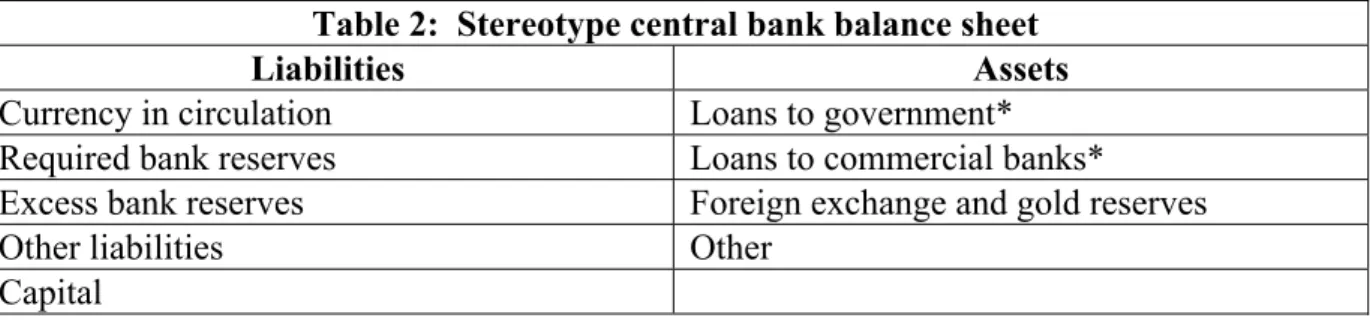
(10) (iii). Access to secure and efficient payment and settlement systems, through which payments can be made and securities delivered in order to settle agreed transactions.. (iv). Accounting systems, so that changes in the central bank’s balance sheet can be promptly and accurately recorded.. (v). Access to information about the creditworthiness of the central bank’s assets, and of the commercial bank counterparties with which the central bank has financial dealings.. There needs to be a degree of separation between those members of the central bank’s staff who are responsible for agreeing deals with other market participants, and those who are responsible for settling the deals by making the necessary payments and deliveries of securities. This is to reduce the risk of collusion for the purpose of fraud, and it is standard practice in all commercial banks and other market participants. 2. 2.1.. Managing the balance sheet of the central bank. The structure of the balance sheet. Indirect monetary policy implementation means managing the supply of central bank money to achieve the objectives of monetary policy. The term “central bank money” describes those of the liabilities of the central bank which are redeemable on demand, and which are therefore immediately available to settle debts. Central bank money is a liability of the central bank, and central banks do not give money away.3 So a change in the amount of central bank money outstanding is matched by a change in at least one other item in the central bank’s balance sheet. Central bank balance sheets vary in structure from country to country, but it is possible to construct a kind of stereotype central bank balance sheet, as shown below. Table 2: Stereotype central bank balance sheet Liabilities Assets Currency in circulation Loans to government* Required bank reserves Loans to commercial banks* Excess bank reserves Foreign exchange and gold reserves Other liabilities Other Capital *. These items should be interpreted broadly, to include (among loans to government) holdings of government securities, including on repo, and (among loans to commercial banks) holdings of commercial bills endorsed by commercial banks.. Which of the central bank’s liabilities count as “central bank money”? Currency in circulation is certainly central bank money, since it is immediately available to make payments. What about required bank reserves? If the reserve requirement to which commercial banks are subject obliges them to meet the requirement each day, then required 3. Though Milton Friedman famously discussed an experiment in which the central bank chartered a helicopter and dropped banknotes from the sky.. 10.
(11) reserves are not immediately available to make payments, and are not central bank money in any meaningful sense. However, if the reserve requirement can be met on average over a period (for example, over a month), then within that period, required reserves are available to make payments, but on condition that if as a result they fall below target on one or more days, the shortfall has to be compensated for on other days in the period.4 Thus with reserve averaging, required reserves have some but not all of the characteristics of central bank money. Finally, excess reserves are reserves held by commercial banks in excess of the minimum required. They are immediately available to make payments and therefore do constitute central bank money. Some of the other items in the balance sheet are outside the control of the central bank, or may be outside its control in certain circumstances. To be specific: (i). Most central banks supply currency on demand to commercial banks, which need it to meet demand from their customers. Equally, they buy back currency on request from commercial banks. When commercial banks purchase currency from the central bank, they pay for it by running down their reserves (required or excess), or by borrowing from the central bank. In the United Kingdom, the demand for currency varies considerably from day to day. It typically increases sharply each Friday, ahead of the weekend, and falls back each Monday. In addition, it increases very greatly before Christmas each year, and falls back again after Christmas. Longer-term variations of the public’s demand for currency depend, presumably, on real incomes and prices, which are not directly under the central bank’s control. They also depend on interest rates, which are potentially under the central bank’s control, but the dependency is not close or precise. Thus in the short term – in other words, in the period relevant for the implementation of monetary policy between one policy decision and the next – the public’s demand for currency is something which affects the central bank’s balance sheet, but which the central bank cannot control.. (ii). For those central banks which are obliged to meet the residual financing needs of their national government – that is, those financing needs which the government is unwilling or unable to satisfy through commercial borrowing – the item “loans to government” is not directly controllable. It depends on the budget deficit, and on how much of the budget deficit is financed by borrowing from commercial sources. Governments which behave irresponsibly by having large budget deficits which they cannot or will not finance by commercial borrowing typically finance the deficits instead by borrowing from the central bank. Thus the total of central bank loans to the government rises steadily, offset initially by a fall in central bank loans to commercial banks (because the flow of payments from the central bank will help the commercial banks repay loans from the central bank) and then by a rise in excess bank reserves. This increase in excess bank reserves, if not offset by some other central bank action, is likely to encourage the commercial banks to extend credit, thereby potentially aggravating the inflationary effects of the budget deficit. Not all government borrowing from central banks is harmful. For example, some governments use the banking services provided by the central bank, and borrow from the central bank at those times of year when expenditures exceed revenues, and place. 4. On the last day of the period over which the reserve requirement has to be met, required reserves are not immediately available to make payments.. 11.
(12) funds on deposit with the central bank (or repay their borrowings) at those times when revenues exceed expenditures. Over a whole year, the government may borrow nothing on balance from the central bank, but it may borrow temporarily during the year to smooth out seasonal fluctuations in its cash flow. Because governments can abuse their ability to borrow from their central banks, some central banks are forbidden by statute to lend to their governments at all. This is the case for central banks in the European Union – though they are allowed to buy government securities, on condition that they do so on their own initiative and in the secondary market. (iii). Where a country has a fixed exchange rate commitment, the central bank has to sell domestic currency and buy foreign exchange if the exchange rate reaches the bottom of the fluctuation band, so that the foreign exchange and gold reserves increase.5 The offsetting changes in the central bank balance sheet are likely to be a fall in central bank lending to commercial banks, or to the government, if the commercial banks use the domestic currency they have bought from the central bank to repurchase government securities that they had sold on repo to the central bank. There is also likely to be a rise in excess bank reserves. Contrariwise, if the exchange rate has reached the top of the band and market participants are selling domestic currency to the central bank, then the foreign exchange and gold reserves will be falling. The offsetting changes in the central bank’s balance sheet in this case are likely to be a fall in excess bank reserves, and a rise in central bank loans to commercial banks, to finance the purchase of foreign currency from the central bank. There may also be a rise in loans to government, if the commercial banks finance purchases of foreign currency from the central bank by selling government securities to the central bank, either outright or on repo. If the central bank does not take any action to offset the impact of foreign exchange intervention on its balance sheet, it is said to be sterilising the intervention. Thus, in the case where the exchange rate is weak and the central bank is buying domestic currency, the central bank would be sterilising the intervention if it did nothing to restrict its lending, for example by raising the interest rate at which it lends. There are serious doubts about the effectiveness of sterilised intervention as a means of influencing the exchange rate. Intervention in the foreign exchange market to support the domestic currency – ie to try to prevent a devaluation of the exchange rate – is limited by the amount of foreign exchange reserves available, the amount of external borrowing facilities available, and the willingness of the central bank and the national government to use them. There are no such limits on the amount of intervention that can be undertaken to prevent a revaluation of the exchange rate, because there is no upper limit on the amount of domestic currency that a central bank can create, other than any self-imposed limit, which might be dictated, for example, by the objective of maintaining or achieving price stability. In many countries, accumulation of foreign exchange reserves has threatened to cause a major expansion in central bank money, and central banks have therefore been anxious to find ways of sterilising foreign exchange inflows so as to. 5. The “bottom” of the band, for the purposes of this paper, means the point at which the lowest number of units of domestic currency is required to purchase one unit of foreign currency, ie the point at which the domestic currency has the highest value.. 12.
(13) reconcile, even if only temporarily, a conflict between an exchange rate commitment and domestic economic objectives, despite the doubts about the effectiveness of sterilised intervention in influencing the exchange rate. 2.2.. How can the central bank contain the growth of central bank money?. The previous section described the ways in which some elements of the central bank’s balance sheet can be out of the immediate control of the central bank. This section describes what the central bank can do to maintain a satisfactory level or growth rate of central bank money in the face of fluctuations in the other elements of its balance sheet. Large long-term fluctuations in particular elements of the central bank’s balance sheet can be offset, for a period, in their effects on the central bank’s balance sheet by the devices described in this section. However, they can normally only be permanently changed by an act of macro-economic policy. Thus if the central bank’s lending to government is increasing rapidly because the central bank is financing a large budget deficit, ultimately the only way of containing the growth of central bank money is for the government either to eliminate the deficit, or to finance it by borrowing from commercial sources. Likewise, if the foreign exchange reserves are increasing undesirably rapidly because of strong demand for the domestic currency in the foreign exchange market, then the government and the central bank face a hard choice between, first, continuing to accumulate foreign exchange reserves and accepting the consequences for domestic monetary policy, while no doubt hoping that the demand for domestic currency will decrease, and second, revaluing the exchange rate parity. And if commercial banks’ required reserves are rising rapidly because of rapid increases in their lending to customers, then a rise in short-term interest rates would be the natural way of reducing the growth of credit and of required reserves, if such a reduction was thought to be desirable. The use of macroeconomic policy instruments, such as changes in the budget deficit or its financing, changes in exchange rate parities, or changes in short-term interest rates, is beyond the scope of this paper, which is about the implementation of a monetary policy in which the setting of these policy instruments has already been determined (eg by the board or monetary policy committee of the central bank). Adjustments to the technique through which monetary policy is implemented cannot avert the need for changes in macroeconomic policy. However, they can accommodate short-term fluctuations, and they can sometimes “buy time” – in other words, contain market pressures for a period to enable the persistence of the pressures to be assessed and to enable changes in macroeconomic policy to be considered. Nevertheless, the amount of time that can be bought in this way is strictly limited, and moreover the time limit is uncertain. When the time limit expires, policy changes are enforced, eg by the impossibility of maintaining a fixed exchange rate any longer. So “buying time” can be risky. A preliminary general observation on the implementation of monetary policy through the management of the central bank’s balance sheet is that it is not technically difficult to deal with fluctuations which have the effect of draining funds from the commercial banking system – that is, of reducing the supply of central bank money. In that situation, it is normally sufficient for the central bank simply to make good the reduction in the supply of central bank money, eg by purchasing more assets from the commercial banks (either government securities or privately-issued securities such as commercial bills), or by reducing required bank reserves.. 13.
(14) Likewise, temporary fluctuations, such as seasonal fluctuations in the demand for currency, are not normally difficult to deal with. A seasonal rise in the demand for currency can, for example, be accommodated by temporary additional purchases of assets from commercial banks, or by a temporary reduction in required reserves. And a seasonal fall in the demand for currency can be accommodated by a temporary reduction in purchases of assets from commercial banks, or by a temporary increase in required reserves. 6 Temporary fluctuations in foreign exchange flows can be accommodated by using foreign exchange swaps. A foreign exchange swap comprises a delivery of currency A in exchange for currency B on the first settlement date, followed by an opposite delivery of currency B in exchange for currency A on the second, later, settlement date. Suppose, for example, that the central bank has bought US$10 million in exchange for SYP500 million7 and expects to receive the US$ on 1 March. Its cash flow will be: 1 March +10 million -500 million. US$ SYP. If it does a suitable swap transaction, with a maturity of, say, a month, it can change its cash flow as follows: Table 3: Effect of foreign exchange swaps on cash flows 1 March Original deal Swap Total US$ +10 million -10 million 0 SYP -500 million +500 million 0 *. 1 April Swap +10 million -500 million. Total +10 million* -500 million*. These amounts are not exact; they would need to be adjusted to allow for the difference in interest rates between US$ and SYP.. Thus central banks can use swaps as a means of effectively postponing the date of receipt of foreign exchange, and since swaps can readily be renewed, they are a very flexible instrument.8 Longer-term fluctuations can be more difficult to deal with, because they can be symptoms of a need for macroeconomic policy changes. A long-term drain of funds from the banking system might be caused by a government budget surplus, or a large permanent loss of foreign exchange reserves, for example. It could be offset by additional purchases of short-term assets from the commercial banks, or by purchases of longer-term assets, or by a reduction in required reserves. A long-term injection of funds into the banking system, for example 6. The temporary fluctuations in the demand for central bank money at the end of 1999 and the beginning of 2000 associated with fears of computer failures related to the millennial date change were more difficult to deal with, partly because the scale of the fluctuations was very hard to predict.. 7. SYP denotes Syrian pounds: see footnote 1.. 8. Used in this way, foreign exchange swaps are a means of temporarily withdrawing domestic currency from the commercial banking system. They can also be used in the opposite direction, to inject domestic currency temporarily into the commercial banking system, and to augment temporarily the foreign exchange reserves of the central bank.. 14.
(15) resulting from a large unfinanced budget deficit or an accumulation of foreign exchange reserves, can be more difficult to deal with, particularly if it is growing in size. The options, short of changes in macroeconomic policy, are: •. to increase required reserves;. •. for the central bank to sell any long-term securities which it owns;. •. for the central bank to issue and sell its own long-term securities.. Finally, if commercial bank lending to their customers is growing very fast, that will lead to rapid growth of bank deposits and to rapid growth in required reserves. That growth would naturally be offset initially by a reduction in excess reserves, and later by an increase in central bank purchases of short-term assets from the commercial banks. 2.3.. Advantages and drawbacks of central bank policy instruments. The group of policies that can be adopted to adjust the central bank’s balance sheet, without a change in macro-economic policy, includes the following: •. changes in the amount of short-term assets that the central bank purchases from the commercial banks;. •. purchases of long-term assets from the commercial banks;. •. foreign exchange swaps;. •. changes in required reserves;. •. issues of securities by the central bank itself.. What are the advantages and drawbacks of these policies? The first three of them – shortterm assets, long-term assets and foreign exchange swaps – can be used to provide domestic currency funds to the commercial banks.9 From the viewpoint of the central bank, they simply represent the investment of incoming domestic currency funds. Thus the choice between them depends partly on the relative financial returns that they offer. It also depends on the desired maturity composition of the central bank’s assets, and on the credit risks that they involve, both of which are discussed below. Most central banks impose reserve requirements on commercial banks in their jurisdiction, based on their domestic currency liabilities.10 Thus the requirement might be that commercial banks have to hold on deposit with the central bank an amount equivalent to (say) 2% of short-term domestic currency deposit liabilities.11 The requirement is normally based on the lagged total of deposit liabilities, so that at any time each commercial bank 9. Foreign exchange swaps can be used either to provide domestic currency funds to the commercial banks, or to withdraw domestic currency funds from them.. 10. Some central banks also impose reserve requirements on foreign currency liabilities.. 11. 2% is the minimum reserve requirement of the European Central Bank.. 15.
(16) knows the exact amount of its required reserves. The requirement might oblige commercial banks to observe the reserve requirement each day, or it might (as in the case of the European Central Bank) oblige them to observe the requirement on average over a period (for example a month). Another important aspect of reserve requirements is whether the central bank pays interest on them. If required reserves bear no interest, then they represent in effect an additional tax on commercial banks (additional, that is, to the other taxes to which commercial banks are subject). The tax revenues can be used to help meet the running costs of the central bank. Like all taxes, non-interest bearing reserve requirements create economic distortions. They discourage financial intermediation through domestic banks and encourage financial intermediation through non-banks and banks located in other countries. The distortions to financial flows have become larger as competition among financial institutions has become more intense. For this reason, the general level of reserve requirements has gradually fallen over the past quarter-century, and there has been a growing tendency for central banks to pay interest on required reserves (as the ECB does).12 Even if required reserves bear interest, so that they do not represent an additional tax on commercial banks, they nevertheless constrain the commercial banks’ asset allocation decisions. Therefore they involve some discouragement to financial intermediation through domestic commercial banks, even if only a minor one. Issues of short-term securities by the central bank itself are a means of absorbing funds from the commercial banks.13 From the viewpoint of the management of the central bank’s balance sheet and the supply of central bank money, increasing the amount of securities in issue has the same effect as increasing required reserves by the same amount. However, it has the advantage that it does not forcibly constrain commercial banks’ asset allocation decisions. It also has the drawback that the central bank also faces “refinancing risk” – that is, the risk that when the securities mature, it will not be able to refinance them, or at least not on acceptable terms. The central bank can overcome this drawback by retaining the option of increasing required reserves as a means of absorbing central bank money if it proves impossible for the central bank to issue its own securities. 2.4.. Profits and losses. In managing their balance sheets, central banks need to take account of the impact of their actions on their profits and losses. The foundation of most central banks’ profitability is the fact that the banknote circulation is non-interest bearing, so that the central bank gets the immediate benefit of the seigniorage – that is, the interest return on the assets corresponding to the note circulation.14 In addition, if required reserves are unremunerated, they too contribute to central bank profitability. However, three components of the central bank balance sheet can threaten the central bank’s profitability and lead to losses. 12. Central banks do not, however, pay interest on excess reserves.. 13. Foreign exchange swaps can be used for the same purpose.. 14. In some countries, including the United Kingdom, the government gets the benefits of the seigniorage.. 16.
(17) First, loans to government. If, for whatever reason, the central bank is prevailed upon or forced to make low-interest loans to the government, and if it finances those loans by running down assets which bear interest at market rates, or by incurring liabilities which bear interest at market rates, then those loans can threaten the central bank’s profitability if they are large enough. Second, loans to commercial banks. If the central bank makes low-interest loans to one or more commercial banks which are in financial distress, in order to prevent them from failing and to allow them to continue in business, and if it finances those loans by running down assets which bear interest at market rates, or by incurring liabilities which bear interest at market rates, then those loans too can threaten the central bank’s profitability. Of course, the effect will be much worse if the distressed commercial banks do not recover and are unable to repay the loans. Third, foreign exchange reserves. If the central bank acquires large amounts of foreign exchange reserves, eg in low-yielding dollars or in euros, which it sterilises, for example by selling domestic-currency securities, it may find that the interest cost of domestic-currency financing exceeds the interest return on its foreign exchange reserves. In those circumstances, the central bank will incur losses in holding foreign exchange reserves, which will increase as the foreign exchange reserves grow in size. How much does it matter if a central bank loses money? Central banks are not judged by their financial strength in the same way as commercial banks are. However, if the loss appears to be the result of mismanagement or incompetence, then it can damage the reputation of the central bank and thereby impair its ability to conduct monetary policy credibly, to play a role in maintaining financial stability, and to supervise commercial banks (if that is among the central bank’s responsibilities). Moreover, if the central bank’s capital erodes to a point at which it requires to be recapitalised by the government, then the relationship between the central bank and the government is likely to be reviewed and whatever independence the central bank has is likely to be threatened. 2.5.. The maturity structure of the central bank’s balance sheet. The central bank’s power to influence the economy depends on its monopoly of the supply of central bank money. In order to exploit its monopoly most effectively, the central bank needs to arrange the maturity structure of its balance sheet in an appropriate way. On any given day, the commercial banks’ demand for central bank money will be a fixed amount, determined by such matters as the public’s demand for currency, the amount of required reserves, etc. The amount will not be exactly known until after the end of the working day (eg because there are sometimes unpredictable delays in the payments system), and it will not be sensitive in the short-term to changes in interest rates. (A rise in interest rates might depress the growth rates of bank credit and deposits, and therefore of required reserves, but required reserves are usually calculated with a time lag – ie they are based on past deposits, not current deposits – and there is also a time lag between a change in interest rates and its effect on borrowing. The demand for excess reserves is normally small, and not sensitive to fluctuations in short-term interest rates, at least in the short term.) However, the commercial banks’ aggregate need for central bank money on any given day can be forecast. Also, the aggregate availability of central bank money can be calculated. The forecasting process will show that, on any given day, the commercial banks in aggregate will have either. 17.
(18) less central bank money than they need (a shortage), or more central bank money than they need (a surplus). If there is a shortage of central bank money in the commercial banking system, the central bank can exploit its monopoly of the supply of central bank money by dictating the terms on which it is willing to supply central bank money by lending to the commercial banking system to relieve the shortage. Normally, central banks use this device to determine the level of short-term interest rates in the economy. Central banks decide the interest rate at which they are willing to make short-term loans of central bank money to commercial banks, and that level of interest rates has a major influence on the interest rates which the commercial banks charge for loans and pay for deposits. If there is a surplus of central bank money in the commercial banking system, the central bank needs to absorb the surplus reserves in order to contain the growth of central bank money. It usually does so by offering to borrow central bank money. It can borrow central bank money by selling some of the securities that it holds (eg it might sell government securities on short-term repo), or by issuing and selling its own short-term debt securities. The central bank can have a powerful influence on interest rates in this way, by offering short-term securities to the banks at an interest rate of its own choosing. But its influence is perhaps not quite as powerful as in the case when there is a shortage of central bank money in the commercial banking system, because the commercial banks have no obligation to buy the securities which the central bank offers, and there is always a risk that the central bank will be unable to sell as many securities as it wants to at interest rates which it considers satisfactory. Therefore, in general, most central banks prefer there normally to be a shortage of funds in the commercial banking system, and the maturity structure of the central bank balance sheet can be adjusted so as to make shortages more frequent. Shortages of central bank money occur on days when the amount of payments to be made from the commercial banks in aggregate to the central bank exceeds the amount of payments to be made in the opposite direction. The central bank can increase the flow of payments from the commercial banks to itself simply by shortening the maturity of its assets. Suppose, for example, that, on 1 March, the central bank makes a loan of SYP100 million, for a week, to be repaid on 8 March. That loan will generate just one payment to the central bank, of SYP100 million (plus interest) on 8 March. If, instead, the central bank had made a series of 1-day loans of SYP100 million, each day for a week, then: •. the amount of lending that it had outstanding at any time between 1 and 8 March would have been exactly the same; but. •. on any day between 2 March and 7 March, the flow of payments from the commercial banks to the central bank would have been greater by SYP100 million.. 18.
(19) How the maturity of central bank assets affects its cash flows 1. Cash flows from a 1-week loan. 2. Cash flows from 5 overnight loans. Equally, the longer the maturity of the central bank’s liabilities, the greater the average daily flow of payments to the central bank. For this purpose, the currency circulation can be regarded as having a long average maturity, because although currency can be exchanged by banks in exchange for a payment flow on demand, in practice the amount of currency outstanding is very stable. Therefore, the maturity structure of the central bank’s balance sheet is important in maintaining the central bank’s power over the supply of central bank money and over the level of short-term interest rates. 2.6.. Credit risk in the central bank balance sheet. Whenever the central bank buys assets from commercial banks, it is exposing itself to the risk that the borrower will be unable to repay. It is not part of the proper function of a central bank to play a major role in allocating savings among investment projects: that function is assigned to the private sector in a market economy. Nevertheless, the central bank has assets and must decide how to allocate them. When purchasing short-term assets, it is normal practice for central banks to buy government securities on short-term repo, since government securities are of high credit quality in most countries. And the credit risk of the repo is not great, because if the central bank’s counterparty in the repo fails to return the money it has borrowed, then in most jurisdictions the central bank has the right to sell the government securities it has taken in the repo and use the proceeds of the sale as repayment of the loan of money. There is a risk that the market price of the government securities will have fallen in the period while the repo is outstanding, and central banks normally insist on receiving an amount of government securities which exceeds the value of the loan by a small margin, to provide reassurance that if it needs to sell the securities in the event of non-repayment of the loan, their market value will be at least equal to the amount of the loan.. 19.
(20) Normally, central banks are prepared to buy other short-term assets as well as government securities (for example, if there is a budget surplus, the supply of government securities may not be sufficient to meet the needs of the central bank). For example, many central banks buy short-term bills of exchange guaranteed by commercial banks. These involve some credit risk. Repayment is normally due from the commercial bank which guaranteed the bill. However, in most jurisdictions, if the commercial bank fails to repay, then the liability falls to other parties – namely the commercial bank which sold the bill to the central bank (which need not be the same as the bank which guaranteed the bill), and the original borrower who issued the bill of exchange. All of these parties need to fail if the bill is not to be redeemed, and if they are all of high creditworthiness, then in these circumstances bills of exchange are low-risk instruments. Central banks need to monitor carefully the creditworthiness of the commercial banks whose guarantees they accept, and to set limits on their risk exposures to individual banks. They also need to be ready to reduce (perhaps to zero) the amount of bills guaranteed by commercial banks whose creditworthiness has decreased that they are willing to accept, even though they may in doing so cause problems for the commercial bank concerned, by drawing attention to its worsening creditworthiness. As noted already, central banks can use foreign exchange swaps to absorb temporarily the domestic liquidity created by inflows of foreign exchange. As already noted (footnote 8), foreign exchange swaps can also be used in the opposite direction, enabling the central bank to inject money into the commercial banking system while in effect borrowing foreign currency for a short period. If swaps are used in this second way, then the central bank needs to invest the foreign currency it receives for a short period until the swap matures. As with domestic currency investment, it can choose between government securities (eg US Treasury bills or government securities repo, if the foreign currency in question is US dollars), or private sector assets such as bank certificates of deposit or commercial paper. This is exactly the same problem as the central bank faces in investing its foreign exchange reserves. Foreign exchange swaps carry the same kind of credit risk as repos of government securities, namely the risk that the counterparty will fail to return the foreign currency which the central bank has delivered to it. The central bank can then sell the domestic currency that it has received, but it may nevertheless lose money if the domestic currency has depreciated since the swap was originally agreed. It is, however, harder in the international market for foreign exchange swaps for the central bank to require an additional margin to protect it against this risk than in the domestic government securities repo market. The central bank therefore needs to monitor and manage its swap exposure to commercial banks very carefully. Foreign exchange swaps involve an additional kind of credit risk: settlement risk.15 For most countries, the two parts of a foreign exchange transaction are settled separately. For example, if bank A buys SYP for US$ from bank B, then the delivery of SYP from B to A takes place separately from the delivery of US$ from A to B. Moreover, because of the rotation of the earth and the difference in time zones, a delivery of SYP on a particular day will normally take place earlier than a delivery of US$. Therefore, there is normally a period (often of several hours) when B has delivered SYP to A, but not received any US$ in exchange. If A were to become insolvent during that period, A would not deliver US$ to B as agreed. B would be exposed to a potentially heavy loss, since in exchange for the delivery of SYP to A, B would receive in exchange only an unsecured claim of uncertain value on the residual assets of A. For the most heavily traded currencies, a new institution (Continuous Linked 15. Settlement risk in transactions in domestic financial markets can be eliminated by Delivery versus Payment (DvP) settlement systems.. 20.
(21) Settlement Bank – CLSB), which eliminates this settlement risk (through a technique known as Payment versus Payment, or PvP), began operations in 2002, but in most currencies, the risk remains; and central banks therefore need to monitor the creditworthiness of the commercial banks with which they deal in foreign exchange swaps and set limits to their risk exposures to individual commercial banks. When central banks are buying longer-term domestic-currency securities, they again have the option of buying government securities. Alternatively, there may be available other long-term domestic-currency securities of sufficiently high credit quality for the central bank to buy. 3. 3.1.. Open market operations. What open market operations are. Open market operations are the main device through which central banks adjust the supply of central bank money by buying or selling short-term assets. Central banks buy assets if there is a shortage of funds (ie of central bank money) in the commercial banking system, so as to provide the commercial banks with additional funds; and they sell assets if there is a surplus of funds, so as to drain the surplus from the commercial banks and prevent a build-up of excess bank reserves. Since central banks have a monopoly of the supply of central bank money, they can dictate the terms on which they are willing to supply funds to the commercial banks to relieve a shortage. They normally do so by prescribing the rate of interest at which they are willing to make funds available.16 Thus open market operations simultaneously achieve two objectives: •. they meet the aggregate needs of the commercial banks for central bank money; and. •. they help the central bank to achieve its objectives for interest rates.17. It is important to note that while open market operations are used to meet the aggregate needs of the commercial banks for central bank money, they cannot ensure that each individual commercial bank has all the central bank money it needs. Individual commercial banks which get into financial distress may be unable to get the central bank money they need. When that happens, there is a question as to whether any kind of official intervention is warranted, either to provide emergency official funds or to ensure an orderly winding-down of the bank’s business. Such issues are not discussed in this paper.. 16. In other words, they prescribe the minimum yield that they are prepared to accept on the short-term assets that they buy.. 17. Central banks which use monetary base control in its purest form (of which there are not many) control the quantity of central bank money and allow interest rates to float. Thus they have much less control over interest rates, but more control over the quantity of central bank money.. 21.
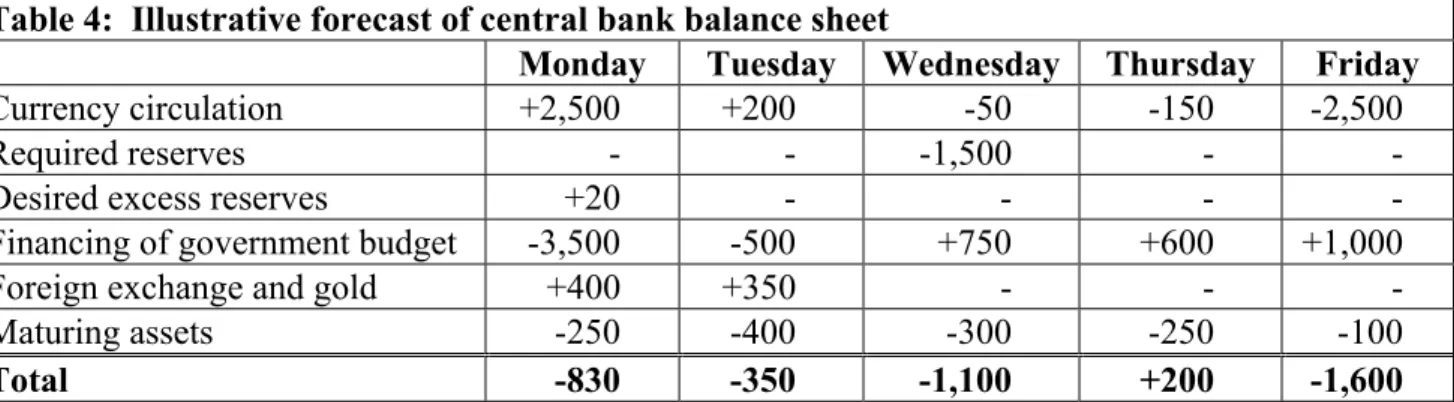
(22) 3.2.. Forecasts. In order to plan its open market operations, a central bank needs a forecast of the future aggregate need of the commercial banks for central bank money. The forecast is made by forecasting how the various elements of the central bank’s balance sheet are likely to develop. The open market operations conducted on a particular day adjust the supply of central bank money from what it would have been had no open market operations been conducted. Thus, in planning a particular day’s open market operations, what is important for that day’s dealings is not the level of the commercial banks’ demand for central bank money, but the change in their demand for central bank money since the last day on which open market operations were undertaken, and autonomous changes in the supply of central bank money. Table 4 shows an illustrative forecast of money market flows for a week (Monday-Friday).18 The main elements are: (i). the currency circulation, which falls sharply on Monday (because of the return of currency to the commercial banks after the weekend) and rises sharply on Friday;. (ii). required reserves, which rise on Wednesday, either because of a regular periodic recalculation or because of an increase in the percentage requirement;. (iii). desired excess reserves, which reflect the commercial banks’ demand for balances with the central bank which they can use freely;19. (iv). the financing by the central bank of the government budget deficit. In the illustration, the government has a large net inflow of funds on Monday, which could reflect tax receipts or, for example, the receipt of the proceeds of an issue of government securities;. (v). foreign exchange and gold flows, which may, for example, reflect official sales of domestic currency in exchange for dollars, undertaken in order to prevent the exchange rate from appreciating;. (vi). maturing assets. The central bank will have bought short-term assets in earlier open market operations, and will receive payment when they mature.. 18. It is assumed in the illustration that open market operations are undertaken each day. The frequency of open market operations is discussed below.. 19. Actual excess reserves will reflect errors in forecasting and cash flow management made by the commercial banks, and will normally not be equal to desired excess reserves.. 22.
(23) Table 4: Illustrative forecast of central bank balance sheet Monday Tuesday Wednesday Currency circulation +2,500 +200 -50 Required reserves -1,500 Desired excess reserves +20 Financing of government budget -3,500 -500 +750 Foreign exchange and gold +400 +350 Maturing assets -250 -400 -300 Total -830 -350 -1,100 Note:. Thursday -150 +600 -250 +200. Friday -2,500 +1,000 -100 -1,600. A – sign denotes a flow which absorbs central bank money from the commercial banking system, while a + sign denotes a flow which supplies central bank money to the commercial banks.. The total of these elements is the daily forecast shortage or surplus of central bank money in the commercial banking system. In the illustration, a shortage is forecast for every day except Thursday. 3.3.. How the forecasts are made. The different elements of the forecast are made in different ways, and with varying degrees of accuracy. (i). The currency circulation can be forecast by statistical methods. In the United Kingdom, it has a pronounced within-week pattern (it rises before weekends and falls back afterwards); a seasonal pattern (it rises before Christmas and Easter, and falls back afterwards); and a continuing upward trend. Forecasts made using statistical techniques are very useful and normally fairly accurate, except that, in the United Kingdom, the big seasonal changes at Christmas and Easter are often difficult to forecast accurately. Flows of currency may not be known with certainty until after they have taken place, because of delays in reporting.. (ii). Required reserves are regularly recalculated using new information about the deposits of individual commercial banks. Between recalculations, total required reserves do not change unless there is a change in the percentage requirement. Forecasts of required reserves over periods of several months in the future depend on assumptions about the future growth of bank deposits and bank credit, which can prove to be seriously inaccurate.. (iii). The commercial banks’ desired excess reserves are likely to be small, because excess reserves do not normally bear interest. They can usually be forecast fairly accurately by statistical means, or simply assumed to remain constant.. (iv). If the central bank is required to finance the residual government budget deficit – that is, the part of the deficit which is not financed by commercial borrowing – then it needs forecasts of what the residual deficit will be. Inevitably, it will have to rely on the government for the forecasts; experience in the United Kingdom is that such forecasts can often be seriously inaccurate. For one thing, governments often make mistakes in forecasting their tax revenues and expenditures over horizons of a year or so; but in addition, the central bank needs information about the timing of cash flows, which often depends on the unpredictable timing of the clearing of large payments. These flows are generally not known with certainty until after they have taken place.. 23.
(24) Incentive schemes can be designed to encourage governments to forecast more accurately. (v). Foreign exchange transactions in wholesale spot markets normally settle two working days after the deal is agreed. Therefore, on a Monday morning, foreign exchange settlements due on Monday and Tuesday are normally known with certainty, since the relevant deals will have been done on the preceding Thursday and Friday. Settlements from Wednesday onwards depend on transactions done from Monday onwards. If the motivation for the central bank’s dealing in the foreign exchange market is to prevent the exchange rate from moving in one direction or the other, or to dampen any movement, it is extremely difficult to predict what future flows will be, since they depend on market demand for domestic currency, which can be highly volatile. So forecasts of foreign exchange flows are often very inaccurate.. (vi). The schedule of maturing assets held by the central bank is known with certainty, so that forecasts should be completely accurate.. 3.4.. Managing uncertainty about cash flows. The previous section described the sources of information which the central bank has about its own cash flow, and explained that forecasts of the shortages or surpluses of central bank money in the commercial banking system are uncertain – even forecasts made for the same day. Commercial banks face the same uncertainties in forecasting their cash flows. Since they are normally required to keep their excess reserves accounts with the central bank in credit, they need to find ways of protecting themselves against unexpected adverse flows of funds. Such protection can be provided in a number of ways: (i). Commercial banks can aim to hold a cushion of excess reserves, so that they can absorb unexpected outflows of central bank money at short notice.. (ii). Some central banks (including the Federal Reserve and the European Central Bank) allow commercial banks to observe their reserve requirement on average over a reserve maintenance period, rather than obliging them to observe it every day.20 This means that, except on the last day of the reserve maintenance period, commercial banks can react to an unexpected outflow of funds by temporarily undershooting their reserve requirement, provided they compensate later by an equivalent overshoot. Reserve averaging is discussed below.. (iii). Most central banks have “standing facilities”. These facilities enable commercial banks to borrow overnight from the central bank against high quality collateral, so as to help them finance unexpected outflows of funds. The interest rate charged on this central bank lending facility is usually set at a high level relative to the rates that the central bank sets in its open market operations, so as to ensure that commercial banks use it only when they have exhausted all other possibilities for borrowing. Some central banks also have a standing facility in which commercial banks can deposit funds overnight with the central bank if they have surplus funds. The interest rate on such deposit facilities is usually set well below the rate that the central bank sets in its open market operations, again to ensure that the facility is used only as a last resort.. 20. In the United States, the reserve maintenance period is two weeks. In the euro area, it is about a month.. 24.
(25) If the central bank provides standing facilities for both borrowing and lending, then the interest rates on those facilities constrain the fluctuation of the market interest rate for overnight loans. No commercial bank will pay a higher rate to borrow overnight than the lending rate on the central bank’s standing facility, and no bank will accept a lower interest rate for an overnight deposit than the deposit rate offered by the central bank in its standing deposit facility. Thus the central bank can create a corridor within which overnight interest rates can fluctuate. And the limits to the fluctuation of overnight rates will also constrain the volatility of longer period rates. If the corridor is relatively narrow, then interest rates will be relatively stable, and the standing facilities will be relatively heavily used, but the development of a commercial market in overnight loans is likely to be inhibited. A wider corridor is likely to be more conducive to market development, but will allow greater interest rate volatility, at least in the short term. By conducting open market operations, by allowing reserve averaging, and by providing standing facilities, central banks enable the commercial banks to hold smaller excess reserves than would otherwise be necessary. Thus central banks contribute to the efficiency of the commercial banking system by making it possible for a larger proportion of commercial bank deposits to be lent to borrowing customers, and a correspondingly smaller proportion to be kept on deposit with the central bank as excess reserves, than would otherwise be the case. 3.5.. Conducting open market operations. As the previous section explained, once it has established its standing facilities, the central bank is passive in their use. It is for the commercial banks to decide whether to borrow on the standing facility from the central bank, and, if so, how much to borrow. In open market operations, the central bank has a more active role. It decides in advance how much money it wants to supply or absorb, and then does so by buying or selling assets from the commercial banking system. The central bank needs to decide how frequently to conduct open market operations. Open market operations are intended to handle the majority of the supply of central bank money. Therefore they need to be conducted at least once in each reserve management period. Many central banks conduct them more than once in each reserve management period – for example, in the United States, the Federal Reserve has the option to conduct open market operations each working day, even though the reserve maintenance period is two weeks. The arguments in favour of frequent open market operations are: (i). Because the forecasts of the central bank balance sheet are inaccurate and therefore prone to large revisions, and because they cannot run their required reserve accounts a the central bank below zero on any day, commercial banks need to keep their cash management under constant review. Frequent open market operations help the commercial banks to adapt to the revisions with less risk of becoming excessively dependent on, for example, overnight borrowing on the central bank’s standing facility.. (ii). The above argument is reinforced if there are limits on access to the central bank’s standing facility to borrow.. (iii). Concentrating the central bank’s provision of central bank money for each reserve management period on one round of open market operations may strain the capacity of the settlement system.. 25.
(26) When the central bank receives offers of securities, it must decide how to respond. Suppose, for example, that there is a forecast shortage of central bank money of 830 (as in the Monday illustration in Table 4); suppose that the level of interest rates announced by the central bank’s board or monetary policy committee is 4.00%; and suppose that it receives the following offers: Table 5(a): Illustrative open market offers (a) Amount. Interest rate. 200. 4.25%. 1,260. 4.00%. The central bank wants to supply 830 of central bank money. It will accept the 200 of securities offered at 4.25%, since they represent the most attractive opportunity available for the use of the central bank’s money. The central bank will also buy 630 of the securities offered at 4.00%, and will therefore accept 50% of each offer made at 4.00%. Now suppose that the offers are as in Table 5(b). Table 5(b): Illustrative open market offers (b) Amount. Interest rate. 230. 4.00%. If the total amount of offers falls short of the forecast shortage, the central bank cannot supply enough central bank money through open market operations to relieve the shortage. In these circumstances, the central bank will accept all of the securities it has been offered, and market overnight interest rates will rise as commercial banks try to borrow funds in the market to meet their needs. Commercial banks will meet their residual need for 600 of central bank money by borrowing overnight on the central bank’s standing facility. The central bank needs to decide on several issues before it embarks on a round of open market operations: (i). What amount of assets it wants to buy (assuming there is a shortage of central bank money in the commercial banking system; if there is a surplus, the central bank needs to decide what amount of assets it wants to sell).. (ii). What period to maturity the assets should have.. (iii). Whether the central bank should specify in advance the price (or interest rate) at which it will supply central bank money, or whether it should allow offers of securities at different prices (interest rates).. (iv). Which counterparties (banks or other financial companies) may take part in open market operations.. (v). What information to publish about open market operations.. 26.
Figure

+2
Related documents
It is shown that re- sequencing and de novo sequencing of the majority of a bacterial genome is possible with read lengths of 20–30 nt, and that reads of 50 nt can provide
To develop the main arguments in a straightforward way, I will concentrate on covering four research papers in some detail: a model of local strategic substitutes on a network
The project target groups include: bookbinders (self-employed) and workers in small bookbinding workshops/ateliers, unemployed workers from former large bookbinding workshops
policy-relevant messages to be brought to the attention of policymakers, as well as open questions requiring further research to address policy needs. This document
s73 hsdisc bird 1.57222 mMN.m −3 Half saturation constant of discard rate of birds and mammals s74 ucorp bird 0.02003 mMN.m −2 .d −1 Maximum uptake rate of corpses by birds and
The DMAIC method is primarily based on the application of statistical process control, quality tools, and process capability analysis; it is not a product development methodology..
Based on the data analysis and the findings of the study, this study was concluded that before the treatment of Reciprocal Reading Strategy, the basic knowledge of students at grade
The development of a dedicated financial intelligence capacity within the South African Police Service Commercial Branch’s Government Commercial Crime Special Investigating Unit..
