WESTERN NEVADA COLLEGE
Academic
Program Guide
www.wnc.edu
Start Here -
Go Anywhere
Western Nevada College
-make your career a reality
Western Nevada College offers academic degrees and programs
to meet a variety of educational goals. You may wish to learn technical skills
or work toward a career, or you may be preparing for transfer to a four-year
college or university. A number of one-year certificates are also offered in
technical areas. Inside you will find specific information about each degree or
certificate. WNC is here to help you make important decisions about your future,
and to prepare for success!
-INFORMATION
775-445-3000 • www.wnc.edu
TIP
CHECKLIST FOR SUCCESS…
— APPLY FOR ADMISSION
— TAKE PLACEMENT TESTS
— MEET WITH A COUNSELOR
— APPLY FOR FINANCIAL AID
— REGISTER FOR CLASSES
— ATTEND AN ORIENTATION
— PAY BY THE DEADLINE
TIP
STEPS ALONG THE WAY…
Choose the items below that pertain to you.
(You may not need all of these)
______ See a counselor
______ Develop an educational plan
______ Visit the Student Center at WNC Carson
______ Get a free planner & an ID card
______ Sign up for a Fitness Center membership in the Student Center
______ Apply early for financial aid - www.wnc.edu/studentservices/financial
______ Apply for scholarships - www.wnc.edu/studentservices/financial
______ Arrange for child care, if needed
______ Join a student club or organization
______ Visit the Veterans Resource Center located in Cedar Bldg./Rm. 327
______ Use the library for study and research
Academic Programs
-to fit your needs
Career Degrees
CAREERS
OCCUPATIONAL PROGRAMS & EMPHASES
WNC offers two-year career preparation programs in many areas. Students learn technical skills that lead to jobs
and earn a two-year Associate of Applied Science degree. Choose from many career areas.
A
four-year Bachelor of Technology degree in Construction Management is also available to help students
climb a career ladder from learning basic construction skills, to becoming a construction manager.
Bachelor of Technology Degree
• Construction Management
Associate of Applied Science Degree
• Business - Accounting
• Business - General
• Business - Management
• Criminal Justice - General
• Graphic Communications
• Nursing
• Technology - Automated Systems
• Technology - Automotive Mechanics
• Technology - Computer Information Technology
• Technology - Construction
• Technology - General Industrial
• Technology - Machine Tool
• Technology - Welding
TIP
MANAGE YOUR TIME WISELY…
A 3-credit/unit class requires three hours of in-class time per week
(a 4-credit/unit class requires four hours in class per week). For
every one hour you spend in class, you should set aside a minimum
of two extra hours of study time outside of class (to do the reading,
study for tests, etc).
If I take ____ credits/units, then I should expect
to spend ____ x 3 = _____ hours per week in class and studying.
Add this number of hours to the number of hours you are working,
eating, sleeping, exercising, and socializing…do you have enough
hours in the week?
Skill Development
CAREERS
Certifications
Associate of General Studies Degree
This general degree fits a wide variety of needs. See a counselor for details.
Certificate of Achievement
One-year academic programs that provide specific
career skills.
• American Sign Language
• Automotive Mechanics
• Bookkeeping
• Business
• Computer Technology, Network Support Technician
• Computer Technology, System Administration Technician
• Criminal Justice - General
• Early Childhood Education
• General Industrial Technology
• Graphic Communications
• Industrial Electronics Technology
• Machine Tool Technology
• Retail Management
• Welding Technology
Workforce Certifications
• Automotive Service Excellence
• Bookkeeping
• Certified Inspector of Structures
• Certified Nursing Assistant
• Cisco Certified Networking Associate
• CompTIA Security+
• Deaf Studies - Interpreting
• Emergency Medical Services
• Industrial Electronics Technician
• Machine Tool Technology
• Manufacturing Technician
• Microsoft Certified Technology Specialist
• Microsoft Certified IT Specialist
• Phlebotomy/Venipuncture
• Real Estate
• Teacher Education
• Welding Certification
TIP
SUCCEED WITH ONLINE CLASSES …
Are you ready for an online class? Online and hybrid classes are
delivered using the internet. These courses are not faster or easier than
in-person classes, nor are they self-paced. Answer these questions truthfully…
• Are you self-motivated?
• Is your reading comprehension good?
• Do you have strong computer skills?
• Do you feel OK about missing the social elements in the classroom?
• Do you own a computer?
CAREERS
Transfer Degrees
WNC enables you to prepare for these areas of study
TRANSFER PROGRAMS & EMPHASES
WNC attracts a large number of students who plan to earn a baccalaureate degree from another four-year college
or university. They choose to begin their college education at WNC for many reasons, including lower tuition cost,
smaller class sizes, flexible class times, and a personalized learning environment.
Associate of Arts & Associate of Science
These degrees are primarily for the student who plans to transfer from WNC to a four-year college or university
to pursue a baccalaureate degree in liberal arts, sciences, humanities, math or related areas.
These programs of study can provide the first one or two years of a four-year degrees. Students can choose
courses that will apply to their desired major.
ASSOCIATE OF ARTS DEGREE
• Accounting• Accounting Information Systems • Agriculture Science
• Anthropology • Art
• Art History
• Communication Studies • Community Health Sciences • Criminal Justice
• Criminal Justice (PreLaw) • Economics
• English
• Environmental Science • Finance
• Forest Management & Ecology • French • General Business • General Studies • Geography • History • Human Development & Family Studies • Information Systems
• Integrated Elementary Teaching • International Affairs • International Business • Journalism • Management • Marketing • Music • Music Education • Music: Applied • Nursing • Philosophy
• Philosophy (Ethics, Law & Politics) • Political Science
• Psychology
• Rangeland Ecology & Management • Secondary Education • Social Work • Sociology • Spanish • Speech Pathology • Theatre • Veterinary Science • Women’s Studies
ASSOCIATE OF SCIENCE DEGREE
• Atmospheric Science• Biochemistry & Molecular Biology • Biology
• Chemical Engineering • Chemistry
• Civil Engineering
• Computer Science & Engineering • Ecohydrology • Electrical Engineering • Engineering Physics • Environmental Engineering • Environmental Science • Geological Engineering • Geology • Geophysics • Hydrogeology • Materials Science & Engineering • Mathematics • Mechancial Engineering • Metallurgical Engineering • Mining Engineering • Molecular Biology/ Immunology • Neuroscience • Nutrition • Physics • Wildlife Ecology & Conservation
TIP
CHECKLIST FOR SUCCESS…
Students who plan to transfer should work closely with a WNC counselor and keep in contact with their
intended transfer institution.
Majors
How WNC Courses Transfer
COUNSELING
Counselors are available weekdays and some evenings at
cam-pus locations to help students plan their academic schedules and
ensure understanding of major/graduation requirements and
current transfer guidelines. Counselors can also assist students
with career exploration, interest testing and job search
tech-niques, and provide current information about labor markets
and educational training requirements.
Information . . . 445-3267 •
www.wnc.edu/studentservices/counseling/
TESTING
Every student planning to register for English or math courses
must either take placement tests, submit ACT/SAT scores (no
more than two years old), or provide a transcript showing
completion of prerequisite courses. Testing assesses a student’s
current skills in reading, writing and math, and helps students
select the appropriate courses.
TRANSFER CENTER/CAREER CENTER
The center provides a variety of services designed to assist
transfer from WNC to another college or university as well as
provide information regarding career descriptions, job outlook,
work settings and preparation necessary to enter specific career
fields. The Transfer Center is available through Counseling
Ser-vices at WNC campuses.
DISABILITY SUPPORT SERVICES (DSS)
Support services for WNC students with disabilities are
pro-vided through Counseling Services on the Carson City campus.
For effective and timely services, students should submit their
requests for assistance at least four weeks in advance.
Student Services -
help achieve your goals
CAREER CONNECT
Students with disabilities who are attending at least one WNC
class at any campus/center or web-based class, and have an
open case with DETR-VR can apply for assistance and will be
referred to Career Connect. Staff will work closely with a
DETR-VR Counselor throughout the referral, eligibility, planning, and
follow-up processes to ensure coordinated service provision
will lead to successful employment outcomes.
Disability Services/Career Connect Carson City campus, Cedar Bldg., Room 212
445-4459 • TTY: 445-4489 • [email protected]
445-3248 • [email protected]
FINANCIAL ASSISTANCE
All students are eligible for some type of financial assistance
which includes grants, scholarships, loans and part-time
employment to assist them in meeting educational expenses.
Deadlines are posted on the application.
Application available . . . 445-3264
• www.wnc.edu/studentservices/financial/
VETERANS SERVICES
The college maintains a Veterans Resource Center on the
Carson City & Fallon campuses. Information concerning
veterans services is also available through Counseling Services,
Financial Assistance or WNC’s outlying campuses. Those who
are eligible for veterans benefits include: honorably discharged
veterans, children of 100 percent service-connected disabled
veterans, and the widowers and children of veterans who died
in service or from service-connected disabilities.
VOLUME 11
FEATURE STORIES
Career and Technical Education/JumpStart ... 2
Veterans Resources ... 4
GENERAL EDUCATION
...3STUDENT LEARNING OUTCOMES
...3TRANSFER DEGREES
...4-6 Associate of Arts Degree ... 5Associate of Science Degree ... 6
CAREER DEGREES
Associate of General Studies Degree ... 7Bachelor of Technology Degree ... 8
Construction Management ... 9
Associate of Applied Science Degree ... 10-11 Business-Accounting ... 12 Business-General ... 15 Business-Management ... 23 Criminal Justice-General ... 18 Deaf Studies ... 19 Graphic Communications ... 20 Nursing ... 24-26 Technology-Automated Systems ... 13 Technology-Automobile Mechanics ... 14
Technology-Computer Information Technology ... 16
Technology-Construction ... 17
Technology-General Industrial Technology ... 21
Technology-Machine Tool ... 22
Technology-Welding ... 27
Find What You Need
____________________________________________________________ NON-DISCRIMINATION STATEMENT WNC is guided by the principle that there shall be no difference in the treatment of persons because of race, religion, color, age, gender, including a pregnancy-relat-ed condition, sexual-orientation, military status or military obligations, disability, including veterans with service-connected disabilities, or national origin, and that equal opportunity and access to facilities shall be available to all. Similarly, there shall be no difference in the treatment of persons who file charges of tion, participate in a discrimination proceeding, or otherwise oppose discrimina-tion. It is our policy to comply fully with the non-discrimination provision of all state and federal regulations with regard to recruitment, admission, financial aid, activities, hiring, promotions, training, terminations, benefits and compensation. ______________________________________________________________ COLLEGE MISSION Western Nevada College inspires success in our community through opportunities that cultivate creativity, intellectual growth and technological excellence, in an environment that nurtures individual potential and respects differences. ______________________________________________________________ COLLEGE GOALS 1. Student Success • WNC students graduate with a degree or certificate • WNC students engage in the college experience 2. Institutional Excellence • WNC is the educational institution of choice in western Nevada • All academic programming is of the highest quality • All support programs and services meet the needs of the WNC community • WNC has an exemplary system of governance and management • WNC strives for institutional sustainability 3. One College Serving Many Communities • WNC promotes access to higher education in western Nevada • WNC serves as a catalyst for personal and community enrichment • WNC promotes community connectionsSKILL DEVELOPMENT
Certificate of Achievement ... 28American Sign Language ... 29
Automotive Mechanics ... 29
Bookkeeping ... 30
Business ... 30
Computer Technology-Network Support Technician... 31
Computer Technology-System Administration Technician ... 31
Criminal Justice-General ... 32
Early Childhood Education ... 32
General Industrial Technology ... 33
Graphic Communications ... 34
Industrial Electronics Technology ... 34
Machine Tool Technology ... 35
Retail Management ... 35
Welding Technology ... 36
Certification Preparation Programs ... 37-39 Economic Development and Continuing Education Programs ... 40
TRANSFER DEGREES • Pages 4-6
CAREER DEGREES • Pages 7-27
JUMPSTART COLLEGE
Douglas High Senior Enjoys Benefits of Jump Start Program
An introduction to college academics while still in high school is
what Western Nevada College’s Jump Start program is all about.
Taking college-credit classes, receiving an early preview of
col-lege life, reducing higher education costs and improving time
management skills are just some of the benefits of the college’s
Jump Start program, said Brooklyn Ives, who will attend WNC
this fall.
“The Jump Start program has benefited
me in many ways,” said Ives, a participant in the
2014-15 Jump Start program. “This program has
given me a taste of how college is going to be
and has prepared me for my upcoming years in
college. It has made me work harder as a student
considering the workload and has taught me how to manage
my time well. ”
Jump Start College is a partnership between Western
Nevada College and 10 high schools and academies in the
region. It offers high-achieving juniors and seniors the
opportunity to earn up to a college associate degree by
the time they graduate from high school. Carson, Churchill
County, Douglas, Dayton, Fernley, Smith Valley, Silver Stage,
Virginia City and Yerington high schools, as well as Oasis
Academy, are participating in the program. Ives said that the
math and English classes that she took as part of the
Jump-Start program made her take ownership of her education.
“With college classes comes more responsibility and the
instuctors have higher expectations, which teaches students
to be more independent,” she said. ”It is up to us as students
to keep up on our work and never get behind. I am learning
Expediting training so that students can gain skills and become
employed faster is what the Trade Adjustment Assistance
Com-munity College and Career Training program is designed to do.
Through the federally funded TAACCCT grant, Western Nevada
Col-lege can offer accelerated classes in automotive mechanics, machine tool
technology and welding, as well as assist with Certified Nursing Assistant,
Cisco Networking and new Applied Industrial Technology programs on the
Carson City campus. TAACCCT-funded programs in welding and CNA are
available on WNC’s Fallon campus as well.
“The accelerated classes allow students to obtain skills that are in
demand in 16 weeks rather than the normal two years,” said David
Stei-ger, WNC’s director of Economic Development and Continuing Education.
“The intent is to get them trained and get them working.”
The accelerated classes are based on the "Right Skills Now" model
the difference between college and high school classes, and it is teaching
me what to expect from other college classes.”
Another major difference that Ives discovered was “the workload is
definitely more than I thought coming into it, but as far as how hard the
work is, it isn't much harder than high school.”
Ives said that the Jump Start classes changed her study habits and
necessitated managing her time more closely.
“The amount of work given is a lot, but you
learn to manage your time to be able to get
every assignment completed. If you fall behind,
it shows in your grade and it is a challenge to get
a poor grade up, so you learn to stay ahead from
the beginning,” Ives said. “I also have to dedicate
more time for myself to study because the material we
cover is very in-depth, and each test is worth 25 percent
of our grade, which we can't afford to do poorly on.”
As part of the first group of students to go through
WNC’s Jump Start program, she says that future students
in the program should know going in that the classes are
challenging and require extra motivation and arduous
work.
“I would tell future Jump Start students to keep
an open mind about the program because there are
many things that will be different from high school-the
instructors, the amount of work and the way each class
is taught,” Ive said. “A student taking these classes must
be motivated and hardworking … it can be a challenge,
but in the end, it is worth it.”
originally developed for machine tool training by the National Association
of Manufacturers. WNC was the first school in Nevada to adopt the format.
Steiger said that WNC is on its third round of funding from the
$4.4 million grant, which started on Oct. 1, 2014. The grant will extend
through Sept. 30, 2018.
In accelerated classes, students can earn up to 24 units in a single,
16-week semester. The two-week classes typically run 8 a.m. to 2 p.m.
at least four days a week, giving students a chance to complete multiple
areas of study before the semester ends.
“In some of these programs, a student can literally get one level of
certification in a 16-week semester,” said Ryan Stryffeler, interim director
of WNC’s Career and Technical Education Division. “Certainly many of
these students can get a degree in three semesters instead of four or five.”
CAREER & TECHNICAL EDUCATION
Accelerated Classes Get Students Working Sooner
Brooklyn Ives
__________________________________
“I am more college ready
because of Jump Start.”
___________________________________
STUDENT LEARNING OUTCOMES
INSTITUTIONAL STUDENT LEARNING OUTCOMES
Student learning is the core of WNC's mission and the college celebrates this importance with institution-wide learning outcomes. The Institutional Student Learning Outcomes guide all courses, programs, and degrees offered by WNC.
Students completing degrees at WNC need to demonstrate a combination of intellectual skills, personal and social responsibility, and the ability to integrate knowledge and skills to understand and solve contemporary and enduring problems. .
Upon completing a degree at WNC, students must demonstrate:
GENERAL EDUCATION STUDENT LEARNING OUTCOMES
General education provides the opportunity to further many of the institutional student learning outcomes by providing specific objectives that students are expected to demonstrate upon the completion of degrees.
The mission of general education at WNC is to provide students who complete degrees and certificates with critical life skills that will benefit them in their personal and professional endeavors.
1. Working Knowledge -Identify, describe, and apply information, theories,
methodologies and approaches from the sciences, social sciences, and humanities/arts.
2. Written Communication - Write effective projects, papers, and reports.
3. Quantitative Reasoning - Present accurate calculations and symbolic
operations, and explain how such calculations and operations are used in either the specific field of study or in interpreting information in other fields.
4. Information Competency - Locate, evaluate, and appropriately use
information from multiple resources to complete projects, activities, and papers.
5. Diversity & Society - Describe diverse historical and/or contemporary
positions on selected democratic values or practices.
6. Critical Thinking - Integrate knowledge and skills from the study of
sciences, mathematics, social sciences, and the humanities/arts to think critically about and develop solutions to contemporary and/or enduring problems.
7. Career Preparation - Identify, describe, and apply information in the
discipline or career area of their choice sufficient for further study and/ or demonstrate competencies required to succeed in the workplace.
INTELLECTUAL SKILLS
1. Demonstrate working knowledge of key concepts, principles, themes, and major content areas needed to explain and solve discipline-specific problems.
2. Present substantially error-free prose suitable in style and content to the purpose of the document and the audience.
3. Present accurate calculations and symbolic operations, and explain how such calculations and operations are used in either the specific field of study or in interpreting information in other fields.
4. Locate, evaluate, and appropriately use information from multiple resources to complete projects, activities, and papers.
PERSONAL AND SOCIAL RESPONSIBILITY
5. Describe diverse historical and/or contemporary positions on selected democratic values or practices.
6. Take an active role in a community context (work, service, co-curricular activities, etc.), and examine the civic issues encountered and the insights gained from the community experience.
7. Design an approach or process toward resolving a social, personal or ethical dilemma.
INTEGRATIVE LEARNING
8. Describe approaches from at least two disciplines that identify, define, and address the importance of a significant contemporary or enduring problem. 9. Use critical thinking and creativity to select and apply recognized methods suitable for solving significant contemporary or enduring problems. 10. Draw a conclusion about how to solve a significant contemporary or enduring problem, and present a rational defense of the conclusion.
TRANSFER DEGREE
TRANSFER DEGREES
Associate of Arts • Associate of Science
WNC students may select a course of study that enables themto complete some or all of the lower division requirements for a four-year degree from the list of transfer programs at the Univer-sity of Nevada, Reno, UniverUniver-sity of Nevada, Las Vegas, Nevada State College or other schools. Recent surveys of WNC students show they have transferred to colleges throughout the country including: UNR; UNLV; Nevada State College; Southern Utah University; University of New Mexico; Arizona State University; California State University, Sacramento; University of Califor-nia at Berkeley; University of Kentucky; University of Southern California; Truckee Meadows Community College; University of Phoenix; Cosumnes River College-Los Rios; Lake Tahoe Commu-nity College; Great Basin College, Salt Lake CommuCommu-nity College, and many more.
Every year, large numbers of WNC students successfully transfer to other schools. Each school has its own specific require-ments and recommended electives for its various degrees. Com-munity college students who plan to transfer to the University of Nevada, Reno, University of Nevada, Las Vegas or Nevada State College and who did not complete the university entrance require-ments in high school must complete a minimum of 24 transferable units with a minimum 2.5 grade point average. Students who earn an Associate of Arts or Associate of Science degree will be admitted to an NSHE university or state college regardless of their grade point average.
Student Veteran Educates
More Than Himself at WNC
After serving his country for eight years in the U.S. Marine
Corps, Timothy Galluzi decided to assist his fellow
veterans when he returned to civilian life.
When the Santa Rosa, Calif., native relocated to northern
Ne-vada, he didn’t know anyone. Now, Galuzzi is one of
the most recogniz-able faces on campus because of what he has done for other veterans.
“I started off as club treasurer for a month, then I took over
club presi-dent,” said Galluzi, who transformed a small student veterans club into a large
and influential student organization.
Over the course of his club presidency, the college notably opened a
Veterans Resource Center. WNC was among 250 community colleges and
uni-versities recognized by the Obama administration for making tremendous
strides to meet specific needs of present day veterans. Galluzi said the club
helped create camaraderie, team building and improve quality
of life and ed-ucation for students.
“I have been really lucky in what I’ve been able to
accom-plish, and I wanted to provide other students the same benefits and help that
I received. I wanted to pay it forward to other student veterans,” Galluzi said.
He also established a veterans peer mentorship program,
cre-ated a scholarship research program for student vets,
participat-ed in training to bring awareness to faculty members about vets who
might suffer from post-traumatic stress disorder, and served as a math
tu-tor at the Veterans Resource Center.
“There’s 24 hours in a day, and I make the best of most of them,” said
Galluzi, who is now a full-time employee at the Veterans Resource Center.
“We aren’t done yet; we’re just getting started.”
Furthermore Galluzi serves on the student veterans advisory council,
which provides recommendations for executive and legislative action on
how to better student lives, ultimately leading to more student veteran
suc-cess,” Galluzi said.
While helping so many others launch and further their education
pursuits, Galluzi still has found the time to further his own education. Last
spring, Galluzi earned an Associate of Science degree and is currently taking
online classes as he works toward a Bachelor’s Degree in Business
Manage-ment.
“We have 150 veterans here on campus. The programs that we’ve worked on and the outreach
that we have established have helped every single one of them, if they know it or not.”
TRANSFER DEGREE
Associate of Arts
_______________________________A TRANSFER DEGREE_______________________________
The Associate of Arts degree is primarily for students planning to transfer with junior standing to a four-year college or university for a baccalaureate degree. It can be used to transfer into a wide variety of majors depending on the courses selected. Satisfactory completion of an AA degree guarantees completion of the lower division general education requirements at University of Nevada Reno , University of Nevada Las Vegas or Nevada State College.
Courses with a number under 100 (such as ENG 95) are not applicable toward the Associate of Arts degree. All courses to be
___________________________________________________________________________________________________________________________________
ASSOCIATE OF ARTS DEGREE REQUIREMENTS
___________________________________________________________________________________________________________________________________ REQUIREMENTS: A minimum of 60 units chosen from the following:
ENGLISH/COMMUNICATIONS REQUIREMENTS - 6–8 units. English: 100 or 101, 102
FINE ARTS REQUIREMENT - 3 units. Art: 100, 101*, 160, 260, 261 Dance: 101 Humanities: 101 Music: 121, 124, 125 Music: Ensemble: 101* Theatre: 100, 105*, 180
* Course may not meet the fine arts requirement at all universities. Please see a counselor.
HUMANITIES REQUIREMENT - 6 units. Core Humanities: 201, 202
English: 200, 223, 266, 267, 271 History: 105, 106, 247
Philosophy: 101, 135, 200, 203, 204, 207, 210
UNR transfer students: Choose one from Group A and one from Group B. Group A: Core Humanities 201 History 105 Philosophy 200 Group B: Core Humanities 202 History 106 Philosophy 207
MATHEMATICS REQUIREMENT - 3 units. Mathematics: 120, 126, 127, 128, 176, 181, 182 Statistics: 152
SCIENCE REQUIREMENT - 6 units. One lab science course recommended. Anthropology: 102, 110L
Astronomy: 109, 110, 120 Atmospheric Sciences: 117
Biology: 100, 113, 190 & 190L, 191 & 191L, 200 Chemistry: 100, 121, 122
Environmental Studies: 100 Geography: 103, 104
Geology: 100, 101, 102, 103, 105, 127, 201 Nutrition: 121
Physics: 100, 151, 152, 180 & 180L, 181 & 181L, 182 & 182L
Note: Completion of CHEM 121, BIOL 223 and BIOL 224, and BIOL 251 fulfills the science general education requirement.
SOCIAL SCIENCES REQUIREMENT - 3 units. Choose from the following list.
Anthropology: 101, 201, 202, 212, 215 Core Humanities: 203 Criminal Justice: 101, 102 Economics: 100, 102, 103 Geography: 106, 200 History: 101, 102, 111, 217 Political Science: 103, 208, 231, Psychology: 101, 102, 233, 234, 240, 261 Sociology: 101, 205, 261, 275
U.S. & NEVADA CONSTITUTION REQUIREMENTS - 3 or 6 units. Must meet both requirements. Choose from:
Core Humanities: 203 History: 111 History: 101 & 102 History: 101 & 217 Political Science: 103
History and Political Science Combination (History 101 and Political Science 208)
TRANSFER REQUIREMENTS OR GENERAL ELECTIVES - 25–30 units.
Students should utilize this area to take courses that meet requirements for their major at their intended transfer school. Those who have not yet selected a major may choose from among any university transferable courses to explore their op-tions. Students planning to transfer to the University of Nevada, Reno should obtain a transfer handout from WNC Counseling Services or the UNR Transfer Center. ASSOCIATE OF ARTS - Mission & Outcomes
MISSION: The purpose of the Associate of Arts degree is to provide the academic
knowledge and skills for successful transfer to meet higher educational goals.
STUDENT LEARNING OUTCOMES: Students who complete an Associate of Arts
degree at WNC are expected to demonstrate that they: • have met the general education student learning outcomes. • know the subject matter appropriate to the emphasis of the degree. • can succeed at their transfer institutions.
counted toward this degree must be university transferable. Courses that are not transferable to an NSHE institution do not apply towards an Associate of Arts degree and are indicated with a nontransferable course attribute in the myWNC course cat-alog.
A maximum of six units of special topics classes in one subject area may apply toward any WNC degree.
Students intending to transfer to other schools should see a counselor or follow the catalog of the transfer school.
Associate of Science
_______________________________
A TRANSFER DEGREE
________________________________
___________________________________________________________________________________________________________________________________
ASSOCIATE OF SCIENCE DEGREE REQUIREMENTS
___________________________________________________________________________________________________________________________________ The Associate of Science degree is designed to help students use
the methods of observation, analysis and logic by which we un-derstand the mathematical, biological and physical nature of the world. The AS degree allows early choices for those planning a professional life in mathematics, science, engineering, medicine or agriculture, and is primarily for the student who plans to transfer with junior standing to a four-year college or university for a bac-calaureate degree. Satisfactory completion of an AS degree guar-antees completion of the lower division general education require-ments at UNR, UNLV or NSC.
Courses with a number under 100 (such as ENG 95) are not appli-cable toward this degree. All courses counted toward this degree must be university transferable. Courses that are not transferable to an NSHE institution do not apply towards an Associate of Sci-ence degree and are indicated with a non-transferable course at-tribute in the myWNC course catalog. A maximum of six units of special topics classes in one subject area may apply toward any WNC degree. Note: See a counselor for the most current information about transferring to any other institution.
REQUIREMENTS: A minimum of 60 units chosen from the following: ENGLISH/COMMUNICATIONS REQUIREMENTS - 6–8 units. English: 100 or 101, 102
FINE ARTS REQUIREMENTS - 3 units. Art: 100, 101*, 160, 260, 261 Dance: 101 Humanities: 101 Music: 121, 124, 125 Music: Ensemble: 101* Theatre: 100, 105*, 180
* Course may not meet the Fine Arts requirement at all universities. Please see a counselor.
HUMANITIES REQUIREMENTS - 6 units. Core Humanities: 201, 202
English: 200, 223, 266, 267, 271 History: 105, 106, 207, 247
Philosophy: 101, 135, 200, 203, 204, 207, 210
UNR transfer students: Choose one from Group A and one from Group B. Group A:
Core Humanities 201 History 105 Philosophy 200
MATHEMATICS REQUIREMENTS - 6 units.
Math 181 or higher required.
Mathematics: 126, 127, 128, 176, 181, 182 Statistics: 152
SCIENCE REQUIREMENTS - 12 units.
A minimum of 6 credits must be chosen from Group A and/or Group B: Group A: Group B:
Biology: 190 & 190L, 191 & 191L Anthropology: 102, 110L
Chemistry: 121, 122 Astronomy: 109, 110, 120 Geology: 101, 103 Geography: 103, 104 Physics: 151, 152, 180 & 180L, 181 & 181L, 182 & 182L Group C:
TRANSFER DEGREE
Group B: Core Humanities 202 History 106 Philosophy 207Atmospheric Sciences: 117 Computer Science: 135, 202
Biology: 200, 223, 224, 251 Engineering Science: 100
Chemistry: 220 Geology: 105
Computer Engineering: 201 Mechanical Engineering: 241, 242
SOCIAL SCIENCES REQUIREMENTS - 3 units. Anthropology: 101, 201, 202, 212, 215 Core Humanities: 203 Criminal Justice: 101, 102 Economics: 100, 102, 103 Geography: 106, 200 History: 101, 102, 111, 217 Political Science: 103, 208, 231 Psychology: 101, 102, 233, 234, 240, 261 Sociology: 101, 205, 261, 275
U.S. & NEVADA CONSTITUTION REQUIREMENTS - 3 or 6 units.
Must meet both requirements. Choose from:
Core Humanities: 203 History: 111* History: 101* & 102* History: 101* & 217* Political Science: 103*
History & Political Science Combination (History 101*, and Political Science 208*)
* These courses will not fulfill UNR’s CH 203 requirement if taken after the student has been admitted and enrolled at UNR.
TRANSFER REQUIREMENTS AND ELECTIVES - 16 -21 units.
Students should utilize this area to take courses that meet requirements for their major at their intended transfer school. Those who have not yet selected a major may choose from among any university transferable courses to explore their op-tions. Students planning to transfer to the University of Nevada, Reno should obtain a transfer handout from WNC Counseling Services or the UNR Transfer Center.
ASSOCIATE OF SCIENCE - Mission and Outcomes
Mission: The purpose of the Associate of Science degree is to provide the academic
knowledge and skills for successful transfer to meet higher education goals.
Student Learning Outcomes: Students who complete an Associate of Science degree at
WNC are expected to demonstrate that they:
• have met the general education student learning outcomes. • understand the content of calculus.
• can apply the content of calculus at the appropriate level in mathematics, science and/or engineering courses
• understand scientific inquiry and the role of science and technology in the modern world. • can succeed at their transfer institution.
Associate of General Studies
____________________
A DEGREE TO MEET A VARIETY OF NEEDS
____________________
___________________________________________________________________________________________________________________________________
ASSOCIATE OF GENERAL STUDIES DEGREE REQUIREMENTS
___________________________________________________________________________________________________________________________________
ASSOCIATE OF GENERAL STUDIES - Mission and Outcomes
Mission: The purpose of the Associate of General Studies degree is to provide academic
knowledge and skills for personal growth, professional advancement, and/or successful transfer.
Student Learning Outcomes: Students who complete an Associate of General Studies
degree at WNC are expected to demonstrate that they • have met the general education student learning outcomes. • know the subject matter appropriate to their fields of study.
The Associate of General Studies has increasingly been utilized by students who intend to transfer to four-year colleges and universi-ties. Although it was not designed for transfer, it can be used for this purpose if courses are selected carefully. The majority of the courses chosen should transfer to fulfill core and major require-ments. It is recommended that anyone planning to attend the University of Nevada, Reno complete ENG 101 and 102, MATH 120 or a higher level math, and science/social science courses that fulfill UNR's core curriculum requirements.
A maximum of six units of special topics classes in one sub-ject area may apply toward any WNC degree. In some cases, courses may not transfer to other Nevada community colleges and Nevada State College or to other colleges and universities. See a WNC counselor for the latest transfer information. Courses with a number under 100 (such as ENG 95) are not applicable toward an Associate of General Studies degree.
REQUIREMENTS: A minimum of 60 total units chosen from the following categories:
ENGLISH/COMMUNICATIONS REQUIREMENT - 6 units.
Must include a three-credit writing course.
Business: 107, 108 Communication: 101, 102, 113 Criminal Justice: 103 English Journalism: 201 Reading
Writing Course (Business 108, English 100, 101, 102, 107 or any other 200 level English class)
FINE ARTS AND HUMANITIES REQUIREMENT - 3 units. American Sign Language
Art Core Humanities: 201, 202 Crafts Dance: 101 English: 190, 200, 223, 243, 250, 252, 267, 271, 282, 297 Foreign Languages Graphic Communications History: 105, 106, 207, 247 Humanities: 101 Music
Philosophy (except for PHIL 102, 114) Theatre: 100, 105, 180
MATHEMATICS REQUIREMENT - 3 units. Business: 109 Economics: 261, 262 Mathematics Psychology: 210 Real Estate: 102 Sociology: 210 Statistics: 152
SCIENCE REQUIREMENT - 3 units. Anthropology: 102, 110L Astronomy: 109, 110, 120 Atmospheric Sciences: 117
Biology (except for BIOL 208, 223, 224, 251)
Chemistry (except for CHEM 220, 241, 241L, 242, 242L) Environmental Studies
Geography: 103, 104
Geology: 105 (except for GEOL 111, 112, 113, 229) Natural Resources: 101
Nutrition: 121
Physics (except for PHYS 293)
SOCIAL SCIENCES REQUIREMENT - 3 units. Anthropology: 101, 201, 202, 210, 212, 215 Core Humanities: 203 Criminal Justice Economics: 100, 102, 103 Geography: 106, 200 History: 101, 102, 111, 217, 295 Political Science
Psychology (except for PSY 210) Sociology (except for SOC 210)
U.S. & NEVADA CONSTITUTION REQUIREMENTS - 3 or 6 units.
Must meet both requirements. Choose from:
Core Humanities: 203 History: 111 History: 101 & 102 History: 101 & 217 Political Science: 103
History and Political Science Combination (History 101 and Political Science 208)
GENERAL ELECTIVES - 36 or 39 units.
Students may choose from any occupational or general education courses to be used as electives for this degree. Some non-traditional credit approved by Admis-sions and Records may be applicable to satisfy course requirements for occupa-tional degrees, while other such units may be used as electives for the AGS and AAS degrees only. Students planning to transfer to the University of Nevada, Reno should use the UNR core curriculum guide to satisfy general education requirements.
Bachelor of Technology
___
_
APPLIED BACCALAUREATE DEGREE IN CONSTRUCTION MANAGEMENT___
_
The Bachelor of Technology degree in Construction Management offers associate degree students, new students and skilled workers an educational route toward a career as a construction manager or supervisor. The 120-credit program combines knowledge in con-struction methods, planning and project management with busi-ness and supervisory skills. This program allows those who have
_________________________________ Bachelor of Technology in Construction Management Admission Requirements _______________________________ 1. Complete a minimum of 45 college units or equivalent with a minimum 2.0 GPA.
Within the 45 units:
a. A minimum of 12 units must be in applicable construction courses. This requirement may be waived if the student has construction experience.
b. A minimum of 15 units must be in applicable general education classes, including English 101, with a grade of C or better - a grade of C- or lower will not be acceptable. OR:
Have an associate degree in Construction Management from a regionally accredited institution. 2. Meet with a WNC counselor.
TIP: WNC also offers . . .
Associate of Applied Science - Technology - Construction • See page 17 Certification Preparation - Inspector of Structures • See page 38
_________________________________________________________________________________________________________________________________
BACHELOR OF TECHNOLOGY IN CONSTRUCTION MANAGEMENT GENERAL EDUCATION COURSE LIST
__________________________________________________________________________________________________________________________ Capstone Course-9 units. Choose from:
Communication: 412 Construction Management: 456 Economics: 334, 365 Management: 462, 469
English/Communications Requirements-9 units. Choose from: Business: 107, or
Communication: 101 or 102 or 113 or 213 English: 100 or 101
English: 102
Fine Arts Requirement-3 units. Choose from: Art: 100, 101, 124, 160, 224, 260, 261 Dance: 101 Humanities: 101 Music, Ensemble: 101 Music: 111, 121, 124, 125, 134 Theatre: 100, 105, 180
Humanities Requirement-3 units. Choose from: Core Humanities: 201, 202
English: 200, 223, 243, 250, 252, 261, 266, 267, 271, 275 History: 105, 106, 207, 247
Philosophy (except for PHIL 102, 114)
Mathematics and Science Requirements-12 units. Choose from:
a minimum of 4 units in mathematics and 6 units in science:
Mathematics
Mathematics: 126 & 127, 128 or higher Statistics: 152 Science Chemistry: 100, 121, 201 Environmental Studies: 100 Geology: 100, 101, 103 Physics: 100, 151, 180
Social Sciences Requirement-3 units. Anthropology: 101, 201, 202, 205, 210, 212, 215 Core Humanities: 203 Criminal Justice: 101, 102, 220, 230, 270 Geography: 106, 200 History: 101, 102, 111, 217, 295 Political Science: 103, 105, 108, 208, 231, 295, 299 Psychology (except for PSY 210)
Sociology (except for SOC 210)
U.S. and Nevada Constitution Requirements-3 units. Choose from: Core Humanities: 203
History: 111 or History: 101 & 217, or History: 101 & 102, or Political Science: 103, or
History and Political Science Combination (History 101 and PSC 208) General Electives - 8 units.
completed an associate degree in construction technology to prog-ress academically and earn a bachelor's degree. It also allows those already working in the construction field to enroll in an applicable baccalaureate degree program and expand career advancement possibilities. Students must meet with a counselor and be admit-ted into the program.
CAREER DEGREE
CONSTRUCTION MANAGEMENT
Bachelor of Technology Degree
_____________________________________________________________ Salary: $64,920 - $106,110 / year (Nevada)
Career Outlook: Above Average growth; Changes in building technology and policies are increasing the demand for construction managers.
Good To Know: Approximately 64% of construction managers are self-employed. Those with a bachelor's degree will have the best job prospects.
WNC Academic Division: Career and Technical Education
_____________________________________________________________ Total Requirements: 120 units
Business and Management Core Requirements 12 Units BUS 101 Introduction to Business 3 ACC 201 Financial Accounting 3 Choose 3 units from the following Economics courses:
ECON 100 Introduction to Economics 3 ECON 102 Principles of Microeconomics 3 ECON 103 Principles of Macroeconomics 3 Choose 3 units from the following Management courses:
MGT 323 Organizational Behavior & Interpersonal Behavior 3 MGT 367 Human Resource Management 3
Program Requirements 60 Units BI 101 Introduction to Building Codes 3 CADD 100 Introduction to Computer Aided Drafting 3 CEE 411 Environmental Law 3 CEE 462 Construction Cost Estimating 3 CEE 463 Project Scheduling 3 CEE 464 Construction Law 2 CEE 465 Construction Cost Accounting 2 CEE 466 Construction Management 2 CEE 495 Special Topics 3 CEM 100 Fundamentals of Construction Management 3 CEM 330 Soils and Foundations for Construction 3 CONS 108 Construction Materials and Methods I 4 CONS 109 Construction Materials and Methods II 4 CONS 118 Construction Contract Documents 2 CONS 120 Blue Print Reading and Specifications 3 CONS 121 Principles of Construction Estimating 3 CONS 205 Construction Site Safety 2 CONS 281 Construction Planning Scheduling And Control 3 CONS 351 Advanced Project Supervision 3 CONS 451 Advanced Internship in Construction 3 SUR 119 Construction Surveying 3
General Education Requirements 48 Units Capstone Courses 9 English/Communications Requirements 9 Fine Arts Requirement 3 Humanities Requirement 3 Mathematics, Science and Statistics Requirements 12 Social Sciences Requirement 3 U.S. and Nevada Constitution Requirements 3 General Electives 6
Choose From: AC 198, CONS 116, CONS 230, AIT 155, AIT 201, DFT 100, ENRG 110
FIRST SEMESTER Completed CEM 100 3 CONS 108 4 ENG 101 3 MATH 126 or higher 3 Science Course 3 SECOND SEMESTER Completed CONS 109 4 CONS 120 3 ENG102 3 Math Course 3 SUR 119 3 THIRD SEMESTER Completed BI 101 3 CADD 100 3 CONS 118 2 Humanities Course 3 General Elective Course 3 FOURTH SEMESTER Completed CONS 121 3 CONS 205 2 CONS 281 3 Economics Course 3 U.S./Nevada Constitution 3
CONSTRUCTION MANAGEMENT - Suggested Course Sequence FIFTH SEMESTER Completed Bus/Management Courses 6 English/Comm Course 3 Fine Arts Course 3 Science Course 3 SIXTH SEMESTER Completed CEE 411 3 CONS 351 3 Capstone Courses 6 Social Science Course 3 SEVENTH SEMESTER Completed CEE 462 3 CEE 463 3 CEE 465 2 CEE 466 2 Bus/Management Courses 3 General Elective Course 3 EIGHTH SEMESTER Completed CEE 464 2 CEE 495 3 CEM 330 3 CONS 451 3 Capstone Course 3
BACHELOR OF TECHNOLOGY - Mission & Outcomes
Mission: The mission of the Bachelor of Technology degree in Construction Management
is to prepare students for entry level and mid-level positions within the various construction industry disciplines, and to meet the goals of the Technology Division.
Student Learning Outcomes: Upon completing the Bachelor of Technology in
Construction Management program, students will be able to demonstrate: • Knowledge in basic economic principals, business principals and construction accounting, finances, and law
• Exposure to the design theory and analysis of construction practices and systems • Understanding of the utilization of available resources for construction planning, methods and materials
• Understanding, skill and knowledge of construction documents, communications, graphics, and surveying
• Skill and knowledge in construction accounting, estimating and bidding practices • Ability for planning and scheduling a construction project
• Application of relevant administrative skills, ethics, safety practices, and problem solving techniques to construction management
CAREER DEGREE
Associate of Applied Science
__________________A CAREER DEGREE__________________
Students enrolled in any of these programs will benefit from "hands-on" laboratory experience within their major field. They will enter the job market with specific skills and knowledge useful for employment and advancement. The Associate of Applied Sci-ence degree is available for those students who desire a two-year course of study and training in an occupational and/or techni-cal career field. Although the AAS degree is not designed to be a transfer program, some courses will transfer to four-year colleges or universities. Students who wish to transfer to a four-year school should consult a WNC counselor. Coursework must total at least 60 units.
All Associate of Applied Science degree and certificate pro-grams require completion of appropriate courses in computation, communication and human relations. Additionally, introductory courses in applied science and technology as well as allied health
programs include instruction in safety, industrial safety and en-vironmental awareness, as appropriate. Students with previous occupational or practical experience may be eligible to challenge certain course requirements and prerequisites. Courses with a number under 100 (such as ENG 095) are not applicable toward an Associate of Applied Science degree at WNC.
In some cases, courses may not transfer to other Nevada com-munity colleges and Nevada State College or to other colleges and universities. See a WNC counselor for the latest transfer informa-tion. A maximum of six units of special topics classes in one sub-ject area may apply toward any WNC degree. To make decisions about specific emphases under the Associate of Applied Science degree, please refer to the academic programs pages or see a WNC counselor.
CAREER DEGREE
___________________________________________________________________________________________________________________________________ASSOCIATE OF APPLIED SCIENCE DEGREE REQUIREMENTS
___________________________________________________________________________________________________________________________________ REQUIREMENTS: A minimum of 60 units chosen from the following:
ENGLISH/COMMUNICATIONS REQUIREMENT - 6 units.
Must include a writing course.
Business: 107, 108 Communication: 101, 102, 113 Criminal Justice: 103 English Journalism: 201 Reading
Writing Course (Business 108, English 100, 101, 102, 107 or any other 200 level English class)
HUMAN RELATIONS REQUIREMENT - 3 units. Anthropology: 101, 201
Business: 110, 287
Counseling and Personal Development: 117, 129 Criminal Justice: 270
Early Childhood Education: 121 Education Psychology: 150
Human Development & Family Studies: 201, 202 Management: 201, 212, 283
Psychology (except for PSY 210) Sociology (except for SOC 210)
HUMANITIES/SOCIAL SCIENCE REQUIREMENTS - 3 units.
Choose from either humanities or social science areas:
Humanities Area: Art: 100, 101*, 124, 160, 224, 260, 261 Core Humanities: 201, 202 Dance: 101 English: 200, 221, 223, 250, 261, 266, 267, 271, 275 History: 105, 106, 207, 247 Humanities: 101 Music: 111*, 121, 124, 125, 134 Philosophy (except for PHIL 102, 114) Theatre: 100, 105, 180
* Course may not meet the fine arts requirement at all universities. Please see a counselor.
Social Sciences Area:
Anthropology: 101, 201, 202, 210, 212, 215 Core Humanities: 203 Criminal Justice: 101, 102, 120, 215, 220, 225, 226, 230, 270 Economics: 100, 102, 103 Geography: 106, 200 History: 101, 102, 111, 217, 295 Political Science
Psychology (except for PSY 210) Sociology (except for SOC 210)
MATHEMATICS REQUIREMENT - 3 units. Business: 109 Economics: 261, 262 Mathematics Psychology: 210 Real Estate: 102 Sociology: 210 Statistics: 152
SCIENCE REQUIREMENT - 6 units. Anthropology: 102, 110L Astronomy: 109, 110, 120 Atmospheric Sciences: 117
Biology (except for BIOL 208, 223, 224, 231)
Chemistry (except for CHEM 220, 241, 241L, 242, 242L) Environmental Studies
Geography: 103, 104
Geology: 105 (except for GEOL 111, 112, 113, 299) Natural Resources: 101
Nutrition: 121
Physics (except for PHYS 293)
U.S. & NEVADA CONSTITUTION REQUIREMENTS - 3 or 6 units.
Must meet both requirements. Choose from the following:
Core Humanities: 203 History: 101 & 217 History: 101 & 102 History: 111 Political Science: 103
History and Political Science Combination (History 101 and Political Science 208) PROGRAM REQUIREMENTS AND GENERAL ELECTIVES
Number of units required may vary by emphasis.
Some units earned in non-traditional courses may be considered for elective credit and may require review in order to be applied to the AAS degree.
ASSOCIATE OF APPLIED SCIENCE - Mission & Outcomes
Mission: The purpose of the Associate of Applied Science degree is to provide employment-related knowledge and skills necessary to succeed in a chosen field of study.
Student Learning Outcomes: Students who complete an Associate of Applied Science degree at WNC are expected to demonstrate that they
• have met the general education student learning outcomes. • know the subject matter appropriate to the emphasis of the degree.
CAREER DEGREE
Business
ACCOUNTING
Associate of Applied Science - Business Degree
______________________________________________________________ The accounting degree has been designed to enable students to establish, maintain and manage both manual and automated accounting systems. Students can develop the necessary competencies to create and analyze information for managerial decision-making situations. In addition to this degree program, students who intend to become full-charge bookkeepers will also need experience in the field.
______________________________________________________________ Salary: $28,200-$44,190 / year (Nevada)
Career Outlook: Above average growth; demand is increasing as regulations for book-keeping and auditing become stricter.
Good To Know: Tax preparation growth is on the decline as tax software becomes more widely used.
WNC Academic Division: Career and Technical Education
______________________________________________________________ Total Requirements: 60 units
Core Business Requirements 30 Units ACC 201 Financial Accounting 3 ACC 202 Managerial Accounting 3 BUS 101 Introduction to Business 3 BUS 273 Business Law I 3 ECON 102 Principles of Microeconomics 3 ECON 103 Principles of Macroeconomics 3 IS 101 Introduction to Information Systems 3 IS 201 Computer Applications 3 MGT 201 Principles of Management 3 MKT210 Marketing Principles 3
Accounting Degree Requirements 6 Units ACC 203 Intermediate Accounting 3 ACC 220 Microcomputer Accounting Systems 3 or ACC 223 Introducion to Quickbooks
Accounting Electives 9 Units
Choose 9 units from the following:
ACC 105 Taxation For Individuals 3 ACC 180 Payroll & Employee Benefit Accounting 3 ACC 204 Intermediate Accounting II 3 ACC 220 Microcomputer Accounting Systems 3 ACC 223 Introduction to QuickBooks 3 ACC 261 Governmental Accounting 3 ACC 290 Certified Bookkeeper Course 6 ACC 295 Work Experience I 3 COT 262 Intermediate Spreadsheets Concepts 3 ECON 261* Principles of Statistics I 3 ECON 262* Principles of Statistics II 3 Students should consult a counselor or instructor for information regarding sequence of accounting courses.
General Education Requirements 15 Units English/Communications Requirement:
Recommended: BUS 107, BUS 108; or ENG 101*, ENG 102*; must include a writing course 6 Mathematics Requirement 3 Science Requirement 3 U.S. and Nevada Constitution Requirement 3
* Recommended for students who plan to transfer and enroll in a bachelor's degree program.
A list of all courses filling general education requirements for the Associate of Applied Science can be found on the Associate of Applied Science page.
FIRST SEMESTER Completed ACC 201 3 BUS 107 or ENG 101 3 BUS 109 or MATH 120 or higher 3 ECON 102 3 Accounting Elective 3 SECOND SEMESTER Completed ACC 202 3 BUS 101 3 BUS 108 or ENG 102 3 ECON 103 3 IS 201 3
ACCOUNTING - Suggested Course Sequence
THIRD SEMESTER Completed ACC 203 3 MGT 201 3 MKT 210 3 Accounting Elective 3 U.S./Nevada Constitution 3 FOURTH SEMESTER Completed ACC 220 or ACC 223 3 BUS 273 3 IS 101 3 Accounting Elective 3 Science Requirement 3
ACCOUNTING - Mission & Outcomes
Mission: The purpose of the AAS Accounting in Business Degree is to provide the
knowl-edge and skills necessary to succeed in the current business environment.
Student Learning Outcomes:
• Provide employment related knowledge and skills • Know subject matter
• Understand accounting principles and their importance to the business environment • Demonstrate oral, written, computational and computer skills
• Demonstrate managerial and personal skills
• Utilize appropriate resources to remain current in their field • Appreciate the importance of social, ethical, legal and diversity issues
TIP: WNC also offers . . .
Certificate of Achievement - Bookkeeping • See page 30 Certification Preparation - Bookkeeping • See page 37
CAREER DEGREE
FIRST SEMESTER Completed ET 131 4 ET 132 4 ENG: BUS 107 3 Humanities/Social Science Course 3
SECOND SEMESTER Completed AIT 101 4 AIT 155 3 ET 104 3 MATH 110 3 Human Relations Course 3
Technology
AUTOMATED SYSTEMS
Associate of Applied Science - Technology Degree
______________________________________________________________ The Automated Systems specialization of the AAS Technology degree focuses on the integration of computers and electronic technologies to control industrial systems and machines in manufacturing, distribution and logistics environments. Courses include basic electronics, computer systems, wiring, and electrical controls, provid-ing students with technical theory, and hands-on practice to install and maintain automated systems for a variety of industries.
______________________________________________________________ Salary: $48,340-$74,620 / year (Nevada)
Career Outlook: Average growth
Good To Know: Offers broad career opportunities & room for advancement. Advances in technology will force companies to improve and update their facilities and design.
WNC Academic Division: Career and Technical Education
______________________________________________________________ Total Requirements: 60 units
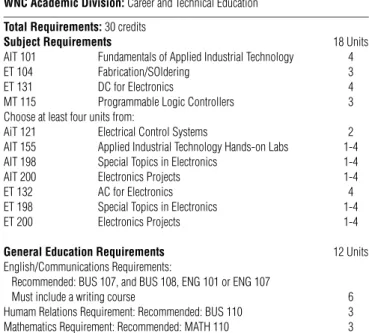
Program Requirements 36 Units AIT 101 Fundamentals of Applied Industrial Technology 4 AIT 121 Electrical Control Systems 1 AIT 155 Applied Hands-On AIT Labs 3 ET 131 DC for Electronics 4 ET 132 AC for Electronics 4 MT 115 Applied Programmable Logic Controllers 3 ET 104 Fabrication/Soldering Techniques 3
Choose at least 14 units from the following program electives:
CADD 100 Introduction to Computer Aided Drafting 3 CIT 161 Essentials of Information Security 3 DFT 110 Blueprint Reading for Industry 3 Any AIT, ET or MT course
General Education Requirements 24 Units English/Communications Requirement: Recommended: BUS 107 ;
Must include a writing course 6 Human Relations: Recommended; BUS 110 3 Humanities/Social Science Requirements 3 Mathematics Requirement 3 Science Requirement 3 U.S. and Nevada Constitution Requirement 3 General Elective 3
A list of all courses filling general education requirements for the Associate of Applied Science degree can be found on the Associate of Applied Science page.
AUTOMATED SYSTEMS - Suggested Course Sequence THIRD SEMESTER Completed English 3 US/Nev. Constitution 3 Program Elective 8-10 FOURTH SEMESTER Completed MT 115 3 AIT 121 1 General Elective 3 Science Course 3 Program Elective 4-6
ASSOCIATE OF APPLIED SCIENCE - TECHNOLOGY Mission & Outcomes
Mission: The purpose of the Associate of Applied Science degree in Technology is to provide
employment-related knowledge and skills necessary to succeed in a chosen field of study.
Student Learning Outcomes: Students who complete programs in occupational areas are
expected to demonstrate that they:
• Know the subject matter appropriate to the emphasis of the degree. • Are able to:
-communicate effectively and appropriately, in oral and written form.
-locate, evaluate and properly utilize the tools and resources appropriate to a technology professional.
-acquire skills and perform tasks necessary for employment or career enhancement • Have developed:
-an appreciation of the importance of social, ethical, legal and diversity issues. -an appreciation of the need and importance of lifelong learning.
TIP: WNC also offers . . .
CAREER DEGREE
Technology
AUTOMOTIVE MECHANICS
Associate of Applied Science - Technology Degree
______________________________________________________________ The technology degree for automotive mechanics offers students an opportunity to acquire the necessary skills and technical theory for a successful career as an au-tomotive mechanic. Individuals who are now employed in the auau-tomotive mechan-ics field will be able to upgrade their knowledge. Students obtaining this associate degree will have completed courses of a very technical nature, chosen to comple-ment each other and provide breadth and depth of diagnostic and repair skill abilities necessary to work in a service facility.
______________________________________________________________ Salary: $31,190-$52,380 / year (Nevada)
Career Outlook: Higher than average growth
Good To Know: Mechanics can be certified in as many as eight service areas. Most jobs are at repair shops and auto dealerships.
WNC Academic Division: Career and Technical Education
______________________________________________________________ Total Requirements: 60 units
Program Requirements 36 Units AUTO 101 Introduction to General Mechanics 3 AUTO 115 Auto Electricity & Electronics I 4 AUTO 117 Advanced Auto Electronics 4 AUTO 130 Engine Reconditioning 3 AUTO 145 Automotive Brakes 4 AUTO 155 Steering & Suspension 4 AUTO 160 Auto Air Conditioning 3 AUTO 210 Automatic Transmissons and Transaxles I 3 AUTO 225 Engine Performance I/Fuel & Ignition 4 AUTO 227 Engine Performance II/Emission Control 4
General Education Requirements 24 Units English/Communications Requirement: Recommended: BUS 107&108;
Must include a writing course 6 Human Relations Requirement: Recommended: BUS 110 3 Humanities/Social Science Requirements 3 Mathematics Requirement: Recommended: MATH 110 3 Science Requirement 6 U.S. and Nevada Constitution Requirement 3
A list of all courses filling general education requirements for the Associate of Applied Science can be found on the Associate of Applied Science page.
ASSOCIATE OF APPLIED SCIENCE - AUTOMOTIVE MECHANICS Mission & Outcomes
Mission: The mission of the Associate of Applied Science in Automotive Mechanics is to
provide employment-related knowledge and skills necessary to succeed in the automotive field.
Student Learning Outcomes: Students who complete an Associate of Applied Science
in Automotive Mechanics are expected to:
• Know the subject matter appropriate to the emphasis of the automotive field. • Acquire skills and perform tasks necessary for employment or career enhancement. • Present themselves effectively to a potential employer.
• Utilize appropriate resources to remain current in the automotive field.
FIRST SEMESTER Completed AUTO 101 3 AUTO 115 4 AUTO 130 3 BUS 107 3 Mathematics Course 3 SECOND SEMESTER Completed AUTO 117 4 AUTO 145 4 AUTO 225 4 Humanities/Social Science Course 3
AUTOMOTIVE MECHANICS - Suggested Course Sequence THIRD SEMESTER Completed AUTO 155 4 AUTO 160 3 AUTO 227 4 Science Course 3 FOURTH SEMESTER Completed AUTO 210 3 BUS 108 3 BUS 110 3 Science Course 3 U.S./Nevada Constitutions 3
TIP: WNC also offers . . .
Certificate of Achievement - Automotive Mechanics • See page 29 Certification Preparation - Automotive Service Excellence • See page 37