Thesis for the degree of doktor ingeniør
Trondheim, June 2007
Norwegian University of
Science and Technology
Faculty of Information Technology, Mathematics and Electrical
Engineering
Department of Engineering Cybernetics
Hans Petter Bieker
Topics in Offshore Oil Production
Optimization using Real-Time Data
Abstract
In all production systems, production optimization is important because it can reduce the cost of operation and increase the production. This the-sis is a contribution within the field of production optimization of off-shore oil production systems using measured real-time data.
Four novel methods related to production optimization of such oil pro-duction systems have been proposed. Using measured data, they are con-tributing to maximize the total oil production rate or the expected total oil production rate of the oil production system.
First, a method optimizing the total oil production rate from subsea wells where a model of the pressure interconnection of a common flow line must be included is proposed. The method uses a piecewise linear approx-imation of the pressure drop in the flow lines and wells enabling global optimization using a branch and bound mixed integer linear program-ming solver.
Second, a method for optimizing the expected total oil production rate by selecting wells for testing is proposed, using real-time data. The well test-ing gives information on the gas oil ratios or the water cuts that is more accurate allowing an improved prioritization of the wells compared to the industry practice when a processing constraint is available. A method for calculating stochastic distributions of the gas oil ratios or water cuts is proposed.
Third, a method handling the uncertainties in the gas oil ratios or water cuts explicitly for prioritizing the wells when a processing constraint is available is proposed. The prioritization was found to depend on the probability distribution of the gas oil ratios or water cuts, oil potential of
each well, and processing capacity. The method is able to handle all these uncertainties explicitly by using a user-provided probability distribution for each of them.
Fourth, a method finding the optimal sequence to open the wells when a limited flow change rate into the production separator and from each well is required is proposed. The method may be used to find a ramp-up se-quence after a shutdown. The excess treatment capacity is updated using the measurements of the treatment utilization in each time step, allowing the treatment capacity to be fully utilized.
Acknowledgments
First, I would like to thank my supervisors Professor Dr Ing Tor Arne Johansen and Dr Ing Olav Slupphaug. Tor Arne has been an invaluable resource suggesting new ways of solving the challenges I studied. I appre-ciate his constructive commenting of my manuscripts. Olav has been the source of most of the industrial challenges studied in this work. He has given me valuable and required background information on the operation of oil production systems and challenges in production optimization. His indefatigability commenting of my manuscripts has certainly improved the quality of them. Without my supervisors, the thesis would not be possible.
The Research Council of Norway, Norsk Hydro ASA, and ABB AS are acknowledged for financing this work. In particular, I would like to thank ABB AS for providing an inspiring working environment. It has been a source of many of the challenges investigated in this thesis. Several of the other professionals at ABB AS have been suggesting interesting chal-lenges to study, and their help is also much appreciated.
Hans Petter Bieker Oslo, June 2007
Table of Contents
Abstract ... i
Acknowledgments ... iii
Table of Contents ... v
1 Introduction ... 1
1.1 Offshore Oil Production System ... 1
1.1.1 Reservoir ... 1
1.1.2 Well... 2
1.1.3 Gathering Network ... 4
1.1.4 Processing Facilities ... 4
1.2 Motivation ... 6
1.3 Summary and Contributions of Papers ... 10
1.3.1 Paper I: Real-Time Optimization of Oil and Gas Production Systems: A Technology Survey ... 10
1.3.2 Paper II: Global Optimization of Multiphase Flow Networks in Oil and Gas Production Systems ... 11
1.3.3 Paper III: Optimal Well-Testing Strategy for Production Optimization: A Monte Carlo Simulation Approach ... 12
1.3.4 Paper IV: Well Management under Uncertain Gas or Water Oil Ratios ... 13
1.3.5 Paper V: Optimal Start-up Scheduling of Production Wells ... 14
2 Real-Time Optimization of Oil and Gas Production Systems: A Technology Survey ... 19
2.1 Introduction ... 19
2.2 Information Flow in Production Optimization ... 22
2.2.1 Data Acquisition ... 22
2.2.2 Control ... 23
2.2.4 Operator ... 24
2.2.5 Strategic Planning ... 24
2.2.6 Reservoir Planning ... 24
2.2.7 Well Model Updating ... 24
2.2.8 Processing Facility Model Updating ... 25
2.2.9 Reservoir Model Updating ... 25
2.3 Technology and Reference Cases ... 25
2.3.1 Global Versus Local Optimization ... 25
2.3.2 Production Planning ... 29
2.3.3 Reservoir Planning ... 38
2.3.4 Model Updating ... 41
2.4 Challenges ... 45
2.5 Conclusions ... 48
3 Global Optimization of Multiphase Flow Networks in Oil and Gas Production Systems ... 57 3.1 Introduction ... 57 3.2 Methodology ... 60 3.2.1 Well... 61 3.2.2 Flow Line ... 62 3.2.3 Choke ... 64 3.2.4 Outlet Boundary ... 65 3.2.5 Connection ... 65 3.2.6 Objective ... 66 3.2.7 Constraints ... 66 3.3 Case Study ... 66 3.4 Conclusions ... 67 3.5 Further Work ... 68 3.6 Nomenclature ... 69
4 Optimal Well-Testing Strategy for Production Optimization: A Monte Carlo Simulation Approach ... 73
4.2 Monte Carlo Simulation ... 76
4.3 Calculating Production ... 78
4.4 Error Distribution of Oil Resource Ratio ... 79
4.5 Case Study ... 81
4.6 Conclusions ... 82
4.7 Further Work ... 83
4.8 Nomenclature ... 84
5 Well Management under Uncertain Gas or Water Oil Ratios ... 91
5.1 Introduction ... 91
5.2 Uncertainty Matters... 94
5.2.1 Low Processing Capacity ... 95
5.2.2 High Processing Capacity ... 96
5.2.3 Comparison ... 97
5.3 Proposed Method ... 98
5.4 Case Study ... 101
5.5 Conclusions ... 103
5.6 Further Work ... 103
6 Optimal Start-up Scheduling of Production Wells ... 109
6.1 Introduction ... 109
6.2 Short-Term Optimization ... 111
6.3 Full Horizon Optimization ... 113
6.4 Computational Results ... 116
6.5 Conclusions ... 117
6.6 Further Work ... 118
7 Conclusions ... 127
1
Introduction
In this chapter, the work in this thesis is restricted, motivated, and the contributions are placed in a wider perspective. The thesis is based on five papers. One paper is accepted to a journal, four papers have been presented on conferences and printed in the proceedings of the confe-rences, and one paper is currently unpublished. A summary of each paper is given. Furthermore, the major contributions of the individual papers are outlined.
1.1
Offshore Oil Production System
In this section, a brief introduction to offshore oil production will be giv-en. Most of the components and terminology used within the thesis will be defined. Oil production is the extraction of oil and gas from the reser-voir to the refinery [1]. Several disciplines are involved in the production and planning.
1.1.1
Reservoir
A reservoir is a porous rock containing producible hydrocarbons such as oil and gas. The reservoir will typically contain a mixture of hydrocarbon components, water, and various contaminations.
The reservoir pressure is typically between the hydrostatic pressure (ap-proximately 10,000 Pa/m) and the rock pressure (ap(ap-proximately 20,000 Pa/m) [1]. The reservoir pressure is reduced when the fluids are extracted. The reservoir temperature increases with the depth of the re-servoir, typically 0.03 K/m [1].
The hydrocarbon components and water will separate naturally in the reservoir because of different fluid densities. At the top of the reservoir,
there will be a gas cap. The water will be on the bottom and the oil in the middle. The ratio between the gas and liquid in the reservoir does however depend on pressure, and much of the oil in the reservoir will be gas at surface pressure conditions.
1.1.2
Well
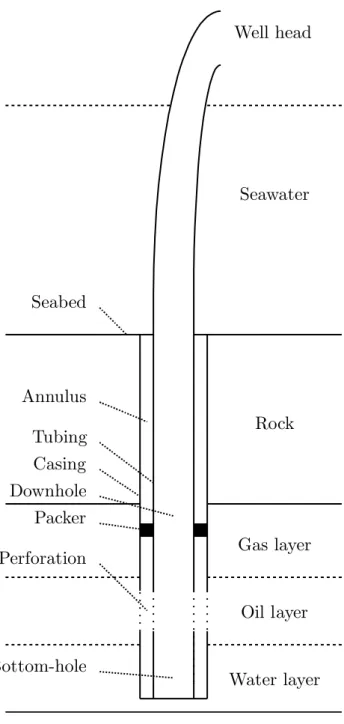
The hydrocarbons in the reservoir are produced by a well into the reser-voir. First, a wellbore is drilled into the reservoir by removing parts of the rock along a path from the surface to the reservoir. The wellbore is stabilized by a casing, which is a large-diameter pipe lowered and mounted using cement into the wellbore. The hydrocarbons from the re-servoirs do not flow in the casing, but in the tubing installed within the casing. The space between the tubing and the casing is the annulus. A packer isolates the annulus from the reservoir. The casing is perforated in the reservoir allowing the fluids to be extracted. This part of the wellbore is described as bottom-hole. The part of the subsurface wellbore is de-scribed as downhole. Some wells may have downhole or bottom-hole pres-sure or temperature meapres-surement devices, which allow measuring the temperatures or pressure at those locations. Some smart horizontal wells even have downhole valves for controlling the inflow from multiple reser-voir zones. The most important components of a well are shown in Figure 1.2.
The wellhead is the surface termination of the wellbore. It includes facili-ties such as chokes for controlling the flow from the well. The choke is similar to a valve. Typically, pressure and temperature measurement de-vices are located both upstream and downstream the choke.
The extraction of the reservoir is driven by the pressure difference be-tween the reservoir pressure and the pressure located upstream the choke. As the reservoir is depleted, the production rates may decline
be-cause of a reduced reservoir pressure. Various artificial lift methods are used to increase the oil production rates from the wells. These artificial lift methods include pumps and gas lift.
Gas lift is an artificial lift method in which gas is injected into the tubing to reduce the hydrostatic pressure drop of the well by decreasing the av-erage fluid density. The reduced hydrostatic pressure drop decreases the downhole pressure of the well allows the reservoir liquids to enter the wellbore at a higher flow rate. The tubing-casing annulus is typically used to transport the injection gas down to the lower part of the wellbore at which there is a gas lift valve connecting the tubing-casing annulus and the wellbore. There are two types of gas lift: intermittent and conti-nuous gas lift. The conticonti-nuous gas lift method injects gas at a conticonti-nuous basis. The intermittent gas lift method injects gas at a cyclical basis to enable the buildup of liquids in the wellbore. The intermittent gas lift method is used in relatively low productivity wells.
The extraction fluids from the reservoir will make the reservoir pressure reduce, and the reduced reservoir pressure will reduce the production rates from the wells. Gas or water injectors may be used to replace the extracted fluid volumes by injecting gas or water at convenient locations in the reservoir in order to support the pressure. In gas injection, sepa-rated gas from the production wells or gas imported from other produc-tion systems are injected into the reservoir. In fact, other gases such as
CO2 have also been tried. Water injection is popular in offshore oil
pro-duction because of good availability of seawater, which may be filtered and treated inexpensively.
Coning is the change in oil-water or gas-oil interface profiles because of drawdown pressures. The result of coning may be higher gas oil ratios or water cuts because of perforations on the water or gas sides of the inter-face levels.
1.1.3
Gathering Network
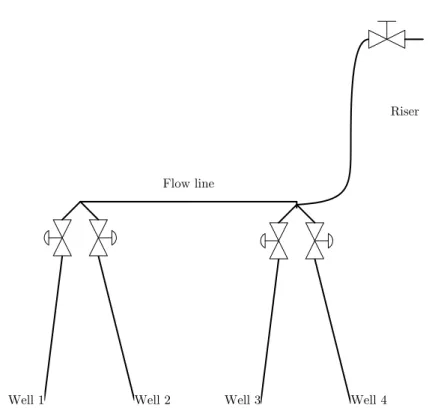
The production from the wells has to be gathered from the wells and transported to the processing facilities of the production system. For this, a set of flow lines is used. In offshore oil production systems the chokes are typically located at surface. The riser, a special type of flow line, is a part of the well. However, subsea wells have become more popular as the technology has evolved. In subsea wells, the chokes are located in a sub-sea facility and they share a flow line to the processing facilities. More recent subsea facilities may even host some processing facilities separat-ing gas and liquids to prevent sluggseparat-ing.
The production manifold is downstream to the chokes. The manifold is a mixing point at which the well stream of each well is mixed. Typically, a production system has one production manifold and one test manifold. The production manifold mixes the well streams from the wells producing to the production separator. The test manifold mixes the well streams from the wells, typically one, producing to the test separator.
The instrumentation of subsea facilities may vary slightly—some may include pressure and temperature measurement devices that communicate with the rest of the production system. Some chokes of subsea facilities are remotely controlled and some are not remotely controlled. The chokes of subsea facilities that are not remotely controlled may require remotely operated vehicles to adjust choke settings making changes very expensive.
1.1.4
Processing Facilities
The overall objective of the processing facilities of an offshore oil and gas production system is to make the oil and gas from the reservoir trans-portable. The oil is typically transported using tankers, which require that the oil is stable at stock tank conditions. Furthermore, most of the water is removed from the liquid to reduce the cost of transportation.
Gas is often exported using flow lines to remote gas terminals. The gas must be dried to prevent liquid slugs to build up in the flow line, and compressed to the required pressure.
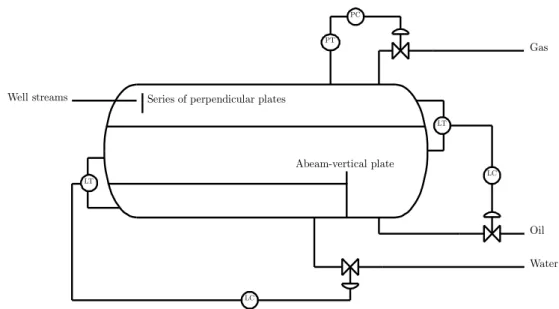
In order to stabilize the oil, separators are used. The well streams enter the separator, which is a horizontal tank, horizontally and hit a series of perpendicular plates, causing the liquids to drop to the bottom and the gas to rise to the top. Gravity separates the liquid of the well streams, which is a mixture of oil and water, into oil and water layers at the bot-tom of the separator. An abeam-vertical plate prevents water to enter the part of the tank farther from the inlet, allowing the oil to be tapped here. Water is tapped on the other side of the abeam-vertical plate. An outlet is also located at the top of the tank for tapping of gas. A separator is illustrated in Figure 1.1. The separators are typically serial-coupled to improve the quality of separation, and a stage number distinguishes them. A scrubber is a vertical separator designed to remove dirt, water, foreign matter, or undesired liquids from a gas stream.
The oil-water and gas-oil interfaces have to be controlled to prevent oil to enter the gas outlet, water to enter the oil outlet, or oil to enter the water outlet. The interfaces are controlled using a control valve at each outlet. An automatic feedback controller is typically used to maintain each of the interfaces at their desired set points using a measurement of the interface level. A similar controller is typically used to control the separator pressure by adjusting the choke at the gas outlet and a separa-tor pressure measurement.
A test separator, possibly equipped with special measurement devices, is used to measure properties of the flow stream of a single well at the time. The test separator enables the measurement of the gas oil ratio and the water cut of each well using the flow rate measurements of the separator.
The separator may be effective, but the water from the separator will still include oil after leaving the separator. A hydro cyclone can be used for separating the remaining oil from the water. A hydro cyclone works by hurling the oily water in the hydro cyclone with a large force (about
10,000 m/s2). Because of the different densities between oil and water,
the water will be hurled to the cyclone wall, while the oil will be in the middle. The oil and water can then be tapped.
For each stage of separation, the pressure is dropped until the oil reaches stock tank conditions. The gas, however, is exported or reinjected at a higher pressure, and compression using gas compressors is required. Be-cause compression increases the temperature of the gas, cooling is re-quired.
Compression of the gas increases the gas temperature, demanding a coo-ler of the gas downstream to the compressor. In offshore oil production systems, seawater is used as a cooling medium for the heat exchangers. Storage cells are used for storage of the produced oil until a tanker is ready to pick it up.
1.2
Motivation
The world is experiencing an increased demand for petroleum in the
be-ginning of the 21st century, and many of the reservoirs of the existing oil
production systems are maturing reducing the oil production rates from these systems. The increasing demand and reducing supply is materializ-ing in raismaterializ-ing oil prices are motivatmaterializ-ing development of new technologies increasing the oil production. The new technologies are given many names including the digital oil field, oil field of the future, and integrated operation. Although the names and the content are different, the goal is the same—to increase the oil production from the existing oil production
systems. The potential net present value of integrated operations on the Norwegian Shelf is estimated to 250 billion NOK (approximately 40–45 billion USD) in a study for The Norwegian Oil Industry Association [2]. Most of the net present value is due to increased and accelerated produc-tion owing to producproduc-tion optimizaproduc-tion.
By changing the work flow of the decision-making in the operation to al-low more interactions between disciplines, better decisions are supposed to be taken. The silo thinking in operations is reduced by building colla-boration rooms—rooms located onshore where professionals from multiple disciplines are supposed to collaborate both within the room and with the operators located offshore. The collaboration rooms are equipped with large screens enabling teleconferences with the operators offshore. The screens are also used for showing process measurements and calculations based on these measurements targeting the professionals on the shared objective.
Many of the companies operating the oil production systems are investing in information systems making the process measurements available on-shore to allow remote operations.
The decision-making in the collaboration rooms is related to the daily operations of the oil production system. The goal is to maximize some kind of performance measure, which typically is the total oil production rate of the oil production system adjusted for the variable cost of opera-tion. Many of the decisions are made using numerical simulations and trends of process measurements, but mathematical optimization is rarely used.
The demand for smarter operations makes mathematical programming more of a topic. The increased availability of real-time process measure-ments onshore is an enabler. The models used by the mathematical
pro-grams can be updated to fit the input-output behavior of the oil produc-tion system. Many professionals study various applicaproduc-tions of mathemati-cal optimization in oil production optimization. This included the optimi-zation of well placement, drilling operations, reservoir drainage, and daily operations.
New gas and water injection strategies are currently being developed where the goal is to maximize the recovery of the reservoir. By using more process measurements including pressures, temperatures, and seis-mic, the current state of the reservoir can be more accurately observed. The more accurate information on the reservoir allows injecting gas and water with reduced risk of a water breakthrough. Because of the delayed water breakthrough, the processing equipments can produce more oil with the same water treatment capacity. Smart wells, which are wells equipped with downhole measurement devices and valves controlling the flow from a multitude of reservoir zones, increase the degrees of freedom available to enable more control of the extraction of oil and gas. Gas and water injection strategies to the reservoir will however not be the focus of the thesis.
Improved methods for operation of wells are also a topic currently devel-oped. The methods include finding the optimal mixture of wells in order to maximize the oil production rate without violating any constraints in the processing equipments. Such constraints are typically related to ca-pacity, quality or safety. The oil produced must not include more than a specified amount of water in order to be accepted by the purchasers. The water produced is often disposed or reinjected into the reservoir. If dis-posed, local environmental regulations restrict the amount of oil and chemicals that it may include. Reinjecting oily water may also be a prob-lem because it may clog the injection well. Sand production may also be an issue because of erosion in bends and chokes. Sand taking up space in
the separator, thus reducing the separator capacity, may also be an issue.
H2S may cause corrosion in the flow line, and the amount may be
re-stricted to prevent this. If exported or sent through flow lines, the gas has requirements on the dryness to avoid liquid slugs. Furthermore, gas typically has quality specification related to the gas composition, such as
the amount of H2S. Safety requirements may be related to design
pres-sures or temperatures of the processing equipments, or the piping or valves connecting them. In order fully to utilize the limited capacity giv-en by the processing equipmgiv-ents, the well mixture must be optimized to consider the fluid composition from the wells. The focus of the thesis will be to develop methods that can be used to find such optimal well mix-tures using real-time data in day-to-day operation.
The reservoir is a dynamical system where oil is extracted from the re-servoir through the well to the processing equipments. The extraction affects the reservoir states by reducing the oil, water, and gas in the re-servoir. Accordingly, the pressure is also reduced. The reduction of pres-sure may be partly compensated by the injection of gas and water; how-ever, the fluid compositions of the reservoir are changed. The focus of this thesis will not consider effects on the reservoir, and the proposed so-lutions will only try to maximize the current total oil production rates rather than total recovery over the life cycle.
Oil production systems include many measurement devices, but the numbers of states or values that are desired are even higher. In order to find the optimal well mixture, accurate information about the fluid com-position is required. The thesis will also focus on developing method for optimally obtaining the desired information or measurements.
1.3
Summary and Contributions of Papers
In this section, a brief summary of each of the papers will be given. The major contributions of each paper will be stated. The papers are con-nected because they all propose production optimization schemes for maximizing the total oil production rate. Two of the methods explicitly handle the uncertainties by including it into the model.
1.3.1
Paper I: Real-Time Optimization of Oil and Gas
Production Systems: A Technology Survey
This paper is a non-critical survey of key literature in the field of real-time optimization of offshore oil and gas production. The goal is to give an overview of technologies that may be applied in a real-time production optimization application. The concept of real-time production optimiza-tion is also discussed. It is included as the first paper to funcoptimiza-tion as an introduction chapter in this thesis. The paper includes an information flow description of the operation of an offshore oil and gas production system. The elements in this description include data acquisition, data storage, processing facility model updating, well model updating, reser-voir model updating, production planning, reserreser-voir planning, and stra-tegic planning. Methods for well prioritization, gas lift optimization, gas or water injection optimization, and model updating are reviewed in the view of the information flow described. Challenges of real-time produc-tion optimizaproduc-tion are also discussed.
This paper contributes an overview and organization of existing technol-ogies that may be used for real-time optimization applications in offshore oil and gas production.
1.3.2
Paper II: Global Optimization of Multiphase Flow
Networks in Oil and Gas Production Systems
A mathematical program for finding the optimal oil production rates of the wells in an oil production system is developed. Each well may be ma-nipulated by injecting lift gas and adjusting a production choke. The oil production from the wells may be restricted by multiple constraints in the maximum oil flow rate, water flow rate, liquid flow rate, and gas flow rate. The wells may also be restricted with a maximum total lift gas rate. In oil production systems with subsea wells, flow lines are often shared between two or more wells. The pressures in the production manifold in such oil production systems are affected by the flow rates from the wells. The commonly used models based on gas lift performance curves (GLPC) no longer apply directly to these problems due to changing pressure con-ditions in the production manifold. Because of this, a model of the flow line is also required to get results that are more accurate. This work in-corporates such a model. A piecewise linear approximation is proposed. This makes it possible to find a proven global optimum, within the ap-proximation, for the optimization problem. The problem is formulated as a mixed integer linear program, and it is solved using a commercial branch and cut solver.
This paper contributes a novel model of pressure drops in flow lines for production optimization. A contribution of the paper is the use of piece-wise linear models of the pressure drop in the common flow line. Further, it is a contribution to solve this as a mixed integer program, which allows for easy global optimization (of the approximate model).
The method is a refinement of the master thesis [3] of the author. The method is improved by calculating the pressure drop from the source to the sink instead of the opposite way. This eliminated the use of a
numer-ical solver to find the pressure drop, speeding up the calculation. Fur-thermore, the method is modified to use special ordered sets of type two, allowing faster convergence of the numerical solver.
A further contribution is the use of a branch and bound method for solv-ing the production optimization problem of multiphase flow networks. A case study is conducted using field data from a Norwegian offshore oil production system comprising four subsea wells. The case study focuses on the computational load of the proposed method. The method is able to solve the optimization problem within ten seconds.
1.3.3
Paper III: Optimal Well-Testing Strategy for
Pro-duction Optimization: A Monte Carlo Simulation
Approach
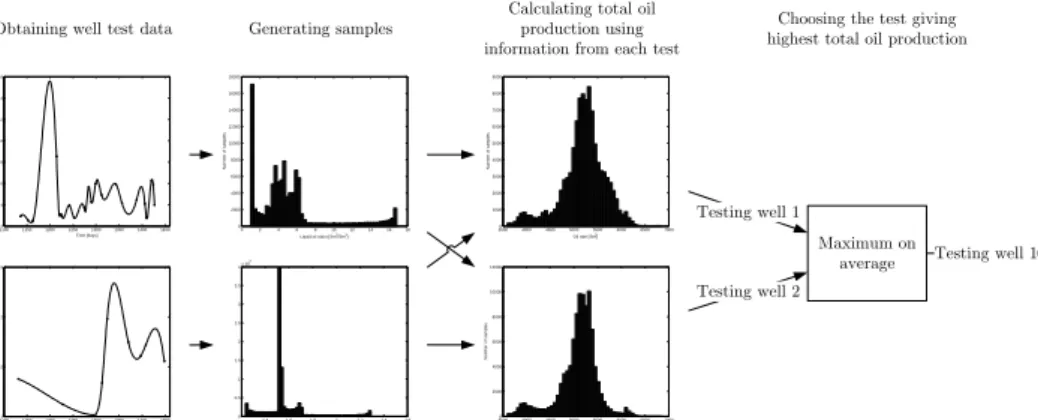
Well testing may be performed to support many decisions including ones related to production optimization of an oil production system. The in-formation flow used for optimization of the system is described. In pro-duction optimization, information such as the gas oil ratio and water cut is used to decide, for example, on the wells to prioritize for choking back or opening to avoid over-utilization or under-utilization of the production capacity. Since the reservoir properties change with time, the uncertain-ties of their estimated values increase with time, and eventually a new well test will be required. The risk of prioritizing the wrong wells, giving a lower total oil production rate than what is possible, increases as the uncertainties in the estimates increase. A computer program is developed to choose the well to test at a given time based on historical well test da-ta. The program uses a Monte Carlo approach for identifying the well test being more likely to lead to the highest increase in the total oil pro-duction rate when the well test information is utilized to optimize the oil
production. The computer program is applied to field data quantifying the benefits when applied to this specific field. The current implementa-tion is limited to producimplementa-tion systems where the pressure interacimplementa-tion among wells may be neglected. Furthermore, the current implementation assumes that a single treatment constraint is active.
This paper contributes a novel method for choosing wells for routing to test separators. A contribution of the paper is the calculation of the ex-pected total oil production rate using the measurements obtained in a possible well test for choosing a well for testing. Furthermore, a contribu-tion of the method is to use Monte Carlo simulacontribu-tions to calculate an ex-pected total oil production rate using the possible outcomes of the mea-surements in the well test. It is a further contribution to test the well giving the maximal expected total oil production rate. The industry prac-tice is to do well testing based on equal frequency for all wells, and to do
ad hoc testing when the measurements from a well look “suspicious”. The paper contributes a method for finding a stochastic distribution of the gas oil ratio or the water cut of a well using historical well test data.
1.3.4
Paper IV: Well Management under Uncertain Gas
or Water Oil Ratios
In the daily operation of an oil production system, it is often required to choke back some of the oil production wells to ensure that the processing capacity is not over-utilized. When the capacity of some processing re-source is over-utilized, wells having large ratios between the consumption of the resource and the oil production rate are choked back. When there is free processing capacity, the chokes of the wells having small ratios are opened. Often, the gas or water oil ratios (derived from the water cuts) are used as such ratios. These ratios are uncertain. This paper proposes to use information about the uncertainties of the gas or water oil ratios
to find the order of opening and closing the wells to maximize the ex-pected total oil production rate from the wells. In a computational study based on field data, the order was found to be different from the order found using the expected value of the gas or water oil ratios.
This paper contributes a novel method for prioritizing wells producing to a shared processing facility having a single processing constraint. A con-tribution of the method is the use of stochastic discon-tributions of the gas oil ratios or water cuts to find the optimal wells to choke back or open max-imizing the expected total oil production rate and not violating the processing constraints. The industry practice is to regard the gas oil ra-tios or water cuts as parameters without uncertainty, and to do prioriti-zation using these presumably accurate values. The method further han-dles uncertainties in the processing capacities and oil potentials explicitly. It is a contribution that mixed integer linear programming is used for finding such an order. Further, a contribution, in this context, is to use values drawn from the stochastic distribution to approximate the sto-chastic distributions themselves.
1.3.5
Paper V: Optimal Start-up Scheduling of
Produc-tion Wells
A linear program for finding the order to open wells after a shutdown is proposed. The oil production over a horizon is maximized, thus minimiz-ing the total losses durminimiz-ing a start-up. The method is able to handle mul-tiple constraints such as oil, gas, water, and liquid treatment capacities as well as quality constraints on the gas. The method is shown to in-crease cumulative production compared to a method using short-term optimization only.
This paper contributes a novel method for handling the uncertainties in the treatment capacities. A linear model of the oil production system is
optimized giving suggestions for changes to the chokes the model is up-dated using measurements related to the excess treatment capacity. In a closed loop, the operating point will therefore typically approach the physical limitations of the system, and it will not just be on the con-straint imposed by the uncertain model.
Water Oil Gas LT LT LC PT LC PC Well streams Abeam-vertical plate Series of perpendicular plates
Figure 1.1: A separator typically comprises two level control loops and a pressure control loop.
Gas layer
Oil layer
Water layer
Perforation
Casing
Tubing
Downhole
Bottom-hole
Seabed
Packer
Annulus
Well head
Seawater
Rock
Figure 1.2: A well extracts fluids from a reservoir through tubing to the surface.
2
Real-Time Optimization of Oil and Gas
Production Systems: A Technology
Sur-vey
Based on
H.P. Bieker, O. Slupphaug, and T.A. Johansen, accepted for
SPE Production & Operations Journal, presented at
2006 SPE Intelligent Energy Conference and Exhibition Amsterdam, The Netherlands, 11–13 April 2006
2.1
Introduction
In the daily operation of an oil and gas production system, many deci-sions (an element of a solution) have to be taken affecting the volumes produced and the cost of production. These decisions are taken at differ-ent levels in the organization, but evdiffer-entually they will reach the produc-tion system layout. Figure 2.1 gives an overview of a physical producproduc-tion system. For such production systems, the decisions are typically related to the choke or valve openings, compressor, and pump settings at every instance of time.
An objective function is a single-valued and well-defined mathematical function mapping the values of the decision variables into a performance measure. Examples of such performances measures are the total oil pro-duction rate, net present value (profit), or the recovery of the reservoir. In the efforts towards better performance of the production system, a question to be answered is which decisions are better in order to optimize
the objective function. In the process of making good decisions, informa-tion about the producinforma-tion system is used. This informainforma-tion may be the physical properties such as pipe diameters and lengths, or it may be mea-surements from the production system.
The environment in which the production of oil and gas is obtained is continuously changing. This will, therefore, affect the value of the per-formance measure of the decisions being used. For example, if the cooling capacity of the production system is an operational bottleneck at some given time, this may no longer be the case if the seawater temperature drops or another pump in the cooling system is started. Incidents in the production system may also affect the value of the performance measure of the decisions. A partial shutdown of the production system due to maintenance may also affect system bottlenecks.
Real-Time Optimization (RTO) is a method for complete, or partial, au-tomation of the process of making good or optimal decisions. The term “optimal” is defined below. By continuously collecting and analyzing da-ta from the production system, optimal decisions may be found. Either these settings are then implemented directly in the production system or they are presented to an operator or engineer for consideration. If the settings are implemented directly, the RTO is said to be in a closed loop.
RTO defined by Saputelli et al. [4] reads: “a process of
measure-calculate-control cycles at a frequency, which maintains the system's optimal oper-ating conditions within the time-constant constraints of the system”. The main aim of RTO is to improve the utilization of the capacity of a production system to obtain higher throughput or net present value. The idea is to operate the production system, at every instant of time, as near to the desired optimum as possible [5]. To achieve this, a model of the production system is optimized to furnish an optimal solution. The model is continuously being updated by measurements from the production
sys-tem to fit the actual input-output behavior of the processing facilities, wells or network, and reservoir better.
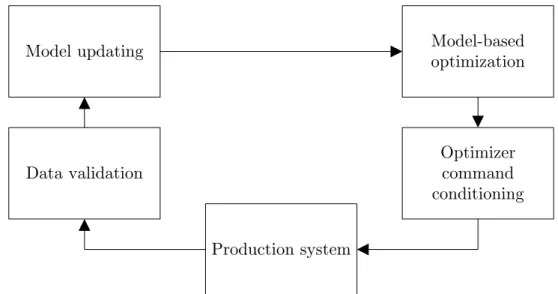
A general RTO system used in, for example, downstream petrochemical production systems consists of the following four components [6] shown in Figure 2.2:
Data validation: The validated input and output data are
vali-dated using data reconciliation and signal processing techniques (for instance using material and energy balances).
Model updating: The processing facility models, well models, flow
line network models, and reservoir models are updated to fit the validated input and output data available the best.
Model-based optimization: An optimization problem based on the
updated models, objective function, and constraints is set up and solved to obtain an optimal solution.
Optimizer command conditioning: A post-optimality analysis is
performed to check the validity of the computed solution before it is implemented.
Although the definition of Saputelli et al. [4] was written with oil and gas
production systems in mind, it is general in the sense that it is not re-strictive to some specific type of production system or method. The defi-nition can be related to Figure 2.2.
Recently, SPE started a technical interest group that focuses on RTO for oil and gas production systems. The driver behind this development is, as in any industry, the demand for more profitable production systems. This survey will help to organize previous work related to RTO. The focus will
be on offshore oil and gas production systems; however, relevant refer-ences from other industries are also included.
A previous survey [7] was recently published. It focused on the organiza-tional issues of using RTO. Because a survey on the organizaorganiza-tional issues is already given, this survey will focus on the existing software, tools, me-thods, and approaches that can be applied for RTO. However, the survey will not focus on the processing facilities. Furthermore, this is a non-critical survey of key literature in the field.
This paper is organized as follows. A description of the information flow associated with the optimization of offshore oil and gas production sys-tems is given to relate the general RTO technology to this specific appli-cation area. Technologies for optimization and model updating of such production systems are reviewed, and reference cases will be presented. Finally, key challenges are addressed and conclusions are stated.
2.2
Information Flow in Production Optimization
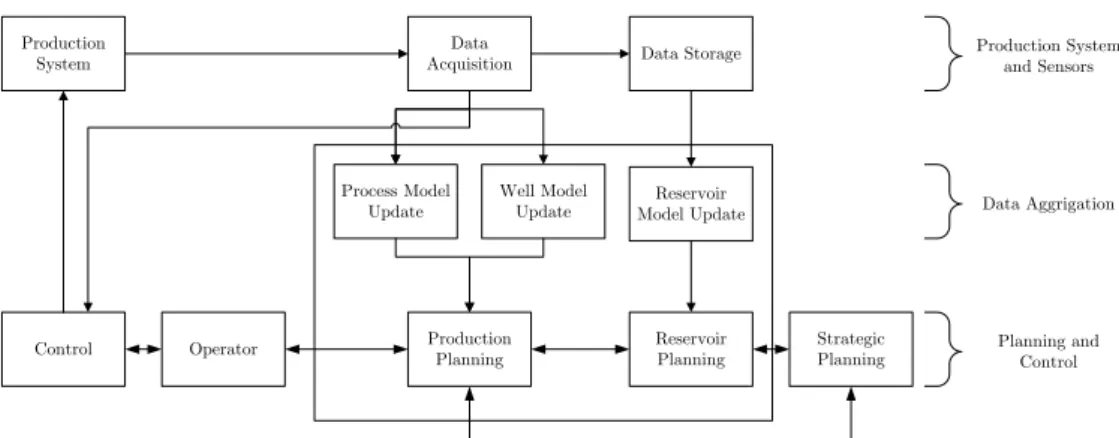
The operation of an oil and gas production system may be illustrated ac-cording to Figure 2.3. The main components of the operation are de-scribed below.
2.2.1
Data Acquisition
Modern production systems usually have good instrumentation. Level (the height of oil-water or gas-oil interface in a separator), pressure, and temperature transmitters are most common. In addition to required fiscal meters, there are often also a few flow transmitters to measure flow rates in gas, water, and oil pipes. Flow transmitters for multiphase flow may also be available, but they are rare. Various off-line analyzers of parame-ters including oil-in-water and other product qualities may also be avail-able. The instrumentation varies considerably between different
produc-tion systems, typically with the age of the system and the country or re-gion it is situated.
2.2.2
Control
A typical oil and gas production system has many (automatic) feedback control loops to support an efficient production and meet the production targets. A feedback control loop generates decisions, such as valve open-ings, based on measurements from the production system. The simplest form of such control is used to control levels and pressures in the separa-tors. Centrifugal compressors are always protected by anti-surge control loops. The control loops ensure that the compressors do not surge, and prevent damage. Control is also used to balance the load among parallel-coupled and serial-parallel-coupled processing units. A phenomenon that may be observed in an oil and gas production system is severe slugging. The pressure and flow rate in a well or flow line start oscillating, and the ef-fective production capacity is reduced. This can sometimes be stabilized by feedback control[8].
2.2.3
Production Planning
A typical oil and gas production system is operated by periodically gene-rating a production and injection plan. This production and injection plan lists the target production of oil, gas, and water for a specific period for each individual well. Similarly, the injection of gas or water is stated for the injection wells. The cycle time of the production and injection plan depends on the policy of the field operator, but it will typically be between a week and a month. The models and constraints of the processing facilities and wells or networks are used together with con-straints from the reservoir planning as inputs to the planning. Politics or constraints from the strategic planning may also be enforced here.
2.2.4
Operator
Above all, the operators are responsible for ensuring safe operation. Fur-thermore, they are responsible for implementing the recommendation from the production and injection plan. When implementing the produc-tion and injecproduc-tion plan, the operators have to meet the operaproduc-tional tar-gets while obeying minimum and maximum limits on variables such as pressures, temperatures, and rates.
2.2.5
Strategic Planning
The production and injection plan is somehow connected to the market and the strategic considerations or policy of the company.
2.2.6
Reservoir Planning
The long-term reservoir drainage is planned here. This includes planning of gas and water injection. The updated reservoir model is used for find-ing proper drainfind-ing strategies. Politics from the strategic plannfind-ing may also be enforced here.
2.2.7
Well Model Updating
To support making good decisions, models may be used to develop the production plans. Typically, well tests are performed to determine the gas oil ratio, water cut, and production rates of each individual well. Well tests are performed by routing a well to a dedicated separator. This separator will separate the three phases, and a flow transmitter is con-nected to the outlet of each phase. The well model is then updated using the measurements taken during the test. Fluid sampling may be used to obtain the fluid composition including the water cut.
2.2.8
Processing Facility Model Updating
Typically, the processing facilities are modeled as constraints on oil, gas, and water processing capacities. This means that the model is updated whenever the capacity changes.
2.2.9
Reservoir Model Updating
To be able to conduct the reservoir planning, a reservoir simulator may be used to evaluate different drainage strategies for the reservoir.
The initial state and parameters of the reservoir model must be updated by measurements from the production system. The volumes produced, volumes injected, and pressures are important measurements used in this updating process. To ensure good accuracy of the model, parameters and the initial state are fitted to longer series of historical production data. The method is typically called history matching.
2.3
Technology and Reference Cases
Figure 2.3 shows an example of how decisions in production optimization may be taken. Most or all the decisions are made with support by some form of technology. This section will provide an outline of relevant tech-nologies and reference cases from the industry that may be extended and used as a part of an RTO system. More specifically, the technologies be-longing inside the large rectangle of Figure 2.3 will be discussed here.
2.3.1
Global Versus Local Optimization
For all the planning activities, numerical optimization may be used to find good or optimal feasible solutions (or decisions). This works by de-fining an objective function to be minimized, or maximized, as a function of decision variables. The feasible set of these decision variables is defined by a set of equality and inequality constraints on the decision variables.
The objective function and the constraints define the optimization prob-lem, or mathematical program.
A solver is used to find an optimal solution, and the solver should be chosen using information about the problem structure. In particular, li-near and convex quadratic programs [9] are often preferred because of their convexity and the existence of mature algorithms for solving them. In some cases, nonlinear constraint and objective functions may be re-formulated to linear equivalents [10], and these mature algorithms may be used.
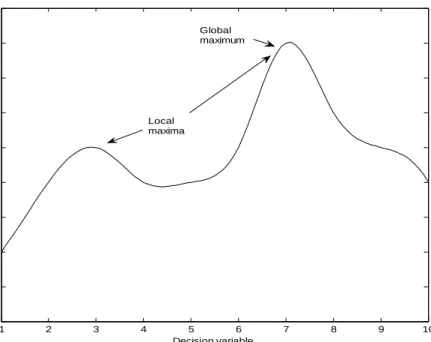
A local optimal solution is defined as a feasible solution having a neigh-borhood where no strictly superior feasible solution exists (in terms of the objective function). A global optimal solution is defined as a feasible solu-tion not having a strictly superior feasible solusolu-tion (in terms of the objec-tive function) in the feasible set, and hence a global optimal solution is also a local optimal solution. The difference between a local and global optimal solution are illustrated in Figure 2.4. Convex optimization prob-lems are preferred because they guarantee that a local optimal solution is also a global optimal solution (however a unique global optimal solution is not necessarily guaranteed). Unfortunately, the term “optimal tion” is ambiguous, and it is used for both local and global optimal solu-tions.
2.3.1.1
Local Solvers
Many local solvers use local information about the neighborhood of a cur-rent solution to find a step that improves the objective function and maintains the feasibility of the current solution. If a step is found, it is used to update the current solution. If not found, the algorithm termi-nates. Typically, there is a threshold on the improvement in the objective function that should be satisfied for the current solution to be updated.
Examples of the local information used are the derivative of the objective function and the constraints with respect to the decision variables eva-luated at the current solution. Examples of solvers using derivative in-formation are the Active Set Quadratic Programming, Successive Qua-dratic Programming (SQP), and Successive Linear Programming (SLP) methods [9]. The algorithms such as SQP and SLP may require an infi-nite number of iterations to find a local optimum (i.e., they only con-verge); however a termination criterion is used to terminate in finite time.
2.3.1.2
Global Solvers
Global solvers are designed to handle multiple local optima [11, 12]. Ex-amples of such solvers include the genetic algorithms and the branch and bound method.
Genetic algorithms mimic the survival of the fittest [13]. A population of solutions is maintained. The solutions are evaluated for fitness, meaning for feasibility and the objective function value. Pairs of solutions are cho-sen randomly from the population and recombined. The higher the fit-ness, the higher the chance for reproduction. The recombination process is done by combining random parts of each decision value. Mutations are included in order to ensure a sufficient large variation in the population for convergence to the optimum. The genetic algorithms do not use any structural information on the optimization problem, and any black box models may easily be applied. However, this is also the main drawback as the method gives a bound of neither the global optimum nor the local optimum on termination, and the computational load is usually large. A general framework for global optimization is the branch and bound method. The method terminates with an upper and lower bound of the objective function. By iteratively dividing the optimization problem in
properly posed sub-problems, the upper and lower bounds converge. The bounds are calculated using structural information on the optimization problem, and the bounds become more accurate as the sub-problems are divided.
The branch and bound framework has shown to be particularly useful for solving (mixed) integer linear programs because an upper bound for max-imization (or lower bound for minmax-imization) may easily be calculated by solving a linear program where the integer constraints are dropped. For mixed integer linear programs with lower and upper bounds for the in-teger variables, the number of sub-problems to be solved is finite and bounded. Each sub-problem is a linear program that is solved in finite and bounded time, and the complete mixed integer linear program is solved in finite and bounded time; however, the bounded time grows gen-erally exponentially with the size of the problem [14, 15].
The branch and bound framework may also be used for general nonlinear programs; however, much work is typically required finding good and va-lid bounding functions. Some solvers are able to find bounding functions by analyzing the constraints and the objective function automatically. However, this requires that the constraints and the objective function are available in analytical, or symbolic, form to the solver. In practice, the optimization problem often includes a black box model (for instance a reservoir simulator), and such bounding functions may not be calculated neither by hand nor automatically because the structure of the model is unknown to both the user and the solver.
2.3.1.3
Hybrid Solvers
Global solvers such as genetic algorithms may terminate far from a local optimum. By passing the solution as an initial value to a local solver, the solution is improved to bring it close to a local optimum.
2.3.1.4
Proxy Models
Proxy models are simplified models that are used because they are faster to evaluate [16] or have better numerical properties [17], and both are properties that are very important in RTO systems. Artificial neural networks have been successfully used as proxy models to reduce the com-putational load in history matching of reservoirs [16, 18, 19]. The proxy model is first typically fitted to a set of model evaluations, and then used as the model in the optimization. The solution found by the solver using the proxy model may be validated or used as an initial value for the orig-inal model to improve the solution further.
The success of proxy models was illustrated by Cullick et al. [16] where
the number of reservoir model evaluations required was reduced by 25 % using such a model in history matching. Each evaluation of the reservoir model took six hours, and hundreds of evaluations were required for the history matching.
2.3.2
Production Planning
The goal of this plan is typically to maximize the daily production rate, for example of oil, and to inject gas and water according to some given rules provided by the reservoir planning.
2.3.2.1
Well Prioritization
If the goal is to maximize the oil production rate, some method is re-quired to find an optimal way to prioritize the wells to produce and the rate to produce. It is often required to prioritize because the available processing capacity is less than the combined flowing capacity of the wells. The processing capacity constraints are related to satisfaction of product quality specifications, safe operation, processing facility capaci-ties, utilities capacicapaci-ties, etc.
When a processing capacity constraint is met, it is often related to the processing of gas, water, or liquid. The operator will typically choke back the well having the largest ratio of the consumption of the associated processing capacity to the oil produced. Examples of such ratios are the gas oil ratio, water-oil-ratio, and liquid-oil-ratio. By successively choking back and opening the wells based on the ratios, the capacity is fully uti-lized and the production system is assumed to give the maximum total oil production rate. When the total oil production rate is maximal, one well will be partly opened and the rest either fully closed or opened. The method above has proven successful because it is unaffected by the un-certainties in the flowing potentials, which are the maximal oil produc-tion rates of wells, and processing capacities. The main drawbacks of the method are its inability to handle multiple active processing constraints and the assumption of the flowing potentials of the wells to be indepen-dent.
The flowing capacities of a well may be regarded as independent when changing the oil production rate from the well does not change the flow-ing capacities from the other wells and the gas oil ratio and the water-oil-ratio are invariant with respect to the oil production rate. An example of such wells is platform wells with wellheads at the processing platform and a short common large diameter flow line to the inlet separators. Lo and Holden [20] used a linear program for finding which wells that should be opened, partially opened, or closed. They assumed each well could produce any oil production rate between zero and the flowing po-tential, and that the water cut and gas oil ratio were the same for all rates (i.e. not coning gas or water). The method is able to handle mul-tiple constraints on oil, water, liquid, and gas production for groups, or all, of the wells. However, uncertainties in the model are not handled.
A way of handling a gas compression-constrained production system
un-der gas coning conditions was proposed by Barnes et al. [21]. The method
is able to handle wells where the incremental gas oil ratio (IGOR) is mo-notonically increasing with the oil production rate. A similar method was proposed by Urbanczyk [22]. The idea is to increase the production from the well with the lowest IGOR with unused capacity, and reduce the production wells with the highest IGOR. At the optimum, all the wells have the same IGOR or they are on a minimum or maximum oil produc-tion rate constraint.
Naus et al. [23] investigated the use of a combination of a reservoir
simu-lator and real-time data could be used to maximize the daily production of oil. The parameters of the reservoir simulator were continuously up-dated to fit measurements from the production system as they became available, and the reservoir simulator was used to find derivative infor-mation. The cases consisted of a reservoir and a horizontal well with four continuous inflow control valves to control the segments of the well. The total water and gas processing capacities were constrained. An SLP algo-rithm was used to solve the problem.
2.3.2.2
Gas Lift
Gas lift may be used to increase the productivity of wells having low gas oil ratio. By injecting gas into the tubing, the density of the well bore fluid is reduced and thus the pressure drop component resulting from gravity is reduced. However, the gas lift also gives a larger pressure drop component resulting from friction, giving some optimum lift gas rate for
the well. Because of friction, the optimum lift gas rate may be 0 Sm3/D.
Usually, the available lift gas is less than the sum of the individual opti-mum lift gas rates. The gas lift optimization problem is to find the lift gas rates for each well giving the maximum total oil production rate sub-ject to a gas lift processing capacity constraint, and possibly other
opera-tional and processing constraints. A cost may also be associated with the processing of gas, water, oil, and lift gas changing the problem into max-imizing the profit.
Mayhill [24] generated a gas lift performance curve by plotting the oil production rate or profit rate versus injected lift gas for each well. The curve is duplicated in Figure 2.5. The performance curves were later used in the equal slope method proposed by Kanu [25]. The equal slope me-thod established a way of finding optimum lift gas rates. The name was given because of the characteristics of the optimum solutions where the effect of an infinitesimal increase of the lift gas rate would be the same for all wells.
Fang and Lo [26] developed a method for finding optimum lift gas rates using gas lift performance curves. Each curve was approximated by a fi-nite number of break points, and the curve was assumed to be linear be-tween any adjacent break points. The production of each well was formu-lated as the convex combination of the break points, resulting in a linear program. The method is able to handle oil, water, liquid, and gas produc-tion constraints for groups of wells or all wells. The same is true for lift gas. Wells with variable water cut or gas oil ratio are also handled. The authors pointed out that the method has problems if some wells cannot flow naturally. This can however be solved by using mixed integer pro-gramming [27]. Figure 2.5 duplicates an illustration by Fang and Lo [26] of gas lift performance curves for wells flowing naturally and wells requir-ing lift to produce.
Buitrago et al. [28] proposed a multistart search algorithm to find the
optimal gas lift rates under a constrained total lift gas rate. The method uses gas lift performance curves, and is able to handle wells that require a finite non-zero lift gas rate to produce. A case study showed a
reduc-tion of 14 % of the total lift gas rate for the same total oil producreduc-tion rate compared to the equal slope method.
Gómez [29] proposed to fit the points defining the gas lift performance curve to a second order polynomial, and then solve the gas lift optimiza-tion problem by quadratic programming. The method was later extended
by Alarcón et al. [30] to also include a logarithmic term for better fitting.
For naturally flowing wells, a global optimum can be proved to be found for the resulting optimization problem because of the convexity of the problem. A heuristic handling shut-ins of wells, which were not naturally flowing, was proposed.
Vazquez et al. [31] stressed the fact that many of the proposed
optimiza-tion problems used for oil producoptimiza-tion optimizaoptimiza-tion may have multiple local optima, and that the solvers may easily be trapped in a local opti-mum that is inferior to a global optiopti-mum. To elude this, they proposed to describe the oil production rate of each well as a function of the gas lift injection rate and the energy consumption. The total production was described as the sum of individual production rates. By using a hybrid solver consisting of a genetic algorithm and a Tabu search heuristic, near global optimal values were found.
2.3.2.3
Network
Earlier in this section, it was assumed that the production of each well was not dependent on the production from the other wells. What mat-tered were only the choke position and the lift gas injection rate. This may be true if the manifold pressure is practically constant and if the reservoir state and parameters do not change. However, the introduction of subsea templates in offshore production systems has changed this. A few wells are connected to each template on the seabed, and a common flow line connects the template to the platform or a different subsea
tem-plate. The manifold pressure at the template will depend on the flow rates from each of the wells connected to it. Thus, if the production from one well is changed, then the others are changed too because of the changed pressure conditions. Increased flow from one well may actually cause an increase or decrease in the production from the other wells de-pending on the operating conditions. For instance, a high gas oil ratio well may give a gas lift effect for the other wells in the riser. The oppo-site effect may be observed if the production from a high water cut well is increased.
Dutta-Roy and Kattapuram [32] compared the optimal lift gas rates for one, two, and three identical wells sharing a common flow line. In addi-tion, larger field-wide networks were studied. SQP was used to find the optimal gas lift rates. It was noted that optimal lift gas rates for each well reduced when the number of wells increased.
Wang [27] used SQP to optimize flow rates of gas-lifted wells in a gather-ing network havgather-ing a maximal total water production capacity con-straint, and the results were compared to optimization using piecewise linear gas lift performance curves ignoring the network. Both methods was implemented on the same numerical simulator. The proposed method included a mathematical model of the pressure drop along the gas lifted wells and the gathering network, and was thus accounting for the pres-sure interaction. The method using piecewise linear gas lift performance curves comprised the steps of generating gas lift performance curves using the numerical simulator for a given manifold pressure, solving a mixed integer linear program to obtain optimal lift gas rates of the wells, and implementing the lift gas rates of the wells to the optimal lift gas rates. The proposed method and the piecewise linear method gave total oil
pro-duction rates of 1528 Sm3/D and 1413 Sm3/D, respectively, when
for accounting for the pressure interaction. See also Wang et al. [33]. Lat-er, Wang and Litvak [34] proposed to extend the SLP algorithm used to solve a piecewise linear approximation in each iteration.
In a work by Handley-Schachler et al. [35] it was proposed to solve this
type of problem using a modified version of SLP. In SLP, a linearization of the optimization problem is used in each iteration to calculate a new step. The linearization is obtained using the derivative of the objective function and the constraints evaluated at the current solution, and each iteration is typically faster than for SQP because a Hessian is not re-quired. The number of iterations may be higher because the linearization does not give any hints of the optimal step length to use as opposed to
SQP. Handley-Schachler et al. modified the SLP code to include
piece-wise linear gas lift curves. The piecepiece-wise linear gas lift curves were formu-lated using linear constraints and non-convex constraints enforcing inter-polation between adjacent points of the curves only. According to the authors, the modification resulted in faster convergence than standard SLP. See also [36].
Kosmidis et al. [37, 38] studied the optimization of gas lift and the
routing of wells to manifolds and separators. A mixed integer nonlinear program was proposed, and it was solved to a local optimum using a
modified version of SLP similar to Handley-Schachler et al. [35] except
for the routing. Each iteration in the modified version of SLP consists of solving a mixed integer program with routing constraints and piecewise linear gas lift performance curves. SLP was used to handle the nonlinear equations describing the flow lines and associated network.
Stoisits et al. [39] proposed to use a genetic algorithm to find the optimal
gas lift rates and oil production rates for the wells. A large number of simulations were fitted to an artificial neural network-based proxy model
to speed up function evaluations. The method was able to handle con-straints in gas and water processing capacity.
Grothey and McKinnon [40] modeled the pressure drop in the gas gather-ing and supply network of an oil and gas production system with gas-lifted wells. The resulting optimization problem was non-convex. By us-ing one integer variable for each well, the optimization problem was re-formulated as a convex nonlinear optimization problem except for the additional integer variables. The branch and bound framework was used to solve the optimization problem using a continuous relaxation (for in-stance relaxing the integer variables to continuous variables). To over-come the high computational load experienced, the optimization problem was decomposed (Benders’ decomposition [41]) into a master and a sub-problem. The sub-problem calculated the maximum total oil production from a subset of the wells for a given gas usage and supply. The master problem optimally distributed the gas usage and supply between the sets of wells. It was not proven that the local optima for the sub-problems also were global optima, and the resulting optimum solution was only found to be a local optimum. However, an upper bound was provided by a convex Lagrangian relaxation of the problem, and the me-thod was able to give a bound on the global optimum.
Various software packages are commercially available. GAP1 allows the
user to find optimal solutions using SQP. Processing facilities may be
in-cluded in the model to provide better results. ReO2 may also be used for
finding optimal solutions. The software uses SLP for solving the optimi-zation problem, and the method is described in [35, 36].
2.3.2.4
Processing Facilities
The well prioritization and gas lift optimization problems reported in the literature do not typically include detailed models of surface processing facilities. In fact, it is often assumed that the processing facilities are able to handle fixed oil, water, gas, liquid, and lift gas rates. This is of course a simplified description; the capacity of each component cannot be inves-tigated independently to what is being produced. For instance, the gas compression capacity may be limited by the capacity of the cooling sys-tem. If two well streams have different temperatures, this may make a difference. This may justify an integrated optimization of the production system including the processing facility system.
The processing facilities typically consist of both parallel- and serial-coupled processing units. Regarding optimized operation, load balancing becomes an issue in both cases. Load balancing is performed by changing the operational conditions of the processing facilities by manipulating the different pressure, temperature, flow, level, or speed controller set points. Ideally, the load balancing should be carried out at a pace that compen-sates for the disturbances to the processing facilities in the form of changes in, say, the air temperature, seawater temperature, processing facility efficiency, processing facility availability, fluid compositions,
en-thalpy, or production rates, etc. This will generally require on-line
nonli-near dynamic optimization. Current industry practice is, however, to do this manually. In addition, binary decisions may be associated with routing of different wells to different inlet separators to do load balancing of these separators. These decisions are harder to make because they make the optimization problem non-convex, and a global solver is re-quired. Koninckx [42] gives an overview of many of these real-time pro-duction optimization problems which have been developed for optimizing operation of continuous processes.
Qin and Badgwell [43] give a review on the usage of Model Predictive Control (MPC) for optimizing operation of continuous processes in gen-eral. MPC is a closed loop control method where the decisions are found by solving a dynamic constrained optimization problem on some finite horizon into the future. The optimization problem includes a dynamic model of the process, an objective function to be minimized, constraints on states, and constraints on decision variable movements and values. The objective function penalizes a predicted deviation from control objec-tives. The decisions may be time variant within the optimization problem (for instance one for each time step), and only the decisions of the first time step are used. The next time step a new dynamic optimization prob-lem is solved using new measurements, closing the loop. The control me-thod requires that the state of the dynamic model be estimated. The con-trol method is used in oil production optimization for problems including load balancing.
2.3

![Figure 2.5: A gas lift performance curve relates the lift gas rate injected into the well to the oil production rate from the well, and may typically be used for finding the optimal gas lift rates for the wells [26]](https://thumb-us.123doks.com/thumbv2/123dok_us/392675.2543660/64.748.177.610.137.515/figure-performance-relates-injected-production-typically-finding-optimal.webp)
![Figure 2.6: The reservoir model has three isolated zones whose flow rates can be independently controlled through valves [49]](https://thumb-us.123doks.com/thumbv2/123dok_us/392675.2543660/65.748.107.654.104.310/figure-reservoir-model-isolated-zones-independently-controlled-valves.webp)