Panoramic 360-Degree Video Application Design, Development and
Evaluation
1. Research Team
Project Leaders: Prof. Albert Rizzo, IMSC and Gerontology
Prof. Ulrich Neumann, IMSC and Computer Science Other Faculty: Prof. Rebecca Allen, UCLA
Prof. Ann Page, USC School of Fine Arts
Res. Jarrell Pair, Institute of Creative Technologies Prof. Cyrus Shahabi, Computer Science
Prof. Marcus Thiebaux, USC Information Sciences Institute Prof. Brenda Wiederhold, CSPP/UC-San Diego
Prof. Mark Wiederhold, Scripps Clinic San Diego
Graduate Students: Ami Natami, Kami Ghahremani, Dave Groves, Randall Taylor, Lily Wang, Naomi Worrell
Undergraduate Students:
Martin Norden, Tom Pintaric
Industrial Partner(s): Panoram Technologies 2. Statement of Project Goals
The acquisition and presentation of high-resolution panoramic video (PV) presents a number of technical difficulties, as well as excellent User Centered Sciences research opportunities. We are using a five-camera 360-degree PV system that acquires high-resolution (>3Kx480) panoramic video images. These images are recorded at 30Hz frame rates and played back for later viewing. During playback, users can wear a head-mounted display (HMD) and a head-tracking device that allows them to turn their heads freely to observe the desired portions of the panoramic scene. Incorporation of immersive audio is anticipated to enhance the usability and sense of presence in these environments and this component has been integrated into investigations with this system. We have made significant advances over the last year in our technical capture and delivery of these Integrated Media Systems (IMS) environments and we continue to explore the issues for creating usable and useful 360 Degree PV environments. The issues that need to be addressed for successful PV application development were detailed in a recent paper by our lab [1] that was also presented at the 2001 International Human Computer Interaction Conference. We currently have a number of major application projects that we are investigating in terms of the additive value for PV capture and delivery in the areas of Mental Health, User Directed News capture and delivery, Historical Documentation, Art and Entertainment. These application areas are currently providing test beds for further investigation into the user centered science issues relevant to immersive IMS. Further details of this work have also been accepted for presentation at the 2003 International Conference on Human Computer Interaction [2].
3. Project Role in Support of IMSC Strategic Plan
The advancement of engineering enabling technologies that underlie the design, development and evaluation of advanced integrated media systems (IMS) with attention to their usability and usefulness by humans is at the core of the IMSC mission. The PV projects have driven research on the enabling technologies required to support efficient and effective system development that will also serve to advance the knowledge base available to other scientists addressing IMS development, implementation and evaluation. Enabling technology advancements in the areas of multimedia programming and display/tracking have allowed us to now be able to deliver our test environments by way of a laptop into a head mounted display (HMD). Exploration of the types of environments that 360 PV can deliver, along with a focus on the underlying issues for scene capture/presentation are in line with IMSCs mission to advance the creation, delivery, usability and usefulness of immersive information technology.
4. Discussion of Methodology Used
Field-trials with the PV camera and user testing with acquired content has been conducted across a range of scenarios to explore feasibility issues for using this system with a variety of user applications. The following test scenarios were captured in order to assess the PV system across a range of lighting, external activity, camera movement and conceptual conditions. Informal evaluation of users’ responses to these scenarios has been conducted and controlled experiments are currently underway for some of the applications. Our PV scenarios have included:
• An outdoor mall with the camera in a static position in daytime lighting with close background structures and moderate human foot traffic, both close-up and at a distance. • An outdoor ocean pier with the camera in a static position in extremely intense lighting
conditions (direct intense late afternoon sunlight with high reflectance off of the ocean) with both long shots of activity on a beach and close-up activity of human foot traffic and amusement park structures on the pier.
• The interior of an outside facing glass elevator with the camera in a static position and the elevator smoothly rising 15 floors from a low light position (e.g., tree-shielded street level) to more intense lighting as the elevator ascended above the tree line.
• Traveling on a canyon road with the camera mounted in the bed of a pickup truck for 30 minutes at speeds ranging from 0-40 mph under all daylight ranges of lighting (low shaded light to intense direct sun).
• Same as #4, except at night on a busy well lit street (Sunset Blvd. In Los Angeles), and on a freeway traveling at speeds from 0-60 mph.
• A USC Football game within the Los Angeles Coliseum from both static and moving positions in daytime lighting, with extreme close-ups of moving people and massive crowd scenes (40-60 thousand people).
• An indoor rock concert in a theatre (Duran Duran) from a static position under a variety of extreme lighting conditions in the midst of an active crowd, slightly above average head level.
• Two artistic projects were done in collaboration with the UCLA Digital Media Arts Department and the USC School of Fine Arts. The UCLA project involved the capture of dancers performing around the 360-degree field of view of the camera. Significant
post-production work took place to display the panoramic capture within an immersive theatre that incorporated live dancers in a mixed reality installation. The USC project involved building a circular fish tank around the camera with live tropical fish swimming within and a coral reef photo serving as background on the outermost tank wall. The users wore an HMD that helped to create the illusion of being immersed within the swimming fish environment for one minute. Following this sequence, the coral reef photo background was manually removed to reveal the activity in the laboratory where the capture occurred creating a dramatic “breaking of the illusion” effect. This application also served as an early test for a future project in which the panoramic camera will be placed within a sealed Plexiglas tube and lowered into a very large commercial aquarium exhibit.
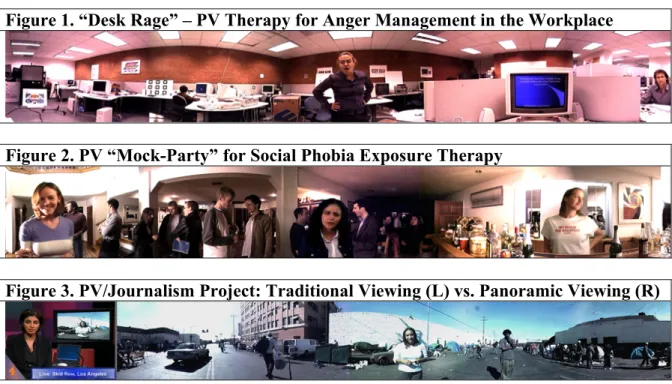
• Thirteen scenarios were created in an indoor office space for an “anger management in the workplace” application. In these scenarios, actors portrayed agitated and insulting co-workers who addressed the camera (and vis a vis, the clinical user wearing the HMD) with provocative and hostile verbal messages (Figure 1). The scenarios were designed to provide role playing environments for patients undergoing psychotherapy for issues relating to anger management in the workplace, or as it is commonly referred to as “Desk Rage” [4]. The patients wearing the HMD in these scenarios have the opportunity to practice appropriate responses to the characters and employ therapeutic strategies for reducing rage responses. Traditional methods of therapy in this area have mainly relied on guided imagery or role-playing with the therapist. It was hypothesized that PV content could serve to create immersive simulations that patients will find more realistic and engaging, and research is currently underway to assess this with clinical users at The Virtual Reality Medical Center (VRMC) in San Diego, CA (see: http://www.vrphobia.com/about.htm).
• A Virtual “Mock-Party” with the camera in a static position in the center of an indoor home environment in the midst of an active party with approximately 30 participants (Figure 2). This “scripted” scenario was shot while systematically directing and controlling the gradual introduction of participants into the scene and orchestrating their proximity and “pseudo-interaction” with the camera. The scenario was created for a therapeutic application designed to conduct graded exposure therapy [3] with social phobias. We have also experimented with pasting “blue screen” capture of actors (using a single video camera in the lab) into the panoramic scenes. The actors address the camera with a spectrum of socially challenging questions that provide the clinical user with opportunities to practice social verbal engagement in a psychologically safe environment. The separate capture and pasting of characters will allow the therapist to introduce a progressively more challenging level of social stress to the patient when deemed appropriate based on therapist monitoring of patient self-report and physiological responses. User testing on this project with clinical populations is anticipated to begin in June 2003.
• We have captured one PV test environment for a journalism project entitled “User Directed News”. This project is being conducted in collaboration with USC’s Annenberg School for Journalism and involves the PV capture of a news event with an in-the-field news reporter (Figure 3). The research aim of this project involves a comparison of groups of viewers who observe the news story either in the traditional single frame “talking head” newscaster format vs. full user immersion “in the scene” using a HMD. The project has thus far involved the capture of a news story on the situation of the Los Angeles’ “homeless” population as part of a study on the usability, preference for use and information processing issues related to this potential journalism application. The details of this project will be presented below.
Figure 1. “Desk Rage” – PV Therapy for Anger Management in the Workplace
Figure 2. PV “Mock-Party”for Social Phobia Exposure Therapy
Figure 3. PV/Journalism Project: Traditional Viewing (L) vs. Panoramic Viewing (R)
The capture, production and delivery of PV scenarios present unique challenges. Application development decisions require informed consideration of pragmatic issues involving the assets/limitations that exist with PV scenarios, the requirements of the application and how these two factors relate to user capabilities and preferences. Based on our initial field-testing experience, we outlined a series of guidelines and recommendations for the creation of PV scenarios that appeared in Rizzo et al. [1]. The areas covered in that paper dealt with pragmatic production issues, determination of suitable PV content, display and user interaction considerations, audio/computer graphic/PV integration issues and hardware options for maximizing accessibility. These recommendations were based on our experience in PV scenario production from a producer/developer standpoint and from user feedback provided by approximately 400-500 individuals at the time. Since then, we have continued to collect user feedback and have used this data to inform the design process in our evolving PV application research and development program. The following example illustrates the types of methodology that have been employed to study both usability and usefulness for panoramic video applications: ImmersiNews Project – The User Directed News project is based on the idea that as journalism moves into the 21st
Century, new forms of information technology (IT) stand to revolutionize methods for acquiring, packaging, organizing and delivering newsworthy information content. With these advancements in IT will come both opportunities and challenges for creating systems that humans will find to be usable, useful and preferred options for interacting with newsworthy information content. While some of the basic issues that constrain journalistic methods over the centuries (word of mouth, print, radio, TV, etc.) remain relevant, new issues are emerging for how humans will effectively interact with the deluge of digital content that will continue to expand in both quantity and scope as we move further into the information age. One area where journalism could benefit from the emerging IT revolution is in the use of systems that are capable of capturing and delivering news events within more “immersive” viewing formats. As
opposed to traditional “fixed-camera/talking head” capture and delivery of “on-the-scene” reporting of newsworthy events, the potential now exists to produce HMD-delivered 360 PV environments that allow the user to self-select what aspects of the event that they would like to observe and promote a sense of being immersed within the ongoing event. When immersed in this context, the user has the option to actively choose what aspects of the event that they are most interested in or are compelled to view. At the same time, this would not eliminate the need for the news reporter, but rather, would dynamically transform her role into that of a “news-guide”, who could stroll freely around the camera and point out aspects of the scene that the user could either chose to view or not. Viewer choice is key here in that current single camera approaches can indeed follow a roving reporter around an event, but do not allow for the user-option to self-select what aspects of the event are most relevant to his interests. This approach may serve to transform the user from simply being a passive observer of “fixed” content, to an active participant in the news acquisition process. The combination of the “immersive” aspect of “being there” along with free choice of viewing may provide a new paradigm for how news is created and consumed. One can imagine many scenarios where use of such a system would be desirable (i.e., observing the activity at a U.N. Security Council meeting or presence at a post Academy Awards party in Hollywood).
However, a number of pragmatic and user-centered questions need to be addressed scientifically before a determination of the value of this system can be made. Some of these basic questions include: Will users generally prefer to have news delivered in this format? Does immersion and self-selection compel the user to prefer this method of being “involved” in the story? Will reporters be able to adapt to this more “free form” method of reporting and what challenges will this produce for reporters in delivering “stories” to users who may not chose to follow the information flow in a traditional fixed “linear” manner? Will choice of viewing interfere with the acquisition of the logical story line in a news report? Will users be able to recall key points of the reported event in a meaningful manner? What types of news events would this system be best suited for in terms of user preference and information processing issues and what are the key elements of newsworthy events that might predict successful outcomes for use of the system? Will users naturally explore the 360 environment and choose to use this option?
Research Design Summary - Research is currently underway to address some of these issues by way of a very basic analog “news event” user preference and information processing comparison study. The current study is based on the production of a panoramic news story on issues regarding the “homeless” in Los Angeles, which puts viewers in the midst of some of the harshest living conditions imaginable within a modern society. Within this environment, the camera was strategically positioned in the middle of a street that was lined with people, an array of tents and makeshift living quarters on the sidewalk. The reporter stood in a fixed position within the field of view of one of the five cameras and reported a 2-minute story, as is typical of on-the-scene reporting. With this content, two user groups are currently being compared:
Group 1 simply views the feed from one of the cameras’ field of view containing the reporter’s delivery of the story, as is common practice in a standard reporting approach.
Group 2 views the event within a HMD to create the sense of being within the event while having free choice to observe the PV scene from any perspective within the 360 arc. At the same time, users hear the exact same verbal delivery from the reporter as presented in Group 1.
Following exposure to the 2-minute story, users in both groups are tested on multiple measures of memory for the information presented in the story and on user preference for use of the system. Memory for the content of the news story is also being tested one week later. This allows us to compare groups on immediate acquisition/retention of content and on long-term recall/recognition retrieval. As well, head-tracking data in Group 2 is being quantified to produce a metric of exploratory behavior within the 360 degree PV scene. We hypothesize that the sense of “being there” or “presence” will be enhanced in Group 2 by way of using an immersive HMD, and that this added engagement will increase recall by providing better contextual retrieval cues that leverage episodic memory processes. While the groups may not differ on measures of immediate memory, due to competing distraction effects nullifying immersion based gains in the HMD condition, we predict that when subjects are tested one week later, the contextual, episodic memory and presence effects will operate to produce much better recall/recognition retrieval. 5. Short Description of Achievements in Previous Years
In addition to the technical challenges that have been addressed in the capture and playback of these scenarios, we have captured an impressive range of scenarios (as detailed in Section 4) and conducted initial informal heuristic evaluations of the scenarios. We now have more than 1000 users try our various scenarios and have used their input to target ways to improve the total system.
5a. Detail of Accomplishments During the Past Year
Following the previous year’s technical accomplishments in the creation of a system for capturing PV and in the building of a media player that allows the scenarios to be delivered on a standard PC or laptop, we have begun to redesign our media player system. This was based on the experience we garnered with intensive use of the initial system and the limitations that were discovered. In addition to this ongoing iterative redesign process, we have commenced the process of conducting evaluation studies via collaborations with the VRMC and the Scripps Clinic in San Diego for the social phobia and anger management scenarios. In this work, we have successfully experimented with blue screen single camera capture of persons to be pasted into our panoramic scenarios (as described above) in order to foster a higher degree of controllable “pseudointeraction” for users. We have also developed ongoing partnerships with both the USC School of Fine Arts and the USC Annenberg School for Communication and with the School of Journalism to foster multidisciplinary development of PV scenarios. The Annenberg collaboration is illustrated in our description of the User Directed News project above. The School of Fine Arts project has evolved into Dr. Rizzo serving as a co-instructor in the “Art and Technology” graduate course that IMSC has collaborated on over the last two years. Over the last year we have put together two competitions whereby student groups in the Art/Tech course submit a proposal for how to create an art installation using the PV system. The best projects were selected by a jury of IMSC and Art faculty with the winner having the opportunity to produce their piece using the system as described in the FishTank application above. This collaboration is expected to continue with applications using other IMSC technologies on the horizon.
6. Other Relevant Work Being Conducted and How this Project is Different
We are unaware of any other research group that is systematically investigating the application of PV for the applications that we are addressing in the areas of art, psychology and journalism. Nor are we aware of any full-scale controlled experiments (such as seen with User Directed News) being done by others that address the issues of PV immersion and it’s impact on information processing within the context of this level of functional application.
7. Plan for the Next Year
Over the next year, we expect to both advance the technical processing issues for the creation of PV scenarios with the Panoramic system and aim to better specify the issues for usable and useful creation of PV scenarios that target a range of application areas. Specific targets are listed in the next section.
8. Expected Milestones and Deliverables
We plan to continue our system development in this area by:
• Complete a series of User Directed News experiments with varying event capture and perform testing with a wider range of user groups.
• Complete and publish findings on the Anger Management and Social Phobia user studies. • Experiment with and expand our bluescreen capture/PV pasting process.
• Redesign our PV media player.
• Explore options for using more compact higher resolution cameras.
• Further integration of Immersidata capture and analysis in collaboration with Cyrus Shahabi’s lab.
• Explore development of branching PV formats and Internet delivery. 9. Member Company Benefits
If found to be usable and useful, PV offers a method for creating immersive environments that capture the real world and could be of value for IMSC corporate sponsors.
10. References
[1] A.A. Rizzo, U. Neumann, T. Pintaric, M. Norden, Issues for Application Development Using Immersive HMD 360 Degree Panoramic Video Environments, In: Smith, M.J., G. Salvendy, D. Harris, R.J. Koubek, (Eds.), Usability Evaluation and Interface Design, L.A. Erlbaum: New York, Vol. 1, 792-796, 2001.
[2] A.A. Rizzo, K. Ghahremani, L. Pryor, & S. Gardner. (2003). Immersive 360- Degree Panoramic Video Environments: Research on Creating Useful and Usable Applications. 10th
International Conference on Human - Computer Interaction, Crete, Greece, June 22-27, 2003. [3] B.O. Rothbaum, L.F. Hodges, The use of Virtual Reality Exposure in the Treatment of Anxiety Disorders, Behavior Modification, 23(4), 507-525,1999.
[4] J. Daw, Road Rage, Air Rage and Now “Desk Rage”, The Monitor of the American Psychological Association, Vol. 32, No. 7, Aug. 2001.