OATAO is an open access repository that collects the work of Toulouse
researchers and makes it freely available over the web where possible
Any correspondence concerning this service should be sent
to the repository administrator: [email protected]
This is an author’s version published in: https://oatao.univ-toulouse.fr/22189
To cite this version:
Tos, Uras and Mokadem, Riad and Hameurlain, Abdelkader and
Ayav, Tolga and Bora, Sebnem
Ensuring performance and provider
profit through data replication in cloud systems.
(2017) Cluster
Computing : The journal of Networks, Software Tools and
Applications, 21 (3). 1479-1492. ISSN 1386-7857
Ensuring
performance
and
provider
profit
through
data
replication
in
cloud
systems
UrasTos1,2,3 ·RiadMokadem1·AbdelkaderHameurlain1·TolgaAyav2·SebnemBora3
Abstract
Cloudcomputingisarelativelyrecentcomputingparadigmthatisoftentheanswerfordealingwithlargeamountsofdata. Tenantsexpectthecloudproviderstokeepsupplyinganagreeduponqualityofservice,whilecloudprovidersaimto increaseprofitsasitisakeyingredientofanyeconomicenterprise.Inthispaper,weproposeadatareplicationstrategyfor cloudsystemsthatsatisfiestheresponsetimeobjectiveforexecutingquerieswhilesimultaneouslyenablestheproviderto returnaprofitfromeachexecution.Theproposedstrategyestimatestheresponsetimeofthequeriesandperformsdata replicationinawaythattheexecutionofanyparticularqueryisstillestimatedtobeprofitablefortheprovider.Weshow withsimulationsthathowtheproposedstrategyfulfillsthesetwocriteria.
KeywordsCloudcomputing· Datareplication· Performance· Economicbenefit
1 Introduction
In the last decade cloud computing has been in the spot-light both as a research area and the implementations in the industry. Cloud providers are able to provide vast com-putational resources for an affordable sum by delivering abstracted resources that is provided by relatively cheap hard-ware. Providers rent these shared resources to the tenants in an economy based-manner [9], with the ultimate aim of
B
Uras Tos [email protected]; [email protected] Riad Mokadem [email protected] Abdelkader Hameurlain [email protected] Tolga Ayav [email protected] Sebnem Bora [email protected]1 Institut de Recherche en Informatique de Toulouse (IRIT),
Paul Sabatier University, 118 Route de Narbonne, 31062 Toulouse, France
2 Department of Computer Engineering, Izmir Institute of
Technology, 35430 Urla, Izmir, Turkey
3 Department of Computer Engineering, Ege University,
35100 Bornova, Izmir, Turkey
returning profit. As the load generated by tenant applications change, cloud resources assigned to the tenants can be elas-tically adjusted. Using a pay-as-you-go pricing model [3], tenants are billed for only the portion of the cloud resources that are consumed by them. While the providers pursue profit, tenants expect the providers to deliver a quality of the service that will serve the tenants’ needs. This economic relationship between the provider and the tenant is clearly defined in the service level agreement(SLA) [32], which is a legally bind-ing contract between the two parties. Among the terms of this contract, an agreed upon set ofservice level objectives (SLO) are included to define the quality of the service. Breach of the SLA terms often result in some consequences for the provider, including monetary compensation as a penalty.
Increased data availability and improved level of perfor-mance are some important issues that exist in the cloud systems. Data replication has been around for decades that addresses these issues as well as providing other benefits. Data replication has been studied in many tradi-tional systems, including (i) database management systems (DBMS) [14], (ii) parallel and distributed systems [23], (iii) mobile systems [11] and (iv) other large-scale systems including P2P [31] and data grid systems [35].
A common way of replicating data in the traditional systems is creating as many replicas as possible to attain maximum resource utilization to provide best performance. In cloud systems, such a data replication strategy may not
The performance evaluation study aims to show the impor-tance of data replication in satisfying response time and to demonstrate how PEPRv2 not only satisfies the SLA, but also ensures profitability of the cloud provider. In a simulation environment, we design a scenario that compares the perfor-mance of PEPRv2 against another data replication strategy for cloud systems, as well as the original PEPR strategy.
The organization of the rest of the paper is as follows. Sec-tion2provides a summary of related work on data replication strategies in the cloud. Section 3 gives some background information and describes the cloud environment in which PEPRv2 operates. Sections4 and5describe the details of PEPRv2 and the implemented economic cost model, respec-tively. Section6evaluates the performance of PEPRv2 in a simulation study. Section7concludes the paper and discusses some possible future studies.
2 Related work
In data replication context, several existing strategies already deal with some of the issues addressed in this paper. Most notably, the consideration of the economic impact of data replication is particularly interesting for our work. This sec-tion briefly discusses the strategies according to whether they take the economic aspect of data replication into account.
2.1 Data replication without considering economic
impact
Cost-effective dynamic replication management (CDRM) strategy [37] highlights that having too many replicas does not increase availability but instead results in diminished returns. CDRM calculates and maintains a minimum number of replicas to satisfy a given level of availability. In the con-sidered cloud storage, data sets are fragmented into several blocks. Authors calculate the availability of data sets depend-ing on the availability of each of their fragments. With this information, CDRM calculates a required number of repli-cas for each fragment. Placement of replirepli-cas is performed in such a way that balances the load on all sites. Reduc-ing access skew ensures that all of the fragments are served without causing a bottleneck. As a consequence of balanced load, the authors also observe increased access performance. Investigating the relationship between the number of replicas and the level of availability has been the focus of other stud-ies as well [22]. Another approach [33] that is very similar to CDRM also deals with finding minimum number of replicas from a data popularity point of view in cloud storage clus-ters. In this work, not all data but only a subset of files which exceed an access threshold are considered for replication.
Increasing data locality, more specifically spatial locality through data replication yields increased performance with beeconomicallybeneficialfortheprovider,sincecreationof
alargenumberofreplicascanresultinawastefulresource utilization,degradedperformanceandreducedprofit. There-fore,dealingwithdatareplication,threemajorquestionsof what to replicate, when to replicate, and where to repli-cate [26] must be answered in such a way to satisfy the performanceinaneconomicallyfeasibleway[36].
In the literature, current efforts on data replication in cloudsystemsaremainlyinterestedinsatisfyingthe objec-tiveof agivenlevel ofavailabilityfor thetenants[29,33]. On the otherhand, satisfying performance objectives has beencomparativelyalessvisitedissuewithonlyahandful ofstudiesbeingparticularlyinterestedinimproved perfor-mance[4,12,37,39].Thismaybe particularlyattributedto thelackofperformanceguaranteesbeingadefactopartof theSLAuntilrecently[16,28].Moreover,evenfewerofthe proposedstrategies consider the economic impactof data replicationonthecloudprovider[7,10].
WeproposePErformanceandProfitorienteddata Repli-cationstrategy,version2(PEPRv2)thataims the simulta-neoussatisfactionof boththe SLA terms,e.g.availability andperformance andensuring the economic profit of the cloudprovider.Wetreattheresponsetimeasthemain per-formancemetric,whichisalsoincludedintheSLA.PEPRv2 estimatestheresponsetimeofthequerieswhentheyarrive atthe cloud.Ifthe estimatedresponsetimeisgreaterthan theSLOresponsetimethreshold,profitabilityofthat partic-ularqueryisthenestimated.Theprofitestimationincludes any possible replication event that will be necessary dur-ing execution. Moreover, PEPRv2 also has the ability of dealingwithagroupof queriesthatare executedin paral-leltoachieveatask.Replicationiscarried outonlywhen boththeresponsetimeandeconomicbenefitoftheprovider are estimated tobe satisfied. Placement of the new repli-casarealso performedconsideringthesetwocriteria.The number of replicas is dynamically adjusted as the SLOs aresatisfiedovertime.Furthermore,aminimumnumberof replicasarealwayskepttoensureaminimumgiven avail-ability[37].
PredecessorofPEPRv2hasbeenintroducedinourearlier paper[36].Whilethetwostrategiesbearsomesimilarities, PEPRv2isproposedwithseveralnovelcontributions includ-ing(i)aresponsetimeestimationmodelthatregardsboththe computationalloadanddataintensivenessofqueries sepa-rately,(ii)considerationofdistributedexecutionof queries onanynumberofvirtualmachines,andinturninclusionof thisaspectintheproposedreplicationdecisionalgorithms, (iii)adetailedeconomicmodelthatestimatesthemonetary correspondancesofthecloudresourcesexpectedtobe con-sumedbyeachquery(iii)arealisticperformanceevaluation studyperformedonaheterogeneouscloudenvironmentthat includesacomparisonwithanotherdatareplicationstrategy forcloudsystems,aswellasthepredecessorofPEPRv2.
strategically placing replicas closer to the requestor sites. Even though some strategies do not directly consider perfor-mance as an objective, increased perforperfor-mance is observed as a consequence of data replication [17]. Another form of increasing locality of data for improved performance is focusing on temporal locality. In this manner, some strate-gies argue that frequently accessed data sets will likely stay popular in the future [13] and decide what to replicate accord-ing to the mentioned popularity assessment. This is a simple but effective strategy for satisfying performance guarantees as evidenced by RTRM strategy [4]. When accessing pop-ular data is causing a higher-than-desired average response time, these data sets are replicated to resolve the performance issue. What is interesting about RTRM is that it replicates not all but just popular data in order to conserve resource usage. Some other strategies deal with availability as a reliability issue regarding the cloud sites [18,19]. While availability is a frequently considered objective, what sets these two strategies apart is their consideration of cost-effectiveness in satisfying availability. By determining the duration to keep replicas according to a reliability metric, these strategies can optimize the number of replicas for each file, hence saving provider costs on storage resource.
2.2 Data replication with considering economic
impact
Modeling a data placement strategy to improve availability can be also be achieved through custom economic cost mod-els. Some present an auction model to implement a replica placement policy in a large-scale cloud storage environment [39]. If the desired availability level cannot be maintained, a bidding is held to determine some placement for a new replica. Bidding price is dependent on several properties of the nodes including failure probability, network band-width and available space. Some performance increase is also observed as a consequential benefit of data replication. Oth-ers deal with a similar problem in a multi-cloud context [1], where tenants receive services from multiple cloud providers. These examples use a custom economic model that is tailored to take into account the heterogeneity caused by resource and pricing variations among multiple cloud providers. Similarly to existing strategies, this economic model is used in order to minimize a cost model [21].
In another similar effort, Skute [7] is introduced as a cost-efficient data replication strategy based on a virtual economy that takes into account marginal utility, storage usage and query load. Virtual nodes act autonomously and they period-ically announce their rent to other nodes. Moreover, nodes also accumulate wealth by answering queries and spend this wealth on other nodes to store replicas on them, accord-ing to their rent. Skute self organizes replica configuration among the virtual nodes to minimize communication cost
while maximizing economic benefit. Even though the strate-gies of this type utilize some form virtual economy, it is not an actual monetary cost model of the provider–tenant rela-tionship [6].
Increasing availability by replicating popular data closer to the locations that originate most amount of requests is also a frequently researched problem. Some strategies even propose mechanisms to predict future accesses based on his-torical access records to preemptively replicate data to meet the increased demand [27]. Moreover, some other strategies deal with data popularity that peaks for a short amount of time, and then tapers off [25]. In order to deal with the quick burst of popularity, these data replication strategies quickly respond and change the replica configuration accordingly. Increasing data locality based on popularity also decreases network consumption [20].
Tos et al. [36] deals with some of the concepts that are proposed in this paper. Proposed work deals with performing data replication in the cloud with respect to the performance metric in the SLA as well as estimating the provider profit in each billing period. Response time estimation for tenant queries are calculated when the queries are arrive at the cloud. If the estimation indicate that a desirable performance can-not be satisfied, data replication is performed, but only when it is economically feasible for the provider. However, in the mentioned work, inter-query parallelism is not considered. Moreover, the performance evaluation considers a compari-son with a strategy that is targeted at the data grid systems.
3 Background
While cloud providers offer numerous services to the public, they are also business entities that operate for generat-ing profit. Regulated by the SLA, the relationship between provider and tenant revolves around the quality of the service and monetary cost of these services. Providers take advan-tage of cheaper hardware, resource sharing, and other factors to maximize profit and offer elastically scalable resources simultaneously in a large scale.
Providing computing resources in a global scale with a realistic quality of service pose significant challenges for the providers. Often times providers establish facilities in mul-tiple geographical regions to achieve this goal. By having facilities in various regions, providers aim to handle queries from tenants with a large diversity of location. Evidently, having facilities in a number of different regions may also result in operating costs of the provider to vary from region to region, depending on the resources consumed (e.g. power costs). This introduces a heterogeneous service supply by the provider. In a particular region, the bandwidth may be cheaper than the storage, while the inverse might be true for another region. This is another issue that should be taken
query. However, going through with the decision to replicate depends on the satisfaction of two criteria. A replication event occurs if and only if it will satisfy the response time guarantee and it is a profitable course of action for the provider.
Initially a queryQis submitted to the cloud that contains a number of nodes{n1,n2, . . . ,ni}. Assuming thatQis dele-gated to nodenithat will execute it, in the first step a response time estimation for that particular queryTQ,ni is calculated. If the estimated TQ,ni is determined to be greater than the service guarantee given to the tenant (TS L O), it would pose a breach of contract and cause the provider to pay a penalty to the tenant. Therefore, provider should perform data repli-cation beforehand to prevent this problem.
The response time estimation is the mechanism that ensures provider to decide whether to replicate or not to meet tenant requirements. However, response estimation is not enough on its own to carry on with the replication. Eco-nomic benefit of the provider must also be ensured for the provider to keep the business afloat and continue serving the tenants.
Algorithm 1Replication decision algorithm.
1:TQ,ni←estimated response time of executingQon nodeni
2:ifAvailability(Q,dj)<Mi n Availabili t yS L Othen
3: PlaceReplica() 4:end if
5:ifTQ,ni>TS L O then
6: p←estimated profit generated by the execution ofQ 7: ifp>0then
8: PlaceReplica()
9: end if
10:end if
Executing query Q costs some monetary sum for the provider. Placement of some replica that is associated with Qon a nodenjthat may or may not be the same node asniis included in this cost. Ideally, provider wants to return some profit from the execution of each query. Therefore a profit estimation is also performed before the execution to evaluate the profitability of the potential replication decisions. Repli-cation is performed only if the result of these two estimations are acceptable as described in Algorithm 1. Of course, repli-cation decision algorithm also checks the availability of the data associated withQand replicates the concerned data set if the availability is below the threshold defined in the SLA.
4.1.1 Response time estimation
When a queryQis submitted to the cloud for processing, an available nodenj takes it up for execution. Processing ofQ requires data sets of{d1,d2, . . . ,dj}during execution. Some of this data may already be present onnior it may be neces-sary for them to be read from remote nodes{n1,n2, . . . ,nk}. intoaccountbyanydatamanagementstrategyoperatingin
thecloud.
Theheterogeneityisnotonlypresentforthecostsofthe provider,butalsotheperformanceofthecloudservicesas well.Asanexampleofthisphenomenon,allregionsofthe cloudareinterconnectedvianetworklinks.Itcanbeexpected that, while the network links are more abundant andless expensive inside the subregions; bandwidth is less abun-dantandmoreexpensiveupperinthehierarchy,i.e.between differentgeographical regions[24]. Insidethesubregions, networklinks are dedicated tothe provider’s use.On the otherhand,usuallytheInternetinfrastructureisusedbetween differentgeographicalregions,thereforebandwidthismore preciousinthatcase.
Tenants consume the services they obtained from the providerbysubmittingqueriestothecloudinorderto pro-cesstheirdata.Thedatatobeprocessedistypicallyglobally distributedinthe cloud.Queries mayrequireoneor more datasetsduringexecution.Consideringthenetwork capabil-itiesbetweenregionsandloadvariationsinthenodesthat willexecutethequeries,meetingresponsetimeobjectiveis non-trivialfortheprovider.
BreachofSLAishandledrelativelystraightforwardfrom theprovider’sperspective.Forexample,inacasewhenthe tenantdoes notpaythe rent,theprovider cansimplystop providingtheservices.Ontheotherhand,itismoredifficult tokeeptrackofSLAbreachesfromthetenant’sperspective. Usuallytheprovidermonitorsthequalityoftheservice,and when theservice qualityfallsbelow athreshold, provider pays a monetary sum to the tenant [16]. Obviously this approachinvolvesacertainamountoftrustbetweenthe par-ties.
4
Data
replication
strategy
Datareplicationinvolvesseveraloperationstepstobecarried outinameaningfulwaytoachievedesiredbenefits.These stepsarefindingwhatdatatobereplicated,whenthe replica-tioneventshouldbecarriedout,howmanyreplicastocreate andwheretoplacethesereplicas[26].Asaresult,PEPRv2 makeseach ofthesedecisionstodetermineanear-optimal replicaconfiguration. Instead of gathering popularity data andperformingaperiodicalreplicareconfiguration,PEPRv2 performsthenecessaryreplicationtasksbeforeexecutingthe queries.Hence,whattoreplicateisalwaysthedataassociated witheachquerybeingexecutedataparticulartime.
4.1
When
to
replicate
InPEPRv2,we followan on-arrivaldecisionapproachfor whether toreplicate. That is, when a query arrives atthe cloud,allreplicationdecisionsaremadebeforeexecutingthat
Some queries may read data sets only once while other queries may require data sets to be accessed many times, depending on the data intensiveness of any particular query. This variations between queries in terms of data intensiveness is included in the response time estimation with the factor of
β. During execution, the portion of data that resides on remote nodes would be required to transferred to the executing node ni. This transfer took place over the I/O throughput capability
tnk of the remote nodenk. Moreover, network link between niandnkis also expected to be consumed. Since the network links other than the ones inside a particular subregion usually established over the Internet, they are heterogeneous. There-fore, our estimation model takes into this account by using the expected available bandwidth between the nodes at the time of execution.
Total data involved with theQis expected to be processed onni by consuming local I/O throughput oftni. Of course, there may already be some other query load onni that may slow down the execution ofQ. This situation is handled by takenlni into account, which is the expected query load on ni during execution. Every single query execution may be different as some queries may have more computational com-plexity than others. We useαas a factor to differentiate these computational variations between queries.
Response time estimation models for similar scenarios has been studied in traditional systems [23], whereas Equation1
shows our response time estimation for the aforementioned query execution scenario.
TQ,ni =α j 1 djlni tni +β j 1 k 1 dj bni,nk + dj tnk φj,k (1) φj,k =
1 ifdj migrated from nodenktoni
0 otherwise (2)
As depicted, the response time estimation mainly consist of the sum of two parts, namely processing and network trans-fers. As a result,TQ,n >TS L O condition may occur in two situations that are relevant to those parts. (i) If the remote data is in a low bandwidth region relative to the executing node or the node hosting the remote data is having low I/O per-formance, this may have an adverse affect on response time. (ii) Ideally the queries should be processed by a node with a suitable computational load. However, if the CPU load on the executing node is high during the execution, this would also cause not meeting the response time guarantee. Therefore, it is beneficial to replicate remote data to more suitable loca-tions as well as migrating the tasks to the nodes with enough computational resources to prevent over-utilization.
In some contexts, tenant may require the completion of a task that involve parallel execution of multiple indepen-dent queries [15]. The execution of these queries naturally takes place in parallel on a multitude of cloud sites. The
completion of that particular task depends on the completion of all of its queries. In this case, due to parallel execution, the response time estimation should be taking each of the concerned queries into account. Rather than the sum, the log-ical approach is to estimate which of the mentioned queries is going to take the longest amount of time to produce a response. PEPRv2 also handles this parallel execution model. LetKbe a tenant task that consist of a number of queries, K = {Q1,Q2, . . . ,Qi}that are executed in a parallel. We assume that a query Qi in K requires a data set Rn for processing, and all queries of the same task begins at the submission of the task. Given that all the R data sets as R= {R1,R2, . . . ,Rn}are distributed in the cloud with repli-cas on j sites as N = {N1,N2, . . . ,Nj}; queries will be executed on the replicas in parallel as Qij. In this case, the estimated response timeTK of the task K is determined by the longest estimated amount of time it takes forQi to exe-cute on a certain particular data set Rnj as shown in Eq.3.
TK =max j T(O j i)|O j i ∈ K (3) 4.1.2 Profit estimation
While the function of the cloud provider is to create and distribute services for the tenants, the purpose of the cloud provider is to obtain economic benefit, in other words mone-tary profit. Since PEPRv2 makes the replication decision on a per-query basis, ideally every replication decision should at least on average be profitable for the provider.
In PEPRv2, we regard that the tenant pays for a particular service with an agreed upon quality. This service quality may include the total size of the hosted data and the arrival rate of the queries. In case the tenant requirements change over time, the rent is elastically scaled as well. Profitability of the provider depends on how much of this revenue is spent on providing the service to the tenants. In other words, ensuring profitability for a certain amount of revenue, the provider must pursue the most economical routes of providing the services in order to decrease expenditures. As PEPRv2 deals only with the data replication portion of these services, it aims to make the replication decision that would yield the least amount of monetary cost.
pr o f i t=r evenues−ex pendi t ur es (4) Similar to the idea of estimating the response time, a profit estimation is calculated for each query. In the profit estimation (Eq.4), how much revenue is expected to be gen-erated for each query is compared with the expenditures of the resources that are estimated to be used during the exe-cution of each particular query. The estimated profit is used alongside the response time estimation to make replication
decisions in a way that only the profitable replication options are carried out. The details such as how the expected revenue and estimated resource consumptions are revisited in Sect.5.
4.2 How many replicas
Keeping how many replicas of any particular data set is another issue to be addressed by the replication strategy. While PEPRv2 focuses on the performance aspect of the provider responsibilities, availability is also an important objective of the provider. Therefore, PEPRv2 keeps each data set at a minimum given availability through replication. Satisfying availability is a widely researched topic in cloud computing as there are already many works focusing on that particular issue [34]. In our study we do not visit this issue in depth, and design PEPRv2 in such a way to not let the number of replicas to not fall below a number that satisfies a minimum given availability level [37].
In the matter of satisfying response time, the number of replicas can be varied between the minimum number of repli-cas to satisfy a given availability and a number that is possible for the provider to physically create. In other words, the max-imum number of replicas for any particular dataset has not a predefined limit, PEPRv2 can create seemingly infinite num-ber of replicas as it deems necessary. This necessity is limited by determining the satisfaction of the response time estima-tion and profit estimaestima-tion models.
Creation of replicas is performed in an incremental man-ner. At each query execution, the number of replicas of relevant data to that particular query is incremented by one. PEPRv2 assumes that, by placing the new replica in a near-optimal manner, the response time should already be satisfied. Therefore incrementing the number of replicas by a number greater than one is should not be necessary.
Algorithm 2Replica retirement algorithm.
1:slaV i olati on←false
2: logQueryCompletionStatistics()
3:TQactual ←measureResponseTime(Q)
4:ifTactual
Q >TS L Othen
5: slaV i olati on←true
6:end if
7:ifE xecut ed QCount=Q Per E pochand
slaV i olati on=true then
8: slaV i olati on←false
9: E xecut ed QCount←0
10: removeReplicasByLRU(N um_L RU)
11:end if
to free up storage space for future replicas and reduce storage costs of the provider. Of course, the retirement operation must be done in a way to make the cloud still satisfy the response time guarantees after the removal of the unnecessary repli-cas. Evidently, there is a need for a decision mechanism to determine which replicas to be removed from the cloud and when.
First step in replica retirement is the identification of some replicas as unnecessary. While other replication decisions in PEPRv2 is made on-the-fly before the execution, replica retirement operation requires some a priori information. This a priori information mainly consists of access histories of each individual replica. Using this information, PEPRv2 can determine the list of replicas that are least frequently accessed during any particular window of time in the past.
LetQ Per E pochshow a system parameter that indicates the number of queries that defines an epoch. After every Q Per E pochqueries executed, if there are no SLA breaches observed in that epoch, a predefined number of least recently used replicas, denoted byN um_L RU, are removed from the system. The retirement algorithm is invoked at each query execution, however it only performs the actual cleanup after eachQ Per E pochqueries. Algorithm 2 describes the retire-ment algorithm in more detail.
4.3 Where to replicate
The final replication decision is the placement of the new replica. Similarly to what has been done in the previ-ous sections, this decision is also made by the response time and profit estimations. A suitable placement for a new replica must satisfy the response time requirement and should still be profitable for the provider after the placement. Moreover, the destination node should have enough storage space and relatively low load to avoid over-utilization.
Ideally, finding an optimal placement requires evaluation of all nodes in the cloud for the necessary criteria. However, as seemingly infinite number of nodes possibly existing in a globally distributed cloud system, this approach is not fea-sible. The search duration itself would be enough to violate the SLA response time guarantee. As a result, a relatively straightforward heuristic is employed to determine a place-ment for the new replica. This heuristic would not look for the best placement, but a near-optimal placement that satis-fies both the response time and the profit.
∃R⊂C|TRi ≤TS L O
∃Si,j ∈Ri|PSi,j >0∧Si,j ←maxPSi,j (5) In the first step, each region Ri in the cloud C =
{R1,R2, . . . ,Ri} is evaluated whether a placement to Ri would satisfy the response time guarantee or not. Then, Removalofunnecessaryreplicasistheotherissue
regard-ingthe numberof replicas maintained inthe cloud. Over time,somereplicasmaygetinfrequentaccessessimplydueto changingdemandcausedbythetenantqueries.Inthesecases, itmaybebeneficialtoretirethosereplicasfromthesystem
among the regions that satisfy response time (Eq.5), the subregion that belongs to that particular region Ri =
{Si,1,Si,2, . . . ,Si,j}and nets the highest amount of provider profit is selected. From the selected subregion, a node with acceptable storage and load is selected for placement. Band-width for reaching out of the subregion is the same for each node inside that particular subregion, as long as storage and load criteria are met. Therefore choosing one node from another would not have any significance as long as it is in the determined subregion.
Algorithm 3Replica placement algorithm.
1:foreach regionRin the cloudCdo
2: ifTR≤TS L O then
3: foreach subregionSin the regionRdo
4: ifPT h∧S←maxPSthen
5: foreach nodeNin the regionSdo
6: if N.f r eeSpace ≥ si zeO f(data)∧ N.load ≤ load T hr esholdthen
7: place on N 8: end if 9: end for 10: end if 11: end for 12: end if 13:end for
Algorithm 3 depicts the placement algorithm as described. While the placement algorithm searches for the most prof-itable subregion, it does not look for the lowest pos-sible response time. As the provider’s guarantee is not the best performance but instead satisfaction of a thresh-old; it would be economically more beneficial for the provider to focus on profit once the response time is sat-isfied.
It is important to mention that, at any time some data migrate, there is a cost associated with the migration. In data migration, bandwidth is consumed during transfer and stor-age is consumed at the destination. Monetary aspect of the migration cost is dealt with the profit estimation by regard-ing migration cost a part of bandwidth and storage costs. In addition, data migration caused by pre-replicating data also results in an adverse effect on response time of execution of a query.
5 Economic cost model
Another important consideration in PEPRv2 replication man-agement is the economic impact of data replication on provider’s profit. The economic model presented in this sec-tion estimates provider revenue and expenditures in order to assess the estimated profit from the tenant queries.
5.1 Provider’s revenue
As a part of the service agreement, tenants are obligated to pay for the rent associated with the services acquired. Con-sidering the elastically scaled services, the total amount of rent can vary during a billing period. The exact amount of payment is determined by measuring the utility metrics that are defined in the SLA. This rent is the only revenue source for the provider in our economic model.
In PEPRv2, the economic part of whether to replicate deci-sion is also depends on the profit of the provider. However, in this case we are interested in the revenue and the profit generated by each query, instead of focusing on profitability in a certain period of time. Therefore, it is important to make the transition between the actual revenue to the expected rev-enue generated from each query. Service details included in the SLA contains the limits for maximum arrival rate of the tenant queries. Therefore, it is possible for the provider to expect how many queries may be received from the tenant in a billing period. Of course, reaching the limits of the service is the worst-case scenario for the provider, but it may be sen-sible for the provider to be prepared for that case as well. The actual economics of operating a cloud is beyond the scope of this paper, therefore we assume that the provider is capa-ble of calculating an expected, on average revenue generated from the execution of each query.
It is worthy of noting that, data replication is the responsi-bility of the service provider in PEPRv2. The tenant pays for a service and expects this service to be supplied at the agreed upon quality against the changing workload of the tenant queries. It is therefore the provider’s responsibility to main-tain the replicas in the cloud to satisfy the SLA terms. The tenant pays for the utilized service, and does not care about how many replicas the provider needs to create or maintain to meet the SLA.
5.2 Provider’s expenditures
Meeting the computational demands of the tenants and elasti-cally adjusting the properties of the services provided, cloud providers face the continually changing costs associated with these services. A cloud operator deals with many types of costs ranging from the paychecks of the employees to the power consumption of the facilities. While some of these costs are directly affected by data replication (e.g. storage costs), others may not be concerned by replication (e.g. on-site physical security).
Obviously it is not feasible to take into account every type of cost during a replication decision. In response time esti-mation model, we estimated the amount of time spent using some specific types of resources during the execution of a query. During estimation of the provider cost, we follow a similar path and estimate the monetary cost of the resources
consumed by each query execution. Consumption of each type of computational resources is estimated before the exe-cution and this estimation is compared against the profit generated by the execution of that particular query to predict the profit. This profit value is used in the replication decision as mentioned in the earlier sections. It should be noted that, while estimating the expenditures, the costs include the pos-sible replication events to evaluate the profitability with the inclusion of the new replicas.
During execution of the queryQ, a CPU cost of Cc is incurred as a result of the expected consumption of the CPU resource. A query may involve a number of nodes, includ-ing the executor node and other nodes that may contribute during migrating the relevant data to that particular query. As a result, the cost of CPU (Eq.6) is estimated by the con-sumption of CPU time (Ti) on all nodes that contribute to the execution [30]. Conversion of CPU time to monetary cost is done by the factor of unit cost of CPU resource denoted by
μt,ithat is dependent on the node itself to take heterogeneity into account. Cc = i 1 Tiμt,i (6)
Data transfer over the network (Eq.7) is another cost item (Cn) the provider deals with. Following a similar assumption as in the response time estimation model, a queryQrequires data sets of{d1,d2, . . . ,dj}during execution. Some of this data may migrate from remote nodes{n1,n2, . . . ,nk}to the executor nodeni. Data migration may occur between nodes that reside in various parts of the cloud hierarchy. Moreover, bandwidth cost between any two node can vary due to het-erogeneity in the cloud. Therefore,νdenotes the unit cost of bandwidth that is specific between any two nodes in the cloud. Cn = j 1 k 1 djνni,nkφj,k (7) φj,k =
1 ifdj migrated from nodenktoni
0 otherwise (8) Cs = j 1 k 1 djσnkχj,k (9) χj,k =
1 ifdj is read from nodenk
0 otherwise (10)
As mentioned before, provider expenditures may include other cost items that may not be directly caused by data replication. Providers can simply include these costs in the economic model as other costs (Cot her s) or impose a margin on the expected profit to cover these expenses. Furthermore, the provider pays penalties to the tenants if one or more SLOs are not satisfied. As a result, in addition to other costs, penal-ties (Cp) are also included in the provider cost. Through data replication, the provider aims to minimize the penalties paid to reduce cost [38]. In regard to all of the described cost types, the estimated provider cost, i.e. expenditures, is given in Eq.11.
ex pendi t ur es =Cc+Cn+Cs+Cp+Cot her s (11) Since the expected revenue of each query is a known amount for the provider, at this point, it is a simple subtrac-tion to calculate the estimated profit using the total amount of expenditures caused by the execution of any particular query.
6 Performance evaluation
6.1 Simulation environment
Realizing an entire cloud topology is a very hard and expensive way of verifying the performance of any study. Acquiring and configuring many hosts to achieve a model of a desired cloud system is indeed non-trivial. Furthermore, this way of testing makes it harder to control all the variables involved in a scenario. In order to address these concerns, sev-eral cloud simulators have been proposed in the literature [2] to accurately implement performance evaluation scenarios without dealing with the burden and cost of an actual cloud environment. While every proposed simulator focuses on one aspect of the cloud, e.g. resource provisioning, as of writing this paper, no particular cloud simulator specializes on data replication. Among the available simulators, CloudSim [8] is noticeably widely used in the literature. CloudSim is also an open source project, therefore it is possible to tailor the simu-lation suite to meet the the requirements of our performance evaluation scenarios.
In its standard form, CloudSim is targeted for creating dat-acenters and allocating virtual machines on physical hosts. It allows creation of simple tasks called cloudlets and models the execution of cloudlets on virtual machines. Therefore it is more suitable towards scenarios that involve virtual machine Finalmaincost itemthat is relevantto datareplication
isthestorage cost,Cs,as depictedinEq.9.Eachdataset canbeused byany numberof queriesduring thelifetime ofthereplicas.Itisthereforenotaccuratetobillthequeries bytheamount ofstorage spaceoccupied.Forthisreason, weestimatethestoragecostbytheamountofstorageI/Ois expectedtobeperformedbyanyparticularquery.Thisway, weestablishthatthequeriesthatcausemoreI/Ooperations resultinmoremonetarycostofstorage.Thepossible hetero-geneityof differentcloud regionshaving different storage costsishandledbythefactor σ,whichdenotestheunitcost ofstorageonanyparticularcloudnode.
Region
...
Datacenter Virtual machines...
Datacenter Virtual machines...
Datacenter Virtual machines Region...
Datacenter Virtual machines...
Datacenter Virtual machines...
Datacenter Virtual machines Region...
Datacenter Virtual machines...
Datacenter Virtual machines...
Datacenter Virtual machines Region...
Datacenter Virtual machines...
Datacenter Virtual machines...
Datacenter Virtual machines Region...
Datacenter Virtual machines...
Datacenter Virtual machines...
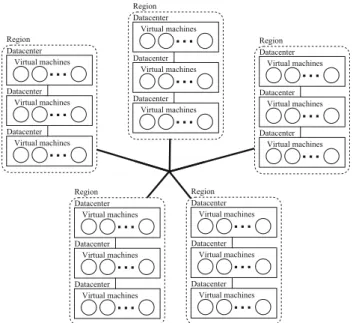
Datacenter Virtual machinesFig. 1 Simulated cloud topology
(VM) provisioning, task distribution, and power manage-ment. However, mechanisms for performing data replication is not present in the original version. As a result, we extended CloudSim to include data replication functionality, as well as other aspects that our simulation scenarios require, includ-ing supportinclud-ing a cloud topology with heterogeneous sites and network links and measuring resource consumptions and conversion of consumed resources into monetary counter-parts.
In the simulations, we realized a cloud environment with hierarchical network links as described at the beginning of Sect. 3. Simulated cloud consists of five geographical regions. Each region contains thre subregions represented as datacenters. In turn, each datacenter contains ten nodes real-ized as VMs. Network topology is established in such a way that, the bandwidth capacity is more abundant and cheaper inside the datacenters but less abundant and more expen-sive towards the inter-region level. Moreover, computational capabilities and storage capacities are also varies from dat-acenter to datdat-acenter to simulate a cloud environment with heterogeneous sites and network links. This heterogeneity is also extended to the costs of the CPU, storage and net-work resources. In every region, the provider costs of these resources are varied to achieve a more realistic cloud system. A schematic overview of this cloud topology is depicted in Fig.1. Also a complete list of simulation parameters, includ-ing in what ranges the heterogeneous cloud resources are varied can be found in Table 1. We chose the simulation parameters to be in accord with existing studies [5] to real-istically represent a typical cloud environment.
Each VM has the necessary computational resources to perform the execution of queries. These resources include
Table 1 Simulation parameters
Parameter Value
Regions 5
Datacenters per region 3
VMs per datacenter 10
VM processing capability 1000–2000 MIPS
VM storage capacity 15–25 GB
Intra-datacenter bandwidth 4–6 Gbit/s
Intra-region bandwidth 1.25–1.75 Gbit/s
Inter-region bandwidth 0.15–0.25 Gbit/s
Avg. intra-datacenter delay 5–10 ms
Avg. intra-region delay 25–50 ms
Avg. inter-region delay 100–150 ms
Response time SLO 180 s
Simulation duration 10 min
Number of queries processed 10,000
Query arrival rate 16.67 query/s
Computational load of a query 1000–7500 MI
Number of data sets 30
Avg. size of a data set 620 MB
Intra-datacenter transfer cost $0.005/GB
Intra-region transfer cost $0.025/GB
Inter-region transfer cost $0.25/GB
Storage cost $0.20 to $0.30/GB
Processing cost $1.25 to $2.25/109MI
Penalty cost $0.0025 per violation
Assumed revenue $0.004 per query
N um_L RU 1
Q Per E poch 10
load T hr eshold 90%
CPU, RAM, storage, and network connectivity. During exe-cution, VMs can access the data sets in other VMs by remote reads or by replicating them to local storage. Optimal dis-tribution of queries to virtual machines, and other related issues including task migration is not a focus this study. When a query is received by a datacenter, a virtual machines is randomly assigned to handle the execution of that par-ticular query. Queries randomly arrive to the cloud system as the average arrival rate indicates. Each query requires a dataset that is randomly determined when the query is cre-ated. Moreover, computational load generated by each query is also randomly varied from one query to another to simulate the computational variations between queries, e.g. a simple projection versus an aggregate function.
The duration of the simulation is regarded as one billing period. For that period, the tenant is charged for the services obtained, and provider profit is determined by the expendi-tures of the provider during this billing period.
Table 2 Simulation results
Replication strategy PEPRv2 PEPR CDRM No replication
Avg. response time (s) 45.56 36.41 203.54 343.27
SLA violations 337 298 3609 7303 Number of replications 1040 1226 797 0 Storage usage (%) 21.96 26.97 16.33 3.81 Inter-region data transfer (GB) 26.87 28.03 294.90 499.98 Intra-region data transfer (GB) 295.80 250.64 164.97 62.84 Intra-datacenter data transfer (GB) 301.94 349.77 173.08 65.26
Total expenditures of the provider ($)
26.94 33.81 97.08 154.46
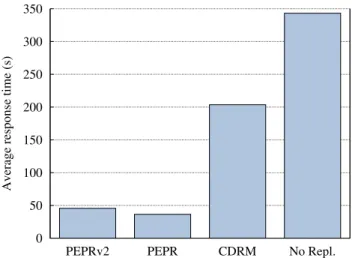
Fig. 2 Average response time in seconds
6.2.3 Average response time and SLA violations
Both PEPRv2 and PEPR managed to satisfy the response time objective with a great margin (Fig.2). Having a much lower average response time than the SLA threshold also meant that these two strategies satisfied the response time for a greater percentage of the queries processed. On the other hand, satisfying availability and balanced load does not ensure performance for CDRM. While the average response time with CDRM is close to the SLA threshold, response time is not satisfied for a great amount of queries. The results also indicate that, it simply was not possible to meet the performance SLO without using a data replication strategy.
Since SLA violation count is a direct measure of the response time satisfaction, we see a similar view on this met-ric as well. Both PEPRv2 and PEPR kept the number of violations to a minimum, albeit with some breaches during the initial replica reconfiguration. On the other hand, CDRM suffered heavy violations, however it still provided a signif-icant advantage over not using data replication.
6.2.4 Number of replications and storage usage
In terms of the number of replications, PEPRv2 made slightly less replications compared to its predecessor. This difference can be attributed to the more intricate replica placement deci-sion on PEPRv2’s part which takes heterogeneous properties of the cloud into account. Still, both PEPRv2 and PEPR created more replicas compared to the number of replicas created by CDRM. This difference in the number of replica-tion events also made an impact on the storage consumpreplica-tion of these strategies as well. This different outlook on the repli-cation event totals and storage usages are due to the different objectives pursued by these strategies, especially with the case of CDRM. Obviously, without any data replication, the
6.2
Simulation
results
6.2.1Compareddatareplicationstrategies
Theaimofthesimulationstudyistomonitorhowdata repli-cationenablesproviderstocopewiththequeryload,inorder tokeeptheresponsetimeSLO.Simultaneously,weobserve theprovider profitinthe samebillingperiod.With agoal ofdemonstrating howthesatisfactionofthesetwocriteria isachievedbyPEPRv2,wecomparedittoitspredecessor, PEPR.Thisenabledustohighlighttheimprovementofthe neweriteration.Moreover,inthecomparativesimulations, wealsoemployedamoretraditionalstrategy,Cost-Effective DynamicReplicationManagement(CDRM)[37].CDRMis anotherdatareplicationstrategyforcloudsystems.It consid-erstheavailabilityandbalancedloadobjectives.However,it doesnottakeeconomicbenefitoftheproviderintoaccount. Finally,wealsorunthesimulationswithoutusinganydata replicationscheme,inordertoshow abaselineto demon-stratetheimpactofdatareplication.
6.2.2Measuredmetrics
InCloudsim,wemadethenecessaryefforttologtheresponse time, the average of actual response times of all queries handledinthebillingperiod.Additionally,numberofSLA violations,totalnumberofreplications, storageusage,and theamount ofnetwork datatransfers arealso logged dur-ing the simulations. The corresponding monetary cost of eachofthesemetricsarecalculatedbyusingtheassociated unitcosts.Sincethecloudenvironmentinthesimulationis heterogeneous,theunitcostofresourcesaredealtwiththe considerationofvariationsbetweenregions.Thesemeasured metricsandthemonetarycostfortheproviderarelistedin Table2.Thetableshowstheresultsforasinglebillingperiod, notjustonesinglequery.
Fig. 3 Breakdown of total data transfers with respect to network hier-archy
final simulation scenario only used the storage necessary to host the initially placed data sets.
6.2.5 Network bandwidth consumption
PEPRv2 and PEPR, by having multiple replicas of each data set strategically placed throughout the cloud, made almost the entire network transfers inside either the local datacen-ter or inside the same region. An almost negligible fraction of the transfers are done at the inter-region level. These two strategies only chose to remotely read, i.e. without replica-tion, the data sets that are not presently available in the same datacenter as the requestor but still available in the same region; as long as it satisfies the performance SLO. Of course the decision behind this behavior lies in the profitability. If accessing a data set in another datacenter is more profitable than creating a new replica in local datacenter, PEPRv2 and PEPR took such an action to improve the economic benefit of the provider. Having said that, there is still a difference in the intra-region and intra-datacenter transfers of these two strategies. This difference is mainly due to the improved data placement heuristic of PEPRv2. Compared to its predeces-sor, PEPRv2 has a better way of determining the placement for new replicas by evaluating each subregion for response time and profit satisfaction instead of former’s simplistic way of evaluating closest-to-requestor first approach. This way, PEPRv2 provided a better trade-off between the storage and network utilization.
CDRM also placed its replicas throughout the cloud, how-ever not following an economic objective, its replication decisions yielded more usage of the expensive inter-region bandwidth (Fig.3). Compared to the evaluated replication strategies, using no data replication obviously made a sig-nificant portion of the network transfers over the relatively slow and expensive inter-region bandwidth, hence the failure in satisfying the performance SLO.
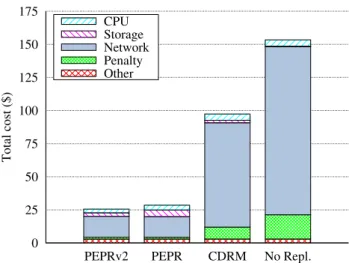
Fig. 4 Total cost (monetary expenditure) of the provider during one simulated billing period
6.2.6 Monetary cost
Figure4depicts the total monetary cost accumulated for the provider during simulations. Each data replication strategy is evaluated by processing the same number of queries gener-ated with the same arrival rate. Moreover, the computational load of these queries are also the same on average. Therefore, the CPU cost is very similar for each strategy and difference between them is at a negligible level. Also, the unit storage costs are relatively cheap, therefore all strategies impact the provider at an acceptable level with PEPR accumulating a slightly more storage cost due to having more replicas. How-ever it should be noted that, slight difference in storage cost between PEPRv2 and PEPR is due to the better-established tradeoffs on PEPRv2’s part as explained in the previous sub-section. PEPRv2 managed to escape unnecessary storage costs by performing replication to cheaper-than-local remote subregions that can still satisfy the response time objective. In the scenario that uses no replication, only storage cost is due to having the initial placement of data sets.
Compared to CDRM, PEPRv2 and PEPR accumulated noticeably less network costs. This is caused by taking mea-sures to place the replicas in a cost-effective way when a replication is required for performance satisfaction. Of course, this is a trade-off move towards utilizing the cheaper network resource more intensively by sacrificing some stor-age space. In the scenario without replication, frequent use of inter-region network links caused the provider costs to rise beyond acceptable levels.
6.2.7 Overall remarks
It is evident from results that, a data replication strategy is crucial to meet the desired quality of service. On the other hand, while a traditional strategy can satisfy the performance
guarantees for a data replication strategy aiming to operate in the cloud.
A possible future direction for this study is to take queries that include dependent operations, e.g. join operations, into account. This way, PEPRv2 would also be applicable to database queries. Moreover, implementing the proposed strategy in a real cloud environment may also present an interesting research opportunity.
Acknowledgements The work presented in this paper is supported in part by TUBITAK.
References
1. Abouzamazem, A., Ezhilchelvan, P.: Efficient inter-cloud repli-cation for high-availability services. In: 2013 IEEE International Conference on Cloud Engineering (IC2E), pp. 132–139 (2013).
https://doi.org/10.1109/IC2E.2013.27
2. Ahmed, A., Sabyasachi, A.S.: Cloud computing simulators: a detailed survey and future direction. In: Souvenir of the 2014 IEEE International Advance Computing Conference, IACC 2014, pp. 866–872 (2014).https://doi.org/10.1109/IAdCC.2014.6779436
3. Armbrust, M., Stoica, I., Zaharia, M., Fox, A., Griffith, R., Joseph, A.D., Katz, R., Konwinski, A., Lee, G., Patterson, D., Rabkin, A.: A view of cloud computing. Commun. ACM53(4), 50 (2010).
https://doi.org/10.1145/1721654.1721672
4. Bai, X., Jin, H., Liao, X., Shi, X., Shao, Z.: RTRM: a response time-based replica management strategy for cloud storage system. Grid Pervasive Comput.1, 124–133 (2013)
5. Barroso, L.A., Clidaras, J., Hölzle, U.: The Datacen-ter as a CompuDatacen-ter: An Introduction to the Design of Warehouse-Scale Machines, 2nd edn. Morgan and Clay-pool Publishers, San Rafael (2013). https://doi.org/10.2200/ S00516ED2V01Y201306CAC024
6. Bonvin, N., Papaioannou, T.G., Aberer, K.: An economic approach for scalable and highly-available distributed applications. In: IEEE 3rd International Conference on Cloud Computing, CLOUD 2010, pp. 498–505 (2010).https://doi.org/10.1109/CLOUD.2010.45
7. Bonvin, N., Papaioannou, T.G., Aberer, K.: A self-organized, fault-tolerant and scalable replication scheme for cloud storage categories and subject descriptors. In: Proceedings of the 1st ACM symposium on Cloud computing-SoCC’10, pp. 205–216 (2010) 8. Calheiros, R.N., Ranjan, R., Beloglazov, A., De Rose, C.A.F.,
Buyya, R.: CloudSim: a toolkit for modeling and simulation of cloud computing environments and evaluation of resource provi-sioning algorithms. Software41(1), 23–50 (2011).https://doi.org/ 10.1002/spe.995
9. Foster, I., Zhao, Y., Raicu, I., Lu, S.: Cloud computing and grid computing 360-degree compared. In: 2008 Grid Computing Envi-ronments Workshop, pp. 1–10 (2008). https://doi.org/10.1109/ GCE.2008.4738445
10. Ghanbari, H., Simmons, B., Litoiu, M., Iszlai, G.: Feedback-based optimization of a private cloud. Fut. Gener. Comput. Syst.28(1), 104–111 (2012).https://doi.org/10.1016/j.future.2011.05.019
11. Guerrero-Contreras, G., Rodriguez-Dominguez, C., Balderas-Diaz, S., Garrido, J.: Dynamic replication and deployment of services in mobile environments. In: New Contributions in Infor-mation Systems and Technologies, pp. 855–864. Springer, Berlin (2015)
12. Janpet, J., Wen, Y.F.: Reliable and available data replication plan-ning for cloud storage. In: IEEE 27th International Conference on
SLOthroughloadbalancing,itmaynotbeenoughtosatisfy theeconomicbenefitoftheprovider.Atraditionalstrategy canextravagantlyutilizecloudresourcesinaneffortto max-imizethe performance. However, the economic impactof replicatingdatainaneagermannercanbetoomuchforthe cloudproviders.Therefore,itisabetterideatofocuson low-eringprovidercosts,oncetheperformanceSLOissatisfied. PEPRv2achievesthisgoalofsimultaneouslysatisfyingboth the performance SLO and economic benefit. Moreover,it alsoprovidesimprovementonsomekeyareassuchasreplica placement,comparedtoitspredecessor.
7
Conclusion
In this paper, we proposed PEPRv2, PErformance and ProfitorienteddataReplicationstrategyforcloudsystems. PEPRv2satisfiesbothperformanceandminimum availabil-ityguaranteesforthetenantwhiletakingtheprofitabilityof thecloudproviderintoaccount.
Tenantsplacequeriesonthecloudforprocessing.These queriesmaybesingleindividualqueriesorpartofasetof queriesthat are executedinparalleltoachieveacommon task.Whenaqueryarrivesatthecloud,PEPRv2estimates theresponsetimeofeachqueryandfindsoutiftheresponse timeofthequerycansatisfyservicequalitythatthetenant expectsfromtheprovider.Iftheresponsetimeguarantee can-notbesatisfied,i.e.estimatedresponsetimeisgreaterthan theresponsetimeSLO,PEPRv2considersreplicatingthe rel-evantdata.Then,PEPRv2calculatesaprofitestimation.This profitestimateincludesanypossibledatareplicationplanned toenabletheprovidertoexecutethequerywithanacceptable responsetime.Onlyiftheexecutionisestimatedtobe prof-itable,theconsideredreplicationisperformed.Moreover,as theperformanceSLOissatisfiedovertime,olderreplicasthat arenotusedareretiredfromthecloudtofurtherimprovethe economicbenefitoftheprovider.
We validated PEPRv2’s ability to simultaneously sat-isfy both the performance SLO and provider profit with anexperimentalevaluation.Withasimulationtool,we cre-atedasimulatedcloudsystemthatprocessestenantqueries. PEPRv2ispitted againstitspredecessor,PEPRaswellas anotherdatareplicationstrategy,CDRM,whichdoesnottake theeconomic aspect of the cloud intoaccount. Moreover, ascenario withouta replication strategyis also evaluated todemonstrate the impactof data replicationon boththe responsetimeandproviderprofit.Simulationresultsshows that PEPRv2 satisfied the response time guarantees with lessexpendituresforthecloudresources.Mostnotably,an improvement overits predecessor isobserved interms of monetarycostwhilestillsatisfyingSLAresponsetime. Over-allresultsalsoindicatethat,takingeconomicsofthecloud must also be considered while ensuring the performance
Advanced Information Networking and Applications (AINA), pp. 772–779 (2013).https://doi.org/10.1109/AINA.2013.125
13. Jayalakshmi, D.S., Rashmi Ranjana, T.P., Srinivasan, R.: Dynamic data replication strategy in cloud environments. In: 2015 Fifth International Conference on Advances in Computing and Commu-nications (ICACC), pp. 102–105 (2015).https://doi.org/10.1109/ ICACC.2015.79
14. Kemme, B., Jimenez-Peris, R., Patino-Martinez, M.: Database Replication. Morgan and Claypool Publishers, San Rafael (2013) 15. Kloudas, K., Mamede, M., Preguiça, N., Rodrigues, R.: Pixida: optimizing data parallel jobs in wide-area data analytics. Proc. VLDB Endow.9(2), 72–83 (2015)
16. Kouki, Y., Ledoux, T., Sharrock, R.: Cross-layer SLA selection for cloud services. In: First International Symposium on Network Cloud Computing and Applications, pp. 143–147 (2011).https:// doi.org/10.1109/NCCA.2011.30
17. Lee, J., Chung, J., Lee, D.: Efficient data replication scheme based on hadoop distributed file system. Int. J. Softw. Eng. Appl.9(12), 177–186 (2015)
18. Li, W., Yang, Y., Yuan, D.: A novel cost-effective dynamic data replication strategy for reliability in cloud data centres. In: 2011 IEEE Ninth International Conference on Dependable, Autonomic and Secure Computing, pp. 496–502 (2011).https://doi.org/10. 1109/DASC.2011.95
19. Li, W., Yang, Y., Yuan, D.: Ensuring cloud data reliability with minimum replication by proactive replica checking. IEEE Trans. Comput. 65(5), 1494–1506 (2016). https://doi.org/10.1109/TC. 2015.2451644
20. Mengxing, H., Xianglong, Y., Sanpeng, W., Donghai, Z.: A strategy of dynamic replica creation in cloud storage. In: Proceedings of the 1st International Workshop on Cloud Computing and Information Security, Ccis, pp. 389–392. Atlantis Press, Paris (2013).https:// doi.org/10.2991/ccis-13.2013.89
21. Miglierina, M., Gibilisco, G.P., Ardagna, D., Di Nitto, E.: Model based control for multi-cloud applications. In: ICSE Workshop on Software Engineering for Adaptive and Self-Managing Systems, pp. 37–43 (2013).https://doi.org/10.1109/MiSE.2013.6595294
22. Myint, J., Naing, T.T.: Management of data replication for pc clus-ter based cloud storage system. Int. J. Cloud Comput.1(3), 31–41 (2011).https://doi.org/10.5121/ijccsa.2011.1303
23. Özsu, M.T., Valduriez, P.: Principles of Distributed Database Sys-tems, 3rd edn. Springer, New York (2011).https://doi.org/10.1007/ 978-1-4419-8834-8
24. Park, S.M., Kim, J.H., Ko, Y.B., Yoon, W.S.: Dynamic data grid replication strategy based on internet hierarchy. In: Grid and Coop-erative Computing, pp. 838–846. Springer, Berlin (2004) 25. Qu, Y., Xiong, N.: RFH: A resilient, fault-tolerant and
high-efficient replication algorithm for distributed cloud storage. In: 2012 41st International Conference on Parallel Processing, pp. 520–529 (2012).https://doi.org/10.1109/ICPP.2012.3
26. Ranganathan, K., Foster, I.: Identifying dynamic replication strate-gies for a high-performance data grid. In: Proceedings of the International Grid Computing Workshop, vol. 2242, pp. 75–86. Springer, Berlin (2001)
27. Ridhawi, I.A., Mostafa, N., Masri, W.: Location-aware data replica-tion in cloud computing systems. In: 2015 IEEE 11th Internareplica-tional Conference on Wireless and Mobile Computing, Networking and Communications (WiMob) pp. 20–27 (2015).https://doi.org/10. 1109/WiMOB.2015.7347936
28. Sakr, S., Liu, A.: SLA-based and consumer-centric dynamic provisioning for cloud databases. In: IEEE Fifth International Con-ference on Cloud Computing, pp. 360–367 (2012).https://doi.org/ 10.1109/CLOUD.2012.11
29. Silvestre, G., Monnet, S., Krishnaswamy, R., Sens, P.: AREN: a popularity aware replication scheme for cloud storage. In: IEEE
18th International Conference on Parallel and Distributed Systems, pp. 189–196 (2012).https://doi.org/10.1109/ICPADS.2012.35
30. Sousa, F.R.C., Machado, J.C.: Towards elastic multi-tenant database replication with quality of service. In: IEEE/ACM 5th International Conference on Utility and Cloud Computing (UCC 2012), pp. 168–175 (2012).https://doi.org/10.1109/UCC.2012.36
31. Spaho, E., Barolli, A., Xhafa, F., Barolli, L.: P2P data replication: techniques and applications. In: Modeling and Processing for Next-Generation Big-Data Technologies, pp. 145–166. Springer, Berlin (2015)
32. Stantchev, V., Schröpfer, C.: Negotiating and enforcing QoS and SLAs in grid and cloud computing. In: Advances in Grid and Per-vasive Computing, pp. 25–35 (2009)
33. Sun, D.W., Chang, G.R., Gao, S., Jin, L.Z., Wang, X.W.: Modeling a dynamic data replication strategy to increase system availability in cloud computing environments. J. Comput. Sci. Technol.27(2), 256–272 (2012).https://doi.org/10.1007/s11390-012-1221-4
34. Tabet, K., Mokadem, R., Laouar, M.R., Eom, S.: Data replication in cloud systems: a survey. Int. J. Inf. Syst. Serv. Sect.8(3), 17–33 (2017).https://doi.org/10.4018/IJISSC.2017070102
35. Tos, U., Mokadem, R., Hameurlain, A., Ayav, T., Bora, S.: Dynamic replication strategies in data grid systems: a survey. J. Supercom-put. 71(11), 4116–4140 (2015). https://doi.org/10.1007/s11227-015-1508-7
36. Tos, U., Mokadem, R., Hameurlain, A., Ayav, T., Bora, S.: A performance and profit oriented data replication strategy for cloud systems. In: International IEEE Con-ference on Cloud and Big Data Computing (CBDCom), pp. 780–787 (2016). https://doi.org/10.1109/UIC-ATC-ScalCom-CBDCom-IoP-SmartWorld.2016.0125
37. Wei, Q., Veeravalli, B., Gong, B., Zeng, L., Feng, D.: Cdrm: a cost-effective dynamic replication management scheme for cloud storage cluster. In: IEEE International Conference on Cluster Com-puting, pp. 188–196 (2010). https://doi.org/10.1109/CLUSTER. 2010.24
38. Xiong, P., Chi, Y., Zhu, S., Moon, H.J., Pu, C., Hacigumus, H.: Intel-ligent management of virtualized resources for database systems in cloud environment. In: International Conference on Data Engi-neering, pp. 87–98 (2011). https://doi.org/10.1109/ICDE.2011. 5767928
39. Zhang, H., Lin, B., Liu, Z., Guo, W.: Data replication placement strategy based on bidding mode for cloud storage cluster. In: 11th Web Information System and Application Conference, pp. 207– 212 (2014).https://doi.org/10.1109/WISA.2014.45
Uras Tosreceived his Ph.D. degree in Computer Science from a joint supervision program between Paul Sabatier University and Ege Uni-versity in 2017. He was most recently employed as a research assistant at Izmir Institute of Tech-nology. His research interests include large-scale data manage-ment, data replication and cloud computing.
Riad Mokadem is currently an Associate Professor in Computer Science at Paul Sabatier Univer-sity, Toulouse, France, and a mem-ber of the Institute of Research in Computer Science of Toulouse (IRIT). He received his Ph.D. degree in Computer Science from Dauphine University in Paris, France in 2006. His main research interests are data management and query optimization in large-scale distributed environments, scalable distributed data structures and database performance.
Abdelkader Hameurlain is full professor in Computer Science at Paul Sabatier University, Toulouse, France. He is a member of the Institute of Research in Computer Science of Toulouse (IRIT). His current research interests are in query processing and optimiza-tion in parallel and large-scale dis-tributed environments, mobile
databases, and database
performance. Prof. Hameurlain has been the general chair of the Inter-national Conference on Database and Expert Systems Applications (DEXA’02, DEXA’2011 and DEXA’2017). He is co-editors in Chief of the International Journal “Transactions on Large-scale Data and Knowledge Centered Systems” (LNCS, Springer). He was guest editor of three special issues of “International Journal of Computer Systems Science and Engineering on “Mobile Databases”, “Data Management in Grid and P2P Systems”, and “Elastic Data Management in Cloud Systems”.
Tolga Ayav received his B.Sc. degree in Electronics Engineering in 1995. After a three year indus-try experience, he received his M.Sc. degree in 1999 and Ph.D. degree in 2004 in Computer Engi-neering from Ege University. He worked as a post-doctoral fellow at INRIA Rhone-Alpes in 2005. He is now with the Department of Computer Engineering in Izmir Institute of Technology as Assis-tant Professor. Mr. Ayav’s research interests lie in formal methods for embedded software verifica-tion, testing and reliability, real-time systems and fault-tolerant sys-tems.
Sebnem Borareceived her Ph.D. degree from Ege University, Turkey in 2006. She is currently an assis-tant professor in the Computer Engineering Department at Ege University. Her research interests include fault tolerance in multi-agent systems, self-adaptive sys-tems, complex-adaptive syssys-tems, and agent-based modeling and sim-ulation.