Computer Engineering and Intelligent Systems www.iiste.org
ISSN 2222-1719 (Paper) ISSN 2222-2863 (Online)
Image Compression using Wavelet and Modified Extreme Learning
Machine
Narayanan Sreekumar, Assistant Professor, Department of Computer Science, Lakshminarayanan Visalakshi College of Arts & Science,
LMS Garden, Chettipalayam, Coimbatore – 641 201, Tamil Nadu, India. Tel: 91-98424-74801 E-mail: [email protected]
Lt. Dr. S. Santhosh Baboo Reader, PG and Research,
Department of Computer Science, D.G.Vyshnav College, Chennai, Tamilnadu, India. Tel: 91-9444063888 E-mail: [email protected]
ABSTRACT
The development of Internet and multimedia technologies that grow exponentially, resulting in the amount of information managed by computer is necessary. This causes serious problems in storage and transmission image data. Therefore, should be considered a way to compress data so that the storage capacity required will be smaller. This paper presents a method of compressing still images combining the powerful features of modified extreme learning machine (MELM) for learning with discrete wavelet transform (DWT) in image transformation. DWT, based on the ‘haar’ wavelet, has been used to transform the image and the coefficients acquired from DWT are then trained with MELM. MELM has the property that it selects a minimal number of coefficients to model the training data. The coefficients are then quantized and encoded using the Huffman coding algorithm. The performance of the proposed method is aspiring and comparable with the existing image compression standards.
KEY WORDS
Image Compression, Discrete Wavelet Transform, Modified Extreme Learning Machine, Regression.
1. Introduction
Computer technology to human needs touch every aspect of life, ranging from household appliances to robots for the expedition in space. The development of the Internet and multimedia technologies grows exponentially this result in the amount of information to be managed by computers [1]. In addition, the use of digital images is growing rapidly. This causes serious problems in image data storage and transmission. Therefore, management needs to consider the volume of image data storage capacity and transmission bandwidth [2]. Gibson, et.al [3] warns that digital signal requires more bits per second (bps) in both the storage and delivery, so it results in higher costs. The concept of graphs and images appear to represent pages of numerical data that need a lot of time to waste. A graph or image is a translation of data in the form of images that can represent the data. Image data is a combination of information and redundancy, the information is maintained by the data because it contains the meaning and designation data. While the redundancies are part of data that can be reduced, compressed, or eliminated. Therefore, it is important to consider a way to compress data in order to minimize the storage capacity required. If, at any time, the data are needed the user can just return it to the original size. Although, today the price of storage is also getting cheaper and bigger in size but it will still be more effective if the data size can be reduced so that it can save more space for other data needed. Besides, in the field of multimedia communications network, if the data is not compressed a large bandwidth and a long time are needed to process the transmission of the data [4]. The solution of this problem is to compress data to reduce storage space and transmission time [1]. This proves the importance of data compression on large data to be transmitted.
Computer Engineering and Intelligent Systems www.iiste.org
ISSN 2222-1719 (Paper) ISSN 2222-2863 (Online)
Image compression is one of the major technologies that enable the revolution of multimedia. Image compression techniques find several applications in the areas like, Internet, digital photography, medical, wireless and document imaging, image archives and databases, security and investigation, printing, scanning, and facsimile. Machine learning algorithms have been used often in image compression. A method using the back-propagation algorithm in a feed-forward network is described in [7]. The compression ratio of the image recovered using this algorithm was generally around 8:1 with an image quality much lower than JPEG, one of the most well-known image compression standards. The compression scheme presented by Amerijckx et al. [8] based on vector quantization (VQ) of the discrete cosine transform (DCT) coefficients by the Kohonen map, differential coding by first order predictor and entropic coding of the differences gave better performance than JPEG for compression ratios greater than 30:1. Robinson and Kecman in [9] and [10] have used image compression algorithms based on SVM learning of the DCT coefficients. The method has produced better image quality than JPEG in higher compression ratios. Compression based on DCT has some drawbacks as described in the following section. The latest standard of still image compression JPEG2000 uses the state-of-heart discrete wavelet transform (DWT) technology with the view of overcoming these limitations. In this paper an image compression algorithm based on wavelet technology is proposed that uses the modified extreme learning machine learning algorithm to achieve the goal. The result of compression is quite satisfactory and aspiring.
2. Discrete Wavelet Transform
Wavelet is a mathematical function that divides the data into different frequency components, and then fits each component with a resolution suitable for its scale [6]. Wavelet is a waveform that effectively has a duration limit of zero mean value. Some applications that have been successfully realized by utilizing such wavelet are image data compression, watermarking, edge detection, radar systems, and encoding fingerprints. Stollnitz et.al [6] says that one of the nature of wavelet is its infrequency. In fact, there are many coefficients in the representation of wavelet with very small or zero value. This characteristic gives the opportunity to perform image data compression. The application of wavelet transform in digital image processing uses the Discrete Wavelet Transform or DWT. Wavelet is a base, the wavelet base is derived from a scaling function which properties are assembled from a number of self copies that has been dilated, translated and scaled.
The main properties of wavelet transform in still image compression is the occurrence of minimum distortion in the reconstructed image even when exercising removal transform coefficients are near zero. Wavelet transforms on an image results in many subfields images with very small magnitude. In determining non-negative threshold, the elements of image with very small subfields can zeroed so as to produce a very rare matrix. The existence of the very rare matrix will make it easier to be transmitted and stored; even the result of image reconstruction with threshold (quantization) can provide visual results for bare eyes.
Block-based DCT techniques are usually suffered from blocking artifacts at higher compression ratios (low bit rates). On the other hand, compressions based on Wavelet techniques provide substantial improvement in picture quality at lower bit rates
If f(t) is any
(1)
* dt (2)
Where the real variables a and τ are dilation and translation parameters, respectively, and * denotes complex conjugation [12].
The wavelet may be defined as equation
Computer Engineering and Intelligent Systems www.iiste.org
ISSN 2222-1719 (Paper) ISSN 2222-2863 (Online)
The function, referred to as the mother wavelet, satisfies two conditions – it integrates to zero and is square integral, or has finite energy. In the wavelet transform, the window size in the time domain varies with frequency, i.e., longer time window for lower frequency and shorter time window for higher frequency. For image data, time-frequency plane concept becomes a space-frequency plane. The wavelet transform allows the spatial resolution and frequency bandwidth to vary in the space-frequency plane thereby results in achieving better bit allocation for active and smooth areas. For image compression using DCT one major difficulty is to choose the block size. The choice of the block size is a trade-off between handling active areas
It is preferred to represent f(t) as a discrete superposition sum rather than an integral for digital image compression. Equation (3) now becomes
k,l (t) = 2 –k/2 (2-k t- l) (4)
where a =2kand τ =2kl for discrete space with k and l both integers. The corresponding wavelet transform can be rewritten as
W(k,l) = * kl (t) dt (5)
and the inverse transform as
f(t) = 2-k/2 (2-k t-l) (6)
The values of the wavelet transform at those a and are represented by
d(k,l) = W(k,l)/C (7)
The d(k,l) coefficients are referred to as the discrete wavelet transform of the function f(t). If the descretization is also applied to the time domain letting t = mT, where m is an integer and T is the sampling interval chosen according to Nyquist sampling theorem, then the discrete time wavelet transform is defined as
wd(k,l) = *kl (m) (8)
and the inverse discrete time wavelet transform as
f(m)= 2-k/2 (2-km-1) (9)
In the wavelet transform process for 2-dimensional image, there are two ways to decompose the pixel values, the standard decomposition and non standard decomposition [6]. Each method is obtained based on wavelet transform dimensional. When the standard decomposition processes an image, the first is by using a wavelet transform 1-dimensional image on each row. This process will generate a mean value along with detail coefficients for each row. The second is by using wavelet transform 1-dimensional image on each column. The process results in the form of detail coefficients and one coefficient average.
The decomposition of an image using discrete wavelet transform comprises of a chosen low pass and a high pass filter, known as Analysis filter pair. The low pass and high pass filters are applied to each row of data to separate the low frequency and the high frequency components. These data can be sub-sampled by two. The filtering is then done for each column of the intermediate data finally results in a two dimensional array of coefficients containing four bands of data, known as low-low (LL), high-low (HL), low-high (LH) and high-high (HH). Each coefficient represents a spatial area corresponding to one-quarter of the original image size. The low frequencies represent a bandwidth corresponding to 0<⎜ω⎜<π/2, while the high frequencies represent the band π/2<⎜ω⎜<π. It can be possible to decompose the LL band in the same way up to any level, resulting in pyramid-structured decomposition
Computer Engineering and Intelligent Systems www.iiste.org
ISSN 2222-1719 (Paper) ISSN 2222-2863 (Online)
as shown Fig 1. The LL band at the top of the pyramid containing approximate coefficients holds the most significant information and the other bands containing details coefficients have lesser significance.
Nonstandard Decomposition transformation is obtained by combining pairs of rows and columns alternately transformation. In the first step wavelet transform 1-dimensional line is applied, then followed by a wavelet transform 1-dimensional column. In the decomposition level 1, the image will be divided into 4 sub bands, they are HH, HL, LH, and LL sub bands. HH sub band image gives details on the diagonal, HL sub band provides detailed images in the horizontal direction, the LH sub band provides detailed images in the vertical direction. While the LL sub band is a low-resolution residue that has low frequency components, which are often referred to as the average image. LL sub band is divided again at the time of decomposition at a higher level. The process is repeated according to the desired level. Thus the degree of significance is decreasing from the top of the pyramid to the ands at the bottom. a) 1st-level decomposition b) 2nd-level decomposition
Fig.1. Two-dimensional wavelet transforms
3.Extreme learning machine
In this section, we present a brief overview of the extreme learning machine (ELM) algorithm [16]. ELM is a single hidden layer feed forward network, where the input weights are chosen randomly and the output weights are calculated analytically. For hidden neurons, many activation functions such as sigmoidal, sine, Gaussian and hard-limiting function can be used, and the output neurons have linear activation function. ELM uses the non differentiable or even discontinuous functions as an activation function. In general, a multi-category classification problem can be stated in the following manner. {Xi,Yi}, where Xi = [ xi1,….xin] Rn is an n-dimensional features of
sample I and Yi = [yi1,yi2,…yic] R c
is its coded class label. If the sample Xi is assigned the class label ck, then the
kth element of Yi is one (yik=1) and other elements are -1. Here we assume that the samples belong to the C distinct
classes. The function describing the useful information on probability of predicting the class label with the desired accuracy is called as classifier function and is defined as
Y = F(X) (10)
The objective of the classification problem is to estimate the functional relationship between the random samples and its class label from the known set of samples. Using universal approximation property, one can say that the single layer feed forward network with sufficient number of hidden neurons H can approximate any function to any arbitrary level of accuracy [16]. It implies that for bounded inputs to the network there exist optimal weights(not necessarily unique) to approximate the function. Let Wi be H x n input weights, B be H x 1 bias of hidden neurons
and W0 be C x H output weights. The output (Y) of the ELM network with H hidden neurons has the following
form
F(xi) = ∑ W0kj Gj(Wi,B,Xi), k =1,2,…..C` (11)
Where Gj(.) is the output of the jth hidden neuron, and G(.) is the activation function. For the sigmoidal hidden neurons, the output of the jth hidden neuron Gj(.) is defined as
Computer Engineering and Intelligent Systems www.iiste.org
ISSN 2222-1719 (Paper) ISSN 2222-2863 (Online)
Gj = ijk xijk + bj ), j = 1,2,….H, (12)
In case of the radial basis function (RBF), the output of the jth Gaussian neuron Gj(.) is defined as
Gj = G(bj||X-Wi||), j=1,2,…H, (13)
Where Wi and bj (bj € R+) are the center and width of the RBF neuron respectively. Eq (11) can be written in matrix form as
= W0YH (14)
Where
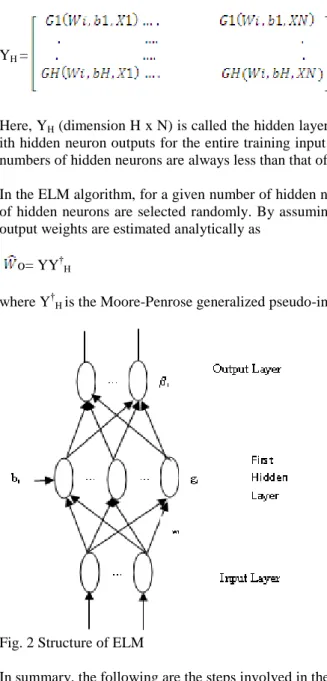
YH =
Here, YH (dimension H x N) is called the hidden layer output matrix of the neural network; the ith row of YH is the
ith hidden neuron outputs for the entire training input X. For most of the practical problems, it is assumed that the numbers of hidden neurons are always less than that of training samples.
In the ELM algorithm, for a given number of hidden neurons, it is assumed that the input weights Wi and the bias B
of hidden neurons are selected randomly. By assuming the predicted output Yˆ is equal to the coded labels Y, the output weights are estimated analytically as
o= YY†H (15)
where Y†H is the Moore-Penrose generalized pseudo-inverse of YH [17].
Fig. 2 Structure of ELM
In summary, the following are the steps involved in the ELM algorithm:
For a given training samples (Xi; Yi), select the appropriate activation function G(.) and the number of
Computer Engineering and Intelligent Systems www.iiste.org
ISSN 2222-1719 (Paper) ISSN 2222-2863 (Online)
Generate the input weights Wi and the bias values B randomly.
Calculate the output weights Wo analytically: Wo = YY †
H
4. Modified Extreme Learning Machine (MELM)
The MELM is developed based on the single hidden layer feedforward neural network with RBF neurons. Its output with hidden nodes can be represented by
(16) where ai and bi are the learning parameters of hidden nodes and I is the weight connecting the jth hidden node to
the output node. The term G(ai,bi,x) is the output of the ith hidden node with respect to the input x.
given a set of initial training data 0 = I, ti) N0 i=1 and N0 > , using ELM algorithm , consider the problem of
minimizing ||H0 -T0|| where
H0 = N0 x
The solution to minimizing ||H0 -T0||is given by[18] (0)
= K-10 HT0T0 (17)
Where K0 = HT0H0
When another block of data, N10 = {(xi,ti)}N0+N1i=N0+1 are received, where N1 denotes the number of observations,
then minimizing
(18)
Where,
Considering both blocks of training data sets N0 and N1, the output weight becomes
(1) = K-1 1 T . (19) Where, (20) and (21)
Computer Engineering and Intelligent Systems www.iiste.org
ISSN 2222-1719 (Paper) ISSN 2222-2863 (Online)
In eqn. (21), H0 and K0 are replaced by the function of K1 and H1, so that they will not appear in the expression for (1)
and could be removed from the memory. Hence from eqn. (19) and eqn. (21), (1) is given by
(1) = K-11 T . (22) = (0) + K-11 HT1(T1 – H1 (0)) 5. Proposed Method
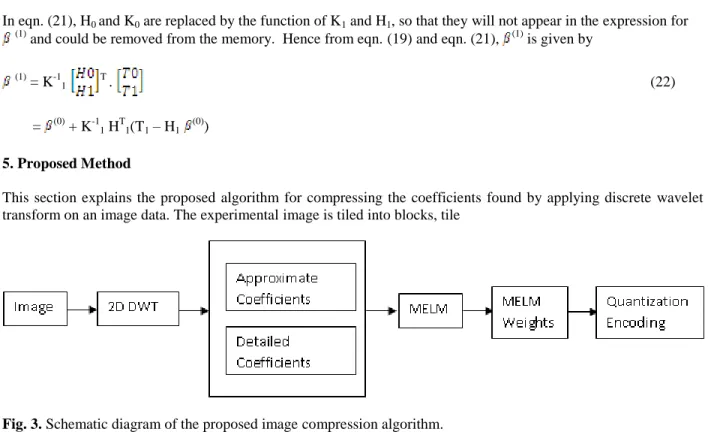
This section explains the proposed algorithm for compressing the coefficients found by applying discrete wavelet transform on an image data. The experimental image is tiled into blocks, tile
Fig. 3. Schematic diagram of the proposed image compression algorithm.
size of image-block being chosen by the user. The complete image may also be treated as a block. The two-dimensional discrete wavelet transform is applied on each tile treating them as one single image. The ‘haar’ wavelet has been used in this paper. The other wavelets may also be found suitable. The resulting approximate coefficients and details coefficients are then stored for each sub-image. Extreme learning machine algorithm for regression analysis is then applied to each matrix of coefficients. The MELM produces a minimum number of coefficients required to generalize the training data and the convergence time is also very quick compare to the ELM. It is found from the experiment that MELM performs better for large sets of coefficients as its training data. The coefficients are then quantized in predefined levels and encoded using Huffman coding principle. The proposed compression algorithm is shown schematically in Fig. 3.
6. Simulation Results
The gray-scale image of size 128 X 128 (shown in Fig. 4a) has been taken to test the compression capability of the proposed method. The image to be compressed is first tiled into some blocks, here the whole image is treated as one block. The two-dimensional discrete wavelet transform is applied on the whole-images thus resulting approximate coefficients and detail coefficients. For the experiment, the whole image of size 128 X 128 was treated as a block and after applying DWT the coefficient matrices generated were each of size 64 X 64. The extreme learning machine regression algorithm was applied on each set of coefficients. It was found that while applying MELM learning, time complexity decreases and the performance increases. After the MELM regression algorithm was applied to the coefficient matrices, the corresponding weights were generated and quantized using Huffman encoder. In the reverse process, the image was reconstructed following the decoding and de-quantization process and by using the weights achieved thereby, thus indicating compression ratio and PSNR. Quality measures such as PSNR and MSE for decompressed image are calculated and compared. Table 1, shows the comparison of the results with the proposed technique to the existing ELM.
7. Conclusion
It may be concluded from the results of the experiment that the proposed method of compressing still images has shown aspiring performances. The algorithm is tested on varieties of benchmark images. Simulation results for
Computer Engineering and Intelligent Systems www.iiste.org
ISSN 2222-1719 (Paper) ISSN 2222-2863 (Online)
standard test images with 128 X 128 size are presented. These results are compared with existing technique. Several performance measures are used to test the reconstructed image quality. According to the experimental results, the proposed technique with MELM method outperformed the existing method. It can be inferred from experimental results as shown in Table 1 that the proposed method performed well and results higher compression ratio. Besides higher compression ratio it also preserves the quality of the image. It can be concluded that the integration of classical with soft computing based image compression enables a new way for achieving higher compression ratio
References:
[1]. Tan, C.L., "Still Image Compression Using Wavelet Transform", The University of Queeslands, 2001 [2]. Talukder, K.,H., dan Harada, K., "Haar Wavelet Based Approach for Image Compression and Quality
assessment of Compresed Image", IAENG International Journal of Applied Mathematics, 36:1, IJAM_36_1_9, 2007. [3]. Gibson, J., D., Berger, T., Lookabaugh, T., Linbergh, D., dan Baker, R.,L., "Digital Compression for
multimedia", Morgan Kaufman Publishers, Inc. San Fransisco, California, 1998.
[4]. Effelsberg, W., dan Steinmetz, R., "Video Compression Technique", Dpunkverlag for digitale Technologie, Muthig GMBH, Jerman, 1998.
[5]. Mubarak, R., "Pemampatan Data Citra Dengan Menggunakan Transform Gelombang-Singkat", UGM, Yogyakarta, 2003.
[6]. Stollnitz, E.J, DeRose, T.D., dan Salesin, D.H., "Wavelets For Computer Graphics: Theory and Applications", Morgan Kaufman Publisher, USA, San Fransisco, 1996.
[7]. M H Hassoun, Fundamentals of Artificial Neural Networks, Cambridge, MA: MIT Press, 1995.
[8]. C. Amerijckx, M. Verleysen, P. Thissen, and J. Legat, Image Compression by self-organized Kohonen map, IEEE Trans. Neural Networks, vol. 9, pp. 503–507, 1998.
[9]. J. Robinson and V. Kecman, Combining Support Vector Machine Learning with the Discrete Cosine Transform in Image Compression, IEEE Transactions on Neural Networks, Vol 14, No 4, July 2003.
[10]. Jonathan Robinson, The Application of Support Vector Machines to Compression of Digital Images, PhD dissertation, School of Engineering, University of Auckland, New Zealand, February 2004.
[11]. D S Taubman, M W Marcellin, JPEG2000: Image Compression Fundamentals, Standards and Practice, Kluwer Academic Publishers, 2002.
[12]. Y Q Shi and H Sun, Image and Video Compression for Multimedia Engineering –Fundamentals, Algorithms and Standards, CRC Press LLC, 2000.
[13]. D. Chai and A. Bouzerdoum, JPEG2000 Image Compression: An Overview, Australian and New Zealand Intelligent Information Systems Conference (ANZIIS'2001), Perth, Australia, pp. 237-241 Nov. 2001. [14]. V N Vapnik, The Nature of Statistical Learning Theory, Springer, 2000.
[15]. V Kecman, Learning and Soft Computing: Support Vector Machines, Neural Networks, and Fuzzy Logic Models, The MIT Press, 2001.
[16]. G-B.Huang, Q.Y.Zhu, C.K.Siew, Extreme learning machine: Theory and applications, Neurocomputing 70(2006) 489-501.
[17]. R.Penrose, A generalized inverse for matrices, Cambridge Philosophy Society 51 (1955) 406-413.
[18]. Yu Jun, Meng Joo Er, An enhanced online sequential extreme learning machine algorithm, Chinese Control and Decision Conference(CCDC 2008), 2008.
Narayanan Sreekumar received his B.Sc Computer Science degree and MCA from Bharathiar University Coimbatore. MPhil, from Manonmaniam Sundaranar University. His research interest is in the field of image compression, wavelets and vector quantization. He is currently working as Asst. Professor, Department of Computer Science, Lakshminarayanan Visalakshi College of Arts & Science, Coimbatore, Tamilnadu, India.
Lt. Dr. S. Santhosh Baboo, has around Seventeen years of postgraduate teaching experience in Computer Science, which includes Six years of administrative experience. He is a member, board of studies, in several autonomous colleges, and designs the curriculum of undergraduate and
Computer Engineering and Intelligent Systems www.iiste.org
ISSN 2222-1719 (Paper) ISSN 2222-2863 (Online)
postgraduate programmes. He is a consultant for starting new courses, setting up computer labs, and recruiting lecturers for many colleges. Equipped with a Masters degree in Computer Science and a Doctorate in Computer Science, he is a visiting faculty to IT companies. It is customary to see him at several national/international conferences and training programmes, both as a participant and as a resource person. He has been keenly involved in organizing training programmes for students and faculty members. His good rapport with the IT companies has been instrumental in on/off campus interviews, and has helped the post graduate students to get real time projects. He has also guided many such live projects. Lt. Dr. Santhosh Baboo has authored a commendable number of research papers in international/national Conference/journals and also guides research scholars in Computer Science. Currently he is Reader in the Postgraduate and Research department of Computer Science at Dwaraka Doss Goverdhan Doss Vaishnav College (accredited at ‘A’ grade by NAAC), one of the premier institutions in Chennai. Table 1: Performance and comparison of existing and proposed technique for image size 128 x 128
Size 128 x 128 Existing Technique
Images MSE PSNR TIME
Lena 1.1759 47.4270 224.047
Pepper 0.8353 48.9123 219.991
Baboon 3.3778e+003 12.8444 218.587 Crowd 163.9564 25.9835 220.771 Cameraman 0.6157 50.2371 220.709
Size 128 x 128 Proposed Technique
Images MSE PSNR TIME
Lena 0.2484 54.1785 210.429
Pepper 0.3062 53.2701 208.900
Baboon 0.5763 50.5244 204.298
Crowd 0.1525 56.2995 203.923