RESEARCH
Structured Learning for Spatial Information
Extraction from Biomedical Text: Bacteria
Biotopes
Parisa Kordjamshidi
1,2*, Dan Roth
2and Marie-Francine Moens
1 *Correspondence:[email protected] 1KULeuven, Leuven, Belgium Full list of author information is available at the end of the article
Abstract
Background:We aim to automatically extract species names of bacteria and their locations from webpages. This task is important for exploiting the vast amount of biological knowledge which is expressed in diverse natural language texts and putting this knowledge in databases for easy access by biologists. The task is challenging and the previous results are far below an acceptable level of performance, particularly for extraction of localization relationships. Therefore, we aim to design a new system for such extractions, using the framework of structured machine learning techniques.
Results:We design a new model for joint extraction of biomedical entities and the localization relationship. Our model is based on aspatial role labeling (SpRL)model designed for spatial understanding of unrestricted text. We extend SpRL to extract discourse level spatial relations in the biomedical domain and apply it on the BioNLP-ST 2013, BB-shared task. We highlight the main differences between general spatial language understanding and spatial information extraction from the scientific text which is the focus of this work. We exploit the text’s structure and discourse level global features. Our model and the designed features substantially improve on the previous systems, achieving an absolute improvement of approximately 57 percent over F1 measure of the best previous system for this task.
Conclusions:Our experimental results indicate that a joint learning model over all entities and relationships in a document outperforms a model which extracts entities and relationships independently. Our global learning model significantly improves the state-of-the-art results on this task and has a high potential to be adopted in other natural language processing (NLP) tasks in the biomedical domain.
Keywords: Bacteria biotopes; Spatial information extraction; Biomedical text mining; Structured learning; BioNLP
1
2
Background
3
There is a rapidly increasing amount of literature available on the web related to biomedical 4
information. Exploiting this literature is very difficult and time consuming for biologists. 5
Automatic information extraction concerns extracting structured knowledge from diverse 6
natural language texts and storing it in databases. This kind of extraction to make this in-7
formation easily accessible to biologists, is increasingly seen as a necessity by the research 8
community. Though this is a highly active research topic, the level of performance is still 9
not satisfactory for many known tasks. The task we focus on in this paper is to extract infor-10
mation about bacteria and their locations from webpages. The locations indicate the places 11
where given species live. Using such a system, biologists can easily query, for example, 12
which bacteria live in the gut of a of a human; where Bifodobacterium Longum can live; or 13
whether mammals provide a habitat for Bifidobacterium. The task is defined based on the 14
Bacteria Biotopes (BB) [1] subtask of the BioNLP-ST 2013 shared task. BioNLP-ST 2013 15
is the third event in the BioNLP-ST series, which has attracted wide attention. The BB-16
task consists of three subtasks. Given a biological text, the first subtask is to detect habitat 17
entities and classify them according to the categories specified in a habitat ontology. This 18
ontology includes general categories likehumandown to very specific categories like
for-19
mula fed infants. The second subtask is to extract two types of relations between given gold
20
entities: Localization and PartOf relations. The given set of entities can be of type bacteria, 21
habitats, or geographical locations. Localization relations occur between a bacterium and a 22
habitat or geographical location, while PartOf relations occur between habitats. The third 23
subtask is an extended combination of the other two subtasks: entities are detected in a text 24
and relations between these entities are extracted. In this paper we focus on the third sub-25
task, which is the most challenging one, and on which previous systems have performed 26
relatively poorly. 27
The task of finding the location of biological entities is a kind of localization in the 28
biomedical domain, so we aim to place it in the context of general domain-independent 29
spatial language understanding, formulated in our previous research on the Spatial Role
30
Labeling (SpRL)task [2, 3, 4]. SpRL considers generic location information expressed in
31
free text about arbitrary entities– for example, finding the location of a book, when it is de-32
scribed in a sentence by referring to a table in a room. Here, we show the analogy between 33
generic SpRL and the extraction of domain-specific localization relations in the biomedical 34
literature. This analogy illustrates the challenges of applying generic NLP semantic extrac-35
tion models to information extraction from the biomedical domain. The main contributions 36
of this paper are as follows: 37
From the perspective of the BB-task: 38
1 We propose a scalable and generic machine learning model that jointly learns and 39
predicts bacteria entities and their spatial relations. Here, we rely on a structured 40
learning model that integrates expert knowledge on the possible relationships be-41
tween biomedical entities and their constraints. 42
2 We substantially improve state-of-the-art results on the BioNLP-ST 2013 shared 43
Bacteria Biotope task[1]; specifically, the F1 measure of our system is approximately 44
57%better than the previous results for localization relation extraction. 45
3 We elaborate on why joint and constrained machine learning has a high potential for 46
many semantic extraction tasks involving biomedical texts. 47
From the perspective of the SpRL task: 48
1 We exploit the habitat ontology and the bacterium taxonomies for the extraction of 49
spatial information: that is, we leverage external knowledge for the extraction of 50
spatial roles and their relations. 51
2 We extend the SpRL to phrase level extractions from previous word level models, 52
which is required to identify the correct bacterium and habitat entity mentions in 53
biomedical texts. 54
3 We extend sentence level extraction to discourse (i.e. document) level extractions of 55
entities and their relationships. 56
In the rest of this Background section, we first describe the problem that we tackle in this 57
paper, then we explain the problem’s context from the perspectives of computational lin-58
guistics and spatial language understanding. At the end, we provide an overview of related 59
research and previous results. 60
Problem description 61
Our goal is the extraction ofbacteria(specific biological entities) and theirhabitats (envi-62
ronments where a bacterium lives) from natural language text. For example, given a docu-63 mentdas below, 64 Bifidobacterium longum NCC2705 65 Description 66
Bifidobacterium. Representatives of this genus naturally
67
colonize the human gastrointestinal tract (GIT) and are
68
important for establishing and maintaining homeostasis of
69
the intestinal ecosystem to allow for normal digestion...
70
the task is to detect the biological entitiesof type E={Bacterium,Habitat}, and 71
indicate which entities haverelationshipsof typeR={Localization}. We are given a 72
training dataset in which these types of entities and relations are annotated manually and 73
stored in annotation files with the following format, 74
T1 Bacterium 0 30 Bifidobacterium longum NCC2705
75
T2 Bacterium 43 58 Bifidobacterium
76
T3 Habitat 113 118 human
77
T4 Habitat 113 141 human gastrointestinal tract
78
R1 Localization Bacterium:T2 Localization:T3.
79
The first column of this annotation contains the identifiers of annotated parts of a textual 80
document, and the second column indicates the type of each annotated entity and relation. 81
For this example, in the first two lines, two Bacteria entities have been annotated and iden-82
tified byT1andT2. In the case of entities, the second and fourth columns are the textual 83
span of the annotated part of text and the next columns contain the actual text. Here,T1
84
identifiesBifidobacterium longum NCC2705which has the textual span from character 0 85
to character 30. In addition, two Habitat entities have been annotated and identified byT3
86
andT4.T3identifieshumanwhich has the textual span from character 113 to 118 in the 87
above document. The last line of annotation identifies a relation with identifierR1. In the 88
case of relations, after indicating the type of relation in the second column (in this case, 89
Localization), the types and identifiers of the entities linked by the relation are specified. In 90
the example, the relationR1holds between the entityT2which is of type Bacterium and 91
entityT3which is labeled as type Localization (in the annotation files the term Localiza-92
tion has been used again instead of Habitat). The entity mentions can contain adjacent or 93
nonadjacent words. 94
Given training data of this form, we aim to build a supervised learning model to pre-95
dict such annotations given an input text. As noted before, this is the third subtask of the 96
Bacteria Biotope (BB) shared task proposed in the framework of BioNLP-ST 2013. 97
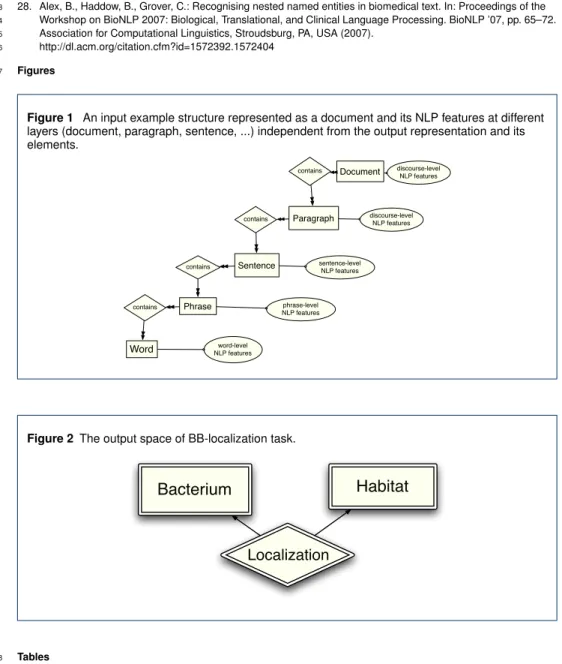
Generally speaking, given an input document containing plain text, we read it into the 98
linguistic structure represented in Figure 1. This structure has been shown in the form of an 99
entity-relationship (ER) diagram. The rectangles show the linguistic units, called entities, 100
and the diamonds show the relationships between these entities. Each input documentdi 101
contains an arbitrary number of paragraphs pj each of which contains a number of sen-102
tencessk. Sentences contain an arbitrary number of phrasesphleach of which contains a 103
number of wordswm. Linguistic features are assigned to different types of input linguistic 104
units (i.e. entities), and are noted as NLP features and shown in ovals. This input structure 105
is independent of the elements we aim to predict in the output. We refer to the set of all in-106
put entities at various levels of granularity (i.e. document, sentence, etc.) as theinput space
107
and later we discuss the features that are used at each level. 108
Figure 2 shows the output concepts to be predicted for this problem in terms of target 109
entity and relationship types. Like the input structure, the output is represented by a simple 110
ER diagram. This diagram shows that the output includes entities of two types (Bacterium 111
and Habitat) and relationships of one type (Localization). In fact, each input linguistic 112
entity of type Phrase are labeled as an output biological entity of type Bacterium or Habitat, 113
or none of them. The pairs of phrases are labeled as having Localization relationship or not. 114
We refer to the set of output variables containing all possible label assignments to phrases 115
and their relations in a document as the output space. Finding the best assignments for 116
an input document is the goal of our supervised learning model for this task. The formal 117
specification of the problem and the input/output representation will be discussed later in 118
the Methodology section. 119
Problem in the context of spatial language understanding 120
We view localization information extraction in the BB-task as a specific instance of general 121
spatial language understanding. In this section, we introduce the spatial language under-122
standing problem previously formulated as Spatial role labeling (SpRL)[2]. We discuss 123
the new features of the SpRL model when it is applied to the biomedical domain. 124
Spatial role labeling
125
Domain-independent spatial language understanding is formulated asspatial role labeling
126
(SpRL)in [2]. The SpRL model considers the extraction of a set of generic spatial roles and
127
relations. This set includes, but is not limited to: the role oftrajector, which is defined as 128
an entity whose location or translocation is described in a sentence; the role oflandmark
129
which is defined as an entity by which we describe the location of thetrajector; and the role 130
ofspatial indicatorwhich is a linguistic signal that indicates the presence of a spatial
rela-131
tionship betweentrajectors andlandmarks and provides information about the semantics 132
of the relationship. 133
For example, in the sentence“Give me the book on AI which is on the table behind you!”, 134
according to the SpRL scheme the word bookis annotated as atrajectorentity meaning 135
that its location is described. The word tableis annotated as alandmarkentity meaning 136
that it is the referring entity which describes the location of the book. The prepositiononis 137
annotated as aspatial indicatorand triggers the spatial relationship betweenbookandtable
138
and expresses the topological semantics of the spatial relationship. In SpRL, thespatial
139
relations are triplets containing the three types of entities mentioned above. For example,
140
in the above sentence the triplet of (on, book, table) is annotated as a spatial relation. 141
Moreover, thetablehas an additional role oftrajector with respect toyou(alandmark) 142
andbehind(anotherspatial indicator), composing the triplet(behind, book, you). In this
143
specific sentence, these two triplets are annotated asspatial relations andtableis annotated 144
twice with two different roles. In the SpRL scheme, the formal semantics of spatial relations 145
are also annotated [4], but this lies outside the scope of the current work. 146
SpRL customized to BB-Localization
147
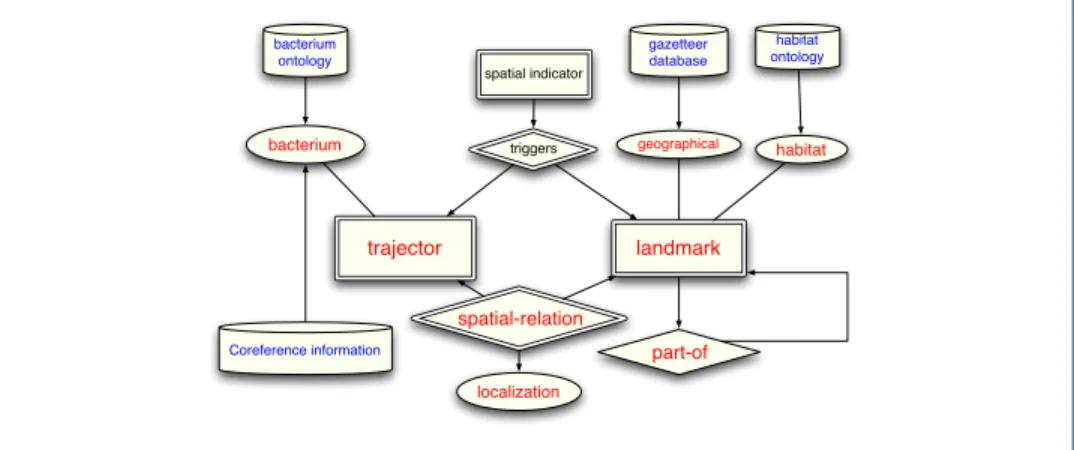
By analogy to the general framework ofSpRL, spatial roles and relations can be mapped to 148
biological entities and localization relations in biomedical text. We consider the bacteria as 149
a specific class oftrajectors and habitats as a class oflandmarks. Localization is a specific 150
type of spatial relationship. Figure 3 shows how the BB-task is placed in the SpRL general 151
framework. In this ER diagram, the double-lined shapes containing the red text are the 152
corresponding SpRL elements that are targeted in the BB-task (trajector,landmark and 153
spatial relation). In the BB-task, the pairs of entities have Localization relationships, in
154
contrast to the SpRL in which thespatial relationships apply to triplets. This difference 155
is due to the absence ofspatial indicatorannotations in the BB-task data. As mentioned 156
before,spatial indicatoris a signal that indicates the existence of spatial information, and a 157
comparable concept –trigger– exists in various other biomedical event extraction tasks [5]. 158
Similarly, thetriggeris a part of text that indicates the occurrence of a specific relationship 159
or event that relates entities in the text. Consequently, in the depicted diagram thespatial
160
indicatorbox is not drawn as a direct part of thespatial relationship, but it is connected to
161
the spatial entities with a dummy relationship calledtriggersto provide a full picture of the 162
spatial roles and their correspondence to the BB-task entities. 163
We represent some more involved elements to clarify the context of the problem. The 164
figure is augmented with the biomedical external resources depicted in cylinders. The ovals 165
show the attributes of the spatial roles oftrajectorandlandmark. 166
We observe a number of differences when moving from the general SpRL model to the 167
domain-specific Bacteria Localization. Some conceptual differences originate from the ba-168
sic difference between spatial language understanding – which tries to explore the seman-169
tics expressed in the language – and information extraction from scientific text – which tries 170
to fill in databases about entities and their relationships – and which searches for linguistic 171
evidence for that target. This basic difference leads to a different approach to annotating 172
scientific text. For example, the Bacterium and Habitat are designated roles for the men-173
tions and all are annotated, ignoring any Localization relationships stated in the text. More 174
clearly, a bacterium is always a bacterium independent from the context, but in the general 175
SpRL being atrajectordepends on the spatial context, as it can be seen for the wordtable
176
in our example. 177
Moreover, the entities’ roles in the BB-task are mutually exclusive, in contrast to the 178
general SpRL. In other words, an entity which is a bacterium can not be a habitat, while in 179
general spatial language an object can play the role of alandmarkin one spatial relation 180
while itself being atrajectorin another spatial relation in the same sentence. In the exam-181
ple sentence from the previous subsection, the objecttableis annotated twice, once as a 182
trajectorand once as alandmark. One can compare this to the following example in the
183
BB-task data:“This organism is found in adult humans and formula fed infants as a
nor-184
mal component of gut flora.”. In this sentence,gutis alandmark(habitat) for the bacterium
185
under discussion, but it is not atrajector forformula fed infant. Hence, in this domain a 186
landmark can not be atrajector. The relationship betweengutandformula fed infantis 187
annotated as PartOf rather than Localization. A PartOf relationship can hold between two 188
habitat entities (i.e. twolandmarks). Note that the PartOf relationship in this biomedical 189
context also has a spatial sense and can be considered as a type of spatial relationship; 190
however we do not consider it as such in this paper. 191
From the linguistic syntactical and lexical point of view, in this domain, specific verbs 192
often play the pivotal role ofspatial indicators, as opposed to spatial prepositions, as in 193
SpRL. Moreover, in the SpRL model the spatial implications are ignored and only the direct 194
location information is considered. In biomedical text the localization relations are often 195
implied from the semantics of the verbs that relate bacteria and habitats. In the previous 196
annotated example, the phrasecolonize the human gastrointestinal tractimplies that the 197
human is a habitat for the subject bacterium. In the sentence,“This organism can infect
198
humans and sheep...”, the phrasecan infectmeans that humans or sheep are a habitat for
199
the bacterium. 200
Finally, our computational models for the BB-task recognize the full phrase or mention 201
of an entity, where in our previous models for SpRL, a sentence is tokenized into words 202
and the words are labeled. 203
One advantage of working on SpRL for scientific text is that there are often well-defined 204
domain-specific ontologies which can be used. For instance, bacterium taxonomies and 205
well-designed habitat ontologies can help the joint recognition of the spatial roles of
tra-206
jector andlandmark and theirspatial relationin the BB-task. For example, a soft or an
207
exact match between a mention in the text and the classes in the ontologies can be used as a 208
feature for the learning models. More specifically, in the above examples the termshuman
209
andinfantexist in a habitat ontology called OntoBiotope.[2]
210
Related works 211
The BB-task along with the experimental dataset was first specified in the BioNLP-ST 2011 212
shared task [6]. Three systems were developed in 2011 and five systems for its extended 213
version were proposed in the 2013 shared task [1]. In 2011, three systems participated 214
in the task: UTurku [7], JAIST [8], and Bibliome [9]. UTurku was proposed as a generic 215
system which uses a SVM multi-class classifier with linear kernel. It made use of named 216
entity recognition patterns and external resources for the BB model. The second system 217
was JAIST, specifically designed for the BB task. It uses CRFs for entity recognition and 218
typing and classifiers for coreference resolution and event extraction. The third system 219
was Bibliome, also specifically designed for this task. This system was rule-based, and 220
exploited patterns and domain lexical resources. 221
The three systems used different resources for Bacterium name detection: which are the 222
List of Prokaryotic Names with Standing in Nomenclature (LPNSN), names in the genomic 223
BLAST page of NCBI and the NCBI Taxonomy, respectively. The Bibliome system was 224
the winner for detecting the Bacterium names as well as for coreference resolution and 225
event extraction. The important factor in their performance was exploiting the resources 226
and ontologies. They found useful matching patterns for the detection of entities, types 227
and events. Using their manually drawn patterns and rules performed better than other task 228
participant systems, in which learning models apply more general features. 229
In the 2013 edition of this task, the event extraction was defined in a similar way but 230
an extension to the 2011 edition considered biotope normalization using a large ontology 231
of biotopes called OntoBiotope. The task was proposed as the three subtasks we referred 232
to in previous sections. Five teams participated in these subtasks. In the first subtask all 233
entities have to be predicted, even if they are not involved in any relation. The participating 234
systems performed reasonably well. However, the difficulty in this task has been boundary 235
detection. The participating systems obtained very low recall for the relation extraction 236
even when the entities and their boundaries were given. 237
The difficulty of the relation extraction task was partly due to the high diversity of bac-238
teria and locations. The many mentions of different bacteria and localization in the same 239
paragraph made it difficult to select the right links between them. The second difficulty has 240
been the high frequency of the anaphoric expressions. This made the extraction of relations 241
that cross sentence boundaries difficult. The results from the strict version of the third task 242
were very poor, due to the challenges of the boundary detection and link extraction tasks. 243
This task is our focus and we approach the challenge of relation extraction using joint 244
learning and inference in the framework of structured output prediction. For subtask three, 245
there were only two participant systems. One system was LIMSI [10] which uses a CRF 246
for extraction of the entities and their boundaries. For relation extraction it relies on manual 247
syntactical rules which fail to yield a reasonable accuracy. Another system is TEES [11] 248
which provided better results compared to LIMSI. However, the results are still poor (see 249
SectionResults and discussion). TEES uses SVM classification in two steps: first for entity 250
detection and classification and then another SVM layer for the relation extraction. In our 251
experiments, their approach is compared with structured SVM and joint learning of both 252
layers. None of the proposed systems perform joint learning and prediction of the entities 253
and relations as we do in our work. 254
Joint learning models have become increasingly popular in various NLP tasks. Our ex-255
perimental results indicate the advantage of joint training and prediction for this task, which 256
is consistent with evidence from other NLP tasks [12, 13, 14]. The most recent work using 257
structured learning and designing joint learning models in the biomedical domain are those 258
of Riedel et al. [12] for event extraction in the BioNLP-ST 2011 Genia and BioNLP-ST 259
2011 Infectious Diseases tasks, which improved on the best participating models for these 260
shared tasks. They use a dual decomposition approach to solve the underlying inference for 261
structured learning and prediction, while we use an off-the-shelf optimization solver, spec-262
ifying appropriate constraints. Another search-based structured learning approach applied 263
on the same BioNLP-ST 2009 and BioNLP-ST 2011 shared tasks on event extraction ap-264
pears in [15]. Their experimental results confirm the advantage of the learning joint models 265
compared to independent models for event extraction. The above mentioned works were 266
related to the biomedical domain, but in other computational linguistic domains there are 267
more recent efforts using joint learning and exploiting global features. One example of such 268
an approach is [16], where the authors extract events, event triggers and their arguments. 269
The events are the counterpart of relations here and arguments are the entities involved 270
in the relations. They exploit the features between triggers and event arguments. This is 271
similar to our effort in this work when exploiting between-relation features and using the 272
similarity between entities involved in different relations. A more recent relevant work 273
is [17] where they perform the standard entity-relationship task consideringpeople,
loca-274
tion,organizationand a number of relations between these entities. They go beyond using
pairs of relation labels and even exploit features linking three relation labels. In our task we 276
only deal with one type of relation and two types of entities, hence exploiting the features 277
between two relations makes more sense in our problem case. However, we believe there 278
is still a significant room for improvement of our model, and adding more global features 279
among relationships might be a useful solution. 280
A counterpart to our approach for structured learning would be probabilistic graphical 281
models for extraction of the entities and relationships [18]. The disadvantage of these ap-282
proaches is the comparatively high computational complexity for the probabilistic infer-283
ence when considering global correlations, particularly when using global hard constraints. 284
The structured learning model that we design here is similar to the model that we have 285
used on other datasets and tasks, particularly for extraction of general spatial relations from 286
language and the type of spatial relationships in [19]. Our previous results on those different 287
data have shown that our model outperforms local classifier models, particularly in relation 288
extraction. In this work we have used the same framework to extract spatial relations in 289
the biomedical domain. The results confirm the advantage of our model for entity-relation 290
extraction in the biomedical domain. 291
Methodology
292
In this section, we first describe the machine learning framework, and the features it uses, 293
and the way we model the problem to exploit the structure. We then describe the experi-294
mental methodology, data and setup which is employed for the evaluation of our designed 295
models. 296
Structured learning formulation 297
We formulate entity and relationship extraction in the framework of structured output 298
prediction [20, 21]. In this learning framework, given a set of N input-output pairs of 299
training examplesE = {(xi, yi) ∈ X × Y : i = 1..N}, we learn an objective function 300
g(x, y;W)which is defined over the combined feature representation of the inputs and 301
outputs denoted byf(x, y)and the parameter setW which is a weight vector: 302
g(x, y;W) =hW, f(x, y)i. (1)
In general, learning a model can be formulated as minimizing the wrong predictions over 303
training data. A loss function determines how we quantify a wrong model prediction com-304
pared to the actual/ground-truth value of an output (see SectionLoss function). A popular 305
discriminative training approach is to minimize the objective function below, which is a 306
convex upper bound of the loss function over the training data, 307 l(W) = N X i=1 max y∈Y(g(x i, y;W)−g(xi, yi;W) + ∆(yi, y)). (2)
The inner maximization is called loss-augmented inference and finds the most violating 308
output (i.e. the output that is highly scored by the current model and meanwhile has a large 309
loss) per training example. This is the crucial inference task that must be solved during 310
training in most structured learning techniques, such as structured SVMs and structured 311
perceptrons. 312
Features 313
We use a collection of linguistic features, as well as some features from the supporting 314
resources and ontologies provided by the task organizers, to be able to detect the entities, 315
their types, and the relations linking them. Since an input instance is a document, the em-316
ployed features are assigned to the document’s building blocks at various layers, that is 317
words, phrases, sentences and paragraphs. In this way, the context of the entities and
re-318
lationships is taken into account when classifying them via the structured model. Table 1 319
shows four classes of features that we use assigned to the input components of typewords, 320
phrases,pairs of phrasesandpairs of relations. We briefly describe these features and the
321
motivation behind using them. 322
We use the three termslocal,relational, andcontextualrespectively to refer to the fea-323
tures that are related to a single identified input component (i.e. an input entity or relation-324
ship), the features that are related to the context of an identified input component, and the 325
features that are explicitly related to more than one identified input component. Relational 326
features are sometimes referred to as global features in the related works [17, 16]. 327
Local and contextual features of words.These features are used to help entity detection. 328
The employed word level features are listed in Table 1 in the first set of rows and are 329
described briefly. The Cocoa feature in the above table is based on external information 330
given by the task organizers. The Cocoa annotations map words to 37 predefined categories 331
such as Cell, Organism, Body-part, Company, Food, etc. These categories can clearly help 332
us to recognize the entities in our interest. 333
Local and contextual features of phrases. As the entity labels are assigned to phrases 334
rather than single words, we use more combinatorial features of phrases in our model based 335
on the above mentioned word-level features. The phrase-level features are listed in Table 1. 336
To measure the similarity with NCBI and OntoBiotope, we use some binary features to 337
represent the lexical overlap, containment and inverse containment between the phrases in 338
the text and the ontologies. Before measuring the similarity, we remove some stop words 339
from the habitat phrases and normalize the bacterium phrases by removing occurrences 340
of{str., str, spp., spp, strain, sp., sp, subsp}from the bacterium candidate phrases. The
341
short explanations of the other features in Table 1 should be sufficient to reproduce them. 342
Relational features of pairs of phrases.We use a number of relational features between 343
two phrases where one of them is a bacterium candidate and the other is a habitat candidate. 344
These relational features are expected to help with recognizing which bacterium phrases 345
are linked to which habitat phrases in the text. We assume that entity phrases in the same 346
paragraph or in the same sentence are more likely to be linked to each other, hence we use 347
Same-par and Same-sen binary features. From looking at documents in the training/devel-348
opment data set, we observed that bacterium name is often in the title of a paragraph and 349
the whole text in that paragraph relates to that bacterium, so we use this as a binary feature 350
(inTitle). Some relational features are only applicable for pairs that occur in the same sen-351
tence, such as Verb, Parse-Dis and Parse-Path. The Verb feature is the predicate (i.e. verb) 352
in between the two phrase candidates for bacterium and habitat entities. As we pointed out 353
in section SpRL customized to BB-Localization, the semantics of the verbs that connect 354
two entities e.g.colonizeorpopulatecan imply the localization relationship between them, 355
therefore we use this verb as a feature for detecting the relationship between two candidate 356
entities. As sentences can be long and contain several verbs, we assume that the verb that 357
is closest to a habitat candidate is the most informative. 358
Similarly, the Preposition feature is the preposition in between two candidate phrases and 359
closest to the habitat candidate. Sometimes, the preposition is informative for recognizing 360
the localization relation, for example in cases such asin the human bodyorinside the liver. 361
Hence, we use both verbs and prepositions occurring in between two candidate entities as 362
features. 363
We assume the entities that are related to each other should generally occur closer to-364
gether in the parse tree, we therefore encode a feature (Parse-Dis) that reports the distance 365
between the two phrases in the parse tree normalized by the number of nodes in the tree. 366
Another relational feature (Parse-path) encodes our assumption that the syntactic path be-367
tween two candidate phrases can help in recognizing whether they are semantically related 368
to each other or not. 369
We assume the concurrence of two entities in the corpus can help distinguish the rela-370
tionships between the entities in unseen documents, so we use Heads-Lem as a relational 371
feature. Relying on the same idea, we use the relational features made by POS-tags of the 372
phrasal head of the two entities i.e. Heads-Pos. Moreover, we assume when a specific de-373
pendency path is observed between two entities in the training data, this feature can help 374
recognize the localization relation for the unobserved test examples, hence we exploit the 375
Dep-Path as a feature too. 376
Relational features of pairs of relations.These are the most global type of features that 377
we use in this work. We observe in the training data that when a bacterium is explained in 378
a text, then most of the mentioned habitats in that text are related to the same bacterium. 379
Hence, we took Same-B as a binary feature between two candidate relations. This feature 380
gives a higher weight for instances of two relations with the same label when they have the 381
same bacterium argument. Moreover, if a candidate bacterium and a candidate habitat have 382
a localization relationship with each other, then the similar pairs also are likely to have the 383
same relationship. However, the notion of similarity is challenging here. 384
For two bacteria we can only consider the lexical similarity as an indication of that both 385
of them refer to the same bacterium. Hence, we use the edit distance between the lexical 386
form of the bacterium after normalizing their names, based on the rules described in the 387
above paragraph about features of phrases. 388
For the habitats, measuring similarity can be more complex and related to their seman-389
tics. For each habitat candidate, we find the best matching node from the habitat ontology 390
using the ontology terms themselves, and theirsynonym termsandrelated termsspecified 391
by the ontology. We then compare the best-matched ontology nodes and take this to be 392
the similarity between the two habitat phrases. We measure this similarity using the edit 393
distanceEdisof the two strings which is normalized based on the length of the longest 394
string and use the1−Edisas the similarity measure. 395
Having the similarity of the arguments (i.e. Bacterium and Habitat) of two relations, 396
now we are able to compare the two relations with each other. Two relations are similar 397
when both of their arguments are similar. For this reason, we take thegeometrical mean
398
of the two computed similarities as the overall similarity of the two relations. If one of the 399
similarities is low, this will have a sharper influence on the value of the geometrical mean, 400
which makes it more sensible to use compared to other types of mean in our context. This 401
similarity measure is a real valued feature which is used for each pair of candidate relations. 402
Since the types of models that we use are robust and can deal with a large number of 403
features, we made use of as many features as possible. Our models weight the features that 404
are more important according to the training data. 405
Link-and-Label structured learning model 406
To specify the structured learning model, we use a representation called link-and-label 407
(LAL) model [22, 19]. In this model we use the notion of templates to represent the joint 408
feature functions, output relations, correlations, and the constraints over the output vari-409
ables imposed on the mentioned objective functions 1, 2. In the following sections we 410
describe the LAL model and how the input and output of the structured learning model are 411
represented in terms of labels and links for the BB-task. 412
Output representation
413
In the LAL model, the output variables are represented as a set of binary labelsl whose 414
size can vary per input example. In contrast to the varying size of the set of labels per input 415
example, the type of the output variables in the model is a predefined fixed set. The labels 416
which are related to the entities are calledsinglelabels. The labels which are related to 417
the relationships are calledlinked-labels. The linked-labels can link not only the entities 418
to each other but also to the relationships. In our problem setting the labelslcan have the 419
following types: l = {tr, lm, loc, nrol, nloc, rr}. Thetr denotes a type of single label 420
which indicates whether an input entity of type phrase is a bacterium, andlmdenotes a 421
type of single label that indicates whether a phrase is a habitat. In our model the linked-422
labels related to the localization establish a link between a pair of entities and we denote 423
them byloc. We also consider the relation between pairs of relations and denote this type of 424
linked-label byrr. Therrlabel indicates whether two given relations are both localization. 425
Thenrollabel is anauxiliarysingle label type that indicates when a given entity is not a 426
bacterium nor a habitat, andnlocis an auxiliary type of linked-label that indicates when 427
the localization relationship between two arbitrary entities does not hold in a document. 428
Input representation
429
Each input instance in our learning model is a document. An input document is a set of input 430
linguistic entities and relations according to the structure that we discussed in theProblem
431
descriptionsection and showed in the ER diagram of Figure 1. We represent these input as
432
sets of inputcandidateentities that are relevant to each type of output label. In our problem 433
setting, the sets of candidates for bacterium, habitat and non entities, that is,tr,lmand 434
nrol, are selected from all phrases that belong to the input document (i.e. input phrases). 435
These labels are only relevant for a subset of phrases (i.e. candidate phrases). In this work 436
we define a phrase as a set of contiguous words that form part of one sentence (although in 437
reality they are not necessarily contiguous). 438
Given each document, to generate the candidate phrases we use a chunker which is 439
trained on the same training data to detect the boundaries of the phrases. The words which 440
are not detected as a part of a mention by the chunker are removed, the phrases which 441
have an overlapping token with theOntoBiotope[3]ontology of microbe habitats are used 442
as habitat candidates, and the ones which have an overlap with the NCBI bacterium tax-443
onomy database[4]are used as bacterium candidates. Any pair of bacteria and habitat
can-444
didates is taken as a candidate for the localization/nonlocalization relationship. Given the 445
set of localization candidates, we generate an ordered list of them and take the pairs ofloci 446
[3]http://bibliome.jouy.inra.fr/MEMOntoBiotope/OntoBiotope BioNLP-ST13.obo [4]http://www.ncbi.nlm.nih.gov/taxonomy/
andloci+1 as the relation-relation, that is,rr candidates. We describe this choice in the
447
experimental section. 448
We denote the candidates for the mentioned labels asCtr,ClmandCnrolrespectively. 449
The candidates for thenrolactually belong toCtr∪Clm. The candidate sets for the local-450
ization and non localization relations i.e.locandnloclinked-labels are equal, hence both 451
are denoted asCloc. The candidate set forrrlabels are denoted asCrr. 452
LAL objective function.
453
In this section we expand the objective g = hW, f(x, y)i, and show its building blocks 454
in our LAL model [22, 19]. The model is specified with a number of templates {C}. 455
Each template Cp ∈ Cis defined with a type of label lp ∈ l, a local joint feature func-456
tionfp(xk, lp), a candidate indicator functionCp and a block of weight vectorWp. The 457
global joint feature function is defined based on a number of local joint feature functions, 458
f(x, y) ={fp(xk, lp)}. These functions are the main components of the model templates. 459
Each local joint feature function relates a part of the input xk to a label in the output 460
lp. In our model, we have: Bacterium template, Habitat template, Localization template, 461
Localization-Localization template, and two more auxiliary templates called NonEntity 462
template and NonLocalization template. The candidate indicator function indicates whether 463
an input part is relevant to, and therefore should be combined with, the output label of each 464
template. We use the same notation, Cp, for candidate indicator functions and for their 465
related set of candidates[5].
466
The local joint feature function is computed as the scalar product of the input feature 467
vector ofxk, denoted byφp(xk), and its output labellpk, that isfp(xk, lp) =φp(xk)lpk.
468
This output labellpkis the indicator function indicating labellpfor the componentxk. The
469
link-and-label (LAL) objective is written in terms of the instantiations of the templates and 470
their related blocks of weightsWp inW = [Wtr, Wlm, ...]. Using the actual type of the 471
labels introduced in theoutput representationsection,l={tr, lm, loc, nrol, nloc, rr}, we 472
end up with the following objective after expanding the objective of equation 1: 473 Obj= X xk∈Ctr hWtr, φtr(xk)itrk+ (3) X xk∈Clm hWlm, φlm(xk)ilmk+ (4) X xk∈Cnrol hWnrol, φtr(xk)inrolk+ (5) X hxi,xji∈Cloc
hWloc, φloc(hxi, xji)ilocij+ (6) X
hxi,xji∈Cnloc
hWnloc, φnloc(hxi, xji)inlocij+ (7) X
hhxi,xji,hxi0,xj0ii∈Crr
hWrr, φrr(hhxi, xji,hxi0,xj0ii)irriji0j0, (8)
Given the weight vectorW, the above objective is optimized during the prediction phase 474
to provide the best assignments to the labels and link-labels for an input document. How-475
ever, the output labels are not independent of each other and their value is constrained by 476
the following constraints that originate from the definition of the labels of each template: 477
∀k, trk+lmk+nrolk= 1 (9)
∀i, j, locij+nlocij = 1 (10)
∀i, j, tri ≥locij, lmj≥locij (11)
∀i, j, i0, j0locij ≥rriji0j0, loci0j0 ≥rriji0j0, (12)
Constraint 9 imposes the requirement that each candidate entity (i.e. phrase) is assigned 478
only one label ofBacterium,Habitatornone. Constraint 10 imposes the requirement 479
that each candidate relation is assigned the labelLocalizationor not. The two constraints 480
in 11, imposeHabitatandBacteriumassignments when aLocalizationlink is found. 481
The integer variables refer to the binary labels here and the inference over this objective 482
is solved using combinatorial constraint optimization solvers. Finally, when anrr joint 483
label of two relations is active, it implies that both related localization relationships should 484
be active; this constraint is formulated in the last two inequalities 12. These constraints 485
impose the necessary structure on the output, and help make a joint prediction for a whole 486
document compared to independently classifying the components of an input document. 487
To train the weight vector W we use the structured SVM (SSVM) model described 488
in [20], which minimizes the general objective of 2. However, the SSVM technique treats 489
the inner maximization, i.e. loss-augmented inference, of the objective 2 as a black box 490
and does not provide a general solution to this. This loss-augmented inference objective 491
is composed of thegfunction, which is expanded and explained in our LAL model case, 492
and an additional loss component∆. We describe the loss function of the LAL model and 493
its solution to this inference in the following section to complete the specification of our 494
training model based on SSVM. 495
Loss function.
496
In the training process we iteratively perform inference to make a prediction that mini-497
mizes the errors made on the training set by our model by adjusting the weights of the 498
features [20]. This is in fact minimizing a loss function. The loss function we use in the 499
LAL training objective is defined as the weighted average of the loss of output components 500
based on Hamming distance between the actual labels of candidates and their true label in 501
the training data. For example, the loss of the model for alltrlabels is computed as follows, 502 ∆tr= 1 |Ctr| X i∈Ctr (1−2tr0i)tri+ X i∈Ctr tr0i,
wheretr0 is the ground-truth values of thetrlabels andCtris, as before, the set of can-503
didates for this type of label. Similarly, this loss is computed for other types of labels and 504
averaged over all. This type of loss is easily decomposable in terms of output labels and 505
linked-labels (i.e. tr, etc.). This is compatible with the way that the feature function is 506
decomposed, hence the form of the objective function for inference during training is the 507
same as the objective shown in equations 3-8, but with different coefficients. 508
In summary, we add the sum of losses of various labels to the objective and minimize 509
the loss jointly. In this way, we perform structured loss minimization to train a model. 510
However, we add the loss of the type of labels which are directly the target of the prediction, 511
namelytr, lmandloc. This was an intuitive choice that led to improved performance in 512
our experiments. It should be mentioned that the above mentioned structural constraints are 513
imposed on the model during the training time while solving the loss-augmented inference. 514
As the LAL objective of training and prediction time inference have a linear form, these 515
are solved using off-the-shelf combinatorial optimization solvers. 516
Experiments 517
In the experiments we aim to answer a number of research questions resulting from the 518
previous efforts and systems designed for this task. In a review article on state-of-the-art 519
systems participating in the BB-task [1], a number of challenges are mentioned. The most 520
important challenge is performance in terms of F1. Particularly, the results on relation 521
extraction have been very far from being useful in practical applications. The best proposed 522
model for relation extraction yields only F1=0.14 [11]. This is analyzed as being due to the 523
high frequency of anaphora and also the existence of many entity phrases in a paragraph 524
which leads to difficulty in finding the correct relations between entities. In this work we 525
focus on improving relation extraction; we reach this goal by using rich contextual features 526
and by jointly recognizing entities and their relations by means of the proposed structured 527
learning model. The experimental research questions we aim to answer are the following: 528
Q1.Can joint entity/relationship recognition perform better than a model in which entities 529
and the localization relationship are predicted independently? 530
Q2.Can joint entity/relationship training perform better than a model in which entities and 531
localization relationship are trained independently? 532
Q3.Can we improve the state-of-the-art results on the BB-task, particularly with regard to 533
relation extraction, by exploiting the joint learning framework? 534
Experimental setting
535
Data.We use the training, development and test data of the BioNLP-ST 2013 BB-task for 536
experiments. The BB-dataset contains 105 documents: 52 for training, 26 for development 537
and 27 for testing. There are 1347 bacteria species names, 1713 habitats and 1030 localiza-538
tion relations annotated in the training and development datasets. 539
Software tools and resources.We use the LBJChunker[6][23] to get the candidate phrases
540
for the entities. The LBJChunker is trained with the training set of the BB-task. The linguis-541
tic features are extracted mostly based on the resources provided by the task organizers. The 542
more complex combinatorial features such as the dependency paths, parse tree paths and 543
others are constructed based on the provided parse trees and CoNLL format[7]data files of 544
each document. A biolemmatizer is used [24] to add the lemma to the set of linguistic fea-545
tures. The NCBI taxonomy, OntoBiotope ontology and the Cocoa[8] external annotations
546
are used for generating features as described in theFeaturessection. The Matlab interface 547
of SVM-struct[9] is used for training. We have not performed any parameter tuning and 548
[6]http://cogcomp.cs.illinois.edu/page/software view/13 [7]http://nextens.uvt.nl/depparse-wiki/DataFormat [8]http://npjoint.com/AboutCocoa.html
used an initial setting for SVM-struct in all experiments. This setting isc = 0.01, where 549
c is the trade-off between training error and margin, ande = 0.0001, where eis the er-550
ror tolerance for the termination of training; we also usedo = 2, which means we made 551
use of the margin rescaling option for rescaling our specified loss. The Matlab interface of 552
Gurobi[10]solver is used to solve the constraint optimization for training and prediction.
553
Evaluation.The evaluation metrics areprecision,recallandF1. Precision is the proportion 554
of the correctly predicted true labels to the total number of predicted true labels. Recall is 555
the proportion of the correctly predicted true labels to the total number of actual true labels. 556
F1 is the harmonic mean of precision and recall. We use our local evaluation system in our 557
first set of experiments and then we use the standard online evaluation system provided by 558
the task organizers. In our local evaluations, the training is performed using 52 training-set 559
documents, and the evaluation is performed on 26 development-set documents. Our local 560
evaluation is over the chunked development-set, meaning that the entities missed by the 561
chunker are ignored. In other words, the reported recall will be bounded by the recall of 562
the chunker, which is about70%here. The goal of our local evaluation setting is to test our 563
hypotheses about how various models should perform relative to one another. The standard 564
evaluation on the test-set, on the other hand, is against the original data and reports the final 565
actual recall of our models to confirm our hypotheses and compare to the state-of-the-art 566
models. 567
Models.We experimented with different settings based on how the various components of 568
the objective function in lines 3-12 are considered together in finding assignments to the 569
output variables. The various models are different in the level of globality/locality in the 570
training and prediction time inference; we describe these settings in more detail along with 571
the results in the following section. 572
Results and discussion
573
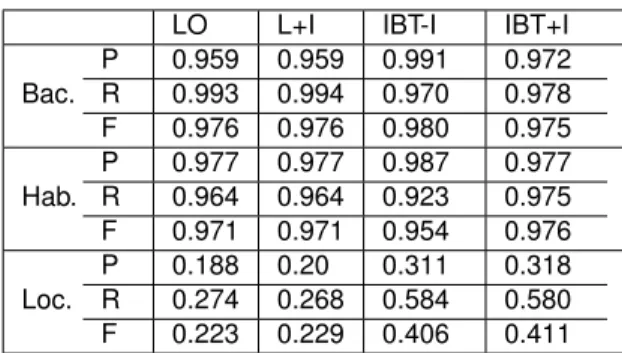
The firstexperimental setting is calledlearning only(LO) [25]. In this model we train 574
independent models for classification of the entities and for the classification of the rela-575
tionships. We train the parameters of the first three components of the objective given in 576
lines 3-5, which regard entity templates only, and we activate the constraint given in equa-577
tion 9 to have a multi-class classification setting for recognizing the entities [26]. Training 578
the weight vectors of the last two components of the objective function in equation 6-7, 579
which are related to the relationship template, is performed independently from training 580
the weights of the entity components. By activating the constraint given in equation 10 581
we have a binary classification of the pairs of entities to classify their relation as localiza-582
tion or not localization. After training the weights of entity and relation recognition, we 583
can perform the prediction of the entities and relations independently considering the same 584
objective components and same constraints. The results of this experiment are shown in 585
Table 2, in the LO column. We use this as a baseline setting. 586
To answer the first research question Q1, in thesecond experiment we use the same 587
trained model but perform joint inference for prediction of the entities and localization 588
relationships. The joint inference is done using constraints defined in equations 9-11 when 589
maximizing the objective function containing lines 3-7 for assigning optimum values to the 590
output labels and links. The results are in the L+I column of Table 2. As can be observed, 591
joint prediction slightly improves the recall of Bacterium (∼ +0.001) but a significant 592
improvement is made in the precision of the localizations(∼+0.12), yielding an improve-593
ment of about 0.07 in final F1 of localization. This means adding constraints that bind 594
entities and relations to each other during prediction helps the precision of the relation 595
extraction. 596
597
To answer the research questionQ2, in thethirdand thefourth experimental settings 598
we train the objective function including lines 3-7 by activating constraints 9-11. The two 599
constraints in 11, bind the linked-labels of relationships to the single labels of entities. The 600
results of the joint training model provide a great improvement on the extraction of the 601
relationships in all the evaluation metrics, this is about 0.7 increase in F1 for the IBT-I 602
model and about0.8increase in F1 for the IBT+I model. The difference between the last 603
two models is that in IBT-I, we make a prediction independently although the training has 604
been done jointly. In IBT+I, both training and prediction integrate a joint inference step. 605
Overall the IBT+I is the best model, as expected. 606
The dramatic improvements by the joint learning and prediction models are made specifi-607
cally on the relation extraction rather than on extraction of entities. In fact, extraction of the 608
entities seems much easier than extraction of the relations in this task and the joint model 609
stimulates the relation extraction when there is strong indication of the presence of both 610
entities in a sentence or in a document (i.e. discourse). By using constraints during training 611
in the IBT models, the parameter update is performed more conservatively as the incorrect 612
predictions, still respect the structure of the output. In this way the unfeasible output pre-613
dictions are not allowed to change the parameters of the model. This is a good and intuitive 614
reason that explains why using constraints during training can yield better models. 615
In ourfinal set of experiments and evaluation, to be able to compare our results with 616
the state-of-the art models for this task, we train our models over the union of training 617
and development sets and test on the standard test set composed of 27 documents whose 618
annotations are not available. We evaluate our models using the online evaluation system 619
of the BioNLP-ST 2013, shared BB-task[11]to be able to compare with the state-of-the-art
620
models for this task. The description of the previous models, whose results are reported 621
here, is provided in theRelated work section. We also expand the global features of our 622
IBT+I model and evaluate two more global models called IBT+IG1 and IBT+IG2. We 623
describe the experimental settings of these two models later in this section. 624
These results on the test set with the standard task evaluation confirm the findings using 625
training and development sets. We do not train our models for the PartOf relations and ig-626
nore them in the annotation files during training. The annotated data for the PartOf relation 627
is very small and needs a different type of attention to deal with this problem. Hence, our 628
models are trained and evaluated only for the Localization relations. However, we report 629
the evaluation of our models when counting the missing PartOf relations as well (see results 630
of IBT+1G1 (p)). 631
All variations of our IBT+I models strongly outperform the best shared task system TEES 632
(SVM based model) [11], with about 0.081 improvement in F1-measure for the strict eval-633
uation (considering missing PartOf) and about 0.09 improvement in F1 for the relaxed 634
evaluation which ignores PartOf and does not require an exact match with the boundaries 635
of the entities (see Table 3). LIMSI (CRF based model) is the other participant system and 636
the last line of Table 3, IBT+I (2) shows the evaluation of the same IBT+I model but on 637
the sentence level relations only. This evaluation ignores the missing relations that connect 638
entities in different sentences. This result indicates our IBT+I model performs consistently 639
well at the sentence and discourse levels. However, the recall of inter-sentence relations 640
is lower as we do not explicitly deal with coreferences. Unfortunately, the sentence level 641
evaluation of the BioNLP-ST 2013 participants is not available. 642
This experiment clearly provides a promising answer to the research question Q3, and 643
confirms our above results and analysis based on the experiments that we did over training 644
and development sets. 645
As mentioned earlier, with the IBT+IG1 and IBT+IG2 models, we exploit the potential 646
of considering more global features in the structured output learning framework. We con-647
sider the additional terms in lines 8 in the main objective of the LAL model. These terms 648
account for the global features between pairs of relations in the learning model. These types 649
of features are described in theFeaturessection. In this experimental setting, considering 650
all possible pairs of relations through the whole document when solving the optimiza-651
tion leads to unmanageable memory requirements (the number of relation-relation pairs 652
isO(n4), wherenis an estimate of the number of candidate entities for each role in the
653
whole document). To alleviate this problem, we form a chain of all candidate relations and 654
pair each relation only with its next relation in the chain. In this way each relation is paired 655
with at least one other and the long distance dependencies between relations are considered 656
indirectly for the sake of efficiency. Adding these terms to the objective implies consider-657
ing additional constraints in equation 12, to impose the consistency between theloclabels 658
that express the localization relationships and the newrrlabels that express whether the 659
localization relationships hold for two relations at the same time. 660
The experimental results are shown in Table 3. IBT+IG1 is the model that considers the 661
Same-B feature and the IBG+IG2 considers both the Same-B and Sim-BH Relation-pair 662
features described in Table 1. The strict localization results indicate a sharp improvement 663
in the precision and a decrease in the recall, however the features have an overall positive 664
impact as the F1-measure is increased by0.01for IBT+IG2 and slightly more for IBT+IG1 665
by0.015. Though the IBT+IG2 model uses the more complex similarity measure compared 666
to the binary exact-match in IBT+IG1, this was not very helpful for overall F1. Using both 667
features yields an increase in the precision and a decrease in the recall. However, the overall 668
result of the last two models shows that using the relational features between relations and 669
the similarity between the entities involved in relations is a promising approach to improve 670
the results. Particularly, this seems to be helpful for solving an important challenge of this 671
task, namely coreference resolution. However, this challenge still exists, as using the usual 672
similarity measures is not very helpful in this respect. Moreover, these similarity measures 673
clearly can not deal with the anaphora resolution. For example, in the sentence mentioned 674
in the Background section, the wordthisrefers to theBifidobacterium, hence the occurring 675
habitats in that sentence are related toBifidobacteriumin the annotations. Recognizing this 676
connection necessitates resolving the anaphora problem. 677
We believe the structured learning framework improves the relation extraction results 678
because it provides the possibility of considering more global and structural features and 679
it helps in dealing with numerous relation candidates where a large number of them are 680
negative relations (i.e. selective parameter update). The large number of negative examples 681
compared to the positive examples for the relations causes the binary classification of the 682
relations to perform very poorly. In the joint learning setting we choose the best negative 683
example per discourse jointly by doing inference and in this way we avoid the influence 684
of the imbalanced data, which is a well-known phenomenon in relation extraction tasks. 685
Our best model improves the best F1 measure of previous systems by57%, (22−14 14 ), when
686
considering the strict evaluation and taking missing PartOf relationships into account. This 687
improvement is fromF1 = 0.14toF1 = 0.22. In future work we plan to build a model 688
for jointly identifying anaphora/coreferences explicitly along with entities and relations. 689
Another challenge for the future is the problem of nested entities. In the same mentioned 690
example, bothhuman gastrointestinal tractand its nesting entityhumanare annotated as 691
habitats. We aim to use state-of-the-art research which considers the nesting problem in the 692
chunking step to improve the results of the entity recognition [27, 28]. By integrating these 693
two extensions to our model we should have a relation extraction approach for biomedical 694
texts which is suitable to be used in real world applications. 695
Conclusions
696
Our investigation on the Bacteria-Biotope localization task (BB-task) illustrates the dif-697
ferences between spatial language understanding in general and the extraction of spatial 698
information from scientific text. These differences lead to different methods of annotating 699
and variation in the background knowledge, constraints and the features that can be used 700
in the two types of text. We designed a global structured prediction model for learning 701
entities and the localization relationships in the framework of the BB-task. Our experimen-702
tal results indicate a significant improvement resulting from the use of joint training and 703
global features linking pairs of relations, when compared to training entity and relation ex-704
tractors independently. Our model significantly improves the state-of-the-art results on this 705
task. There are a number of remaining challenges such as jointly resolving anaphora/coref-706
erences, recognizing entities and their relationships, using more sophisticated similarity 707
measures to compare relations, and dealing with nested entities, which could lead to fur-708
ther performance improvements for this task. 709
List of abbreviations
710
SpRL spatial role labeling
SSVM structured support vector machines SVM support vector machines
CRF conditional random fields BB bacteria biotope
NLP natural language processing POS part of speech
LO learning only
L+I learning plus inference IBT inference based training P precision
R recall
Competing interests 711
The authors declare that they have no competing interests. 712
Author’s contributions 713
PK has written this document, designed and programmed the machine learning models and conducted the 714
experiments. 715
DR has contributed to the design of the machine learning models, design of the experimental setting, discussing the 716
ideas and the validity of the ideas in the paper, revising the paper critically. 717
SM has contributed to the conception and design of the core machine learning model used in the experiments and in 718
the drafting of the manuscript and revising it critically. 719