MASTER THESIS
Motives, valuation and pricing: a small sample analysis
of Small- and Medium Enterprises in the Netherlands
Name: Luke te Woerd
Title Master Thesis: Motives, valuation and pricing: a small sample analysis of Small- and Medium Enterprises in the Netherlands
Study: Business administration
Mastertrack: Financial Management University: University of Twente, Enschede
Company: Brouwers
Supervisor company: Mr. K.J. (Jeroen) Heine Supervisors UT: Prof. Dr. M.R. Kabir
Contents
Contents ... i
Preface ...iii
Management Summary...iv
1 Introduction ... 1
1.1 The research ... 2
1.1.1 Problem statement ... 2
1.1.2 Research question ... 3
1.1.3 The structure ... 3
1.2 Introducing the topics ... 4
1.2.1 Small- and Medium Enterprises ... 4
2 Literature review... 6
2.1 Motives for acquisitions ... 6
2.1.1 Acquisitions ... 6
2.1.2 Motives... 7
2.2 Valuation ...10
2.2.1 Value drivers... 10
2.2.2 Valuation methods ... 11
2.2.3 Discounted Cash Flow (DCF) method ... 16
2.3 Pricing ...21
2.3.1 The transaction price... 21
2.3.2 The acquisition premium... 23
2.3.3 Price drivers... 24
2.3.4 Private- versus Public companies... 26
2.4 Valuation versus Pricing ...27
2.4.1 Explanations ... 29
3 Data & Methodology ... 31
3.1 Data ...31
3.1.1 Secondary data... 31
3.1.2 Primary data ... 31
3.2 Methodology ...31
3.2.1 Purpose research... 31
3.2.2 Research method ... 31
3.2.3 Sampling ... 32
3.3 The interviews...33
3.3.1 Pre-testing ... 34
3.3.2 Analysis... 35
4 Results ... 37
4.1 Motives for acquisitions ...39
4.2 Valuation ...40
4.2.1 Value drivers... 40
4.2.2 Valuation methods ... 41
4.3 Pricing ...44
4.4 Valuation versus pricing ...46
4.4.1 The explanations for the difference between valuation and pricing... 48
5 Conclusions ... 55
5.1 Limitations of the research...57
References... 58
Annexes... 62
1) The extended steps in selling a company (in Dutch) ... 62
Preface
This Master Thesis is the final part of my study Business Administration, track Finanical Management, at the University of Twente (Enschede). The main topics of this research are: motives, valuation and pricing. It is a small sample analysis of Small- and Medium Enterprises (SMEs) in the Netherlands. The research was executed at “Brouwers Corporate Finance” (Zwolle) in the period from May 2010 untill June 2011.
The report starts with a literature review and the theory is discussed by using a framework. It is a theoretical framework that contains the main topics and shows the problem statement (price vs. value) and the explanations. The chapter results will answer the main question by analyzing the data from the fifteen Small- and Medium Enterprises in the Netherlands. The purpose of this research is to provide more insights in the valuation and pricing and to explain the difference between the two. Research about acquisitions does not occur much in Small- and Medium Enterprises and most theories about valuations are based on publicly traded companies.
The completion of this research would not be possible without the support of some important people. Several people have guided, supported and encouraged me during this project, which helped me to carry out this research. I would like to thank particularly my supervisors, prof. Dr. M.R. Kabir and Drs. G.C. Vergeer, for their guidance and their valuable feedback.
I would also like to extend my thanks to Brouwers Corporate Finance in Zwolle for their support and assistance. Particularly I would like to express my thanks to the managing director of Brouwers Corporate Finance, mr. Heine, for his support.
I would also like to acknowledge the persons I interviewed, those who supported this research and my family and friends for their support and encouragement during this period. At last I would like to thank all the people I have forgotten in my acknowledgements.
Beltrum, July 2011
Management Summary
This research is about the difference between valuation and pricing in acquisitions of SMEs. It was performed based on a theoretical framework that includes the three main topics of this research: motives for acquisitions, valuation and pricing. In reality the value of a company is not the same as the transaction price of a company. Several explanations determine the difference between value and price. This research identifies, explains and rates these explanations. The purpose is to clarify the difference and to open the eyes of SMEs in acquisitions. After the identification, these explanations were rated to what extent these explain the difference between valuation and pricing. It is important to reduce the difference, because in that way the price comes closer to the expectations of the emotional buyers and sellers in and valuations will have an added value in that case.
This report was performed at the Corporate Finance department of Brouwers in Zwolle (the Netherlands). There is not a lot of research about acquisitions in Small- and Medium
Enterprises, but the most are based on publicly traded companies (Nunnally, 2006). That means this research adds interesting insights in the SME area about the topics discussed above.
The research question is:
What are the explanations for the difference between valuation and pricing of fifteen acquisitions in Small- and Medium Enterprises in the Netherlands?
The research is an explanatory study and it uses survey research in a small sample. It focuses on a small sample of fifteen acquisitions in Small- and Medium Enterprises in the
Netherlands. The secondary data was collected from scientific books and articles and the primary data was collected through semi-structured face-to-face interviews with owners or financial directors (buyers and sellers) from these fifteen companies. These companies were involved in acquisitions in the last three years and are from different industries and have different sizes.
Results
The valuation and pricing start with the motives. Synergy and corporate control are the most important motives for buyers in the sample. Looking at the motives for the sellers in the sample, circumstances that relate to the owners are the motives to sell the company.
The explanations for the difference between valuation and pricing could be the choice of valuation methods, the value drivers and the price drivers. These were rated on a Likert-scale from 1 to 5 and the scores for each explanation were added. The explanations could be objective or subjective. Objective explanations could be calculated and subjective
explanations are not visible and different in different cases. The value estimations (in the value drivers and the valuation methods) and the price drivers are subjective. Synergy is also an explanation for the difference and is very subjective and should be included in the
The results are that the acquisition related benefits (synergy) are the most important explanations for the difference between valuation and pricing in the sample. These explanations are followed by the bargaining strengths and the motives for acquisitions, these explanations explain the difference to a large extent. The other explanations in order of rank (interests for acquisitions, presence of advisers, financing acquisitions, trends in economics and politics, risks, others, multiple bidders and choice of valuation methods & valuation errors), explain the difference to a small extent according to the results from the interviews.
Not the DCF method, as could be expected from the literature, but the valuation method using multiples was used the most in the fifteen acquisitions. This is an easy and subjective method and less accurate than the DCF method. Buyers and sellers in SMEs prefer to use their feeling and an easy valuation method. If buyers and sellers in SMEs want to reduce the difference between valuation and pricing, they have to use more accurate valuation
methods, they have to pay more attention to the valuation and the importance of these valuations has to be recognized by them. In this way more aspects will be included into the valuation and the difference will be smaller.
The right value drivers also have to be identified and have to be implemented in the valuation method, otherwise valuation errors could occur. Also the SMEs have to take into account the price drivers, because these could deviate the transaction price from the valuations. Some price drivers (example advisers) could be influenced by the buyers and sellers and some could not (example interests in acquisitions). The explanations which affected the valuation process and the pricing process (acquisition related benefits, trends in economics & politics and risks), should be implemented better in the valuations, so that a smaller gap arises. A difference between the valuation and the transaction price of
1
Introduction
The central themes of this Master Thesis are valuation and pricing of acquisitions in SMEs. This thesis was performed at the Corporate Finance department of “Brouwers” in Zwolle (the Netherlands). They supported and assisted the research. Brouwers is active in the following areas: accountancy, consultancy, staff services and corporate finance. The 160 employees are working in Zwolle, Deventer, Genemuiden and Arnhem.
Everyday when you open a newspaper or watch the news on the television, a news item about acquisitions shows up. Some questions that could come to mind are: What were the motives to buy or to sell the company? What was the value of the company? What was finally paid for it? There are a lot of acquisitions in the modern world and these acquisitions are an important element in the corporate finance world (Martynova and Renneboog, 2006). All these acquisitions bring separate companies together to form larger ones.
Taking over the ownership of another organization is called an acquisition (Johnson, Scholes and Whittington, 2006). A strategy has to be developed before the start of an acquisition. An acquisition is a way to acquire another firm by buying the ownership stakes from the target company in exchange for cash , shares, or other securities. Buying all the assets from the selling could also be an acquisition, but this research does not include asset deals (Ross, Westerfield, Jaffe and Jordan, 2008).
1.1
The research
This paragraph introduces the research. The research was performed based on a framework that includes the three main topics of this research. These three topics could also be found in the title of this Master Thesis. The valuation is determined by using different valuation methods and value drivers. The transaction price is determined by several price drivers and consists of different components. The result is a discrepancy between the valuations and the pricing of a company. This research identifies, explains and rates these explanations, to clarify the difference and to open the eyes of SMEs in acquistions.
The report focuses on fifteen acquisitions of Small- and Medium Enterprises (SMEs). The primary data was collected through semi-structured interviews with owners or financial directors from these sample. These companies were involved in acquisitions in the last three years (Saunders, Lewis, Thornhill, 2007).
The research contributes to the literature about valuation and pricing in acquisitions, especially in Small- and Medium Enterprises (SMEs). There is not a lot of research about acquisitions in Small- and Medium Enterprises and most value determinations are based on publicly traded companies (Nunnally, 2006). That means this research adds interesting insights in the SME area about the topics discussed above. More about the data & methodology can be read in the third chapter.
1.1.1 Problem statement
The company Brouwers wanted to get more insights into the explanations for the difference between the value and the acquistion price. They asked me to do a research about this problem.
Different motives for buyers and sellers in acquisitions result in a difference between
valuations. The discrepancy between both valuations and the price is a problem. In a perfect world the value of a company should be the same as the transaction price, but in reality the value of a company is not the same as the price of a company (Gondhakelar, Sant and Ferris, 2004; Walking and Edminster, 1985; Sudarsanam and Sorwar, 2010; Desmond and Amster, 1994; Chiu and Siegel, 1990).
How is it possible that there is a gap between the value of a company and the transaction price of a company? What are the explanations for these differences? These questions will be answered in this research. Possible explanations for the difference could be over- or undervaluation by using different valuation methods, over- or underpayment by different motives/interests for takeovers, the valuation of goodwill and intangible assets, the bargaining process, the period of time, the managers involved, the role of the advisers, the amount of potential buyers and more.
1.1.2
Research question
The research question is:What are the explanations for the difference between valuation and pricing in the acquisitions of Small- and Medium Enterprises in the Netherlands?
To answer this research question, the following sub questions are used: - How do acquisitions in SMEs look like?
- What are the differences between buyers and sellers in acquisitions? - What are the motives for acquisitions in SMEs?
- What is according to the literature the common way of valuing SMEs? - What are the value drivers in a company?
- What kind of valuation methods were used in the sample of SMEs? - What are the components of the transaction price?
- What are the price drivers that influence the transaction price of a company?
1.1.3 The structure
1.2
Introducing the topics
The research question focuses on the topics valuation and pricing. Buyers and sellers could have the following questions: What is a company worth? Did I pay too much? Can I influence the explanations for the difference? This research provides more insights into these
questions. This paragraph introduces the main topics of this research.
Buyers and sellers will have other priorities and interests and these will be reflected in the motives (Damodaran, 2001). The motives for acquisitions could be increasing, value-decreasing or circumstances that relate to the owners (Damodaran, 2001; McCarthy and Weitzel, 2009). After the motives are determined, a valuation takes place.
A major step in an acquisition is the valuation. A valuation measures and calculates the value of a company at a certain moment. It is a function of three factors: cash, timing and risk (Luehrman, 1997). The value can be calculated by different valuation methods. The possible valuation methods for SMEs are: the book value method, earnings capitalization method, valuation using multiples and the Discounted Cash Flow method (Fernandez, 2002).
After the valuation starts the negotiation about the price. The transaction price depends on the market price of a company and the acquisition premium (the amount that is paid too much). The buyer wants to pay a price that is as low as possible and the seller wants to receive a price that is as high as possible. Both parties have to bargain untill both are satisfied with the final price of the company. If not, then the deal will be canceled. At the end, important in buying another company is knowing the maximum price you can pay and then having the discipline not to pay a euro more. About the motives, the valuation and the pricing more in the next chapter.
1.2.1 Small- and Medium Enterprises
[image:10.612.94.518.514.705.2]The research focuses on Small- and Medium Enterprises. There are many definitions for the term SME, varying from country to country. In the Netherlands, SMEs represent about 99% of all firms, the SMEs employ a lot of people and drive innovation and competition. In table 1, the SME definition of the European Commission can be found:
According to this table, a company in Europe is a SME if it meets two of the three criteria mentioned in the table. SMEs have a maximum of 250 employees, a turnover with a maximum of 50 million euros and a balance sheet total up to 43 million euros (European Commission, 2009). This is the definition for SMEs in Europe, the numbers specifically for the Netherlands are lower. In the Netherlands the SMEs hava a maximum of 100 employees, have a turnover with a maximum of 34,5 million and a balance sheet total up to 17,5 million euros. Also a qualitative definition could be used. The upper limit of the SME definition is where “the entrepreneur stops and the manager starts”. In that case the ownership and the risks are not longer in one hand. The functions that the entrepreneur had are now split up into the management (supporting staff) (MKB servicedesk, 2010). Both definitions could be used, but this research will use the Dutch definition for the turnover and the balance sheet total, because that one is more applicable to the Netherlands.
2
Literature review
This chapter discusses published information in particular areas. Step by step a framework will unfold in which all of the three topics are presented, described and connected.
2.1
Motives for acquisitions
2.1.1 Acquisitions
When one company takes over another company and establishes itself as the new owner, the purchase is called an acquisition. The key principle behind an acquisition is to create (shareholder) value over and above the sum of the two companies, so maximize the value (Koller, Goedhart and Wessels, 2005). Acquisitions can be friendly or hostile. Potential sellers in friendly acquisitions welcome acquisitions and potential sellers in hostile acquisitions do not welcome them (Damodaran, 2001). The recent economic crisis has little influence on a planned acquisition. Only a quarter of the Medium Enterprises in the Netherlands postpones the sale of their company or accepts a lower price (Staalbankiers and Jonker Advies, 2010).
Most of the theory about acquisitions in the literature was developed for the study of large deals by large firms. Something to keep in mind is the difference between large (public) companies and Small- and Medium Enterprises in acquisitions. There is a difference between them in risks, valuations, references, stakeholders, emotions, method of payment,
influences and more.
The process
Looking at the process of an acquisition, the average time for an acquisition is approximately between the six and eight months. For buyers the following consecutive steps can be
defined in an acquisition: 1) make an acquiring strategy; 2) determine the motives for an acquisition; 3) analyze the company; 4) a valuation of the company; 5) the negotiations & pricing about the company; 6) the closing of the acquisition & the transfer of the company and 8) the aftercare. These steps were described by the scientific articles from Roll (1986) and Damodaran (2001) and combined to these eight steps.
For sellers the steps in acquisitions are different than for buyers, sellers will use the
Buyers and sellers
There are three types of buyers: personal buyers, financial buyers and strategic buyers. Buyers could be family, competitors, the management or a participation company (investors) (Staalbankiers and Jonker Advies, 2010; Blok, Derksen, Diagos, Lomeijer, Notenboom, Post, Sluis, Smeets and Wijs, 2002). An acquisition by the management could be distinguished in a Management Buy-Out (MBO) and a Management Buy-in (MBI). In a MBO the management of the company takes over the company from the owners and in a MBI a management from outside the company will takeover the company from the owners. Looking at the buying side: families and MBIs are personal buyers, participation companies and MBOs are financial buyers and competitors are strategic buyers (Blok, Derksen, Diagos, Lomeijer, Notenboom, Post, Sluis, Smeets and Wijs, 2002).
All these buyers and sellers are different parties and will have different motives, interests, emotions and ideas about acquisitions. For example, in a family business that is looking for a successor, the continuation of the company is more important than the price. On the other hand, the transaction price will be more important in an acquisition with competitors. At the end of an acquisition process, buyers want to pay a price that is as low as possible and sellers want to receive a price that is as high as possible.
This paragraph elaborated about acquisitions, the acquisition process and the difference between buyers and sellers. About the motives for buyers and sellers more in the next paragraph.
2.1.2 Motives
A good strategy and clear motives are the starting point for an acquisition. Motives show why companies want to buy a company or want to sell a company. Several scientific articles discussed the motives for acquisitions and wondered what kind of motives are the most important in acquisitions. The three motives for buyers that were discussed in the theory the most are: synergy, agency and managerial hubris (Hayward and Hambrick, 1997; Berkovitch and Narayanan, 1993; Martynova and Renneboog, 2006).
When acquisitions occur because of economic gains that result by combining the resources of the two firms, the motive is synergy. The motive is agency if acquisitions are motivated by the self-interest of the management and the result is that the buyer will be worse off. Managerial hubris is the motive if managers make mistakes in the valuation (analysis) of potential sellers and engage in acquisitions even when there is no synergy (Berkovitch and Narayanan, 1993). The last two are explanations for acquisitions and the company finds out after the acquisition, because then the company finds out the mistakes in the analysis.
All the motives for acquisitions combined in a table will lead to the following clarifying table with motives for acquisitions and the firm characteristics of the sellers (Mccarthy and Weitzel, 2009; Damodaran, 2001).
If companies have more than one motive in an acquisition, the most important motive will be the leading motive in acquisitions. These motives could influence the value and the price of a company. Two examples: the explanation managerial hubris (value-decreasing)
influences valuation and the motive corporate control (value-increasing) influences the price.
The motives for buyers in Small- and Medium Enterprises were ranked (high/medium/low) in the literature. According to that ranking, synergy is the most important motive for
acquisitions in SMEs and that is why it has the ranking high. Market power, corporate control, managerial hubris and managerial discretion have the ranking medium. For a few acquirers the motive is agency and that is why this motive has the ranking low (McCarthy and Weitzel, 2009).
Party Theories If the motive is... Then the seller…
Synergy Can create operating or financial synergy for the buyer
Market power (diversification)
Will enlarge the market power of the buyer
Value-increasing
theories
Corporate control Is a badly managed firm whose stock has underperformed the market Managerial hubris Is evaluated wrong and acquired even
when there was no synergy (overpaying)
Managerial discretion
Has a lot of liquidity and so the management will make bad decisions, because the quality of their decisions will be less challenged
Buyers Value-decreasing theories Agency (empire-building or entrenchment)
Has characteristics that best meet management’s ego and power needs
Age Wants to retire (babyboom generation)
Illness Wants to sell the company
Financial need Needs to sell the company
Dissatisfaction within the
company
Wants to sell the company, because cooperation with the owners and the management is impossible
Sellers
Circumstances that relate to the
owners
A good bid from a buyer
Wants to be financially independent
For buyers, synergy is the main reason for acquisitions in SMES and this motive will be explained. Buyers generally base their calculations on five types of synergies: cost savings, revenue enhancements, process improvements, financial engineering and tax benefits (Eccles, Lanes and Wilson, 1999). Synergy can be operative or financial. Operating synergy can lead to cost savings by creating economies of scale and can also lead to higher growth, because companies can open new markets or expand existing ones. On the other side there is financial synergy. This can mean tax benefits for the buyer or other financial benefits for the buyer. (McCarthy and Weitzel, 2009).
The motives for sellers are assembled in the category circumstances that relate to the owners. Age, illness, financial need, dissatisfaction within the company and a good bid from a buyer are motives to sell a company. Age is associated with the distribution of the
population in the Netherlands, because at the moment there is a babyboom generation in the country and people want to retire.
The motives for buyers and sellers are not the same. Motives will determine and lead to two different valuations made by the buyers and the sellers. These motives also influence the final transaction price that buyers want to pay and sellers want to receive. The more
important the motives for a buyer, the higher the valuation and the transaction price will be. The more important the motives for a seller, the lower the valuation and the transaction price will be. Only in cases of dissatisfaction within the company or a good bid from a buyer it could be the other way around. The valuation and the pricing should be the same in a “perfect” world, but because of different explanations in the valuation- and pricing process, there is a difference in the value and the price. In the sequel of this chapter and this
framework, that discrepancy will be illustrated and explained. All this lays the foundation for the beginning of the framework (see below). The next paragraph will continue with the literature about the valuation.
Motives
Valuation
Pricing
Should
be
[image:15.612.101.516.450.664.2]=
2.2
Valuation
Motives lead to low valuations or high valuations. Buyers would like low valuations for other companies and sellers would like high valuations for their company (Tobler, 2006). If there is illiquidity and non-diversifiable risk in a company, then there should be a discount on the value. In this way the motive for valuation matters (Damodaran, 2002). For some target companies, the valuation is very difficult. Examples are: firms that have negative earnings, young firms and unique firms with a few or no comparable firms (Damodaran, 1999). This subsection will discuss the valuation in Small- and Medium Enterprises.
Valuation of a company is a major step in the acquisition process. A valuation is an
expression of an opinion about the value of a company. Valuation of small firms has become increasingly important in recent years, because of the large amount of Small- and Medium Enterprises in the world and the differences between countries (Ribal, Blasco and Segura, 2010; European Commission, 2009). Certain value drivers determine the value of a company. About these value drivers more in the next paragraph.
The choice for valuation methods by advisers is based on technical factors (the firm’s industrial and business characteristics), contextual considerations (institutional context) and clients. An estimation of the price is set on the basis of one or a combination of valuation methods.
Businesses need valuations for several types of situations: bankruptcy, litigation other than bankruptcy, estate- and gift tax determination, estate settlement, mergers, acquisitions, sale of a business and contribution to an Employee Stock Ownership Plan (Dukes, Bowlin and Ma, 1996). More than one fifth of the entrepreneurs in Medium Enterprises who want to sell their company, has no clear view about the value of their business. A reason for this could be the uncertainty about the development of value during the recent economic crisis. Three out of four entrepreneurs also expects that in two years the value of the company will be higher than before the economic crisis (Staalbankiers and Jonker Advies, 2010). So the crisis is a chance to create more value, because the efficiency could be improved.
2.2.1 Value drivers
In valuing a company, a number of factors or value drivers can influence the value of a company. There are two types of value drivers: subjective- and objective value drivers. Objective value drivers could be easily measured by valuation methods and subjective value drivers are difficult to measure. These subjective value drivers are important for buyers and less important for sellers or the other way around. The following table shows the value drivers. These value drivers are classified in the following five categories: intern, extern, financial, strategic and operational. If these factors are present, strong, positive or good then they will increase the value, because they will add value to a company (Desmond and
These value drivers have to be indicated in the analysis of a company and after that a valuation has to be made.
2.2.2
Valuation methods
All the valuation methods can be classified in categories. The four main categories are: balance sheet-based methods, income statement-based methods, cash flow discounting-based methods and mixed methods (Fernandez, 2002). The balance sheet-discounting-based methods are based on assets, the income statement-based methods are based on earnings, the cash flow discounting-based methods are based on cash flows and the mixed methods are based on assets and goodwill (Pricer and Johnson, 1997). Most of the valuation methods in Small- and Medium Enterprises are based on the earnings or the cash flows of the companies (Sim and Wilhelm, 2010; Staalbankiers and Jonker Advies, 2010).
Looking at family businesses, the total value of these companies is not only the financial worth and the private benefits, but also the emotional components according to Astrachan (2008). Central in that article are the family businesses. Family business owners do not see their businesses as a financial tool for profit maximization only. Also emotional returns affect the total value positively and the emotional costs affect the total value negatively. All these returns and costs return in the total value formula. The total value of privately held family businesses is the financial value plus the emotional value. Examples of emotional returns are achieving financial and non-financial goals (pride, independence, togetherness,
opportunities etcetera). Emotional costs result by not achieving financial and non-financial goals. Examples of emotional costs are: family tension, conflicts, obligations, dependence, rivalry and the reduction of leisure time.
This shows that the feeling of the entrepreneur and the emotional returns and emotional costs are very important for the total value of a family-owned firm (Astrachan, 2008).
Value drivers
Intern Extern Financial Strategic Operational
Degree of risk Industry Sales trend Unique location and/or marketposition
Degree of (in)dependency of
owner/personnel
History of the business Ease or difficulty of entry Stability of earnings Takeover motives
Investment level / innovativeness Construction Workforce Economic and political trends Financial status of the
company Secured brands and patents Quality of management Construction of customer base
Competition Marketing factors
[image:17.612.88.515.66.325.2]Reputation Product quality
Valuation is always a function of three factors: cash, timing and risk (Luehrman, 1997). There are various methods to value. These methods differ from easy to difficult and frequently more than one method was used by analysts or advisers to control other methods (Imam, Barker and Clubb, 2008).
In this paragraph and the next one, the most common and major valuation methods in SMEs will be discussed: the book value method, the earnings capitalization method, the
Discounted Cash Flow (DCF) method and the multiples method. The Discounted Cash Flow method will be discussed in the next paragraph, because it is a major valuation method (Koller, Goedhart and Wessels, 2005; Chiu and Siegel, 1989; Lippit and Mastracchio, 1993; Nunnally, 2006; Fernandez, 2001; Fernandez, 2002; Heaton, 1998).
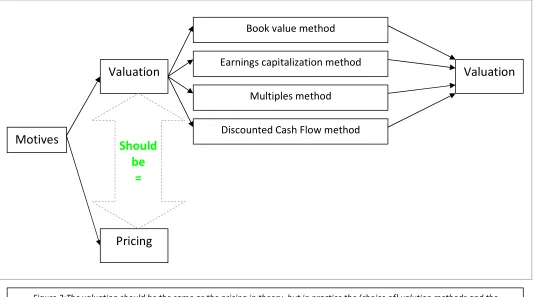
These four valuation methods will be added to the framework that was established so far. The choice of one of these valuation valuation methods, the additional valuation errors and the application of the methods could lead to different valuations between buyers and sellers. This leads to the following figure, that will be extended in the next paragraphs.
Motives
Valuation
Pricing
Earnings capitalization method
Multiples method
Discounted Cash Flow method
Valuation
Book value methodShould
be
[image:18.612.43.577.300.597.2]=
Figure 2:The valuation should be the same as the pricing in theory, but in practice the (choice of) valution methods and the valuation drivers determine the valuation of buyers and sellers (Koller, Goedhart and Wessels, 2005; Chiu and Siegel, 1989; Lippit
Book value method
Book value belongs to the category balance sheet-based methods. Book value is the assets of a small business minus its liabilities. It is the value of the equity stated in the balance sheet (components of equity, capital and reserves). The strength of this method is that information is immediately available and the assets are the drivers for generating future income. The method does not have a lot of support in the literature (Dukes, Bowlin, Ma, 1996). It is a snapshot and does not include the intangible assets (goodwill) that are not on the balance sheet of small businesses, like reputation, managerial expertise or relationships (Heaton, 1998). Book value is based on the historical costs of the assets and not on their market value. Other disadvantages are: book value does not take into account the future, the earnings, the skills of the personnel and the fact that accounting practices and
depreciations vary between companies (Pricer and Johnson, 1997; Fernandez, 2002). The adjusted book value tries to overcome the shortcomings of the normal book value
(Fernandez, 2002). Because of the many shortcomings, the book value is not often used as a valuation method.
Earnings capitalization method
Earnings capitalization is an income statement-based method, it is a valuation based on earnings. Two variables are important in earnings capitalization: the earnings and the capitalization rate. The earnings should reflect the true nature of the business, such as the the average of the last three years, the current year and/or projected years. The expected earnings are derived from the results in the past. Earnings can be capitalized by taking the earnings and divide these by the rate of return on the investment. The reason for using a capitalization rate is to remove sporadic influences. A company with high earnings and low asset value is worth more than a company with low earnings and high asset value. The formula to determine the value of a company according to the earnings capitalization method is: Earnings / Capitalization rate (Lippit and Mastracchio, 1993). The capitalization rate depends on business risk and interest on long-term debt. It could be determined by comparing rates that are available for similar risky investments. The formula above can change if constant growing earnings are implemented in the formula. Then the formula will be: Earnings / (Capitalization rate – growth rate).
An advantage of earnings capitalization is its simplicity. The information of earnings is available in companies and with a structured capitalization rate the method is quite objective. It also takes into account the future earnings and the valuation method above (book value) does not. The dangers of this valuation method are: the subjectivity of some variables in the formula (earnings and the risk factor in the capitalization rate), it also assumes that the growth rate will continue with the same rate and that the company will exist untill infinity (Pricer and Johnson, 1997; Lippit and Mastracchio, 1993). Other
disadvantages are: the valuation method does not take into account the financing structure of the firm or the presence of excess assets and it focuses especially on historic
Multiples method
Valuation methods using multiples use performance measures and multipliers to calculate the value of a company. This valuation method can be categorized as an income statement-based method, because it mainly focuses on earnings and sales. The earnings, gross sales, cash flows or other performance measures will be multiplied with a certain industry multiplier or with the multiplier of comparable companies. The result of the formula is the value of a company (Koller, Goedhart and Wessels, 2005; Kaplan and Ruback, 1996). Valuation using multiples nearly always have a broad dispersion, that is why these are not recommended. In stable companies with each year the same cash flows, this valuation method could be used. However, this valuation method can be useful to check the main valuation method and show the differences between the methods (Fernandez, 2001).
Valuation methods using multiples are more quickly and need fewer assumptions than for example the discounted cash flow valuation. It is also easier to understand and easier to present to stakeholders than other valuation methods. The last advantage is that it reflects the mood of the market, because it does not measure the intrinsic value.
Looking at the disadvantages of this valuation method, then the strengths are also the weaknesses. The ease of the method can lead to inconsistent estimates of value. When a comparable firm is overvalued, the firm that has to be valued, will also be overvalued and vice versa. This valuation method also focuses especially on historic earnings and not on forecasts. The last disadvantage is that the method is vulnerable for manipulation. An
adviser or analyst can pick a multiple or a comparable firm that gives the best value but not a realistic value (Damodaran, 2002).
Multiples can be divided into four groups: earnings multiples, book value or replacement value multiples, revenue multiples and sector-specific multiples (Damodaran, 2002). Factors that affect the multiplier are: historical earnings, income risk, terms of sale, business type, business growth, location/facilities, marketability, desirability, competition and industry growth (Sliwoski and Jorgenson, 1996). These factors have been mentioned in the paragraph about value drivers.
An example of a major earnings multiple is the Price Earnings Ratio (PER). The PER calculates the value by multiplying the annual net income by the price earnings ratio. This ratio is calculated as the quotient between the market value and earnings per share. That is called the recovery time and it shows how long it would take the investor to get back its
investment if all earnings were paid out as dividends.
The disadvantages of this ratio are: it is a senitive ratio and it can be distorted by different accounting practices and different levels of leverage. Almost similar to the PER is the Price Cashflow Ratio (PCF), only here cashflows are used instead of earnings. Cash Flows are more objective, are comparable and eliminate valuation adjustments (Ribal, Blasco, Segura, 2010). Sales multiples will be used in industries with a certain frequency.
An advantage of revenue multiples is that it is easier to compare firms in different markets with revenue multiples than with the multiples discussed above. Sometimes also sector-specific multiples are used in valuations of companies (Damodaran, 2002).
Examples of earnings multiples are: value of the company divided by the Earnings Before Interest and Taxes (EBIT) and value of the company diveded by the Earnings Before Interest, Taxes, Depreciation and Amortization (EBITDA). Another multiple is the value of the
company divided by the operating cash flows (Ribal, Blasco and Segura, 2010).
In Spain, the multiple value of the company divided by EBITDA is often used in the valuation of companies. EBITDA prevents distortions caused by different financial structures and tax policies. This multiple is the best in the category multiples, because of a small variability rate. Preferred in multiples of prices is the the PCF ratio (Ribal, Blasco, Segura, 2010). An
interesting question that remains is what kind of valuation method and multiple is preferred in the Netherlands?
The rules of thumb approach is the easiest valuation method and it is a valuation based on industry formulas. An example is that the value of a bakery is two times the annual
revenues. Rules of thumb are not really relevant in small businesses, because these rules are based on industry averages and small firms are unique and are difficult to compare with larger firms (Heaton, 1998).
According to Medium Enterprises the future earnings (earnings capitalization) and the free cash flows (DCF method) have the most influence on the value of a company. The multiples method could focus on several performance measures. The historic results and turnover are not that important for the value of a company (Sim and Wilhelm, 2010; Staalbankiers and Jonker Advies, 2010). This results in the fact that nowadays the earnings capitalitzation, the valuation method using multiples and the DCF method are the valuation methods that are the most important and the most used in SMEs according to the literature. According to the literature the most suitable way of valuation is the DCF method (Koller, Goedhart and Wessels, 2005; Heaton, 1998; Fernandez, 2002; Dukes, Bowlin and Ma, 1996). It is an accurate and difficult valuation method and it takes into consideration the future, the risk, the return, the cash flows and the cost of capital.
Is the most suitable valuation method also the method that is used in SMEs? In the recent past the DCF method was not often used in SMEs, because it was difficult to calculate. That was why in practice the earnings apitalization method, the multiples and other historical earnings based models were popular (Lippit and Mastracchio, 1993). Is this still the situation or was there a switch?
2.2.3 Discounted Cash Flow (DCF) method
Having discussed some of the other valuation methods, now the attention is going to a major valuation method, the Discounted Cash Flow (DCF) method. This valuation method fits into the category of cash flow discounting-based methods and is also used in SMEs.
DCF is the present value of the cash flows of a firm over multiple periods (Demirakos, Strong and Walker, 2004). Important factors in DCF valuation are: a calculation of net cash flow for the current period and future periods, a horizon period for the cash flows, a growth rate for the cash flows, a discount rate for the cash flows and a terminal/residual value for the cash flows (Nunnally, 2006; Luehrman, 1997; Ribal, Blasco and Segura, 2010). The formula below is the formula to calculate the value of the firm with the DCF method. The time horizon for the estimation of cash flows is three to five years according to a survey by Dukes et al. (1996). According to a research in Denmark, almost 65 percent of the analysts use an average time horizon between one and five years (Ribal, Blasco and Segura, 2010). The growth rate (h) for the cash flows is the rate the cash flow will grow each year.
Cash flow discounting can be divided into five basic stages. The first stage is a historic-, financial- and strategic analysis of the company and the industry. Then projections (financial, strategic, competitive, consistency) of future cash flows will be made. In the third stage the cost of capital (required return) will be determined. After that the net present value of future flows will be calculated. The last stage in the cash flow discounting consists out of an interpretation of the results (Fernandez, 2002).
Cash Flows (CFn)
The Discounted Cash Flow method first estimates the future cash flows after all expenses, investments in working capital and capital expenditures (Heaton, 1998). To estimate the cash flows of a company, a company has to observe how much cash is going out and how much cash is coming in. That is an easy way of keeping up with the cash flows. To calculate the cash flows in another way, some elements need to be added and substracted from the net income and depreciation and other non-cash charges are added to the net income. Also the annual change in working capital and the annual change in long-term debt are added to net income. The capital expenditures are substracted from the net income.
All this creates the following formula for calculating the cash flows: CF = E + D – CAPEX + ∆WC + ∆LTD.
CF is the annual cash flow, E is the annual net income, D is the annual depreciation charge, CAPEX is the gross annual capital expenditures, ∆WC is the annual change in working capital and ∆LTD is the annual change in long-term debt (Lippit and Mastracchio, 1993).
[image:22.612.136.476.282.405.2]EV: value of the firm CF: the cash flow of the firm n: the number of time periods k: the discount rate (WACC) h: the growth rate
After calculating the cash flows for multiple periods, these cash flows have to be discounted to the present value or the amount of money that a potential buyer is willing to pay for a company (Heaton, 1998; Fernandez, 2002). The DCF method will be used if companies have different cash flows, examples are companies which grow, companies with a good strategy and firms which often have new policies.
Terminal value (CFn·(1+h)/(k-h))
The terminal or residual value consists out of cash flows that will occur after the horizon period, but a precise estimation is not possible. The terminal value is the last part of the formula (CFn·(1+h)/(k-h)) and it also needs to be discounted. It can be calculated by multiplying the cash flow of the horizon year by the assumed growth rate past the horizon year, divided by the difference between the assumed growth rate past the horizon year and the discount rate. The terminal value is difficult to determine and it is around the 40-50% of the total value of a company (Nunnally, 2006).
Discount rate (k)
One of the most difficult and influential parts of the DCF method is the determination of the discount rate (Fernandez, 2002) The discount rate is the rate of return demanded by the suppliers of capital. It is the return available for other investments with the same risk (Heaton, 1998). The discount rate in large companies is approximately around the 15% and the discount rate in SMEs is around the 25%. The basic principle of the discount rate is the Weighted Average Cost of Capital (WACC). The costs of capital (k) are the weighted average costs of the different components of financing (debt and equity) an investment. It consists out of the cost of equity, the after tax cost of debt and the optimal capital structure of the company (Ribal, Blasco and Segura, 2010; Sim and Wilhelm, 2010; Heaton, 1998; Ross, Westerfield, Jaffe and Jordan, 2007).
Empirical research shows that smaller firms normally have a higher cost of capital and are riskier than larger firms (Sim and Wilhelm, 2010). In selecting a discount rate for these small businesses, analysts need to keep in mind the limited sources of capital available to small firms. They also need to adjust estimates of market data from larger companies to reflect the size, the risk and the illiquidity of small companies (Heaton, 1998).
A difference between large and small companies is that large companies have more references and small firms are more unique. Large companies also have less risk, because they have more body. Small companies are on the other hand easier to analyze.
k: discount rate
WACC: Weighted Average Cost of Capital E: amount of equity
ke: cost of equity
D: amount of debt kd: cost of debt
[image:23.612.119.537.433.578.2]t: corporate tax rate
Equity (E) and Debt (D)
A balance sheet has two sides. On the left are the assets and on the right side are the forms of financing: the liabilities and (stockholder) equity. The assets are items of economic value owned by a company. These items can be converted to cash (fixed- and current assets). The liabilities are the items on a balance sheet that the company owes. Liabilities are debts and are associated with nominally fixed cash burdens. The value of debt or bonds is called debt. The value of the stock of a firm is called equity. Equity is the value of an owner in an asset or group of assets. Equity is normally defined as the value of the assets contributed by the owners. The formula for equity is: equity = total assets – total liabilities (Ross, Westerfield, Jaffe and Jordan, 2007).
Cost of equity (Ke)
An element of the discount rate is the cost of equity. The cost of equity is the rate of return that investors require to make an equity investment in a firm (Damodaran, 2002). It is difficult to estimate the cost of equity for small illiquid companies. Normally these companies have a cost of equity in the range of 20-50% (Heaton, 1998).
There are two ways for estimating the cost of equity, the build-up approach and the Capital Asset Pricing Model (CAPM). The build-up approach is more often used in the valuation of small and privately held companies and the CAPM approach more often in large and publicly traded companies (Sim and Wilhelm, 2010). One major reason for this is that CAPM requires a factor, beta, but this beta is not available for small private firms. Small firms have risks that are not reflected by beta, but are related to size (lack of liquidity, higher risk, lack of
information, lack of bargaining strengths, lack of resources, less control and more) (Sim and Wilhelm, 2010). In general, smaller firms will have a relatively lower value than larger firms, because SMEs have a higher risk profile and the shares are less liquid.
The formula for the CAPM is: Required return = Rf + β(Rm - Rf). Where, Rf = Risk-free rate, β = beta and Rm = market expected return.
The build-up approach is the sum of risks associated with various assets. The cost of equity according to the build-up approach is estimated using professional judgment or experience. This approach is more subjective than the CAPM. The build-up approach is the sum of the risk-free rate (the rate of return on intermediate-term or long-term government bonds), the equity risk premium (Rm - Rf) and the small firm premium. The equity risk premium is the premium above the risk-free rate (the interest rate on long-term government bonds), because investors would like an additional return over and above this risk-free rate.
The literature describes several risk factors that could influence the increased required return of non-listed companies. These nine risk factors are:
- Illiquidity (To sell unlisted companies it often takes more time and money) - Dependency management (The continuity of the company often depends on one
or a few individuals and the performance depends on these people)
- Dependency customers (If one customer will leave the company then it has more
consequences for a company with a small amount of customers than for a company with a large amount of customers)
- Dependency suppliers (The same as for the customers applies to the suppliers) - Proof of financial performance / ambition (The trends of future cash flows
(forecasts) should be reflected in historical cash flows; the track-record)
- Reputation (a good reputation leads to less risks for a company)
- Distribution of activities (SMEs normally only focus on one activity and that is why
the company-specific risks for these companies will be higher)
- Entry barriers to the market (a low entry barrier for companies in a specific
industry can be a risk factor for an enterprise)
- Flexibility (The recent economic crises has shown that many companies lack
flexibilty to change market conditions. Flexible companies are able to cut production in bad times and these are able to increase the production in an improving market fast. They are also able to respond rapidly to new trends and innovations) (BDO, 2006)
Remarkable is that the risk factors mentioned above are also very important value drivers that determine the valuation of SMEs. These value drivers were described in paragraph 2.2.1. The Small- and Medium Enterprises cannot influence their environment like large companies can do. Large companies do not need an additional risk premium, because they are more professional, have less risks, have a better management and can influence the environment better. Thanks to the Small Firm Premium the discount rate will increase and the value of the company will decrease.
Cost of debt (Kd)
Another element of the discount rate is the cost of debt. The cost of debt is the current market rate the company is paying on its debt, adjusted for the tax-deductibility of interest expenses. The cost of debt for companies consists out of a risk-free rate (treasury bill) and a risk component.
Corporate tax rate (t)
The corporate tax rate is also included in the formula of the cost of capital. Interest is tax deductible, this means the positive effect of tax on the interest of debt has to be taken into account. This is called the tax shield (Ribal, Blasco and Segura, 2010; Ross, Westerfield, Jaffe and Jordan, 2007).
Advantages and disadvantages
The advantages of the DCF method are: - The focus is on the future;
- Cash flows are used, these take into consideration the investment needs; - It takes into account measures that could improve the returns;
- It takes into account the time value of money;
- Accounting rules are circumvented by using cash flows instead of earnings.
The disadvantages of the DCF method are:
- The forecast period is long and it is difficult to forecast several years ahead;
- The terminal value is often disproportionate, because it is not possible to predict too far ahead;
- The assumptions and principles in DCF are subjective and based on the current expectations of economic conditions;
- The investment policy of a company has a strong impact on the final value.
2.3
Pricing
At the end of the acquisition process, a price has to be paid for a company. But how do buyers and sellers determine such a price and what is the right price for a company? This paragraph answers these questions.
The transaction price of an acquisition is the result of the bargaining between the buyer and the seller about the company (Damodaran, 2001; KvK, 2010). If the price of a company is too high, then it will reduce unnecessarily the return on investment for buyers. On the other side, if the price that buyers want to pay is too low, then it can result in a failed offer and the loss of a good investment opportunity (Walking and Edmister, 1985; Fernandez, 2002).
Focusing on the start of the framework (at the left), also the motives the buyers and sellers have, influence and lead to the pricing of a company. The valuation together with the price drivers explain the transaction price and the acquisition premium, but all this will be
discussed further on in this paragraph. The different motives result in different expectations for the buyers and sellers about the transaction price. Looking at the motives for buyers that were discussed the most in the theory (synergy, agency and managerial hubris), then all these influence the level of the acquisition premium and the transaction price (Hayward and Hambrick, 1997; Berkovitch and Narayanan, 1993; Martynova and Renneboog, 2006;
Gondhalekar, Sant, Ferris, 2004).
And who are the decision makers in the pricing process? The (top)management together with their advisers are the decision makers about the final price. Final pricing of major acquisitions need approval from the board of directors or the owners (Hayward and
Hambrick, 1997). The buyers need to know what their highest price is and they need to have the discipline to stick to it. This leads to two characteristics that are important for the buyers: analytical rigor and strict process discipline (Eccles, Lanes and Wilson, 1999).
2.3.1 The transaction price
Acquisition price
Market price prior to the acquisition
Fair value
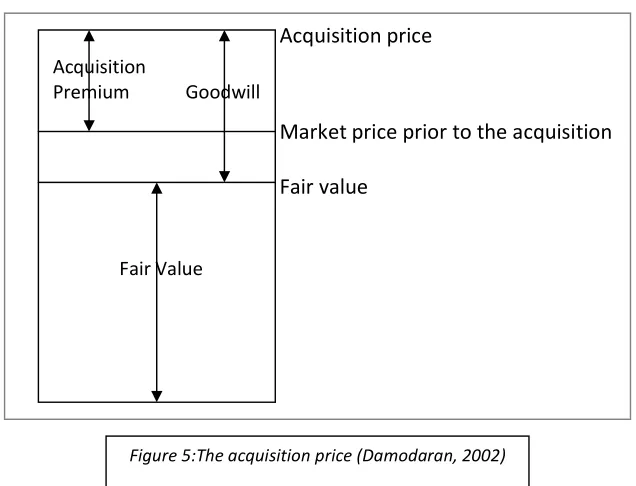
The transaction (or acquisition) price can be broken down into the Fair Value and the market price prior to the acquisition of the company. The difference between the acquisition price and the market price prior to the acquisition is called the acquisition premium (Damodaran, 2001). It is the amount of money above the market price of a company prior to the
acquisition. It is the amount that is paid too much. The difference between the Fair value and the acquisition price is called the goodwill. The Fair value is the price that an interested but not desperate buyer would be willing to pay and an interested but not interested seller would be willing to receive on the open market assuming a period of time before an agreement arises (Ross, Westerfield and Jaffe, 2008).
Goodwill, the surplus value or profit of an enterprise, is very important in determining the acquisition premium and the acquisition price. There are two kinds of goodwill: business goodwill and personal goodwill. The goodwill of a business could be a patent (a special recipe), a good organisation in a company or a good location of a company. Personal goodwill is the goodwill from the entrepreneur himself/herself, some specialties. Goodwill depends on different factors, some examples are: the industry, the owners, the location, market developments and forecasts (Ross, Westerfield and Jaffe, 2008). The next paragraph will look more extensively at the acquisition premium and the characteristics of companies which pay high premiums.
[image:28.612.141.459.60.303.2]A phenomenon called the “winner’s curse” occurs in competitive situations when a succesful buyer thinks that he or she has paid too much for a purchase of uncertain value. Two of the possible reasons for overpaying can be the lack of information about the other company and the number of competing bidders (Bazerman and Samuelson, 1983).
Figure 5:The acquisition price (Damodaran, 2002)
Acquisition
Premium Goodwill
2.3.2 The acquisition premium
The acquisition premium depends on several characteristics and determinants of companies. The acquisition premium is the difference between the estimated value of a company and the price the buyer pays to buy it. It is an overpayment that consumes the expected
synergies over the performance that would need to be achieved in order even to sustain the market value of a seller (Laamanen, 2007). This paragraph distinguishes characteristics of companies that will influence acquisition premiums.
Looking at the characteristics of companies, then buyers that are over-invested approach acquisitions more aggressively. They do it by paying higher premia than their under-invested competitors. This means buyers with high free cash flows and low market-to-book ratios will be more aggressively in the acquisition process and are likely to pay higher premiums (Gondhakelar, Sant and Ferris, 2004; Office, 2007).
Also buyers will pay higher premia for small firms, because their small size makes them more easy to integrate into their business. For companies that are for sale and have a strong growth in earnings or are technology-based firms, buyers will also pay more. Growing and innovative companies will increase the price, because these are active in an interesting industry (Gondhalekar, Sant and Ferris, 2004).
Companies with declining amounts of leverage (less debt used to finance the assets of a firm) and companies with low valuations (or valuation errors) enforce higher acquistion premiums (Sudarsanam, Sorwar, 2010). The percentage of shares controlled by the seller is important too, because when this percentage is low the bidder can takeover total control and is willing to pay a higher premium (Gondhalekar, Sant and Ferris, 2004; Walking and Edminster, 1985).
The size of the acquisition premium is for each acquisition unique. In Small and Medium Enterprises the difference between the acquisition price and the market price (prior to the acquisition) is around the 10-20 percent. For the technologybased firms the acquirers continue to pay premia of 20-30 percent of their total acquisition spending (Laamanen, 2007). The article, the price of corporate acquisition: determinants of cash takeover premia (Gondhalekar, Sant and Ferris, 2004) did research in cash-only acquisitions of Nasdaq targets. Nasdaq targets are small targets with high growth opportunities and in that article was found that the mean percentage premia is declining a lot and that it was 47% in the 1990s.
2.3.3 Price drivers
This part of the paragraph mentions the determinants of acquisition premia. These
determinants are called price drivers, because these influence the acquisition premium and in that way also the transaction price.
If there are multiple bidder involved in an acquisition, then the acquisition premium will be higher, because the competition about the company is stronger. Therefore an opposing bid at the time of an offer also determines the acquisition premium (Gondhalekar, Sant and Ferris, 2004; Walking and Edminster, 1985; Laamanen, 2007). A certain competitor will pay a strategic premium or will pay more, because he does not want competitors to get the control over a company. The influence of multiple bidders is that the bid premium averages 30 percentage points higher than the sample mean in the article, Determinants of tender offer premiums (Walking and Edminster, 1985). Therefore the price driver competition influences the price.
Another determinant for the acquisition premium is the motive for acquisitions. Motives are also the starting point in the framework and have a great influence on the pricing of a company. When pricing the company, it is important to look at the other party (buyer or seller) and their motives. The seller will ask a higher price from the strategic buyer or the competitor than from the management or business successors (son/daughter), because the seller will give well-known people a better/lower price. In these cases the price of the company is not so important, the continuation is more important for family businesses then.
According to Gondhalekar et al. (2004) the motive agency influences the level of acquisition premium rather than synergy or managerial hubris. This demonstrates the presence of managerial self-interest in premia. Agency considerations influence the activity of
acquisitions, especially the valuation of buyers. According to Sudarsanam et al. (2010) and Laamanen (2007) overpayment by buyers is caused by managerial hubris as argued by Roll (1986) (Sudarsanam and Sorwar, 2010; Laamanen, 2007). In the case of managerial hubris, the target company that sells the business was not analyzed good enough and was bought even if there was no or not so much synergy. According to them this is the reason for high acquisition premiums. According to the literature above, the motives of an acquisition have much influence on the premium and the transaction price.
Expected acquisition related benefits or expected synergy also influences the price of a company (Walking and Edminster, 1985; Black, 1989; Laamanen, 2007). Synergy is a motive for acquisitions, but is also a free-standing price driver that has a big influence on the pricing. Possibilities of synergy for the buyer will increase the price, because the higher the expected synergy, the higher the acquisition premium and the transaction price will be (Sudarsanam and Sorwar, 2010). Causes of increased acquisition gains are underpricing and
The bargaining strength also determines the price of a company and is a price driver. The better the tactics and skills of the bargainers, the stronger the power of the bargainers. Especially the power of the buyer is important in the size of the acquisition premium (Walking and Edminster, 1985). The following bid characteristics: number of shares
controlled, target firm resistance (Laamanen, 2007) and the existence of a competitive buyer determine the bargaining strength of the buyer (Walking and Edmister, 1985). During the negotiations, the expectations of the buyers and sellers are differerent and this discrepancy needs to be solved. Causes of the enhancement of the bargaining strength of the seller are an increase in competition in the acquisition market and the inclusion of anti-takeover amendments (Varaiya, 1987).
The results of the research of Varaiya (1987) on determinants of premiums in acquisitions provide strong support for the bargaining strength and mixed support for the magnitude of the estimate of acquisition gains for the buying firm (Varaiya, 1987).
The financing of acquisitions or the method of payment is also a factor that influences the transaction price for a seller (KvK, 2010). The methods of payment in acquisitions can be: cash, debt or stock (Faccio and Masulis, 2005; Martynova and Renneboog, 2006). This means that bidders could finance acquisitions with equity or debt (Faccio and Masulis, 2005;
Martynova and Renneboog, 2009). Buyers that have limited cash and liquid assets in SMEs, require debt financing for the acquisition.
Several characteristics of the deal (relative size of the selling company, the mode of an acquisition, public- or private status of the seller) and characteristics of the sellers (cash flows, debt capacity, corporate governance regulation or growth/investment opportunities) affect the choice for the method of payment (Faccio and Masulis, 2005; Martin, 1996). These characteristics could lead to a preference of cash-, debt- or stock financing. Acquisitions in SMEs are more likely to be financed with equity than with debt. The pecking order for financing SMEs nowadays is cash, then stock and then debt. The probability that a firm pays with stock decreases when the size of firms grow (Weitzel and McCarthy, 2009). When buyers pay by cash immediately, they will pay a lower amount of money, because in this way sellers immediately get the money and do not have the risk that they will get less money or no money at all (Martynova and Renneboog, 2006). The text above shows that the way of financing an acquisition and the method of payment will influence the transaction price of a company, because specific ways of financing will give advantages to seller and buyer.
Corporate finance advisers, investment advisers and interlock partners are also related to the acquisition premium, because advisers are an added value in an acquisition of SMEs. SMEs almost cannot do acquisitions without the support of advisers. Their advices, practices and experience could be used or imitated and could result in higher transaction price for the seller and a lower transaction price for the buyer (Laamanen, 2007).
After the clarification of the pricing, the breakdown of the transaction price and the
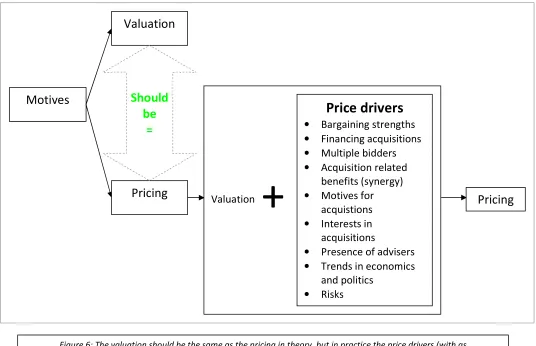
clarification of the price drivers, the framework can be extented with the price drivers in the pricing process. The valuation is the guideline in an acquisition and the price drivers
determine the transaction price of a company. The next figure shows this.
2.3.4 Private- versus Public companies
The acquisition premium depends on several price drivers and characteristics of companies, but is there also a difference in premium between private- and public acquirers? Target shareholders earn 35% higher premiums if a public firm is the buyer rather than a private firm. Sellers earn 63% higher premiums with public buyers rather than with private equity buyers (Stulz and Zutter, 2008).
There are at least two reasons for the differences. The first reason is that the failure of an offer has more consequences for managers in public firms than for managers in private firms, because public firms have to reveal more information about their strategy in the process of making an offer and this could help competitors. The second reason is that agency problems might be more serious in many public firms than in private firms (Bargeron,
[image:32.612.41.577.133.479.2]Schlingemann, Stulz and Zutter, 2008). The next paragraph will show the complete theoretical framework and the discrepancy between valuation and pricing in acquisitions.
Figure 6: The valuation should be the same as the pricing in theory, but in practice the price drivers (with as a guideline the valuation) determine the pricing in an acquistion (Walking and Edminster, 1985).
Motives
Valuation
Pricing
Pricing
Should
be
=
Valuation
Price drivers
• Bargaining strengths
• Financing acquisitions
• Multiple bidders
• Acquisition related benefits (synergy)
• Motives for acquistions
• Interests in acquisitions
• Presence of advisers
• Trends in economics and politics
• Risks
2.4
Valuation versus Pricing
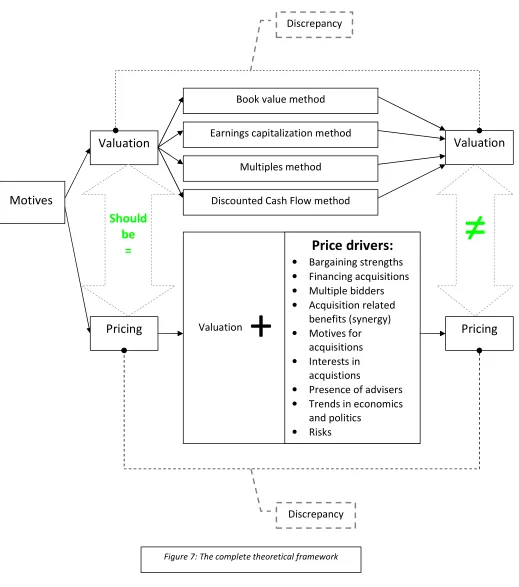
Discussed in the previous paragraphs were: the motives for acquisitions, the valuation and the pricing. Next to that, also a framework was developed that contains the three topics in this research. All the small parts of the framework that were discussed before are now combined to a total framework in this chapter. The total framework will be explained and could be found below.
Motives
Valuation
Pricing
Earnings capitalization method
Multiples method
Discounted Cash Flow method
Valuation
Pricing
Book value method
Should
be
=
≠
Discrepancy
Discrepancy
Price drivers:
• Bargaining strengths
• Financing acquisitions
• Multiple bidders
• Acquisition related benefits (synergy)
• Motives for acquisitions
• Interests in acquistions
• Presence of advisers
• Trends in economics and politics
[image:33.612.53.572.154.741.2]• Risks Valuation
+
Looking at the upperside of the framework, the motives for buyers and sellers are displayed on the left side. A valuation arises out of these motives and a valuation can be calculated by four different valuation methods in SMEs. After the valuation, the buyer and the seller know what the company is worth. The valuation from the buyer and the seller should be the same in theory, but are not the same in practice. Reasons could be that they both analyze the company in different ways (choice of valuation methods), some valuation errors occur, they have a different view about the value drivers in a company and their interests could be different.
Looking at the bottom of the framework also the price of a company arises out of the motives for buyers and sellers. The negotiations about the price between the selller and the buyer are based on both the valuations. The transaction price arises from those valuations and the price drivers. These price drivers determine the price.
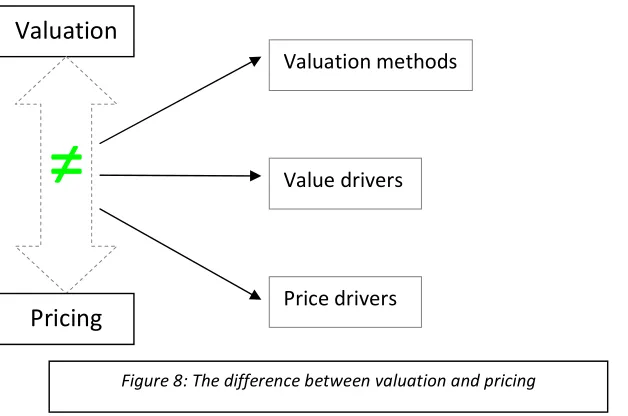
The beginning of the framework shows a “perfect” world, in which the valuation should be the same as the pricing of a company. In reality the valuation and pricing are not the same. The middle of the framework shows some elements in acquisitions and shows how the valuation and the pricing are realized. In that process, in the middle of the framework, have been found and identified explanations for the difference between valuation and pricing. These explanations cause a difference between valuation and pricing in a “normal” world. This difference could be found in the framework at the right side. This research identifies and rates these explanations on scale from 1 to 5. The explanations could be found in the valuation methods, the valuation drivers and the price drivers. Valuation estimations in value drivers & valuation methods and the price drivers could influence the difference.
The difference between value and price in a “normal” world causes a discrepancy between the theory and the practice. According to the theory, the valuations are the foundation for the acquisition process and these should be very clos