South Dakota State University
Open PRAIRIE: Open Public Research Access Institutional
Repository and Information Exchange
Agronomy, Horticulture and Plant Science Faculty
Publications
Department of Agronomy, Horticulture, and Plant
Science
2019
Transcriptome Profiling of Interaction Effects of
Soybean Cyst Nematodes and Soybean Aphids on
Soybean
Surendra Neupane
Febina M. Mathew
Adam J. Varenhorst
Madhav P. Nepal
www.nature.com/scientificdata
Transcriptome profiling of
interaction effects of soybean cyst
nematodes and soybean aphids on
soybean
Surendra Neupane
1, Febina M. Mathew
2, Adam J. Varenhorst
2& Madhav P. Nepal
1Soybean aphid (Aphis glycines; SBA) and soybean cyst nematode (Heterodera glycines; SCN) are two major pests of soybean (Glycine max) in the United States of America. This study aims to characterize three-way interactions among soybean, SBA, and SCN using both demographic and genetic datasets. SCN-resistant and SCN-susceptible soybean cultivars with a combination of soybean aphids (biotype 1) and SCN (HG type 0) in a randomized complete block design (RCBD) with six blocks were used to evaluate the three-way interactions in a greenhouse setup. Treatments receiving SCN were infested at planting with 2000 nematode eggs, and the treatments with soybean aphids were infested at second trifoliate growth stage (V2) with 15 soybean aphids. The whole roots were sampled from plants at 5 and 30 days post SBA infestation for RNA sequencing using Illumina Hiseq. 3000. The data comprises of 47 libraries that are useful for further analyses of important genes, which are involved in interaction effects of SBA and SCN on soybean.
Background & Summary
Soybean [Glycine max (L.) Merr.], considered as the source of high-quality sugar, protein, and oil, is one of the most important crops worldwide1. Soybean aphid (SBA), Aphis glycines Matsumura (Hemiptera: Aphididae) and
soybean cyst nematode (SCN), Heterodera glycines Ichinohe (Tylenchida: Heteroderidae) are the two most eco-nomically important pests of soybean in the Midwestern United States2,3. Soybean aphid, an aboveground
herbi-vore (pest), feeds on phloem sap whereas SCN, a belowground pest, infests the soybean roots. These infestations can co-occur and amplify further reduction in soybean yield4,5. In the United States, annual economic losses due
to the SBA and SCN have been estimated to be approximately $4 billion and $1.3 billion, respectively6–8. To
coun-teract these devastating pests, farmers rely on various management strategies that include host plant resistance and chemical measures9–11. For SBA, dependency on the use of chemical management has resulted in pyrethroid
resistance in SBA populations in Iowa, Minnesota, North Dakota and South Dakota as well as the impacts on non-target beneficial organisms12,13. In addition, the long-term use of SCN resistance has resulted in SCN
popula-tions that are capable of overcoming the resistance genes (i.e., HG types)14. Although host plant resistance has not
been implemented on a large scale for SBA management, multiple virulent SBA biotypes have been discovered in the U.S. Virulent SBA biotypes and SCN races threaten the sustainability of host plant resistance for these two pests14–17. Thus, genetic data generated from greenhouse experiments on the effects of SBA and SCN on soybean
cultivars are of tremendous importance for unraveling resistance genes and regulatory networks that can poten-tially be used for developing durable resistance in soybean to both pests.
Although above- and below- ground herbivores are spatially segregated, they both share the host plant through systemic tissues and are able to influence each other18. Previously, the influence of SCN on soybean
aphid infestation or vice versa has been studied on soybean using demographic datasets4,5,19–21. McCarville, et al.4
conducted experiments on various soybean cultivars [SCN susceptible (DK 28–52, IA 3018, IA 3041) and SCN resistant (DK 27–52, AG 2821 V, IA 3028)] to understand the effect of SBA, SCN, and fungus Cadophora gregata (Allington & Chamberlain) Harrington & McNew on soybean. Their study showed 5.24 times increase in SCN 1Department of Biology and Microbiology, South Dakota State University, Brookings, SD, 57007, USA. 2Department of Agronomy, Horticulture and Plant Science, South Dakota State University, Brookings, SD, 57007, USA. Correspondence and requests for materials should be addressed to M.P.N. (email: [email protected]) Received: 27 February 2019
Accepted: 30 June 2019 Published: xx xx xxxx
DATA DeSCRIPToR
www.nature.com/scientificdata
www.nature.com/scientificdata/
reproduction in the presence of soybean aphid and the fungus. In contrast, the aphid population decreased by 26.4% in the presence of SCN and C. gregata and the aphid exposure reduced by 19.8% in SCN resistant cultivars. Later, McCarville, et al.5 demonstrated the relationship between the aboveground feeding of soybean aphid and
belowground reproduction of SCN in the SCN resistant Dekalb 27–52 (PI 88788 derived) cultivar, and SCN susceptible Kenwood 94 cultivar. In 30 days, both SCN eggs and the number of females increased by 33% in SCN-resistant cultivar and reduced by 50% in the SCN-susceptible cultivar. In 60 days, the number of SCN eggs and female count remained unaffected in the resistant cultivar but decreased in the susceptible cultivar. The authors concluded that soybean aphid feeding improved the quality of soybean as a host for SCN but this result was varied significantly with the cultivar and length of the experiment. Apart from these demographic studies, molecular characterization of SBA-SCN-soybean interaction has not been reported previously.
RNA-Sequencing (RNA-Seq) has been a standard tool for studying qualitative and quantitative gene expres-sion assays that provide information on transcript abundance with their variation22,23. The major objective of this
study was to evaluate differential gene expression of soybean plants that are infested with SCN in the presence or absence of SBA. To achieve the objective, we conducted experiments on two genotypes of G. max [H. glycines susceptible Williams 82 (PI518671), and H. glycines resistant MN1806CN] that were infested with biotype 1 SBA and HG Type 0 SCN for RNA-sequencing. More than 1.1 billion reads (61.4 GB) of transcriptomic data were obtained from 47 samples derived from the experiment using whole roots of G. max. An overview of the experi-mental design, methods and transcriptome analysis pipeline is shown in Fig. 1a–c, respectively. A comprehensive understanding of these transcriptome data will enhance our understanding of interactions among soybean, SBA, and SCN at the molecular level. The rapid advancement of bioinformatics tools is facilitating the search of can-didate genes and their function that might play a crucial role in various pathways for host resistance against both herbivores.
Methods
Plant material, soybean aphid, and SCN.
Two cultivars of soybean– Williams 82 (PI518671) and MN1806CN were used in this experiment. Williams 82 is susceptible to both HG Type 0 (race 3) of the SCN and SBA. MN1806CN is resistant to HG Type 0 (race 3) of the SCN but susceptible to SBA. Soybean aphid biotype 1 populations were originally obtained from the Ohio State University and were reared on susceptible cultivar LD12-15838R at South Dakota State University. This biotype is defined by an avirulent response to all known SBA resistance (Rag) genes and was first identified in Illinois24. The SCN population used was HG type 0, whichis defined by having less than 10% reproduction documented by studies of SCN resistance and is avirulent to all SCN resistance genes in soybean.
experimental design and sample collection.
A greenhouse experiment was designed using a rand-omized complete block design (RCBD) with eight treatments (four treatments per cultivars) with eight experi-mental units (plants) in six blocks. The treatments were factors of soybean genotype, SBA infestation, and SCNFig. 1 An overview of greenhouse experiments and transcriptomic data analysis pipeline. (a) A randomized complete block design (RCBD) using two water baths (Water bath I and Water bath II), (b) A flow chart representing experimental methods used for soybean cyst nematode and soybean aphid interaction using two cultivars of soybean, and (c) A flow chart showing RNA-seq data analysis pipeline.
www.nature.com/scientificdata
www.nature.com/scientificdata/
infestation. For examples, each of the soybean genotypes received one of the following combinations: SCN:no SBA, no SCN:SBA, SCN:SBA, or no SBA:no SCN (control).
For this experiment, the soil-sand mixture was prepared by adding construction sand and clay soil including SCN infested clay soil in the ratio of 3:1. The 125 cc of the mixture was distributed in cone-tainers (diameter of 3.8 cm, a depth of 21 cm and a volume of 164 cc; Greenhouse Megastore, USA). For SCN included treatments, each cone-tainer received approximately 2,000 SCN eggs. The cone-tainers with three soybean seeds were arranged in a 2.0 U.S. gallon (7.57 liter) plastic buckets (Leaktite, USA) filled with construction sand (Quikrete, GA).
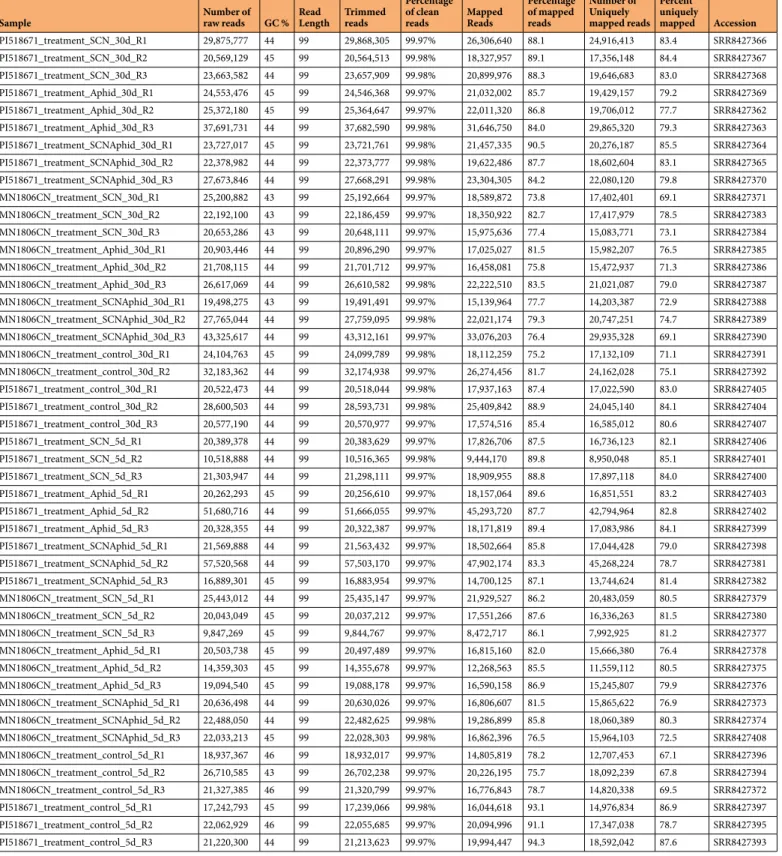
Sample Number of raw reads GC % Read Length Trimmed reads
Percentage of clean
reads Mapped Reads
Percentage of mapped reads Number of Uniquely mapped reads Percent uniquely mapped Accession PI518671_treatment_SCN_30d_R1 29,875,777 44 99 29,868,305 99.97% 26,306,640 88.1 24,916,413 83.4 SRR8427366 PI518671_treatment_SCN_30d_R2 20,569,129 45 99 20,564,513 99.98% 18,327,957 89.1 17,356,148 84.4 SRR8427367 PI518671_treatment_SCN_30d_R3 23,663,582 44 99 23,657,909 99.98% 20,899,976 88.3 19,646,683 83.0 SRR8427368 PI518671_treatment_Aphid_30d_R1 24,553,476 45 99 24,546,368 99.97% 21,032,002 85.7 19,429,157 79.2 SRR8427369 PI518671_treatment_Aphid_30d_R2 25,372,180 45 99 25,364,647 99.97% 22,011,320 86.8 19,706,012 77.7 SRR8427362 PI518671_treatment_Aphid_30d_R3 37,691,731 44 99 37,682,590 99.98% 31,646,750 84.0 29,865,320 79.3 SRR8427363 PI518671_treatment_SCNAphid_30d_R1 23,727,017 45 99 23,721,761 99.98% 21,457,335 90.5 20,276,187 85.5 SRR8427364 PI518671_treatment_SCNAphid_30d_R2 22,378,982 44 99 22,373,777 99.98% 19,622,486 87.7 18,602,604 83.1 SRR8427365 PI518671_treatment_SCNAphid_30d_R3 27,673,846 44 99 27,668,291 99.98% 23,304,305 84.2 22,080,120 79.8 SRR8427370 MN1806CN_treatment_SCN_30d_R1 25,200,882 43 99 25,192,664 99.97% 18,589,872 73.8 17,402,401 69.1 SRR8427371 MN1806CN_treatment_SCN_30d_R2 22,192,100 43 99 22,186,459 99.97% 18,350,922 82.7 17,417,979 78.5 SRR8427383 MN1806CN_treatment_SCN_30d_R3 20,653,286 43 99 20,648,111 99.97% 15,975,636 77.4 15,083,771 73.1 SRR8427384 MN1806CN_treatment_Aphid_30d_R1 20,903,446 44 99 20,896,290 99.97% 17,025,027 81.5 15,982,207 76.5 SRR8427385 MN1806CN_treatment_Aphid_30d_R2 21,708,115 44 99 21,701,712 99.97% 16,458,081 75.8 15,472,937 71.3 SRR8427386 MN1806CN_treatment_Aphid_30d_R3 26,617,069 44 99 26,610,582 99.98% 22,222,510 83.5 21,021,087 79.0 SRR8427387 MN1806CN_treatment_SCNAphid_30d_R1 19,498,275 43 99 19,491,491 99.97% 15,139,964 77.7 14,203,387 72.9 SRR8427388 MN1806CN_treatment_SCNAphid_30d_R2 27,765,044 44 99 27,759,095 99.98% 22,021,174 79.3 20,747,251 74.7 SRR8427389 MN1806CN_treatment_SCNAphid_30d_R3 43,325,617 44 99 43,312,161 99.97% 33,076,203 76.4 29,935,328 69.1 SRR8427390 MN1806CN_treatment_control_30d_R1 24,104,763 45 99 24,099,789 99.98% 18,112,259 75.2 17,132,109 71.1 SRR8427391 MN1806CN_treatment_control_30d_R2 32,183,362 44 99 32,174,938 99.97% 26,274,456 81.7 24,162,028 75.1 SRR8427392 PI518671_treatment_control_30d_R1 20,522,473 44 99 20,518,044 99.98% 17,937,163 87.4 17,022,590 83.0 SRR8427405 PI518671_treatment_control_30d_R2 28,600,503 44 99 28,593,731 99.98% 25,409,842 88.9 24,045,140 84.1 SRR8427404 PI518671_treatment_control_30d_R3 20,577,190 44 99 20,570,977 99.97% 17,574,516 85.4 16,585,012 80.6 SRR8427407 PI518671_treatment_SCN_5d_R1 20,389,378 44 99 20,383,629 99.97% 17,826,706 87.5 16,736,123 82.1 SRR8427406 PI518671_treatment_SCN_5d_R2 10,518,888 44 99 10,516,365 99.98% 9,444,170 89.8 8,950,048 85.1 SRR8427401 PI518671_treatment_SCN_5d_R3 21,303,947 44 99 21,298,111 99.97% 18,909,955 88.8 17,897,118 84.0 SRR8427400 PI518671_treatment_Aphid_5d_R1 20,262,293 45 99 20,256,610 99.97% 18,157,064 89.6 16,851,551 83.2 SRR8427403 PI518671_treatment_Aphid_5d_R2 51,680,716 44 99 51,666,055 99.97% 45,293,720 87.7 42,794,964 82.8 SRR8427402 PI518671_treatment_Aphid_5d_R3 20,328,355 44 99 20,322,387 99.97% 18,171,819 89.4 17,083,986 84.1 SRR8427399 PI518671_treatment_SCNAphid_5d_R1 21,569,888 44 99 21,563,432 99.97% 18,502,664 85.8 17,044,428 79.0 SRR8427398 PI518671_treatment_SCNAphid_5d_R2 57,520,568 44 99 57,503,170 99.97% 47,902,174 83.3 45,268,224 78.7 SRR8427381 PI518671_treatment_SCNAphid_5d_R3 16,889,301 45 99 16,883,954 99.97% 14,700,125 87.1 13,744,624 81.4 SRR8427382 MN1806CN_treatment_SCN_5d_R1 25,443,012 44 99 25,435,147 99.97% 21,929,527 86.2 20,483,059 80.5 SRR8427379 MN1806CN_treatment_SCN_5d_R2 20,043,049 45 99 20,037,212 99.97% 17,551,266 87.6 16,336,263 81.5 SRR8427380 MN1806CN_treatment_SCN_5d_R3 9,847,269 45 99 9,844,767 99.97% 8,472,717 86.1 7,992,925 81.2 SRR8427377 MN1806CN_treatment_Aphid_5d_R1 20,503,738 45 99 20,497,489 99.97% 16,815,160 82.0 15,666,380 76.4 SRR8427378 MN1806CN_treatment_Aphid_5d_R2 14,359,303 45 99 14,355,678 99.97% 12,268,563 85.5 11,559,112 80.5 SRR8427375 MN1806CN_treatment_Aphid_5d_R3 19,094,540 45 99 19,088,178 99.97% 16,590,158 86.9 15,245,807 79.9 SRR8427376 MN1806CN_treatment_SCNAphid_5d_R1 20,636,498 44 99 20,630,026 99.97% 16,806,607 81.5 15,865,622 76.9 SRR8427373 MN1806CN_treatment_SCNAphid_5d_R2 22,488,050 44 99 22,482,625 99.98% 19,286,899 85.8 18,060,389 80.3 SRR8427374 MN1806CN_treatment_SCNAphid_5d_R3 22,033,213 45 99 22,028,303 99.98% 16,862,396 76.5 15,964,103 72.5 SRR8427408 MN1806CN_treatment_control_5d_R1 18,937,367 46 99 18,932,017 99.97% 14,805,819 78.2 12,707,453 67.1 SRR8427396 MN1806CN_treatment_control_5d_R2 26,710,585 43 99 26,702,238 99.97% 20,226,195 75.7 18,092,239 67.8 SRR8427394 MN1806CN_treatment_control_5d_R3 21,327,385 46 99 21,320,799 99.97% 16,776,843 78.7 14,820,338 69.5 SRR8427372 PI518671_treatment_control_5d_R1 17,242,793 45 99 17,239,066 99.98% 16,044,618 93.1 14,976,834 86.9 SRR8427397 PI518671_treatment_control_5d_R2 22,062,929 46 99 22,055,685 99.97% 20,094,996 91.1 17,347,038 78.7 SRR8427395 PI518671_treatment_control_5d_R3 21,220,300 44 99 21,213,623 99.97% 19,994,447 94.3 18,592,042 87.6 SRR8427393
www.nature.com/scientificdata
www.nature.com/scientificdata/
These buckets were kept in a water bath for maintaining soil temperature between 26.7 °C and 28.9 °C to ensure the reproduction of SCN (i.e. ~30 days)5. The temperature of the water bathes were regularly monitored using
thermometers. The plants were grown under 16:8 (L:D) in a greenhouse with a temperature of 28 °C and 45% relative humidity. The plants were thinned down to one plant per cone-tainer upon reaching the second vegetative growth stage (V2). The V2-staged plants with the SBA included treatments were infested with 15 mixed age (i.e., fourth instar nymphs and adults) biotype 1 SBA using a 000 fine tip paintbrush (Winsor & Newton, England). The SBA were applied on the abaxial surface of the first trifoliate of V2-staged plants. All plants in each bucket were covered with a large no-see-um mesh net (Quest Outfitters, Sarasota, FL) to prevent inter-bucket movement of aphids. After SBA infestation, soybean plants were regularly checked to confirm the successful establishment of soybean aphids. Soybean aphid populations were counted at 5, 15, and 30 days post infestation (dpi). For SBA only treatment, the populations on the two soybean varieties were not significantly different, indicating that both lines were susceptible to SBA. SCN eggs were sampled at 30 dpi. The whole roots were collected on 5 and 30 dpi by snap freezing in liquid Nitrogen and stored at −80 °C for further analysis. The 5 dpi and 30 dpi root samples treated with each treatment were collected from Water bath I and Water bath II, respectively, representing each plant from three blocks (three biological replicates). The SCN soil and SCN infested roots were used for SCN cysts collection (except root samples collected for transcriptomic study) and the soil was examined for SCN counts.
RNA extraction, library construction, and RNA sequencing.
RNA was extracted from all samples rep-resenting three biological replicates of each treatment that constituted 24 samples collected at 5 and 30 dpi each. As the major foci of the project were to determine whether the gene expression differed between SCN resistant and SCN susceptible soybeans, and to evaluate the gene expression of soybeans that were dual infested with SCN and SBA, we selected two timepoints (5 and 30 dpi). We selected 30 dpi to observe gene expression of treatment effects on a single generation of SCN reproduction keeping 5 dpi as a reference in the presence or absence of SBA. Frozen root samples from each treatment were grounded in liquid nitrogen with a mortar and pestle to a fine powder followed by total RNA extraction using PureLink RNA mini kit (Invitrogen, USA). RNA samples were treated with TURBOTM DNase (Invitrogen, USA) to remove any DNA contamination following the manufacturer’s instructions. Assessment of the isolated RNA integrity was performed by 1% agarose gel electrophoresis, and RNA concentration was measured by Nanodrop 2000 (Thermo Fisher Scientific, USA). The cDNA libraries were constructed using NEBNext Ultra II RNA library 96 single index prep kit and sequenced using Illumina HiSeq. 3000 (single read end utilizing 100 bases read length) at Iowa State University Sequencing Facilities.Pre-processing of sequencing data.
Quality control of reads was assessed using FastQC program (ver-sion 0.11.3) (https://www.bioinformatics.babraham.ac.uk/projects/fastqc/)25. The FastQC results were visualizedFig. 2 Quality metrics of G. max sequencing data. (a) Mean quality scores per position, (b) Per sequence quality scores, (c) GC content distribution, and (d) Read length distribution.
www.nature.com/scientificdata
www.nature.com/scientificdata/
using MultiQC v1.326, and low quality bases (QC value < 20; 5-bp window size) were removed by trimming in
the program Btrim64 (version 0.2.0)27. High-quality single-end reads were mapped against the primary
cod-ing sequences of G. max. The codcod-ing sequences (Gmax:
Gmax_275_Wm82.a2.v1.transcript_primaryTranscrip-tOnly.fa.gz) were obtained from the Phytozome database and aligned using Salmon ver.0.9.128 accessed from
Bioconda29. Downstream analyses of the quantified transcript reads were performed using integrated Differential
Expression and Pathway analysis (iDEP 0.81, R/Bioconductor packages)30. The quantified transcript reads were
filtered with 0.5 counts per million (CPM) in at least one sample and transformed using regularized log (rlog), which is implemented in the DESeq. 231 package.
Data Records
All sequence reads were deposited in the National Center for Biotechnology Information (NCBI) Sequence Read Archive (accession SRR8427366-SRR8427408) under Bioproject PRJNA514200 (Project ID: SRP178193)33
(Table 1). The raw transcript abundance counts for all the samples was deposited at the Gene Expression Omnibus (GEO) database, GSE12510334. The transformed transcript abundance counts, hierarchical clustering, correlation
matrices, and clusters are available in figshare at: https://doi.org/10.6084/m9.figshare.7755152.v332.
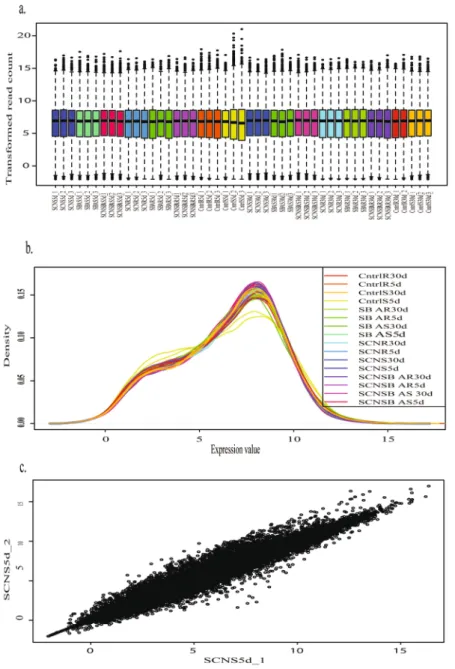
Fig. 3 Pre-processing of transcriptomic data. (a) Distribution of transformed data, (b) Density plot of transformed data, and (c) Scatter plot of the first two samples (SCNS5d_1 vs SCNS5d_2).
www.nature.com/scientificdata
www.nature.com/scientificdata/
Technical Validation
Quality control.
Forty-eight RNA libraries were prepared and sequenced with the sequencing depth ranging from 9,847,269 to 57,520,568 reads (see Table 1). Sequencing of one of the replicates of control resistant cultivar (MN1806CN collected at 30 dpi) came in error. Therefore, total reads of more than 1.1 billion from 47 libraries were subjected to FastQC analysis, which helped determine the data quality using various quality metrics such as mean quality scores (Fig. 2a), per sequence quality scores (Fig. 2b), per sequence GC content (Fig. 2c), and sequence length distribution (Fig. 2d). Phred quality scores per-base for all samples were higher than 30 and GCFig. 4 Assessment of transcriptomic data. (a) Heatmap of top 6,000 variable genes, (b) Gene SD distribution, (c) Correlation matrix, (d) Visualization of top 6,000 genes shown in the t-SNE map, and (e) A principal components analysis (PCA) plot.
www.nature.com/scientificdata
www.nature.com/scientificdata/
content ranged from 43 to 45%, following a normal distribution. After trimming, more than 99% of the reads were retained as clean and good quality reads. Upon mapping these reads, a high mapping rate of 73.8% to 94.3% was obtained. Among these, 67.1% to 87.6% reads were uniquely mapped.
Assessment of transcriptomic data.
The 43,122 genes passed the filter upon filtering with 0.5 CPM in at least one sample. To reduce the mean dependent variance, the quantified transcript reads were transformed as shown in Fig. 3a–c and available in Figshare32 (the transformed transcript abundance count for all the samples).The transformed data were subjected to hierarchical clustering and principal component analysis (PCA) followed by visualization using t-SNE map35 in order to assess the global transcriptomic data. The hierarchical clustering
of top 6000 variable genes based on two time points (5 dpi and 30 dpi) showed distinct clustering except for some samples [Fig. 4a; Figshare32 (the hierarchical clustering of top 6,000 variable genes)]. Figure 4b represents the
standard deviation (SD) distribution of the top variable 6,000 genes. Figure 4c represents the Pearson’s correlation between the samples using the top 75% genes and available in Figshare32 (the correlation between the samples
using the top 75% genes). The t-SNE map revealed four clusters (A, B, C, and D) for 6,000 variable genes [Fig. 4d; Figshare32 (the four clusters for 6,000 variable genes)]. Regarding the PCA, PC1 is correlated with time (P =
1.16e-06) with 28% variance, and PC2 is correlated with Treatment (P = 2.02e-08) with 15% variance (Fig. 4e).
Usage Notes
This data represents the first publicly available transcriptomic data for soybean roots from the three-way interaction among G. max, H. glycines, and A. glycines. The raw compressed fastq files (fastq.gz) were submitted to the National Center for Biotechnology Information (NCBI) and are available with accession numbers (SRR8427366-SRR8427408; http://identifiers.org/ncbi/insdc.sra:SRP178193)33. The data could be retrieved using fastq-dump tool SRA toolkit
(https://www.ncbi.nlm.nih.gov/sra). There are various tools such as Trimmomatic36, cutadapt37, Fastq_clean38 that
could be used for trimming purpose. Apart from the Salmon tool for the alignment and quantification of reads, other tools such as STAR aligner (https://github.com/alexdobin/STAR), Bowtie39, HISAT240, TopHat241, Cufflinks with
HTSeq can be employed, which requires reference genome of G. max and annotation file in gff3 format. For differ-ential gene expression analysis, EdgeR42 and limma43 could be used instead of DEseq. 231. Apart from the standalone
tools like iDEP30, Galaxy (https://usegalaxy.org), CyVerse (http://www.cyverse.org), MeV (http://mev.tm4.org)44,
and integrated RNA-seq interpretation system for gene expression data analysis tool (http://bmbl.sdstate.edu/IRIS/)45
could also be used for both analysis and visualization of RNA-seq data.
Code Availability
Codes used for RNA-seq data processing in the current study are available as supplementary material in Figshare at: https://doi.org/10.6084/m9.figshare.7755152.v332 (Codes used for RNA-seq data processing).
References
1. Yu, X., Yuan, F., Fu, X. & Zhu, D. Profiling and relationship of water-soluble sugar and protein compositions in soybean seeds. Food Chem. 196, 776–782 (2016).
2. Hartman, G. et al. Occurrence and distribution of Aphis glycines on soybeans in Illinois in 2000 and its potential control. Plant Health Progr. 2, 17, https://doi.org/10.1094/PHP-2001-0205-01-HN (2001).
3. Wrather, J. A. & Koenning, S. R. Estimates of disease effects on soybean yields in the United States 2003 to 2005. J. Nematol. 38, 173 (2006).
4. McCarville, M., O’Neal, M., Tylka, G., Kanobe, C. & MacIntosh, G. A nematode, fungus, and aphid interact via a shared host plant: implications for soybean management. Entomol. Exp. Appl. 143, 55–66 (2012).
5. McCarville, M. T., Soh, D. H., Tylka, G. L. & O’Neal, M. E. Aboveground feeding by soybean aphid, Aphis glycines, affects soybean cyst nematode, Heterodera glycines, reproduction belowground. PloS one 9(1) e86415 (2014).
6. Hill, C., Chirumamilla, A. & Hartman, G. Resistance and virulence in the soybean-Aphis glycines interaction. Euphytica 186, 635–646 (2012).
7. Koenning, S. R. & Wrather, J. A. Suppression of soybean yield potential in the continental United States by plant diseases from 2006 to 2009. Plant Health Progr, https://doi.org/10.1094/PHP-2010-1122-01-RS (2010).
8. Niblack, T., Lambert, K. & Tylka, G. A model plant pathogen from the kingdom animalia: Heterodera glycines, the soybean cyst nematode. Ann. Rev. Phytopathol. 44, 283–303 (2006).
9. Olson, K. D., Badibanga, T. M. & DiFonzo, C. Farmers’ awareness and use of IPM for soybean aphid control: report of survey results for the 2004, 2005, 2006, and 2007 crop years. Staff Papers 45803, University of Minnesota, Department of Applied Economics
1701-2016-138883, 1–29 (2008).
10. Niblack, T. Soybean cyst nematode management reconsidered. Plant Dis. 89, 1020–1026 (2005).
11. Ragsdale, D. W., Landis, D. A., Brodeur, J., Heimpel, G. E. & Desneux, N. Ecology and management of the soybean aphid in North America. Annu. Rev. Entomol 56, 375–399 (2011).
12. Koch, R. L. et al. Biology and economics of recommendations for insecticide-based management of soybean aphid. Plant Health Progr. 17, 265–269 (2016).
13. Varenhorst, A. J. & O’Neal, M. E. The response of natural enemies to selective insecticides applied to soybean. Environ. Entomol. 41, 1565–1574 (2012).
14. Tylka, G. L. Understanding soybean cyst nematode HG types and races. Plant Health Progr. 17, 149–151 (2016).
15. Mitchum, M. G., Wrather, J. A., Heinz, R. D., Shannon, J. G. & Danekas, G. Variability in distribution and virulence phenotypes of
Heterodera glycines in Missouri during 2005. Plant Dis. 91, 1473–1476 (2007).
16. Hesler, L. S. et al. Performance and prospects of Rag genes for management of soybean aphid. Entomol. Exp. Appl. 147, 201–216 (2013). 17. Mitchum, M. G. Soybean resistance to the soybean cyst nematode Heterodera glycines: an update. Phytopathology 106, 1444–1450
(2016).
18. Megías, A. G. & Müller, C. Root herbivores and detritivores shape above‐ground multitrophic assemblage through plant‐mediated effects. J. Anim. Ecol. 79, 923–931 (2010).
19. Hong, S., Donaldson, J. & Gratton, C. Soybean cyst nematode effects on soybean aphid preference and performance in the laboratory. Environ. Entomol. 39, 1561–1569 (2010).
20. Hong, S., MacGuidwin, A. & Gratton, C. Soybean aphid and soybean cyst nematode interactions in the field and effects on soybean yield. J. Econ. Entomol. 104, 1568–1574 (2011).
www.nature.com/scientificdata
www.nature.com/scientificdata/
21. Heeren, J. et al. The interaction of soybean aphids and soybean cyst nematodes on selected resistant and susceptible soybean lines.
J. Appl. Entomol. 136, 646–655 (2012).
22. Griffith, M., Walker, J. R., Spies, N. C., Ainscough, B. J. & Griffith, O. L. Informatics for RNA sequencing: a web resource for analysis on the cloud. PLoS Comp. Bio. 11, e1004393 (2015).
23. Shan, X. et al. Transcriptome profile analysis of maize seedlings in response to high-salinity, drought and cold stresses by deep sequencing. Plant Mol. Biol. Rep. 31, 1485–1491 (2013).
24. Kim, K. S., Hill, C. B., Hartman, G. L., Mian, M. & Diers, B. W. Discovery of soybean aphid biotypes. Crop Sci. 48, 923–928 (2008). 25. Andrews, S. FastQC: a quality control tool for high throughput sequence data, http://www.bioinformatics.babraham.ac.uk/projects/
fastqc/ (2010).
26. Ewels, P., Magnusson, M., Lundin, S. & Käller, M. MultiQC: summarize analysis results for multiple tools and samples in a single report. Bioinformatics 32, 3047–3048 (2016).
27. Kong, Y. J. G. Btrim: a fast, lightweight adapter and quality trimming program for next-generation sequencing technologies.
Genomics 98, 152–153 (2011).
28. Patro, R., Duggal, G., Love, M. I., Irizarry, R. A. & Kingsford, C. Salmon provides fast and bias-aware quantification of transcript expression. Nat. Methods 14, 417 (2017).
29. Grüning, B. et al. Bioconda: sustainable and comprehensive software distribution for the life sciences. Nat. Methods 15, 475 (2018). 30. Ge, S. X., Son, E. W. & Yao, R. iDEP: an integrated web application for differential expression and pathway analysis of RNA-Seq data.
BMC Bioinformatics 19, 534 (2018).
31. Love, M. I., Huber, W. & Anders, S. Moderated estimation of fold change and dispersion for RNA-seq data with DESeq. 2. Genome Biol. Evol. 15, 550 (2014).
32. Neupane, S., Mathew, F. M., Varenhorst, A. J. & Nepal, M. P. Transcriptome profiling of interaction effects of soybean cyst nematodes and soybean aphids on soybean. figshare, https://doi.org/10.6084/m9.figshare.7755152.v3 (2019).
33. NCBI Sequence Read Archive, http://identifiers.org/ncbi/insdc.sra:SRP178193 (2019).
34. Neupane, S., Varenhorst, A. J. & Nepal, M. P. Transcriptome profiling of interaction effects of soybean cyst nematodes and soybean aphids on soybean. Gene Expression Omnibus, https://identifiers.org/geo:GSE125103 (2019).
35. Maaten, L. V. D. & Hinton, G. Visualizing data using t-SNE. J. Mach. Learn Res. 9, 2579–2605 (2008).
36. Bolger, A. M., Lohse, M. & Usadel, B. Trimmomatic: a flexible trimmer for Illumina sequence data. Bioinformatics 30, 2114–2120 (2014). 37. Martin, M. Cutadapt removes adapter sequences from high-throughput sequencing reads. EMBnet journal 17, 10–12 (2011). 38. Zhang, M. et al. Fastq_clean: an optimized pipeline to clean the illumina sequencing data with quality control. In Bioinformatics and
Biomedicine (BIBM), IEEE International Conference (IEEE), 44–48 (2014).
39. Langmead, B., Trapnell, C., Pop, M. & Salzberg, S. L. Ultrafast and memory-efficient alignment of short DNA sequences to the human genome. Genome Biol. Evol. 10, R25 (2009).
40. Kim, D., Langmead, B. & Salzberg, S. L. HISAT: a fast spliced aligner with low memory requirements. Nat. Methods 12, 357 (2015). 41. Kim, D. et al. TopHat2: accurate alignment of transcriptomes in the presence of insertions, deletions and gene fusions. Genome Biol.
Evol. 14, R36 (2013).
42. Robinson, M. D., McCarthy, D. J. & Smyth, G. K. edgeR: a Bioconductor package for differential expression analysis of digital gene expression data. Bioinformatics 26, 139–140 (2010).
43. Ritchie, M. E. et al. limma powers differential expression analyses for RNA-sequencing and microarray studies. Nucleic Acids Res. 43, e47–e47 (2015).
44. Howe, E. A., Sinha, R., Schlauch, D. & Quackenbush, J. RNA-Seq analysis in MeV. Bioinformatics 27, 3209–3210 (2011).
45. Monier, B. et al. IRIS-EDA: An integrated RNA-Seq interpretation system for gene expression data analysis. PLOS Comput. Biol. 15, e1006792 (2019).
Acknowledgements
Authors would like to acknowledge Dr. Emmanuel Byamukama (South Dakota State University) for providing H. glycines HG Type 0 infested soil as a source of SCN for the experiment. Also, Philip Rozeboom and Alyssa Vachino are acknowledged for their assistance in greenhouse experiments. The greenhouse experiments and RNA sequencing were funded through South Dakota Soybean Research and Promotion Council (SDSRPC-SA1800238). The analysis, data interpretation and writing of the manuscript were funded through USDA-NIFA hatch Projects (SD00H469-13 and SD00H659-18 to M.P.N.).
Author Contributions
S.N. conducted the experiment, performed data analyses and drafted the manuscript. M.P.N. and A.J.V. conceived the project and helped designed the experiments. M.P.N., A.J.V., and F.M.M. edited the manuscript. All authors read and approved the final manuscript.
Additional Information
Competing Interests: The authors declare no competing interests.
Publisher’s note: Springer Nature remains neutral with regard to jurisdictional claims in published maps and
institutional affiliations.
Open Access This article is licensed under a Creative Commons Attribution 4.0 International
License, which permits use, sharing, adaptation, distribution and reproduction in any medium or format, as long as you give appropriate credit to the original author(s) and the source, provide a link to the Cre-ative Commons license, and indicate if changes were made. The images or other third party material in this article are included in the article’s Creative Commons license, unless indicated otherwise in a credit line to the material. If material is not included in the article’s Creative Commons license and your intended use is not per-mitted by statutory regulation or exceeds the perper-mitted use, you will need to obtain permission directly from the copyright holder. To view a copy of this license, visit http://creativecommons.org/licenses/by/4.0/.
The Creative Commons Public Domain Dedication waiver http://creativecommons.org/publicdomain/zero/1.0/ applies to the metadata files associated with this article.