Air Force Institute of Technology
AFIT Scholar
Theses and Dissertations Student Graduate Works
9-15-2016
Improving the Cybersecurity of Cyber-Physical
Systems Through Behavioral Game Theory and
Model Checking in Practice and in Education
Seth T. HammanFollow this and additional works at:https://scholar.afit.edu/etd Part of theComputer Sciences Commons
This Dissertation is brought to you for free and open access by the Student Graduate Works at AFIT Scholar. It has been accepted for inclusion in Theses and Dissertations by an authorized administrator of AFIT Scholar. For more information, please [email protected]. Recommended Citation
Hamman, Seth T., "Improving the Cybersecurity of Cyber-Physical Systems Through Behavioral Game Theory and Model Checking in Practice and in Education" (2016).Theses and Dissertations. 252.
IMPROVING THE CYBERSECURITY OF CYBER-PHYSICAL SYSTEMS THROUGH BEHAVIORAL GAME THEORY AND MODEL CHECKING IN
PRACTICE AND IN EDUCATION
DISSERTATION
Seth T. Hamman AFIT-ENG-DS-16-S-010
DEPARTMENT OF THE AIR FORCE AIR UNIVERSITY
AIR FORCE INSTITUTE OF TECHNOLOGY
Wright-Patterson Air Force Base, OhioDISTRIBUTION STATEMENT A.
The views expressed in this dissertation are those of the author and do not reflect the official policy or position of the United States Air Force, Department of Defense, or the United States Government. This material is declared a work of the U.S. Government and is not subject to copyright protection in the United States.
AFIT-ENG-DS-16-S-010
IMPROVING THE CYBERSECURITY OF CYBER-PHYSICAL SYSTEMS THROUGH BEHAVIORAL GAME THEORY AND MODEL CHECKING IN
PRACTICE AND IN EDUCATION
DISSERTATION
Presented to the Faculty
Graduate School of Engineering and Management
Air Force Institute of Technology
Air University
Air Education and Training Command
In Partial Fulfillment of the Requirements for the
Degree of Doctor of Philosophy
Seth T. Hamman, BA, MS
September 2016
DISTRIBUTION STATEMENT A.
AFIT-ENG-DS-16-S-010
IMPROVING THE CYBERSECURITY OF CYBER-PHYSICAL SYSTEMS THROUGH BEHAVIORAL GAME THEORY AND MODEL CHECKING IN
PRACTICE AND IN EDUCATION
Seth T. Hamman, BA, MS
Committee Membership:
Kenneth M. Hopkinson, PhD Chairman
Barry E. Mullins, PhD, PE Member
Michael R. Grimaila, PhD, CISM, CISSP Member
ADEDJI B. BADIRU, PhD
AFIT-ENG-DS-16-S-010
Abstract
This dissertation presents automated methods based on behavioral game theory
and model checking to improve the cybersecurity of cyber-physical systems (CPSs) and
advocates teaching certain foundational principles of these methods to cybersecurity students. First, it encodes behavioral game theory’s concept of level-k reasoning into an
integer linear program that models a newly defined security Colonel Blotto game. This
approach is designed to achieve an efficient allocation of scarce protection resources by
anticipating attack allocations. A human subjects experiment based on a CPS
infrastructure demonstrates its effectiveness. Next, it rigorously defines the term
adversarial thinking, one of cybersecurity education’s most important and elusive
learning objectives, but for which no proper definition exists. It spells out what it means to “think like a hacker” by examining the characteristic thought processes of hackers
through the lens of Sternberg’s triarchic theory of intelligence. Next, a classroom
experiment demonstrates that teaching basic game theory concepts to cybersecurity
students significantly improves their strategic reasoning abilities. Finally, this
dissertation applies the SPIN model checker to an electric power protection system and
demonstrates a straightforward and effective technique for rigorously characterizing the
degree of fault tolerance of complex CPSs, a key step in improving their defensive
AFIT-ENG-DS-16-S-010
Acknowledgments
First, thank you to Dr. Hopkinson, my advisor, for his genuine kindness and for always being willing and available to help me. Also thank you to my committee members for their support, guidance, and feedback. Finally, and most of all, thank you to my family, without whose sacrifice this work would not have been possible.
Table of Contents
Page
Abstract ... iv
Table of Contents ... vii
List of Figures ... xi
List of Tables ... xii
I. Introduction ...1
II. Applying Behavioral Game Theory to Cyber-Physical Systems Protection Planning ...6
2.1 Introduction ...6
2.2 Related Work...8
2.3 Approach ...9
2.3.1 Level-k Reasoning ... 9
2.3.2 The Colonel Blotto Game ... 11
2.3.3 Calculating Level-k Strategies ... 14
2.4 Illustration ...16
2.4.1 Attacking the Smart Grid ... 16
2.5 Validation ...19
2.5.1 Experimental Details ... 19
2.5.2 Experimental Results ... 21
2.6 Conclusion ...24
III. Teaching Adversarial Thinking for Cybersecurity ...26
3.2 Background ...27
3.2.1 Hacker Definition ... 27
3.2.2 Definitions of Adversarial Thinking ... 28
3.2.3 Cognitive Psychology ... 29
3.3 The Triarchic Theory Applied to Hackers ...31
3.3.1 Analytical... 31
3.3.2 Creative ... 32
3.3.3 Practical ... 34
3.3.4 Summary ... 35
3.3.5 Adversarial Thinking Definition ... 37
3.4 Adversarial Thinking for Cybersecurity Education ...37
3.4.2 Technological Capabilities ... 38
3.4.3 Unconventional Perspectives ... 38
3.4.4 Strategic Reasoning ... 39
3.5 Recommendations ...40
3.6 Conclusion ...41
IV. Teaching Game Theory to Improve Strategic Reasoning in Cybersecurity Students ...42
4.1 Introduction ...42
4.2 Background ...43
4.2.1 Game Theory ... 43
4.2.2 Teaching Game Theory to Improve Strategic Reasoning ... 45
4.3.1 Study Design... 46
4.3.2 The Treatment ... 47
4.3.3 Measurement Instrument ... 47
4.4 Results ...50
4.4.1 Data Analysis ... 50
4.4.2 The Validity and Reliability of the Instrument ... 52
4.4.3 Threats to Internal and External Validity ... 53
4.5 Discussion ...55
4.6 Conclusion ...57
V. A Model Checking Approach to Characterizing the Fault Tolerance of Smart Grid Protection Systems ...59
5.1 Introduction ...59
5.2 Related Work...61
5.3 SPIN Background ...62
5.4 SPIN Smart Grid Software Case Study ...67
5.4.1 Tong’s WABPS ... 67
5.4.2 Modeling Tong’s WABPS... 72
5.4.3 SPIN Testing Tong’s WABPS ... 74
5.4.4 SPIN Results ... 78
5.5 Conclusion ...79
VI. Conclusion ...81
6.1 Future Work ...84
Appendix B: The SPIN Model of Tong’s WABPS ...88
List of Figures
Page
Figure 1. The distribution of 13,030 MWs over the 30 distribution substations in [25] ..17
Figure 2. The aggregate human attack strategies (n=92) ...19
Figure 3. The results of the defense competition (n=98) ...21
Figure 4. Data Breach aggregated attacks (n=33) ...49
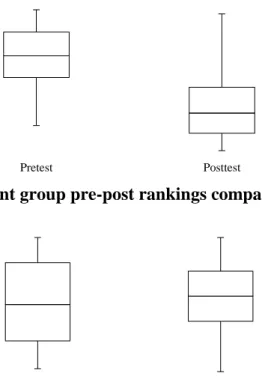
Figure 5. Treatment group pre-post rankings comparison (n=26) ...50
Figure 6. Control group pre-post rankings comparison (n=25). ...50
Figure 7. Treatment and control pretests rankings comparison (n=26, 25) ...54
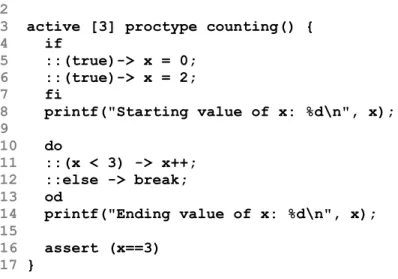
Figure 8. The PROMELA source code for a simple example program...64
Figure 9. A SPIN simulation run of the example program ...65
Figure 10. The SPIN verification run of the example program ...65
Figure 11. The “trail” produced by SPIN showing a specific failure scenario ...66
Figure 12. A detailed state transition diagram of LDAs in Tong’s WABPS [76] ...67
Figure 13. WABPS’s layout on the IEEE 14-bus test case [76] ...69
Figure 14. The nondeterministic if statement that verifies all combinations of failures ...73
Figure 15. Simulation run of WABPS model testing three total IED failures and showing the system functioning correctly ...76
Figure 16. The trail simulation run showing one of the two ways that the WABPS fails weak correctness when three total IED failures occur ...78
List of Tables
Page
Table 1. The L0-L5 Allocations of 100 Defensive Units Across the 30 Sites ...18
Table 2. Competition Result Details for Select Defense Strategies (n=98) ...22
Table 3. Summary of Sternberg’s Triarchic Theory of Intelligence ...30
Table 4. The Triarchic Theory Applied to Adversarial Thinking for Cybersecurity...36
Table 5. Summary of Adversarial Thinking Instruction in Cybersecurity Education ...40
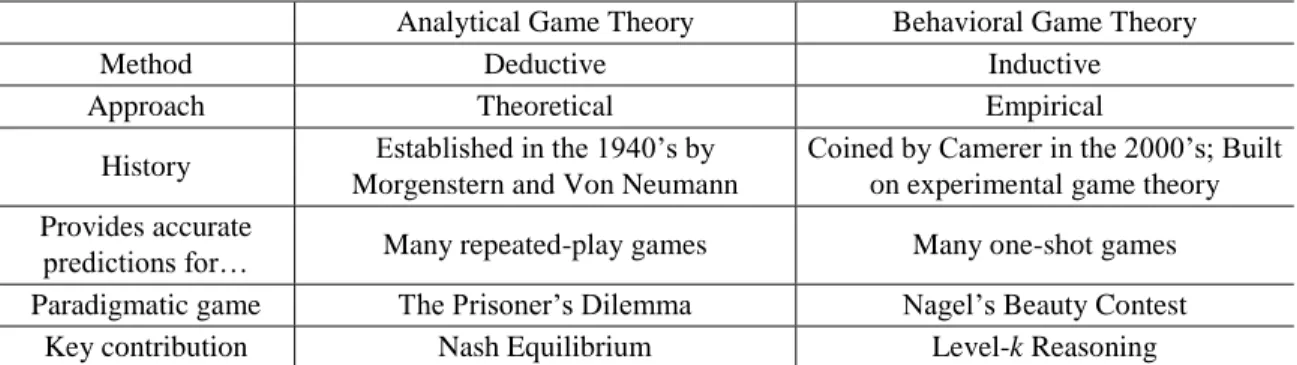
Table 6. Analytical and Behavioral Game Theory Comparison ...44
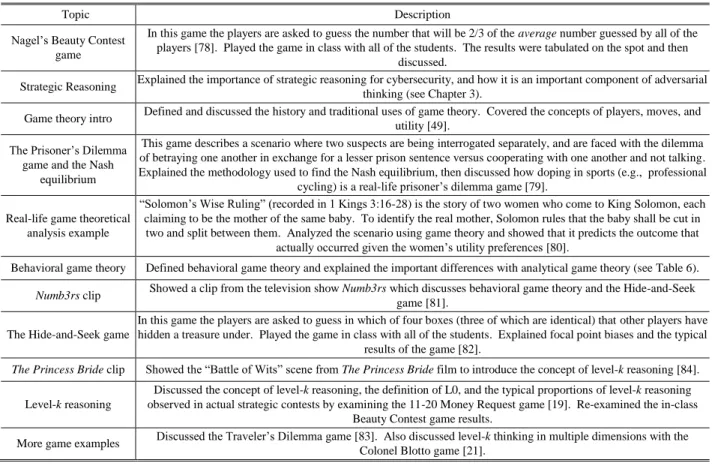
Table 7. Game Theory Lecture Topics ...46
Table 8. Comparisons of Group Performance Rankings ...51
Table 9. Average Allocation of Hours Across Days...52
Table 10. IEDs Directly Incorporated into LDA Line State Calculations ...70
IMPROVING THE CYBERSECURITY OF CYBER-PHYSICAL SYSTEMS
THROUGH BEHAVIORAL GAME THEORY AND MODEL CHECKING IN
PRACTICE AND IN EDUCATION
I. Introduction
Cyber-physical systems (CPSs) integrate computer processing and physical
sensors in a continuous feedback loop to obtain efficient control and oversight over an
environment. Because of the economic and societal potential of such systems, large
investments are being made worldwide to advance CPS technology. However, due to the
physical distribution of their critical components and their intrinsically networked nature,
they “introduce safety and reliability requirements qualitatively different from those in
general purpose computing” [1].
This dissertation presents automated methods based on behavioral game theory
and model checking to improve the cybersecurity of CPSs, and advocates teaching
certain foundational principles of these methods to cybersecurity students. For
illustrative purposes, it applies its findings to the smart grid, a CPS which is a network of
computers and power infrastructure that “enhances customers’ and utilities’ ability to
monitor, control, and predict energy use” [2]. The overarching research questions this
dissertation examines are:
RQ1: Can automated reasoning, including model checking and integer linear
programs that model game theoretic concepts, be applied to improve the
cybersecurity of CPSs? If so, can insights gained from these techniques be
It examines these questions over four specific and distinct research components that
comprise Chapters 2-5 of this dissertation. Summaries of these components follow.
Chapter 2 explores the scarce resource allocation problem inherent in protecting
CPSs from attack by intelligent adversaries. It poses the following research question:
RQ2: Can the concept of level-k reasoning be automated to create CPS defense
allocations that counteract human-generated attack allocations?
Specifically, the chapter seeks to derive protection resource allocations optimized to obtain the biggest “bang for the buck.” Behavioral game theory’s concept of level-k
reasoning provides the framework for modeling the strategic nature of intelligent
attackers and insights into predicting their most likely attack allocations. The approach
leverages an integer linear program that “solves” the newly introduced security Colonel
Blotto game, which models allocating scarce resources across a CPS’s infrastructure, for
any level of level-k reasoning. The effectiveness of the approach is validated by entering
its automated defense allocations into an attack and defend competition conducted with
human subjects and based on a published smart grid protection system.
Chapter 3 seeks to position the key insights gained from applying level-k
reasoning to CPS protection planning in Chapter 2 within an accepted framework for
educating the next generation of cybersecurity professionals. It does so by applying
cognitive psychology research to the concept of adversarial thinking for cybersecurity. It
examines the research question:
RQ3: Can Sternberg’s triarchic theory of intelligence provide a paradigm for
defining adversarial thinking for cybersecurity that identifies practicable student
The chapter highlights the fact that working from the simplistic definition that adversarial thinking means “the ability to think like a hacker” makes framing student learning
outcomes difficult, and without proper learning outcomes, it is not possible to create
appropriate instructional materials. It argues that a better understanding of the concept of
adversarial thinking is needed in order to improve this all-important aspect of
cybersecurity education. The chapter sheds new light on adversarial thinking by exploring it through the lens of Sternberg’s triarchic theory of intelligence. The triarchic
theory’s division of the intellect into the analytical, creative, and practical components
provides a helpful framework for examining the characteristic thought processes of
hackers. This exploration produces a novel, multidimensional definition of adversarial
thinking that leads naturally to three clearly defined learning outcomes, one of which
focuses on developing the strategic reasoning abilities of cybersecurity students.
Based on the new definition of adversarial thinking from Chapter 3, Chapter 4
homes in on the challenge of developing the strategic reasoning abilities of cybersecurity
students. It examines the research question:
RQ4: Does learning basic game theory concepts improve a student’s ability to
anticipate the strategic choices made by other people?
The chapter reiterates how strategic reasoning is an important, but often overlooked,
aspect of the practice of cybersecurity. It proposes teaching basic game theory to
cybersecurity students to help develop their strategic reasoning abilities. To demonstrate
the promise of such an approach, it details a pretest-posttest educational experiment with
a control group and an original measurement instrument. Details of the treatment, which
theory, are also provided. The classroom experiment demonstrates that learning about game theory resulted in a statistically significant improvement in the students’ abilities to
anticipate the strategic choices made by others. Additionally, the chapter suggests that
learning about game theory in a cybersecurity class has the potential to fundamentally
alter the way students view the practice of cybersecurity. It may help to orient them
around the adversarial conflict that is at the heart of cybersecurity, and this could lead to
a more strategic-minded, and therefore better equipped, cybersecurity workforce.
Finally, in Chapter 5, attention is focused on the cybersecurity and reliability
challenges posed by CPSs. It explores how the discipline of formal methods—the
applied mathematics of design verification—can be applied to rigorously characterize the
fault tolerance of CPSs. It examines the research question:
RQ5: Can the SPIN model checker be applied to automate the identification of
the degree of fault tolerance of CPSs?
The chapter describes how as distributed, communication-based protection systems (a
type of CPS) become more prevalent in the emerging smart grid, the task of critically
assessing their reliability has become increasingly challenging due to the complexity of
their underlying software. It demonstrates that the discipline of software model checking
can be applied to smart grid protection software designs to rigorously assess their fault
tolerance. It applies the SPIN model checker (SPIN) to a published wide-area backup
protection system (WABPS)—a smart grid technology. The WABPS was specifically
architected to be highly reliable under various kinds of common failure scenarios,
including mechanical malfunctions, erroneous sensor readings, and communication
design, calculating its precise fault tolerance is non-trivial. The chapter shows how SPIN
can be applied to the WABPS’s design to brute-force prove the limits of the number and
types of failures that can occur while the system remains able to successfully perform its
function. The same technique is applicable to a wide variety of CPS software designs,
and it provides key insights into understanding the security vulnerabilities of such
systems.
In summary, this dissertation examines important research questions involving the
cybersecurity of CPSs and has two primary focuses. One is on applying its insights in an
automated fashion, which may help lower the barrier to their acceptance by the
professional community. The other focus is on adapting its research findings to
educational contexts, which will help better equip the next generation of cybersecurity
II. Applying Behavioral Game Theory to Cyber-Physical Systems Protection Planning*
2.1 Introduction
As civilization enters the fourth industrial revolution (Industry 4.0),
cyber-physical systems (CPSs) will play an increasingly expanding role in society [3] [4]. Because society’s dependence on CPSs is directly proportional to their attractiveness to
terrorists and other adversaries who are motivated to inflict maximum harm on their
enemies [5], protection planning is a vital aspect of the ongoing operation of any
real-world CPS.
Large-scale CPSs pose some unique security challenges because they may be
geographically dispersed and located in remote areas where it is difficult to provide
physical security [6]. Providing adequate protection resources in such contexts is
infeasible due to the large attack surface and the limited availability of man hours and
money. Therefore, large-scale CPS protection planning is necessarily an exercise in the
allocation of scarce protection resources [7].
Not only are protection resources scarce, but they must be allocated in light of the
fact that adversaries are strategic actors. The U.S. Office of Homeland Security warns
that adversaries (e.g., terrorists, enemy nation states, etc.) perform reconnaissance and
undertake intensive planning before making an attack [8]. Any CPS protection scheme
that does not take into account attack scenarios waged by intelligent adversaries is naïve
and inadequate.
* This chapter is based on research that will be published in a chapter in an upcoming book on cyber-physical systems:
S. Hamman, K. Hopkinson L. McCarty, “Applying behavioral game theory to cyber-physical systems protection planning,” in Cyber-physical systems: foundations, principles, and applications, Elsevier, Academic Press, (projected fall 2016).
The research presented in this chapter lays the foundation for approaching the
challenge of CPS protection planning in view of these realities. The approach is to model
the protection scenario as a newly formulated security game based on the Colonel Blotto (CB) game from game theory. A security game has been defined as a “game-theoretic
model that captures essential characteristics of resource allocation decision making” [9].
Then, the security game is “solved” by applying the concept of level-k reasoning from
behavioral game theory. Behavioral game theory makes it possible to model the strategic
nature of intelligent adversaries and provides insights into anticipating and countering
their most likely actions. The goal of this approach is to neither over- nor under-protect
the critical sites in a CPS infrastructure, thereby achieving the biggest “bang for the buck.”
Furthermore, much of the human element involved in protection planning is
eliminated by leveraging a mathematical programming solver to determine level-k
solutions to an integer linear program (ILP) which models the security CB game. The
solver outputs a precise allocation of protection resources across critical sites. The ILP is
applicable to any size CPS and any amount of protection resources.
In order to provide a clear illustration of how the methodology can be applied to a
real-world CPS, this chapter demonstrates how it would allocate protection resources
across a notional smart grid special protection system (SPS).
Lastly, the approach is validated by conducting an attack competition with human
subjects based on the parameters of the SPS. Using human subjects is the only legitimate
way to validate the effectiveness of an approach that has as its goal the countering of
performing computer simulations, generating random attacks, or even constructing
mathematically rigorous models, fall short because it cannot be convincingly
demonstrated that they fully capture the intelligence and strategic nature of human
beings.
2.2 Related Work
This work is related to other research efforts that attempt to allocate scarce
protection resources effectively over CPSs. [10] promotes building attack trees to find
the most damaging attack paths, thereby identifying where protection resources are
needed most. Similarly, [7] recognizes the impossibility of protecting every aspect of a
CPS infrastructure. It introduces an integrated methodology to prioritize security
requirements with the goal of ensuring that the most important tasks are addressed first, instead of proceeding in an ad hoc manner such as “easiest first” or “least expensive
first.”
Other work has been done regarding the use of game theory in CPS protection
planning. [11] emphasizes the need for estimation algorithms that capture realistic attack
models, and suggests that game theoretic techniques for modeling rational adversaries
may be useful for this task. [12] uses game theory to model the probabilities of
successful attacks as a function of the number of components that are attacked and
defended. [13] attempts to find the Nash Equilibria for a game theoretic formulation of a
CPS security scenario, and it distinguishes between the degradability and the
survivability of CPSs after attacks. [14] finds an optimum solution to a CPS security
game by utilizing linear programming. [15] incorporates human decision making into a
Although not in the context of CPSs, [16] cites successful, real-world
implementations of security systems that rely on computer-generated solutions to security
games. Its algorithms are currently being used by the Los Angeles International Airport
and the U.S. Coast Guard, among others, to derive inspection schedules.
2.3 Approach
When trying to defend a large-scale distributed CPS, protection planners are faced
with the dilemma of allocating limited protection resources (e.g., man hours and money)
as efficiently as possible over multiple vulnerable sites. If the sites are not all equally
valuable, it does not make sense to allocate the resources evenly over the sites (the equal
allocation strategy). A much better strategy would be to allocate the resources
proportionately according to the relative values of the sites (the proportional allocation
strategy). However, these two approaches, like any plain optimization formulation, fail
to capture the effects of the attacker behavior in the model [17]. Consequently, these two
natural approaches to the scarce resource allocation problem are inadequate.
The approach taken in this chapter to large-scale CPS protection planning is to try
and anticipate how an adversary would allocate his attack resources and then to deploy
defensive resources accordingly. To accomplish this, the concept of level-k reasoning
from behavioral game theory is leveraged.
2.3.1 Level-k Reasoning
When engaging in a strategic contest, the first step a person typically employs in
formulating a strategy is to make an educated guess as to what his opponent will do. From that point, he can arrange his strategy to beat his opponent’s putative strategy. Of
procedure. This might lead him to try and beat the strategy that he imagines his opponent
is going to use to try and beat his initial strategy. This type of back-and-forth reasoning
could theoretically continue indefinitely. Behavioral game theorists, who have
extensively studied the dynamics of human beings engaged in strategic interactions, have
termed this thought process level-k reasoning [18].
In the concept of level-k reasoning, the natural, instinctual strategy is denoted as
the level-0 (L0) strategy, the first logical extension of it as the L1 strategy, then L2, and
so on. To summarize, the Lk type assumes his opponent is an L(k-1) type.
Over decades and in many contexts, behavioral game theorists have empirically
studied how many levels deep people typically descend into the level-k reasoning
process. One noteworthy attempt to isolate the level-k reasoning process from possible
confounding variables is the 11-20 money request game [19]. In this game, two
participants, independently of one another, are asked to choose an amount of money
between $11 and $20, and they are told they will be given whatever amount of money
they choose. Additionally, they are told that they will earn a $20 bonus if they choose
exactly $1 less than the other participant.
The L0 strategy in this game is to ask for $20—it is the instinctual starting point
since it is the highest amount of money available. From there, the L1 strategy is to ask
for $19 in anticipation of the other participant asking for $20, because this will result in
the $20 bonus. The L2 strategy is to ask for $18, and the L3 strategy is to ask for $17.
Around 80% of the subjects in a study conducted with 108 participants chose between
$17 and $20, and the authors demonstrate that these choices represent between three and
This leaves the other 20% of participants who chose between $11 and $16. Did
they employ more in-depth reasoning than the other 80% of participants? Based on ex
post interviews with the subjects, the answer to this question is a definitive, “No.” Indeed,
behavioral game theory researchers have repeatedly demonstrated that humans rarely (if
ever) continue to four or more levels of reasoning, either because they do not believe
their opponents will continue that far, or because they stop when they reach the limit of
their mental capacity [19]. People who do not employ level-k reasoning typically describe their strategies as being based on “gut instincts,” guesses, or intuition. These
strategies require very little time to formulate relative to level-k reasoning strategies and
typically perform poorly in strategic contests.
Numerous level-k reasoning studies have been conducted on vastly different pools
of people and the results are similar to those of the 11-20 money request game.
Researchers have concluded that the majority of people, no matter what their country of
origin, level of intelligence, profession, ethnicity, gender, etc., employ between zero to
three levels of reasoning [18]. The approach taken in this chapter is to leverage this basic
trait of human nature to derive efficient protection resource allocations. However, before
level-k reasoning can be applied to the scarce resource allocation problem, a formal
model of the problem is needed, which the CB game from game theory provides.
2.3.2 The Colonel Blotto Game
Gross and Wagner devised the CB game to capture the strategic dynamics
inherent in allocating scarce resources over multiple sites [20]. In the canonical CB game, two colonels, A and B, compete over K independent battlefields of total aggregate value U. The colonels control M and N soldiers, respectively, and they must distribute
them over the K battlefields independently of one another (in the cover of darkness as the eponymous construction goes). Their choices are revealed simultaneously (continuing
the illustration, at dawn), and whichever colonel has allocated the most soldiers to a
particular battlefield wins that battlefield. Each colonel’s goal is to maximize his own
utility.
There are many variations of the basic CB game. The colonels may have the
same amount of soldiers or different amounts. The values of the battlefields may be
homogenous or heterogeneous. The colonels may agree or disagree on the values of the
battlefields. There are also different ways to resolve ties, including denoting a default
winner in all cases, splitting the utility between the colonels, or not awarding the utility to
either colonel.
Arad and Rubinstein have demonstrated that when people play the CB game, they
exhibit level-k reasoning [21]. Therefore, this strategic model provides a sound basis for
applying level-k reasoning to CPS protection planning.
CPS protection planning is modeled as a specific type of CB game where the
defender and the attacker are the two colonels, protection and attack resources are the
soldiers, and CPS critical sites are the battlefields. In order to capture the nuanced
dynamics of CPS protection planning, the following game variations were selected:
Both the defender and the attacker are assigned the same number of soldiers, making them equally matched. This makes sense because both the defender and
the attacker would naturally allocate resources in proportion to the size and value
Both the defender and the attacker are assigned 100 soldiers. This choice allows for the easy identification of the proportion of resources allocated to each site
(i.e., each soldier is 1% of a colonel‘s budget).
The battlefields’ values are heterogeneous. Based on their location in the infrastructure and their differing responsibilities, the critical sites of any
large-scale distributed CPS will have different amounts of utility.
It is assumed that the attacker and the defender will value the battlefields symmetrically. Because the model is predicated on a well-planned attack, the
attacker, having conducted substantial reconnaissance, will have accurate values
for the sites.
In the case of a tie, the battlefield utility is split evenly.
In addition to these variations one tweak must be made to the canonical CB game
to transform it into a security game. In protection planning, unlike in the war version of
the game, the critical sites are not neutral ground—they are all owned by the defender by
default. In the classic CB game, in the scenario where neither the defender nor the attacker allocate resources to a particular battlefield, the battlefield’s value goes
un-awarded. However, in the same situation in a security context, the defender would win
that site because he owns all of the sites to begin with. Therefore, in what this chapter
terms the security CB game, un-attacked battlefields are automatically awarded to the
2.3.3 Calculating Level-k Strategies
An ILP was devised to model the security CB game. Based on the ILP, a
mathematical programming solver (e.g., CPLEX) is able to efficiently calculate the best
responses to any set of opponent strategies. By bootstrapping the model with the L0
strategy, the ILP can calculate strategies at any depth of level-k reasoning by first
computing the best response to the L0 strategy (i.e., the L1 strategy), and then the best
response to that strategy, and so on, until the desired level is reached.
The L0 strategy in the CB game is the proportional allocation strategy, as
demonstrated by Arad and Rubinstein [21]. The proportional allocation strategy for a
colonel with N total soldiers, and a game with set K of battlefields and U total utility is calculated as follows:
𝑛𝑗 = 𝑢𝑗⁄ × 𝑁, ∀ 𝑗 ∈ 𝐾 𝑈 (1)
Even though this approach allows one to calculate any level of level-k reasoning
strategy, which level should CPS protection planners select? The answer is that it
depends on what level the attackers select. Based on the findings from behavioral game
theory described earlier, it can be assumed that they will use between zero and three
levels of level-k reasoning.
This might make it appear like the L4 strategy would be the best choice, but the
evidence from the experiment conducted with human subjects (detailed below) strongly
supports the choice of L3 as the correct defensive strategy for the security CB game.
This makes sense because as strategies become more distant from lower-level strategies,
they over-protect some sites at the expense of others (i.e., they “overthink” the problem).
anticipated attacks. The choice of L3 as the best strategy is also consistent with the
results of behavioral game theory competitions [22].
The ILP is as follows:
Let P be the set of possible attack strategies and K be the set of battlefields
Let 𝑎𝑝𝑗 be the number of soldiers placed at battlefield j in attack strategy p, for 1 ≤ j ≤ |K |, 1 ≤ p ≤ |P |.
Let 𝑧𝑗𝑛 be a decision variable where
𝑧𝑗𝑛 = {1, defender places exactly n soldiers at battlefield 𝑗0, otherwise for 1 ≤ j ≤ |K |, 0 ≤ n ≤ 100.
Let 𝜀𝑝𝑗𝑛 be an indicator variable that is calculated off-line for each 1 ≤ p ≤ |P |, 1 ≤ j ≤ |K |, 0 ≤ n ≤ 100.
For 𝑛 ≠ 0, 𝜀𝑝𝑗𝑛 = {
1, 𝑛 > 𝑎𝑝𝑗
0, 𝑛 = 𝑎𝑝𝑗
−1, 𝑛 < 𝑎𝑝𝑗
, so a tie results in 0 points.
For n = 0, 𝜀𝑝𝑗0 = {
1, 0 = 𝑎𝑝𝑗
−1, 0 < 𝑎𝑝𝑗, so a 0-0 score results in a win for the defender.
Let 𝑢𝑗 represent the utility of battlefield j for 1 ≤ j ≤ |K |. A model to find an optimal strategy for the defender becomes:
maximize ∑|𝑃|𝑝=1∑|𝐾|𝑗=1∑100𝑛=0𝑢𝑗𝜀𝑝𝑗𝑛𝑧𝑗𝑛 (2)
subject to ∑|𝐾|𝑗=1∑100𝑛=0𝑛 ∙ 𝑧𝑗𝑛 = 100 ∑100 𝑧𝑗𝑛
𝑛=0 = 1 ∀𝑗
The objective function is the number of wins, minus the number of losses, where
ties count as 0 for n ≠ 0. The first constraint enforces the rule that the attacker and defender each have only 100 soldiers. The second constraint ensures that the defense
cannot place two different amounts of soldiers at one battlefield.
2.4 Illustration
In order to illustrate how this approach would allocate scarce protection resources
in a real security setting, in this section a specific large-scale distributed CPS is detailed
along with a realistic, although hypothetical, attack scenario.
2.4.1 Attacking the Smart Grid
Lloyds imagines a realistic power grid attack scenario conducted by a highly
motivated and capable adversary [23]. The report describes a meticulously planned cyber
attack involving considerable reconnaissance and effort that hinges on planting malware
in smart grid safety control systems. In the scenario proposed, the malware lies dormant
until activated during a peak period of electricity demand, at which point it attacks grid
components in a coordinated manner and eventually triggers a cascading blackout. A
cascading blackout is an “avalanche” of power outages that spreads rapidly and
uncontrollably over a vast region. To prevent cascading outages from occurring, load
shedding, the practice of taking “blocks of customers off-line in order to prevent a total
collapse of the electric system,” is typically performed [24].
The attack scenario in this chapter is based on Lloyds’, and is oriented around the
SPS described in [25], which is representative of a general, large-scale CPS. As the
power grid evolves into the smart grid, SPSs will be increasingly relied upon to help
points in the grid which automatically detect and correct power imbalances in a
coordinated manner.
The SPS outlined by [25] is distributed over 30 power distribution substations.
The goal of an adversary in the hypothetical attack scenario is to infiltrate the nodes of
the SPS and cause them to ignore load shedding commands on demand. Ironically, it is
by keeping customers online that the adversary hopes to maximize damage. If the
adversary can cause a major source of power generation to go offline, perhaps through a
physical attack on a key generator, and then prevent mitigating load shedding from taking
place, he may be able to create enough of a power imbalance to trigger a cascading
blackout.
Because each node manages a different number of megawatts (MWs) (i.e., some
distribution substations may be located in urban areas and others in rural areas), they are
not all equally attractive to the adversary. His goal is not to obtain control over as many
of the 30 nodes as possible, but to gain control over as many MWs as possible. It is Figure 1. The distribution of 13,030 MWs over the 30 distribution
substations in [25] 20 1700 0 200 400 600 800 1000 1200 1400 1600 1800 2 4 6 8 10 12 14 16 18 20 22 24 26 28 30 MW s Distribution Substations
assumed that the adversary, having done considerable reconnaissance, knows the average
number of MWs flowing through each distribution substation.
It is also assumed that the adversary does not know how protection resources have
been allocated to the nodes. His goal is to allocate more attack resources to particular
nodes than the defender has allocated to protecting them. As demonstrated earlier in this
chapter, based on findings from behavioral game theory, it is highly likely that the
attacker will start with the proportional allocation strategy and then employ between zero
and three levels of level-k reasoning to allocate his attack resources. This assumption is
put to the test in the competition detailed below.
With the infrastructure detailed, the two parameters needed by the mathematical
programming solver to calculate level-k resource allocations from the ILP have been
identified: the number of critical sites (30, based on the 30 distribution substations) and
their values (the average number of MWs they control, which are rounded to the nearest
10). This data was compiled from the model power grid in [25] and is shown graphically
in Figure 1. The entire power system is comprised of 13,030 MWs, spread out over 30
substations, ranging from 20 to 1,700 MWs each.
Table 1. The L0-L5 Allocations of 100 Defensive Units Across the 30 Sites
ID 1-7 8-15 16 17 18 19 20 21 22 23 24 25 26 27 28 29 30 L0 0 1 1 1 2 2 3 4 5 7 8 8 8 8 10 12 13 L1 0 0 0 0 0 3 4 5 6 8 9 9 9 9 11 13 14 L2 0 0 0 0 0 4 0 6 0 9 10 10 10 10 12 14 15 L3 0 0 0 0 2 0 0 0 0 10 11 11 11 11 13 15 16 L4 0 0 0 0 1 0 2 0 2 0 12 12 12 12 14 16 17 L5 0 0 1 2 0 2 2 2 2 0 0 13 13 13 15 17 18
Table 1 shows the CPLEX calculated allocations for each of the L0 through L5
strategies. It illustrates that as level-k reasoning increases, the trend is to devote more
resources to the largest sites at the expense of the lesser sites.
2.5 Validation
To test this approach, an experiment was conducted with human subjects, which
is uniquely capable of validating the computer-generated strategy’s performance against
intelligent human beings.
2.5.1 Experimental Details
Volunteers were solicited from among the engineering and computer science
majors at a private Midwestern university. 92 human subjects participated. They
competed for gift cards and were given a week to compile their submissions, which
incentivized thoughtful participation. The participants were analytically minded, with an Figure 2. The aggregate human attack strategies (n=92)
0 2 4 6 8 10 12 14 16 18 2 4 6 8 10 12 14 16 18 20 22 24 26 28 30 A ttack Un its Distribution Substations Median Attack Allocation L3 Defense Allocation
average ACT Math score of 29.83, which exceeds the 93rd percentile. It is believed they
are a fair representative sample of intelligent and motivated people in general.
The participants were provided with a prompt based on the SPS defined earlier,
outlining the 30 critical sites and their values. There were asked to compete in two
different competitions, one as defenders of the infrastructure and one as attackers. (The
competitions were subtly different due to the nuance in the security CB game where the
defenders own all of the sites by default.) They were tasked with allocating 100
indivisible units of resources across the 30 sites with the goal of winning as much utility
as possible. They were clearly informed of all of the specific dynamics of the game,
including the equally matched opponent, the rule of the defender winning un-attacked
sites by default, and the splitting of utility in case of a tie.
The attack competition served as the basis to measure the defense submissions
against. The defense submissions were scored by matching each of them against all of
the attack submission in head-to-head contests. The total amount of utility won over all
of the head-to-head contests served as the ranking criteria.
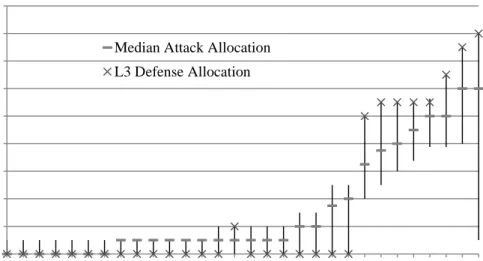
The aggregated attack strategies the subjects submitted are shown in Figure 2.
The median attack allocations approximately align with the proportional allocation
strategy (compare with Figure 1). The vertical bars denote the middle 50% of attack
allocations. The L3 defense allocations, marked with X’s, defeat approximately 75% of
the attack strategies in all nine sites where resources were allocated, which includes the
eight most valuable sites. This is a remarkably efficient allocation of defensive
2.5.2 Experimental Results
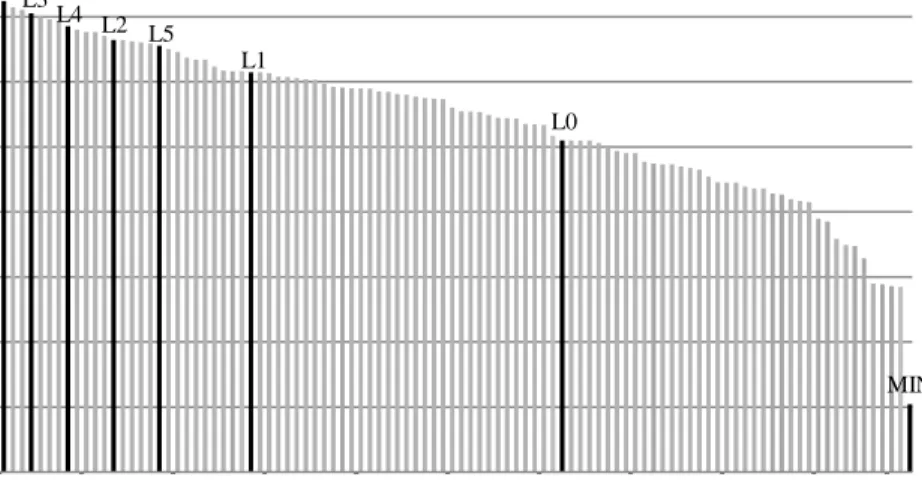
Figure 3 illustrates the results of the defense competition, including the scores of
all 92 human participants and the computer-generated L0 to L5 strategies. The L3
strategy performed remarkably well, finishing the best of any of the level-k strategies in
3rd place. The L3 strategy achieved 32% more aggregate utility than L0 (i.e., the
proportional allocation strategy) and only 2% less than the maximum possible utility.
The L0 strategy finished in a tie for 61st place (three of the 92 human competitors
also submitted the L0 strategy). This is an alarming result because it is the natural way
that limited protection resources would be allocated across a CPS infrastructure in
practice, because it is the most “commonsense” approach. However, it is not a strategic
approach. The reason it did poorly in the competition is presumably because many of the
attackers anticipated this “commonsense” defensive posture and allocated their attack
resources accordingly. This result provides support for the notion that the L0 strategy is
naïve.
Figure 3. The results of the defense competition (n=98) MAX L3 L4 L2 L5 L1 L0 MIN 100 200 300 400 500 600 700 800 1 10 20 30 40 50 60 70 80 90 98 A g g reg ate Uti li ty ( 1 0 3) Place Finished
Also noteworthy is that the first three level-k strategies did progressively better,
peaking at L3, and then began to degrade with the L4 strategy. This is consistent with
behavioral game theory findings, and suggests that the L4 and L5 strategies are
over-optimized. Meanwhile the L3 strategy competed in the same space as most of the
competitors, and likely due to its mathematical precision, out-performed most of the other
L3 thinkers in the competition. The experimental results confirm that the L3 strategy
achieves the best balance across all sites, neither over- nor under-allocating resources.
To help gain insight into a more absolute measure of performance (as opposed to
the relative performance against this specific pool of human competitors), CPLEX was
used to solve for the optimal defensive strategy (designated MAX) in the competition.
MAX could only be determined after the competition because it requires perfect
knowledge of all of the attack strategies. (No participant, including the authors, was privy
to the specific attack strategies during the competition.) MAX represents the maximum
achievable amount of utility.
Table 2. Competition Result Details for Select Defense Strategies (n=98)
ID Place in
Competition
Percentage of all Possible Strategies Outperformed L0 T61 82.2% L1 26 97.3% L2 12 99.2% L3 3 99.7% L4 7 99.5% L5 17 99.0% Human-Best 1 99.8% Human-Worst 98 10.5% MAX N/A 100.0% MIN N/A 0.0%
The minimum achievable amount of utility (designated MIN) was also calculated
by entering a strategy with zero resources allocated to all of the sites. MIN achieved some
utility because it won sites where no attack resources were allocated.
In this competition, the total number of possible allocations of 100 units of
resources over 30 sites equals:
(100 + 30 – 130 – 1 ) ≈ 6 × 1028 (3)
This is an enormous number of strategies, of which the competition submissions
represent only a minute subset. Assuming that if all possible defensive submissions were
to be entered into the competition, they would be roughly normally distributed between
MIN and MAX, and by setting MIN and MAX each three standard deviations on either
side of the mean, it is possible to use the cumulative distribution function for the standard
normal distribution to calculate an absolute percentage score for every strategy in the
competition. These values are summarize in Table 2. The level-k strategies peak at L3,
which finished 3rd place in the competition against 92 human competitors, and
outperformed approximately 99.7% of all possible strategies against this set of human
attackers.
The L3 strategy performed better than 99.7% of all possible defensive allocations
against this pool of attackers. For comparison purposes, L0 performed better than 82.2%,
and the last place human finisher in the competition performed better than only 10.5%.
On average, the defense strategies submitted into the competition outperformed 89% of
humans. They would naturally outperform the random (i.e., unintelligent) strategies that
make up the vast majority of all possible strategies.
2.6 Conclusion
In conclusion, this chapter argues that any promising approach to CPS protection
planning must take into account the strategic nature of powerful and highly motivated
adversaries. Failure to do so is naïve and unlikely to be effective. To accomplish this,
behavioral game theory is leveraged, which is a field that has extensively studied and
documented how human beings behave in strategic scenarios. To make concrete the
connection between CPS security and behavioral game theory, the security CB game was
created, which is a rigorous model of the scarce resource allocation problem inherent in
defending any large-scale CPS from attack.
Furthermore, by using CPLEX in conjunction with an ILP, the allocation
computations are automated. This is helpful because it provides a mathematically sound
basis for resolving the trade-offs and difficult decisions inherent in the scarce protective
resource allocation problem.
Most importantly, this chapter demonstrates that it is possible to do much better
than the obvious, straightforward approach of allocating scarce protection resources
proportionately across a CPS infrastructure. The proportional allocation strategy is highly unlikely to effectively counteract an attacker’s resource allocations, as
demonstrated by the attack competition conducted with human subjects, because it is
naïve and not strategic. On the other hand, the computer-generated L3 strategy
performed very well in the competition, demonstrating the validity of the overall
The findings from this work are intended to be the beginning of CPS protection
planning, not the end. In other words, any serious attempt to protect a large-scale CPS
will involve the strategic allocation of scarce resources as a starting point. The security
CB game and the ILP provide protection planners with data to help them make the
difficult decisions inherent in this task. Because of its general nature, this approach is
applicable to a wide variety of CPSs situated in various contexts, but it does not provide
protection planners with the implementation details they ultimately need.
Future work could explore how the allocation of man hours and money can be
made concrete in a specific CPS infrastructure. For example, log auditing and network
monitoring are two tasks where man hours are invariably in limited supply. How,
therefore, should security personnel divide up these man hours amongst the many nodes
that make up a large-scale CPS? This research argues that as opposed to a proportional
allocation of man hours, they should choose the mathematically optimized L3 strategy.
As another example, [6] notes that security in CPSs must be accomplished in part by
making the nodes resilient because they are inherently vulnerable. But resilience is
inherently a matter of degree. The security CB game and L3 reasoning can help determine where “extra resilience” should be placed and exactly how much is necessary.
For example, if budget is available to purchase additional security measures (e.g.,
biometric authentication, surveillance cameras, anti-tamper hardware, etc.) for
geographically disparate sites in a CPS, this methodology can shed light on how one
III. Teaching Adversarial Thinking for Cybersecurity* 3.1 Introduction
It is widely acknowledged that teaching adversarial thinking to cybersecurity
students is important. In a recent editorial highlighting the state of cybersecurity education in colleges and universities, Fred Schneider writes, “Can adversarial thinking
for cybersecurity even be taught, or is it an innate skill that only some can develop? The
answer, which is neither known nor aggressively being sought by those who study
cybersecurity education, seems central to the development [emphasis added] of an effective cybersecurity course” [26].
A team of subject matter experts convened by the Association of Computing
Machinery (ACM) to identify cybersecurity curricular guidelines agrees that teaching
adversarial thinking is vital. Their summary report states, “To protect systems…we need to temporarily adopt the thinking process of the malevolent hacker…Developing this way
of thinking must be part of [emphasis added]…educating cybersecurity professionals”
[27].
While there is a consensus that adversarial thinking should be taught in higher
education settings, current cybersecurity curricular guidelines, both from academia and
industry, omit this aspect of cybersecurity education. The recent “CS Curricula 2013”
[28], which made headlines for its new emphasis on cybersecurity, does not explicitly
mention the term adversarial thinking, nor does the National Security Agency (NSA) in
their National Centers of Academic Excellence (CAE) curricular guidelines [29]. What
* This chapter is based on research that will be published in an upcoming conference proceedings:
S. Hamman, K. Hopkinson, “Teaching adversarial thinking for cybersecurity,” in Proceedings of the 20th colloquium for information systems security education, Philadelphia, 2016.
explains this disconnect between the acknowledged importance of teaching adversarial
thinking, and the apparent lack of curriculum support for doing so? The hypothesis of
this chapter is that part of the problem is caused by a lack of clarity regarding what it
really means to “think like a hacker.” A necessary step towards addressing adversarial
thinking effectively in the classroom is identifying appropriate student learning
outcomes, but this cannot be accomplished without first having a clear understanding of
what adversarial thinking really means.
This chapter sets out to define the term adversarial thinking by viewing it through
the lens of cognitive psychology. As a discipline that studies the human brain, cognitive
psychology provides a good foundation for helping to “get inside the minds” of hackers.
Specifically, this chapter homes in on Sternberg’s Triarchic theory of intelligence as an
anchor for understanding how hackers think. Then, with new insights gained from this
exploration, a novel, multidimensional definition of adversarial thinking is proposed that
leads immediately to three clearly defined learning outcomes and to some new ideas for
teaching adversarial thinking to cybersecurity students.
3.2 Background
3.2.1 Hacker Definition
Given the starting point that adversarial thinking means “thinking like a hacker,”
the first question that should be addressed in any attempt to define adversarial thinking is, “What kind of a hacker?” For example, the following hacker activities differ
substantially: email spear phishing, writing worms and viruses, circumventing digital
rights management (DRM) protection, coding a buffer overflow attack, and password
from script kiddies to highly trained professionals, and from insider threats to hacktivists.
For the purposes of this chapter, because the emphasis is on exploring adversarial
thinking in the context of cybersecurity practice, all references to hackers refer to the
individuals whom cybersecurity personnel are hired to prevent from breaking into their
networks and computer systems.
3.2.2 Definitions of Adversarial Thinking
To date, there is no commonly accepted definition of adversarial thinking. When
the term is used, in many cases it is not defined at all, taking it for granted that adversarial thinking merely means “thinking like your cyber adversary (i.e., a hacker).” However,
this raises the obvious question: what is different or unique about the way hackers think?
Two notable attempts to unpack the idea further have been made in recent
editorials promoting the teaching of adversarial thinking in cybersecurity education.
Melissa Dark, Education Editor for IEEE Security & Privacy, proposes the following
definition of adversarial thinking: “Let’s say that adversarial thinking is the ability to
look at system rules and think about how to exploit and subvert them as well as to identify ways to alter the material, cyber, social, and physical operational space” [30].
Another definition comes from Schneider, who writes that adversarial thinking is “the
very essence of game theory. In it, actions by each player are completely specified; for
cybersecurity and safety-critical systems, identifying possible player actions is part of the
central challenge” [26].
On the surface these two definitions are very different, but what they have in common is the identification of some of the salient objects of a hacker’s attention. For
actions.” Hackers undoubtedly bring a unique perspective to system rules, they strive to
alter operational spaces to their advantage, and they carefully consider possible player
actions. Combining these two definitions in a concise way might lead to the following
definition: adversarial thinking is the ability to approach system rules, operational
spaces, and player actions from a hacker’s perspective.
This is certainly more helpful than the simplistic “thinking like a hacker”
definition. However, this chapter takes the exploration a step further in that it orients the term not around the objects of a hacker’s focus, but around the primary structures of his
intellect. In other words, the goal of this chapter is to provide a more fundamental
definition of adversarial thinking that could then, if desired, be applied to various different objects of a hacker’s attention, including system rules, operational spaces, and
player actions.
3.2.3 Cognitive Psychology
According to the American Psychological Association, cognitive psychology is the study of “higher mental processes such as attention, language use, memory,
perception, problem solving, and thinking” [31]. Because of its focus on the human
mind, and in particular on the structures of thought, cognitive psychology is a natural
place to turn to for guidance in exploring the minds of hackers.
Well-known psychology professor Robert Sternberg proposes a cognitive model
called the Triarchic theory that breaks the intellect down into three component parts: the
analytical, the creative, and the practical [32]. While there are many competing cognitive models, Sternberg’s is appreciated for its simplicity and strong explanatory power. Long
before Sternberg, Aristotle developed a roughly parallel three-pronged model of the
intellect, which may have provided some of the inspiration for Sternberg [33].
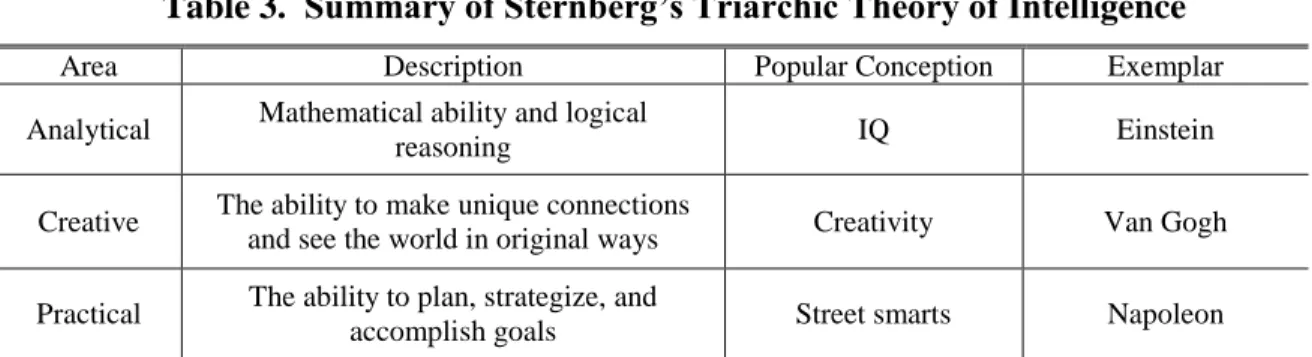
Sternberg’s analytical area captures the popular conception of intelligence, and
coincides with the notion of IQ. It includes mathematical ability and logical reasoning.
The creative area of the intellect includes the ability to make unique connections and to
see the world in original ways. Artists, authors, and musicians excel in this aspect of the
intellect. And lastly, practical intelligence includes the ability to plan, strategize, and
accomplish goals. CEOs and military leaders typically have high degrees of practical
intelligence (see Table 3).
The three areas of the Triarchic theory are meant to capture different modes of
intelligence that all human beings possess to a greater or lesser extent. The three areas
are not necessarily correlated with one another—a person might be above or below
average in any given area independent of the other areas. The model is useful to help
explain why some people succeed in some arenas and fail in others. Sternberg notes that
some students with high analytical intelligence do very well in the highly structured
world of undergraduate education, but they struggle as graduate students because they
lack creative and practical intelligence, both of which are paramount for conducting and
completing original research [32].
Table 3. Summary of Sternberg’s Triarchic Theory of Intelligence
Area Description Popular Conception Exemplar
Analytical Mathematical ability and logical
reasoning IQ Einstein
Creative The ability to make unique connections
and see the world in original ways Creativity Van Gogh
Practical The ability to plan, strategize, and
3.3 The Triarchic Theory Applied to Hackers
Applying Sternberg’s framework to the minds of hackers provides some valuable
insights and a more thorough understanding of what makes their way of thinking unique.
This section of the chapter views hacker behavior through each of the three lenses
provided by the Triarchic theory, with an emphasis on explaining how each category of
the intellect contributes to success in hacking.
3.3.1 Analytical
In the popular culture hackers are typically portrayed as highly intelligent “computer wizards.” Hackers in television shows and movies sometimes seem like aliens
to those around them because of their uncanny technical abilities. Typically, these
characters are irresistibly drawn to computing from their youth. While these portrayals
are fictitious, there is support for this popular hacker stereotype; hackers do seem to have
an unusual affinity and knack for technology.
Hacking involves detailed knowledge of many highly technical aspects of
computing, including computer networking protocols, assembly language programming,
and operating systems. In Sternberg’s paradigm, this technical knack exhibited by
computer hackers ties into the analytical component of their intellect. In this case, their
analytical gifts translate into a remarkable facility with computers and technology.
Having strong technical abilities is vital to hackers because many kinds of cyber attacks
involve overcoming significant technological hurdles. Here are a few examples: to
infiltrate a computer network, a hacker may need to construct precisely malformed
buffer overflow attack; and to remain undetected on a system, a hacker might need to modify an operating system’s libraries.
One real-life example of a hacker who leveraged his analytical intelligence is
Robert Tappan Morris. At the age of 19, Morris published a technical paper on a major
vulnerability in a trust protocol used in the BSD Unix operating system [34]. A few
years later, freshly graduated from Harvard, he used his advanced understanding of
computer networking protocols and operating systems to write a software worm that
infiltrated an alarming percentage of the computer systems on the Internet at that time
[35]. Another example of a hacker who excelled in this area is Elias Levy (a.k.a. Aleph
One) who wrote the seminal paper on buffer overflow attacks [36]. Both of these
individuals used their analytical gifts to dissect software and network and security
protocols, and this enabled them to identify exploits.
In summary, to think like a hacker in terms of the analytical component of his
intellect is to embody his technological capabilities, which includes low-level
programming skills and a deep familiarity with operating systems and computer
networking protocols.
3.3.2 Creative
Sternberg cites “lack of conventionality” as one of the markers for creative
intelligence [32]. This is similar to the way cybersecurity guru Bruce Schneier describes what he calls the “hacker mindset.” Schneier writes that a hacker is a person who
“discards conventional wisdom,” and who by “thinking differently,” is able to uncover
of adversarial thinking may be what Dark is referring to in her definition (quoted above)
when she mentions the ability to subvert system rules.
Creativity is at the core of the “hacker mindset.” While fiction writers excel at
creating original stories that capture the imagination, hackers excel at creating original
exploits that bend technology in unexpected ways. Both are manifestations of the same
root—they involve seeing the world in a unique way, and the ability “to put old information together in a new way,” as Sternberg puts it [32]. While most technologists
are concerned with making systems work, hackers are obsessed with pushing the limits of
systems and exploring possibilities that many people would never consider. This aspect
of hacking is the main connection between the pejorative way the term hacker is used
today, and the original, complimentary term from a previous era which connoted being a
highly skilled programmer.
IP fragmentation attacks provide a good illustration of the way hackers apply their
creativity to bend technology and protocols. This class of attacks is where IPv4 packets
are intentionally fragmented by hackers for purposes ranging from crashing computers to
circumventing firewalls [38]. All computer network students learn that routers are
programmed to automatically fragment IPv4 packets that are too large to traverse the next
hop link, but the creative and unconventional mind of a hacker realizes that packets could
also be fragmented by programmers, intentionally, and in unusual ways. This opens up a
world of possible attacks, many of which have exposed unsafe security assumptions
![Figure 1. The distribution of 13,030 MWs over the 30 distribution substations in [25] 20 170002004006008001000120014001600180024681012141618202224262830MWsDistribution Substations](https://thumb-us.123doks.com/thumbv2/123dok_us/9021686.2800023/31.918.292.674.137.350/figure-distribution-mws-distribution-substations-mwsdistribution-substations.webp)