Roadmapping při řízení technologií výroby energie
z obnovitených zdrojů
Technology Roadmapping in the Management of
Renewable Energy Technologies
Katarzyna Halicka
Abstract:
Purpose of the article: The main objective of this paper is to present the possibility of using the method of technology roadmapping to build the route of development of RES technologies. The article is of review-theoretical character and is the beginning of further work in this area.
Methodology/methods: General scheme of route development of RES technologies has been developed, inter alia, on the basis of evaluation studies of Polish and foreign literature and conceptual study work in the field of graphic presentation of routes, as well as the experience of the author associated with the management and planning in the energy market.
Scientific aim: The scientific purpose of this study was to identify and present the basic assumptions of the design of routes of development of RES technologies and to construct a general scheme of the routes of development of renewable energy technologies.
Findings: This paper presents the basic principles for the design of routes of development of renewable energy technologies. Based on a detailed review of the designed routes of development of technologies in the area of renewable energy, recommendations for the design of routes of development of RES technologies have been formulated. Also, a base the concept of the routes of RES technologies has been proposed.
Conclusions: The basic project of the RES route will enable the coordination of the development of the technological potential of renewable energy sources, as well as the development of the routes of implementation of the desired vision of the development of technologies using renewable energy sources in Poland in two time perspectives: 2030 and up to 2050. It will also generate the knowledge needed in the development of the appropriate energy policy of the country. Knowledge obtained in this way can provide a basis for energy security management of the state.
Keywords: technology development, technology roadmapping, renewable energy sources
Introduction
Currently, one of the most important challenges facing the Polish, but also global energy economy, is its adaptation to the requirements of the global low-carbon economy, which is characterized by high energy efficiency, rational management of the energy demand, and, above all, a much higher use of renewable energy sources. The issue of renewable energy is a major, not only political and economic, but also scientific challenge. There are many, both technical and organizational, issues related to this topic. The technical aspect, and in particular the research on new technologies of renewable energy sources, are the subject of many research works. An organizational aspect, and, in particular, the issu-es related to the management of renewable energy technologies are discussed occasionally (Czaplic-ka-Kolarz, 2007; Halicka, 2013). It should be em-phasized that from the point of view of a country, a region, a company or an organization, creation and maintenance of relationships between technological resources of renewable energy sources and the adop-ted political or strategic objectives are essential. This requires effective communication, dialogue and understanding, as well as effective management of the available knowledge. It is necessary to adopt an appropriate method of management of technolo-gy, as is the case with issues of quality, environment, safety, etc. Technology management is aimed at the effective identification, selection, acquisition (pur -chase / transfer), exploration, and protection of tech-nologies in order to achieve and maintain, or to inc-rease a high market position, based on the objectives of the organization (Phaal, Farrukh, Probert, 2001; Phaal, Farrukh, Probert, 2003).
Due to the complexity and global pace of change, the effective management of technology is a difficult process that requires taking into account specific systems and processes, adapting to market needs and the industry, both in the present, as well as in a long term perspective. According to Klincewicz (2010), important problems of technology management include, inter alia, “(1) understanding the emerging technologies and their relevance to the current acti-vity of the company, (2) identification of opportu -nities and risks associated with the development of technology and the choice of technologies of strate-gic importance, (3) choice of technology of stratestrate-gic and tactical significance” (Klincewicz, 2010). The usage of the methods of strategic planning is helpful in eliminating the abovementioned problems, parti-cularly in the long term perspective. One such tools is the method of technology roadmapping.
The main objective of this paper is to present the possibility of using the method of technology road-mapping to build the route of development of RES technologies. The article is of a review-theoretical character and is the beginning of further work in this area. This paper presents the basic principles for the design of routes of development of renewable ener-gy technologies. Also, a general, preliminary sche-matic of the route of RE technologies development has been proposed. The presented scheme has been developed based on literature studies, as well as ba-sed on the experience and knowledge of the author. In further research, conducted by the author, it will be verified.
1. The essence of the method of technology
roadmapping
The method of technology roadmapping (TRM) is a comprehensive approach to strategic planning and enables adjusting the development of the range of products, technologies and technological potential to the scenario of market development and base techno-logies. It should be emphasized that the time factor is characteristic for this method. (Bernal, Dornberger, Torres, Byrnes, 2009; Daim, Oliver, 2008).
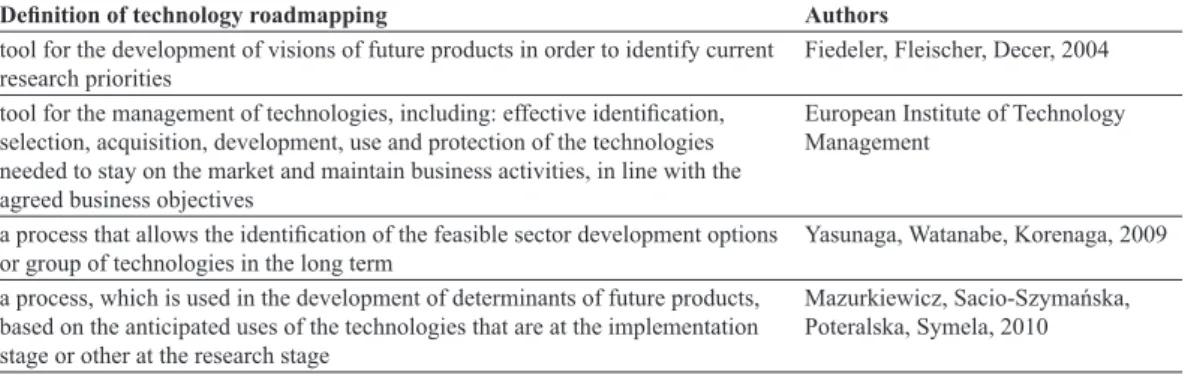
Table 1 presents the selected definitions of tech -nology roadmapping. For the purposes of this article the definition of Yasunaga, Watanabe, Korenaga (2009) have been used, according to which road-mapping is a process that allows the identification of feasible possibilities of development of the sector or group of technologies in the long term.
The end result of the process of roadmapping is an action plan positioned in time, presented in gra-phical form, referred to as a map (roadmap) of tech-nologies or technology development route. Accor-ding to the author, it is this latter term that captures the character, and the expected effect of the method of technology roadmapping in a logical and simple way. The technology development route presents visions of development of selected technologies in terms of market, technological and human potential.
The technology development route locates the development of technology in a time context and allows to emulate the relationships that exist be-tween the development of technology and progress in other areas (Kononiuk, Gudanowska, 2013). Re-view of the literature indicates that the created route of development can also take a variety of graphic forms. They are presented in the form of histograms, tables, graphs, flow diagrams or text. According to the author, maps showing the development of
technology in the form of layered graphs covering, inter alia, such layers as the market, products, tech-nologies, research directions and resources are clear, and easy to read and understand.
The method of technology development routes is a tool enabling the identification of the feasible development sectors, including the energy sector. The route of technology development allows for the presentation of the development of the energy sec-tor and the relevant to the secsec-tor groups of energy technologies in terms of the market, product types, technology taking into account the resources.
Due to the action plans formulated by the Europe-an Commission, concerning energy, which assume security, competitiveness, efficiency, use of renewa -ble resources and carbon efficiency of the energy sector, it is important to analyse the issues related to the development of the design methodology for the routes of renewable energy technologies that meet market requirements and legislation.
2. Examples of development routes
of RES technologies – foreign experience
In order to analyse foreign experience in the design of the routes of development of renewable energy technologies, the database of public sector projects, database projects, foresight projects, the database of the International Energy Agency (IEA) and the Research Institute of Electricity (EPRI) have been analysed. Apart from the presentation of the empiri-cal experience of applying the method of technol-ogy development routes in the analysed projects, the theoretical assumptions and empirical applica-tion of the method on the pages of scientific publi -cations has also been analyzed. One of the flagship application examples of the method of
technologi-cal roadmapping in the energy sector is the Energy Roadmap2050. In 2011, the European Commission adopted the assumptions developed under the Ener-gy Roadmap2050, which constituted the basis for the formulation of a long-term strategy and a plan of its implementation in order to ensure energy se-curity and competitiveness of the European energy sector. Detailed assumptions relate to, among others, the reduction of greenhouse gas emissions by 80% compared to the year 1990, increasing the efficiency of the energy sources used and the use of renewable energy sources.
In the last decade, many examples of the use of technological roadmapping in the energy sec-tor were noted (170 routes in the public secsec-tor), of which 60 were related to renewable energy sources.
The method of technological roadmapping used in the energy sector has enabled the development of, inter alia:
●Technology Roadmap: Carbon Capture and Stor-age 2013, OECD/IEA 2013;
●Technology Roadmap: Carbon Capture and Sto-rage in Industrial Applications, OECD/IEA 2011; ●Technology Roadmap: Bioenergy for Heat and
Power, OECD/IEA 2012;
●Energy Storage Technology Roadmap, Roles and future deployment, IEA, 2012;
●Technology Roadmap: Biofuels for Transport, OECD/IEA 2011;
●Technology Roadmap: Geothermal Heat and Po-werer, OECD/IEA 2011;
●Technology Roadmap, Smart Grids, 2011; ●Technology Roadmap: Nuclear Energy, NEA,
OECD/IEA 2010;
●Technology Roadmap: Concentrating Solar Po-wer, NEA, OECD/IEA 2011;
●Technology Roadmap: Solar Heating and Coo-ling, OECD/IEA 2012;
Table 1 The diversity of definitions of technology roadmapping – selected definitions of the term.
Definition of technology roadmapping Authors
tool for the development of visions of future products in order to identify current
research priorities Fiedeler, Fleischer, Decer, 2004 tool for the management of technologies, including: effective identification,
selection, acquisition, development, use and protection of the technologies needed to stay on the market and maintain business activities, in line with the agreed business objectives
European Institute of Technology Management
a process that allows the identification of the feasible sector development options
or group of technologies in the long term Yasunaga, Watanabe, Korenaga, 2009 a process, which is used in the development of determinants of future products,
based on the anticipated uses of the technologies that are at the implementation stage or other at the research stage
Mazurkiewicz, Sacio-Szymańska, Poteralska, Symela, 2010 Source: Own study.
● Technology Roadmap: Wind energy, International Energy Agency, OECD/IEA 2013;
● Technology Roadmap: China Wind Energy Deve -lopment Roadmap 2050, OECD/IEA 2011. In the course of designing the routes of develop-ment of the renewable energy sources, such tools have been used as: scenario based planning, SWOT analysis, delphi, expert panels, risk assessment, PEST analysis, citation network analysis, internal corporate meetings, QFD. In more than 50% of the constructed routes SWOT analysis and expert pan -els have been used. At the same time scenario and SWOT analysis is also frequently used during the process of developing national and industry road-maps. Delphi method and PEST analysis is used in a few cases of national and industry roadmaps.
Analyzing the available foreign publications it has been noted that the use of the method of technol-ogy roadmapping in the context of RES has enabled, among others:
● effective identification of key renewable energy technologies that have the highest potential for growth in the future;
● identification of alternative energy technologies; ● identification of technological niches in the study
area;
●creation of multi-faceted, long-term plans for technology development;
● identification of future market needs;
● identification of priority areas for the technology industry.
3. Exemplary routes of development of
RES technologies – national experiences
In the national survey, the method of technology roadmapping, in the context of renewable energy sources, is used occasionally. When reviewing the available literature and the published research fin -dings the author has identified only one project tit -led Scenarios of technological development of a fuel and energy complex to ensure the energy security of the country, in which route of development of re-newable energy technologies was designed.
In the context of that project, routes of develo-pment of coal technology, routes of management of hydrocarbon energy sources, renewable energy sources, nuclear energy and hydrogen economy have been developed. The routes of technology de-velopment for the area of renewable energy sources have been presented in the publication for the mode-rately optimistic and pessimistic variants. In additi-on to developing technologies in the timeframe until
2030, the diagram of the route also contains the ne-cessary actions of educational, scientific, research, legislative and economic nature in the four time perspectives, i.e. until 2012, 2020, 2025 and 2030. The route also identifies the relationship between the types of actions of different nature.
It should also be emphasized that the result of technological roadmapping, i.e. the technology maps, technology routes may also constitute an in-formation tool that can be used in the promotion and marketing of the analyzed energy technologies.
4. Designing routes of technology
development in the context of renewable
energy sources – recommendations
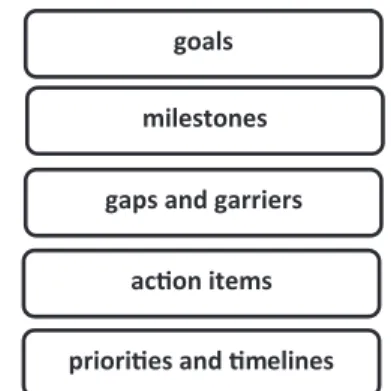
The author recommends design the routes for renew-able energy sources, in accordance with the method-ology of designing technmethod-ology maps, developed by the International Energy Agency (IEA). Taking into account the principles of this methodology, the route of development of RES technologies should include the following elements (Figure 1): (1) objectives and end results; (2) list of requirements, activities, in-dicators affecting the achievement of the objectives and assumptions; (3) list of potential barriers, gaps in knowledge, limitations in the development of a given technology, regulatory restrictions preventing the achievement of objectives and indicators; (4) list of actions to be taken to overcome any limitations and barriers that stand in the way of achieving the objectives (e.g. the creation of appropriate financing mechanisms, shaping public awareness, legislative solutions); (5) a list of the most important measures to be taken to achieve the objectives and the time-frame, taking into account the combination of these
Figure 1 The logic of a roadmap (International Energy Agency, 2014). Source: Own work.
goals milestones gaps and garriers
priories and melines acon items
activities and the roles of the stakeholders and the relationships.
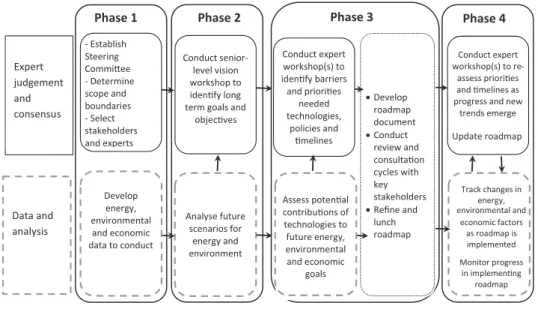
According to the literature on the subject, a prop-erly conducted process of creating the routes of re-newable energy technologies should be carried out in four successive stages (Figure 2). In the first stage – planning and preparation – one should, inter alia, identify the purpose, create a steering committee, determine the final results. The next stage – visual -ization – consists of generating a vision of long-term goals and objectives. Scenarios of the development of the energy sector, with regard to changes in its en-vironment, are analyzed. In the third stage – devel-opment plan – the identification and prioritization of technology, and the related regulations along with placing their evolution in time is carried out. At this stage, the opinions of the subjective environment are taken into account. The last step – implemen-tation and verification – is to develop a plan for the implementation of a technology map, with detailed reference to the necessary actions and time horizons of their implementation.
In the process of designing the routes of devel-opment of RES technologies expert knowledge is essential, as well as its acquisition during expert workshops. The task of domain experts is to identify technological and institutional barriers, evaluation and verification of assumptions, definition of alter -native paths of development of technologies and
the development of implementation strategies. The process may be supported by the quantity methods.
5. Proposed scheme of the route of RES
in Poland
Taking the above considerations into account and considering the time horizon of strategic documents on the development of the Polish energy sector, it seems appropriate to develop the routing of the RES technology development in Poland in two time hori-zons: in the perspective to the year 2030 and 2050.
According to the author, the design of routing of the RES technology development should be based on the concept of R. Phaal, taking the planning of the technology development model into considera-tion, and consisting of (Richey, Grinnell, 2004; Ce-tindamar, Phaal, Probert, 2009; Phaal et al., 2001; Phaal et al., 2003):
● needs of the industrial, scientific and research se -ctor, the country, and the organization;
●products, services and projects that will meet the identified needs;
●directions of research allowing for the develop-ment or production of new products and services; ●potential and resources that will allow for the
implementation of the desired vision of develo-pment.
Figure 2. Roadmap process (IEA, 2014). Source: Own work.
Conduct senior-level vision workshop to idenfy long term goals and
objecves Analyse future scenarios for energy and environment Track changes in energy, environmental and economic factors as roadmap is implemented Monitor progress in implemenng roadmap Conduct expert workshop(s) to re-assess priories and melines as progress and new
trends emerge
Update roadmap
Phase 2
Phase 1 Phase 3 Phase 4
Expert judgement and consensus Data and analysis Conduct senior-level vision workshop to idenfy long term goals and
objecves •Develop roadmap document •Conduct review and consultaon cycles with key stakeholders •Refine and lunch roadmap Conduct expert workshop(s) to idenfy barriers and priories needed technologies, policies and melines Assess potenal contribuons of technologies to future energy, environmental and economic goals - Establish Steering Commiee - Determine scope and boundaries - Select stakeholders and experts Develop energy, environmental and economic data to conduct
Based on a literature review and a detailed ana-lysis of the developed routes of technology develo-pment in the energy field, the author has designed a core concept of system of routes of RES technolo-gies. It is proposed that the route of development of RES technologies consisted of three layers: market drivers, sphere of R & D and resources. The first layer should include social, political, legal, and en-vironmental factors that influence the development of the of RES technologies. In turn, the R & D layer should include, inter alia, applied and industrial ba-sic research, carried out in the area of RES techno-logies. In contrast, the resource layer should refer to the technical and property aspects.
The author proposes to initially design specific routes for RES technologies used in Poland. She also suggests the creation of one aggregate route taking into account the development of all RES technologies in Poland.
The scheme of route of development of the RES technologies is presented in Figure 3.
The recipients of the routes of development of renewable energy sources can be (Amer, Daim, 2010): (1) national government decision makers in ministries of energy, environment, natural resources and infrastructure; (2) national government deci-sion makers in ministries of finance or economics; (3) state/provincial and local policy makers and na-tional regulators; (4) producers of renewable energy sources; (5) RES consumers; (6) representatives of the scientific, economic, non-governmental orga -nizations related to renewable energy sources as well as to policy development and socio-economic development.
Conclusion
The above observations allow us to conclude that due to the adopted strategic objectives, developments in the area of competitiveness and innovativeness of, both, Polish and EU economy, the undertaken in this article problem of designing routes of development of renewable energy technologies, particularly within the Polish experience, is a new and important problem.
The process of routes allows for the development, organization and presentation of information on the needs and goals that must be met within a specified time. It also indicates the technologies that must be developed in order to achieve specific objectives. It provides information needed for the selection be-tween compromising technological solutions.
As a result, roadmapping is a specific technique for technology management, which helps, but does not replace, a set of business planning activities. This contributes to the determination of the future critical technology features and the selection of appropriate functions to drive the development of technology. Roadmapping provides a consistent method of com-munication and strengthens the agreed investment decisions in the field of technology.
The project of the RES route, which was devel-oped within the framework of this article, will enable the coordination of development of the technical potential of renewable energy sources, and develop-ment of paths of impledevelop-mentation of the desired vi-sion for technology development of renewable ener-gy sources in Poland in two time perspectives: 2030 and by 2050. Production of knowledge necessary in the process of shaping of a proper energy policy of Figure 3. General scheme of the RES technologies route development. Source: Own work.
2030 2050
MARKET
DRIVERS
R&D
RESOURCES financial aspects
HORIZON
basic research applied research industrial research
technical and property aspects environmental polical
social
the country will also be possible. Thusly obtained knowledge may provide a basis for managing the energy security of the state.
The methodology of creating technology develo-pment routes and the proprietary scheme of desig-ning the route of renewable energy sources in Po-land, presented in the article, will be the basis for the development of the design and research application.
The application will be submitted to the National Science Centre. The main scientific objective of the project will be the development of the theory of pro-spective technology management, with particular emphasis on the prioritization of future technologies and construction of methods of routing technology development. The theory will be specified in relati -on to renewable energy sources.
References
Amer, M., Daim, T. U. (2010). Application of technology roadmaps for renewable energy sector. Technological Forecasting and Social Change, 8(77), pp. 1355–1370. Bernal, L., Dornberger, U, Torres, O., Byrnes, T. (2009). Technology roadmapping handbook, International SEPT Program, University of Leipzig. [online] [cit. 2014-08-08]. Retrieved from: <http://www.vgu.edu.vn/fileadmin/ pictures/studies/MBA/Handbook_Roadmapping.pdf>. Czaplicka-Kolarz, K. (Ed.) (2007). Scenariusze rozwoju technologicznego kompleksu paliwowo-energetycznego dla zapewnienia bezpieczeństwa energetycznego kraju. Część 2. Katowice. Poland: Główny Instytut Górnictwa. [online] [cit. 2014-08-08]. Retrieved from: <http://www. foresightenergetyczny.pl/cscore/files/Dokumentacje/cz2.pdf>. Cetindamar, D., Phaal, R., Probert, D. (2009). Understanding technology management as a dynamic capability: A framework for technology management activities. Technovation, 29, pp. 237–46.
Daim, T. U., Oliver, T. (2008). Implementing technology roadmap process in the energy services sector: A case study of a government agency. Technological Forecasting & Social Change, 75, pp. 687–720.
Fiedeler U., Fleischer T., Decer, M. (2004, May 14), Roadmapping as TA-Tool: Pre-requisites and potential benefits for assessing Nanotechnology, Eu-Us Seminar. New Technology Foresight, Forecasting & Assessment Methods, Seville, pp. 20–30.
International Energy Agency (2014). Energy Technology Roadmaps a guide development and implementation. Paris. France: OECD/IEA, [online] [cit. 2014-08-08]. Retrieved from: <http://www.iea.org/publications/freepublications/ publication/TechnologyRoadmapAguidetodevelopmentand implementation.pdf>.
Halicka, K. (2013). Przyszłość polskiej energetyki w świetle badań foresight. Rynek Energii, 2(105), pp. 10–17. Klincewicz, K. (Ed.) (2010). Zarządzanie technologiami. Przypadek niebieskiego lasera. Warszawa. Poland: Wydawnictwo Naukowe Wydziału Zarządzania Uniwersytetu Warszawskiego, 198 p.
Kononiuk, A., Gudanowska, A. E (2013). Kierunki rozwoju nanotechnologii w województwie podlaskim. Mapy. Marszruty. Trendy. Białystok. Poland: Oficyna Wydawnicza Politechniki Białostockiej, 112 p.
Mazurkiewicz, A., Sacio-Szymańska, A., Poteralska, B., Symela, K. (2010). Mapy technologii w obszarze zrównoważonego rozwoju, ITeE – PIB, Radom. Poland: Instytut Technologii Eksploatacji – Państwowy Instytut Badawczy, 148 p.
Phaal, R., Farrukh, C., Probert, D. (2001). Technology management process assessment: a case study. International Journal of Operations & Production Management, 21, pp. 1118–1122.
Phaal, R., Farrukh, C., Probert, D. (2003). Technology roadmapping: linking technology resources to business objectives. International Journal of Technology Management, 26, pp. 2–19.
Richey, M. J., Grinnell, M. (2004). Evolution of roadmapping at Motorola. Research-Technology Management, 47, pp. 37–41.
Yasunaga Y., Watanabe M., Korenaga, M. (2009). Application of technology roadmaps to governmental innovation policy for promoting technology convergence, Technological Forecasting and Social Change, 76, pp. 61–79.
Doručeno redakci: 11. 8. 2014 Recenzováno: 7. 12. 2014
Schváleno k publikování: 25. 2. 2015
Katarzyna Halicka,
Ph.D
Bialystok University of Technology Faculty of Managament Department of Business Informatics and Logistics Wiejska Street 45A, 15-351 Bialystok Poland Tel.: + 48857469875 E-mail: [email protected]