Reflective, Deliberative Agent-Based Information
Gathering
Adam D. Eck
University of Nebraska - Lincoln, [email protected]
Follow this and additional works at:http://digitalcommons.unl.edu/computerscidiss
Part of theArtificial Intelligence and Robotics Commons
This Article is brought to you for free and open access by the Computer Science and Engineering, Department of at DigitalCommons@University of Nebraska - Lincoln. It has been accepted for inclusion in Computer Science and Engineering: Theses, Dissertations, and Student Research by an authorized administrator of DigitalCommons@University of Nebraska - Lincoln.
Eck, Adam D., "Reflective, Deliberative Agent-Based Information Gathering" (2015).Computer Science and Engineering: Theses, Dissertations, and Student Research. 89.
by
Adam Dewane Eck
A DISSERTATION
Presented to the Faculty of
The Graduate College at the University of Nebraska In Partial Fulfillment of Requirements For the Degree of Doctor of Philosophy
Major: Computer Science
Under the Supervision of Professor Leen-Kiat Soh
Lincoln, Nebraska
As computational devices and entities become further established as routine, omnipresent components of our everyday lives (e.g., wearable sensors, smart homes, cyber-physical systems, embodied agents, human-robot interactions), such systems face an increased pressure to perpetually understand the complex, noisy, uncertain world around them in real-time. This environmental knowledge enables computational systems to intelligently decide how to best behave in response to the current situation, adapt to the ever-changing conditions of the dynamic world, and accomplish system goals that ultimately aim to improve our daily experience. However, achieving and maintaining such knowledge is very complicated due to the complexities and challenging properties of real-world environments.
In this research, we study how to improve environment knowledge in intelligent agents and multiagent systems through reflective, deliberative information gathering. By being deliberative, an agent intentionally and selectively chooses how to gather information. By being reflective, an agent can self-evaluate its informational needs and performance in order to understand its needs and past sensing outcomes to best guide deliberative information gathering, as well as adapt and learn in an uncertain environment.
two key problems: (1) the Analysis Problem, whereby an agent must determine how to measure and balance sensing benefits and costs in order to reflect and improve deliberative information gathering, (2) the Information Sharing Problem, whereby multiple agents must determine how to cooperatively sense together and share information to update collective beliefs.
For the Analysis Problem, we propose two improvements to a popular framework for reasoning under uncertainty—partially observable Markov decision processes (POMDPs): (1) Potential-based Reward Shaping (PBRS) providing metareasoning about information gathering within time-constrained planning, and (2) Difference-based Heuristic Selection (DHS) with Long Sequence Entropy Minimization (LSEM) for situationally-aware planning capable of balancing knowledge improvement and costs minimization. For the Information Sharing Problem, we propose two solutions for improving large team information sharing observing localized, non-stationary phenomena: (3) cooperative change detection and response and (4) forgetting-based adaptation of information sharing. We also propose: (5) a learning-based approach for ad hoc information gathering that enables agents to learn how to share information without requiring pre-coordination.
ACKNOWLEDGEMENTS
I would like to thank those who have assisted with the creation of this dissertation. First, I am very grateful for my advisor Dr. Leen-Kiat Soh, whose guidance, mentoring, thought provoking discussions, meaningful feedback, and careful review have helped me to grow as a researcher, a scholar, and a person. Second, I appreciate the help of my committee members Dr. Stephen Scott, Dr. Ashok Samal, Dr. Steven Dunbar, and Dr. Milind Tambe for their willingness to assist with my research and thoughtful review of my work. Third, I thank my colleagues for the many discussions and critiques that have improved my research, especially L.D. Miller and Nobel Khandaker. Fourth, I acknowledge the resources available at the University of Nebraska used to complete my research, including the Holland Computing Center.
Further, I am forever indebted to my wonderful wife Liz, whose love, support, patience, and sacrifice have allowed me to reach for my dreams. Finally, I thank God for the many blessings in my life and for the gifts He has bestowed upon me. Without either, this research would not be possible.
as grants from the NSF (DBI-0743783, DEB-0953766, SBES-1228937, SES-1132015), and has been partially completed utilizing the Holland Computing Center of the University of Nebraska.
CHAPTER 1 INTRODUCTION ... 1
1.1. Reflective, Deliberative Information Gathering... 3
1.2. Initial Research ... 5
1.3. Dissertation Problems ... 8
1.4. Solutions to Dissertation Problems ... 11
1.5. Dissertation Contributions ... 15
1.6. Dissertation Outline ... 17
CHAPTER 2 BACKGROUND AND RELATED WORK ... 18
2.1. Deliberative Information Gathering ... 18
2.2. Deliberative Information Gathering with Active Sensing POMDPs ... 22
2.2.1. Markov Decision Process ... 23
2.2.2. Partially Observable Markov Decision Process ... 23
2.2.3. Active Sensing POMDP ... 26
2.2.4. Applications of the Active Sensing POMDP ... 27
2.3. Reflective Information Gathering ... 30
2.3.1. Reflection for Deliberative Information Gathering ... 30
2.3.2. Reflection for the Active Sensing POMDP ... 33
2.4. Multiagent Information Gathering with Limited Sensors ... 36
2.5. Comparison of our Research to Prior Work ... 38
CHAPTER 3 POTENTIAL-BASED REWARD SHAPING FOR POMDPS (SOLUTION 1 TO THE ANALYSIS PROBLEM) ... 42
3.1. Introduction ... 43
3.2. Background ... 50
3.2.1. Online POMDP Planning ... 50
3.2.2. Potential-Based Reward Shaping ... 54
3.3. Potential-Based POMDP Planning ... 58
3.3.1. Extending PBRS to Online POMDP Planning ... 58
3.3.2. Impact of PBRS on Online Planning ... 70
3.4. Experimental Setup ... 78
3.4.1. Benchmark Problems ... 81
3.5.1.2. Comparison Between Potential Function Types ... 92
3.5.1.3. Comparison of PBRS with Depth-Focused, State-of-the-Art Planning Algorithms ... 93
3.5.2. RockSample Results ... 95
3.5.2.1. Comparison of Full Breadth Planning With and Without Reward Shaping ... 95
3.5.2.2. Comparison Between Potential Function Types ... 96
3.5.2.3. Comparison of PBRS with Depth-Focused, State-of-the-Art Planning Algorithms ... 98
3.5.3. AUVNavigation Results ... 99
3.5.3.1. Comparison of Full Breadth Planning With and Without Reward Shaping ... 99
3.5.3.2. Comparison Between Potential Function Types ... 102
3.5.3.3. Comparison of PBRS with Depth-Focused, State-of-the-Art Planning Algorithms .... 103
3.5.4. Discussion ... 106
3.6. Conclusions and Future Work ... 114
CHAPTER 4 SITUATIONALLY-AWARE ONLINE HEURISTIC PLANNING FOR HIGHLY UNCERTAIN ENVIRONMENTS (SOLUTION 2 TO THE ANALYSIS PROBLEM) ... 117
4.1. Introduction ... 118
4.2. Background ... 123
4.2.1. Online POMDP Planning ... 123
4.2.2. Heuristic Search Algorithms for Online POMDP Planning ... 127
4.3. Problem ... 132 4.4. Solution Approach ... 136 4.4.1. Planning Stages ... 137 4.4.2. LSEM Heuristic ... 139 4.4.3. DHS Situational-Awareness ... 142 4.4.4. Theoretical Analysis ... 148 4.5. Experimental Setup ... 153 4.6. Results ... 160 4.6.1. AUVNavigation Results ... 160
4.6.2. Tag Results ... 164
4.6.3. RockSample Results ... 167
4.6.4. Discussion ... 168
4.7. Conclusions ... 170
CHAPTER 5 INTELLIGENT INFORMATION SHARING WITH LOCALIZED, NON-STATIONARY PHENOMENA (SOLUTIONS 1 AND 2 TO THE INFORMATION SHARING PROBLEM) ... 173
5.1. Introduction ... 174
5.2. LTIS ... 176
5.2.1. LTIS Model... 176
5.2.2. Prior LTIS Research ... 178
5.3. Non-Stationary Phenomena ... 180
5.3.1. Modeling Non-Stationarity in LTIS... 180
5.3.2. Analyzing the Effect of Non-Stationarity ... 181
5.4. Change Detection and Response ... 185
5.5. Forgetting Outdated Beliefs ... 188
5.6. Experimental Setup ... 192
5.7. Results ... 194
5.8. Conclusions ... 200
CHAPTER 6 AD HOC INFORMATION GATHERING (SOLUTION 3 TO THE INFORMATION SHARING PROBLEM) ... 201
6.1. Introduction ... 201 6.2. Problem ... 205 6.2.1. AHIG Formulation ... 205 6.2.2. Related Work ... 208 6.3. POMDP Formulation ... 209 6.3.1. AHIG as a POMDP ... 210
6.3.2. Problems with POMDP Formulation ... 212
6.4. Knowledge State MDP ... 214
6.4.1. Incorporating Shared Information ... 214
6.4.2. Knowledge State MDP Transformation ... 215
7.1. Summary ... 228
7.2. Future Work ... 232
7.3. Contributions... 234
TABLE OF FIGURES
Figure 1.1: Summary of Research ... 11
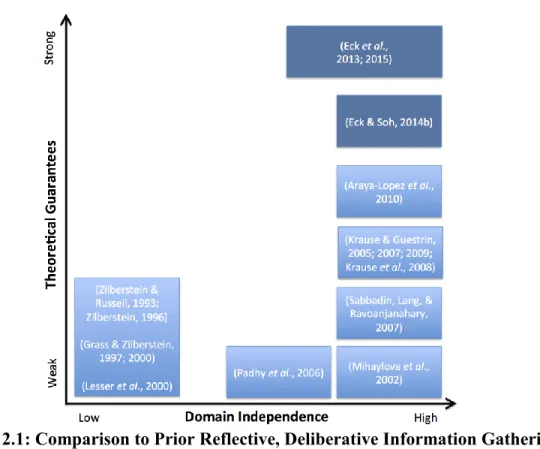
Figure 2.1: Comparison to Prior Reflective, Deliberative Information Gathering Research within the Analysis Problem ... 38
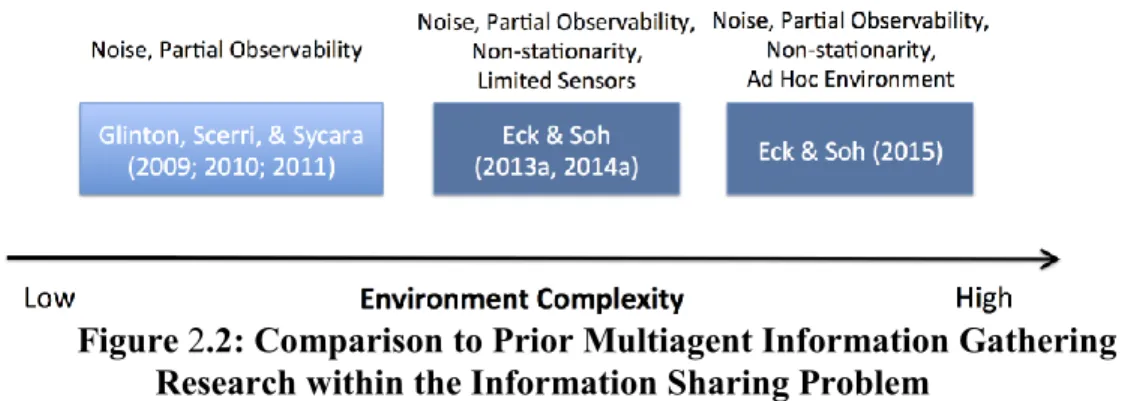
Figure 2.2: Comparison to Prior Multiagent Information Gathering Research within the Information Sharing Problem ... 40
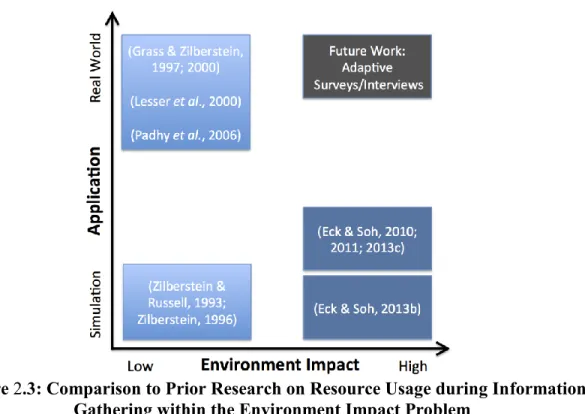
Figure 2.3: Comparison to Prior Research on Resource Usage during Information Gathering within the Environment Impact Problem ... 41
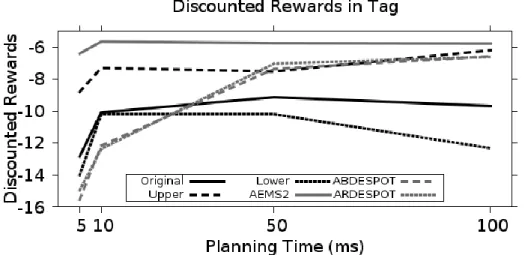
Figure 3.1: Performance of Planning Algorithms as Planning Time Increased on the Tag Benchmark Problem for Select Approaches ... 94
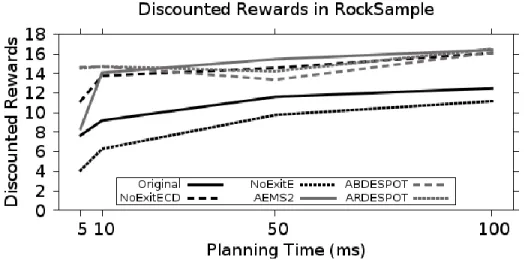
Figure 3.2: Performance of Planning Algorithms as Planning Time Increased on the RockSample Benchmark Problem for Select Approaches ... 98
Figure 3.3: Performance of Planning Algorithms as Planning Time Increased on the AUVNavigation Benchmark Problem for Select Approaches ... 104
Figure 3.4: Proportion of AUVNavigation Runs Successfully Ending at a Goal Location as Planning Time Increased for Select Approaches ... 104
Figure 4.1: (a) Example 𝝅 Tree with Two Actions and Two Observations with Depth 1, (b) Example Path with Depth 𝒏 ... 125
Figure 4.2: Stages of Planning in Highly Uncertain Environments ... 138
Figure 5.1: Agent Belief Updates ... 182
Figure 5.2: Impact of Non-Stationarity... 184
Figure 5.3: Example of Performing Belief Decay (a) Only Upon Receipt of Information vs. (b) Every Tick ... 191
Figure 5.4: Impact of Malicious/Faulty Agents under Periodic Sequences of Phenomenon Values ... 198
Figure 5.5: Impact of Malicious/Faulty Agents under Random Sequences of Phenomenon Values ... 198
Figure 6.1: Average Belief Certainty... 224
Figure 6.2: Average Proportion of Correct Agents ... 224
Figure 6.3: Average Total Reward ... 226
Table 2.4: Related Multiagent Information Sharing Research ... 36
Table 3.1: Types of Potential Functions for POMDPs ... 60
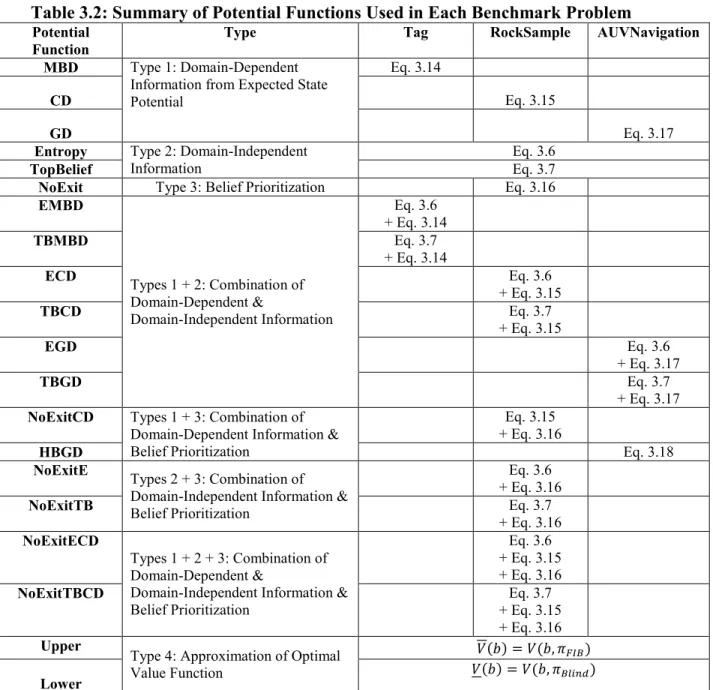
Table 3.2: Summary of Potential Functions Used in Each Benchmark Problem ... 80
Table 3.3: Results from Tag Benchmark Problem with 95% Confidence Intervals ... 90
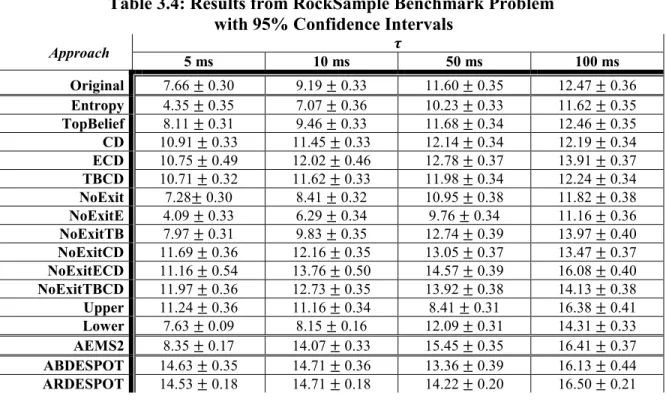
Table 3.4: Results from RockSample Benchmark Problem with 95% Confidence Intervals ... 95
Table 3.5: Results from AUVNavigation Benchmark Problem with 95% Confidence Intervals ... 100
Table 3.6: Proportion of AUVNavigation Runs Successfully Ending at a Goal Location with 95% Confidence Intervals ... 102
Table 4.1: Results on AUVNavigation Benchmark with 95% Confidence Intervals ... 161
Table 4.2: Results on Tag Benchmark with 95% Confidence Intervals ... 164
Table 4.3: Results on RockSample Benchmark with 95% Confidence Intervals ... 167
Table 5.1: Comparison of Solutions with Different Phenomenon and Networks with 95% Confidence Intervals ... 195
Table 6.1: POMDP Formulation of AHIG Problem ... 211
CHAPTER 1
INTRODUCTION
Many real-world applications of computer systems benefit from the use of artificial intelligence (AI) and multiagent systems (MAS). For example, intelligent agents have found wide-ranging uses from intelligent tutoring systems and collaborative learning environments in education (e.g., D’Mello & Graesser, 2012; Khandaker et al., 2011) to mixed-initiative systems supporting human users with routine tasks (e.g., Chalupsky et al., 2001; Myers et al., 2007; Yorke-Smith et al., 2009) to search and rescue robots that help discover human victims after disasters (e.g., Casper & Murphy, 2003; Calisi et al., 2007).
In particular, an intelligent agent is a unit situated in a specified environment capable of autonomously (1) sensing its environment to gather information about its current situation, (2) using this information to decide how to behave in the environment (e.g., based on internal goals), and (3) taking action to change the environment according to its decisions in order to complete tasks. Through intelligence, hardware or software agents provide features such as reactivity to changing environments, proactive behavior aimed to accomplish goals, learning to improve performance over time, and social behavior to work together to solve complex problems (Wooldridge, 1999). Together, these features enable a system to achieve valuable properties such as reliability, scalability, robustness, consistency, efficiency, and effectiveness.
Achieving these benefits requires an agent to consistently make correct decisions appropriate to its current situation. However, the quality of an agent’s decision making depends on the information gathered by the agent from its environment through sensing: without good information, even a rational agent could make wrong decisions and thus fail
stationarity, and limited resources.
For example, in a search and rescue robotics application, individual robots could be responsible for autonomously navigating a physical space to discover trapped victims in need of assistance within collapsed buildings after a powerful earthquake. These robotic agents must be able to gather high quality information during sensing in order to know how to navigate through the space and identify all victims so that they can be freed from the rubble. However, the quality of information gathered during sensing by these robots is negatively influenced by their environment. For instance, smoldering fires might resemble the heat signature of a person to an agent’s infrared sensor, returning noisy, inaccurate information to the agent. Additionally, the agents’ sensors can only view a limited portion of the disaster area at once, so the environment is only partially observable (with portions of the true state of the environment hidden from the agent at any particular point in time). Furthermore, the environment can change while each agent is sensing (e.g., new buildings collapse), causing the prior information collected by agents to become outdated and in need of refresh to maintain accurate, up-to-date beliefs. Finally, the robots are powered by battery supplies and must therefore be careful when consuming limited energy to maximize the amount of area covered and/or their operational time in order to find the most victims. Given that there are also multiple agents (i.e., robots) operating in the same environment, their actions can also work against one another, making sensing even more difficult. For instance, robots might
move in front of each other’s sensors, adding noise to the resulting information gathered. Likewise, agents can otherwise change the environment (e.g., creating extra rubble by running into obstacles), making the environment even more non-stationary and requiring more sensing to maintain up-to-date beliefs.
Given the challenges of sensing in complex environments, special care must be taken to make sure that agents appropriately sense to gather information with sufficient quality and quantity to inform their decisions, achieve goals, and complete tasks. We next outline our research vision to address this necessity.
1.1. Reflective, Deliberative Information Gathering
To improve agent sensing in order to benefit agent reasoning and actuation, as well as overall system performance, this research focuses on reflective, deliberative information gathering1 by intelligent agents. By being deliberative, an agent
intentionally and selectively chooses how to gather information, as opposed to considering sensing as a secondary behavior, which could instead potentially lead to suboptimal information gathering in complex environments. By being reflective, an agent self-evaluates its informational needs and performance in order to understand its needs and past sensing outcomes to best guide deliberative information gathering, as well as adapt and learn as it faces new decisions in an uncertain environment. Together, these qualities enable an intelligent agent to carefully consider its current knowledge, the knowledge required of its decisions, and the state of its environment in order to know
1 By “information gathering”, we mean both the gathering of raw data/observations from the environment, as well as the transformation of such data into information useful for the agent’s reasoning. We use the terms “sensing” and “information gathering” interchangeably throughout this dissertation.
focus its reasoning solely on completing tasks and not explicitly think about how to act to perform good sensing now with the hope of potentially later benefitting its tasks. For instance, a search and rescue robot that pre-computes a path to take through the disaster area and does not periodically adjust its movement or sensor positioning would be a non-deliberative information gathering agent. Furthermore, a non-reflective yet non-deliberative information gathering agent would not self-evaluate its sensing performance or learn over time how to improve its sensing from past experience. For instance, a non-reflective search and rescue robot might not recognize that continually adjusting its vision camera isn’t helping it find new victims due to a lack of ambient light in the collapsed building, and thus the agent would not switch to focus its limited energy resources on more effective infrared sensing in order to better find victims.
Overall, this research both (1) extends classical metareasoning (e.g., Cox & Raja, 2011; Raja & Lesser, 2007; Zilberstein, 2008) from decisions about reasoning control to decisions about sensing control which benefits both sensing and the agent’s task-level decisions, and (2) extends prior research on deliberative information gathering, sometimes called active sensing/perception (e.g., Weyns, Steegmans, & Holvoet, 2004), to be more introspective about agent performance and needs in order to encourage improved adaptation over time.
For instance, in our search and rescue running example, a robotic agent should deliberatively manage its sensors to maintain high quality sensing while moving through
the complex environment terrain. This could include frequently re-aiming its visual camera and infrared sensors to best scan for victims, as well as planning routes to intentionally navigate through areas where the agent has the least knowledge of the presence of victims. To determine how to best deliberatively sense over time, the agent should reflect on what it already knows about the complex environment, as well as the potential benefits of different types of actions (e.g., choosing to enter a room, pointing its camera in a different direction) and the costs of these actions (e.g., consumed battery power, wasted time, possible noise which could corrupt its current knowledge). Following such behavior, the robot should then be able to gather both higher quality information (through choosing the best sensing actions) as well as a greater quantity of information (by lasting longer in the environment before its battery expires). Together, such information better informs the agent’s decisions and enables it to find the most victims to rescue.
1.2. Initial Research
Our research on reflective, deliberative information gathering for intelligent agents and multiagent systems was initially inspired by our earlier research (Eck, 2010) studying the Environment Impact Problem:
Environment Impact Problem: How can an agent mitigate any changes to its environment caused by sensing that have lasting impacts on both the information gathered and the ability of the agent to accomplish its tasks in order to avoid corrupting the environment?
In the Environment Impact Problem, actions taken by agents for the purpose of sensing not only result in gathered information used to change the agent’s knowledge, but these actions can also change the agent’s environment and affect its future behavior. In
One type of environment change we have studied involves the use of stateful resources by agents to gather information. As an agent interacts with a stateful resource, the agent can change the state of the resource, causing dynamic (rather than fixed) costs to the agent based on the state of the resource. Furthermore, the quality and quantity of information gathered by a stateful resource depends on its current state, providing greater accuracy or more information in some states than others. We call this effect the Observer Effect of agent sensing. Overall, agents must be mindful of the internal state of resources used during sensing (and how its actions change the state) in order to gather the best information at the lowest cost, and we have studied solutions for both modeling stateful resource behavior, as well as approaches for managing usage of such resources.
For example, in a mixed-initiative system application where an intelligent agent works alongside a human user to support the user’s daily tasks (e.g., an office worker scheduling meetings (Chalupsky et al., 2001; Myers et al., 2007; Yorke-Smith et al., 2009) or a student learner performing educational assignments (D’Mello & Graesser, 2012; Khandaker et al., 2011)), the agent might need to interact directly with the human user (a stateful resource) to gather information and understand the user’s preferences so that it can best support the user and her tasks. Such interactions can interrupt and distract the user from her current activities. If done at inopportune times, these interruptions can disrupt the user’s cognitive processes (Mark, Gudith, & Klocke, 2008) and increase user frustration (Adamczyk & Bailey, 2004) (the resource states), and cause the user to want
to return quickly to her current activities or even quit using the system (Klein, Moon, & Picard, 2002), altogether affecting the quality and quantity of information provided back to the mixed-initiative agent. Properly managing human-agent interactions to gather information in this example enables us to construct more efficient and effective agents, as well as improve the end-user experience and productivity.
Alternatively, sensing actions taken by agents can also have permanent effects on the environment. That is, an action can produce a change in the environment state that could prevent the agent from ever gathering necessary information or achieving certain tasks and goals. For instance, in our search and rescue example, if a robot chooses to navigate through a dangerous hallway to search for victims, its movement through the hallway could further weaken the structure of the building and collapse other paths, preventing the robot from exploring nearby areas or rescuing other victims in the future. Thus, current actions have an influence on the future abilities of the robot, including its ability to gather information and/or accomplish its goals.
As part of studying reflective, deliberative information gathering, we have also extended our Master’s thesis research on the Environment Impact Problem and the Observer Effect (Eck, 2010) separate from this dissertation. First, we have enhanced the formalization of the problem of modeling this effect. We have also improved our POMDP-based solution framework for metacognitively managing agent sensing, which allows the agent to reflect on the impacts of sensing actions with respect to changing both stateful resources and the agent’s knowledge, then deliberatively choose sensing actions expected to best improve the agent’s knowledge under the Observer Effect. This research has been published in the Journal of Autonomous Agents and Multiagent Systems
make sensing a challenging activity. This research has been published in the Multiagent and Grid-Based Systems (MAGS) journal (Eck & Soh, 2013b).
1.3. Dissertation Problems
To better understand both (1) how to produce reflective, deliberative information gathering in intelligent agents, as well as (2) the benefits of this approach for agent-based sensing, this dissertation focus on two core problems: the Analysis Problem, and the Information Sharing Problem.
Analysis Problem: How should an agent measure or predict the benefits and costs of performing various sensing actions with respect to gathering information, then analyze the resulting tradeoff, in order to best guide its deliberative sensing?
First, the Analysis Problem is at the core of reflective, deliberative sensing: an agent must be able to measure and/or predict the benefits and costs of its actions with respect to its current knowledge and informational needs in order to achieve reflective sensing behavior. Within this problem, we study different methods for performing such measurement and prediction at different levels of agent reasoning. We also study different techniques and approaches for analyzing these measures and predictions in order to best guide deliberative sensing and balance the tradeoffs between sensing benefits and costs.
For instance, in our search and rescue running example, one possible useful measure of sensing benefits is the improvement in the certainty of an agent’s beliefs after
gathering new information. Since the location of victims is inherently uncertain, the agent wants to know with high certainty whether a victim is nearby before moving on to another room (lest it accidentally leave victims behind undiscovered). In contrast, the agent might measure the costs of sensing based on the amount of time different sensing actions take (e.g., slowly moving deeper into the room vs. quickly re-aiming its sensors), as well as the limited battery energy required for each action (e.g., a low cost for forward movement vs. a high cost for turning around). Then, analyzing this information, the agent can deliberatively choose the action to continue its sensing that best balances benefits and costs and boost its overall performance.
Information Sharing Problem: How can agents leverage multiagent cooperation in order to share information when information gathering is limited (e.g., agents have limited sensors or resources)?
Second, rather than looking at intelligent agents as isolated individuals responsible for their own independent information gathering, we can also look at how cooperative agents can help one another in the sensing process. By combining multiple agents, we can achieve benefits such as increased coverage of the environment (when individual agents suffer from a limited world view through partial observability), timelier sensing (especially in dynamic, non-stationary environments), higher accuracy and faster uncertainty reduction (by combining multiple viewpoints of the environment to avoid noise), as well as better limited resource management.
Towards information sharing, in this research we study the dynamics of information flow through multiple cooperative agents working together as they share information, as well as solutions for (1) determining when and where each agent should sense, (2) how agents should share information with their neighbors, (3) how to incorporate shared information in agent beliefs, and (4) how to share or conserve limited
better sensing as a group rather than as individual agents. In particular, we are interested in environments where the sensing capabilities of agents are limited compared to the size of the team of cooperative agents (e.g., only a few agents have sensors to directly observe the environment). We are also interested in environments, called ad hoc environments, where agents have no prior knowledge of each other or their peers’ capabilities and willingness to cooperate, preventing pre-coordination of information sharing behavior.
For instance, in our search and rescue robotics example, a small group of robots developed by different organizations could work together to canvas a damaged building at once, and they belong to a larger team of agents (e.g., emergency responders, dispatchers) that cannot otherwise observe the disaster area. These robots could cooperatively compare their initial knowledge, and then decide how to divide up the area for exploration in order to speed up identification of victims, as well as redundantly overlap their sensing areas to provide additional information to increase overall certainty after searching through the environment for victims. Agents could learn how to weight their own observations versus how much they should trust shared information from their teammates when updating their beliefs. Depending on the circumstances, the robots might frequently communicate with each other to maintain up-to-date beliefs, or they might conserve energy by communicating infrequently to maximize how long they can operate in the environment.
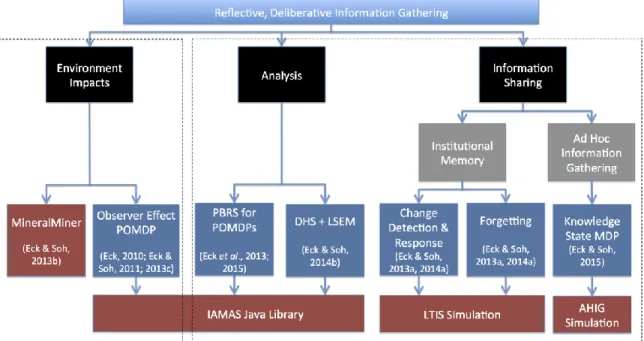
Figure 1.1: Summary of Research
1.4. Solutions to Dissertation Problems
Towards solving these two core problems—the Analysis Problem and the Information Sharing Problem—and better understanding reflective, deliberative information gathering, the research presented in this dissertation has accomplished the following, summarized in Figure 1.1 and described in more detail below.
To address the Analysis Problem, we propose two novel approaches to reflecting on the benefits and costs of sensing actions, then optimizing the resulting tradeoff within a popular framework for agent reasoning (e.g., Boutilier, 2002; Doshi & Roy, 2008; Spaan, Veiga, & Lima, 2010; Williams & Young, 2007): the partially observable Markov Decision process (POMDP) (Kaelbling, Littman, & Cassandra, 1998). These two solutions include: (1) potential-based reward shaping (PBRS) (Ng, Harada, & Russell, 1999; Asmuth, Littman, & Zinkov, 2008) for POMDPs, and (2) difference-based
measures reflecting action benefits and costs (including with respect to sensing) in reward optimization by agents to produce agent behavior that best addresses the tradeoff between benefits and costs to improve overall agent behavior. Unlike past attempts to include similar information to guide action selection in POMDPs (e.g., Mihaylova et al., 2002; Araya-Lopez et al., 2010), our approach offers important theoretical guarantees on agent performance. As an additional benefit, this approach also generalizes to a solution for improving agent planning in devices with constrained computational resources (e.g., wireless sensors, robots) by guiding the agent towards large rewards beyond the myopic planning (i.e., limited number of planning steps) caused by a lack of computational power. It also represents a novel technique for adding metareasoning to agent reasoning with POMDPs without increasing the size of the agent’s state space (and thus does not increase the computational complexity of the reasoning process). Overall, PBRS both addresses the Analysis Problem studied in this dissertation, as well as offers broader impacts for agent reasoning in general. This research has been published both as an extended abstract (Eck et al., 2013) at AAMAS 2013 and more recently as an article in JAAMAS (Eck et al., 2015). This solution will be discussed in greater detail in Chapter 3 of this dissertation.
Second, DHS + LSEM represents a novel heuristic search algorithm for online planning in POMDPs. In particular, the LSEM heuristic guides agent planning towards policies (i.e., action plans) that quickly gather the necessary information to operate in
highly uncertain environments (such as those commonly found in real-world applications of multiagent systems). It does so by reflecting on the expected certainty in agent knowledge (a measure of sensing benefit, directly addressing the high uncertainty in the domain) after taking an action in order to determine which action sequences to consider during planning and find a good policy. This work differs from our PBRS solution in that LSEM reflects on sensing benefits when choosing how to search through the policy space while planning, whereas PBRS reflects on sensing benefits during the choice of sensing action to take during execution of plans (and thus at a different level of agent reasoning). Additionally, DHS provides situationally-aware planning that enables the agent to select between different heuristics measuring different types of information when choosing how to expand planning during plan construction. As such, DHS enables the agent to consider both the benefits of sensing (revealed through LSEM) with other heuristics (reflecting sensing costs) to quickly find approximately optimal policies. Altogether, DHS + LSEM can find good policies two orders of magnitude faster than the best previously reported heuristic search online POMDP planning algorithms. This research was published as a full paper at the AAMAS 2014 conference (Eck & Soh, 2014b) and will be discussed in greater detail in Chapter 4 of this dissertation.
Third, to address the Information Sharing Problem, we first focus on challenging domains with localized phenomenon observed by only a small subset of the agents within a large cooperative team (e.g., observing individual users of a large mixed initiative software system), requiring large team information sharing (LTIS) (Glinton, Scerri, & Sycara, 2009, 2010, 2011; Pryymak, Rogers, & Jennings, 2012) to achieve and maintain consistent and accurate shared beliefs. We produce solutions to overcome a challenging
goals), no matter how much additional information enters the team through additional sensing. In particular, we develop two algorithms for mitigating this problem: (1) a change detection and response algorithm where agents work together within local sub-teams to quickly detect changes to the observed phenomenon, and (2) a forgetting-based algorithm, where agents independently use belief decay to maintain up-to-date beliefs to avoid problems caused by faulty agents or malicious information. Both solutions successfully avoid the institutional memory problem and lead to consistent, accurate beliefs through the team as the environment changes. This research has been published as an extended abstract at AAMAS 2013 (Eck & Soh, 2013a) and as a full paper with the WEIN workshop at AAMAS 2014 (Eck & Soh, 2014a). This work will be discussed in greater detail in Chapter 5 of this dissertation.
Fourth, to further address the Information Sharing Problem, we also focus on ad hoc environments where agents can either sense on their own or share information with peers, except the agents have no advance knowledge of their peers’ capabilities and willingness to work together. Thus, agents cannot pre-coordinate their joint behavior in advance, and instead must learn both when to work together (through sharing) and when to work independently (through sensing with the agent’s own sensors) in order best update agent knowledge over time. We propose a solution called the Knowledge State MDP where agents individually learn the benefits of relying on each type of source to maximize knowledge improvement. This research was accepted for publication as a full
paper at the AAMAS 2015 conference (Eck & Soh, 2015) and will be discussed in greater detail in Chapter 6 of this dissertation.
1.5. Dissertation Contributions
The research for this dissertation has made several important contributions to the fields of artificial intelligence and multiagent systems, including:
1. A better fundamental understanding of agent-based sensing in complex environments, valuable for a wide range of intelligent agents and multiagent systems domains. This knowledge can be applied to improve agent reasoning and actuation in different applications, as well as improves our overall understanding of general artificial intelligence. 2. A set of solutions to provide reflective, deliberative information gathering
to improve agent-based sensing, including single-agent POMDP solutions and cooperative agent team-based solutions.
3. New techniques for metareasoning by intelligent agents with broader impacts beyond sensing control.
4. Implemented simulation environments mimicking real-world scenarios and applications for studying agent-based sensing.
5. The addition of implementations of many of our solutions to a Java library for artificial intelligence that can be reused for other AI and agent-based projects.
First, from a fundamental research perspective, the dissertation both (1) explores difficult aspects of agent-based sensing in complex environments in order to improve our scientific understanding of the relationship between information gathering and agent reasoning and actuation, as well as (2) produces general-purpose, domain-independent solutions that can be used to engineer agent-based sensing systems in a wide range of domains and real-world applications of intelligent agents and multiagent systems. For example, this research could be applied to applications in autonomic computing; computer supported, collaborative learning; cyber-physical systems; mixed-initiative
that not only improve agent sensing through reflection and deliberation, but can also improve other aspects of agent reasoning. Specifically, our PBRS for POMDPs solution represents a general-purpose approach to adding metareasoning to the popular POMDP agent reasoning framework. This solution allows not only reflections on the benefits and costs of agent sensing to be used to guide action selection, but any measure of benefits and costs across any agent goal. Chapter 3 details some other types of measures that the agent can use to reflect on its overall needs and future expectations to improve reward maximization in complex environments. Additionally, our DHS heuristic selection approach to improve online POMDP planning can work with any set of heuristics, not just those maximizing uncertainty reduction to improve agent sensing (e.g., LSEM).
Finally, from a software perspective, the research for this dissertation has resulted in two types of products. First, this research has produced and enhanced simulation environments for evaluating agent-based sensing, including the simulations for large team information sharing and ad hoc information gathering, as well the implementation of many popular POMDP benchmark problems in a unified framework and programming language (Java). Second, combined with the other research activities of the authors, this research has also contributed implementations of our solutions to a Java-based library for general artificial intelligence techniques called IAMAS (which we intend to release as open source software for general, free availability to other programmers and researchers).
1.6. Dissertation Outline
The rest of this dissertation is organized as follows. First, in Chapter 2, we discuss prior work within the agent-based sensing literature in order to frame our research on reflective, deliberative information gathering in the context of the state-of-the-art. We also provide some general background on concepts and techniques used throughout the dissertation. Next, we describe our two solutions for the Analysis Problem in Chapters 3 and 4, respectively: (1) PBRS for POMDPs and (2) the DHS + LSEM heuristic search algorithm for online POMDP planning. Then, in Chapter 5, we detail our research on the institutional memory subproblem of the Information Sharing Problem with solutions. Afterwards, in Chapter 6, we detail our learning-based Knowledge State MDP solution to ad hoc information gathering subproblem of the Information Sharing Problem. In each of these four solution chapters, we also present experimental studies used to evaluate our solutions, as well as investigate the benefits of reflective, deliberative information gathering in agent-based sensing. Please note that these four chapters are each based on our prior publications (aforementioned in Section 1.3). Finally, we conclude in Chapter 7 by summarizing our dissertation research, as well as we outline future work we intend to continue.
gathering. First, we introduce some general work on deliberative information gathering in Section 2.1. Next, in Section 2.2, we detail more specific work using active sensing POMDPs for deliberative information gathering, which is closely related to our PBRS for POMDPs and DHS + LSEM solution approaches presented in Chapters 3 and 4, respectively, as well as our Knowledge State MDP solution in Chapter 6. Then, we describe prior work that initially added reflectiveness to deliberative information gathering in Section 2.3. Afterwards, we discuss related work from the multiagent sensing literature in Section 2.4. Finally, in Section 2.5, we conclude by discussing how our research on reflective, deliberative information gathering (both from this dissertation and our prior work on the Environment Impact Problem) fits within the context of the state-of-the-art introduced in this chapter.
Along the way, we also introduce some background, including an overview of MDPs and POMDPs in Section 2.2.1-2.2.2, which is relevant to both the related work in Section 2.2, as well as our solutions in Chapters 3, 4, and 6. Background or related work only relevant to specific parts of our research will be introduced later in the appropriate chapters.
2.1. Deliberative Information Gathering
Although the vast majority of intelligent agents and multiagent systems research focuses primarily on the reasoning and actuation components of agent behavior (and thus generally relegates sensing to a by-product of other agent activities), research focusing on
Table 2.1: Related Deliberative Information Gathering Research
Reference Contributions
(Bajcsy, 1988)
Bajcsy advocated for the use of active perception to control information gathering for robotics, which represented one of the earliest calls for deliberative information gathering in agents. They developed a hierarchical approach to improve sensing both locally and globally.
(Floreano & Mondada, 1994)
Floreano & Mondada studied the use of neural networks and genetic algorithms to learn controllers to guide active perception in robotics. Their algorithms resulted in learned automated behavior such as targeted exploration for missing information.
(Grass & Zilberstein, 1997; 2000)
Grass & Zilberstein developed Value-Driven Information Gathering (VDIG) for automating information gathering from the internet to support human users’ decisions.
(Lesser et al., 2000)
Lesser et al. studied resource-Bounded Information Gathering (BIG), including an agent for (goal oriented and opportunistic) planning for information gathering from sources distributed across the internet. (Weyns, Steegmans, &
Holvoet, 2004)
Weyns, Steegmans, & Holvoet developed one of the first domain-independent frameworks for active sensing by agents. They studied this framework in the context of situated agents (researching the relationship and connections between an agent and its environment). (Weyns, Helleboogh, &
Holvoet, 2005)
Weyns, Helleboogh, & Holvoet implemented a simulation
environment called Packet-World for their study of active sensing. (So & Sonenberg, 2009)
So & Sonenberg studied the application of active perception for situation awareness in intelligent agents in order to direct an agent’s attention to the most interesting or relevant features of the
environment for information gathering.
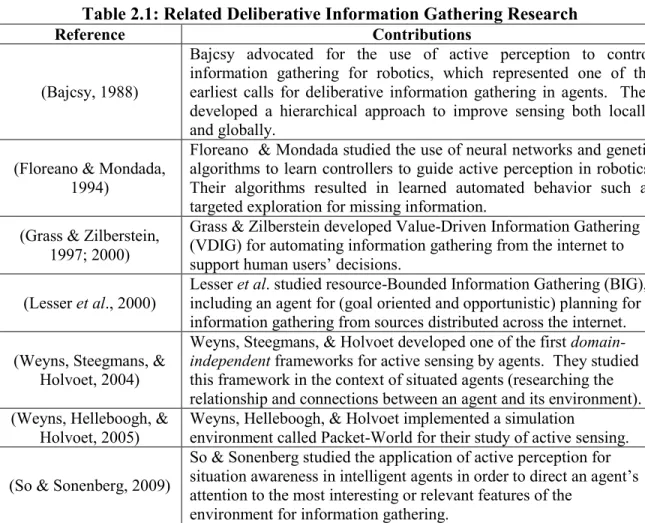
agent sensing as a primary objective has recently begun growing in popularity in the literature. In this subsection, we review some of the general history of deliberative information gathering within the agents literature in order to place our research in the context of the state-of-the-art. We summarize this history in Table 2.1. We will further elaborate in Section 2.2 on recent deliberate sensing research using a similar type of solution to our solutions in Chapters 3 and 4.
To begin, Bajcsy (1988) and Floreano & Mondada (1994) were two of the first researchers to explore the needs for (and benefits of) deliberately choosing how to perform sensing in order to improve the quality and quantity of information gathered by
sensing (e.g., active control of vision cameras (Bajcsy, 1988)), or (2) what information to extract from raw data when processing observations from the agent’s sensors. Using active perception, Bajcsy (1988) and Floreano & Mondada (1994) advocated that autonomous, intelligent agents could improve their understanding of the world around them, which in turn would improve their ability to complete tasks in the environment. To perform active perception, Bajcsy (1988) considered a hierarchical approach that improved information gathering both locally with respect to individual models of the environment, as well as globally across components used for sensing. Floreano & Mondada (1994), on the other hand, used neural networks and genetic algorithms to learn how to sense in complex environments, resulting in automated behavior such as targeted exploration for missing information.
A few years later, in response to the growing amount of information valuable to human users offered through various web pages and services, Grass & Zilberstein (1997; 2000) developed an agent-based framework called Value-Driven Information Gathering (VDIG) using software agents to choose what information to collect for users, as well as how to collect it, in order to support human users’ decisions (e.g., purchasing software online). Similarly, Lesser et al. (2000) developed an autonomous, intelligent software agent called BIG (resource-Bounded Information Gathering) that was capable of multilevel planning to choose how to deliberatively gather information from the internet
2 Recall (c.f., Section 1.1) that in this research, active perception and active sensing are synonymous with deliberative information gathering. “Active” refers to the agent conscientiously (i.e., deliberatively) choosing actions for their sensing or information gathering value.
for human users. Details of how VDIG and BIG performed deliberative information gathering are provided in Section 2.3.
More generally, Weyns, Steegmans, & Holvoet (2004) were one of the first to study the need for general purpose, domain independent approaches for deliberative information gathering by agents. In particular, they studied what they called active sensing3 and focused on improving information gathering for agents as part of their research studying situated agents (i.e., the relationship and connections between agents and their environments). They developed an extensible framework that divides information gathering into three components: (1) sensing, which collects raw values from the environment, (2) interpreting, where raw observations are converted into domain-specific representations for knowledge, and (3) filtering, where only the relevant and/or important observations are retained for knowledge refinement. We take a similar perspective4 to information gathering in our research (as a process of collecting and transforming raw observations into useful information for refining agent knowledge to support agent reasoning). To control information gathering in a deliberative manner, Weyns, Steegmans, & Holvoet propose that domain-specific optimizations over sensing benefits and costs should be embedded by the developer in the selection of which raw observations to collect in the sensing component, as well as in the filtering of processed observations in the filtering component. As part of this research, Weyns, Helleboogh, &
3 Again, recall (c.f., Section 1.1) that in this research, active perception and active sensing are synonymous with deliberative information gathering. “Active” refers to the agent conscientiously (i.e., deliberatively) choosing actions for their sensing or information gathering value.
4 However, we use the terms “sensing” and “information gathering” interchangeably and do not limit the meaning of the term “sensing” to be collecting raw observations, as done by Weyns, Steegmans, & Holvoet (2004)
So & Sonenberg (2009) explored the use of active perception to improve situation awareness within intelligent agents. That is, in order to best understand the agent’s current situation in its situated environment, So & Sonenberg advocated the use of active perception to proactively direct the agent’s attention to the most relevant or important aspects of its environment for observation (e.g., interesting events or to fill in missing information from the agent’s knowledge) and improve upon the traditional belief-desire-intention (BDI) framework (Rao & Georgeff, 1995) for agent reasoning. To guide active perception, So & Sonenberg considered the use of a logical events calculus.
2.2. Deliberative Information Gathering with Active Sensing POMDPs
One popular solution approach to performing deliberative information gathering in the intelligent agent literature is the active sensing (or active perception) POMDP. In particular, the active sensing POMDP has been commonly used to (1) model the dynamics and goals of the deliberative information gathering problem for agents and (2) generate dynamic plans for choosing sensing actions to perform based on the agent’s current situation (e.g., Doshi and Roy, 2008; Guo, 2003; Spaan et. al, 2010; Williams and Young, 2007). In this subsection, we first formalize the general POMDP (and the related fully observable MDP) to provide the background necessary for understanding both (1) important prior work in deliberative information gathering, as well as (2) three of our solution techniques for reflective, deliberative information gathering (presented in Chapters 3, 4, and 6 later in this dissertation). Then, we discuss how the deliberative
information gathering problem is commonly modeled within a POMDP. Finally, we provide examples of prior work using active sensing POMDPs for deliberative information gathering. We summarize the related work on active sensing POMDPs in Table 2.2.
2.2.1. Markov Decision Process
Formally, a (discounted, finite state) MDP can be represented mathematically as a tuple 〈𝑆, 𝐴, 𝑇, 𝑅, 𝛾〉 [Kaelbling, Littman, & Cassandra, 1998]. Within this model, 𝑆 = {𝑠}
represents the set of states of the agent’s environment. Since the environment is fully observable, the agent always knows the current state 𝑠 in an MDP. The agent can perform actions from 𝐴 = {𝑎}. Taking an action 𝑎 in state 𝑠 both (1) earns the agent a reward 𝑅(𝑠, 𝑎) according to a reward function 𝑅: 𝑆 × 𝐴 → ℝ and (2) stochastically changes the state of the environment to a next state 𝑠′. The transition function𝑇: 𝑆 × 𝐴 × 𝑆 → [0,1] models the probability that action 𝑎 changes the dynamic environment from state 𝑠 to 𝑠′: 𝑇(𝑠, 𝑎, 𝑠′) = 𝑃(𝑠′ | 𝑠, 𝑎).
The agent’s goal is to determine a plan of actions called a policy 𝜋: 𝑆 → 𝐴 that controls what action the agent takes based on its current state in order to maximize cumulative, discounted rewards:
𝐸[∑ 𝛾𝑡𝑟 𝑡 𝑛
𝑡=0 ] (2.1)
where 𝑟𝑡 is the reward received at time 𝑡, 𝑛 is the planning horizon (i.e., number of steps to plan ahead), and 𝛾 ∈ [0,1) is a discount factor for weighting future, uncertain rewards.
2.2.2. Partially Observable Markov Decision Process
The POMDP, on the other hand, is an extension of the MDP to partially observable environments. Formally, a POMDP can be represented mathematically as a
each action, the agent receives an observation from the set 𝑍 = {𝑧} that reveals some information about the next state of the environment 𝑠′. The observation function
𝑂: 𝑆 × 𝐴 × 𝑍 → [0,1] models the probability that next state 𝑠′ and action 𝑎 produce
observation 𝑧: 𝑂(𝑠′, 𝑎, 𝑧) = 𝑃(𝑧 | 𝑠′, 𝑎).
Since the environment state is hidden from the agent at any point in time, the agent faces uncertainty about the current state of the environment. This type of uncertainty is addressed by the agent through maintaining a probability distribution over possible states called a belief state𝑏: 𝑆 → [0,1] such that
∑𝑠∈𝑆𝑏(𝑠) = 1 (2.2)
𝑏(𝑠) ≥ 0, ∀𝑠 ∈ 𝑆 (2.3) so that 𝑏 ∈ 𝛱(𝑆), where 𝛱(𝑆) denotes the set of probability distributions over 𝑆.
After taking action 𝑎 and receiving observation 𝑧, the agent’s belief state probability distribution 𝑏 is updated to incorporate the new information using a Bayesian update:
𝑏𝑎,𝑧(𝑠′) = 𝑃(𝑠′| 𝑎, 𝑧, 𝑏) =𝑃(𝑧 | 𝑠′,𝑎,𝑏)𝑃(𝑠′| 𝑎,𝑏)
𝑃(𝑧 | 𝑎,𝑏) =
1
𝑃(𝑧 | 𝑎,𝑏)𝑂(𝑠′, 𝑎, 𝑧) ∑𝑠∈𝑆𝑇(𝑠, 𝑎, 𝑠′)𝑏(𝑠) (2.4)
where 𝑃(𝑧 | 𝑎, 𝑏) normalizes belief state 𝑏𝑎,𝑧 so that it remains a valid probability
distribution under Eq. 2.2. As the agent performs more and more actions and thus receives more and more observations, its beliefs change from the initial belief state 𝑏0
belief state 𝑏𝑡 (after taking 𝑡 actions and receiving 𝑡 observations) in order to reduce the
agent’s uncertainty about the current environment state.
Using the POMDP model, the agent’s goal is to maximize the cumulative rewards it earns for taking actions while operating in the environment. Since the agent is uncertain about the current state of the environment, it aims to maximize expected
rewards:
𝐸[𝑟𝑡] = 𝑅(𝑏𝑡, 𝑎𝑡) = 𝐸[𝑅(𝑠𝑡, 𝑎𝑡)| 𝑏𝑡] = ∑𝑠𝑡∈𝑆𝑏𝑡(𝑠𝑡)𝑅(𝑠𝑡, 𝑎𝑡) (2.5) In order to accomplish this goal, the agent plans a policy 𝜋: 𝛱(𝑆) → 𝐴 (over belief states instead of states, as in an MDP) prescribing an action 𝑎 to take dependent on the agent’s belief state 𝑏. The policy is calculated by recursively or iteratively solving the set of Bellman equations to calculate the agent’s expected cumulative rewards:
𝑉(𝑏0, 𝜋) = 𝐸[∑ 𝛾𝑡𝑟 𝑡 𝑛 𝑡=0 ] (2.6) 𝑉(𝑏) = max𝑎∈𝐴𝑄(𝑏, 𝑎) (2.7) 𝑄(𝑏, 𝑎) = 𝑅(𝑏, 𝑎) + 𝛾 ∑ 𝑏(𝑠) ∑ 𝑇(𝑠, 𝑎, 𝑠′) 𝑠′∈𝑆 𝑠∈𝑆 ∑𝑧∈𝑍𝑂(𝑠′, 𝑎, 𝑧)𝑉(𝑏𝑎,𝑧) (2.8) then choosing 𝜋(𝑏) = argmax𝑎∈𝐴𝑄(𝑏, 𝑎) (2.9)
To plan a policy 𝜋 satisfying Eq. 2.9, an agent must recursively solve Eqs. 2.7-2.9. This entails iteratively computing values of 𝑄(𝑏, 𝑎) for additional belief states 𝑏𝑎,𝑧
that the agent might experience in the future to accurately calculate the long-term cumulative value from its initial belief state 𝑏0. The tradeoff is that the farther into the
future the agent plans, the more accurately it will account for future rewards and thus choose better actions, but deeper planning requires more time and the number of possible future belief states grows exponentially with planning depth 𝑛.
popular approximate solutions include point-based methods (Shani, Pineau, & Kaplow, 2013) that determine appropriate actions around select belief states the agent might encounter, such as PBVI (Pineau et. al, 2003), Perseus (Spaan and Vlassis, 2005), HSVI (Smith and Simmons, 2004), and SARSOP (Kurniawati et al., 2008). An agent can build its policy maximizing expected rewards offline, allowing for more computational time and resources to build a larger policy, then follow the policy while operating online in the environment. Alternatively, an agent can also use more recent methods to interleave planning and execution online to adapt to unforeseen situations, such as state-of-the-art online POMDP planning algorithms (Ross & Chaib-draa, 2007; Ross et al., 2008; Zhang & Chen, 2012). We will provide background on online algorithms for POMDPs in Sections 3.2 and 4.2.
2.2.3. Active Sensing POMDP
Most often, the information variables the agent is trying to discern through sensing are represented by the hidden states 𝑆 in an active sensing POMDP (e.g., Guo, 2003; Doshi and Roy, 2008). Furthermore, factors internal to the agent or external in the environment that can influence the observations gathered by sensing are also represented in the state space, such as user behavior history (Williams and Young, 2007), bookkeeping variables for controlling reasoning (Spaan, Veiga, & Lima, 2010) and remembering history, as well as the state of stateful resources that can corrupt gathered information (Eck, 2010; Eck & Soh, 2011; 2013c). The different sensing actions the
agent can perform to gather information are represented by the POMDP’s actions 𝐴, and the observations 𝑍 reflect information collected that help the agent refine its beliefs about which state is the correct one (i.e., what the true value of the information variables the agent intends to know through sensing). How the agent chooses actions to achieve its goals (e.g., uncertainty reduction, balancing the tradeoff between sensing costs vs. task accomplishment) is controlled by the reward function 𝜌 used in the POMDP. Most commonly, 𝜌 is chosen to be Eq. 2.4 and causes the agent to choose sensing actions that both (1) lead the agent to large future task-based rewards and (2) have low cost. However, other types of reward functions have recently been proposed that add some level of reflection to the agent’s sensing action selection, which we will discuss in more detail in Section 2.3. We also propose a more principled way to add reflection to the active sensing POMDP using PBRS for POMDPs in Chapter 3.
2.2.4. Applications of the Active Sensing POMDP
One popular application of active sensing POMDPs is user preference elicitation, whereby the agent gathers information about a human user’s preference over a set of items (e.g., products, interest, goals). Such interactions with humans are important for a range of environments, including recommendation systems (e.g., Adomavicius and Tuzhulin, 2005), computer supported collaborative learning systems (e.g., Khandaker et. al, 2011), and personal assistant agents (e.g., Eck & Soh, 2012b; Myers et. al, 2007; Yorke-Smith et. al, 2009). For example, Boutilier (2002) considered an active sensing POMDP for determining user utility functions over a range of items. Additionally, Doshi and Roy (2008) described an active sensing POMDP for first discovering a user’s current goal, then acting on the goal to provide intelligent user support. Similarly, Williams and
(Sabbadin, Lang, & Ravoanjanahary,
2007)
Sabbadin, Lang, & Ravoanjanahary developed the epistemic MDP, a specific form of the active sensing POMDP (with no state transitions and only information gathering actions).
(Williams & Young, 2007)
Williams & Young applied POMDPs to the problem of understanding human user speech in an automated telephone dialog system.
(Doshi & Roy, 2008)
Doshi & Roy developed improved solutions for solving the preference elicitation POMDP used to gather information during human-agent interactions.
(Spaan, 2008; Spaan, Veiga, & Lima,
2010)
Spaan studied the use of POMDPs to control information gathering by a team of cooperating robotic and sensor agents in order to enable the team to appropriately respond to events in the local area.
(Cohn et al., 2010; Cohn, Durfee, &
Singh, 2011)
Cohn et al. proposed expected myopic gain algorithms for choosing queries (i.e., information gathering actions) to ask human operators to learn how to act autonomously for the human operator in an MDP using Bayesian inverse reinforcement learning.
(Eck, 2010; Eck & Soh, 2011;
2013c)
Eck & Soh developed the Observer Effect POMDP for controlling information gathering to appropriately use stateful resources and avoid/mitigate the Observer Effect during agent sensing.
Young (2007) considered the problem of determining and responding to user goals during human-agent dialog management. In these problems, the goal of the agent when choosing sensing actions is often to minimize costs from sensing and failed intelligent support (Doshi and Roy, 2008; Williams and Young, 2007), or maximizing the value of information collected during sensing with respect to the user’s task (Boutilier, 2002).
Active sensing POMDPs have also been used for other applications of intelligent agent-based systems. For example, Guo (2003) used an active sensing POMDP to control sensing actions used to classify the label of objects in the agent’s environment while minimizing sensing costs. Moreover, Spaan (2008; et. al, 2010) used an active sensing POMDP to integrate observations from fixed position cameras and control the movements of a mobile robot to best observe a common area and respond to events and
users in need of assistance. Also, Eck and Soh (2013c) used the Observer Effect POMDP to control sensing with stateful resources to maximize knowledge refinement and minimize distortions in observations from changing the state of resources during sensing.
Furthermore, another model very similar to the active sensing POMDP has also been proposed in the literature. Specifically, epistemic MDPs (Sabbadin, Lang, & Ravoanjanahary, 2007) model the environment similar to active sensing POMDPs but exclusively consider epistemic actions that only gather information from the environment but do not change the state of the environment. Thus, epistemic MDPs are appropriate for active sensing applications where the primary goal of the agent is to discern the correct state of the environment without having to worry about affecting the environment during sensing. To account for this difference from general active sensing, the state transition probabilities are removed from the standard POMDP model. However, although this relaxation of the POMDP is more concise and has fewer terms in its calculations, Sabbadin, Lang, & Ravoanjanahary prove that the relaxation does not improve the model’s complexity except under certain strict conditions (e.g., observations are deterministic5). Thus, an epistemic MDP can be represented as an active sensing POMDP without affecting the complexity of the solution by using deterministic state transitions (c.f., Section 2.2.1):
𝑇(𝑠, 𝑎, 𝑠′) = { 1 if 𝑠 = 𝑠′
0 else (2.10)
In fact, actions have already been assumed to be purely epistemic in some applications of active sensing POMDPs (e.g., Guo, 2003).
5 That is, taking the same action resulting in the same state always returns the same observation, but different states and actions can produce the same observation
to act autonomously in lieu of a human operator according to the human's preferences, Cohn et al. (2010; Cohn, Durfee, & Singh, 2011) propose expected myopic gain algorithms for choosing queries to ask the human operator to myopically improve the agent's understanding of either (1) the unknown environment dynamics modeled by the transition function 𝑇 (Cohn et al., 2010), (2) the unknown reward function 𝑅 (Cohn et al., 2010), or (3) the preferred action 𝑎 for a given state 𝑠 (Cohn, Durfee, & Singh, 2011).
2.3. Reflective Information Gathering
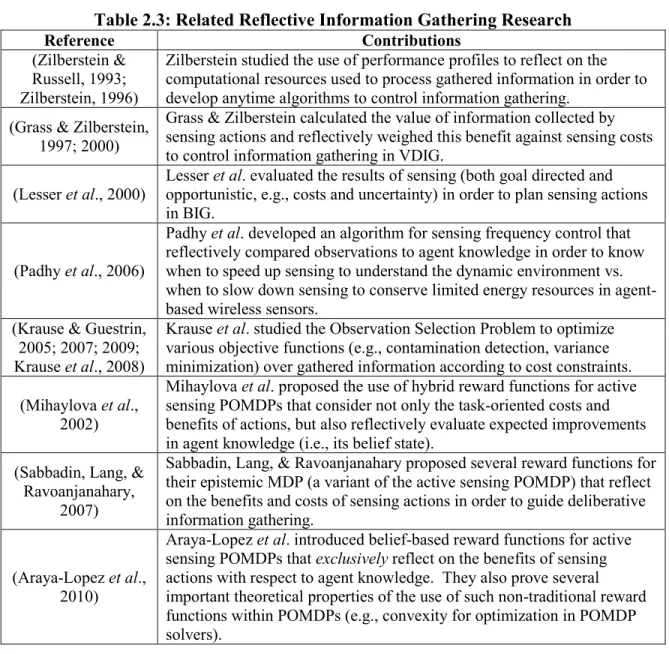
In this subsection, we next review some of the general history of reflective information gathering. We summarize this history in Table 2.3.
2.3.1. Reflection for Deliberative Information Gathering
In some of the earliest work on reflection in information gathering, Zilberstein (1996; with Russell, 1993) studied how to allocate resources within information gathering in autonomous robots to support the robot’s tasks (e.g., movement to a location). In particular, they considered the observation processing component of information gathering (i.e., transforming raw observations into useful information for reasoning, such as raw vision pixels into information about the agent’s surroundings). The goal of this research was to control how much time was spent on processing information during information gathering to avoid consuming computational resources that could instead be used by the agent’s task-oriented reasoning. Thus, the agent faced a tradeoff between time available for reasoning vs. the quality of information necessary for reasoning