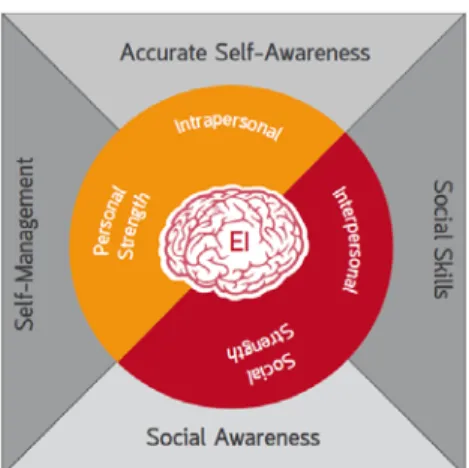
Exploring the impact of emotional intelligence training in the workplace
by
ANNA SUSANNA JANSEN VAN RENSBURG
submitted in accordance with the requirements for the degree of
MASTER OF ARTS
in the subject
PSYCHOLOGY
at the
UNIVERSITY OF SOUTH AFRICA
SUPERVISOR: DR E M CRONJE CO-SUPERVISOR: PROF J M NIEUWOUDT
DECLARATION
Name: Anna Susanna Jansen Van Rensburg Student Number: 3248 784 3
Degree: Master of Arts: Psychology
Exploring the Impact of Emotional Intelligence Training in the Workplace.
I declare that the above dissertation is my own work and that all the sources that I have used or quoted have been indicated and acknowledged by means of complete references.
___________________________ November 2018
ACKNOWLEDGEMENTS
Philippians 4:13. "I can do all things through Christ which strengtheneth me." (KJV)
This is amazing Grace, this is unfailing Love. Thank you, Lord Jesus.
I would like to acknowledge and express my gratitude also to:
My dearest family: My husband and all our children, for your sustained love and support. Your unselfish dedication to me leaves me humbly grateful. I am blessed to have all of you in my life.
To the rest of my family and friends for all your gestures or words of
encouragement and support. None slipped my attention. It is much appreciated.
My supervisors, Dr. Elsje Cronjé and Prof. Johan Nieuwoudt: Like a compass, you guided me with your expertise to keep me on track and achieve my goal. I
thoroughly enjoyed this journey of learning and am sincerely grateful for your patience and guidance.
André Vermeulen and The Neuro-Link Company for granting me the opportunity to use the Neuro-Link program and intellectual property for this research study.
The participating companies and every participant: Without you, this study was not possible. I appreciate your contribution sincerely.
I dedicate this dissertation to my dearly beloved parents who modelled a
remarkable example of love, dedication, perseverance, and integrity throughout their lives. An example from which I could only benefit and learn. Thank you very much! I will always love you.
ABSTRACT
Exploring the Impact of Emotional Intelligence Training in the Workplace. The complexity of mental development in humans together with human interaction in the social context presents itself to be a continued source of investigation and exploration. Emotional Intelligence (EI) is such a field of study in the discipline of psychology. Researchers emphasized the importance and value of emotional development ("soft-skills") equal to cognitive development (“hard-skills”). EI abilities are associated with key skills and competencies required for operating successfully in today’s organizations. This study focused on this theme
specifically and tried to determine how EI training impacted on the success of the individual who fits the modern working profile and how emotionally intelligent employees are beneficial to organisational success overall.
An ethnographic qualitative study (including an autoethnography) was performed on individuals of different participant groupings who completed the Neuro-Link EI Program. The aim was to assess if they showed increased growth in areas of EI, specifically addressed in the program namely self-awareness, self-management, social awareness, and social management. Findings indicated that EI training works with positive results. It was of great value to the individual having an immense impact on their personal lives. It further had a major positive impact on the group dynamics of individuals who attended the training. At companies where facilitators presented the program, EI training had a positive impact. A conclusion on the impact that such training had on the two companies whose staff members directly participated in this study, was not yet possible at the time of the study. The development of an awareness model for the promotion of EI training in the workplace is recommended. This may increase available knowledge regarding corporate EI training but also accelerates an emerging, but a too slowly growing movement.
Key Terms: Emotional intelligence; Self-awareness; Intrapersonal skills; Interpersonal skills; Self-reflection; Self-directed change; Social and emotional learning; Emotional intelligence training outcomes; Context; Autoethnography; management; Self-understanding; Social Self-understanding; Social awareness; Social cohesion; Relationship management; Soft-skills; Hard-skills.
TABLE OF CONTENTS Declaration ii Acknowledgements iii Abstract iv Table of Contents v Chapter 1 Introduction 1.1 Personal Background 1 1.2 Historical Background 2 1.3 Literature Review 8
1.4 Research Problem and Objectives 10
1.5 Research Design 10
1.5.1 Paradigm 10
1.5.2 Research Method and Design 11
1.6 Ethical Considerations 12 1.7 Presentation 13 1.8 Conclusion 14 Chapter 2 Literature Research 2.1 Introduction 15
2.2 Defining Emotional Intelligence 15
2.3 Theories, Models, and Measurements of EI 17
2.3.1 The Trait Model 18
2.3.2 The Ability Model 19
2.3.3 Emotional-Social Intelligence Model 20
2.3.4 The Emotional Competence Model 21
2.3.5 Construing a Mixed Model 23
2.4 Emotional Intelligence in the Workplace 24 2.4.1 A Paradigm Shift: Recognising the Importance of EI Skills 24 2.4.2 Emotional Competence and Cognitive Intelligence in Job
Satisfaction 25 2.4.3 Emotional Competence Through Behaviour Change 26 2.4.4 Working Relations and Team Effectiveness 24 2.4.5 EI Intervention for Job Satisfaction, Performance, and Career
Advancement 28 2.4.6 Managing Occupational Stress with EI Skills 29 2.4.7 EI Skills can be Learned and Developed 30 2.5 EI training: Methods, Theories, and Approaches 32
2.5.1 The Intentional Change Theory 33
2.5.2 The Social-Emotional Learning Model 34
2.5.3 Applying Theories and Approaches 35
2.6 Conclusion 36
Chapter 3
Method: Exploring the Impact of the Neuro-Link Emotional Intelligence High Achievers Development Program
3.1 Introduction 38
3.2 The Neuro-Link EI Program: Curriculum Design 39
3.2.1 Dimensions of the Program 39
3.2.2 Modules of the Neuro-Link Program 40 3.3 How the Neuro-Link Program Applies to EI Theories and
Approaches 41
3.4 Proposed Outcomes that will be Investigated 42
3.5 Research Design and Methodology 43
3.5.1 Research Paradigm 44
3.5.2 Research Approach 45
3.5.3 Theoretical Framework 48
3.5.4 Standards of Credibility and Trustworthiness 53
3.5.5 Ethical Considerations 54
Chapter 4
An Autoethnographic Account of the Impact of Experiencing an Emotional Intelligence Program 4.1 Introduction 57 4.2 EI in my Capacity as a Student 58 4.3 Being a Counsellor 61 4.4 Personal Development 64 4.5 Social Development 65
4.6 The Impact of EI on Psychotherapy – Applying EI as a Counsellor 67
4.7 A Notable Need for EI Among Students 71
4.8 Conclusion 72
Chapter 5
The Impact of Presenting the Emotional Intelligence Program
5.1 Introduction 74
5.2 Grand Tour Questions 74
5.3 The Participants 75
5.3.1 “Annie” 75
5.3.2 “Ben” 82
5.4 Conclusion 88
Chapter 6
The impact of the EI Program on Employees and the Organisation
6.1 Introduction 90
6.2 Grand Tour Questions 90
6.3 A Vehicle Tracking and Fleet Management Company 91
6.3.1 "Connie" 92
6.3.2 "Devon" 97
6.4 A Holding Company 100
6.4.1 "Eleanor" 102
6.5 Conclusion 107
Chapter 7
Findings, Conclusions and Recommendations
7.1 Introduction 109
7.2 Most Important Findings of this Study 111
7.2.1 Rationales for Participation in the EI Training Program 111 7.2.2 Feedback – Participant Experiences of the EI Program 113 7.2.3 Feedback – from an Organisational Perspective 113 7.2.4 How do Findings Relate to Existing Research 114
7.3 Themes 115
7.3.1 Pre-Training Assessment 115
7.3.2 Program Composition and Sequence of Presentation 116
7.3.3 Program Content 118
7.3.4 Change 119
7.3.5 Sustainability 120
7.3.6 Participation 121
7.4 Personal Reflection 122
7.5 Strengths and Limitations of the Study 123 7.6 Recommendations: for Promoting EI in Future 124
7.7 Recommendations for Further Research 125
7.8 Final Reflection 125
References 127
Appendices
Appendix A: Consent from Neuro-Link 146
Appendix B: Consent from Participating Companies 147 Appendix C: Consent from Individual Participants 148
Appendix D: NL Corporate Prospectus 152
Figures
Figure 3.1. The framework of the Neuro-Link EI Program 40 Tables
CHAPTER 1 INTRODUCTION
1.1 Personal Background
During the early 1990’s a radio talk about brain hemispheric dominance caught my interest. This, and a general curiosity about how people think, and why they behave the way they do, inspired me to study Psychology. Completing my Honours degree in Psychology during 2008 motivated me to further personal development and exploration into the different facets of the discipline of the human psyche.
The hemispheric dominance effect, still at the back of my mind, inspired me to investigate this phenomenon further. I came across several models regarding brain dominance, but the Neuro-Link Program seemed to be the most
comprehensive at the time. I subsequently attended several different courses to become a Neuro-Link Licensee. This enabled me to use the program’s brain profile- and emotional intelligence (EI) assessments. Through my involvement in the company, I also attended their Emotional Intelligence High Achiever
Development Program (from here on referred to as the Neuro-Link EI Program). Enjoying this process thoroughly and discovering the benefit I personally gained from participating in the program and undergoing the training, lead to a
predominant interest in the field of EI. To educate individuals to strive for optimal mental development is my field of interest, and equipping them with necessary intra- and interpersonal skills, I believe, prevent pathological thinking in a culture filled with negative input via the media and everyday circumstances. Observing the value this program adds to the lives of others, motivated me for further studies in this regard. Although the program is applicable to all individuals in general, it is especially successful when presented in the working environment as it could be beneficial to the organization as a whole in that it strengthens the workforce in their professional capacity as well as their private lives.
The present research will be conducted in order to put my belief in this program to the test. I am aware that I have a vested interest in the Neuro-Link Program.
However, I will do my utmost not to let this cloud my judgement and put my integrity at risk.
1.2 Historical Background
The roots of emotional intelligence can be traced to the ideas of various well-known persons:
• Darwin (1872) stated that emotional expression is essential for survival. • Edward Thorndike (1920) described the concept of interpersonal intelligence
(also known as “social intelligence”) as the ability to get along with other people.
• David Wechsler (1943) suggested that affective components of intelligence may be essential to success in life.
• The humanistic psychologist Abraham Maslow (1943) described how people can build emotional strength in his theory of human motivation.
The idea of emotional intelligence first appeared in educational work in a paper written by Michael Beldoch in 1964 (Beldoch, 1964). Almost 20 years later, in 1983, Howard Gardner published a book called Frames of mind: The theory of multiple intelligence (Gardner, 1983). Following his argument that the traditional intelligence quotient (IQ) cannot explain cognitive ability entirely, he developed the Howard Gardner theory of multiple intelligences that same year. This theory challenged the original understanding of a single general ability of intelligence. Gardner argues that every person’s level of intelligence actually consists of many distinct “intelligences”. He included seven intelligences in his theory: (a)
Linguistic/verbal intelligence – the spoken and written language ability; (b) Logical-mathematical intelligence – the capacity to analyze problems logically,
mathematically and scientifically; (c) Musical/rhythmic intelligence – the capacity to recognize and compose musical pitches, tones and rhythms; (d)
Bodily-kinaesthetic intelligence – using one’s body to solve problems; (e) Spatial/visual intelligence – the use and recognizing of wide spaces and confined areas; (f) Intrapersonal intelligence – the capacity to understand oneself, appreciate one’s own feelings, fears and motivations; and (g) Interpersonal intelligence – the capacity to understand the intentions, motivations and desires of others. Not part
of the seven distinct intelligences, Gardner (1999) later also added naturalistic intelligence – the ability to recognize flora and fauna and to make other
consequential distinctions in the natural world, to the list.
The term, emotional intelligence, was officially used for the first time in1985 when a USA graduate Wayne Payne mentioned it in his doctoral thesis A study of emotion: Developing emotional intelligence (Payne, 1985). The term was
acknowledged in the academic world when it evolved and specific models started to arise. One of these, the Ability Model, developed by Mayer, Salovey and Caruso in 1990 and revised in 1997, describes how the individual processes emotional information, uses this information to navigate his or her social environment, to reason about emotions and to promote personal thinking and growth (Mayer & Salovey, 1997; Mayer, Salovey & Caruso, 2004). This model indicates that EI includes four types of actual abilities: perceiving emotions, reasoning with emotions, understanding emotions, and managing emotions.
As opposed to the abovementioned ability-based model that refers to actual abilities, Konstantin Vasily Petrides developed another model named the trait model over several years of research (Petrides & Furnham, 2000). Trait EI measured through self-report refers to an individual's self-perceptions of his emotional abilities.
The emotional intelligence concept as such, became a household name in 1994/5 after Daniel Goleman (1996) published his book Emotional Intelligence: Why it can matter more than IQ. He realised that although we do not choose many of the events that happen to us, we certainly have a choice of how we will react to these. Extending research on EI, Daniel Goleman borrowed from the ability and trait models of Mayer, Salovey and Caruso, and Petrides during his research.
According to Goleman (1996, p. 34), EI consists of “abilities such as being able to motivate oneself and persist in the face of frustrations; to control impulse and delay gratification; to regulate one’s moods and keep distress from swamping the ability to think, to empathise, and to hope’’. These principal areas are to know one’s emotions, to manage these emotions, to motivate oneself, to recognise emotions in others, and to handle relationships. He wrote a book entitled Working
with Emotional Intelligence (Goleman, 1998), and grouping capabilities into three categories, he indicated that EI accounted for 67% of the abilities deemed
necessary for superior performance in leaders and that it mattered twice as much as technical expertise or IQ (Goleman, 2004). He defined EI as the combination of skills and characteristics that drive leadership performance. In 2000 a distinction arose between trait- and ability-EI and Goleman’s studies began to provide evidence of neural mechanisms involved in EI. He later developed the mixed EI model, a combination of the trait- and ability-EI models. The mixed model’s focus is on a wide range of competencies and skills that drive leadership performance and support five main EI constructs namely self-awareness, self-regulation, social skill, empathy, and motivation. Within each of these constructs, Goleman included a set of emotional competencies. He speculates that individuals are born with a general EI that determines their potential for learning emotional competencies. He, however, states that “these emotional competencies are not instinctive talents, but rather learned capabilities that must and can develop to achieve outstanding performance” (Boyatzis, Goleman, & Rhee, 2000).
Besides the above-mentioned researchers who developed the concept, there were some other academics worth mentioning who also contributed greatly to the field of EI. Among them are Robert Sternberg (1985) who created the triarchic theory of human intelligence consisting of analytic intelligence, creative intelligence, and practical intelligence. Also contributing to current knowledge is the Bar-On Model of Social and Emotional Intelligence by Reuven Bar-On (2006) and Anabel
Jensen’s six seconds model of EI that she developed in 1997 (Jensen, 1997). The latter consists of the following three pursuits namely know yourself, choose
yourself, and give yourself. These are subdivided into eight competencies and measured through the six seconds emotional intelligence assessment.
Although all previously mentioned researchers presented research to support their theories, they do not escape fierce criticism. For example, Eysenck (1998)
criticised Goleman’s description of EI in claiming that it contains unsubstantiated assumptions about intelligence in general, and that it even runs contrary to what researchers have come to expect when studying types of intelligence. Locke (2005) criticised misinterpretation of the intelligence construct, and Adam Grant
(2014) proclaimed that EI is a quality rather than a skill. In 2005 Landy claimed that EI has little predictive value and that a few incremental studies conducted on EI have shown that it adds little or nothing to the explanation or prediction of some common outcomes – most notably academic and work success (Landy, 2005).
For researchers who believed in the relevance of their theories, however, the importance to measure emotional intelligence became evident. In an article published by Mensa Magazine, Keith Beasley (1987) used the term “emotional quotient” for the first time. Two academic articles, one by Stanley Greenspan (1989), and the other by Peter Salovey and John Mayer (1990), put more focus on the concept. They found that some people more than others are better at
identifying their own feelings, identifying the feelings of others, and solving problems involving emotional issues. Several different tests started to see the light. Some examples are the Emotional Quotient Inventory (EQ-I), the first
assessment designed by Reuven Bar-On; a self-report test designed to measure a number of constructs related to EI (Bar-On, 1997); the MSCEIT (Mayer-Salovey-Caruso Emotional Intelligence Test), measuring emotional intelligence based on a series of emotion-based problem-solving items (Brackett & Salovey, 2006); and the MSCEIT V2.0 (Mayer, Salovey, Caruso & Sitarenios, 2003).
Measurements based on the Goleman model, are available namely the Emotional Competency Inventory (ECI), which was created in 1999, the Emotional and Social Competency Inventory (ESCI), a newer edition of the ECI, developed in 2007, and the Emotional and Social Competency – University Edition (ESCI-U). These tools were developed by Boyatzis and Goleman and provide a behavioural measure of the emotional and social competencies (Boyatzis et al., 2000). The Emotional Intelligence Appraisal, which was created in 2001 is a skill based self-report and 360-degree assessment and was developed by Travis Bradberry and Jean Greaves (2009). The 12 Emotional Intelligence Competencies Profile developed by Andre Vermeulen (2002), is also a 360-degree practical assessment to determine how skilled a person is in terms of EI. This profile illustrates 6
intrapersonal- and 6 interpersonal competencies of EI and is used in conjunction with their brain profile. This brain profile is based on the neuroscience of learning and referred to as the Neuro Agility Profile (NAP).
Emotional intelligence,has been defined in several different ways. Among others are Reuven Bar-On who defines EI as an array of non-cognitive abilities –
emotional and social abilities, competencies and skills that enable individuals to cope with daily demands that influence their ability to succeed in coping with environmental demands and pressures, to enable them to be more effective in their personal and social lives (Bar-On, Tranel, Denburg, & Bechara, 2003). Colman(2015) describes it as the ability to monitor one's own and other people's emotions, to discriminate between different emotions and label them appropriately, and to use emotional information to guide thinking and behaviour.
Bar-On, Tranel, Denburg and Becharaalso contributed greatly when defining EI in terms of neuroscientific research in a 2003 article (Bar-On et al., 2003). Various other studies attempted to characterise the neural mechanisms of EI proclaiming that emotional intelligence is a valid construct that is neurally distinct from
cognitive intelligence (Barby, Colom, & Grafman, 2012).
Described by the previously mentioned scientists, emotional intelligence involves us as emotional feeling and cognitive thinking beings in a social environment in that it relates to how we handle ourselves, and our relationships with others. Van Jaarsveld (2008) noted that EI does not only pertain to the emotional but also to the collective non-cognitive dimensions of intelligence that determine success in life. He stated that although the emotional dimensions are very important in EI, the total spectrum of the non-cognitive abilities including social intelligence is closely related. This belief resembles the way in which Thorndike (1920) first defined social intelligence as the ability to perceive one's own and others' internal states, motives, and behaviours, and to act toward them optimally based on that information. Because of the similarity between the concepts of social and
emotional intelligences, some psychologists have suggested that they may relate to different aspects of the same construct (Bar-On, 2006).
But how does EI influence the employee, manager, or leader in the workplace? A research study performed by Goleman (2004), tracking over 160 high performing individuals in a variety of industries and job levels, indicated that EI was twice as
important in contributing to excellence as intellect and expertise alone were. He based his performance-related research on top executives of the world’s largest corporations and concluded that close to 90% of leadership success is attributable to EI.
The World Economic Forum predicts that to be able to thrive in the job market, an enormous change in the most desirable skills will be necessary (Schwab &
Samans, 2016). On behalf of the Forum, Schwab and Samans (2016) claim that by the year 2020 the top ten rated skills in order of importance will be: (a) Complex problem-solving; (b) Critical thinking, (c) Creativity, (d) People management, (e) Coordinating with others, (f) Emotional intelligence, (g) Judgement and decision making, (h) Service orientation, (i) Negotiation, and (j) Cognitive flexibility. Social skills such as EI will be in high demand across industries, and strong social and collaborative skills will have to supplement technical and cognitive skills. These authors state that to simply reform the current educational systems to better equip today’s students to meet future skills requirements, is not going to be enough to remain competitive. They wrote: "Ageing countries will not just need lifelong learning but will need wholesale reskilling of existing workforces throughout their lifecycle" (Schwab & Samans, 2016, p. 32) and "there is thus a need for bolder leadership and strategic action within companies and within and across industries” (Schwab & Samans, 2016, p.29).
To have a competitive advantage in the field of EI, training becomes increasingly a necessity in the workplace. This applies to the international as well as the South African workforce. Although several companies offer a variety of this kind of training programs in the South African context, scientific research evidence of the impact thereof, is still unavailable. Based on the ground-breaking work of
previously mentioned scientists, especially the Howard Gardner theory of multiple intelligences, research in this study will therefore strive to investigate the impact of the South African developed EI program of Andre Vermeulen (2002), called the Neuro-Link Emotional Intelligence High Achiever Development Program, to determine the impact thereof in the workplace. Up to date, no formal research study has been done on this program.
1.3 Literature Review
Most of the studies on EI link EI to job satisfaction, leadership, ethical work behaviour, aggression, commitment, performance, job involvement, decision making and adult learning. For example, research by Onuoha and Segun-Martins (2013) investigated the link between EI and job satisfaction of married female employees. They found a significant difference in job satisfaction of participants, in that those with higher EI experienced a higher level of job satisfaction than those with a lower level of EI.
Furthermore, Olannye (2013) assessed the effect of EI on leadership performance in local government administration in Nigeria and found that managing emotions through EI is a critical element to leadership performance and is therefore associated with successful outcomes that can drive employees’ loyalty and commitment.
From Nigeria as well, Ojedokun (2010) did a study on the effort-reward imbalance and attitude towards unethical work behaviour among police personnel with EI as a moderator. He concluded that the inclusion of emotional training modules in the training of police personnel would create ethical workplaces devoid of favourable attitudes towards unethical work behaviour.
Another research study also indicated that aggressive behaviour in members when trained in EI skills, can be successfully reduced, remediated, and alleviated. This reflected in the findings of Animasahun (2007) who studied the measured effect of EI education in the remediation of aggressive behaviours among the members of the NURTW (National Union of Road Transport Workers) in the Ibadan metropolis of Nigeria.
The results of a study by Adeoye and Torubelli (2011) seeking to explain the interactive and relative effects of EI and human relationship management as predictors of organizational commitment of Nigerian civil servants indicated positively to EI intervention. Human relationship management programs were advocated in order to enhance the organisational commitment of civil servants.
At the University of Namibia, Akintayo and Babalola (2012) investigated the relationship between EI and workers’ job performance, job satisfaction, job
involvement and organisational commitment. The findings of their study revealed the significant impact EI has on the behaviour of workers in industrial
organisations.
When looking at the United States of America, research studies at FedEx revealed very large increases in performance, decision making, quality of life and major improvement in influence and link this to EI (Freedman, 2014).
Lastly, also in the United States of America, a study by Rude (2013) of the George Washington University, investigated experiences of the developing of EI in the United States federal government leaders, to contribute towards a greater understanding of the evolving relationship between EI, adult learning and leadership. The research findings supported this assumption.
Research regarding EI in South Africa include a study by Ramesar, Koortzen and Oosthuizen (2009) revealing that stress management is a component of EI and can be an inflow or outflow of EI or the lack thereof. Du Plessis, Wakelin and Nel (2015) found that EI training should form part of a necessary component in the development of servant leaders as indicated in their study. Lastly, Richards and Barry (2010), investigated the relevance of EI in project management for the aviation industry. It included the four clusters of awareness,
self-management, social awareness, and relationship management. This study found EI to be an important attribute for project managers in the aviation industry. All the quadrants were found to be of equal importance.
With the exception of the qualitative study by Rude (2013), all of the above studies were quantitative research, which necessitates some qualitative studies with a fresh approach, new terms, and key concepts. Evidence from the
abovementioned research studies justifies the feasibility for a study in that they all proved the importance of EI. Furthermore, whilst some research dealt with EI training, these studies did not investigate the impact of EI training in the
workplace. There is also very little published about specific training programs in the workplace with regard to EI.
My personal interest, the belief in the need for and relevance of EI training in the workplace as well as the lack of a prior qualitative study on the Neuro-Link EI Program, therefore, drives this proposed study.
1.4 Research Problem and Objectives
The aim of the present study is to investigate if the Neuro-Link EI Program is beneficial for the individual firstly and subsequently for the company as a whole. The research problem is to explore the impact of the training program in the work context. This broad objective gives rise to the following specific research
questions:
• Do individuals accurately know and understand their own truths, emotions, motives, strengths, weaknesses, and talents?
• Can individuals manage and control what they understand about themselves? • Do individuals know and understand the truths of others?
• How did individuals develop through the process and were the changes sustainable?
• Do the participants have healthy constructive interactions with, and influence on all people especially their colleagues?
• How did the participants experience the program?
• How did the program affect their personal wellbeing and working relationships with colleagues?
• How can the program be improved?
A detailed description of this program will be given in Chapter 3.
1.5 Research Design 1.5.1 Paradigm
This study will follow a constructivist-interpretive approach (Wagner, Kawulich & Garner, 2012). Techniques and methodologies such as interviews in the form of open-ended but also quite specific questioning of the participants will be applied.
The “grand tour” (central question) questioning technique as described by Spradley (2003), will suit this study quite well. (This will be explained in more detail in Chapter 3).
1.5.2 Research Method and Design
An ethnographic qualitative research approach will be used in this study in order to gain an understanding of the personal and social experiences of those who
participate in the study. In other words, I will try to enable the participants to tell coherent stories (Wagner et al., 2012) of how EI impacts on their lived lives in a work setting.
Rather than using a probability sampling procedure, I will be using purposive non-probability sampling, as the participants must meet the criteria of having
completed the Neuro-Link EI Program.
Data will be collected through in-depth repeated interviewing in the form of a series of one-on-one semi-structured interviews with some predetermined open-ended questions. Small groups will be selected to generate data-saturation that delivers a trustworthy and credible conclusion from their responses. A
triangulation data gathering technique will apply to increase the trustworthiness and credibility of the conclusion drawn from analysed data. Data will be collected during all observations and interviews by recordings or will be written up in field notes, and interviews will be transcribed. Recordings will ensure that no
information gets lost during the conversations.
This study will make use of interpretative ethnographic analysis focussing on how participants make sense of their personal experiences but will also include how I as researcher make sense of and understand the data. The bracketing technique will enhance and ensure an open and empathic attitude towards the participants. Thematic analysis of data will be a continuous process simultaneously with data collection through the different steps of familiarisation, immersion, coding, and elaboration to finally interpretation of the data (Terre Blanche & Kelly, 2002;
activity of data analysis will be applied namely data reduction, data display, and conclusion drawing and verification. Connections through themes identification will be made to form a cohesive narrative to explain findings.
1.6 Ethical Considerations
I have obtained a written consent from the participating company, Neuro-Link, whose intellectual property in the form of assessments and the training program were used (Appendix A). Gatekeepers of the participating companies that will be observed, will be consulted to obtain written permission to enable me to conduct the research study (Appendix B).
An informed consent document was drawn up and will be presented to all proposed participants to obtain their signed consent to participate in the study. This will include information to inform participants that they may withdraw from the research process at any time, that their participation is voluntary and that they must understand that the research may affect them emotionally. The informed consent process will continue throughout the duration of the research project (Appendix C).
I will take care to establish and maintain a relationship of trust with all participants, to provide them with information for an understanding of the purpose of the study, and to explain the methodology that will be used. I will provide the opportunity to participants to give their ideas only, not to judge or criticise them, and never to argue or disagree with them. I undertake not to harm participants regarding time commitments, stressful topic discussions, and disclosure of information. Attention will continuously be focussed on the well-being of all participants.
I further undertake to not deceive participants in any way, but to convey the true purpose and results, the potential uses of the research, as well as any risks and benefits that may arise during the research process. As the researcher, I will present myself as such, without exerting positional power over any participant and will enter the study by maintaining a neutral stance in data collection and the analysis thereof without perceived ideas of bias. Vulnerable participants will be
protected, and an attitude of fairness and justice maintained at all times throughout the research process. This includes the recruitment of participants, the
development of questions, interpretation of results as well as the conveying thereof.
I will assure participants of the privacy and confidentiality of their responses throughout observations and individual interviews. No information that will embarrass or harm them will be disclosed at any time. Information discussed in confidentiality will only be disclosed on consent and anonymously if at all
necessary.
1.7 Presentation
Chapter 1 – Introduction to the study.
Chapter 2 – Reflects a literature research.
Chapter 3 – This chapter will focus on the Neuro-Link EI Program that will be investigated during this study. An explanation and discussion of the program follows in this chapter. A discussion of the qualitative investigative methodology that will be applied during this study will be followed by a detailed exposition of the paradigm, design, and research method. This discussion will include a description of sampling methods, interviews, data gathering techniques and data analysis.
Chapter 4 – In an autoethnography: this chapter will reflect on my own experience of EI training.
Chapter 5 – An ethnographic account of the impact of experiencing the emotional intelligence program by two facilitators of the program.
Chapter 6 – A discussion of the impact of the EI program on employees and the organisation.
themes that emerged from the study, a summary of conclusions drawn from the investigation, and recommendations for future research.
1.8 Conclusion
The complexity of mental development in humans together with human interaction in the social context presents itself to be a continued area of investigation and exploration. This leads to the discovering and interest in areas of psychological functioning previously fairly unknown to researchers. As seen in the history of research, EI is such a field of study in the discipline of psychology. This study will focus on this theme specifically, and the development thereof in the professional capacity of individuals in their world of work. A qualitative study will be performed on individuals who participated in the Neuro-Link EI Program and aims to
investigate the impact such a program has on working individuals and their professional environment.
CHAPTER 2 Literature Research
2.1 Introduction
The interest in EI has evolved into an enterprise comprising of a vast array of publications, testing, education, and consulting (Mayer, Salovey, & Caruso, 2008). Matthews, Zeidner, and Roberts (2012) have outlined the dramatic growth of the literature concerning EI. They argue convincingly that it is no longer an issue whether emotions have a place in the work environment, but rather that one should gain competencies and skills to use and manage these emotions and realise what impact such EI skills of employees have on the work environment.
What then is the link between EI and workplace outcomes? Research from different disciplines such as psychology, psychiatry, business, education,
medicine, sports science, computer science, and the neuroscientific fields of study have all contributed to provide an answer to this question (Boyatzis, Rochford, & Taylor, 2015; Schutte, Malouff, & Thorsteinsson, 2013).
This chapter will present literature on theories, models, approaches, and research on EI and the relevance of EI in the workplace. This will be followed with a
discussion on how EI can be applied within the workplace.
2.2 Defining Emotional Intelligence
EI refers to the capabilities, competencies, and skills that influence one’s ability to succeed in coping with environmental demands and pressures that directly affect a person’s overall psychological well-being; a type of social intelligence that involves the ability to monitor one's own and others' emotions, to discriminating among them, and to use the information to guide thoughts and actions, as defined by Segen (2011).
Salovey and Mayer (1990, p. 189) describe EI as: “The ability to monitor one’s own and others’ feelings and emotions, to discriminate among them, and to use this information to guide one’s own thinking and actions”. Cherniss (2010) and
Mayer, Salovey, Caruso, and Cherkasskiy (2011, p. 532) define EI as “the ability to perceive and express emotion, assimilate emotions in thought, understand and reason with emotions and regulate emotion in self and others”. Emotions are “internal events that coordinate many psychological subsystems including
physiological responses, cognition and conscious awareness” (Mayer, Caruso, & Salovey, 1999, p. 267). Mayer and Salovey (1997, p. 10), describe EI as “the abilities to accurately perceive emotions, to access and generate emotions to assist thought, to understand emotions and emotional knowledge, and to reflectively regulate emotions to promote emotional and intellectual growth”.
Bar-Onconstrued EI as emotional and socially competent behaviour and qualities. He describes emotional and social intelligence as a multi-factorial array of
interrelated emotional, personal and social abilities – non-cognitive capabilities, competencies, and skills that influence one’s overall ability to actively and
effectively succeed in coping with environmental demands and pressures (Bar-On, 2006). Bar-On believes that to be emotionally and socially intelligent is to
effectively understand and express oneself, to understand and relate well with others, and to successfully cope with daily demands, challenges, and pressures. It is this aspect of human intelligence that governs our ability to recognise,
understand, control, and use emotions in solving problems of a personal and interpersonal nature (Bar-On, 2006).
The competency-based model of EI rooted in the works of Goleman (1998) and Boyatzis (2008), describes emotional competence as the capacity for recognising our own and others’ emotions and the ability to use this knowledge to manage ourselves and our relationships effectively.
In Goleman’s (1996, p. 34) Personality Model, EI is seen as emotional
competencies: “abilities such as self-control, zeal and persistence, being able to motivate oneself and persist in the face of frustrations; to control impulse and delay gratification; to regulate one’s moods and keep distress from swamping the ability to think; to emphasize and to hope”. In a following book, Goleman (1998 p. 317) defined EI as the “capacity for recognising our own feelings and those of others, for motivating ourselves and for managing emotions well in ourselves and
our relationships” (Khokhar & Kush, 2009, p. 2). He expanded on Mayer and Salovey’s definition of EI by incorporating personal and social competencies. His conceptualization of EI closely parallels the earlier ideas of Thorndike (1920) on social intelligence and H. Gardner (1993) on personal intelligence but departs significantly from Salovey and Mayer’s ability model. Thorndike defined social intelligence as “the ability to understand and manage men and women, boys and girls and manage wisely in human relations” (Thorndike, 1920, p. 228).
Petrides, Pita, and Kokkinaki, (2007, p. 287) define trait EI as: “a constellation of emotional self-perceptions located at the lower levels of personality hierarchies”, as measured by the trait EI questionnaire. These authors claim this to be the only operational definition in the field that recognizes the inherent subjectivity of
emotional experience (Petrides, 2010).
In conclusion, EI is considered as a set of abilities. Emotional competence is an acquired competency based on EI abilities and has an outcome of strong
workplace performance (Goleman, 1998). Thus, despite the debates within literature whether EI follow from traits, ability and mixed models, the literature suggests that an individual with high EI will demonstrate the competencies that comprise self-awareness, self-management, social awareness, and social skills (Boyatzis et al., 2000).
From the previous discussion it is clear that there are a myriad of definitions and points of view that attempt to define EI. For the purpose of this study I will define EI as follows: For an individual to be successful in intrapersonal (personal) and interpersonal (social) competence, requires accurate development of
self-awareness, self-management, social self-awareness, and social management skills, in that specific sequence. These dimensions are all vital for general contentment and well-being, improved performance, productivity, and success, and could be seen as aspects of EI.
2.3 Theories, Models, and Measurements of EI
different perspectives of what could be included within the concept. After I have presented the models I will attempt to construe a mixed model based on the previous four models.
2.3.1 The Trait Model
Petrides (2010) developed the trait model of EI. According to this model trait EI refers to individuals’ self-perceptions of their emotional abilities as measured through a self-report. Traits are deemed to be relatively stable over time, differ across individuals, and influence behaviour. Trait theorists are primarily interested in the measurement of traits, which can be defined as habitual patterns of
behaviour, thought, and emotion.
Petrides (2010) identifies the following 15 traits that reflect facets of EI:
adaptability, assertiveness, emotional perception of self and others, emotional expression, emotional management (others), emotional regulation, impulse control, relationships, self-esteem, self-motivation, social awareness, stress management, trait empathy, trait happiness, and trait optimism. Trait EI theory connects the construct to mainstream research on differential psychology and has been used as reference framework in diverse areas of which work is amongst them (Petrides, 2010).
There are many self-report measures of EI,including the EQ-i, the Swinburne University Emotional Intelligence Test (SUEIT), and the Schutte EI model. None of these assess intelligence, abilities, or skills, but are limited measures of trait EI (Petrides et al., 2007). The most widely used and researched measures of self-report EI are the EQ-i 2.0 and TEIQue. Used in more than 200 studies, it proved to have the best norms, reliability, and validity of any self-report instrument. The TEIQue provides an operationalization for the model of Petrides, that
conceptualizes EI in terms of personality (Petrides & Furnham, 2003). A number of quantitative genetic studies have been carried out within the trait EI model, which have revealed significant genetic effects and heritabilities for all trait EI scores (Vernon, Petrides, Bratko, & Schermer, 2008).
Although the trait model has contributed significantly to current knowledge, there is a lack of various aspects that form part of EI. These will be discussed in the subsequent sections.
2.3.2 The Ability Model
The ability model of Mayer, Salovey, and Caruso (2008) conceptualises EI as the ability to engage in information processing of one’s own and others’ emotions and to use this information as a guide to thinking and behaviour. The model proposes that individuals vary in their ability to process information of an emotional nature and in their ability to relate emotional processing to a wider cognition. Individuals high in EI has the ability to pay attention to, understand, use, and manage
emotions. These skills serve adaptive functions that potentially benefit the person and others.
The ability model of EI has four underlying emotional abilities that describe how emotionally intelligent people function both intra- and interpersonally in workplace settings. These hierarchically organised skills are arranged from lower to higher levels into four branches/competencies/areas, each describing a set of skills woven together to create a more emotionally intelligent person (Carter, 2015). Branches include abilities to: (a) perceive emotions in oneself and others
accurately, (b) use emotions to facilitate thinking, (c) understand emotions, and (d) manage emotions to attain specific goals. With each branch building upon
previous abilities, this integrative model illustrates the concept of EI as a developmental exercise.
Ability models focus on one’s capacity, such as emotional perception, emotion-facilitated thinking, emotional reasoning, or emotional management (Mayer et al., 2008), and constructs especially relevant to EI. Their stance is that individual differences exist in each of these abilities that can be measured and
operationalized formally as a set of problems that should be solved. Excluded thus are certain personality traits such as assertiveness, neuroticism, extraversion, conscientiousness, optimism, and so forth. These traits are not regarded as EI competencies.
A number of ability-based scales of emotional perception, emotional identification and understanding, and emotional integrative complexity are available (Mayer et al., 2008). An example is the Mayer-Salovey-Caruso Emotional Intelligence Test (MSCEIT), a renewal of the Multifactor Emotional Intelligence Scale (MEIS), testing ability to perceive, identify, understand, and work with emotion. It consists of eight tasks, two for each of the four branches of the EI model. Substantial evidence indicates that the MSCEIT measures EI rather than other constructs (Mayer et al., 2008).
2.3.3 Emotional-Social Intelligence Model
Bar-On’s (2006) emotional-social intelligence model (ESI-model) combines various intrapersonal and interpersonal skills, competencies, and facilitators to determine effective human behaviour. According to this model emotional and social
intelligence implies the abilities to effectively understand and express oneself, to understand and relate well with others, and to successfully cope with daily demands, challenges, and pressures. All of this requires that one is aware of one’s own strengths and weaknesses and is able to express one’s feelings and thoughts non-destructively.
On both intra- and interpersonal levels, this model includes one or more of five key components that individuals can develop to increase their EI. These five
components are the ability to: (a) recognize, understand, and express emotions and feelings; (b) manage and control emotions; (c) generate positive affect and be self-motivated; (d) understand how others feel and to relate to them; and (e) manage change to adapt and solve problems of a personal and social nature.
The Bar-On model provides the theoretical basis for the Emotional Quotient Inventory Self-report assessment (EQ-i) (Bar-On, 1997). It indicates personal qualities that enable some people to possess better emotional well-being than others and plays an instrumental role by which this model is operationalized. It has been developed to assess and conceptualise various aspects of EI (Bar-On, 2006). The EQ-i is a self-report measure of emotionally and socially intelligent
behaviour. Each of the previously mentioned five components comprise of a number of closely related competencies. The questionnaire contains 133 items and is suitable for individuals 17 years and older. It includes the following scales and subscales: (a) Intrapersonal ̶ comprising of variables of self-regard,
emotional self-awareness, assertiveness, independence, and self-actualization; (b) Interpersonal – including empathy, social responsibility, and interpersonal
relationship; (c) Stress management – that includes stress tolerance, and impulse control; (d) Adaptability – tapping areas of reality-testing, flexibility, and problem solving; and (e) General mood – including optimism and happiness. Above average EQ scores on the EQ-i suggests that the respondent is effective in emotional and social functioning. The higher the score, the more predictive is effective functioning in meeting daily demands and challenges, whereas a lower score suggests an inability thereof (Bar-On, 2006).
2.3.4 The Emotional Competence Model
Goleman’s (1998) Emotional Competence Model combines physiological evidence underlying EI. This model is relevant to the workplace as it conceptualises EI as a “theory of performance” (Goleman, 2001a, p. 14). Behavioural aspects of EI proved to be crucial to workplace performance as he emphasised that these behaviours can be learned and developed (Goleman, Boyatzis, & McKee, 2002). Focussing on EI as a theory of performance, this model is based on competencies that have been identified in research on many corporations and organisations, distinguishing outstanding performers. Goleman (2001b, p. 41) hypothesised that EI explains which individuals would excel in any given job, and who would be an outstanding leader. He also contends that an emotionally intelligent organisation is better equipped to survive than one which is not.
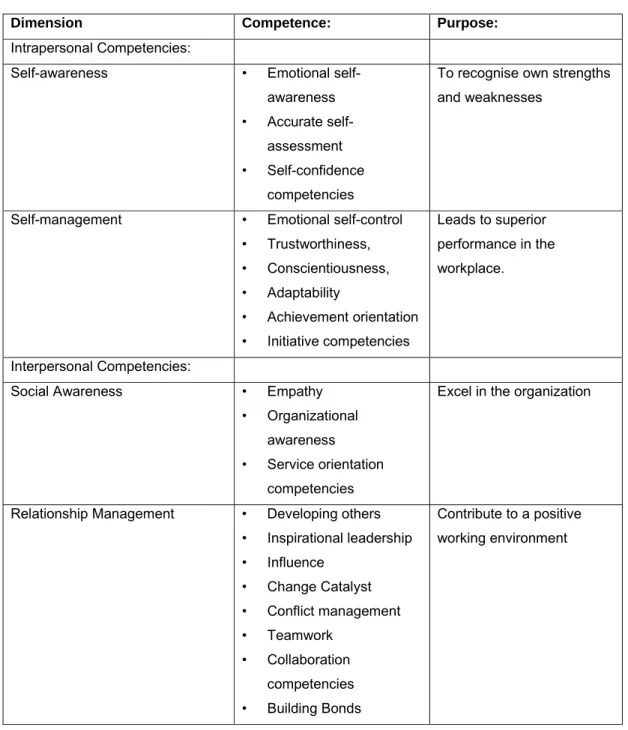
This competency-based EI model integrates emotional and social competencies that have been linked to outstanding performance in the workplace (Goleman et al., 2002). Table 2.1 illustrates the EI competency model of Goleman, consisting of the four major cluster domains with twenty competencies.
Table 2.1: The Daniel Goleman Emotional Competence Framework of EI (adapted from Goleman, 1998, p. 26-27).
Dimension Competence: Purpose:
Intrapersonal Competencies:
Self-awareness • Emotional
self-awareness • Accurate
self-assessment • Self-confidence
competencies
To recognise own strengths and weaknesses
Self-management • Emotional self-control • Trustworthiness, • Conscientiousness, • Adaptability • Achievement orientation • Initiative competencies Leads to superior performance in the workplace. Interpersonal Competencies:
Social Awareness • Empathy
• Organizational awareness
• Service orientation competencies
Excel in the organization
Relationship Management • Developing others • Inspirational leadership • Influence • Change Catalyst • Conflict management • Teamwork • Collaboration competencies • Building Bonds Contribute to a positive working environment
The one important competency which is highlighted in this model is empathy. According to a study by C. B. Carter (2012), empathy bridges the gap between self-awareness and social awareness. To determine the emotional state of another, requires cognitive recognition skills known as empathic skills. It works toward understanding someone else’s perspective and a different point of view than your own. Through this action, empathy is put into practice. To have the
knowledge and the skills is only half the ability, but to apply it in practice, is the full ability. Carter distinguishes three kinds of empathy namely: (a) cognitive empathy – understand how another person thinks, (b) emotional empathy – understand and feel how another person feels, and (c) behavioural empathic concern – feeling inclined to help with the needs of another. This forms the basis of compassion he claims. Martinuzzi (2009) notes that empathy is an ability worth cultivating in the business industry: soft skills tools that can lead to hard tangible results.
Based on his theory Goleman developed the Emotional Competency Inventory (ECI), a multi-rater instrument that provides report ratings based on a series of behavioural indicators of EI. The ECI provides self-, manager-, and peer ratings. Twenty competencies are measured and organized into four constructs namely self-awareness, self-management, social awareness, and social skills. Each respondent is asked to describe themselves or the other person on a scale from 1 to 7 for each item – where 1 represents slightly characteristic of the individual’s behaviour, and 7 is very characteristic of the individual’s behaviour. Items are composed into ratings for each of the competencies. This leaves the respondent with two ratings for each competency: a self-rating and a total other rating made up of an average of all other ratings (Stys & Brown, 2004). This instrument
incorporates a person’s self-assessment and others’ assessment of him/her giving a 360-degree perspective (Gayathri & Meenakshi, 2013).
2.3.5 Construing a Mixed Model
Although the world of education uses EI skills in the general term of social and emotional learning (Mayer & Salovey, 1997), the EI model emerged as an influential framework in the discipline of Psychology and ranging over the entire spectrum thereof. Areas with the strongest connections seem to include industrial and organisational psychology (Goleman, 2001a, p. 15).
Active research and interest in this field of study has led to two main different approaches – the Mayer and Salovey’s “ability” model, and the Goleman and Bar-On’s “mixed‟ models. Both these approaches address a multitude of factors which include traits, preferences and abilities, but individually they do not provide a
comprehensive picture of EI. The ability and trait models are specific and narrow. Traits are considered to be stagnant and exclude the development potential of intelligence, abilities, or skills entirely, and it relies heavily on personality
characteristics. Researched limitations of the Ability Model of EI indicate its low discriminant validity, and questionable construct and incremental validity in the standards of measurement (Fiori & Antonakis, 2011). Integrative “mixed” models on the other hand, represent EI as cohesive by integrating more abilities (Mayer et al., 2008). Bar-On (2000) makes a clear distinction between EI and social
intelligence, considering EI as personal self-management capabilities, and social intelligence as relationship skills. Goleman’s theory is specific to the domain of work performance (Emmerling & Goleman, 2003).
As approaches differ, equally so is there little consensus amongst researchers concerning how to best conceptualise and measure constructs in organisational research. They doagree however, that the higher the result of an EI assessment (called Emotional Intelligence Quotient [EQ] – and designed to quantify EI), the more competent the person is per skill set (Cherniss, 2000).
The foregoing discussion suggests that all perspectives have merit, and there is no evidence that any should be dismissed. Nor can any of the abovementioned characteristics be ignored when EI is being studied, despite the broad interest in EI with such diverse academic approaches. Aspects of all four models were therefore gathered, combined, and unified into one mixed model of EI. This adds value to the model because it includes all dimensions and levels considered as EI qualities and skills that is necessary to completely represent the construct, and that was originally not included in the individual models. A comprehensive description of the Neuro-Link model which will be used in this study follows in Chapter 3.
2.4 Emotional Intelligence in the Workplace
2.4.1 A Paradigm Shift: Recognising the Importance of EI Skills
Traditionally the workplace was viewed as a rational, logical environment with the main purpose of merely completing specific tasks. The role of emotion was
consequently neglected and as a result, considered irrelevant or unnecessary for effective workplace performance (Briner & Reynolds, 1999). On the contrary, research indicated that employees are constantly required to engage in
interpersonal interactions involving a range of emotions, and as they interact for the purpose of completing tasks or work, emotions such as gratitude, fear, anger, and frustration may surface, be experienced, and expressed (Van Oosten, 2013). As Ashforth and Humphrey (1995, p. 98) explained, “the experience of work is saturated with feeling”.
Mitchell, Skinner, and White (2010) noted a paradigm shift for our future
workforce, requiring employees to be well-armed with a variety of skills. These include “hard-skills” which are technical requirements for the job obtained from academic training, experience, and expertise, as well as "soft-skills", namely EI. They claim that the latter contribute up to 85% of the success rate. A study by Wilhelm, Logan, Smith, and Szul (2002) indicates that employers now rate soft-skills highest in importance for entry-level success in the workplace by recognising the value of both emotional and cognitive development. This clearly indicates the link between EI and workplace outcomes resulting in EI as an ever-increasing employment skills requirement.
2.4.2 Emotional Competence and Cognitive Intelligence in Job Satisfaction To distinguish where emotions actually fit into the bigger picture of work, Fisher (2000) explains job satisfaction as an attitude with an affective component (emotions and feelings), together with a cognitive component (judgement, belief, and knowledge). Gardner (2005) mentions the sustained cognitive and emotional effort that a demanding job requires. This is due to the physical, psychological, social, or organisational aspects their jobs are associated with, which has a psychological burden on individuals.
EI is distinguished from cognitive intelligence by its focus on feelings and
behaviour rather than facts and knowledge and it represents a cluster of personal and social competencies. To acquire these competencies, the emphasis is on behaviour changes through intervention. Personal behaviour change focus on
inner-, other-, and outer awareness fostering stronger relationships, personal development, and work-family integration (Goleman, 2013). Goleman (2013) describes inner awareness as the ability to manage oneself, where other
awareness indicates managing other people, and outer awareness has to do with the world system: strategic thinking and the understanding of how things work. He believes that a balance of all three of these competencies are needed.
2.4.3 Emotional Competence Through Behaviour Change
Present day organizations often face different obstacles as they are increasingly under pressure to complete complex projects faster and with fewer resources whilst still needing to remain competitive. This implies that both the organization and its members should adapt to change. Change is mostly part of any business and while organisations focus on deciding what to change to improve the
organisation’s performance and quality, the human element of executing these decisions are often left unattended (Conner, 1994). When emotional needs are in charge, a person becomes ineffective. The Institute for Health and Human
Potential UK quoted a professor at Harvard Business School, John Kotter, who said, “because of the furious pace of change in business today, it is difficult to manage relationships, as it sabotages more businesses than anything else. It is not a question of strategy that gets us into trouble, but a question of emotions” (Maheshwari & Tripathi, 2003, p. 4). As team effectiveness is strengthened or weakened by the existence of trust and emotional competence amongst the members and their leader, change may be seen as an opportunity or a threat (Kanter, 2007).
Looking then at the inevitable occurrence of change in the business world, the need is to be a change-manager and not a change-resister. Not only does the EI of its members play a crucial part in the ability of an organisation to realise the need for change, but it also influences the pace of change and how quickly the members of the organisation can anticipate and adapt to change and still maintain a competitive advantage. Huy (1999) and Kanter (2007) noted that emotions in itself have an important effect on the fields of change management in dealing with diversity, teamwork, resistance to change and systems thinking. Regaining
balance after a major change initiative requires intellectual, emotional, and physical energy from all involved, and behavioural change of people requires adaptability, flexibility, and multiple perspectives, making EI competencies unmissable.
2.4.4 Working Relations and Team Effectiveness
In a social working environment, the significance of teamwork – what we give and what we receive – plays a crucial role. Open communication, articulating goals, building coalitions, acknowledging others, and creating effective partnerships are essential to sustain high performance, making teamwork the most important asset in the working community. The focus shifts from individual IQ’s and trait abilities of group members to social effectiveness. EI competencies are valuable to
individuals within groups as it contributes to building bonds, collaboration, cooperation, and team capabilities (Boyatzis et al., 2000). It has been proposed that EI constitutes the building blocks to these important interpersonal behaviours. EI may, therefore, be a useful contributor to our understanding of variables like effective networking, communication, negotiation, performance and leading, and motivation, says Goleman (Boyatzis et al., 2000).
In his study, Groenewald (2003) explained the concept of systems thinking – where the focus is on explaining how things interact within the system as a whole. It studies the interaction of the various parts, and whenever the tasks are more complex, the dependencies between the parts are even more crucial to be effective. The importance of the emotional development of the individuals that make up the system, should not be underestimated, he says. High performance used to be all about those who got the most sales and achieved profitability and delivered. Today’s success is measured by the extent of performance in and amongst the team, as well as the task on hand. It involves a social and emotional developmental process. It is thus a reality that the quality of working relations and the personal wellness of employees and leaders nowadays are just as important to a successful business, as their product or service rendered.
2.4.5 EI Intervention for Job Satisfaction, Performance, and Career Advancement
The growing interest in the concept of EI has spurred an equally growing interest in intervention programs and the development of EI capabilities aimed at adults within organisations. This is to produce a positive influence on the important aspects of job satisfaction, career advancement, and job performance.
Research studies reflect a link between job satisfaction and EI (Law, Wong, Huang, & Li, 2008; Rosete & Ciarrochi, 2005), career advancement and EI (Dulewicz & Higgs, 2005), as well as job performance and EI (Dulewicz & Higgs, 2005; Law et al., 2008). Bond (2016), who investigated differences in trait EI of individuals between various stages of their career, also indicated that valuable desirable workplace outcomes such as job performance, are tied to EI. He added that training initiatives to develop EI in military service members are still missing in institutional programs. Because the challenges of today’s occupations extend beyond cognitive intellect, employees need to be focused, creative, committed, and motivated. A study by Groenewald (2003) reflects that organisations started to take personal qualities such as initiative, empathy, adaptability, persuasiveness, communication skills, and interpersonal skills into account as essential for superior performance. It does not only require radical shifts in the ways employees
interact, but leaders also discover that attention to emotions has shown to save time, expand opportunities and focus energy on better results.
A study by Engeser and Rheinberg (2008) tested the assumption that flow predicts job performance. Their study is based on the psychological concept of a
Hungarian psychologist, Mihaly Csikszentmihalyi, who claims that peak
performance is achieved in a state of flow. It illustrates that in order to achieve a state of flow, or being “in the zone”, a balance must be struck between the challenge of the task and the skill of the performer. Explained on a graph, the horizontal axis measures how challenging the activity is, and the vertical axis measures the level of skill at that particular task. The point where the level of challenge is high and the skills that you have to meet that challenge, are also high, is the point that you enter the flow state. Peak performance in the workplace, or
“in the flow”-performance, relies more than ever on interpersonal relationships, tolerance, adaptability and teamwork, all facets of EI.
2.4.6 Managing Occupational Stress with EI Skills
When considering occupational stress as yet another but important aspect
experienced in the working setup, dimensions of EI are particularly important. This was pointed out by Gardner (2005) who conducted a study on EI and occupational stress. Organisational stressors like policies, procedural requirements and
working relationships have a significant impact on well-being. Factors taken into consideration in the study were emotional recognition and expression,
understanding emotions, emotional management, and emotional control. Findings revealed that those employees using EI were less likely to report feelings of stress, ill health and lower satisfaction and commitment. Some employees experience stress more intensely than others, and EI programs can be used effectively to improve employee well-being and decrease feelings of occupational stress and burnout.
A study by Bilich-Erich (2009), investigated and implemented worksite stress management intervention in the police force. The intervention was based on the Acceptance and Commitment Therapy (ACT) model of Hayes, Strosahl and
Wilson (1999). In his study, Bilich-Erich used the ACT intervention model primarily to influence change of behaviour based on increasing psychological flexibility. This differentiated it from other studies in that the focus was not on how
participants handle emotional and social problems, but rather to promote proactive EI behaviour. It demonstrated emotional intelligent behaviour versus intelligence. The Mindfulness-based Emotional Intelligence Training (MBEIT) program was used. This program is specifically designed to promote well-being and workplace effectiveness and to improve interpersonal relationships (personal and work related). The training was done for four days over a period of four months. Everything was about intervening to help participants lead better and more vital lives. A significant improvement in the general mental health of participants was the result. The study found modest evidence for the effectiveness of the MBEIT intervention.