Languages for Learning and Mining
Luc De Raedt
KU Leuven, Department of Computer Science Celestijnenlaan 200A, POBox 2402
3001 Heverlee, Belgium
Abstract
Applying machine learning and data mining to novel ap-plications is cumbersome. This observation is the prime motivation for the interest in languages for learning and mining. This note provides a gentle introduction to three types of languages that support machine learn-ing and data minlearn-ing: inductive query languages, which extend database query languages with primitives for mining and learning, modelling languages, which allow to declaratively specify and solve mining and learning problems, and programming languages, that support the learning of functions and subroutines. It uses an exam-ple of each type of language to introduce the underlying ideas and puts them into a common perspective. This then forms the basis for a short analysis of the state-of-the-art.
Introduction
Machine learning and data mining are popular subfields of artificial intelligence. However, it is well-known that apply-ing machine learnapply-ing and data minapply-ing to novel data sets is challenging because each application imposes its own re-quirements and constraints that often require the develop-ment of new algorithms and systems. While there are soft-ware packages and tools such as Scikit for machine learning and Weka, Orange or Knime for data mining, adapting them to novel tasks is not easy, which explains why one often re-sorts to implementing new algorithms and variations from scratch.
This observation is not new and it forms also the key mo-tivation for different proposals for languages for learning and mining. For instance, (Imielinski and Mannila 1996) ar-gue for the development of inductive query languages for data mining with“a focus on increasing programmer pro-ductivity for KDD applications.” The ultimate goal of in-ductive databases and querying is to put data mining on the same methodological grounds as databases and to derive the equivalent of Codd’s relational database model for data min-ing, that is, to find the primitives underlying data mining. (Imielinski and Mannila 1996) argue that patterns should be first class citizens that can be queried and manipulated just like data, and they used the slogan
Copyright c2015, Association for the Advancement of Artificial Intelligence (www.aaai.org). All rights reserved.
From the user point of view, there is no such thing as real discovery, just a matter of the expressive power of the available query language.
Coming more from a machine learning perspective, Tom Mitchell (2006) in his essay onThe Discipline of Machine Learning asks a similar question but using programming languages rather than query languages and focussing on learning instead of mining:
Can we design programming languages containing machine learning primitives? Can a new generation of computer programming languages directly support writing programs that learn? ... Why not design a new computer programming language that supports writing programs in which some subroutines are hand-coded while others are specified as to be learned? Such a pro-gramming language could allow the programmer to de-clare the inputs and outputs of each to be learned sub-routine, then select a learning algorithm from the prim-itives provided by the programming language.
Finally, inspired by the field of constraint programming, (Guns et al. 2013) aim at developing declarative modeling languages for specifying a wide range of mining problems. Such languages should support
the high-level and natural modeling of pattern mining tasks; that is, the models should closely correspond to the definitions of data mining problems found in the literature; should support user-defined constraints and criteria such that existing problem formulations can be extended and modified and novel mining tasks can be specified.
Although query, modelling and programming languages are quite different types of language, the motivation for in-corporating machine learning and data mining primitives in these languages is essentially the same: it is to bring added power and expressiveness to the programmer who is devel-oping machine learning and data mining software or appli-cations. Furthermore, also the means with which they want to realize this goal are essentially the same: it is to provide the programmer with a formalism for declaratively specify-ing the patterns or models of interest. This should facilitate the task of the developer as providing a specification of the problem is much easier than implementing a full algorithm in some programming language.
Beer Brand Color Alcohol%
1 Westmalle Tripel Blonde 9.5
2 Orval Dark 6.2
3 Straffe Hendrik Gold 9
4 Straffe Hendrik Dark 11
.... ... ... ...
Table 1: The Beer table.
Cid Brand Color Alcohol%
c1 Westmalle Tripel ? ?
c2 Westmalle Tripel Blonde ?
c3 ? Blonde ?
c4 ? Blonde 9.5
c5 Straffe Hendrik ? ?
.... ... ... ...
Table 2: The BeerConcept table.
This note will provide a gentle introduction to these three types of languages and will put them into a common per-spective. This will allow us to clarify the state-of-the-art and to identify some remaining challenges. But first, we shall introduce these three types of languages using an example.
Inductive Query Languages
Since the seminal paper by (Imielinski and Mannila 1996) many different inductive query languages have been devel-oped, e.g. (Meo, Psaila, and Ceri 1998; Imielinski and Vir-mani 1999; Blockeel et al. 2012). Most of these languages extend relational database languages (such as SQL) with primitives for mining. While some query languages merely invoke an extra primitive to call a particular data mining algorithm, such as a decision tree learner, others aim for a tighter integration between the database and data mining components. An interesting perspective in this regard is that of the virtual mining views of (Blockeel et al. 2012), who claim that inductive querying can be realized by adding a number of ‘virtual views’ to the database and querying these as any other relation in a database. A virtual mining view is a relation that virtually contains the output of a data mining component. It is virtual in that it need not be fully material-ized as this would lead to combinatorial problems.
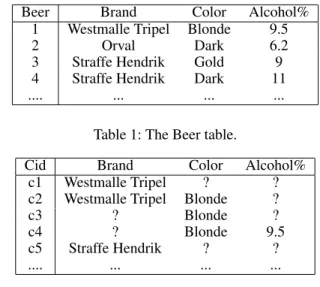
Let us illustrate this idea on a simple example (adapted from (Blockeel et al. 2012)). Assume we have a dataset about Belgian beers, cf. Table 1.
Two mining views could then be created for this relation, cf. Tables 2 and 3. The BeerConcept table lists all possi-ble tuples using the values of the attributes that occur in the original table, but also allows for the special don’t care value
cid frequency size
c5 2 1
... ... ...
Table 3: The BeerSet table.
“?”. The idea is that this virtual view contains the set of all possible patterns, where a pattern can be regarded as a con-junction of attribute-value pairs. The BeerSet table contains the corresponding patterns (through their concept identifier cid) as well as information about the number of occurences, i.e. the frequency, of these patterns in the original dataset. Once these tables are in place, one can mine for patterns using SQL on the resulting tables. For instance, the query below asks for all patterns (concepts) that occur at least 10 times in the data or have an area of at least 60 such as c5.
SELECT C.*, S.supp, S.sz, S.supp * S.sz AS area
FROM BeerConcepts C, BeerSets S
WHERE (C.cid = S.cid AND (S.freq * S.sz > 60))
OR (S.freq > 10)
The concept of virtual mining views has been applied to richer types of patterns such as rules and decision trees, and it has been successfully integrated in a database system. Its integration in database systems is typical for inductive query languages. It involves processing the SQL query to split it in three parts corresponding to 1) pre-processing, 2) data min-ing, and 3) post-processing. The pre-processing query will retrieve the data from the database and put it in the right for-mat so that it can be processed by a data mining system. The data mining system will then process the data and pass on the result to the post-processing step, which will query the data mining result to obtain the final answer.
Inductive querying is elegant and quite flexible, though many challenges remain. First, the integration of various types of patterns and models in a database management sys-tem remains cumbersome as it typically requires coupling with external data mining algorithms and there is only little support for this as deep integrations of the mining primi-tives in the underlying database management and query op-timization system are still missing. Secondly, current induc-tive querying systems offer only little support to the user for defining new types of constraints and optimization criteria. Thirdly, despite the fact that inductive query languages are typically integrated in a (relational) database system, they often do not support the querying of relational or structured data. Finally, and most importantly, the ‘equivalent’ of the relational algebra for data mining has not yet been identified, and so the quest for inductive query languages continues.
Modeling Languages
In artificial intelligence there has been a shift from program-ming to solving as argued by (Geffner 2014). The idea is to model the artificial intelligence problem and then call a solver rather than to produce a program that implements a particular algorithm for computing the solutions to the prob-lem. Numerous solvers have been developed for important classes of problems such as SAT, maxSAT, weighted model counting, Markov Decision Processes, constraint satisfac-tion problems and linear programming. Furthermore, these solvers enabled the development of high-level modeling lan-guages in the knowledge representation and constraint pro-gramming communities such as Essence (Frisch et al. 2008) and Zinc (Marriott et al. 2008). It has been argued that this
type of approach represents (using the words of Eugene Freuder)
... one of the closest approaches computer science has yet made to the Holy Grail of programming: the user states the problem, the computer solves it.
and the slogan ‘constraint programming = model + solver(s)’ has been used.
Although solvers for convex optimization and mathe-matical programming are very popular in machine learn-ing, the use of solvers for combinatorial optimization is less common in data mining and machine learning. More importantly, there are today only few high-level modeling approaches to machine learning or data mining (but see (Bruynooghe et al. 2014; Guns et al. 2013; De Raedt et al. 2011)) although the topic is enjoying more and more atten-tion (cf. Dagstuhl Seminar 14411).
Let us now illustrate the idea underlying the modeling methodology. Figure 1 contains an example model written in MiningZinc (Guns et al. 2013), which is essentially a li-brary that supports pattern mining for MiniZinc (Marriott et al. 2008), a popular modeling language for constraint pro-gramming. The model looks for discriminative patterns and it is specified in a form that closely resembles definitions of the discriminative pattern mining problem that one may find in the literature. It assumes that we are given a set of items{1, ..., N}, and two sets of transactions,D fraudand D ok, where each transaction(tid, I)consists of a transac-tion identifiertidand a subsetIof the items{1, ..., N}. The goal then is to find anItemset(i.e., a pattern) that 1) cov-ers at least 5 transactions inD fraudand 2) that scores best w.r.t. accuracy. AnItemsetcovers a transaction(tid, I)if Itemset⊆ I and the cover of an itemset is simply the set of transactionstidit covers. The constraint then uses the cardinality functioncard to represent the frequency con-straint 1). The scoring function corresponds to the accuracy of the pattern (the difference between the frequencies in the two transaction sets) and the goal is to find the best pattern according to this scoring function.
The example illustrates the power of the modeling ap-proach: by varying the constraints and the (scoring) func-tions in the model, one can easily specify a wide range of mining problems. To find solutions for any given model, one can either rely on general purpose solvers that are available for the underlying modeling language (MiniZinc), or auto-matically analyse the model in order to determine which data mining algorithm to use for solving particular subtasks of the problem following an approach that is analogous to that de-scribed for the virtual mining views. In the above example, one might, for instance, invoke a frequent pattern miner on D fraudas one step in the solution process. MiningZinc provides support for incorporating such data mining solvers and for reasoning over possible executions of the solution methods. This is realized by defining each specific data min-ing solver as a conjunction of constraints.
Modeling languages allow to elegantly specify many problems. The modeled problems can – in theory – always be solved by resorting to one of the standard solvers, these solvers are usually not efficient enough and are certainly not
var set of 1..N: Itemset;
array[int] of set of 1..N: D_fraud;
array[int] of set of 1..N: D_ok;
constraint card(cover(Itemset,D_fraud)) > 5 ;
% Optimisation function
var int: Score = card(cover(Items, D_fraud)) -card(cover(Items, D_ok));
solve maximize Score :: itemset_search(Items);
Figure 1: Discriminative itemset mining model
meant for dealing with the large datasets (and constraints) of data mining. The modeling languages can also be coupled to specific data mining algorithms but this requires extra effort. As for inductive query languages, there is not yet a deep integration in the underlying solvers (but see (Nijssen and Guns 2010) for a special purpose constraint programming solver for data mining). So, one of the most important chal-lenges for the modeling approach to data mining is to devise solvers that are more efficient and scalable even though these more general approaches may never reach the performance of highy specialized solvers due to their greater expressivity. Another ongoing challenge is concerned with extending this type of modeling approach to a much wider spectrum of data mining tasks. A final one is, as for the inductive query lan-guages, to support structured data such as sequences, graphs and relational data.
Probabilistic Programming Languages
Several extensions of programming languages exist that sup-port learning from examples. Most popular amongst these are the so-called probabilistic programming languages (Sato and Kameya 2001; Goodman et al. 2008; Fierens et al. 2013; Milch et al. 2007; De Raedt and Kimmig 2013; McCal-lum, Schultz, and Singh 2009), which essentially define a probability distribution over possible executions and out-comes of the underlying program and then provide algo-rithms for estimating the parameters of the underlying dis-tributions from samples of the desired behaviour of the pro-gram. This is very similar in spirit to the learning of graph-ical models from data, and indeed similar algorithms, such as EM and Bayesian methods, are employed. Most proba-bilistic programming languages extend existing functional or logic programming languages such as Scheme and Pro-log with probabilistic primitives. Probabilistic programming languages have been applied to several challenging applica-tions, and their key advantage is that it is easy to write down the model and then apply a learning engine. This is perfectly in line with the goal of supporting the programmer to write machine learning software.Probabilistic programming has strong links to statistical relational learning (Getoor and Taskar 2007), though statis-tical relational learning approaches such as Markov Logic (Richardson and Domingos 2006) and Probabilistic Rela-tional Models (Getoor et al. 2001) are not programming lan-guages. While they possess many properties of the model-ing approach described earlier they are also somewhat more limited in that they do not allow the user to model the
learn-0.1::burglary. 0.2::earthquake. 0.7::hears_alarm(mary). 0.4::hears_alarm(john). alarm :- earthquake. alarm :- burglary.
calls(x) :- alarm, hears_alarm(x). call :- calls(x).
Figure 2: ProbLog program
ing task (e.g., the scoring function, the learning setting and learning algorithm are typically fixed and built-in).
Let us illustrate probabilistic programming using a ProbLog example (Fierens et al. 2013). ProbLog is a prob-abilistic extension of Prolog that allows for facts to be an-notated with probability values. Each (ground) probabilis-tic factp::f is viewed as an independent random variable f that is true with probability pand false with probability 1−p. Thus a ProbLog program defines a distribution over total choices, i.e., truth-assignments to the set of all (ground instances of the) probabilistic facts. In the example in Fig-ure 2, these are the variablesburglary,earthquake, hears alarm(mary),hears alarm(john). For in-stance, the probability that all of them exceptearthquake are true is0.1×(1−0.2)×0.7×0.4. Each total choice then induces a (deterministic) Prolog program, and the set of all its consequences yields one possible world. The possible world corresponding to the above total choice includes also the factsalarm,calls(john),calls(mary),call. The probability of a query is defined as the probability that it is true in a randomly sampled possible world. For instance, the querycalls(mary)has probability 0.196 as 0.196 is the sum of the probabilities of all the possibles worlds that containcalls(mary).
The parameters of the probabilistic program could then be learned from samples of the target program, which could take the form of (partial) possible worlds or queries.
The key challenge for probabilistic programming is – not surprisingly – to perform efficient inference and learning and to scale up to large datasets. But there are also other open challenges. For instance, from a software engineering per-spective one should be able to give guarantees on the perfor-mance of the learned programs. Will the answers they com-pute be approximately correct with high probability?
Further Languages for Learning
In addition to the three types of languages illustrated above, there exist several types of languages for mining and learn-ing that have not been mentioned yet.
First, in addition to probabilistic programming languages, there exist also other types of programming languages that support learning. For instance, Learning Based Java (Riz-zolo and Roth 2010) is an extension of Java that is very much in the spirit of Mitchell’s vision as it allows to specify that certain procedures are to be learned from data. LBJ specifies and solves these problems using constraint conditional mod-els. The way of realizing this in LBJ bears some resemblance
to the modeling approach descibed in MiningZinc. It is only that the tasks are more machine learning oriented, related to predictive learning, and that the problems are cast as con-straint conditional models instead of as concon-straint programs. Another example is Dyna (Eisner and Filardo 2011), which extends Datalog with semi-rings and learning, which makes it related to ProbLog though unlike ProbLog it associates weights to ground atoms rather than probabilities. This al-lows it to represent grammar-like structures but also neural networks, and it provides a gradient-based approach to pa-rameter estimation. Finally, the kLog language and frame-work (Frasconi et al. 2014) integrates kernel-based learning with logic programs. It first turns the input data (represented as a logic program as in inductive logic programming) into a graph and then employs a graph-kernel on the resulting graphicalization to derive a set of features that are then used in an SVM. All of these languages have been used in natural language processing applications.
Another class of languages for learning has been devel-oped with agent programming and reinforcement learning in mind. The language is used to specify the action and world model of the agent and reinforcement learning is used to de-termine the policies that the agent will execute. In this way, it combines elements of planning and Markov Decision Pro-cesses in a declarative modeling way. Example languages include ALISP (Andre and Russell 2002) and Golog (Beck and Lakemeyer 2012).
Discussion
This note has introduced three types of languages that sup-port learning and mining. Although these types of languages are based on quite different principles (querying, modeling, and programming), these differences are not always as clear cut when looking at particular languages and there really seems to be a continuum. This is clear when looking, for instance, at some probabilistic programming languages, like ProbLog and Church (Goodman et al. 2008), whose pro-grams could also be viewed as models.
What is more important than these differences is that they share a common goal: support the programmer to produce learning and mining software by writing queries, models or declarative programs and calling solvers rather than having to implement complex mining and learning algorithms. This is more convenient and more economical. For the machine learning and data mining scientists, these languages also re-alize rapid prototyping and in case the performance needs improvement, one can always implement a specialized algo-rithm implementing the model afterwards. Furthermore, de-veloping machine learning and data mining systems within such a framework may also lead towards libraries of com-mon problems and reuse of solutions.
Many of these languages have been used to solve real-life applications already. Furthermore, the several streams of re-search and the number of results in these area show that there is an increasing interest and an increasing need for such lan-guages. However, they are also still limited in that they are typically based on a single paradigm or task, that they are not always tightly integrated into the inference engine of the underlying language, that they often need to be coupled to
an external data mining or learning system, and that it is not easy to scale up the inference and learning mechanisms to cope with realistic data sets. Thus the quest for the un-derlying primitives, the general principles and the universal solvers for learning and mining remains open.
Acknowledgments
The author is grateful to his collaborators, especially to Tias Guns, Siegfried Nijssen, and Angelika Kimmig, and also to Hendrik Blockeel and the reviewers for feedback on this note. This work was also supported by the EU ICON FP7 Project and by the BOF GOA project on Declarative Model-ing for LearnModel-ing and MinModel-ing.
References
Andre, D., and Russell, S. J. 2002. State abstraction for pro-grammable reinforcement learning agents. InProceedings 18th National Conference on Artificial Intelligence, 119– 125.
Beck, D., and Lakemeyer, G. 2012. Reinforcement learning for golog programs with first-order state-abstraction. Logic Journal of IGPL20(5):909–942.
Blockeel, H.; Calders, T.; Fromont, ´E.; Goethals, B.; Prado, A.; and Robardet, C. 2012. An inductive database system based on virtual mining views.Data Mining and Knowledge Discovery24(1):247–287.
Bruynooghe, M.; Blockeel, H.; Bogaerts, B.; De Cat, B.; De Pooter, S.; Jansen, J.; Labarre, A.; Ramon, J.; Denecker, M.; and Verwer, S. 2014. Predicate logic as a modeling language: modeling and solving some machine learning and data mining problems with IDP3. Theory and Practice of Logic Programming1–35.
De Raedt, L., and Kimmig, A. 2013. Probabilistic program-ming concepts. arXiv preprint arXiv:1312.4328.
De Raedt, L.; Nijssen, S.; O’Sullivan, B.; and Van Hen-tenryck, P. 2011. Constraint programming meets ma-chine learning and data mining (dagstuhl seminar 11201). Dagstuhl Reports1(5).
Eisner, J., and Filardo, N. W. 2011. Dyna: Extending datalog for modern ai. InDatalog Reloaded. Springer. 181–220. Fierens, D.; Van den Broeck, G.; Renkens, J.; Shterionov, D.; Gutmann, B.; Thon, I.; Janssens, G.; and De Raedt, L. 2013. Inference and learning in probabilistic logic programs using weighted boolean formulas. Theory and Practice of Logic Programming1–44.
Frasconi, P.; Costa, F.; De Raedt, L.; and De Grave, K. 2014. klog: A language for logical and relational learning with ker-nels.Artificial Intelligencein press.
Frisch, A. M.; Harvey, W.; Jefferson, C.; Mart´ınez-Hern´andez, B.; and Miguel, I. 2008. Essence: A constraint language for specifying combinatorial problems. Con-straints13(3):268–306.
Geffner, H. 2014. Artificial intelligence: From programs to solvers.AI Communications27(1):45–51.
Getoor, L., and Taskar, B., eds. 2007. An Introduction to Statistical Relational Learning. MIT Press.
Getoor, L.; Friedman, N.; Koller, D.; and Pfeffer, A. 2001. Learning probabilistic relational models. In Dˇzeroski, S., and Lavraˇc, N., eds., Relational Data Mining. Springer. 307–335.
Goodman, N.; Mansinghka, V. K.; Roy, D. M.; Bonawitz, K.; and Tenenbaum, J. B. 2008. Church: a language for generative models. InProceedings 24th Conference on Un-certainty in Artificial Intelligence, 220–229.
Guns, T.; Dries, A.; Tack, G.; Nijssen, S.; and De Raedt, L. 2013. Miningzinc: A modeling language for constraint-based mining. In Proceedings of the Twenty-Third Inter-national Joint Conference on Artificial Intelligence, 1365– 1372. AAAI Press.
Imielinski, T., and Mannila, H. 1996. A database perspec-tivce on knowledge discovery.Communications of the ACM 39(11):58–64.
Imielinski, T., and Virmani, A. 1999. Msql: A query lan-guage for database mining. Data Mining and Knowledge Discovery3(4):373–408.
Marriott, K.; Nethercote, N.; Rafeh, R.; Stuckey, P. J.; De La Banda, M. G.; and Wallace, M. 2008. The design of the zinc modelling language.Constraints13(3):229–267. McCallum, A.; Schultz, K.; and Singh, S. 2009. Factorie: Probabilistic programming via imperatively defined factor graphs. InAdvances in Neural Information Processing Sys-tems, 1249–1257.
Meo, R.; Psaila, G.; and Ceri, S. 1998. An extension to sql for mining association rules. Data Mining and Knowledge Discovery2(2):195–224.
Milch, B.; Marthi, B.; Russell, S.; Sontag, D.; Ong, D. L.; and Kolobov, A. 2007. Blog: Probabilistic models with un-known objects. In Getoor, L., and Taskar, B., eds.,Statistical Relational Learning. MIT Press.
Mitchell, T. M. 2006. The discipline of machine learning. Carnegie Mellon University, School of Computer Science, Machine Learning Department.
Nijssen, S., and Guns, T. 2010. Integrating constraint pro-gramming and itemset mining. In Machine Learning and Knowledge Discovery in Databases. Springer. 467–482. Richardson, M., and Domingos, P. 2006. Markov logic net-works. Machine Learning62:107–136.
Rizzolo, N., and Roth, D. 2010. Learning based java for rapid development of nlp systems. InProceedings Interna-tional Conference on Language Resources and Evaluation. Sato, T., and Kameya, Y. 2001. Parameter learning of logic programs for symbolic-statistical modeling. Journal of Ar-tificial Intelligence Research15:391–454.