Binghamton University
The Open Repository @ Binghamton (The ORB)
Graduate Dissertations and Theses
Dissertations, Theses and Capstones
2018
Cyber-Physical Embedded Systems with Transient
Supervisory Command and Control: A
Framework for Validating Safety Response in
Automated Collision Avoidance Systems
Daniel K. Trembley
Binghamton University--SUNY, [email protected]
Follow this and additional works at:
https://orb.binghamton.edu/dissertation_and_theses
Part of the
Computer Engineering Commons
, and the
Systems and Communications Commons
This Thesis is brought to you for free and open access by the Dissertations, Theses and Capstones at The Open Repository @ Binghamton (The ORB). It has been accepted for inclusion in Graduate Dissertations and Theses by an authorized administrator of The Open Repository @ Binghamton (The ORB). For more information, please [email protected].
Recommended Citation
Trembley, Daniel K., "Cyber-Physical Embedded Systems with Transient Supervisory Command and Control: A Framework for Validating Safety Response in Automated Collision Avoidance Systems" (2018).Graduate Dissertations and Theses. 39.
CYBER-PHYSICAL EMBEDDED SYSTEMS WITH TRANSIENT
SUPERVISORY COMMAND AND CONTROL
A FRAMEWORK FOR VALIDATING SAFETY RESPONSE IN AUTOMATED
COLLISION AVOIDANCE SYSTEMS
BY
DANIEL K. TREMBLEY
BS, ROCHESTER INSTITUTE OF TECHNOLOGY, 2010
THESIS
Submitted in partial fulfillment of the requirements for the degree of Master of Science in Systems Science
in the Graduate School of Binghamton University State University of New York
© Copyright by Daniel K. Trembley 2018 All Rights Reserved
iii
Accepted in partial fulfillment of the requirements for the degree of Master of Science in Systems Science
in the Graduate School of Binghamton University State University of New York
2018 April 17, 2018
Dr. Sarah Lam, Chair and Faculty Advisor
Department of Systems Science and Industrial Engineering, Binghamton University Dr. Harold Lewis, Committee Member
Department of Systems Science and Industrial Engineering, Binghamton University Dr. Yong Wang, Committee Member
iv Abstract
The ability to design and engineer complex and dynamical Cyber-Physical Systems (CPS) requires a systematic view that requires a definition of level of automation intent for the system. Since CPS covers a diverse range of systemized implementations of smart and intelligent technologies
networked within a system of systems (SoS), the terms “smart” and “intelligent” is frequently
used in describing systems that perform complex operations with a reduced need of a human-agent. The difference between this research and most papers in publication on CPS is that most other research focuses on the performance of the CPS rather than on the correctness of its design. However, by using both human and machine agency at different levels of automation, or autonomy, the levels of automation have profound implications and affects to the reliability and safety of the CPS. The human-agent and the machine-agent are in a tidal lock of decision-making using both feedforward and feedback information flows in similar processes, where a transient shift within the level of automation when the CPS is operating can have undesired consequences. As CPS systems become more common, and higher levels of autonomy are embedded within them, the relationship between human-agent and machine-agent also becomes more complex, and the testing methodologies for verification and validation of performance and correctness also become more complex and less clear. A framework then is developed to help the practitioner to understand the difficulties and pitfalls of CPS designs and provides guidance to test engineering design of soft computational systems using combinations of modeling, simulation, and prototyping.
v
vi
Table of Contents
List of Tables ... viii
List of Figures ... ix
List of Abbreviations ... x
Introduction ... 1
1.1 Thesis Purpose and Intention ... 1
1.2 Cyber-Physical Systems ... 1
Definition of Cyber-Physical Systems ... 1
Definition of Cyber-Physical Embedded Systems ... 2
1.3 Cyber-Physical Embedded Systems Forms and Usage ... 3
1.4 Level of Automation in Adaptive Systems ... 4
1.5 Propositions of the Thesis ... 6
Proposition One ... 6
Proposition Two ... 6
Proposition Three... 8
1.6 Significance of the Research ... 8
1.7 Challenges of Cyber-Physical Systems ... 9
1.8 Summary and Overview ... 10
Literature Review ... 11
2.1 A Brief History on Cyber-Physical Systems ... 11
2.2 Classifying System Automation and Autonomy ... 14
2.3 Levels of Technology Development ... 16
2.4 Usefulness of Autonomy ... 18
2.5 Developing a Cyber-Physical Autonomous System ... 21
2.6 The Taxonomies of Levels of Automation ... 24
2.7 Testing Architectures for Command and Control ... 25
2.8 Cyber-Physical Systems in the Real World ... 26
2.9 Multi-disciplinary Approach of CPS ... 28
2.10 Future Growth and Consequences ... 31
Methodological Framework ... 36
3.1 Modeling Paradigm ... 36
3.2 Cyber Decision Modeling ... 38
vii
3.4 Cyber-Physical System and AI ... 44
3.5 Backpropagation Neural Network ... 45
3.6 Fuzzy Inference and Fuzzy Logic ... 46
3.7 Logistic Regression ... 46
3.8 Levels of Automation ... 47
3.9 Combining Design Attributes for Autonomy ... 55
3.10 Summary ... 55
Experimental Frameworks Using Modeling, Simulation, and Prototypes ... 57
4.1 Modeling an Experimental Framework ... 57
4.2 Cyber-Physical System Test Architecture ... 60
4.3 Applied Experiment of a Cyber-Physical System ... 61
Simulated Moon landing ... 61
Blackjack with the BeagleBone™ ... 65
4.4 Blackjack Player Experimental Results ... 74
4.5 Summary ... 77
Application of the Thesis ... 78
5.1 Introduction to Applications ... 78
5.2 Autonomous Vehicles ... 79
5.3 Unmanned Aerial Vehicles ... 80
5.4 Internet of Things ... 81
5.5 Security ... 82
5.6 Safety ... 83
5.7 Hardware and Software Maintenance ... 84
Conclusion ... 86
Future Research ... 91
7.1 Introduction to Research and Development ... 91
7.2 Mathematical Models and Meta-Modeling ... 91
7.3 Cyber Security in Cyber-Physical Systems ... 93
7.4 Critical Systems using AI ... 94
viii List of Tables
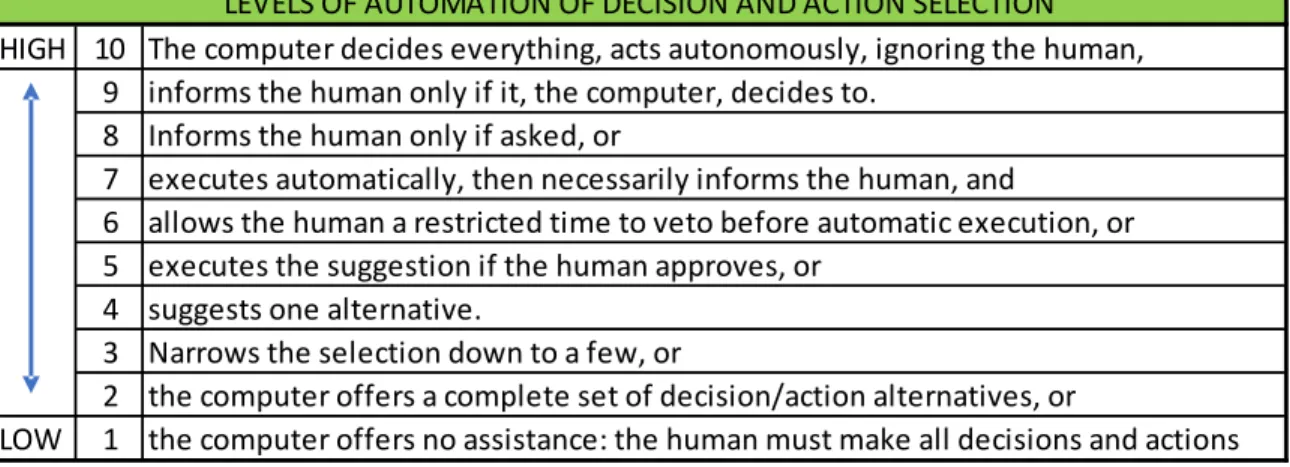
Table 3-1: Sheridan Level of Automation (Sheridan, 2002) ... 49
Table 3-2: SAE Levels of Automation (SAE, 2014) ... 50
Table 3-3: UE Levels of Automation (EPRS, 2016) ... 53
Table 4-1: Blackjack BPN Training Data ... 71
Table 4-2: BPN Only Win/Loss Ratio ... 75
Table 4-3: BPN with FIS ... 75
ix List of Figures
Figure 2-1: Telephone Operators Salt Lake City, Utah circa 1914 (Reyner Media, 2009) ... 12
Figure 2-2: Nortel DMS-100 Digital Multiplexing System (Mudares, 2007) ... 13
Figure 2-3: Joint Cognitive Systems Engineering Chart (Hollnagel et al, 2005) ... 29
Figure 3-1: OODA Loop: Human-agent (Boyd, 1976) ... 38
Figure 3-2: OODA Loop: Machine-agent (Trembley et al, 2017) ... 40
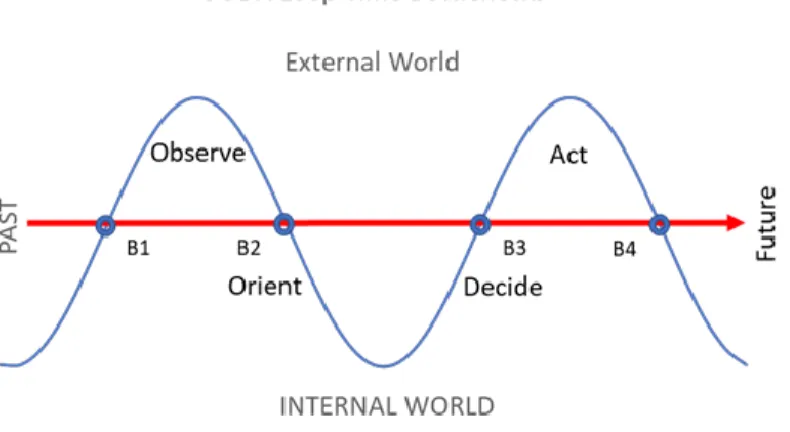
Figure 3-3: OODA Loop Time Bottlenecks (Boyd, 1976) ... 41
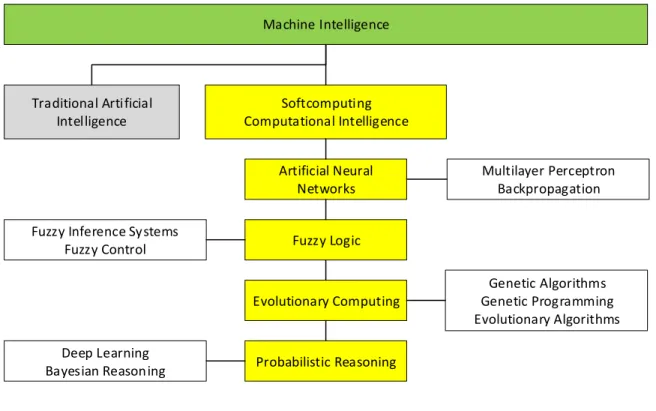
Figure 3-4: Machine Intelligence Tree Diagram (Lewis, 2015) ... 43
Figure 3-5: AI Venn Diagram (Goodfellow et al, 2015) ... 45
Figure 3-6: Four-stage Model of Information Processing (Sheridan, 2011) ... 48
Figure 4-1: Basic Data Flow (Parasuraman et al., 2000) ... 58
Figure 4-2: Human, Software, Hardware Loop Architecture (Trembley, 2015) ... 59
Figure 4-3: Test System Architecture (Trembley, 2015) ... 61
Figure 4-4: Moon Lander Cockpit LabView (Trembley, 2018) ... 63
Figure 4-5: RADAR Image (NASA, 2009) ... 63
Figure 4-6: Video Moon Surface Distant (NASA, 1972) ... 63
Figure 4-7: Video Moon Surface Near (NASA, 1972) ... 63
Figure 4-8: Saitek X52 Joystick ... 64
Figure 4-9: Saitek X52 Throttle Control ... 64
Figure 4-10: Model Based Design Blackjack Player (Trembley, 2016) ... 66
Figure 4-11: BeagleBone with Camera (Trembley, 2017) ... 67
Figure 4-12: Standard 52-card Deck (Shutterstock, 2018) ... 68
Figure 4-13: CCD Camera (Trembley, 2017) ... 69
Figure 4-14: BPN/FIS 2-Inputs 2-Outputs (Trembley, 2017) ... 70
Figure 4-15: Blackjack BPN Schematic (Trembley, 2017) ... 70
Figure 4-16: Trial Input / Output Activations (Trembley, 2017) ... 74
x
List of Abbreviations AI Artificial Intelligence
C2 (C2) Command and Control
C4 (C4) Command, Control, Computer, Communications
C5 (C5) Command, Control, Computer, Communications, Cyber-Intelligence
CAS Collision Avoidance System
CCD Charged Coupled Device
CE Conformité Européenne
CPS Cyber-Physical System CSE Cognitive System Engineering
DARPA Defense Advanced Research Projects Agency
DSS Decision Support System
EMI Electro-Magnetic Interference EPA Environmental Protection Agency
EPRS European Parliamentary Research Services
ESA European Space Agency
FCC Federal Communication Commission FIS Fuzzy Inference System
FSM Finite State Machine
GD Gradient Descent
HIL Human-in-the-loop
HMI Human Machine Interface
I/O INPUT/OUTPUT
IoT Internet of Things
LoA Levels of Automation
LoRV Law of Requisite Variety
LIDAR Light Detection and Ranging
MIL Machine-in-the-loop
MLLR Multinominal Latent Logistic Regression
MPH Miles Per Hour
NASA National Aeronautics and Space Administration NTSB National Transportation Safety Board
PLC Programmable Logic Controller RADAR Radio Detection and Ranging SAE Society of Automotive Engineers
SIL Software-in-the-loop
SEPTA Southeastern Pennsylvania Transportation Authority TCP/IP Transmission Control Protocol/Internet Protocol TUV Technischer Überwachungsverein
UL Underwriter Laboratories
1
Introduction
1.1 Thesis Purpose and Intention
Cyber-physical systems (CPS) covers a diverse range of systemized implementations of smart and intelligent technologies. The term “Smart” or “Intelligent” technology is used frequently in describing systems with the inherent ability of an engineered system to perform complex operations without the requirement of a human-agent (Sheridan, 2011). The terms “smart” and
“intelligent” are relatively synonymous with only varying degrees of interpretation as to an actual agreed upon definition (Lee, 2015). This thesis researches smart and intelligent technologies a domain that refers to itself as the cyber-physical system. The difference between this research and most papers in publication on CPS, is that most of the research focuses on how levels of automation, or autonomy, are designed into the engineered system, and how the levels of autonomy affect reliability and safety of the system. This research focuses on the human-agent, namely an operator interacting or monitoring the system, as being directly affected by shifts and transitions within a system’s levels of autonomy, while the system is under operation (Chen et al, 2011). As the CPS systems become more and more common, the relationship between the human-agent and machine become ever more complex chorography of engineering, science, and cultural (Tweedale and Jain, 2011).
1.2 Cyber-Physical Systems
Definition of Cyber-Physical Systems
The terms and definitions used in the thesis are complicated by the newness and diversification of CPS technologies. The term cyber-physical system was first used in 2006 and is attributed to
2
Helen Gill at the National Science Foundation (NSF) for having coined the term (Lee and Seshia, 2012). The context in which the term cyber-physical system is used refers to a computational system that integrates itself into physical processes (Lee, 2015). This is an extremely generic definition but will suffice. The problem with defining a CPS is that it comes in all sizes, forms, and functions. The argument of when CPS came into existence is controversial. Some experts claim that CPS have existed since the early 1980’s in industrial manufacturing processes using PLC controllers (Lee, 2015). However, other researchers claim that there is a much longer history and deeper history that surrounds the current model of CPS development and that technologies that use terms such as smart or intelligent are mere marketing attempts at making products “sexier.”
This research uses the latter rather than the former viewpoint because the evolution of technology depends on the infrastructure of where science, engineering, and society are currently rather than where or when the idea or invention took place. That is, using machines to offload tasks is essentially the whole point of the industrial revolution, and cyber-physical systems is the latest application that uses microprocessors and microcontrollers. The smarts and intelligence of the CPS is the ability to program by software into the hardware the system’s ability to be reactive to external information (Tweedale and Jain, 2011).
Definition of Cyber-Physical Embedded Systems
Since there is little agreement on the definition of an embedded system, the embedded systems as presented in this research are the few to many smaller systems that interact with larger systems by a collection of smart technologies that interact with the physical system (Lee and Seshia, 2012). The term cyber-physical system, then, will be used throughout the remainder of the thesis to encapsulate the idea of a system in its entirety, and the definition of an embedded system is the component level of the CPS. Because the definitions are general and describe a wide range of system types, the generalization will work adequately to explain the complex nature of
3
the CPS without the need to understand the lower level details of the embedded system’s
structure.
The research in the field of CPS and embedded systems is limited; however, it is growing as both the conceptual ideas of CPS and embedded systems usage expands and is rapidly advancing into every area of daily life (Yarmoluk, 2017). For example, the Internet of Things (IoT) is causing much excitement in the way intelligent technologies are used (Lee, 2015). The IoT is composed of embedded intelligent technologies, and thus is considered the cyber-physical system that integrates smart sensors, microcontrollers, and networking technologies in existing products (Tweedale and Jain, 2011). The IoT forms communication networks that interact as information conduits across multiple types of technology platforms. The IoT architecture is being used and adapted in all facets of industrial and commercial based applications (Yarmoluk, 2017).
1.3 Cyber-Physical Embedded Systems Forms and Usage
The definition of the cyber-physical embedded system is therefore general and is mostly used to
describe a “thing” with intelligence that can interact in both closed and open loop systems (Lee, 2015). The specific nature of such a system is its relation to its application. It becomes an appliance to a larger framework of a System of Systems (SoS). For example, the cruise control in a car is an embedded system that appeared in automobiles around the mid-1950’s. These control systems
were analog and used to maintain a car at a constant set speed. Cruise control systems in automobiles today use computers (Vahidi and Eskandarian, 2003). However, the implementation is not what is important but that the same system exists in many different implementations. What needs clarification then is the system or systemness of what is being described. The definition of system is a wide range and class of “things”forming “relations” with its environment (Klir, 2001).
4
The description of the CPS demonstrates the necessity of viewing the system as a SoS and using the “black box” perspective to form its model, so an attempt to analyze its design can be made (Ashby, 1956). This assumes that the inherent decision-making processes of the CPS, i.e., intelligent system, is in fact operating within design parameters in an environmentally rich input data landscape that uses much of the dominant information to from hypotheses on which to act and react (Chen et al., 2011). In most cases, the external responses of those decisions are only noticed in the observable state. The internal data structures remain internal to the hidden layers that are embedded, and therefore, transparent to the operation of the system. This produces a natural emergent layer of security to the system (Backhaus et al., 2013). The idea of security will be addressed only briefly, but as an abstraction to the ability of the system to defend itself against threat, it becomes a very important topic, but beyond the scope of this thesis.
1.4 Level of Automation in Adaptive Systems
The level of automation is a topic that has relatively disappeared from the literature, which is troublesome because as this thesis maintains, the validation of the system is the demonstration of controlling transient levels of automation (Moradi-Pari et al., 2014). These are adaptive systems. In human factors engineering, the interaction between human and machine is best described as adaptive automation which is thus defined:
…refers to human interaction with electro-mechanical control devices that interact with humans such that the allocation of control function (to either human or computer) changes with time to accommodate changes in the conditions of either the physical environment or the human. (Sheridan, 2011)
This definition somewhat describes the CPS and the involvement of the human-agent with the operation of the system. The problem is with the evolution of the technology that uses “electro -mechanical control devices” to interact with the physical world. This is reinterpreted as the CPS
5
with human-agent in a mix of responsibilities over the system at certain times based on certain conditions (Sheridan, 2011).
The idea that both the CPS and human-agent are decision-making is loosely based on the fact that sensory observation is being used to create or enhance experience. This provides the command and supervisory authority to create actionable events (Chen et al., 2011). In this sense, the case that the system is intelligent is partially made if it were not for the fact that the human-agent is involved. Since the CPS is reactive to the sensory inputs, and the levels of automation are used as a design specification, the reliability and safety factors are determined although not necessarily known. There is a chance of emergent behavior from the system that the designer did not account for. For the system engineer, the system needs to meet or exceed the primary design requirements for the success of the system. The decision-making supervisory controls define the level of automation and become the definition of the system’s architecture and robustness of its design (Parnell et al., 2011).
6 1.5 Propositions of the Thesis
There are three fundamental propositions of this thesis that form the basis of a framework to validate any cyber-physical system in its ability to remain reliable and safe.
Proposition One
The first proposition uses the definition of an embedded system that possesses properties that define cyber-physicality. Decision-making is a general process that leverages the ability of the human-agent and intelligent machine through a physical world of hardware, software, sensors, actuators, controllers, and human physical capital. The first proposition of this thesis is as follows:
Proposition 1: The human-agent and machine use similar principles,
rules, and guidelines to generate decisions that form actions. The combination is a reactive system to external input stimuli and external output response.
The human-agent is the person(s) interacting with the CPS. By interacting, the human-agent is either monitoring or physically providing stimulus to the machine, i.e., information (Ruff et al., 2002). The principal operating guidelines to the decision-making process, or structured source system, are generalized. The application of the system determines the operational state in dynamic conditions that are either discrete, continuous, or a combination of both (Novak et al., 2017).
Proposition Two
The second proposition pertains to the composition of the machine state and is considered the algorithm that the system operates under. It is the use of input states to the internal structure of the machine that form the basis of decision-making. The source structure is the external stimulus of information that is forming knowledge and experience and being transformed into actions. This is how an intelligent system would arrive at the actionable state (Tweedale and Jain, 2011).
7
each being equally capable of making the same decision by using similar decision-making processes. The second proposition of the research is as follows:
Proposition 2: Decisions and actions are only optimal if the system
continues to operate at equal or greater performance to the previous machine-state cycle.
There are many types of decision-making systems that are useful in governmental, business, military, emergency service, air traffic control, etc. decision-making processes (Alippi et al., 2017). The fundamental algorithmic process of decision-making is then deployed on the CPS. Since the CPS bases its performance on collaboration with the human-agent, this is essentially the idea of teamwork because there are at least two decision-making systems involved in a single CPS. This complicates the design paradigm of the system because first, the decisions of the system are not allowed to cause degradation of the overall performance from machine cycle to state-machine cycle; and second, the state-machine’s performance is confined to equal or greater to the last time it performed an action. System performance is the requirement to have a perpetually functioning system that is equal or greater to its start state, which goes against the first and second laws of thermodynamics, so the machine is constantly using information to maintain the appearance of perpetual motion (Kang et al., 2018).
In this case, it is the adaptation to uncertain input states that must be sufficiently dealt with by the system for continuation to the next machine-state cycle. A decision that is optimal sets a maximum to the decision-to-action function. Therefore, this requires the system to have knowledge and experience of “good” and “bad” attributes, which are more qualitative than quantitative. The machine-states then become a probabilistic continuous system and not a directly observable deterministic system. This is the definition of an “Intelligent Machine.”
8 Proposition Three
The third proposition uses, and is derived directly from, Ashby’s Law of Requisite Variety. The law
is stated as follows:
The larger the variety of actions available to a control system, the larger the variety of perturbations it is able to compensate (Ashby, 1956).
The Law of Requisite Variety is also known as the first law of cybernetics (Boisot and McKelvey, 2011). The third proposition is as follows:
Proposition 3: The Law of Requisite Variety remains valid and is
conceptually necessary to the design of test and validation methodologies where the states of hidden variables within a generative system is not known.
This proposition sets forth the test and validation methodology that defines the informational entropy in the system. The knowledge of the variables and their states is not as important as quantifying the informational energy and entropy within the system. That is, the information, known or unknown, hidden or observable, forms the context of the system whose external observation will be used to gain deep insight into the internal machine-state decision-making. The validation only needs to identify the guard bands and constraints of the system’s behaviors that are either consistent or inconsistent with the requirements of the design. To prove the integrity of the system becomes a multifaceted problem of linear and non-linear optimization (Zhang et al., 2017).
1.6 Significance of the Research
In the current era, where the rise and almost intrusive nature of automated systems is becoming extremely advanced, the need to verify and validate such systems as driverless cars, pilotless planes, deep space probes, and other unmanned systems becomes paramount (Wan et al., 2017). Although a driverless car may have an intelligent machine at the steering wheel, it will also have
9
flesh and blood passengers. Turning complex high reliability tasks over to such intelligent automated systems is in the beta-test phase as of the writing of this thesis (Noh and An, 2018). However, the debate on how to prove the reliability and safety of such systems is controversial and loosely defined in many engineering circles. Here the groundwork of a framework is laid down on how to accomplish such an important and difficult task.
The thesis carries forward several paradigms from game, control, and information theory (Backhaus, 2013; Wiener, 1948; Shannon, 1948). One such paradigm is that all information contained within systems will not be made available, and the composite of information that is available will allow certain mathematical properties of the system to be used. The information will need mapping and interpretation that it conforms to the design and model of the system. By defining an autonomous system using an informational based approach, through a good modeling, simulation, and prototyping activity, it will provide the bounds and operational test limits of the system (Sheng et al. 2017). The model only needs to substantiate the keys elements of the design; whereas, the simulation and prototyping need only factor in the possibilities of conditions that have strong causal relations, such as to the external stimuli (Sheng, et al. 2017; Alippi et al., 2017).
1.7 Challenges of Cyber-Physical Systems
The development of CPS requires a variety of detailed expert knowledge concerning the system’s
software and hardware architecture, and how it automates decision-making processes, maintains levels of automations, and the internal and external command and control structure of the system (Chen et al., 2011). It is not enough to understand individual characteristics of the above-mentioned categories, but to understand the complex set of dynamical processes at play in harmonious balance when the system is working well, or the imbalances when it is not. Placing
10
such systems in charge, especially in safety critical applications, has engineering, governmental regulatory, and cultural challenges (Sheridan, 2002).
This thesis exemplifies the use decision-making process at hierarchical levels of automation within the cyber-physical system architectures (Robertson, 2010). By leveraging the human-agent ability to help the CPS react, the design builds in a safety factor; however, this will prove difficult to validate. A framework of verification and validation test methodologies of cyber-physical systems, as well as other autonomous systems that use software and hardware based neural computing techniques will be discussed, developed, and designed (Dundar et al., 2017). This framework will help ensure integrity, reliability, and safety of the system for optimal trust.
1.8 Summary and Overview
The thesis is separated into five sections to form a framework of working knowledge to aspects of solving autonomous design related issues. The literature review discusses the historic, current, and future applications of CPS and autonomous systems. The following four sections give a review of decision-modeling, embedded automation design, and levels of automation architectures. The combination of these sections lays the ground work for the basis of a framework to both real and generalized design. Further, two case studies examine automation in CPS are described, and the inherent problem of how automation is both “friend and foe” to the end user. The case study uses a train accident and a plane accident. The final section proposes a framework for use in modeling and simulating the intelligently designed CPS systems. By applying common tools, the framework will be demonstrated as a standardization of tests for verification and validation of intelligent systems using modeling, simulation, and prototyping.
11
Literature Review 2.1 A Brief History on Cyber-Physical Systems
In the time period from the late 1940’s through the 1950’s, control theory, information theory,
cybernetics, artificial intelligence, and complexity were being discussed and formulated into mathematical equations, scientific theory, and applied engineering applications (Lee, 2015). The first digital computers were bulky, hard to maintain, and slow. However, it was the gateway to the age of the cyber-physical system. Performance of the machine would increase as larger and larger problems would be thrown at it. Psychology, mathematics, biology, and engineering were brought together to research the human-machine relationship by improved means of automation as technologies in materials allowing a continued growth in the power of digital systems from the analogue systems (James, 1953; Wiener, 1948; Sanders and McCormick, 1993; Von Bertalanffy, 1974).
Automation in the early stages of the 21st century has many promising possibilities. Most
machines are now built with some form of automation that adds a layer of ease of use to the machine. From cars to refrigerators to smartphones to GPS devices, the lives of 21st century
denizens have become unencumbered from the drudgery of working with a small amount of information, usually hard to obtain, to having mountains of information, easily accessible but difficult to decipher (Gubbi et al. 2013; Sheridan, 2017). For example, refrigerators can upload grocery lists to a Smartphone, and the Smartphone can notify the car, which makes the recommendation of the store to shop based on traffic flow and produce pricing. Cars are now coming equipped with Lane Change Detection, GPS, satellite radio, cruise control, and Collision Avoidance Systems (Safety, 2015; Katzourakis et al., 2014) The idea of carrying a roadmap in the
12
glove compartment is obsolete. Daily life becomes highly optimized and control by systems embedded within the technology.
The telephone system is a good example of a Cyber-Physical System that has maintained longevity and increased the use of automated technology over a period of a century. The common practice of making a telephone call is a great achievement in the telecommunication technology of the past decade. The telephone has been around since 1887, and the Smartphones of 2017 perform the same basic function as phones from 1900. Here, the technological history demonstrates a basic mapping of automation within a framework of solutions to improve on the existing technology. In Figure 2-1, a telephone switchboard operating room is shown from circa 1914. The women are sitting at the switchboards connecting callers to one another by manually inserting a plug from the caller into the receptacle of the callee.
Figure 2-1: Telephone Operators Salt Lake City, Utah circa 1914 (Reyner Media, 2009)
Essentially, the technology of 1914 was manually and mechanically driven by the telephone operators. When someone called into the switchboard, the caller would ask the operator to simply connect them to the phone number of the callee. The problem is that the expansion of the
13
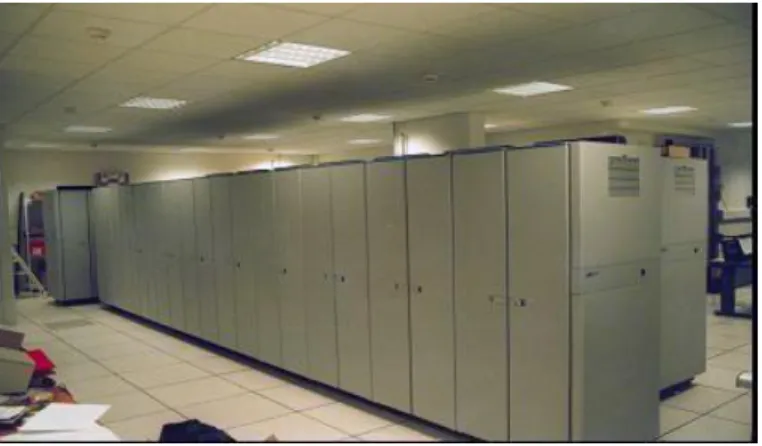
phone system required more and more space for the switchboards, operators, and power systems. The telephone system in this configuration was not very scalable. In Figure 2-2, the Nortel digital switch replaces all the operators by performing the same essential functions, i.e., connecting callers, but with less transparency to how this is being accomplished with end results that are much faster and accurate because of the automation. The switch operates 24 hours a day, 7 days a week for the entire year. Even a rare break for maintenance will not take the whole system offline. It allows scalability from the few hundreds of phones in 1914 to over one-million in 2007.
Figure 2-2: Nortel DMS-100 Digital Multiplexing System (Mudares, 2007)
But the history of Cyber-Physical Systems does not begin there. The first transatlantic telegraph cable was first laid in 1858. A telegraph operator on one side of the Atlantic would send communiqués by Morse code to another operator on the other side of the Atlantic. It would be 100-years further on until the first transatlantic telephone cable was put into service. However, from the isomorphic nature of the technology, the telegraph was in essence a digital communication system. The telegraph operated by sending bits of information in the form of short and long pulses via Morse code. Today, a person making a call from New York to Moabi is converted into a bit stream that is packetized through communication protocols, such as
14
Transmission Control Protocol/Internet Protocol (TCP/IP), a more sophisticated and robust version of Morse code.
The human and the machine became an important area of study in the engineering profession especially during the World War II era from 1939 to 1945. The term “cybernetics” was coined by Nobert Wiener at the Massachusetts Institute of Technology (MIT) (Wiener, 1948). With new technologies and rapid advancement in fields such as aerospace, the importance of the human-machine interface (HMI) was even more closely scrutinized by research using scientific methodologies of descriptive studies, experimental, and evaluation research (Gobbo and Benini, 2013; Sheridan, 2017; Palmer et al., 2003). Job titles such as human factors engineer, ergonomic engineer, and engineering psychologist began to appear in the help wanted ads and became part of the curriculum of engineering colleges and universities. Machines being designed from 1940 onward increased rapidly in complexity, operation, and performance (Zadeh, 2008). The operators of these machines needed to keep up with the learning and training. However, the operators would reach a limit on involvement with the cyber-physical processes. Automating the processes would become the goal to achieve system efficiency and affectedness.
2.2 Classifying System Automation and Autonomy
The term Cyber-Physical System was used circa 2006 and attributed to Helen Gill at the National Science Foundation (NSF) for coining the term (Lee and Seshia, 2012). The CPS computationally integrates itself into a physical process, and although the definition is relatively simple, the difficulty is trying to understand the computational mechanism that underlies that physical system (Lee, 2015). Because of this, a clarification between the definition of autonomy and automation needs to be made:
15
Automation – Any mechanical or electronic replacement of human labor (Sheridan, 2002).
Autonomy - The attribute of a system to meet mission
performance requirements without external support for a specified period of time (Turner, 1985).
In the definition of automation, the term labor is used to mean physical or mental labor. However,
the definition of “mechanical or electronic” device is the “embedded system.” The definition
could read as, “Any embedded system mechanical and/or electronic…” which provides further
clarity of the system’s autonomous designs. An example of an embedded system with mechanical and electronic features would be the television remote. The buttons on the remote would be the mechanical aspect of the system, and the ability to control the channels on a television is viewed as the electronic feature. The user of the remote gains no insight into how the system works, but they can sit on the couch and remotely control the channels to watch without much physical effort. Although using a remote with televisions was a rarity in the first couple of decades of the television, the remote was adopted early on by higher-end models of television and later improved as the television became more digital. Almost no televisions are manufactured that do not require a remote. This is an example of the technology becoming extremely advanced digitally and embedded over time. The human-agent has only to perform channel selection and watching, and with the exception of changing the batteries in the remote occasionally, there is not much else required.
From the above example, it is interesting to note that engineering design in cyber-physical systems has a relation to an economic and social class structure. The early adopters of technologies tend to be high-end products afforded by a wealthy class of consumer, such as luxury car models. The high-end car models have always been accessorized by the latest trends and fashions in technology. For example, although it is hard to imagine a car without a radio and music
16
system, it was common through even the late 1990’s where radios, tape players, CD-ROM drives existed as options and expensive add-ons. Today, the dash board of even economy class cars makes these features standard or part of a service package, such as Bluetooth, General Motors OnStar™ or SiriusXM™. With global positioning navigation, backup cameras, satellite radio, hands free communication, lane departure detection, etc., the functionality of the automobile has radically departed from the idea of a 1910 Ford Model-T. That is, an automobile is no longer a purely functional means of getting from point A to B. It is a fully accessorized extension of existing technologies embedding themselves into the structure known as “car”. And the push to make the car self-sustaining and driverless is the next phase in this evolution (Borenstein et al., 2017).
2.3 Levels of Technology Development
Currently, there is much literature and research in the driverless car technologies and the companies investing in these technologies. The large and well-known technology companies, such as Tesla, Google, Microsoft, Amazon, and Tom-Tom are willing to compete against long time established companies like Ford, BMW, and Toyota for the driverless car market share. The threshold of available technology appears at the precipice of making the driverless car a reality. There are many technical challenges and regulatory hurdles to overcome, but many companies are achieving success in the beta-testing phase (Borenstein et al., 2017; Lazanyi and Maraczi, 2017).
The driverless car technology comes at the high price that it may takes years to migrate the newer autonomous technology from prototypes into all cars. Current driver assistance systems commonly found in high-end vehicles (circa, 2017) are the Collision Avoidance System (CAS), automatic parallel parking, and lane drift warning (Liu et al., 2017; Schnelle et al., 2017; Katzourakis, et al., 2014; NTSB, 2015). Though these three mentioned features will become
17
standard in economy class cars, it will be by governmental regulatory means that the safety standards of all automobiles sold within the United States will be made. This creates the parity between a high-end and economy car. The National Transportation Safety Board (NTSB) has directed automakers to install forward and rear collision avoidance systems and the backup camera in all cars in the next few years. The NTSB states that 80% of all deaths and injuries would have been prevented if such systems were installed (Safety, 2015). So, the question is, “Why not
do it sooner than later?”
The simple answer is economics. A decision is being made purposely by automobile manufacturers to leave low end model cars without the safety features to contain cost. The irony is that everyone shares the same road, and the cars without collision avoidance will still end up colliding with cars with the collision avoidance (Bajpayee and Mathur, 2015). But the technology, although produced and sold circa 2017, is not as mature as the sales and marketing brochures tell. There are different types of collision avoidance systems that have advantages and disadvantages depending on the driving environment. Also, not all CAS has the same performance record and may be more detrimental to the driver who assumes that the system is safe, and therefore, relaxes vigilance (Safety, 2015).
There are three common types of technology used in the CAS. These technologies are essentially the eyes of the car. First, CAS technology can use a LIDAR-based sensor data system. These are fairly accurate systems with fewer false alarms than the other types of technology, but LIDAR systems lack information such as target speed and direction. Speed and direction are critical attributes of a 2-dimensional system in motion (Safety, 2015). Whereas the RADAR-based CAS provides excellent data of target motion and speed, the drawback is that RADAR is easily interfered with by outside sources of electro-magnetic inference (EMI) (Safety, 2015). The third type of CAS technology uses a camera-based data collection system. By using machine vision
18
algorithms, the car sees what a human would see; however, the ability of the algorithm to interpret the captured data and turn the data into speed and distance determines the performance quality of a camera-based CAS. The camera-based CAS is limited to the same factors of human vision such as conditions of poor visibility (i.e., rain, fog, night time, etc.). So ideally, it would seem the design solution should include all three CAS; however, the complexity of such a system would be formidable, and the reliability uncertain. Based on the above discussion, automation challenges the available technology to be able to deliver results that are optimal in terms of good reliability and safety metrics (Young et al., 2017). By defining the autonomous systems at a particular level of automation, the descriptive language that classifies the roles and responsibilities of human-agent and machine-agent will lead to the expectation of performance and operation of any cyber-physical system. The test methodology frames the validation measures necessary to prove the such system requirements (Young et al., 2017; Parasuraman et al., 2000; Sheridan, 2011).
2.4 Usefulness of Autonomy
In a different mode of autonomy, deep space exploration also leverages the use of automated systems. The reason for this is simple. The communication time between Earth and the deep space probe gets longer as distances grow between the two. Radio signals, even at the speed of light, become so delayed that working in anything close to real-time system is impossible. The communication turn-around time could be in the neighborhood of hours and days as in the cases of deep space probes such as New Horizon, Cassini, and Voyager (Reinholtz and Patel, 2008; NASA, 2015; Popken, 2007). Additionally, if data is coming from a deep space probe, the bit-rate (baud) determines the amount of data that will be received per unit of time. This could potentially constrain the system as much more data could be collected than downloaded, especially when
19
high resolution pictures are being sent. So, it is critical to get the memory storage system optimized because radio carrier frequencies used to transmit data over the vast distances of space are low frequency, meaning, less bits are transferred per unit time than if the signal were at a higher frequency.
The propagated communications delay between Earth and a space probe creates the environment where autonomy built into the probe is essential. The probe may need to detect, orient, make decisions, and take actions that are necessary to keep the mission safe. For instance, the New Horizon mission is a deep space probe that reached Pluto in 2016. The distance the probe had to travel was a staggering 3 billion-mile journey that took over 9 years. The probe travelled at a speed of approximately 50,000 mph and approached Pluto and its moons for a one-time encounter before hurtling into the deeper regions of the Kuyper Belt. The near approach to Plutonium System was an event that only took 4 hours to complete before it was all over. At a distance of 3 billion miles, communications take a little more than 5 hours one way. The quickest message turn-around time was approximately 11 hours. Because so little was known about the Plutonium System (uncertainty), the probe was essentially communicating back to Earth the pictures of what lay ahead in its course. The telemetry of the positions of Pluto, its moons, and anything else that might be in the path of New Horizon was a guess. Since no Earth based telescope had the resolution to provide navigation information to New Horizon, the navigation system was control by the probe. The probe sailed through the Plutonium system without incident, all the while collecting data by being able to point the scientific equipment on board with pinpoint accuracy (NASA, 2015).
This is considered a Level 5 type of automated system (SAE INTERNATIONAL, 2014), except that the maneuvering plan for the New Horizon flyby was automated based on the predefined mission parameters and was adjusted in the last months before the Plutonium encounter. However, New
20
Horizons would autonomously fire its maneuvering thrusters to gain the best angles for the scientific equipment it was carrying. The flyby needed to happen without real-time coordination from ground control because of the distance to Earth. Once New Horizon cleared the Pluto systems, it would take nearly a year and a half to send all the data to Earth that it collected from the 4-hour encounter (NASA, 2015).
Aviation systems safety and accident investigation has been a vast field of research for well over 100 years. The accident investigations become a forensic tool to understand design problems in a CPS. Since the early age of heavier than air aviation, autonomy has been used to assist and aid in the control of the aircraft. The first autopilot was used in 1914, just ten years after the Wright
Brothers’ first flight. Automation remains a top priority to embed into any cyber-physical system. For example, a B-2 Stealth Bomber is a plane that will not fly without computers and other autonomous control systems. These systems control and supervise the aircraft in flight and are outside the range of the pilot’s need to adjust. On February 23, 2008, the United States Air Force lost a $1.4 billion-dollar B-2 as a result of improperly calibrated sensors that the aircraft computer interpreted as correct. The input sensors caused a mismatch between what the automated system was interpreting and what the aircraft was doing. The pilot had no chance to react during takeoff when the plane suddenly flew itself into the ground (USAF, 2008).
The term human factor is used to define the human-agent as an entity that interacts and provides feedback to keep the system operational. In aviation, the operational state is the management of the operation being performed based on the level of criticality (i.e., landing, taxiing, embarking, takeoff, etc.). An example of human-agent and machine interacting poorly happened on June 1st,
2009 when Air France Flight 447 from Rio de Janeiro to Paris, France crashed with the loss of 216 passengers and 12 crew. The events that led up to the crash were barely notable. However, in the matter of minutes, the plane was flying through heavy weather, which is normal for the latitudes
21
at the equator, but suddenly the plane’s autopilot disengaged. The plane essentially gave control back to the pilots. (This is a transient down-shift in the level of the automation). However, there was no indication of why the autopilot disengaged, because all instruments appeared normal, except air speed. The air speed indicated that the plane was flying too slow at a very high cruising altitude. The aircrew had control of the plane but were unaware that the airspeed pitot tubes had frozen over. The air speed indication from the flight computer was mismatched to the actual speed of the aircraft. The sensor data was being reported in error. The crash investigation determined that this problem should have been easily recognized by the aircrew. The plane at the time before the crash was operational and safe, but for unknown reasons, the aircrew accelerated the plane, and essentially put the plane into a fatal non-recoverable stall at speeds at an altitude outside the performance limits of the aircraft. The investigation that followed concluded that training of the aircrew was insufficient, and that the plane did not have redundant air speed sensors (BEA, 2012).
2.5 Developing a Cyber-Physical Autonomous System
Science and engineering from the late 1940s onward has brought about many changes in fields that use automation and autonomy in a variety of disciplines such as astronomy, mathematics, computers, aerospace, etc. There is a distinct definition of what the term autonomous means for science and engineering. When speaking about autonomy, the definition of choice is the one used by the aerospace industry:
The attribute of a system to meeting mission performance requirements without external support for a specified period of time (Reinholtz, 2008).
22
The research concerning the design of engineering systems that embed autonomous features into the design has initiated debate for more than 50 years (Sheridan, 2011). Using Sheridan’s
classification of autonomy (Table 3-1), design engineers are required to describe and discuss the motivations for choices being made for the design. These choices will inevitably impact the design functionality as related to cost, schedule and quality. If planning for a design with some or all automation, three types of distinctions need to be made (Sheridan, 2002):
1. Command and Supervisory Controls
2. Modes in which the automation is to be used 3. The Failsafe
The first distinction is about who or what is in control during normal operation, and who or what is in control during an actionable event. For CAS, automation is fully implemented from the system, that is, the CAS has full command and control when it detects a possible collision event. In normal operation, the system is monitoring and during the actionable event the car is braking. The human-agent is at all times driving the car, but the CAS can go into operational mode within milliseconds of the possible collision (NTSB, 2015; Vahidi and Eskandarian, 2003; Schnelle et al. 2017).
A cyber-physical autonomous system by definition has decision-making capabilities. There is either a linear or cluster of details that define what actions the system is to take based on sensor data input (Noh and An, 2018). But herein lies the cleverness of cyber-physical system design. The human-agent is part of the system as well as the machine. As levels of automation become greater and more complex, as defined by the requirements of the system, the algorithms and types of Artificial Intelligence (AI) used in design become more difficult to test, especially when an automation level is transient and can shift upward or downward unexpectedly (Sheridan, 2002;
23
Chen et al., 2011). This is the software of the system, and in the strictest sense, software source code coverage and cyclical complexity measures become very unclear whether the use of a probability-based machine model can be reliably tested and guaranteed safe. If the system optimizes for the choice of best decision, what will the system truly do once the threshold of an activation point is reached or exceeded? This is where the case of the human-agent as a variable within the equation of the CPS is slightly different from the machine’s role. The decision whether to interact either partially or fully with the machine is an uncertainty. It is based on human-agent state conditions like training and alertness (Parasuraman et al., 2000; Sheridan, 2011).
The second distinction implies whether the level of automation is optimal for the system. Implementing automation into a CPS may only achieve a level of novelty, but again, it may have adverse effects. This is, of course, why testing is crucial. For example, if the design is to contain an internal monitoring system, and the system does not achieve the performance metrics necessary to be implemented, much time and money could go into fixing a bad design, making one that is barely adequate. The case of Volkswagen (VW) emissions testing is a case in point. When VW was testing the emission system standards for diesel cars, there was a precipice drop of engine horsepower with the emissions system “on”. However, VW used the data with the emission
systems “on” to report to the Environmental Protection Agency (EPA), but turned “off” the
emissions system when the cars went to dealerships. The clients of VW’s enjoyed the exceptional horsepower of environmentally friendly diesel cars, when in fact, the cars were polluting the air far beyond the regulatory limits set by the EPA (Mansouri, 2016; Blackwelder et al., 2016). The third distinction of a failsafe is simple. In the event that things go terribly wrong, can the system recover? Again, this is where the knowledge of environmental conditions coincides with the internal operation of the CPS to provide controlled responses that keep the CPS operating safe at the equal or better performance prior to the event (that is, Proposition 2). In the case of
24
the CAS, the driver of the car has the ultimate say in the matter, as the CAS can be turned off. The driver is, by the design, the failsafe (Petit, 2009).
2.6 The Taxonomies of Levels of Automation
The taxonomies for defining levels of automation are numerous and growing (Sheridan, 2002; ASME, 2012; EU, 2015). There are many similarities in the various definitions of levels of autonomy continuously revisited by designers of autonomous systems. The refinement is based on the science and an engineering acumen of autonomous systems need for both a specific and general purpose. Automated systems are improving and becoming more numerous. The embedded processors and microcontrollers that these systems use have more computational power, higher digital-analog resolutions, faster communications channels, and low power consumption, than just a decade ago. In the embedded autonomous system world, the realm of sensors and data streams is getting more powerful, cost effective, and reliable. The Internet of Things (IoT) revolution that is currently being acknowledged by most technologists as the next growth industry will revolutionize by automating processes through the linking of systems together over a network fabric. IoT is embedding itself into an already existing infrastructure that forms a tapestry of digital information (Yarmoluk, 2017; Gubbi et al., 2013).
The notion that small computer-like systems being used as part of the layer of monitoring and servicing a larger system in scalable designs is not new. The idea of embedded systems has been
around since the 1970’s. However, there has been impracticality to using embedded systems. Previous generations of embedded systems have been computationally under-powered, expensive, and unreliable to operate. Also, because of the low level of automation used in systems in the past, most autonomous systems were for the most part unnecessary and added very little to the design. This notion has changed in the last few years that parallels the evolution of cell
25
phone technology. It can be shown that the benchmarks of cost, computational power, and reliability has been achieved to allow this technology to become a part of everyday systems. This
essentially is the formation of the “Internet of Things” (Chen et al., 2018; Dhanalaxmi and Naidu, 2017; Gubbi et al., 2013).
The agent-based frameworks within these designs are very complex. There are many different types of agents that could be discussed: mobile, intelligent, software, information, etc. (Tweedale, 2012). The word “agent” means anything that interacts with the system and/or its environment. In this research, the consideration to the human-agent with the embedded system is implied. The human interacts with the system in a monitoring task or performs an action task that is required to keep the system operational.
2.7 Testing Architectures for Command and Control
The testing architectures for automation, especially where the human-agent takes command and control within the higher levels of autonomy, complicates the design, and therefore, its testability. Rarely is there an agreement for the type of testing architecture that implements and engages a technology framework that covers all facets and forms. There will be gaps or loss of test coverage based on unknowns and assumptions made. The information within the system exists, but it is hidden and does not advance the knowledge of the system (Shannon, 1948).
This is due to the informational loss within the system. The system is a black box (Ashby, 1956). However, by understanding the requirements of the design, and being able to provide test plans that have knowledge of the system performance in the environment, the cyclical complexities of the software (software-in-the-loop) and firmware (hardware-in-the-loop) to the properties of the system, (meaning, the execution of software in conjunction with the firmware) become
26
inextricably intertwined and abstract. The external stimuli input will invariably cause different outputs as the complexity of the system gets larger. The software and hardware states are controlled through the pre-emptive and cooperative multitasking of the systems (Reinholtz and Patel, 2008; Ryan and Cummings, 2016). Additionally, defining the CPS model as discrete or dynamic, state-transition or time-transition, is analogous to trying to understand Maxwell’s
Demon or Schrödinger’s Cat for these systems.
2.8 Cyber-Physical Systems in the Real World
The concern is the command and control structure of the CPS. The case studies will demonstrate the importance of a command and control (C2), and the consequences that erupt when the system
is not used properly. Command and control is a large area of research across many different systems. The US Department of Defense uses a term called C4, C5, or C4+1 ISR (Command, Control,
Computers, Communications, Cyber, Intelligence, Surveillance, and Reconnaissance) to formulate decision making in strategic and tactical military environments (Arne, 2000). The C4 model is also
used in business and emergency services decision-making systems. Essentially, in any system reacting to its environment, the more complex and diverse the system is, the more sophisticated the decision-making capabilities are required to perform predefined algorithms offloads to the decision-making authority. This becomes the high-level architecture and design of a Decision Support System (DSS) (DHS, 2002; National Research Council, 2006; Arciszewski, 2009).
For example, the computer center would be collecting data for fighting forest fires (i.e., wind, humidity, available area responders, equipment on hand, ground reports, etc.). The computer uses the variety and complexity of the information to make recommendations, such as allocating firefighting resources to an area, or predicting the spread of a wild fire based on wind conditions (DHS, 2002). Systems such as these improve safety and reliability for both responders and
27
bystanders. Responders are allocated to where they are needed most, and the bystanders can be guided away from the potential threats wild fires bring.
The command and supervisory control structure within the design of the CPS has to be carefully mapped out, fully documented, and rigorously tested. For example, the use of “watch-dogs” in CPS are essential to its effectiveness. The watchdog is essentially a timed interrupt to the system where an event has not occurred. If servicing the watchdog fails to occur before time expires, the watchdog will fall into a different set of routines that are not part of the normal operation. However, the problem is twofold and does matter whether the CPS is time or state controlled. The watchdog expires because something happens on the system that prevents the watchdog from being serviced, and the system has to find a recovery path. The command handler, based on the state or time transitions, will perform certain tasks to recover the system. That is, the system should be designed to recover. The control structure is what interacts with the system’s environment. So, based on the needs of the command handler, the control system will interact with sensor and effector to carry out the instructions.
Communication is the single most complex standard to any system (Klir, 1995). Signaling is how a network of systems communicate with one another. How systems communicate with each other is part of the initial design of the system, and without radical redesigning, remains a permanent infrastructure to the lifetime of the design. The CPS consists of the software-in-the-loop, hardware-in-the-loop, and a human-in-the-loop. Using the adopting principles of cognitive psychology and human factors engineering, there is an enormous opportunity to identify and solve problems where learning, memory, attention, and perception are concerned. The development of machine intelligence in artificial systems is isomorphic to that of human intelligence. In the design of machine intelligence, terms like neural networks, genetic algorithms,
28
etc. are used to describe the machine intelligence from an animal intelligence perspective, essentially mapping natural systems onto artificial ones (Holland, 1975).
2.9 Multi-disciplinary Approach of CPS
At the nexus of cognitive psychology, systems engineering, and design engineering is an engineering discipline called joint cognitive systems engineering (CSE). By using multidisciplinary approaches to problems of human factors engineering, the design of systems (i.e., software, hardware, interface, space, etc.) uses certain principles and guidelines to improve and leverage through the arrangement and augmentation of internal and external features – switches, displays, lights, software, hardware, etc. Training is a learning process by which both the machine-agent and the human-agent interact with the CPS to reach the full potential of the design. Keeping the performance of the CPS within safe limits during operations for which it was designed reduces the risk of unwanted occurrences happening, i.e., faults (Kang et al., 2018; Martin et al., 2014; Novak et al., 2017).
For example, an elevator that has voice control will detect passengers stepping into and out of the elevator. The elevator would ask which floor the rider would like to visit and would inform the rider once the elevator reached the desired floor. But is this a good design choice of automation? If the rider does not understand the language of the voice system, cannot speak to the voice system, or cannot hear the voice system, the voice system becomes irrelevant. The designers of the system assumed that all riders would understand the language, would speak back to the request of the automated system, and could hear the voice from the automated system. However, if the rider did not understand the language or how to control an elevator, the elevator and rider would remain in a virtual deadlock. The rider is then assumed by the designer to understand how to use the elevator’s manual system. Currently, there are very few human elevator operators, but
29
in the not too distant past, the job description of elevator operator was found in the help wanted ads. Today, elevators are almost all exclusively automated. The economics of having a person as an elevator operator is no longer feasible. The elevator designers have leveraged the assumption that human agency is competent to use an elevator as designed. The human-agent boards the elevator and pushes the button to the desired floor. The machine-agent of the elevator’s
automated control systems close the doors, and proceeds to the desired floor while stopping along the way to pick up other passengers. The passenger is only singly tasked whereas the elevator is multitasking.
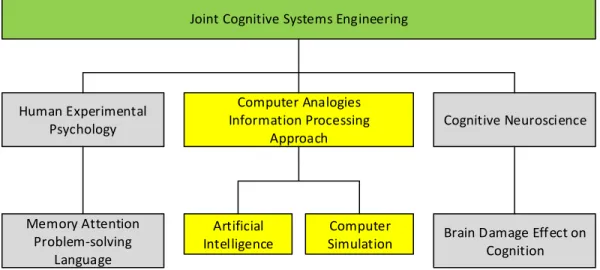
Cognitive psychology is a branch of psychology that concerns itself with mental processes such as learning, memory, language, perception, creativity, problem solving, and thinking. The cognitive psychology that is of interest here is the branch consisting of computer analogies (Figure 2-3). The middle branch of Figure 2-3 is concerned with approaches to intelligence that are most apt to be used in the internal development of the intelligent machines. This is especially the case when computer algorithms are used to create artificial intelligence that mimics human behavior, like in robotics (Chen et al., 2011).
Joint Cognitive Systems Engineering
Human Experimental Psychology Computer Analogies Information Processing Approach Cognitive Neuroscience Memory Attention Problem-solving Language Artificial Intelligence Computer
Simulation Brain Damage Effect on Cognition
30
Cognitive psychology is the integration of all these aspects into a framework attempting to describe what it is to be human from the perspective of experience. In the mid-20th century, with
new technologies concerning warfare being developed, cognitive psychology was at the forefront of this research to understand human performance with newly designed machines. The designers needed to know a person’s aptitude to operate the system. One of the first key aspects discovered was that training and attention were extremely important. Attention to the indicators and the actions necessary when situations arose needed to be dealt with quickly. This was especially the case in aerospace design (Casanova et al., 2014; Tweedale and Jain, 2011).
Recognizing and reacting to the system when the system is operating normally is much different than reacting to the system under duress (Smets et al., 2010). It is bridging this understanding with the design, especially in the initial phases of the design, that becomes extremely important (this is why modeling and simulation are very important at the preliminary design phase). For example, if a person is told to monitor a light on the panel, the person has to know what the light means, and what to do about it when it either comes on or goes off. This is the learning and memorization activity that the person acquires in order to have knowledge of and control the
system. There lies the simplest of problems with a design: the requirement. “What is the requirement of the light, and what is the person to do if the light blinks?” This example is level 3
in the Sheridan’s Level of Automation. If the light blinks, the operator needs know what actions to perform. The scenario goes like this, “What if after performing the action the light is still
blinking?” Is the operator going to have enough knowledge of the system to properly assess the
situation? Or is it beyond the normal operating strategies and standard operating procedures? Also, what is the safety factor involved? Should the person take flight or fight the response to the system? In any design that leverages the human-agents, it is essential to have an operator who is trained and experienced. This prevents the operator from being subjected to situations beyond
31
their cognitive skills and abilities to command and control the CPS (Tweedale and Jain, 2011; Sheridan, 2011).
Design and systems engineering are multidisciplinary fields within the context of engineering disciplines. The attempt to identify and apply good design and processes is a result of experience and knowledge from several other disciplines, such as construction, mechanics, electricity, chemistry, etc. The system engineer derives requirements of the system where the human-machine interface is concerned based on the specification set by the end user. In essence, the system engineer would be the cognitive systems engineer (CSE) in embedded CPS designs. The strategies employed would be to recognize and define all confluences to the design through an adaptive activity of the modeling, simulation, and prototype testing (Chen et al., 2011; Klien et al., 2004).
The CSE identifies the interface that is necessary to allow for performance, safety, and knowledge to improve adaptive activities between the human-agents and machine-agents. Through good system development of interfaces of control panels, software, ergonomic design, teams, etc., the establishment and certifications can be obtained for the CPS. The amount of operator training and education that allows for the safe and optimal performance of systems is paramount to success. In applying these preliminary adaptive design activities, the development of the system goes through three phase concurrent process of design, analysis, and evaluation (Wang, 2016; Rovere et al., 2016).
2.10 Future Growth and Consequences
Understanding how the human-agent relates to the environment is a growing concern in the world of automation. The desk jobs of accountants, computer programmers, and administrative