Research Notes
Issue 43/January 2011
A quarterly publication reporting on research, test development and validation
Senior Editor & Editor
Dr Ardeshir Geranpayeh & Dr Ivana Vidakovic´
Editorial Board
Dr Nick Saville, Director,Research and Validation Group, Cambridge ESOL
Nigel Pike, Head of Assessment, Assessment and Operations Group, Cambridge ESOL
Production Team
Caroline Warren, Research Support Administrator Rachel Rudge, Marketing Production Controller George Hammond, Design
C A M B R I D G E E S O L : R E S E A R C H N OT E S : I SS U E 4 3 / J A N U A R Y 2 0 1 1
|
1©UCLES 2011 – The contents of this publication may not be reproduced without the written permission of the copyright holder.
Research
Notes
Editorial Notes
Welcome to issue 43 of Research Notes, our quarterly publication reporting on matters relating to research, test development and validation within Cambridge ESOL.
The use of technology in language testing dates back to 1985 when the Language Testing Research Colloquium (LTRC) chose this theme for its annual conference. The very first
Research Notesissue, published in 2000, contained an article on the use of computers in the
Local Item Banking System at Cambridge ESOL. The theme of the use of technology was continued in issues 12 (2003) and 23 (2006) which addressed the relationship between technology and language assessment within Cambridge ESOL examinations. This issue of
Research Notesis dedicated to the latest developments in technology harnessed for the
purposes of language assessment at Cambridge ESOL.
The opening article by Sharon Jordan, Glyn Hughes and Cris Betts provides a broad overview of the use of information technology at Cambridge ESOL, discussing the associated benefits, issues and practices. The following three papers discuss the technological systems which support and facilitate the work of the external professionals who work on Cambridge ESOL examinations. Chris Hubbard outlines the development and impact of the Cambridge ESOL Professional Support Network (PSN), currently used for the co-ordination and standardisation of Speaking Examiners. Juliet Wilson and Murat Velioglu’s article on Connect, a system through which computer-based tests are run, shares with us the benefits of the system from the perspective of test centres. Margaret Cooze’s article on scoris®discusses the advantages of
onscreen marking as well as the issues considered and addressed. The remaining papers are concerned with validation activities of computer-based (CB) and computer-adaptive tests from a variety of perspectives. Picking up a thread from Cooze’s paper, Ardeshir Geranpayeh
investigates onscreen marking via scoris®from a different angle, examining the comparability
between onscreen and paper-based marking. Lucy Chambers and Kate Ingham outline the aspects of development of the BULATS Online Speaking Test, focussing on a proof-of-concept trial and alignment to the Common European Framework of Reference (CEFR). Following that, Lucy Chambers investigates the composition and revision strategies of a cohort of candidates who took the Business English Certificate (BEC) VantageTest of Writing in the CB mode. Using an innovative method of data collection – the capture of the writing process through snapshots over the course of the test – Lucy explores the extent to which the assets of the CB medium are utilised during writing and how composition and revision strategies relate to the writing score achieved. Last but not least, Laura Cope and Andrew Somers discuss the challenges of paper-based pretesting and show how these challenges are addressed through a system of online pretesting in the context of computer-adaptive testing.
We finish this issue by reporting on the conference season and events Cambridge ESOL has supported. Ardeshir Geranpayeh reports on the HR Magazineconference (Hong Kong, July 2010), while Evelina Galaczi briefs us on the BAAL TEA SIG conference (Nottingham, November 2010). Angeliki Salamoura and Martin Nuttall report on the English Profile Project and ALTE events respectively. Finally, Lynda Taylor provides a brief on the latest volume in the SiLT series.
Editorial Notes 1
Technology in assessment: Sharon Jordan, Glyn Hughes and Cris Betts 2 Cambridge ESOL Professional Support Network Extranet: Development and impact:Chris Hubbard 6 Using Connect: The test centre perspective: Juliet Wilson and Murat Velioglu 10 Assessing Writing tests on scoris®: The introduction of online marking: Margaret Cooze 12 The impact of online marking on examiners’ behaviour: Ardeshir Geranpayeh 15 The BULATS Online Speaking Test: Lucy Chambers and Kate Ingham 21 Composition and revision in computer-based written assessment: Lucy Chambers 25 Effective pretesting: An online solution: Laura Cope and Andrew Somers 32
Conferences and publications 35
Introduction
Technology in assessment and Cambridge ESOL’s
application of developments in technology are themes that have recurred many times over the years in Research Notes. Issue 1 of Research Notesin March 2000 contained an article showcasing a newly developed software application for the hosting and maintenance of all Cambridge ESOL test material and metadata: Local Item Banking System (LIBS) (Beeston 2000:5). The main benefits of this new technology put forward in 2000 mirror the benefits we continue to aim for today via technology: greater efficiency, improved and harmonised processes and ability to meet the changing needs of those who use our assessment services.
Information Technology has moved on rapidly since March 2000, and indeed has come a long way since the last issue of Research Notesdedicated to technology in May 2003. Vast improvements in internet connectivity worldwide in addition to increases in connection speeds have made it possible to deliver a significantly broader range of content over the internet. This, combined with the increasing processing power of the modern computer and its increasing prevalence in offices, schools, colleges and indeed homes, has made this broad range of content accessible to an ever wider audience.
Throughout this time, Cambridge ESOL’s use of
technology in assessment has also expanded significantly, from the growth of computer-based testing to the
introduction of onscreen marking, online results and online results verification. Although the use of technology in our assessment services has increased dramatically throughout this period, the principles underlying them have remained the same. Cambridge ESOL’s approach has focused on: • increasing choice
• improving the service we provide to centres and candidates
• maintaining and improving the quality of our exams. This article provides an overview of how these principles are reflected across the developments that have occurred. This theme is then taken up in more detail throughout this edition of Research Notes.
Computer-based testing
From a candidate’s perspective, the most obvious
application of technology to assessment is computer-based (CB) testing. Technology applied to testing in the form of offering candidates tests via computer aims to make assessment more appealing, efficient and serviceable (Chalhoub-Deville 2001) and brings with it many
advantages, including a positive impact on those who enjoy using computers, ease of administration, speed and reliability of marking, greater security, greater motivation to some candidates and arguably a more friendly interface than paper-based tests.
Cambridge ESOL has been producing computer-based tests since the mid 1990s, when Communicatand CB
BULATS (Business Language Testing Service), both
innovative computer-adaptive language tests using an award-winning algorithm, were first introduced on CD-ROM. Ten years later, computer-based BULATSis one of
Cambridge ESOL’s most popular tests and is now taken online, on demand worldwide via a high specification online test administration and delivery system. This test administration and delivery system has also been extended to offer other assessment services such as online
placement tests. Advances in technology have made life easier for test administrators who now simply need to log on to the testing system to run tests 24 hours a day, 365 days a year. There is no longer a need to order tests in advance of the test date or for installation of CD-ROMs or other software, and test results are available immediately. Cambridge Assessment’s specially developed computer-based test delivery system ‘Cambridge Connect’ was launched in 2005 with a computer-based version of
Cambridge English: Preliminary (PET). Cambridge Connect
interfaces with Cambridge Assessment back-end systems to allow a smooth end-to-end testing process from test creation on LIBS to test delivery to results availablity on ESOL Online. There are now 11 Cambridge ESOL examinations on Connect, with plans for more including International English Language Testing System (IELTS),
Cambridge English: First (FCE) for Schoolsand Cambridge
English: Proficiency (CPE)to be added in the near future.
Technology in the form of CB testing is giving candidates more choice in terms of the test delivery mode but also in terms of when they take tests, with CB testing allowing Cambridge ESOL to now offer almost 700 test sessions a year. Supplementing paper-based (PB) assessments with computer-based versions has also enabled Cambridge ESOL to improve the service we provide by significantly reducing turnaround times. Candidates can enter for CB tests as little as one week before the test date and get their results just two weeks after they have sat their test.
Cambridge ESOL’s approach to CB testing has always been to use CB platforms to increase the choice available to candidates and to provide tests that are fit for purpose: not to replace existing paper-based tests but to continue to offer paper-based versions of tests while also giving candidates the opportunity to take the test on computer if this is the candidate’s preference (Blackhurst 2005, Jones &
2
|
C A M B R I D G E E S O L : R E S E A R C H N OT E S : I SS U E 4 3 / J A N U A R Y 2 0 1 1Technology in assessment
SHARON JORDANASSESSMENT AND OPERATIONS GROUP, CAMBRIDGE ESOL GLYN HUGHESASSESSMENT AND OPERATIONS GROUP, CAMBRIDGE ESOL CRIS BETTSASSESSMENT AND OPERATIONS GROUP, CAMBRIDGE ESOLC A M B R I D G E E S O L : R E S E A R C H N OT E S : I SS U E 4 3 / J A N U A R Y 2 0 1 1
|
3©UCLES 2011 – The contents of this publication may not be reproduced without the written permission of the copyright holder. Maycock 2007). All of Cambridge ESOL’s CB tests on
Cambridge Connect are computer-based equivalents of existing paper-based tests. The format of the test is the same on computer as on paper; it is simply the delivery method that is different. A major driver for having CB tests as additions to paper-based (PB) tests rather than replacements for them is the notion of bias for best (Jones 2003:4). In the early days of computer-based testing, there were concerns that construct irrelevant variance may be introduced as a result of familiarity with computers becoming a feature of what is being tested (Huff & Sireci 2001). However, as familiarity with computing has increased, concerns have also focused on whether
handwritten responses are the most appropriate way to test writing (Russell & Haney 2000). Research into this field continues, as evidenced by Chambers’ article (Chambers 2011 in this issue), which focuses on whether candidates make use of the potential benefits offered by composing written texts on a computer. By producing parallel CB and PB tests, we give candidates the opportunity to select the medium in which they feel most comfortable.
However, having two different test delivery modes for the same test on offer simultaneously, where the results from both modes are presented as comparable, brings its own issues and has necessitated continued research into the comparability of PB and CB testing. There has been extensive research in this area; see for example, Choi, Sung Kim & Boo (2003) and Taylor, Jamieson, Eignor & Kirsch (1998), as well as studies on paper-based and computer-based IELTS(Blackhurst 2005, Green 2004, Green & Maycock 2004, Maycock 2004, Maycock & Green 2005, Shaw, Jones & Flux 2001, Thighe, Jones & Geranpayeh 2001), computer-based BULATS(Jones 2000) and computer-based PET(Hackett 2005:12). As it stands, research generally concludes that test results are equivalent across test modes, and Cambridge ESOL’s position is that candidates’ interests are best served by offering them choice: ‘Generally, we should agree that fairness will be best served by ensuring that candidates can choose the test format which they believe allows them to demonstrate their ability to the full – a “bias for best” approach’ (Jones & Maycock 2007:12).
Indeed since these studies were carried out, computer systems have progressed and people have become much more used to dealing with text onscreen, so it is reasonable to assume that some of the extraneous variables which may have existed in these studies (e.g. quality of onscreen text or participant familiarity with computers) should be less of a factor today, and hence there is greater likelihood that test scores across PB and CB modes of tests are even more comparable now than in the past.
In terms of test delivery, Cambridge ESOL has taken different approaches depending on the precise nature of the tests involved. The exams delivered on Connect, including Business English Certificates (BEC), Cambridge
English: Key (KET), Cambridge English: Preliminary (PET),
Cambridge English: First (FCE)and Cambridge English:
Advanced (CAE), are linear tests. These tests aim to build
up a detailed picture of candidates within a relatively narrow ability range. As such, they are well suited to
rigorous task-based assessment that tests a broad range of sub-skills at a given level. In addition, the high-stakes nature of these tests means rigorous security features are essential for running tests and tests must run with a very high degree of reliability. This means that, although Connect tests are delivered to test centres via the internet, they are administered to candidates offline via a centre’s Local Area Network (LAN) and using software installed on local computers. This gives the increased confidence and increased security required for higher-stakes testing. Wilson & Velioglu (2011 in this issue) report in more detail on experiences of test centres using Connect.
With BULATS, a different approach was taken. In 2009, an online version of CB BULATSwas launched. Unlike the tests delivered on Connect, BULATStests are delivered fully online via a web browser. The major advantage of this approach is that it requires no software to be installed. This is an important factor for BULATSas tests are taken in a wide range of locations, including company premises. This delivery method also works very well for computer-adaptive tests such as BULATSas a large item bank can be hosted and maintained at Cambridge Assessment with items drawn down from the bank in real time as candidates take their tests.
With the benefits of technology also come the drawbacks and, as Bachman (2000:9) points out: ‘The challenge in applying (such) technologies to language assessment will be to recognize not only the potential benefits but also the limitations of these technologies.’
One of the great challenges of an online test is the internet itself and its variability worldwide. Although a solid system can be built, it is also essential to consider issues such as bandwidth, latency, firewalls, PC configurations, etc. Whilst some of these cannot be controlled, technology itself can enable greater information and automated checks before tests are administered. Both BULATS Onlineand Connect systems continue to explore and use new technologies to enhance these services.
The coming year will see a major technological innovation for Cambridge ESOL with the impending launch of an online Speaking test, a first for Cambridge Assessment. Chambers & Ingham (2011 in this issue) detail the extensive trialling that went into producing the BULATS Online Speaking Test. Although, by its nature, a computer-mediated speaking test focuses a narrower range of the speaking construct than a face-to-face test (Galaczi 2010), the BULATS Online
Speaking Testis an example of Cambridge ESOL’s
increasing focus on extending the range and availability of fit-for-purpose tests. In this instance, such a test is able to deliver the information that customers want in a quick and easy manner: companies worldwide are interested in an easy way of administering a Speaking test that will give an indication of overall speaking ability.
Test production and processing
The expansion in the range and number of tests we offer has been dependent on developments in the use of technology when producing and processing tests. The use of LIBS over a period of more than 10 years has
4
|
C A M B R I D G E E S O L : R E S E A R C H N OT E S : I SS U E 4 3 / J A N U A R Y 2 0 1 1 enabled Cambridge ESOL to systematically track and review task and item metadata (Marshall 2006:3). As mentioned by Jones (2003:3), the use of item banking has led to increasing applications of latent-trait theory to language testing. Swift turnaround times for IELTSand for CB tests are only possible when we have precise information regarding the level of ability the items in our tests measure.Computer-adaptive testing (CAT) is predicated on the application of latent-trait theory to language testing and is a good example of how we have been able to make use of technology to increase the sophistication of our
measurement processes. This is a process that started with LIBS, continued with the development of the CAT algorithm
for BULATS(Maycock 2007) described above and is a
continuous process. The introduction of SAS software has in the past 12–18 months enabled us to make huge
improvements in the way we handle data. The use of SAS makes it possible to automate the creation of data files and control files to use external packages in a seamless process, minimising the opportunities for human error in data manipulation. Beyond this we now also have the tools to be able to carry out further analyses on a more frequent basis. For instance we have enhanced malpractice analysis by having the power to compare candidates’ response patterns with all other candidates. Future plans include enhancements to test development, new analysis routines to provide further evidence on the functioning of test items, and further tests based on the latent-trait model. The improvements in data handling outlined above will almost certainly continue to influence the processes by which we construct tests and grade performance.
Any increase in the number of tests Cambridge ESOL produces is heavily dependent on the ability to pretest potential test material before live use. As paper-based pretesting has some limitations in terms of how efficiently and speedily material can be pretested, we have been looking to technology to find alternative and
complementary solutions. A recent development in 2010 has been the implementation of online pretesting via our online computer-adaptive tests. Cope & Somers (2011 in this issue) outline the significant benefits that technology is bringing to pretesting and test production.
Automarking
Hand in hand with the increasingly sophisticated use of statistical data, we are also using technology to improve the rigour of marking procedures. In September 2010, we launched a new automarker which is used for all Cambridge ESOL computer-based tests. The automarker marks all short-text responses. When generating keys, the automarker references predetermined algorithms for date, time and currency keys. It also references a dictionary feature that contains alternative spellings and acceptable misspellings where appropriate. Test producers are able to configure a number of options depending on the testing product, including whether to accept misspellings or whether the automarker should be punctuation sensitive. The use of the new automarker has enabled us to ensure consistency of approach, where desirable, across all of our examinations.
Examiner management
Cambridge ESOL manages quality assurance processes for approximately 20,000 Speaking and Writing test Examiners worldwide. These processes are designed to ensure that all Cambridge ESOL Examiners are equipped to deliver fair and consistent assessments in live test environments and typically take the form of practice marking of non-live candidate performances via filmed Speaking tests or copies of Writing scripts. Since 2008, the majority of these activities for Speaking Examiners have been delivered via the Professional Support Network (PSN), which is described in more detail by Hubbard (2011 in this issue). Plans to make use of these technological solutions for Writing Examiners are also well advanced.
Similarly, Cambridge ESOL has been able to take advantage of the increased use and improved capability of technology to support the live operational work of Writing Examiners. The onscreen marking package scoris assessor® has been in use by ESOL Examiners since 2008 (see Cooze 2011 in this issue). By March 2011, all examining for Main
Suiteand BECtests will be supported by scoris®. The
system allows examiners to access and mark scanned and anonymous candidates’ scripts by logging into a secure website. It is acknowledged that examiners rating text produced in tests of Writing could potentially introduce construct-irrelevant variance in test scores (Schaefer 2008:467). However, the scoris®package provides a
number of major enhancements to examiner quality assurance, as identified by Harding & Raikes (2002:6). Salient among these is that examiners’ marking tendencies can be monitored more comprehensively and effectively online, and that this can be accomplished at an early stage in marking cycles, allowing senior examiners to intervene in the marking process if necessary. Another feature of scoris®
software allows Cambridge ESOL to feed in ‘gold standard’ scripts (Raikes & Shaw 2005:7), where examiners blind-mark scripts which have been previously rated by a group of senior examiners. This allows a reliable comparison to be made and re-marking to be triggered where the individual examiner’s mark is out of tolerance with the expert group, and also facilitates post-test statistical analysis of the sort more commonly associated with objective testing than performance testing (Shaw and Weir 2007:312).
An obvious quality assurance concern arising from the introduction of scoris®was that the onscreen marking mode
might have an impact on the marks returned. Geranpayeh (2011 in this issue), describing research carried out by Cambridge ESOL, indicates that this is not the case.
Cambridge ESOL is currently developing a bespoke examiner management system called Cambridge ESOL
Online – Examinerswhich, as well as delivering numerous
administrative services (such as automatic capture of examiner availability and electronic invitations), will support enhanced standardisation across all examiner QA processes and ensure that the most reliable examiners are targeted for live marking. As ESOL increases the range and availability of its products, the need to engage English language teaching professionals with excellent credentials also increases, and one objective of the system is to improve the quality of the examiner experience by, for
C A M B R I D G E E S O L : R E S E A R C H N OT E S : I SS U E 4 3 / J A N U A R Y 2 0 1 1
|
5©UCLES 2011 – The contents of this publication may not be reproduced without the written permission of the copyright holder. example, providing examiners with a one-stop portal
through which they can manage their interactions with Cambridge ESOL.
Making life easier
The processes outlined above have enabled us to reduce significantly the time it takes to issue results without compromising on the necessary quality assurance steps. We have also been able to use technology in other ways to make life easier for centres and candidates. Cambridge ESOL Online, launched in February 2009, enables centres to make entries, timetable tests, print statements of entry and access results, all in one online portal. A similar portal is also available to preparation centres. Finally, the results verification website has added greatly to the value of our certificates by enabling any stakeholder to verify with Cambridge ESOL the result obtained by a candidate. This gives reassurance to institutions that accept Cambridge ESOL qualifications, and also to candidates.
Advances in technology have also enabled us to provide better support for our stakeholders. In addition to the web services offered to centres, we also have an online Teacher Support website (https://www.teachers. CambridgeESOL.org/ts/) with lesson ideas, online practice tests and online courses. Improvements in technology are enabling us to build a community of practitioners that use our assessments and courses and to share best practice among them.
The future
Cambridge ESOL continues to invest in technology in order to make processes more efficient and reliable and to improve the range and quality of the services we offer. Future plans include the modernisation of our processing systems to allow for more finely grained reporting of results, based on, for example, sub-skills tested within a single test. We are also investing in new materials management solutions that we anticipate may revolutionise test production in the same way as LIBS did 12 years ago, making it possible to deliver even more tests within even shorter timeframes.
In the area of computer-based testing, as well as new tests, future developments include a new and more technologically advanced version of our Connect test delivery system, to be launched in 2011. This will be a more intuitive, robust and user-friendly system and will be flexible enough to accommodate new types of CB tests and new methods of delivery in the future.
We anticipate that demand for CB testing, although currently considerably smaller than demand for paper-based tests, will continue to grow at an increased rate, in particular as our candidature becomes increasingly made up of a new technology-savvy generation who will want and expect to take tests on computer or via other electronic devices. As this happens and as new technologies and media emerge and advance, we will be able to explore new and exciting testing methods and modes of delivery. Some areas under
consideration, which we would hope to be able to report on in the future issues of Research Notes, are technologies used by the gaming industry, Voice over Internet Protocol (VOIP) technology and mobile phone technology.
Of course, by then, technology will have moved yet further which is why our aim must be to continue exploring what technology may have to offer the field of assessment. Cambridge ESOL will continue not to be led by technology, but to make best use of it, in order to enhance the assessment products and services we provide so that they best meet the needs of those who use them.
References
Bachman, L F (2000) Modern language testing at the turn of the century: assuring that what we count counts, Language Testing17 (1), 1–42.
Beeston, S (2000) The EFL Local Item Banking System, Research Notes1, 5–6.
Blackhurst, A (2005) Listening, Reading and Writing on computer-based and paper-computer-based versions of IELTS, Research Notes 21, 14–17.
Chalhoub-Deville, M (2001) Language testing and technology: past and future, Language Learning and Technology5 (2), 95–98. Chambers, L (2011) Composition and revision in computer-based
written assessment, Research Notes43, 25–32.
Chambers, L and Ingham, K (2011) The BULATS Online Speaking Test, Research Notes 43, 21–25.
Choi, I, Sung Kim, K and Boo, J (2003) Comparability of a paper-based language test and a computer-based language test, Language Testing20 (3), 296–320.
Cooze, M (2011) Assessing Writing tests on scoris®: The introduction of online marking, Research Notes43, 12–15.
Cope, L and Somers, A (2011) Effective pretesting: An online solution, Research Notes43, 32–35.
Galaczi, E D (2010) Face-to-face and computer-based assessment of speaking: challenges and opportunities, in Araújo, L (Ed.) Computer-based Assessment (CBA) of Foreign Language Speaking Skills, Luxembourg: Publications Office of the European Union, 29–52.
Geranpayeh, A (2011) The impact of online marking on examiners’ behaviour, Research Notes43, 15–21.
Green, A (2004) Comparison of computer and paper-based versions of IELTS Writing: a further investigation of Trial A data, unpublished report.
Green, A and Maycock, L (2004) Computer-based IELTS and paper-based versions of IELTS, Research Notes18, 3–6.
Hackett, E (2005) The development of a computer-based version of PET, Research Notes22, 9–13.
Harding, R and Raikes, N (2002) ICT in Assessment and Learning: The Evolving Role of an External Examinations Board, paper presented at Second SCROLLA Symposium, Herriot-Watt University, 6 February 2002.
Hubbard, C (2011) Cambridge ESOL Professional Support Network Extranet: Development and impact, Research Notes43, 6–10. Huff, K L and Sireci, S G (2001) Validity issues in computer-based
testing, Educational Measurement: Issues and Practice, 16–25. Jones, N (2000) BULATS: a case study comparing computer-based
and paper-and-pencil tests, Research Notes3, 10–13.
Jones, N (2003) The Role of Technology in Language Testing, Research Notes12, 3–4.
6
|
C A M B R I D G E E S O L : R E S E A R C H N OT E S : I SS U E 4 3 / J A N U A R Y 2 0 1 1Jones, N and Maycock, L (2007) The comparability of computer-based and paper-based tests: goals, approaches, and a review of research, Research Notes27, 11–14.
Marshall, H (2006) The Cambridge ESOL Item Banking System, Research Notes23, 3–5.
Maycock, L (2004) CB IELTS: A report on the findings of Trial A (Live trial 2003/4), unpublished report.
Maycock, L (2007) Using simulation to inform item bank construction for the BULATS computer adaptive test, Research Notes27, 7–10. Maycock, L and Green, A (2005) The effects on performance of
computer familiarity and attitudes towards CB IELTS, Research Notes20, 3–8.
Raikes, N and Shaw, S (2005) ESM Marking Models and Quality Control, unpublished report.
Russell, M and Haney, W (2000) Bridging the gap between testing and technology in schools, Education Policy Analysis Archives8 (19), 1–10.
Schaefer, E (2008) Rater bias patterns in an EFL writing assessment, Language Testing 25 (4), 465–483.
Shaw, S, Jones N and Flux, T (2001) CB IELTS – A comparison of computer-based and paper-based versions, unpublished report. Shaw, S and Weir, C (2007) Examining Writing in a Second Language,
Studies in Language Testing volume 26, Cambridge: UCLES/Cambridge University Press.
Taylor, C, Jamieson, J, Eignor, D and Kirsch, I (1998) The relationship between computer familiarity and performance on computer-based TOEFL test tasks, TOEFL Research Report 61, Princeton, NJ: Educational Testing Service.
Thighe, D, Jones, N and Geranpayeh, A (2001) IELTS PB and CB equivalence: A comparison of equated versions of the Reading and Listening components of PB IELTS in relation to CB IELTS,
unpublished report.
Wilson, J and Velioglu, M (2011) Using Connect: The test centre perspective, Research Notes43, 10–12.
Introduction
In order to successfully produce and deliver a large range of examinations to candidates worldwide, Cambridge ESOL relies on an extensive cadre of professionals worldwide. Cambridge ESOL draws on a network of people trained in specific responsibilities and subject to ongoing Quality Assurance (QA) procedures in order to ensure continued high standards of work. As the network has grown and diversified so have the requirements for the ways in which Cambridge ESOL supports them, both as groups and as individuals. In late 2008, after six months of trialling and system development, Cambridge ESOL launched a web-based extranet system called the Professional Support Network (PSN), with the specific intention of enhancing and extending the support given to external groups.
The first group targeted in full was the Speaking Examiner cadre. This article will overview the process in terms of the development, the uptake and the impact of PSN, with a view to assessing the success of the system to date and identifying future stages to be followed.
PSN development
The ongoing support of Speaking Examiners is a well established system which includes annual standardisation of examiners, both in procedures and in marking. Prior to the launch of PSN, this stage of the quality assurance process, known as co-ordination, used to be completed in face-to-face meetings which required examiners to attend a series of meetings to cover each exam that they were eligible to examine for. Although this was a robust and proven system, it also had some limitations:
• it was time consuming for examiners who had to attend multiple meetings to cover a range of exams
• it was limited to a once a year focus, although examining sessions take place throughout the year
• session content and speed were dictated by the session programme and timing.
In response to the highlighting of these limitations by examiners and Centre Exams Managers, the development of PSN was initiated. This development sought to address these limitations by complementing an annual face-to-face meeting with online materials and tasks to improve the process and provide the following opportunities (Mitchell Crow & Hubbard 2006):
• access – allowing 24/7 access, with real time feedback and instant access to materials updates
• flexibility – allowing examiners to work with materials at their own pace and to participate in development tasks when it best suits them in the examining year
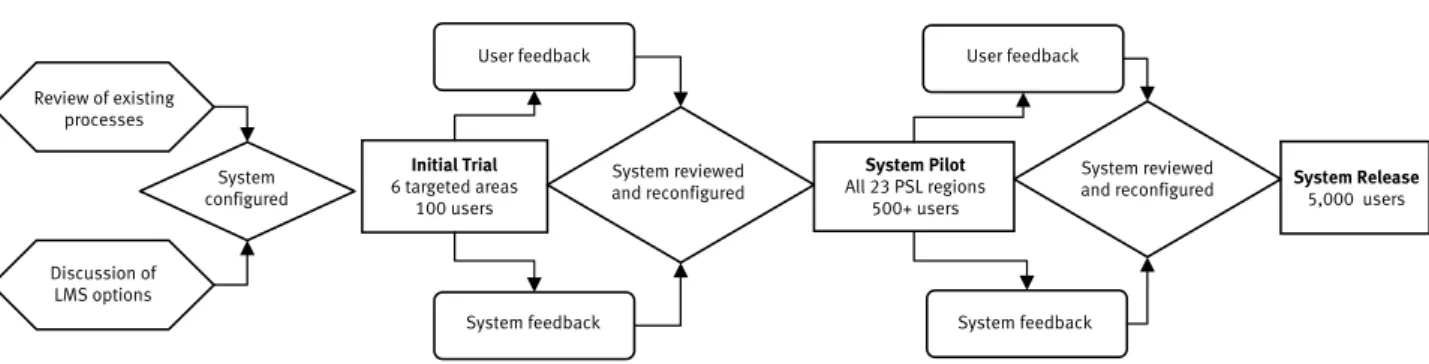
• autonomy – offering development activities in this mode offers examiners a certain level of freedom in taking responsibility for their own professional development. The development process was designed to take best advantage of the knowledge and experience of those involved in the existing QA processes, and to combine them with the opportunities being offered by the introduction of a Learning Management System. Figure 1 shows the linear process adopted and exemplifies how the three main development stages were combined with consultation and analysis of outcomes in order to inform the following steps and the subsequent configuration of the system.
Space limitations do not permit a detailed look at each
Cambridge ESOL Professional Support Network
Extranet: Development and impact
C A M B R I D G E E S O L : R E S E A R C H N OT E S : I SS U E 4 3 / J A N U A R Y 2 0 1 1
|
7stage and the decisions taken. Instead, an overview will be given of the main outcomes and the focus of user feedback from the Trial stage and a brief overview of the Pilot stage. The aims of the trial were important because they sought to put in place and test a number of the founding principles for the organisation and configuration of the system, while the pilot was a full system ‘user testing’ environment that would give users and administrators access to materials and data in a live operational situation, and so verify the effectiveness of the earlier design decisions.
PSN trial
The Speaking Examiner hierarchy is divided into 23 regions, with each region made up of the exam centres within the country or group of countries designated to that region. Teams of Speaking Examiners (SEs) are managed locally by one or two Team Leaders (TLs), and TLs are in turn managed within the region by the Professional Support Leader (PSL) who may be assisted by one or more Regional Team Leaders (RTLs). In order to represent the varied regional scenarios that examiner teams operate in, and to ensure that user feedback would address relevance and usability of the system both in terms of the effectiveness of QA processes and the technical practicalities of accessing materials, a targeted group of participants was selected to take part in the initial trial.
Participants were invited from six of the Speaking Examiner regions, and involved PSLs, RTLs, TLs and SEs in each region. There were over 100 participants. Sample Speaking tests for Cambridge English: First (FCE) and
Business English Certificates (BEC) Preliminarywere
included and the materials for each examination were divided into three stages which related to the way they would be presented in a face-to-face co-ordination meeting: • Setting the Standard – a benchmarking exercise before
being asked to assess
• Applying the Standard – an opportunity to practise applying assessment criteria with feedback provided • Marks Collection – a once only submission to check
examiners are marking within acceptable limits. The fundamental objectives of the trial, and to a large degree of the eventual completed PSN system, were functionality based and are detailed in Table 1 from SE, TL and system perspectives.
In terms of achieving these functionality objectives, the trial was successful in fully or partially achieving all the
©UCLES 2011 – The contents of this publication may not be reproduced without the written permission of the copyright holder.
User feedback User feedback
System feedback System feedback System reviewed and reconfigured System reviewed and reconfigured System configured Initial Trial 6 targeted areas 100 users System Pilot All 23 PSL regions 500+ users System Release 5,000 users Review of existing processes Discussion of LMS options
Figure 1: PSN Development Processes and Stages
Table 1: Objectives of PSN trial (February 2008)
Speaking Examiner Team Leader System
functionality functionality
1. Can watch sample 1–6. Can complete 11. Easy to use – video tests all SE tasks user guides 2. Can submit In addition: 12. Successfully assessment marks 7. Can enrol SEs into completes all SE
exam areas based on and TL functionality eligibility, when
required
3. Can receive 8. Can check 13. Can present multi-outcome and access outcomes of SE work media content support commentaries
4. Can submit secure 9. Can access 14. Records user Marks Collection individual tests if activity and marks required outcomes
5. Can follow SE user 10. Can follow TL 15. Operates without guides user guides heavy support
requirement 6. Can submit feedback
15 objectives outlined above. For those objectives which were only partially achieved, such as accessing video samples and other materials, the common and main contributing factor preventing their full achievement was system connectivity. This was mostly related to delivery of large video samples across a variety of end user system configurations and hardware capacities, and a major outcome from the trial was a focus on revising materials in order to present them in the most accessible format possible whilst still retaining a high enough quality to ensure that examiner assessments would not be adversely affected.
Trial participants were asked to complete a survey related to system usability and the outcomes of that survey are summarised in Table 2. Participants were asked to rate each of the questions on a scale from 1 (unsatisfactory) to 5 Table 2: PSN trial: Feedback question scores
Question Average score
on a scale 1–5
Login and general access to the system 4.2 Navigation within PSN 4.2 The speed of operation on your computer 3.9 Video and sound quality 3.8 Instructions and user guides 3.8 Your overall impression of the PSN 4.1
8
|
C A M B R I D G E E S O L : R E S E A R C H N OT E S : I SS U E 4 3 / J A N U A R Y 2 0 1 1 (excellent), and were also given the opportunity to submit free text comments. The average scores for all six questions were all acceptably high.The comments gathered at this stage were extremely informative. Many of the positive comments picked up on some of the main aims of the system:
‘An excellent system which will save time and money [compared to] attending standardisation meetings.’
‘Very helpful for finding the benchmark at the beginning of an examining session.’
‘I liked it. Nice to be able to re-watch videos and read comments about candidates’ performances to get a real feel for the exams and levels.’ ‘This could work well as an addition to face-to-face co-ordination as SEs often want a chance for supplementary standardisation.’
However, a number of users also identified areas that required focus and improvement, such as the accessibility of multimedia files:
‘I can see that this could work, but I found it frustrating working on a narrow bandwidth.’
Other very useful comments related to the clarity of user instructions. The system was to be rolled out to examiner groups across the world without direct user training and so would rely on intuitive and comprehensible functionality and clear user guides. The following comment suggested there was still work to be done in this area:
‘I was a bit disconcerted at first because I didn’t have access to all areas. It may have been presented clearly enough for most people, but for some (including me) it may have to be spelled out even more simply.’
There was also feedback related to some of the extra administrative functionality provided to TLs, functionality that reflected procedures directly transferred from the existing QA process. Representative of the concerns raised in most comments is the following:
‘Enrolling your SEs (to restrict their access) was not easy … this was time consuming.’
These comments highlighted the need for the system development process to include the understanding that moving existing procedures into an online environment requires an extensive review of the procedures themselves, and the principles that underpin them, so that the new environment would not be encumbered by constraints which result from the transfer of a physical process into an online environment. The subsequent review of the trial feedback focused on the following crucial aspects of QA procedures, and fed directly into the system reconfiguration for the pilot and live release stages:
• Restricted versus open access. The trial reflected the existing restricted access model. Prior to PSN,
examiners only attended face-to-face meetings covering exams for which they were eligible to examine.
Feedback from TLs and system administrators questioned the limiting of access in the online environment. It was subsequently agreed that the pilot would include an open access model with examiners required to complete tasks covering exams relevant to
them, but being able to access materials relating to other exams if they wished to extend their knowledge and exposure to other assessment levels. Based on the fact that the Cambridge ESOL Speaking test assessment scales form a single continuous scale from A2 to C2 (on the Common European Framework of Reference) with overlap at the extremes of performance at each level, this was seen as a positive outcome. • Security of reference marks versus instant feedback.
One result of all co-ordination being covered in face-to-face meetings was that all reference marks and performance commentaries were held by the TL (the trainer), and referred to as required during the session. The access to marks and commentaries of some samples was restricted in the trial. The related user feedback expressed the need to show this information so that the experience could be more valuable. Instant feedback and access to information explaining potential differences in marks or confirming similarity in marks was seen as essential to allow examiners the autonomy to shape their own development.
• Local versus centralised administration. One aim of the trial had been to empower local TLs to populate and locally manage their examiner teams online. However, as identified above, some aspects of this were seen as being time consuming and outweighed benefits gained. Preferences were expressed for the centralisation of routine administration of the system, but with TLs requesting more ability to question and report on examiner outcomes at a local level, in order to best support individual examiners when needed.
PSN pilot and system release
The review and reconfiguration discussions that followed the trial concluded that the above QA procedural
questions raised in feedback would be answered by giving examiners open access to all Speaking test areas of the system, providing instant feedback including marks and performance commentaries, and by managing routine administration centrally.
The pilot took place in May and June 2008 and included all PSLs, RTLs, and TLs from around the world; in total, it involved over 500 participants. The same objectives outlined in Table 1 were identified, with the small amendment to objective 7: ‘TL can enrol SEs into exam areas based on eligibility’ was amended to ‘SEs are enrolled into exam areas and can access materials’ and was moved into the system/central administration column.
During the pilot all functionality objectives were achieved, and all to an acceptable level of success. This meant that going live with the system would not result in large groups of examiners having to contact the PSN support team in order to carry out the basic functionality for which the system was intended.
Based on trial feedback, a description of minimum system specifications was circulated to TLs and SEs prior to the pilot and system release. In addition, the release
©UCLES 2011 – The contents of this publication may not be reproduced without the written permission of the copyright holder.
C A M B R I D G E E S O L : R E S E A R C H N OT E S : I SS U E 4 3 / J A N U A R Y 2 0 1 1
|
9was supported by the production of existing DVD-based co-ordination materials that could be used in areas where access was problematic. Therefore, from system release, Cambridge ESOL predicted that approximately 50% of the SE cadre would move to the system immediately, and aimed for the uptake to increase from there to gradually include more and more of the examiner group.
PSN uptake
The PSN extranet has been operational for Speaking test Examiners since August 2008, and it formed an essential part of the process introducing a revised set of Speaking test assessment scales in the last quarter of that year. A measure of the successful introduction of a system such as this is uptake, reflected in the amount and rate of increase of users it is designed to support. The other major area to measure is the impact of the system on the elements of the QA process it set out to enhance. Both of these areas will be discussed here.
In terms of uptake, Table 3 outlines the usage since 2008. The data for 2008 includes the system usage during the trial and pilot stages (approximately 600 users).
2) Refocusing the content and format of those meetings to cover a better balance of procedural and assessment issues.
3) Providing examiners with flexibility to access and work with materials when they wish, and to do as little or as much of this as they find necessary.
4) Providing Cambridge ESOL with focused feedback on the standardisation materials we produce via system reports relating to proportions of marks awarded for every sample. This allows us to monitor whether particular exams, types of performance, levels of performance or assessment criteria, etc., pose more of a problem for examiners when they co-ordinate than others. If this is the case, we can ensure future
performances and supporting commentaries target these areas and that we provide more practice opportunities.
Next areas of focus
The successful implementation and uptake of the PSN extranet to support the worldwide cadre of Speaking test Examiners has established a firm foundation on which to build extra applications and support for other groups of professionals. In terms of examiner groups the following aims have now been established:
• Speaking Examiners – The current aim is to support other sections of the QA ‘life cycle’, from initial recruitment through training to ongoing support and monitoring, via the PSN extranet.
• Writing Examiners – Cambridge ESOL intends to draw from, and build on, the success of online delivery of QA processes for Speaking Examiners, by extending this functionality to Writing Examiners (WEs). This project aims to deliver the same benefits achieved through online co-ordination for SEs, but with one important addition. Currently WEs are co-ordinated using scripts which are made available after the test is taken. Under current procedures, these are then marked by a panel of senior examiners, and then used to standardise the rest of the team (Shaw and Weir 2007:276). Moving to the Speaking test QA model of conducting the co-ordination process before the test date will facilitate the faster release of results to candidates, and provide important QA enhancements in terms of the reliability of reference marks used in standardisation.
The process and system outlined in this paper has been in operation for Speaking Examiners for two years and, as discussed above, has been deemed to be a successful addition to examiner QA processes. It can also be extended to a wide cadre of other professionals (e.g. Centre
Inspectors, Teaching Awards providers), on whom Cambridge ESOL relies worldwide in order to support its operation. The outcomes described here in terms of system design and usage, and approaches to transferring existing procedures into the online PSN environment, can all be applied to reviews of the QA processes for other sections of the external cadre covering other responsibilities. This will allow Cambridge ESOL to also support these professionals in the most efficient, effective and flexible manner it can. Table 3: PSN usage figures (2008–2010)
2008 2009 2010 (Jan–Oct)
Total logins 32,942 42,083 56,204 Individual users 5,079 6,820 7,780 Exam materials accessed 117,353 180,430 197,694 Marks Collections completed 10,001 16,193 18,937
From these figures we can draw the following conclusions in relation to system uptake and subsequent impact:
• On average, individual users logged on around six times each in 2008 and 2009, and seven times each in 2010. This increase in 2010 is encouraging and indicates sustained usage of the system as part of the overall QA process.
• On average, during each of the six or seven visits that they make each year, users accessed 20 exam related materials (e.g. sample Speaking test videos and support materials) and in 2009 and 2010 this rose to almost 30. • Examiners are required to complete Marks Collection
assessment tasks for each CEFR level that they examine at. In 2008, the average of 1.6 Marks Collection events were completed per user via PSN, and in 2009 and 2010 this rose to 2.7, again showing a confidence in, and acceptance of, the system.
PSN impact
The introduction of the PSN extranet system can be seen to have had the following impacts on the co-ordination stage of the QA procedures for SEs:
1) Reducing the number of meetings that examiners have to attend. All examiners now attend a single annual face-to-face co-ordination meeting.
1 0
|
C A M B R I D G E E S O L : R E S E A R C H N OT E S : I SS U E 4 3 / J A N U A R Y 2 0 1 1Introduction
Over the last 12 months, there has been a huge uptake of computer-based testing across the Cambridge ESOL exam centre network. We now have over 350 centres running computer-based tests on Connect and at least 200 others who are currently being trained or completing their application process. In this article, we will look at the reasons for this increase in interest and describe a number of cases where centres have taken advantage of the many benefits which computer-based delivery offers to
candidates and centre administrators.
Background
When computer-based tests were first launched in 2005, a number of Cambridge ESOL centres were initially reluctant to introduce them. Many believed that they did not have sufficiently up-to-date equipment or the requisite number of computers. Others said they did not have the technical expertise to administer the tests. Moreover, for centres who were used to filling huge exam halls with candidates taking paper-based tests, the logistics of offering a large number of tests on computer seemed complex and even
intimidating. There were also concerns about the security of computer-based testing and the possibility of malpractice such as candidates being able to access helpful websites during the tests. Some teachers were resistant to, or even felt threatened by, the introduction of technology in their examination preparation classes. In some parts of the world, centres reported that there was no appetite in the market and candidates were not requesting to take their exams on computer, preferring to stay with the more traditional pen and paper method.
Examination centres embrace
computer-based testing
Over the last year, there has been a huge increase in the number of centres embracing a computer-based way of administering language tests. Below we discuss the reasons behind this dramatic change:
• In 2011, there are 123 computer-based test dates and 566 opportunities for candidates to sit a computer-based
test. This is a radical change from the situation a few years ago when candidates could only sit a paper-based Cambridge ESOL exam twice a year. This increase in the number of dates and the possibility of running more than one session on each test date means that centres are able to offer candidates more choice and flexibility about when they take the test. In this way, they are able to meet the needs of their candidates more effectively.
• There are now a very large range of Cambridge ESOL examinations available on Connect: Cambridge English:
Key (KET), Cambridge English: Preliminary (PET)and the
respective ‘for Schools’ versions, Cambridge English: First
(FCE), Cambridge English: Advanced (CAE), Business
English Certificates (BEC) Preliminary, Vantage and
Higher, Skills for Life (SfL)and Teaching Knowledge Test
(TKT).
• The reduced time for making entries and the quick turnaround of results suit candidates who need to take an exam quickly and receive their results within two weeks. • Computer-based tests reduce a centre’s administrative
load as there is no storing, packing and return or secure destruction of question papers required. Centres can also spread their administrative work over the year by organising a number of smaller sessions rather than one or two very large sessions.
• Computer-based testing can also be cost-effective as centres can save on postage and delivery charges. Centres can also avoid the stress which can be caused if materials are held up in customs or delayed in transit. • The interface of Connect is very user-friendly and
candidates appreciate the benefits of online features such as the help function and the timer, and the fact that they can edit their answers onscreen. In addition, candidates take the Listening test using headphones so they can adjust the volume to suit their particular needs. All these features combine to ensure that the test takers can do their very best when they sit for a computer-based test.
• Online practice tests are available to help teachers and candidates prepare for the exams. Teachers have realised that it is not necessary for them to understand the technology to prepare candidates for success in the computer-based exams. The content of these exams is exactly the same as that of the paper-based exams and
Using Connect: The test centre perspective
JULIET WILSONCUSTOMER SERVICES GROUP, CAMBRIDGE ESOL MURAT VELIOGLUCUSTOMER SERVICES GROUP, CAMBRIDGE ESOL
References
Mitchell Crow, C and Hubbard, C (2006) ESOL Professional Support Network Extranet, Research Notes23, 6–7.
Shaw, S D and Weir, C J (2007) Examining Writing: Research and practice in assessing second language writing, Studies in Language Testing, volume 26, Cambridge: UCLES/Cambridge University Press.
C A M B R I D G E E S O L : R E S E A R C H N OT E S :I S S U E 4 3 / J A N U A R Y 2 0 1 1
|
1 1©UCLES 2011– The contents of this publication may not be reproduced without the written permission of the copyright holder.
the research carried out by Cambridge ESOL confirms that the mode of marking (paper-based vs. onscreen) has no impact on examiners’ behaviour and the resulting marks (see Geranpayeh 2011 in this issue).
Becoming a computer-based exam centre
The Customer Services Group registers, trains and supports Cambridge ESOL exam centres and is responsible for ensuring that they run the examinations in line with Cambridge ESOL regulations. Over the last year, the procedure for becoming a computer-based centre has been made as easy and straightforward as possible, while maintaining its rigour. The latest procedure consists of the following steps:
1) Centres complete an application form, including confirmation that their computers meet the published technical requirements. (The Cambridge Connect software system uses a standard computer network with candidate workstations linked to an administrator workstation. Centres only need five computers to set up as a centre and although the technical support person needs to be computer literate, there is no need for them to be an IT specialist.)
2) A member of the Application Support team in Cambridge confirms the centre’s technical suitability to run the exams.
3) The test administrator and the technical support staff complete a training session.
4) The centre staff install the software at the centre and run a dummy test.
Training and support
Cambridge ESOL Customer Services offers centres either online training via Moodle or face-to-face training which takes place over one or two days. If centres choose to do the training online, they must also complete a short test to confirm their understanding of the technical requirements and the exam day regulations. Many centres have chosen the face-to-face training and have appreciated the workshop and hands-on approach as well as the
opportunity to meet other centres who are also beginning this new way of working. Since June 2009, 28 face-to-face sessions have taken place across the world in a number of destinations from Australia, Brazil and Canada to India, Spain and the UK. The training equips the test administrator and technical support staff to install and run the tests, including basic trouble-shooting.
However rigorous a training programme is, centres are understandably nervous as their first computer-based test day approaches. To help give centres the confidence and reassurance they need, the Cambridge ESOL Application Support team sends all centres a series of emails leading up to the test day to remind them of the key tasks they need to do in preparation for the test. On the day of the test, Application Support offers on-call 24/7 telephone and email support. The effort invested in training and support has
resulted in success, as the Centre Exams Manager of QLS, Greece, testifies: ‘The training that we were offered by our colleagues in Cambridge did pay off along with the extensive support we were given during the duration of the exam.’
Security and quality assurance
Cambridge ESOL takes the security and integrity of its tests extremely seriously and works closely with centres to ensure that the administration of examinations meets requirements and that the security of all confidential materials is maintained. The security of the examinations offered on Connect is protected by state-of-the-art encryption and an onscreen lock-down facility. Regular inspections at centres ensure compliance with all
regulations. In addition to general criteria related to security of materials and conduct and supervision of the staff, an inspector visiting a computer-based exam session will also assess centres using particular criteria related to the technical equipment and support available. All this ensures that for the test taker, the exam experience is fair and positive, and for centres, the quality requirements stipulated by Cambridge ESOL are clear and transparent.
Feedback from test centres
A number of our test centres were asked to tell us about their experiences with Connect. Their feedback outlined the benefits which we had anticipated. The main themes which came through were: improved flexibility, enhanced customer service, easier administration and the up-to-date image which computer-based testing gives a centre.
The Cambridge ESOL examinations centre at Winterthur, Switzerland was one of the first centres to offer computer-based tests in 2005. Peter Kaithan, Director of Marketing and Communications, saw the need for a system that would allow his centre to run exams with more flexibility and with less administration. He says: ‘Today, with the demand for computer-based testing on the rise, we are slowly but surely experiencing the return we hoped for. Even though a quite expensive undertaking, the benefits today, and particularly over time, will outweigh the cost. Beyond the financial aspect, providing exams on computer also gives us a progressive and advanced image as an examination provider which made the investment in a multimedia PC lab worthwhile, particularly since the infrastructure can be used for other purposes such as teacher seminars.’
Veronica Cameron, Centre Exams Manager at Buenos Aires Open Centre, started offering computer-based tests in October 2009 with the primary aim of offering a better service to her customers: ‘We can give them more flexibility with enrolment, payment and they can see their results in two weeks’ time. We rented a suitable venue located in the heart of our city. The desks were specially built for the computers and candidates can complete their tests in a quiet and comfortable environment. Most candidates have sent very positive feedback and many are willing to repeat the experience.’ As well as pleasing her candidates, centre staff have also been very positive about the new way of
1 2
|
C A M B R I D G E E S O L : R E S E A R C H N OT E S :I S S U E 4 3 / J A N U A R Y 2 0 1 1Background
As the candidature for Cambridge ESOL exams continues to grow, so does the requirement for more flexibility in the provision of exam dates and formats. In meeting this demand, it became evident that Cambridge ESOL would need to harness technology to ensure that it continues providing results to candidates accurately and promptly. As long ago as 1999, Cambridge Assessment started investigating a system whereby scripts (candidates’ responses to Writing test questions) are scanned and the resulting digital images loaded to a web-based system for examiners to download and mark. Initial trials of onscreen marking were carried out in 2000 and 2001, but it was not until 2003 that research into onscreen marking using the
scoris assessor®marking system and collaboration working
with our technology partners RM plc. began in earnest. scoris®and the system it is part of, Electronic Script
Introduction
Assessment bodies have been taking advantage of technological developments in recent years in the form of computer-based testing. They have also been able to draw on the wealth of performance data provided by these technological developments to inform exam revisions and to feed into other research. Over the past five years in particular, Cambridge Assessment has widened the use of technology to include onscreen marking of extended essay responses. Onscreen marking is now in use for Cambridge ESOL computer-based tests (CBT) and paper-based tests (PBT). The present article provides background to the onscreen marking system being used, discusses its benefits and summarises the training which was provided to a key
group of stakeholders: Writing Examiners ofCambridge
English: Advanced(also known asCertificate in Advanced English (CAE)).
Assessing Writing tests on scoris
®
: The introduction
of online marking
MARGARET COOZEASSESSMENT AND OPERATIONS GROUP, CAMBRIDGE ESOL
working: ‘Not having to pack papers and boxes and the saving in postage and customs is greatly appreciated by supervisors and centre managers.’
Margaret Fowler, the British Council Country Examinations Manager in Italy reiterates the above-mentioned benefits. She reports that candidates have shown a growing preference for computer tests in Italy over the last two years: ‘The word count facility is very popular and gives candidates more time to concentrate on actually writing their answer rather than totting up the number of words. Candidates like the fact that they can do the whole exam in one day including the Speaking test because the sessions are smaller.’ For the centre, one additional benefit which has emerged is that they need to train up fewer Speaking Examiners: as there are more exam sessions spread over the year, there are smaller numbers of candidates per session. Margaret summarises the reasons for her involvement and commitment to computer-based testing: ‘It has become a matter of principle for us at the British Council, Italy to be in the vanguard of whatever is new in testing.’
One of the newest recruits to computer-based testing is Harmon Hall in Mexico. The Centre Exams Manager, Rommel Mandujano, and his academic team, have been eagerly anticipating the launch of the new Cambridge ESOL computer-based testing system which will be delivered during 2011 and explains: ‘The new system will offer Harmon Hall two main benefits over paper-based exams: firstly it will allow us to administer Cambridge ESOL
examinations in a Mac environment and secondly we will be able to register entries and deliver results within a shorter
period of time, which aligns with our short study terms of one to two months.’
Connect – the future
After each computer-based session, the Customer Services Group collects feedback on centres’ experience with Connect. The aim of this is to ensure that the user experience remains positive. This feedback has been integral in helping us to define requirements for the ‘next generation’ of Connect. Some of the new features which are being introduced as a direct result of this feedback are: • a much simpler installation process, requiring even less
technical expertise at centres
• compatibility with Windows 7 and Macs
• the ability to run Connect on laptops, opening up many more possibilities for offering tests in different venues. As the test centre perspective is so important, Cambridge ESOL is running a number of trials of the new system prior to the launch in 2011. By remaining focused on the test centre perspective, we can ensure that we are able to continue to deliver the many benefits of computer-based testing to centres and their candidates.
References
Geranpayeh, A (2011) The impact of online marking on examiners’ behaviour,Research Notes43, 15–21.
Management (ESM), have already contributed considerably to improved Quality Assurance. They will be discussed in this article and possibilities they offer for new
developments will be outlined in the last section.
Electronic Script Management (ESM)
Electronic Script Management (ESM) is one part of a strategic corporate programme which supports the online marking of candidate responses. It enables onscreen marking of candidates’ responses, allowing for remote co-ordination and standardisation of examiners as well as acting as an electronic system for tracking scripts. RM’s scoris assessor®package has formed a major part of this management system. It is an established software package for marking online, created as a result of RM’s stated vision to improve the marking process for both assessment bodies and examiners: ‘For individual markers, scoris®presents asecure online environment in which they can receive, view and mark exam scripts on their own home computers. For examination boards, it provides a web-delivered workflow system, which controls the process of allocating exam scripts to markers, collecting marks and monitoring the quality and consistency of markers’ work’ (RM plc.).
The ESM marking process, based on the use of scoris®,
is illustrated in Diagram 1 and involves:
• the transfer of entry and Writing Examiner information in data feeds from Exams Processing System (EPS) to RM
• creating digital objects from candidate scanned responses in the case of PBT responses
• loading digital images from PB and CB tests onto a server (scoris®central)
• distributing the digital objects electronically so that examiners can log onto the server and mark onscreen at home
• capturing marks and examiner annotations from the marking process electronically in the Item Marks Data Base (IMDB)
• post-marking processing in the Cambridge Assessment Exams Processing System (EPS) and Local Item Banking System (LIBS)
• results issue and storage.
How scoris assessor
®works
In order to mark on scoris®, examiners are first asked to
check that they have the necessary PC specifications and broadband connection. Following that, they download the marking system and access the scoris®server with
a secure login and password. The system provides examiners with tools to view responses, use zoom tools to facilitate reading, mark annotations electronically and note comments, as well as recording marks. Visuals 1 and 2 show the examiner view of CBT and PBT responses on scoris®.
C A M B R I D G E E S O L : R E S E A R C H N OT E S : I SS U E 4 3 / J A N U A R Y 2 0 1 1
|
1 3©UCLES 2011 – The contents of this publication may not be reproduced without the written permission of the copyright holder. Cambridge Assessment
systems (EPS, LIBS)
scoris® Central
• Entries • Script packet data • Panel information • Examiner targets • Component information • Layout data
scoris® Administrative Interface
Real-time reporting, monitoring script tracking and admin tools
Outbound Data feeds Inbound Item Level Marks return Item Marks Database – Aggregation Load marks to EPS Onscreen marking with scoris assessor®
by Writing Examiners
Responses, marks, and scoris® AI
instructions Scanning and Reconciliation
(PBT)
or
responses loaded from Cambridge Connect (CBT)